

ISO 18639-5:2018
(Main)PPE ensembles for firefighters undertaking specific rescue activities — Part 5: Helmet
General Information
- Abstract
This document provides the principles that govern the development of incident type and/or hazard specific test methods and minimum performance requirements for helmets for firefighters while engaged in specific rescue activities. Helmets related to specific rescue activities, such as road traffic crash (RTC) and urban search and rescue (USAR), are documented in individual subclauses of this document. NOTE Further guidance can be found in ISO 18639-1. The purpose of this document is to ensure that minimum performance requirements for incident type and/or hazard specific helmets are designated. This document covers general helmet design, the minimum performance level of the materials used and the methods of test for determining this performance level. It does not cover special helmets for use in other high risk situations such as firefighting. This document does not cover protection for the torso, arms, legs and feet or protection of the hands against other hazards, e.g. chemical, biological, radiation and electrical hazards, except for limited, accidental exposure to fire ground chemicals and contaminated blood or body fluids. Selection of the appropriate system of personal protective equipment, (PPE), including helmets, is dependent on carrying out an effective risk assessment which identifies the hazard to be faced, evaluates the likelihood of those hazards and provides the means of reducing or eliminating these hazards.
- Status
- Published
- Publication Date
- 02-Dec-2018
- Technical Committee
- ISO/TC 94/SC 14 - Firefighters' personal equipment
- Drafting Committee
- ISO/TC 94/SC 14/WG 5 - Non-fire rescue incidents (Rescue)
- Current Stage
- 9092 - International Standard to be revised
- Start Date
- 22-Oct-2024
- Completion Date
- 29-Aug-2026
Buy Documents
ISO 18639-5:2018 - PPE ensembles for firefighters undertaking specific rescue activities
ISO 18639-5:2018 - PPE ensembles for firefighters undertaking specific rescue activities — Part 5: Helmet/3/2018
Overview
ISO 18639-5:2018 - "PPE ensembles for firefighters undertaking specific rescue activities - Part 5: Helmet" defines principles, test methods and minimum performance requirements for helmets used by firefighters during specific rescue activities (for example road traffic crash (RTC) and urban search and rescue (USAR)). The standard addresses helmet design, material performance and test methods to verify protection levels for incident‑type and hazard‑specific rescue helmets. It is intended to support selection of appropriate head protection based on an effective risk assessment and is not a replacement for full firefighting helmets or whole‑body PPE.
Key topics and technical requirements
ISO 18639-5:2018 organizes helmet requirements and tests into practical sections that include:
- Design and materials: Guidance on general helmet shell construction, projections, retention systems and accessories.
- Sampling and pre‑treatment: Procedures for sample selection and conditioning (e.g., thermal plus/minus, wet, normal).
- Performance requirements: Hazard‑specific performance categories such as RTC and USAR, plus general criteria.
- Impact and shock absorption: Crown impact and lateral impacts (front, rear, side) requirements and test approaches.
- Penetration resistance: Methods to evaluate resistance to sharp objects.
- Retention system strength: Tests to confirm chinstrap and retention durability.
- Flame and thermal resistance: Shell and accessory flame tests and thermal resistance/convective heat tests.
- Lateral crushing and conductive headform testing: Mechanical crushing and electrical/thermal conductive considerations.
- Optional tests: Protection against high‑speed particles.
- Marking and user information: Required product marking and user care/maintenance instructions.
- Annexes: Normative conditioning/testing schedules and an informative example of failure modes and effects analysis (FMEA).
Normative references used include ISO 17493 and multiple EN helmet test methods (EN 13087 series, EN 16473, EN 166, EN 960).
Applications and users
This standard is relevant for:
- Helmet manufacturers and designers developing technical rescue helmets for firefighters (RTC, USAR).
- Test laboratories and conformity assessors performing conditioning and performance testing.
- Procurement teams and safety managers specifying helmet performance for rescue operations.
- Standards committees and regulatory bodies aligning national/regional PPE requirements.
- Fire and rescue services for informed procurement and risk‑based PPE selection.
Note: ISO 18639-5:2018 does not cover special firefighting helmets intended for active fire suppression or comprehensive body protection against chemical, biological, electrical or radiation hazards beyond limited accidental exposure.
Related standards
- ISO 18639‑1 (general guidance for PPE ensembles for specific rescue activities)
- ISO 17493 (thermal test methods)
- EN 13087 series (protective helmets test methods)
- EN 16473 (firefighters helmet - technical rescue)
Keywords: ISO 18639-5:2018, firefighter helmet standard, PPE ensembles, technical rescue helmets, RTC helmet, USAR helmet, helmet testing, shock absorption, penetration resistance, flame resistance, thermal resistance.
Buy Documents
ISO 18639-5:2018 - PPE ensembles for firefighters undertaking specific rescue activities
ISO 18639-5:2018 - PPE ensembles for firefighters undertaking specific rescue activities — Part 5: Helmet/3/2018
Get Certified
Connect with accredited certification bodies for this standard

CIS Institut d.o.o.
Personal Protective Equipment (PPE) certification body. Notified Body NB-2890 for EU Regulation 2016/425 PPE.

Kiwa BDA Testing
Building and construction product certification.
Kmetijski inštitut Slovenije
Agricultural Institute of Slovenia. Soil testing, plant health, agricultural product analysis.
Sponsored listings
Frequently Asked Questions
ISO 18639-5:2018 is a standard published by the International Organization for Standardization (ISO). Its full title is "PPE ensembles for firefighters undertaking specific rescue activities — Part 5: Helmet". This standard covers: This document provides the principles that govern the development of incident type and/or hazard specific test methods and minimum performance requirements for helmets for firefighters while engaged in specific rescue activities. Helmets related to specific rescue activities, such as road traffic crash (RTC) and urban search and rescue (USAR), are documented in individual subclauses of this document. NOTE Further guidance can be found in ISO 18639-1. The purpose of this document is to ensure that minimum performance requirements for incident type and/or hazard specific helmets are designated. This document covers general helmet design, the minimum performance level of the materials used and the methods of test for determining this performance level. It does not cover special helmets for use in other high risk situations such as firefighting. This document does not cover protection for the torso, arms, legs and feet or protection of the hands against other hazards, e.g. chemical, biological, radiation and electrical hazards, except for limited, accidental exposure to fire ground chemicals and contaminated blood or body fluids. Selection of the appropriate system of personal protective equipment, (PPE), including helmets, is dependent on carrying out an effective risk assessment which identifies the hazard to be faced, evaluates the likelihood of those hazards and provides the means of reducing or eliminating these hazards.
This document provides the principles that govern the development of incident type and/or hazard specific test methods and minimum performance requirements for helmets for firefighters while engaged in specific rescue activities. Helmets related to specific rescue activities, such as road traffic crash (RTC) and urban search and rescue (USAR), are documented in individual subclauses of this document. NOTE Further guidance can be found in ISO 18639-1. The purpose of this document is to ensure that minimum performance requirements for incident type and/or hazard specific helmets are designated. This document covers general helmet design, the minimum performance level of the materials used and the methods of test for determining this performance level. It does not cover special helmets for use in other high risk situations such as firefighting. This document does not cover protection for the torso, arms, legs and feet or protection of the hands against other hazards, e.g. chemical, biological, radiation and electrical hazards, except for limited, accidental exposure to fire ground chemicals and contaminated blood or body fluids. Selection of the appropriate system of personal protective equipment, (PPE), including helmets, is dependent on carrying out an effective risk assessment which identifies the hazard to be faced, evaluates the likelihood of those hazards and provides the means of reducing or eliminating these hazards.
ISO 18639-5:2018 is classified under the following ICS (International Classification for Standards) categories: 13.340.20 - Head protective equipment. The ICS classification helps identify the subject area and facilitates finding related standards.
ISO 18639-5:2018 is available in PDF format for immediate download after purchase. The document can be added to your cart and obtained through the secure checkout process. Digital delivery ensures instant access to the complete standard document.
Standards Content (Sample)
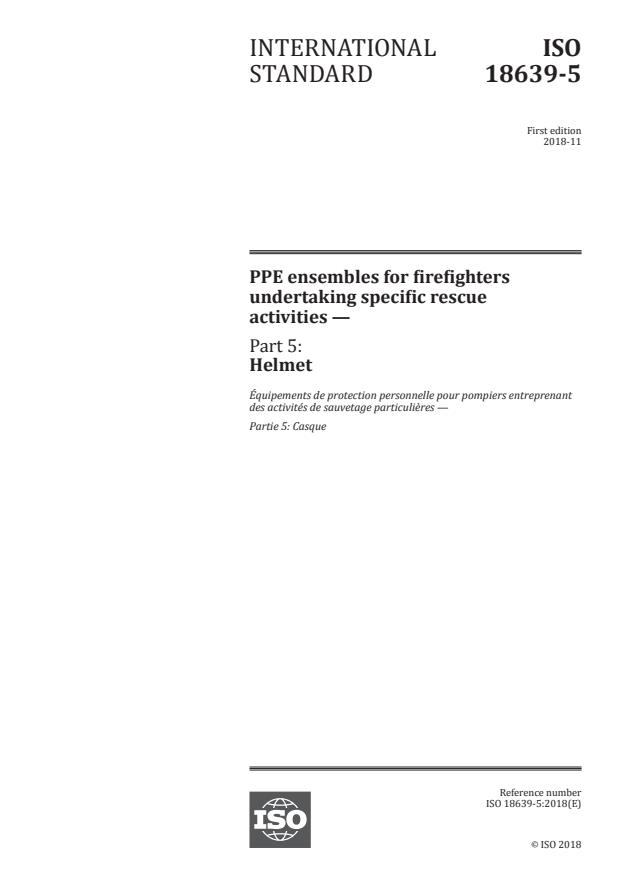
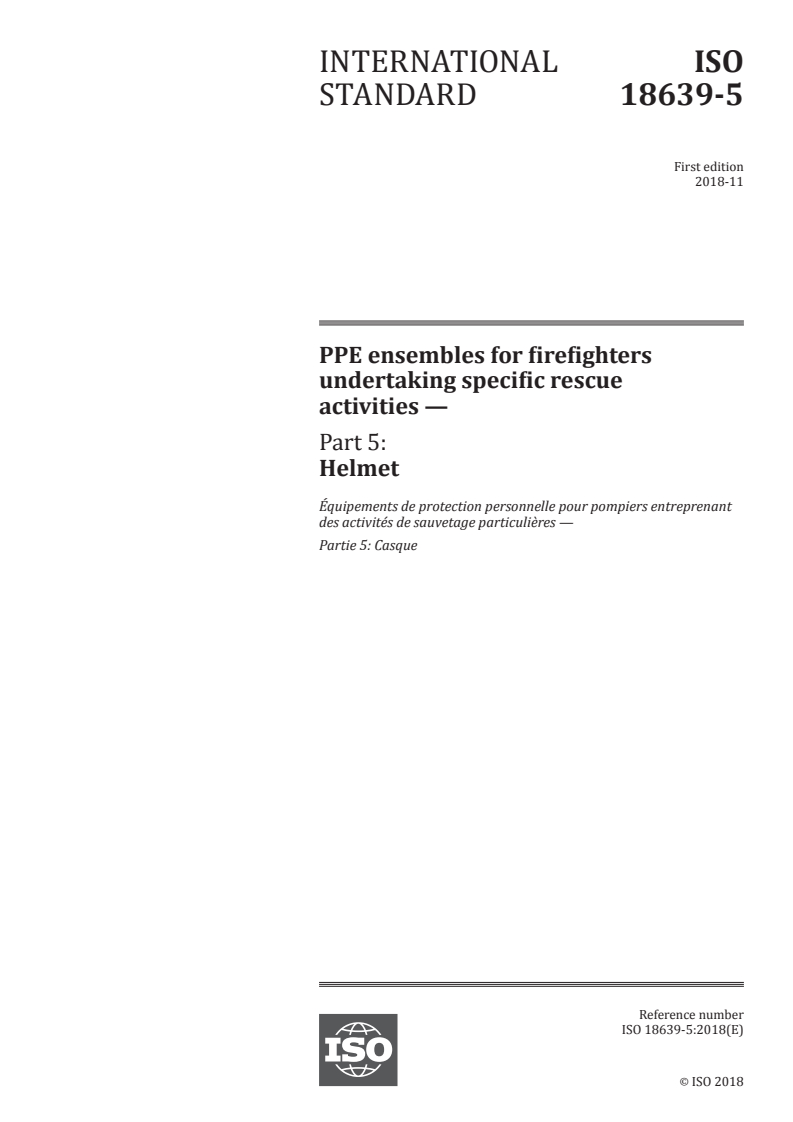
INTERNATIONAL ISO
STANDARD 18639-5
First edition
2018-11
PPE ensembles for firefighters
undertaking specific rescue
activities —
Part 5:
Helmet
Équipements de protection personnelle pour pompiers entreprenant
des activités de sauvetage particulières —
Partie 5: Casque
Reference number
©
ISO 2018
© ISO 2018
All rights reserved. Unless otherwise specified, or required in the context of its implementation, no part of this publication may
be reproduced or utilized otherwise in any form or by any means, electronic or mechanical, including photocopying, or posting
on the internet or an intranet, without prior written permission. Permission can be requested from either ISO at the address
below or ISO’s member body in the country of the requester.
ISO copyright office
CP 401 • Ch. de Blandonnet 8
CH-1214 Vernier, Geneva
Phone: +41 22 749 01 11
Fax: +41 22 749 09 47
Email: copyright@iso.org
Website: www.iso.org
Published in Switzerland
ii © ISO 2018 – All rights reserved
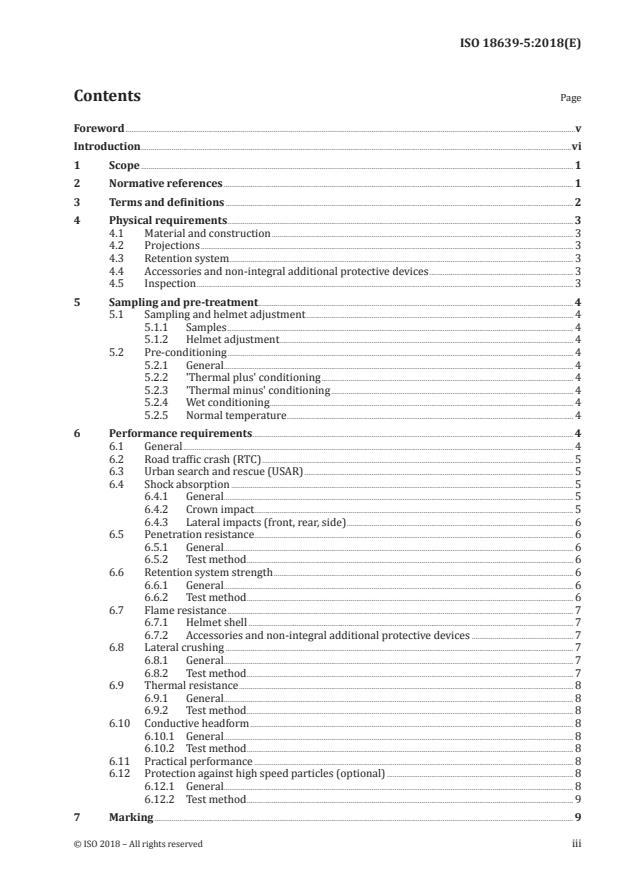
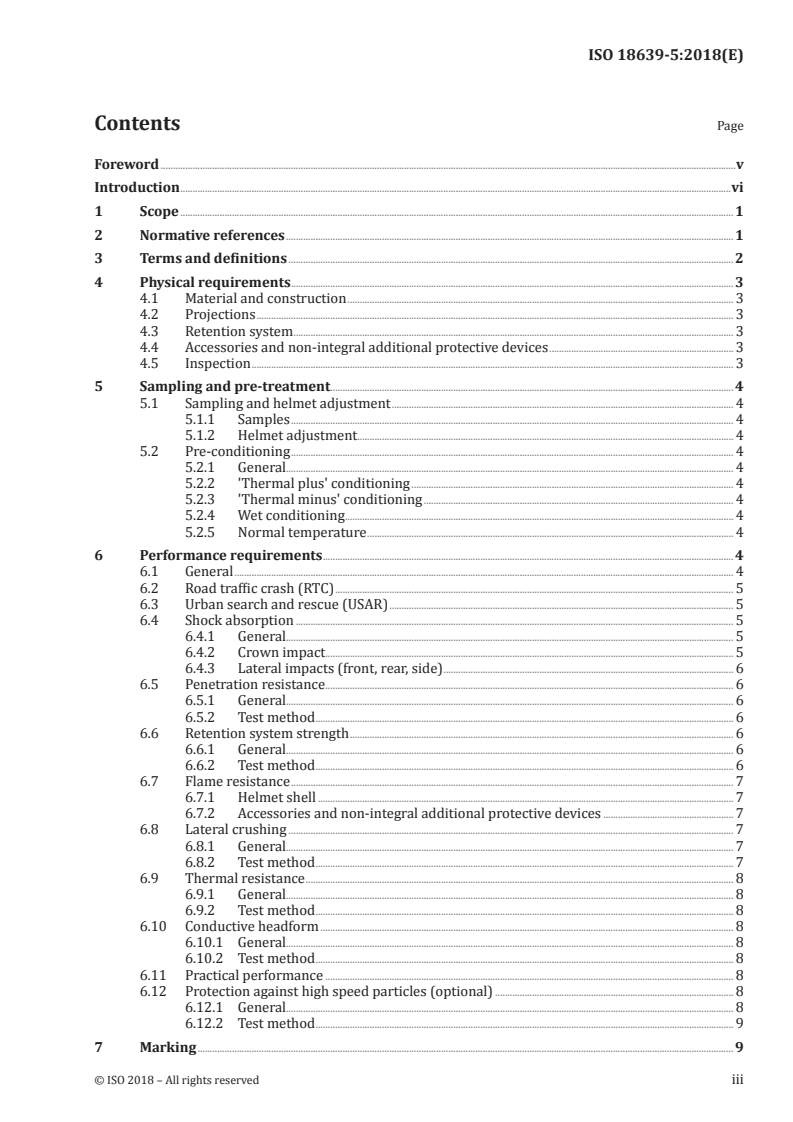
Contents Page
Foreword .v
Introduction .vi
1 Scope . 1
2 Normative references . 1
3 Terms and definitions . 2
4 Physical requirements . 3
4.1 Material and construction . 3
4.2 Projections . 3
4.3 Retention system . 3
4.4 Accessories and non-integral additional protective devices . 3
4.5 Inspection . 3
5 Sampling and pre-treatment . 4
5.1 Sampling and helmet adjustment . 4
5.1.1 Samples . 4
5.1.2 Helmet adjustment. 4
5.2 Pre-conditioning . 4
5.2.1 General. 4
5.2.2 'Thermal plus' conditioning . 4
5.2.3 'Thermal minus' conditioning . 4
5.2.4 Wet conditioning . 4
5.2.5 Normal temperature . 4
6 Performance requirements . 4
6.1 General . 4
6.2 Road traffic crash (RTC) . 5
6.3 Urban search and rescue (USAR) . 5
6.4 Shock absorption . 5
6.4.1 General. 5
6.4.2 Crown impact . . 5
6.4.3 Lateral impacts (front, rear, side) . 6
6.5 Penetration resistance . 6
6.5.1 General. 6
6.5.2 Test method . 6
6.6 Retention system strength . 6
6.6.1 General. 6
6.6.2 Test method . 6
6.7 Flame resistance . 7
6.7.1 Helmet shell . 7
6.7.2 Accessories and non-integral additional protective devices . 7
6.8 Lateral crushing . 7
6.8.1 General. 7
6.8.2 Test method . 7
6.9 Thermal resistance . 8
6.9.1 General. 8
6.9.2 Test method . 8
6.10 Conductive headform . 8
6.10.1 General. 8
6.10.2 Test method . 8
6.11 Practical performance . 8
6.12 Protection against high speed particles (optional) . 8
6.12.1 General. 8
6.12.2 Test method . 9
7 Marking . 9
8 User information . 9
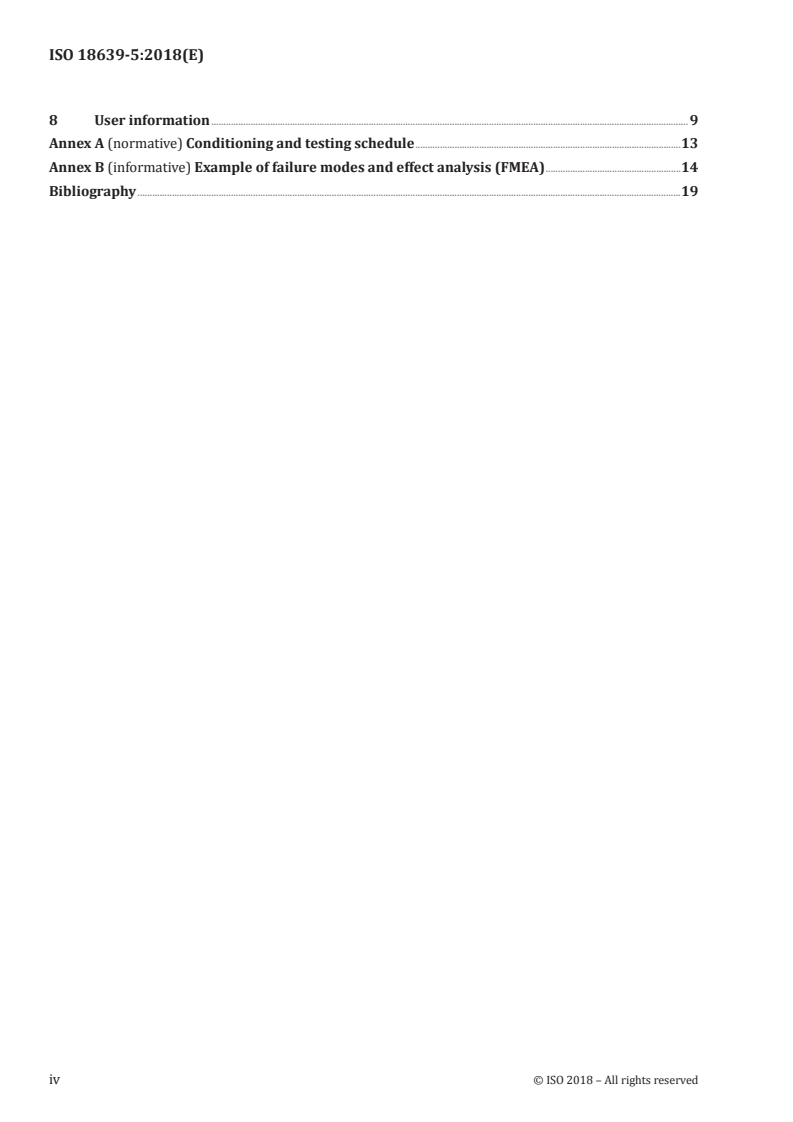
Annex A (normative) Conditioning and testing schedule .13
Annex B (informative) Example of failure modes and effect analysis (FMEA) .14
Bibliography .19
iv © ISO 2018 – All rights reserved
Foreword
ISO (the International Organization for Standardization) is a worldwide federation of national standards
bodies (ISO member bodies). The work of preparing International Standards is normally carried out
through ISO technical committees. Each member body interested in a subject for which a technical
committee has been established has the right to be represented on that committee. International
organizations, governmental and non-governmental, in liaison with ISO, also take part in the work.
ISO collaborates closely with the International Electrotechnical Commission (IEC) on all matters of
electrotechnical standardization.
The procedures used to develop this document and those intended for its further maintenance are
described in the ISO/IEC Directives, Part 1. In particular, the different approval criteria needed for the
different types of ISO documents should be noted. This document was drafted in accordance with the
editorial rules of the ISO/IEC Directives, Part 2 (see www .iso .org/directives).
Attention is drawn to the possibility that some of the elements of this document may be the subject of
patent rights. ISO shall not be held responsible for identifying any or all such patent rights. Details of
any patent rights identified during the development of the document will be in the Introduction and/or
on the ISO list of patent declarations received (see www .iso .org/patents).
Any trade name used in this document is information given for the convenience of users and does not
constitute an endorsement.
For an explanation of the voluntary nature of standards, the meaning of ISO specific terms and
expressions related to conformity assessment, as well as information about ISO's adherence to the
World Trade Organization (WTO) principles in the Technical Barriers to Trade (TBT) see www .iso
.org/iso/foreword .html.
This document was prepared by Technical Committee ISO/TC 94, Personal safety — Personal protective
equipment, Subcommittee SC 14, Firefighters' personal equipment.
A list of all the parts in the ISO 18639 series can be found on the ISO website.
Any feedback or questions on this document should be directed to the user’s national standards body. A
complete listing of these bodies can be found at www .iso .org/members .html.
Introduction
ISO 18639 is a series of standards for personal protective equipment (PPE) for firefighters when
engaged in specific rescue activities. It is not possible to provide a standard for PPE to cover all of the
diverse range of rescue scenarios that firefighters are likely to encounter so it is important that risk
assessments be undertaken to determine if the PPE covered by the ISO 18639 series is suitable for its
intended use and the expected exposure to hazards. For complete protection against exposures, the
risk assessment should include protection of the whole body including the torso, arms and legs, head,
face, hands and feet.
For certain rescue activities, safety ropes and harnesses may be required. For certain rescue situations,
special PPE for use in and on water may be required. In some cases, appropriate respiratory protection
may also be identified as being necessary.
The performance requirements in this document take account of accidental exposure to heat and flame,
but do not cover PPE for firefighting. While this document takes account of accidental exposure to some
common chemicals, it is not intended that PPE conforming to this document should be considered as
providing chemical protection as a primary function. It does not cover PPE to protect against biological,
electrical or radiation hazards. The risk assessment should determine whether PPE complying with
this document or to the requirements of any other relevant standard is more suitable.
Firefighters should be trained in the use, care and maintenance of the PPE covered by this document,
including an understanding of its limitations.
vi © ISO 2018 – All rights reserved
INTERNATIONAL STANDARD ISO 18639-5:2018(E)
PPE ensembles for firefighters undertaking specific rescue
activities —
Part 5:
Helmet
1 Scope
This document provides the principles that govern the development of incident type and/or hazard
specific test methods and minimum performance requirements for helmets for firefighters while
engaged in specific rescue activities.
Helmets related to specific rescue activities, such as road traffic crash (RTC) and urban search and
rescue (USAR), are documented in individual subclauses of this document.
NOTE Further guidance can be found in ISO 18639-1.
The purpose of this document is to ensure that minimum performance requirements for incident type
and/or hazard specific helmets are designated.
This document covers general helmet design, the minimum performance level of the materials used and
the methods of test for determining this performance level.
It does not cover special helmets for use in other high risk situations such as firefighting.
This document does not cover protection for the torso, arms, legs and feet or protection of the hands
against other hazards, e.g. chemical, biological, radiation and electrical hazards, except for limited,
accidental exposure to fire ground chemicals and contaminated blood or body fluids.
Selection of the appropriate system of personal protective equipment, (PPE), including helmets,
is dependent on carrying out an effective risk assessment which identifies the hazard to be faced,
evaluates the likelihood of those hazards and provides the means of reducing or eliminating these
hazards.
2 Normative references
The following documents are referred to in the text in such a way that some or all of their content
constitutes requirements of this document. For dated references, only the edition cited applies. For
undated references, the latest edition of the referenced document (including any amendments) applies.
ISO 17493, Clothing and equipment for protection against heat — Test method for convective heat
resistance using a hot air circulating oven
EN 166:2001, Personal eye-protection — Specifications
EN 960, Headforms for use in the testing of protective helmets
EN 13087-1:2000, Protective helmets —Test methods — Part 1: Conditions and conditioning
EN 13087-2, Protective helmets — Test methods — Part 2: Shock absorption
EN 13087-3, Protective helmets — Test methods — Part 3: Resistance to penetration
EN 13087-5:2012, Protective helmets — Test methods — Part 5: Retention system strength
EN 13087-7, Protective helmets — Test methods — Part 7: Flame resistance
EN 13087-8:2000, Protective helmets — Test methods — Part 8: Electrical properties
EN 16473:2014, Firefighters helmet — Helmets for technical rescue
3 Terms and definitions
For the purposes of this document, the following terms and definitions apply.
ISO and IEC maintain terminological databases for use in standardization at the following addresses:
— ISO Online browsing platform: available at https: //www .iso .org/obp
— IEC Electropedia: available at http: //www .electropedia .org/
3.1
helmet for technical rescue
hardware, including all integral components supplied by the manufacturer, intended primarily to
protect the upper part of a wearer's head against hazards which may occur during technical rescue
activities
Note 1 to entry: Hereafter, helmets for technical rescue are referred to as helmets.
3.2
helmet shell
component in hard material with a smooth finish, which gives the helmet its general shape
3.3
retention system
those parts which are responsible for securing the helmet in position on the head, including items which
enable adjustment or improved comfort
3.4
chin strap
part of a retention system, including a strap which passes under or on the wearer's chin and which
helps to ensure that the helmet is correctly maintained in place
3.5
headform
shape that replaces the head and is used for testing certain characteristics
Note 1 to entry: The design of the headform complies with EN 960:2006, 3.7.
3.6
accessories
additional device(s) supplied or recommended by the manufacturer which may be attached to the
helmet but which provide no protective function to the wearer
EXAMPLE Lamp brackets, cable clips, badges and trims.
3.7
non-integral additional protective devices
additional protective device(s) supplied or recommended by the manufacturer which may be attached
to the helmet and intended to be removable by the user
EXAMPLE Mesh visors, ear defenders, neck-guard and safety goggles.
2 © ISO 2018 – All rights reserved
3.8
failure modes and effects analysis
FMEA
method used to derive design features that are difficult to test in a laboratory, and not allowed to be
tested on humans, such as skin irritations
4 Physical requirements
4.1 Material and construction
Materials used in helmets that may come into contact with the wearer’s skin shall not be known to be
likely to cause irritation or any other adverse effect to health.
This shall be addressed by the FMEA conducted by the manufacturer.
NOTE A typical FMEA process is given for information in Annex B.
4.2 Projections
There shall be no sharp edges, roughness, or projections on any part of the helmet which, when worn,
are in contact or potential contact with the wearer and which may cause injury to the wearer.
4.3 Retention system
The helmet shall be fitted with a retention system, including a chinstrap. The chinstrap shall be
adjustable in length.
4.4 Accessories and non-integral additional protective devices
When the helmet manufacturer states any accessories and/or non-integral additional protective
devices, as defined in 3.6 and 3.7, being used with the helmet, the helmet fitted with such items shall
continue to meet the requirement of this document.
4.5 Inspection
The inspection shall be made prior to laboratory or practical performance tests or as specified in the
standard. This may entail a certain amount of assembly, dismantling or adjustment of the helmet. The
inspection shall include a report of the findings and assessments.
Inspection shall include, where applicable, an assessment of;
a) visible damage, deformation, and corrosion;
b) operation of connections, including with the use of gloves (if required);
c) the need for special tools;
d) compatibilities with other PPE or equipment;
e) marking;
f) information provided by the helmet manufacturer;
g) documentation, e.g. safety data sheets or declarations relevant to the materials used, a written
declaration with relevant parts of the FMEA.
5 Sampling and pre-treatment
5.1 Sampling and helmet adjustment
5.1.1 Samples
Helmets shall be submitted for testing in the condition in which they are offered for sale, including
any requisite holes or other means of attachment, for any item(s) as defined in the manufacturer’s
instructions.
If several sizes of the helmet are available, then the size representing the most unfavourable helmet
regarding headform size shall be used.
5.1.2 Helmet adjustment
Before any testing to the relevant headform, the helmet shall be adjusted in accordance with the
manufacturer's instructions
When putting helmets on headform which has a number of head sizes, ensure the most unfavourable
combination is used.
5.2 Pre-conditioning
5.2.1 General
Before any testing is performed, the helmet shall be preconditioned in accordance with the
preconditioning sequences specified in Annex A and the relevant specifications defined in 5.2.2 to 5.2.4.
5.2.2 'Thermal plus' conditioning
The helmet shall be preconditioned in accordance with EN 13087-1:2000, 4.4. The temperature shall be
(50 ± 2) °C for between 4 h to 24 h.
5.2.3 'Thermal minus' conditioning
The helmet shall be preconditioned in accordance with EN 13087-1:2000, 4.5.
5.2.4 Wet conditioning
The helmet shall be preconditioned by totally immersing it in water at (20 ± 2) °C for between 4 h to 24 h.
5.2.5 Normal temperature
Unless otherwise specified in the specific test methods, all specimens (complete with any attached
accessories, which shall be in the stowed position, where appropriate) shall be conditioned for a
minimum of 24 h by exposure to a temperature of (20 ± 3) °C and a relative humidity of (60 ± 30) %
prior to testing.
6 Performance requirements
6.1 General
Helmets shall be classified as RTC or USAR by meeting the performance requirements in Table 1.
4 © ISO 2018 – All rights reserved
Table 1 — Summary of requirements and classification
...
INTERNATIONAL ISO
STANDARD 18639-5
First edition
2018-11
PPE ensembles for firefighters
undertaking specific rescue
activities —
Part 5:
Helmet
Équipements de protection personnelle pour pompiers entreprenant
des activités de sauvetage particulières —
Partie 5: Casque
Reference number
©
ISO 2018
© ISO 2018
All rights reserved. Unless otherwise specified, or required in the context of its implementation, no part of this publication may
be reproduced or utilized otherwise in any form or by any means, electronic or mechanical, including photocopying, or posting
on the internet or an intranet, without prior written permission. Permission can be requested from either ISO at the address
below or ISO’s member body in the country of the requester.
ISO copyright office
CP 401 • Ch. de Blandonnet 8
CH-1214 Vernier, Geneva
Phone: +41 22 749 01 11
Fax: +41 22 749 09 47
Email: copyright@iso.org
Website: www.iso.org
Published in Switzerland
ii © ISO 2018 – All rights reserved
Contents Page
Foreword .v
Introduction .vi
1 Scope . 1
2 Normative references . 1
3 Terms and definitions . 2
4 Physical requirements . 3
4.1 Material and construction . 3
4.2 Projections . 3
4.3 Retention system . 3
4.4 Accessories and non-integral additional protective devices . 3
4.5 Inspection . 3
5 Sampling and pre-treatment . 4
5.1 Sampling and helmet adjustment . 4
5.1.1 Samples . 4
5.1.2 Helmet adjustment. 4
5.2 Pre-conditioning . 4
5.2.1 General. 4
5.2.2 'Thermal plus' conditioning . 4
5.2.3 'Thermal minus' conditioning . 4
5.2.4 Wet conditioning . 4
5.2.5 Normal temperature . 4
6 Performance requirements . 4
6.1 General . 4
6.2 Road traffic crash (RTC) . 5
6.3 Urban search and rescue (USAR) . 5
6.4 Shock absorption . 5
6.4.1 General. 5
6.4.2 Crown impact . . 5
6.4.3 Lateral impacts (front, rear, side) . 6
6.5 Penetration resistance . 6
6.5.1 General. 6
6.5.2 Test method . 6
6.6 Retention system strength . 6
6.6.1 General. 6
6.6.2 Test method . 6
6.7 Flame resistance . 7
6.7.1 Helmet shell . 7
6.7.2 Accessories and non-integral additional protective devices . 7
6.8 Lateral crushing . 7
6.8.1 General. 7
6.8.2 Test method . 7
6.9 Thermal resistance . 8
6.9.1 General. 8
6.9.2 Test method . 8
6.10 Conductive headform . 8
6.10.1 General. 8
6.10.2 Test method . 8
6.11 Practical performance . 8
6.12 Protection against high speed particles (optional) . 8
6.12.1 General. 8
6.12.2 Test method . 9
7 Marking . 9
8 User information . 9
Annex A (normative) Conditioning and testing schedule .13
Annex B (informative) Example of failure modes and effect analysis (FMEA) .14
Bibliography .19
iv © ISO 2018 – All rights reserved
Foreword
ISO (the International Organization for Standardization) is a worldwide federation of national standards
bodies (ISO member bodies). The work of preparing International Standards is normally carried out
through ISO technical committees. Each member body interested in a subject for which a technical
committee has been established has the right to be represented on that committee. International
organizations, governmental and non-governmental, in liaison with ISO, also take part in the work.
ISO collaborates closely with the International Electrotechnical Commission (IEC) on all matters of
electrotechnical standardization.
The procedures used to develop this document and those intended for its further maintenance are
described in the ISO/IEC Directives, Part 1. In particular, the different approval criteria needed for the
different types of ISO documents should be noted. This document was drafted in accordance with the
editorial rules of the ISO/IEC Directives, Part 2 (see www .iso .org/directives).
Attention is drawn to the possibility that some of the elements of this document may be the subject of
patent rights. ISO shall not be held responsible for identifying any or all such patent rights. Details of
any patent rights identified during the development of the document will be in the Introduction and/or
on the ISO list of patent declarations received (see www .iso .org/patents).
Any trade name used in this document is information given for the convenience of users and does not
constitute an endorsement.
For an explanation of the voluntary nature of standards, the meaning of ISO specific terms and
expressions related to conformity assessment, as well as information about ISO's adherence to the
World Trade Organization (WTO) principles in the Technical Barriers to Trade (TBT) see www .iso
.org/iso/foreword .html.
This document was prepared by Technical Committee ISO/TC 94, Personal safety — Personal protective
equipment, Subcommittee SC 14, Firefighters' personal equipment.
A list of all the parts in the ISO 18639 series can be found on the ISO website.
Any feedback or questions on this document should be directed to the user’s national standards body. A
complete listing of these bodies can be found at www .iso .org/members .html.
Introduction
ISO 18639 is a series of standards for personal protective equipment (PPE) for firefighters when
engaged in specific rescue activities. It is not possible to provide a standard for PPE to cover all of the
diverse range of rescue scenarios that firefighters are likely to encounter so it is important that risk
assessments be undertaken to determine if the PPE covered by the ISO 18639 series is suitable for its
intended use and the expected exposure to hazards. For complete protection against exposures, the
risk assessment should include protection of the whole body including the torso, arms and legs, head,
face, hands and feet.
For certain rescue activities, safety ropes and harnesses may be required. For certain rescue situations,
special PPE for use in and on water may be required. In some cases, appropriate respiratory protection
may also be identified as being necessary.
The performance requirements in this document take account of accidental exposure to heat and flame,
but do not cover PPE for firefighting. While this document takes account of accidental exposure to some
common chemicals, it is not intended that PPE conforming to this document should be considered as
providing chemical protection as a primary function. It does not cover PPE to protect against biological,
electrical or radiation hazards. The risk assessment should determine whether PPE complying with
this document or to the requirements of any other relevant standard is more suitable.
Firefighters should be trained in the use, care and maintenance of the PPE covered by this document,
including an understanding of its limitations.
vi © ISO 2018 – All rights reserved
INTERNATIONAL STANDARD ISO 18639-5:2018(E)
PPE ensembles for firefighters undertaking specific rescue
activities —
Part 5:
Helmet
1 Scope
This document provides the principles that govern the development of incident type and/or hazard
specific test methods and minimum performance requirements for helmets for firefighters while
engaged in specific rescue activities.
Helmets related to specific rescue activities, such as road traffic crash (RTC) and urban search and
rescue (USAR), are documented in individual subclauses of this document.
NOTE Further guidance can be found in ISO 18639-1.
The purpose of this document is to ensure that minimum performance requirements for incident type
and/or hazard specific helmets are designated.
This document covers general helmet design, the minimum performance level of the materials used and
the methods of test for determining this performance level.
It does not cover special helmets for use in other high risk situations such as firefighting.
This document does not cover protection for the torso, arms, legs and feet or protection of the hands
against other hazards, e.g. chemical, biological, radiation and electrical hazards, except for limited,
accidental exposure to fire ground chemicals and contaminated blood or body fluids.
Selection of the appropriate system of personal protective equipment, (PPE), including helmets,
is dependent on carrying out an effective risk assessment which identifies the hazard to be faced,
evaluates the likelihood of those hazards and provides the means of reducing or eliminating these
hazards.
2 Normative references
The following documents are referred to in the text in such a way that some or all of their content
constitutes requirements of this document. For dated references, only the edition cited applies. For
undated references, the latest edition of the referenced document (including any amendments) applies.
ISO 17493, Clothing and equipment for protection against heat — Test method for convective heat
resistance using a hot air circulating oven
EN 166:2001, Personal eye-protection — Specifications
EN 960, Headforms for use in the testing of protective helmets
EN 13087-1:2000, Protective helmets —Test methods — Part 1: Conditions and conditioning
EN 13087-2, Protective helmets — Test methods — Part 2: Shock absorption
EN 13087-3, Protective helmets — Test methods — Part 3: Resistance to penetration
EN 13087-5:2012, Protective helmets — Test methods — Part 5: Retention system strength
EN 13087-7, Protective helmets — Test methods — Part 7: Flame resistance
EN 13087-8:2000, Protective helmets — Test methods — Part 8: Electrical properties
EN 16473:2014, Firefighters helmet — Helmets for technical rescue
3 Terms and definitions
For the purposes of this document, the following terms and definitions apply.
ISO and IEC maintain terminological databases for use in standardization at the following addresses:
— ISO Online browsing platform: available at https: //www .iso .org/obp
— IEC Electropedia: available at http: //www .electropedia .org/
3.1
helmet for technical rescue
hardware, including all integral components supplied by the manufacturer, intended primarily to
protect the upper part of a wearer's head against hazards which may occur during technical rescue
activities
Note 1 to entry: Hereafter, helmets for technical rescue are referred to as helmets.
3.2
helmet shell
component in hard material with a smooth finish, which gives the helmet its general shape
3.3
retention system
those parts which are responsible for securing the helmet in position on the head, including items which
enable adjustment or improved comfort
3.4
chin strap
part of a retention system, including a strap which passes under or on the wearer's chin and which
helps to ensure that the helmet is correctly maintained in place
3.5
headform
shape that replaces the head and is used for testing certain characteristics
Note 1 to entry: The design of the headform complies with EN 960:2006, 3.7.
3.6
accessories
additional device(s) supplied or recommended by the manufacturer which may be attached to the
helmet but which provide no protective function to the wearer
EXAMPLE Lamp brackets, cable clips, badges and trims.
3.7
non-integral additional protective devices
additional protective device(s) supplied or recommended by the manufacturer which may be attached
to the helmet and intended to be removable by the user
EXAMPLE Mesh visors, ear defenders, neck-guard and safety goggles.
2 © ISO 2018 – All rights reserved
3.8
failure modes and effects analysis
FMEA
method used to derive design features that are difficult to test in a laboratory, and not allowed to be
tested on humans, such as skin irritations
4 Physical requirements
4.1 Material and construction
Materials used in helmets that may come into contact with the wearer’s skin shall not be known to be
likely to cause irritation or any other adverse effect to health.
This shall be addressed by the FMEA conducted by the manufacturer.
NOTE A typical FMEA process is given for information in Annex B.
4.2 Projections
There shall be no sharp edges, roughness, or projections on any part of the helmet which, when worn,
are in contact or potential contact with the wearer and which may cause injury to the wearer.
4.3 Retention system
The helmet shall be fitted with a retention system, including a chinstrap. The chinstrap shall be
adjustable in length.
4.4 Accessories and non-integral additional protective devices
When the helmet manufacturer states any accessories and/or non-integral additional protective
devices, as defined in 3.6 and 3.7, being used with the helmet, the helmet fitted with such items shall
continue to meet the requirement of this document.
4.5 Inspection
The inspection shall be made prior to laboratory or practical performance tests or as specified in the
standard. This may entail a certain amount of assembly, dismantling or adjustment of the helmet. The
inspection shall include a report of the findings and assessments.
Inspection shall include, where applicable, an assessment of;
a) visible damage, deformation, and corrosion;
b) operation of connections, including with the use of gloves (if required);
c) the need for special tools;
d) compatibilities with other PPE or equipment;
e) marking;
f) information provided by the helmet manufacturer;
g) documentation, e.g. safety data sheets or declarations relevant to the materials used, a written
declaration with relevant parts of the FMEA.
5 Sampling and pre-treatment
5.1 Sampling and helmet adjustment
5.1.1 Samples
Helmets shall be submitted for testing in the condition in which they are offered for sale, including
any requisite holes or other means of attachment, for any item(s) as defined in the manufacturer’s
instructions.
If several sizes of the helmet are available, then the size representing the most unfavourable helmet
regarding headform size shall be used.
5.1.2 Helmet adjustment
Before any testing to the relevant headform, the helmet shall be adjusted in accordance with the
manufacturer's instructions
When putting helmets on headform which has a number of head sizes, ensure the most unfavourable
combination is used.
5.2 Pre-conditioning
5.2.1 General
Before any testing is performed, the helmet shall be preconditioned in accordance with the
preconditioning sequences specified in Annex A and the relevant specifications defined in 5.2.2 to 5.2.4.
5.2.2 'Thermal plus' conditioning
The helmet shall be preconditioned in accordance with EN 13087-1:2000, 4.4. The temperature shall be
(50 ± 2) °C for between 4 h to 24 h.
5.2.3 'Thermal minus' conditioning
The helmet shall be preconditioned in accordance with EN 13087-1:2000, 4.5.
5.2.4 Wet conditioning
The helmet shall be preconditioned by totally immersing it in water at (20 ± 2) °C for between 4 h to 24 h.
5.2.5 Normal temperature
Unless otherwise specified in the specific test methods, all specimens (complete with any attached
accessories, which shall be in the stowed position, where appropriate) shall be conditioned for a
minimum of 24 h by exposure to a temperature of (20 ± 3) °C and a relative humidity of (60 ± 30) %
prior to testing.
6 Performance requirements
6.1 General
Helmets shall be classified as RTC or USAR by meeting the performance requirements in Table 1.
4 © ISO 2018 – All rights reserved
Table 1 — Summary of requirements and classification
...