


ISO 14246:2014
(Main)Gas cylinders — Cylinder valves — Manufacturing tests and examinations
Gas cylinders — Cylinder valves — Manufacturing tests and examinations
ISO 14246:2014 specifies the procedures and acceptance criteria for manufacturing testing and examination of cylinder valves that have been manufactured to achieve type approval. ISO 14246:2014 is applicable to cylinder valves intended to be fitted to refillable transportable gas cylinders, main valves (excluding ball valves) for cylinder bundles and cylinder valves or main valves with integrated pressure regulator (VIPR) designed and type tested according to ISO 10297.
Bouteilles à gaz — Robinets de bouteilles à gaz — Essais de fabrication et contrôles
L'ISO 14246:2014 décrit les modes opératoires et les critères d'acceptation applicables aux essais de fabrication et aux contrôles des robinets (appelés parfois contrôle initial et essais) de bouteilles ayant obtenu des agréments de type. La présente Norme internationale s'applique a) aux robinets de bouteilles destinés à être montés sur des bouteilles à gaz transportables et rechargeables, b) aux robinets principaux (à l'exclusion des robinets à bille) pour cadres multibouteilles, et c) aux robinets de bouteilles ou robinets principaux avec détendeur intégré conçus et soumis aux essais de type conformément à l'ISO 10297.
General Information
- Status
- Withdrawn
- Publication Date
- 05-Jun-2014
- Technical Committee
- ISO/TC 58/SC 2 - Cylinder fittings
- Drafting Committee
- ISO/TC 58/SC 2 - Cylinder fittings
- Current Stage
- 9599 - Withdrawal of International Standard
- Start Date
- 08-Feb-2022
- Completion Date
- 12-Feb-2026
Relations
- Referred By
EN ISO 23826:2021 - Gas cylinders - Ball valves - Specification and testing (ISO 23826:2021) - Effective Date
- 09-Feb-2026
- Effective Date
- 09-Feb-2026
- Effective Date
- 09-Feb-2026
- Consolidates
EN ISO 14246:2014 - Gas cylinders - Cylinder valves - Manufacturing tests and examinations (ISO 14246:2014) - Effective Date
- 12-Feb-2026
- Effective Date
- 06-Jun-2022
- Effective Date
- 17-Jul-2021
- Effective Date
- 16-Oct-2010


ISO 14246:2014 - Gas cylinders -- Cylinder valves -- Manufacturing tests and examinations
ISO 14246:2014 - Bouteilles à gaz -- Robinets de bouteilles à gaz -- Essais de fabrication et contrôles
Get Certified
Connect with accredited certification bodies for this standard

Institut za varilstvo d.o.o. (Welding Institute)
Slovenia's leading welding institute since 1952. ISO 3834, EN 1090, pressure equipment certification, NDT personnel, welder qualification. Only IIW Au
Sponsored listings
Frequently Asked Questions
ISO 14246:2014 is a standard published by the International Organization for Standardization (ISO). Its full title is "Gas cylinders — Cylinder valves — Manufacturing tests and examinations". This standard covers: ISO 14246:2014 specifies the procedures and acceptance criteria for manufacturing testing and examination of cylinder valves that have been manufactured to achieve type approval. ISO 14246:2014 is applicable to cylinder valves intended to be fitted to refillable transportable gas cylinders, main valves (excluding ball valves) for cylinder bundles and cylinder valves or main valves with integrated pressure regulator (VIPR) designed and type tested according to ISO 10297.
ISO 14246:2014 specifies the procedures and acceptance criteria for manufacturing testing and examination of cylinder valves that have been manufactured to achieve type approval. ISO 14246:2014 is applicable to cylinder valves intended to be fitted to refillable transportable gas cylinders, main valves (excluding ball valves) for cylinder bundles and cylinder valves or main valves with integrated pressure regulator (VIPR) designed and type tested according to ISO 10297.
ISO 14246:2014 is classified under the following ICS (International Classification for Standards) categories: 23.020.30 - Pressure vessels, gas cylinders; 23.020.35 - Gas cylinders. The ICS classification helps identify the subject area and facilitates finding related standards.
ISO 14246:2014 has the following relationships with other standards: It is inter standard links to EN ISO 23826:2021, EN ISO 17879:2017, EN ISO 17871:2015, EN ISO 14246:2014, ISO 14246:2014/Amd 1:2017, ISO 14246:2022, ISO 14246:2001. Understanding these relationships helps ensure you are using the most current and applicable version of the standard.
ISO 14246:2014 is available in PDF format for immediate download after purchase. The document can be added to your cart and obtained through the secure checkout process. Digital delivery ensures instant access to the complete standard document.
Standards Content (Sample)
INTERNATIONAL ISO
STANDARD 14246
Second edition
2014-06-15
Gas cylinders — Cylinder valves —
Manufacturing tests and examinations
Bouteilles à gaz — Robinets de bouteilles à gaz — Essais de
fabrication et contrôles
Reference number
©
ISO 2014
© ISO 2014
All rights reserved. Unless otherwise specified, no part of this publication may be reproduced or utilized otherwise in any form
or by any means, electronic or mechanical, including photocopying, or posting on the internet or an intranet, without prior
written permission. Permission can be requested from either ISO at the address below or ISO’s member body in the country of
the requester.
ISO copyright office
Case postale 56 • CH-1211 Geneva 20
Tel. + 41 22 749 01 11
Fax + 41 22 749 09 47
E-mail copyright@iso.org
Web www.iso.org
Published in Switzerland
ii © ISO 2014 – All rights reserved
Contents Page
Foreword .iv
Introduction .v
1 Scope . 1
2 Normative references . 1
3 Terms and definitions . 1
4 Cleaning . 2
5 Manufacturing tests and examinations. 2
5.1 General . 2
5.2 Valve test pressure . 2
5.3 Tests to be performed on every valve. 3
5.4 Inspections, verifications and examinations to be performed on a sample . 3
5.5 Procedures to verify materials of construction and components . 4
Annex A (informative) Example of test protocol on every valve . 5
Bibliography . 6
Foreword
ISO (the International Organization for Standardization) is a worldwide federation of national standards
bodies (ISO member bodies). The work of preparing International Standards is normally carried out
through ISO technical committees. Each member body interested in a subject for which a technical
committee has been established has the right to be represented on that committee. International
organizations, governmental and non-governmental, in liaison with ISO, also take part in the work.
ISO collaborates closely with the International Electrotechnical Commission (IEC) on all matters of
electrotechnical standardization.
The procedures used to develop this document and those intended for its further maintenance are
described in the ISO/IEC Directives, Part 1. In particular the different approval criteria needed for the
different types of ISO documents should be noted. This document was drafted in accordance with the
editorial rules of the ISO/IEC Directives, Part 2 www.iso.org/directives.
Attention is drawn to the possibility that some of the elements of this document may be the subject of
patent rights. ISO shall not be held responsible for identifying any or all such patent rights. Details of any
patent rights identified during the development of the document will be in the Introduction and/or on
the ISO list of patent declarations received www.iso.org/patents.
Any trade name used in this document is information given for the convenience of users and does not
constitute an endorsement.
For an explanation on the meaning of ISO specific terms and expressions related to conformity
assessment, as well as information about ISO’s adherence to the WTO principles in the Technical Barriers
to Trade (TBT), see the following URL: Foreword - Supplementary information.
The committee responsible for this document is ISO/TC 58, Gas cylinders, Subcommittee SC 2, Cylinder
fittings.
This second edition cancels and replaces the first edition (ISO 14246:2001), which has been technically
revised.
The main changes from ISO 14246:2001 are
— the scope refers to cylinder valves, main valves for cylinder bundles and cylinder valves or main
valves with integrated pressure regulators (VIPR) according to ISO 10297 only,
— the definitions were brought in line with the revision of ISO 10297 and ISO 10286,
— addition of a separate clause for the determination of the valve test pressure,
— modification/addition/deletion of manufacturing related definitions (batch/sample/shift),
— modification of tests to be performed on every valve,
— modification of inspections, verifications and examinations to be performed on a sample,
— addition of procedures to verify materials of construction and components,
— deletion of revalidation tests, and
— modification of example of test protocol on every valve.
iv © ISO 2014 – All rights reserved
Introduction
This International Standard covers the function of a cylinder valve as a closure (defined by the UN
Model Regulations). Additional features of cylinder valves (e.g. pressure regulators, residual pressure-
retaining devices, non-return devices and pressure relief devices) might be covered by other standards
and/or regulations.
Cylinder valves complying with this International Standard can be expected to perform satisfactorily
under normal service conditions.
This International Standard pays particular attention to manufacturing tests and examinations of
cylinder valves designed and type tested according to ISO 10297.
This standard has been written to be in conformity with the UN Model Regulations. When published
it will be submitted to the UN Sub Committee of Experts on the Transport of Dangerous Goods with a
request that it be included in the UN Model Regulations.
Where there is any conflict between this International Standard and any applicable regulation, the
regulation always takes precedence.
In this International Standard the unit bar is used, due to its universal use in the field of technical gases.
It should, however, be noted that bar is not an SI unit, and that the corresponding SI unit for pressure is
5 5 2
Pa (1 bar = 10 Pa = 10 N/m ).
Pressure values given in this International Standard are given as gauge pressure (pressure exceeding
atmospheric pressure) unless noted otherwise.
INTERNATIONAL STANDARD ISO 14246:2014(E)
Gas cylinders — Cylinder valves — Manufacturing tests and
examinations
1 Scope
This International Standard describes the procedures and acceptance criteria for manufacturing
testing and examination (sometimes called initial inspection and tests) of cylinder valves that have been
manufactured according to type approvals.
This International Standard is applicable to
a) cylinder valves intended to be fitted to refillable transportable gas cylinders,
b) main valves (excluding ball valves) for cylinder bundles, and
c) cylinder valves or main valves with integrated pressure regulator (VIPR)
designed and type tested according to ISO 10297.
NOTE Where there is no risk of ambiguity, cylinder valves, main valves and VIPR are addressed with the
coll
...
NORME ISO
INTERNATIONALE 14246
Deuxième édition
2014-06-15
Bouteilles à gaz — Robinets de
bouteilles à gaz — Essais de
fabrication et contrôles
Gas cylinders — Cylinder valves — Manufacturing tests and
examinations
Numéro de référence
©
ISO 2014
DOCUMENT PROTÉGÉ PAR COPYRIGHT
© ISO 2014
Droits de reproduction réservés. Sauf indication contraire, aucune partie de cette publication ne peut être reproduite ni utilisée
sous quelque forme que ce soit et par aucun procédé, électronique ou mécanique, y compris la photocopie, l’affichage sur
l’internet ou sur un Intranet, sans autorisation écrite préalable. Les demandes d’autorisation peuvent être adressées à l’ISO à
l’adresse ci-après ou au comité membre de l’ISO dans le pays du demandeur.
ISO copyright office
Case postale 56 • CH-1211 Geneva 20
Tel. + 41 22 749 01 11
Fax + 41 22 749 09 47
E-mail copyright@iso.org
Web www.iso.org
Publié en Suisse
ii © ISO 2014 – Tous droits réservés
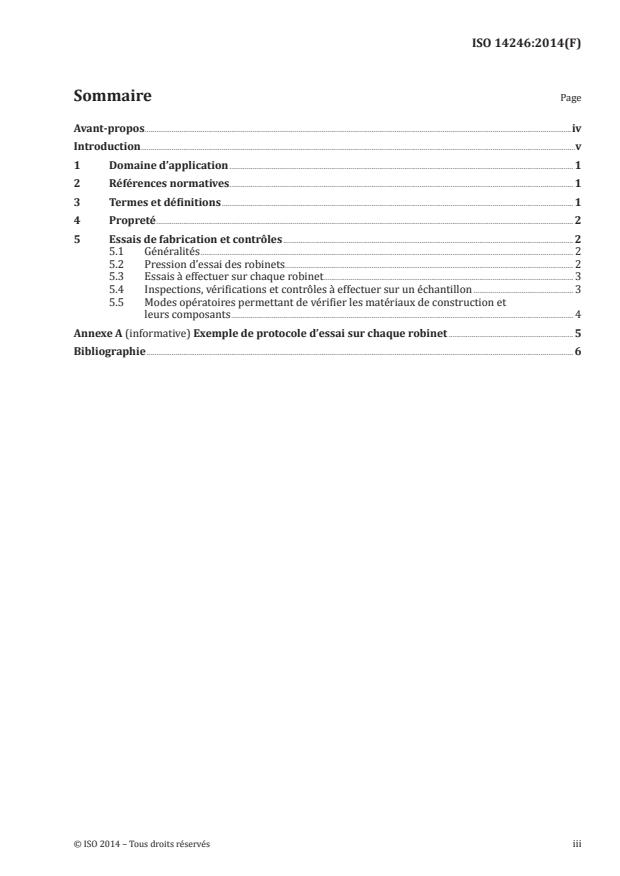
Sommaire Page
Avant-propos .iv
Introduction .v
1 Domaine d’application . 1
2 Références normatives . 1
3 Termes et définitions . 1
4 Propreté . 2
5 Essais de fabrication et contrôles . 2
5.1 Généralités . 2
5.2 Pression d’essai des robinets . . 2
5.3 Essais à effectuer sur chaque robinet . 3
5.4 Inspections, vérifications et contrôles à effectuer sur un échantillon . 3
5.5 Modes opératoires permettant de vérifier les matériaux de construction et
leurs composants . 4
Annexe A (informative) Exemple de protocole d’essai sur chaque robinet .5
Bibliographie . 6
Avant-propos
L’ISO (Organisation internationale de normalisation) est une fédération mondiale d’organismes
nationaux de normalisation (comités membres de l’ISO). L’élaboration des Normes internationales est
en général confiée aux comités techniques de l’ISO. Chaque comité membre intéressé par une étude
a le droit de faire partie du comité technique créé à cet effet. Les organisations internationales,
gouvernementales et non gouvernementales, en liaison avec l’ISO participent également aux travaux.
L’ISO collabore étroitement avec la Commission électrotechnique internationale (CEI) en ce qui concerne
la normalisation électrotechnique.
Les procédures utilisées pour élaborer le présent document et celles destinées à sa mise à jour sont
décrites dans les Directives ISO/CEI, Partie 1. Il convient, en particulier de prendre note des différents
critères d’approbation requis pour les différents types de documents ISO. Le présent document a été
rédigé conformément aux règles de rédaction données dans les Directives ISO/CEI, Partie 2 (voir www.
iso.org/directives).
L’attention est appelée sur le fait que certains des éléments du présent document peuvent faire l’objet de
droits de propriété intellectuelle ou de droits analogues. L’ISO ne saurait être tenue pour responsable
de ne pas avoir identifié de tels droits de propriété et averti de leur existence. Les détails concernant les
références aux droits de propriété intellectuelle ou autres droits analogues identifiés lors de l’élaboration
du document sont indiqués dans l’Introduction et/ou dans la liste des déclarations de brevets reçues par
l’ISO (voir www.iso.org/brevets).
Les appellations commerciales éventuellement mentionnées dans le présent document sont données
pour information, par souci de commodité, à l’intention des utilisateurs et ne sauraient constituer un
engagement.
Pour une explication de la signification des termes et expressions spécifiques de l’ISO liés à l’évaluation de
la conformité, ou pour toute information au sujet de l’adhésion de l’ISO aux principes de l’OMC concernant
les obstacles techniques au commerce (OTC), voir le lien suivant: Avant-propos — Informations
supplémentaires.
Le comité chargé de l’élaboration du présent document est l’ISO/TC 58, Bouteilles à gaz, sous-comité
SC 2, Accessoires de bouteilles.
Cette deuxième édition annule et remplace la première édition (ISO 14246:2001), qui a fait l’objet d’une
révision technique.
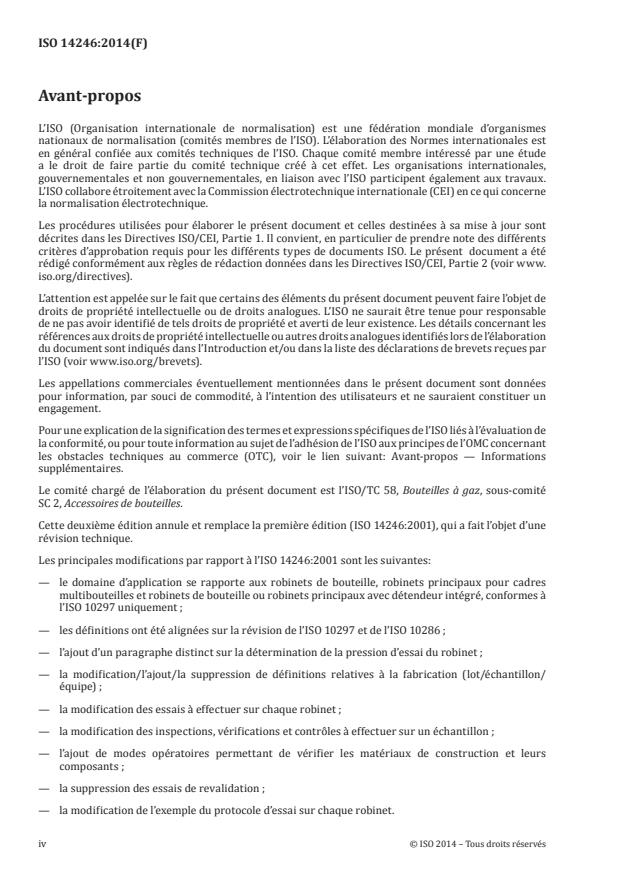
Les principales modifications par rapport à l’ISO 14246:2001 sont les suivantes:
— le domaine d’application se rapporte aux robinets de bouteille, robinets principaux pour cadres
multibouteilles et robinets de bouteille ou robinets principaux avec détendeur intégré, conformes à
l’ISO 10297 uniquement ;
— les définitions ont été alignées sur la révision de l’ISO 10297 et de l’ISO 10286 ;
— l’ajout d’un paragraphe distinct sur la détermination de la pression d’essai du robinet ;
— la modification/l’ajout/la suppression de définitions relatives à la fabrication (lot/échantillon/
équipe) ;
— la modification des essais à effectuer sur chaque robinet ;
— la modification des inspections, vérifications et contrôles à effectuer sur un échantillon ;
— l’ajout de modes opératoires permettant de vérifier les matériaux de construction et leurs
composants ;
— la suppression des essais de revalidation ;
— la modification de l’exemple du protocole d’essai sur chaque robinet.
iv © ISO 2014 – Tous droits réservés
Introduction
La présente Norme internationale concerne la fonction de fermeture des robinets de bouteilles (définis
dans le Règlement type de l’ONU). Les fonctions supplémentaires des robinets de bouteilles (par exemple,
pour les robinets servant de régulateurs de pression, de dispositifs à pression résiduelle, de dispositifs
anti-retour ou de dispositifs limiteurs de pression) peuvent être couvertes par d’autres normes et/ou
par d’autres réglementations.
Les robinets de bouteilles conformes à la présente norme internationale sont supposés fonctionner de
manière satisfaisante dans les conditions de service normales.
La présente norme internationale traite, en particulier, des essais de fabrication et des contrôles des
robinets de bouteilles conçus et soumis aux essais de type selon l’ISO 10297.
La présente norme a été rédigée de sorte qu’elle soit conforme au Règlement type de l’ONU. Une fois
publiée, elle sera soumise au Sous-Comité d’experts du transport des marchandises dangereuses de
l’ONU et une demande visant à l’intégrer dans le Règlement type de l’ONU sera formulée.
Lorsqu’il existe une contradiction entre la présente Norme internationale et une quelconque
réglementation en vigueur, ladite réglementation prévaut dans tous les cas.
Dans la présente Norme internationale, l’unité utilisée est le bar, en raison de son utilisation universelle
dans le domaine des gaz techniques. Il convient de noter toutefois que cette unité ne fait pas partie du
Système international d’unités (SI), et que l’unité SI correspondante pour mesurer la pression est le
5 5 2
pascal (Pa, 1 bar = 10 Pa = 10 N/m ).
Sauf indication contraire, les valeurs de pression indiquées dans la présente Norme internationale sont
des pressions relatives (portion de la pression qui est supérieure à la pression atmosphérique).
NORME INTERNATIONALE ISO 14246:2014(F)
Bouteilles à gaz — Robinets de bouteilles à gaz — Essais de
fabrication et contrôles
1 Domaine d’application
La présente Norme internationale décrit les modes opératoires et les critères d’acceptation applicables
aux essais de fabrication et aux contrôles des robinets (appelés parfois contrôle initial et essais) de
bouteilles ayant obtenu des agréments de type.
La présente Norme internationale s’applique :
a) aux robinets de bouteilles destinés à être montés sur des bouteilles à gaz transportables et
rechargeables,
b) aux robinets principaux (à l’exclusion des robinets à bille) pour cadres multibouteilles, et
c) aux robinets de bouteilles ou robinets principaux avec détendeur intégré
conçus et soumis aux essais de type conformément à l’ISO 10297.
NOTE Dans la mesure où il n’y a pas de risque d’ambigüité, le présent document utilise le terme générique
“robinets” pour désigner indistinctement les robinets de bouteilles, les robinets principaux et les robinets avec
détendeur intégré.
Les principes de ces essais et contrôles peuvent être appliqués avantageusement à des robinets de
bouteille ayant été soumis aux essais de type conformément à des Normes nationales ou internationales
autres que ISO 10297.
2 Références normativ
...
Questions, Comments and Discussion
Ask us and Technical Secretary will try to provide an answer. You can facilitate discussion about the standard in here.
Loading comments...