

ISO 11193-2:2006
(Main)Single-use medical examination gloves — Part 2: Specification for gloves made from poly(vinyl chloride)
General Information
- Abstract
ISO 11193-2:2006 specifies requirements for packaged sterile, or bulked non-sterile, poly(vinyl chloride) gloves intended for use in medical examinations, and diagnostic or therapeutic procedures, to protect the patient and the user from cross-contamination. It also covers poly(vinyl chloride) gloves intended for use in handling contaminated medical materials. ISO 11193-2:2006 is intended as a reference for the performance and safety of poly(vinyl chloride) examination gloves. The safe and proper usage of examination gloves and sterilization procedures with subsequent handling, packaging and storage procedures are outside the scope of ISO 11193-2:2006.
- Status
- Published
- Publication Date
- 24-Oct-2006
- Technical Committee
- ISO/TC 45/SC 4 - Products (other than hoses)
- Drafting Committee
- ISO/TC 45/SC 4/WG 5 - Gloves and other latex products
- Current Stage
- 9092 - International Standard to be revised
- Start Date
- 01-Nov-2021
- Completion Date
- 29-Aug-2026
Overview
ISO 11193-2:2006 is the International Organization for Standardization specification for single-use medical examination gloves made from poly(vinyl chloride) (PVC). The standard defines performance, materials and quality requirements for packaged sterile or bulk non-sterile PVC examination gloves intended to protect patients and users from cross‑contamination. It is a reference for manufacturers, test laboratories and regulatory staff; it does not cover detailed instructions for safe use, sterilization procedures or storage practices.
Key topics and technical requirements
- Scope & classification: Covers PVC (plasticized poly(vinyl chloride)) single‑use examination gloves. Gloves are classified by finish: textured, smooth, powdered, powder-free.
- Materials: Gloves must be manufactured from plasticized PVC; any pigments, powders or surface treatments must be non‑toxic and disclosed on request. Biocompatibility must conform to relevant parts of ISO 10993.
- Sampling & inspection: Lot inspection and sampling follow ISO 2859‑1. Key AQLs: physical dimensions and tensile properties AQL 4.0, watertightness AQL 2.5.
- Dimensions & thickness: Width and length measured at specified glove points. Single‑wall thickness minima (where measured): smooth area ≥ 0.08 mm, textured area ≥ 0.11 mm; palm centre thickness values are specified in the standard.
- Watertightness: Annex A defines a watertightness test using a hollow mandrel and 1 000 cm3 of water (≤36 °C); leakage within 40 mm of the cuff is disregarded.
- Tensile properties & ageing: Tensile testing per ISO 37 and accelerated ageing per ISO 188. Minimum requirements: force at break ≥ 7.0 N and elongation at break ≥ 350%, both before and after accelerated ageing.
- Packaging & marking: Sterile glove packaging, labelling elements and unit/multi‑unit marking requirements are specified (manufacturer, material, finish, size, lot number, date of manufacture, “FOR SINGLE USE”, sterile/non‑sterile, and a plasticizer disclosure/warning).
Practical applications and users
- Manufacturers: product design, material selection, production QC and final release criteria for PVC examination gloves.
- Quality & testing laboratories: sampling plans, performance testing (watertightness, tensile, thickness) and compliance verification.
- Regulatory and procurement teams: product specifications for tendering, conformity evidence and labelling requirements.
- Healthcare supply chain: acceptance testing and supplier audits to ensure PPE meets required safety benchmarks.
Related standards
- ISO 11193-1 (latex/rubber examination gloves)
- ISO 10993 (biological evaluation of medical devices)
- ISO 37 (tensile testing), ISO 188 (accelerated ageing)
- ISO 2859-1 (sampling by attributes), ISO 15223 (medical device symbols), ISO 23529 (test piece preparation)
Keywords: ISO 11193-2, PVC gloves, poly(vinyl chloride) examination gloves, medical examination gloves specification, watertightness test, tensile properties, sterile examination gloves, glove marking and packaging.
Relations
- Effective Date
- 15-Apr-2008
Get Certified
Connect with accredited certification bodies for this standard

BSI Group
BSI (British Standards Institution) is the business standards company that helps organizations make excellence a habit.

TÜV Rheinland
TÜV Rheinland is a leading international provider of technical services.

TÜV SÜD
TÜV SÜD is a trusted partner of choice for safety, security and sustainability solutions.
Sponsored listings
Frequently Asked Questions
ISO 11193-2:2006 is a standard published by the International Organization for Standardization (ISO). Its full title is "Single-use medical examination gloves — Part 2: Specification for gloves made from poly(vinyl chloride)". This standard covers: ISO 11193-2:2006 specifies requirements for packaged sterile, or bulked non-sterile, poly(vinyl chloride) gloves intended for use in medical examinations, and diagnostic or therapeutic procedures, to protect the patient and the user from cross-contamination. It also covers poly(vinyl chloride) gloves intended for use in handling contaminated medical materials. ISO 11193-2:2006 is intended as a reference for the performance and safety of poly(vinyl chloride) examination gloves. The safe and proper usage of examination gloves and sterilization procedures with subsequent handling, packaging and storage procedures are outside the scope of ISO 11193-2:2006.
ISO 11193-2:2006 specifies requirements for packaged sterile, or bulked non-sterile, poly(vinyl chloride) gloves intended for use in medical examinations, and diagnostic or therapeutic procedures, to protect the patient and the user from cross-contamination. It also covers poly(vinyl chloride) gloves intended for use in handling contaminated medical materials. ISO 11193-2:2006 is intended as a reference for the performance and safety of poly(vinyl chloride) examination gloves. The safe and proper usage of examination gloves and sterilization procedures with subsequent handling, packaging and storage procedures are outside the scope of ISO 11193-2:2006.
ISO 11193-2:2006 is classified under the following ICS (International Classification for Standards) categories: 11.140 - Hospital equipment; 83.140.99 - Other rubber and plastics products. The ICS classification helps identify the subject area and facilitates finding related standards.
ISO 11193-2:2006 has the following relationships with other standards: It is inter standard links to ISO 11193:1994. Understanding these relationships helps ensure you are using the most current and applicable version of the standard.
ISO 11193-2:2006 is available in PDF format for immediate download after purchase. The document can be added to your cart and obtained through the secure checkout process. Digital delivery ensures instant access to the complete standard document.
Standards Content (Sample)
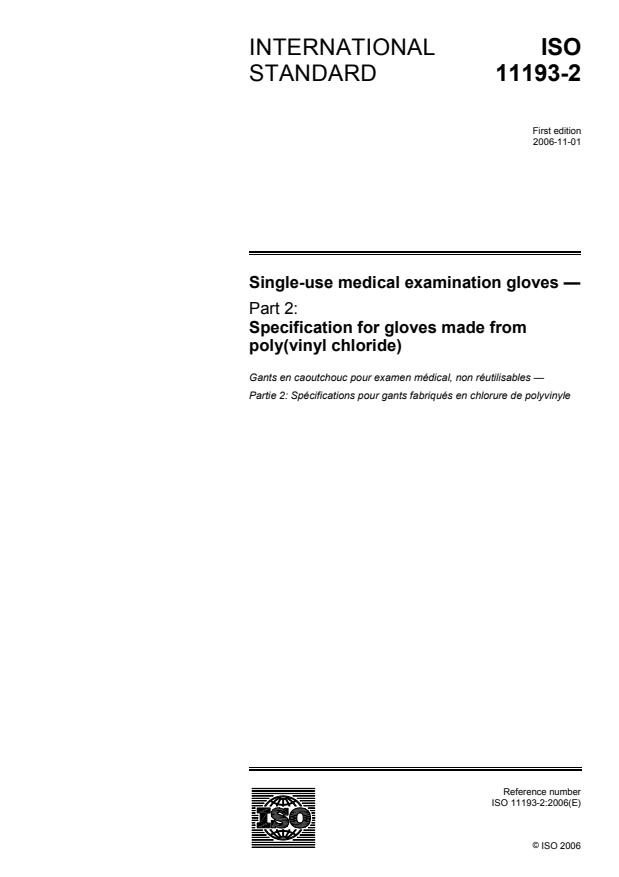
INTERNATIONAL ISO
STANDARD 11193-2
First edition
2006-11-01
Single-use medical examination gloves —
Part 2:
Specification for gloves made from
poly(vinyl chloride)
Gants en caoutchouc pour examen médical, non réutilisables —
Partie 2: Spécifications pour gants fabriqués en chlorure de polyvinyle
Reference number
©
ISO 2006
PDF disclaimer
This PDF file may contain embedded typefaces. In accordance with Adobe's licensing policy, this file may be printed or viewed but
shall not be edited unless the typefaces which are embedded are licensed to and installed on the computer performing the editing. In
downloading this file, parties accept therein the responsibility of not infringing Adobe's licensing policy. The ISO Central Secretariat
accepts no liability in this area.
Adobe is a trademark of Adobe Systems Incorporated.
Details of the software products used to create this PDF file can be found in the General Info relative to the file; the PDF-creation
parameters were optimized for printing. Every care has been taken to ensure that the file is suitable for use by ISO member bodies. In
the unlikely event that a problem relating to it is found, please inform the Central Secretariat at the address given below.
© ISO 2006
All rights reserved. Unless otherwise specified, no part of this publication may be reproduced or utilized in any form or by any means,
electronic or mechanical, including photocopying and microfilm, without permission in writing from either ISO at the address below or
ISO's member body in the country of the requester.
ISO copyright office
Case postale 56 • CH-1211 Geneva 20
Tel. + 41 22 749 01 11
Fax + 41 22 749 09 47
E-mail copyright@iso.org
Web www.iso.org
Published in Switzerland
ii © ISO 2006 – All rights reserved
Contents Page
Foreword. iv
1 Scope . 1
2 Normative references . 1
3 Classification. 2
4 Materials . 2
5 Sampling and selection of test pieces. 2
6 Requirements . 3
7 Packaging . 4
8 Marking . 4
Annex A (normative) Test for watertightness . 8
Foreword
ISO (the International Organization for Standardization) is a worldwide federation of national standards bodies
(ISO member bodies). The work of preparing International Standards is normally carried out through ISO
technical committees. Each member body interested in a subject for which a technical committee has been
established has the right to be represented on that committee. International organizations, governmental and
non-governmental, in liaison with ISO, also take part in the work. ISO collaborates closely with the
International Electrotechnical Commission (IEC) on all matters of electrotechnical standardization.
International Standards are drafted in accordance with the rules given in the ISO/IEC Directives, Part 2.
The main task of technical committees is to prepare International Standards. Draft International Standards
adopted by the technical committees are circulated to the member bodies for voting. Publication as an
International Standard requires approval by at least 75 % of the member bodies casting a vote.
Attention is drawn to the possibility that some of the elements of this document may be the subject of patent
rights. ISO shall not be held responsible for identifying any or all such patent rights.
ISO 11193-2 was prepared by Technical Committee ISO/TC 45, Rubber and rubber products, Subcommittee
SC 4, Products (other than hoses).
This part of ISO 11193, together with ISO 11193-2, cancels and replaces ISO 11193:1994, which has been
technically revised.
ISO 11193 consists of the following parts, under the general title Single-use medical examination gloves:
— Part 1: Specification for gloves made from rubber latex or rubber solution
— Part 2: Specification for gloves made from poly(vinyl chloride)
iv © ISO 2006 – All rights reserved
INTERNATIONAL STANDARD ISO 11193-2:2006(E)
Single-use medical examination gloves —
Part 2:
Specification for gloves made from poly(vinyl chloride)
WARNING — Persons using this International Standard should be familiar with normal laboratory
practices. This standard does not purport to address all of the safety problems, if any, associated with
its use. It is the responsibility of the user to establish appropriate safety and health practices and to
ensure compliance with any regulatory conditions.
1 Scope
This part of ISO 11193 specifies requirements for packaged sterile, or bulked non-sterile, poly(vinyl chloride)
gloves intended for use in medical examinations, and diagnostic or therapeutic procedures, to protect the
patient and the user from cross-contamination. It also covers poly(vinyl chloride) gloves intended for use in
handling contaminated medical materials.
This part of ISO 11193 is intended as a reference for the performance and safety of poly(vinyl chloride)
examination gloves. The safe and proper usage of examination gloves and sterilization procedures with
subsequent handling, packaging and storage procedures are outside the scope of this part of ISO 11193.
2 Normative references
The following referenced documents are indispensable for the application of this document. For dated
references, only the edition cited applies. For undated references, the latest edition of the referenced
document (including any amendments) applies.
ISO 37:2005, Rubber, vulcanized or thermoplastic — Determination of tensile stress-strain properties
ISO 188, Rubber, vulcanized or thermoplastic — Accelerated ageing and heat resistance tests
ISO 2859-1, Sampling procedures for inspection by attributes — Part 1: Sampling schemes indexed by
acceptance quality limit (AQL) for lot-by-lot inspection
ISO 10993 (all parts), Biological evaluation of medical devices
ISO 15223, Medical devices — Symbols to be used with medical device labels, labelling and information to be
supplied
ISO 23529, Rubber — General procedures for preparing and conditioning test pieces for physical test
methods
3 Classification
Gloves are classified by finish as follows:
a) textured surface over part or all of the glove;
b) smooth surface;
c) powdered surface;
d) powder-free surface.
NOTE 1 Powdered gloves are gloves where a powder has been added as a part of the manufacturing process,
generally to facilitate donning. Powder-free gloves are gloves which have been manufactured without the deliberate
addition of powdered materials to facilitate donning.
NOTE 2 The cuff termination of the glove may be cut or in the form of a rolled rim.
4 Materials
Gloves shall be manufactured from plasticized poly(vinyl chloride). To facilitate donning the gloves, any
surface treatment, lubricant, powder or polymer coating may be used.
Any pigment, surface treatment, lubricant, or powder used shall be non-toxic and shall be disclosed on
request. It is essential that substances used for surface treatment, which are capable of being transferred, are
bio-absorbable.
Gloves as supplied to the user shall comply with the relevant part(s) of ISO 10993. The manufacturer shall
make available, on request, data to support compliance with these requirements.
NOTE Limits of extractable plasticizers, residual chemicals and residual powder in gloves may be specified in future
editions of this part of ISO 11193, subject to the availability of relevant ISO standard test methods.
5 Sampling and selection of test pieces
5.1 Sampling
For reference purposes, gloves shall be sampled and inspected in accordance with ISO 2859-1. The
inspection levels and acceptance quality limits (AQLs) shall conform to those specified in Table 1 for the
characteristics listed.
When a lot size cannot be determined, a lot of 35 001 to 150 000 shall be assumed.
Table 1 — Inspection levels and AQLs
Characteristic Inspection level AQL
Physical dimensions (width, length, thickness) S-2 4,0
Watertightness G-1 2,5
Force
...