

ISO/IEC 13346-1:1995
(Main)Information technology — Volume and file structure of write-once and rewritable media using non-sequential recording for information interchange — Part 1: General
General Information
- Abstract
Consists of five parts; part 1 specifies references, definitions, notation and basic structures that apply to the other four parts.
- Status
- Published
- Publication Date
- 26-Dec-1995
- Technical Committee
- ISO/IEC JTC 1 - Information technology
- Drafting Committee
- ISO/IEC JTC 1 - Information technology
- Current Stage
- 9093 - International Standard confirmed
- Start Date
- 29-Jul-2008
- Completion Date
- 29-Aug-2026
Overview
ISO/IEC 13346-1:1995 - Part 1: General is the foundational document for the ISO/IEC 13346 family of standards that define the volume and file structure of write-once and rewritable media using non-sequential recording for information interchange. Part 1 does not define complete file-system behaviors itself; rather it specifies the references, definitions, notation and basic structures used by Parts 2–5 (Volume & Boot Block Recognition, Volume Structure, File Structure, Record Structure). The standard was adopted from ECMA-167 and is intended for media that may be write-once, read-only, rewritable, or combinations of those types.
Key topics and technical requirements
Part 1 establishes the common terminology, data typing and notation that the other Parts rely on. Major technical topics include:
- Scope and structure of the ISO/IEC 13346 series and part numbering conventions (e.g., 2/5 → clause 5 in Part 2).
- Conformance rules for media and information processing systems, including how to declare which Parts and conformance levels apply.
- Notation and basic types, such as numerical value formats, bit-field layouts and descriptor formats.
- Character sets and coding (references to ISO/IEC character standards), fixed-length character fields and multiple character set support.
- Timestamps and entity identifiers, including the layout and role of time fields and entity ID structures.
- Descriptor sequence schema and other common data-structure notations that ensure consistent interpretation across Parts.
- Normative references to related ISO/IEC standards (e.g., ISO/IEC 646, 2022, 6429) which are required for character and control functions.
Practical applications
ISO/IEC 13346 Part 1 is used wherever reliable interchange of files and metadata across different information-processing systems and removable media is required. Typical applications:
- Designing or implementing file systems that support non-sequential (out-of-order) recording on optical and other removable media.
- Developing media preparation and burning tools (write-once and rewritable media).
- Creating bootable media recognition and volume-recognition utilities (in conjunction with Part 2).
- Archival and data-exchange workflows that require robust handling of character sets, timestamps and standardized metadata descriptors.
Who uses this standard
- Filesystem and storage engineers
- Device and media manufacturers
- Software vendors for media creation, reading and archival tools
- Archivists and IT managers focused on long-term interchange and preservation
- Standards architects integrating boot, volume and file-system specifications
Related standards
- ECMA-167 (origin of ISO/IEC 13346)
- ISO 9660 (existing volume/file-structure standard referenced for comparison)
- ISO/IEC 646, 2022, 6429 (character set and control function standards referenced by Part 1)
ISO/IEC 13346-1 is essential reading when implementing or validating conformance across the ISO/IEC 13346 series for interoperable, non-sequential media interchange.
Get Certified
Connect with accredited certification bodies for this standard

BSI Group
BSI (British Standards Institution) is the business standards company that helps organizations make excellence a habit.

NYCE
Mexican standards and certification body.
Sponsored listings
Frequently Asked Questions
ISO/IEC 13346-1:1995 is a standard published by the International Organization for Standardization (ISO). Its full title is "Information technology — Volume and file structure of write-once and rewritable media using non-sequential recording for information interchange — Part 1: General". This standard covers: Consists of five parts; part 1 specifies references, definitions, notation and basic structures that apply to the other four parts.
Consists of five parts; part 1 specifies references, definitions, notation and basic structures that apply to the other four parts.
ISO/IEC 13346-1:1995 is classified under the following ICS (International Classification for Standards) categories: 35.220.20 - Magnetic storage devices in general; 35.220.30 - Optical storage devices. The ICS classification helps identify the subject area and facilitates finding related standards.
ISO/IEC 13346-1:1995 is available in PDF format for immediate download after purchase. The document can be added to your cart and obtained through the secure checkout process. Digital delivery ensures instant access to the complete standard document.
Standards Content (Sample)
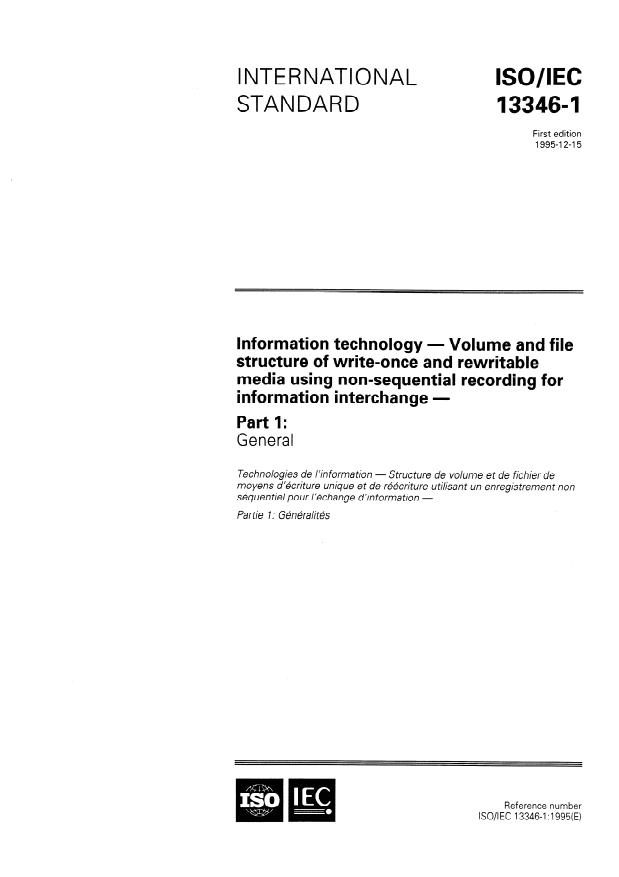
INTERNATIONAL
ISO/IEC
STANDARD
13346-l
First edition
1995-l 2-l 5
Information technology - Volume and file
structure of write-once and rewritable
media using non-sequential recording for
information interchange -
Part 1:
General
Technologies de I ‘information - Structure de volume et de fichier de
moyens d ‘kriture unique et de r&criture utilisan t un enregistremen t non
s6quentiel pour /‘&change d’information -
Partie 7: G&&alit&
ISO/lEC 13346-l: 1995(E)
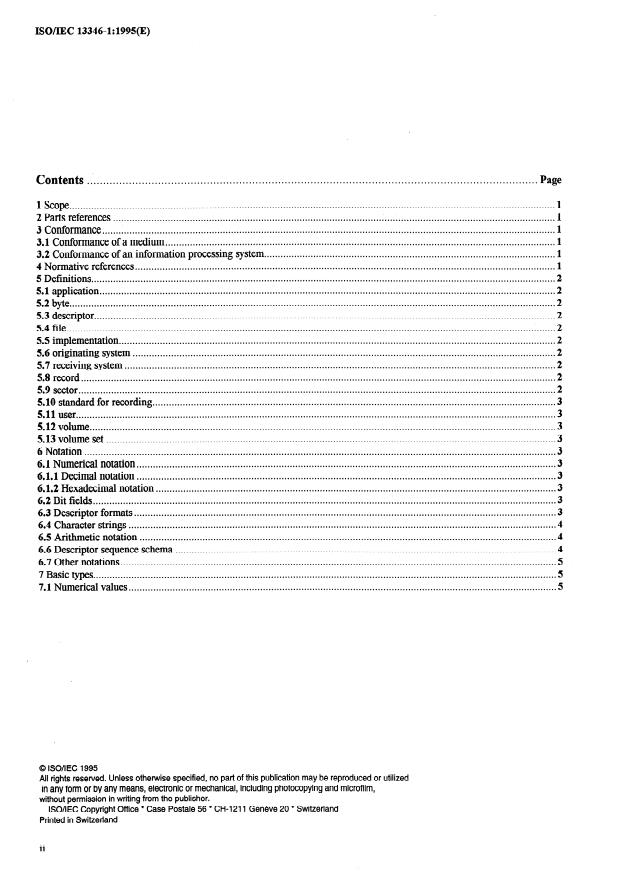
Page
Contents . . . . . . . . . . . . . . . . . . . . . . . . . . . . . . . . . . . . . . . . . . . . . . . . . . . . . . . . . . . . . . . . . . . . . . . . . . . . . . . . . . . . . . . . . . . . . . . . . . . . . . . . . . . . . . . . . . . . . . . . .
.................................................................................................................................................................................
1 scope
2 Parts references .
3 Conformance .
..............................................................................................................................................
3.1 Conformance of a medium
..........................................................................................................
3.2 Conformance of an information processing system
.........................................................................................................................................................
4 Normative references
5 Definitions .
5.1 application .
5.2 byte .
5.3 descriptor .
5.4 file .
...............................................................................................................................................................
5.5 implementation
5.6 originating system .
5.7 receiving system .
5.8 record .
5.9 sector .
...................................................................................................................................................
5.10 standard for recording
...............................................................................................................................................................................
5.11 user
5.12 volume .
5.13 volume set .
6 Notation .
.........................................................................................................................................................
6.1 Numerical notation
.........................................................................................................................................................
6.1.1 Decimal notation
6.1.2 Hexadecimal notation .
6.2 Bit fields .
..........................................................................................................................................................
6.3 Descriptor formats
............................................................................................................................................................
6.4 Character strings
6.5 Arithmetic notation .
6.6 Descriptor sequence schema .
6.7 Other notations .
7 Basic types .
7.1 Numerical values .
0 ISO/IEC 1995
All rights reserved. Unless otherwise specified, no part of this publication may be reproduced or utilized
in any form or by any means, electronic or mechanical, including photocopying and microfilm,
without permission in writing from the publisher.
ISO/IEC Copyright Office * Case Postale 56 * CH-1211 Geneve 20 * Switzerland
Printed in Switzerland
ii
ISO/IEC 13346-l: 1995(E)
OISO/IEC
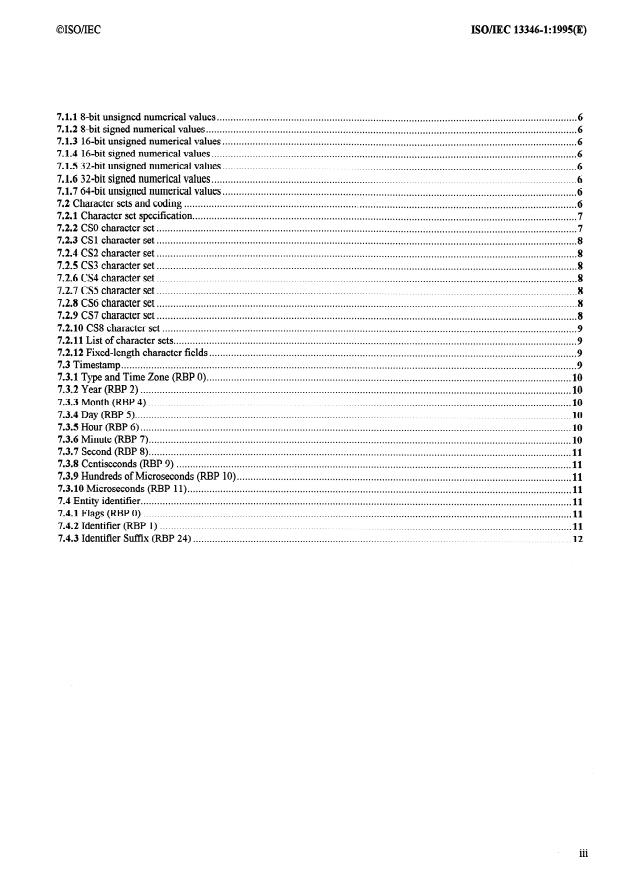
S-bit unsigned numerical values .
7.1.1
7.1.2 8-bit signed numerical values .
7.1.3 l&bit unsigned numerical values .
7.1.4 16.bit signed numerical values .
32-bit unsigned numerical values .
7.1.5
7.1.6 32.bit signed numerical values .
7.1.7 64-bit unsigned numerical values .
...............................................................................................................................................
7.2 Character sets and coding
............................................................................................................................................
7.2.1 Character set specification
.........................................................................................................................................................
7.2.2 CSO character set
7.2.3 CSl character set .
7.2.4 CS2 character set .
7.2.5 CS3 character set .
7.2.6 CS4 character set .
.........................................................................................................................................................
7.2.7 CS5 character set
.........................................................................................................................................................
7.2.8 CS6 character set
.........................................................................................................................................................
7.2.9 CS7 character set
7.2.10 CS8 character set .
7.2.11 List of character sets .
7.2.12 Fixed-length character fields .
7.3 Timestamp .
.....................................................................................................................................
7.3.1 Type and Time Zone (RBP 0)
.............................................................................................................................................................
7.3.2 Year (RBP 2)
7.3.3 Month (RBP 4) .
7.3.4 .
Day (RBP 5)
7.3.5 Hour (RBP 6) .
.......................................................................................................................................................... 10
7.3.6 Minute (RBP 7)
..........................................................................................................................................................
7.3.7 Second @BP 8)
7.3.8 Centiseconds @BP 9) .
7.3.9 Hundreds of Microseconds (RBP 10) .
7.3.10 Microseconds @BP 11) .
7.4 Entity identifier .
............................................................................................................................................................ 11
7.4.1 Flags @BP 0)
7.4.2 Identifier @BP 1) . 11
7.4.3 Identifier Suffix (RBP 24) .
. . .
ISO/IEC 13346=1:1995(E)
OISO/IEC
Foreword
IS0 (the International Organization for Standardization) and IEC (the International Electrotechnical Commission) form the
specialised system for worldwide standardisation. National bodies that are members of IS0 or IEC participate in the
development of International Standards through technical committees established by the respective organisation to deal with
particular fields of technical activity. IS0 and IEC technical committees collaborate in fields of mutual interest. Other
international organisations, governmental and non-governmental, in liaison with IS0 and IEC, also take part in this work.
In the field of information technology, IS0 and IEC have established a joint technical committee, ISO/IEC JTC 1. Draft
International Standards adopted by the joint technical committee are circulated to national bodies for voting. Publication of
an International Standard requires approval by at least 75% of the national bodies casting a vote.
International Standard ISO/IEC 13346 was prepared by the European Association for Standardizing Information and
Communication Systems, ECMA, (as Standard ECMA-167) and was adopted, under a special “fast-track procedure”, by Joint
Technical Committee ISO/IEC JTC 1, Information technology, in parallel with its approval by National Bodies of IS0 and
IEC.
iv
OISO/IEC ISO/IEC 13346-l: 1995(E)
Introduction
ISO/IEC 13346 is a volume and file structure standard for interchanging files and as such, it is a peer to existing volume and
file structure standards such as IS0 9293 and IS0 9660. It is rather different from those standards in at least two important
ways. Firstly, it offers much more functionality, mainly because of user needs for increased character set support and for more
powerful file system features. Secondly, it acknowledges the separate concerns of booting, volume structure and file system
structure. Rather than bundling these diEerent functions together, ISO/IEC 13346 carefully segregates these functions into
separate parts and describes in detail how those parts fit together. It is expected that future volume and file structure
standards will fit into this framework, rather than building other distinct and incompatible formats.
ISO/IEC 13346 is published in five Parts. Part 1 - general - specifies references, definitions, notations and basic structures
used in the other four Parts. Part 2 - volume and boot block recognition - specifies formats and system requirements for
recognising the volume structures on a medium and booting from a medium. Part 3 - volume structure - specifies how to
record various volume-related entities such as volumes, volume sets and logical volumes. Part 4 - file structure - specifies how
to record and interpret files, both file data and file attributes, and file hierarchies within logical volumes. Part 5 - record
structure - specifies how to record and interpret file data encoded as records.
This page intentionally left blank
INTERNATIONAL STANDARD OISO/IEC ISO/IEC 13346-l: 1995(E)
Information technology - Volume and file structure of write-once and rewritable
media using non-sequential recording for information interchange -
Part 1:
General
1 Scope
ISO/IEC 13346 specifies a format and associated system requirements for volume and boot block recognition, volume
structure, file structure and record structure for the interchange of information on media between users of information
processing systems.
The media shall be recorded as if the recording of sectors may be done in any order.
NOTE 1 - The medium is not restricted to being of only one type; the type of medium may be either write once, or read only, or rewritable, or a combination of these
types.
ISO/IEC 13346 consists of the following five Parts:
Part 1: General
Part 2: Volume and Boot Block Recognition
Part 3: Volume Structure
Part 4: File Structure
Part 5: Record Structure
Annex A - ICB Strategies, is part of Part 4.
Part 1 specifies references, definitions, notation and basic structures that apply to the other four Parts.
2 Parts references
The first digit of a reference within ISO/IEC 13346 identifies the Part, e.g. 2/5 refers to clause 5 in Part 2, and figure 413
refers to figure 3 in Part 4.
3 Conformance
3.1 Conformance of a medium
A medium shall be in conformance with ISO/IEC 13346 when it conforms to a standard for recording (see l/5.10) and
information recorded on sectors of the medium conform to the specifications of Part 1 and one or more of Parts 2, 3, 4 and 5.
A statement of conformance shall identify the sectors of the medium on which information is recorded according to the
specifications of ISO/IEC 13346, and the Parts and the levels of medium interchange (see 2/10, 3DO.10, and 4/15) to which
the contents of those sectors of the medium conform.
3.2 Conformance of an information processing system
An information processing system shall be in conformance with ISO/IEC 13346 if it meets the requirements specified in
Part 1 and one or more of Parts 2, 3, 4 and 5 either for an originating system (see 2/12, 3/l 3, 4/17 and 5/l 1) or for a receiving
system (see 2/l 3, 3/14, 4/l 8 and 5/12) or for both types of system. A statement of conformance shall identify the Parts, and
the levels of the requirements for each of those Parts, which can be met by the system.
4 Normative references
The following International Standards contain provisions which, through reference in this text, constitute provisions of this
part of ISO/IEC 13346. At the time of publication, the editions indicated were valid. All standards are subject to revision, and
parties to agreements based on this part of ISO/IEC 13346 are encouraged to investigate the possibility of applying the most
recent editions of the standards indicated below. Members of IEC and IS0 maintain registers of currently valid International
Standards.
OISO/IEC
ISO/IEC 13346-l: 1995(E)
ISO/IEC 646: 199 1, Information technology - IS0 7-bit code character set for information interchange.
ISO/IEC 2022: 1994, Information technology - Character code structure and extension techniques.
ISO/IEC 6429: 1992, Information technology - Control functions for coded character sets.
IS0 8859-l : 1987, Information processing - 8-bit single-byte coded graphic character sets - Part 1: Latin alphabet No. 1.
ISO/IEC 9293 : 1994, Information technology - Volume andfile structure of disk cartridges for information interchange.
Volume andcfile structure of CD-ROMfor information interchange.
IS0 9660: 1988, Information processing -
ISOAEC 9945-l: 1990, Information technology - Portable Operating System Interface (POSIX) - Part I: System Application
Program Interface (A PI) [C Language J.
Universal Multiple Octet Coded Character Set (UC’S) - Part 1:
ISOIIEC 10646-l : 1993, Information technology -
Architecture and Basic Multilingual Plane.
ISOIIEC 13490-l: 1995, Information technology - Volume andfile structure of read-only and write-once compact disk media
for information interchange - Part 1: General.
ISOAEC 13490-2: 1995, Information technology - Volume andfile structure of read-only and write-once compact disk media
for information interchange - Part 2: Volume andflle structure.
ISO/IEC 13 800’) , Information technology - Procedure for the registration of identifiers and attributes for volume andJle
structure
ITU-T Recommendation V.41, Code-Independent Error-Control System.
5 Definitions
For the purposes of ISO/IEC 13346, the following definitions apply.
5.1 application: A program that processes the contents of a file, and may also process selected attribute data relating to the
file or to the volume(s) on which the file is recorded.
5.2 byte: A string of eight binary digits operated upon as a unit. If the standard for recording (see l/5.10) specifies that the
container for the recording of a byte has more than eight bits, in ISO/IEC 13346 a byte shall be recorded in the least
significant eight bits of the container with the remaining bits of the container set to ZERO.
5.3 descriptor: A structure containing descriptive information about a volume or a file.
5.4 file: A collection of information.
5.5 implementation: A set of processes which enable information processing system to behave as an originating system,
or as a receiving system, or as both types of system.
5.6 originating system: An information processing system which can create a set of files on a volume set for the purpose of
data interchange with another system.
5.7 receiving system: An information processing system which can read a set of files from a volume set which has been
created by another system for the purpose of data interchange.
5.8 record: A sequence of bytes treated as a unit of information.
5.9 sector: The data field of the smallest addressable part of the medium that can be accessed independently of other
addressable parts of the medium.
‘) To be published
ISO/IEC 13346-l: 1995(E)
01s0/IEc
5.10 standard for recording: A standard that specifies the recording method and the addressing method for the
information recorded on a medium. The specifications of the standard for recording that are relevant for ISO/IEC 13346 are:
- a unique address for each sector;
- the length of each sector;
-
the means for determining whether a sector is read-only, write-once, or rewritable;
- for media where sectors may only be recorded once, a means for detecting whether each sector has not yet been recorded;
-
whether sectors may require preprocessing prior to recording.
The standard for recording used in conjunction with ISOIIEC 13346 is subject to agreement between the originator and
recipient of the medium.
5.11 user: A person or other entity (for example, an application) that causes the invocation of the services provided by an
implementation.
5.12 volume: A sector address space as specified in the relevant standard for recording.
NOTE 2 - A medium usually has a single set of sector addresses, and is therefore a single volume. A medium may have a separate set of addresses for each side of
the medium
...