

ISO/IEC 13346-2:1999
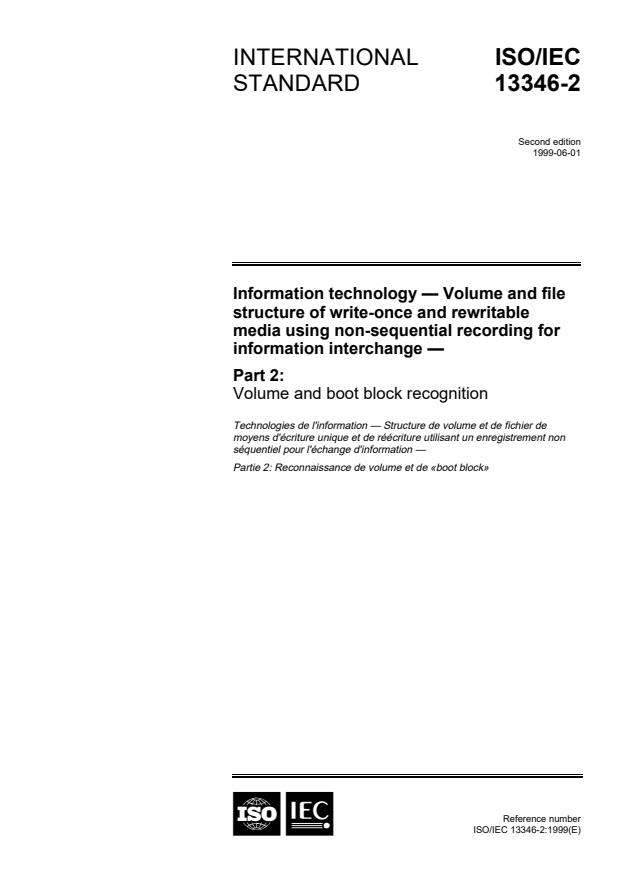
(Main)Information technology — Volume and file structure of write-once and rewritable media using non-sequential recording for information interchange — Part 2: Volume and boot block recognition
General Information
- Abstract
This part of ISO/IEC 13346 specifies a format and associated system requirements for volume and boot block recognition by specifying: volume recognition; boot descriptors intended for use to bring a system to a known state; levels of medium interchange; requirements for the processes which are provided within information processing systems, to enable information to be interchanged between different systems; for this purpose, this part of ISO/IEC 13346 specifies the functions to be provided within systems which are intended to originate or receive media which conform to this part of ISO/IEC 13346.
- Status
- Published
- Publication Date
- 02-Jun-1999
- Technical Committee
- ISO/IEC JTC 1 - Information technology
- Drafting Committee
- ISO/IEC JTC 1 - Information technology
- Current Stage
- 9060 - Close of review
- Completion Date
- 04-Jun-2031
Buy Documents
ISO/IEC 13346-2:1999 - Information technology — Volume and file structure of write-once and rewritable media using non-sequential recording for information interchange — Part 2: Volume and boot block recognition Released:6/3/1999
Overview
ISO/IEC 13346-2:1999 defines the volume and boot block recognition requirements for write-once and rewritable media that use non-sequential recording (e.g., many optical and removable media). Part 2 is one element of the ISO/IEC 13346 family and specifies the format and system-level rules used to detect volumes and boot descriptors on media, so systems can reliably identify, interpret and optionally boot from recorded media. The standard covers sector numbering, the layout of a volume recognition space and volume recognition area, and the recorded descriptor sequences used to advertise volume and boot information.
Key topics and technical requirements
- Sector addressing and numbering: sectors are numbered with consecutive integers starting at sector 0 for the initial sector; sector numbers reflect ascending physical addresses per the relevant recording standard.
- Volume recognition space and area: a contiguous sequence of sectors is defined as the volume recognition space; the volume recognition area contains the descriptor-based volume recognition sequence beginning after byte 32 767 of that space.
- Descriptor-based recognition: a volume recognition sequence is composed of a set of descriptors (Volume Structure Descriptor, Beginning/Terminating Extended Area Descriptors, Boot Descriptor, etc.) recorded on sector boundaries. Each descriptor identifies the standard or clause that specifies how to interpret its contents.
- Boot descriptors: Boot Descriptor structures provide information intended to bring a system to a known state (architecture type, boot extent location/length, load/start addresses, flags, creation date/time, boot use).
- Levels of medium interchange: the standard defines interchange levels (Level 1, Level 2) that establish expectations for compatibility between originating and receiving systems.
- System requirements and conformance: specifies required functions for originating systems (to produce conforming media) and for receiving systems (to locate, interpret and optionally use boot/volume data).
Applications and practical value
- Ensures interoperability of removable media between authoring systems, operating systems, firmware and boot loaders.
- Used by developers of optical disc formats, file-system implementers, device firmware engineers, and system integrators to support bootable media and standardized volume recognition.
- Supports archiving, software distribution, embedded system deployment and cross-platform media exchange where predictable boot behavior and volume discovery are required.
Who should use this standard
- Firmware and boot-loader engineers
- Optical media authors and mastering tool developers
- File system and OS developers implementing media recognition
- Hardware vendors and integrators building drives and readers
Related standards
- ISO/IEC 13346 (Parts 1, 3, 4, 5) - the multi-part volume and file structure framework
- ECMA-167 (equivalent origin) and prior volume/file standards such as ISO 9660 (for historic comparison)
Keywords: ISO/IEC 13346-2, volume recognition, boot descriptor, write-once media, rewritable media, non-sequential recording, volume recognition space, boot block recognition, medium interchange, volume structure descriptor.
Relations
- Effective Date
- 15-Apr-2008
Buy Documents
ISO/IEC 13346-2:1999 - Information technology — Volume and file structure of write-once and rewritable media using non-sequential recording for information interchange — Part 2: Volume and boot block recognition Released:6/3/1999
Get Certified
Connect with accredited certification bodies for this standard

BSI Group
BSI (British Standards Institution) is the business standards company that helps organizations make excellence a habit.

NYCE
Mexican standards and certification body.
Sponsored listings
Frequently Asked Questions
ISO/IEC 13346-2:1999 is a standard published by the International Organization for Standardization (ISO). Its full title is "Information technology — Volume and file structure of write-once and rewritable media using non-sequential recording for information interchange — Part 2: Volume and boot block recognition". This standard covers: This part of ISO/IEC 13346 specifies a format and associated system requirements for volume and boot block recognition by specifying: volume recognition; boot descriptors intended for use to bring a system to a known state; levels of medium interchange; requirements for the processes which are provided within information processing systems, to enable information to be interchanged between different systems; for this purpose, this part of ISO/IEC 13346 specifies the functions to be provided within systems which are intended to originate or receive media which conform to this part of ISO/IEC 13346.
This part of ISO/IEC 13346 specifies a format and associated system requirements for volume and boot block recognition by specifying: volume recognition; boot descriptors intended for use to bring a system to a known state; levels of medium interchange; requirements for the processes which are provided within information processing systems, to enable information to be interchanged between different systems; for this purpose, this part of ISO/IEC 13346 specifies the functions to be provided within systems which are intended to originate or receive media which conform to this part of ISO/IEC 13346.
ISO/IEC 13346-2:1999 is classified under the following ICS (International Classification for Standards) categories: 35.220.20 - Magnetic storage devices in general; 35.220.30 - Optical storage devices. The ICS classification helps identify the subject area and facilitates finding related standards.
ISO/IEC 13346-2:1999 has the following relationships with other standards: It is inter standard links to ISO/IEC 13346-2:1995. Understanding these relationships helps ensure you are using the most current and applicable version of the standard.
ISO/IEC 13346-2:1999 is available in PDF format for immediate download after purchase. The document can be added to your cart and obtained through the secure checkout process. Digital delivery ensures instant access to the complete standard document.
Standards Content (Sample)
INTERNATIONAL ISO/IEC
STANDARD 13346-2
Second edition
1999-06-01
Information technology — Volume and file
structure of write-once and rewritable
media using non-sequential recording for
information interchange —
Part 2:
Volume and boot block recognition
Technologies de l'information — Structure de volume et de fichier de
moyens d'écriture unique et de réécriture utilisant un enregistrement non
séquentiel pour l'échange d'information —
Partie 2: Reconnaissance de volume et de «boot block»
Reference number
B C
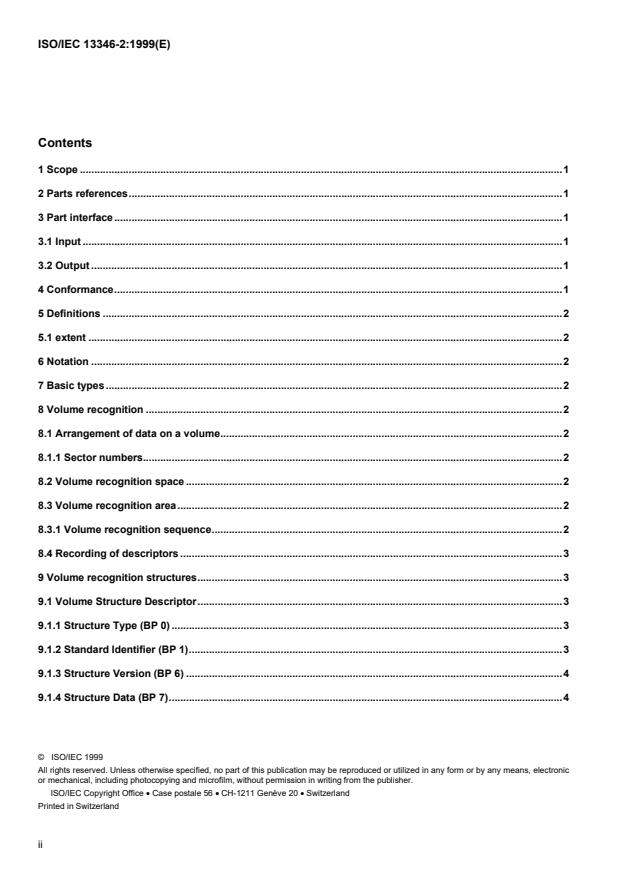
Contents
1 Scope .1
2 Parts references.1
3 Part interface.1
3.1 Input .1
3.2 Output .1
4 Conformance.1
5 Definitions .2
5.1 extent .2
6 Notation .2
7 Basic types.2
8 Volume recognition .2
8.1 Arrangement of data on a volume.2
8.1.1 Sector numbers.2
8.2 Volume recognition space .2
8.3 Volume recognition area.2
8.3.1 Volume recognition sequence.2
8.4 Recording of descriptors .3
9 Volume recognition structures.3
9.1 Volume Structure Descriptor.3
9.1.1 Structure Type (BP 0) .3
9.1.2 Standard Identifier (BP 1).3
9.1.3 Structure Version (BP 6) .4
9.1.4 Structure Data (BP 7).4
© ISO/IEC 1999
All rights reserved. Unless otherwise specified, no part of this publication may be reproduced or utilized in any form or by any means, electronic
or mechanical, including photocopying and microfilm, without permission in writing from the publisher.
ISO/IEC Copyright Office • Case postale 56 • CH-1211 Genève 20 • Switzerland
Printed in Switzerland
ii
© ISO/IEC
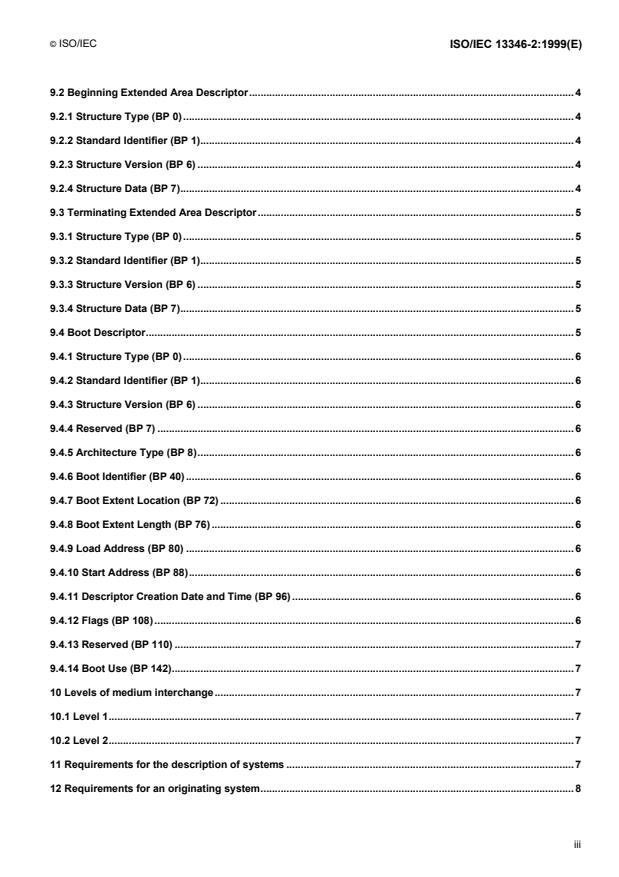
9.2 Beginning Extended Area Descriptor. 4
9.2.1 Structure Type (BP 0). 4
9.2.2 Standard Identifier (BP 1). 4
9.2.3 Structure Version (BP 6) . 4
9.2.4 Structure Data (BP 7). 4
9.3 Terminating Extended Area Descriptor. 5
9.3.1 Structure Type (BP 0). 5
9.3.2 Standard Identifier (BP 1). 5
9.3.3 Structure Version (BP 6) . 5
9.3.4 Structure Data (BP 7). 5
9.4 Boot Descriptor. 5
9.4.1 Structure Type (BP 0). 6
9.4.2 Standard Identifier (BP 1). 6
9.4.3 Structure Version (BP 6) . 6
9.4.4 Reserved (BP 7) . 6
9.4.5 Architecture Type (BP 8). 6
9.4.6 Boot Identifier (BP 40). 6
9.4.7 Boot Extent Location (BP 72) . 6
9.4.8 Boot Extent Length (BP 76) . 6
9.4.9 Load Address (BP 80) . 6
9.4.10 Start Address (BP 88). 6
9.4.11 Descriptor Creation Date and Time (BP 96) . 6
9.4.12 Flags (BP 108) . 6
9.4.13 Reserved (BP 110) . 7
9.4.14 Boot Use (BP 142). 7
10 Levels of medium interchange. 7
10.1 Level 1. 7
10.2 Level 2. 7
11 Requirements for the description of systems . 7
12 Requirements for an originating system. 8
iii
© ISO/IEC
12.1 General.8
12.2 Optional access by user.8
12.2.1 Descriptors.8
13 Requirements for a receiving system.8
13.1 General.8
13.2 Optional access by user.8
13.2.1 Descriptors.8
Annex A (informative) Changes from ISO/IEC 13346-2:1995 to this second edition.9
iv
© ISO/IEC
Foreword
ISO (the International Organization for Standardization) and IEC (the International Electrotechnical Commission)
form the specialised system for worldwide standardisation. National Bodies that are members of ISO or IEC
participate in the development of International Standards through technical committees established by the
respective organisation to deal with particular fields of technical activity. ISO and IEC technical committees
collaborate in fields of mutual interest. Other international organisations, governmental and non-governmental, in
liaison with ISO and IEC, also take part in this work.
In the field of information technology, ISO and IEC have established a Joint Technical Committee, ISO/IEC JTC 1.
Draft International Standards adopted by the Joint Technical Committee are circulated to National Bodies for voting.
Publication of an International Standard requires approval by at least 75% of the national bodies casting a vote.
International Standard ISO/IEC 13346-2 was prepared by ECMA, (as Standard ECMA-167) and was adopted,
under a special “fast-track procedure”, by Joint Technical Committee ISO/IEC JTC 1, Information technology, in
parallel with its approval by National Bodies of ISO and IEC.
This second edition cancels and replaces the first edition (ISO/IEC 13346-2:1995), which has been technically
revised.
ISO/IEC 13346 consists of the following parts, under the general title Information technology — Volume and file
structure of write-once and rewritable media using non-sequential recording for information interchange:
Part 1: General
Part 2: Volume and boot block recognition
Part 3: Volume structure
Part 4: File structure
Part 5: Record structure
Annex A of this part of ISO/IEC 13346 is for information only.
v
© ISO/IEC
Introduction
ISO/IEC 13346 is a volume and file structure standard for interchanging files and as such, it is a peer to existing
volume and file structure standards such as ISO 9293 and ISO 9660. It is rather different from those standards in at
least two important ways. Firstly, it offers much more functionality, mainly because of user needs for increased
character set support and for more powerful file system features. Secondly, it acknowledges the separate concerns
of booting, volume structure and file system structure. Rather than bundling these different functions together,
ISO/IEC 13346 carefully segregates these functions into separate parts and describes in detail how those parts fit
together. It is expected that future volume and file structure standards will fit into this framework, rather than building
other distinct and incompatible formats.
ISO/IEC 13346 is published in five Parts. Part 1 - general - specifies references, definitions, notations and basic
structures used in the other four Parts. Part 2 - volume and boot block recognition - specifies formats and system
requirements for recognising the volume structures on a medium and booting from a medium. Part 3 - volume
structure - specifies how to record various volume-related entities such as volumes, volume sets and logical
volumes. Part 4 - file structure - specifies how to record and interpret files, both file data and file attributes, and file
hierarchies within logical volumes. Part 5 - record structure - specifies how to record and interpret file data encoded
as records.
vi
©
INTERNATIONAL STANDARD ISO/IEC ISO/IEC 13346-2:1999(E)
Information technology — Volume and file structure of write-once
and rewritable media using non-sequential recording for
information interchange —
Part 2:
Volume and boot block recognition
1 Scope
This part of ISO/IEC 13346 specifies a format and associated system requirements for volume and boot block
recognition by specifying:
volume recognition;
boot descriptors intended for use to bring a system to a known state;
levels of medium interchange;
requirements for the processes which are provided within information processing systems, to enable
information to be interchanged between different systems; for this purpose, this part of ISO/IEC 13346 specifies
the functions to be
...