

ISO/IEC 4005-3:2023
(Main)Telecommunications and information exchange between systems — Unmanned aircraft area network (UAAN) — Part 3: Physical and data link protocols for control communication
General Information
- Abstract
This document specifies communication protocols for the physical and data link layer for control communication, which is wireless distributed communication network for units related with unmanned aircrafts (UAs) in level II. This document describes control communication, which is one-to-one communication between a UA and a controller.
- Status
- Published
- Publication Date
- 21-Mar-2023
- Drafting Committee
- ISO/IEC JTC 1/SC 6/WG 1 - Physical and data link layers
- Current Stage
- 6060 - International Standard published
- Start Date
- 22-Mar-2023
- Due Date
- 09-Feb-2023
- Completion Date
- 22-Mar-2023

Overview
ISO/IEC 4005-3:2023 - Telecommunications and information exchange between systems - Unmanned aircraft area network (UAAN) - Part 3: Physical and data link protocols for control communication - specifies the physical layer and data link layer protocols for one-to-one control communication between an unmanned aircraft (UA) and its controller. Focused on a wireless distributed communication model (Level II), the standard defines how UAs and controllers establish and maintain robust, interference-managed links in licensed frequency bands.
Key keywords: ISO/IEC 4005-3:2023, Unmanned aircraft area network, UAAN, control communication, physical layer, data link layer, wireless distributed communication, UA controller.
Key Topics and Technical Requirements
The standard covers detailed technical topics and requirements for reliable UA control links, including:
Physical layer specifications
- Channel and frame structure for data channels (number of channels, bandwidth, frame/slot structure, subchannels)
- Channel and frame structure for tone channels (frame structure, slot power, slot block and subslot timing, signal waveform)
- Encoding procedures, synchronization, subchannel power management, measurements and coexistence operation
Data link layer protocols
- General protocol behavior, channel mapping, and measurement processes
- Subchannel negotiation mechanisms (using shared channel, dedicated slot, or initial work resources)
- Resource allocation competition, generated link confirmation, and broadcasting of control channel status
- Subchannel occupation, collision detection and collision management (including collision tone procedures and power control during occupation)
- Reallocation procedures and decision criteria
- Data exchange (packet format) and synchronization
- Data link layer security and interfaces with upper layers and other communication layers
Operational elements
- Initial work resources (IWR), dedicated slots/subchannels, subchannel maps, interference power calculation, and interface definitions for initialization and dynamic control.
Practical Applications and Who Uses This Standard
ISO/IEC 4005-3:2023 is intended for organizations involved in designing, implementing, certifying, and operating UA control communications:
- Aerospace and UAV system integrators implementing UA-to-controller links
- Telecommunications and radio equipment manufacturers (modems, transceivers)
- Regulatory bodies and spectrum managers implementing licensed-band UA communication rules
- Test labs and certification bodies validating compliance with UAAN physical and data link requirements
- Software developers and network architects building UAAN protocol stacks and control applications
Related Standards
- ISO/IEC 4005-1 - Communication model and requirements for UAAN
- ISO/IEC 4005-2:2023 - Physical and data link protocols for shared communication
- ISO/IEC 4005-4 - Video communication for UAs
Note: The standard is intended for licensed frequency use and includes patent‑related considerations as noted by ISO/IEC.
Get Certified
Connect with accredited certification bodies for this standard

BSI Group
BSI (British Standards Institution) is the business standards company that helps organizations make excellence a habit.

Bureau Veritas
Bureau Veritas is a world leader in laboratory testing, inspection and certification services.

DNV
DNV is an independent assurance and risk management provider.
Sponsored listings
Frequently Asked Questions
ISO/IEC 4005-3:2023 is a standard published by the International Organization for Standardization (ISO). Its full title is "Telecommunications and information exchange between systems — Unmanned aircraft area network (UAAN) — Part 3: Physical and data link protocols for control communication". This standard covers: This document specifies communication protocols for the physical and data link layer for control communication, which is wireless distributed communication network for units related with unmanned aircrafts (UAs) in level II. This document describes control communication, which is one-to-one communication between a UA and a controller.
This document specifies communication protocols for the physical and data link layer for control communication, which is wireless distributed communication network for units related with unmanned aircrafts (UAs) in level II. This document describes control communication, which is one-to-one communication between a UA and a controller.
ISO/IEC 4005-3:2023 is classified under the following ICS (International Classification for Standards) categories: 35.100.10 - Physical layer; 35.100.20 - Data link layer; 49.020 - Aircraft and space vehicles in general. The ICS classification helps identify the subject area and facilitates finding related standards.
ISO/IEC 4005-3:2023 is available in PDF format for immediate download after purchase. The document can be added to your cart and obtained through the secure checkout process. Digital delivery ensures instant access to the complete standard document.
Standards Content (Sample)
INTERNATIONAL ISO/IEC
STANDARD 4005-3
First edition
2023-03
Telecommunications and information
exchange between systems —
Unmanned aircraft area network
(UAAN) —
Part 3:
Physical and data link protocols for
control communication
Télécommunications et échange d'information entre systèmes —
Réseau de zone de drones (Unmanned aircraft area network -
UAAN) —
Partie 3: Protocoles de liaison de données et physiques pour la
communication de contrôle
Reference number
© ISO/IEC 2023
© ISO/IEC 2023
All rights reserved. Unless otherwise specified, or required in the context of its implementation, no part of this publication may
be reproduced or utilized otherwise in any form or by any means, electronic or mechanical, including photocopying, or posting on
the internet or an intranet, without prior written permission. Permission can be requested from either ISO at the address below
or ISO’s member body in the country of the requester.
ISO copyright office
CP 401 • Ch. de Blandonnet 8
CH-1214 Vernier, Geneva
Phone: +41 22 749 01 11
Email: copyright@iso.org
Website: www.iso.org
Published in Switzerland
ii
© ISO/IEC 2023 – All rights reserved
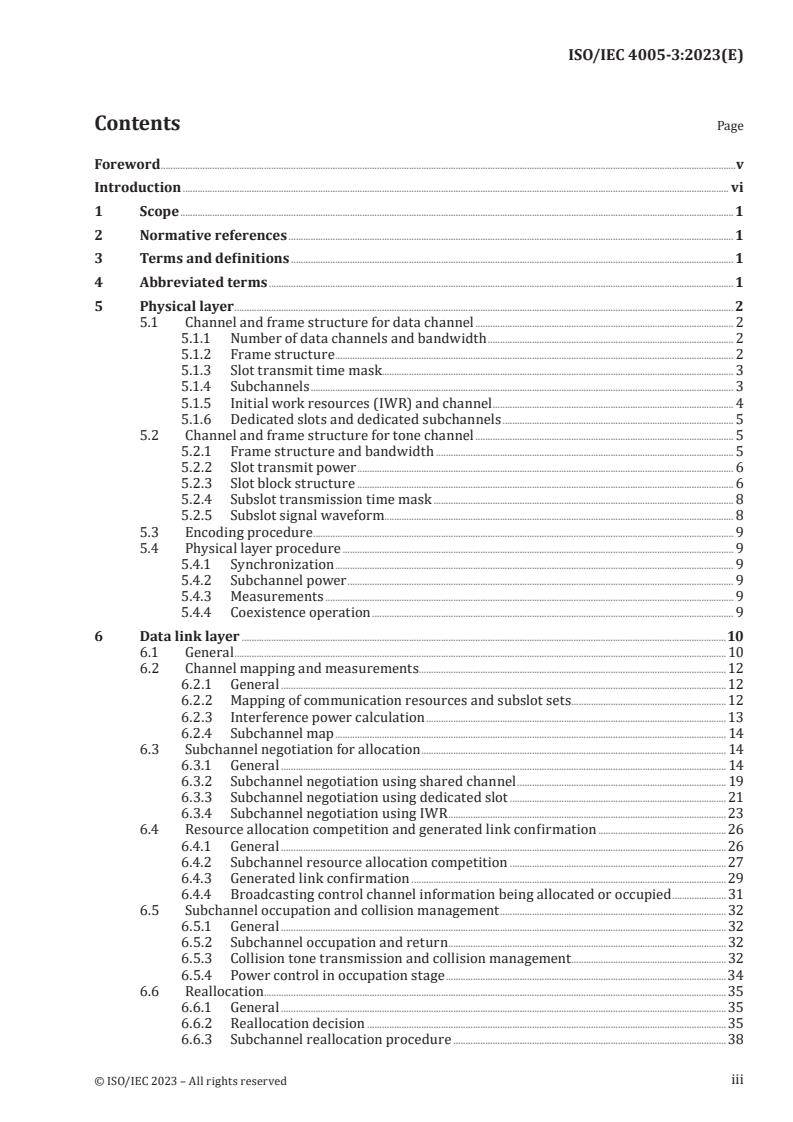
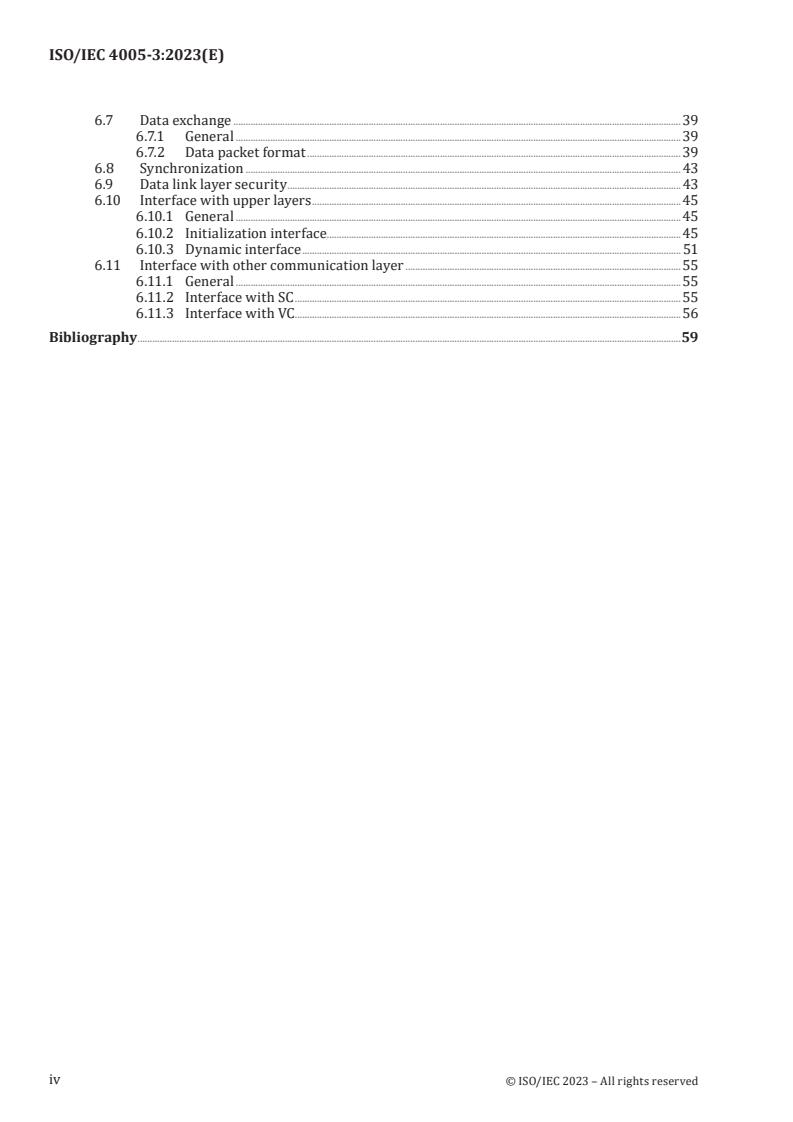
Contents Page
Foreword .v
Introduction . vi
1 Scope . 1
2 Normative references . 1
3 Terms and definitions . 1
4 Abbreviated terms . 1
5 Physical layer . 2
5.1 Channel and frame structure for data channel . 2
5.1.1 Number of data channels and bandwidth . 2
5.1.2 Frame structure . 2
5.1.3 Slot transmit time mask . . 3
5.1.4 Subchannels . 3
5.1.5 Initial work resources (IWR) and channel . 4
5.1.6 Dedicated slots and dedicated subchannels . 5
5.2 Channel and frame structure for tone channel . 5
5.2.1 Frame structure and bandwidth . 5
5.2.2 Slot transmit power . 6
5.2.3 Slot block structure . 6
5.2.4 Subslot transmission time mask . 8
5.2.5 Subslot signal waveform. 8
5.3 Encoding procedure . 9
5.4 Physical layer procedure . 9
5.4.1 Synchronization . 9
5.4.2 Subchannel power . 9
5.4.3 Measurements . 9
5.4.4 Coexistence operation . 9
6 Data link layer .10
6.1 General . 10
6.2 Channel mapping and measurements.12
6.2.1 General .12
6.2.2 Mapping of communication resources and subslot sets.12
6.2.3 Interference power calculation . 13
6.2.4 Subchannel map . 14
6.3 Subchannel negotiation for allocation . 14
6.3.1 General . 14
6.3.2 Subchannel negotiation using shared channel . 19
6.3.3 Subchannel negotiation using dedicated slot . 21
6.3.4 Subchannel negotiation using IWR . 23
6.4 Resource allocation competition and generated link confirmation . 26
6.4.1 General . 26
6.4.2 Subchannel resource allocation competition . 27
6.4.3 Generated link confirmation .29
6.4.4 Broadcasting control channel information being allocated or occupied . 31
6.5 Subchannel occupation and collision management . 32
6.5.1 General . 32
6.5.2 Subchannel occupation and return . 32
6.5.3 Collision tone transmission and collision management . 32
6.5.4 Power control in occupation stage .34
6.6 Reallocation . . 35
6.6.1 General . 35
6.6.2 Reallocation decision . 35
6.6.3 Subchannel reallocation procedure .38
iii
© ISO/IEC 2023 – All rights reserved
6.7 Data exchange . 39
6.7.1 General .39
6.7.2 Data packet format . 39
6.8 Synchronization . 43
6.9 Data link layer security . 43
6.10 Interface with upper layers . 45
6.10.1 General . 45
6.10.2 Initialization interface. 45
6.10.3 Dynamic interface . 51
6.11 Interface with other communication layer . 55
6.11.1 General . 55
6.11.2 Interface with SC . 55
6.11.3 Interface with VC . .56
Bibliography .59
iv
© ISO/IEC 2023 – All rights reserved
Foreword
ISO (the International Organization for Standardization) and IEC (the International Electrotechnical
Commission) form the specialized system for worldwide standardization. National bodies that are
members of ISO or IEC participate in the development of International Standards through technical
committees established by the respective organization to deal with particular fields of technical
activity. ISO and IEC technical committees collaborate in fields of mutual interest. Other international
organizations, governmental and non-governmental, in liaison with ISO and IEC, also take part in the
work.
The procedures used to develop this document and those intended for its further maintenance
are described in the ISO/IEC Directives, Part 1. In particular, the different approval criteria
needed for the different types of document should be noted. This document was drafted in
accordance with the editorial rules of the ISO/IEC Directives, Part 2 (see www.iso.org/directives or
www.iec.ch/members_experts/refdocs).
Attention is drawn to the possibility that some of the elements of this document may be the subject
of patent rights. ISO and IEC shall not be held responsible for identifying any or all such patent
rights. Details of any patent rights identified during the development of the document will be in the
Introduction and/or on the ISO list of patent declarations received (see www.iso.org/patents) or the IEC
list of patent declarations received (see https://patents.iec.ch).
Any trade name used in this document is information given for the convenience of users and does not
constitute an endorsement.
For an explanation of the voluntary nature of standards, the meaning of ISO specific terms and
expressions related to conformity assessment, as well as information about ISO's adherence to
the World Trade Organization (WTO) principles in the Technical Barriers to Trade (TBT) see
www.iso.org/iso/foreword.html. In the IEC, see www.iec.ch/understanding-standards.
This document was prepared by Joint Technical Committee ISO/IEC JTC 1, Information technology,
Subcommittee SC 6, Telecommunications and information exchange between systems.
A list of all parts in the ISO/IEC 4005 series can be found on the ISO and IEC websites.
Any feedback or questions on this document should be directed to the user’s national standards
body. A complete listing of these bodies can be found at www.iso.org/members.html and
www.iec.ch/national-committees.
v
© ISO/IEC 2023 – All rights reserved
Introduction
Unmanned aircrafts (UAs) operating at low altitudes will provide a variety of commercial services in
the near future. UAs that provide these services are distributed in the airspace. In low uncontrolled
airspace, many people operate their own UAs without the assignment of communication channels from
a central control centre.
This document describes control communication, which is a wireless distributed communication. Control
communication allows control pairs of UA and controller distributed over the airspace to communicate
with each other without serious interference. The channel used for control communication has a multi-
channel structure, which enables UAs and controllers to independently use the communication link
occupied by each other. A wireless distributed communication described by this document is intended
to be used in licensed frequency bands.
The ISO/IEC 4005 series consists of the following four parts:
ISO/IEC 4005-1: To support various services for UAs, it describes a wireless distributed communica-
tion model and the requirements that this model shall satisfy.
ISO/IEC 4005-2: It describes communication in which all units involved in UA operation can broad-
cast or exchange information by sharing communication resources with each other.
ISO/IEC 4005-3 (this document): It describes the control communication for the controller to con-
trol the UA.
ISO/IEC 4005-4: It describes video communication for UAs to send video to a controller.
The International Organization for Standardization (ISO) and International Electrotechnical
Commission (IEC) draw attention to the fact that it is claimed that compliance with this document may
involve the use of patents.
ISO and IEC take no position concerning the evidence, validity and scope of these patent rights.
The holders of these patent rights have assured ISO and IEC that they are willing to negotiate licences
under reasonable and non-discriminatory terms and conditions with applicants throughout the world.
In this respect, the statements of the holders of these patent rights are registered with ISO and IEC.
Information may be obtained from the patent database available at www.iso.org/patents.
Attention is drawn to the possibility that some of the elements of this document may be the subject
of patent rights other than those in the patent database. ISO and IEC shall not be held responsible for
identifying any or all such patent rights.
vi
© ISO/IEC 2023 – All rights reserved
INTERNATIONAL STANDARD ISO/IEC 4005-3:2023(E)
Telecommunications and information exchange between
systems — Unmanned aircraft area network (UAAN) —
Part 3:
Physical and data link protocols for control communication
1 Scope
This document specifies communication protocols for the physical and data link layer for control
communication, which is wireless distributed communication network for units related with unmanned
aircrafts (UAs) in level II.
This document describes control communication, which is one-to-one communication between a UA
and a controller.
2 Normative references
The following documents are referred to in the text in such a way that some or all of their content
constitutes requirements of this document. For dated references, only the edition cited applies. For
undated references, the latest edition of the referenced document (including any amendments) applies.
ISO/IEC 4005-1, Telecommunications and information exchange between systems — Unmanned aircraft
area network (UAAN) — Part 1: Communication model and requirements
ISO/IEC 4005-2:2023, Telecommunications and information exchange between systems — Unmanned
aircraft area network (UAAN) — Part 2: Physical and data link protocols for shared communication
ISO/IEC 4005-4, Telecommunications and information exchange between systems — Unmanned aircraft
area network (UAAN) — Part 4: Physical and data link protocols for video communication
ISO 21384-4, Unmanned aircraft systems — Part 4: Vocabulary
3 Terms and definitions
For the purposes of this document, the terms and definitions defined in ISO/IEC 4005-1, ISO/IEC 4005-2,
ISO 21384-4 and the following apply.
ISO and IEC maintain terminology databases for use in standardization at the following addresses:
— ISO Online browsing platform: available at https:// www .iso .org/ obp
— IEC Electropedia: available at https:// www .electropedia .org/
3.1
subchannel map
2-bit string indicating whether subchannels are available
Note 1 to entry: In wireless distributed communication, the subchannel map of each unit is generally different.
4 Abbreviated terms
CC Control Communication
© ISO/IEC 2023 – All rights reserved
CRC Cyclic Redundancy Check
CSCH Control Subchannel
DLL Data Link Layer
DS Dedicated Slot
FN Frame Number
IWR Initial Work Resource
LFSR Linear Feedback Shift Register
PB Parsing Block
PKH Packet Header
PN Pseudo Noise
SA Source Address
SC Shared Communication
TSB Tone Slot Block
TX Transmission
UTC Coordinated Universal Time
VC Video Communication
VSCH Video Subchannel
5 Physical layer
5.1 Channel and frame structure for data channel
5.1.1 Number of data channels and bandwidth
The number of data channels is N as shown in Figure 1. N is greater than or equal to one. The bandwidth
of one data channel is 1,25 MHz. The N is determined in the upper layer.
Figure 1 — Data channels in frequency region
5.1.2 Frame structure
The frame length of the data channel is 1 sec and consists of 500 slots and one slot time T is 2 ms as
s
shown in Figure 2. FN is a frame number that varies from 0 to 59 and has the same value as the second
of the current time.
© ISO/IEC 2023 – All rights reserved
a
1 frame, T = 1 sec = 500 T
f s.
b
1 slot, T = 2 ms.
s
Figure 2 — Frame structure of the control channel
5.1.3 Slot transmit time mask
The transmission time mask of a slot is shown in Figure 3.
a
2 ms.
b
Modulated signal.
Figure 3 — The transmission time mask of a slot
T , T , T , T are symbol offsets from T and symbol time is 1/672000 sec. Each value is as follows: T is
1 2 3 4 0 1
2, T is 1297, T is 1299, T is 1344.
2 3 4
T is 0 μs as the start time of the slot and the power amplifier is gated on and unmodulated fine signals
begin to be transmitted. T is an offset at which modulation signal transmission starts. T is an offset
1 2
at which the transmission of the modulated signal ends. T is an offset at which the power amplifier is
gated off, and transmission of unmodulated fine signals is stopped. The transmit power of T to T , T to
0 1 2
T shall be at least 50 dB less than the modulation signal transmit power.
5.1.4 Subchannels
5.1.4.1 General
One data channel consists of 20 subchannels as shown in Figure 4. Subchannel y of control channel x is
composed of the following slot set.
CCH = S , S , S , …, S
x,y x,z x,z+20 x,z+40 x,z+480
ye, venframe
z = (1)
yy+(2m− od 4)/2 ×4, oddframe
where
y is subchannel number, y=0, 1, …, 19;
© ISO/IEC 2023 – All rights reserved
S is slot z of control channel x.
x,z
a
CCH
x
b
CCH
x,0
c
CCH
x,1
d
CCH
x,18
e
CCH
x,19
Figure 4 — Subchannel structure of control communication in even frame
A subchannel consists of 25 slots, the i-th slot resource of the subchannel y of the channel x is indicated
by SR and the subchannel y of frequency channel x is indicated by CCH . Therefore, CCH is as
x,y,i x,y x,y
follows.
CCH =…SR ,,SR ,SR (2)
xy,,xy ,,01xy ,,xy ,24
where SR is i-th slot resource of subchannel y of channel x, i=0, …, 24.
x,y,i
5.1.4.2 Up and down link decision of slot resources
For SR , 5 slots satisfying (i mod 5) =(FN mod 5) are downlink and remain 20 slots are uplink, where
x,y,i
mod means modulo operation.
5.1.5 Initial work resources (IWR) and channel
The upper layer can set the initial work resource (IWR) as follows, and the use of the IWR is determined
by the upper layer.
© ISO/IEC 2023 – All rights reserved
Four subchannels of frequency channel N_IWR, CCH , CCH , CCH , CCH
N_IWR,16 N_IWR,17 N_IWR,18 N_IWR,19
are designated as initial work channels. They are newly named IWRCH , IWRCH , IWRCH , IWRCH
0 1 2 3
respectively. These four initial work channels are not used for control, but are initially used to allocate
control subchannels (CSCHs) between the UA and the controller, where N_IWR is received from the
upper layer with UPtoDL.InfoIWRSlot.
The 25 slots of IWRCH are divided into five IWRs in order.
y
IR =ISRI, SR ,,,ISRISR ISR (3)
yi,,xi55xi, +15xi,,,+++25xi 35xi 4
where
y is an IWRCH number and has the value from 0 to 3;
ISR is i-th slot resource of IWRCH .
x,y,i y
5.1.6 Dedicated slots and dedicated subchannels
The upper layer can pre-determine one or more subchannels as dedicated subchannels. In this case,
the tone subslot sets mapped with the dedicated subchannel is not used as a competition tone and can
be used for other purposes. Slots in the dedicated subchannel are used as dedicated slots (DSs). One or
several dedicated slots can be assigned to UAs and controllers in advance. UAs and controllers use the
dedicated slots without competition.
It is recommended to set the dedicated subchannel in frequency channel N_IWR.
Dedicated subchannel information and dedicated slot information are received from an upper layer
through UPtoDL.InfoDedicatedChannel and UPtoDL.InfoDedicatedSlot.
5.2 Channel and frame structure for tone channel
5.2.1 Frame structure and bandwidth
The tone channel of the control communication indicates a competitive tone channel. The frame length
of tone channel is 1 sec and the number of slots per frame is 500. Four tone slots constitute one tone
slock block (TSB). Thus, there are 125 TSBs in one second frame as shown in Figure 5.
a
1 frame, T = 1 second = 500 T
f s.
b
1 slot, T = 2 ms.
s
c
1 slot block, T = 8 ms.
sb
Figure 5 — Frame structure of tone channel in control communication
The bandwidth of the tone channel is 250 kHz. FN is a frame number that varies from 0 to 59 and has
the same value as the second of the current time.
© ISO/IEC 2023 – All rights reserved
5.2.2 Slot transmit power
The maximum slot transmission power of the tone channel, PmaxTCH, is received as UPtoDL.
InfoPowerParamCCH from the upper layer. The transmission power of the tone subslot signal is
determined by adding the PTX_CCHTCH_differ value to the transmission power of the mapped CSCH.
5.2.3 Slot block structure
There are three types of slot blots. TSBtype0, TSBtype1, TSBtype2 are these. The type of each slot blot
of the TCH is received from the upper layer as UPtoDL.InfoTSBTypeMap.
There are 132 subslots in one slot block of TSBtype0. The length T of the subslot is 60 μs. The 132
ss
subslots are divided into four parts, as shown in Figure 6, according to each slot numbers.
a
Type 0.
b
1 slot block, T = 8 ms.
sb
c
T = 60 μs.
ss
d
40 μs.
Figure 6 — Type 0 TSB structure
In case of TSBtype0, n-th slot block is composed as follows.
— (0, 4n), (0, (4n + 1)), (0, (4n + 2)), (0, (4n + 3)), (1, 4n), (1, (4n + 1) ), (1, (4n + 2)), (1, (4n + 3)),. , (32,
4n), (32, (4n + 1)), (32, (4n + 2)), (32, (4n + 3))
where (x, y) is the x-th subslot of the y-th subslot set. The 132 subslots are divided into four subslot sets.
— {S } = {(0, 4n), (1, 4n), ., (32, 4n)}
4n
— {S } = {(0, (4n + 1)), (1, (4n + 1)), ., (32, (4n + 1))}
4n+1
— {S } = {(0, (4n + 2)), (1, (4n + 2)), ., (32, (4n + 2))}
4n+2
— {S } = {(0, (4n + 3)), (1, (4n + 3)), ., (32, (4n + 3))}
4n+3
where {S } is the x-th subslot set.
x
There are a total of 80 subslots in TSBtype1. The length T of the subslot is 100 μs. The 80 subslots are
ss
divided into four parts, as shown in Figure 7, according to each slot number.
© ISO/IEC 2023 – All rights reserved
a
Type1.
b
1 slot block, T = 8 ms.
sb
c
T = 100 μs.
ss
Figure 7 — Type 1 TSB structure
The n-th slot block that belongs to TSBtype1 is composed of the following subslot combinations.
— (0, 4n), (0, (4n + 1)), (0, (4n + 2)), (0, (4n + 3)), (1, 4n), (1, (4n + 1) ), (1, (4n + 2)), (1, (4n + 3)),. , (19,
4n), (19, (4n + 1)), (19, (4n + 2)), (19, (4n + 3))
The 80 subslots make up four subslot sets.
— {S } = {(0, 4n), (1, 4n), ., (19, 4n)}
4n
— {S } = {(0, (4n + 1)), (1, (4n + 1)), ., (19, (4n + 1))}
4n+1
— {S } = {(0, (4n + 2)), (1, (4n + 2)), ., (19, (4n + 2))}
4n+2
— {S } = {(0, (4n + 3)), (1, (4n + 3)), ., (19, (4n + 3))}
4n+3
There are a total of 40 subslots in TSBtype2. The length T of the subslot is 200 μs. The 40 subslots are
ss
divided into four parts, as shown in Figure 8, according to each slot numbers.
a
Type2.
b
1 slot block, T = 8 ms.
sb
c
T = 200 μs.
ss
Figure 8 — Type 2 TSB structure
© ISO/IEC 2023 – All rights reserved
The n-th slot block that belongs to TSBtype2 is composed of the following subslot combinations.
— (0, 4n), (0, (4n + 1)), (0, (4n + 2)), (0, (4n + 3)), (1, 4n), (1, (4n + 1) ), (1, (4n + 2)), (1, (4n + 3)),. , (9, 4n),
(9, (4n + 1)), (9, (4n + 2)), (9, (4n + 3))
The 40 subslots make up four subslot sets.
— {S } = {(0, 4n), (1, 4n), ., (9, 4n)}
4n
— {S } = {(0, (4n + 1)), (1, (4n + 1)), ., (9, (4n + 1))}
4n+1
— {S } = {(0, (4n + 2)), (1, (4n + 2)), ., (9, (4n + 2))}
4n+2
— {S } = {(0, (4n + 3)), (1, (4n + 3)), ., (9, (4n + 3))}
4n+3
Regardless of the type of TSB, there are a total of 500 subslot sets in one frame.
5.2.4 Subslot transmission time mask
Subslot transmission time mask is shown in Figure 9.
Key
T 0 μs
T , T , T , T time offsets from T
1 2 3 4 0
a
Subslot start.
b
Subslot end.
c
Tone signal.
d
Guard time.
Figure 9 — Subslot transmission time mask
T , T , T , and T are time offsets from T . T is 1 μs, T is 41 μs, and T is 42 μs.
1 2 3 4 0 1 2 3
In TSBtype0, T is 60 μs, guard time is 18 μs.
In TSBtype1, T is 100 μs, guard time is 58 μs.
In TSBtype2, T is 200 μs, guard time is 158 μs.
T is the time when the power amplifier is gated on, and unmodulated fine signals begin to be
transmitted. T is the time at which transmission of the modulated signal begins. T is the time at which
1 2
transmission of the modulated signal is terminated. T is the time when the power amplifier is gated
off and the transmission of unmodulated fine signals is stopped. The transmission power of the time
region from T to T and the transmission power of the time region from T to T shall be 50dB or more
0 1 2 3
less than the modulated signal transmission power.
5.2.5 Subslot signal waveform
The subslot signal waveform is the same as that of shared communication. See ISO/IEC 4005-2:2023,
5.1.2.3.
© ISO/IEC 2023 – All rights reserved
The modulation scheme of subslot signal is on-off keying. The subslot signal is started at T and
transmitted during the 40 μs interval. The waveform of the subslot transmission signal uses a raised
cosine function. The subslot signal is generated by the following formula.
cos(()πα tT −2 )
(tT −2 ))
gt(;α) = sinc , 04 ≤≤tT (4)
T
12 −−((α tT 2 )/ T)
where
α is 0,75 as a roll-off factor;
T is 10 μs as a raised cosine period.
5.3 Encoding procedure
The encoding procedure is identical with that of shared communication. See ISO/IEC 4005-2:2023, 5.2.
The final encoded signal is located between T and T in Figure 3, i.e. in the modulated signal part.
1 2
5.4 Physical layer procedure
5.4.1 Synchronization
All messages shall be transmitted based on UTC absolute time. All times are measured on UTC.
The synchronization mode of the unit includes 'A sync', 'B sync' and 'C sync'.
— A sync is synchronization obtained from UTC.
— B sync is secondary synchronization acquired from the synchronization signal of the A sync unit.
— C sync is sync status within 20 sec after sudden loss of sync in A or B sync mode.
A sync unit shall know the date, hour, minute, second, slot number.
The time error of A sync shall be within ±0,4 μs. The time error of B sync shall be within ±4 μs. The time
error of C sync shall be within ±5 μs.
The frequency error of A sync shall be within ±0,1 ppm. The frequency error of the B sync shall be
within ±0,2 ppm. The frequency error of the C sync shall be within ±0,3 ppm.
5.4.2 Subchannel power
The maximum power of the CSCH, PmaxCCH, is received as UPtoDL.InfoPowerParamCCH from the
upper layer. The maximum transmission power and minimum transmission power of each CSCH are
received from the upper layer as UPtoDL.InfoPowerParamCCHsub. The power control of each CSCH is
described in the resource allocation procedure.
5.4.3 Measurements
The physical layer shall have the ability to measure the following parameters. The received signal
power of a tone subslot, the received signal power of a data slot, and propagation delay time of the
received data signal shall be measured. The receiving power determination point shall be the receiving
antenna connector.
5.4.4 Coexistence operation
If the hardware of shared communication described in ISO/IEC 4005-2 and the hardware of control
communication described in this document and the hardware of video communication described in
© ISO/IEC 2023 – All rights reserved
ISO/IEC 4005-4 are completely physically isolated and do not affect each other at all, it shall be allowed
that they do not perform coexistence operations, which is implementation dependent. In general, the
three communications affect each other, and in this case, the following coexistence operations shall be
performed.
The TX operation of a shared slot includes the TX of the corresponding shared slot and the TX operation
in the mapped tone subslot set. The TX operation of a control communication includes TX of the mapped
tone subslot set and CSCH TX. The TX operation of video communication includes TX of a mapped tone
subslot set and VSCH TX.
When a UA periodically broadcasts its information to a shared slot of a shared channel, a shared slot
and a tone subslot set mapped to the shared slot generally require 1 slot and 4 slots, respectively, for TX
operation. If the TX operation of the shared slot used for mandatory periodic broadcasting and the TX
operation of the control channel overlap, the TX operation of the shared slot shall be performed.
A CSCH and a VSCH shall be allocated so that they do not overlap in time.
The TX time of the tone subslot set mapped with mandatory periodically broadcasted shared slot, the
TX time of the tone subslot set mapped with the CSCH, and the TX time of the tone subslot set mapped
with the VSCH shall not overlap each other. If the control TSB type is TSBtype0, the control tone subslot
set and the shared tone subslot set can be located in the same TSB. In this case, the two tone subslot set
numbers shall be different. If the control TSB type is not TSBtype0, the control tone subslot set and the
shared tone subslot set cannot be located in the same TSB.
The TX operation time of the tone subslot set mapped with a CSCH can overlap the TX time of a VSCH,
and in this case, the corresponding video slot cannot be transmitted. The TX operation time of the
tone subslot set mapped with a VSCH can overlap with the slot TX time of a CSCH, and in this case, the
corresponding control slot cannot be transmitted.
The coexistence operation of the tone subslot set mapped with an IWR is the same with coexistence
operation of the tone subslot set mapped with the CSCH.
6 Data link layer
6.1 General
The data link layer allocates subchannels consisting of 25 slots to controllers and UAs. The controller
can use this subchannel to control the UA. The typical application service of control communication
is that the controller controls the UA, but it is possible to provide other services through the occupied
control link. This is determined at the upper layer.
The procedure of using the subchannel is shown in Figure 10 and as follows:
— negotiation of subchannel number to be allocated;
— competition for allocation and generated link confirmation;
— occupation and management of subchannels;
— subchannel return or reallocation.
Firstly, the UA and the controller each create a map of the available subchannels. The controller selects
one of the subchannels available together and the controller transfers the selected subchannel number
to the other unit. This process can be performed by the CC DLL as well as SC DLL.
After that, the UA and the controller attempt to allocate subchannel at the same time. Subchannel can
be allocated only when the UA and the controller succeed in allocation at the same time. Therefore, it is
necessary to confirm whether a link is formed.
© ISO/IEC 2023 – All rights reserved
If the subchannel allocation is successful, the UA and the controller simultaneously perform slot clearing
to occupy the subchannel. While occupying a subchannel, the UA and the controller constantly check for
collisions of subchannel resources. They also calculate the amount of interference from neighboring
channels.
If collision of subchannel resources or interference with neighbouring channels exceeding the threshold
is detected, the UA and the controller reallocate the subchannel. To do this, the UA and the controller
decide which subchannels to reallocate and perform allocation competition on that subchannel.
The UA and the controller return the subchannel when they can no longer maintain or need to maintain
them.
Figure 10 — Subchannel use procedure
[1]
NOTE Detecting resource collision satisfies the data link design requirement described in ISO 21384-2
that the design of the data link mitigates co-channel interference with other users of the spectrum.
© ISO/IEC 2023 – All rights reserved
6.2 Channel mapping and measurements
6.2.1 General
Allocating subchannel resources is performed by a tone channel. One subslot set in a tone channel and
one subchannel have a mapping relationship. When one tone subslot set is allocated, the subchannel
mapped thereto is allocated.
In order for a UA and a controller to allocate a subchannel, the UA and the controller shall find
subchannels that can be allocated at the same time. To this end, the UA and the controller determine
allocable subchannels by calculating the interference power for each subchannel.
6.2.2 Mapping of communication resources and subslot sets
The competition for allocating a subchannel or an IWR is performed in the subslot set mapped thereto.
Subslot sets are mapped to subchannels or IWRs.
If the upper layer does not specify IWRs, the tone subslot set 0 to the tone subslot set 19 are left empty.
When the IWRs are specified, the tone subslot sets are mapped as follows.
The tone subslot sets {S }, {S }, {S }, and {S } are mapped to IR , IR , IR , and IR respectively.
0 1 2 3 0,0 1,0 2,0 3,0
The tone subslot sets {S }, {S }, {S }, and {S } are mapped to IR , IR , IR , and IR respectively.
4 5 6 7 0,1 1,1 2,1 3,1
The tone subslot sets {S }, {S }, {S }, and {S } are mapped to IR , IR , IR , and IR respectively.
8 9 10 11 0,2 1,2 2,2 3,2
The tone subslot sets {S }, {S }, {S }, and {S } are mapped to IR , IR , IR , and IR respectively.
12 13 14 15 0,3 1,3 2,3 3,3
The tone subslot sets {S }, {S }, {S }, and {S } are mapped to IR , IR , IR , and IR respectively.
16 17 18 19 0,4 1,4 2,4 3,4
The tone subslot set {S } is mapped to the subchannel CCH , where m is 20x+((y+8) mod 20) and
m+20+n x,y
n is as follows.
0, evenframe
n = (5)
20 −×(mxo od 24), 0 dd frame
Thereafter, {S } mapped to CCH is expressed as {S }.
m+20+n x,y x,y
As mentioned above, the four subchannels of frequency channel N_IWR, CCH , CCH ,
N_IWR,16 N_IWR,17
CCH , CCH are newly renamed as IWRCH , IWRCH , IWRCH , IWRCH . Therefore, the tone
N_IWR,18 N_IWR,19 0 1 2 3
subslot sets mapped with these four subchannels are not used. The upper layer can designate these
tone subslot sets as information tone subslot sets. The slot block type of the tone subslot sets from {S }
to {S } is TSBtype2.
This mapping is shown in Figure 11.
a) Even frame
© ISO/IEC 2023 – All rights reserved
b) Odd frame
a
IR , IR , IR , IR , IR , IR , …, IR , IR
0,0 1,0 2,0 3,0 0,1 1,1 2,4 3,4
b
Tone subslot set.
c
CCH , CCH , … CCH
0,12 0,13 0,11
d
CCH , CCH , … CCH
1,12 1,13 1,11
Figure 11 — Mapping of control subchannel (CSCH) and tone subslot sets
6.2.3 Interference power calculation
In order to allocate the CSCH, the unit shall calculate the interference power in the allocable subchannels.
The interference constants for calculating the interference power are N, IC , IC , …, IC and received
1 2 N-1
as UPtoDL.InfoICConstant from the upper layer. Where N is the number of CCH channels. The unit
of interference constants is dB. The estimated interference power of the subchannel is expressed as
PImCCH .
xy
The interference of the subchannel CCH experienced by the controller is calculated as follows.
xy
N−1
Pc Im CCH =−()PmdCCH IC (6)
xy,,∑ iy xi−
ii=≠0, x
where PImdCCH is the reception power of the tone transmitted by the UA in the tone subslot set
i,y
mapped with CCH and the unit of this is dBm. The unit of (PImdCCH -IC ) is also dBm.
i,y i,y |x-i|
The interference of the subchannel CCH experienced by the UA is calculated as follows.
xy
N−1
PdIm CCH =−()PmcCCH IC (7)
xy,,iy xi−
∑
ii=≠0, x
where PImcCCH is the reception power of the tone transmitted by the controller in the tone subslot set
i,y
mapped with CCH .
i,y
IWRs exist in four subchannels of frequency channel N_IWR, CCH , CCH , CCH
N_IWR,16 N_IWR,17 N_IWR,18
and CCH . Therefore, the interference power of the IWR is equal to the interference power of
N_IWR,19
CCH , CCH , CCH and CCH . PImcIR is the interference power of the IWR in
N_IWR,16 N_IWR,17 N_IWR,18 N_IWR,19 i,y
controller and PImdIR is the interference power of the IWR in UA.
i,y
PImcIR =PImcCCH
iy,_NIWR,16+y
(8)
PImdIR =PImdCCH
iy,_NIWR,16+y
© ISO/IEC 2023 – All rights reserved
6.2.4 Subchannel map
Each unit shall make a subchannel map indicating the availability of subchannels. The subchannel map
is expressed in 2 bits per subchannel. If the subchannel interference PImCCH is equal to or less than
x,y
PTH_SMI0, 2 bits are '11'. If it is greater than PTH_SMI0 and less than PTH_SMI1, 2 bits are '10'. If it is
greater than PTH_SMI1 and less than PTH_SMI2, 2 bits are '01'. And if it is greater than PTH_SMI12, 2
bits are '00', where PTH_SMI0, PTH_SMI1, and PTH_SMI2 are threshold values for writing a subchannel
map and are received as UPtoDL.InfoPowerParamCCH from an upper layer. In addition, the upper layer
can designate available subchannels as UPtoDL.InfoApprovedSubchMap and subchannels that cannot
be used are written as '00'.
A UA that has allocated a control channel shall broadcast its own location, controller location, and
transmission power through the SC using a 0x86 parsing header, where ‘0x’ means hex notation and
each unit shall receive an SC signal transmitted by other units.
Each unit can know the currently occupied subchannels from the SC signal, and if the distance to
the UA or the controller occupying the subchannels is greater than d_map1, subchannels whose
transmission power is less than PTXmap0 are expressed as '10', and subchannels above PTXmap0 and
below PTXmap1 are expressed as '01', and subchannels above PTXmap1 are expressed as '00'. If the
distance to the UA or the controller occupying the subchannels is greater than d_map0 and less than or
equal to d_map1, subchannels with transmission power less than PTXmap2 are expressed as '10', and
subchannels greater than PTXmap2 and smaller than PTXmap3 are expressed as '01' and subchannels
greater than or equal to PTXmap3 are expressed as '00', where PTXmap0, PTXmap1, PTXmap2,
PTXmap3, d_map0 and d_map1 are threshold values for subchannel map creation, and are received as
UPtoDL.InfoPo
...