

ISO 14937:2009
(Main)Sterilization of health care products — General requirements for characterization of a sterilizing agent and the development, validation and routine control of a sterilization process for medical devices
General Information
- Abstract
ISO 14937:2009 specifies general requirements for the characterization of a sterilizing agent and for the development, validation and routine monitoring and control of a sterilization process for medical devices. It applies to sterilization processes in which microorganisms are inactivated by physical and/or chemical means and is intended to be applied by process developers, manufacturers of sterilization equipment, manufacturers of medical devices to be sterilized, and organizations responsible for sterilizing medical devices. ISO 14937:2009 specifies the elements of a Quality Management System which are necessary to assure the appropriate characterization of the sterilizing agent, development, validation and routine monitoring and control of a sterilization process.
- Status
- Published
- Publication Date
- 13-Oct-2009
- Technical Committee
- ISO/TC 198 - Sterilization of health care products
- Drafting Committee
- ISO/TC 198 - Sterilization of health care products
- Current Stage
- 9093 - International Standard confirmed
- Start Date
- 18-Sep-2026
- Completion Date
- 26-Sep-2026
Buy Documents


ISO 14937:2009 - Sterilization of health care products — General requirements for characterization of a sterilizing agent and the development, validation and routine control of a sterilization process for medical devices Released:10/14/2009

ISO 14937:2009 - Stérilisation des produits de santé — Exigences générales pour la caractérisation d'un agent stérilisant et pour la mise au point, la validation et la vérification de routine d'un processus de stérilisation pour dispositifs médicaux Released:10/14/2009

ISO 14937:2009 - Sterilization of health care products — General requirements for characterization of a sterilizing agent and the development, validation and routine control of a sterilization process for medical devices Released:10/27/2011
Overview
ISO 14937:2009 - Sterilization of health care products - defines general requirements for characterizing a sterilizing agent and for the development, validation and routine control of sterilization processes for medical devices. It applies to processes that inactivate microorganisms by physical and/or chemical means and specifies the essential elements of a Quality Management System (QMS) needed to ensure reproducible sterilization performance. Target users include process developers, sterilizer manufacturers, medical device producers and organizations performing sterilization.
Key topics and technical requirements
ISO 14937:2009 structures the lifecycle of a sterilization process into clear, auditable elements:
- QMS elements: documentation, management responsibility, product realization, measurement/analysis and control of non-conforming product.
- Sterilizing agent characterization: description of the agent, microbicidal effectiveness, material compatibility, safety and environmental considerations.
- Process and equipment characterization: process mapping, equipment capabilities and limits, and critical process parameters.
- Product and process definition: defining product families, bioburden considerations and process acceptance criteria.
- Validation: staged qualification including Installation Qualification (IQ), Operational Qualification (OQ) and Performance Qualification (PQ).
- Routine monitoring and control: in-process controls, indicators, product release criteria and record keeping.
- Maintaining effectiveness: calibration, maintenance, requalification and change assessment.
- Annexes provide normative guidance - selection of challenge microorganisms, three approaches for process definition (based on natural bioburden, reference organisms, or conservative reference-based definitions) and informative application guidance.
These requirements are intended to deliver a sterilization process that is reproducible, reliable and auditable, enabling assessment of sterility in probabilistic terms rather than absolute guarantees.
Applications and who uses it
ISO 14937:2009 is used for:
- Developing new sterilization methods where no specific standard exists (e.g., novel chemical agents or proprietary cycles).
- Validating and controlling sterilization lines in medical device manufacturing and contract sterilization facilities.
- Guiding sterilizer equipment manufacturers in characterizing performance and designing validation support.
- Regulatory and quality teams establishing procedures for product release, routine monitoring and change control.
Practical benefits include improved process robustness, defensible validation packages, and alignment with regulatory expectations for sterility assurance.
Related standards
- ISO 13485 (medical device QMS)
- ISO 17664 (processing of medical devices)
- EN 556-1 and ANSI/AAMI ST67 (sterility requirements / SAL guidance)
Keywords: ISO 14937:2009, sterilization process validation, sterilizing agent characterization, medical device sterilization, IQ OQ PQ, routine monitoring, bioburden, quality management system.
Relations
- Effective Date
- 06-May-2026
- Effective Date
- 09-Feb-2026
- Effective Date
- 09-Feb-2026
- Effective Date
- 09-Feb-2026
- Effective Date
- 09-Feb-2026
- Effective Date
- 09-Feb-2026
- Effective Date
- 09-Feb-2026
- Effective Date
- 09-Feb-2026
- Effective Date
- 09-Feb-2026
- Effective Date
- 09-Feb-2026
- Effective Date
- 09-Feb-2026
- Effective Date
- 09-Feb-2026
- Effective Date
- 09-Feb-2026
- Effective Date
- 09-Feb-2026
- Effective Date
- 09-Feb-2026
Buy Documents
ISO 14937:2009 - Sterilization of health care products — General requirements for characterization of a sterilizing agent and the development, validation and routine control of a sterilization process for medical devices Released:10/14/2009
ISO 14937:2009 - Stérilisation des produits de santé — Exigences générales pour la caractérisation d'un agent stérilisant et pour la mise au point, la validation et la vérification de routine d'un processus de stérilisation pour dispositifs médicaux Released:10/14/2009
ISO 14937:2009 - Sterilization of health care products — General requirements for characterization of a sterilizing agent and the development, validation and routine control of a sterilization process for medical devices Released:10/27/2011
Get Certified
Connect with accredited certification bodies for this standard

BSI Group
BSI (British Standards Institution) is the business standards company that helps organizations make excellence a habit.

TÜV Rheinland
TÜV Rheinland is a leading international provider of technical services.

TÜV SÜD
TÜV SÜD is a trusted partner of choice for safety, security and sustainability solutions.
Sponsored listings
Frequently Asked Questions
ISO 14937:2009 is a standard published by the International Organization for Standardization (ISO). Its full title is "Sterilization of health care products — General requirements for characterization of a sterilizing agent and the development, validation and routine control of a sterilization process for medical devices". This standard covers: ISO 14937:2009 specifies general requirements for the characterization of a sterilizing agent and for the development, validation and routine monitoring and control of a sterilization process for medical devices. It applies to sterilization processes in which microorganisms are inactivated by physical and/or chemical means and is intended to be applied by process developers, manufacturers of sterilization equipment, manufacturers of medical devices to be sterilized, and organizations responsible for sterilizing medical devices. ISO 14937:2009 specifies the elements of a Quality Management System which are necessary to assure the appropriate characterization of the sterilizing agent, development, validation and routine monitoring and control of a sterilization process.
ISO 14937:2009 specifies general requirements for the characterization of a sterilizing agent and for the development, validation and routine monitoring and control of a sterilization process for medical devices. It applies to sterilization processes in which microorganisms are inactivated by physical and/or chemical means and is intended to be applied by process developers, manufacturers of sterilization equipment, manufacturers of medical devices to be sterilized, and organizations responsible for sterilizing medical devices. ISO 14937:2009 specifies the elements of a Quality Management System which are necessary to assure the appropriate characterization of the sterilizing agent, development, validation and routine monitoring and control of a sterilization process.
ISO 14937:2009 is classified under the following ICS (International Classification for Standards) categories: 11.080.01 - Sterilization and disinfection in general. The ICS classification helps identify the subject area and facilitates finding related standards.
ISO 14937:2009 has the following relationships with other standards: It is inter standard links to EN ISO 80601-2-74:2026, EN ISO 16061:2021, EN ISO 80601-2-12:2023, EN ISO 17510:2020, EN ISO 80601-2-67:2020, EN ISO 17510:2025, EN ISO 5840-1:2021, EN ISO 14630:2012, EN ISO 25539-2:2012, EN ISO 80601-2-70:2025, EN ISO 25539-1:2017, EN ISO 80601-2-69:2020, EN ISO 80601-2-74:2021, EN ISO 80601-2-70:2020, EN ISO 25539-2:2020. Understanding these relationships helps ensure you are using the most current and applicable version of the standard.
ISO 14937:2009 is available in PDF format for immediate download after purchase. The document can be added to your cart and obtained through the secure checkout process. Digital delivery ensures instant access to the complete standard document.
Standards Content (Sample)
INTERNATIONAL ISO
STANDARD 14937
Second edition
2009-10-15
Sterilization of health care products —
General requirements for characterization
of a sterilizing agent and the
development, validation and routine
control of a sterilization process for
medical devices
Stérilisation des produits de santé — Exigences générales pour la
caractérisation d'un agent stérilisant et pour la mise au point, la
validation et la vérification de routine d'un processus de stérilisation
pour dispositifs médicaux
Reference number
©
ISO 2009
PDF disclaimer
This PDF file may contain embedded typefaces. In accordance with Adobe's licensing policy, this file may be printed or viewed but
shall not be edited unless the typefaces which are embedded are licensed to and installed on the computer performing the editing. In
downloading this file, parties accept therein the responsibility of not infringing Adobe's licensing policy. The ISO Central Secretariat
accepts no liability in this area.
Adobe is a trademark of Adobe Systems Incorporated.
Details of the software products used to create this PDF file can be found in the General Info relative to the file; the PDF-creation
parameters were optimized for printing. Every care has been taken to ensure that the file is suitable for use by ISO member bodies. In
the unlikely event that a problem relating to it is found, please inform the Central Secretariat at the address given below.
© ISO 2009
All rights reserved. Unless otherwise specified, no part of this publication may be reproduced or utilized in any form or by any means,
electronic or mechanical, including photocopying and microfilm, without permission in writing from either ISO at the address below or
ISO's member body in the country of the requester.
ISO copyright office
Case postale 56 • CH-1211 Geneva 20
Tel. + 41 22 749 01 11
Fax + 41 22 749 09 47
E-mail copyright@iso.org
Web www.iso.org
Published in Switzerland
ii © ISO 2009 – All rights reserved
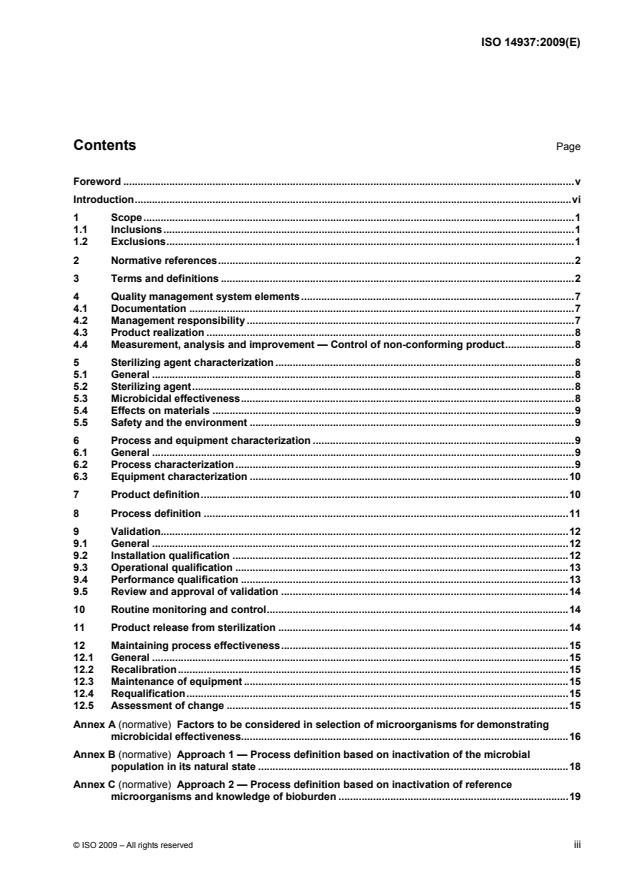
Contents Page
Foreword .v
Introduction.vi
1 Scope.1
1.1 Inclusions.1
1.2 Exclusions.1
2 Normative references.2
3 Terms and definitions .2
4 Quality management system elements.7
4.1 Documentation .7
4.2 Management responsibility .7
4.3 Product realization .8
4.4 Measurement, analysis and improvement — Control of non-conforming product.8
5 Sterilizing agent characterization .8
5.1 General .8
5.2 Sterilizing agent.8
5.3 Microbicidal effectiveness.8
5.4 Effects on materials .9
5.5 Safety and the environment .9
6 Process and equipment characterization .9
6.1 General .9
6.2 Process characterization.9
6.3 Equipment characterization .10
7 Product definition.10
8 Process definition .11
9 Validation.12
9.1 General .12
9.2 Installation qualification .12
9.3 Operational qualification .13
9.4 Performance qualification .13
9.5 Review and approval of validation .14
10 Routine monitoring and control.14
11 Product release from sterilization .14
12 Maintaining process effectiveness.15
12.1 General .15
12.2 Recalibration.15
12.3 Maintenance of equipment .15
12.4 Requalification.15
12.5 Assessment of change .15
Annex A (normative) Factors to be considered in selection of microorganisms for demonstrating
microbicidal effectiveness.16
Annex B (normative) Approach 1 — Process definition based on inactivation of the microbial
population in its natural state .18
Annex C (normative) Approach 2 — Process definition based on inactivation of reference
microorganisms and knowledge of bioburden .19
Annex D (normative) Approach 3 — Conservative process definition based on inactivation of
reference microorganisms.20
Annex E (informative) Guidance on application of this International Standard .22
Bibliography .36
iv © ISO 2009 – All rights reserved
Foreword
ISO (the International Organization for Standardization) is a worldwide federation of national standards bodies
(ISO member bodies). The work of preparing International Standards is normally carried out through ISO
technical committees. Each member body interested in a subject for which a technical committee has been
established has the right to be represented on that committee. International organizations, governmental and
non-governmental, in liaison with ISO, also take part in the work. ISO collaborates closely with the
International Electrotechnical Commission (IEC) on all matters of electrotechnical standardization.
International Standards are drafted in accordance with the rules given in the ISO/IEC Directives, Part 2.
The main task of technical committees is to prepare International Standards. Draft International Standards
adopted by the technical committees are circulated to the member bodies for voting. Publication as an
International Standard requires approval by at least 75 % of the member bodies casting a vote.
Attention is drawn to the possibility that some of the elements of this document may be the subject of patent
rights. ISO shall not be held responsible for identifying any or all such patent rights.
ISO 14937 was prepared by Technical Committee ISO/TC 198, Sterilization of health care products.
This second edition cancels and replaces the first edition (ISO 14937:2000) and ISO 14937:2000/Cor.1:2003
which have been technically revised.
Introduction
A sterile medical device is one that is free of viable microorganisms. International Standards that specify
requirements for validation and routine control of sterilization processes require, when it is necessary to
supply a sterile medical device, that adventitious microbiological contamination of a medical device prior to
sterilization be minimized. Even so, medical devices produced under standard manufacturing conditions in
accordance with the requirements for quality management systems (see, for example, ISO 13485) could, prior
to sterilization, have microorganisms on them, albeit in low numbers. Such medical devices are non-sterile.
The purpose of sterilization is to inactivate the microbiological contaminants and thereby transform the non-
sterile medical devices into sterile ones.
The kinetics of inactivation of a pure culture of microorganisms by physical and/or chemical agents used to
sterilize medical devices generally can best be described by an exponential relationship between the number
of microorganisms surviving and the extent of treatment with the sterilizing agent; inevitably this means that
there is always a finite probability that a microorganism might survive regardless of the extent of treatment
applied. For a given treatment, the probability of survival is determined by the number and resistance of
microorganisms and by the environment in which the organisms exist during treatment. It follows that the
sterility of any one medical device in a population subjected to sterilization processing cannot be guaranteed
and the sterility of a processed population is defined in terms of the probability of there being a viable
microorganism present on a medical device.
This International Standard describes requirements that, if met, will provide a sterilization process with
appropriate microbicidal activity intended to sterilize medical devices. Furthermore, compliance with the
requirements ensures that the sterilization process is both reliable and reproducible so that predictions can be
made, with reasonable confidence, that there is a low level of probability of there being a viable
microorganism present on a medical device after sterilization. Specification of this probability is a matter for
regulatory authorities and can vary from country to country (see, for example, EN 556-1 and
ANSI/AAMI ST67).
Generic requirements of the quality management system for design and development, production, installation
and servicing are given in ISO 9001 and particular requirements for quality management systems for medical
device production are given in ISO 13485. The standards for quality management systems recognise that, for
certain processes used in manufacturing, the effectiveness of the process cannot be fully verified by
subsequent inspection and testing of the product. Sterilization is an example of such a process. For this
reason, sterilization processes are validated for use, the performance of the sterilization process is monitored
routinely and the equipment is maintained.
Exposure to a properly validated, accurately controlled sterilization process is not the only factor associated
with the provision of reliable assurance that a processed medical device is sterile and, in this regard, suitable
for its intended use. Attention is also given to a number of factors including:
a) the microbiological status of incoming raw materials and/or components;
b) the validation and routine control of any cleaning and disinfection procedures used on the medical device;
c) the control of the environment in which the medical device is manufactured, assembled and packaged;
d) the control of equipment and processes;
e) the control of personnel and their hygiene;
f) the manner and materials in which the medical device is packaged;
g) the conditions under which the medical device is stored.
vi © ISO 2009 – All rights reserved
The type of contamination on a medical device to be sterilized varies, and this influences the effectiveness of
a sterilization process. Medical devices that have been used in a health care setting and that are being
presented for resterilization in accordance with the manufacturer's instructions (see ISO 17664) should be
regarded as special cases. There is the potential for such medical devices to possess a wide range of
contaminating microorganisms and residual inorganic and/or organic contamination in spite of the application
of a cleaning process. Hence, particular attention has to be given to the validation and control of the cleaning
and disinfection processes used during reprocessing.
The requirements are the normative parts of this International Standard with which compliance is claimed. The
guidance given in Annex E is not normative and is not provided as a checklist for auditors. The guidance
provides explanations and methods that are regarded as being a suitable means for complying with the
requirements. Methods other than those given in the guidance can be used if they are effective in achieving
compliance with the requirements of this International Standard.
The development, validation and routine control of a sterilization process comprise a number of discrete but
interrelated activities, for example, calibration, maintenance, product definition, process definition, installation
qualification, operational qualification and performance qualification. While the activities required by this
International Standard have been grouped together and are presented in a particular order, this International
Standard does not require that the activities be performed in the order that they are presented. The activities
required are not necessarily sequential, as the programme of development and validation can be iterative. The
responsibility for carrying out the activities required by this International Standard will vary from case to case.
This International Standard requires that the responsibilities of the various parties be defined (see 4.2) but
does not specify to whom the responsibilities are allocated. Annex E provides guidance on allocation of
responsibility.
This International Standard has three distinct applications:
⎯ for manufacturers of health care products who wish to apply to their products a sterilization process for
which a specific International Standard does not exist;
⎯ for manufacturers and users of sterilization processes in health care settings for which a specific
International Standard does not exist;
⎯ as a framework for the preparation or revision of standards for specific sterilization processes.
INTERNATIONAL STANDARD ISO 14937:2009(E)
Sterilization of health care products — General requirements
for characterization of a sterilizing agent and the development,
validation and routine control of a sterilization process for
medical devices
1 Scope
1.1 Inclusions
1.1.1 This International Standard specifies general requirements for the characterization of a sterilizing
agent and for the development, validation and routine monitoring and control of a sterilization process for
medical devices.
NOTE Although the scope of this International Standard is limited to medical devices, the requirements specified
herein can also be applied to sterilization processes for other health care products.
1.1.2 This International Standard applies to sterilization processes in which microorganisms are inactivated
by physical and/or chemical means.
1.1.3 This International Standard is intended to be applied by process developers, manufacturers of
sterilization equipment, manufacturers of medical devices to be sterilized, and organizations responsible for
sterilizing medical devices.
1.1.4 This International Standard specifies the elements of a Quality Management System which are
necessary to assure the appropriate characterization of the sterilizing agent, development, validation and
routine monitoring and control of a sterilization process.
NOTE It is not a requirement of this International Standard to have a full quality management system. The necessary
elements are normatively referenced at appropriate places in the text (see, in particular, Clause 4). Attention is drawn to
the standards for quality management systems (see ISO 13485) that control all stages of production or reprocessing of
medical devices. National and/or regional regulations for the provision of medical devices might require the
implementation of a full quality management system and the assessment of that system by a third party.
1.2 Exclusions
1.2.1 This International Standard does not apply to sterilization processes that rely solely on physical
removal of microorganisms (for example, filtration).
1.2.2 This International Standard does not describe detailed procedures for assessing microbial inactivation.
1.2.3 This International Standard does not specify requirements for characterization of an agent or for
development, validation and routine control of a process for inactivating the causative agents of spongiform
encephalopathies such as scrapie, bovine spongiform encephalopathy and Creutzfeldt-Jakob disease.
Specific recommendations have been produced in particular countries for the processing of materials
potentially contaminated with these agents.
NOTE See also ISO 22442-1, ISO 22442-2 and ISO 22442-3.
1.2.4 This International Standard does not supersede or modify published International Standards for
particular sterilization processes.
2 Normative references
The following referenced documents are indispensable for the application of this document. For dated
references, only the edition cited applies. For undated references, the latest edition of the referenced
document (including any amendments) applies.
ISO 10012, Measurement management systems — Requirements for measurement processes and
measuring equipment
ISO 10993-1, Biological evaluation of medical devices — Part 1: Evaluation and testing within a risk
management process
ISO 10993-17, Biological evaluation of medical devices — Part 17: Establishment of allowable limits for
leachable substances
ISO 11138-1:2006, Sterilization of health care products — Biological indicators — Part 1: General
requirements
ISO 11140-1, Sterilization of health care products — Chemical indicators — Part 1: General requirements
ISO 11737-1, Sterilization of medical devices — Microbiological methods — Part 1: Determination of a
population of microorganisms on products
ISO 11737-2, Sterilization of medical devices — Microbiological methods — Part 2: Tests of sterility performed
in the definition, validation and maintenance of a sterilization process
ISO 13485:2003, Medical devices — Quality management systems — Requirements for regulatory purposes
IEC 61010-2-040, Safety requirements for electrical equipment for measurement, control and laboratory
use — Part 2-040: Particular requirements for sterilizers and washer-disinfectors used to treat medical
materials
3 Terms and definitions
For the purposes of this International Standard, the following terms and definitions apply.
3.1
bioburden
population of viable microorganisms on or in product and/or sterile barrier system
[ISO/TS 11139:2006, definition 2.2]
3.2
biological indicator
test system containing viable microorganisms providing a defined resistance to a specified sterilization
process
[ISO/TS 11139:2006, definition 2.3]
3.3
change control
assessment and determination of the appropriateness of a proposed alteration to product or procedure
[ISO/TS 11139:2006, definition 2.5]
2 © ISO 2009 – All rights reserved
3.4
chemical indicator
non-biological indicator
test system that reveals change in one or more pre-defined process variables based on a chemical or physical
change resulting from exposure to a process
[ISO/TS 11139:2006, definition 2.6]
3.5
corrective action
action to eliminate the cause of a detected non-conformity or other undesirable situation
NOTE 1 There can be more than one cause for a non-conformity.
NOTE 2 Corrective action is taken to prevent recurrence whereas preventive action (3.17) is taken to prevent
occurrence.
NOTE 3 There is a distinction between correction (3.6) and corrective action.
[ISO 9000:2005, definition 3.6.5]
3.6
correction
action to eliminate a detected non-conformity
NOTE A correction can be made in conjunction with a corrective action (3.5).
[ISO 9000:2005, definition 3.6.6]
3.7
development
act of elaborating a specification
[ISO/TS 11139:2006, definition 2.13]
3.8
establish
determine by theoretical evaluation and confirm by experimentation
[ISO/TS 11139:2006, definition 2.17]
3.9
fault
one or more of the process parameters lying outside of its/their specified tolerance(s)
[ISO/TS 11139:2006, definition 2.19]
3.10
health care product(s)
medical device(s), including in vitro diagnostic medical device(s), or medicinal product(s), including
biopharmaceutical(s)
[ISO/TS 11139:2006, definition 2.20]
3.11
installation qualification
IQ
process of obtaining and documenting evidence that equipment has been provided and installed in
accordance with its specification
[ISO/TS 11139:2006, definition 2.22]
3.12
material safety data sheet
MSDS
document specifying the properties of a substance, its potential hazardous effects for humans and the
environment, and the precautions necessary to handle and dispose of the substance safely
[ISO/TS 11139:2006, definition 2.23]
3.13
medical device
instrument, apparatus, implement, machine, appliance, implant, in vitro reagent or calibrator, software,
material or other related article, intended by the manufacturer to be used, alone or in combination, for human
beings for one or more of the specific purpose(s) of
⎯ diagnosis, prevention, monitoring, treatment or alleviation of disease,
⎯ diagnosis, monitoring, treatment, alleviation of or compensation for an injury,
⎯ investigation, replacement, modification or support of the anatomy or of a physiological process,
⎯ supporting or sustaining life,
⎯ control of conception,
⎯ disinfection of medical devices,
⎯ providing information for medical purposes by means of in vitro examination of specimens derived from
the human body
and which does not achieve its primary intended action in or on the human body by pharmacological,
immunological or metabolic means, but which may be assisted in its function by such means
[ISO 13485:2003, definition 3.7]
NOTE This definition from ISO 13485:2003 has been developed by the Global Harmonization Task Force (GHTF 2002).
3.14
operational qualification
OQ
process of obtaining and documenting evidence that installed equipment operates within predetermined limits
when used in accordance with its operational procedures
[ISO/TS 11139:2006, definition 2.27]
3.15
parametric release
declaration that a product is sterile, based on records demonstrating that the process parameters were
delivered within specified tolerances
[ISO/TS 11139:2006, definition 2.29]
4 © ISO 2009 – All rights reserved
3.16
performance qualification
PQ
process of obtaining and documenting evidence that the equipment, as installed and operated in accordance
with operational procedures, consistently performs in accordance with predetermined criteria and thereby
yields product meeting specifications
[ISO/TS 11139:2006, definition 2.30]
3.17
preventive action
action to eliminate the cause of a potential non-conformity or other undesirable potential situation
NOTE 1 There can be more than one cause for a potential non-conformity.
NOTE 2 Preventive action is taken to prevent occurrence, whereas corrective action (3.5) is taken to prevent
recurrence.
[ISO 9000:2005, definition 3.6.4]
3.18
process challenge device
PCD
item designed to constitute a defined resistance to a sterilization process and used to assess performance of
the process
[ISO/TS 11139:2006, definition 2.33]
3.19
process parameter
specified value for a process variable
NOTE The specification for a sterilization process includes the process parameters and their tolerances.
[ISO/TS 11139:2006, definition 2.34]
3.20
process variable
condition within a sterilization process, changes in which alter microbicidal effectiveness
EXAMPLES Time, temperature, pressure, concentration, humidity, wavelength.
[ISO/TS 11139:2006, definition 2.35]
3.21
recognised culture collection
depository authority under the Budapest Treaty on The International Recognition of the Deposit of
Microorganisms for the Purpose of Patent and Regulation
[ISO/TS 11139:2006, definition 2.38]
3.22
reference microorganism
microbial strain obtained from a recognised culture collection
[ISO/TS 11139:2006, definition 2.39]
3.23
requalification
repetition of part of validation for the purpose of confirming the continued acceptability of a specified process
[ISO/TS 11139:2006, definition 2.40]
3.24
services
supplies from an external source, needed for the function of equipment
EXAMPLES Electricity, water, compressed air, drainage.
[ISO/TS 11139:2006, definition 2.41]
3.25
specify
stipulate in detail within an approved document
[ISO/TS 11139:2006, definition 2.42]
3.26
sterile
free from viable microorganisms
[ISO/TS 11139:2006, definition 2.43]
3.27
sterility
state of being free from viable microorganisms
NOTE In practice, no such absolute statement regarding the absence of microorganisms can be proven
[see sterilization (3.28)].
[ISO/TS 11139:2006, definition 2.45]
3.28
sterilization
validated process used to render a product free from viable microorganisms
[ISO/TS 11139:2006, definition 2.47]
NOTE In a sterilization process, the nature of microbial inactivation is exponential, and the survival of a
microorganism on an individual item can thus be expressed in terms of probability. While this probability can be reduced to
a very low number, it can never be reduced to zero. (See sterility assurance level in ISO/TS 11139.)
3.29
sterilization load
product to be, or that has been, sterilized using a given sterilization process
[ISO/TS 11139:2006, definition 2.48]
3.30
sterilization process
series of actions or operations needed to achieve the specified requirements for sterility
NOTE This series of actions or operations includes pre-treatment (if necessary), exposure under defined conditions
to the sterilizing agent and any necessary post-treatment. It does not include any cleaning, disinfection or packaging
operations that precede the sterilization process.
[ISO/TS 11139:2006, definition 2.49]
6 © ISO 2009 – All rights reserved
3.31
sterilizing agent
physical or chemical entity, or combination of entities, that have sufficient microbicidal activity to achieve
sterility under defined conditions
[ISO/TS 11139:2006, definition 2.50]
3.32
survivor curve
graphical representation of the inactivation of a population of microorganisms with increasing exposure to a
microbicidal agent under stated conditions
[ISO/TS 11139:2006, definition 2.51]
3.33
test for sterility
technical operation, defined in a Pharmacopoeia, performed on product following exposure to a sterilization
process or following an aseptic manufacturing process
3.34
test of sterility
technical operation performed as part of development, validation or requalification to determine the presence
or absence of viable microorganisms on product or portions thereof
[ISO/TS 11139:2006, definition 2.54]
3.35
validation
documented procedure for obtaining, recording and interpreting the results required to establish that a process
will consistently yield product complying with predetermined specifications
[ISO/TS 11139:2006, definition 2.55]
4 Quality management system elements
4.1 Documentation
4.1.1 Procedures for characterization of a sterilizing agent, development, validation, and routine control of a
sterilization process and product release from sterilization shall be specified.
4.1.2 Documents and records required by this International Standard shall be reviewed and approved by
designated personnel (see 4.2.1). Documents and records shall be controlled in accordance with the
applicable clauses of ISO 13485.
4.2 Management responsibility
4.2.1 The responsibility and authority for implementing and meeting the requirements described in this
International Standard shall be specified. Responsibility shall be assigned to competent personnel in
accordance with the applicable clauses of ISO 13485.
4.2.2 If the requirements of this International Standard are undertaken by organizations with separate
quality management systems, the responsibilities and authority of each party shall be specified.
4.3 Product realization
4.3.1 Procedures for purchasing shall be specified. These procedures shall comply with the applicable
clauses of ISO 13485.
4.3.2 Procedures for identification and traceability of product shall be specified. These procedures shall
comply with the applicable clauses of ISO 13485.
4.3.3 A system complying with the applicable clause(s) of ISO 13485 or ISO 10012 shall be specified for
the calibration of all equipment, including instrumentation for test purposes, used in meeting the requirements
of this International Standard.
4.4 Measurement, analysis and improvement — Control of non-conforming product
Procedures for control of product designated as non-conforming and for correction, corrective action and
preventive action shall be specified. These procedures shall comply with the applicable clauses of ISO 13485.
5 Sterilizing agent characterization
5.1 General
The purpose of this activity is to define the sterilizing agent, demonstrate its microbicidal effectiveness, identify
the factors that influence microbicidal effectiveness, assess the effects that exposure to the sterilizing agent
has on materials, and identify requirements for safety of personnel and protection of the environment. This
activity may be undertaken in a test or prototype system. Where this occurs, the final equipment specification
(see 6.3) shall be relatable to the results of experimental studies undertaken in the test or prototype
equipment.
5.2 Sterilizing agent
The sterilizing agent shall be specified. The specification shall include, if appropriate, conditions of storage of
the sterilizing agent to maintain the sterilizing agent within its specification for the duration of the stated shelf
life.
5.3 Microbicidal effectiveness
5.3.1 Microbicidal effectiveness studies shall
a) demonstrate the lethal action of the sterilizing agent against a range of representative microorganisms
selected in accordance with Annex A;
b) establish an empirical mathematical relationship defining the microbial inactivation kinetics of identified
resistant microorganisms so that the probability of a microorganism surviving exposure to a defined
treatment can be predicted;
c) identify reference microorganism(s) that has (have) known high resistance to the sterilizing agent;
d) identify the process variables that affect the lethal action of the sterilizing agent and the interactions of
these process variables in relation to this lethal action;
e) assess those factors that can adversely influence the effectiveness of the sterilizing agent based upon
physical and/or chemical interactions;
EXAMPLES Interactions with materials and residues from manufacturing, cleaning and/or disinfection.
8 © ISO 2009 – All rights reserved
f) assess those factors that can adversely affect the delivery and/or distribution of the sterilizing agent;
EXAMPLES The environment, materials and residues from manufacturing, cleaning and/or disinfection.
g) identify a means for terminating the activity of the sterilizing agent, if applicable.
5.3.2 The test method(s), acceptance criteria and justification for the choice of test microorganisms shall be
documented. Test results shall be recorded (see 4.1.2).
5.4 Effects on materials
5.4.1 The effects of exposure to the sterilizing agent on the physical and/or chemical properties of materials
and on their biological safety shall be assessed.
5.4.2 The effects of repeated exposure to the sterilizing agent on the properties of materials shall be studied
using the combination of process parameters likely to maximize effects on materials.
5.4.3 The materials tested and the outcomes of tests shall be recorded (see 4.1.2), together with the criteria
against which the properties of materials were assessed before and after exposure to the sterilizing agent.
5.5 Safety and the environment
5.5.1 Either a material safety data sheet or analogous safety information shall be specified for the sterilizing
agent, its precursors (if any) and any by-products of the sterilizing agent. This information may be provided by
a supplier for a chemical agent or be prepared as a prelude to experimental studies on the sterilizing agent.
5.5.2 The potential effect on the environment of any substance which could be released, either deliberately
or accidentally, during or following use of the sterilizing agent, shall be assessed and measured for the control
of the substance(s) established. This assessment, including the potential effect (if any) and the measures for
control (if identified), shall be recorded (see 4.1.2).
6 Process and equipment characterization
6.1 General
The purpose of this activity is to define the entire sterilization process and the equipment necessary to deliver
the sterilization process safely and reproducibly.
6.2 Process characterization
6.2.1 The process parameters, together with their tolerances, shall be specified. These tolerances shall be
based upon knowledge of the combination of process parameters yielding minimal acceptable microbicidal
effectiveness. Processing at such process parameters shall routinely yield safe and functional product.
NOTE The establishment of the process parameters follows the definition of process variables [see 5.3.1 d)],
including those process variables that are excluded or minimized in ensuring the effectiveness of the sterilization process.
6.2.2 Means of monitoring and controlling the process variables shall be determined.
6.2.3 Any treatment of product that is required prior to exposure to the sterilizing agent to ensure
effectiveness of the sterilization process shall be specified.
6.2.4 Any treatment of product that is required following exposure to the sterilizing agent to ensure safety of
product shall be specified as part of the sterilization processes.
6.3 Equipment characterization
6.3.1 The equipment to deliver the process in a safe manner within the tolerances stipulated for the process
parameters shall be specified.
6.3.2 The specification shall include, but is not limited to:
a) physical description of the equipment and necessary ancillary items, including materials of construction;
b) specification of the sterilizing agent (see 5.2) and the means by which it is provided, including any
additives or precursors necessary for its delivery;
c) description of instrumentation for monitoring and controlling the sterilization process, including sensor
characteristics and locations, and indicating and recording instruments;
d) faults recognized by the sterilizing equipment;
e) safety features, including those for personnel and environmental protection;
f) installation requirements, including those for the control of emissions, if applicable.
6.3.3 Software used to control and/or monitor the process shall be prepared in accordance with a quality
management system that provides documented evidence (see 4.1.2) that the software meets its design
intention.
NOTE Attention is drawn to ISO 90003.
6.3.4 Means shall be provided to ensure that a failure in a control function does not lead to a failure in
recording of process parameters such that an ineffective process appears effective. This may be achieved
either by the use of independent systems for control and monitoring, or by a cross-check between control and
monitoring that identifies any discrepancies and indicates a fault.
7 Product definition
7.1 The purpose of this activity is to define the product to be sterilized, including the microbiological quality
of the product prior to sterilization and the manner in which product is packaged and presented for sterilization.
7.2 Product to be sterilized, including the packaging materials to be used and the manner in which product
is to be presented to the sterilization process, shall be specified.
Meeting this requirement could necessitate that appropriate information be provided to the organization
undertaking the sterilization process by the manufacturer of the medical device and the manufacturer of the
sterilization equipment.
NOTE See, for example, ISO 17664.
7.3 A system shall be specified and maintained to ensure that the condition of the product presented for
sterilization, including microbiological, organic and inorganic contamination levels, is controlled and does not
compromise the effectiveness of the sterilization process.
7.4 The effectiveness of the system defined in accordance with 7.3 shall be demonstrated. For medical
devices to be supplied for single use, this demonstration shall include estimation of bioburden in accordance
with ISO 11737-1. For medical devices to be reprocessed, this demonstration shall include assessment of the
effectiveness of the specified cleaning and, if applicable, disinfecting process.
10 © ISO 2009 – All rights reserved
The intention is that bioburden be stable and low, taking account of the nature of the raw materials, product
and manufacturing or reprocessing procedures prior to sterilization. This can be achieved by employing a
quality management system complying with ISO 13485 throughout the manufacture of the medical device, or
by employing a defined and controlled cleaning process of demonstrated effectiveness, together with a
disinfection process (if specified) prior to sterilization, and thereafter preventing recontamination of the medical
device.
NOTE International Standards for equipment to be used in cleaning and disinfecting medical devices (ISO 15883
series) include methods to demonstrate the effectiveness of a cleaning and disinfecting process.
8 Process definition
8.1 The purpose of this activity is to obtain a detailed specification for the sterilization process to be applied
to defined product (see Clause 7), without compromising the safety, quality and performance of that product.
8.2 The sterilization process appropriate for defined product shall be established. This shall be achieved by:
a) selecting the process parameters and, if practicable, demonstrating their attainment by measurements;
b) delivering the sterilizing agent under conditions so designed to represent increments of treatment that
deliver less lethality than the intended sterilization process using one of the approaches outlined in
Annexes B, C or D.
8.3 If biological indicators are used as part of the establishment of the sterilization process, they shall:
a) comply with ISO 11138-1 and any subsequent parts of ISO 11138 that are applicable to the sterilization
process;
b) be shown to be resistant to the sterilizing agent relative to the bioburden of product to be sterilized;
c) be placed either at positions in product where it has been determined that sterilizing conditions are most
difficult to achieve or within a process challenge device (PCD).
8.4 If chemical indicators are used as part of the establishment of the sterilization process, they shall
comply with ISO 11140-1 and any subsequent parts of ISO 11140 that are applicable to the process.
Chemical indicators shall be placed either at positions in product where it has been determined that sterilizing
conditions are most difficult to achieve or within a PCD (see 8.6).
8.5 If tests of sterility are performed during the establishment of the sterilization process, such tests shall
comply with ISO 11737-2.
8.6 If PCDs are used as part of the establishment of the sterilization process, their appropriateness shall be
determined. PCDs shall present a challenge equivalent to or greater than that at the position in product where
it has been determined that sterilizing conditions are most difficult to achieve.
8.7 The biological safety of product following exposure to the sterilization process shall be established in
accordance with ISO 10993-1.
8.8 A health-based risk assessment shall be conducted in accordance with ISO 10993-17 to identify and
specify limits for process residuals on/in product.
8.9 If necessary, means shall be established to reduce level(s) of process residual(s) on/in product below
that (those) identified in a
...
NORME ISO
INTERNATIONALE 14937
Deuxième édition
2009-10-15
Stérilisation des produits de santé —
Exigences générales pour la
caractérisation d'un agent stérilisant et
pour la mise au point, la validation et la
vérification de routine d'un processus de
stérilisation pour dispositifs médicaux
Sterilization of health care products — General requirements for
characterization of a sterilizing agent and the development, validation
and routine control of a sterilization process for medical devices
Numéro de référence
©
ISO 2009
PDF – Exonération de responsabilité
Le présent fichier PDF peut contenir des polices de caractères intégrées. Conformément aux conditions de licence d'Adobe, ce fichier
peut être imprimé ou visualisé, mais ne doit pas être modifié à moins que l'ordinateur employé à cet effet ne bénéficie d'une licence
autorisant l'utilisation de ces polices et que celles-ci y soient installées. Lors du téléchargement de ce fichier, les parties concernées
acceptent de fait la responsabilité de ne pas enfreindre les conditions de licence d'Adobe. Le Secrétariat central de l'ISO décline toute
responsabilité en la matière.
Adobe est une marque déposée d'Adobe Systems Incorporated.
Les détails relatifs aux produits logiciels utilisés pour la création du présent fichier PDF sont disponibles dans la rubrique General Info
du fichier; les paramètres de création PDF ont été optimisés pour l'impression. Toutes les mesures ont été prises pour garantir
l'exploitation de ce fichier par les comités membres de l'ISO. Dans le cas peu probable où surviendrait un problème d'utilisation,
veuillez en informer le Secrétariat central à l'adresse donnée ci-dessous.
DOCUMENT PROTÉGÉ PAR COPYRIGHT
© ISO 2009
Droits de reproduction réservés. Sauf prescription différente, aucune partie de cette publication ne peut être reproduite ni utilisée sous
quelque forme que ce soit et par aucun procédé, électronique ou mécanique, y compris la photocopie et les microfilms, sans l'accord écrit
de l'ISO à l'adresse ci-après ou du comité membre de l'ISO dans le pays du demandeur.
ISO copyright office
Case postale 56 • CH-1211 Geneva 20
Tel. + 41 22 749 01 11
Fax + 41 22 749 09 47
E-mail copyright@iso.org
Web www.iso.org
Publié en Suisse
ii © ISO 2009 – Tous droits réservés
Sommaire Page
Avant-propos .v
Introduction.vi
1 Domaine d'application .1
1.1 Inclusions.1
1.2 Exclusions.1
2 Références normatives.2
3 Termes et définitions .2
4 Éléments du système de management de la qualité .7
4.1 Documentation .7
4.2 Responsabilité de la direction .8
4.3 Réalisation du produit.8
4.4 Mesurage, analyse et amélioration — Maîtrise du produit non conforme .8
5 Caractérisation de l'agent stérilisant.8
5.1 Généralités .8
5.2 Agent stérilisant .8
5.3 Efficacité microbicide .8
5.4 Effets sur les matériaux.9
5.5 Sécurité et environnement .9
6 Caractérisation du procédé et des équipements .9
6.1 Généralités .9
6.2 Caractérisation du procédé.10
6.3 Caractérisation des équipements.10
7 Définition du produit .11
8 Définition du procédé.11
9 Validation.12
9.1 Généralités .12
9.2 Qualification de l'installation.12
9.3 Qualification opérationnelle .13
9.4 Qualification des performances.13
9.5 Revue et approbation de la validation.14
10 Surveillance et contrôle de routine .14
11 Libération du produit après stérilisation .15
12 Maintien de l'efficacité du procédé.15
12.1 Généralités .15
12.2 Nouvel étalonnage.15
12.3 Maintenance de l'équipement .15
12.4 Requalification.16
12.5 Évaluation des changements.16
Annexe A (normative) Facteurs à prendre en compte dans la sélection des micro-organismes
pour démontrer l'efficacité microbicide.17
Annexe B (normative) Méthode 1 — Définition du procédé fondée sur l'inactivation de la
population microbienne dans son état naturel .19
Annexe C (normative) Méthode 2 — Définition du procédé fondée sur l'inactivation de micro-
organismes de référence et de la connaissance de la charge biologique .20
Annexe D (normative) Méthode 3 — Définition d'un procédé consacré par l'usage, fondée sur
l'inactivation des micro-organismes de référence.21
Annexe E (informative) Directives relatives à l'application de la présente Norme internationale.23
Bibliographie .39
iv © ISO 2009 – Tous droits réservés
Avant-propos
L'ISO (Organisation internationale de normalisation) est une fédération mondiale d'organismes nationaux de
normalisation (comités membres de l'ISO). L'élaboration des Normes internationales est en général confiée
aux comités techniques de l'ISO. Chaque comité membre intéressé par une étude a le droit de faire partie du
comité technique créé à cet effet. Les organisations internationales, gouvernementales et non
gouvernementales, en liaison avec l'ISO participent également aux travaux. L'ISO collabore étroitement avec
la Commission électrotechnique internationale (CEI) en ce qui concerne la normalisation électrotechnique.
Les Normes internationales sont rédigées conformément aux règles données dans les Directives ISO/CEI,
Partie 2.
La tâche principale des comités techniques est d'élaborer les Normes internationales. Les projets de Normes
internationales adoptés par les comités techniques sont soumis aux comités membres pour vote. Leur
publication comme Normes internationales requiert l'approbation de 75 % au moins des comités membres
votants.
L'attention est appelée sur le fait que certains des éléments du présent document peuvent faire l'objet de
droits de propriété intellectuelle ou de droits analogues. L'ISO ne saurait être tenue pour responsable de ne
pas avoir identifié de tels droits de propriété et averti de leur existence.
L'ISO 14937 a été élaborée par le comité technique ISO/TC 198, Stérilisation des produits de santé.
Cette deuxième édition annule et remplace la première édition (ISO 14937:2000), conjointement à
l'ISO 14937:2000/Cor.1:2003, qui a fait l'objet d'une révision technique.
Introduction
Un dispositif médical est considéré comme stérile lorsqu'il est exempt de micro-organismes viables. Les
Normes internationales qui précisent les exigences pour la validation et le contrôle de routine des procédés
de stérilisation d'un dispositif médical distribué comme stérile requièrent une réduction de la contamination
initiale avant la stérilisation. Même ainsi, des dispositifs médicaux produits dans des conditions de fabrication
normalisées conformément aux exigences des systèmes de management de la qualité (voir, par exemple,
l'ISO 13485) pourraient, avant la stérilisation, comporter des micro-organismes, bien qu'en nombre très réduit.
De tels dispositifs médicaux ne sont pas stériles. Le but de la stérilisation est d'inactiver les contaminants
microbiologiques et, ce faisant, de rendre stériles les dispositifs médicaux qui ne l'étaient pas.
La cinétique de l'inactivation d'une culture pure de micro-organismes par des agents physiques et/ou
chimiques utilisés pour stériliser les dispositifs médicaux peut généralement être décrite de manière optimale
par une relation exponentielle entre le nombre de micro-organismes survivants et l'intensité du traitement
avec l'agent stérilisant. Cela signifie inévitablement qu'il existe toujours une probabilité finie qu'un micro-
organisme pourrait survivre, quelle que soit l'intensité du traitement appliqué. Pour un traitement donné, la
probabilité de survie est fonction du nombre et de la résistance des micro-organismes ainsi que de
l'environnement dans lequel ceux-ci se trouvent pendant le traitement. Il s'ensuit que la stérilité de n'importe
quel dispositif médical appartenant à un lot soumis à l'opération de stérilisation ne peut être garantie et que la
stérilité de la population traitée est définie en termes de probabilité de présence d'un micro-organisme viable
sur un dispositif médical.
La présente Norme internationale décrit les exigences qui, si elles sont satisfaites, fourniront un procédé
destiné à stériliser des dispositifs médicaux qui possèdent l'activité microbicide appropriée. De plus, la
conformité aux exigences assure que le procédé de stérilisation est à la fois fiable et reproductible, de sorte
qu'il soit possible de prédire, avec une confiance raisonnable, à faible niveau de probabilité, la présence d'un
micro-organisme viable sur un dispositif médical après sa stérilisation. La spécification de cette probabilité est
du ressort des autorités de réglementation et elle peut varier d'un pays à l'autre (voir, par exemple, l'EN 556-1
et l'ANSI/AAMI ST67).
Les exigences génériques du système de management de la qualité concernant la conception et la mise au
point, la production, l'installation et l'entretien sont données dans l'ISO 9001, et des exigences particulières
pour les systèmes de management de la qualité pour la production des dispositifs médicaux sont données
dans l'ISO 13845. Les normes relatives aux systèmes de management de la qualité reconnaissent que, pour
certains procédés utilisés dans la fabrication, l'efficacité du procédé ne peut pas être totalement vérifiée par
les inspections et les essais ultérieurs auxquels est soumis le produit. La stérilisation en est un exemple. Pour
cette raison, les procédés de stérilisation sont validés pour leur utilisation, les performances du procédé de
stérilisation sont surveillées de façon régulière et les équipements sont entretenus.
L'exposition à un procédé de stérilisation correctement validé et précisément contrôlé n'est pas le seul facteur
qui apporte l'assurance fiable qu'un dispositif médical traité est stérile, et donc approprié à l'utilisation pour
lequelle il est prévu. Une attention particulière est également apportée à un certain nombre de facteurs,
incluant
a) la charge biologique des matières premières et/ou des composants réceptionnés,
b) la validation et le contrôle de routine de tous les modes opératoires de nettoyage et de désinfection
appliqués au dispositif médical,
c) la maîtrise de l'environnement dans lequel le dispositif médical est fabriqué, assemblé et conditionné,
d) le contrôle des équipements et des procédés,
e) le contrôle du personnel et de son hygiène,
f) le mode et les matériaux de conditionnement du dispositif médical, et
vi © ISO 2009 – Tous droits réservés
g) les conditions de stockage du dispositif médical.
Le type de contamination affectant un dispositif médical à stériliser varie et cela influe sur l'efficacité d'un
procédé de stérilisation. Il convient de considérer comme un cas spécial les dispositifs médicaux qui ont été
utilisés dans un établissement de santé et qui sont présentés pour une nouvelle stérilisation conformément
aux instructions du fabricant (voir l'ISO 17664). Il existe un risque potentiel que ces dispositifs médicaux
présentent une large plage de micro-organismes contaminants et une contamination organique et/ou
inorganique résiduelle en dépit de l'application d'un procédé de nettoyage. Par conséquent, il faut accorder
une attention particulière à la validation et au contrôle des procédés de nettoyage et de désinfection utilisés
pendant le retraitement.
Les exigences sont les parties normatives de la présente Norme internationale par rapport auxquelles la
conformité est revendiquée. Les directives données dans l'Annexe E sont pas normatives et ne sont pas
fournies pour servir de listes de contrôle à des auditeurs. Elles fournissent des explications et des méthodes
considérées comme des moyens appropriés pour se conformer aux exigences. Des méthodes autres que
celles indiquées dans les directives peuvent être utilisées si elles permettent de satisfaire efficacement aux
exigences de la présente Norme internationale.
La mise au point, la validation et le contrôle de routine d'un procédé de stérilisation comprend un nombre
d'activités individuelles mais étroitement liées, telles que l'étalonnage, la maintenance, la définition du produit,
la définition du procédé, la qualification de l'installation, la qualification opérationnelle et la qualification des
performances. Tandis que les activités requises par la présente Norme internationale ont été regroupées et
sont présentées dans un ordre particulier, celle-ci n'exige pas que les activités soient réalisées dans l'ordre
dans lequel elles sont présentées. Les activités requises ne sont pas nécessairement séquentielles, car le
programme de mise au point et de validation peut être itératif. La décision de mener les activités requises par
la présente Norme internationale variera selon les cas. La présente Norme internationale exige que les
responsabilités des diverses parties soient définies (voir 4.2), mais elle ne spécifie pas à qui les
responsabilités sont attribuées. L'Annexe E donne des directives sur l'attribution des responsabilités.
La présente Norme internationale a trois applications distinctes:
⎯ pour les fabricants de produits de santé qui désirent appliquer à leurs produits un procédé de stérilisation
pour lequel il n'existe pas de Norme internationale spécifique;
⎯ pour les fabricants et utilisateurs des procédés de stérilisation dans les établissements de santé pour
lesquels il n'existe pas de Norme internationale spécifique;
⎯ en tant que cadre pour la préparation ou la révision de normes relatives à des procédés de stérilisation
spécifiques.
NORME INTERNATIONALE ISO 14937:2009(F)
Stérilisation des produits de santé — Exigences générales pour
la caractérisation d'un agent stérilisant et pour la mise au point,
la validation et la vérification de routine d'un processus de
stérilisation pour dispositifs médicaux
1 Domaine d'application
1.1 Inclusions
1.1.1 La présente Norme internationale spécifie les exigences générales pour la caractérisation d'un agent
stérilisant et pour la mise au point, la validation et la surveillance et le contrôle de routine d'un procédé de
stérilisation pour les dispositifs médicaux.
NOTE Bien que le domaine d'application de la présente Norme internationale soit limité aux dispositifs médicaux, les
exigences spécifiées ci-dessus peuvent s'appliquer aux procédés de stérilisation d'autres produits de santé.
1.1.2 La présente Norme internationale s'applique aux procédés de stérilisation par lesquels des micro-
organismes sont inactivés par un moyen physique et/ou chimique.
1.1.3 La présente Norme internationale est destinée à être appliquée par les responsables de la conception
des procédés, les fabricants d'équipements de stérilisation, les fabricants de dispositifs médicaux à stériliser
et les organismes responsables de la stérilisation de dispositifs médicaux.
1.1.4 La présente Norme internationale spécifie les éléments d'un système de management de la qualité
nécessaires pour garantir la caractérisation appropriée de l'agent stérilisant, la mise au point, la validation et
la surveillance et le contrôle de routine appropriés d'un procédé de stérilisation.
NOTE La présente Norme internationale ne requiert pas de disposer d'un système de management de la qualité
complet. Les éléments nécessaires sont référencés de manière normative aux emplacements appropriés dans le texte
(voir, en particulier, l'Article 4). L'attention est attirée sur les normes concernant les systèmes de management de la
qualité (voir l'ISO 13485) qui contrôlent toutes les étapes de la production ou du retraitement des dispositifs médicaux. Les
réglementations nationales et/ou régionales pour la fourniture de dispositifs médicaux pourraient requérir la mise en place
d'un système de management de la qualité complet et l'évaluation de ce système par un tiers.
1.2 Exclusions
1.2.1 La présente Norme internationale ne s'applique pas aux procédés de stérilisation qui reposent
uniquement sur l'élimination physique des micro-organismes (par exemple la filtration).
1.2.2 La présente Norme internationale ne décrit pas de modes opératoires détaillés pour évaluer
l'inactivation microbienne.
1.2.3 La présente Norme internationale ne spécifie pas d'exigences pour la caractérisation d'un agent ou
pour la mise au point, la validation et le contrôle de routine d'un procédé destiné à inactiver les agents
responsables des encéphalopathies spongiformes, telles que la tremblante du mouton, l'encéphalopathie
spongiforme bovine et la maladie de Creutzfeldt-Jakob. Des recommandations spécifiques ont été préparées
dans certains pays pour le traitement des matériaux potentiellement contaminés par ces agents.
NOTE Voir également l'ISO 22442-1, l'ISO 22442-2 et l'ISO 22442-3.
1.2.4 La présente Norme internationale n'annule pas, ni ne modifie, les Normes internationales publiées
relatives à des procédés de stérilisation particuliers.
2 Références normatives
Les documents de référence suivants sont indispensables pour l'application du présent document. Pour les
références datées, seule l'édition citée s'applique. Pour les références non datées, la dernière édition du
document de référence s'applique (y compris les éventuels amendements).
ISO 10012, Systèmes de management de la mesure — Exigences pour les processus et les équipements de
mesure
ISO 10993-1, Évaluation biologique des dispositifs médicaux — Partie 1: Évaluation et essais au sein d'un
processus de gestion du risque
ISO 10993-17, Évaluation biologique des dispositifs médicaux — Partie 17: Établissement des limites
admissibles des substances relargables
ISO 11138-1:2006, Stérilisation des produits de santé — Indicateurs biologiques — Partie 1: Exigences
générales
ISO 11140-1, Stérilisation des produits de santé — Indicateurs chimiques — Partie 1: Exigences générales
ISO 11737-1, Stérilisation des dispositifs médicaux — Méthodes microbiologiques — Partie 1: Détermination
d'une population de micro-organismes sur des produits
ISO 11737-2, Stérilisation des dispositifs médicaux — Méthodes microbiologiques — Partie 2: Essais de
stérilité pratiqués au moment de la définition, de la validation et de la maintenance d'un procédé de
stérilisation
ISO 13485:2003, Dispositifs médicaux — Systèmes de management de la qualité — Exigences à des fins
réglementaires
CEI 61010-2-040, Règles de sécurité pour appareils électriques de mesurage, de régulation et de
laboratoire — Partie 2-040: Exigences particulières pour stérilisateurs et laveurs désinfecteurs utilisés pour
traiter le matériel médical
3 Termes et définitions
Pour les besoins du présent document, les termes et définitions suivants s'appliquent.
3.1
charge biologique
population de micro-organismes viables sur ou dans un produit et/ou un système de barrière stérile
[ISO/TS 11139:2006, définition 2.2]
3.2
indicateur biologique
système d'essai contenant des micro-organismes viables, garantissant une résistance définie à un procédé
de stérilisation spécifié
[ISO/TS 11139:2006, définition 2.3]
3.3
contrôle des modifications
évaluation et détermination de la justesse d'un changement proposé pour un produit ou un mode opératoire
[ISO/TS 11139:2006, définition 2.5]
2 © ISO 2009 – Tous droits réservés
3.4
indicateur chimique
indicateur non biologique
système d'essai révélant un changement d'une ou plusieurs des variables prédéfinies d'un procédé fondé sur
un changement physique ou chimique dû à l'exposition au procédé
[ISO/TS 11139:2006, définition 2.6]
3.5
action corrective
action visant à éliminer la cause d'une non-conformité ou d'une autre situation indésirable détectée
NOTE 1 Il peut y avoir plusieurs causes à une non-conformité.
NOTE 2 Une action corrective est entreprise pour empêcher la réapparition alors qu'une action préventive (3.17) est
entreprise pour empêcher l'occurence.
NOTE 3 Il y a une différence entre correction (3.6) et action corrective.
[ISO 9000:2005, définition 3.6.5]
3.6
correction
action visant à éliminer une non-conformité détectée
NOTE Une correction peut être menée conjointement avec une action corrective (3.5).
[ISO 9000:2005, définition 3.6.6]
3.7
mise au point
élaboration d'une spécification
[ISO/TS 11139:2006, définition 2.13]
3.8
établir
déterminer par évaluation théorique et confirmer par expérimentation
[ISO/TS 11139:2006, définition 2.17]
3.9
défaut
situation dans laquelle un ou plusieurs paramètres du procédé est/sont en dehors de ses/leurs limites de
tolérance spécifiées
[ISO/TS 11139:2006, définition 2.19]
3.10
produit(s) de santé
dispositifs médicaux, notamment les dispositifs médicaux de diagnostic in vitro, ou les produits médicinaux,
notamment les produits biopharmaceutiques
[ISO/TS 11139:2006, définition 2.20]
3.11
qualification de l'installation
QI
processus d'obtention de preuves documentées selon lesquelles les équipements ont été fournis et installés
conformément à leurs spécifications
[ISO/TS 11139:2006, définition 2.22]
3.12
fiche technique de sécurité des matériaux
document spécifiant les propriétés d'une substance, ses effets dangereux potentiels pour l'homme et
l'environnement, et les précautions nécessaires pour manipuler et éliminer la substance en toute sécurité
[ISO/TS 11139:2006, définition 2.23]
3.13
dispositif médical
instrument, appareil, équipement, machine, dispositif, implant, réactif in vitro ou calibreur, logiciel, matériel ou
autre article similaire ou associé, dont le fabricant prévoit qu'il soit utilisé seul ou en association chez l'être
humain pour la (les) fin(s) spécifique(s) suivantes:
⎯ diagnostic, prévention, surveillance, traitement ou atténuation d'une maladie,
⎯ diagnostic, surveillance, traitement, soulagement ou compensation d'une blessure,
⎯ étude, remplacement, modification ou entretien de l'anatomie ou d'un processus physiologique,
⎯ entretien (artificiel) ou maintien de la vie,
⎯ maîtrise de la conception,
⎯ désinfection des dispositifs médicaux,
⎯ communication d'informations à des fins médicales par un examen in vitro de spécimens (prélèvements)
provenant du corps humain,
et dont l'action principale voulue dans ou sur le corps humain n'est pas obtenue par des moyens
pharmacologiques ou immunologiques ni par métabolisme, mais dont la fonction peut être assistée par de tels
moyens
[ISO 13485:2003, définition 3.7]
NOTE Cette définition de l'ISO 13485:2003 a été élaborée par le Groupe de travail sur l'harmonisation mondiale
(GTHM 2002).
3.14
qualification opérationnelle
QO
processus d'obtention de preuves documentées selon lesquelles l'équipement installé fonctionne dans les
limites prédéterminées, dans la mesure où il est utilisé conformément à son mode opératoire
[ISO/TS 11139:2006, définition 2.27]
3.15
libération paramétrique
déclaration qu'un produit est stérile, sur la base d'enregistrements démontrant que les paramètres du procédé
ont été respectés dans les tolérances spécifiées
[ISO/TS 11139:2006, définition 2.29]
4 © ISO 2009 – Tous droits réservés
3.16
qualification de performance
QP
processus d'obtention de preuves documentées selon lesquelles l'équipement, installé et utilisé
conformément à son mode opératoire, fonctionne de façon constante conformément aux critères
prédéterminés et donne par conséquent un produit conforme à ses spécifications
[ISO/TS 11139:2006, définition 2.30]
3.17
action préventive
action visant à éliminer la cause d'une non-conformité potentielle ou d'une autre situation potentielle
indésirable
NOTE 1 Il peut y avoir plusieurs causes à une non-conformité potentielle.
NOTE 2 Une action préventive est entreprise pour empêcher l'occurrence alors qu'une action corrective (3.5) est
entreprise pour empêcher la réapparition.
[ISO 9000:2005, définition 3.6.4]
3.18
dispositif d'épreuve de procédé
PCD
article conçu pour constituer une résistance définie à un procédé de stérilisation et destiné à évaluer
l'efficacité du procédé
[ISO/TS 11139:2006, définition 2.33]
3.19
paramètre du procédé
valeur spécifiée pour une variable du procédé
NOTE La spécification pour un procédé de stérilisation comprend les paramètres du procédé et leurs tolérances.
[ISO/TS 11139:2006, définition 2.34]
3.20
variable du procédé
condition associée à un procédé de stérilisation et dont les changements altèrent l'efficacité microbicide
EXEMPLES Le temps, la température, la pression, la concentration, l'humidité, la longueur d'onde.
[ISO/TS 11139:2006, définition 2.35]
3.21
collection de culture reconnue
instance internationale de dépôt soumise à la convention de Budapest sur la Reconnaissance internationale
du dépôt de micro-organismes à des fins de brevets et de réglementation
[ISO/TS 11139:2006, définition 2.38]
3.22
micro-organisme de référence
souche microbienne obtenue à partir d'une collection de culture reconnue
[ISO/TS 11139:2006, définition 2.39]
3.23
requalification
répétition d'une partie de la validation afin de confirmer le maintien de l‘acceptabilité d'un procédé spécifié
[ISO/TS 11139:2006, définition 2.40]
3.24
services
fournitures venant d'une source externe et nécessaires au fonctionnement des équipements
EXEMPLES L'électricité, les eaux, l'air comprimé, le système d'égouts.
[ISO/TS 11139:2006, définition 2.41]
3.25
spécifier
stipuler en détail dans un document approuvé
[ISO/TS 11139:2006, définition 2.42]
3.26
stérile
exempt de micro-organismes viables
[ISO/TS 11139:2006, définition 2.43]
3.27
stérilité
état correspondant à une absence de micro-organismes viables
NOTE En pratique, aucune formulation absolue de ce type ne peut être démontrée quant à l'absence de micro-
organismes.
[ISO/TS 11139:2006, définition 2.45]
3.28
stérilisation
procédé validé utilisé pour obtenir un produit exempt de micro-organismes viables
NOTE Dans un procédé de stérilisation, la nature de l'inactivation microbienne est exponentielle, par conséquent la
survie d'un micro-organisme sur une unité individuelle peut être exprimée en termes de probabilité. Cette probabilité peut
être réduite à un nombre très faible, mais elle ne peut jamais être nulle, (voir niveau d'assurance de la stérilité dans
l'ISO/TS 11139).
[ISO/TS 11139:2006, définition 2.47]
3.29
charge de stérilisation
produits qui doivent être ou qui ont été stérilisés ensemble à l'aide d'un procédé de stérilisation donné
[ISO/TS 11139:2006, définition 2.48]
6 © ISO 2009 – Tous droits réservés
3.30
procédé de stérilisation
série d'actions ou d'opérations nécessaires pour satisfaire aux exigences spécifiées concernant la stérilité
NOTE Cette série d'actions comprend un prétraitement du produit (si nécessaire), une exposition selon des
conditions définies à l'agent stérilisant, ainsi que tout post-traitement nécessaire. Le procédé de stérilisation ne comprend
ni nettoyage, ni désinfection, ni opération d'emballage précédant la stérilisation.
[ISO/TS 11139:2006, définition 2.49]
3.31
agent stérilisant
entité physique ou chimique, ou combinaison d'entités, ayant une activité microbicide suffisante pour obtenir
la stérilité dans des conditions définies
[ISO/TS 11139:2006, définition 2.50]
3.32
courbe de survie
représentation graphique de l'inactivation d'une population de micro-organismes soumis à une exposition
croissante à un agent microbicide dans des conditions définies
[ISO/TS 11139:2006, définition 2.51]
3.33
essai de stérilité
opération technique, définie dans une pharmacopée, réalisée sur le produit après exposition à un procédé de
stérilisation ou après un procédé de fabrication aseptique
NOTE Adapté de l'ISO/TS 11139:2006, définition 2.53.
3.34
contrôle de stérilité
opération technique effectuée dans le cadre de la mise au point, de la validation ou de la requalification visant
à déterminer la présence ou l'absence de micro-organismes viables sur un produit ou des portions de produit
[ISO/TS 11139:2006, définition 2.54]
3.35
validation
mode opératoire écrit utilisé pour obtenir, enregistrer et interpréter les résultats nécessaires pour établir qu'un
procédé fournit de façon constante un produit conforme aux spécifications prédéterminées
[ISO/TS 11139:2006, définition 2.55]
4 Éléments du système de management de la qualité
4.1 Documentation
4.1.1 Des modes opératoires pour la caractérisation d'un agent stérilisant, la mise au point, la validation et
le contrôle de routine d'un procédé de stérilisation ainsi que pour la libération du produit après stérilisation
doivent être spécifiés.
4.1.2 Les documents et les enregistrements requis par la présente Norme internationale doivent être revus
et approuvés par un personnel désigné (voir 4.2.1). Les documents et les enregistrements doivent être
contrôlés conformément aux articles applicables de l'ISO 13485.
4.2 Responsabilité de la direction
4.2.1 La responsabilité et l'autorité pour la mise en place et le respect des exigences décrites dans la
présente Norme internationale doivent être spécifiées. La responsabilité doit être attribuée à un personnel
compétent conformément aux articles applicables de l'ISO 13485.
4.2.2 Si les exigences de la présente Norme Internationale sont entreprises par des organismes avec des
systèmes de management de la qualité séparés, les responsabilités et l'autorité de chaque partie doivent être
spécifiées.
4.3 Réalisation du produit
4.3.1 Des modes opératoires pour la réalisation des achats doivent être spécifiés. Ces modes opératoires
doivent être conformes aux articles applicables de l'ISO 13485.
4.3.2 Des modes opératoires d'identification et de traçabilité du produit doivent être spécifiés. Ces modes
opératoires doivent être conformes aux articles applicables de l'ISO 13485.
4.3.3 Un système conforme à l'article ou aux articles applicable(s) de l'ISO 13485 ou de l'ISO 10012 doit
être spécifié pour l'étalonnage de tous les équipements, y compris les instruments employés à des fins d'essai,
utilisés pour satisfaire aux exigences de la présente Norme internationale.
4.4 Mesurage, analyse et amélioration — Maîtrise du produit non conforme
Des modes opératoires pour la maîtrise du produit désigné comme non conforme et pour la correction, l'action
corrective et l'action préventive doivent être spécifiés. Ces modes opératoires doivent être conformes aux
articles applicables de l'ISO 13485.
5 Caractérisation de l'agent stérilisant
5.1 Généralités
L'objet de cette activité est de définir l'agent stérilisant, de démontrer son efficacité microbicide, d'identifier les
facteurs qui influent sur l'efficacité microbicide, d'évaluer les effets de l'exposition à l'agent stérilisant sur les
matériaux et d'identifier les exigences pour la sécurité du personnel et la protection de l'environnement. Cette
activité peut se faire par un système d'essais ou à l'aide d'un prototype. Le cas échéant, la spécification finale
des équipements (voir 6.3) doit pouvoir être mise en relation avec les résultats des études expérimentales
entreprises dans les équipements prototypes ou d'essai.
5.2 Agent stérilisant
L'agent stérilisant doit être spécifié. La spécification doit comprendre, le cas échéant, des conditions de
stockage de l'agent stérilisant afin qu'il soit conforme à sa spécification pendant la durée de la conservation
indiquée.
5.3 Efficacité microbicide
5.3.1 Les études sur l'efficacité microbicide doivent
a) démontrer l'action létale de l'agent stérilisant sur une plage représentative de micro-organismes
représentatifs sélectionnés conformément à l'Annexe A,
b) établir une relation mathématique empirique définissant la cinétique de l'inactivation microbienne des
micro-organismes résistants identifiés de façon à pouvoir prédire la probabilité de survie d'un micro-
organisme exposé à un traitement défini,
8 © ISO 2009 – Tous droits réservés
c) identifier le(s) micro-organisme(s) de référence qui a (ont) une (des) résistance(s) élevée(s) connue(s) à
l'agent stérilisant,
d) identifier les variables du procédé qui ont une incidence sur l'action létale de l'agent stérilisant et les
interactions de ces variables en relation avec cette action létale,
e) évaluer les facteurs qui peuvent avoir une influence défavorable sur l'efficacité de l'agent stérilisant sur la
base d'interactions physiques et/ou chimiques,
EXEMPLES Les interactions avec les matériaux et les résidus de fabrication, de nettoyage et/ou de désinfection.
f) évaluer les facteurs qui peuvent avoir un effet défavorable sur la mise en œuvre et/ou la distribution de
l'agent stérilisant,
EXEMPLES L'environnement, les matériaux et les résidus de fabrication, de nettoyage et/ou de désinfection.
g) identifier un moyen de mettre fin à l'activité de l'agent stérilisant, le cas échéant.
5.3.2 La (les) méthode(s) d'essai, les critères d'acceptation et la justification du choix des micro-organismes
d'essai doivent être consignés. Les résultats d'essai doivent être enregistrés (voir 4.1.2)
5.4 Effets sur les matériaux
5.4.1 Les effets de l'exposition à l'agent stérilisant ou à ses éventuels composés de dégradation sur les
propriétés physiques et/ou chimiques des matériaux et sur leur sécurité biologique doivent être évalués.
5.4.2 Des études doivent être menées sur les effets d'une exposition répétée à l'agent stérilisant sur les
propriétés des matériaux, à l'aide de la combinaison de paramètres du procédé susceptibles d'en optimiser
les effets.
5.4.3 Les matériaux soumis à essai et les résultats des essais doivent être enregistrés (voir 4.1.2), ainsi
que les critères ayant servi à évaluer les propriétés des matériaux avant et après exposition à l'agent
stérilisant.
5.5 Sécurité et environnement
5.5.1 Une fiche technique de sécurité des matériaux ou des informations analogues sur la sécurité doivent
être spécifiées pour l'agent stérilisant, ses précurseurs (éventuels) et tous ses sous-produits. Cette
information peut être fournie par un fournisseur pour un agent chimique ou être préparée préalablement aux
études expérimentales entreprises sur l'agent stérilisant.
5.5.2 L'effet potentiel sur l'environnement d'une substance quelconque qui pourrait être libérée, soit
délibérément, soit par accident, pendant ou après l'utilisation de l'agent stérilisant, doit être évalué et des
mesures établies pour le contrôle de la (des) substance(s). Cette évaluation, y compris l'effet potentiel (le cas
échéant) et les moyens de le maîtriser (s'ils sont identifiés), doivent être enregistrés (voir 4.1.2).
6 Caractérisation du procédé et des équipements
6.1 Généralités
Le but de cette activité est de définir le procédé de stérilisation au complet ainsi que les équipements
nécessaires pour le réaliser en toute sécurité et de manière reproductible.
6.2 Caractérisation du procédé
6.2.1 Les paramètres du procédé, ainsi que leurs tolérances, doivent être spécifiés. Ces tolérances doivent
être fondées sur une connaissance de la combinaison des paramètres du procédé produisant l'efficacité
microbicide minimale acceptable. Le traitement à ces paramètres du procédé doit donner un produit sûr et
fonctionnel en routine.
NOTE L'établissement des paramètres du procédé suit la définition des variables du procédé [voir 5.3.1 d)], y
compris les variables du procédé qui sont exclues ou réduites le plus possible pour assurer l'efficacité du procédé de
stérilisation.
6.2.2 Des moyens de surveillance et de contrôle des variables du procédé doivent être déterminés.
6.2.3 Tout traitement du produit nécessaire avant l'exposition à l'agent stérilisant pour assurer l'efficacité du
procédé de stérilisation doit être spécifié.
6.2.4 Tout traitement du produit nécessaire à la suite de l'exposition à l'agent stérilisant pour assurer la
sécurité du produit doit être spécifié comme faisant partie du procédé de stérilisation.
6.3 Caractérisation des équipements
6.3.1 Les équipements nécessaires pour appliquer le procédé dans les tolérances stipulées pour les
paramètres du procédé et de manière sûre doivent être spécifiés.
6.3.2 La spécification doit comprendre, de façon non exclusive,
a) la description physique des équipements, avec tous les accessoires nécessaires, y compris les matériaux
de construction,
b) la spécification de l'agent stérilisant (voir 5.2) et des moyens par lesquels il est fourni, y compris tout
additif ou précurseur nécessaire à son application,
c) la description des instruments pour la surveillance et le contrôle du procédé de stérilisation, y compris les
caractéristiques et les emplacements des capteurs et les instruments d'indication et d'enregistrement,
d) tout défaut décelé par l'équipement de stérilisation,
e) les mesures de sécurité, y compris celles ayant trait à la protection du personnel et de l'environnement,
f) les exigences d'installation, y compris celles pour le contrôle des émissions, le cas échéant.
6.3.3 Le logiciel utilisé pour contrôler et/ou surveiller le procédé doit être préparé conformément à un
système de management de la qualité qui fournit une preuve écrite (voir 4.1.2) que le logiciel répond aux
intentions de sa conception.
NOTE L'attention est attirée sur l'ISO 90003.
6.3.4 Des moyens doivent être prévus pour assurer que la défaillance d'une fonction de commande
n'entraîne pas de défaillance dans l'enregistrement des paramètres du procédé qui ferait apparaître efficace
un procédé qui ne l'est pas. Cela peut se faire par l'utilisation de systèmes indépendants de contrôle et de
surveillance ou par un recoupement entre le contrôle et la surveillance qui identifie toutes les divergences et
indique un défaut.
10 © ISO 2009 – Tous droits réservés
7 Définition du produit
7.1 Le but de cette activité est de définir le produit à stériliser, y compris sa qualité microbiologique avant
stérilisation et la manière selon laquelle le produit est conditionné et présenté pour la stérilisation.
7.2 Le produit à stériliser, y compris les matériaux de conditionnement à utiliser et la manière dont le
produit va être présenté au procédé de stérilisation, doivent être spécifiés.
Le respect de cette exigence peut nécessiter que des informations appropriées soient fournies à l'organisme
chargé du procédé de stérilisation, par le fabricant du dispositif médical et par le fabricant des équipements de
stérilisation.
NOTE Voir, par exemple, l'ISO 17664.
7.3 Un système doit être spécifié et tenu à jour pour assurer que l'état du produit présenté à la stérilisation,
y compris les niveaux de contamination microbiologiques, organiques et non organiques, est contrôlé et qu'il
ne compromet pas l'efficacité du procédé de stérilisation.
7.4 L'efficacité du système défini con
...
МЕЖДУНАРОДНЫЙ ISO
СТАНДАРТ 14937
Второе издание
2009-10-15
Стерилизация медицинской
продукции. Общие требования к
определению характеристик
стерилизующего средства и
разработке, валидации и текущему
контролю процесса стерилизации
медицинских изделий
Sterilization of health care products — General requirements for
characterization of a sterilizing agent and the development, validation
and routine control of a sterilization process for medical devices
Ответственность за подготовку русской версии несёт GOST R
(Российская Федерация) в соответствии со статьёй 18.1 Устава ISO
Ссылочный номер
©
ISO 2009
Отказ от ответственности при работе в PDF
Настоящий файл PDF может содержать интегрированные шрифты. В соответствии с условиями лицензирования, принятыми
фирмой Adobe, этот файл можно распечатать или смотреть на экране, но его нельзя изменить, пока не будет получена
лицензия на интегрированные шрифты и они не будут установлены на компьютере, на котором ведется редактирование. В
случае загрузки настоящего файла заинтересованные стороны принимают на себя ответственность за соблюдение
лицензионных условий фирмы Adobe. Центральный секретариат ISO не несет никакой ответственности в этом отношении.
Adobe - торговый знак фирмы Adobe Systems Incorporated.
Подробности, относящиеся к программным продуктам, использованные для создания настоящего файла PDF, можно найти в
рубрике General Info файла; параметры создания PDF были оптимизированы для печати. Были приняты во внимание все
меры предосторожности с тем, чтобы обеспечить пригодность настоящего файла для использования комитетами-членами
ISO. В редких случаях возникновения проблемы, связанной со сказанным выше, просьба проинформировать Центральный
секретариат по адресу, приведенному ниже.
ДОКУМЕНТ ЗАЩИЩЕН АВТОРСКИМ ПРАВОМ
Все права сохраняются. Если не указано иное, никакую часть настоящей публикации нельзя копировать или использовать в
какой-либо форме или каким-либо электронным или механическим способом, включая фотокопии и микрофильмы, без
предварительного письменного согласия ISO по адресу ниже или представительства ISO в соответствующей стране.
Бюро авторского права ISO
Почтовый ящик 56 • CH-1211 Женева 20
Тел. + 41 22 749 01 11
Факс + 41 22 749 09 47
E-mail copyright@iso.org
Web www.iso.org
Опубликовано в Швейцарии
ii © ISO 2009 – Все права сохраняются
Содержание Страница
Предисловие .v
Введение .vi
1 Область применения .1
1.1 Включения .1
1.2 Исключения .1
2 Нормативные ссылки .2
3 Термины и определения .2
4 Элементы системы менеджмента качества.8
4.1 Документация.8
4.2 Ответственность руководства.8
4.3 Реализация продукции .8
4.4 Измерения, анализ и улучшение. Контроль несоответствующей продукции.9
5 Описание характеристик стерилизующего вещества .9
5.1 Общие положения .9
5.2 Стерилизующее вещество.9
5.3 Микробицидная эффективность.9
5.4 Влияние на материалы.10
5.5 Безопасность и окружающая среда.10
6 Описание характеристик процесса и оборудования.10
6.1 Общие положения .10
6.2 Описание характеристик процесса .10
6.3 Описание характеристик оборудования.11
7 Определение продукта.11
8 Определение процесса.12
9 Валидация.13
9.1 Общие положения .13
9.2 Аттестация ввода в эксплуатацию .13
9.3 Аттестация эксплуатации .14
9.4 Аттестация эксплуатируемого оборудования.14
9.5 Пересмотр и утверждение валидации .15
10 Текущий мониторинг и контроль.15
11 Выпуск продукта после стерилизации .16
12 Поддержание эффективности процесса .16
12.1 Общие положения .16
12.2 Повторная калибровка .16
12.3 Обслуживание оборудования.16
12.4 Повторная аттестация .17
12.5 Оценка изменений .17
Приложение A (нормативное) Факторы, учитываемые при выборе микроорганизмов для
демонстрации микробицидной эффективности.18
Приложение B (нормативное) Подход 1. Определение процесса, основанное на инактивации
микробной популяции в ее естественном состоянии.20
Приложение C (нормативное) Подход 2. Определение процесса, основанное на инактивации
референтных микроорганизмов и известной бионагрузке .21
Приложение D (нормативное) Подход 3. Консервативное определение процесса,
основанное на инактивации референтных микроорганизмов. 22
Приложение E (информативное) Руководство по применению данного международного
стандарта. 24
Библиография . 40
iv © ISO 2009 – Все права сохраняются
Предисловие
Международная организация по стандартизации (ISO) является всемирной федерацией национальных
организаций по стандартизации (комитетов-членов ISO). Разработка международных стандартов
обычно осуществляется техническими комитетами ISO. Каждый комитет-член, заинтересованный в
деятельности, для которой был создан технический комитет, имеет право быть представленным в этом
комитете. Международные правительственные и неправительственные организации, имеющие связи с
ISO, также принимают участие в работах. Что касается стандартизации в области электротехники, то
ISO работает в тесном сотрудничестве с Международной электротехнической комиссией (IEC).
Проекты международных стандартов разрабатываются в соответствии с правилами Директив ISO/IEC,
Часть 2.
Основная задача технических комитетов заключается в подготовке международных стандартов.
Проекты международных стандартов, принятые техническими комитетами, рассылаются комитетам-
членам на голосование. Их опубликование в качестве международных стандартов требует одобрения
не менее 75 % комитетов-членов, принимающих участие в голосовании.
Следует иметь в виду, что некоторые элементы настоящего международного стандарта могут быть
объектом патентных прав. ISO не может нести ответственность за идентификацию какого-либо одного
или всех патентных прав.
ISO 14937 был подготовлен Техническим комитетом ISO/TC 198, Стерилизация медицинской
продукции.
Настоящее второе издание отменяет и заменяет первое издание (ISO 14937:2000) и
ISO 14937:2000/Cor.1:2003, которые были технически пересмотрены.
Введение
Стерильные медицинские изделия – это изделия, свободные от жизнеспособных микроорганизмов.
Международные стандарты, определяющие требования к валидации и текущему контролю процесса
стерилизации, требуют, если необходимо поставлять стерильные медицинские изделия, чтобы было
минимизировано случайное микробиологическое загрязнение медицинских изделий перед
стерилизацией. Тем не менее, медицинские изделия, произведенные при стандартных условиях
производства в соответствии с требованиями систем менеджмента качества (см., например,ISO 13485)
могут до стерилизации нести на себе микроорганизмы, хотя и в небольшом количестве. Такие
медицинские изделия не стерильны. Назначением стерилизации является инактивация
микробиологических загрязнителей и, следовательно, could, изменение нестерильного медицинского
изделия на стерильное.
Кинетика инактивации чистой культуры микроорганизмов физическими и/или химическими агентами,
используемыми для стерилизации медицинских изделий, обычно лучше всего может быть описана
экспоненциальным законом изменения числа выживших микроорганизмов от продолжительности
обработки стерилизующим агентом; неизбежно это означает, что существует конечная вероятность,
что микроорганизмы могут выжить независимо от применяемой продолжительности обработки. Для
данной обработки вероятность выживания определяется числом и устойчивостью микроорганизмов и
средой, в которой находятся организмы во время обработки. Это означает, что стерильность любого
медицинского изделия в группе, подвергающейся процессу стерилизации, не может быть
гарантирована и стерильность обработанной группы определяется в терминах вероятности
присутствия жизнеспособных микроорганизмов на медицинских изделиях.
В данном международном стандарте описаны требования, которые при их соблюдении обеспечивают
процесс стерилизации для медицинских изделий, предназначенных для стерилизации, с
соответствующим уровнем микробиологической активности. Кроме того, соответствие требованиям
гарантирует, что процесс стерилизации является, как надежным, так и воспроизводимым, так что с
разумной степенью достоверности можно предсказать, что существует маленькая вероятность
присутствия жизнеспособных микроорганизмов на медицинском изделии после стерилизации.
Определение этой вероятности является задачей уполномоченных органов и может отличаться в
разных странах (см., например, EN 556-1 и ANSI/AAMI ST67).
Обобщенные требования системы менеджмента качества к разработке и развитию, производству,
установке и обслуживанию приведены в ISO 9001, а специальные требования к системам
менеджмента качества производства медицинских изделий приведены в ISO 13485. Стандарты на
системы менеджмента качества признают, что для некоторых процессов, используемых при
производстве, эффективность процесса не может быть полностью верифицирована последующей
проверкой и испытанием продукта. Стерилизация является примером такого процесса. По этой
причине, валидируется использование процесса стерилизации, рабочие характеристики процесса
стерилизации контролируются в текущем режиме, и производится техническое обслуживание
оборудования.
Воздействие валидированного соответствующим образом точно контролируемого процесса
стерилизации является не единственным фактором, связанным с обеспечением достаточной
уверенности в том, что обработанное изделие является стерильным, и, с этой точки зрения, подходит
для его предполагаемого использования. Также обращаем внимание на ряд факторов, включающих:
a) микробиологический статус поступающих исходных материалов и/или компонентов;
b) валидацию и текущий контроль любых процедур очистки и дезинфекции, используемых для
медицинского изделия;
c) контроль окружающей среды, в которой производится, собирается и упаковывается медицинское
изделие;
vi © ISO 2009 – Все права сохраняются
d) контроль оборудования и процессов;
e) контроль персонала и его гигиены;
f) способ и материалы, в которые упаковывается медицинское изделие;
g) условия, в которых хранится медицинское изделие.
Тип загрязнения стерилизуемого медицинского изделия различен, и это влияет на эффективность
процесса стерилизации. Медицинские изделия, использованные в области здравоохранения и
представленные для повторной стерилизации в соответствии с инструкциями производителя
(см. ISO 17664) должны рассматриваться как особый случай. Для таких медицинских изделий
существует вероятность, что они представляют широкий диапазон загрязняющих микроорганизмов и
остаточного неорганического и/или органического загрязнения, не смотря на применение процессов
очистки. Следовательно, следует обратить особое внимание на валидацию и контроль процессов
очистки и дезинфекции, используемых во время повторной обработки.
Требования составляют нормативные части данного международного стандарта, соответствие
которому заявлено. Руководство, приведенное в Приложении Е, не являются нормативными и не
представляют список контрольных вопросов для аудиторов. В руководстве приведены объяснения и
методы, которые считаются подходящими способами соответствия требованиям. Методы,
отличающиеся от приведенных в руководстве, могут использоваться, если они эффективны в
достижении соответствия требованиям данного международного стандарта.
Усовершенствование, валидация и текущий контроль процесса стерилизации включают в себя ряд
отдельных, но взаимосвязанных действий; например, калибровка, текущее обслуживание,
определение продукта, определение процесса, аттестацию ввода в эксплуатацию, аттестацию
эксплуатации и аттестацию рабочих характеристик. Не смотря на то, что действия, требуемые в
данном международном стандарте, сгруппированы и представлены в определенном порядке, в данном
международном стандарте не требуется, чтобы действия выполнялись именно в том порядке, в
котором они представлены. Требуемые действия не обязательно должны выполняться
последовательно, так как алгоритм усовершенствования и валидации может быть итерационным.
Ответственность за выполнение действий, требуемых данным международным стандартом, зависит от
конкретного случая. В данном международном стандарте требуется, чтобы была определена
ответственность за различные части (см. 4.2), но не определяет на кого ложиться ответственность. В
Приложении Е приведено руководство по распределению ответственности.
Данный международный стандарт имеет три отдельных применения:
⎯ для производителей медицинской продукции, которые хотят применять к их продукции процесс
стерилизации, для которого не существует специального международного стандарта;
⎯ для разработчиков и пользователей процессов стерилизации в медицине, для которых не
существует специального международного стандарта;
⎯ как основа для разработки или пересмотра стандартов на специальные процессы стерилизации.
МЕЖДУНАРОДНЫЙ СТАНДАРТ ISO 14937:2009(R)
Стерилизация медицинской продукции. Общие требования
к определению характеристик стерилизующего средства и
разработке, валидации и текущему контролю процесса
стерилизации медицинских изделий
1 Область применения
1.1 Включения
1.1.1 Данный международный стандарт определяет основные требования к характеристикам
стерилизующих веществ и разработке, валидации и текущему мониторингу и контролю процесса
стерилизации медицинских изделий.
ПРИМЕЧАНИЕ Хотя область применения данного международного стандарта ограничена медицинскими
изделиями, требования, определенные в нем, могут также применяться к процессам стерилизации других
медицинских продуктов.
1.1.2 Данный международный стандарт применяется к процессам стерилизации, в которых
микроорганизмы инактивируются физическими и/или химическими методами.
1.1.3 Данный международный стандарт предназначен для применения разработчиками процесса,
производителями оборудования для стерилизации, производителями стерилизуемых медицинских
изделий, и организациями, ответственными за стерилизацию медицинских изделий.
1.1.4 Данный международный стандарт определяет элементы системы менеджмента качества,
необходимые для уверенности в соответствующих характеристиках стерилизующих веществ,
разработке, валидации и текущем мониторинге и контроле процесса стерилизации.
ПРИМЕЧАНИЕ Требованием данного международного стандарта не является наличие полной системы
менеджмента качества. Необходимые элементы нормативно упомянуты в соответствующих местах в тексте
(см., в частности, Раздел 4). Обратите внимание на стандарты на системы менеджмента качества (см. ISO 13485),
которые контролируют все этапы производства или повторной обработки медицинских изделий. Национальные
и/или региональные нормативные документы могут требовать реализации полной системы менеджмента качества
и оценки этой системы третьей стороной.
1.2 Исключения
1.2.1 Данный международный стандарт не применяется к процессам стерилизации, которые
основаны только на физическом удалении микроорганизмов (например, фильтрации).
1.2.2 Данный международный стандарт не описывает в подробностях процедуры оценки
микробиологической инактивации.
1.2.3 Данный международный стандарт не определяет требования к характеристикам веществ или
разработке, валидации и текущему контролю процесса инактивации возбудителей спонгиозных
энцефалопатий, таких как почесуха, губкообразная энцефалопатия крупного рогатого скота и болезнь
Кройцфельда-Джекоба. В отдельных странах выработаны специальные рекомендации по обработке
материалов, потенциально зараженных данными агентами.
ПРИМЕЧАНИЕ См. также ISO 22442-1, ISO 22442-2 и ISO 22442-3.
1.2.4 Данный международный стандарт не заменяет или изменяет опубликованные международные
стандарты на конкретные процессы стерилизации.
2 Нормативные ссылки
Ссылка на следующие документы обязательна при использовании данного документа. Для жестких
ссылок применяются только указанное по тексту издание. Для плавающих ссылок необходимо
использовать самое последнее издание нормативного ссылочного документа (включая любые
изменения).
ISO 10012, Управление системами измерений. Требования к процессам измерения и измерительному
оборудованию
ISO 10993-1, Биологическая оценка медицинских изделий. Часть 1. Оценка и испытание в рамках
процесса менеджмента риска
ISO 10993-17, Биологическая оценка медицинских изделий. Часть 17. Установление допустимых
пределов выщелачиваемых веществ
ISO 11138-1:2006, Стерилизация медицинской продукции. Биологические индикаторы. Часть 1.
Общие требования
ISO 11140-1, Стерилизация медицинской продукции. Химические индикаторы. Часть 1. Общие
требования
ISO 11737-1, Стерилизация медицинской продукции. Микробиологические методы. Часть 1.
Определение заселения продукции микроорганизмами
ISO 11737-2, Стерилизация медицинской продукции. Микробиологические методы. Часть 2.
Испытание стерильности, проводимое при определении, валидации и обслуживании процесса
стерилизации
ISO 13485:2003, Медицинские изделия. Системы менеджмента качества. Требования для целей
регулирования
IEC 61010-2-040, Требования безопасности для электрооборудования для измерений, контроля и
лабораторного использования. Часть 2-040. Специальные требования к стерилизаторам и
аппаратам для мойки и дезинфекции, используемым для обработки медицинских материалов
3 Термины и определения
В рамках данного международного стандарта применяются следующие термины и определения.
3.1
бионагрузка
bioburden
популяция жизнеспособных микроорганизмов на или в продукте и/или стерильной системе защиты
[ISO/TS 11139:2006, определение 2.2]
3.2
биологический индикатор
biological indicator
испытательная система, содержащая жизнеспособные микроорганизмы, обеспечивающая
определенную устойчивость конкретному процессу стерилизации
[ISO/TS 11139:2006, определение 2.3]
2 © ISO 2009 – Все права сохраняются
3.3
контроль изменений
change control
оценка и определение применимости предполагаемых изменений в продукте или процедуре
[ISO/TS 11139:2006, определение 2.5]
3.4
химический индикатор
небиологический индикатор
chemical indicator
non-biological indicator
испытательная система, обнаруживающая изменения в одном или нескольких предопределенных
параметрах процесса, обусловленные химическими или физическими изменениями, обусловленными
протеканием процесса
[ISO/TS 11139:2006, определение 2.6]
3.5
корректирующие действия
corrective action
действия по удалению причины обнаруженных несоответствий или других нежелательных ситуаций
ПРИМЕЧАНИЕ 1 Может быть более одной причины несоответствия.
ПРИМЕЧАНИЕ 2 Корректирующие действия проводятся для предотвращения повторения ситуации, в то время
как профилактические действия (3.17) предпринимаются для предотвращения происшествий.
ПРИМЕЧАНИЕ 3 Существует разница между корректировкой (3.6) и корректирующими действиями.
[ISO 9000:2005, определение 3.6.5]
3.6
корректировка
correction
действия по удалению обнаруженного несоответствия
ПРИМЕЧАНИЕ Корректировка может проводиться совместно с корректирующими действиями (3.5).
[ISO 9000:2005, определение 3.6.6]
3.7
разработка
development
действие, в результате которого разрабатывается спецификация
[ISO/TS 11139:2006, определение 2.13]
3.8
установить
establish
определить по теоретической оценке и подтвердить экспериментом
[ISO/TS 11139:2006, определение 2.17]
3.9
ошибка
fault
один или более параметров процесса, выходящий за пределы своего определенного допуска
[ISO/TS 11139:2006, определение 2.19]
3.10
медицинский продукт(ы)
health care product(s)
медицинское изделие (изделия), включая медицинское изделие (изделия) для диагностики in vitro, или
лекарственный препарат(ы), включая биофармацевтические
[ISO/TS 11139:2006, определение 2.20]
3.11
аттестация ввода в эксплуатацию
installation qualification
IQ
процесс признания и подтверждения документацией того, что оборудование оснащено и установлено в
соответствии с его спецификацией
[ISO/TS 11139:2006, определение 2.22]
3.12
паспорт безопасности материала
material safety data sheet
MSDS
документ, определяющий свойства веществ, его потенциально опасное влияние на человека и
окружающую среду, и меры предосторожности, необходимые для безопасного обращения и
утилизации веществ
[ISO/TS 11139:2006, определение 2.23]
3.13
медицинское изделие
medical device
инструмент, аппарат, прибор, машина, приспособление, имплантат, in vitro реагент или калибратор,
программные средства, материал или связанное изделие, предназначенные производителем для
использования, отдельно или в сочетании, человеком для одной или более определенных целей
⎯ диагностики, профилактики, наблюдения, лечения или облегчения болезни,
⎯ диагностики, наблюдения, лечения, облегчения или компенсации при травмах,
⎯ исследования, пересадки или модификации или поддержки органов или физиологических
процессов,
⎯ поддержания или обеспечения жизнедеятельности,
⎯ контроля зачатия,
⎯ дезинфекции медицинских изделий,
⎯ получение информации медицинского назначения посредством in vitro исследования образцов,
взятых из человеческого тела
и не оказывающие своего основного действия в или на человеческий организм с помощью
фармакологических, иммунологических или метаболических средств, но функционированию которых
такие средства могут способствовать
[ISO 13485:2003, определение 3.7]
ПРИМЕЧАНИЕ Данное определение из ISO 13485:2003 разрабатывалось Global Harmonization Task Force
(GHTF 2002).
4 © ISO 2009 – Все права сохраняются
3.14
аттестация эксплуатации
operational qualification
OQ
процесс признания и подтверждения документацией того, что установленное оборудование
функционирует в пределах предопределенных уровней при использовании в соответствии с его
рабочими процедурами
[ISO/TS 11139:2006, определение 2.27]
3.15
выпуск по значениям параметров
parametric release
заявление о стерильности продукта, основанное на регистрации наглядных доказательств того, что
технологические параметры находятся в пределах заданного допуска
[ISO/TS 11139:2006, определение 2.29]
3.16
аттестация эксплуатируемого оборудования
performance qualification
PQ
процесс признания и подтверждения документацией того, что оборудование, установленное и
работающее в соответствии с рабочими процедурами, соответственно выполнено в соответствии с
предопределенными критериями и, таким образом, получаемая продукция удовлетворяет своей
спецификации
[ISO/TS 11139:2006, определение 2.30]
3.17
профилактические действия
preventive action
действия по удалению причины возможного несоответствия или других возможных нежелательных
ситуаций
ПРИМЕЧАНИЕ 1 Может быть более одной причины несоответствия.
ПРИМЕЧАНИЕ 2 Профилактические действия предпринимаются для предотвращения происшествий, в то время
как корректирующие действия (3.5) проводятся для предотвращения повторения ситуации,.
[ISO 9000:2005, определение 3.6.4]
3.18
устройство для испытания эффективности процесса
process challenge device
PCD
объект, сконструированный для моделирования определенной резистентности к процессу
стерилизации и используемый для оценки рабочих характеристик процесса
[ISO/TS 11139:2006, определение 2.33]
3.19
параметр процесса
process parameter
установленное значение технологического параметра
ПРИМЕЧАНИЕ Технические условия процесса стерилизации включают в себя параметры процесса и их
допуски.
[ISO/TS 11139:2006, определение 2.34]
3.20
технологический параметр
process variable
условие процесса стерилизации, при котором меняется микробиологическая эффективность
ПРИМЕРЫ Время, температура, давление, концентрация, влажность, длина волны.
[ISO/TS 11139:2006, определение 2.35]
3.21
признанное собрание культур
recognized culture collection
банк-хранилище, уполномоченный Будапештским договором по Международным признанным банкам-
хранилищам микроорганизмов для целей патентования и регулирования
[ISO/TS 11139:2006, определение 2.38]
3.22
референтный микроорганизм
reference microorganism
штамм микроорганизмов, полученный из признанных собраний культур
[ISO/TS 11139:2006, определение 2.39]
3.23
повторная оценка
requalification
повторение части валидации с целью подтверждения сохранения применимости определенному
процессу
[ISO/TS 11139:2006, определение 2.40]
3.24
обслуживание
services
подача из внешних источников, необходимая для функционирования оборудования
ПРИМЕРЫ Электричество, вода, сжатый воздух, дренаж.
[ISO/TS 11139:2006, определение 2.41]
3.25
определять
specify
подробно описывать в сопроводительной документации
[ISO/TS 11139:2006, определение 2.42]
3.26
стерильный
sterile
не содержащий жизнеспособных микроорганизмов
[ISO/TS 11139:2006, определение 2.43]
3.27
стерильность
sterility
отсутствие жизнеспособных микроорганизмов
6 © ISO 2009 – Все права сохраняются
ПРИМЕЧАНИЕ На практике невозможно доказать абсолютное отсутствие микроорганизмов
[см. стерилизация (3.28)].
3.28
стерилизация
sterilization
валидированный процесс, используемый для освобождения продукции от жизнеспособных
микроорганизмов
[ISO/TS 11139:2006, определение 2.47]
ПРИМЕЧАНИЕ Характер инактивации микроорганизмов в процессе стерилизации описывается
экспоненциальной функцией, и, следовательно, выживаемость микроорганизмов на отдельной единице продукции
может быть выражено в терминах вероятности. Хотя эта вероятность может быть снижена до очень маленьких
значений, она никогда не будет снижена до нуля. (См. уровень обеспечения стерильности в ISO/TS 11139.)
3.29
стерилизуемая загрузка
sterilization load
продукты, которые стерилизуются или должны стерилизоваться, используя данный процесс
стерилизации
[ISO/TS 11139:2006, определение 2.48]
3.30
процесс стерилизации
sterilization process
ряд действий или операций, необходимых для достижения определенных требований к стерильности
ПРИМЕЧАНИЕ Серия таких действий или операций включают предварительную обработку (при
необходимости), выдержку в заданных условиях в стерилизующем веществе и любую необходимую последующую
обработку. Они не включают любые операции очистки, дезинфекции или упаковки, которые предшествуют
процессу стерилизации.
[ISO/TS 11139:2006, определение 2.49]
3.31
стерилизующее вещество
sterilizing agent
физическая или химическая единица, или их комбинация, которые имеют достаточную микробицидную
активность для достижения стерильности в заданных условиях
[ISO/TS 11139:2006, определение 2.50]
3.32
кривая выживаемости
survivor curve
графическое представление инактивации популяции микроорганизмов с возрастающим временем
воздействия микробицидного вещества в установленных условиях
[ISO/TS 11139:2006, определение 2.51]
3.33
испытание на стерильность
test of sterility
технологическая операция, определенная в Фармакопее, проводимая на продукте после воздействия
процесса стерилизации или после процесса асептического производства
3.34
испытание на стерильность
test of sterility
технологическая операция, проводимая как часть разработки, валидации и повторной оценки для
определения присутствия или отсутствия жизнеспособных микроорганизмов на продукции или её части
[ISO/TS 11139:2006, определение 2.54]
3.35
валидация
validation
документированная процедура получения, протоколирования и интерпретации результатов,
необходимых для установления того, что процесс неизменно дает продукцию, соответствующую
определенным техническим требованиям
[ISO/TS 11139:2006, определение 2.55]
4 Элементы системы менеджмента качества
4.1 Документация
4.1.1 Должны быть определены процедуры по описанию характеристик стерилизующих веществ,
разработке, валидации и текущему контролю процесса стерилизации и выпуска продукции после
стерилизации.
4.1.2 Документация и записи, требуемые данным международным стандартом, должны
пересматриваться и утверждаться назначенным персоналом (см. 4.2.1). Документация и записи
должны контролироваться в соответствии с применимыми разделами ISO 13485.
4.2 Ответственность руководства
4.2.1 Должны быть определены ответственность и полномочия за осуществление и удовлетворение
требованиям, описанным в данном международном стандарте. Ответственность должна быть
присвоена квалифицированному персоналу в соответствии с применимыми разделами ISO 13485.
4.2.2 Если требования данного международного стандарта гарантируются организацией с
отдельными системами менеджмента качества, должны быть определены ответственность и
полномочия каждой группы лиц.
4.3 Реализация продукции
4.3.1 Должны быть определены процедуры закупки. Данные процедуры должны соответствовать
применимым разделам стандарта ISO 13485.
4.3.2 Должны быть определены процедуры идентификации и прослеживаемости продукции.
Процедуры должны соответствовать применимым разделам стандарта ISO 13485.
4.3.3 Должна быть определена система, соответствующая применимым разделам ISO 13485 или
ISO 10012, для калибровки всего оборудования, включая измерительную аппаратуру для проведения
испытаний, используемого для обеспечения соответствия требованиям данного международного
стандарта.
8 © ISO 2009 – Все права сохраняются
4.4 Измерения, анализ и улучшение. Контроль несоответствующей продукции
Должны быть определены процедуры контроля продукции, признанной несоответствующей, и
процедуры корректировки, корректирующих действий и профилактических действий. Данные
процедуры должны удовлетворять применимым разделам ISO 13485.
5 Описание характеристик стерилизующего вещества
5.1 Общие положения
Целью данной деятельности является определение стерилизующего вещества, демонстрация его
микробицидной эффективности, определение факторов, которые влияют на микробицидную
эффективность, оценка влияния стерилизующего вещества на материалы и определение требований,
обеспечивающих безопасность персонала и защиту окружающей среды. Эти действия могут
проводиться в испытательной системе или ее прототипе. Если это происходит, окончательная
спецификация на оборудование (см. 6.3) должна быть связана с результатами экспериментальных
исследований, проводимых на испытательном оборудовании или прототипе.
5.2 Стерилизующее вещество
Должно быть определено стерилизующее вещество. Спецификация должна включать, если применимо,
условия хранения стерилизующего вещества для поддержания стерилизующего вещества в рамках
его спецификации в течение установленного срока годности.
5.3 Микробицидная эффективность
5.3.1 Исследование микробицидной эффективности должно
a) демонстрировать смертельное действие стерилизующего вещества на ряд характерных
микроорганизмов, выбранных в соответствии с Приложением A;
b) устанавливать эмпирическое математическое соотношение, определяющее кинетику микробной
инактивации определенных устойчивых микроорганизмов так, чтобы можно было предсказать
вероятность выживания микроорганизмов, подвергнутых определенной обработке.
c) определять референтные микроорганизмы, которые имеют известную устойчивость к
стерилизующим веществам;
d) определять технологические параметры, которые влияют на смертельное действие
стерилизующего вещества и взаимосвязь этих технологических параметров и этого смертельного
действия;
e) оценивать те факторы, которые негативно влияют на эффективность стерилизующего вещества,
основываясь на физическом и/или химическом взаимодействии;
ПРИМЕРЫ Взаимодействие с материалами и остаточными веществами после производства, чистки и/или
дезинфекции.
f) оценивать те факторы, которые могут негативно влиять на доставку и/или распределение
стерилизующего вещества;
ПРИМЕРЫ Окружающая среда, материалы и остаточные вещества после производства, чистки и/или
дезинфекции.
g) определять средства для остановки действия стерилизующего вещества, если применимо.
5.3.2 Метод(ы) испытания, критерии приемки и обоснование выбора испытательных
микроорганизмов должны быть документально зафиксированы. Должны быть записаны результаты
испытания (см. 4.1.2).
5.4 Влияние на материалы
5.4.1 Должно быть оценено влияние воздействия стерилизующего вещества на физические и/или
химические свойства материалов и биологическую безопасность.
5.4.2 Должно быть изучено влияние повторяющегося воздействия стерилизующего вещества на
свойства материалов, используя комбинацию параметров процесса, наиболее вероятно
увеличивающую влияние на материалы.
5.4.3 Должны быть записаны испытываемые материалы и результаты испытания (см. 4.1.2),
совместно с критериями, по которым оценивались свойства материала до и после воздействия
стерилизующего вещества.
5.5 Безопасность и окружающая среда
5.5.1 Должны быть определены либо справочный листок по безопасности материала, либо
аналогичная информация по безопасности для стерилизующего вещества, его предшественников
(если они есть) и побочных продуктов стерилизующего вещества. Эта информация может
предоставляться поставщиком химического вещества или подготавливаться как исходная информация
для экспериментальных исследований стерилизующего вещества.
5.5.2 Потенциальное влияние на окружающую среду любых веществ, которые могут выделяться,
специально или случайно, во время или после использования стерилизующего вещества, должно быть
оценено и измерено для установления контроля за веществом (веществами). Эта оценка, включая
оценку вероятного влияния (если оно есть) и измерения для контроля (если определены) должны быть
записаны (см. 4.1.2).
6 Описание характеристик процесса и оборудования
6.1 Общие положения
Целью данной деятельности является определение полного процесса стерилизации и оборудования,
необходимого для обеспечения безопасного и воспроизводимого процесса стерилизации.
6.2 Описание характеристик процесса
6.2.1 Должны быть определены параметры процесса и их допуски. Эти параметры должны
основываться на знаниях о комбинации параметров процесса, обеспечивающей минимальную
допустимую микробицидную эффективность. Процесс с такими параметрами процесса должен в
текущем режиме обеспечивать получение безопасной и функциональной продукции.
ПРИМЕЧАНИЕ Установление параметров процесса следует после определения технологических параметров
[см. 5.3.1 d)], включая те технологические параметры, которые исключены или сведены к минимуму для
обеспечения эффективности процесса стерилизации.
6.2.2 Должны быть определены средства мониторинга и контроля технологических параметров.
6.2.3 Должна быть определена любая обработка продукта, требуемая до воздействия
стерилизующего вещества для обеспечения эффективности процесса стерилизации.
6.2.4 Любая обработка продукта, требуемая после воздействия стерилизующего вещества для
обеспечения безопасности продукта, должна быть определена как часть процесса стерилизации.
10 © ISO 2009 – Все права сохраняются
6.3 Описание характеристик оборудования
6.3.1 Должно быть определено оборудование для обеспечения безопасного процесса в пределах
допусков, установленных для параметров процесса.
6.3.2 Спецификация должна включать, но не ограничиваться:
a) физическое описание оборудования и необходимых вспомогательных блоков, включая материалы
конструкции;
b) спецификацию стерилизующего вещества (см. 5.2) и средства, с помощью которых она
достигается, включая любые добавки или исходные вещества, необходимые для его получения;
c) описание инструментов для мониторинга и контроля процесса стерилизации, включая
характеристики и расположение датчиков, и инструментов отображения и записи;
d) часто встречаемые сбои оборудования для стерилизации;
e) меры обеспечения безопасности, включая защиту персонала и окружающей среды;
f) требования к установке, включая требования к контролю выбросов, если применимо.
6.3.3 Программное обеспечение, используемое для контроля и/или мониторинга процесса, должно
быть подготовлено в соответствии с системой менеджмента качества, которая предоставляет
документированные доказательства (см. 4.1.2) того, что программное обеспечение соответствует цели
его разработки.
ПРИМЕЧАНИЕ Обратите внимание на ISO 90003.
6.3.4 Должны быть предусмотрены средства, обеспечивающие, что сбой функции контроля не
приведет к сбою в записи параметров процесса так, что неэффективный процесс будет считаться
эффективным. Это может быть достигнуто либо использованием независимых систем для контроля и
мониторинга, либо перекрестной проверкой систем мониторинга и контроля, которая выявит любые
различия и отобразит ошибку.
7 Определение продукта
7.1 Целью данной деятельности является определение стерилизуемого продукта, включая
микробиологическое качество продукта до стерилизации и способ упаковки и представления продукта
для стерилизации.
7.2 Должны быть определены стерилизуемый продукт, включая используемый упаковочный
материал и вид, в котором продукт представляется для процесса стерилизации.
Чтобы соответствовать данному требованию необходимо, чтобы соответствующая информация
представлялась в соответствующую организацию, проводящую процесс стерилизации,
производителем медицинского изделия и производителем оборудования для стерилизации.
ПРИМЕЧАНИЕ См., например, ISO 17664.
7.3 Должна быть определена и поддерживаться система, гарантирующая, что состояние продукта,
приготовленного для стерилизации, включая уровни микробиологического, органического и
неорганического загрязнения, контролируется и не снижает эффективность процесса стерилизации.
7.4 Должна быть продемонстрирована эффективность системы, определенная в соответствии с 7.3.
Для медицинских изделий, поставляемых для одноразового использования, эта демонстрация должна
включать оценку бионагрузки в соответствии с ISO 11737-1. Для медицинских изделий,
подвергающихся повторной обработке, эта демонстрация должна включать оценку эффективности
определенного процесса очистки и, если применимо, дезинфекции.
Необходимо, чтобы бионагрузка была стабильной и низкой, принимая во внимание природу исходных
материалов, продукт и процедуры производства и повторной обработки до стерилизации. Это может
быть достигнуто применением при производстве системы менеджмента качества, соответствующей
ISO 13485, или применением определенных и контролируемых процессов очистки с
продемонстрированной эффективностью совместно с процессом дезинфекции (если определен) до
стерилизации, с последующим предотвращением повторного загрязнения медицинских изделий.
ПРИМЕЧАНИЕ Международные стандарты на оборудование, используемое для чистки и дезинфекции
медицинских изделий (серия ISO 15883) включают методы демонстрации эффективности процессов чистки и
дезинфекции.
8 Определение процесса
8.1 Целью данной деятельности является получение подробной спецификации процесса
стерилизации, применяемого для определенного продукта (см. Раздел 7), без ухудшения безопасности,
качества и рабочих характеристик данного продукта.
8.2 Должен быть установлен процесс стерилизации, соответствующий определенному продукту. Это
должно быть достигнуто за счет:
...