


ISO/TS 21177:2019
(Main)Intelligent transport systems — ITS station security services for secure session establishment and authentication between trusted devices
Intelligent transport systems — ITS station security services for secure session establishment and authentication between trusted devices
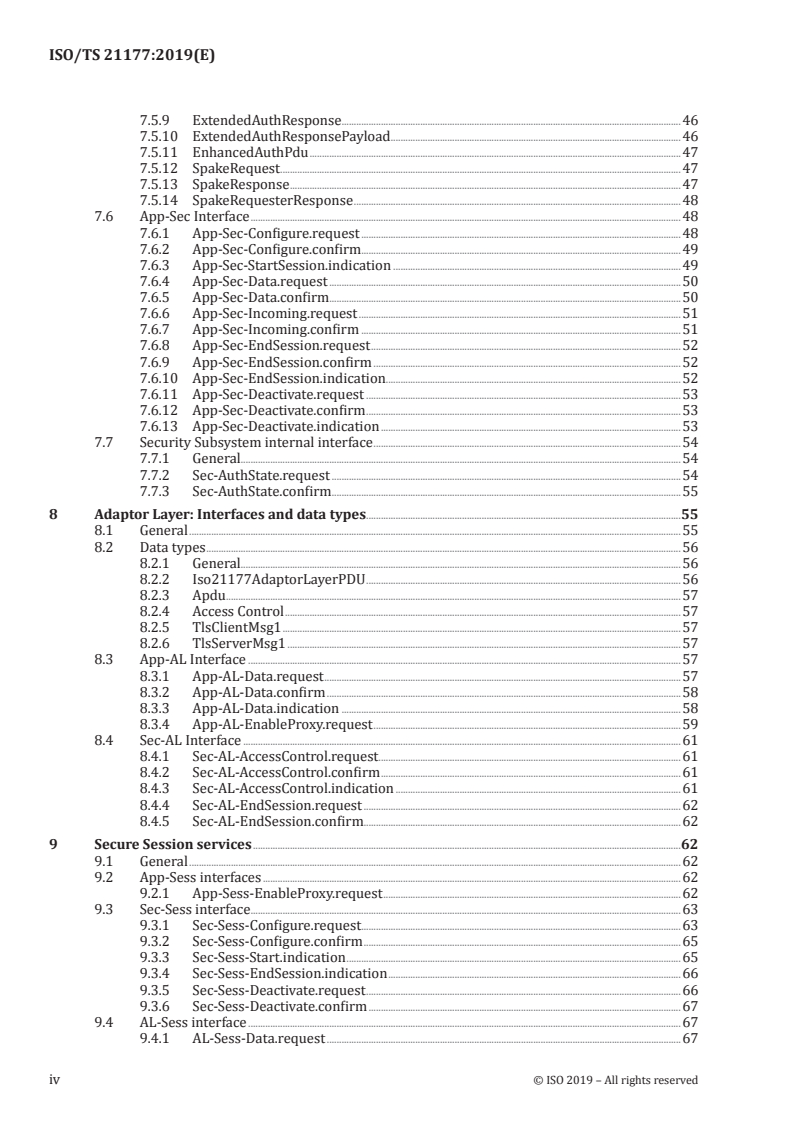
This document contains specifications for a set of ITS station security services required to ensure the authenticity of the source and integrity of information exchanged between trusted entities: — devices operated as bounded secured managed entities, i.e. "ITS Station Communication Units" (ITS-SCU) and "ITS station units" (ITS-SU) specified in ISO 21217, and — between ITS-SUs (composed of one or several ITS-SCUs) and external trusted entities such as sensor and control networks. These services include authentication and secure session establishment which are required to exchange information in a trusted and secure manner. These services are essential for many ITS applications and services including time-critical safety applications, automated driving, remote management of ITS stations (ISO 24102-2[5]), and roadside/infrastructure related services.
Titre manque
General Information
- Status
- Withdrawn
- Publication Date
- 06-Aug-2019
- Technical Committee
- ISO/TC 204 - Intelligent transport systems
- Drafting Committee
- ISO/TC 204/WG 18 - Cooperative systems
- Current Stage
- 9599 - Withdrawal of International Standard
- Start Date
- 07-Apr-2023
- Completion Date
- 12-Feb-2026
Relations
- Effective Date
- 09-Feb-2026
- Effective Date
- 09-Feb-2026
- Effective Date
- 09-Feb-2026
- Effective Date
- 12-Feb-2026
- Consolidates
ISO 11960:2014 - Petroleum and natural gas industries — Steel pipes for use as casing or tubing for wells - Effective Date
- 06-Jun-2022
- Effective Date
- 08-May-2020
Get Certified
Connect with accredited certification bodies for this standard

BSI Group
BSI (British Standards Institution) is the business standards company that helps organizations make excellence a habit.

Bureau Veritas
Bureau Veritas is a world leader in laboratory testing, inspection and certification services.

DNV
DNV is an independent assurance and risk management provider.
Sponsored listings
Frequently Asked Questions
ISO/TS 21177:2019 is a technical specification published by the International Organization for Standardization (ISO). Its full title is "Intelligent transport systems — ITS station security services for secure session establishment and authentication between trusted devices". This standard covers: This document contains specifications for a set of ITS station security services required to ensure the authenticity of the source and integrity of information exchanged between trusted entities: — devices operated as bounded secured managed entities, i.e. "ITS Station Communication Units" (ITS-SCU) and "ITS station units" (ITS-SU) specified in ISO 21217, and — between ITS-SUs (composed of one or several ITS-SCUs) and external trusted entities such as sensor and control networks. These services include authentication and secure session establishment which are required to exchange information in a trusted and secure manner. These services are essential for many ITS applications and services including time-critical safety applications, automated driving, remote management of ITS stations (ISO 24102-2[5]), and roadside/infrastructure related services.
This document contains specifications for a set of ITS station security services required to ensure the authenticity of the source and integrity of information exchanged between trusted entities: — devices operated as bounded secured managed entities, i.e. "ITS Station Communication Units" (ITS-SCU) and "ITS station units" (ITS-SU) specified in ISO 21217, and — between ITS-SUs (composed of one or several ITS-SCUs) and external trusted entities such as sensor and control networks. These services include authentication and secure session establishment which are required to exchange information in a trusted and secure manner. These services are essential for many ITS applications and services including time-critical safety applications, automated driving, remote management of ITS stations (ISO 24102-2[5]), and roadside/infrastructure related services.
ISO/TS 21177:2019 is classified under the following ICS (International Classification for Standards) categories: 03.220.01 - Transport in general; 35.030 - IT Security; 35.240.60 - IT applications in transport. The ICS classification helps identify the subject area and facilitates finding related standards.
ISO/TS 21177:2019 has the following relationships with other standards: It is inter standard links to CEN/TS 17402:2020, CEN/TS 17466:2020, CEN ISO/TS 21184:2021, CEN ISO/TS 21177:2019, ISO 11960:2014, ISO 21177:2023. Understanding these relationships helps ensure you are using the most current and applicable version of the standard.
ISO/TS 21177:2019 is available in PDF format for immediate download after purchase. The document can be added to your cart and obtained through the secure checkout process. Digital delivery ensures instant access to the complete standard document.
Standards Content (Sample)
TECHNICAL ISO/TS
SPECIFICATION 21177
First edition
2019-08
Intelligent transport systems —
ITS station security services for
secure session establishment and
authentication between trusted devices
Reference number
©
ISO 2019
© ISO 2019
All rights reserved. Unless otherwise specified, or required in the context of its implementation, no part of this publication may
be reproduced or utilized otherwise in any form or by any means, electronic or mechanical, including photocopying, or posting
on the internet or an intranet, without prior written permission. Permission can be requested from either ISO at the address
below or ISO’s member body in the country of the requester.
ISO copyright office
CP 401 • Ch. de Blandonnet 8
CH-1214 Vernier, Geneva
Phone: +41 22 749 01 11
Fax: +41 22 749 09 47
Email: copyright@iso.org
Website: www.iso.org
Published in Switzerland
ii © ISO 2019 – All rights reserved
Contents Page
Foreword .vi
Introduction .vii
1 Scope . 1
2 Normative references . 1
3 Terms and definitions . 1
4 Symbols and abbreviated terms . 2
5 Overview . 3
5.1 Goals . 3
5.2 Architecture and functional entities . 4
5.3 Cryptomaterial handles . 7
5.4 Session IDs and state . 7
5.5 Access control and authorisation state . 8
5.6 Application level non-repudiation . 8
5.7 Service primitive conventions . 8
6 Process flows and sequence diagrams . 9
6.1 General . 9
6.2 Overview of process flows . 9
6.3 Sequence diagram conventions .10
6.4 Configure .11
6.5 Start Session .12
6.6 Send data .14
6.7 Send access control PDU .17
6.8 Receive PDU .18
6.9 Secure connection brokering .23
6.9.1 Goals .23
6.9.2 Prerequisites .24
6.9.3 Overview .24
6.9.4 Detailed specification .25
6.10 Force end session .33
6.11 Session terminated at session layer .35
6.12 Deactivate .35
6.13 Secure session example .36
7 Security Subsystem: interfaces and data types .38
7.1 General .38
7.2 Access control policy and state .39
7.3 Enhanced authentication .40
7.3.1 Definition and possible states .40
7.3.2 States for owner role enhanced authentication .40
7.3.3 State for accessor role enhanced authentication .41
7.3.4 Use by Access Control .42
7.3.5 Methods for providing enhanced authentication .42
7.3.6 Enhanced authentication using SPAKE2 .42
7.4 Extended authentication .43
7.5 Data types .44
7.5.1 General.44
7.5.2 Imports .44
7.5.3 Iso21177AccessControlPdu .44
7.5.4 AccessControlResult .44
7.5.5 ExtendedAuthPdu .44
7.5.6 ExtendedAuthRequest .45
7.5.7 InnerExtendedAuthRequest .45
7.5.8 AtomicExtendedAuthRequest .46
7.5.9 ExtendedAuthResponse .46
7.5.10 ExtendedAuthResponsePayload .46
7.5.11 EnhancedAuthPdu .47
7.5.12 SpakeRequest.47
7.5.13 SpakeResponse .47
7.5.14 SpakeRequesterResponse .48
7.6 App-Sec Interface .48
7.6.1 App-Sec-Configure.request .48
7.6.2 App-Sec-Configure.confirm.49
7.6.3 App-Sec-StartSession.indication .49
7.6.4 App-Sec-Data.request .50
7.6.5 App-Sec-Data.confirm . .50
7.6.6 App-Sec-Incoming.request .51
7.6.7 App-Sec-Incoming.confirm .51
7.6.8 App-Sec-EndSession.request .52
7.6.9 App-Sec-EndSession.confirm .52
7.6.10 App-Sec-EndSession.indication.52
7.6.11 App-Sec-Deactivate.request .53
7.6.12 App-Sec-Deactivate.confirm .53
7.6.13 App-Sec-Deactivate.indication .53
7.7 Security Subsystem internal interface .54
7.7.1 General.54
7.7.2 Sec-AuthState.request .54
7.7.3 Sec-AuthState.confirm . .55
8 Adaptor Layer: Interfaces and data types .55
8.1 General .55
8.2 Data types .56
8.2.1 General.56
8.2.2 Iso21177AdaptorLayerPDU .56
8.2.3 Apdu . .57
8.2.4 Access Control .57
8.2.5 TlsClientMsg1 .57
8.2.6 TlsServerMsg1 .57
8.3 App-AL Interface .57
8.3.1 App-AL-Data.request .57
8.3.2 App-AL-Data.confirm .58
8.3.3 App-AL-Data.indication .58
8.3.4 App-AL-EnableProxy.request .59
8.4 Sec-AL Interface .61
8.4.1 Sec-AL-AccessControl.request.61
8.4.2 Sec-AL-AccessControl.confirm .61
8.4.3 Sec-AL-AccessControl.indication .61
8.4.4 Sec-AL-EndSession.request .62
8.4.5 Sec-AL-EndSession.confirm.62
9 Secure Session services .62
9.1 General .62
9.2 App-Sess interfaces .62
9.2.1 App-Sess-EnableProxy.request .62
9.3 Sec-Sess interface .63
9.3.1 Sec-Sess-Configure.request .63
9.3.2 Sec-Sess-Configure.confirm .65
9.3.3 Sec-Sess-Start.indication .65
9.3.4 Sec-Sess-EndSession.indication .66
9.3.5 Sec-Sess-Deactivate.request .66
9.3.6 Sec-Sess-Deactivate.confirm .67
9.4 AL-Sess interface .67
9.4.1 AL-Sess-Data.request .67
iv © ISO 2019 – All rights reserved
9.4.2 AL-Sess-Data.confirm.67
9.4.3 AL-Sess-Data.indication .68
9.4.4 AL-Sess-EndSession.request .68
9.4.5 AL-Sess-EndSession.confirm .68
9.4.6 AL-Sess-ClientHelloProxy.request .69
9.4.7 AL-Sess-ClientHelloProxy.indication .69
9.4.8 AL-Sess-ServerHelloProxy.request .70
9.4.9 AL-Sess-ServerHelloProxy.indication .70
9.4.10 AL-Sess-EndSession.request .71
9.4.11 AL-Sess-EndSession.confirm .72
9.5 Permitted mechanisms .72
9.5.1 TLS 1.3 .72
9.5.2 DTLS 1.3.73
Annex A (informative) Usage scenarios .74
Annex B (normative) ASN.1 module .81
Bibliography .82
Foreword
ISO (the International Organization for Standardization) is a worldwide federation of national standards
bodies (ISO member bodies). The work of preparing International Standards is normally carried out
through ISO technical committees. Each member body interested in a subject for which a technical
committee has been established has the right to be represented on that committee. International
organizations, governmental and non-governmental, in liaison with ISO, also take part in the work.
ISO collaborates closely with the International Electrotechnical Commission (IEC) on all matters of
electrotechnical standardization.
The procedures used to develop this document and those intended for its further maintenance are
described in the ISO/IEC Directives, Part 1. In particular, the different approval criteria needed for the
different types of ISO documents should be noted. This document was drafted in accordance with the
editorial rules of the ISO/IEC Directives, Part 2 (see www .iso .org/directives).
Attention is drawn to the possibility that some of the elements of this document may be the subject of
patent rights. ISO shall not be held responsible for identifying any or all such patent rights. Details of
any patent rights identified during the development of the document will be in the Introduction and/or
on the ISO list of patent declarations received (see www .iso .org/patents).
Any trade name used in this document is information given for the convenience of users and does not
constitute an endorsement.
For an explanation of the voluntary nature of standards, the meaning of ISO specific terms and
expressions related to conformity assessment, as well as information about ISO's adherence to
the World Trade Organization (WTO) principles in the Technical Barriers to Trade (TBT) see
www .iso .org/iso/foreword .html.
This document was prepared by Technical Committee ISO/TC 204, Intelligent transport systems.
Any feedback or questions on this document should be directed to the user’s national standards body. A
complete listing of these bodies can be found at www .iso .org/members .html.
vi © ISO 2019 – All rights reserved
Introduction
This document is about ITS station security services required to ensure the authenticity of the source
and confidentiality and integrity of application activities taking place between trusted devices.
The trust relation between two devices is illustrated in Figure 1. Two devices cooperate in a trusted
way, i.e. exchange information with optional explicit bi-directional protection.
Figure 1 — Interconnection of trusted devices
According to ISO 21217, an ITS station unit (ITS-SU), i.e. the physical implementation of the ITS station
(ITS-S) functionality, is a trusted device, and an ITS-SU may be composed of ITS station communication
units (ITS-SCU) that are interconnected via an ITS station-internal network. Thus an ITS-SCU is the
smallest physical entity of an ITS-SU that is referred to as a trusted device.
[15]
NOTE 1 ISO 21217 fully covers the functionality of EN 302 665 , which is a predecessor of ISO 21217.
NOTE 2 An ITS-SU can be composed of ITS-SCUs from different vendors where each ITS-SCU is linked to a
[5]
different ITS-SCU configuration and management centre specified in ISO 24102-2 and ISO 17419. Station-
[7]
internal management communications between ITS-SCUs of the same ITS-SU is specified in ISO 24102-4 .
European C-ITS regulation refers to the "ITS-SCU configuration and management centre" as "C-ITS station
operator" meaning the entity responsible for the operation of a C-ITS station. The C-ITS station operator can be
responsible for the operation of one single C-ITS station (fixed or mobile), or a C-ITS infrastructure composed of a
number of fixed C-ITS stations, or a number of mobile ITS-Stations.
Four implementation contexts of communication nodes in ITS communications networks are identified
in the ITS station and communication architecture ISO 21217, each comprised of ITS-station units (ITS-
SU) taking on a particular role; personal, vehicular, roadside, or central. These ITS-SUs are ITS-secured
communication nodes as required in ISO 21217 that participate in a wide variety of ITS services related
to, e.g. sustainability, road safety and transportation efficiency.
Over the last decade, ITS services have arisen that require secure access to data from Sensor and Control
Networks (SCN), e.g. from In-Vehicle Networks (IVN) and from Infrastructure/Roadside Networks
(IRN), some of which require secure local access to time-critical information; see Figures 2 and 3.
Figure 2 — Example of a roadside ITS-SU connected with proprietary IRN
Figure 3 — Example of a vehicle ITS-SU connected with proprietary IRN
Trust in the ITS domain primarily is between ITS Station Communication Units (ITS-SCUs) introduced
in ISO 21217; see Figure 4.
viii © ISO 2019 – All rights reserved
Figure 4 — Interconnection of ITS-SCUs in an ITS-SU
ITS-SCUs are interconnected via an ITS station-internal network. Applying basic security means
specified in this document, the ITS-SCUs trust each other. Additionally, protocol data units exchanged
between ITS-SCUs may be further protected by additional means, e.g. applying encryption. Major
application domains of secure communications between ITS-SCUs of the same ITS-SU are local station
[4]
management specified in ISO 24102-1 using station-internal management communications specified
[7]
in ISO 24102-4 .
Trust in the ITS domain further is between ITS-SUs introduced in ISO 21217; see Figure 5.
Figure 5 — Interconnection of ITS-SUs
Applying basic security means specified in this document, the ITS-SUs can establish secure application
sessions. Establishment of sessions either needs a-priori knowledge about a session partner or can
[3]
be achieved by means of service announcement specified in ISO 22418 . Further on, broadcast of
messages is secured by means of authenticating the sender of such a message, applicable for the service
[1] [3]
advertisement message (SAM) specified in ISO/TS 16460 and used in ISO 22418 . Additionally, other
security means may be applied, e.g. encryption of messages.
A further trust relation in the ITS domain is between an ITS-SU consisting of one or several ITS-SCUs
and a sensor and control network (SCN). Trust is achieved by applying security means in an interface as
illustrated in Figure 6 with details specified in this document.
Figure 6 — Interface between ITS-SU and sensor and control network
The interface presented in Figure 6 may be a stand-alone device, or may be integrated in the ITS-SU,
or may be part of the SCN. Examples of SCNs are "In-Vehicle Networks" (IVN) and "Infrastructure/
Roadside Networks" (IRN).
Related use cases of these ITS services have largely been derived from regulatory requirements and ITS
operational needs, and they include:
— secure real-time access to time-critical vehicle-related data for safety of life and property
applications, e.g. collision avoidance, emergency electronic brake light and event determination;
— secure local access to detailed real-time data for efficiency applications (traffic management), e.g.
intersection interaction, congestion avoidance, dynamic priorities;
— protection of private data, e.g. in compliance with the European "General Data Protection Regulation"
[16]
(GDPR) ;
— local access to certified real-time data for sustainability applications, e.g. dynamic emission zones
(controlled zones as currently standardized in CEN TC 278 within the Project Team PT 1705 funded
by the European Commission), intersection priorities based on emissions, interactive optimum
vehicle settings to minimize fuel consumption.
There are many use cases of ITS services currently identified where real-time exchange of time-critical
information between ITS-SUs in close proximity is essential, and the number will grow, see e.g. the US
[17]
National ITS Reference Architecture . It is critical that ultimately all ITS-SUs in a given area are able
to be engaged in these distributed services. This, in turn, requires vehicle ITS-SUs to have real-time
access to vehicle data, and roadside ITS-SUs to have real-time access to infrastructure data. All ITS-SUs
need being capable of secure software updates.
According to ISO 21217, an ITS-SCU of an ITS-SU can communicate with devices that, in a strict sense,
are not compliant with the architecture specified in ISO 21217. However, in order to have trusted
communications, a certain minimum level of security measures must be shared between an ITS-SCU
and such an external device. Examples of such external devices are a node in the Internet, or a node in a
sensor and control network. In this document, the assumption is made that ITS-S application processes
operating on ITS-SUs are issued with certificates by a Certificate Authority (CA), and that the CA is a
trusted third party in the sense that before issuing the certificate to the ITS-S application process, it
ensures that the ITS-SU on which the ITS-S application process is resident meets the minimum security
requirements for that application. This allows peer ITS-S application processes which observe that
an ITS-S application process possesses a valid certificate to have a level of assurance that the ITS-S
application process is in fact secure and trustworthy.
x © ISO 2019 – All rights reserved
The subject of this document thus is three-fold:
1) Specify ITS station security services for enabling trust between ITS-S application processes
running on different ITS-SCUs of the same ITS-SU, i.e. establishing a trusted processing platform,
considering also trust inside an ITS-SCU:
— protection of applications from the actions of other applications;
— protection of shared information;
— protection of shared processing resources such as communications software and hardware,
which includes methods of prioritisation and restricted access.
2) Specify ITS station security services for enabling trust between ITS-S application processes
running on the same ITS-SU.
3) Extend these ITS security services for enabling trust between an ITS-SCU and devices being part of
a sensor and control network.
NOTE 3 It is intended to extend the subject of this document in future editions.
Such security services include e.g. the basic security features of:
a) authentication and authorisation;
b) confidentiality and privacy;
c) data integrity;
d) non-repudiation.
Tasks related to communications are:
a) establishing secure sessions for bi-directional communications, e.g. based on service advertisement
[3]
specified in ISO 22418 ;
b) authenticating a sender of broadcast messages, e.g. CAM, DENM, BSM, SPaT, MAP, FSAM, WSA;
c) encrypting messages.
NOTE 4 Tasks b) and c) above related to communications are already specified in other standards, see e.g.
IEEE Std. 1609.2™ and several related standards from ETSI TC ITS.
TECHNICAL SPECIFICATION ISO/TS 21177:2019(E)
Intelligent transport systems — ITS station security
services for secure session establishment and
authentication between trusted devices
1 Scope
This document contains specifications for a set of ITS station security services required to ensure the
authenticity of the source and integrity of information exchanged between trusted entities:
— devices operated as bounded secured managed entities, i.e. "ITS Station Communication Units"
(ITS-SCU) and "ITS station units" (ITS-SU) specified in ISO 21217, and
— between ITS-SUs (composed of one or several ITS-SCUs) and external trusted entities such as sensor
and control networks.
These services include authentication and secure session establishment which are required to exchange
information in a trusted and secure manner.
These services are essential for many ITS applications and services including time-critical safety
[5]
applications, automated driving, remote management of ITS stations (ISO 24102-2 ), and roadside/
infrastructure related services.
2 Normative references
The following documents are referred to in the text in such a way that some or all of their content
constitutes requirements of this document. For dated references, only the edition cited applies. For
undated references, the latest edition of the referenced document (including any amendments) applies.
ISO 17419, Intelligent transport systems — Cooperative systems — Globally unique identification
IEEE Std 1609.2™, IEEE Standard for Wireless Access in Vehicular Environments — Security Services for
Applications and Management Messages
3 Terms and definitions
For the purposes of this document, the following terms and definitions apply.
ISO and IEC maintain terminological databases for use in standardization at the following addresses:
— ISO Online browsing platform: available at https: //www .iso .org/obp
— IEC Electropedia: available at http: //www .electropedia .org/
3.1
Access Control PDU
PDU generated by the Security Subsystem for purposes of establishing the authorisation status of a
peer ITS-S application process
3.2
Access Control Policy
data source governing what access to resources is permissible by peer Applications
3.3
application
functional entity, i.e. an ITS-S application process
3.4
security subsystem
functional entity providing security functionality for use by an ITS-S application process
3.5
Security Adaptor Layer
functional entity providing multiplexing and demultiplexing functionality for data and session control
commands
3.6
Secure Session
functional entity providing confidentiality, integrity, authentication, guaranteed in-order delivery, and
replay protection on the datagrams that are passed over it
3.7
resources
functional entity constituting endpoints of ITS-S application process activity
3.8
Cryptomaterial Handle
reference to Cryptomaterial allowing that Cryptomaterial to be used in cryptographic operations, i.e.
sign, verify, encrypt, decrypt
3.9
Cryptomaterial
cryptographic keys and associated material, either a secret key for a symmetric algorithm, or a private
key for an asymmetric algorithm, and the associated public key or certificate
3.10
Secure Session Service
functional entity responsible for establishing secure communications sessions with its peer instances
4 Symbols and abbreviated terms
ACK acknowledge
ALPDU adaptor layer PDU
APDU application protocol data unit
DTLS datagram TLS
ID identifier
IRN infrastructure/roadside network
ITS intelligent transport systems
ITS-S ITS station
[SOURCE: ISO 21217:2014]
ITS-SCP ITS station communication profile
Note to entry: From ISO 21217
2 © ISO 2019 – All rights reserved
ITS-SU ITS station unit
[SOURCE: ISO 21217:2014]
IVN in-vehicle network
OSI open system interconnection
OTP one time password
PDU protocol data unit
PDU protocol data unit
PSID provider service identifier
SAM service advertisement message
[SOURCE: ISO/TS 16460]
SCN sensor and control network
SDEE secure data exchange entity
SPAKE2 secure password authenticated key exchange 2
SRM service response message
[SOURCE: ISO/TS 16460]
SSP service specific permission
SSTD secure session between trusted devices
TLS transport layer security
5 Overview
5.1 Goals
Clause 5 presents the logical architecture followed in this document. The logical architecture is
designed to accomplish the following goals:
— Two peer ITS-S application processes can communicate securely, i.e. in an authorized, integrity
protected and confidential manner.
— The ITS-S application processes can authenticate to each other using role- or attribute-based access
control.
— Each individual incoming application protocol data unit (APDU) can be subject to individual access
control processes.
— The security state of the connection (i.e. the authentication status of one ITS-S application process
with respect to access to the other connection) can be updated within the secure session as follows.
— An ITS-S application process can prove to the other that it knows a shared secret (Enhanced
Authentication, see 7.3) — the intended use of this is to allow the owner or other legitimate operator
of one ITS-S application process to permit access by a specific peer ITS-S application process, see
Clause 6 for further discussion.
— An ITS-S application process can provide additional authentication within the secure session
(Extended Authentication, see 7.4) — for example to provide an identity as well as application
permissions, or to provide additional application permissions.
— Secure session communication uses the same credentials as ITS-S application processes use.
— An ITS-S application process can configure a secure session so that it terminates under specific
conditions (e.g. timeouts of different kinds) and can also terminate the secure session directly.
— To allow secure and private service discovery, the initialization stage (the “handshake”) of one
secure session between two peer ITS-S application processes can be proxied over an existing secure
session between two different peers.
5.2 Architecture and functional entities
Figure 7 — Logical Architecture
Figure 7 shows the functional entities and data sources involved in secure communications between
pairs of ITS-S application processes using mechanisms specified in this document. A pair of ITS-S
application processes can reside
— either on the same ITS-SCU,
— or in different ITS-SCUs of the same ITS-SU,
— or in different ITS-SUs,
— or in an ITS-SU and another trusted entity not being a dedicated ITS device.
This description refers in general to activities on the “home trusted entity" and the “peer trusted
entity".
NOTE 1 If an entity is described as “fully specified in this document”, that includes the case where some of the
specification is in external documents that are incorporated in this document by reference.
Functional entities are:
— Resources: These are endpoints of ITS-S application process activity and may be inside or outside
the ITS-SU on which the ITS-S application process resides.
— Application: This is an ITS-S application process that uses input from resources, from a peer ITS-S
application process (peer Application), and from its own state to carry out application activities.
NOTE 2 To simplify reading of this document, the term "Application" is used as a replacement for "ITS-S
application process", where appropriate. The term "application" is used in its generic meaning.
— Security Subsystem: The security subsystem applies security mechanisms to determine what
actions the peer Application is permitted to take and implements support functionality in support
4 © ISO 2019 – All rights reserved
of making those decisions. The Security Subsystem contains some non-application-specific
functionality, specified in this document, and also application-specific functionality (it has to
understand the semantics of application PDUs in order to make access control decisions); as such, it
is shown within the Application in Figure 7.
The Security Subsystem is configured using input from the Access Control Policy data source. For
outgoing communications, it takes as input commands and data from the Application and applies
appropriate security processing. For incoming communications, it takes as input commands and
data from the Security Adaptor Layer and applies the appropriate access control policy; as a result
of applying the access control policy it either passes the input to the application or generates an
access control response. See Clause 7.
The Security Subsystem in its own turn contains two distinct functional elements: the
Authentication State Subsystem and the Access Control Subsystem. The Authentication State
Subsystem stores the authentication state of the secure session, and can also generate Access
Control request PDUs to enable this state to be updated. The Access Control Subsystem ma
...
Questions, Comments and Discussion
Ask us and Technical Secretary will try to provide an answer. You can facilitate discussion about the standard in here.
Loading comments...