

IEC 61298-1:2026
(Main)Process measurement and control devices - General methods and procedures for evaluating performance - Part 1: General considerations
General Information
- Abstract
IEC 61298-1:2026 specifies general methods and procedures for conducting tests and reporting on the functional and performance characteristics of process instrumentation except process measurement transmitters (PMT) which are standardized by the IEC 62828 series. The tests are applicable to any such devices characterized by their own specific input and output variables, and by the specific relationship (transfer function) between the inputs and outputs and include analogue and digital devices. For devices that require special tests, this document can be used together with any product specific standard specifying special tests. This document covers general principles which apply to the IEC 61298 series.
This third edition cancels and replaces the second edition published in 2008. This edition constitutes a technical revision.
This edition includes the following significant technical changes with respect to the previous edition:
a) Process measurement transmitters (PMT) have been removed from the scope of this standard.
- Status
- Published
- Publication Date
- 07-Jun-2026
- Technical Committee
- SC 65B - Measurement and control devices
- Drafting Committee
- WG 6 - TC 65/SC 65B/WG 6
- Current Stage
- PPUB - Publication issued
- Start Date
- 08-Jun-2026
- Completion Date
- 03-Jul-2026
Buy Documents
REDLINE IEC 61298-1:2026 RLV - Process measurement and control devices - General methods and procedures for evaluating performance - Part 1: General considerations
iec61298-1{ed3.0}en - Process measurement and control devices - General methods and procedures for evaluating performance - Part 1: General considerations
iec61298-1{ed3.0}fr - Dispositifs de mesure et de commande de processus - Méthodes et procédures générales d'évaluation des performances - Partie 1: Généralités
Overview
IEC 61298-1:2026 is an international standard developed by the International Electrotechnical Commission (IEC) that outlines general methods and procedures for evaluating the performance of process measurement and control devices. It specifically sets out how to conduct tests and report on functional and performance characteristics of such devices, both analogue and digital, with the exception of process measurement transmitters (PMT), which are standardized separately by the IEC 62828 series. The 2026 third edition is a technical revision that notably removes PMTs from its scope, reflecting advances and updates in the field of process instrumentation standards.
Key Topics
Scope and Exclusions
- Applies to process measurement and control devices defined by specific input and output variables and their transfer functions.
- Excludes process measurement transmitters, now covered by IEC 62828.
- Covers both analogue and digital devices, providing a flexible framework across device types.
Testing Methods and Procedures
- Specifies two main categories of evaluation: complete performance evaluations (type tests) and simplified tests (individual or sample tests).
- Outlines clear reporting requirements, including documentation of methods, conditions, and any deviations or omissions in testing.
- Emphasizes reproducibility and comparability of test results, necessitating standardized methods to enable consistent quality assessments worldwide.
Environmental and Operating Conditions
- Defines standard laboratory conditions for testing (temperature, humidity, pressure) and details criteria for sampling, installation, and load conditions.
- Recommends maintaining consistent and realistic operational conditions, and minimizing external influences such as mechanical constraints or vibrations.
Quality and Economic Considerations
- Supports cost-effective testing by balancing comprehensive data collection with practical constraints.
- Stipulates that any omitted or modified tests must be clearly justified and recorded.
Applications
IEC 61298-1 is widely used in various industrial sectors where reliable measurement and control are key, including:
- Product Development and Conformity Assessment
- Manufacturers use the standard to systematically assess and document the performance characteristics of process instrumentation prior to market release.
- Quality Assurance and Procurement
- End users and purchasers rely on standardized test reports for credible comparisons and informed selection of devices that meet specific operational needs.
- Accredited Laboratory Testing
- Testing laboratories utilize IEC 61298-1 to ensure their methods align with international expectations, supporting accreditation and third-party validation processes.
- Normative Reference for Further Standards
- Acts as a reference document when developing device-specific or application-specific standards, ensuring consistency across the IEC 61298 series and related documents.
Related Standards
IEC 61298 Series
- IEC 61298-2: Tests under reference conditions
- IEC 61298-3: Determination of influence quantity effects
- IEC 61298-4: Test report documentation requirements
IEC 62828 Series
- Dedicated to process measurement transmitters (PMT), which are no longer in the scope of IEC 61298-1.
IEC 60050 & ISO/IEC 80000
- Provide essential terminology and units used throughout the evaluation and documentation processes.
Other Related Standards
- IEC 60410: Sampling plans and procedures used in device selection
- IEC Electropedia: Online reference for electrotechnical terminology
By applying IEC 61298-1:2026, organizations ensure robust, repeatable, and internationally recognized performance assessment and reporting of process measurement and control devices, supporting the quality and reliability critical to industrial automation and process control applications.
Relations
- Effective Date
- 05-Sep-2023
Buy Documents
REDLINE IEC 61298-1:2026 RLV - Process measurement and control devices - General methods and procedures for evaluating performance - Part 1: General considerations
iec61298-1{ed3.0}en - Process measurement and control devices - General methods and procedures for evaluating performance - Part 1: General considerations
iec61298-1{ed3.0}fr - Dispositifs de mesure et de commande de processus - Méthodes et procédures générales d'évaluation des performances - Partie 1: Généralités
Get Certified
Connect with accredited certification bodies for this standard

DVS-ZERT GmbH
German welding certification society.
CARES (UK Certification Authority for Reinforcing Steels)
UK certification for reinforcing steels and construction.
EWF/IIW (European/International Welding Federation)
International welding personnel certification.
Sponsored listings
Frequently Asked Questions
IEC 61298-1:2026 is a standard published by the International Electrotechnical Commission (IEC). Its full title is "Process measurement and control devices - General methods and procedures for evaluating performance - Part 1: General considerations". This standard covers: IEC 61298-1:2026 specifies general methods and procedures for conducting tests and reporting on the functional and performance characteristics of process instrumentation except process measurement transmitters (PMT) which are standardized by the IEC 62828 series. The tests are applicable to any such devices characterized by their own specific input and output variables, and by the specific relationship (transfer function) between the inputs and outputs and include analogue and digital devices. For devices that require special tests, this document can be used together with any product specific standard specifying special tests. This document covers general principles which apply to the IEC 61298 series. This third edition cancels and replaces the second edition published in 2008. This edition constitutes a technical revision. This edition includes the following significant technical changes with respect to the previous edition: a) Process measurement transmitters (PMT) have been removed from the scope of this standard.
IEC 61298-1:2026 specifies general methods and procedures for conducting tests and reporting on the functional and performance characteristics of process instrumentation except process measurement transmitters (PMT) which are standardized by the IEC 62828 series. The tests are applicable to any such devices characterized by their own specific input and output variables, and by the specific relationship (transfer function) between the inputs and outputs and include analogue and digital devices. For devices that require special tests, this document can be used together with any product specific standard specifying special tests. This document covers general principles which apply to the IEC 61298 series. This third edition cancels and replaces the second edition published in 2008. This edition constitutes a technical revision. This edition includes the following significant technical changes with respect to the previous edition: a) Process measurement transmitters (PMT) have been removed from the scope of this standard.
IEC 61298-1:2026 is classified under the following ICS (International Classification for Standards) categories: 25.040.40 - Industrial process measurement and control. The ICS classification helps identify the subject area and facilitates finding related standards.
IEC 61298-1:2026 has the following relationships with other standards: It is inter standard links to IEC 61298-1:2008. Understanding these relationships helps ensure you are using the most current and applicable version of the standard.
IEC 61298-1:2026 is available in PDF format for immediate download after purchase. The document can be added to your cart and obtained through the secure checkout process. Digital delivery ensures instant access to the complete standard document.
Standards Content (Sample)
IEC 61298-1 ®
Edition 3.0 2026-06
INTERNATIONAL
STANDARD
REDLINE VERSION
Process measurement and control devices - General methods and procedures
for evaluating performance -
Part 1: General considerations
ICS 25.040.40 ISBN 978-2-8327-1316-7
All rights reserved. Unless otherwise specified, no part of this publication may be reproduced or utilized in any form or
by any means, electronic or mechanical, including photocopying and microfilm, without permission in writing from either
IEC or IEC's member National Committee in the country of the requester. If you have any questions about IEC copyright
or have an enquiry about obtaining additional rights to this publication, please contact the address below or your local
IEC member National Committee for further information.
IEC Secretariat Tel.: +41 22 919 02 11
3, rue de Varembé info@iec.ch
CH-1211 Geneva 20 www.iec.ch
Switzerland
About the IEC
The International Electrotechnical Commission (IEC) is the leading global organization that prepares and publishes
International Standards for all electrical, electronic and related technologies.
About IEC publications
The technical content of IEC publications is kept under constant review by the IEC. Please make sure that you have the
latest edition, a corrigendum or an amendment might have been published.
IEC publications search - IEC Products & Services Portal - products.iec.ch
webstore.iec.ch/advsearchform Discover our powerful search engine and read freely all the
The advanced search enables to find IEC publications by a publications previews, graphical symbols and the glossary.
variety of criteria (reference number, text, technical With a subscription you will always have access to up to date
committee, …). It also gives information on projects, content tailored to your needs.
replaced and withdrawn publications.
Electropedia - www.electropedia.org
The world's leading online dictionary on electrotechnology,
IEC Just Published - webstore.iec.ch/justpublished
Stay up to date on all new IEC publications. Just Published containing more than 22 500 terminological entries in English
details all new publications released. Available online and and French, with equivalent terms in 25 additional languages.
once a month by email. Also known as the International Electrotechnical Vocabulary
(IEV) online.
IEC Customer Service Centre - webstore.iec.ch/csc
If you wish to give us your feedback on this publication or
need further assistance, please contact the Customer
Service Centre: sales@iec.ch.
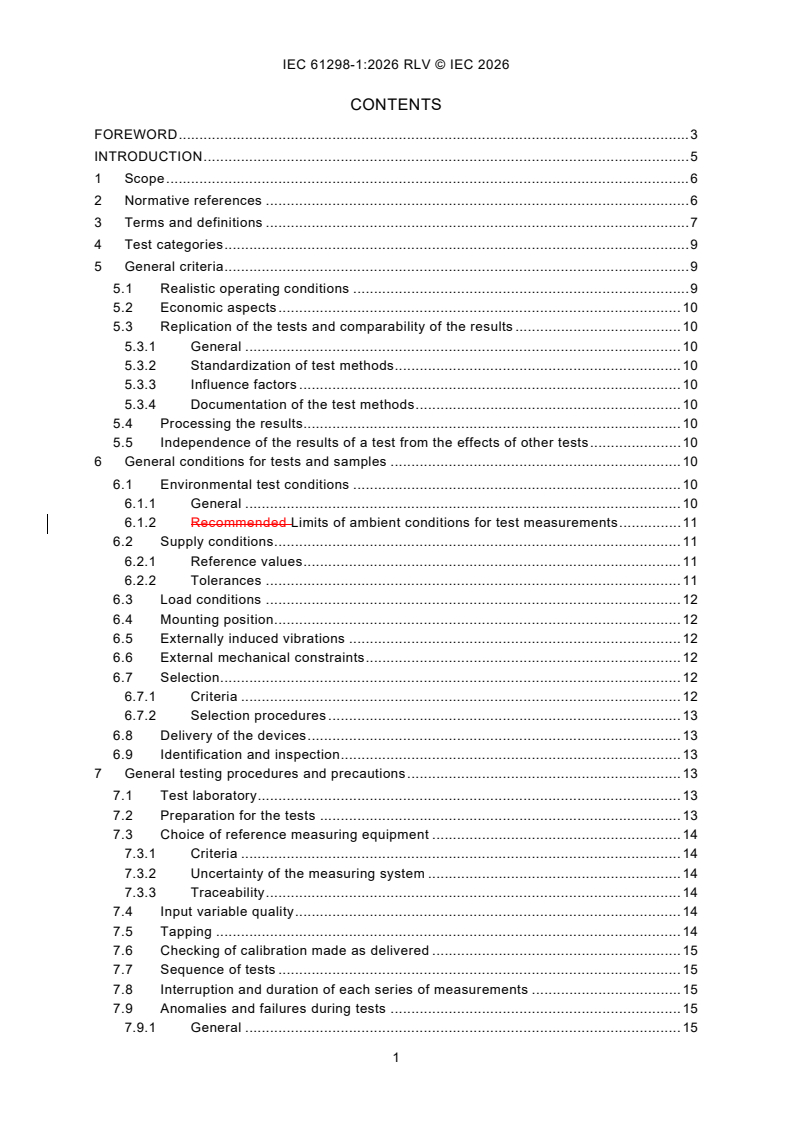
CONTENTS
FOREWORD . 3
INTRODUCTION . 5
1 Scope . 6
2 Normative references . 6
3 Terms and definitions . 7
4 Test categories . 9
5 General criteria . 9
5.1 Realistic operating conditions . 9
5.2 Economic aspects . 10
5.3 Replication of the tests and comparability of the results . 10
5.3.1 General . 10
5.3.2 Standardization of test methods . 10
5.3.3 Influence factors . 10
5.3.4 Documentation of the test methods . 10
5.4 Processing the results. 10
5.5 Independence of the results of a test from the effects of other tests . 10
6 General conditions for tests and samples . 10
6.1 Environmental test conditions . 10
6.1.1 General . 10
6.1.2 Recommended Limits of ambient conditions for test measurements . 11
6.2 Supply conditions . 11
6.2.1 Reference values . 11
6.2.2 Tolerances . 11
6.3 Load conditions . 12
6.4 Mounting position . 12
6.5 Externally induced vibrations . 12
6.6 External mechanical constraints . 12
6.7 Selection. 12
6.7.1 Criteria . 12
6.7.2 Selection procedures . 13
6.8 Delivery of the devices . 13
6.9 Identification and inspection . 13
7 General testing procedures and precautions . 13
7.1 Test laboratory . 13
7.2 Preparation for the tests . 13
7.3 Choice of reference measuring equipment . 14
7.3.1 Criteria . 14
7.3.2 Uncertainty of the measuring system . 14
7.3.3 Traceability . 14
7.4 Input variable quality . 14
7.5 Tapping . 14
7.6 Checking of calibration made as delivered . 15
7.7 Sequence of tests . 15
7.8 Interruption and duration of each series of measurements . 15
7.9 Anomalies and failures during tests . 15
7.9.1 General . 15
7.9.2 Procedures . 15
7.10 Re-start of a test . 15
7.11 Setting of adjustments . 15
7.12 Preconditioning . 16
7.12.1 Criteria . 16
7.12.2 Procedure . 16
7.13 Calibration adjustments of lower range value and span . 16
7.14 Constancy of the operating conditions and settings . 16
7.15 Input/output variable relationships . 16
7.15.1 Criteria . 16
7.15.2 Procedure . 16
7.16 Error assessment . 17
7.17 Symbols and units of measurement. 17
7.18 Test report and documentation . 17
Bibliography . 18
Table 1 – Environmental test conditions . 11
INTERNATIONAL ELECTROTECHNICAL COMMISSION
____________
Process measurement and control devices -
General methods and procedures for evaluating performance -
Part 1: General considerations
FOREWORD
1) The International Electrotechnical Commission (IEC) is a worldwide organization for standardization comprising
all national electrotechnical committees (IEC National Committees). The object of IEC is to promote international
co-operation on all questions concerning standardization in the electrical and electronic fields. To this end and
in addition to other activities, IEC publishes International Standards, Technical Specifications, Technical Reports,
Publicly Available Specifications (PAS) and Guides (hereafter referred to as "IEC Publication(s)"). Their
preparation is entrusted to technical committees; any IEC National Committee interested in the subject dealt with
may participate in this preparatory work. International, governmental and non-governmental organizations liaising
with the IEC also participate in this preparation. IEC collaborates closely with the International Organization for
Standardization (ISO) in accordance with conditions determined by agreement between the two organizations.
2) The formal decisions or agreements of IEC on technical matters express, as nearly as possible, an international
consensus of opinion on the relevant subjects since each technical committee has representation from all
interested IEC National Committees.
3) IEC Publications have the form of recommendations for international use and are accepted by IEC National
Committees in that sense. While all reasonable efforts are made to ensure that the technical content of IEC
Publications is accurate, IEC cannot be held responsible for the way in which they are used or for any
misinterpretation by any end user.
4) In order to promote international uniformity, IEC National Committees undertake to apply IEC Publications
transparently to the maximum extent possible in their national and regional publications. Any divergence between
any IEC Publication and the corresponding national or regional publication shall be clearly indicated in the latter.
5) IEC itself does not provide any attestation of conformity. Independent certification bodies provide conformity
assessment services and, in some areas, access to IEC marks of conformity. IEC is not responsible for any
services carried out by independent certification bodies.
6) All users should ensure that they have the latest edition of this publication.
7) No liability shall attach to IEC or its directors, employees, servants or agents including individual experts and
members of its technical committees and IEC National Committees for any personal injury, property damage or
other damage of any nature whatsoever, whether direct or indirect, or for costs (including legal fees) and
expenses arising out of the publication, use of, or reliance upon, this IEC Publication or any other IEC
Publications.
8) Attention is drawn to the Normative references cited in this publication. Use of the referenced publications is
indispensable for the correct application of this publication.
9) IEC draws attention to the possibility that the implementation of this document may involve the use of (a)
patent(s). IEC takes no position concerning the evidence, validity or applicability of any claimed patent rights in
respect thereof. As of the date of publication of this document, IEC had not received notice of (a) patent(s), which
may be required to implement this document. However, implementers are cautioned that this may not represent
the latest information, which may be obtained from the patent database available at https://patents.iec.ch. IEC
shall not be held responsible for identifying any or all such patent rights.
This redline version of the official IEC Standard allows the user to identify the changes made
to the previous edition IEC 61298-1:2008. A vertical bar appears in the margin wherever a
change has been made. Additions are in green text, deletions are in strikethrough red text.
IEC 61298-1 has been prepared by subcommittee 65B: Measurement and control devices, of
IEC technical committee 65: Industrial-process measurement, control and automation. It is an
International Standard.
This third edition cancels and replaces the second edition published in 2008. This edition
constitutes a technical revision.
This edition includes the following significant technical changes with respect to the previous
edition:
a) Process measurement transmitters (PMT) have been removed from the scope of this
standard.
The text of this International Standard is based on the following documents:
Draft Report on voting
65B/1304/FDIS 65B/1329/RVD
Full information on the voting for its approval can be found in the report on voting indicated in
the above table.
The language used for the development of this International Standard is English.
This document was drafted in accordance with ISO/IEC Directives, Part 2, and developed in
accordance with ISO/IEC Directives, Part 1 and ISO/IEC Directives, IEC Supplement, available
at www.iec.ch/members_experts/refdocs. The main document types developed by IEC are
described in greater detail at www.iec.ch/publications.
A list of all parts of the IEC 61298 series, under the general title Process measurement and
control devices - General methods and procedures for evaluating performance, can be found
on the IEC website.
The committee has decided that the contents of this document will remain unchanged until the
stability date indicated on the IEC website under webstore.iec.ch in the data related to the
specific document. At this date, the document will be
– reconfirmed,
– withdrawn, or
– revised.
INTRODUCTION
This document is not intended as a substitute for existing standards, but is rather intended as
a reference document for any future standards developed within the IEC or other standards
organizations, concerning the evaluation of process instrumentation. Any revision of existing
standards should take this standard into account, except process measurement transmitters
(PMT) which are standardized by the IEC 62828 series.
This common standardized basis should can be utilized for the preparation of future relevant
standards, as follows:
– any test method or procedure, already treated in this document, should will be specified and
described in the new standard by referring to the corresponding clause of this document.
Consequently new editions of this document are revised without any change in numbering
and scope of each clause;
– any particular method or procedure, not covered by this document, should will be developed
and specified in the new standard in accordance with the criteria, as far as they are
applicable, stated in this document;
– any conceptual or significant deviation from the content of this document should will clearly
be identified and justified if introduced in a new standard.
1 Scope
This part of IEC 61298 specifies general methods and procedures for conducting tests and
reporting on the functional and performance characteristics of process instrumentation except
process measurement and control devices transmitters (PMT) which are standardized by the
IEC 62828 series. The methods and procedures specified in this standard are applicable to
any type of process measurement and control device. The tests are applicable to any such
devices characterized by their own specific input and output variables, and by the specific
relationship (transfer function) between the inputs and outputs and include analogue and digital
devices. For devices that require special tests, this document should can be used together with
any product specific standard specifying special tests.
This document covers general principles which apply to the IEC 61298 series.
2 Normative references
The following documents are referred to in the text in such a way that some or all of their content
constitutes requirements of this document. For dated references, only the edition cited applies.
For undated references, the latest edition of the referenced document (including any
amendments) applies.
IEC 60050-300, International Electrotechnical Vocabulary (IEV) - Part 300: Electrical and
electronic measurements and measuring instruments - Part 311: General terms relating to
measurements - Part 312: General terms relating to electrical measurements - Part 313: Types
of electrical measuring instruments - Part 314: Specific terms according to the type of
instrument, available at https://www.electropedia.org/
IEC 60050-351, International Electrotechnical Vocabulary (IEV) - Part 351: Control technology,
available at https://www.electropedia.org/
IEC 60410:1973, Sampling plans and procedures for inspection by attributes
IEC 61298-2, Process measurement and control devices - General methods and procedures for
evaluating performance - Part 2: Tests under reference conditions
IEC 61298-3, Process measurement and control devices - General methods and procedures for
evaluating performance - Part 2: Tests for the effects of influence quantities
IEC 61298-4, Process measurement and control devices - General methods and procedures for
evaluating performance - Part 4: Evaluation report content
ISO 31 (all parts), Quantities and units
ISO/IEC 80000 (all parts), Quantities and units
3 Terms and definitions
For the purposes of this document, the terms and definitions given in IEC 60050-300,
IEC 60050-351 and the following apply.
ISO and IEC maintain terminology databases for use in standardization at the following
addresses:
– IEC Electropedia: available at https://www.electropedia.org/
– ISO Online browsing platform: available at https://www.iso.org/obp
3.1
variable
quantity or condition whose value is subject to change and can usually be measured
(e.g. temperature, flow rate, speed, signal, etc.)
[SOURCE: IEV 351-21-01 IEC 60050-351:2013, 351-41-01, modified – The first preferred term,
“variable quantity”, has been removed, the definition has been amended and the 3 notes to
entry have been removed.]
3.2
signal
physical quantity, one or more parameters of which carry information about one or more
variables which the signal represents
[IEV 351-21-51, modified]
3.2
range
range of values defined by the two extreme values, within which a variable can be measured
within the specified accuracy
[SOURCE: IEV 351-27-11 IEC 60050-311:2001, 311-03-14, modified – The definition has been
amended and the note to entry has been removed.]
3.3
span
algebraic difference between the values of the upper and lower limits of the measuring range
[SOURCE: IEC 60050-311:2001, 311-03-13]
3.4
inaccuracy
maximum positive and negative deviation from the specified characteristic curve observed in
testing a device under specified conditions and by a specified procedure
Note 1 to entry: Accuracy is defined in IEC 60050-300:2001, 311-06-08.
3.5
error
algebraic difference between the indicated value and a comparison value of the measured
variable
Note 1 to entry: The error is positive when the indicated value is greater than the comparison value. The error is
generally expressed as a percentage of the relevant ideal span.
[SOURCE: IEV 351-27-04 IEC 60050-192:2024, 192-03-02, modified – The definition has been
amended, Note 1 to entry has been amended and Note 2 to entry has been removed.]
3.6
measured error
largest positive or negative value of errors of the average upscale or downscale values at each
point of measurement
3.7
non-linearity
deviation from linearity
Note 1 to entry: Linearity is defined in IEC 60050-300:2001, 311-06-05.
Note 2 to entry: Non-linearity does not include hysteresis.
3.8
non-repeatability
deviation from repeatability
Note 1 to entry: Repeatability is defined in IEC 60050-300:2001, 311-06-06.
3.9
hysteresis
property of a device or instrument whereby it gives different output values in relation to its input
values depending on the directional sequence in which the input values have been applied
[SOURCE: IEV 351-24-15 IEC 60050-351:2013, 351-45-16, modified – The definition has been
amended and the note to entry has been removed.]
3.10
dead band
finite range of values within which a variation of the input variable does not produce any
measurable change in the output variable
[SOURCE: IEV 351-24-14 IEC 60050-351:2013, 351-45-15, modified – The definition has been
amended and the note to entry has been removed.]
3.11
unexpected event
device breakdown, failure to work, anomaly, or inadvertent damage occurring during an
evaluation, which requires needs correction by the device manufacturer
3.12
test procedure
statement of the tests to be carried out, and the conditions for each test, agreed between the
manufacturer, the test laboratory, and the purchaser/user before the evaluation starts
3.13
type test
test of one or more devices made to a certain design to show that the design meets certain
specifications
Note 1 to entry: The type tests are in principle applied only on a sample. Normally, they are not repeated on all the
individual units of equipment made in series.
3.14
performance evaluation
complete test to establish the performance of a device under any likely operating conditions to
permit comparison with the manufacturer's published or stated performance specification for
the device, or the user's requirements
3.15
routine test
simplified test to which each individual instrument is subjected during or after manufacture to
ascertain whether it complies with certain criteria
3.16
sample test
simplified test to check specific characteristics of a device
3.17
signal
physical quantity, one or more parameters of which carry information about one or more
variables which the signal represents
[SOURCE: IEC 60050-351:2013, 351-41-17, modified – The definition has been amended.]
4 Test categories
The tests specified can be considered under two categories:
a) Complete tests
These cover performance evaluations or type tests to establish the performance of a device
under any likely operating conditions; to permit comparison with the manufacturer's published
or stated performance specification for the device, or the user's requirements.
b) Simplified tests
These cover a selection of the complete tests to check specific characteristics of a device (e.g.,
routine tests of all devices before delivery, or tests on a random sample of devices).
Where the full range of tests is not carried out, this shall be stated in all reports on the testing,
and the reasons given (e.g., economy, lack of relevance to the particular application, or failure
of the device). Deviations from the test procedures specified shall also be reported.
The program of tests, prepared in accordance with this document, shall be agreed between the
test house, the initiator/purchaser, and where appropriate, the device supplier or manufacturer,
before tests are commenced. Because of the generic nature of this document, the tests listed
may can be too extensive, or insufficiently comprehensive for a particular requirement, and a
modification of the test program may can be agreed.
The criteria for accepting test results (e.g., expected or limiting values), and for judgement of
the quality and acceptance of the device under test, are strictly related to the subsequent use
of the test results, and are outside the scope of this document.
5 General criteria
5.1 Realistic operating conditions
Ideally, instruments should be evaluated under each of the conditions which they are likely to
meet in service. Unfortunately, it is not practical to evaluate performance under all possible
combinations of operating conditions. A standard test procedure is therefore specified which is
practical under laboratory conditions, which will provide sufficient data on which a prediction of
field performance can be made. Use of a small number of standard conditions covering the
range will simplify testing and enable tests on different devices to be more readily compared.
5.2 Economic aspects
The test procedures, and the number of test points and measurement cycles, shall be chosen
so as to obtain the best compromise between objectives and relevance of the results on the
one hand, and costs and technical difficulties of the test on the other. Standard procedures
should shall be used, but if tests are omitted or curtailed for economic or other reasons, this
shall be stated in the test report.
5.3 Replication of the tests and comparability of the results
5.3.1 General
To obtain comparable results from tests performed at different times and places, by different
operators, on different devices of the same type, it is important that the test procedures and
methods need to be are well defined and reproducible. In particular, the elements described in
5.3.2 to 5.5 are required.
5.3.2 Standardization of test methods
The test methods to be followed during the evaluation shall be decided before the start and
shall conform with standardized test methods wherever possible. Deviation from standard
methods shall be reported.
5.3.3 Influence factors
During the test, all the factors which might can influence the behavior of the Device Under Test
(DUT) shall be checked and maintained as constant as possible (with the exception of the
specific condition being tested).
5.3.4 Documentation of the test methods
The test report shall clearly indicate the standards or standard referred to during the evaluation
and state the test conditions and any deviation from the specified conditions which has occurred
during the evaluation (a format for a full report of an evaluation is presented in IEC 61298-4).
5.4 Processing the results
Due to economic aspects (see 5.2), the number of measurements during a test is often reduced
to the minimum, and therefore it is statistically insignificant. Processing of the results to obtain
meaningful information from the evaluation, therefore, cannot be performed following statistical
methods, but it shall be performed following conventional methods.
Consequently, in view of the general nature of the parameters characterizing the DUT (e.g.
inaccuracy, hysteresis, non-repeatability, dead band, etc.) the calculations are based on
maximum values (positive and negative) of the difference between the measured value and
conventional true values, with the exception of a few quantities, for which use is made of
averaged values (e.g. measured error, non-linearity).
5.5 Independence of the results of a test from the effects of other tests
Special care shall be exercised to ensure that The results of a test are shall not be influenced
by the previous tests.
6 General conditions for tests and samples
6.1 Environmental test conditions
6.1.1 General
The test shall be performed under these ambient test conditions.
Table 1 – Environmental test conditions
Temperature Relative humidity Atmospheric
Atmospheric test conditions
pressure
°C % kPa
Standard reference atmosphere 2023 65 101,3
Recommended limits 15-2518-28 45-75 86-106
a
20 ± 2 65 ± 5 86-106
Referee measurements
b
23 ± 2 50 ± 5 86-106
a
For equipment suitable for mechanical, weight, pressure and similar applications.
b
For equipment for electrical, temperature, humidity and similar applications.
The test values shall be corrected back to the standard reference atmosphere conditions listed
above. The standard reference atmosphere is equivalent to the normal reference operating
conditions commonly identified by the manufacturer.
NOTE 1 It is recognized that there may not can be a no factor to correct for humidity.
When measurements within the recommended range of ambient conditions are unsatisfactory,
and the correction factors to adjust parameters to the standard atmosphere are unknown, repeat
measurements (referee measurements) may be conducted under the conditions listed in the
a b
above Table 1, either or , or others reference operating conditions identified by the
manufacturer.
NOTE 2 Special equipment may can be required to maintain the basic tests conditions within the limits specified.
6.1.2 Recommended Limits of ambient conditions for test measurements
Electromagnetic field: value to be stated, if relevant.
The maximum rate of change of ambient temperature permissible during any test shall be 1 °C
in 10 min, but not more than 3 °C/h.
6.2 Supply conditions
6.2.1 Reference values
The values specified are those given by the manufacturer technical documentation.
6.2.2 Tolerances
Unless other tolerances are agreed between user and manufacturer, the Following tolerances
shall apply:
Electrical supply
– rated voltage: ±1 %;
– rated frequency: ±1 %;
– harmonic distortion (AC supply): less than 5 %;
– ripple (DC supply): less than 0,1 %.
NOTE Tolerances on supply conditions are not applicable to devices with self-contained power
supplies (e.g. battery-powered). The tolerance for battery powered equipment should be
agreed.
Pneumatic supply
– rated pressure: ±1 %;
– supply air temperature: ambient temperature ±2 °C;
– supply air humidity: dew-point at least 10 °C below
device body temperature;
– oil and dust content:
– oil: less than 1 part per million by weight;
– dust: absence of particles greater than
3 µm diameter.
Fluid supply (for example chemical analyzers and flowmeters).
– The flow rate shall be the mean of the maximum and minimum values specified by the
manufacturer, and its temperature shall be maintained within ±2 °C of a suitable value.
6.3 Load conditions
The load conditions during the evaluation shall be:
a) for electric instrumentation:
1) the minimum condition specified by the manufacturer;
2) the maximum condition specified by the manufacturer;
b) for pneumatic instrumentation:
1) Unless otherwise specified by the manufacturer, and/or in the specific standard applied:
a rigid tube 8 m long and 4 mm internal diameter connected to a capacity of 20 cm for
devices normally operating with the output connected to a small capacity. Flow rates
and pressure shall be within the limit specified for the device.
2) Special devices (e.g. positioners) may can require other load capacities representing
typical operating conditions.
6.4 Mounting position
The DUT shall be installed in only one of its specified normal operating positions, with a ±3°
tolerance or less, in accordance with the manufacturer's instructions.
Where appropriate, the mounting bracket supplied with the instrument shall be used.
All covers for the instrument shall be in place.
6.5 Externally induced vibrations
Installation of the device shall be such as to avoid any effect due to vibrations induced from
outside the device during the tests.
6.6 External mechanical constraints
No external mechanical constraints, other than the manufacturer's recommended mounting
means, shall be permitted. Electrical and pipe connections shall be flexible.
6.7 Selection
6.7.1 Criteria
The selection of the devices to be tested is made by taking into account the criteria given in 5.2
(economic aspects).
For tests where the results of the measurements performed on a sample from the batch are to
be considered valid, with good approximation, for all the devices of the batch, it is necessary to
select a sample which is representative of its original batch.
The sampling plans and the criteria for selection of the sample depend on, and shall be
consistent with, the aims and the category of test to be performed.
6.7.2 Selection procedures
The selection of the device to be tested shall be agreed upon between the manufacturer and
client in accordance with the relevant test categories.
a) Performance evaluation and type test
1) For these tests, the measurements are taken on only one device, which can be drawn
from the production line, or from the manufacturer's stock.
2) The device to be tested shall be typical of the product, i.e., it should not be specially
selected or recalibrated before delivery.
b) Routine test
1) The routine test is performed on all devices during or after manufacture. Therefore, no
selection procedure is involved.
2) By previous agreement between the parties, particular sampling techniques can be
chosen.
c) Sample test
1) The sample test is performed on a representative number of devices selected at random
by the tester. It is recommended that a sampling method, such as described in
IEC 60410, be used.
6.8 Delivery of the devices
The devices should be delivered to the test site in their normal packing, together with the
accessories and all manuals normally supplied.
6.9 Identification and inspection
At the test site, the devices shall be stored under suitable ambient conditions, and in their
packing, and shall be taken out and commissioned just before the start of the program of tests.
A visual inspection of the DUT and of the packing should be made for damage sustained during
transit. The test report shall contain observations on the packing adequacy, and on any defect
of the device noticed on delivery.
The DUT should be identified by its mark or plate.
7 General testing procedures and precautions
7.1 Test laboratory
The laboratory in which the tests are to be carried out shall be accredited to the national
standards authority for the standard tests. An exception may be made for specialized tests
where accreditation is impracticable, in which case this shall be stated in the report.
7.2 Preparation for the tests
Test procedures and the action to be taken on the occurrence of an unexpected event should
be agreed before the tests start. After reading the instruction manual supplied with the device,
the tester shall install and commission the device in accordance with the manufacturer's
instructions. For specialized equipment, the supplier may be invited to commission the device,
where this is the normal practice.
If required by the test program, the test report shall contain an assessment of the instruction
manual.
7.3 Choice of reference measuring equipment
7.3.1 Criteria
The measurement instruments shall be selected so as to permit correct measurement (in terms
of accuracy and reliability) of the performance of the devices to be tested, commensurate with
their cost and availability on the market.
7.3.2 Uncertainty of the measuring system
The accuracy rating of the reference measuring system shall be higher than that of the DUT.
The uncertainty of the measuring system used for the tests shall be not greater than one-fourth
of the stated limit of error for the device being tested.
The uncertainty of the measuring system should be calculated in accordance with relevant
International Standards, and should be reported in every final test report as indicated in
IEC 61298-4.
When the value and sign of the uncertainty of the measuring system are known, the test
measurements shall be corrected for the uncertainty due to the measuring system.
NOTE Care should be taken when using test instruments with a specified inaccuracy expressed
in percent of span. For example, if an instrument with a specified inaccuracy of ±0,1 % of span
is used to measure the output of the DUT, but this output signal falls in only the first third of the
scale of the reference instrument, the effective inaccuracy over the effective range that the
instrument is being used could be ±0,3 %, and may can be unsuitable for many applications.
7.3.3 Traceability
The measurement instruments shall be periodically calibrated and certified against instruments
or procedures traceable to the appropriate national standard at intervals in accordance with the
requirements of the national standards authority.
7.4 Input variable quality
The input variable signal shall be free of any extraneous noise which could have a significant
effect on the test results.
Where noise and/or vibration cannot be eliminated, special care must shall be exercised to
reduce to a minimum the effects from noise and/or vibrations.
For example, in flow tests several runs at each flow rate may can be required to obtain results
giving a reliable measurement of accuracy and repeatability.
7.5 Tapping
The DUT should be tapped only if the test program requires it. The test program may can call
for tests with and without tapping to determine its effect.
7.6 Checking of calibration made as delivered
Unless a device is delivered uncalibrated for user calibration, the tester shall verify the input-
output characteristic (one measurement cycle is sufficient) on delivery of the device to the test
site. The calibration shall not be changed thereafter unless an anomaly occurs (see 7.7).
7.7 Sequence of tests
The test sequence should be planned to schedule any tests which might have irreversible
effects on the performance of the DUT, or any potentially destructive testing (e.g., vibration,
accelerated life, overrange, or overvoltage), to the end of the test sequence.
If an anomaly occurs, following agreement with the supplier and customer, the DUT may be
recalibrated before continuing the testing (see 5.5).
7.8 Interruption and duration of each series of measurements
To avoid any long- and medium-term effects due to instability of the DUT, or the effect of
significant variation in the environmental conditions, each series of measurements shall be
performed without interruption, and in the shortest reasonable time required (see 5.3.3).
7.9 Anomalies and failures during tests
7.9.1 General
If during the tests, any unexpected event, anomalous performance, or failure of the DUT occurs,
the tester shall record them in the test report, together with any related cause, and the actions
taken.
7.9.2 Procedures
For performance evaluations and type tests, the tester, if capable of doing it, can repair the
device following the instruction manual, or ask for the manufacturer's intervention. If,
subsequently, the device presents other anomalies or failures, further actions shall be agreed
with the manufacturer and customer. The planned tests shall be interrupted, and only the test
results that have not been influenced by the anomaly shall be considered valid.
For routine and sample tests, the failed device shall be repaired and tested again or rejected in
accordance with the agreed procedures relating to that type of test (see 7.2).
7.10 Re-start of a test
When a test has been interrupted, it shall be necessary to consider whether to continue the test
or to re-start it, taking into account the test criteria and fault or anomaly that occurred.
In the case of re-start of the evaluation after repairing a failure, it is advisable recommended to
repeat the measurements from the beginning, because before turning into a failure, it can
happen that a developing fault might have has influenced the previous measurements
performed so far.
If the anomalies or failures have been caused by improper handling of the DUT, the previous
results shall not be reported.
7.11 Setting of adjustments
All filters or damping adjustments of the DUT which may can possibly affect the test in progress
but are not the object of the test, shall be set in accordance with the test program, the
manufacturer's instructions or for minimum effect and added in test procedure and protocol
documents.
The setting of these for specific tests is under reference conditions and for the effects of
influence quantities shall be as described in IEC 61298-2 and IEC 61298-3 respectively.
7.12 Preconditioning
7.12.1 Criteria
The DUT shall be preconditioned by allowing it to operate for sufficient time to establish stable
temperature conditions.
NOTE The time is a function of the mass and dissipated energy of the DUT.
7.12.2 Procedure
With power applied to the DUT, sufficient time shall be allowed to ensure stabilization of the
operating temperature of the DUT. In the absence of any recommendations in the test program,
this time shall be determined on the basis of the criterion above, but it shall not be shorter than
30 min.
The testing equipment associated with the DUT shall also be allowed to stabilize.
7.13 Calibration adjustments of lower range value and span
If the device is supplied uncalibrated, and calibration points (e.g. lower range value and span)
are provided, the device shall be calibrated before the start of the test program using the
manufacturer's instructions. Subsequently, the calibration shall be re-adjusted only if the device
deviates significantly from the manufacturer's specification. When this is done, the fact shall be
stated in the evaluation report.
7.14 Constancy of the operating conditions and settings
Only that operating condition for which the specific test is being conducted shall be varied. All
other operating conditions and settings shall be maintained at the reference con
...
IEC 61298-1 ®
Edition 3.0 2026-06
INTERNATIONAL
STANDARD
Process measurement and control devices - General methods and procedures
for evaluating performance -
Part 1: General considerations
ICS 25.040.40 ISBN 978-2-8327-1301-3
All rights reserved. Unless otherwise specified, no part of this publication may be reproduced or utilized in any form or
by any means, electronic or mechanical, including photocopying and microfilm, without permission in writing from either
IEC or IEC's member National Committee in the country of the requester. If you have any questions about IEC copyright
or have an enquiry about obtaining additional rights to this publication, please contact the address below or your local
IEC member National Committee for further information.
IEC Secretariat Tel.: +41 22 919 02 11
3, rue de Varembé info@iec.ch
CH-1211 Geneva 20 www.iec.ch
Switzerland
About the IEC
The International Electrotechnical Commission (IEC) is the leading global organization that prepares and publishes
International Standards for all electrical, electronic and related technologies.
About IEC publications
The technical content of IEC publications is kept under constant review by the IEC. Please make sure that you have the
latest edition, a corrigendum or an amendment might have been published.
IEC publications search - IEC Products & Services Portal - products.iec.ch
webstore.iec.ch/advsearchform Discover our powerful search engine and read freely all the
The advanced search enables to find IEC publications by a publications previews, graphical symbols and the glossary.
variety of criteria (reference number, text, technical With a subscription you will always have access to up to date
committee, …). It also gives information on projects, content tailored to your needs.
replaced and withdrawn publications.
Electropedia - www.electropedia.org
The world's leading online dictionary on electrotechnology,
IEC Just Published - webstore.iec.ch/justpublished
Stay up to date on all new IEC publications. Just Published containing more than 22 500 terminological entries in English
details all new publications released. Available online and and French, with equivalent terms in 25 additional languages.
once a month by email. Also known as the International Electrotechnical Vocabulary
(IEV) online.
IEC Customer Service Centre - webstore.iec.ch/csc
If you wish to give us your feedback on this publication or
need further assistance, please contact the Customer
Service Centre: sales@iec.ch.
CONTENTS
FOREWORD . 3
INTRODUCTION . 5
1 Scope . 6
2 Normative references . 6
3 Terms and definitions . 6
4 Test categories . 9
5 General criteria . 9
5.1 Realistic operating conditions . 9
5.2 Economic aspects . 9
5.3 Replication of the tests and comparability of the results . 9
5.3.1 General . 9
5.3.2 Standardization of test methods . 10
5.3.3 Influence factors . 10
5.3.4 Documentation of the test methods . 10
5.4 Processing the results. 10
5.5 Independence of the results of a test from the effects of other tests . 10
6 General conditions for tests and samples . 10
6.1 Environmental test conditions . 10
6.1.1 General . 10
6.1.2 Limits of ambient conditions for test measurements . 11
6.2 Supply conditions . 11
6.2.1 Reference values . 11
6.2.2 Tolerances . 11
6.3 Load conditions . 11
6.4 Mounting position . 12
6.5 Externally induced vibrations . 12
6.6 External mechanical constraints . 12
6.7 Selection. 12
6.7.1 Criteria . 12
6.7.2 Selection procedures . 12
6.8 Delivery of the devices . 13
6.9 Identification and inspection . 13
7 General testing procedures and precautions . 13
7.1 Test laboratory . 13
7.2 Preparation for the tests . 13
7.3 Choice of reference measuring equipment . 13
7.3.1 Criteria . 13
7.3.2 Uncertainty of the measuring system . 13
7.3.3 Traceability . 14
7.4 Input variable quality . 14
7.5 Tapping . 14
7.6 Checking of calibration made as delivered . 14
7.7 Sequence of tests . 14
7.8 Interruption and duration of each series of measurements . 14
7.9 Anomalies and failures during tests . 14
7.9.1 General . 14
7.9.2 Procedures . 15
7.10 Re-start of a test . 15
7.11 Setting of adjustments . 15
7.12 Preconditioning . 15
7.12.1 Criteria . 15
7.12.2 Procedure . 15
7.13 Calibration adjustments of lower range value and span . 15
7.14 Constancy of the operating conditions and settings . 16
7.15 Input/output variable relationships . 16
7.15.1 Criteria . 16
7.15.2 Procedure . 16
7.16 Error assessment . 16
7.17 Symbols and units of measurement. 16
7.18 Test report and documentation . 16
Bibliography . 17
Table 1 – Environmental test conditions . 10
INTERNATIONAL ELECTROTECHNICAL COMMISSION
____________
Process measurement and control devices -
General methods and procedures for evaluating performance -
Part 1: General considerations
FOREWORD
1) The International Electrotechnical Commission (IEC) is a worldwide organization for standardization comprising
all national electrotechnical committees (IEC National Committees). The object of IEC is to promote international
co-operation on all questions concerning standardization in the electrical and electronic fields. To this end and
in addition to other activities, IEC publishes International Standards, Technical Specifications, Technical Reports,
Publicly Available Specifications (PAS) and Guides (hereafter referred to as "IEC Publication(s)"). Their
preparation is entrusted to technical committees; any IEC National Committee interested in the subject dealt with
may participate in this preparatory work. International, governmental and non-governmental organizations liaising
with the IEC also participate in this preparation. IEC collaborates closely with the International Organization for
Standardization (ISO) in accordance with conditions determined by agreement between the two organizations.
2) The formal decisions or agreements of IEC on technical matters express, as nearly as possible, an international
consensus of opinion on the relevant subjects since each technical committee has representation from all
interested IEC National Committees.
3) IEC Publications have the form of recommendations for international use and are accepted by IEC National
Committees in that sense. While all reasonable efforts are made to ensure that the technical content of IEC
Publications is accurate, IEC cannot be held responsible for the way in which they are used or for any
misinterpretation by any end user.
4) In order to promote international uniformity, IEC National Committees undertake to apply IEC Publications
transparently to the maximum extent possible in their national and regional publications. Any divergence between
any IEC Publication and the corresponding national or regional publication shall be clearly indicated in the latter.
5) IEC itself does not provide any attestation of conformity. Independent certification bodies provide conformity
assessment services and, in some areas, access to IEC marks of conformity. IEC is not responsible for any
services carried out by independent certification bodies.
6) All users should ensure that they have the latest edition of this publication.
7) No liability shall attach to IEC or its directors, employees, servants or agents including individual experts and
members of its technical committees and IEC National Committees for any personal injury, property damage or
other damage of any nature whatsoever, whether direct or indirect, or for costs (including legal fees) and
expenses arising out of the publication, use of, or reliance upon, this IEC Publication or any other IEC
Publications.
8) Attention is drawn to the Normative references cited in this publication. Use of the referenced publications is
indispensable for the correct application of this publication.
9) IEC draws attention to the possibility that the implementation of this document may involve the use of (a)
patent(s). IEC takes no position concerning the evidence, validity or applicability of any claimed patent rights in
respect thereof. As of the date of publication of this document, IEC had not received notice of (a) patent(s), which
may be required to implement this document. However, implementers are cautioned that this may not represent
the latest information, which may be obtained from the patent database available at https://patents.iec.ch. IEC
shall not be held responsible for identifying any or all such patent rights.
IEC 61298-1 has been prepared by subcommittee 65B: Measurement and control devices, of
IEC technical committee 65: Industrial-process measurement, control and automation. It is an
International Standard.
This third edition cancels and replaces the second edition published in 2008. This edition
constitutes a technical revision.
This edition includes the following significant technical changes with respect to the previous
edition:
a) Process measurement transmitters (PMT) have been removed from the scope of this
standard.
The text of this International Standard is based on the following documents:
Draft Report on voting
65B/1304/FDIS 65B/1329/RVD
Full information on the voting for its approval can be found in the report on voting indicated in
the above table.
The language used for the development of this International Standard is English.
This document was drafted in accordance with ISO/IEC Directives, Part 2, and developed in
accordance with ISO/IEC Directives, Part 1 and ISO/IEC Directives, IEC Supplement, available
at www.iec.ch/members_experts/refdocs. The main document types developed by IEC are
described in greater detail at www.iec.ch/publications.
A list of all parts of the IEC 61298 series, under the general title Process measurement and
control devices - General methods and procedures for evaluating performance, can be found
on the IEC website.
The committee has decided that the contents of this document will remain unchanged until the
stability date indicated on the IEC website under webstore.iec.ch in the data related to the
specific document. At this date, the document will be
– reconfirmed,
– withdrawn, or
– revised.
INTRODUCTION
This document is intended as a reference document for any future standards developed within
the IEC or other standards organizations, concerning the evaluation of process instrumentation,
except process measurement transmitters (PMT) which are standardized by the IEC 62828
series.
This common standardized basis can be utilized for the preparation of future relevant standards,
as follows:
– any test method or procedure, already treated in this document, will be specified and
described in the new standard by referring to the corresponding clause of this document.
Consequently new editions of this document are revised without any change in numbering
and scope of each clause;
– any particular method or procedure, not covered by this document, will be developed and
specified in the new standard in accordance with the criteria, as far as they are applicable,
stated in this document;
– any conceptual or significant deviation from the content of this document will clearly be
identified and justified if introduced in a new standard.
1 Scope
This part of IEC 61298 specifies general methods and procedures for conducting tests and
reporting on the functional and performance characteristics of process instrumentation except
process measurement transmitters (PMT) which are standardized by the IEC 62828 series. The
tests are applicable to any such devices characterized by their own specific input and output
variables, and by the specific relationship (transfer function) between the inputs and outputs
and include analogue and digital devices. For devices that require special tests, this document
can be used together with any product specific standard specifying special tests.
This document covers general principles which apply to the IEC 61298 series.
2 Normative references
The following documents are referred to in the text in such a way that some or all of their content
constitutes requirements of this document. For dated references, only the edition cited applies.
For undated references, the latest edition of the referenced document (including any
amendments) applies.
IEC 60050-300, International Electrotechnical Vocabulary (IEV) - Part 300: Electrical and
electronic measurements and measuring instruments - Part 311: General terms relating to
measurements - Part 312: General terms relating to electrical measurements - Part 313: Types
of electrical measuring instruments - Part 314: Specific terms according to the type of
instrument, available at https://www.electropedia.org/
IEC 60050-351, International Electrotechnical Vocabulary (IEV) - Part 351: Control technology,
available at https://www.electropedia.org/
IEC 61298-2, Process measurement and control devices - General methods and procedures for
evaluating performance - Part 2: Tests under reference conditions
IEC 61298-3, Process measurement and control devices - General methods and procedures for
evaluating performance - Part 2: Tests for the effects of influence quantities
IEC 61298-4, Process measurement and control devices - General methods and procedures for
evaluating performance - Part 4: Evaluation report content
ISO/IEC 80000 (all parts), Quantities and units
3 Terms and definitions
For the purposes of this document, the terms and definitions given in IEC 60050-300,
IEC 60050-351 and the following apply.
ISO and IEC maintain terminology databases for use in standardization at the following
addresses:
– IEC Electropedia: available at https://www.electropedia.org/
– ISO Online browsing platform: available at https://www.iso.org/obp
3.1
variable
quantity or condition whose value is subject to change and can usually be measured
(e.g. temperature, flow rate, speed, signal, etc.)
[SOURCE: IEC 60050-351:2013, 351-41-01, modified – The first preferred term, “variable
quantity”, has been removed, the definition has been amended and the 3 notes to entry have
been removed.]
3.2
range
range of values defined by the two extreme values, within which a variable can be measured
within the specified accuracy
[SOURCE: IEC 60050-311:2001, 311-03-14, modified – The definition has been amended and
the note to entry has been removed.]
3.3
span
algebraic difference between the values of the upper and lower limits of the measuring range
[SOURCE: IEC 60050-311:2001, 311-03-13]
3.4
inaccuracy
maximum positive and negative deviation from the specified characteristic curve observed in
testing a device under specified conditions and by a specified procedure
Note 1 to entry: Accuracy is defined in IEC 60050-300:2001, 311-06-08.
3.5
error
algebraic difference between the indicated value and a comparison value of the measured
variable
Note 1 to entry: The error is positive when the indicated value is greater than the comparison value. The error is
generally expressed as a percentage of the relevant ideal span.
[SOURCE: IEC 60050-192:2024, 192-03-02, modified – The definition has been amended,
Note 1 to entry has been amended and Note 2 to entry has been removed.]
3.6
measured error
largest positive or negative value of errors of the average upscale or downscale values at each
point of measurement
3.7
non-linearity
deviation from linearity
Note 1 to entry: Linearity is defined in IEC 60050-300:2001, 311-06-05.
Note 2 to entry: Non-linearity does not include hysteresis.
3.8
non-repeatability
deviation from repeatability
Note 1 to entry: Repeatability is defined in IEC 60050-300:2001, 311-06-06.
3.9
hysteresis
property of a device or instrument whereby it gives different output values in relation to its input
values depending on the directional sequence in which the input values have been applied
[SOURCE: IEC 60050-351:2013, 351-45-16, modified – The definition has been amended and
the note to entry has been removed.]
3.10
dead band
finite range of values within which a variation of the input variable does not produce any
measurable change in the output variable
[SOURCE: IEC 60050-351:2013, 351-45-15, modified – The definition has been amended and
the note to entry has been removed.]
3.11
unexpected event
device breakdown, failure to work, anomaly, or inadvertent damage occurring during an
evaluation, which needs correction by the device manufacturer
3.12
test procedure
statement of the tests to be carried out, and the conditions for each test, agreed between the
manufacturer, the test laboratory, and the purchaser/user before the evaluation starts
3.13
type test
test of one or more devices made t
...
IEC 61298-1 ®
Edition 3.0 2026-06
NORME
INTERNATIONALE
Dispositifs de mesure et de commande de processus - Méthodes et procédures
générales d'évaluation des performances -
Partie 1: Généralités
ICS 25.040.40 ISBN 978-2-8327-1301-3
Droits de reproduction réservés. Sauf indication contraire, aucune partie de cette publication ne peut être reproduite ni
utilisée sous quelque forme que ce soit et par aucun procédé, électronique ou mécanique, y compris la photocopie et
les microfilms, sans l'accord écrit de l'IEC ou du Comité national de l'IEC du pays du demandeur. Si vous avez des
questions sur le copyright de l'IEC ou si vous désirez obtenir des droits supplémentaires sur cette publication, utilisez
les coordonnées ci-après ou contactez le Comité national de l'IEC de votre pays de résidence.
IEC Secretariat Tel.: +41 22 919 02 11
3, rue de Varembé info@iec.ch
CH-1211 Geneva 20 www.iec.ch
Switzerland
A propos de l'IEC
La Commission Electrotechnique Internationale (IEC) est la première organisation mondiale qui élabore et publie des
Normes internationales pour tout ce qui a trait à l'électricité, à l'électronique et aux technologies apparentées.
A propos des publications IEC
Le contenu technique des publications IEC est constamment revu. Veuillez vous assurer que vous possédez l’édition la
plus récente, un corrigendum ou amendement peut avoir été publié.
Recherche de publications IEC - IEC Products & Services Portal - products.iec.ch
webstore.iec.ch/advsearchform Découvrez notre puissant moteur de recherche et consultez
La recherche avancée permet de trouver des publications gratuitement tous les aperçus des publications, symboles
IEC en utilisant différents critères (numéro de référence, graphiques et le glossaire. Avec un abonnement, vous aurez
texte, comité d’études, …). Elle donne aussi des toujours accès à un contenu à jour adapté à vos besoins.
informations sur les projets et les publications remplacées
ou retirées. Electropedia - www.electropedia.org
Le premier dictionnaire d'électrotechnologie en ligne au
IEC Just Published - webstore.iec.ch/justpublished monde, avec plus de 22 500 articles terminologiques en
Restez informé sur les nouvelles publications IEC. Just anglais et en français, ainsi que les termes équivalents
dans 25 langues additionnelles. Egalement appelé
Published détaille les nouvelles publications parues.
Disponible en ligne et une fois par mois par email. Vocabulaire Electrotechnique International (IEV) en ligne.
Service Clients - webstore.iec.ch/csc
Si vous désirez nous donner des commentaires sur cette
publication ou si vous avez des questions contactez-
nous: sales@iec.ch.
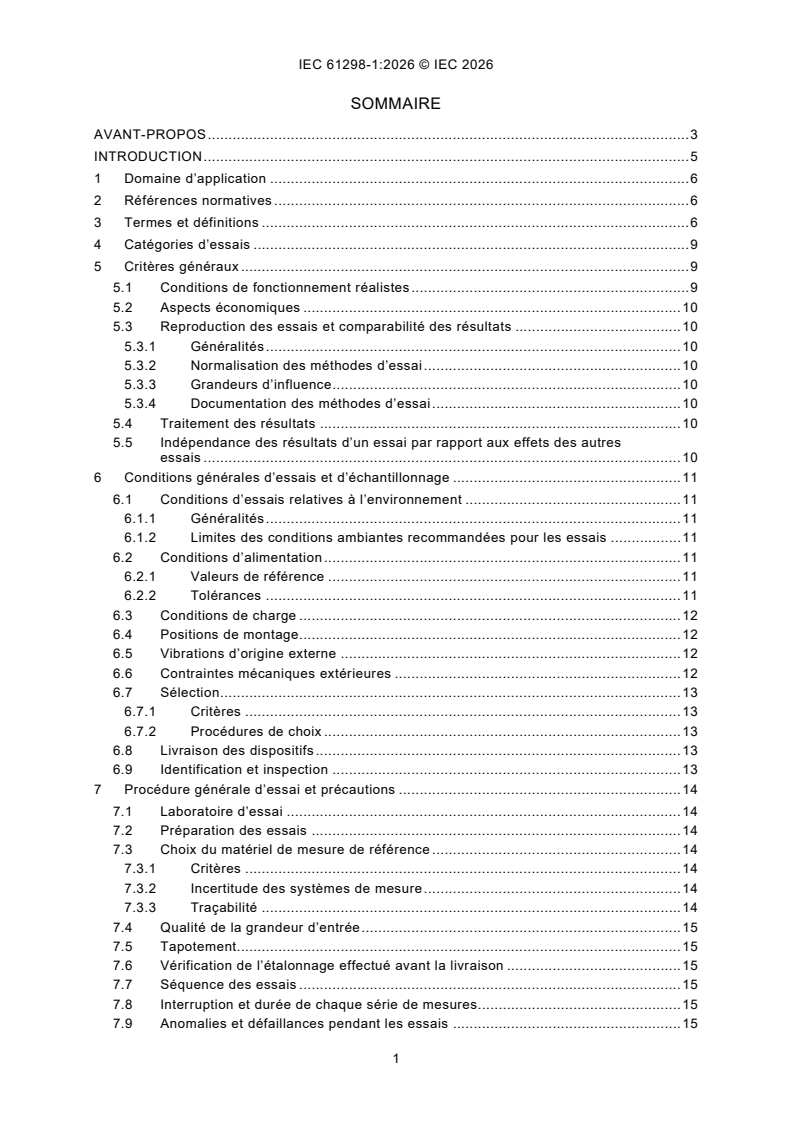
SOMMAIRE
AVANT-PROPOS . 3
INTRODUCTION . 5
1 Domaine d’application . 6
2 Références normatives . 6
3 Termes et définitions . 6
4 Catégories d’essais . 9
5 Critères généraux . 9
5.1 Conditions de fonctionnement réalistes . 9
5.2 Aspects économiques . 10
5.3 Reproduction des essais et comparabilité des résultats . 10
5.3.1 Généralités . 10
5.3.2 Normalisation des méthodes d’essai . 10
5.3.3 Grandeurs d’influence . 10
5.3.4 Documentation des méthodes d’essai . 10
5.4 Traitement des résultats . 10
5.5 Indépendance des résultats d’un essai par rapport aux effets des autres
essais . 10
6 Conditions générales d’essais et d’échantillonnage . 11
6.1 Conditions d’essais relatives à l’environnement . 11
6.1.1 Généralités . 11
6.1.2 Limites des conditions ambiantes recommandées pour les essais . 11
6.2 Conditions d’alimentation . 11
6.2.1 Valeurs de référence . 11
6.2.2 Tolérances . 11
6.3 Conditions de charge . 12
6.4 Positions de montage. 12
6.5 Vibrations d’origine externe . 12
6.6 Contraintes mécaniques extérieures . 12
6.7 Sélection . 13
6.7.1 Critères . 13
6.7.2 Procédures de choix . 13
6.8 Livraison des dispositifs . 13
6.9 Identification et inspection . 13
7 Procédure générale d’essai et précautions . 14
7.1 Laboratoire d’essai . 14
7.2 Préparation des essais . 14
7.3 Choix du matériel de mesure de référence . 14
7.3.1 Critères . 14
7.3.2 Incertitude des systèmes de mesure . 14
7.3.3 Traçabilité . 14
7.4 Qualité de la grandeur d’entrée . 15
7.5 Tapotement. 15
7.6 Vérification de l’étalonnage effectué avant la livraison . 15
7.7 Séquence des essais . 15
7.8 Interruption et durée de chaque série de mesures . 15
7.9 Anomalies et défaillances pendant les essais . 15
7.9.1 Généralités . 15
7.9.2 Mode opératoire . 15
7.10 Reprise d’un essai . 16
7.11 Réglages . 16
7.12 Préconditionnement . 16
7.12.1 Critères . 16
7.12.2 Mode opératoire . 16
7.13 Réglage d’étalonnage de la valeur inférieure de l’étendue et de l’intervalle . 16
7.14 Constance des conditions et réglages de fonctionnement . 16
7.15 Relation entre les grandeurs d’entrée et de sortie . 17
7.15.1 Critères . 17
7.15.2 Mode opératoire . 17
7.16 Évaluation de l’erreur . 17
7.17 Symboles et unités de mesure . 17
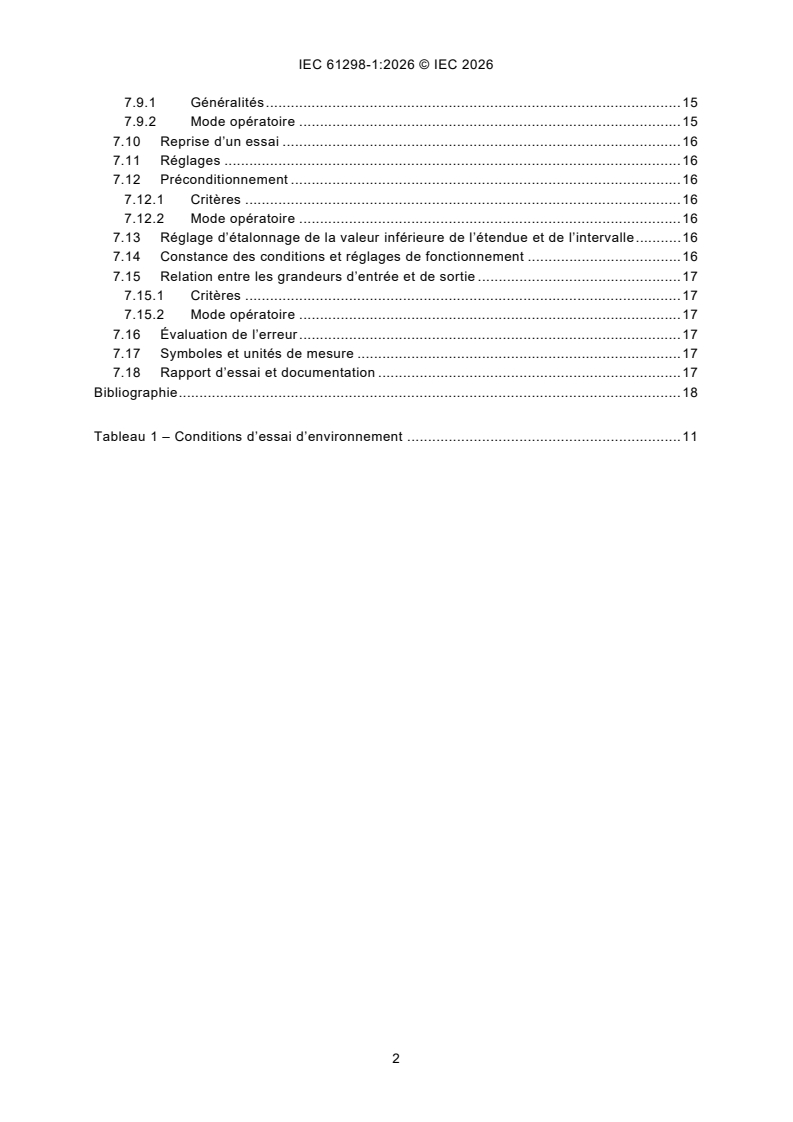
7.18 Rapport d’essai et documentation . 17
Bibliographie . 18
Tableau 1 – Conditions d’essai d’environnement . 11
COMMISSION ÉLECTROTECHNIQUE INTERNATIONALE
____________
Dispositifs de mesure et de commande de processus -
Méthodes et procédures générales d’évaluation des performances -
Partie 1: Généralités
AVANT-PROPOS
1) La Commission Électrotechnique Internationale (IEC) est une organisation mondiale de normalisation composée
de l’ensemble des comités électrotechniques nationaux (Comités nationaux de l’IEC). L’IEC a pour objet de
favoriser la coopération internationale pour toutes les questions de normalisation dans les domaines de
l’électricité et de l’électronique. À cet effet, l’IEC – entre autres activités – publie des Normes internationales,
des Spécifications techniques, des Rapports techniques, des Spécifications accessibles au public (PAS) et des
Guides (ci-après dénommés "Publication(s) de l’IEC"). Leur élaboration est confiée à des comités d’études,
aux travaux desquels tout Comité national intéressé par le sujet traité peut participer. Les organisations
internationales, gouvernementales et non gouvernementales, en liaison avec l’IEC, participent également aux
travaux. L’IEC collabore étroitement avec l’Organisation Internationale de Normalisation (ISO), selon des
conditions fixées par accord entre les deux organisations.
2) Les décisions ou accords officiels de l’IEC concernant les questions techniques représentent, dans la mesure du
possible, un accord international sur les sujets étudiés, étant donné que les Comités nationaux de l’IEC intéressés
sont représentés dans chaque comité d’études.
3) Les Publications de l’IEC se présentent sous la forme de recommandations internationales et sont agréées
comme telles par les Comités nationaux de l’IEC. Tous les efforts raisonnables sont entrepris afin que l’IEC
s’assure de l’exactitude du contenu technique de ses publications; l’IEC ne peut pas être tenue responsable de
l’éventuelle mauvaise utilisation ou interprétation qui en est faite par un quelconque utilisateur final.
4) Dans le but d’encourager l’uniformité internationale, les Comités nationaux de l’IEC s’engagent, dans toute la
mesure possible, à appliquer de façon transparente les Publications de l’IEC dans leurs publications nationales
et régionales. Toutes divergences entre toutes Publications de l’IEC et toutes publications nationales ou
régionales correspondantes doivent être indiquées en termes clairs dans ces dernières.
5) L’IEC elle-même ne fournit aucune attestation de conformité. Des organismes de certification indépendants
fournissent des services d’évaluation de conformité et, dans certains secteurs, accèdent aux marques de
conformité de l’IEC. L’IEC n’est responsable d’aucun des services effectués par les organismes de certification
indépendants.
6) Tous les utilisateurs doivent s’assurer qu’ils sont en possession de la dernière édition de cette publication.
7) Aucune responsabilité ne doit être imputée à l’IEC, à ses administrateurs, employés, auxiliaires ou mandataires,
y compris ses experts particuliers et les membres de ses comités d’études et des Comités nationaux de l’IEC,
pour tout préjudice causé en cas de dommages corporels et matériels, ou de tout autre dommage de quelque
nature que ce soit, directe ou indirecte, ou pour supporter les coûts (y compris les frais de justice) et les dépenses
découlant de la publication ou de l’utilisation de cette Publication de l’IEC ou de toute autre Publication de l’IEC,
ou au crédit qui lui est accordé.
8) L’attention est attirée sur les références normatives citées dans cette publication. L’utilisation de publications
référencées est obligatoire pour une application correcte de la présente publication.
9) L’IEC attire l’attention sur le fait que la mise en application du présent document peut entraîner l’utilisation d’un
ou de plusieurs brevets. L’IEC ne prend pas position quant à la preuve, à la validité et à l’applicabilité de tout
droit de brevet revendiqué à cet égard. À la date de publication du présent document, l’IEC n’avait pas reçu
notification qu’un ou plusieurs brevets pouvaient être nécessaires à sa mise en application. Toutefois, il y a lieu
d’avertir les responsables de la mise en application du présent document que des informations plus récentes
sont susceptibles de figurer dans la base de données de brevets, disponible à l’adresse https://patents.iec.ch.
L’IEC ne saurait être tenue pour responsable de ne pas avoir identifié de tels droits de brevet.
L’IEC 61298-3 a été établie par le sous-comité 65B: Dispositifs de mesure et de commande,
du comité d’études 65 de l’IEC: Mesure, commande et automation dans les processus
industriels. Il s’agit d’une Norme internationale.
Cette troisième édition annule et remplace la deuxième édition parue en 2008 et constitue une
révision technique.
Cette édition inclut les modifications techniques majeures suivantes par rapport à l’édition
précédente:
a) Les émetteurs de mesure de processus (PMT) ont été retirés du champ d’application de
cette norme.
Le texte de cette Norme internationale est issu des documents suivants:
Projet Rapport de vote
65B/1304/FDIS 65B/1329/RVD
Le rapport de vote indiqué dans le tableau ci-dessus donne toute information sur le vote ayant
abouti à son approbation.
La langue employée pour l’élaboration de cette Norme internationale est l’anglais.
Ce document a été rédigé selon les Directives ISO/IEC, Partie 2, il a été développé selon les
Directives ISO/IEC, Partie 1 et les Directives ISO/IEC, Supplément IEC, disponibles sous
www.iec.ch/members_experts/refdocs. Les principaux types de documents développés par
l’IEC sont décrits plus en détail sous www.iec.ch/publications.
Une liste de toutes les parties de la série IEC 61298, présentées sous le titre général
Dispositifs de mesure et de commande de processus - Méthodes et procédures générales
d’évaluation des performances, peut être consultée sur le site web de l’IEC.
Le comité a décidé que le contenu de ce document ne sera pas modifié avant la date de stabilité
indiquée sur le site web de l’IEC sous webstore.iec.ch dans les données relatives au document
recherché. À cette date, le document sera
– reconduit,
– supprimé, ou
– révisé.
INTRODUCTION
Le présent document est destiné à servir de document de référence pour l’élaboration de
futures normes, tant par l’IEC que par d’autres organismes de normalisation, dans le domaine
de l’évaluation de l’instrumentation des processus, à l’exception des émetteurs de mesure de
processus (PMT) qui sont normalisés par la série IEC 62828.
Les éléments normatifs suivants peuvent être utilisés pour l’établissement de futures normes,
comme suit:
– toute méthode ou procédure d’essai figurant déjà dans le présent document est spécifiée et
décrite dans la nouvelle norme en faisant référence à l’article approprié du présent
document. C’est pourquoi les nouvelles éditions révisées du présent document ne
comportent pas de changement quant à la numérotation des articles et leur domaine
d’application;
– toute méthode ou procédure d’essai particulière non couverte par le présent document est
développée et spécifiée dans la nouvelle norme conformément aux critères définis dans le
présent document, dans la mesure où ils sont applicables;
– tout écart fondamental ou important par rapport au contenu du présent document est
distinctement identifié et justifié, s’il est introduit dans une nouvelle norme.
1 Domaine d’application
La présente partie de l’IEC 61298 spécifie les méthodes et procédures générales pour la
conduite des essais et la production de rapports sur les caractéristiques fonctionnelles et de
performance des instruments de processus, à l’exception des émetteurs de mesure de
processus (PMT) qui sont normalisés par la série IEC 62828. Ces essais sont applicables à
tout dispositif à condition que ce dispositif soit caractérisé par ses propres grandeurs d’entrée
et de sortie et par la relation spécifique (fonction de transfert) entre les entrées et les sorties.
Ils concernent les dispositifs analogiques et numériques. Pour les dispositifs exigeant des
essais spéciaux, le présent document peut être utilisé en conjonction avec la norme particulière
de produit spécifiant ces essais spéciaux.
Le présent document couvre les principes généraux qui s’appliquent à l’ensemble de la série
IEC 61298.
2 Références normatives
Les documents suivants sont cités dans le texte de sorte qu’ils constituent, pour tout ou partie
de leur contenu, des exigences du présent document. Pour les références datées,
seule l’édition citée s’applique. Pour les références non datées, la dernière édition du document
de référence s’applique (y compris les éventuels amendements).
IEC 60050-300, Vocabulaire Électrotechnique International (IEV) - Partie 300: Mesures et
appareils de mesure électriques et électroniques - Partie 311: Termes généraux concernant les
mesures - Partie 312: Termes généraux concernant les mesures électriques - Partie 313: Types
d’appareils électriques de mesure - Partie 314: Termes spécifiques selon le type d’appareil,
disponible à l’adresse https://www.electropedia.org/
IEC 60050-351, Vocabulaire Électrotechnique International (IEV) - Partie 351: Technologie de
commande et de régulation, disponible à l’adresse https://www.electropedia.org/
IEC 61298-2, Dispositifs de mesure et de commande de processus - Méthodes et procédures
générales d’évaluation des performances - Partie 2: Essais dans les conditions de référence
IEC 61298-3, Dispositifs de mesure et de commande de processus - Méthodes et procédures
générales d’évaluation des performances - Partie 3: Essais pour la détermination des effets
des grandeurs d’influence
IEC 61298-4, Dispositifs de mesure et de commande de processus - Méthodes et procédures
générales d’évaluation des performances - Partie 4: Contenu du rapport d’évaluation
ISO/IEC 80000 (toutes les parties), Grandeurs et unités
3 Termes et définitions
Pour les besoins du présent document, les termes et les définitions de l’IEC 60050-300 et
l’IEC 60050-351, ainsi que les suivants, s’appliquent.
L’ISO et l’IEC tiennent à jour des bases de données terminologiques destinées à être utilisées
en normalisation, consultables aux adresses suivantes:
– IEC Electropedia: disponible à l’adresse https://www.electropedia.org/
– ISO Online browsing platform: disponible à l’adresse https://www.iso.org/obp
3.1
grandeur
variable
grandeur ou condition dont la valeur est variable et qui peut en général être mesurée
(par exemple température, débit, vitesse, signal, etc.)
[SOURCE: IEC 60050-351:2013, 351-41-01, modifié – Le premier terme préférentiel,
"quantité variable", a été supprimé, la définition a été modifiée et les 3 notes à l’article ont été
supprimées.]
3.2
étendue
gamme des valeurs définie par deux valeurs extrêmes, entre lesquelles une variable peut être
mesurée avec la précision spécifiée
[SOURCE: IEC 60050-311:2001, 311-03-14, modifié – La définition a été modifiée et la note à
l’article a été supprimée.]
3.3
intervalle
différence algébrique entre les valeurs de la limite supérieure et de la limite inférieure de
l’étendue de mesure
[SOURCE: IEC 60050-311:2001, 311-03-13]
3.4
imprécision
écart positif ou négatif maximal à partir de la courbe caractéristique spécifiée, observé quand
un dispositif est soumis à essai dans les conditions spécifiées et suivant une procédure
spécifiée
Note 1 à l’article: La précision est définie dans l’IEC 60050-300:2001, 311-06-08.
3.5
erreur
différence algébrique entre la valeur indiquée et une valeur comparative de la grandeur
mesurée
Note 1 à l’article: L’erreur est positive quand la valeur indiquée est supérieure à la valeur comparative. L’erreur est
en général exprimée en pourcentage de l’intervalle idéal correspondant.
[SOURCE: IEC 60050-192:2024, 192-03-02, modifié – La définition a été modifiée, la Note 1 à
l’article a été modifiée et la Note 2 à l’article a été supprimée.]
3.6
erreur mesurée
valeur positive ou négative la plus élevée de l’erreur de la valeur moyenne, mesurée en montant
ou en descendant, à chaque point de mesure
3.7
non-linéarité
écart par rapport à la linéarité
Note 1 à l’article: La linéarité est définie dans l’IEC 60050-300:2001, 311-06-05.
Note 2 à l’article: La non-linéarité ne comprend pas l’hystérésis.
3.8
non-répétabilité
écart par rapport à la répétabilité
Note 1 à l’article: La répétabilité est définie dans l’IEC 60050-300:2001, 311-06-06.
3.9
hystérésis
propriété qu’a un instrument ou un appareil de mesure de donner différentes valeurs de sortie
pour les mêmes valeurs d’entrée selon le sens dans lequel ces dernières ont été appliquées
successivement
[SOURCE: IEC 60050-351:2013, 351-45-16, modifié – La définition a été modifiée et la note à
l’article a été supprimée.]
3.10
zone d’insensibilité (zone morte)
étendue finie de valeurs à l’intérieur de laquelle une variation de la variable d’entrée
n’entraîne pas de variation mesurable de la variable de sortie
[SOURCE: IEC 60050-351:2013, 351-45-15, modifié – La définition a été modifiée et la note à
l’article a été supprimée.]
3.11
événement inattendu
panne, défaut de fonctionnement, anomalie du dispositif ou dommage inopiné à ce dispositif
survenant durant une évaluation, et nécessitant une intervention du fabricant
3.12
procédure d’essai
spécification des essais à effectuer et des conditions de chaque essai, établie avant d’effectuer
les essais et d’un commun accord entre le fabricant, le laboratoire d’essai et le client
(ou l’utilisateur)
3.13
essai de type
essai portant sur un ou plusieurs dispositifs de conception particulière dans le but de démontrer
que la conception est conforme à des spécifications données
Note 1 à l’article: En principe, les essais de type sont réalisés uniquement sur un échantillon. En règle générale,
ils ne sont pas répétés sur chacune des unités fabriquées en série.
3.14
évaluation des performances
essai complet destiné à établir les performances d’un dispositif dans les conditions de
fonctionnement vraisemblables, et à permettre la comparaison avec les spécifications de
performances du dispositif publiées ou déclarées par le fabricant, ou avec les exigences de
l’utilisateur
3.15
essai individuel
essai simplifié auquel chaque instrument est soumis pendant ou après sa fabrication afin de
vérifier sa conformité à certains critères
3.16
essai sur prélèvement
essai simplifié pour vér
...