

IEC 61298-1:2008
(Main)Process measurement and control devices - General methods and procedures for evaluating performance - Part 1: General considerations
General Information
- Abstract
IEC 61298-1:2008 specifies general methods and procedures for conducting tests, and reporting on the functional and performance characteristics of process measurement and control devices. The methods and procedures specified in this standard are applicable to any type of process measurement and control device. The tests are applicable to any such devices characterized by their own specific input and output variables, and by the specific relationship (transfer function) between the inputs and outputs, and include analogue and digital devices. For devices that require special tests, this standard should be used, together with any product specific standard specifying special tests. It covers general principles which apply to the series.
- Status
- Published
- Publication Date
- 07-Oct-2008
- Technical Committee
- SC 65B - Measurement and control devices
- Drafting Committee
- WG 6 - TC 65/SC 65B/WG 6
Overview
IEC 61298-1:2008, titled Process Measurement and Control Devices - General Methods and Procedures for Evaluating Performance - Part 1: General Considerations, is an international standard developed by the International Electrotechnical Commission (IEC). This standard specifies general methods and procedures for testing and reporting the functional and performance characteristics of process measurement and control devices. It applies universally to all types of such devices, whether analogue or digital, characterized by specific inputs, outputs, and their transfer functions.
IEC 61298-1:2008 serves as a foundational reference for the evaluation of process instruments, providing a consistent and standardized approach to performance testing. It is used alongside product-specific standards where specialized tests are required. This ensures high reliability, repeatability, and comparability of test results across different devices and manufacturers.
Key Topics
Scope and Applicability
The standard covers testing procedures for any process measurement and control device, emphasizing devices with defined input-output relationships. Its scope includes a broad range of devices from simple sensors to complex control units.Test Categories and Criteria
It discusses different categories of tests and lays out general criteria such as realistic operating conditions, economic feasibility, and independence of test results from interfering factors.Environmental and Operating Conditions
IEC 61298-1 defines recommended limits on ambient conditions during tests, including temperature, vibration, mechanical constraints, power supply tolerances, and mounting conditions which must be accounted for when performing performance evaluations.Test Procedures and Documentation
Detailed guidance is given on the preparation and execution of tests including selection and calibration of reference measurement equipment, sequence and duration of tests, handling of anomalies or failures, and data processing protocols.Reporting and Traceability
The standard emphasizes thorough documentation and transparency; ensuring test results and methods are well-recorded to allow traceability and reproducibility. This includes clear specifications on units of measurement, symbols, and error assessments.Integration with Other Standards
While IEC 61298-1 provides general principles, it should be used in conjunction with product-specific standards covering specialized tests for particular devices.
Applications
Industrial Process Control
Ensures that sensors, transmitters, controllers, and other automated instruments used in process industries meet strict performance and reliability criteria.Quality Assurance and Compliance
Device manufacturers and testing laboratories apply IEC 61298-1 to validate product performance, facilitating compliance with regulatory requirements and customer expectations.Standardization in Production and Testing
Provides a consistent framework for evaluation that helps harmonize test methodologies across global markets, enhancing interoperability and reducing costs due to duplicated testing efforts.Research and Development
Enables design engineers to benchmark device performance against international criteria during product development phases.Calibration Laboratories
Serves as a guideline for calibration centers to conduct and document performance testing accurately, ensuring traceability to international standards.
Related Standards
IEC 60050-300: International Electrotechnical Vocabulary (IEV) Part 300
Provides essential terminology referenced in IEC 61298-1 for clear communication and understanding of test concepts.Product-Specific IEC Standards
For devices requiring specialized testing beyond general procedures, corresponding IEC standards apply (e.g., specific standards for flowmeters, temperature transmitters, pressure sensors).ISO/IEC Directives
These directives govern the development and formatting of IEC standards, ensuring coherence and quality in documentation.
Conclusion
IEC 61298-1:2008 is a critical standard for the performance evaluation of process measurement and control devices, underpinning industrial automation and control quality worldwide. By standardizing test environments, procedures, and documentation, it enhances the reliability and interoperability of process instrumentation. Organizations involved in industrial process control, manufacturing, calibration, and testing will find this standard invaluable for ensuring consistent and accurate device performance assessments.
Keywords: IEC 61298-1, process measurement devices, process control devices, performance evaluation, testing procedures, process instrumentation standards, IEC standards, industrial automation, device calibration, measurement accuracy.
Relations
- Effective Date
- 05-Sep-2023
Get Certified
Connect with accredited certification bodies for this standard

DVS-ZERT GmbH
German welding certification society.
CARES (UK Certification Authority for Reinforcing Steels)
UK certification for reinforcing steels and construction.
EWF/IIW (European/International Welding Federation)
International welding personnel certification.
Sponsored listings
Frequently Asked Questions
IEC 61298-1:2008 is a standard published by the International Electrotechnical Commission (IEC). Its full title is "Process measurement and control devices - General methods and procedures for evaluating performance - Part 1: General considerations". This standard covers: IEC 61298-1:2008 specifies general methods and procedures for conducting tests, and reporting on the functional and performance characteristics of process measurement and control devices. The methods and procedures specified in this standard are applicable to any type of process measurement and control device. The tests are applicable to any such devices characterized by their own specific input and output variables, and by the specific relationship (transfer function) between the inputs and outputs, and include analogue and digital devices. For devices that require special tests, this standard should be used, together with any product specific standard specifying special tests. It covers general principles which apply to the series.
IEC 61298-1:2008 specifies general methods and procedures for conducting tests, and reporting on the functional and performance characteristics of process measurement and control devices. The methods and procedures specified in this standard are applicable to any type of process measurement and control device. The tests are applicable to any such devices characterized by their own specific input and output variables, and by the specific relationship (transfer function) between the inputs and outputs, and include analogue and digital devices. For devices that require special tests, this standard should be used, together with any product specific standard specifying special tests. It covers general principles which apply to the series.
IEC 61298-1:2008 is classified under the following ICS (International Classification for Standards) categories: 25.040.40 - Industrial process measurement and control. The ICS classification helps identify the subject area and facilitates finding related standards.
IEC 61298-1:2008 has the following relationships with other standards: It is inter standard links to IEC 61298-1:2026. Understanding these relationships helps ensure you are using the most current and applicable version of the standard.
IEC 61298-1:2008 is available in PDF format for immediate download after purchase. The document can be added to your cart and obtained through the secure checkout process. Digital delivery ensures instant access to the complete standard document.
Standards Content (Sample)
IEC 61298-1
Edition 2.0 2008-10
INTERNATIONAL
STANDARD
NORME
INTERNATIONALE
Process measurement and control devices – General methods and procedures
for evaluating performance –
Part 1: General considerations
Dispositifs de mesure et de commande de processus – Méthodes et procédures
générales d'évaluation des performances –
Partie 1: Généralités
All rights reserved. Unless otherwise specified, no part of this publication may be reproduced or utilized in any form or by
any means, electronic or mechanical, including photocopying and microfilm, without permission in writing from either IEC or
IEC's member National Committee in the country of the requester.
If you have any questions about IEC copyright or have an enquiry about obtaining additional rights to this publication,
please contact the address below or your local IEC member National Committee for further information.
Droits de reproduction réservés. Sauf indication contraire, aucune partie de cette publication ne peut être reproduite
ni utilisée sous quelque forme que ce soit et par aucun procédé, électronique ou mécanique, y compris la photocopie
et les microfilms, sans l'accord écrit de la CEI ou du Comité national de la CEI du pays du demandeur.
Si vous avez des questions sur le copyright de la CEI ou si vous désirez obtenir des droits supplémentaires sur cette
publication, utilisez les coordonnées ci-après ou contactez le Comité national de la CEI de votre pays de résidence.
IEC Central Office
3, rue de Varembé
CH-1211 Geneva 20
Switzerland
Email: inmail@iec.ch
Web: www.iec.ch
About the IEC
The International Electrotechnical Commission (IEC) is the leading global organization that prepares and publishes
International Standards for all electrical, electronic and related technologies.
About IEC publications
The technical content of IEC publications is kept under constant review by the IEC. Please make sure that you have the
latest edition, a corrigenda or an amendment might have been published.
ƒ Catalogue of IEC publications: www.iec.ch/searchpub
The IEC on-line Catalogue enables you to search by a variety of criteria (reference number, text, technical committee,…).
It also gives information on projects, withdrawn and replaced publications.
ƒ IEC Just Published: www.iec.ch/online_news/justpub
Stay up to date on all new IEC publications. Just Published details twice a month all new publications released. Available
on-line and also by email.
ƒ Electropedia: www.electropedia.org
The world's leading online dictionary of electronic and electrical terms containing more than 20 000 terms and definitions
in English and French, with equivalent terms in additional languages. Also known as the International Electrotechnical
Vocabulary online.
ƒ Customer Service Centre: www.iec.ch/webstore/custserv
If you wish to give us your feedback on this publication or need further assistance, please visit the Customer Service
Centre FAQ or contact us:
Email: csc@iec.ch
Tel.: +41 22 919 02 11
Fax: +41 22 919 03 00
A propos de la CEI
La Commission Electrotechnique Internationale (CEI) est la première organisation mondiale qui élabore et publie des
normes internationales pour tout ce qui a trait à l'électricité, à l'électronique et aux technologies apparentées.
A propos des publications CEI
Le contenu technique des publications de la CEI est constamment revu. Veuillez vous assurer que vous possédez
l’édition la plus récente, un corrigendum ou amendement peut avoir été publié.
ƒ Catalogue des publications de la CEI: www.iec.ch/searchpub/cur_fut-f.htm
Le Catalogue en-ligne de la CEI vous permet d’effectuer des recherches en utilisant différents critères (numéro de référence,
texte, comité d’études,…). Il donne aussi des informations sur les projets et les publications retirées ou remplacées.
ƒ Just Published CEI: www.iec.ch/online_news/justpub
Restez informé sur les nouvelles publications de la CEI. Just Published détaille deux fois par mois les nouvelles
publications parues. Disponible en-ligne et aussi par email.
ƒ Electropedia: www.electropedia.org
Le premier dictionnaire en ligne au monde de termes électroniques et électriques. Il contient plus de 20 000 termes et
définitions en anglais et en français, ainsi que les termes équivalents dans les langues additionnelles. Egalement appelé
Vocabulaire Electrotechnique International en ligne.
ƒ Service Clients: www.iec.ch/webstore/custserv/custserv_entry-f.htm
Si vous désirez nous donner des commentaires sur cette publication ou si vous avez des questions, visitez le FAQ du
Service clients ou contactez-nous:
Email: csc@iec.ch
Tél.: +41 22 919 02 11
Fax: +41 22 919 03 00
IEC 61298-1
Edition 2.0 2008-10
INTERNATIONAL
STANDARD
NORME
INTERNATIONALE
Process measurement and control devices – General methods and procedures
for evaluating performance –
Part 1: General considerations
Dispositifs de mesure et de commande de processus – Méthodes et procédures
générales d'évaluation des performances –
Partie 1: Généralités
INTERNATIONAL
ELECTROTECHNICAL
COMMISSION
COMMISSION
ELECTROTECHNIQUE
PRICE CODE
INTERNATIONALE
Q
CODE PRIX
ICS 25.040.40 ISBN 978-2-88910-483-3
– 2 – 61298-1 © IEC:2008
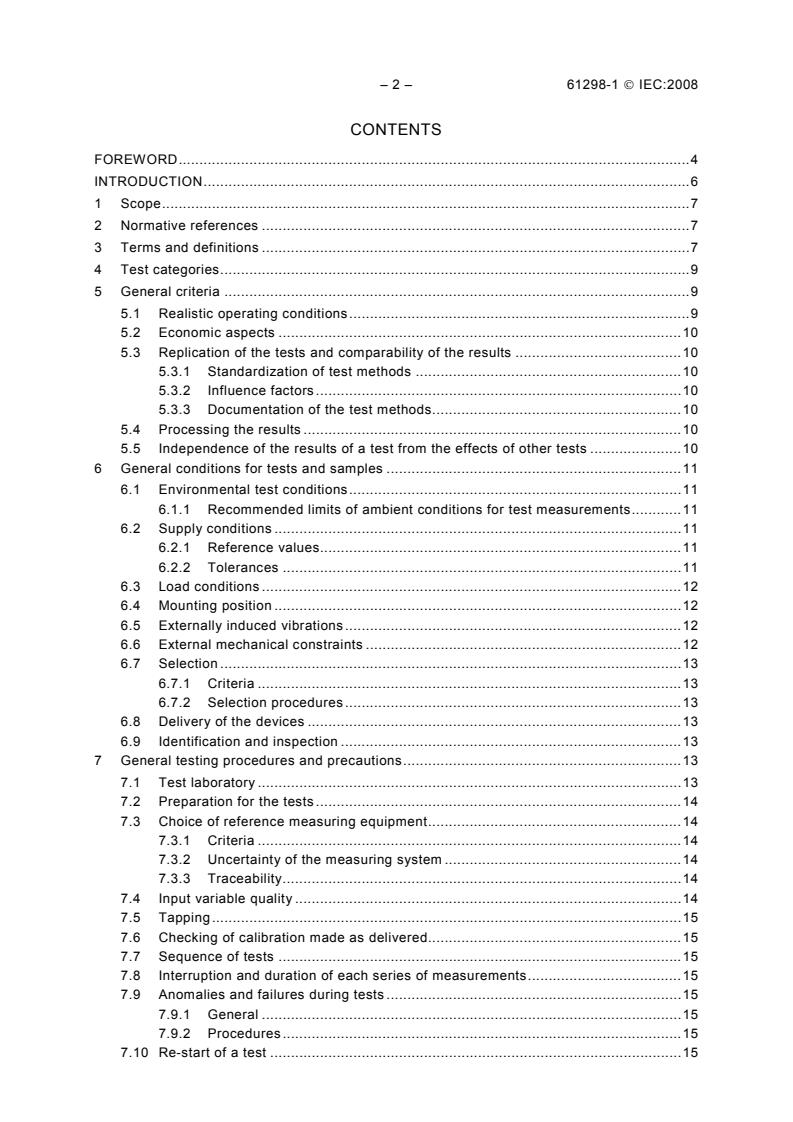
CONTENTS
FOREWORD.4
INTRODUCTION.6
1 Scope.7
2 Normative references .7
3 Terms and definitions .7
4 Test categories.9
5 General criteria .9
5.1 Realistic operating conditions.9
5.2 Economic aspects .10
5.3 Replication of the tests and comparability of the results .10
5.3.1 Standardization of test methods .10
5.3.2 Influence factors.10
5.3.3 Documentation of the test methods.10
5.4 Processing the results .10
5.5 Independence of the results of a test from the effects of other tests .10
6 General conditions for tests and samples .11
6.1 Environmental test conditions.11
6.1.1 Recommended limits of ambient conditions for test measurements.11
6.2 Supply conditions .11
6.2.1 Reference values.11
6.2.2 Tolerances .11
6.3 Load conditions .12
6.4 Mounting position .12
6.5 Externally induced vibrations.12
6.6 External mechanical constraints .12
6.7 Selection .13
6.7.1 Criteria .13
6.7.2 Selection procedures.13
6.8 Delivery of the devices .13
6.9 Identification and inspection .13
7 General testing procedures and precautions.13
7.1 Test laboratory .13
7.2 Preparation for the tests .14
7.3 Choice of reference measuring equipment.14
7.3.1 Criteria .14
7.3.2 Uncertainty of the measuring system .14
7.3.3 Traceability.14
7.4 Input variable quality .14
7.5 Tapping.15
7.6 Checking of calibration made as delivered.15
7.7 Sequence of tests .15
7.8 Interruption and duration of each series of measurements.15
7.9 Anomalies and failures during tests .15
7.9.1 General .15
7.9.2 Procedures.15
7.10 Re-start of a test .15
61298-1 © IEC:2008 – 3 –
7.11 Setting of adjustments.16
7.12 Preconditioning .16
7.12.1 Criteria .16
7.12.2 Procedure.16
7.13 Calibration adjustments of lower range value and span .16
7.14 Constancy of the operating conditions and settings .16
7.15 Input/output variable relationships .16
7.15.1 Criteria .16
7.15.2 Procedure.16
7.16 Error assessment .17
7.17 Symbols and units of measurement .17
7.18 Test report and documentation .17
– 4 – 61298-1 © IEC:2008
INTERNATIONAL ELECTROTECHNICAL COMMISSION
____________
PROCESS MEASUREMENT AND CONTROL DEVICES –
GENERAL METHODS AND PROCEDURES FOR
EVALUATING PERFORMANCE –
Part 1: General considerations
FOREWORD
1) The International Electrotechnical Commission (IEC) is a worldwide organization for standardization comprising
all national electrotechnical committees (IEC National Committees). The object of IEC is to promote
international co-operation on all questions concerning standardization in the electrical and electronic fields. To
this end and in addition to other activities, IEC publishes International Standards, Technical Specifications,
Technical Reports, Publicly Available Specifications (PAS) and Guides (hereafter referred to as “IEC
Publication(s)”). Their preparation is entrusted to technical committees; any IEC National Committee interested
in the subject dealt with may participate in this preparatory work. International, governmental and non-
governmental organizations liaising with the IEC also participate in this preparation. IEC collaborates closely
with the International Organization for Standardization (ISO) in accordance with conditions determined by
agreement between the two organizations.
2) The formal decisions or agreements of IEC on technical matters express, as nearly as possible, an international
consensus of opinion on the relevant subjects since each technical committee has representation from all
interested IEC National Committees.
3) IEC Publications have the form of recommendations for international use and are accepted by IEC National
Committees in that sense. While all reasonable efforts are made to ensure that the technical content of IEC
Publications is accurate, IEC cannot be held responsible for the way in which they are used or for any
misinterpretation by any end user.
4) In order to promote international uniformity, IEC National Committees undertake to apply IEC Publications
transparently to the maximum extent possible in their national and regional publications. Any divergence
between any IEC Publication and the corresponding national or regional publication shall be clearly indicated in
the latter.
5) IEC provides no marking procedure to indicate its approval and cannot be rendered responsible for any
equipment declared to be in conformity with an IEC Publication.
6) All users should ensure that they have the latest edition of this publication.
7) No liability shall attach to IEC or its directors, employees, servants or agents including individual experts and
members of its technical committees and IEC National Committees for any personal injury, property damage or
other damage of any nature whatsoever, whether direct or indirect, or for costs (including legal fees) and
expenses arising out of the publication, use of, or reliance upon, this IEC Publication or any other IEC
Publications.
8) Attention is drawn to the Normative references cited in this publication. Use of the referenced publications is
indispensable for the correct application of this publication.
9) Attention is drawn to the possibility that some of the elements of this IEC Publication may be the subject of
patent rights. IEC shall not be held responsible for identifying any or all such patent rights.
International Standard IEC 61298-1 has been prepared by subcommittee 65B: Devices and
process analysis, of IEC technical committee 65: Industrial-process measurement, control and
automation.
This second edition cancels and replaces the first edition published in 1995 and constitutes a
technical revision.
This edition is a general revision with respect to the previous edition and does not include any
significant changes (see Introduction).
61298-1 © IEC:2008 – 5 –
The text of this standard is based on the following documents:
FDIS Report on voting
65B/685/FDIS 65B/693/RVD
Full information on the voting for the approval of this standard can be found in the report on
voting indicated in the above table.
This publication has been drafted in accordance with the ISO/IEC Directives, Part 2.
A list of all parts of the IEC 61298 series, under the general title Process measurement and
control devices – General methods and procedures for evaluating performance, can be found
on the IEC website.
The committee has decided that the contents of this publication will remain unchanged until
the maintenance result date indicated on the IEC web site under "http://webstore.iec.ch" in
the data related to the specific publication. At this date, the publication will be
• reconfirmed,
• withdrawn,
• replaced by a revised edition, or
• amended.
– 6 – 61298-1 © IEC:2008
INTRODUCTION
This standard is not intended as a substitute for existing standards, but is rather intended as a
reference document for any future standards developed within the IEC or other standards
organizations, concerning the evaluation of process instrumentation. Any revision of existing
standards should take this standard into account.
This common standardized basis should be utilized for the preparation of future relevant
standards, as follows:
– any test method or procedure, already treated in this standard, should be specified and
described in the new standard by referring to the corresponding clause of this standard.
Consequently new editions of this standard are revised without any change in numbering
and scope of each clause;
– any particular method or procedure, not covered by this standard, should be developed
and specified in the new standard in accordance with the criteria, as far as they are
applicable, stated in this standard;
– any conceptual or significant deviation from the content of this standard, should clearly be
identified and justified if introduced in a new standard.
61298-1 © IEC:2008 – 7 –
PROCESS MEASUREMENT AND CONTROL DEVICES –
GENERAL METHODS AND PROCEDURES FOR
EVALUATING PERFORMANCE –
Part 1: General considerations
1 Scope
This part of IEC 61298 specifies general methods and procedures for conducting tests, and
reporting on the functional and performance characteristics of process measurement and
control devices. The methods and procedures specified in this standard are applicable to any
type of process measurement and control device. The tests are applicable to any such
devices characterized by their own specific input and output variables, and by the specific
relationship (transfer function) between the inputs and outputs, and include analogue and
digital devices. For devices that require special tests, this standard should be used, together
with any product specific standard specifying special tests.
This standard covers general principles which apply to the series.
2 Normative references
The following referenced documents are indispensable for the application of this document.
For dated references, only the edition cited applies. For undated references, the latest edition
of the referenced document (including any amendments) applies.
IEC 60050-300, International Electrotechnical Vocabulary (IEV) – Electrical and electronic
measurements and measuring instruments (composed of Part 311, 312, 313 and 314)
IEC 60050-351, International Electrotechnical Vocabulary (IEV) – Part 351: Control
technology
IEC 60410:1973, Sampling plans and procedures for inspection by attributes
IEC 61298-4, Process measurement and control devices – General methods and procedures
for evaluating performance – Part 4: Evaluation report content
IEC 61298-2, Process measurement and control devices – General methods and procedures
for evaluating performance – Part 2: Tests under reference conditions
ISO 31 (all parts), Quantities and units
3 Terms and definitions
For the purpose of this document, the following relevant terms and definitions, some of them
based on IEC 60050(300) or IEC 60050(351), apply.
3.1 variable
quantity or condition whose value is subject to change and can usually be measured (e.g.,
temperature, flow rate, speed, signal, etc.)
[IEV 351-21-01, modified]
– 8 – 61298-1 © IEC:2008
3.2
signal
physical quantity, one or more parameters of which carry information about one or more
variables which the signal represents
[IEV 351-21-51, modified]
3.3
range
range of values defined by the two extreme values, within which a variable can be measured
within the specified accuracy
[IEV 351-27-11, modified]
3.4
span
algebraic difference between the values of the upper and lower limits of the measuring range
[IEV 311-03-13]
3.5
inaccuracy
maximum positive and negative deviation from the specified characteristic curve observed in
testing a device under specified conditions and by a specified procedure
NOTE Accuracy is defined in IEC 60050-300, definition 311-06-08.
3.6
error
algebraic difference between the indicated value and a comparison value of the measured
variable
[IEV 351-27-04, modified]
NOTE The error is positive when the indicated value is greater than the comparison value. The error is generally
expressed as a percentage of the relevant ideal span.
3.7
measured error
largest positive or negative value of errors of the average upscale or downscale values at
each point of measurement
3.8
non-linearity
deviation from linearity
NOTE 1 Linearity is defined in IEC 60050(300), definition 311-06-05.
NOTE 2 Non-linearity does not include hysteresis.
3.9
non-repeatability
deviation from repeatability
NOTE Repeatability is defined in IEC 60050(300), definition 311-06-06.
3.10
hysteresis
property of a device or instrument whereby it gives different output values in relation to its
input values depending on the directional sequence in which the input values have been
applied
[IEV 351-24-15, modified]
61298-1 © IEC:2008 – 9 –
3.11
dead band
finite range of values within which a variation of the input variable does not produce any
measurable change in the output variable
[IEV 351-24-14, modified]
3.12
unexpected event
device breakdown, failure to work, anomaly, or inadvertent damage occurring during an
evaluation, which requires correction by the device manufacturer
3.13
test procedure
statement of the tests to be carried out, and the conditions for each test, agreed between the
manufacturer, the test laboratory, and the purchaser/user before the evaluation starts
3.14
type tests
a test of one or more devices made to a certain design to show that the design meets certain
specifications
NOTE The type tests are in principle applied only on a sample. Normally are not repeated on all the individual
units of equipment made in series.
4 Test categories
The tests specified can be considered under two categories.
a) Complete tests
These cover performance evaluations or type tests to establish the performance of a device
under any likely operating conditions; to permit comparison with the manufacturer's published
or stated performance specification for the device, or the user's requirements.
b) Simplified tests
These cover a selection of the complete tests to check specific characteristics of a device
(e.g., routine tests of all devices before delivery, or tests on a random sample of devices).
Where the full range of tests is not carried out, this shall be stated in all reports on the testing,
and the reasons given (e.g., economy, lack of relevance to the particular application, or failure
of the device). Deviations from the test procedures specified shall also be reported.
The programme of tests, prepared in accordance with this standard, shall be agreed between
the test house, the initiator/purchaser, and where appropriate, the device supplier or
manufacturer, before tests are commenced. Because of the generic nature of this standard,
the tests listed may be too extensive, or insufficiently comprehensive for a particular
requirement, and a modification of the test programme may be agreed.
The criteria for accepting test results (e.g., expected or limiting values), and for judgement of
the quality and acceptance of the device under test, are strictly related to the subsequent use
of the test results, and are outside the scope of this standard.
5 General criteria
5.1 Realistic operating conditions
Ideally, instruments should be evaluated under each of the conditions which they are likely to
meet in service. Unfortunately, it is not practical to evaluate performance under all possible
– 10 – 61298-1 © IEC:2008
combinations of operating conditions. A standard test procedure is therefore specified which
is practical under laboratory conditions, which will provide sufficient data on which a
prediction of field performance can be made. Use of a small number of standard conditions
covering the range will simplify testing, and enable tests on different devices to be more
readily compared.
5.2 Economic aspects
The test procedures, and the number of test points and measurement cycles, shall be chosen
so as to obtain the best compromise between objectives and relevance of the results on the
one hand, and costs and technical difficulties of the test on the other. Standard procedures
should be used, but if tests are omitted or curtailed for economic or other reasons, this shall
be stated in the test report.
5.3 Replication of the tests and comparability of the results
To obtain comparable results from tests performed at different times and places, by
different operators, on different devices of the same type, the test procedures and methods
need to be well defined and reproducible. In particular, the following are required.
5.3.1 Standardization of test methods
The test methods to be followed during the evaluation shall be decided before the start, and
shall conform with standardized test methods wherever possible. Deviation from standard
methods shall be reported.
5.3.2 Influence factors
During the test, all the factors which might influence the behaviour of the Device Under Test
(DUT) shall be checked and maintained as constant as possible (with the exception of the
specific condition being tested).
5.3.3 Documentation of the test methods
The test report shall clearly indicate the standards or standard referred to during the
evaluation, and state the test conditions and any deviation from the specified conditions which
has occurred during the evaluation (a format for a full report of an evaluation is presented in
IEC 61298-4).
5.4 Processing the results
Due to economic aspects (see 5.2), the number of measurements during a test is often
reduced to the minimum, and therefore it is statistically insignificant. Processing of the results
to obtain meaningful information from the evaluation, therefore, cannot be performed following
statistical methods, but it shall be performed following conventional methods.
Consequently, in view of the general nature of the parameters characterizing the DUT (e.g.,
inaccuracy, hysteresis, non-repeatability, dead band, etc.) the calculations are based on
maximum values (positive and negative) of the difference between the measured value and
conventional true values, with the exception of a few quantities, for which use is made of
averaged values (e.g., measured error, non-linearity).
5.5 Independence of the results of a test from the effects of other tests
Special care shall be exercised to ensure that the results of a test are not influenced by
the previous tests.
61298-1 © IEC:2008 – 11 –
6 General conditions for tests and samples
6.1 Environmental test conditions
The test shall be performed under these ambient test conditions.
Table 1 – Environmental test conditions
Relative Atmospheric
Atmospheric test
Temperature humidity pressure
conditions
°C % kPa
Standard reference atmosphere 20 65 101,3
Recommended limits 15-25 45-75 86-106
a
86-106
20 ± 2 65 ± 5
Referee measurements
b
86-106
23 ± 2 50 ± 5
a
For equipment suitable for mechanical, weight, pressure and similar applications.
b
For equipment for electrical, temperature, humidity and similar applications.
The test values shall be corrected back to the standard reference atmosphere conditions
listed above. The standard reference atmosphere is equivalent to the normal reference
operating conditions commonly identified by the manufacturer.
NOTE It is recognized that there may not be a factor to correct for humidity.
When measurements within the recommended range of ambient conditions are unsatisfactory,
and the correction factors to adjust parameters to the standard atmosphere are unknown,
repeat measurements (referee measurements) may be conducted under the conditions listed
a b
in the above Table 1, either or , or others reference operating conditions identified by the
manufacturer.
NOTE Special equipment may be required to maintain the basic tests conditions within the limits specified.
6.1.1 Recommended limits of ambient conditions for test measurements
Electromagnetic field: value to be stated, if relevant.
The maximum rate of change of ambient temperature permissible during any test shall be
1 °C in 10 min, but not more than 3 °C/h.
6.2 Supply conditions
6.2.1 Reference values
The values specified are those given by the manufacturer.
6.2.2 Tolerances
Unless other tolerances are agreed between user and manufacturer, the following tolerances
shall apply:
Electrical supply
– rated voltage: ±1 %;
– rated frequency: ±1 %;
– 12 – 61298-1 © IEC:2008
– harmonic distortion (a.c. supply): less than 5 %;
– ripple (d.c. supply): less than 0,1 %.
NOTE Tolerances on supply conditions are not applicable to devices with self-contained power supplies (e.g.
battery-powered). The tolerance for battery powered equipment should be agreed
Pneumatic supply
– rated pressure: ±1 %;
– supply air temperature: ambient temperature ±2 °C;
– supply air humidity: dew-point at least 10 °C below
device body temperature;
– oil and dust content:
oil: less than 1 part per million by
weight;
dust: absence of particles greater than
3 μm diameter.
Fluid supply (for chemical analysers and flowmeters)
– The flow rate shall be the mean of the maximum and minimum values specified by the
manufacturer, and its temperature shall be maintained within ±2 °C of a suitable value.
6.3 Load conditions
The load conditions during the evaluation shall be:
a) for electric instrumentation:
– the minimum condition specified by the manufacturer;
– the maximum condition specified by the manufacturer;
b) for pneumatic instrumentation:
Unless otherwise specified by the manufacturer, and/or in the specific standard applied: a
rigid tube 8 m long and 4 mm internal diameter connected to a capacity of 20 cm³ for
devices normally operating with the output connected to a small capacity. Flow rates and
pressure shall be within the limit specified for the device.
Special devices (e.g., positioners) may require other load capacities representing typical
operating conditions.
6.4 Mounting position
The DUT shall be installed in only one of its specified normal operating positions, with a ±3°
tolerance or less, in accordance with the manufacturer's instructions.
Where appropriate, the mounting bracket supplied with the instrument shall be used.
All covers for the instrument shall be in place.
6.5 Externally induced vibrations
Installation of the device shall be such as to avoid any effect due to vibrations induced from
outside the device during the tests.
6.6 External mechanical constraints
No external mechanical constraints, other than the manufacturer's recommended mounting
means, shall be permitted. Electrical and pipe connections shall be flexible.
61298-1 © IEC:2008 – 13 –
6.7 Selection
6.7.1 Criteria
The selection of the devices to be tested is made by taking into account the criteria given in
5.2 (economic aspects).
For tests where the results of the measurements performed on a sample from the batch are to
be considered valid, with good approximation, for all the devices of the batch, it is necessary
to select a sample which is representative of its original batch.
The sampling plans and the criteria for selection of the sample depend on, and shall be
consistent with, the aims and the category of test to be performed.
6.7.2 Selection procedures
The selection of the device to be tested shall be agreed upon between the manufacturer and
client in accordance with the relevant test categories.
a) Performance evaluation and type test
– For these tests, the measurements are taken on only one device, which can be drawn
from the production line, or from the manufacturer's stock.
– The device to be tested shall be typical of the product, i.e., it should not be specially
selected or recalibrated before delivery.
b) Routine test
– The routine test is performed on all devices during or after manufacture. Therefore, no
selection procedure is involved.
– By previous agreement between the parties, particular sampling techniques can be
chosen.
c) Sample test
– The sample test is performed on a representative number of devices selected at
random by the tester. It is recommended that a sampling method, such as described in
IEC 60410, be used.
6.8 Delivery of the devices
The devices should be delivered to the test site in their normal packing, together with the
accessories and all manuals normally supplied. .
6.9 Identification and inspection
At the test site, the devices shall be stored under suitable ambient conditions, and in their
packing, and shall be taken out and commissioned just before the start of the programme of
tests.
A visual inspection of the DUT and of the packing should be made for damage sustained
during transit. The test report shall contain observations on the packing adequacy, and on any
defect of the device noticed on delivery.
The DUT should be identified by its mark or plate.
7 General testing procedures and precautions
7.1 Test laboratory
The laboratory in which the tests are to be carried out shall be accredited to the national
– 14 – 61298-1 © IEC:2008
standards authority for the standard tests. An exception may be made for specialized tests
where accreditation is impracticable, in which case this shall be stated in the report.
7.2 Preparation for the tests
Test procedures and the action to be taken on the occurrence of an unexpected event should
be agreed before the tests start. After reading the instruction manual supplied with the device,
the tester shall install and commission the device in accordance with the manufacturer's
instructions. For specialized equipment, the supplier may be invited to commission the device,
where this is the normal practice.
If required by the test programme, the test report shall contain an assessment of the
instruction manual.
7.3 Choice of reference measuring equipment
7.3.1 Criteria
The measurement instruments shall be selected so as to permit correct measurement (in
terms of accuracy and reliability) of the performance of the devices to be tested,
commensurate with their cost and availability on the market.
7.3.2 Uncertainty of the measuring system
The accuracy rating of the reference measuring system shall be higher than that of the DUT.
The uncertainty of the measuring system used for the tests shall be not greater than one-
fourth of the stated limit of error for the device being tested.
The uncertainty of the measuring system should be calculated in accordance with relevant
International Standards, and should be reported in every final test report (see also
IEC 61298-4).
When the value and sign of the uncertainty of the measuring system are known, the test
measurements shall be corrected for the uncertainty due to the measuring system.
NOTE Care should be taken when using test instruments with a specified inaccuracy expressed in percent of
span. For example, if an instrument with a specified inaccuracy of ±0,1 % of span is used to measure the output of
the DUT, but this output signal falls in only the first third of the scale of the reference instrument, the effective
inaccuracy over the effective range that the instrument is being used could be ±0,3 %, and may be unsuitable for
many applications.
7.3.3 Traceability
The measurement instruments shall be periodically calibrated and certified against
instruments or procedures traceable to the appropriate national standard at intervals in
accordance with the requirements of the national standards authority.
7.4 Input variable quality
The input variable signal shall be free of any extraneous noise which could have a significant
effect on the test results.
Where noise and/or vibration cannot be eliminated, special care must be exercised to reduce
to a minimum the effects from noise and/or vibrations.
For example, in flow tests several runs at each flow rate may be required to obtain results
giving a reliable measurement of accuracy and repeatability.
61298-1 © IEC:2008 – 15 –
7.5 Tapping
The DUT should be tapped only if the test programme requires it. The test programme may
call for tests with and without tapping to determine its effect.
7.6 Checking of calibration made as delivered
Unless a device is delivered uncalibrated for user calibration, the tester shall verify the input-
output characteristic (one measurement cycle is sufficient) on delivery of the device to the test
site. The calibration shall not be changed thereafter unless an anomaly occurs (see 7.7).
7.7 Sequence of tests
The test sequence should be planned to schedule any tests which might have irreversible
effects on the performance of the DUT, or any potentially destructive testing (e.g., vibration,
accelerated life, overrange, or overvoltage), to the end of the test sequence.
If an anomaly occurs, following agreement with the supplier and customer, the DUT may be
recalibrated before continuing the testing (see 5.5).
7.8 Interruption and duration of each series of measurements
To avoid any long- and medium-term effects due to instability of the DUT, or the effect of
significant variation in the environmental conditions, each series of measurements shall be
performed without interruption, and in the shortest reasonable time required (see 5.3.2).
7.9 Anomalies and failures during tests
7.9.1 General
If during the tests, any unexpected event, anomalous performance, or failure of the DUT
occurs, the tester shall record them in the test report, together with any related cause, and the
actions taken.
7.9.2 Procedures
For performance evaluations and type tests, the tester, if capable of doing it, can repair the
device following the instruction manual, or ask for the manufacturer's intervention.
If, subsequently, the device presents other anomalies or failures, further actions shall be
agreed with the manufacturer and customer. The planned tests shall be interrupted, and only
the test results that have not been influenced by the anomaly shall be considered valid.
For routine and sample tests, the failed device shall be repaired and tested again, or rejected
in accordance with the agreed procedures relating to that type of test (see 7.2).
7.10 Re-start of a test
When a test has been interrupted, it shall be necessary to consider whether to continue the
test or to re-start it, taking into account the test criteria and fault or anomaly that occurred.
In the case of re-start of the evaluation after repairing a failure, it is advisable to repeat the
measurements from the beginning, because before turning into a failure, a developing fault
might have influenced the previous measurements performed so far.
If the anomalies or failures have been caused by improper handling of the DUT, the previous
results shall not be reported.
– 16 – 61298-1 © IEC:2008
7.11 Setting of adjustments
All filters or damping adjustments of the DUT which may affect the test in progress but are not
the object of the test, shall be set in accordance with the test programme, the manufacturer's
instructions or for minimum effect.
The setting of these for specific tests is described in IEC 61298-2.
7.12 Preconditioning
7.12.1 Criteria
The DUT shall be preconditioned by allowing it to operate for sufficient time to establish
stable temperature conditions.
NOTE The time is a function of the mass and dissipated energy of the DUT.
7.12.2 Procedure
With power applied to the DUT, a sufficient time shall be allowed to ensure stabilization of the
operating temperature of the DUT. In the absence of any recommendations in the test
programme, this time shall be determined on the basis of the criterion above, but it shall not
be shorter than 30 min.
The testing equipment associated with the DUT shall also be allowed to stabilize.
7.13 Calibration adjustments of lower range value and span
If the device is supplied uncalibrated, and calibration points (e.g., lower range value and
span) are provided, the device shall be calibrated before the start of the test programme using
the manufacturer's instructions. Subsequently, the calibration shall be re-adjusted only if the
device deviates significantly from the manufacturer's specification. When this is done, the fact
shall be stated in the evaluation report.
7.14 Constancy of the operating conditions and settings
Only that operating condition for which the specific test is being conducted shall be varied. All
other operating conditions and settings shall be maintained at the reference conditions.
7.15 Input/output variable relationships
7.15.1 Criteria
The input/output relationship is determined by assigning predetermined values to either the
input or output variable, whichever has the higher uncertainty, and measuring the respective
value of the other. The output signal of a device may include indication by a digital or
analogue display.
NOTE The predetermined values should be assigned to the variable which is more difficult to measure or set (i.e.,
has a higher uncertainty in the measurement).
7.15.2 Procedure
In general, the input/output relationship is defined by assigning predetermined values within
its range to the input variable, and by measuring the corresponding output signals.
Should there be difficulty in setting the predetermined value (for instance with a flow
transmitter or a chemical analyser), cycles of measurements can be performed with values
near the predetermined ones and corrected to the predetermined values by calculation.
Alternatively, on certain devices (e.g., indicators, recorders) it may be more convenient to
61298-1 © IEC:2008 – 17 –
adjust the input values to obtain the ideal output values and then record the values of the
input variable. The sign of the data is important.
This method may also be more convenient on devices with adjustable gain (e.g., controllers).
NOTE When making measurements on instruments which have calibration limits (e.g., at 0 % and 100 % input or
output), measurements should be made at points just inside the calibration limits (e.g., at 5 % and 95 % span) in
order to avoid the effect of the deliberate performance limit.
7.16 Error assessment
Errors shall be expressed as departure from the specified input/output relationship, identifying
clearly the input variable. For example, a temperature transmitter may have an output
intended to be linear with respect to input voltage, or incorporate a network intended
...