

IEC 61298-3:2026
(Main)Process measurement and control devices - General methods and procedures for evaluating performance - Part 3: Tests for the effects of influence quantities
General Information
- Abstract
IEC 61298-3:2026 specifies general methods and procedures for conducting tests and reporting on the functional and performance characteristics of process instrumentation except process measurement transmitters (PMT) which are standardized by IEC 62828 series. The tests are applicable to any such devices characterized by their own specific input and output variables, and by the specific relationship (transfer function) between the inputs and outputs and include analogue and digital devices. For devices that require special tests, this document can be used, together with any product-specific standard specifying special tests. This document covers tests for the effects of influence quantities. This third edition cancels and replaces the second edition published in 2008. This edition constitutes a technical revision.
This edition includes the following significant technical changes with respect to the previous edition:
a) process measurement transmitters (PMT) have been removed from the scope of this document;
b) contents of subclauses referring to EMC and electrical safety have been deleted, only leaving reference to the IEC standards.
- Status
- Published
- Publication Date
- 07-Jun-2026
- Technical Committee
- SC 65B - Measurement and control devices
- Drafting Committee
- WG 6 - TC 65/SC 65B/WG 6
- Current Stage
- PPUB - Publication issued
- Start Date
- 08-Jun-2026
- Completion Date
- 10-Jul-2026
Buy Documents
REDLINE IEC 61298-3:2026 RLV - Process measurement and control devices - General methods and procedures for evaluating performance - Part 3: Tests for the effects of influence quantities
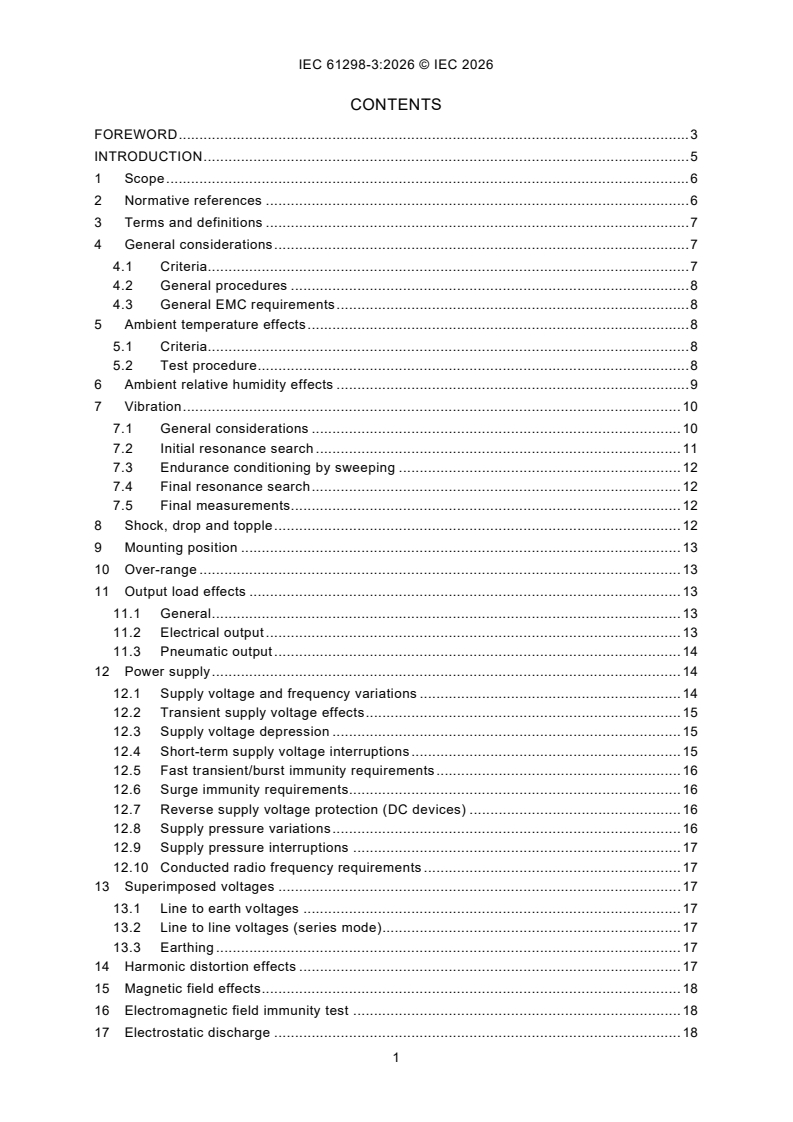
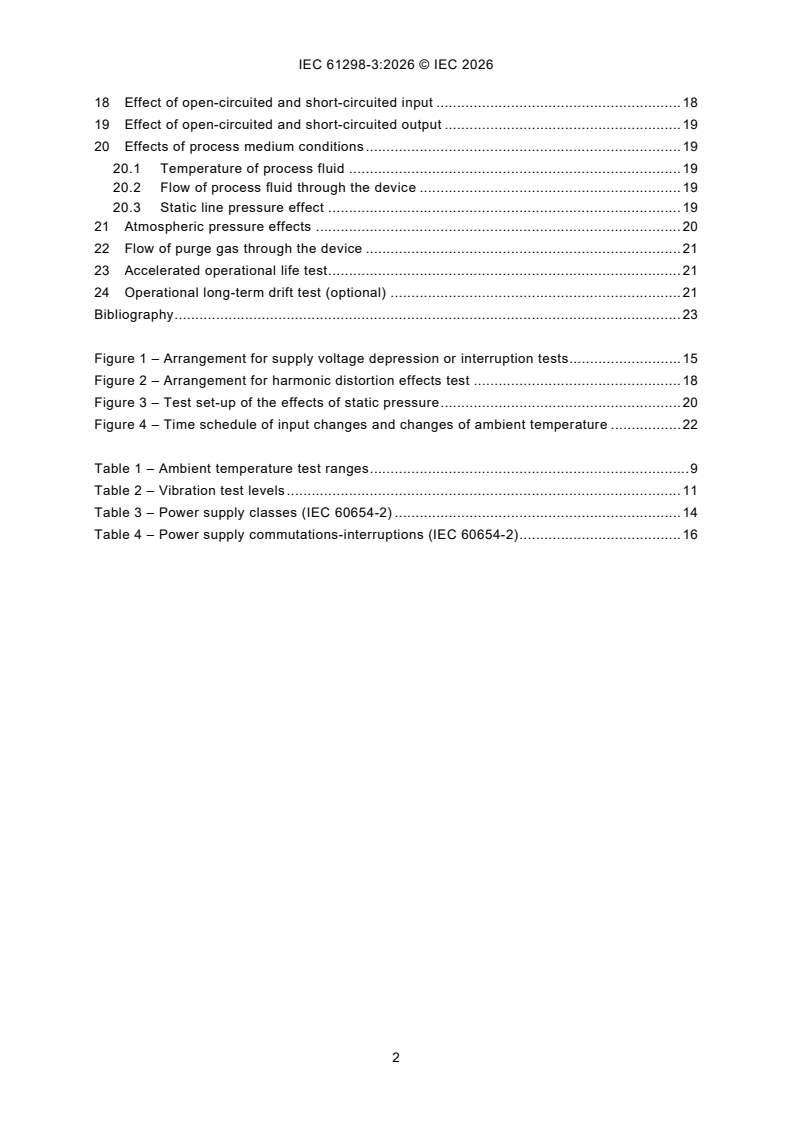
iec61298-3{ed3.0}en - Process measurement and control devices - General methods and procedures for evaluating performance - Part 3: Tests for the effects of influence quantities
iec61298-3{ed3.0}fr - Dispositifs de mesure et de commande de processus - Méthodes et procédures générales d'évaluation des performances - Partie 3: Essais pour la détermination des effets des grandeurs d'influence
Overview
IEC 61298-3:2026, published by the International Electrotechnical Commission (IEC), is an international standard that specifies general methods and procedures to evaluate the performance of process measurement and control devices with respect to the effects of influence quantities. This third edition provides updated methodologies for testing and documenting how various environmental and operational factors-such as temperature, humidity, vibration, and electrical disturbances-affect the functional characteristics of analogue and digital devices used in industrial process measurement and control. Process measurement transmitters (PMT) are now excluded from the scope and are covered by the IEC 62828 series.
This standard is applicable across a broad range of process instrumentation, supporting consistent, reliable evaluation for product development, quality control, procurement, and compliance.
Key Topics
Covered Influence Quantities
IEC 61298-3:2026 establishes methods for testing and reporting the impact on device performance from:
- Ambient temperature changes
- Ambient relative humidity
- Mechanical vibrations
- Shocks, drops, and tumbling
- Device mounting position
- Output load effects (electrical and pneumatic)
- Electrical supply variations (voltage, frequency, interruptions)
- Harmonic distortion and superimposed voltages
- Magnetic and electromagnetic fields
- Electrostatic discharge (ESD)
- Process fluid parameters (temperature, pressure, media flow)
- Atmospheric pressure changes
- Purge gas flow through devices
General Principles
- Device Characterization: Applies to devices identifiable by unique input/output variables and transfer functions.
- Test Applicability: Tests are performed only if relevant to the device under test; unnecessary tests can be excluded if justified.
- Reference Conditions: All tests are conducted with reference performance and environmental conditions as baseline.
- Reporting: All observed effects and deviations, particularly those impacting accuracy, linearity, hysteresis, and display functionality, are to be systematically documented.
Significant Updates in the 2026 Edition
- Removal of process measurement transmitters (PMT) from scope.
- Deletion of detailed EMC and electrical safety test content, retaining only references to relevant IEC standards.
Applications
IEC 61298-3:2026 supports a range of practical needs within process automation and instrumentation sectors:
- Manufacturers use the standard for consistent device evaluation, product development, and type approval.
- End-users (plant operators, engineers) rely on standardized test results for procurement decisions and lifecycle cost assessment.
- Testing laboratories gain a unified methodology for conducting influence quantity tests and preparing test reports across analogue and digital process devices.
- Regulatory bodies and compliance assessors reference the standard to verify that devices meet contractual and regulatory requirements.
Industries benefiting from IEC 61298-3 include chemical processing, food and beverage, power generation, oil and gas, pharmaceuticals, and water treatment-anywhere robust, repeatable performance of process measurement and control devices is critical.
Related Standards
For comprehensive evaluation and integration, IEC 61298-3:2026 references and works alongside several other international standards, including:
- IEC 61298-1:2026: General considerations for process measurement and control device performance evaluation
- IEC 61298-2:2026: Tests under reference conditions
- IEC 61298-4: Structure and content of performance evaluation reports
- IEC 60654 series: Operating conditions and influences for measurement and control equipment
- IEC 60068 series: Environmental testing methods for temperature, humidity, shock, and vibration
- IEC 61326-1: EMC requirements for measurement, control, and laboratory equipment
- IEC 62828 series: Specific to process measurement transmitters (PMT); not covered by IEC 61298-3
Summary
By adhering to IEC 61298-3:2026, stakeholders ensure that process measurement and control devices are rigorously evaluated for operational reliability under real-world environmental and electrical influence quantities. This standard underpins quality assurance, interoperability, and compliance in modern industrial automation and instrumentation.
Relations
- Effective Date
- 05-Sep-2023
Buy Documents
REDLINE IEC 61298-3:2026 RLV - Process measurement and control devices - General methods and procedures for evaluating performance - Part 3: Tests for the effects of influence quantities
iec61298-3{ed3.0}en - Process measurement and control devices - General methods and procedures for evaluating performance - Part 3: Tests for the effects of influence quantities
iec61298-3{ed3.0}fr - Dispositifs de mesure et de commande de processus - Méthodes et procédures générales d'évaluation des performances - Partie 3: Essais pour la détermination des effets des grandeurs d'influence
Get Certified
Connect with accredited certification bodies for this standard

DVS-ZERT GmbH
German welding certification society.
CARES (UK Certification Authority for Reinforcing Steels)
UK certification for reinforcing steels and construction.
EWF/IIW (European/International Welding Federation)
International welding personnel certification.
Sponsored listings
Frequently Asked Questions
IEC 61298-3:2026 is a standard published by the International Electrotechnical Commission (IEC). Its full title is "Process measurement and control devices - General methods and procedures for evaluating performance - Part 3: Tests for the effects of influence quantities". This standard covers: IEC 61298-3:2026 specifies general methods and procedures for conducting tests and reporting on the functional and performance characteristics of process instrumentation except process measurement transmitters (PMT) which are standardized by IEC 62828 series. The tests are applicable to any such devices characterized by their own specific input and output variables, and by the specific relationship (transfer function) between the inputs and outputs and include analogue and digital devices. For devices that require special tests, this document can be used, together with any product-specific standard specifying special tests. This document covers tests for the effects of influence quantities. This third edition cancels and replaces the second edition published in 2008. This edition constitutes a technical revision. This edition includes the following significant technical changes with respect to the previous edition: a) process measurement transmitters (PMT) have been removed from the scope of this document; b) contents of subclauses referring to EMC and electrical safety have been deleted, only leaving reference to the IEC standards.
IEC 61298-3:2026 specifies general methods and procedures for conducting tests and reporting on the functional and performance characteristics of process instrumentation except process measurement transmitters (PMT) which are standardized by IEC 62828 series. The tests are applicable to any such devices characterized by their own specific input and output variables, and by the specific relationship (transfer function) between the inputs and outputs and include analogue and digital devices. For devices that require special tests, this document can be used, together with any product-specific standard specifying special tests. This document covers tests for the effects of influence quantities. This third edition cancels and replaces the second edition published in 2008. This edition constitutes a technical revision. This edition includes the following significant technical changes with respect to the previous edition: a) process measurement transmitters (PMT) have been removed from the scope of this document; b) contents of subclauses referring to EMC and electrical safety have been deleted, only leaving reference to the IEC standards.
IEC 61298-3:2026 is classified under the following ICS (International Classification for Standards) categories: 25.040.40 - Industrial process measurement and control. The ICS classification helps identify the subject area and facilitates finding related standards.
IEC 61298-3:2026 has the following relationships with other standards: It is inter standard links to IEC 61298-3:2008. Understanding these relationships helps ensure you are using the most current and applicable version of the standard.
IEC 61298-3:2026 is available in PDF format for immediate download after purchase. The document can be added to your cart and obtained through the secure checkout process. Digital delivery ensures instant access to the complete standard document.
Standards Content (Sample)
IEC 61298-3 ®
Edition 3.0 2026-06
INTERNATIONAL
STANDARD
REDLINE VERSION
Process measurement and control devices - General methods and procedures
for evaluating performance -
Part 3: Tests for the effects of influence quantities
ICS 25.040.40 ISBN 978-2-8327-1318-1
All rights reserved. Unless otherwise specified, no part of this publication may be reproduced or utilized in any form or
by any means, electronic or mechanical, including photocopying and microfilm, without permission in writing from either
IEC or IEC's member National Committee in the country of the requester. If you have any questions about IEC copyright
or have an enquiry about obtaining additional rights to this publication, please contact the address below or your local
IEC member National Committee for further information.
IEC Secretariat Tel.: +41 22 919 02 11
3, rue de Varembé info@iec.ch
CH-1211 Geneva 20 www.iec.ch
Switzerland
About the IEC
The International Electrotechnical Commission (IEC) is the leading global organization that prepares and publishes
International Standards for all electrical, electronic and related technologies.
About IEC publications
The technical content of IEC publications is kept under constant review by the IEC. Please make sure that you have the
latest edition, a corrigendum or an amendment might have been published.
IEC publications search - IEC Products & Services Portal - products.iec.ch
webstore.iec.ch/advsearchform Discover our powerful search engine and read freely all the
The advanced search enables to find IEC publications by a publications previews, graphical symbols and the glossary.
variety of criteria (reference number, text, technical With a subscription you will always have access to up to date
committee, …). It also gives information on projects, content tailored to your needs.
replaced and withdrawn publications.
Electropedia - www.electropedia.org
The world's leading online dictionary on electrotechnology,
IEC Just Published - webstore.iec.ch/justpublished
Stay up to date on all new IEC publications. Just Published containing more than 22 500 terminological entries in English
details all new publications released. Available online and and French, with equivalent terms in 25 additional languages.
once a month by email. Also known as the International Electrotechnical Vocabulary
(IEV) online.
IEC Customer Service Centre - webstore.iec.ch/csc
If you wish to give us your feedback on this publication or
need further assistance, please contact the Customer
Service Centre: sales@iec.ch.
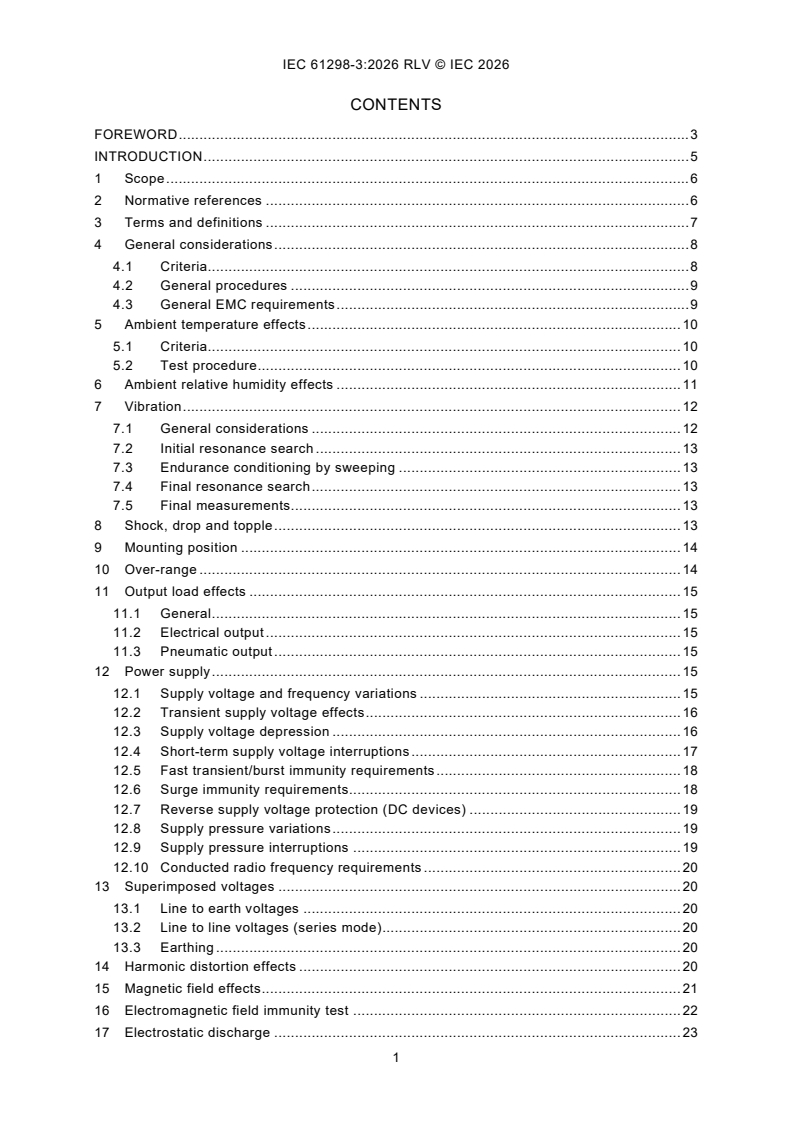
CONTENTS
FOREWORD . 3
INTRODUCTION . 5
1 Scope . 6
2 Normative references . 6
3 Terms and definitions . 7
4 General considerations . 8
4.1 Criteria. 8
4.2 General procedures . 9
4.3 General EMC requirements . 9
5 Ambient temperature effects . 10
5.1 Criteria. 10
5.2 Test procedure. 10
6 Ambient relative humidity effects . 11
7 Vibration . 12
7.1 General considerations . 12
7.2 Initial resonance search . 13
7.3 Endurance conditioning by sweeping . 13
7.4 Final resonance search . 13
7.5 Final measurements. 13
8 Shock, drop and topple . 13
9 Mounting position . 14
10 Over-range . 14
11 Output load effects . 15
11.1 General . 15
11.2 Electrical output . 15
11.3 Pneumatic output . 15
12 Power supply . 15
12.1 Supply voltage and frequency variations . 15
12.2 Transient supply voltage effects . 16
12.3 Supply voltage depression . 16
12.4 Short-term supply voltage interruptions . 17
12.5 Fast transient/burst immunity requirements . 18
12.6 Surge immunity requirements. 18
12.7 Reverse supply voltage protection (DC devices) . 19
12.8 Supply pressure variations . 19
12.9 Supply pressure interruptions . 19
12.10 Conducted radio frequency requirements . 20
13 Superimposed voltages . 20
13.1 Line to earth voltages . 20
13.2 Line to line voltages (series mode) . 20
13.3 Earthing . 20
14 Harmonic distortion effects . 20
15 Magnetic field effects . 21
16 Electromagnetic field immunity test . 22
17 Electrostatic discharge . 23
18 Effect of open-circuited and short-circuited input . 24
19 Effect of open-circuited and short-circuited output . 24
20 Effects of process medium conditions . 25
20.1 Temperature of process fluid . 25
20.2 Flow of process fluid through the device . 25
20.3 Static line pressure effect . 25
21 Atmospheric pressure effects . 26
22 Flow of purge gas through the device . 26
23 Accelerated operational life test . 27
24 Operational long-term drift test (optional) . 27
Bibliography . 29
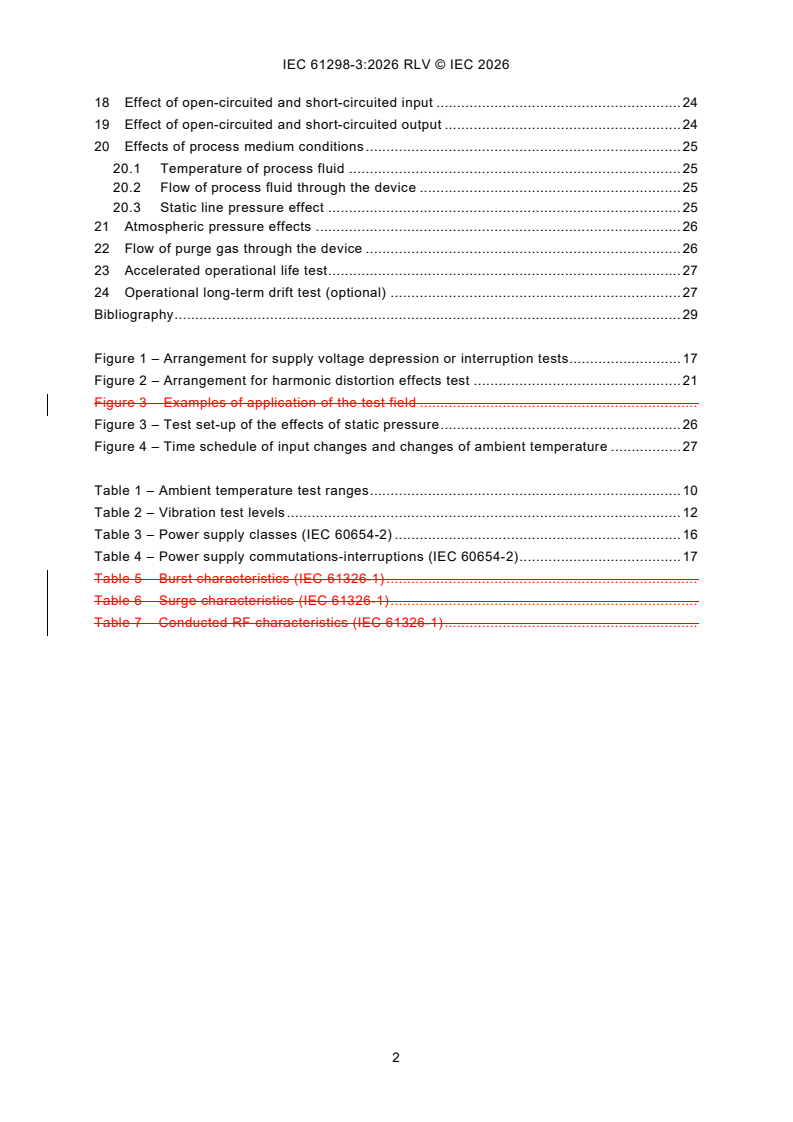
Figure 1 – Arrangement for supply voltage depression or interruption tests . 17
Figure 2 – Arrangement for harmonic distortion effects test . 21
Figure 3 – Examples of application of the test field .
Figure 3 – Test set-up of the effects of static pressure . 26
Figure 4 – Time schedule of input changes and changes of ambient temperature . 27
Table 1 – Ambient temperature test ranges . 10
Table 2 – Vibration test levels . 12
Table 3 – Power supply classes (IEC 60654-2) . 16
Table 4 – Power supply commutations-interruptions (IEC 60654-2) . 17
Table 5 – Burst characteristics (IEC 61326-1) .
Table 6 – Surge characteristics (IEC 61326-1) .
Table 7 – Conducted RF characteristics (IEC 61326-1) .
INTERNATIONAL ELECTROTECHNICAL COMMISSION
____________
Process measurement and control devices -
General methods and procedures for evaluating performance -
Part 3: Tests for the effects of influence quantities
FOREWORD
1) The International Electrotechnical Commission (IEC) is a worldwide organization for standardization comprising
all national electrotechnical committees (IEC National Committees). The object of IEC is to promote international
co-operation on all questions concerning standardization in the electrical and electronic fields. To this end and
in addition to other activities, IEC publishes International Standards, Technical Specifications, Technical Reports,
Publicly Available Specifications (PAS) and Guides (hereafter referred to as "IEC Publication(s)"). Their
preparation is entrusted to technical committees; any IEC National Committee interested in the subject dealt with
may participate in this preparatory work. International, governmental and non-governmental organizations liaising
with the IEC also participate in this preparation. IEC collaborates closely with the International Organization for
Standardization (ISO) in accordance with conditions determined by agreement between the two organizations.
2) The formal decisions or agreements of IEC on technical matters express, as nearly as possible, an international
consensus of opinion on the relevant subjects since each technical committee has representation from all
interested IEC National Committees.
3) IEC Publications have the form of recommendations for international use and are accepted by IEC National
Committees in that sense. While all reasonable efforts are made to ensure that the technical content of IEC
Publications is accurate, IEC cannot be held responsible for the way in which they are used or for any
misinterpretation by any end user.
4) In order to promote international uniformity, IEC National Committees undertake to apply IEC Publications
transparently to the maximum extent possible in their national and regional publications. Any divergence between
any IEC Publication and the corresponding national or regional publication shall be clearly indicated in the latter.
5) IEC itself does not provide any attestation of conformity. Independent certification bodies provide conformity
assessment services and, in some areas, access to IEC marks of conformity. IEC is not responsible for any
services carried out by independent certification bodies.
6) All users should ensure that they have the latest edition of this publication.
7) No liability shall attach to IEC or its directors, employees, servants or agents including individual experts and
members of its technical committees and IEC National Committees for any personal injury, property damage or
other damage of any nature whatsoever, whether direct or indirect, or for costs (including legal fees) and
expenses arising out of the publication, use of, or reliance upon, this IEC Publication or any other IEC
Publications.
8) Attention is drawn to the Normative references cited in this publication. Use of the referenced publications is
indispensable for the correct application of this publication.
9) IEC draws attention to the possibility that the implementation of this document may involve the use of (a)
patent(s). IEC takes no position concerning the evidence, validity or applicability of any claimed patent rights in
respect thereof. As of the date of publication of this document, IEC had not received notice of (a) patent(s), which
may be required to implement this document. However, implementers are cautioned that this may not represent
the latest information, which may be obtained from the patent database available at https://patents.iec.ch. IEC
shall not be held responsible for identifying any or all such patent rights.
This redline version of the official IEC Standard allows the user to identify the changes made
to the previous edition IEC 61298-3:2008. A vertical bar appears in the margin wherever a
change has been made. Additions are in green text, deletions are in strikethrough red text.
IEC 61298-3 has been prepared by sub-committee 65B: Devices and process analysis, of IEC
technical committee 65: Industrial-process measurement, control and automation. It is an
International Standard.
This third edition cancels and replaces the second edition published in 2008. This edition
constitutes a technical revision.
This edition includes the following significant technical changes with respect to the previous
edition:
a) process measurement transmitters (PMT) have been removed from the scope of this
document;
b) contents of subclauses referring to EMC and electrical safety have been deleted, only
leaving reference to the IEC standards.
The text of this International Standard is based on the following documents:
Draft Report on voting
65B/1314/FDIS 65B/1331/RVD
Full information on the voting for its approval can be found in the report on voting indicated in
the above table.
The language used for the development of this International Standard is English.
This document was drafted in accordance with ISO/IEC Directives, Part 2, and developed in
accordance with ISO/IEC Directives, Part 1 and ISO/IEC Directives, IEC Supplement, available
at www.iec.ch/members_experts/refdocs. The main document types developed by IEC are
described in greater detail at www.iec.ch/publications.
A list of all parts of the IEC 61298 series, under the general title Process measurement and
control devices - General methods and procedures for evaluating performance, can be found
on the IEC website.
The committee has decided that the contents of this document will remain unchanged until the
stability date indicated on the IEC website under webstore.iec.ch in the data related to the
specific document. At this date, the document will be
– reconfirmed,
– withdrawn, or
– revised.
INTRODUCTION
This document is not intended as a substitute for existing standards, but is rather intended as
a reference document for any future standard developed within the IEC, or other standards
organizations, concerning the evaluation of process instrumentation. Any revision of existing
standards should take this standard into account, except the Process Measurement
Transmitters (PMT) which are standardized by IEC 62828 series.
This common standardized basis should can be utilized for the preparation of future relevant
standards, as follows:
– any test method or procedure, already treated in this document, should will be specified and
described in the new standard by referring to the corresponding clause of this document.
Consequently, new editions of this document are revised without any change in numbering
and scope of each clause;
– any particular method or procedure, not covered by this document, should will be developed
and specified in the new standard in accordance with the criteria, as far as they are
applicable, stated in this document;
– any conceptual or significant deviation from the content of this document should will be
clearly identified and justified if introduced in a new standard.
1 Scope
This part of IEC 61298 specifies general methods and procedures for conducting tests and
reporting on the functional and performance characteristics of process measurement and
control devices instrumentation except process measurement transmitters (PMT) which are
standardized by IEC 62828 series. The tests are applicable to any such devices characterized
by their own specific input and output variables, and by the specific relationship (transfer
function) between the inputs and outputs and include analogue and digital devices. For devices
that require special tests, this document should can be used, together with any product-specific
standard specifying special tests.
This document covers tests for the effects of influence quantities.
2 Normative references
The following documents are referred to in the text in such a way that some or all of their content
constitutes requirements of this document. For dated references, only the edition cited applies.
For undated references, the latest edition of the referenced document (including any
amendments) applies.
IEC 60050-300, International Electrotechnical Vocabulary (IEV) - Part 300: Electrical and
electronic measurements and measuring instruments - Part 311: General terms relating to
measurements - Part 312: General terms relating to electrical measurements - Part 313: Types
of electrical measuring instruments - Part 314: Specific terms according to the type of
instrument, available at https://www.electropedia.org/
IEC 60050-351, International Electrotechnical Vocabulary (IEV) - Part 351: Control technology,
available at https://www.electropedia.org/
IEC 61298-1:1995, Process measurement and control devices – General methods and
procedures for evaluating performance – Part 1: General considerations
IEC 61298-2:1995, Process measurement and control devices – General methods and
procedures for evaluating performance – Part 2: Tests under reference conditions
IEC 61298-4:1995, Process measurement and control devices – General methods and
procedures for evaluating performance – Part 4: Evaluation report content
IEC 60068-2-1, Environmental testing - Part 2-1: Tests - Test A: Cold
IEC 60068-2-2, Environmental testing - Part 2-2: Tests - Test B: Dry heat
IEC 60068-2-6, Environmental testing - Part 2-6: Tests - Test Fc: Vibration (sinusoidal)
IEC 60068-2-30, Environmental testing - Part 2-30: Tests - Test Db: Damp heat, cyclic
(12 + 12 h cycle)
IEC 60068-2-31, Environmental testing - Part 2-31: Tests - Test Ec: Drop and topple Rough
handling shocks, primarily for equipment-type specimens
IEC 60654-1:1993, Operating conditions for, Industrial-process measurement and control
equipment - Operating conditions - Part 1: Climatic conditions
IEC 60654-2:1992, Operating conditions for industrial-process measurement and control
equipment - Part 2: Power
IEC 60654-3:1983, Operating conditions for industrial-process measurement and control
equipment - Part 3: Mechanical influences
IEC 61298-1:2026, Process measurement and control devices - General methods and
procedures for evaluating performance - Part 1: General considerations
IEC 61298-2:2026, Process measurement and control devices - General methods and
procedures for evaluating performance - Part 2: Tests under reference conditions
IEC 61298-4, Process measurement and control devices - General methods and procedures for
evaluating performance - Part 4: Evaluation report content
IEC 61326 (all parts), Electrical equipment for measurement, control and laboratory use – EMC
requirements
IEC 61326-1:2005, Electrical equipment for measurement, control and laboratory use - EMC
requirements - Part 1: General requirements
IEC 61000-4-2:2001, Electromagnetic compatibility (EMC) – Part 4-2: Testing and
measurement techniques – Electrostatic discharge immunity test. Basic EMC publication
IEC 61000-4-3:2002, Electromagnetic compatibility (EMC) – Part 4-3: Testing and
measurement techniques – Radiated, radio-frequency, electromagnetic field immunity test.
Basic EMC publication
IEC 61000-4-4:2004, Electromagnetic compatibility (EMC) – Part 4-4: Testing and
measurement techniques – Electrical fast transient/burst immunity test. Basic EMC publication
IEC 61000-4-5:1995, Electromagnetic compatibility (EMC) – Part 4-5: Testing and
measurement techniques – Surge immunity test. Basic EMC publication
IEC 61000-4-6:2006, Electromagnetic compatibility (EMC) – Part 4-6: Testing and
measurement techniques – Immunity to conducted disturbances, induced by radio-frequency
fields
IEC 61000-4-8:2001, Electromagnetic compatibility (EMC) – Part 4-8: Testing and
measurement techniques – Power frequency magnetic field immunity test. Basic EMC
publication
IEC 61000-4-11:2004, Electromagnetic compatibility (EMC) – Part 4-11: Testing and
measurement techniques – Voltage dips, short interruptions and voltage variations immunity
tests . Basic EMC publication
3 Terms and definitions
For the purposes of this document, the terms and definitions given in IEC 60050-300,
IEC 60050-351 and the following apply.
ISO and IEC maintain terminology databases for use in standardization at the following
addresses:
– IEC Electropedia: available at https://www.electropedia.org/
– ISO Online browsing platform: available at https://www.iso.org/obp
3.1
influence quantity
test parameter chosen to represent a condition representing one aspect of the environment
under which a device may can operate
3.2
variable
quantity or condition whose value is subject to change and can usually be measured (e.g.
temperature, flow rate, speed, signal, etc.)
[IEV 351-21-01, modified]
3.3
signal
physical variable, one or more parameters of which carry information about one or more
variables which the signal represents
[IEV 351-21-51, modified]
3.4
range
range of values defined by the two extreme values within which a variable can be measured
within the specified accuracy
[IEV 351-27-11, modified]
3.5
span
algebraic difference between the values of the upper and lower limits of the measuring range
[IEV 311-03-13]
3.6
unexpected event
device breakdown, failure to work, anomaly, or inadvertent damage occurring during an
evaluation which requires correction by the device manufacturer
3.7
test procedure
statement of the tests to be carried out, and the conditions for each test, agreed between the
manufacturer, the test laboratory, and the purchaser/user before the evaluation starts
3.8
type tests
a test of one or more devices made to a certain design to show that the design meets certain
specifications
NOTE The type tests are in principle applied only on a sample. Normally are not repeated on all the individual units
of equipment made in series.
4 General considerations
4.1 Criteria
Unless otherwise stated, any effects of the tests described in this document shall be assessed
by determining the change in the functional and performance characteristics due to the single
influence quantity applied. A test is only to be performed if it is applicable to the Device Under
Test (DUT). If the specification of the DUT states limits for the influence considered, these limits
shall be noted and respected.
NOTE It is recommended to perform each influence test described in this document, except if
the DUT operates under an environment that excludes the influence considered.
Rates of change of influence quantities shall be sufficiently slow to ensure that no overshoot of
the influence quantities occurs at any point in the DUT. Sufficient time shall be allowed for
stabilization at each value or state of the influence quantity before taking readings. It may can
be useful to check, by means of specific measurements of the effects, whether the influence
quantities cause variations in the characteristics of the DUT other than those addressed in this
part of the document.
In the case of discontinuous-output devices such as alarms, the tests shall be conducted to
establish the effects of the specified influence.
Only that influence quantity for which a specific test is being conducted shall be applied during
a specified test. All other influences shall be maintained at the reference operating conditions.
However, consideration should be given to any combination of two or more influence quantities
which may can aggravate the operating conditions (e.g. for an electrical device, temperature
and supply voltage).
The limit values of influence quantities specified in this document should be used if no other
limit values are specified by the manufacturer or by the user. Testing at these values shall be
agreed by the parties and the results of tests shall be added to the report.
4.2 General procedures
The procedures used for the determination of the effects of influence quantities depend on the
kind of test, on the type of device and on its most significant characteristics (e.g. zero, span,
etc.).
The procedures should shall be established in accordance with the criteria given in 5.1 and 5.2
of IEC 61298-1:2026 in order to avoid tests which are too severe.
To satisfy these criteria, the DUT should be tested by assessing the effects of all the quantities
which might influence the performance of the DUT; this general statement is strictly valid for
performance evaluation and for type tests.
For routine and sampling tests, only the influence quantity which is considered to have the most
effect or is agreed between the parties should be applied. Wherever possible, all the tests shall
be carried out by measurement of the change of the output of the DUT.
The deviations caused by the effect of the specific influence quantity should be expressed
generally as a percentage of the output span. On certain devices, it may be more convenient
to express it in terms of the input span (see 4.1.6 of IEC 61298-2:2026). It is important that The
input should be set so that the output is not limited; so in all tests, inputs corresponding to, for
example, 5 % and 95 % may be used instead of 0 % and 100 %. For the same reason, tests
that can produce large deviations on output (for example, supply voltage interruptions, electrical
fast transients, and so on) may be executed at input levels held at a value which produces 50 %
output signal.
In the case of discontinuous output devices such as alarms, the tests shall be conducted in the
same way to establish the conditions at which the performance is affected, with the
alarm/switching level set to 10 % above or below the nominal output.
4.3 General EMC requirements
In the first edition of this standard, some EMC requirements were described with reference to
IEC 61326. In the meantime, IEC 61326 has been transferred into the IEC 61326 series with
more detailed requirements. If a reference to this standard series is given in the following
clauses, this standard series shall be applied, if applicable, and as far as the DUT is not covered
by a more dedicated IEC product standard. In the latter case, the more dedicated IEC product
standard shall be applied.
As far as no other performance criteria are specified, the following performance criteria
(conforming to the IEC 61326 series) shall be applied.
• Performance criteria A for continuously present disturbances (electromagnetic field,
magnetic field, HF currents induced by RF transmitters).
• Performance criteria B for short time transient disturbances (EDS, bursts, surges).
• Performance criteria C for long time transient disturbances (supply voltage interruption).
As far as no other test severity levels are specified, the test severity levels shall be at least
according to Table 1 of IEC 61326-1:2005.
For what concerns this 4.3, see the IEC 61326 series.
5 Ambient temperature effects
5.1 Criteria
Sufficient time shall be allowed at each test temperature to permit thermal stabilization of the
DUT before test measurements are taken (as specified in IEC 60068-2-1 and 60068-2-2).
The stabilization period is a function of the DUT mass and of energy dissipation. It is normally
checked by recording the output signal of the DUT. It may can be as long as 3 h.
Whatever the temperature cycle prescribed, during the temperature cycles, it is important to
carry out the measurements at the same temperatures during repeat cycles so as to permit
comparison.
Pneumatic devices shall have sufficient air supply tubing inside the test chamber to ensure that
the supply and input air are at the same temperature as the DUT.
5.2 Test procedure
The effects of ambient temperature shall be measured in the temperature range specified by
the manufacturer technical documentation or, if no value is specified, between the limits shown
in Table 1 (according to the standard range specified in IEC 60654-1).
The test limits for ambient temperature should be appropriate to the temperatures at the
intended operational location of the DUT.
The test shall be carried out by conducting the same performance test at each selected test
ambient temperature, beginning at the reference temperature (+20 °C).
Table 1 – Ambient temperature test ranges
Temperature Temperature Typical service
class (IEC 60654-1) application
°C
min. max.
+5 +40 B2 Heated or/and cooled enclosed
locations
–25 +55 C2 Sheltered locations
–33 +40 D1 Outdoor locations
–40 +85 DX Special outdoor locations
NOTE For others temperature classes, see IEC 60654-1.
The test ambient temperatures should be chosen generally at 20 °C intervals, up to the
specified limit temperatures for the DUT.
For example, for the temperature class C2, the test temperature cycle should be +20 °C
(reference), +40 °C, +55 °C, +20 °C, 0 °C, -25 °C, +20 °C.
If agreed by all parties in the test programme, a test at only four temperatures, 20 °C
(reference), maximum, minimum, and 20 °C, may can be sufficient.
The tolerance for each test temperature should be ±2 °C and the rate of change of ambient
temperature should be less than 1 °C per minute. No adjustments to the DUT shall be made
during the test cycle.
A second or third temperature cycle, without any adjustment of the DUT, may be specified in
the test program. At each test temperature, data shall be recorded for increasing and
decreasing values of output at each 25 % of span.
The output changes at each test value shall be calculated from the average of the upscale and
downscale readings and reported in percent of ideal output span. Any significant changes in
hysteresis or linearity or repeatability shall also be calculated and reported, as described in
IEC 61298-4.
Any effects on a digital display indicator shall also be reported, including loss of contrast,
brightness, distortion or missing bits.
6 Ambient relative humidity effects
The effects of ambient relative humidity shall be determined by placing the DUT in a humidity
test chamber in which the value of relative humidity should shall be controlled within +2 % to -
3 % of the specified relative humidity levels as specified in IEC 60068-2-30.
The DUT shall be stabilized at the reference relative humidity < 60 % at the temperature of
40 °C ± 2 °C.
Measurements shall be taken at each 25 % of output span in each direction.
+2
The relative humidity shall then be increased in not less than 3 h up to ( 93 ) 90 % to 95 %
−3
avoiding the deposition of condensation on the DUT and maintained at this value for a period
of at least
48 h. If agreed in the test program, the DUT may be de-energized during this period.
The measurements shall again be taken at 25 % intervals of output span in each direction.
With the DUT remaining in operation, the relative humidity shall be reduced in not less than 3 h
to the original reference value of < 60 %.
After stabilization for at least 12 h, the measurements shall be repeated.
Any changes in lower range value and span shall be calculated and reported in per cent of
output span.
In addition, any significant changes in hysteresis or linearity or repeatability should be
calculated and reported.
In addition, a visual examination shall be made after the test to check for indications of
component deterioration or moisture having entered sealed enclosures.
7 Vibration
7.1 General considerations
The general procedures of this test comply shall be in accordance with the test procedure Fc
of IEC 60068-2-6, and the vibration ranges and values are in accordance with those reported
in IEC 60654-3.
The effect of vibration shall be determined by the following procedure using the peak
amplitudes, acceleration levels, and frequency ranges reported in Table 2 or specified by the
manufacturer.
Measurements shall be made before and after the vibration exposure.
The DUT shall be mounted, in accordance with the manufacturer's instructions for a normal
installation, on a vibration table where it shall be subjected to rectilinear sinusoidal vibrations
in each of three mutually perpendicular axes, one of which shall be the vertical.
The rigidity of the vibration table and of the mounting means for the DUT shall be such that the
vibration is transferred to the normal mounting point of the DUT with a minimum of loss or gain.
The test vibration level shall be measured at the normal mounting point of the DUT.
Vibrations shall be applied with the DUT powered and operating with 50 % input signal.
The output signal shall be recorded in order to report any change in output.
Table 2 – Vibration test levels
a
Typical application Displacement Acceleration
Test frequency range
peak amplitude
amplitude
Hz mm
m/s
b
Control room or field with low vibration
0,35 1
10 to 150
level
b
Control room or field with medium vibration 0,75 2
10 to 150
level
c
Field with general application or pipeline 0,15 20
10 to 1 000
with low vibration
c
Field with high vibration level or pipe line 0,35 50
10 to 1 000
with high vibration
a
For a list of all test frequency ranges, see IEC 60654-3.
b
Test frequency range derived from low-frequency classes (IEC 60654-3) but limited to 10 Hz (instead of
0,1 Hz) and with crossover frequency at 8 ÷ 9 Hz.
c
Test frequency range derived from high-frequency classes (IEC 60654-3) but limited to 1 000 Hz (instead of
10 000 Hz) and with crossover frequency at 57 ÷ 62 Hz.
The crossover frequency is the region of change from constant amplitude and constant
acceleration.
The vibration tests shall include three stages:
– an initial resonance search;
– an endurance conditioning by sweeping the frequency over the appropriate frequency range
specified in Table 2 (or over another range reported in IEC 60654-3), or as specified by the
manufacturer or by the user;
– a final resonance search.
These three stages shall be performed in sequence. At each stage, the DUT shall be vibrated
in each of the three major axes before proceeding to the next stage.
7.2 Initial resonance search
The initial resonance search shall be carried out to study behavior of the DUT to determine any
component resonances and the corresponding resonance frequencies, and to obtain
information for comparison with the final resonance search.
The sweep rate shall be not greater than 0,5 octave per minute.
During the resonance search, frequencies shall be noted which cause
a) significant changes in the output signal;
b) mechanical resonances of components or sub-assemblies.
All the amplitudes and frequencies at which these effects occur shall be noted in order to be
compared with those found during the final resonance search specified below.
7.3 Endurance conditioning by sweeping
The test is carried out by sweeping the vibration frequency at a rate of one octave per minute
over the range selected.
The total number of sweep cycles should be 60, being 20 in each of the three mutually
perpendicular directions.
7.4 Final resonance search
The final resonance search shall be made in the same way as the initial resonance search and
with the same vibration characteristics.
The resonance frequencies, and the frequencies which cause significant changes in the output
signal, found in the initial resonance search and final resonance search shall be compared.
7.5 Final measurements
The satisfactory mechanical condition of the DUT shall be verified at the end of the tests with
a visual examination for any deformation or cracks in the components or mountings.
The satisfactory performance of the DUT shall be verified with a measurement test; any change
in the lower range value and span shall be recorded in percent of output span.
8 Shock, drop and topple
The test shall be made according to the test procedure Ec of IEC 60068-2-31 and according to
the free fall method reported in IEC 60654-3.
Before the test, reference measurements of lower range-value and span shall be recorded.
During the test, the power supply and inputs may be switched off.
The object of this test is
– to represent knocks and jolts likely to occur during repair work or rough handling in use;
– to verify the minimum degree of mechanical ruggedness.
The procedure of "dropping on to a face" shall be applied as follows:
The DUT, standing in its normal position of use on a smooth, hard, rigid surface of concrete or
steel, is tilted about one bottom edge so that the distance between the opposite edge and the
test surface is 25 mm, 50 mm or 100 mm (value chosen by agreement between manufacturer
and use), or so that the angle made by the bottom and the test surface is 30°, whichever
condition is the less severe. It is then allowed to fall freely onto the test surface.
The DUT shall be subjected to one drop about each of the four bottom edges.
After this test, the DUT shall be examined for damage.
Any change in lower range-value and span shall be recorded.
If any changes are noted, it shall be verified that the DUT can be readjusted so that the initial
performance can be re-established.
NOTE In special cases, by agreement, one of the other shock tests in IEC 60068-2-31 may be
used, or the free fall method, reported in IEC 60654-3 (from height 25 mm to 1 000 mm or
more), may be used.
9 Mounting position
Where the DUT might can be position sensitive, the change in lower range-value and span
caused by 10° inclinations from the position(s) specified by the manufacturer shall be measured
and recorded in percent of output span.
Four measurements shall be made with tilt applied in two planes at right angles to each other.
Where a 10° inclination is excessive due to the design of the DUT, the maximum inclination
specified by the manufacturer shall be used.
10 Over-range
This test shall be carried out by measuring any residual changes in lower range-value and span
which result from over-ranging the input by 50 % at the minimum and maximum span settings
if not otherwise specified by the manufacturer.
The input shall be increased gradually from the lower range-value to the over-range selected
for the test.
After the over-range has been applied for 1 min, the input shall be reduced to the nominal lower
range-value.
After a further 5 min have elapsed, the lower range-value and the span shall be determined in
per cent of output span.
If the DUT is to be tested for over-range effect in both directions, as with differential measuring
devices and devices whose input may can be both below the lower range-value and above the
upper range-value, it shall be tested as described above, first over-ranging above the upper
range-value, and then over-ranging below the lower range-value.
Any changes of lower range-value and span determined after over-ranging in each direction
shall be recorded.
NOTE If over-ranging produces significant thermal effects, the duration of application should be
increased accordingly.
11 Output load effects
11.1 General
The purpose of this test is to determine any effects on the output signal when the output load
is varied.
11.2 Electrical output
To determine any effect on an electrical output signal, the load resistance shall be varied from
the minimum to the maximum value specified by the manufacturer. Any changes in lower range-
value and span caused by the variations shall be expressed as a percentage of the output span.
The output voltage drop at the DUT at the upper range value shall also be noted when the DUT
is a two-wire transmitter. Consideration should be given to the effect of connecting capacitive
or inductive loads.
11.3 Pneumatic output
This test shall be carried out as specified in 6.6 of IEC 61298-2:2026.
12 Power supply
12.1 Supply voltage and frequency variations
For two-wire transmitters, reference should be made to 11.2 of this document.
NOTE Power inputs for voltages up to 75 V direct current or voltages up to 50 V alternating current with
superimposed output signals (for example 4 mA to 20 mA current loop with two-wire technology) are tested as
input/output lines.
For electrical devices except two-wire transmitters, the test shall be carried out first set
...
IEC 61298-3 ®
Edition 3.0 2026-06
INTERNATIONAL
STANDARD
Process measurement and control devices - General methods and procedures
for evaluating performance -
Part 3: Tests for the effects of influence quantities
ICS 25.040.40 ISBN 978-2-8327-1306-8
All rights reserved. Unless otherwise specified, no part of this publication may be reproduced or utilized in any form or
by any means, electronic or mechanical, including photocopying and microfilm, without permission in writing from either
IEC or IEC's member National Committee in the country of the requester. If you have any questions about IEC copyright
or have an enquiry about obtaining additional rights to this publication, please contact the address below or your local
IEC member National Committee for further information.
IEC Secretariat Tel.: +41 22 919 02 11
3, rue de Varembé info@iec.ch
CH-1211 Geneva 20 www.iec.ch
Switzerland
About the IEC
The International Electrotechnical Commission (IEC) is the leading global organization that prepares and publishes
International Standards for all electrical, electronic and related technologies.
About IEC publications
The technical content of IEC publications is kept under constant review by the IEC. Please make sure that you have the
latest edition, a corrigendum or an amendment might have been published.
IEC publications search - IEC Products & Services Portal - products.iec.ch
webstore.iec.ch/advsearchform Discover our powerful search engine and read freely all the
The advanced search enables to find IEC publications by a publications previews, graphical symbols and the glossary.
variety of criteria (reference number, text, technical With a subscription you will always have access to up to date
committee, …). It also gives information on projects, content tailored to your needs.
replaced and withdrawn publications.
Electropedia - www.electropedia.org
The world's leading online dictionary on electrotechnology,
IEC Just Published - webstore.iec.ch/justpublished
Stay up to date on all new IEC publications. Just Published containing more than 22 500 terminological entries in English
details all new publications released. Available online and and French, with equivalent terms in 25 additional languages.
once a month by email. Also known as the International Electrotechnical Vocabulary
(IEV) online.
IEC Customer Service Centre - webstore.iec.ch/csc
If you wish to give us your feedback on this publication or
need further assistance, please contact the Customer
Service Centre: sales@iec.ch.
CONTENTS
FOREWORD . 3
INTRODUCTION . 5
1 Scope . 6
2 Normative references . 6
3 Terms and definitions . 7
4 General considerations . 7
4.1 Criteria. 7
4.2 General procedures . 8
4.3 General EMC requirements . 8
5 Ambient temperature effects . 8
5.1 Criteria. 8
5.2 Test procedure. 8
6 Ambient relative humidity effects . 9
7 Vibration . 10
7.1 General considerations . 10
7.2 Initial resonance search . 11
7.3 Endurance conditioning by sweeping . 12
7.4 Final resonance search . 12
7.5 Final measurements. 12
8 Shock, drop and topple . 12
9 Mounting position . 13
10 Over-range . 13
11 Output load effects . 13
11.1 General . 13
11.2 Electrical output . 13
11.3 Pneumatic output . 14
12 Power supply . 14
12.1 Supply voltage and frequency variations . 14
12.2 Transient supply voltage effects . 15
12.3 Supply voltage depression . 15
12.4 Short-term supply voltage interruptions . 15
12.5 Fast transient/burst immunity requirements . 16
12.6 Surge immunity requirements. 16
12.7 Reverse supply voltage protection (DC devices) . 16
12.8 Supply pressure variations . 16
12.9 Supply pressure interruptions . 17
12.10 Conducted radio frequency requirements . 17
13 Superimposed voltages . 17
13.1 Line to earth voltages . 17
13.2 Line to line voltages (series mode) . 17
13.3 Earthing . 17
14 Harmonic distortion effects . 17
15 Magnetic field effects . 18
16 Electromagnetic field immunity test . 18
17 Electrostatic discharge . 18
18 Effect of open-circuited and short-circuited input . 18
19 Effect of open-circuited and short-circuited output . 19
20 Effects of process medium conditions . 19
20.1 Temperature of process fluid . 19
20.2 Flow of process fluid through the device . 19
20.3 Static line pressure effect . 19
21 Atmospheric pressure effects . 20
22 Flow of purge gas through the device . 21
23 Accelerated operational life test . 21
24 Operational long-term drift test (optional) . 21
Bibliography . 23
Figure 1 – Arrangement for supply voltage depression or interruption tests . 15
Figure 2 – Arrangement for harmonic distortion effects test . 18
Figure 3 – Test set-up of the effects of static pressure . 20
Figure 4 – Time schedule of input changes and changes of ambient temperature . 22
Table 1 – Ambient temperature test ranges . 9
Table 2 – Vibration test levels . 11
Table 3 – Power supply classes (IEC 60654-2) . 14
Table 4 – Power supply commutations-interruptions (IEC 60654-2) . 16
INTERNATIONAL ELECTROTECHNICAL COMMISSION
____________
Process measurement and control devices -
General methods and procedures for evaluating performance -
Part 3: Tests for the effects of influence quantities
FOREWORD
1) The International Electrotechnical Commission (IEC) is a worldwide organization for standardization comprising
all national electrotechnical committees (IEC National Committees). The object of IEC is to promote international
co-operation on all questions concerning standardization in the electrical and electronic fields. To this end and
in addition to other activities, IEC publishes International Standards, Technical Specifications, Technical Reports,
Publicly Available Specifications (PAS) and Guides (hereafter referred to as "IEC Publication(s)"). Their
preparation is entrusted to technical committees; any IEC National Committee interested in the subject dealt with
may participate in this preparatory work. International, governmental and non-governmental organizations liaising
with the IEC also participate in this preparation. IEC collaborates closely with the International Organization for
Standardization (ISO) in accordance with conditions determined by agreement between the two organizations.
2) The formal decisions or agreements of IEC on technical matters express, as nearly as possible, an international
consensus of opinion on the relevant subjects since each technical committee has representation from all
interested IEC National Committees.
3) IEC Publications have the form of recommendations for international use and are accepted by IEC National
Committees in that sense. While all reasonable efforts are made to ensure that the technical content of IEC
Publications is accurate, IEC cannot be held responsible for the way in which they are used or for any
misinterpretation by any end user.
4) In order to promote international uniformity, IEC National Committees undertake to apply IEC Publications
transparently to the maximum extent possible in their national and regional publications. Any divergence between
any IEC Publication and the corresponding national or regional publication shall be clearly indicated in the latter.
5) IEC itself does not provide any attestation of conformity. Independent certification bodies provide conformity
assessment services and, in some areas, access to IEC marks of conformity. IEC is not responsible for any
services carried out by independent certification bodies.
6) All users should ensure that they have the latest edition of this publication.
7) No liability shall attach to IEC or its directors, employees, servants or agents including individual experts and
members of its technical committees and IEC National Committees for any personal injury, property damage or
other damage of any nature whatsoever, whether direct or indirect, or for costs (including legal fees) and
expenses arising out of the publication, use of, or reliance upon, this IEC Publication or any other IEC
Publications.
8) Attention is drawn to the Normative references cited in this publication. Use of the referenced publications is
indispensable for the correct application of this publication.
9) IEC draws attention to the possibility that the implementation of this document may involve the use of (a)
patent(s). IEC takes no position concerning the evidence, validity or applicability of any claimed patent rights in
respect thereof. As of the date of publication of this document, IEC had not received notice of (a) patent(s), which
may be required to implement this document. However, implementers are cautioned that this may not represent
the latest information, which may be obtained from the patent database available at https://patents.iec.ch. IEC
shall not be held responsible for identifying any or all such patent rights.
IEC 61298-3 has been prepared by sub-committee 65B: Devices and process analysis, of IEC
technical committee 65: Industrial-process measurement, control and automation. It is an
International Standard.
This third edition cancels and replaces the second edition published in 2008. This edition
constitutes a technical revision.
This edition includes the following significant technical changes with respect to the previous
edition:
a) process measurement transmitters (PMT) have been removed from the scope of this
document;
b) contents of subclauses referring to EMC and electrical safety have been deleted, only
leaving reference to the IEC standards.
The text of this International Standard is based on the following documents:
Draft Report on voting
65B/1314/FDIS 65B/1331/RVD
Full information on the voting for its approval can be found in the report on voting indicated in
the above table.
The language used for the development of this International Standard is English.
This document was drafted in accordance with ISO/IEC Directives, Part 2, and developed in
accordance with ISO/IEC Directives, Part 1 and ISO/IEC Directives, IEC Supplement, available
at www.iec.ch/members_experts/refdocs. The main document types developed by IEC are
described in greater detail at www.iec.ch/publications.
A list of all parts of the IEC 61298 series, under the general title Process measurement and
control devices - General methods and procedures for evaluating performance, can be found
on the IEC website.
The committee has decided that the contents of this document will remain unchanged until the
stability date indicated on the IEC website under webstore.iec.ch in the data related to the
specific document. At this date, the document will be
– reconfirmed,
– withdrawn, or
– revised.
INTRODUCTION
This document is intended as a reference document for any future standard developed within
the IEC, or other standards organizations, concerning the evaluation of process
instrumentation, except the Process Measurement Transmitters (PMT) which are standardized
by IEC 62828 series.
This common standardized basis can be utilized for the preparation of future relevant standards,
as follows:
– any test method or procedure, already treated in this document, will be specified and
described in the new standard by referring to the corresponding clause of this document.
Consequently, new editions of this document are revised without any change in numbering
and scope of each clause;
– any particular method or procedure, not covered by this document, will be developed and
specified in the new standard in accordance with the criteria, as far as they are applicable,
stated in this document;
– any conceptual or significant deviation from the content of this document will be clearly
identified and justified if introduced in a new standard.
1 Scope
This part of IEC 61298 specifies general methods and procedures for conducting tests and
reporting on the functional and performance characteristics of process instrumentation except
process measurement transmitters (PMT) which are standardized by IEC 62828 series. The
tests are applicable to any such devices characterized by their own specific input and output
variables, and by the specific relationship (transfer function) between the inputs and outputs
and include analogue and digital devices. For devices that require special tests, this document
can be used, together with any product-specific standard specifying special tests.
This document covers tests for the effects of influence quantities.
2 Normative references
The following documents are referred to in the text in such a way that some or all of their content
constitutes requirements of this document. For dated references, only the edition cited applies.
For undated references, the latest edition of the referenced document (including any
amendments) applies.
IEC 60050-300, International Electrotechnical Vocabulary (IEV) - Part 300: Electrical and
electronic measurements and measuring instruments - Part 311: General terms relating to
measurements - Part 312: General terms relating to electrical measurements - Part 313: Types
of electrical measuring instruments - Part 314: Specific terms according to the type of
instrument, available at https://www.electropedia.org/
IEC 60050-351, International Electrotechnical Vocabulary (IEV) - Part 351: Control technology,
available at https://www.electropedia.org/
IEC 60068-2-1, Environmental testing - Part 2-1: Tests - Test A: Cold
IEC 60068-2-2, Environmental testing - Part 2-2: Tests - Test B: Dry heat
IEC 60068-2-6, Environmental testing - Part 2-6: Tests - Test Fc: Vibration (sinusoidal)
IEC 60068-2-30, Environmental testing - Part 2-30: Tests - Test Db: Damp heat, cyclic
(12 + 12 h cycle)
IEC 60068-2-31, Environmental testing - Part 2-31: Tests - Test Ec: Rough handling shocks,
primarily for equipment-type specimens
IEC 60654-1, Industrial-process measurement and control equipment - Operating conditions -
Part 1: Climatic conditions
IEC 60654-2, Operating conditions for industrial-process measurement and control equipment -
Part 2: Power
IEC 60654-3, Operating conditions for industrial-process measurement and control equipment -
Part 3: Mechanical influences
IEC 61298-1:2026, Process measurement and control devices - General methods and
procedures for evaluating performance - Part 1: General considerations
IEC 61298-2:2026, Process measurement and control devices - General methods and
procedures for evaluating performance - Part 2: Tests under reference conditions
IEC 61298-4, Process measurement and control devices - General methods and procedures for
evaluating performance - Part 4: Evaluation report content
IEC 61326-1, Electrical equipment for measurement, control and laboratory use - EMC
requirements - Part 1: General requirements
3 Terms and definitions
For the purposes of this document, the terms and definitions given in IEC 60050-300,
IEC 60050-351 and the following apply.
ISO and IEC maintain terminology databases for use in standardization at the following
addresses:
– IEC Electropedia: available at https://www.electropedia.org/
– ISO Online browsing platform: available at https://www.iso.org/obp
3.1
influence quantity
test parameter chosen to represent a condition representing one aspect of the environment
under which a device can operate
4 General considerations
4.1 Criteria
Unless otherwise stated, any effects of the tests described in this document shall be assessed
by determining the change in the functional and performance characteristics due to the single
influence quantity applied. A test is only to be performed if it is applicable to the Device Under
Test (DUT). If the specification of the DUT states limits for the influence considered, these limits
shall be noted and respected.
It is recommended to perform each influence test described in this document, except if the DUT
operates under an environment that excludes the influence considered.
Rates of change of influence quantities shall be sufficiently slow to ensure that no overshoot of
the influence quantities occurs at any point in the DUT. Sufficient time shall be allowed for
stabilization at each value or state of the influence quantity before taking readings. It can be
useful to check, by means of specific measurements of the effects, whether the influence
quantities cause variations in the characteristics of the DUT other than those addressed in this
part of the document.
In the case of discontinuous-output devices such as alarms, the tests shall be conducted to
establish the effects of the specified influence.
Only that influence quantity for which a specific test is being conducted shall be applied during
a specified test. All other influences shall be maintained at the reference operating conditions.
However, consideration should be given to any combination of two or more influence quantities
which can aggravate the operating conditions (e.g. for an electrical device, temperature and
supply voltage).
The limit values of influence quantities specified in this document should be used if no other
limit values are specified by the manufacturer or by the user. Testing at these values shall be
agreed by the parties and the results of tests shall be added to the report.
4.2 General procedures
The procedures used for the determination of the effects of influence quantities depend on the
kind of test, on the type of device and on its most significant characteristics (e.g. zero, span,
etc.).
The procedures shall be established in accordance with the criteria given in 5.1 and 5.2 of
IEC 61298-1:2026 in order to avoid tests which are too severe.
To satisfy these criteria, the DUT should be tested by assessing the effects of all the quantities
which might influence the performance of the DUT; this general statement is strictly valid for
performance evaluation and for type tests.
For routine and sampling tests, only the influence quantity which is considered to have the most
effect or is agreed between the parties should be applied. Wherever possible, all the tests shall
be carried out by measurement of the change of the output of the DUT.
The deviations caused by the effect of the specific influence quantity should be expressed
generally as a percentage of the output span. On certain devices, it may be more convenient
to express it in terms of the input span (see 4.1.6 of IEC 61298-2:2026). The input should be
set so that the output is not limited; so in all tests, inputs corresponding to, for example, 5 %
and 95 % may be used instead of 0 % and 100 %. For the same reason, tests that can produce
large deviations on output (for example, supply voltage interruptions, electrical fast transients,
and so on) may be executed at input levels held at a value which produces 50 % output signal.
In the case of discontinuous output devices such as alarms, the tests shall be conducted in the
same way to establish the conditions at which the performance is affected, with the
alarm/switching level set to 10 % above or below the nominal output.
4.3 General EMC requirements
For what concerns this 4.3, see the IEC 61326 series.
5 Ambient temperature effects
5.1 Criteria
Sufficient time shall be allowed at each test temperature to permit thermal stabilization of the
DUT before test measurements are taken (as specified in IEC 60068-2-1 and 60068-2-2).
The stabilization period is a function of the DUT mass and of energy dissipation. It is normally
checked by recording the output signal of the DUT. It can be as long as 3 h.
Whatever the temperature cycle prescribed, during the temperature cycles, it is important to
carry out the measurements at the same temperatures during repeat cycles so as to permit
comparison.
Pneumatic devices shall have sufficient air supply tubing inside the test chamber to ensure that
the supply and input air are at the same temperature as the DUT.
5.2 Test procedure
The effects of ambient temperature shall be measured in the temperature range specified by
the technical documentation or, if no value is specified, between the limits shown in Table 1
(according to the standard range specified in IEC 60654-1).
The test limits for ambient temperature should be appropriate to the temperatures at the
intended operational location of the DUT.
The test shall be carried out by conducting the same performance test at each selected test
ambient temperature, beginning at the reference temperature (+20 °C).
Table 1 – Ambient temperature test ranges
Temperature Temperature Typical service
class (IEC 60654-1) application
°C
min. max.
+5 +40 B2 Heated or/and cooled enclosed
locations
–25 +55 C2 Sheltered locations
–33 +40 D1 Outdoor locations
–40 +85 DX Special outdoor locations
NOTE For others temperature classes, see IEC 60654-1.
The test ambient temperatures should be chosen generally at 20 °C intervals, up to the
specified limit temperatures for the DUT.
For example, for the temperature class C2, the test temperature cycle should be +20 °C
(reference), +40 °C, +55 °C, +20 °C, 0 °C, -25 °C, +20 °C.
If agreed by all parties in the test programme, a test at only four temperatures, 20 °C
(reference), maximum, minimum, and 20 °C, can be sufficient.
The tolerance for each test temperature should be ±2 °C and the rate of change of ambient
temperature should be less than 1 °C per minute. No adjustments to the DUT shall be made
during the test cycle.
A second or third temperature cycle, without any adjustment of the DUT, may be specified in
the test program. At each test temperature, data shall be recorded for increasing and
decreasing values of output at each 25 % of span.
The output changes at each test value shall be calculated from the average of the upscale and
downscale readings and reported in percent of ideal output span. Any significant changes in
hysteresis or linearity shall also be calculated and reported, as described in IEC 61298-4.
Any effects on a digital display indicator shall also be reported, including loss of contrast,
brightness, distortion or missing bits.
6 Ambient relative humidity effects
The effects of ambient relative humidity shall be determined by placing the DUT in a humidity
test chamber in which the value of relative humidity shall be controlled within +2 % to -3 % of
the specified relative humidity levels as specified in IEC 60068-2-30.
The DUT shall be stabilized at the reference relative humidity < 60 % at the temperature of
40 °C ± 2 °C.
Measurements shall be taken at each 25 % of output span in each direction.
The relative humidity shall then be increased in not less than 3 h up to 90 % to 95 % avoiding
the deposition of condensation on the DUT and maintained at this value for a period of at least
48 h. If agreed in the test program, the DUT may be de-ene
...
IEC 61298-3 ®
Edition 3.0 2026-06
NORME
INTERNATIONALE
Dispositifs de mesure et de commande de processus - Méthodes et procédures
générales d'évaluation des performances -
Partie 3: Essais pour la détermination des effets des grandeurs d'influence
ICS 25.040.40 ISBN 978-2-8327-1306-8
Droits de reproduction réservés. Sauf indication contraire, aucune partie de cette publication ne peut être reproduite ni
utilisée sous quelque forme que ce soit et par aucun procédé, électronique ou mécanique, y compris la photocopie et
les microfilms, sans l'accord écrit de l'IEC ou du Comité national de l'IEC du pays du demandeur. Si vous avez des
questions sur le copyright de l'IEC ou si vous désirez obtenir des droits supplémentaires sur cette publication, utilisez
les coordonnées ci-après ou contactez le Comité national de l'IEC de votre pays de résidence.
IEC Secretariat Tel.: +41 22 919 02 11
3, rue de Varembé info@iec.ch
CH-1211 Geneva 20 www.iec.ch
Switzerland
A propos de l'IEC
La Commission Electrotechnique Internationale (IEC) est la première organisation mondiale qui élabore et publie des
Normes internationales pour tout ce qui a trait à l'électricité, à l'électronique et aux technologies apparentées.
A propos des publications IEC
Le contenu technique des publications IEC est constamment revu. Veuillez vous assurer que vous possédez l’édition la
plus récente, un corrigendum ou amendement peut avoir été publié.
Recherche de publications IEC - IEC Products & Services Portal - products.iec.ch
webstore.iec.ch/advsearchform Découvrez notre puissant moteur de recherche et consultez
La recherche avancée permet de trouver des publications gratuitement tous les aperçus des publications, symboles
IEC en utilisant différents critères (numéro de référence, graphiques et le glossaire. Avec un abonnement, vous aurez
texte, comité d’études, …). Elle donne aussi des toujours accès à un contenu à jour adapté à vos besoins.
informations sur les projets et les publications remplacées
ou retirées. Electropedia - www.electropedia.org
Le premier dictionnaire d'électrotechnologie en ligne au
IEC Just Published - webstore.iec.ch/justpublished monde, avec plus de 22 500 articles terminologiques en
Restez informé sur les nouvelles publications IEC. Just anglais et en français, ainsi que les termes équivalents
dans 25 langues additionnelles. Egalement appelé
Published détaille les nouvelles publications parues.
Disponible en ligne et une fois par mois par email. Vocabulaire Electrotechnique International (IEV) en ligne.
Service Clients - webstore.iec.ch/csc
Si vous désirez nous donner des commentaires sur cette
publication ou si vous avez des questions contactez-
nous: sales@iec.ch.
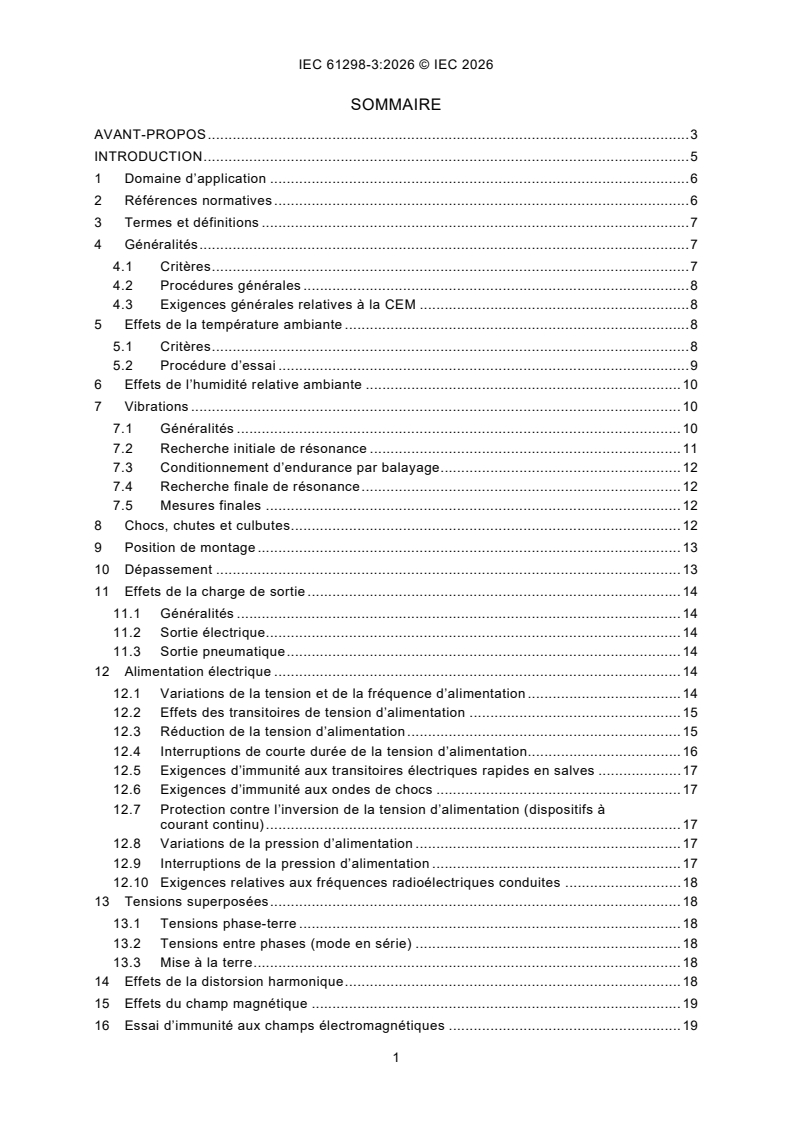
SOMMAIRE
AVANT-PROPOS . 3
INTRODUCTION . 5
1 Domaine d’application . 6
2 Références normatives . 6
3 Termes et définitions . 7
4 Généralités . 7
4.1 Critères . 7
4.2 Procédures générales . 8
4.3 Exigences générales relatives à la CEM . 8
5 Effets de la température ambiante . 8
5.1 Critères . 8
5.2 Procédure d’essai . 9
6 Effets de l’humidité relative ambiante . 10
7 Vibrations . 10
7.1 Généralités . 10
7.2 Recherche initiale de résonance . 11
7.3 Conditionnement d’endurance par balayage . 12
7.4 Recherche finale de résonance . 12
7.5 Mesures finales . 12
8 Chocs, chutes et culbutes . 12
9 Position de montage . 13
10 Dépassement . 13
11 Effets de la charge de sortie . 14
11.1 Généralités . 14
11.2 Sortie électrique. 14
11.3 Sortie pneumatique . 14
12 Alimentation électrique . 14
12.1 Variations de la tension et de la fréquence d’alimentation . 14
12.2 Effets des transitoires de tension d’alimentation . 15
12.3 Réduction de la tension d’alimentation . 15
12.4 Interruptions de courte durée de la tension d’alimentation. 16
12.5 Exigences d’immunité aux transitoires électriques rapides en salves . 17
12.6 Exigences d’immunité aux ondes de chocs . 17
12.7 Protection contre l’inversion de la tension d’alimentation (dispositifs à
courant continu) . 17
12.8 Variations de la pression d’alimentation . 17
12.9 Interruptions de la pression d’alimentation . 17
12.10 Exigences relatives aux fréquences radioélectriques conduites . 18
13 Tensions superposées . 18
13.1 Tensions phase-terre . 18
13.2 Tensions entre phases (mode en série) . 18
13.3 Mise à la terre . 18
14 Effets de la distorsion harmonique . 18
15 Effets du champ magnétique . 19
16 Essai d’immunité aux champs électromagnétiques . 19
17 Décharge électrostatique . 19
18 Effets de l’ouverture ou de la mise en court-circuit de l’entrée . 19
19 Effets de l’ouverture ou de la mise en court-circuit de la sortie . 20
20 Effets des paramètres du fluide de processus . 20
20.1 Température du fluide du processus . 20
20.2 Passage du fluide du processus au travers du dispositif . 20
20.3 Effets de la pression du circuit statique . 20
21 Effets de la pression atmosphérique . 21
22 Écoulement du gaz de purge au travers du dispositif . 22
23 Essai fonctionnel accéléré . 22
24 Essai fonctionnel de longue durée (facultatif) . 22
Bibliographie . 24
Figure 1 – Circuit utilisé pour les essais de diminution et d’interruption de la tension
d’alimentation . 16
Figure 2 – Circuit d’essai des effets de la distorsion harmonique . 19
Figure 3 – Montage d’essai des effets de la pression statique . 21
Figure 4 – Programme des variations des entrées et de la température ambiante . 23
Tableau 1 – Plages d’essai pour la température ambiante . 9
Tableau 2 – Niveaux d’essais de vibration . 11
Tableau 3 – Classes d’alimentation (IEC 60654-2) . 15
Tableau 4 – Interruptions-Commutations de l’alimentation (IEC 60654-2) . 17
COMMISSION ÉLECTROTECHNIQUE INTERNATIONALE
____________
Dispositifs de mesure et de commande de processus -
Méthodes et procédures générales d’évaluation des performances -
Partie 3: Essais pour la détermination des effets
des grandeurs d’influence
AVANT-PROPOS
1) La Commission Électrotechnique Internationale (IEC) est une organisation mondiale de normalisation composée
de l’ensemble des comités électrotechniques nationaux (Comités nationaux de l’IEC). L’IEC a pour objet de
favoriser la coopération internationale pour toutes les questions de normalisation dans les domaines de
l’électricité et de l’électronique. À cet effet, l’IEC – entre autres activités – publie des Normes internationales,
des Spécifications techniques, des Rapports techniques, des Spécifications accessibles au public (PAS) et des
Guides (ci-après dénommés "Publication(s) de l’IEC"). Leur élaboration est confiée à des comités d’études, aux
travaux desquels tout Comité national intéressé par le sujet traité peut participer. Les organisations
internationales, gouvernementales et non gouvernementales, en liaison avec l’IEC, participent également aux
travaux. L’IEC collabore étroitement avec l’Organisation Internationale de Normalisation (ISO), selon des
conditions fixées par accord entre les deux organisations.
2) Les décisions ou accords officiels de l’IEC concernant les questions techniques représentent, dans la mesure du
possible, un accord international sur les sujets étudiés, étant donné que les Comités nationaux de l’IEC intéressés
sont représentés dans chaque comité d’études.
3) Les Publications de l’IEC se présentent sous la forme de recommandations internationales et sont agréées
comme telles par les Comités nationaux de l’IEC. Tous les efforts raisonnables sont entrepris afin que l’IEC
s’assure de l’exactitude du contenu technique de ses publications; l’IEC ne peut pas être tenue responsable de
l’éventuelle mauvaise utilisation ou interprétation qui en est faite par un quelconque utilisateur final.
4) Dans le but d’encourager l’uniformité internationale, les Comités nationaux de l’IEC s’engagent, dans toute la
mesure possible, à appliquer de façon transparente les Publications de l’IEC dans leurs publications nationales
et régionales. Toutes divergences entre toutes Publications de l’IEC et toutes publications nationales ou
régionales correspondantes doivent être indiquées en termes clairs dans ces dernières.
5) L'IEC elle-même ne fournit aucune attestation de conformité. Des organismes de certification indépendants
fournissent des services d'évaluation de conformité et, dans certains secteurs, accèdent aux marques de
conformité de l’IEC. L'IEC n'est responsable d'aucun des services effectués par les organismes de certification
indépendants.
6) Tous les utilisateurs doivent s’assurer qu’ils sont en possession de la dernière édition de cette publication.
7) Aucune responsabilité ne doit être imputée à l’IEC, à ses administrateurs, employés, auxiliaires ou mandataires,
y compris ses experts particuliers et les membres de ses comités d’études et des Comités nationaux de l’IEC,
pour tout préjudice causé en cas de dommages corporels et matériels, ou de tout autre dommage de quelque
nature que ce soit, directe ou indirecte, ou pour supporter les coûts (y compris les frais de justice) et les dépenses
découlant de la publication ou de l’utilisation de cette Publication de l’IEC ou de toute autre Publication de l’IEC,
ou au crédit qui lui est accordé.
8) L’attention est attirée sur les références normatives citées dans cette publication. L’utilisation de publications
référencées est obligatoire pour une application correcte de la présente publication.
9) L'IEC attire l'attention sur le fait que la mise en application du présent document peut entraîner l'utilisation d'un
ou de plusieurs brevets. L'IEC ne prend pas position quant à la preuve, à la validité et à l'applicabilité de tout
droit de brevet revendiqué à cet égard. À la date de publication du présent document, l'IEC n'a pas reçu
notification qu'un ou plusieurs brevets pouvaient être nécessaires à sa mise en application. Toutefois, il y a lieu
d'avertir les responsables de la mise en application du présent document que des informations plus récentes
sont susceptibles de figurer dans la base de données de brevets, disponible à l'adresse https://patents.iec.ch.
L'IEC ne saurait être tenue pour responsable de ne pas avoir identifié de tels droits de brevets.
L'IEC 61298-3 a été établie par le sous-comité 65B: Équipements de mesure et de contrôle-
commande, du comité d’études 65 de l’IEC: Mesure, commande et automation dans les
processus industriels. Il s'agit d'une Norme internationale.
Cette troisième édition annule et remplace la deuxième édition parue en 2008. Cette deuxième
édition constitue une révision technique.
Cette édition inclut les modifications techniques significatives suivantes par rapport à l'édition
précédente:
a) Les émetteurs de mesure de processus (PMT, process measurement transmitters) ont été
retirés du domaine d'application du présent document;
b) le texte des paragraphes relatifs à la CEM et à la sécurité électriques a été supprimé, seule
la référence aux normes IEC a été conservée.
Le texte de cette Norme internationale est issu des documents suivants:
Projet Rapport de vote
65B/1314/FDIS 65B/1331/RVD
Le rapport de vote indiqué dans le tableau ci-dessus donne toute information sur le vote ayant
abouti à son approbation.
La langue employée pour l'élaboration de cette Norme internationale est l'anglais.
Ce document a été rédigé selon les Directives ISO/IEC, Partie 2, il a été développé selon les
Directives ISO/IEC, Partie 1 et les Directives ISO/IEC, Supplément IEC, disponibles sous
www.iec.ch/members_experts/refdocs. Les principaux types de documents développés par
l'IEC sont décrits plus en détail sous www.iec.ch/publications.
Une liste de toutes les parties de la série IEC 61298, publiées sous le titre général Dispositifs
de mesure et de commande de processus - Méthodes et procédures générales d'évaluation des
performances, se trouve sur le site web de l'IEC.
Le comité a décidé que le contenu de ce document ne sera pas modifié avant la date de stabilité
indiquée sur le site web de l'IEC sous webstore.iec.ch dans les données relatives au document
recherché. À cette date, le document sera
– reconduit,
– supprimé, ou
– révisé.
INTRODUCTION
Le présent document est considéré comme un document de référence pour l’élaboration de
futures normes, tant par l’IEC que par d’autres organismes de normalisation, dans le domaine
de l’évaluation de l’instrumentation des processus, à l’exception des émetteurs de mesure de
processus (PMT) qui sont normalisés par la série IEC 62828.
Lors de l’établissement de futures normes applicables, les éléments normatifs suivants peuvent
être utilisés:
– toute méthode ou procédure d’essai figurant déjà dans le présent document sera spécifiée
et décrite dans la nouvelle norme en faisant référence à l’article correspondant du présent
document. C’est pourquoi les nouvelles éditions révisées du présent document ne
comportent pas de modification quant à la numérotation des articles et leur domaine
d’application;
– toute méthode ou procédure d’essai particulière non couverte par le présent document sera
développée et spécifiée dans la nouvelle norme conformément aux critères définis dans le
présent document, dans la mesure où ils sont applicables;
– tout écart fondamental ou important par rapport au contenu du présent document sera
distinctement identifié et justifié, s’il est introduit dans une nouvelle norme.
1 Domaine d’application
La présente partie de l’IEC 61298 spécifie les méthodes et procédures générales pour la
conduite des essais et la production de rapports sur les caractéristiques fonctionnelles et de
performance des instruments de processus à l’exception des émetteurs de mesure de
processus (PMT) qui sont normalisés par la série IEC 62828. Ces essais sont applicables à
tout dispositif à condition que ce dispositif soit caractérisé par ses propres variables d’entrée
et de sortie et par la relation spécifique (fonction de transfert) entre les entrées et les sorties.
Ils concernent les dispositifs analogiques et numériques. Pour les dispositifs qui exigent des
essais spéciaux, le présent document peut être utilisé en conjonction avec la norme particulière
de produit spécifiant ces essais spéciaux.
Le présent document couvre les essais réalisés pour la détermination des effets des grandeurs
d’influence.
2 Références normatives
Les documents suivants sont cités dans le texte de sorte qu’ils constituent, pour tout ou partie
de leur contenu, des exigences du présent document. Pour les références datées, seule
l'édition citée s'applique. Pour les références non datées, la dernière édition du document de
référence s'applique (y compris les éventuels amendements).
IEC 60050-300, Vocabulaire Électrotechnique International (IEV) - Partie 300: Mesures et
appareils de mesure électriques et électroniques - Partie 311: Termes généraux concernant les
mesures - Partie 312: Termes généraux concernant les mesures électriques - Partie 313: Types
d'appareils électriques de mesure - Partie 314: Termes spécifiques selon le type d'appareil,
disponible à l'adresse http://www.electropedia.org/
IEC 60050-351, Vocabulaire Électrotechnique International (IEV) - Partie 351: Technologie de
commande et de régulation, disponible à l'adresse http://www.electropedia.org/
IEC 60068-2-1, Essais d’environnement - Partie 2-1: Essais - Essai A: Froid
IEC 60068-2-2, Essais d’environnement - Partie 2-2: Essais - Essai B: Chaleur sèche
IEC 60068-2-6, Essais d’environnement - Partie 2-6: Essais - Essai Fc: Vibrations
(sinusoïdales)
IEC 60068-2-30, Essais d’environnement - Partie 2-30: Essais - Essai Db: Essai cyclique de
chaleur humide (cycle de (12 + 12 h))
IEC 60068-2-31, Essais d’environnement - Partie 2-31: Essais - Essai Ec: Choc lié à des
manutentions brutales, essai destiné en premier lieu aux matériels
IEC 60654-1, Matériels de mesure et de commande dans les processus industriels - Conditions
de fonctionnement - Partie 1: Conditions climatiques
IEC 60654-2, Conditions de fonctionnement pour les matériels de mesure et commande dans
les processus industriels - Partie 2: Alimentation
IEC 60654-3, Conditions de fonctionnement pour les matériels de mesure et commande dans
les processus industriels - Partie 3: Influences mécaniques
IEC 61298-1:2026, Process measurement and control devices - General methods and
procedures for evaluating performance - Part 1: General considerations
IEC 61298-2:2026, Dispositifs de mesure et de commande de processus - Méthodes et
procédures générales d'évaluation des performances - Partie 2: Essais dans les conditions de
référence
IEC 61298-4, Dispositifs de mesure et de commande de processus - Méthodes et procédures
générales d'évaluation des performances - Partie 4: Contenu du rapport d'évaluation
IEC 61326-1, Matériel électrique de mesure, de commande et de laboratoire - Exigences
relatives à la CEM - Partie 1: Exigences générales
3 Termes et définitions
Pour les besoins du présent document, les termes et définitions de l’IEC 60050-300, de
l’IEC 60050-351, ainsi que les suivants s’appliquent.
L'ISO et l'IEC tiennent à jour des bases de données terminologiques destinées à être utilisées
en normalisation, consultables aux adresses suivantes:
– IEC Electropedia: disponible à l'adresse http://www.electropedia.org/
– ISO Online browsing platform: disponible à l'adresse http://www.iso.org/obp
3.1
grandeur d’influence
paramètre d’essai choisi pour représenter une condition représentant un aspect de
l’environnement dans lequel un dispositif peut fonctionner
4 Généralités
4.1 Critères
Sauf spécification contraire, les effets des essais décrits dans le présent document doivent être
évalués en déterminant les modifications des caractéristiques fonctionnelles et de performance
dues à chaque grandeur d’influence appliquée séparément. Un essai est effectué uniquement
s’il s’applique au dispositif soumis à essai (DUT). Si la spécification du DUT indique des limites
pour l’influence en question, ces limites doivent être notées et respectées.
Il est recommandé d’effectuer chacun des essais d’influence décrits dans le présent document,
sauf si le DUT fonctionne dans un environnement qui exclut l’influence en question.
Les grandeurs d’influence doivent varier de manière suffisamment lente pour ne provoquer
aucun dépassement en quelque endroit que ce soit du DUT. Un temps de stabilisation suffisant
doit être respecté pour chaque valeur ou état de la grandeur d’influence avant de procéder à la
lecture des valeurs. Il peut s’avérer utile de vérifier, par des mesures spécifiques effectuées
sur ces effets, si les variations des grandeurs d’influence provoquent des variations des
caractéristiques du DUT autres que celles traitées dans le présent document.
Dans le cas de dispositifs à sortie discontinue tels que les alarmes, les essais doivent être
réalisés pour déterminer les effets de l’influence spécifiée.
Lors d’un essai donné, seule la grandeur d’influence pour laquelle cet essai particulier est
réalisé doit être appliquée. Toutes les autres grandeurs d’influence doivent être maintenues
aux conditions de fonctionnement de référence.
Il convient de tenir compte cependant des combinaisons d'au moins deux grandeurs d’influence
susceptibles d’aggraver les conditions de fonctionnement (par exemple pour un dispositif
électrique, la température et la tension d’alimentation).
Il convient que les valeurs limites des grandeurs d’influence indiquées dans le présent
document soient utilisées en l’absence d’indication de valeurs limites par le fabricant ou
l’utilisateur. Les essais à ces valeurs doivent faire l’objet d’un accord entre les parties et les
résultats d’essai doivent être consignés dans le rapport d’essai.
4.2 Procédures générales
Les procédures utilisées pour la détermination des effets des grandeurs d’influence dépendent
du type d’essai, du type de dispositif et de ses caractéristiques les plus significatives (par
exemple zéro, intervalle, etc.).
Les procédures doivent être établies conformément aux critères définis en 5.1 et 5.2 de
l’IEC 61298-1:2026, afin d’éviter des essais trop sévères.
Afin de satisfaire à ces critères, il convient que le DUT soit soumis à essai en évaluant les
effets de toutes les grandeurs susceptibles d’influencer ses performances: cet énoncé général
n’est valable que pour l’évaluation des performances et les essais de type.
Pour les essais individuels de série et par échantillonnage, il convient de n'appliquer que la
grandeur d’influence considérée comme ayant le plus d’effet ou convenue entre les parties.
Lorsque cela est possible, tous les essais doivent être effectués en mesurant la variation de la
sortie du DUT.
Il convient que les variations causées par les effets d’une grandeur d’influence spécifique soient
généralement exprimées en pourcentage de l’intervalle de sortie. Pour certains dispositifs, il
peut être plus pratique de les exprimer par rapport à l’intervalle d’entrée (voir 4.1.6 de
l’IEC 61298-2:2026). Il convient que la valeur d’entrée soit réglée de façon que la sortie ne soit
pas limitée, en prenant par exemple des entrées correspondant à 5 % et 95 % au lieu de 0 %
et de 100 %. Pour la même raison, les essais qui peuvent provoquer des variations importantes
du signal de sortie (tels que l’interruption de la tension d’alimentation, des transitoires
électriques rapides, etc.) peuvent être exécutés à des niveaux d’entrée qui produisent un signal
de sortie à 50 %.
Si les dispositifs ont une sortie discontinue telle qu’une alarme, les essais doivent être conduits
de façon similaire pour établir les conditions pour lesquelles les performances sont affectées,
avec un niveau d’alarme ou de basculement établi à 10 % au-dessus ou au-dessous de la sortie
nominale.
4.3 Exigences générales relatives à la CEM
Pour ce qui concerne le présent 4.3, voir la série IEC 61326.
5 Effets de la température ambiante
5.1 Critères
Un temps suffisant pour permettre la stabilisation thermique du DUT doit être prévu pour chaque
température d'essai avant d’effectuer les mesures correspondant à l’essai (tel que spécifié dans
l’IEC 60068-2-1 et l’IEC 60068-2-2).
La période de stabilisation dépend de la masse du DUT et de sa dissipation d’énergie. Pour la
vérifier, le signal de sortie du DUT est habituellement enregistré. Trois heures peuvent être
nécessaires.
Quel que soit le cycle de températures exigé, durant les cycles de températures, il est important
de réaliser les mesures aux mêmes températures lors des répétitions de cycles, afin de
permettre des comparaisons.
Les dispositifs pneumatiques doivent disposer, à l’intérieur de l’enceinte d’essai, d’une
tuyauterie d’alimentation d’air suffisante afin que l’air d’alimentation et d’entrée soit à la même
température que le DUT.
5.2 Procédure d’essai
Les effets de la température ambiante doivent être mesurés dans la plage de températures
indiquée dans la documentation technique, ou à défaut, entre les limites indiquées dans le
Tableau 1 (conformément à la plage normale spécifiée dans l’IEC 60654-1).
Il convient que les limites d’essai pour la température ambiante correspondent à la plage de
températures représentative de l’emplacement prévu pour le fonctionnement du DUT.
L’essai doit être réalisé en effectuant le même essai de performances pour chaque température
ambiante d’essai choisie, en commençant à la température de référence (+20 °C).
Tableau 1 – Plages d’essai pour la température ambiante
Température Classe Condition de fonctionnement
de température typique
°C (IEC 60654-1)
min. max.
+5 +40 B2 Emplacements chauffés et/ou
refroidis clos
-25 +55 C2 Sous abri
-33 +40 D1 À l’extérieur
-40 +85 DX Emplacements extérieurs spéciaux
NOTE Pour les autres classes de température, voir l’IEC 60654-1.
Il convient que les températures ambiantes des essais soient généralement choisies par pas
de 20 °C, jusqu’aux températures limites indiquées pour le DUT.
Par exemple, pour les températures de la classe de température C2, il convient que le cycle
soit le suivant: +20 °C (température de référence), +40 °C, +55 °C, +20 °C, 0 °C, -25 °C,
+20 °C.
Sous réserve d'accord entre toutes les parties concernées par le programme d’essai, un essai
à seulement quatre températures peut s’avérer suffisant: 20 °C (référence), maximale,
minimale et 20 °C.
Il convient que la tolérance pour chaque température d’essai soit de ±2 °C et le taux de variation
de la température ambiante inférieur à 1 °C par minute. Aucun réglage du DUT ne doit être
réalisé au cours du cycle d’essais.
Un deuxième ou troisième cycle de températures sans réglage du DUT peut être spécifié dans
le programme d’essai. Pour chaque température d’essai, les données doivent être relevées
pour des valeurs de sortie croissantes et décroissantes tous les 25 % de l’intervalle.
Les variations de la sortie pour chaque valeur d’essai doivent être calculées à partir de la
moyenne des valeurs mesurées croissantes et décroissantes et consignées en pourcentage de
l’intervalle de sortie idéal. Toute variation importante de l’hystérésis ou de la linéarité doit
également être calculée et consignée, comme décrit dans l’IEC 61298-4.
Tout effet sur un affichage numérique doit également être consigné, y compris les pertes de
contraste, de luminosité, les distorsions et bits manquants.
6 Effets de l’humidité relative ambiante
Pour déterminer les effets de l’humidité relative ambiante, le DUT doit être placé dans une
enceinte d’essai dont l’humidité relative doit être contrôlée dans les limites de +2 % à -3 % des
niveaux d’humidité relative indiqués comme spécifié dans l’IEC 60068-2-30.
Le DUT doit être stabilisé à l’humidité relative de référence < 60 % à la température de 40 °C
±2 °C.
Les mesures doivent être effectuées tous les 25 % de l’intervalle de sortie, dans les deux sens.
L’humidité relative doit ensuite être augmentée, en moins de 3 h, jusqu’à 90 % et 95 % en
évitant la formation d’un dépôt de condensation sur le DUT, puis être maintenue à cette valeur
pendant au moins 48 h. Si le programme d’essai le prévoit, le DUT peut être mis hors tension
pendant cette période.
Les mesures doivent de nouveau être effectuées tous les 25 % de l’intervalle de sortie, dans
les deux sens.
Le DUT restant en fonctionnement, l’humidité relative doit être diminuée, en moins de 3 h,
jusqu’à la valeur de référence initiale inférieure à < 60 %.
Les mesures doivent être répétées après une stabilisation d’au moins 12 h.
Toute variation de la valeur inférieure de la plage ou de l’intervalle doit être calculée et
consignée en pourcentage de l’intervalle de sortie.
Il convient que toute modification importante de l’hystérésis ou de la linéarité soit également
calculée et consignée.
Un contrôle visuel doit également être effectué à la suite de l’essai afin de vérifier les indices
de détérioration des composants ou de pénétration d’humidité à l’intérieur des enceintes
étanches.
7 Vibrations
7.1 Généralités
Les procédures générales de cet essai doivent être conformes à la procédure d’essai Fc décrite
dans l’IEC 60068-2-6 et les plages et les valeurs de vibrations sont conformes à celles
indiquées dans l’IEC 60654-3.
Les effets dus aux vibrations doivent être déterminés conformément à la procédure suivante,
en utilisant les amplitudes crête, les niveaux d’accélération et les plages de fréquences
indiqués dans le Tableau 2 ou ceux spécifiés par le fabricant.
Les mesures doivent être réalisées avant et après l’exposition aux vibrations.
Le montage du DUT doit être conforme aux instructions du fabricant pour une installation
normale. Il doit être monté sur un banc de vibrations et soumis à des vibrations sinusoïdales
rectilignes suivant trois axes perpendiculaires entre eux dont l’un doit être vertical.
La rigidité du banc de vibrations et les moyens de montage du DUT doivent permettre de
transmettre les vibrations au point de montage normal du DUT avec un minimum de perte ou
de gain.
Le niveau de vibrations de l’essai doit être mesuré au point de montage normal du DUT.
Les vibrations doivent être appliquées lorsque le DUT est sous tension et fonctionne avec 50 %
du signal d’entrée.
Le signal de sortie doit être consigné afin d’établir le rapport des variations du signal de sortie.
Tableau 2 – Niveaux d’essais de vibration
Application type Plage de fréquences Amplitude Amplitude de
a
crête du l’accélération
d’essai
déplacement
Hz mm
m/s
b
Salle de commande ou environnement de 0,35 1
10 à 150
processus à bas niveau de vibrations
b
Salle de commande ou environnement de 0,75 2
10 à 150
processus à niveau de vibrations moyen
c
Environnement courant de processus ou 0,15 20
10 à 1 000
oléoduc à bas niveau de vibrations
c
Environnement de processus à haut niveau 0,35 50
10 à 1 000
de vibrations ou oléoduc à haut niveau de
vibrations
a
Pour la liste des plages de fréquences d’essai, voir l’IEC 60654-3.
b
Plage de fréquences d’essai dérivée des classes basse fréquence (IEC 60654-3), mais limitée à 10 Hz (au
lieu de 0,1 Hz) et avec la fréquence de transition à 8 ÷ 9 Hz.
c
Plage de fréquences d’essai dérivée des classes haute fréquence (IEC 60654-3), mais limitée à 1 000 Hz (au
lieu de 10 000 Hz) et avec la fréquence de transition à 57 ÷ 62 Hz.
La fréquence de transition est la zone de variation entre amplitude constante et accélération
constante.
Les essais de vibrations doivent comprendre les trois étapes suivantes:
– la recherche initiale de résonance;
– le conditionnement d’endurance par balayage de la fréquence sur la plage de fréquences
indiquée dans le Tableau 2 (ou sur une autre plage indiquée dans l’IEC 60654-3) ou suivant
les spécifications du fabricant ou de l’utilisateur;
– la recherche finale de résonance.
Ces trois étapes doivent être effectuées l’une après l’autre. À chaque étape, le DUT doit être
soumis à des vibrations suivant chacun des trois axes principaux avant de passer à l’étape
suivante.
7.2 Recherche initiale de résonance
Cette recherche initiale de résonance doit être réalisée afin d’étudier le comportement du DUT,
de déterminer les résonances de chaque composant et les fréquences de résonance
correspondantes, et d’obtenir des informations permettant une comparaison avec la recherche
finale de résonance.
La vitesse de balayage ne doit pas être supérieure à 0,5 octave par minute.
Lors de la recherche de résonance, les fréquences qui entraînent
a) des variations significatives du signal de sortie;
b) des résonances mécaniques des composants ou sous-ensembles, doivent être notées.
Toutes les amplitudes et fréquences auxquelles ces effets se produisent doivent être
consignées afin de les comparer avec celles détectées lors de la recherche finale de résonance
spécifiée ci-dessous.
7.3 Conditionnement d’endurance par balayage
Cet essai est effectué par balayage de la fréquence de vibration à la vitesse d’une octave par
minute, sur l’ensemble de la plage choisie.
Il convient que le nombre total de cycles de balayage soit de 60, 20 pour chacune des trois
directions perpendiculaires entre elles.
7.4 Recherche finale de résonance
La recherche finale de résonance doit s’effectuer de la même façon que la recherche initiale
de résonance, avec les mêmes caractéristiques de vibrations.
Les fréquences de résonance et les fréquences qui entraînent des variations significatives du
signal de sortie détectées lors des recherches initiale et finale de résonance doivent être
comparées.
7.5 Mesures finales
Un contrôle visuel du DUT doit être effectué en fin d’essai afin de s’assurer de son bon état
mécanique afin de déceler d’éventuelles déformations, fissures des composants ou de leurs
supports.
Des mesures doivent être effectuées afin de vérifier le bon fonctionnement du DUT; toute
variation de la valeur inférieure de la plage ou de l’intervalle doit être consignée et exprimée
en pourcentage de l’intervalle de sortie.
8 Chocs, chutes et culbutes
L’essai doit être conforme à la procédure d’essai Ec de l’IEC 60068-2-31 et doit être conforme
à la méthode de chute libre décrite dans l’IEC 60654-3.
Avant d’effectuer l’essai, les mesures de référence de la valeur inférieure de la plage et de
l’intervalle doivent être consignées.
Lors de l’essai, l'alimentation et les entrées peuvent être coupées.
Le but de cet essai est le suivant:
– simuler des heurts et secousses susceptibles de se produire lors de réparations ou de
manipulations brusques lors de l’utilisation;
– vérifier le degré minimal de solidité mécanique.
La procédure de "chute sur une face" doit être appliquée de la façon suivante:
Le DUT, placé en position normale d’utilisation sur une surface lisse, dure et rigide, en béton
ou en acier, est basculé autour d’une de ses arêtes inférieures jusqu’à ce que la distance entre
l’arête opposée et la surface d’essai soit de 25 mm, 50 mm ou 100 mm (valeur convenue entre
le fabricant et l’utilisateur), ou jusqu’à ce que l’angle formé par la face inférieure et la surface
d’essai soit de 30°, si cette dernière condition est moins sévère. On le laisse ensuite tomber
librement sur la surface d’essai.
Le DUT doit être soumis à une chute sur chacune des quatre arêtes inférieures.
À l’issue de cet essai, le DUT doit être examiné pour vérifier qu’il n’a pas été endommagé.
Toute variation de la limite inférieure de la plage et de l’intervalle doit être consignée dans le
rapport.
Si des variations ont été notées, il doit être vérifié que le DUT peut être réglé à nouveau afin
de rétablir les performances initiales.
Pour les cas particuliers, suivant accord, il est possible d’effectuer l’un des autres essais de
choc indiqués dans l’IEC 60068-2-31 ou bien la méthode de chute libre décrite dans
l’IEC 60654-3 (d’une hauteur comprise entre 25 mm et 1 000 mm ou plus) peut être utilisée.
9 Position de montage
Dans les cas où le DUT peut être sensible à la position, la variation de la limite inférieure de la
plage et de l’intervalle provoquée par une inclinaison de 10° par rapport à la ou aux positions
indiquées par le fabricant doit être mesurée et consignée en pourcentage de l’intervalle de
sortie.
Quatre mesures doivent être réalisées avec une inclinaison effectuée dans deux plans
perpendiculaires l’un par rapport à l’autre.
Lorsqu’une inclinaison de 10° est excessive pour la configuration du DUT, l’inclinaison
maximale indiquée par le fabricant doit être utilisée.
10 Dépassement
Cet essai doit être effectué en mesurant toute variation résiduelle de la limite inférieure de la
plage et de l’intervalle résultant d’un dépassement de 50 % de la valeur d’entrée, pour des
réglages de la valeur maximale et minimale de l’intervalle, sauf spécification contraire du
fabricant.
L’entrée doit être augmentée progressivement de la limite inférieure de l’étendue à la valeur de
dépassement choisie pour l’essai.
Après un dépassement durant 1 min, l’entrée doit être ramenée à la limite inférieure nominale
de la plage.
Au bout de 5 min supplémentaires, la limite inférieure de la plage de mesure et l’intervalle
doivent être définis en pourcentage de l’intervalle de sortie.
Si le DUT doit subir les essais de dépassement dans les deux sens, comme dans le cas des
instruments de mesure différentiels et des instruments dont l’entrée peut se situer à la fois en
deçà de la limite inférieure de la plage et au-delà de la limite supérieure de la plage, les essais
doivent être effectués conformément aux indications données plus haut en commençant par un
dépassement de la limite supérieure de la plage et en poursuivant par le dépassement vers le
bas de la limite inférieure de la plage.
Toute variation de la limite inférieure de la plage de mesure et de l’intervalle déterminée après
les dépassements dans chaque direction doit être consignée.
Si le dépassement entraîne des effets thermiques importants, il convient que la durée
d’application soit allongée en conséquence.
11 Effets de la charge de sortie
11.1 Généralités
Le but de cet essai est de déterminer les effets de la variation de la charge de sortie sur le
signal de sortie.
11.2 Sortie électrique
Afin de déterminer les effets sur le signal électrique de sortie, la résistance de charge doit être
variée de la valeur minimale à la valeur maximale indiquée par le fabricant. Toute variation de
la limite inférieure de la plage et de l’intervalle provoquée par ces variations doit être exprimée
en pourcentage de l’intervalle de sortie. La chute de la tension de sortie du DUT, pour la valeur
maximale de la plage, doit également être consignée lorsque le DUT est un transmetteur à deux
fils. Il convient que les effets dus à la connexion de charges capacitives ou inductives soient
également pris en considération.
11.3 Sortie pneumatique
Cet essai doit être effectué conformément au 6.6 de l’IEC 61298-2:2026.
12 Alimentation électrique
12.1 Variations de la tension et de la fréquence d’alimentation
Pour les transmetteurs à deux fils, il convient de se reporter au 11.2 du présent document.
NOTE Les entrées de puissance pour les tensions inférieures ou égales à 75 V en courant continu ou inférieures
ou égales à 50 V en courant alternatif avec superposition de signaux de sortie (par exemple la boucle de courant
4 mA à 20 mA fonctionnant avec la technologie à deux fils) sont soumises à essai en tant que circuits d’entrée/sortie.
Pour d’autres dispositifs électriques, à l'exception des transmetteurs à deux fils, l’essai doit
être réalisé en réglant tout d’abord les valeurs de la limite inférieure de transmetteurs à deux
fils et de l’intervalle pour la tension d’alimentation et la fréquence nominales, puis en consignant
les variations de ces valeurs pour les mêmes valeurs d’entrée, provoquées par les variations
de tension d’alimentation et des fréquences suivantes de la manière suivante:
– tension
• valeur nominale;
• valeur maximale;
• valeur minimale;
– fréquence
• valeur nominale;
• valeur maximale;
• valeur minimale;
où les valeurs maximale et minimale sont indiquées dans le Tableau 3 suivant en fonction des
classes d’alimentation des dispositifs normalisées de l’IEC 60654-2.
Tableau 3 – Classes d’alimentation (IEC
...