

IEC 63206:2024
(Main)Industrial-process control systems - Recorders - Testing and performance evaluation
General Information
- Abstract
IEC 63206:2024 specifies the characterization, the classification (e.g.: analogue chart recorder, digital recorder, X-Y recorder, paperless recorder, event recorder, data logger, and data acquisition device, etc.) and performance evaluation methods of recorders. It covers type tests as well as routine tests.
This document is applicable to recorder devices and recorder modules for control systems.
IEC 63206 is intended for use by manufacturers to determine the performance of their products and by users or independent testing bodies to verify manufacturers’ performance specifications.
IEC 63206 has fully covered IEC 60873-1 and IEC 60873-2 which are withdrawn.
- Status
- Published
- Publication Date
- 10-Dec-2024
- Technical Committee
- SC 65B - Measurement and control devices
- Drafting Committee
- WG 6 - TC 65/SC 65B/WG 6
- Current Stage
- PPUB - Publication issued
- Start Date
- 11-Dec-2024
- Completion Date
- 03-Jan-2025
Overview
IEC 63206:2024 - Industrial-process control systems – Recorders – Testing and performance evaluation specifies standardized methods for the characterization, classification, and performance evaluation of recorders used in industrial process control systems. As an international standard by the IEC, it applies to both complete recorder devices and recorder modules within control systems, including analogue chart recorders, digital recorders, X-Y recorders, paperless recorders, event recorders, data loggers, and data acquisition devices (DAQs).
This document is essential for manufacturers seeking to determine and specify the performance of their products, as well as for users, system integrators, and independent testing bodies verifying compliance with manufacturers’ claims. IEC 63206:2024 supersedes IEC 60873-1 and IEC 60873-2, consolidating and updating requirements to ensure global harmonization.
Key Topics
Classification of Recorders:
- Analogue chart recorders, digital recorders, X-Y recorders, paperless (chartless) recorders
- Event recorders, data loggers, and DAQs for measuring and recording data
Performance Evaluation Procedures:
- Type tests and routine tests for different recorder types
- Defined test environments and standardized test procedures
Recorder Types by Medium and Functionality:
- Paper medium recorders (strip chart, drum, pen, thermal, jet, printing)
- Digital medium recorders (magnetic, optical, or solid-state storage)
- Specialized modules for electrical and pneumatic recorders
Performance Criteria Assessed:
- Accuracy, error in timekeeping, start-up/long-term drift
- Step response, input resistance, insulation and dielectric strength
- Power consumption (electrical/pneumatic), alarm response, mutual interference between channels, channel synchronization, EMC performance
Influence of Environmental and Operational Factors:
- Ambient temperature, humidity, vibration, shock
- Mounting position, supply voltage/frequency variations, over-range protection
Recording Quality Evaluation (for paper-based systems):
- Long-term stability, marking velocity, smear test, chart speed, parallax
Applications
IEC 63206:2024 offers significant value across a range of industries using process control systems, such as manufacturing, chemical processing, energy, pharmaceuticals, and water treatment. It is particularly relevant in the following areas:
Manufacturer Compliance and Product Development:
- Enables manufacturers to design recorder devices that meet globally recognized criteria.
- Provides a clear framework for self-assessment and third-party verification of product performance.
Quality Assurance and Procurement:
- Helps end-users and procurement specialists evaluate and select recorder products based on verifiable, standardized performance indicators.
Testing Laboratories and Certification Bodies:
- Serves as a foundation for developing test protocols and assessing conformity for recorder devices and modules.
Integration in Process Control Systems:
- Enables system integrators to ensure compatibility, accuracy, and reliability of data logging and recording equipment within larger automation and control infrastructures.
Migration from Withdrawn Standards:
- Assists organizations previously using IEC 60873-1 and IEC 60873-2 to transition their specifications and processes to the new requirements.
Related Standards
For comprehensive integration and testing of recorder devices in industrial environments, the following related IEC standards are recommended:
- IEC 60050-313 / IEC 60050-351 – International Electrotechnical Vocabulary for measurement and control
- IEC 61003-1 – Performance evaluation of industrial process control instruments
- IEC 61010-1 – Safety requirements for electrical measurement and control equipment
- IEC 61326-1 – EMC requirements for measurement and control equipment
- IEC 62828-1 – Reference conditions and testing procedures for measurement transmitters
IEC 63206:2024 strengthens the reliability and consistency of industrial recording devices, supporting accurate data acquisition and process monitoring throughout the lifecycle of process control systems.
Relations
- Effective Date
- 13-Dec-2024
- Effective Date
- 13-Dec-2024
Get Certified
Connect with accredited certification bodies for this standard

DVS-ZERT GmbH
German welding certification society.
CARES (UK Certification Authority for Reinforcing Steels)
UK certification for reinforcing steels and construction.
EWF/IIW (European/International Welding Federation)
International welding personnel certification.
Sponsored listings
Frequently Asked Questions
IEC 63206:2024 is a standard published by the International Electrotechnical Commission (IEC). Its full title is "Industrial-process control systems - Recorders - Testing and performance evaluation". This standard covers: IEC 63206:2024 specifies the characterization, the classification (e.g.: analogue chart recorder, digital recorder, X-Y recorder, paperless recorder, event recorder, data logger, and data acquisition device, etc.) and performance evaluation methods of recorders. It covers type tests as well as routine tests. This document is applicable to recorder devices and recorder modules for control systems. IEC 63206 is intended for use by manufacturers to determine the performance of their products and by users or independent testing bodies to verify manufacturers’ performance specifications. IEC 63206 has fully covered IEC 60873-1 and IEC 60873-2 which are withdrawn.
IEC 63206:2024 specifies the characterization, the classification (e.g.: analogue chart recorder, digital recorder, X-Y recorder, paperless recorder, event recorder, data logger, and data acquisition device, etc.) and performance evaluation methods of recorders. It covers type tests as well as routine tests. This document is applicable to recorder devices and recorder modules for control systems. IEC 63206 is intended for use by manufacturers to determine the performance of their products and by users or independent testing bodies to verify manufacturers’ performance specifications. IEC 63206 has fully covered IEC 60873-1 and IEC 60873-2 which are withdrawn.
IEC 63206:2024 is classified under the following ICS (International Classification for Standards) categories: 25.040.40 - Industrial process measurement and control. The ICS classification helps identify the subject area and facilitates finding related standards.
IEC 63206:2024 has the following relationships with other standards: It is inter standard links to IEC 60873-2:2004, IEC 60873-1:2003. Understanding these relationships helps ensure you are using the most current and applicable version of the standard.
IEC 63206:2024 is available in PDF format for immediate download after purchase. The document can be added to your cart and obtained through the secure checkout process. Digital delivery ensures instant access to the complete standard document.
Standards Content (Sample)
IEC 63206 ®
Edition 1.0 2024-12
INTERNATIONAL
STANDARD
NORME
INTERNATIONALE
Industrial-process control systems – Recorders – Testing and performance
evaluation
Systèmes de commande de processus industriels – Enregistreurs – Essais et
évaluation des performances
All rights reserved. Unless otherwise specified, no part of this publication may be reproduced or utilized in any form
or by any means, electronic or mechanical, including photocopying and microfilm, without permission in writing from
either IEC or IEC's member National Committee in the country of the requester. If you have any questions about IEC
copyright or have an enquiry about obtaining additional rights to this publication, please contact the address below or
your local IEC member National Committee for further information.
Droits de reproduction réservés. Sauf indication contraire, aucune partie de cette publication ne peut être reproduite ni
utilisée sous quelque forme que ce soit et par aucun procédé, électronique ou mécanique, y compris la photocopie et
les microfilms, sans l'accord écrit de l'IEC ou du Comité national de l'IEC du pays du demandeur. Si vous avez des
questions sur le copyright de l'IEC ou si vous désirez obtenir des droits supplémentaires sur cette publication, utilisez
les coordonnées ci-après ou contactez le Comité national de l'IEC de votre pays de résidence.
IEC Secretariat Tel.: +41 22 919 02 11
3, rue de Varembé info@iec.ch
CH-1211 Geneva 20 www.iec.ch
Switzerland
About the IEC
The International Electrotechnical Commission (IEC) is the leading global organization that prepares and publishes
International Standards for all electrical, electronic and related technologies.
About IEC publications
The technical content of IEC publications is kept under constant review by the IEC. Please make sure that you have the
latest edition, a corrigendum or an amendment might have been published.
IEC publications search - webstore.iec.ch/advsearchform IEC Products & Services Portal - products.iec.ch
The advanced search enables to find IEC publications by a Discover our powerful search engine and read freely all the
variety of criteria (reference number, text, technical publications previews, graphical symbols and the glossary.
committee, …). It also gives information on projects, replaced With a subscription you will always have access to up to date
and withdrawn publications. content tailored to your needs.
IEC Just Published - webstore.iec.ch/justpublished
Electropedia - www.electropedia.org
Stay up to date on all new IEC publications. Just Published
The world's leading online dictionary on electrotechnology,
details all new publications released. Available online and once
containing more than 22 500 terminological entries in English
a month by email.
and French, with equivalent terms in 25 additional languages.
Also known as the International Electrotechnical Vocabulary
IEC Customer Service Centre - webstore.iec.ch/csc
(IEV) online.
If you wish to give us your feedback on this publication or need
further assistance, please contact the Customer Service
Centre: sales@iec.ch.
A propos de l'IEC
La Commission Electrotechnique Internationale (IEC) est la première organisation mondiale qui élabore et publie des
Normes internationales pour tout ce qui a trait à l'électricité, à l'électronique et aux technologies apparentées.
A propos des publications IEC
Le contenu technique des publications IEC est constamment revu. Veuillez vous assurer que vous possédez l’édition la
plus récente, un corrigendum ou amendement peut avoir été publié.
Recherche de publications IEC - IEC Products & Services Portal - products.iec.ch
webstore.iec.ch/advsearchform Découvrez notre puissant moteur de recherche et consultez
La recherche avancée permet de trouver des publications IEC gratuitement tous les aperçus des publications, symboles
en utilisant différents critères (numéro de référence, texte, graphiques et le glossaire. Avec un abonnement, vous aurez
comité d’études, …). Elle donne aussi des informations sur les toujours accès à un contenu à jour adapté à vos besoins.
projets et les publications remplacées ou retirées.
Electropedia - www.electropedia.org
IEC Just Published - webstore.iec.ch/justpublished
Le premier dictionnaire d'électrotechnologie en ligne au monde,
Restez informé sur les nouvelles publications IEC. Just
avec plus de 22 500 articles terminologiques en anglais et en
Published détaille les nouvelles publications parues.
français, ainsi que les termes équivalents dans 25 langues
Disponible en ligne et une fois par mois par email.
additionnelles. Egalement appelé Vocabulaire
Electrotechnique International (IEV) en ligne.
Service Clients - webstore.iec.ch/csc
Si vous désirez nous donner des commentaires sur cette
publication ou si vous avez des questions contactez-nous:
sales@iec.ch.
IEC 63206 ®
Edition 1.0 2024-12
INTERNATIONAL
STANDARD
NORME
INTERNATIONALE
Industrial-process control systems – Recorders – Testing and performance
evaluation
Systèmes de commande de processus industriels – Enregistreurs – Essais et
évaluation des performances
INTERNATIONAL
ELECTROTECHNICAL
COMMISSION
COMMISSION
ELECTROTECHNIQUE
INTERNATIONALE
ICS 25.040.40 ISBN 978-2-8327-0066-2
– 2 – IEC 63206:2024 © IEC 2024
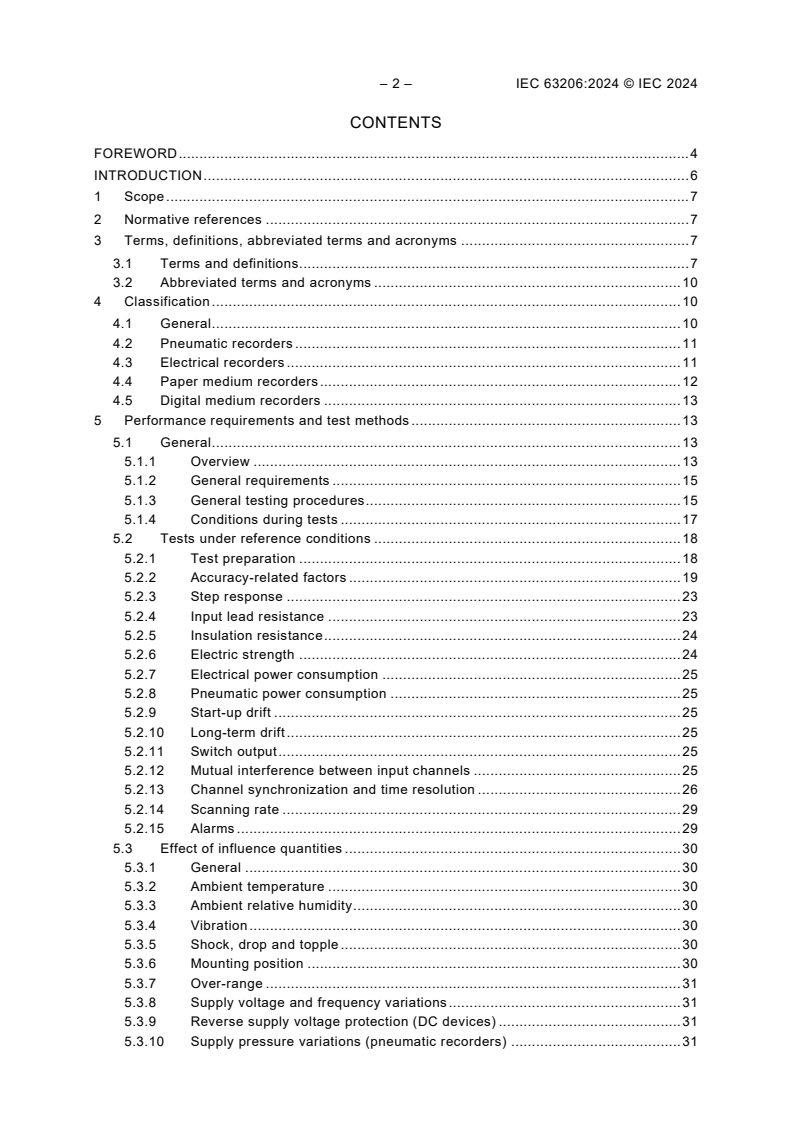
CONTENTS
FOREWORD . 4
INTRODUCTION . 6
1 Scope . 7
2 Normative references . 7
3 Terms, definitions, abbreviated terms and acronyms . 7
3.1 Terms and definitions . 7
3.2 Abbreviated terms and acronyms . 10
4 Classification . 10
4.1 General . 10
4.2 Pneumatic recorders . 11
4.3 Electrical recorders . 11
4.4 Paper medium recorders . 12
4.5 Digital medium recorders . 13
5 Performance requirements and test methods . 13
5.1 General . 13
5.1.1 Overview . 13
5.1.2 General requirements . 15
5.1.3 General testing procedures . 15
5.1.4 Conditions during tests . 17
5.2 Tests under reference conditions . 18
5.2.1 Test preparation . 18
5.2.2 Accuracy-related factors . 19
5.2.3 Step response . 23
5.2.4 Input lead resistance . 23
5.2.5 Insulation resistance . 24
5.2.6 Electric strength . 24
5.2.7 Electrical power consumption . 25
5.2.8 Pneumatic power consumption . 25
5.2.9 Start-up drift . 25
5.2.10 Long-term drift . 25
5.2.11 Switch output . 25
5.2.12 Mutual interference between input channels . 25
5.2.13 Channel synchronization and time resolution . 26
5.2.14 Scanning rate . 29
5.2.15 Alarms . 29
5.3 Effect of influence quantities . 30
5.3.1 General . 30
5.3.2 Ambient temperature . 30
5.3.3 Ambient relative humidity . 30
5.3.4 Vibration . 30
5.3.5 Shock, drop and topple . 30
5.3.6 Mounting position . 30
5.3.7 Over-range . 31
5.3.8 Supply voltage and frequency variations . 31
5.3.9 Reverse supply voltage protection (DC devices) . 31
5.3.10 Supply pressure variations (pneumatic recorders) . 31
5.3.11 Earthing . 31
5.3.12 EMC test . 31
5.3.13 Purge gas flow . 32
5.3.14 Accelerated operational life test (paper medium recorders) . 32
5.3.15 Effect of open-circuited input . 32
5.3.16 Effect of short-circuited input . 32
5.3.17 Recording medium storage conditions . 32
5.4 Quality of recording (paper medium recorders) . 33
5.4.1 General . 33
5.4.2 Long-term test . 33
5.4.3 Marking velocity . 33
5.4.4 Smear test . 33
5.4.5 Chart speed . 34
5.4.6 Parallax . 34
5.4.7 Time per point (multi-channel recorder) . 34
5.5 Function assessment . 34
6 Test report . 34
Annex A (informative) Function assessment . 36
A.1 General . 36
A.2 General assessment . 36
A.3 Interface . 37
A.4 Storage device . 38
Bibliography . 39
Figure 1 – Example of an electrical recorder functional model . 12
Figure 2 – Example of error curve . 21
Figure 3 – Test set-up for input resistance . 24
Figure 4 – Example of channel synchronization test . 27
Figure 5 – Example of time resolution test . 27
Figure 6 – Example of sequence of event test . 28
Table 1 – Performance requirements . 14
Table 2 – Settings of span and lower range value adjustments . 17
Table 3 – Example of error tabulation . 20
Table 4 – Example of function assessment report . 35
Table A.1 – Checklist for mapping general function assessment . 36
Table A.2 – Checklist for mapping interface . 37
Table A.3 – Checklist for mapping storage device . 38
– 4 – IEC 63206:2024 © IEC 2024
INTERNATIONAL ELECTROTECHNICAL COMMISSION
____________
INDUSTRIAL-PROCESS CONTROL SYSTEMS –
RECORDERS –
TESTING AND PERFORMANCE EVALUATION
FOREWORD
1) The International Electrotechnical Commission (IEC) is a worldwide organization for standardization comprising
all national electrotechnical committees (IEC National Committees). The object of IEC is to promote international
co-operation on all questions concerning standardization in the electrical and electronic fields. To this end and
in addition to other activities, IEC publishes International Standards, Technical Specifications, Technical Reports,
Publicly Available Specifications (PAS) and Guides (hereafter referred to as “IEC Publication(s)”). Their
preparation is entrusted to technical committees; any IEC National Committee interested in the subject dealt with
may participate in this preparatory work. International, governmental and non-governmental organizations liaising
with the IEC also participate in this preparation. IEC collaborates closely with the International Organization for
Standardization (ISO) in accordance with conditions determined by agreement between the two organizations.
2) The formal decisions or agreements of IEC on technical matters express, as nearly as possible, an international
consensus of opinion on the relevant subjects since each technical committee has representation from all
interested IEC National Committees.
3) IEC Publications have the form of recommendations for international use and are accepted by IEC National
Committees in that sense. While all reasonable efforts are made to ensure that the technical content of IEC
Publications is accurate, IEC cannot be held responsible for the way in which they are used or for any
misinterpretation by any end user.
4) In order to promote international uniformity, IEC National Committees undertake to apply IEC Publications
transparently to the maximum extent possible in their national and regional publications. Any divergence between
any IEC Publication and the corresponding national or regional publication shall be clearly indicated in the latter.
5) IEC itself does not provide any attestation of conformity. Independent certification bodies provide conformity
assessment services and, in some areas, access to IEC marks of conformity. IEC is not responsible for any
services carried out by independent certification bodies.
6) All users should ensure that they have the latest edition of this publication.
7) No liability shall attach to IEC or its directors, employees, servants or agents including individual experts and
members of its technical committees and IEC National Committees for any personal injury, property damage or
other damage of any nature whatsoever, whether direct or indirect, or for costs (including legal fees) and
expenses arising out of the publication, use of, or reliance upon, this IEC Publication or any other IEC
Publications.
8) Attention is drawn to the Normative references cited in this publication. Use of the referenced publications is
indispensable for the correct application of this publication.
9) IEC draws attention to the possibility that the implementation of this document may involve the use of (a)
patent(s). IEC takes no position concerning the evidence, validity or applicability of any claimed patent rights in
respect thereof. As of the date of publication of this document, IEC had not received notice of (a) patent(s), which
may be required to implement this document. However, implementers are cautioned that this may not represent
the latest information, which may be obtained from the patent database available at https://patents.iec.ch. IEC
shall not be held responsible for identifying any or all such patent rights.
IEC 63206 has been prepared by subcommittee 65B: Measurement and control devices, of IEC
technical committee 65: Industrial-process measurement, control and automation. It is an
International Standard.
The IEC 63206 cancels and replaces the IEC 60873-1:2003 and IEC 60873-2:2004, of which it
proposes revisions and updates.
The text of this International Standard is based on the following documents:
Draft Report on voting
65B/1254/FDIS 65B/1276/RVD
Full information on the voting for its approval can be found in the report on voting indicated in
the above table.
The language used for the development of this International Standard is English.
This document was drafted in accordance with ISO/IEC Directives, Part 2, and developed in
accordance with ISO/IEC Directives, Part 1 and ISO/IEC Directives, IEC Supplement, available
at www.iec.ch/members_experts/refdocs. The main document types developed by IEC are
described in greater detail at www.iec.ch/publications.
The committee has decided that the contents of this document will remain unchanged until the
stability date indicated on the IEC website under webstore.iec.ch in the data related to the
specific document. At this date, the document will be
• reconfirmed,
• withdrawn, or
• revised.
IMPORTANT – The "colour inside" logo on the cover page of this document indicates
that it contains colours which are considered to be useful for the correct understanding
of its contents. Users should therefore print this document using a colour printer.
– 6 – IEC 63206:2024 © IEC 2024
INTRODUCTION
IEC 63206 is intended for use by manufacturers to determine the performance of their products
and by users or independent testing bodies to verify manufacturers’ performance specifications.
IEC 63206 has fully covered IEC 60873-1 and IEC 60873-2 which are withdrawn.
INDUSTRIAL-PROCESS CONTROL SYSTEMS –
RECORDERS –
TESTING AND PERFORMANCE EVALUATION
1 Scope
IEC 63206 specifies the characterization, the classification (e.g.: analogue chart recorder,
digital recorder, X-Y recorder, paperless recorder, event recorder, data logger, and data
acquisition device, etc.) and performance evaluation methods of recorders. It covers type tests
as well as routine tests.
This document is applicable to recorder devices and recorder modules for control systems.
2 Normative references
The following documents, in whole or in part, are normatively referenced in this document and
are indispensable for its application. For dated references, only the edition cited applies. For
undated references, the latest edition of the referenced document (including any amendments)
applies.
IEC 60050-313, International Electrotechnical Vocabulary (IEV) – Electrical and electronic
measurements and measuring instruments – Part 313: Types of electrical measuring
instruments (available at )
IEC 60050-351, International Electrotechnical Vocabulary (IEV) – Part 351: Control technology
(available at )
IEC 61003-1:2016, Industrial-process control systems – Instruments with analogue inputs and
two- or multi-position outputs – Part 1: Methods for evaluating performance
IEC 61010-1:2010, Safety requirements for electrical equipment for measurement, control, and
laboratory use – Part 1 General requirements
IEC 61010-1:2010/AMD1:2016
IEC 61326-1:2020, Electrical equipment for measurement, control and laboratory use – EMC
requirements – Part 1: General requirements
IEC 62828-1:2017, Reference conditions and procedures for testing industrial and process
measurement transmitters – Part 1: General procedures for all types of transmitters
3 Terms, definitions, abbreviated terms and acronyms
3.1 Terms and definitions
For the purposes of this document, the terms and definitions given in IEC 60050-313,
IEC 60050-351, IEC 62828-1 and the following apply.
ISO and IEC maintain terminology databases for use in standardization at the following
addresses:
• IEC Electropedia: available at https://www.electropedia.org/
• ISO Online browsing platform: available at https://www.iso.org/obp
– 8 – IEC 63206:2024 © IEC 2024
3.1.1
data acquisition device
DAQ
device for entering or collecting data
Note 1 to entry: Multifunction DAQ devices rely on an industrial computer (commercial PC, Industrial PC, Compact
PCI, notebook etc.) for control. These devices are designed to meet the needs of a general-purpose measurement
system. They are not designed for a specific type of measurement. DAQ generally provide multiple measurement
modes such as analogue input, analogue output, digital input, digital output, and counter-timer functionality.
[SOURCE: IEC 62008:2005 [1], 3.1.4, modified – In the note to entry, "personal computer" has
been changed to "industrial computer" and the last sentence has been deleted.]
3.1.2
data logger
system to measure a number of variables and write tabulations and/or records in a form suitable
for computer input
[SOURCE: IEC TS 61968-2:2011 [2], 2.63, modified – "and make written tabulations and/or
record in a form suitable for computer input" has been changed to "and write tabulations and/or
records in a form suitable for computer input".]
3.1.3
digital medium recorder
recorder whose recording medium is electronic media
Note 1 to entry: Magnetic disk, optical disk or solid-state disk are storage medium of a digital medium recorder.
3.1.4
error in timekeeping
value obtained by subtracting the true value of elapsed time from the recorded value of time
[SOURCE: IEC 61143-1:1992 [3], 3.7.5]
3.1.5
friction effect
in the case of continuous line recorders, effect that friction of the marking device produces on
the recording chart
3.1.6
hysteresis
phenomenon represented by a characteristic curve which has a branch, called ascending
branch, for increasing values of the input variable, and a different branch, called descending
branch, for decreasing values of the input variable
Note 1 to entry: The CDD code of this entry for Electronic Data Exchange is ABB661 and the hysteresis is defined
as the difference between consecutive upscale and downscale outputs for any single test cycle at the same input
test point.
[SOURCE: IEC 60050-351:2013, 351-45-16, modified − Note to entry has been replaced.]
3.1.7
input range
region between the limits within which a quantity is measured, or received, expressed by stating
the lower and upper range values (for example, 0 mA, 100 mA)
Note 1 to entry: The zero value greater than the lowest range value is called "elevated"; and less than the lowest
range value is called "suppressed".
Note 2 to entry: Instruments can be supplied with manual or automatic means of adjusting the range. As used in
this document, the term "range" and the definitions below apply to the characteristics of the instruments for a specified
setting of the adjustment means.
3.1.8
non-linearity
deviation from ideal behaviour for devices that have a linear input/out relationship, determined
from the curve plotted using the overall average of corresponding upscale and downscale errors
Note 1 to entry: Non-linearity can be calculated and expressed in one of three ways:
– independent: line positioned so as to minimize the maximum deviation;
– terminal-based: line positioned so as to coincide with the actual characteristic curve at the upper and lower range-
values;
– zero-based: line positioned so as to coincide with the actual characteristic curve at the lower range-value.
Note 2 to entry: The corresponding properties are to be found in the CDD.
[SOURCE: IEC 61987-13 [4]:2016, 3.3.7]
3.1.9
output
position of the marking device of a recorder (for paper medium recorder) or stored data in
recording medium (for digital medium recorder)
Note 1 to entry: If an indicator is directly connected to the marking device, the indicated value is tested as a second
output.
3.1.10
paperless recorder
recorder in which the chart is displayed on an electronic screen
Note 1 to entry: In industry it is not uncommon to refer these kinds of recorders as "chartless".
3.1.11
paper medium recorder
recorder whose display medium is a type of paper
Note 1 to entry: Example of recorders: dotted line recorder, strip chart recorder, stylus recorder, (ink) jet recorder,
printing recorder, spot recorder, thermal recorder.
Note 2 to entry: Example of papers: regular paper, light-sensitive medium, heat-sensitive paper, dielectric-coated
paper or other papers.
3.1.12
record
trace or event marked on the instrument chart, text or stored electromagnetic information in
response to a signal
– 10 – IEC 63206:2024 © IEC 2024
3.1.13
recorder
measuring instrument which records on a recording medium information corresponding to the
values of the measurand
Note 1 to entry: Some recording instruments can incorporate an indicating device.
Note 2 to entry: Some recording instruments can record information corresponding to more than one measurand.
[SOURCE: IEC 60050-312:2001 [5], 312-02-11]
3.1.14
multiple-channel recorder
recorder for more than one signal to the recorder
3.1.15
multiple-pen recorder
recorder for more than one signal providing an individual pen or other marking device for each
signal
3.1.16
time per point
time interval between two immediately successive readings of the same or different signals
Note 1 to entry: Sample time, time interval, sample hold time are different ways to express the definition.
3.1.17
time resolution
the minimum time by which two events are separated in order that the corresponding time tags
be different
Note 1 to entry: The time resolution cannot be shorter than the time per point.
[SOURCE: IEC 60050-371:1984 [6], 371-05-03, modified – "must be" has been changed to
"are".]
3.1.18
zero adjustment
means provided in an instrument to cause a parallel shift in the input-output relation
[SOURCE: IEC 61987-1:2006 [7], 3.56, modified – "curve" has been changed to "relation".]
3.2 Abbreviated terms and acronyms
DAQ data acquisition device
DUT device under test
HHT hand held terminal
HMI human machine interface
PC personal computer
4 Classification
4.1 General
Recorders can be classified by the way they are powered (e.g.: pneumatic recorder and
electrical recorder), by recording medium (e.g.: paper medium recorder and digital medium
recorder) or by function (e.g.: continuous signal recorder and event recorder).
4.2 Pneumatic recorders
Pneumatic recorders record pneumatic signals and use paper as recording medium; their
marking device and the recording medium are driven by compressed air or electrical motor.
NOTE A typical recording range is 20 kPa to 100 kPa.
4.3 Electrical recorders
Electrical recorders record electric signals and are electrically powered. Electrical recorders
can be classified by:
– mechanical structure as: desktop type, rail mounted type, panel mounted type, portable or
board card type;
– function as: chart recorder, X-t recorder (or trend recorder), X-Y recorder, paperless
recorder, event recorder, data logger and data acquisition device.
In control systems, the recorder function could also be done by software with no hardware
dedicated elements.
The functional model for an electrical recorder is as shown in Figure 1. The electrically power
supply unit, the input channel unit and the data processing unit are basic modules of a recorder
(for example: a data logger). There should be at least one module of paper medium recording
unit, digital medium recording unit (magnetic or CD-RW disk and solid state medium) or
communication unit. Display unit, alarm unit and switch output unit are optional.
Electrical recorder functions include:
– electrical power supply unit, to provide the recorder with the energy from a power regulator
unit that is supplied by AC or DC power supply or a set of rechargeable batteries;
– input channel unit, to receive the signals from process field, it is the interface between the
recorder and the external world;
– data processing unit, it is the most important part of an electrical recorder. Its main function
is to provide and process the measured signals, write tabulations and records in a form
suitable for digital medium recording units, communication unit or paper medium recording
unit. Besides the main measurement function, it can be equipped with a number of additional
functions: configuration, adjustment, self-testing, diagnostics, condition monitoring, external
process control function, internal data storage, etc. An event recorder, besides the above
functions, also contains a clock with sufficient time resolution to associate to all input events
a time stamp to distinguish their precedence relationship.
– 12 – IEC 63206:2024 © IEC 2024
NOTE Grey boxes with bold-type letter means removable modules.
Figure 1 – Example of an electrical recorder functional model
– Paper medium recording unit, normally consists of paper driving machine, marking device
and paper medium.
– Magnetic or optical disk unit have dedicated drivers for recording media disks.
– Solid state medium unit, features different interfaces depending on the solid-state medium,
e.g. USB.
– Communication unit, to exchange information with any external system.
EXAMPLE Sending real time information, receiving external command, or reading internal data storage.
– Display or HMI unit, to display chart, trending, data list or to locally operate recorder; it can
be realized in many different ways: with display unit, without display unit, and with display
unit separate or removable.
– Alarm unit, can be used to alert the human operator with different patterns of sound, light,
and/or any other signals.
– Switch output unit, provides on/off signal to any external system.
A PC has most of Figure 1 modules; adding an input module, it becomes a data acquisition
device (DAQ).
4.4 Paper medium recorders
Paper medium recorders are characterized by:
– recording medium shape: strip chart recorders, drum recorders and (paper) disc recorders;
– marking device: pen recorders, stylus recorders, array recorders, spot recorders; thermal
recorders, light beam recorders, (ink) jet recorders and printing recorders;
– quantity of marking devices: single-pen recorders, multiple-pen recorders;
– recording trace: continuous line recorders, dotted line recorders.
4.5 Digital medium recorders
Digital medium recorders can be used with an external computer which has dedicated software.
Their information storage and access can be:
– external storage media, including magnetic disks, optical disk units, non-volatile read-write
memories, etc., using external computer reading information and display historical chart,
trending or data list;
– communication interface, using external computer display real time chart, trending, data list
and storing information in external computer store media, or accessing internal data storage,
similar to reading an external store media;
– display device, that shows the real time chart, the trend and all the recorded parameters of
the event, or accessing internal data storage to show historical scenario.
5 Performance requirements and test methods
5.1 General
5.1.1 Overview
The following Table 1 lists all the type and routine tests for different types of recorders. In
general, if a full evaluation report is planned, each applicable test should be conducted on a
given recorder. If a test has been omitted this should be stated, together with the reason.
For all tests, see Table 1.
– 14 – IEC 63206:2024 © IEC 2024
Table 1 – Performance requirements
Electrical recorders type test
Pneumatic
Special Special
Test Routine
Common Special
No. Test recorders
for for
method test
to all for event
type test
multiple- paper
families recorder
channel medium
Tests under reference conditions
1 Measured error 5.2.2.2 √ √ √
2 Dead band 5.2.2.3 √ √ +
Error in
3 5.2.2.4 + √ +
timekeeping
4 Step response 5.2.3 √ √
Input lead
5.2.4 √
resistance
Insulation
6 5.2.5 √ √
resistance
Dielectric
7 5.2.6 √
strength
Electrical power
8 5.2.7 √
consumption
Pneumatic
9 power 5.2.8 √
consumption
10 Start-up drift 5.2.9 √ √
11 Long-term drift 5.2.10 √ √
12 Switch output 5.2.11 +
Mutual influence
13 between input 5.2.12 √
channels
Channel
14 5.2.13.2 + +
synchronization
15 Time resolution 5.2.13.3 √ +
Sequence of
16 5.2.13.4 √ √
event
17 Scanning rate 5.2.14 √
18 Alarm patterns 5.2.15.1 +
Alarm response
19 5.2.15.2 + √
time
Effects of influence quantities
Ambient
20 5.3.2 √ √
temperature
Ambient relative
21 5.3.3 √ √
humidity
22 Vibration 5.3.4 √ √
Shock, drop and
23 5.3.5 √ √ +
topple
Mounting
24 5.3.6 √ √ +
position
25 Over-range 5.3.7 √ √ √
Supply voltage
26 and frequency 5.3.8 √ √
variations
Electrical recorders type test
Pneumatic
Special Special
Test Routine
Common Special
No. Test recorders
for for
method test
to all for event
type test
multiple- paper
families recorder
channel medium
Reverse supply
27 voltage 5.3.9 √
protection
Supply pressure
28 5.3.10 √
variations
29 Earthing 5.3.11 √
EMC immunity
30 5.3.12.1 √
test
EMC emission
31 5.3.12.2 √
test
32 Purge gas flow 5.3.13 √
Accelerated
33 operational life 5.3.14 √ √
test
Effect of open-
34 5.3.15 √
circuited input
Effect of short-
35 5.3.16 √
circuited input
Recording media
36 storage 5.3.17 √
conditions
Quality of recording
37 Long-term test 5.4.2 √ √
38 Marking velocity 5.4.3 √ √
39 Smear test 5.4.4 √ √
40 Chart speed 5.4.5 √ √
41 Parallax 5.4.6 √
42 Time per point 5.4.7 √ √
NOTE 1 "√" mark means it is a common basic item for all similar type recorders.
NOTE 2 "+" mark means it is an optional test for some of recorders.
5.1.2 General requirements
Unless otherwise stated in this subclause, technical indicators shall conform to the
manufacturer’s specifications.
5.1.3 General testing procedures
5.1.3.1 Overview
An adequate time, as specified by the manufacturer, shall be given after switching on the power
supply in order to allow temperature within the recorder to stabilize. In the absence of a
manufacturer’s specification, a period of 30 min shall be used.
– 16 – IEC 63206:2024 © IEC 2024
In performing tests on a multiple-channel recording instrument, the measured quantity shall be
applied to the recorder under test and to a reference instrument and shall be varied so that the
required value is also shown on the reference instrument. The determination of deviations shall
be carried out by using first one of the channels and then, successively, the other channels.
Input values should generally be selected in such a way that the recorded values are produced
on different points on the chart to provide best discrimination between the recorded values (in
the case of certain tests, such as checking zero and span, this is not possible).
NOTE For multiple-channel recorders, it is generally more convenient to adjust the input to obtain the true output
values and then record the value of the input.
Errors shall be determined as departure from the input/output relationship specified by the
manufacturer, where the manufacturer’s settings before delivery are used. In other cases,
reference shall be made to the adjustments and settings put in by the tester.
5.1.3.2 Selection of test ranges
Where there are switched ranges (or dial settings), for example, gain, the tests shall be
repeated to cover all ranges. Where the DUT is supplied calibrated for use, the first set of tests
shall be carried out without adjustment.
Three different types of adjustment are explained below:
a) The recorder shall be put into operation according to the manufacturer's instructions; in
particular, those relating to the preliminary adjustments.
The chart and ink supplied by the manufacturer for the recorders should be used for all
tests.
b) Unless otherwise stated, where the span is adjustable other than to take up manufacturing
tolerances, the tests should be carried out with the span adjustment set approximately at
the manufacturer's stated minimum and maximum and at an intermediate value.
c) Unless otherwise stated, where the zero adjustment is adjustable other than to take up
manufacturing tolerances, such as devices equipped with means for suppression or
elevation of zero, the tests should be carried out with the elevation/suppression adjustment
set for its minimal effect, then at its extreme values.
If the extent of adjustment is more than twice the maximum span, tests should also be carried
out with the adjustment set approximately at the arithmetic mean of the two extreme values of
elevation and/or suppression (see 5.1.3.4).
Testing of a recorder with provision for substantial adjustment of both span and zero in
accordance with b) and c) above can require an impractically large number of tests. Preliminary
tests should be conducted to determine the effect of changing span and zero adjustments on
the characteristic being measured so that redundant tests can be eliminated from the test
program in cases where the characteristic can be inferred reliably from fewer tests. For example,
it is possible that hysteresis and dead band are not significantly affected by selection of the
lower and upper range value if the span is held constant and can often be calculated for different
spans from measurements at a single-span setting. In any case, the report should clearly
indicate relevant values of the measured parameters for each setting of the adjustments so that
the values of measured error, hysteresis, dead band, etc., are all referenced to the same
adjustment of the recorder.
5.1.3.3 Zero and span adjustment
Zero and span should be adjusted to make the actual characteristic conform closely to ideal
values at the upper and lower range limits before carrying out each test specified in this
document. The adjustment, if any shall be stated in the evaluation report.
5.1.3.4 Setting of span and lower range value adjustments
Whenever the span and/or lower range value adjustments are adjustable further than the
adjustments for the manufacturing tolerances, when testing for the factors related to accuracy
the adjustments should be set at the settings A, B, C, D as required in Table 2, unless otherwise
specified in the test programme.
Table 2 – Settings of span and lower range value adjustments
Kind of test Adjustable span Zero suppression and/or elevation
Performance evaluation
a b
Complete tests
A B
Type test
Routine tests
c d
Simplified tests C D
Sample test
a
Setting A – Span adjustment set at the maximum and minimum values specified by the manufacturer, and at
one intermediate value.
b
Setting B – Normally, tests will be done at only one setting of lower range value, without suppression or
elevation, but further tests at minimum and maximum settings may be required if the effects are significant.
c
Setting C – Unless otherwise specified in the test program, the span shall be as set by the manufacturer.
d
Setting D – Unless otherwise specified in the test program, the lower range value shall be as set by the
manufacturer.
5.1.3.5 Information to be reported
Unless otherwise agreed, the test results shall be expressed as percentages of output span.
When performance characteristics are specified, they shall be tabulated beside the actual test
results.
The uncertainty of the measuring systems used for the test shall be stated in the test report.
This uncertainty should be smaller than, or equal to, one-third of the stated uncertainty of the
recorder tested.
5.1.4 Conditions during tests
5.1.4.1 Environmental c
...