

IEC 61298-2:2026
(Main)Process measurement and control devices - General methods and procedures for evaluating performance - Part 2: Tests under reference conditions
General Information
- Abstract
IEC 61298-2:2026 specifies general methods and procedures for conducting tests and reporting on the functional and performance characteristics of process instrumentation except process measurement transmitters (PMT) which are standardized by IEC 62828 series. The tests are applicable to any such devices characterized by their own specific input and output variables, and by the specific relationship (transfer function) between the inputs and outputs and include analogue and digital devices. For devices that require special tests, this standard can be used, together with any product specific standard specifying special tests. This document covers tests made under reference conditions.
This third edition cancels and replaces the second edition published in 2008. This edition constitutes a technical revision.
This edition includes the following significant technical changes with respect to the previous edition:
a) Process measurement transmitters (PMT) have been removed from the scope of this standard
- Status
- Published
- Publication Date
- 07-Jun-2026
- Technical Committee
- SC 65B - Measurement and control devices
- Drafting Committee
- WG 6 - TC 65/SC 65B/WG 6
- Current Stage
- PPUB - Publication issued
- Start Date
- 08-Jun-2026
- Completion Date
- 26-Jun-2026
Buy Documents
REDLINE IEC 61298-2:2026 RLV - Process measurement and control devices - General methods and procedures for evaluating performance - Part 2: Tests under reference conditions
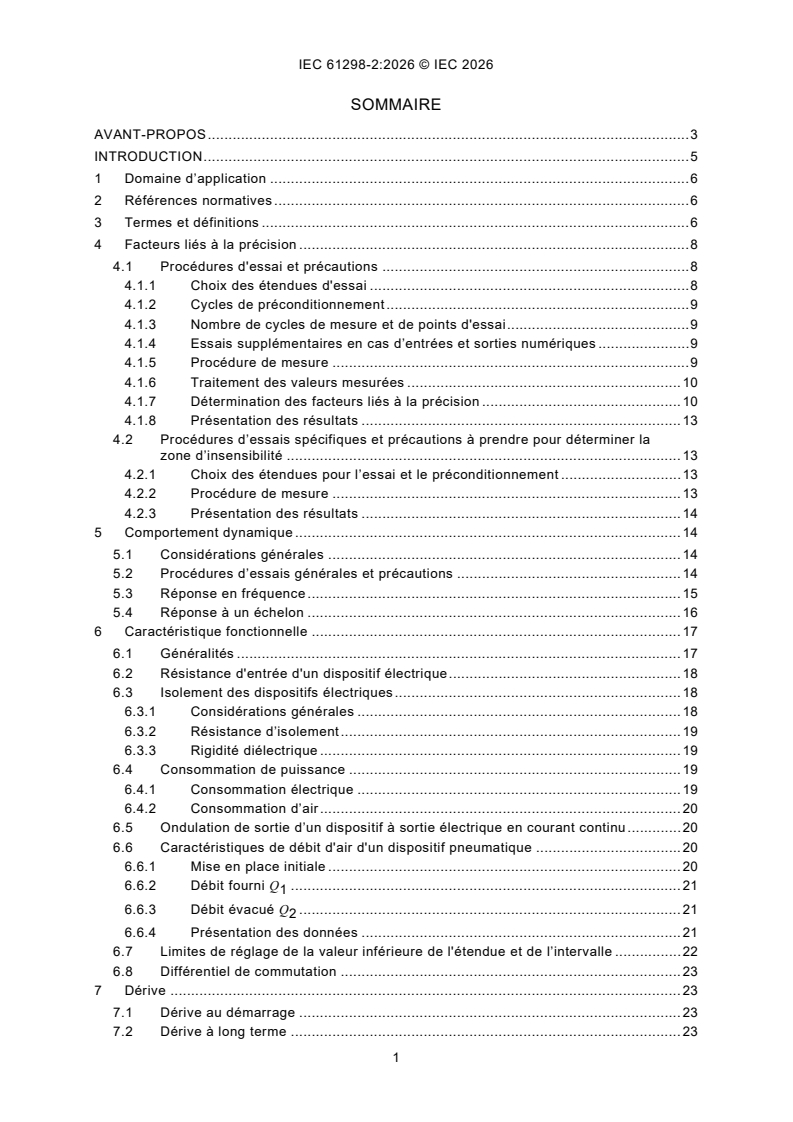
IEC 61298-2:2026 - Dispositifs de mesure et de commande de processus - Méthodes et procédures générales d'évaluation des performances - Partie 2: Essais dans les conditions de référence
iec61298-2{ed3.0}en - Process measurement and control devices - General methods and procedures for evaluating performance - Part 2: Tests under reference conditions
Overview
IEC 61298-2:2026 provides internationally recognized general methods and procedures for evaluating the performance of process measurement and control devices, excluding process measurement transmitters (PMT), which are standardized by the IEC 62828 series. This standard applies to both analogue and digital devices used in process control environments, covering tests under reference conditions. It serves as a foundational reference for test protocols and reporting in industrial automation, ensuring consistency, transparency, and comparability of device performance characteristics worldwide.
This third edition (2026) introduces significant changes, notably the exclusion of PMTs from its scope, further aligning with evolving standardization within the process instrumentation industry.
Key Topics
- Scope and Applicability: Applicable to various process measurement and control devices, characterized by distinct input and output variables and transfer functions; suitable for both analogue and digital technology.
- Test Methods: Outlines comprehensive procedures for accuracy verification, dynamic behavior evaluation, and reporting under controlled, reference conditions.
- Accuracy-Related Factors: Establishes standardized approaches to assess inaccuracy, hysteresis, non-linearity, dead band, and non-repeatability of devices.
- Measurement Procedures: Describes the selection of ranges for testing, preconditioning requirements, measurement cycles, and the number/location of test points for effective evaluation.
- Dynamic Behavior: Encompasses methods for frequency response, step response, rise time, settling time, and time constant determination.
- Functional Characteristics: Details tests for input resistance, insulation, power consumption, output ripple (for electrical DC outputs), pneumatic device airflow, and adjustment limits.
- Reporting: Defines standardized tables and graphical representation of errors and measurement results for transparent reporting and device comparison.
Applications
IEC 61298-2:2026 is crucial for manufacturers, testing laboratories, and end-users of process measurement and control instrumentation. Practical applications include:
- Device Evaluation and Certification: Provides a uniform basis for acceptance and conformity testing by manufacturers and independent testing bodies.
- Quality Assurance: Enables organizations to verify devices' performance characteristics before installation or during routine maintenance.
- Product Development and R&D: Offers guidelines to engineers designing new process control devices, ensuring compatibility with international performance expectations.
- System Integration: Facilitates reliable selection and integration of instrumentation in industrial control systems, supporting compliance and operational safety.
- Standardized Reporting: Assists in preparing consistent documentation required for regulatory or contractual purposes, supporting traceability and auditability.
Related Standards
- IEC 61298 Series: Part 1 (General Considerations) and other relevant parts in the series specify additional procedures and considerations.
- IEC 62828 Series: Standards focused on process measurement transmitters (PMT), excluded from IEC 61298-2:2026.
- IEC 61010-1: Safety requirements for electrical equipment for measurement and control.
- IEC 60050-300/351: Terminology and vocabulary for electrical measurements and control technology.
- ISO/IEC Directives: Foundational procedural and drafting guidelines for all IEC documents.
Summary
Adopting IEC 61298-2:2026 ensures a harmonized, globally accepted approach to testing the functional and performance characteristics of process measurement and control devices. This standard streamlines device evaluation and facilitates interoperability, reliability, and safety in industrial process automation. Its methods are instrumental for device manufacturers, testing engineers, and organizations aiming for high-quality, standards-compliant instrumentation within modern industrial environments.
Relations
- Effective Date
- 05-Sep-2023
Buy Documents
REDLINE IEC 61298-2:2026 RLV - Process measurement and control devices - General methods and procedures for evaluating performance - Part 2: Tests under reference conditions
IEC 61298-2:2026 - Dispositifs de mesure et de commande de processus - Méthodes et procédures générales d'évaluation des performances - Partie 2: Essais dans les conditions de référence
iec61298-2{ed3.0}en - Process measurement and control devices - General methods and procedures for evaluating performance - Part 2: Tests under reference conditions
Get Certified
Connect with accredited certification bodies for this standard

DVS-ZERT GmbH
German welding certification society.
CARES (UK Certification Authority for Reinforcing Steels)
UK certification for reinforcing steels and construction.
EWF/IIW (European/International Welding Federation)
International welding personnel certification.
Sponsored listings
Frequently Asked Questions
IEC 61298-2:2026 is a standard published by the International Electrotechnical Commission (IEC). Its full title is "Process measurement and control devices - General methods and procedures for evaluating performance - Part 2: Tests under reference conditions". This standard covers: IEC 61298-2:2026 specifies general methods and procedures for conducting tests and reporting on the functional and performance characteristics of process instrumentation except process measurement transmitters (PMT) which are standardized by IEC 62828 series. The tests are applicable to any such devices characterized by their own specific input and output variables, and by the specific relationship (transfer function) between the inputs and outputs and include analogue and digital devices. For devices that require special tests, this standard can be used, together with any product specific standard specifying special tests. This document covers tests made under reference conditions. This third edition cancels and replaces the second edition published in 2008. This edition constitutes a technical revision. This edition includes the following significant technical changes with respect to the previous edition: a) Process measurement transmitters (PMT) have been removed from the scope of this standard
IEC 61298-2:2026 specifies general methods and procedures for conducting tests and reporting on the functional and performance characteristics of process instrumentation except process measurement transmitters (PMT) which are standardized by IEC 62828 series. The tests are applicable to any such devices characterized by their own specific input and output variables, and by the specific relationship (transfer function) between the inputs and outputs and include analogue and digital devices. For devices that require special tests, this standard can be used, together with any product specific standard specifying special tests. This document covers tests made under reference conditions. This third edition cancels and replaces the second edition published in 2008. This edition constitutes a technical revision. This edition includes the following significant technical changes with respect to the previous edition: a) Process measurement transmitters (PMT) have been removed from the scope of this standard
IEC 61298-2:2026 is classified under the following ICS (International Classification for Standards) categories: 25.040.40 - Industrial process measurement and control. The ICS classification helps identify the subject area and facilitates finding related standards.
IEC 61298-2:2026 has the following relationships with other standards: It is inter standard links to IEC 61298-2:2008. Understanding these relationships helps ensure you are using the most current and applicable version of the standard.
IEC 61298-2:2026 is available in PDF format for immediate download after purchase. The document can be added to your cart and obtained through the secure checkout process. Digital delivery ensures instant access to the complete standard document.
Standards Content (Sample)
IEC 61298-2 ®
Edition 3.0 2026-06
INTERNATIONAL
STANDARD
REDLINE VERSION
Process measurement and control devices - General methods and procedures
for evaluating performance -
Part 2: Tests under reference conditions
ICS 25.040.40 ISBN 978-2-8327-1317-4
All rights reserved. Unless otherwise specified, no part of this publication may be reproduced or utilized in any form or
by any means, electronic or mechanical, including photocopying and microfilm, without permission in writing from either
IEC or IEC's member National Committee in the country of the requester. If you have any questions about IEC copyright
or have an enquiry about obtaining additional rights to this publication, please contact the address below or your local
IEC member National Committee for further information.
IEC Secretariat Tel.: +41 22 919 02 11
3, rue de Varembé info@iec.ch
CH-1211 Geneva 20 www.iec.ch
Switzerland
About the IEC
The International Electrotechnical Commission (IEC) is the leading global organization that prepares and publishes
International Standards for all electrical, electronic and related technologies.
About IEC publications
The technical content of IEC publications is kept under constant review by the IEC. Please make sure that you have the
latest edition, a corrigendum or an amendment might have been published.
IEC publications search - IEC Products & Services Portal - products.iec.ch
webstore.iec.ch/advsearchform Discover our powerful search engine and read freely all the
The advanced search enables to find IEC publications by a publications previews, graphical symbols and the glossary.
variety of criteria (reference number, text, technical With a subscription you will always have access to up to date
committee, …). It also gives information on projects, content tailored to your needs.
replaced and withdrawn publications.
Electropedia - www.electropedia.org
The world's leading online dictionary on electrotechnology,
IEC Just Published - webstore.iec.ch/justpublished
Stay up to date on all new IEC publications. Just Published containing more than 22 500 terminological entries in English
details all new publications released. Available online and and French, with equivalent terms in 25 additional languages.
once a month by email. Also known as the International Electrotechnical Vocabulary
(IEV) online.
IEC Customer Service Centre - webstore.iec.ch/csc
If you wish to give us your feedback on this publication or
need further assistance, please contact the Customer
Service Centre: sales@iec.ch.
CONTENTS
FOREWORD . 3
INTRODUCTION . 5
1 Scope . 6
2 Normative references . 6
3 Terms and definitions . 6
4 Accuracy related factors . 9
4.1 Test procedures and precautions . 9
4.1.1 Selection of ranges for test . 9
4.1.2 Preconditioning cycles . 10
4.1.3 Number of measurement cycles and test points . 10
4.1.4 Additional tests where digital inputs and outputs are provided . 11
4.1.5 Measurement procedure . 11
4.1.6 Processing of the measured values . 11
4.1.7 Determination of accuracy related factors . 12
4.1.8 Presentation of the results . 16
4.2 Specific testing procedures and precautions for the determination of dead
band . 16
4.2.1 Selection of ranges for test and preconditioning . 16
4.2.2 Measurement procedure . 16
4.2.3 Presentation of the results . 17
5 Dynamic behaviour . 17
5.1 General considerations . 17
5.2 General testing procedures and precautions . 17
5.3 Frequency response . 18
5.4 Step response. 19
6 Functional characteristic . 20
6.1 General . 20
6.2 Input resistance of an electrical device . 20
6.3 Insulation of electrical devices . 21
6.3.1 General considerations . 21
6.3.2 Insulation resistance . 21
6.3.3 Dielectric strength. 22
6.4 Power consumption. 22
6.4.1 Electrical power consumption . 22
6.4.2 Air consumption . 22
6.5 Output ripple of a device with an electrical DC output . 23
6.6 Air flow characteristics of a pneumatic device . 23
6.6.1 Initial setting up . 23
6.6.2 Delivered flow Q . 23
6.6.3 Exhausted flow Q . 24
6.6.4 Data presentation . 24
6.7 Limits of adjustments of lower range value and span . 25
6.8 Switching differential . 25
7 Drift . 25
7.1 Start-up drift . 25
7.2 Long-term drift . 26
Bibliography . 27
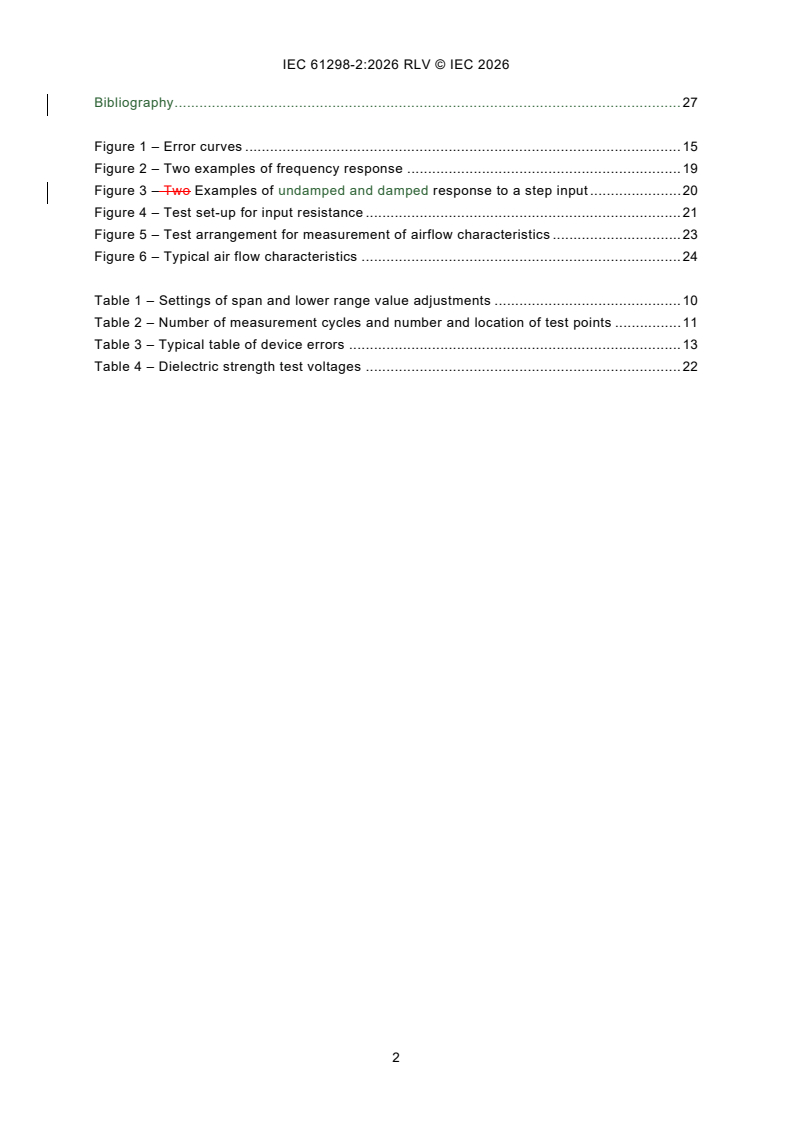
Figure 1 – Error curves . 15
Figure 2 – Two examples of frequency response . 19
Figure 3 – Two Examples of undamped and damped response to a step input . 20
Figure 4 – Test set-up for input resistance . 21
Figure 5 – Test arrangement for measurement of airflow characteristics . 23
Figure 6 – Typical air flow characteristics . 24
Table 1 – Settings of span and lower range value adjustments . 10
Table 2 – Number of measurement cycles and number and location of test points . 11
Table 3 – Typical table of device errors . 13
Table 4 – Dielectric strength test voltages . 22
INTERNATIONAL ELECTROTECHNICAL COMMISSION
____________
Process measurement and control devices -
General methods and procedures for evaluating performance -
Part 2: Tests under reference conditions
FOREWORD
1) The International Electrotechnical Commission (IEC) is a worldwide organization for standardization comprising
all national electrotechnical committees (IEC National Committees). The object of IEC is to promote international
co-operation on all questions concerning standardization in the electrical and electronic fields. To this end and
in addition to other activities, IEC publishes International Standards, Technical Specifications, Technical Reports,
Publicly Available Specifications (PAS) and Guides (hereafter referred to as "IEC Publication(s)"). Their
preparation is entrusted to technical committees; any IEC National Committee interested in the subject dealt with
may participate in this preparatory work. International, governmental and non-governmental organizations liaising
with the IEC also participate in this preparation. IEC collaborates closely with the International Organization for
Standardization (ISO) in accordance with conditions determined by agreement between the two organizations.
2) The formal decisions or agreements of IEC on technical matters express, as nearly as possible, an international
consensus of opinion on the relevant subjects since each technical committee has representation from all
interested IEC National Committees.
3) IEC Publications have the form of recommendations for international use and are accepted by IEC National
Committees in that sense. While all reasonable efforts are made to ensure that the technical content of IEC
Publications is accurate, IEC cannot be held responsible for the way in which they are used or for any
misinterpretation by any end user.
4) In order to promote international uniformity, IEC National Committees undertake to apply IEC Publications
transparently to the maximum extent possible in their national and regional publications. Any divergence between
any IEC Publication and the corresponding national or regional publication shall be clearly indicated in the latter.
5) IEC itself does not provide any attestation of conformity. Independent certification bodies provide conformity
assessment services and, in some areas, access to IEC marks of conformity. IEC is not responsible for any
services carried out by independent certification bodies.
6) All users should ensure that they have the latest edition of this publication.
7) No liability shall attach to IEC or its directors, employees, servants or agents including individual experts and
members of its technical committees and IEC National Committees for any personal injury, property damage or
other damage of any nature whatsoever, whether direct or indirect, or for costs (including legal fees) and
expenses arising out of the publication, use of, or reliance upon, this IEC Publication or any other IEC
Publications.
8) Attention is drawn to the Normative references cited in this publication. Use of the referenced publications is
indispensable for the correct application of this publication.
9) IEC draws attention to the possibility that the implementation of this document may involve the use of (a)
patent(s). IEC takes no position concerning the evidence, validity or applicability of any claimed patent rights in
respect thereof. As of the date of publication of this document, IEC had not received notice of (a) patent(s), which
may be required to implement this document. However, implementers are cautioned that this may not represent
the latest information, which may be obtained from the patent database available at https://patents.iec.ch. IEC
shall not be held responsible for identifying any or all such patent rights.
This redline version of the official IEC Standard allows the user to identify the changes made
to the previous edition IEC 61298-2:2008. A vertical bar appears in the margin wherever a
change has been made. Additions are in green text, deletions are in strikethrough red text.
IEC 61298-2 has been prepared by subcommittee 65B: Measurement and control devices, of
IEC technical committee 65: Industrial-process measurement, control and automation. It is an
International Standard.
This third edition cancels and replaces the second edition published in 2008. This edition
constitutes a technical revision.
This edition includes the following significant technical changes with respect to the previous
edition:
a) Process measurement transmitters (PMT) have been removed from the scope of this
standard.
The text of this International Standard is based on the following documents:
Draft Report on voting
65B/1311/FDIS 65B/1322/RVD
Full information on the voting for its approval can be found in the report on voting indicated in
the above table.
The language used for the development of this International Standard is English.
This document was drafted in accordance with ISO/IEC Directives, Part 2, and developed in
accordance with ISO/IEC Directives, Part 1 and ISO/IEC Directives, IEC Supplement, available
at www.iec.ch/members_experts/refdocs. The main document types developed by IEC are
described in greater detail at www.iec.ch/publications.
A list of all parts of the IEC 61298 series, under the general title Process measurement and
control devices - General methods and procedures for evaluating performance, can be found
on the IEC website.
The committee has decided that the contents of this document will remain unchanged until the
stability date indicated on the IEC website under webstore.iec.ch in the data related to the
specific document. At this date, the document will be
– reconfirmed,
– withdrawn, or
– revised.
INTRODUCTION
This document is not intended as a substitute for existing standards, but is rather intended as
a reference document for any future standards developed within the IEC or other standards
organizations, concerning the evaluation of process instrumentation. Any revision of existing
standards should take this standard into account, except process measurement transmitters
(PMT) which are standardized by the IEC 62828 series.
This common standardized basis should can be utilized for the preparation of future relevant
standards, as follows:
– any test method or procedure, already treated in this document, should will be specified and
described in the new standard by referring to the corresponding clause of this document.
Consequently, new editions of this document are revised without any change in numbering
and scope of each clause;
– any particular method or procedure, not covered by this document, should will be developed
and specified in the new standard in accordance with the criteria, as far as they are
applicable, stated in this document;
– any conceptual or significant deviation from the content of this document, should will clearly
be identified and justified if introduced in a new standard.
1 Scope
This part of IEC 61298 specifies general methods and procedures for conducting tests and
reporting on the functional and performance characteristics of process measurement and
control devices instrumentation except process measurement transmitters (PMT) which are
standardized by IEC 62828 series. The tests are applicable to any such devices characterized
by their own specific input and output variables, and by the specific relationship (transfer
function) between the inputs and outputs and include analogue and digital devices. For devices
that require special tests, this standard should can be used, together with any product specific
standard specifying special tests.
This document covers tests made under reference conditions.
2 Normative references
The following documents are referred to in the text in such a way that some or all of their content
constitutes requirements of this document. For dated references, only the edition cited applies.
For undated references, the latest edition of the referenced document (including any
amendments) applies.
IEC 60050-300, International Electrotechnical Vocabulary (IEV) - Electrical and electronic
measurements and measuring instruments - Part 311: General terms relating to
measurements - Part 312: General terms relating to electrical measurements - Part 313: Types
of electrical measuring instruments - Part 314: Specific terms according to the type of
instrument, available at https://www.electropedia.org/
IEC 60050-351, International Electrotechnical Vocabulary (IEV) - Part 351: Control technology,
available at https://www.electropedia.org/
IEC 61010-1, Safety requirements for electrical equipment for measurement, control, and
laboratory use - Part 1: General requirements
IEC 61298-1:2026, Process measurement and control devices - General methods and
procedures for evaluating performance - Part 1: General considerations
3 Terms and definitions
For the purposes of this document, the terms and definitions given in IEC 60050-300,
IEC 60050-351 and the following apply.
ISO and IEC maintain terminology databases for use in standardization at the following
addresses:
– IEC Electropedia: available at https://www.electropedia.org/
– ISO Online browsing platform: available at https://www.iso.org/obp
3.1
variable
quantity or condition whose value is subject to change and can usually be measured (e.g.,
temperature, flow rate, speed, signal, etc.)
[IEV 351-21-01, modified]
3.2
signal
physical quantity, one or more parameters of which carry information about one or more
variables which the signal represents
[IEV 351-21-51, modified]
3.3
range
range of values defined by the two extreme values within which a variable can be measured
within the specified accuracy
[IEV 351-27-11, modified]
3.4
span
algebraic difference between the values of the upper and lower limits of the measuring range
[IEV 311-03-13]
3.5
inaccuracy
maximum positive and negative deviation from the specified characteristic curve observed in
testing a device under specified conditions and by a specified procedure
NOTE 1 Accuracy is defined in IEC 60050-300, definition 311-06-08.
NOTE 2 The term inaccuracy is sometime referred to as measured accuracy. This term should not be used.
3.6
error
algebraic difference between the indicated value and a comparison value of the measured
variable
[IEV 351-27-04, modified]
NOTE The error is positive when the indicated value is greater than the comparison value. The error is generally
expressed as a percentage of the relevant ideal span.
3.7
measured error
largest positive or negative value of errors of the average upscale or downscale values at each
point of measurement
3.1
non-conformity
closeness with which a calibration curve approximates to a specified characteristic curve (which
can be linear, logarithmic, parabolic, etc.)
Note 1 to entry: Non-conformity does not include hysteresis.
3.9
non-linearity
deviation from linearity
NOTE 1 Linearity is defined in IEC 60050(300), definition 311-06-05.
NOTE 2 Non-linearity does not include hysteresis.
3.10
non-repeatability
deviation from repeatability
NOTE Repeatability is defined in IEC 60050(300), definition 311-06-06.
3.11
hysteresis
property of a device or instrument whereby it gives different output values in relation to its input
values depending on the directional sequence in which the input values have been applied
[IEV 351-24-15, modified]
3.12
dead band
finite range of values within which a variation of the input variable does not produce any
measurable change in the output variable
[IEV 351-24-14, modified]
3.2
dead time
time interval between the instant when a variation of an input variable is produced, and the
instant when the subsequent variation of the output variable starts
[IEV 351-28-41]
(see IEC 60050-351, Figure 5)
[IEC 60050-351, 351-50-30, modified – The definition has been amended and the note to entry
has been removed].
3.3
rise time
for a step response, the duration of the time interval between the instant when the output
variable (starting from zero) reaches a small specified percentage (for instance 10 %) of the
final steady-state value, and the instant when it reaches for the first time a large specified
percentage (for instance 90 %) of the same difference
[IEV 394-39-11, modified]
(see IEC 60050-351, Figure 3)
[IEC 60050-845:2020, 845-25-067, modified – The definition has been amended and the three
notes to entry have been removed.]
3.4
settling time
time interval between the instant of the step change of an input variable, and the instant when
the output variable does not deviate by more than a specified tolerance from its final steady
state value (see IEC 60050-351, Figure 3). For this standard, a tolerance of 1 % is adopted
[IEV 351-24-29]
Note 1 to entry: In this document, a tolerance of 1 % is adopted.
[IEC 60050-351:2013, 351-45-37, modified – The definition has been amended and Note 1 to
entry has been added.]
3.5
step response time
time interval between the instant of a step change in the input variable and the instant when
the output variable reaches for the first time a specified percentage of the difference between
the final and the initial steady state value (see IEC 60050-351, Figure 3). For this standard , a
specified percentage of 90 % is adopted [IEV 351-24-28]
Note 1 to entry: In this document, a specified percentage of 90 % is adopted.
[IEC 60050-351:2013, 351-45-36, modified – The definition has been amended and Note 1 to
entry has been added.]
3.6
time constant
time required to complete 63,2 % of the total change of the output of a first-order linear system,
produced by a step variation of the input variable
[IEV 351-24-24]
[IEC 60050-351:2013, 351-45-32, modified – The definition has been amended and the five
notes to entry have been removed.]
3.18
test procedure
statement of the tests to be carried out, and the conditions for each test, agreed between the
manufacturer, the test laboratory, and the purchaser/user before the evaluation starts
3.19
type tests
a test of one or more devices made to a certain design to show that the design meets certain
specifications
NOTE The type tests are in principle applied only on a sample. Normally are not repeated on all the individual units
of equipment made in series.
3.20
performance evaluation
a complete test to establish the performance of a device under any likely operating conditions
to permit comparison with the manufacturer’s published or stated performance specification for
the device, or the user’s requirements
3.21
routine test
a simplified test to which each individual instrument is subjected during or after manufacture to
ascertain whether it complies with certain criteria
3.22
sample test
a simplified test to check specific characteristics of a device
4 Accuracy related factors
4.1 Test procedures and precautions
4.1.1 Selection of ranges for test
4.1.1.1 General
Where there are switched ranges or dial settings (e.g., gain), the tests shall be repeated to
cover all ranges or settings. When the device under test (DUT) is supplied calibrated for use,
the first set of tests shall be carried out without adjustment.
4.1.1.2 Criteria
The measurements shall be performed with the devices operating at the minimum number of
calibration settings necessary to establish the device performance in all required operational
settings required by the test program (refer to Clause 5 of IEC 61298-1:2026).
Testing of a device which has provision for substantial adjustment of both span and lower range
value may can require an impractically large number of tests. In such a case, preliminary tests
shall be conducted to determine the effect of changing span and lower range value adjustments
on the characteristic being measured. This should enable some tests to be eliminated from the
test program in cases where the characteristic can be inferred reliably from fewer tests. For
example, hysteresis may is not be significantly affected by selection of the lower and upper
range value if the span is held constant and often may can be inferred for different spans from
measurements at a single span setting.
However, the report shall indicate clearly relevant values of the measured parameters for each
setting of the adjustments, so that the values of inaccuracy, hysteresis, etc., can all be
referenced to the same adjustment of the device.
4.1.1.3 Setting of span and lower range value adjustments
Generally, unless otherwise specified in the test program, the test for accuracy related factors
shall be carried out with the adjustments set at the settings A, B, C, D, listed below, and in
accordance with Table 1 whenever the span and/or the lower range value adjustments are
adjustable further than the adjustments for the manufacturing tolerances.
NOTE Further details on tests of dynamic behaviour, functional characteristics, and drift can be found in Clause 5,
Clause 6 and Clause 7, respectively.
Table 1 – Settings of span and lower range value adjustments
Zero suppression
Kind of test Adjustable span
and/or elevation
Complete Performance evaluation
A B
Tests Type test
Simplified Routine tests
C D
Tests Sample test
Setting A Span adjustment set at the maximum and minimum values specified by the
manufacturer, and at one intermediate value.
Setting B Normally, tests will be done at only one setting of lower range value, without
suppression or elevation, but further tests at minimum and maximum settings may
be required if the effects are significant.
Setting C Unless otherwise specified in the test programme, the span shall be as set by the
manufacturer.
Setting D Unless otherwise specified in the test programme, the lower range value shall be
as set by the manufacturer.
4.1.2 Preconditioning cycles
Prior to recording observations, the DUT shall be preconditioned as described in 7.12 of
IEC 61298-1:2026 and shall be exercised by three full range traverses in each direction.
4.1.3 Number of measurement cycles and test points
The performance of the DUT shall be verified over the full range for increasing and decreasing
values.
Taking into account the economic aspects outlined in 5.2 of IEC 61298-1:2026, the number of
measurement cycles and of test points shall be the lowest possible. The number and location
of the test points shall be consistent with the kind of test, the degree of accuracy desired, and
the characteristics being evaluated.
The number of increasing and decreasing test points shall be the same for each predetermined
test point, with the exception of 0 % and 100 %, that are reached only when going downscale
or upscale.
The number of measurement cycles and the number of test points depend on the kind of test
under consideration. Unless otherwise specified for a particular type of device, the values and
locations that should be adopted are given in Table 2.
4.1.4 Additional tests where digital inputs and outputs are provided
Tests shall be made to ensure that the protocols comply with international standards
(e.g. RS 232, IEEE 488) or the specifications of the DUT supplier. Tests shall be carried out to
confirm that the DUT functions works correctly according to the specified protocol under
reference conditions, and without error (or within any error rate specified by the supplier). The
levels of logical "1" and "0" shall be determined. Appropriate Tests shall also be made in order
to display errors (missing digit sections, etc.), brightness, contrast, and angle of view before
loss of brightness/contrast. The update rate shall be recorded, together with display (accuracy)
errors.
4.1.5 Measurement procedure
The first measurement shall be performed to the first significant value of the scale after 0 % of
input span (e.g. 10 % of input span – see Table 2).
Initially, an input signal equal to the lower range value is generated, and then the input signal
is slowly increased to reach, without overshoot, the first test point; after an adequate a
stabilization period, the value of the corresponding input and output signal is noted.
Then the input signal is slowly increased to reach, without overshoot, the value of the next test
point and, after a stabilization period, the corresponding value of the output signal is recorded.
The operation is repeated for all the predetermined values up to 100 % of the input span. After
measurement at this point, the input signal is slowly brought down to the test value directly
below 100 % of input span, and then to all the other values in turn down to 0 % of input span,
thus closing the measurement cycle.
Table 2 – Number of measurement cycles and number and location of test points
Location of test points
Number of Number of
Kind of test
measurement cycles test points
(% of input span)
Complete Performance 6 0-20-40-60-80-100
evaluation
3 or 5
Tests Type tests 11 0-10-20-30-40-50-60-70-80-90-100
Simplified Routine tests 1 5 0-25-50-75-100
Tests Sample tests
4.1.6 Processing of the measured values
The difference between the output signal values obtained at the various test points for each
upscale and downscale traverse and the corresponding ideal values are recorded as the output
errors.
The errors generally shall be expressed as percent of the ideal output span. On certain devices
(e.g., recorders, or devices with adjustable gain), it may can be more convenient to express the
errors as percent of nominal input span (see 7.16 of IEC 61298-1:2026).
For each measuring point, the readings obtained in successive cycles for upscale and
downscale error, respectively, shall be averaged to give average upscale and downscale
values, and these averaged to give the average value at that point.
All the error values thus obtained shall be shown in a table (see Table 3), and the average
values shall be presented graphically (see Figure 1).
4.1.7 Determination of accuracy related factors
4.1.7.1 General
Because of the limited number of measurements (see 4.1.3), the accuracy related factors shall
be determined by treating the errors in a mathematically simple way, and not on the basis of
statistical methods. The different methods of treatment are described in the following clauses.
4.1.7.2 Inaccuracy
Inaccuracy is determined from Table 3 by selecting the greatest positive and negative
deviations of any measured value from the ideal value for increasing and decreasing inputs for
any test cycle separately, and reporting this in percent of ideal output span.
4.1.7.3 Maximum measured error
Maximum measured error is determined from Table 3 by selecting the greatest positive or
negative value from the average upscale errors and the average downscale errors.
4.1.7.4 Non-linearity
For devices that have a linear input/output relationship, the non-linearity is determined from the
curve plotted using the overall average of corresponding upscale and downscale average errors
(see Table 3 and Figure 1).
The maximum positive or negative deviation between the average curve and the selected
straight line, expressed in percent of ideal output span, is the non-linearity, and is independent
of dead band and hysteresis.
a) Terminal based non-linearity
Terminal based non-linearity is determined by drawing a straight line so that it coincides
with the average calibration curve at the upper range value and at the lower range value.
NOTE Where calibrations in workshops and adjustments in the field are made, only terminal based non-linearity
is of practical interest. Other expressions of non-linearity are sometimes used.
b) Independent non-linearity
Independent non-linearity is determined by drawing a straight line through the average curve
in such a way as to minimize the maximum deviation. It is not necessary that the straight
line be horizontal or pass through the end points of the average calibration curve.
c) Zero based non-linearity
Zero based non-linearity is determined by drawing a straight line so that it coincides with
the average calibration curve at the lower range value (zero) and minimizes the maximum
deviation.
Table 3 – Typical table of device errors
Average of
Total
st nd rd
1 cycle 2 cycle 3 cycle
the cycles
average
Error (in % of ideal span)
Input Up Down Up Down Up Down Up Down Average
actual actual actual actual actual actual actual average error
in %
span
%
% % % % % % % %
–0,05
0 –0,04 –0,05 +0,06 –0,050
+0,15 +0,05 +0,16 +0,05 +0,100
10 +0,06 +0,14 +0,04 +0,15
+0,26 +0,175
20 +0,13 +0,23 +0,08 +0,09 +0,26 +0,10 +0,25
30 +0,11 +0,24 +0,09 +0,25 +0,10 +0,26 +0,10 +0,25 +0,175
+0,13 –0,07 +0,15 +0,17 +0,050
40 –0,04 –0,04 –0,05 +0,15
50 –0,18 –0,02 –0,16 +0,01 –0,13 +0,01 –0,15 0,00 –0,075
60 –0,27 –0,12 –0,25 –0,10 –0,23 –0,08 –0,025 –0,10 –0,175
–0,28 –0,15 –0,225
–0,32 –0,17 –0,30 –0,16 –0,12 –0,30
–0,27 –0,17 –0,15 –0,22 –0,13 –0,25 –0,15
80 –0,26 –0,200
–0,05 –0,14
90 –0,16 –0,06 –0,15 –0,04 –0,15 –0,05 –0,100
100 +0,09 +0,11 +0,10 +0,10 +0,100
Non-repeatability = 0,05 %
Hysteresis = 0,22 %
= hysteresis error + dead band
Maximum measured error = –0,30 %
Inaccuracy = –0,32 % +0,26 %
0,3
Downscale average
0,2 Average
0,1
Terminal based straight line
Zero based straight line
Independent straight line
–0,1
Upscale average
–0,2
–0,3
0 10 20 30 40 50 60 70 80 90 100
Percent input span
1 Independent non-linearity = ± 0,2 %
2 Terminal based non-linearity = – 0,28 % and at ± 0,28 %
Zero based non-linearity = ± 0,22 %
IEC 1711/08
Average error, percent of ideal output span
Key
1 independent non-linearity = 0,2 %
2 terminal based non-linearity = 0,28 % and at 0,28 %
3 zero based non-linearity = 0,22%
Figure 1 – Error curves
4.1.7.5 Non-conformity
The term non-conformity (terminal based non-conformity, independent non-conformity, and
zero-based non-conformity) should be used for devices which have a non-linear input-output
relationship (e.g., logarithmic, square root, etc.).
The non-conformity is determined and presented using the same procedures as for non-
linearity.
4.1.7.6 Hysteresis
Hysteresis is determined directly from the deviation values shown in Table 3, and it is the
difference between consecutive upscale and downscale outputs for any single test cycle at the
same test point.
The maximum value observed from all the test cycles is reported as "hysteresis" and shall be
expressed as percent of the ideal output span. If required, hysteresis error may can be
determined by subtracting the value of dead band from the corresponding value of hysteresis
for a given measured point; its maximum value may can be reported, as "hysteresis error", in
percent of the ideal output span.
NOTE Dead band may can be determined by a conventional dead band test as described in 4.2.2.
4.1.7.7 Non-repeatability
The non-repeatability is the algebraic difference between the extreme values obtained by a
number of consecutive measurements of the output over a short period of time, for the same
value of the input, under the same operating conditions, approaching from the same direction,
for full range traverses.
Non-repeatability is usually expressed in percentage of ideal output span and does not include
hysteresis.
Non-repeatability is determined directly from Table 3. Observe the maximum difference in
percent of the ideal output span, between all values of output for any single input value,
considering upscale and downscale curves separately. The maximum value from either upscale
or downscale value is reported as non-repeatability.
4.1.8 Presentation of the results
The results of measurements made during the tests shall be presented in the report by including
figures corresponding to Table 3 and Figure 1. These figures shall be included in the test report.
The values of inaccuracy, or measured error, or non-conformity, hysteresis, and
non-repeatability shall be determined in accordance with 4.1.7, and tabulated in the test report.
The corresponding values of the accuracy related factors specified by the manufacturer shall
be tabulated alongside the values determined from the tests.
Note that the accuracy related terms may be stated by the manufacturer either as:
– the inaccuracy (which includes hysteresis and non-repeatability) and the hysteresis; or
– measured error (which includes hysteresis) and the hysteresis; or
– non-linearity/non-conformity (which does not include hysteresis), the hysteresis and the
dead band.
4.2 Specific testing procedures and precautions for the determination of dead band
4.2.1 Selection of ranges for test and preconditioning
Dead band is measured by using the same ranges and preconditioning as for the determination
of accuracy related factors in 4.1.1 (Table 1) and 4.1.2.
4.2.2 Measurement procedure
Unless the dead band is known to be insignificant, it shall be measured as follows. Dead band
shall be measured three times at each of three test points at 10 %, 50 % and 90 % of span, by
proceeding as follows:
a) slowly increase the input variable to the DUT until a detectable output change is observed;
b) note the input value;
c) slowly decrease the input until a detectable output change is observed;
d) note the input value.
It shall be necessary to observe and record the output values at least three times, and preferably
five times, over full range traverses in each direction. The increment through which the input
signal is varied (difference between b) and d) above) is the dead band at this point.
4.2.3 Presentation of the results
The maximum value of dead band at each test point shall be tabulated in percent of ideal input
span, in the test report.
The maximum overall value shall be reported as the dead band of the DUT.
If the dead band value is specified by the manufacturer, this value shall be reported beside the
value determined in the test.
5 Dynamic behaviour
5.1 General considerations
The objective of this Clause 5 is to give data that will characterize dynamic performance of the
DUTs in a uniform, comparable manner.
For the purposes of this document, sine wave and step input signals may be used for dynamic
response tests, as required.
Sine wave test data are most generally useful for mathematical analysis, for graphical solution
of control problems, and for characterization of dynamic performance of linear systems.
Step tests permit the measurement of the dead time and of the time constant and give a
qualitative evaluation of the non-linearity of the DUT.
In order to arrive at a practical number of tests, in accordance with 5.2 of IEC 61298-1:2026,
for the majority of equipment, only one value of output load and a minimum number of input
signal configurations need be are adopted.
It is realized that the data from the specified step and sine wave tests will not suffice to describe
completely non-linearities of the DUT. However, this document is intended to give comparable
data useful to identify the dynamic behaviour of simple devices, and to give qualitative
indications for the more complex ones. In special cases, more detailed testing may can be
specified in the test program.
NOTE The specified output loads and the levels of input signals are sufficient to give valid data for the most usual
test requirements, and qualitative indications on the effect of unusual large, changing signals.
5.2 General testing procedures and precautions
Testing shall be carried out with the span adjusted to the approximate mean of the maximum
and minimum span, and with the lower range value set approximately at the mid-point of its
permissible range of adjustment.
If there are adjustable functions (e.g. filters, dampers) provided to modify the dynamic
behaviour of the DUT, tests shall be carried out with these adjustments set to have first their
minimum and then, if required, their maximum effects.
For tests to assess the dynamic behaviour of devices with an electrical output, a realistic load
on the electrical output may be simulated by the connection of a 0,1 µF capacitor across the
resistive load, unless some other value is specified in the test program.
5.3 Frequency response
A sinusoidal signal shall be applied by a function generator to the input of the DUT.
The peak-to-peak amplitude of the sinusoidal signal should not exceed 20 % of span but shall
be sufficient to allow a valid measurement without causing distortion or saturation of the output.
The frequency of the input signal shall be increased in increments, from an initial low frequency
value low enough to at which determine the static gain, to a higher frequency at which the
output is attenuated to less than 10 % of its initial amplitude, or at which the phase lag will be
300°.
At least one complete cycle of the input and output shall be recorded simultaneously at each
frequency step.
The results of these tests shall be presented graphically in the following form (see Figure 2):
– the gain and the phase lag shall be plotted against frequency on a logarithmic scale.
From the graphs, the following values shall be obtained:
a) the frequency at which the relative gain is 0,7;
b) the frequency at which the phase lag is 45°;
c) the frequency at which the phase lag is 90°;
d) the maximum relative gain, and the corresponding frequency and phase angle.
--------
...
IEC 61298-2 ®
Edition 3.0 2026-06
NORME
INTERNATIONALE
Dispositifs de mesure et de commande de processus - Méthodes et procédures
générales d'évaluation des performances -
Partie 2: Essais dans les conditions de référence
ICS 25.040.40 ISBN 978-2-8327-1265-8
Droits de reproduction réservés. Sauf indication contraire, aucune partie de cette publication ne peut être reproduite ni
utilisée sous quelque forme que ce soit et par aucun procédé, électronique ou mécanique, y compris la photocopie et
les microfilms, sans l'accord écrit de l'IEC ou du Comité national de l'IEC du pays du demandeur. Si vous avez des
questions sur le copyright de l'IEC ou si vous désirez obtenir des droits supplémentaires sur cette publication, utilisez
les coordonnées ci-après ou contactez le Comité national de l'IEC de votre pays de résidence.
IEC Secretariat Tel.: +41 22 919 02 11
3, rue de Varembé info@iec.ch
CH-1211 Geneva 20 www.iec.ch
Switzerland
A propos de l'IEC
La Commission Electrotechnique Internationale (IEC) est la première organisation mondiale qui élabore et publie des
Normes internationales pour tout ce qui a trait à l'électricité, à l'électronique et aux technologies apparentées.
A propos des publications IEC
Le contenu technique des publications IEC est constamment revu. Veuillez vous assurer que vous possédez l’édition la
plus récente, un corrigendum ou amendement peut avoir été publié.
Recherche de publications IEC - IEC Products & Services Portal - products.iec.ch
webstore.iec.ch/advsearchform Découvrez notre puissant moteur de recherche et consultez
La recherche avancée permet de trouver des publications gratuitement tous les aperçus des publications, symboles
IEC en utilisant différents critères (numéro de référence, graphiques et le glossaire. Avec un abonnement, vous aurez
texte, comité d’études, …). Elle donne aussi des toujours accès à un contenu à jour adapté à vos besoins.
informations sur les projets et les publications remplacées
ou retirées. Electropedia - www.electropedia.org
Le premier dictionnaire d'électrotechnologie en ligne au
IEC Just Published - webstore.iec.ch/justpublished monde, avec plus de 22 500 articles terminologiques en
Restez informé sur les nouvelles publications IEC. Just anglais et en français, ainsi que les termes équivalents
dans 25 langues additionnelles. Egalement appelé
Published détaille les nouvelles publications parues.
Disponible en ligne et une fois par mois par email. Vocabulaire Electrotechnique International (IEV) en ligne.
Service Clients - webstore.iec.ch/csc
Si vous désirez nous donner des commentaires sur cette
publication ou si vous avez des questions contactez-
nous: sales@iec.ch.
SOMMAIRE
AVANT-PROPOS . 3
INTRODUCTION . 5
1 Domaine d’application . 6
2 Références normatives . 6
3 Termes et définitions . 6
4 Facteurs liés à la précision . 8
4.1 Procédures d'essai et précautions . 8
4.1.1 Choix des étendues d'essai . 8
4.1.2 Cycles de préconditionnement . 9
4.1.3 Nombre de cycles de mesure et de points d'essai . 9
4.1.4 Essais supplémentaires en cas d’entrées et sorties numériques . 9
4.1.5 Procédure de mesure . 9
4.1.6 Traitement des valeurs mesurées . 10
4.1.7 Détermination des facteurs liés à la précision . 10
4.1.8 Présentation des résultats . 13
4.2 Procédures d’essais spécifiques et précautions à prendre pour déterminer la
zone d’insensibilité . 13
4.2.1 Choix des étendues pour l’essai et le préconditionnement . 13
4.2.2 Procédure de mesure . 13
4.2.3 Présentation des résultats . 14
5 Comportement dynamique . 14
5.1 Considérations générales . 14
5.2 Procédures d’essais générales et précautions . 14
5.3 Réponse en fréquence . 15
5.4 Réponse à un échelon . 16
6 Caractéristique fonctionnelle . 17
6.1 Généralités . 17
6.2 Résistance d'entrée d'un dispositif électrique . 18
6.3 Isolement des dispositifs électriques . 18
6.3.1 Considérations générales . 18
6.3.2 Résistance d’isolement . 19
6.3.3 Rigidité diélectrique . 19
6.4 Consommation de puissance . 19
6.4.1 Consommation électrique . 19
6.4.2 Consommation d’air . 20
6.5 Ondulation de sortie d’un dispositif à sortie électrique en courant continu . 20
6.6 Caractéristiques de débit d'air d'un dispositif pneumatique . 20
6.6.1 Mise en place initiale . 20
6.6.2 Débit fourni Q . 21
6.6.3 Débit évacué Q . 21
6.6.4 Présentation des données . 21
6.7 Limites de réglage de la valeur inférieure de l'étendue et de l’intervalle . 22
6.8 Différentiel de commutation . 23
7 Dérive . 23
7.1 Dérive au démarrage . 23
7.2 Dérive à long terme . 23
Bibliographie . 24
Figure 1 – Courbes d'erreur . 12
Figure 2 – Deux exemples de réponse en fréquence . 16
Figure 3 – Exemples de réponses non amorties et amorties à une entrée variable par
échelon . 17
Figure 4 – Montage d’essai pour la mesure de la résistance d’entrée . 18
Figure 5 – Montage d’essai pour la mesure des caractéristiques de débit d’air . 20
Figure 6 – Caractéristiques typiques du débit d’air . 22
Tableau 1 – Réglages de l’intervalle et de la valeur inférieure de l'étendue . 8
Tableau 2 – Nombre de cycles de mesure; nombre et emplacement des points d’essai . 10
Tableau 3 – Tableau d’erreurs typiques d’un dispositif . 11
Tableau 4 – Tensions d’essai pour l’essai de rigidité diélectrique . 19
COMMISSION ÉLECTROTECHNIQUE INTERNATIONALE
____________
Dispositifs de mesure et de commande de processus -
Méthodes et procédures générales d’évaluation des performances -
Partie 2: Essais dans les conditions de référence
AVANT-PROPOS
1) La Commission Électrotechnique Internationale (IEC) est une organisation mondiale de normalisation composée
de l'ensemble des comités électrotechniques nationaux (Comités nationaux de l’IEC). L’IEC a pour objet de
favoriser la coopération internationale pour toutes les questions de normalisation dans les domaines de
l'électricité et de l'électronique. À cet effet, l’IEC – entre autres activités – publie des Normes internationales,
des Spécifications techniques, des Rapports techniques, des Spécifications accessibles au public (PAS) et des
Guides (ci-après dénommés "Publication(s) de l’IEC"). Leur élaboration est confiée à des comités d'études, aux
travaux desquels tout Comité national intéressé par le sujet traité peut participer. Les organisations
internationales, gouvernementales et non gouvernementales, en liaison avec l’IEC, participent également aux
travaux. L’IEC collabore étroitement avec l'Organisation Internationale de Normalisation (ISO), selon des
conditions fixées par accord entre les deux organisations.
2) Les décisions ou accords officiels de l’IEC concernant les questions techniques représentent, dans la mesure du
possible, un accord international sur les sujets étudiés, étant donné que les Comités nationaux de l’IEC intéressés
sont représentés dans chaque comité d’études.
3) Les Publications de l’IEC se présentent sous la forme de recommandations internationales et sont agréées
comme telles par les Comités nationaux de l’IEC. Tous les efforts raisonnables sont entrepris afin que l’IEC
s'assure de l'exactitude du contenu technique de ses publications; l’IEC ne peut pas être tenue responsable de
l'éventuelle mauvaise utilisation ou interprétation qui en est faite par un quelconque utilisateur final.
4) Dans le but d'encourager l'uniformité internationale, les Comités nationaux de l’IEC s'engagent, dans toute la
mesure possible, à appliquer de façon transparente les Publications de l’IEC dans leurs publications nationales
et régionales. Toutes divergences entre toutes Publications de l’IEC et toutes publications nationales ou
régionales correspondantes doivent être indiquées en termes clairs dans ces dernières.
5) L’IEC elle-même ne fournit aucune attestation de conformité. Des organismes de certification indépendants
fournissent des services d'évaluation de conformité et, dans certains secteurs, accèdent aux marques de
conformité de l’IEC. L’IEC n'est responsable d'aucun des services effectués par les organismes de certification
indépendants.
6) Tous les utilisateurs doivent s'assurer qu'ils sont en possession de la dernière édition de cette publication.
7) Aucune responsabilité ne doit être imputée à l’IEC, à ses administrateurs, employés, auxiliaires ou mandataires,
y compris ses experts particuliers et les membres de ses comités d'études et des Comités nationaux de l’IEC,
pour tout préjudice causé en cas de dommages corporels et matériels, ou de tout autre dommage de quelque
nature que ce soit, directe ou indirecte, ou pour supporter les coûts (y compris les frais de justice) et les dépenses
découlant de la publication ou de l'utilisation de cette Publication de l’IEC ou de toute autre Publication de l’IEC,
ou au crédit qui lui est accordé.
8) L'attention est attirée sur les références normatives citées dans cette publication. L'utilisation de publications
référencées est obligatoire pour une application correcte de la présente publication.
9) L'IEC attire l'attention sur le fait que la mise en application du présent document peut entraîner l'utilisation d'un
ou de plusieurs brevets. L'IEC ne prend pas position quant à la preuve, à la validité et à l'applicabilité de tout
droit de brevet revendiqué à cet égard. À la date de publication du présent document, l'IEC n'a pas reçu
notification qu'un ou plusieurs brevets pouvaient être nécessaires à sa mise en application. Toutefois, il y a lieu
d'avertir les responsables de la mise en application du présent document que des informations plus récentes
sont susceptibles de figurer dans la base de données de brevets, disponible à l'adresse https://patents.iec.ch.
L'IEC ne saurait être tenue pour responsable de ne pas avoir identifié de tels droits de brevets.
L'IEC 61298-2 a été établie par le sous-comité 65B: Équipements de mesure et de contrôle-
commande, du comité d’études 65 de l'IEC: Mesure, commande et automation dans les
processus industriels. Il s'agit d'une Norme internationale.
Cette troisième édition annule et remplace la deuxième édition parue en 2008. Cette édition
constitue une révision technique.
Cette édition inclut les modifications techniques significatives suivantes par rapport à l'édition
précédente:
a) Les émetteurs de mesure de processus (PMT, process measurement transmitters) ont été
retirés du domaine d'application de la présente norme.
Le texte de cette Norme internationale est issu des documents suivants:
Projet Rapport de vote
65B/1311/FDIS 65B/1322/RVD
Le rapport de vote indiqué dans le tableau ci-dessus donne toute information sur le vote ayant
abouti à son approbation.
La langue employée pour l'élaboration de cette Norme internationale est l'anglais.
Ce document a été rédigé selon les Directives ISO/IEC, Partie 2, il a été développé selon les
Directives ISO/IEC, Partie 1 et les Directives ISO/IEC, Supplément IEC, disponibles sous
www.iec.ch/members_experts/refdocs. Les principaux types de documents développés par
l'IEC sont décrits plus en détail sous www.iec.ch/publications.
Une liste de toutes les parties de la série IEC 61298, publiées sous le titre général Dispositifs
de mesure et de commande de processus - Méthodes et procédures générales d'évaluation des
performances, se trouve sur le site web de l'IEC.
Le comité a décidé que le contenu de ce document ne sera pas modifié avant la date de stabilité
indiquée sur le site web de l'IEC sous webstore.iec.ch dans les données relatives au document
recherché. À cette date, le document sera
– reconduit,
– supprimé, ou
– révisé.
INTRODUCTION
Le présent document est considéré comme un document de référence pour l’élaboration de
futures normes, tant par l’IEC que par d’autres organismes de normalisation, dans le domaine
de l’évaluation de l’instrumentation des processus, à l’exception des émetteurs de mesure de
processus (PMT) qui sont normalisés par la série IEC 62828.
Lors de l’établissement de futures normes applicables, les éléments normatifs suivants peuvent
être utilisés:
– toute méthode ou procédure d’essai figurant déjà dans le présent document sera spécifiée
et décrite dans la nouvelle norme en faisant référence à l’article correspondant du présent
document. C’est pourquoi les nouvelles éditions révisées du présent
document ne comportent pas de modification quant à la numérotation des articles et leur
domaine d’application;
– toute méthode ou procédure d’essai particulière non couverte par le présent document sera
développée et spécifiée dans la nouvelle norme conformément aux critères définis dans le
présent document, dans la mesure où ils sont applicables;
– tout écart fondamental ou important par rapport au contenu du présent document sera
distinctement identifié et justifié, s’il est introduit dans une nouvelle norme.
1 Domaine d’application
La présente partie de l’IEC 61298 spécifie les méthodes et procédures générales pour la
conduite des essais et la production de rapports sur les caractéristiques fonctionnelles et de
performance des instruments de processus à l’exception des émetteurs de mesure de
processus (PMT) qui sont normalisés par la série IEC 62828. Ces essais sont applicables à
tout dispositif à condition que ce dispositif soit caractérisé par ses propres variables d’entrée
et de sortie et par la relation spécifique (fonction de transfert) entre les entrées et les sorties.
Ils concernent les dispositifs analogiques et numériques. Pour les dispositifs qui exigent des
essais spéciaux, la présente norme peut être utilisée en conjonction avec la norme particulière
de produit spécifiant ces essais spéciaux.
Le présent document couvre les essais effectués dans les conditions de référence.
2 Références normatives
Les documents suivants sont cités dans le texte de sorte qu'ils constituent, pour tout ou partie
de leur contenu, des exigences du présent document. Pour les références datées, seule
l'édition citée s'applique. Pour les références non datées, la dernière édition du document de
référence s'applique (y compris les éventuels amendements).
IEC 60050-300, Vocabulaire Électrotechnique International (IEV) - Mesures et appareils de
mesure électriques et électroniques - Partie 311: Termes généraux concernant les mesures -
Partie 312: Termes généraux concernant les mesures électriques - Partie 313: Types
d’appareils électriques de mesure - Partie 314: Termes spécifiques selon le type d’appareil,
disponible à l’adresse https://www.electropedia.org/
IEC 60050-351, Vocabulaire Électrotechnique International (IEV) - Partie 351: Technologie de
commande et de régulation, disponible à l'adresse https://www.electropedia.org/
IEC 61010-1, Exigences de sécurité pour appareils électriques de mesurage, de régulation et
de laboratoire - Partie 1: Exigences générales
IEC 61298-1:2026, Dispositifs de mesure et de commande de processus – Méthodes et
procédures générales d’évaluation des performances - Partie 1: Généralités
3 Termes et définitions
Pour les besoins du présent document, les termes et définitions de l'IEC 60050-300, de
l'IEC 60050-351 ainsi que les suivants s'appliquent.
L'ISO et l'IEC tiennent à jour des bases de données terminologiques destinées à être utilisées
en normalisation, consultables aux adresses suivantes:
– IEC Electropedia: disponible à l'adresse https://www.electropedia.org/
– ISO Online browsing platform: disponible à l’adresse https://www.iso.org/obp
3.1
non-conformité
degré de proximité entre une courbe d’étalonnage et une courbe caractéristique spécifiée (par
exemple linéaire, logarithmique ou parabolique)
Note 1 à l'article: La non-conformité ne comprend pas l'hystérésis.
3.2
temps mort
intervalle de temps compris entre l’instant où l’on provoque une variation d’une variable
d’entrée et l’instant où débute la variation subséquente de la variable de sortie
[IEC 60050-351, 351-50-30, modifié – La définition a été modifiée et la note à l'article a été
supprimée].
3.3
temps de montée
pour une réponse à un échelon, durée de l’intervalle de temps compris entre l’instant où la
variable de sortie (partant de la valeur zéro) atteint un pourcentage spécifié et faible (par
exemple 10 %) de sa valeur de régime finale et l’instant où cette même variable atteint pour la
première fois un pourcentage spécifié et fort (par exemple 90 %) de cette même différence
[IEC 60050-845:2020, 845-25-067, modifié – La définition a été modifiée et les trois notes à
l'article ont été supprimées.]
3.4
durée d'établissement
intervalle de temps compris entre l’instant de la variation en échelon d’une variable d’entrée et
l’instant où la variation de la variable de sortie ne s’écarte pas de plus d’une tolérance spécifiée
de la valeur finale de régime permanent
Note 1 à l'article: Dans le présent document, une tolérance de 1 % est adoptée.
[IEC 60050-351:2013, 351-45-37, modifié – La définition a été modifiée et la Note 1 à l’article
a été ajoutée.]
3.5
temps de réponse à un échelon
intervalle de temps compris entre l'instant où une variation en échelon est appliquée à la
variable d'entrée, et l'instant où la variable de sortie atteint pour la première fois un pourcentage
spécifié de la différence entre ses valeurs de régime établi final et initial
Note 1 à l'article: Dans le présent document, un pourcentage spécifié de 90 % est adopté.
[IEC 60050-351:2013, 351-45-36, modifié – La définition a été modifiée et la Note 1 à l’article
a été ajoutée.]
3.6
constante de temps
temps nécessaire pour atteindre 63,2 % de la variation totale de la sortie d’un système linéaire
du premier ordre, résultant de l’application à la variable d’entrée d’une variation en échelon
[IEC 60050-351:2013, 351-45-32, modifié – La définition a été modifiée et les cinq notes à
l'article ont été supprimées]
4 Facteurs liés à la précision
4.1 Procédures d'essai et précautions
4.1.1 Choix des étendues d'essai
4.1.1.1 Généralités
Lorsqu’il y a des commutations d'étendues ou des réglages par cadran (par exemple réglage
de gain), les essais doivent être répétés pour couvrir toutes les étendues ou tous les réglages.
Lorsque le dispositif soumis à essai (DUT, device under test) est fourni étalonné pour
l’utilisation, le premier groupe d’essais doit être effectué sans réglage.
4.1.1.2 Critères
Les mesures doivent être effectuées sur les dispositifs fonctionnant avec le nombre minimal de
réglages d’étalonnage nécessaires pour déterminer les performances du dispositif pour tous
les réglages exigés en exploitation et exigés par le programme d’essais (voir Article 5 de
l’IEC 61298-1:2026).
L’essai d’un dispositif possédant une large étendue de réglages tant de l’intervalle que de la
valeur inférieure de l'étendue peut exiger un nombre d’essais impossible à réaliser dans la
pratique. Dans ce cas, des essais préliminaires doivent être effectués pour déterminer
l’influence de la modification des réglages d’intervalle et de valeur inférieure de l'étendue sur
la caractéristique mesurée. Il convient que cela permette d’éliminer certains essais du
programme d’essais lorsque la caractéristique peut être déduite de façon fiable d’un nombre
plus réduit d’essais. Par exemple, l’hystérésis n'est pas notablement sensible au choix de la
valeur inférieure et supérieure de l'étendue si l’intervalle reste constant et il est souvent permis
de la déduire, pour différentes valeurs d’intervalle, de mesures effectuées avec un seul réglage
d’intervalle.
Toutefois, le rapport doit préciser clairement les valeurs correspondantes des paramètres
mesurés pour chaque valeur des réglages afin que les valeurs d’imprécisions, d’hystérésis, etc.
puissent toutes être rapportées au même réglage du dispositif.
4.1.1.3 Réglages de l’intervalle et de la valeur inférieure de l'étendue
Généralement, sauf spécification contraire dans le programme d’essais, les essais de facteurs
liés à la précision doivent être effectués en réglant les commandes aux valeurs A, B, C, D,
énumérées ci-dessous, et conformément au Tableau 1 chaque fois que les réglages d’intervalle
et/ou de la valeur inférieure de l'étendue sont réglables au-delà des réglages prévus pour les
tolérances de fabrication.
NOTE D'autres détails sur les essais de comportement dynamique, de caractéristiques fonctionnelles et de dérive
sont donnés à l'Article 5, à l'Article 6 et à l'Article 7, respectivement.
Tableau 1 – Réglages de l’intervalle et de la valeur inférieure de l'étendue
Suppression et/ou
Type d'essai Intervalle de réglage
élévation du zéro
Essais Évaluation des performances
A B
complets Essai de type
Essais Essais individuels de série
C D
simplifiés Essai par échantillonnage
Réglage A Intervalle réglé aux valeurs maximale et minimale spécifiées par le fabricant et à
une valeur intermédiaire.
Réglage B Les essais sont normalement effectués avec un seul réglage de la valeur inférieure
de l'étendue, sans suppression ni élévation, mais d’autres essais aux réglages
minimal et maximal peuvent être exigés si des effets importants sont observés.
Réglage C Sauf spécification contraire dans le programme d’essais, l’intervalle doit être laissé
comme réglé par le fabricant.
Réglage D Sauf spécification contraire dans le programme d’essais, la valeur inférieure de
l'étendue doit être laissée comme réglée par le fabricant.
4.1.2 Cycles de préconditionnement
Avant de noter les résultats observés, le DUT doit être préconditionné tel que décrit au 7.12 de
l'IEC 61298-1:2026 et doit être soumis à trois balayages de toute l'étendue dans chaque
direction.
4.1.3 Nombre de cycles de mesure et de points d'essai
Les performances du DUT doivent être vérifiées sur toute l'étendue pour des valeurs
croissantes et décroissantes.
Compte tenu des aspects économiques décrits au 5.2 de l’IEC 61298-1:2026, le nombre de
cycles de mesure et de points d’essai doit être aussi faible que possible. Le nombre et
l’emplacement des points d’essai doivent être compatibles avec le type d’essai et le degré de
précision souhaité ainsi que les caractéristiques évaluées.
Le nombre de points d’essai croissants et décroissants doit être le même pour chaque point
d’essai prédéterminé, à l’exception de 0 % et 100 % qui ne sont atteints que lorsque la mesure
est effectuée en descendant ou en montant.
Le nombre de cycles de mesure et le nombre de points d’essai sont fonction du type d’essai
considéré. Sauf spécification contraire pour un type particulier de dispositif, les valeurs et
emplacements qu’il convient d’adopter sont donnés dans le Tableau 2.
4.1.4 Essais supplémentaires en cas d’entrées et sorties numériques
Des essais doivent être effectués pour s’assurer que les protocoles sont conformes aux normes
internationales (par exemple RS 232, IEEE 488) ou aux spécifications du fournisseur du DUT.
Des essais doivent être effectués pour confirmer que le DUT fonctionne correctement
conformément au protocole spécifié, dans les conditions de référence et ceci sans erreur
(ou dans les limites des taux d’erreurs spécifiés par le fournisseur). Les niveaux logiques "1"
et "0" doivent être déterminés. Des essais doivent également être effectués pour mettre en
évidence les erreurs d’affichage (éléments manquants, etc.), la brillance, le contraste et l’angle
de vue limite avant la perte de cette brillance ou de ce contraste. La vitesse de rafraîchissement
doit être enregistrée, de même que les erreurs (de précision) de l’affichage.
4.1.5 Procédure de mesure
La première mesure doit être effectuée sur la première valeur significative de l’échelle après
0 % de l’intervalle d’entrée (par exemple 10 % de l’intervalle d’entrée – voir Tableau 2).
Initialement, un signal d’entrée égal à la valeur inférieure de l'étendue est généré, puis le signal
d’entrée est augmenté lentement pour atteindre, sans le dépasser, le premier point d’essai;
après un temps de stabilisation, la valeur des signaux d’entrée et de sortie correspondants est
notée.
Le signal d’entrée est ensuite augmenté lentement pour atteindre, sans la dépasser, la valeur
du point d’essai suivant, et après un temps de stabilisation, la valeur correspondante du signal
de sortie est notée.
L’opération est recommencée pour toutes les valeurs prédéterminées jusqu’à 100 % de
l’intervalle d’entrée. Après avoir effectué la mesure en ce point, le signal d’entrée est réduit
lentement à la valeur d’essai juste en dessous de 100 % de l’intervalle d’entrée puis à toutes
les autres valeurs en redescendant jusqu’à 0 % de l’intervalle d’entrée, ce qui termine le cycle
de mesure.
Tableau 2 – Nombre de cycles de mesure; nombre et emplacement des points d’essai
Nombre de
Emplacement des points d'essai
Nombre de cycles de
Type d'essai points
mesure
(% de l'intervalle d'entrée)
d'essai
Essais Évaluation des 6 0-20-40-60-80-100
performances
3 ou 5
complets Essais de type 11 0-10-20-30-40-50-60-70-80-90-100
Essais Essais 1 5 0-25-50-75-100
individuels de
série
simplifiés Essais par
échantillonnage
4.1.6 Traitement des valeurs mesurées
La différence entre les valeurs du signal de sortie obtenues aux différents points d’essai pour
chaque balayage montant et descendant et les valeurs idéales correspondantes sont
enregistrées comme étant les erreurs de sortie.
Les erreurs doivent généralement être exprimées en pourcentage de l’intervalle de sortie idéal.
Sur certains dispositifs (par exemple enregistreurs ou dispositifs à gain réglable), il peut
s’avérer plus pratique d’exprimer les erreurs en pourcentage de l’intervalle d’entrée nominal
(voir le 7.16 de l’IEC 61298-1:2026).
Pour chaque point de mesure, la moyenne des lectures obtenues pour les erreurs en montant
et en descendant lors des cycles successifs doit être faite pour obtenir les valeurs moyennes
en montant et en descendant, la moyenne de ces deux valeurs étant la valeur moyenne en ce
point.
Toutes les valeurs d’erreur a
...
IEC 61298-2 ®
Edition 3.0 2026-06
INTERNATIONAL
STANDARD
Process measurement and control devices - General methods and procedures
for evaluating performance -
Part 2: Tests under reference conditions
ICS 25.040.40 ISBN 978-2-8327-1265-8
All rights reserved. Unless otherwise specified, no part of this publication may be reproduced or utilized in any form or
by any means, electronic or mechanical, including photocopying and microfilm, without permission in writing from either
IEC or IEC's member National Committee in the country of the requester. If you have any questions about IEC copyright
or have an enquiry about obtaining additional rights to this publication, please contact the address below or your local
IEC member National Committee for further information.
IEC Secretariat Tel.: +41 22 919 02 11
3, rue de Varembé info@iec.ch
CH-1211 Geneva 20 www.iec.ch
Switzerland
About the IEC
The International Electrotechnical Commission (IEC) is the leading global organization that prepares and publishes
International Standards for all electrical, electronic and related technologies.
About IEC publications
The technical content of IEC publications is kept under constant review by the IEC. Please make sure that you have the
latest edition, a corrigendum or an amendment might have been published.
IEC publications search - IEC Products & Services Portal - products.iec.ch
webstore.iec.ch/advsearchform Discover our powerful search engine and read freely all the
The advanced search enables to find IEC publications by a publications previews, graphical symbols and the glossary.
variety of criteria (reference number, text, technical With a subscription you will always have access to up to date
committee, …). It also gives information on projects, content tailored to your needs.
replaced and withdrawn publications.
Electropedia - www.electropedia.org
The world's leading online dictionary on electrotechnology,
IEC Just Published - webstore.iec.ch/justpublished
Stay up to date on all new IEC publications. Just Published containing more than 22 500 terminological entries in English
details all new publications released. Available online and and French, with equivalent terms in 25 additional languages.
once a month by email. Also known as the International Electrotechnical Vocabulary
(IEV) online.
IEC Customer Service Centre - webstore.iec.ch/csc
If you wish to give us your feedback on this publication or
need further assistance, please contact the Customer
Service Centre: sales@iec.ch.
CONTENTS
FOREWORD . 3
INTRODUCTION . 5
1 Scope . 6
2 Normative references . 6
3 Terms and definitions . 6
4 Accuracy related factors . 7
4.1 Test procedures and precautions . 7
4.1.1 Selection of ranges for test . 7
4.1.2 Preconditioning cycles . 8
4.1.3 Number of measurement cycles and test points . 9
4.1.4 Additional tests where digital inputs and outputs are provided . 9
4.1.5 Measurement procedure . 9
4.1.6 Processing of the measured values . 10
4.1.7 Determination of accuracy related factors . 10
4.1.8 Presentation of the results . 13
4.2 Specific testing procedures and precautions for the determination of dead
band . 13
4.2.1 Selection of ranges for test and preconditioning . 13
4.2.2 Measurement procedure . 13
4.2.3 Presentation of the results . 13
5 Dynamic behaviour . 14
5.1 General considerations . 14
5.2 General testing procedures and precautions . 14
5.3 Frequency response . 14
5.4 Step response. 15
6 Functional characteristic . 17
6.1 General . 17
6.2 Input resistance of an electrical device . 17
6.3 Insulation of electrical devices . 17
6.3.1 General considerations . 17
6.3.2 Insulation resistance . 18
6.3.3 Dielectric strength. 18
6.4 Power consumption. 18
6.4.1 Electrical power consumption . 18
6.4.2 Air consumption . 19
6.5 Output ripple of a device with an electrical DC output . 19
6.6 Air flow characteristics of a pneumatic device . 19
6.6.1 Initial setting up . 19
6.6.2 Delivered flow Q . 20
6.6.3 Exhausted flow Q . 20
6.6.4 Data presentation . 20
6.7 Limits of adjustments of lower range value and span . 21
6.8 Switching differential . 21
7 Drift . 22
7.1 Start-up drift . 22
7.2 Long-term drift . 22
Bibliography . 23
Figure 1 – Error curves . 12
Figure 2 – Two examples of frequency response . 15
Figure 3 – Examples of undamped and damped response to a step input . 16
Figure 4 – Test set-up for input resistance . 17
Figure 5 – Test arrangement for measurement of airflow characteristics . 19
Figure 6 – Typical air flow characteristics . 21
Table 1 – Settings of span and lower range value adjustments . 8
Table 2 – Number of measurement cycles and number and location of test points . 9
Table 3 – Typical table of device errors . 11
Table 4 – Dielectric strength test voltages . 18
INTERNATIONAL ELECTROTECHNICAL COMMISSION
____________
Process measurement and control devices -
General methods and procedures for evaluating performance -
Part 2: Tests under reference conditions
FOREWORD
1) The International Electrotechnical Commission (IEC) is a worldwide organization for standardization comprising
all national electrotechnical committees (IEC National Committees). The object of IEC is to promote international
co-operation on all questions concerning standardization in the electrical and electronic fields. To this end and
in addition to other activities, IEC publishes International Standards, Technical Specifications, Technical Reports,
Publicly Available Specifications (PAS) and Guides (hereafter referred to as "IEC Publication(s)"). Their
preparation is entrusted to technical committees; any IEC National Committee interested in the subject dealt with
may participate in this preparatory work. International, governmental and non-governmental organizations liaising
with the IEC also participate in this preparation. IEC collaborates closely with the International Organization for
Standardization (ISO) in accordance with conditions determined by agreement between the two organizations.
2) The formal decisions or agreements of IEC on technical matters express, as nearly as possible, an international
consensus of opinion on the relevant subjects since each technical committee has representation from all
interested IEC National Committees.
3) IEC Publications have the form of recommendations for international use and are accepted by IEC National
Committees in that sense. While all reasonable efforts are made to ensure that the technical content of IEC
Publications is accurate, IEC cannot be held responsible for the way in which they are used or for any
misinterpretation by any end user.
4) In order to promote international uniformity, IEC National Committees undertake to apply IEC Publications
transparently to the maximum extent possible in their national and regional publications. Any divergence between
any IEC Publication and the corresponding national or regional publication shall be clearly indicated in the latter.
5) IEC itself does not provide any attestation of conformity. Independent certification bodies provide conformity
assessment services and, in some areas, access to IEC marks of conformity. IEC is not responsible for any
services carried out by independent certification bodies.
6) All users should ensure that they have the latest edition of this publication.
7) No liability shall attach to IEC or its directors, employees, servants or agents including individual experts and
members of its technical committees and IEC National Committees for any personal injury, property damage or
other damage of any nature whatsoever, whether direct or indirect, or for costs (including legal fees) and
expenses arising out of the publication, use of, or reliance upon, this IEC Publication or any other IEC
Publications.
8) Attention is drawn to the Normative references cited in this publication. Use of the referenced publications is
indispensable for the correct application of this publication.
9) IEC draws attention to the possibility that the implementation of this document may involve the use of (a)
patent(s). IEC takes no position concerning the evidence, validity or applicability of any claimed patent rights in
respect thereof. As of the date of publication of this document, IEC had not received notice of (a) patent(s), which
may be required to implement this document. However, implementers are cautioned that this may not represent
the latest information, which may be obtained from the patent database available at https://patents.iec.ch. IEC
shall not be held responsible for identifying any or all such patent rights.
IEC 61298-2 has been prepared by subcommittee 65B: Measurement and control devices, of
IEC technical committee 65: Industrial-process measurement, control and automation. It is an
International Standard.
This third edition cancels and replaces the second edition published in 2008. This edition
constitutes a technical revision.
This edition includes the following significant technical changes with respect to the previous
edition:
a) Process measurement transmitters (PMT) have been removed from the scope of this
standard.
The text of this International Standard is based on the following documents:
Draft Report on voting
65B/1311/FDIS 65B/1322/RVD
Full information on the voting for its approval can be found in the report on voting indicated in
the above table.
The language used for the development of this International Standard is English.
This document was drafted in accordance with ISO/IEC Directives, Part 2, and developed in
accordance with ISO/IEC Directives, Part 1 and ISO/IEC Directives, IEC Supplement, available
at www.iec.ch/members_experts/refdocs. The main document types developed by IEC are
described in greater detail at www.iec.ch/publications.
A list of all parts of the IEC 61298 series, under the general title Process measurement and
control devices - General methods and procedures for evaluating performance, can be found
on the IEC website.
The committee has decided that the contents of this document will remain unchanged until the
stability date indicated on the IEC website under webstore.iec.ch in the data related to the
specific document. At this date, the document will be
– reconfirmed,
– withdrawn, or
– revised.
INTRODUCTION
This document is intended as a reference document for any future standards developed within
the IEC or other standards organizations, concerning the evaluation of process instrumentation,
except process measurement transmitters (PMT) which are standardized by the IEC 62828
series.
This common standardized basis can be utilized for the preparation of future relevant standards,
as follows:
– any test method or procedure, already treated in this document, will be specified and
described in the new standard by referring to the corresponding clause of this document.
Consequently, new editions of this document are revised without any change in numbering
and scope of each clause;
– any particular method or procedure, not covered by this document, will be developed and
specified in the new standard in accordance with the criteria, as far as they are applicable,
stated in this document;
– any conceptual or significant deviation from the content of this document, will clearly be
identified and justified if introduced in a new standard.
1 Scope
This part of IEC 61298 specifies general methods and procedures for conducting tests and
reporting on the functional and performance characteristics of process instrumentation except
process measurement transmitters (PMT) which are standardized by IEC 62828 series. The
tests are applicable to any such devices characterized by their own specific input and output
variables, and by the specific relationship (transfer function) between the inputs and outputs
and include analogue and digital devices. For devices that require special tests, this standard
can be used, together with any product specific standard specifying special tests.
This document covers tests made under reference conditions.
2 Normative references
The following documents are referred to in the text in such a way that some or all of their content
constitutes requirements of this document. For dated references, only the edition cited applies.
For undated references, the latest edition of the referenced document (including any
amendments) applies.
IEC 60050-300, International Electrotechnical Vocabulary (IEV) - Electrical and electronic
measurements and measuring instruments - Part 311: General terms relating to
measurements - Part 312: General terms relating to electrical measurements - Part 313: Types
of electrical measuring instruments - Part 314: Specific terms according to the type of
instrument, available at https://www.electropedia.org/
IEC 60050-351, International Electrotechnical Vocabulary (IEV) - Part 351: Control technology,
available at https://www.electropedia.org/
IEC 61010-1, Safety requirements for electrical equipment for measurement, control, and
laboratory use - Part 1: General requirements
IEC 61298-1:2026, Process measurement and control devices - General methods and
procedures for evaluating performance - Part 1: General considerations
3 Terms and definitions
For the purposes of this document, the terms and definitions given in IEC 60050-300,
IEC 60050-351 and the following apply.
ISO and IEC maintain terminology databases for use in standardization at the following
addresses:
– IEC Electropedia: available at https://www.electropedia.org/
– ISO Online browsing platform: available at https://www.iso.org/obp
3.1
non-conformity
closeness with which a calibration curve approximates to a specified characteristic curve (which
can be linear, logarithmic, parabolic, etc.)
Note 1 to entry: Non-conformity does not include hysteresis.
3.2
dead time
time interval between the instant when a variation of an input variable is produced, and the
instant when the subsequent variation of the output variable starts
[IEC 60050-351, 351-50-30, modified – The definition has been amended and the note to entry
has been removed].
3.3
rise time
for a step response, the duration of the time interval between the instant when the output
variable (starting from zero) reaches a small specified percentage (for instance 10 %) of the
final steady-state value, and the instant when it reaches for the first time a large specified
percentage (for instance 90 %) of the same difference
[IEC 60050-845:2020, 845-25-067, modified – The definition has been amended and the three
notes to entry have been removed.]
3.4
settling time
time interval between the instant of the step change of an input variable, and the instant when
the output variable does not deviate by more than a specified tolerance from its final steady
state value
Note 1 to entry: In this document, a tolerance of 1 % is adopted.
[IEC 60050-351:2013, 351-45-37, modified – The definition has been amended and Note 1 to
entry has been added.]
3.5
step response time
time interval between the instant of a step change in the input variable and the instant when
the output variable reaches for the first time a specified percentage of the difference between
the final and the initial steady state value
Note 1 to entry: In this document, a specified percentage of 90 % is adopted.
[IEC 60050-351:2013, 351-45-36, modified – The definition has been amended and Note 1 to
entry has been added.]
3.6
time constant
time required to complete 63,2 % of the total change of the output of a first-order linear system,
produced by a step variation of the input variable
[IEC 60050-351:2013, 351-45-32, modified – The definition has been amended and the five
notes to entry have been removed.]
4 Accuracy related factors
4.1 Test procedures and precautions
4.1.1 Selection of ranges for test
4.1.1.1 General
Where there are switched ranges or dial settings (e.g., gain), the tests shall be repeated to
cover all ranges or settings. When the device under test (DUT) is supplied calibrated for use,
the first set of tests shall be carried out without adjustment.
4.1.1.2 Criteria
The measurements shall be performed with the devices operating at the minimum number of
calibration settings necessary to establish the device performance in all required operational
settings required by the test program (refer to Clause 5 of IEC 61298-1:2026).
Testing of a device which has provision for substantial adjustment of both span and lower range
value can require an impractically large number of tests. In such a case, preliminary tests shall
be conducted to determine the effect of changing span and lower range value adjustments on
the characteristic being measured. This should enable some tests to be eliminated from the test
program in cases where the characteristic can be inferred reliably from fewer tests. For
example, hysteresis is not significantly affected by selection of the lower and upper range value
if the span is held constant and often can be inferred for different spans from measurements at
a single span setting.
However, the report shall indicate clearly relevant values of the measured parameters for each
setting of the adjustments, so that the values of inaccuracy, hysteresis, etc., can all be
referenced to the same adjustment of the device.
4.1.1.3 Setting of span and lower range value adjustments
Generally, unless otherwise specified in the test program, the test for accuracy related factors
shall be carried out with the adjustments set at the settings A, B, C, D, listed below, and in
accordance with Table 1 whenever the span and/or the lower range value adjustments are
adjustable further than the adjustments for the manufacturing tolerances.
NOTE Further details on tests of dynamic behaviour, functional characteristics, and drift can be found in Clause 5,
Clause 6 and Clause 7, respectively.
Table 1 – Settings of span and lower range value adjustments
Zero suppression
Kind of test Adjustable span
and/or elevation
Complete Performance evaluation
A B
Tests Type test
Simplified Routine tests
C D
Tests Sample test
Setting A Span adjustment set at the maximum and minimum values specified by the
manufacturer, and at one intermediate value.
Setting B Normally, tests will be done at only one setting of lower range value, without
suppression or elevation, but further tests at minimum and maximum settings may
be required if the effects are significant.
Setting C Unless otherwise specified in the test programme, the span shall be as set by the
manufacturer.
Setting D Unless otherwise specified in the test programme, the lower range value shall be
as set by the manufacturer.
4.1.2 Preconditioning cycles
Prior to recording observations, the DUT shall be preconditioned as described in 7.12 of
IEC 61298-1:2026 and shall be exercised by three full range traverses in each direction.
4.1.3 Number of measurement cycles and test points
The performance of the DUT shall be verified over the full range for increasing and decreasing
values.
Taking into account the economic aspects outlined in 5.2 of IEC 61298-1:2026, the number of
measurement cycles and of test points shall be the lowest possible. The number and location
of the test points shall be consistent with the kind of test, the degree of accuracy desired, and
the characteristics being evaluated.
The number of increasing and decreasing test points shall be the same for each predetermined
test point, with the exception of 0 % and 100 %, that are reached only when going downscale
or upscale.
The number of measurement cycles and the number of test points depend on the kind of test
under consideration. Unless otherwise specified for a particular type of device, the values and
locations that should be adopted are given in Table 2.
4.1.4 Additional tests where digital inputs and outputs are provided
Tests shall be made to ensure that the protocols comply with international standards
(e.g. RS 232, IEEE 488) or the specifications of the DUT supplier. Tests shall be carried out to
confirm that the DUT works correctly according to the specified protocol under reference
conditions, and without error (or within any error rate specified by the supplier). The levels of
logical "1" and "0" shall be determined. Tests shall also be made in order to display errors
(missing digit sections, etc.), brightness, contrast, and angle of view before loss of
brightness/contrast. The update rate shall be recorded, together with display (accuracy) errors.
4.1.5 Measurement procedure
The first measurement shall be performed to the first significant value of the scale after 0 % of
input span (e.g. 10 % of input span – see Table 2).
Initially, an input signal equal to the lower range value is generated, and then the input signal
is slowly increased to reach, without overshoot, the first test point; after a stabilization period,
the value of the corresponding input and output signal is noted.
Then the input signal is slowly increased to reach, without overshoot, the value of the next test
point and, after a stabilization period, the corresponding value of the output signal is recorded.
The operation is repeated for all the predetermined values up to 100 % of the input span. After
measurement at this point, the input signal is slowly brought down to the test value directly
below 100 % of input span, and then to all the other values in turn down to 0 % of input span,
thus closing the measurement cycle.
Table 2 – Number of measurement cycles and number and location of test points
Location of test points
Number of Number of
Kind of test
measurement cycles test points
(% of input span)
Complete Performance 6 0-20-40-60-80-100
evaluation
3 or 5
Tests Type tests 11 0-10-20-30-40-50-60-70-80-90-100
Simplified Routine tests 1 5 0-25-50-75-100
Tests Sample tests
...