


IEC 60747-8:2010
(Main)Semiconductor devices - Discrete devices - Part 8: Field-effect transistors
Semiconductor devices - Discrete devices - Part 8: Field-effect transistors
IEC 60747-8:2010 gives standards for the following categories of field-effect transistors:
- type A: junction-gate type;
- type B: insulated-gate depletion (normally on) type;
- type C: insulated-gate enhancement (normally off) type.
The main changes with respect to the previous edition are listed below.
a) "Clause 3 Classification" was moved and added to Clause 1.
b) "Clause 4 Terminology and letter symbols" was divided into "Clause 3 Terms and definitions" and "Clause 4 Letter symbols" was amended with additions and deletions.
c) Clause 5, 6 and 7 were amended with necessary additions and deletions.
This publication is to be read in conjunction with IEC 60747-1:2006.
Dispositifs à semiconducteurs - Dispositifs descrets - Partie 8: Transistors à effet de champ
La CEI 60747-8:2010 donne les normes pour les catégories suivantes de transistors à effets de champ:
- type A: type à jonction de grille;
- type B: type à grille isolée à déplétion (appauvrissement) (normalement à l'état passant);
- type C: type à grille isolée à enrichissement (normalement à l'état bloqué).
Les principaux changements par rapport à l'édition précédente sont énumérés ci-dessous.
a) L'Article 3 "Classification" a été déplacé et ajouté à l'Article 1.
b) L'Article 4 "Terminologie et symboles littéraux" a été divisé en Article 3 "Termes et définitions" et Article 4 "Symboles littéraux", ce dernier a été amendé avec des additions et des suppressions.
c) Les Articles 5, 6 et 7 ont été amendés avec les nécessaires additions et suppressions.
Cette publication doit être lue conjointement avec la CEI 60747-1:2006.
General Information
- Status
- Published
- Publication Date
- 24-Jun-2021
- Technical Committee
- SC 47E - Discrete semiconductor devices
- Drafting Committee
- WG 3 - TC 47/SC 47E/WG 3
- Current Stage
- PPUB - Publication issued
- Start Date
- 15-Dec-2010
- Completion Date
- 31-Dec-2010
Relations
- Effective Date
- 05-Sep-2023
- Effective Date
- 05-Sep-2023
- Effective Date
- 05-Sep-2023
Overview
IEC 60747-8:2010 (consolidated with AMD1:2021) is the International Electrotechnical Commission standard that specifies definitions, ratings, characteristics and test methods for discrete field-effect transistors (FETs). It covers three device categories:
- Type A: junction-gate (JFET)
- Type B: insulated‑gate depletion (normally on)
- Type C: insulated‑gate enhancement (normally off, e.g., MOSFET)
This part is intended to be read in conjunction with IEC 60747-1:2006 (general semiconductor device requirements) and provides detailed, harmonized rules for datasheet parameters, measurement procedures and reliability testing.
Key topics and technical requirements
The standard organizes technical content into practical sections that include:
- Terms and letter symbols: standardized terminology and symbol lists for voltages, currents, powers and small‑signal parameters to ensure consistent datasheets and test reports.
- Essential ratings and characteristics: definitions and limits for temperatures, voltages, currents, power dissipation, safe operating area (SOA) and device categories (single‑gate, multiple‑gate).
- Electrical characteristics measured: breakdown voltage, gate‑source threshold/off voltage, drain leakage/cut‑off current, RDS(on) (on‑state resistance), switching times (td(on), tr, td(off), tf), gate charge (Qg, Qgd, Qgs), capacitances (Ciss, Coss, Crss), transconductance, noise and forward recovery metrics.
- Measuring methods and test circuits: standardized circuits and waveforms for verifying ratings (e.g., FBSOA/RBSOA), avalanche energy, switching energy, gate charge and thermal impedance.
- Thermal and reliability tests: channel‑case transient thermal impedance, thermal resistance, high‑temperature blocking, high‑temperature gate bias and intermittent operating life tests.
- Acceptance and reliability criteria: type and routine tests, endurance and failure‑mode considerations for manufacturing and qualification.
Applications and who uses this standard
IEC 60747-8 is used by:
- Semiconductor manufacturers for defining device specifications, characterizing FETs and preparing compliant datasheets.
- Test laboratories and QA teams to implement repeatable measurement procedures and acceptance testing.
- Power electronics and analog circuit designers who need reliable parameter definitions (RDS(on), SOA, gate charge, capacitances) to select and model FETs.
- Procurement and compliance engineers ensuring parts meet international test and reliability expectations for automotive, industrial and consumer electronics.
Benefits include consistent device characterization, comparable datasheets across vendors, reproducible testing, and improved interoperability in design and supply chains.
Related standards
- IEC 60747-1:2006 - Semiconductor devices - Part 1: General (normative companion document)
- Other IEC 60747 parts for discrete devices and semiconductor testing standards (refer to IEC Webstore for related parts and amendments).
Keywords: IEC 60747-8, field‑effect transistor standard, FET testing, MOSFET, JFET, device ratings, RDS(on), gate charge, safe operating area, semiconductor standards.

IEC 60747-8:2010+AMD1:2021 CSV - Semiconductor devices - Discrete devices - Part 8: Field-effect transistors Released:6/25/2021

IEC 60747-8:2010 - Semiconductor devices - Discrete devices - Part 8: Field-effect transistors
Frequently Asked Questions
IEC 60747-8:2010 is a standard published by the International Electrotechnical Commission (IEC). Its full title is "Semiconductor devices - Discrete devices - Part 8: Field-effect transistors". This standard covers: IEC 60747-8:2010 gives standards for the following categories of field-effect transistors: - type A: junction-gate type; - type B: insulated-gate depletion (normally on) type; - type C: insulated-gate enhancement (normally off) type. The main changes with respect to the previous edition are listed below. a) "Clause 3 Classification" was moved and added to Clause 1. b) "Clause 4 Terminology and letter symbols" was divided into "Clause 3 Terms and definitions" and "Clause 4 Letter symbols" was amended with additions and deletions. c) Clause 5, 6 and 7 were amended with necessary additions and deletions. This publication is to be read in conjunction with IEC 60747-1:2006.
IEC 60747-8:2010 gives standards for the following categories of field-effect transistors: - type A: junction-gate type; - type B: insulated-gate depletion (normally on) type; - type C: insulated-gate enhancement (normally off) type. The main changes with respect to the previous edition are listed below. a) "Clause 3 Classification" was moved and added to Clause 1. b) "Clause 4 Terminology and letter symbols" was divided into "Clause 3 Terms and definitions" and "Clause 4 Letter symbols" was amended with additions and deletions. c) Clause 5, 6 and 7 were amended with necessary additions and deletions. This publication is to be read in conjunction with IEC 60747-1:2006.
IEC 60747-8:2010 is classified under the following ICS (International Classification for Standards) categories: 31.080.30 - Transistors. The ICS classification helps identify the subject area and facilitates finding related standards.
IEC 60747-8:2010 has the following relationships with other standards: It is inter standard links to IEC 60747-8-4:2004, IEC 60747-8:2010/AMD1:2021, IEC 60747-8:2000. Understanding these relationships helps ensure you are using the most current and applicable version of the standard.
IEC 60747-8:2010 is available in PDF format for immediate download after purchase. The document can be added to your cart and obtained through the secure checkout process. Digital delivery ensures instant access to the complete standard document.
Standards Content (Sample)
IEC 60747-8 ®
Edition 3.1 2021-06
CONSOLIDATED VERSION
INTERNATIONAL
STANDARD
colour
inside
Semiconductor devices – Discrete devices –
Part 8: Field-effect transistors
All rights reserved. Unless otherwise specified, no part of this publication may be reproduced or utilized in any form
or by any means, electronic or mechanical, including photocopying and microfilm, without permission in writing from
either IEC or IEC's member National Committee in the country of the requester. If you have any questions about IEC
copyright or have an enquiry about obtaining additional rights to this publication, please contact the address below or
your local IEC member National Committee for further information.
IEC Central Office Tel.: +41 22 919 02 11
3, rue de Varembé info@iec.ch
CH-1211 Geneva 20 www.iec.ch
Switzerland
About the IEC
The International Electrotechnical Commission (IEC) is the leading global organization that prepares and publishes
International Standards for all electrical, electronic and related technologies.
About IEC publications
The technical content of IEC publications is kept under constant review by the IEC. Please make sure that you have the
latest edition, a corrigendum or an amendment might have been published.
IEC publications search - webstore.iec.ch/advsearchform IEC online collection - oc.iec.ch
The advanced search enables to find IEC publications by a Discover our powerful search engine and read freely all the
variety of criteria (reference number, text, technical publications previews. With a subscription you will always
committee, …). It also gives information on projects, replaced have access to up to date content tailored to your needs.
and withdrawn publications.
Electropedia - www.electropedia.org
IEC Just Published - webstore.iec.ch/justpublished
The world's leading online dictionary on electrotechnology,
Stay up to date on all new IEC publications. Just Published
containing more than 22 000 terminological entries in English
details all new publications released. Available online and
and French, with equivalent terms in 18 additional languages.
once a month by email.
Also known as the International Electrotechnical Vocabulary
(IEV) online.
IEC Customer Service Centre - webstore.iec.ch/csc
If you wish to give us your feedback on this publication or
need further assistance, please contact the Customer Service
Centre: sales@iec.ch.
IEC 60747-8 ®
Edition 3.1 2021-06
CONSOLIDATED VERSION
INTERNATIONAL
STANDARD
colour
inside
Semiconductor devices – Discrete devices –
Part 8: Field-effect transistors
INTERNATIONAL
ELECTROTECHNICAL
COMMISSION
ICS 31.080.30 ISBN 978-2-8322-9959-3
IEC 60747-8 ®
Edition 3.1 2021-06
CONSOLIDATED VERSION
REDLINE VERSION
colour
inside
Semiconductor devices – Discrete devices –
Part 8: Field-effect transistors
– 2 – IEC 60747-8:2010+AMD1:2021 CSV
IEC 2021
CONTENTS
FOREWORD . 6
1 Scope . 8
2 Normative references . 8
3 Terms and definitions . 9
3.1 Types of field-effect transistors . 9
3.2 General terms . 10
3.2.1 Physical regions (of a field-effect transistor) . 10
3.2.2 Functional regions . 11
3.3 Terms related to ratings and characteristics . 12
3.4 Conventional used terms . 17
4 Letter symbols . 17
4.1 General . 17
4.2 Additional general subscripts . 17
4.3 List of letter symbols . 17
4.3.1 Voltage . 17
4.3.2 Currents . 18
4.3.3 Power dissipation . 19
4.3.4 Small-signal parameters . 19
4.3.5 Other parameters . 20
4.3.6 Matched-pair field-effect transistors . 21
4.3.7 Inverse diodes integrated in MOSFETs for N-channel . 21
5 Essential ratings and characteristics . 22
5.1 General . 22
5.1.1 Device categories . 22
5.1.2 Multiple-gate devices . 22
5.1.3 Handling precautions . 22
5.2 Ratings (limiting values) . 22
5.2.1 Temperatures . 22
5.2.2 Power dissipation (P ) . 22
tot
5.2.3 Safe operating area (SOA) for MOSFET only . 22
5.2.4 Voltages and currents . 23
5.3 Characteristics . 24
5.3.1 Characteristics for low-frequency amplifier . 24
5.3.2 Characteristics for high-frequency amplifier . 25
5.3.3 Characteristics for high and low power switching and chopper . 27
5.3.4 Characteristics for low-level amplifier . 30
5.3.5 Characteristics for voltage-controlled resistor . 32
5.3.6 Specific characteristics of matched-pair field-effect transistors for
low-frequency differential . 33
6 Measuring methods . 34
6.1 General . 34
6.2 Verification of ratings (limiting values) . 34
6.2.1 Voltages and currents . 34
6.2.2 Safe operating area . 40
6.2.3 Avalanche energy . 45
IEC 2021
6.3 Methods of measurement . 47
6.3.1 Breakdown voltage, drain to source (V ) . 47
(BR)DS*
6.3.2 Gate-source off-state voltage (V ) (type A and B), gate source
GS(off)
threshold voltage (V ) (type C) . 48
GS(th)
6.3.3 Drain leakage current (d.c.) (I )(type C), Drain cut-off current (d.c.)
DS*
(I ) (type A and B) . 49
DSX
6.3.4 Gate cut-off current (I )(type A), Gate-leakage current (I )(type
GS* GS*
B and C) . 49
6.3.5 (Static) drain-source on-state resistance (r ) or drain-source
DS(on)
on-state voltage (V ) . 50
DS(on)
6.3.6 Switching times (t , t , t , and t ) . 52
d(on) r d(off) f
6.3.7 Turn-on power dissipation (P ), turn-on energy (per pulse) (E ) . 53
on on
6.3.8 Turn-off power dissipation (P ), turn-off energy (per pulse) (E ). 54
off off
6.3.9 Gate charges (Q , Q , Q , Q ) . 54
G GD GS(th) GS(pl)
6.3.10 Common source short-circuit input capacitance (C ) . 55
iss
6.3.11 Common source short-circuit output capacitance (C ) . 56
oss
6.3.12 Common source short-circuit reverse transfer capacitance (C ) . 57
rss
6.3.13 Internal gate resistance (r ) . 58
g
6.3.14 MOSFET forward recovery time (t ) and MOSFET forward recovered
fr
charge (Q ) . 59
f
6.3.15 Drain-source reverse voltage (V V ) . 64
DSR SD
6.3.16 Small-signal short-circuit output conductance (type A, B and C) (g )
oss
.................................................................................................................. 64
6.3.17 Small-signal short-circuit forward transconductance (types A, B and
C) . 67
6.3.18 Noise (types A, B and C) (F, Vn) . 69
6.3.19 On-state drain-source resistance (under small-signal conditions)
(r ) . 70
ds(on)
6.3.20 Channel-case transient thermal impedance (Z ) and thermal
th(j-c)
resistance (R ) of a field-effect transistor . 71
th(j-c)
7 Acceptance and reliability . 73
7.1 General requirements . 73
7.2 Acceptance-defining characteristics . 73
7.3 Endurance and reliability tests . 74
7.3.1 High-temperature blocking (HTRB) . 74
7.3.2 High-temperature gate bias . 74
7.3.3 Intermittent operating life (load cycles) . 74
7.4 Type tests and routine tests . 75
7.4.1 Type tests . 75
7.4.2 Routine tests . 75
Bibliography . 77
Figure 1 – Basic waveforms to specify the gate charges . 14
Figure 2 – Integral times for the turn-on energy E and turn-off energy E . 16
on off
Figure 3 – Switching times . 21
Figure 4 – Circuit diagram for testing of drain-source voltage. 35
Figure 5 – Circuit diagram for testing of gate-source voltage. 35
Figure 6 – Circuit diagram for testing of gate-drain voltage . 36
Figure 7 – Basic circuit for the testing of drain current . 37
– 4 – IEC 60747-8:2010+AMD1:2021 CSV
IEC 2021
Figure 8 – Circuit diagram for testing of peak drain current . 38
Figure 9 – Basic circuit for the testing of reverse drain current of MOSFETs . 38
Figure 10 – Basic circuit for the testing of peak reverse drain current of MOSFETs. 39
Figure 11 – Circuit diagram for verifying FBSOA . 40
Figure 12 – Circuit diagram for verifying RBSOA . 41
Figure 13 – Test waveforms for verifying RBSOA . 42
Figure 14 – Circuit for testing safe operating pulse duration at load short circuit . 43
Figure 15 – Waveforms of gate-source voltage V , drain current I and voltage V
GS D DS
during load short circuit condition SCSOA . 43
Figure 16 – Circuit for the inductive avalanche switching . 45
Figure 17 – Waveforms of I , V and V during unclamped inductive switching . 45
D DS GS
Figure 18 – Waveforms of I , V and V for the non-repetitive avalanche switching . 46
D DS GS
Figure 19 – Circuit diagrams for the measurement drain-source breakdown voltage . 47
Figure 20 – Circuit diagram for measurement of gate-source off-state voltage and gate-
source threshold voltage . 48
Figure 21 – Circuit diagram for drain leakage (or off-state) current or drain cut-off
current measurement . 49
Figure 22 – Circuit diagram for measuring of gate cut-off current or gate leakage
current . 50
Figure 23 – Basic circuit of measurement for on-state resistance . 51
Figure 24 – On-state resistance . 51
Figure 25 – Circuit diagram for switching time . 52
Figure 26 – Schematic switching waveforms and times . 52
Figure 27 – Circuit for determining the turn-on and turn-off power dissipation and/or
energy . 53
Figure 28 – Circuit diagrams for the measurement gate charges . 55
Figure 29 – Basic for the measurement of short-circuit input capacitance . 56
Figure 30 – Basic circuit for measurement of short-circuit output capacitance (C ) . 57
oss
Figure 31 – Circuit for measurement of reverse transfer capacitance C . 58
rss
Figure 32 – Circuit for measurement of internal gate resistance . 59
Figure 33 – Circuit diagram for MOSFET forward recovery time and recovered charge
(Method 1) . 60
Figure 34 – Current waveform through MOSFET (Method 1) . 61
Figure 35 – Circuit diagram for MOSFET forward recovery time and recovered charge
(Method 2) . 62
Figure 36 – Current waveform through MOSFET (Method 2) . 63
Figure 37 – Circuit diagram for the measurement of drain-source reverse voltage . 64
Figure 38 – Basic circuit for the measurement of the output conductance g (method
oss
1: null method) . 65
Figure 39 – Basic circuit for the measurement of the output conductance g (method
oss
2: two-voltmeter method) . 66
Figure 40 – Circuit for the measurement of short-circuit forward transconductance g
fs
(Method 1: Null method) . 67
Figure 41 – Circuit for the measurement of forward transconductance g (method 2:
fs
two-voltmeter method) . 68
Figure 42 – Block diagram for the measurement of equivalent input noise voltage . 69
IEC 2021
Figure 43 – Circuit for the measurement of equivalent input noise voltage . 69
Figure 44 – Circuit diagram for the measurement of on-state drain-source resistance . 70
Figure 45 – Circuit diagram . 71
Figure 46 – Circuit for high-temperature blockings . 74
Figure 47 – Circuit for high-temperature gate bias . 74
Figure 48 – Circuit for intermittent operating life . 75
Table 1 – Terms for MOSFET in this standard document and the conventional used
terms for the inverse diode integrated in the MOSFETs for N-channel . 17
Table 2 – Acceptance defining characteristics. 34
Table 3 – Acceptance-defining characteristics for endurance and reliability tests . 73
Table 4 – Minimum type and routine tests for FETs when applicable . 76
– 6 – IEC 60747-8:2010+AMD1:2021 CSV
IEC 2021
INTERNATIONAL ELECTROTECHNICAL COMMISSION
____________
SEMICONDUCTOR DEVICES –
DISCRETE DEVICES –
Part 8: Field-effect transistors
FOREWORD
1) The International Electrotechnical Commission (IEC) is a worldwide organization for standardization comprising
all national electrotechnical committees (IEC National Committees). The object of IEC is to promote
international co-operation on all questions concerning standardization in the electrical and electronic fields. To
this end and in addition to other activities, IEC publishes International Standards, Technical Specifications,
Technical Reports, Publicly Available Specifications (PAS) and Guides (hereafter referred to as “IEC
Publication(s)”). Their preparation is entrusted to technical committees; any IEC National Committee interested
in the subject dealt with may participate in this preparatory work. International, governmental and non-
governmental organizations liaising with the IEC also participate in this preparation. IEC collaborates closely
with the International Organization for Standardization (ISO) in accordance with conditions determined by
agreement between the two organizations.
2) The formal decisions or agreements of IEC on technical matters express, as nearly as possible, an international
consensus of opinion on the relevant subjects since each technical committee has representation from all
interested IEC National Committees.
3) IEC Publications have the form of recommendations for international use and are accepted by IEC National
Committees in that sense. While all reasonable efforts are made to ensure that the technical content of IEC
Publications is accurate, IEC cannot be held responsible for the way in which they are used or for any
misinterpretation by any end user.
4) In order to promote international uniformity, IEC National Committees undertake to apply IEC Publications
transparently to the maximum extent possible in their national and regional publications. Any divergence
between any IEC Publication and the corresponding national or regional publication shall be clearly indicated in
the latter.
5) IEC itself does not provide any attestation of conformity. Independent certification bodies provide conformity
assessment services and, in some areas, access to IEC marks of conformity. IEC is not responsible for any
services carried out by independent certification bodies.
6) All users should ensure that they have the latest edition of this publication.
7) No liability shall attach to IEC or its directors, employees, servants or agents including individual experts and
members of its technical committees and IEC National Committees for any personal injury, property damage or
other damage of any nature whatsoever, whether direct or indirect, or for costs (including legal fees) and
expenses arising out of the publication, use of, or reliance upon, this IEC Publication or any other IEC
Publications.
8) Attention is drawn to the Normative references cited in this publication. Use of the referenced publications is
indispensable for the correct application of this publication.
9) Attention is drawn to the possibility that some of the elements of this IEC Publication may be the subject of
patent rights. IEC shall not be held responsible for identifying any or all such patent rights.
This consolidated version of the official IEC Standard and its amendment has been
prepared for user convenience.
IEC 60747-8 edition 3.1 contains the third edition (2010-12) [documents 47E/398/FDIS
and 47E/406/RVD] and its amendment 1 (2021-06) [documents 47E/726/CDV and
47E/744/RVC].
In this Redline version, a vertical line in the margin shows where the technical content
is modified by amendment 1. Additions are in green text, deletions are in strikethrough
red text. A separate Final version with all changes accepted is available in this
publication.
IEC 2021
International Standard IEC 60747-8 has been prepared by subcommittee 47E: Discrete
semiconductor devices, of IEC technical committee 47: Semiconductor devices.
This third edition constitutes a technical revision.
The main changes with respect to the previous edition are listed below.
a) ”Clause 3 Classification” was moved and added to Clause 1.
b) “Clause 4 Terminology and letter symbols” was divided into “Clause 3 Terms and
definitions” and “Clause 4 Letter symbols” was amended with additions and deletions.
c) Clause 5, 6 and 7 were amended with necessary additions and deletions.
This publication has been drafted in accordance with the ISO/IEC Directives, Part 2.
This Part 8 should be used in conjunction with IEC 60747-1:2006.
A list of all the parts in the IEC 60747 series, under the general title Semiconductor devices –
Discrete devices, can be found on the IEC website.
Future standards in this series will carry the new general title as cited above. Titles of existing
standards in this series will be updated at the time of the next edition.
The committee has decided that the contents of the base publication and its amendment will
remain unchanged until the stability date indicated on the IEC web site under
"http://webstore.iec.ch" in the data related to the specific publication. At this date, the
publication will be
• reconfirmed,
• withdrawn,
• replaced by a revised edition, or
• amended.
IMPORTANT – The 'colour inside' logo on the cover page of this publication indicates
that it contains colours which are considered to be useful for the correct
understanding of its contents. Users should therefore print this document using a
colour printer.
– 8 – IEC 60747-8:2010+AMD1:2021 CSV
IEC 2021
SEMICONDUCTOR DEVICES –
DISCRETE DEVICES –
Part 8: Field-effect transistors
1 Scope
This part of IEC 60747 gives standards for the following categories of field-effect transistors:
– type A: junction-gate type;
– type B: insulated-gate depletion (normally on) type;
– type C: insulated-gate enhancement (normally off) type.
Since a field-effect transistor may have one or several gates, the classification shown below
results:
Field-effect devices
(a source, a drain, one or several gates)
Devices with one or Devices with one or
several P channels several N channels
Junction-gate Schottky Insulated-gate Junction-gate Schottky Insulated-gate
devices barrier-gate devices devices barrier-gate devices
devices devices
MESFET MOSFET MESFET MOSFET
MODFET Other insulated- MODFET Other insulated-
HEMT gate FET HEMT gate FET
NOTE 1 Schottky barrier-gate and insulated gate devices include depletion type devices and enhancement type
devices.
NOTE 2 MOSFETs for some applications may not have inverse diode characteristics in the data sheet. Special
circuit element structures to eliminate body diode are under development for such applications. MOSFET
applications such as motor control equipment need to specify the inverse diode characteristics in the MOSFET to
use the inverse diode as a free wheeling diode.
NOTE 3 The graphical symbol only for type C is used in this standard. The standard equally applies for P-channel
and for type A and B devices.
2 Normative references
The following referenced documents are indispensable for the application of this document.
For dated references, only the edition cited applies. For undated references, the latest edition
of the referenced document (including any amendments) applies.
IEC 61340 (all parts), Electrostatics
IEC 60747-1:2006, Semiconductor devices – Part 1: General
IEC 2021
IEC 60747-7:2000, Semiconductor devices – Part 7: Bipolar transistors
IEC 60749-23:2004, Semiconductor devices – Mechanical and climatic test methods – Part 23:
High temperature operating life
IEC 60749-34, Semiconductor devices – Mechanical and climatic test methods – Part 34:
Power cycling
3 Terms and definitions
For the purpose of this document, the following terms and definitions apply.
3.1 Types of field-effect transistors
3.1.1
N-channel field-effect transistor
field-effect transistor that has one or more N-type conduction channels
3.1.2
P-channel field-effect transistor
field-effect transistor that has one or more P-type conduction channels
3.1.3
junction-gate field-effect transistor
JFET
field-effect transistor in which
– the source and drain regions are connected with each other by the channel region, all
three being of the same conductivity type;
– a gate region adjacent to the channel has the opposite conductivity type, thus forming with
source, channel and drain region a PN junction
NOTE The gate-source voltage controls the conductivity of the conduction channel in the channel region by
controlling the width of the gate space-charge region and hence also the remaining cross-section of the conduction
channel.
3.1.4
insulated-gate field-effect transistor
IGFET
field-effect transistor in which
– one or more gate electrodes are electrically insulated from the body;
– the conductivity type of both the source and drain regions is opposite from that of the
semiconductor body in which they are located;
– the principal current flows in a channel that is formed by an inversion layer connecting
source and drain regions
NOTE The inversion layer is either already present at zero gate-source voltage or produced within the body at
sufficiently high forward gate-source voltage by accumulation of the minority charge carriers of the body material.
The conductance of the channel is controlled by the gate-source voltage, which controls the electric field between
gate electrode and the body and hence the amount of accumulated minority charge carriers.
3.1.5
metal-oxide-semiconductor field-effect transistor
MOSFET
insulated-gate field-effect transistor in which the insulating layer between each gate electrode
and the channel is oxide material
– 10 – IEC 60747-8:2010+AMD1:2021 CSV
IEC 2021
3.1.6
depletion-type (normally on) field-effect transistor
field-effect transistor in which an inversion layer present at the surface of the active
semiconductor region causes an appreciable channel conductance that may be increased
(decreased) by applying a forward (reverse) gate-source voltage
3.1.7
enhancement-type (normally off) field-effect transistor
field-effect transistor having substantially zero channel conductance at zero gate-source
voltage, and in which a conduction channel may be obtained by applying a sufficiently high
forward gate-source voltage, which induces an inversion layer below the gate electrode
3.1.8
single-gate field-effect transistor
field-effect transistor having a gate region, a source region, and a drain region
NOTE The term may be abbreviated to "field-effect transistor", if no ambiguity is likely to occur.
3.1.9
dual-gate field-effect transistor
field-effect transistor having two independent gate regions, a source region, and a drain
region
3.1.10
schottky-barrier-gate field-effect transistor
field-effect transistor in which
– the source and drain regions are connected with each other by the channel region, all
three being of the same conductivity type;
– one or more gate electrodes each form a Schottky-barrier with the channel region;
the gate-source voltage controls the conductance of the conduction channel by varying its
cross-section
3.1.11
metal-semiconductor field-effect transistor
MESFET
Schottky-barrier-gate field-effect transistor in which the gate electrodes are metal
3.1.12
modulation-doped field-effect transistor or high electron mobility transistor
MODFET or HEMT
metal-semiconductor field-effect transistor in which a doped material forms a heterojunction
with an undoped channel; the doped material supplies electrons to the undoped channel
whose high electron mobility results in enhanced channel conductance
NOTE MODFET and HEMT should be used interchangeably.
3.2 General terms
3.2.1 Physical regions (of a field-effect transistor)
3.2.1.1
source (of a field-effect transistor)
physical region that is designed by the manufacturer to contain the supply region under the
defined operating conditions to which the specifications refer
IEC 2021
3.2.1.2
drain (of a field-effect transistor)
physical region that is designed by the manufacturer to contain the collection region under the
defined operating conditions to which the specifications refer
3.2.1.3
gate (of an IGFET)
insulating layer between the gate electrode and the surface of the semiconductor body, below
which the channel is or may be formed
3.2.1.4
gate (of an JFET)
region below the gate electrode that is of opposite conductivity type from that of the source,
channel and drain regions
3.2.1.5
channel (of a depletion-type IGFET)
inversion layer technologically placed below the gate region
3.2.1.6
channel (of a JFET)
region between source region and drain region that has the same conductivity type as these
two regions
3.2.1.7
subchannel (of an IGFET)
region between source region and drain region, excluding the channel region of a depletion-
type IGFET and all pertinent transition zones
3.2.1.8
substrate (of a JFET or IGFET)
part of the original material that remains unchanged when the device elements are formed
upon or within the original material
NOTE The original material may be a layer of semiconductor material cut from a single crystal, a layer of
semiconductor material deposited on a supporting base, or the supporting base itself.
3.2.1.9
substrate (of a JFET or IGFET)
original semiconductor material before being processed
NOTE The intended meaning will become clear from the context in which the term is used. If necessary, distinction
could be made between the "original substrate" and the "remaining substrate".
3.2.1.10
substrate (of a thin-film field-effect transistor)
insulator that supports the source and drain electrodes, the insulating gate layer, and the thin
semiconductor layer
3.2.2 Functional regions
3.2.2.1
functional source region
supply region that delivers principal-current charge carriers into the channel
3.2.2.2
functional drain region
collection region that acquires principal-current charge carriers from the channel
– 12 – IEC 60747-8:2010+AMD1:2021 CSV
IEC 2021
3.2.2.3
channel (of a IGFET)
functional region through which the principal-current charge carriers pass and in which the
carrier concentration is determined by the gate-source voltage, the principal current being the
result of the drift field produced by the drain-source voltage
3.2.2.4
channel (of a JFET)
functional region through which the principal-current charge carriers pass and whose cross-
section is determined by the applied gate-source voltage, the principal current being the result
of the drift field produced by the drain-source voltage
3.2.2.5
subchannel space-charge region (of an IGFET)
space-charge region associated with the transition regions between the subchannel region on
one side, and source region, channel region and drain region on the other side
3.2.2.6
functional subchannel region
remaining neutral part of the (physical) subchannel region that is confined by the surrounding
subchannel space-charge region
3.3 Terms related to ratings and characteristics
3.3.1
gate cut-off current (of a junction-gate field-effect transistor)
current flowing in the gate terminal of a junction field-effect transistor when the pn junction is
biased in the reverse direction
3.3.2
gate leakage current (of an insulated-gate field-effect transistor)
leakage current through the insulated-gate of an insulated-gate field-effect transistor
3.3.3
capacitances
3.3.3.1
(short-circuit) input capacitance
capacitance between the gate and source terminals with the drain terminal short-circuited to
the source terminal for a.c. signals
3.3.3.2
(short-circuit) output capacitance
capacitance between the drain and source terminals with the gate terminal short-circuited to
the source terminal for a.c. signals
3.3.3.3
reverse transfer capacitance
capacitance between the drain and gate terminals excluding parallel capacitances between
drain and source, and gate and source
3.3.4
gate-source resistance
d.c. resistance between gate and source terminals at specified gate-source and drain-source
voltages
3.3.5
drain-source on-state resistance
d.c. resistance between the drain and source terminals when the FET is in its on-state
IEC 2021
3.3.6
gate charge
charge required to raise the gate-source voltage from zero to a specified value
3.3.6.1
total gate charge
charge that is required to raise the gate-source voltage from zero to a specified value and
calculated by the equation below (see Figure 1)
t4
Q = i (t)dt
G GG
∫
t0
3.3.6.2
threshold gate charge
charge required to raise gate-source from zero to V and calculated by the equation
GS(th)
below (see Figure 1)
t1
Q = i (t)dt
GS(th) GG
∫
t0
3.3.6.3
plateau gate charge
charge required to raise gate-source voltage from zero to plateau voltage V and
GS(pl)
calculated by the equation below (see Figure 1)
t2
Q = i (t)dt
GS(pl) GG
∫
t0
3.3.6.4
gate drain charge
charge difference between beginning and end of plateau region, required to charge up C
GD
and calculated by the equation below (see Figure 1)
t3
Q = i (t)dt
GD GG
∫
t2
– 14 – IEC 60747-8:2010+AMD1:2021 CSV
IEC 2021
i
GG
I
GG Q : Total gate charge
G
Q
G
Q
GS(pl) Q : Threshold gate charge
GS(th)
Q
GS
Q
GS(th
)
0 Q : Plateau gate charge
GS(pl)
time for Q
G t
t
Q : Gate-drain charge
GD
time for Q
GS(pl)
time for Q
GD
time for Q
GS(th)
V
GS
v
GS
V
GS(th)
t
t
i
D
V
DS
I
D
v
DS
t
t t t t
2 3
0 1 4 t
t
IEC 2736/10
NOTE Time intervals indicated by arrow end lines are integral intervals to calculate the gate charges.
Figure 1 – Basic waveforms to specify the gate charges
3.3.7
overall efficiency
ratio of the output power to the sum of the input signal power and the d.c. input power
P
out
η =
tot
P + P
in (d.c.)
3.3.8
drain efficiency
ratio of the output power to the d.c. drain power
P
out
η =
d
P
d(d.c.)
3.3.9
power-added efficiency
ratio of the difference between the output power and the input signal power to the d.c. input
power
IEC 2021
P P
out in
η =
add
P
d(d.c.)
3.3.10
rate of rise of off-state voltage
rate of rise of drain-source off-state voltage induced during reverse recovery period of the
inverse diode
3.3.11
reverse-bias safe operating area
drain current versus drain-source voltage region in which the MOSFET is able to turned-off
repetitively with clamped inductive load without failure
3.3.12
short circuit safe operating area
drain current versus drain voltage region in which the MOSFET is able to turn on and off non
repetitively without failure
3.3.13
avalanche energy (for avalanche devices)
avalanche energy capability during turn-off period
3.3.14
repetitive avalanche energy (for avalanche devices)
repetitive avalanche energy capability during turn-off period
3.3.15
non-repetitive avalanche energy (for avalanche devices)
non-repetitive avalanche capability during turn-off period (single pulse)
3.3.16
drain leakage current
drain current in the off-state
3.3.17
breakdown voltage, drain to source
drain-source breakdown voltage in the off-state
3.3.18
internal gate resistance
short-circuit internal gate resistance (see Figure 32)
3.3.19
switching times
input wave form is the gate to source voltage, and output waveform is the drain current (see
IEC 60747-1:2006)
3.3.20
turn-on energy
value of the integral of the product of drain-source voltage V and drain current I during
DS D
t
turn-on described in the following equation: = (see Figure 2)
E i ×v × dt
on D DS
∫
– 16 – IEC 60747-8:2010+AMD1:2021 CSV
IEC 2021
3.3.21
turn-off energy
value of the integral of drain-source voltage V multiplied by drain current I during turn-off
DS D
t
described in the following equation: E = i ×v × dt (see Figure 2)
off D DS
∫
t
i
D
V
DS
v
DS
10 %
0(A), 0(V)
t
t t t
1 2 3
IEC 2737/10
Figure 2 – Integral times for the turn-on energy E and turn-off energy E
on off
3.3.22
output capacitance charge
charge required to change the voltage at output capacitance C during turn-on and turn-off
oss
3.3.23
gate-source plateau voltage
voltage during turn-on, where V is relatively constant (Miller-Plateau) and during which C
GS GD
is charged
NOTE See Figure 1.
3.3.24
drain-source reverse voltage
voltage across the MOSFET which results from the flow of current in the reverse direction from
source to drain
3.3.25
MOSFET forward recovery current
recovery current of the MOSFET which results from the flow of current in the reverse direction
from source to drain
3.3.26
MOSFET forward recovery time
recovery time of the MOSFET which results from the flow of current in the reverse direction
from source to drain
3.3.27
MOSFET forward recovery charge
recovery charge of the MOSFET which results from the flow of current in the reverse direction
from source to drain
3.3.28
MOSFET forward recovery energy
recovery energy of the MOSFET which results from the flow of current in the reverse direction
from source to drain
IEC 2021
3.4 Conventional used terms
Table 1 – Terms for MOSFET in this standard document and the conventional used
terms for the inverse diode integrated in the MOSFETs for N-channel
Letter Deprecated terms for inverse diode with
Preferred terms
symbol MOSFET in off-state
Drain-source reverse voltage V Inverse diode forward voltage
DSR
V
SD
MOSFET forward recovery current I Inverse diode reverse recovery current
fr
MOSFET peak forward recovery current I Inverse diode peak reverse recovery current
frm
MOSFET forward recovery time t Inverse diode reverse recovery time
fr
MOSFET forward recovery charge Q Inverse diode reverse recovery charge
f
MOSFET forward recovery energy E Inverse diode reverse recovery energy
fr
Reverse drain current I Inverse diode forward current
DR
I
S
Repetitive peak reverse drain current I Inverse diode repetitive peak forward current
DRM
I
SRM
4 Letter symbols
4.1 General
General letter symbols for MOSFETs are defined in Subclauses 4.4 and 4.5 of IEC 60747-
1:2006.
4.2 Additional general subscripts
In addition to the list of recommended general subscripts given in 4.2.3 of IEC 60747-1:2006,
the following special subscripts are recommended for field-effect transistors:
D, d = drain
G, g = gate
S, s = source or termination with a short circuit
B, b; U, u = substrate
T; th; (TO) = threshold
O = termination with an open circuit
R = termination with a resistor
X = termination with specified gate source voltage
pl = plateau
4.3 List of letter symbols
Name and designation Letter symbol Remarks
4.3.1 Voltage
Drain-source (d.c.) voltage V
DS
Gate-source (d.c.) voltage V
GS
Gate-source cut-off voltage (of a junction field-effect
transistor and of a depletion type insulated-gate V ; V
GS(OFF) GSoff
– 18 – IEC 60747-8:2010+AMD1:2021 CSV
IEC 2021
Name and designation Letter symbol Remarks
...
IEC 60747-8 ®
Edition 3.0 2010-12
INTERNATIONAL
STANDARD
NORME
INTERNATIONALE
Semiconductor devices – Discrete devices –
Part 8: Field-effect transistors
Dispositifs à semiconducteurs – Dispositifs descrets –
Partie 8: Transistors à effet de champ
All rights reserved. Unless otherwise specified, no part of this publication may be reproduced or utilized in any form or by
any means, electronic or mechanical, including photocopying and microfilm, without permission in writing from either IEC or
IEC's member National Committee in the country of the requester.
If you have any questions about IEC copyright or have an enquiry about obtaining additional rights to this publication,
please contact the address below or your local IEC member National Committee for further information.
Droits de reproduction réservés. Sauf indication contraire, aucune partie de cette publication ne peut être reproduite
ni utilisée sous quelque forme que ce soit et par aucun procédé, électronique ou mécanique, y compris la photocopie
et les microfilms, sans l'accord écrit de la CEI ou du Comité national de la CEI du pays du demandeur.
Si vous avez des questions sur le copyright de la CEI ou si vous désirez obtenir des droits supplémentaires sur cette
publication, utilisez les coordonnées ci-après ou contactez le Comité national de la CEI de votre pays de résidence.
IEC Central Office
3, rue de Varembé
CH-1211 Geneva 20
Switzerland
Email: inmail@iec.ch
Web: www.iec.ch
About the IEC
The International Electrotechnical Commission (IEC) is the leading global organization that prepares and publishes
International Standards for all electrical, electronic and related technologies.
About IEC publications
The technical content of IEC publications is kept under constant review by the IEC. Please make sure that you have the
latest edition, a corrigenda or an amendment might have been published.
§ Catalogue of IEC publications: www.iec.ch/searchpub
The IEC on-line Catalogue enables you to search by a variety of criteria (reference number, text, technical committee,…).
It also gives information on projects, withdrawn and replaced publications.
§ IEC Just Published: www.iec.ch/online_news/justpub
Stay up to date on all new IEC publications. Just Published details twice a month all new publications released. Available
on-line and also by email.
§ Electropedia: www.electropedia.org
The world's leading online dictionary of electronic and electrical terms containing more than 20 000 terms and definitions
in English and French, with equivalent terms in additional languages. Also known as the International Electrotechnical
Vocabulary online.
§ Customer Service Centre: www.iec.ch/webstore/custserv
If you wish to give us your feedback on this publication or need further assistance, please visit the Customer Service
Centre FAQ or contact us:
Email: csc@iec.ch
Tel.: +41 22 919 02 11
Fax: +41 22 919 03 00
A propos de la CEI
La Commission Electrotechnique Internationale (CEI) est la première organisation mondiale qui élabore et publie des
normes internationales pour tout ce qui a trait à l'électricité, à l'électronique et aux technologies apparentées.
A propos des publications CEI
Le contenu technique des publications de la CEI est constamment revu. Veuillez vous assurer que vous possédez
l’édition la plus récente, un corrigendum ou amendement peut avoir été publié.
§ Catalogue des publications de la CEI: www.iec.ch/searchpub/cur_fut-f.htm
Le Catalogue en-ligne de la CEI vous permet d’effectuer des recherches en utilisant différents critères (numéro de référence,
texte, comité d’études,…). Il donne aussi des informations sur les projets et les publications retirées ou remplacées.
§ Just Published CEI: www.iec.ch/online_news/justpub
Restez informé sur les nouvelles publications de la CEI. Just Published détaille deux fois par mois les nouvelles
publications parues. Disponible en-ligne et aussi par email.
§ Electropedia: www.electropedia.org
Le premier dictionnaire en ligne au monde de termes électroniques et électriques. Il contient plus de 20 000 termes et
définitions en anglais et en français, ainsi que les termes équivalents dans les langues additionnelles. Egalement appelé
Vocabulaire Electrotechnique International en ligne.
§ Service Clients: www.iec.ch/webstore/custserv/custserv_entry-f.htm
Si vous désirez nous donner des commentaires sur cette publication ou si vous avez des questions, visitez le FAQ du
Service clients ou contactez-nous:
Email: csc@iec.ch
Tél.: +41 22 919 02 11
Fax: +41 22 919 03 00
IEC 60747-8 ®
Edition 3.0 2010-12
INTERNATIONAL
STANDARD
NORME
INTERNATIONALE
Semiconductor devices – Discrete devices –
Part 8: Field-effect transistors
Dispositifs à semiconducteurs – Dispositifs descrets –
Partie 8: Transistors à effet de champ
INTERNATIONAL
ELECTROTECHNICAL
COMMISSION
COMMISSION
ELECTROTECHNIQUE
PRICE CODE
INTERNATIONALE
XC
CODE PRIX
ICS 31.080.30 ISBN 978-2-88912-279-0
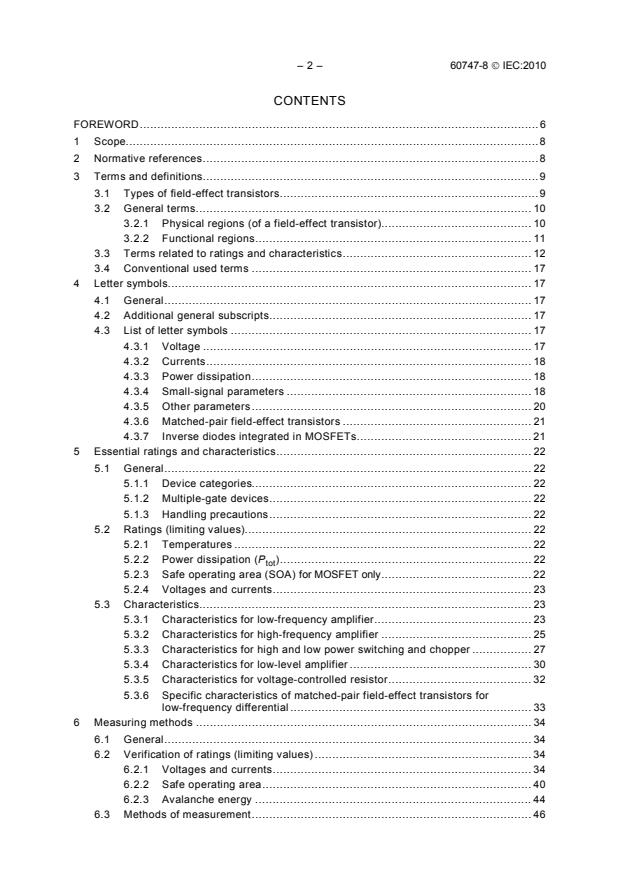
– 2 – 60747-8 Ó IEC:2010
CONTENTS
FOREW ORD . 6
1 Sc o pe . 8
2 Normative references . 8
3 Terms and definitions . 9
3.1 Types of field-effect transistors . 9
3.2 General terms . 10
3.2.1 Physical regions (of a field-effect transistor). 10
3.2.2 Functional regions . 11
3.3 Terms related to ratings and characteristics . 12
3.4 Conventional used terms . 17
4 Letter symbols . 17
4.1 General . 17
4.2 Additional general subscripts . 17
4.3 List of letter symbols . 17
4.3.1 Voltage . 17
4.3.2 Currents . 18
4.3.3 Power dissipation . 18
4.3.4 Small-signal parameters . 18
4.3.5 Other parameters . 20
4.3.6 Matched-pair field-effect transistors . 21
4.3.7 Inverse diodes integrated in MOSFETs . 21
5 Essential ratings and characteristics . 22
5.1 General . 22
5.1.1 Device categories. 22
5.1.2 Multiple-gate devices . 22
5.1.3 Handling precautions . 22
5.2 Ratings (limiting values). 22
5.2.1 Temperatures . 22
5.2.2 Power dissipation (P ). 22
tot
5.2.3 Safe operating area (SOA) for MOSFET only . 22
5.2.4 Voltages and currents . 23
5.3 Characteristics . 23
5.3.1 Characteristics for low-frequency amplifier . 23
5.3.2 Characteristics for high-frequency amplifier . 25
5.3.3 Characteristics for high and low power switching and chopper . 27
5.3.4 Characteristics for low-level amplifier . 30
5.3.5 Characteristics for voltage-controlled resistor . 32
5.3.6 Specific characteristics of matched-pair field-effect transistors for
low-frequency differential . 33
6 Measuring methods . 34
6.1 General . 34
6.2 Verification of ratings (limiting values) . 34
6.2.1 Voltages and currents . 34
6.2.2 Safe operating area . 40
6.2.3 Avalanche energy . 44
6.3 Methods of measurement . 46
60747-8 Ó IEC:2010 – 3 –
6.3.1 Breakdown voltage, drain to source (V ) . 46
(BR)DS*
6.3.2 Gate-source off-state voltage (V ) (type A and B), gate source
GS(off)
threshold voltage (V ) (type C) . 47
GS(th)
6.3.3 Drain leakage current (d.c.) (I )(type C), Drain cut-off current (d.c.)
DS*
(I ) (type A and B) . 48
DSX
6.3.4 Gate cut-off current (I )(type A), Gate-leakage current (I )(type
GS* GS*
B and C) . 48
6.3.5 (Static) drain-source on-state resistance (r ) or drain-source on-
DS(on)
state voltage (V ) . 49
DS(on)
6.3.6 Switching times (t , t , t , and t ) . 51
d(on) r d(off) f
6.3.7 Turn-on power dissipation (P ), turn-on energy (per pulse) (E ) . 52
on on
6.3.8 Turn-off power dissipation (P ), turn-off energy (per pulse) (E ) . 53
off off
6.3.9 Gate charges (Q , Q , Q , Q ) . 53
G GD GS(th) GS(pl)
6.3.10 Common source short-circuit input capacitance (C ) . 54
iss
6.3.11 Common source short-circuit output capacitance (C ) . 55
oss
6.3.12 Common source short-circuit reverse transfer capacitance (C ) . 56
rss
6.3.13 Internal gate resistance (r ) . 57
g
6.3.14 MOSFET forward recovery time (t ) and MOSFET forward recovered
fr
charge (Q ) . 58
f
6.3.15 Drain-source reverse voltage (V ) . 62
DSR
6.3.16 Small-signal short-circuit output conductance (type A, B and C) (g ) . 62
oss
6.3.17 Small-signal short-circuit forward transconductance (types A, B and
C) . 65
6.3.18 Noise (types A, B and C) (F, Vn) . 67
6.3.19 On-state drain-source resistance (under small-signal conditions)
(r ) . 68
ds(on)
6.3.20 Channel-case transient thermal impedance (Z ) and thermal
th(j-c)
resistance (R ) of a field-effect transistor . 69
th(j-c)
7 Acceptance and reliability . 71
7.1 General requirements . 71
7.2 Acceptance-defining characteristics . 71
7.3 Endurance and reliability tests . 72
7.3.1 High-temperature blocking (HTRB). 72
7.3.2 High-temperature gate bias . 72
7.3.3 Intermittent operating life (load cycles) . 72
7.4 Type tests and routine tests . 73
7.4.1 Type tests . 73
7.4.2 Routine tests . 73
Bibliography . 75
Figure 1 – Basic waveforms to specify the gate charges . 14
Figure 2 – Integral times for the turn-on energy E and turn-off energy E . 16
on off
Figure 3 – Switching times . 21
Figure 4 – Circuit diagram for testing of drain-source voltage . 35
Figure 5 – Circuit diagram for testing of gate-source voltage . 35
Figure 6 – Circuit diagram for testing of gate-drain voltage . 36
Figure 7 – Basic circuit for the testing of drain current . 37
Figure 8 – Circuit diagram for testing of peak drain current . 38
Figure 9 – Basic circuit for the testing of reverse drain current of MOSFETs . 38
– 4 – 60747-8 Ó IEC:2010
Figure 10 – Basic circuit for the testing of peak reverse drain current of MOSFETs . 39
Figure 11 – Circuit diagram for verifing FBSOA . 40
Figure 12 – Circuit diagram for verifying RBSOA. 41
Figure 13 – Test waveforms for verifying RBSOA . 41
Figure 14 – Circuit for testing safe operating pulse duration at load short circuit . 42
Figure 15 – Waveforms of gate-source voltage V , drain current I and voltage V
GS D DS
during load short circuit condition SCSOA . 43
Figure 16 – Circuit for the inductive avalanche switching . 44
Figure 17 – Waveforms of I , V and V during unclamped inductive switching . 44
D DS GS
Figure 18 – Waveforms of I , V and V for the non-repetitive avalanche switching . 45
D DS GS
Figure 19 – Circuit diagrams for the measurement drain-source breakdown voltage . 46
Figure 20 – Circuit diagram for measurement of gate-source off-state voltage and gate-
source threshold voltage . 47
Figure 21 – Circuit diagram for drain leakage (or off-state) current or drain cut-off
current measurement . 48
Figure 22 – Circuit diagram for measuring of gate cut-off current or gate leakage
current . 49
Figure 23 – Basic circuit of measurement for on-state resistance . 50
Figure 24 – On-state resistance . 50
Figure 25 – Circuit diagram for switching time . 51
Figure 26 – Schematic switching waveforms and times . 51
Figure 27 – Circuit for determining the turn-on and turn-off power dissipation and/or
energy . 52
Figure 28 – Circuit diagrams for the measurement gate charges. 54
Figure 29 – Basic for the measurement of short-circuit input capacitance . 55
Figure 30 – Basic circuit for measurement of short-circuit output capacitance (C ) . 56
oss
Figure 31 – Circuit for measurement of reverse transfer capacitance C . 57
rss
Figure 32 – Circuit for measurement of internal gate resistance . 58
Figure 33 – Circuit diagram for MOSFET forward recovery time and recovered charge
(Method 1) . 59
Figure 34 – Current waveform through MOSFET (Method 1) . 59
Figure 35 – Circuit diagram for MOSFET forward recovery time and recovered charge
(Method 2) . 60
Figure 36 – Current waveform through MOSFET (Method 2) . 61
Figure 37 – Circuit diagram for the measurement of drain-source reverse voltage . 62
Figure 38 – Basic circuit for the measurement of the output conductance g (method 1:
oss
null method) . 63
Figure 39 – Basic circuit for the measurement of the output conductance g (method 2:
oss
two-voltmeter method) . 64
Figure 40 – Circuit for the measurement of short-circuit forward transconductance g
fs
(Method 1: Null method) . 65
Figure 41 – Circuit for the measurement of forward transconductance g (method 2:
fs
two-voltmeter method) . 66
Figure 42 – Block diagram for the measurement of equivalent input noise voltage . 67
Figure 43 – Circuit for the measurement of equivalent input noise voltage . 67
Figure 44 – Circuit diagram for the measurement of on-state drain-source resistance . 68
60747-8 Ó IEC:2010 – 5 –
Figure 45 – Circuit diagram . 69
Figure 46 – Circuit for high-temperature blockings . 72
Figure 47 – Circuit for high-temperature gate bias. 72
Figure 48 – Circuit for intermittent operating life . 73
Table 1 – Terms for MOSFET in this standard and the conventional used terms for the
inverse diode integrated in the MOSFET . 17
Table 2 – Acceptance defining characteristics . 34
Table 3 – Acceptance-defining characteristics for endurance and reliability tests . 71
Table 4 – Minimum type and routine tests for FETs when applicable . 74
– 6 – 60747-8 Ó IEC:2010
INTERNATIONAL ELECTROTECHNICAL COMMISSION
____________
SEMICONDUCTOR DEVICES –
DISCRETE DEVICES –
Part 8: Field-effect transistors
FOREWORD
1) The International Electrotechnical Commission (IEC) is a worldwide organization for standardization comprising
all national electrotechnical committees (IEC National Committees). The object of IEC is to promote
international co-operation on all questions concerning standardization in the electrical and electronic fields. To
this end and in addition to other activities, IEC publishes International Standards, Technical Specifications,
Technical Reports, Publicly Available Specifications (PAS) and Guides (hereafter referred to as “IEC
Publication(s)”). Their preparation is entrusted to technical committees; any IEC National Committee interested
in the subject dealt with may participate in this preparatory work. International, governmental and non-
governmental organizations liaising with the IEC also participate in this preparation. IEC collaborates closely
with the International Organization for Standardization (ISO) in accordance with conditions determined by
agreement between the two organizations.
2) The formal decisions or agreements of IEC on technical matters express, as nearly as possible, an international
consensus of opinion on the relevant subjects since each technical committee has representation from all
interested IEC National Committees.
3) IEC Publications have the form of recommendations for international use and are accepted by IEC National
Committees in that sense. While all reasonable efforts are made to ensure that the technical content of IEC
Publications is accurate, IEC cannot be held responsible for the way in which they are used or for any
misinterpretation by any end user.
4) In order to promote international uniformity, IEC National Committees undertake to apply IEC Publications
transparently to the maximum extent possible in their national and regional publications. Any divergence
between any IEC Publication and the corresponding national or regional publication shall be clearly indicated in
the latter.
5) IEC itself does not provide any attestation of conformity. Independent certification bodies provide conformity
assessment services and, in some areas, access to IEC marks of conformity. IEC is not responsible for any
services carried out by independent certification bodies.
6) All users should ensure that they have the latest edition of this publication.
7) No liability shall attach to IEC or its directors, employees, servants or agents including individual experts and
members of its technical committees and IEC National Committees for any personal injury, property damage or
other damage of any nature whatsoever, whether direct or indirect, or for costs (including legal fees) and
expenses arising out of the publication, use of, or reliance upon, this IEC Publication or any other IEC
Publications.
8) Attention is drawn to the Normative references cited in this publication. Use of the referenced publications is
indispensable for the correct application of this publication.
9) Attention is drawn to the possibility that some of the elements of this IEC Publication may be the subject of
patent rights. IEC shall not be held responsible for identifying any or all such patent rights.
International Standard IEC 60747-8 has been prepared by subcommittee 47E: Discrete
semiconductor devices, of IEC technical committee 47: Semiconductor devices.
This third edition of IEC 60747-8 cancels and replaces the second edition published in 2000.
This third edition constitutes a technical revision.
The main changes with respect to the previous edition are listed below.
a) ”Clause 3 Classification” was moved and added to Clause 1.
b) “Clause 4 Terminology and letter symbols” was divided into “Clause 3 Terms and
definitions” and “Clause 4 Letter symbols” was amended with additions and deletions.
c) Clause 5, 6 and 7 were amended with necessary additions and deletions.
60747-8 Ó IEC:2010 – 7 –
The text of this standard is based on the following documents:
FDIS Report on voting
47E/398/FDIS 47E/406/RVD
Full information on the voting for the approval of this standard can be found in the report on
voting indicated in the above table.
This publication has been drafted in accordance with the ISO/IEC Directives, Part 2.
This Part 8 should be used in conjunction with IEC 60747-1:2006.
A list of all the parts in the IEC 60747 series, under the general title Semiconductor devices –
Discrete devices, can be found on the IEC website.
Future standards in this series will carry the new general title as cited above. Titles of existing
standards in this series will be updated at the time of the next edition.
The committee has decided that the contents of this publication will remain unchanged until
the stability date indicated on the IEC web site under "http://webstore.iec.ch" in the data
related to the specific publication. At this date, the publication will be
• reconfirmed,
• withdrawn,
• replaced by a revised edition, or
• amended.
– 8 – 60747-8 Ó IEC:2010
SEMICONDUCTOR DEVICES –
DISCRETE DEVICES –
Part 8: Field-effect transistors
1 Scope
This part of IEC 60747 gives standards for the following categories of field-effect transistors:
– type A: junction-gate type;
– type B: insulated-gate depletion (normally on) type;
– type C: insulated-gate enhancement (normally off) type.
Since a field-effect transistor may have one or several gates, the classification shown below
results:
Field-effect devices
(a source, a drain, one or several gates)
Devices with one or Devices with one or
several P channels several N channels
Junction-gate Schottky Insulated-gate Junction-gate Schottky Insulated-gate
devices barrier-gate devices devices barrier-gate devices
devices devices
MESFET MOSFET MESFET MOSFET
MODFET Other insulated- MODFET Other insulated-
HEMT gate FET HEMT gate FET
NOTE 1 Schottky barrier-gate and insulated gate devices include depletion type devices and enhancement type
devices.
NOTE 2 MOSFETs for some applications may not have inverse diode characteristics in the data sheet. Special
circuit element structures to eliminate body diode are under development for such applications. MOSFET
applications such as motor control equipment need to specify the inverse diode characteristics in the MOSFET to
use the inverse diode as a free wheeling diode.
NOTE 3 The graphical symbol only for type C is used in this standard. The standard equally applies for P-channel
and for type A and B devices.
2 Normative references
The following referenced documents are indispensable for the application of this document.
For dated references, only the edition cited applies. For undated references, the latest edition
of the referenced document (including any amendments) applies.
IEC 61340 (all parts), Electrostatics
IEC 60747-1:2006, Semiconductor devices – Part 1: General
60747-8 Ó IEC:2010 – 9 –
IEC 60747-7:2000, Semiconductor devices – Part 7: Bipolar transistors
IEC 60749-23:2004, Semiconductor devices – Mechanical and climatic test methods – Part 23:
High temperature operating life
IEC 60749-34, Semiconductor devices – Mechanical and climatic test methods – Part 34:
Power cycling
3 Terms and definitions
For the purpose of this document, the following terms and definitions apply.
3.1 Types of field-effect transistors
3.1.1
N-channel field-effect transistor
field-effect transistor that has one or more N-type conduction channels
3.1.2
P-channel field-effect transistor
field-effect transistor that has one or more P-type conduction channels
3.1.3
junction-gate field-effect transistor
JFET
field-effect transistor in which
– the source and drain regions are connected with each other by the channel region, all
three being of the same conductivity type;
– a gate region adjacent to the channel has the opposite conductivity type, thus forming with
source, channel and drain region a PN junction
NOTE The gate-source voltage controls the conductivity of the conduction channel in the channel region by
controlling the width of the gate space-charge region and hence also the remaining cross-section of the conduction
channel.
3.1.4
insulated-gate field-effect transistor
IGFET
field-effect transistor in which
– one or more gate electrodes are electrically insulated from the body;
– the conductivity type of both the source and drain regions is opposite from that of the
semiconductor body in which they are located;
– the principal current flows in a channel that is formed by an inversion layer connecting
source and drain regions
NOTE The inversion layer is either already present at zero gate-source voltage or produced within the body at
sufficiently high forward gate-source voltage by accumulation of the minority charge carriers of the body material.
The conductance of the channel is controlled by the gate-source voltage, which controls the electric field between
gate electrode and the body and hence the amount of accumulated minority charge carriers.
3.1.5
metal-oxide-semiconductor field-effect transistor
MOSFET
insulated-gate field-effect transistor in which the insulating layer between each gate electrode
and the channel is oxide material
– 10 – 60747-8 Ó IEC:2010
3.1.6
depletion-type (normally on) field-effect transistor
field-effect transistor in which an inversion layer present at the surface of the active
semiconductor region causes an appreciable channel conductance that may be increased
(decreased) by applying a forward (reverse) gate-source voltage
3.1.7
enhancement-type (normally off) field-effect transistor
field-effect transistor having substantially zero channel conductance at zero gate-source
voltage, and in which a conduction channel may be obtained by applying a sufficiently high
forward gate-source voltage, which induces an inversion layer below the gate electrode
3.1.8
single-gate field-effect transistor
field-effect transistor having a gate region, a source region, and a drain region
NOTE The term may be abbreviated to "field-effect transistor", if no ambiguity is likely to occur.
3.1.9
dual-gate field-effect transistor
field-effect transistor having two independent gate regions, a source region, and a drain
region
3.1.10
schottky-barrier-gate field-effect transistor
field-effect transistor in which
– the source and drain regions are connected with each other by the channel region, all
three being of the same conductivity type;
– one or more gate electrodes each form a Schottky-barrier with the channel region;
the gate-source voltage controls the conductance of the conduction channel by varying its
cross-section
3.1.11
metal-semiconductor field-effect transistor
MESFET
Schottky-barrier-gate field-effect transistor in which the gate electrodes are metal
3.1.12
modulation-doped field-effect transistor or high electron mobility transistor
MODFET or HEMT
metal-semiconductor field-effect transistor in which a doped material forms a heterojunction
with an undoped channel; the doped material supplies electrons to the undoped channel
whose high electron mobility results in enhanced channel conductance
NOTE MODFET and HEMT should be used interchangeably.
3.2 General terms
3.2.1 Physical regions (of a field-effect transistor)
3.2.1.1
source (of a field-effect transistor)
physical region that is designed by the manufacturer to contain the supply region under the
defined operating conditions to which the specifications refer
60747-8 Ó IEC:2010 – 11 –
3.2.1.2
drain (of a field-effect transistor)
physical region that is designed by the manufacturer to contain the collection region under the
defined operating conditions to which the specifications refer
3.2.1.3
gate (of an IGFET)
insulating layer between the gate electrode and the surface of the semiconductor body, below
which the channel is or may be formed
3.2.1.4
gate (of an JFET)
region below the gate electrode that is of opposite conductivity type from that of the source,
channel and drain regions
3.2.1.5
channel (of a depletion-type IGFET)
inversion layer technologically placed below the gate region
3.2.1.6
channel (of a JFET)
region between source region and drain region that has the same conductivity type as these
two regions
3.2.1.7
subchannel (of an IGFET)
region between source region and drain region, excluding the channel region of a depletion-
type IGFET and all pertinent transition zones
3.2.1.8
substrate (of a JFET or IGFET)
part of the original material that remains unchanged when the device elements are formed
upon or within the original material
NOTE The original material may be a layer of semiconductor material cut from a single crystal, a layer of
semiconductor material deposited on a supporting base, or the supporting base itself.
3.2.1.9
substrate (of a JFET or IGFET)
original semiconductor material before being processed
NOTE The intended meaning will become clear from the context in which the term is used. If necessary, distinction
could be made between the "original substrate" and the "remaining substrate".
3.2.1.10
substrate (of a thin-film field-effect transistor)
insulator that supports the source and drain electrodes, the insulating gate layer, and the thin
semiconductor layer
3.2.2 Functional regions
3.2.2.1
functional source region
supply region that delivers principal-current charge carriers into the channel
3.2.2.2
functional drain region
collection region that acquires principal-current charge carriers from the channel
– 12 – 60747-8 Ó IEC:2010
3.2.2.3
channel (of a IGFET)
functional region through which the principal-current charge carriers pass and in which the
carrier concentration is determined by the gate-source voltage, the principal current being the
result of the drift field produced by the drain-source voltage
3.2.2.4
channel (of a JFET)
functional region through which the principal-current charge carriers pass and whose cross-
section is determined by the applied gate-source voltage, the principal current being the result
of the drift field produced by the drain-source voltage
3.2.2.5
subchannel space-charge region (of an IGFET)
space-charge region associated with the transition regions between the subchannel region on
one side, and source region, channel region and drain region on the other side
3.2.2.6
functional subchannel region
remaining neutral part of the (physical) subchannel region that is confined by the surrounding
subchannel space-charge region
3.3 Terms related to ratings and characteristics
3.3.1
gate cut-off current (of a junction-gate field-effect transistor)
current flowing in the gate terminal of a junction field-effect transistor when the pn junction is
biased in the reverse direction
3.3.2
gate leakage current (of an insulated-gate field-effect transistor)
leakage current through the insulated-gate of an insulated-gate field-effect transistor
3.3.3
capacitances
3.3.3.1
(short-circuit) input capacitance
capacitance between the gate and source terminals with the drain terminal short-circuited to
the source terminal for a.c. signals
3.3.3.2
(short-circuit) output capacitance
capacitance between the drain and source terminals with the gate terminal short-circuited to
the source terminal for a.c. signals
3.3.3.3
reverse transfer capacitance
capacitance between the drain and gate terminals excluding parallel capacitances between
drain and source, and gate and source
3.3.4
gate-source resistance
d.c. resistance between gate and source terminals at specified gate-source and drain-source
voltages
3.3.5
drain-source on-state resistance
d.c. resistance between the drain and source terminals when the FET is in its on-state
60747-8 Ó IEC:2010 – 13 –
3.3.6
gate charge
charge required to raise the gate-source voltage from zero to a specified value
3.3.6.1
total gate charge
charge that is required to raise the gate-source voltage from zero to a specified value and
calculated by the equation below (see Figure 1)
t4
Q = i (t)dt
G GG
ò
t0
3.3.6.2
threshold gate charge
charge required to raise gate-source from zero to V and calculated by the equation
GS(th)
below (see Figure 1)
t1
Q = i (t)dt
GS(th) GG
ò
t0
3.3.6.3
plateau gate charge
charge required to raise gate-source voltage from zero to plateau voltage V and
GS(pl)
calculated by the equation below (see Figure 1)
t2
Q = i (t)dt
GS(pl) GG
ò
t0
3.3.6.4
gate drain charge
charge difference between beginning and end of plateau region, required to charge up C
GD
and calculated by the equation below (see Figure 1)
t3
Q = i (t)dt
GD GG
ò
t2
– 14 – 60747-8 Ó IEC:2010
i
GG
I
GG Q : Total gate charge
G
Q
G
Q
GS(pl) : Threshold gate charge
Q
GS(th)
Q
GS
Q
GS(th
)
Q : Plateau gate charge
GS(pl)
time for Q
G
t t
Q : Gate- drain charge
GD
time for Q
G S (p l) time for Q
GD
time for Q
G S(th)
V
GS
v
GS
V
GS(th)
t
t
i
D
V
DS
I
D
v
DS
t t t t
t
0 1 2 3 4 t
t
IEC 2736/10
NOTE Time intervals indicated by arrow end lines are integral intervals to calculate the gate charges.
Figure 1 – Basic waveforms to specify the gate charges
3.3.7
overall efficiency
ratio of the output power to the sum of the input signal power and the d.c. input power
P
out
h =
tot
P + P
in (d.c.)
3.3.8
drain efficiency
ratio of the output power to the d.c. drain power
P
out
h =
d
P
d(d.c.)
3.3.9
power-added efficiency
ratio of the difference between the output power and the input signal power to the d.c. input
power
60747-8 Ó IEC:2010 – 15 –
P P
out in
h =
add
P
d(d.c.)
3.3.10
rate of rise of off-state voltage
rate of rise of drain-source off-state voltage induced during reverse recovery period of the
inverse diode
3.3.11
reverse-bias safe operating area
drain current versus drain-source voltage region in which the MOSFET is able to turned-off
repetitively with clamped inductive load without failure
3.3.12
short circuit safe operating area
drain current versus drain voltage region in which the MOSFET is able to turn on and off non
repetitively without failure
3.3.13
avalanche energy (for avalanche devices)
avalanche energy capability during turn-off period
3.3.14
repetitive avalanche energy (for avalanche devices)
repetitive avalanche energy capability during turn-off period
3.3.15
non-repetitive avalanche energy (for avalanche devices)
non-repetitive avalanche capability during turn-off period (single pulse)
3.3.16
drain leakage current
drain current in the off-state
3.3.17
breakdown voltage, drain to source
drain-source breakdown voltage in the off-state
3.3.18
internal gate resistance
short-circuit internal gate resistance (see Figure 32)
3.3.19
switching times
input wave form is the gate to source voltage, and output waveform is the drain current (see
IEC 60747-1:2006)
3.3.20
turn-on energy
value of the integral of the product of drain-source voltage V and drain current I during
DS D
t
turn-on described in the following equation: E = (see Figure 2)
i ´ v ´ dt
on D DS
ò
– 16 – 60747-8 Ó IEC:2010
3.3.21
turn-off energy
value of the integral of drain-source voltage V multiplied by drain current I during turn-off
DS D
t
described in the following equation: E = i ´ v ´ dt (see Figure 2)
off D DS
ò
t
i
D
V
DS
v
DS
10 %
0(A), 0(V) t
0 t t t
1 2 3
IEC 2737/10
Figure 2 – Integral times for the turn-on energy E and turn-off energy E
on off
3.3.22
output capacitance charge
charge required to change the voltage at output capacitance C during turn-on and turn-off
oss
3.3.23
gate-source plateau voltage
voltage during turn-on, where V is relatively constant (Miller-Plateau) and during which C
GS GD
is charged
NOTE See Figure 1.
3.3.24
drain-source reverse voltage
voltage across the MOSFET which results from the flow of current in the reverse direction from
source to drain
3.3.25
MOSFET forward recovery current
recovery current of the MOSFET which results from the flow of current in the reverse direction
from source to drain
3.3.26
MOSFET forward recovery time
recovery time of the MOSFET which results from the flow of current in the reverse direction
from source to drain
3.3.27
MOSFET forward recovery charge
recovery charge of the MOSFET which results from the flow of current in the reverse direction
from source to drain
3.3.28
MOSFET forward recovery energy
recovery energy of the MOSFET which results from the flow of current in the reverse direction
from source to drain
60747-8 Ó IEC:2010 – 17 –
3.4 Conventional used terms
Table 1 – Terms for MOSFET in this standard and the conventional used terms for the
inverse diode integrated in the MOSFET
Letter Deprecated terms for inverse diode with
Preferred terms
symbol MOSFET in off-state
Drain-source reverse voltage V Inverse diode forward voltage
DSR
I
MOSFET forward recovery current Inverse diode reverse recovery current
FR
MOSFET peak forward recovery current I Inverse diode peak reverse recovery current
FRM
MOSFET forward recovery time t Inverse diode reverse recovery time
fr
Q
MOSFET forward recovery charge Inverse diode reverse recovery charge
f
MOSFET forward recovery energy E Inverse diode reverse recovery energy
fr
Reverse drain current I Inverse diode forward current
DR
Peak reverse drain current I Inverse diode peak forward current
DRM
4 Letter symbols
4.1 General
General letter symbols for MOSFETs are defined in Subclauses 4.4 and 4.5 of IEC 60747-
1:2006.
4.2 Additional general subscripts
In addition to the list of recommended general subscripts given in 4.2.3 of IEC 60747-1:2006,
the following special subscripts are recommended for field-effect transistors:
D, d = drain
G, g = gate
S, s = source or termination with a short circuit
B, b; U, u = substrate
T; th; (TO) = threshold
O = termination with an open circuit
R = termination with a resistor
X = termination with specified gate source voltage
pl = plateau
4.3 List of letter symbols
Name and designation Letter symbol Remarks
4.3.1 Voltage
Drain-source (d.c.) voltage V
DS
V
Gate-source (d.c.) voltage
GS
Gate-source cut-off voltage (of a junction field-effect
V ; V
transistor and of a depletion type insulated-gate
...
Questions, Comments and Discussion
Ask us and Technical Secretary will try to provide an answer. You can facilitate discussion about the standard in here.
Loading comments...