

IEC 61181:2007
(Main)Mineral oil-filled electrical equipment - Application of dissolved gas analysis (DGA) to factory tests on electrical equipment
General Information
- Abstract
Specifies oil-sampling procedures, analysis requirements and procedures, and recommends sensitivity, repeatability and accuracy criteria for the application of dissolved gas analysis (DGA) to factory testing of new power transformers, reactors and instrument transformers filled with mineral insulating oil when DGA testing has been specified. The most effective and useful application of DGA techniques to factory testing is during the performance of long-term tests, typically temperature-rise (heat run) and overloading tests on power transformers and reactors, also impulse tests on instrument transformers. DGA may also be valuable for over-excitation tests run over an extended period of time. Experience with DGA results, before and after short-time dielectric tests, indicates that DGA is normally less sensitive than electrical and acoustic methods for detecting partial discharges. However, DGA will indicate when these partial discharges become harmful to the insulation and may be detected by inspection [2]. This edition includes the following significant technical changes with respect to the previous edition: a) the specific procedures used during factory tests (sampling location, sampling frequency, gas extraction and chromatographic analysis in the laboratory) are described in more detail; b) information is provided in Annex A concerning the residual gas contents recommended before thermal tests on power transformers, typical gas values observed during the tests and cases where gas formation during the tests was followed by problems in the transformers; c) typical values observed during chopped lightning-impulse tests on instrument transformers are indicated in Annex B.
- Status
- Published
- Publication Date
- 25-Mar-2012
- Technical Committee
- TC 10 - Fluids for electrotechnical applications
- Current Stage
- PPUB - Publication issued
- Start Date
- 23-Feb-2007
- Completion Date
- 15-Jun-2007
Buy Documents
IEC 61181:2007 - Mineral oil-filled electrical equipment - Application of dissolved gas analysis (DGA) to factory tests on electrical equipment Released:2/23/2007
IEC 61181:2007+AMD1:2012 CSV - Mineral oil-filled electrical equipment - Application of dissolved gas analysis (DGA) to factory tests on electrical equipment Released:3/26/2012
Overview
IEC 61181:2007 is an international standard established by the International Electrotechnical Commission (IEC) that specifies the application of Dissolved Gas Analysis (DGA) for factory testing of mineral oil-filled electrical equipment. This includes power transformers, reactors, and instrument transformers filled with mineral insulating oil. The standard defines detailed procedures for oil sampling, gas analysis, and criteria related to sensitivity, repeatability, and accuracy during factory tests. The key factory tests where DGA is most effective include long-term temperature-rise (heat run), overloading, and impulse tests.
DGA is a vital diagnostic technique used to detect and assess the condition of insulation within mineral oil-filled electrical apparatus. It measures specific gases dissolved in the oil, which are byproducts of degradation or faults like overheating, partial discharges, and electrical arcing. The application of IEC 61181 ensures consistent quality control during the manufacturing process, helping to identify early warning signs of insulation problems before equipment installation and operation.
Key Topics
Oil Sampling Procedures:
The standard mandates sampling using gas-tight containers, preferably glass syringes with three-way sampling cocks or stainless steel caps. Samples must be representative of the bulk oil, typically drawn from the main oil circulation stream. Sampling frequency and proper labeling are crucial for accurate DGA results.Gas Extraction and Analytical Methods:
Gas extraction and chromatographic analysis should meet the sensitivity and accuracy limits defined in the standard. This assures detection of minor gas concentrations generated during factory tests.Factory Testing Applications:
- Temperature-rise tests: Monitor gas generation due to controlled heating of the transformer or reactor to verify insulation performance.
- Overloading tests: Detect gases formed due to stress caused by overload conditions over extended periods.
- Impulse tests: Applied mainly on instrument transformers to observe gas evolution under sudden electrical stress.
- Over-excitation tests: DGA can track insulation condition during prolonged over-excitation scenarios.
Interpretation of Results:
The standard provides guidelines on expected residual gas contents before tests commence and gas formation rates during tests. It highlights that while DGA is less sensitive to partial discharges compared to electrical and acoustic methods, it indicates when discharges become harmful to insulation.Health, Safety, and Environmental Considerations:
Handling of mineral insulating oil requires adherence to health and safety protocols to avoid direct contact and environmental contamination. The disposal of used samples must comply with local regulations.
Applications
IEC 61181 is intended for manufacturers and testing facilities involved in the production and quality assurance of mineral oil-filled electrical equipment. Its application ensures:
Improved Factory Test Reliability: DGA applied in factory testing assists in verifying electrical equipment design and manufacturing quality prior to shipment.
Early Fault Detection: Identification of incipient faults such as thermal degradation or partial discharges that can lead to insulation failure.
Standardized Testing Protocols: Provides industry-wide consistent procedures improving confidence in test results and facilitating international commerce.
Predictive Maintenance Foundation: Data from factory DGA tests can establish baseline conditions for future maintenance and monitoring.
Related Standards
IEC 60567: Guide for sampling gases and oil from oil-filled electrical equipment, providing essential detailed methodology on oil sampling critical for DGA application.
IEC 60475:2011: Standard outlining sampling methods for insulating liquids, referenced to ensure appropriate oil sample collection.
Additional Industry Guidelines:
CIGRE recommendations on dissolved gas analysis in transformers complement IEC 61181 by addressing interpretation and acceptance criteria, although acceptance limits are outside the scope of IEC 61181.
By adhering to IEC 61181:2007, manufacturers apply a rigorous, standardized approach to dissolved gas analysis, enabling high-quality factory testing of mineral oil-filled electrical equipment. This facilitates early detection of potential insulation problems and helps ensure the reliable operation of critical electrical infrastructure.
Relations
- Effective Date
- 05-Sep-2023
Buy Documents
IEC 61181:2007 - Mineral oil-filled electrical equipment - Application of dissolved gas analysis (DGA) to factory tests on electrical equipment Released:2/23/2007
IEC 61181:2007+AMD1:2012 CSV - Mineral oil-filled electrical equipment - Application of dissolved gas analysis (DGA) to factory tests on electrical equipment Released:3/26/2012
Get Certified
Connect with accredited certification bodies for this standard

IMQ S.p.A. (Certification)
Italian electrical product certification.

SLG Prüf- und Zertifizierungs GmbH
German testing and certification body.

UL Solutions
Global safety science company with testing, inspection and certification.
Sponsored listings
Frequently Asked Questions
IEC 61181:2007 is a standard published by the International Electrotechnical Commission (IEC). Its full title is "Mineral oil-filled electrical equipment - Application of dissolved gas analysis (DGA) to factory tests on electrical equipment". This standard covers: Specifies oil-sampling procedures, analysis requirements and procedures, and recommends sensitivity, repeatability and accuracy criteria for the application of dissolved gas analysis (DGA) to factory testing of new power transformers, reactors and instrument transformers filled with mineral insulating oil when DGA testing has been specified. The most effective and useful application of DGA techniques to factory testing is during the performance of long-term tests, typically temperature-rise (heat run) and overloading tests on power transformers and reactors, also impulse tests on instrument transformers. DGA may also be valuable for over-excitation tests run over an extended period of time. Experience with DGA results, before and after short-time dielectric tests, indicates that DGA is normally less sensitive than electrical and acoustic methods for detecting partial discharges. However, DGA will indicate when these partial discharges become harmful to the insulation and may be detected by inspection [2]. This edition includes the following significant technical changes with respect to the previous edition: a) the specific procedures used during factory tests (sampling location, sampling frequency, gas extraction and chromatographic analysis in the laboratory) are described in more detail; b) information is provided in Annex A concerning the residual gas contents recommended before thermal tests on power transformers, typical gas values observed during the tests and cases where gas formation during the tests was followed by problems in the transformers; c) typical values observed during chopped lightning-impulse tests on instrument transformers are indicated in Annex B.
Specifies oil-sampling procedures, analysis requirements and procedures, and recommends sensitivity, repeatability and accuracy criteria for the application of dissolved gas analysis (DGA) to factory testing of new power transformers, reactors and instrument transformers filled with mineral insulating oil when DGA testing has been specified. The most effective and useful application of DGA techniques to factory testing is during the performance of long-term tests, typically temperature-rise (heat run) and overloading tests on power transformers and reactors, also impulse tests on instrument transformers. DGA may also be valuable for over-excitation tests run over an extended period of time. Experience with DGA results, before and after short-time dielectric tests, indicates that DGA is normally less sensitive than electrical and acoustic methods for detecting partial discharges. However, DGA will indicate when these partial discharges become harmful to the insulation and may be detected by inspection [2]. This edition includes the following significant technical changes with respect to the previous edition: a) the specific procedures used during factory tests (sampling location, sampling frequency, gas extraction and chromatographic analysis in the laboratory) are described in more detail; b) information is provided in Annex A concerning the residual gas contents recommended before thermal tests on power transformers, typical gas values observed during the tests and cases where gas formation during the tests was followed by problems in the transformers; c) typical values observed during chopped lightning-impulse tests on instrument transformers are indicated in Annex B.
IEC 61181:2007 is classified under the following ICS (International Classification for Standards) categories: 29.040.10 - Insulating oils; 29.180 - Transformers. Reactors. The ICS classification helps identify the subject area and facilitates finding related standards.
IEC 61181:2007 has the following relationships with other standards: It is inter standard links to IEC 61181:2007/AMD1:2012. Understanding these relationships helps ensure you are using the most current and applicable version of the standard.
IEC 61181:2007 is available in PDF format for immediate download after purchase. The document can be added to your cart and obtained through the secure checkout process. Digital delivery ensures instant access to the complete standard document.
Standards Content (Sample)
NORME CEI
INTERNATIONALE
IEC
INTERNATIONAL
Deuxième édition
STANDARD
Second edition
2007-02
Matériels électriques imprégnés d’huile minérale –
Application de l’analyse des gaz dissous (AGD)
lors d’essais en usine de matériels électriques
Mineral oil-filled electrical equipment –
Application of dissolved gas analysis (DGA)
to factory tests on electrical equipment
Numéro de référence
Reference number
CEI/IEC 61181:2007
Numérotation des publications Publication numbering
Depuis le 1er janvier 1997, les publications de la CEI As from 1 January 1997 all IEC publications are
sont numérotées à partir de 60000. Ainsi, la CEI 34-1 issued with a designation in the 60000 series. For
devient la CEI 60034-1. example, IEC 34-1 is now referred to as IEC 60034-1.
Editions consolidées Consolidated editions
Les versions consolidées de certaines publications de la The IEC is now publishing consolidated versions of its
CEI incorporant les amendements sont disponibles. Par publications. For example, edition numbers 1.0, 1.1
exemple, les numéros d’édition 1.0, 1.1 et 1.2 indiquent and 1.2 refer, respectively, to the base publication,
respectivement la publication de base, la publication de the base publication incorporating amendment 1 and
base incorporant l’amendement 1, et la publication de the base publication incorporating amendments 1
base incorporant les amendements 1 et 2. and 2.
Informations supplémentaires Further information on IEC publications
sur les publications de la CEI
Le contenu technique des publications de la CEI est The technical content of IEC publications is kept
constamment revu par la CEI afin qu'il reflète l'état under constant review by the IEC, thus ensuring that
actuel de la technique. Des renseignements relatifs à the content reflects current technology. Information
cette publication, y compris sa validité, sont dispo- relating to this publication, including its validity, is
nibles dans le Catalogue des publications de la CEI available in the IEC Catalogue of publications
(voir ci-dessous) en plus des nouvelles éditions, (see below) in addition to new editions, amendments
amendements et corrigenda. Des informations sur les and corrigenda. Information on the subjects under
sujets à l’étude et l’avancement des travaux entrepris consideration and work in progress undertaken by the
par le comité d’études qui a élaboré cette publication, technical committee which has prepared this
ainsi que la liste des publications parues, sont publication, as well as the list of publications issued,
également disponibles par l’intermédiaire de: is also available from the following:
• Site web de la CEI (www.iec.ch) • IEC Web Site (www.iec.ch)
• Catalogue des publications de la CEI • Catalogue of IEC publications
Le catalogue en ligne sur le site web de la CEI The on-line catalogue on the IEC web site
(www.iec.ch/searchpub) vous permet de faire des (www.iec.ch/searchpub) enables you to search by a
recherches en utilisant de nombreux critères, variety of criteria including text searches,
comprenant des recherches textuelles, par comité technical committees and date of publication. On-
d’études ou date de publication. Des informations en line information is also available on recently
ligne sont également disponibles sur les nouvelles issued publications, withdrawn and replaced
publications, les publications remplacées ou retirées, publications, as well as corrigenda.
ainsi que sur les corrigenda.
• IEC Just Published • IEC Just Published
Ce résumé des dernières publications parues This summary of recently issued publications
(www.iec.ch/online_news/justpub) est aussi dispo- (www.iec.ch/online_news/justpub) is also available
nible par courrier électronique. Veuillez prendre by email. Please contact the Customer Service
contact avec le Service client (voir ci-dessous) Centre (see below) for further information.
pour plus d’informations.
• Service clients • Customer Service Centre
Si vous avez des questions au sujet de cette If you have any questions regarding this
publication ou avez besoin de renseignements publication or need further assistance, please
supplémentaires, prenez contact avec le Service contact the Customer Service Centre:
clients:
Email: custserv@iec.ch Email: custserv@iec.ch
Tél: +41 22 919 02 11 Tel: +41 22 919 02 11
Fax: +41 22 919 03 00 Fax: +41 22 919 03 00
.
NORME CEI
INTERNATIONALE
IEC
INTERNATIONAL
Deuxième édition
STANDARD
Second edition
2007-02
Matériels électriques imprégnés d’huile minérale –
Application de l’analyse des gaz dissous (AGD)
lors d’essais en usine de matériels électriques
Mineral oil-filled electrical equipment –
Application of dissolved gas analysis (DGA)
to factory tests on electrical equipment
© IEC 2007 Droits de reproduction réservés ⎯ Copyright - all rights reserved
Aucune partie de cette publication ne peut être reproduite ni No part of this publication may be reproduced or utilized in any
utilisée sous quelque forme que ce soit et par aucun procédé, form or by any means, electronic or mechanical, including
électronique ou mécanique, y compris la photocopie et les photocopying and microfilm, without permission in writing from
microfilms, sans l'accord écrit de l'éditeur. the publisher.
International Electrotechnical Commission, 3, rue de Varembé, PO Box 131, CH-1211 Geneva 20, Switzerland
Telephone: +41 22 919 02 11 Telefax: +41 22 919 03 00 E-mail: inmail@iec.ch Web: www.iec.ch
CODE PRIX
N
PRICE CODE
Commission Electrotechnique Internationale
International Electrotechnical Commission
МеждународнаяЭлектротехническаяКомиссия
Pour prix, voir catalogue en vigueur
For price, see current catalogue
– 2 – 61181 © CEI:2007
SOMMAIRE
AVANT-PROPOS.4
INTRODUCTION.8
1 Domaine d'application .10
2 Références normatives.10
3 Précautions générales, protection de la santé, de la sécurité et de l'environnement .10
4 Échantillonnage de l'huile.12
4.1 Généralités.12
4.2 Récipients d’échantillon.12
4.3 Point d'échantillonnage .12
4.4 Fréquence d'échantillonnage.12
4.5 Identification des échantillons .14
4.6 Stockage des échantillons.14
4.7 Élimination de l’huile usagée .16
5 Facteurs influençant la vitesse de formation de gaz pendant les essais
d’échauffement.16
6 Extraction et analyse des gaz dissous .16
7 Rapport .20
Annexe A (informative) Vitesses de formation de gaz pendant les essais
d’échauffement sur les transformateurs de puissance .22
Annexe B (informative) Vitesses de formation de gaz pendant les essais de choc de
foudre coupé sur les transformateurs de mesure [6] .26
Bibliographie.28
Tableau 1 – Seuils de détection exigés pour les essais en usine .16
Tableau A.1 – Gammes de vitesses de formation de gaz typiques à 90 % dans des
transformateurs de puissance modernes imprégnés d’huile minérale pendant les
essais d’échauffement, en μl/l/h.22
Tableau A.2 – Relevé des cas suivis de problèmes dans des transformateurs de
puissance à colonnes remplis d’huile, pour différentes vitesses de formation de gaz
observés pendant les essais d’échauffement, en μl/l/h.24
Tableau B.1 – Augmentation de concentration de gaz typiques à 90 % dans des
transformateurs de mesure entre le début et la fin des essais de choc de foudre coupé.26
61181 © IEC:2007 – 3 –
CONTENTS
FOREWORD.5
INTRODUCTION.9
1 Scope.11
2 Normative references .11
3 General caution, health, safety and environmental protection .11
4 Oil sampling .13
4.1 General .13
4.2 Sample containers.13
4.3 Sampling location.13
4.4 Sampling frequency.13
4.5 Sample labelling.15
4.6 Sample storage .15
4.7 Disposal of waste oil .17
5 Factors affecting gassing rate during thermal tests.17
6 Dissolved gas extraction and analysis .17
7 Report .21
Annex A (informative) Gas formation rates during thermal tests on power transformers .23
Annex B (informative) Gas formation rates during chopped-lightning impulse tests on
instrument transformers [6].27
Bibliography.29
Table 1 – Required detection limits for factory tests.17
Table A.1 – Ranges of 90 % typical rates of gas formation in modern, mineral oil- filled
power transformers during thermal tests, in μl/l/h.23
Table A.2 – Survey of cases followed by problems in core-type, mineral oil- filled
power transformers, for various rates of gas formation observed during the thermal
tests, (values in μl/l/h).25
Table B.1 – 90 % typical gas concentration increases observed between the beginning
and the end of chopped lightning-impulse tests on instrument transformers .27
– 4 – 61181 © CEI:2007
COMMISSION ÉLECTROTECHNIQUE INTERNATIONALE
____________
MATÉRIELS ÉLECTRIQUES IMPRÉGNÉS D’HUILE MINÉRALE –
APPLICATION DE L'ANALYSE DES GAZ DISSOUS (AGD)
LORS D'ESSAIS EN USINE DE MATÉRIELS ÉLECTRIQUES
AVANT-PROPOS
1) La Commission Electrotechnique Internationale (CEI) est une organisation mondiale de normalisation
composée de l'ensemble des comités électrotechniques nationaux (Comités nationaux de la CEI). La CEI a
pour objet de favoriser la coopération internationale pour toutes les questions de normalisation dans les
domaines de l'électricité et de l'électronique. A cet effet, la CEI – entre autres activités – publie des Normes
internationales, des Spécifications techniques, des Rapports techniques, des Spécifications accessibles au
public (PAS) et des Guides (ci-après dénommés "Publication(s) de la CEI"). Leur élaboration est confiée à des
comités d'études, aux travaux desquels tout Comité national intéressé par le sujet traité peut participer. Les
organisations internationales, gouvernementales et non gouvernementales, en liaison avec la CEI, participent
également aux travaux. La CEI collabore étroitement avec l'Organisation Internationale de Normalisation (ISO),
selon des conditions fixées par accord entre les deux organisations.
2) Les décisions ou accords officiels de la CEI concernant les questions techniques représentent, dans la mesure
du possible, un accord international sur les sujets étudiés, étant donné que les Comités nationaux de la CEI
intéressés sont représentés dans chaque comité d’études.
3) Les Publications de la CEI se présentent sous la forme de recommandations internationales et sont agréées
comme telles par les Comités nationaux de la CEI. Tous les efforts raisonnables sont entrepris afin que la CEI
s'assure de l'exactitude du contenu technique de ses publications; la CEI ne peut pas être tenue responsable
de l'éventuelle mauvaise utilisation ou interprétation qui en est faite par un quelconque utilisateur final.
4) Dans le but d'encourager l'uniformité internationale, les Comités nationaux de la CEI s'engagent, dans toute la
mesure possible, à appliquer de façon transparente les Publications de la CEI dans leurs publications
nationales et régionales. Toutes divergences entre toutes Publications de la CEI et toutes publications
nationales ou régionales correspondantes doivent être indiquées en termes clairs dans ces dernières.
5) La CEI n’a prévu aucune procédure de marquage valant indication d’approbation et n'engage pas sa
responsabilité pour les équipements déclarés conformes à une de ses Publications.
6) Tous les utilisateurs doivent s'assurer qu'ils sont en possession de la dernière édition de cette publication.
7) Aucune responsabilité ne doit être imputée à la CEI, à ses administrateurs, employés, auxiliaires ou
mandataires, y compris ses experts particuliers et les membres de ses comités d'études et des Comités
nationaux de la CEI, pour tout préjudice causé en cas de dommages corporels et matériels, ou de tout autre
dommage de quelque nature que ce soit, directe ou indirecte, ou pour supporter les coûts (y compris les frais
de justice) et les dépenses découlant de la publication ou de l'utilisation de cette Publication de la CEI ou de
toute autre Publication de la CEI, ou au crédit qui lui est accordé.
8) L'attention est attirée sur les références normatives citées dans cette publication. L'utilisation de publications
référencées est obligatoire pour une application correcte de la présente publication.
9) L’attention est attirée sur le fait que certains des éléments de la présente Publication de la CEI peuvent faire
l’objet de droits de propriété intellectuelle ou de droits analogues. La CEI ne saurait être tenue pour
responsable de ne pas avoir identifié de tels droits de propriété et de ne pas avoir signalé leur existence.
La Norme internationale CEI 61181 a été établie par le comité d'étude 10 de la CEI: Fluides
pour applications électrotechniques.
Cette deuxième édition annule et remplace la première édition parue en 1993 et constitue une
révision technique.
Cette édition inclut les modifications techniques majeures suivantes par rapport à l’édition
précédente:
a) les procédures spécifiques utilisées pendant les essais en usine (points et fréquence
d’échantillonnage, extraction des gaz et analyse chromatographique en laboratoire) sont
décrites avec plus de détails;
b) l’Annexe A fournit des informations sur les teneurs en gaz résiduelles qui sont
recommandées avant les essais thermiques sur les transformateurs de puissance, sur les
valeurs typiques de gaz observées pendant les essais, et sur les cas où la formation de
gaz pendant les essais a été suivie de problèmes dans les transformateurs;
61181 © IEC:2007 – 5 –
INTERNATIONAL ELECTROTECHNICAL COMMISSION
____________
MINERAL OIL-FILLED ELECTRICAL EQUIPMENT –
APPLICATION OF DISSOLVED GAS ANALYSIS (DGA)
TO FACTORY TESTS ON ELECTRICAL EQUIPMENT
FOREWORD
1) The International Electrotechnical Commission (IEC) is a worldwide organization for standardization comprising
all national electrotechnical committees (IEC National Committees). The object of IEC is to promote
international co-operation on all questions concerning standardization in the electrical and electronic fields. To
this end and in addition to other activities, IEC publishes International Standards, Technical Specifications,
Technical Reports, Publicly Available Specifications (PAS) and Guides (hereafter referred to as “IEC
Publication(s)”). Their preparation is entrusted to technical committees; any IEC National Committee interested
in the subject dealt with may participate in this preparatory work. International, governmental and non-
governmental organizations liaising with the IEC also participate in this preparation. IEC collaborates closely
with the International Organization for Standardization (ISO) in accordance with conditions determined by
agreement between the two organizations.
2) The formal decisions or agreements of IEC on technical matters express, as nearly as possible, an international
consensus of opinion on the relevant subjects since each technical committee has representation from all
interested IEC National Committees.
3) IEC Publications have the form of recommendations for international use and are accepted by IEC National
Committees in that sense. While all reasonable efforts are made to ensure that the technical content of IEC
Publications is accurate, IEC cannot be held responsible for the way in which they are used or for any
misinterpretation by any end user.
4) In order to promote international uniformity, IEC National Committees undertake to apply IEC Publications
transparently to the maximum extent possible in their national and regional publications. Any divergence
between any IEC Publication and the corresponding national or regional publication shall be clearly indicated in
the latter.
5) IEC provides no marking procedure to indicate its approval and cannot be rendered responsible for any
equipment declared to be in conformity with an IEC Publication.
6) All users should ensure that they have the latest edition of this publication.
7) No liability shall attach to IEC or its directors, employees, servants or agents including individual experts and
members of its technical committees and IEC National Committees for any personal injury, property damage or
other damage of any nature whatsoever, whether direct or indirect, or for costs (including legal fees) and
expenses arising out of the publication, use of, or reliance upon, this IEC Publication or any other IEC
Publications.
8) Attention is drawn to the Normative references cited in this publication. Use of the referenced publications is
indispensable for the correct application of this publication.
9) Attention is drawn to the possibility that some of the elements of this IEC Publication may be the subject of
patent rights. IEC shall not be held responsible for identifying any or all such patent rights.
International Standard IEC 61181 has been prepared by IEC technical committee 10: Fluids
for electrotechnical applications.
This second edition cancels and replaces the first edition published in 1993 and constitutes a
technical revision.
This edition includes the following significant technical changes with respect to the previous
edition:
a) the specific procedures used during factory tests (sampling location, sampling frequency,
gas extraction and chromatographic analysis in the laboratory) are described in more
detail;
b) information is provided in Annex A concerning the residual gas contents recommended
before thermal tests on power transformers, typical gas values observed during the tests
and cases where gas formation during the tests was followed by problems in the
transformers;
– 6 – 61181 © CEI:2007
c) l’Annexe B indique les valeurs typiques observées pendant les essais en choc de foudre
coupé sur les transformateurs de mesure.
Le texte de cette norme est issu des documents suivants:
FDIS Rapport de vote
10/675/FDIS 10/688/RVD
Le rapport de vote indiqué dans le tableau ci-dessus donne toute information sur le vote ayant
abouti à l'approbation de cette norme.
Cette publication a été rédigée selon les Directives ISO/CEI, Partie 2.
Le comité a décidé que le contenu de cette publication ne sera pas modifié avant la date de
maintenance indiquée sur le site web de la CEI sous «http://webstore.iec.ch» dans les
données relatives à la publication recherchée. A cette date, la publication sera
• reconduite;
• supprimée;
• remplacée par une édition révisée, ou
• amendée.
61181 © IEC:2007 – 7 –
c) typical values observed during chopped lightning-impulse tests on instrument transformers
are indicated in Annex B.
The text of this standard is based on the following documents:
FDIS Report on voting
10/675/FDIS 10/688/RVD
Full information on the voting for the approval of this standard can be found in the report on
voting indicated in the above table.
This publication has been drafted in accordance with the ISO/IEC Directives, Part 2.
The committee has decided that the contents of this publication will remain unchanged until
the maintenance result date indicated on the IEC web site under "http://webstore.iec.ch" in
the data related to the specific publication. At this date, the publication will be
• reconfirmed;
• withdrawn;
• replaced by a revised edition, or
• amended.
– 8 – 61181 © CEI:2007
INTRODUCTION
Le comité d'étude 10 de la CEI, en charge de la CEI 61181, a préparé des lignes directrices
concernant les mesures d’analyse des gaz dissous (AGD) réalisées pendant les essais en
usine sur les matériels remplis d’huile minérale isolante afin d'assurer une certaine cohérence
dans l'industrie et d’améliorer la confiance dans l'utilisation des résultats.
L’analyse des gaz dissous (AGD) est utilisée régulièrement comme procédure normalisée de
contrôle de qualité pendant et après les essais en usine sur les matériels électriques, par
exemple pendant les essais d’échauffement et les essais de choc de foudre coupés, pour
indiquer qu’un type de conception répond aux spécifications. À cause des faibles quantités de
gaz formées pendant les essais en usine, des exigences particulières sont nécessaires pour
l’échantillonnage et l’analyse des échantillons d’huile et pour l’interprétation des résultats.
Les critères d’acceptation sont en dehors du domaine d'application du CE 10. Il est cependant
signalé que les lignes directrices émises par le CIGRE en 1993-1995 [1] ne s’appliquent plus
aux transformateurs construits aujourd’hui, dont la conception a été améliorée. Des exemples
de valeurs réellement observées aujourd’hui sont indiquées dans les Annexes A et B.
—————————
Les chiffres entre crochets renvoient à la bibliographie.
61181 © IEC:2007 – 9 –
INTRODUCTION
IEC technical committee 10, responsible for IEC 61181, has prepared guidelines for
performing DGA measurements during factory testing on equipment filled with mineral
insulating oil in order to ensure consistency in the industry and improve the confidence with
which the results will be used.
DGA is used routinely as a standard quality control procedure during and after factory tests
on electrical equipment, for example during temperature-rise and chopped lightning-impulse
tests, to indicate that a design meets specified requirements. Due to the small quantities of
gases generated during factory tests, specific requirements are necessary for the sampling
and analysis of oil samples and the interpretation of results.
Acceptance criteria are beyond the scope of TC 10. Attention is drawn, however, to the fact
that the guidelines issued by CIGRE in 1993-1995 [1] do not apply any more to transformers
manufactured today, the design of which having been improved. Examples of values actually
observed today are indicated in Annexes A and B.
———————
Figures in square brackets refer to the bibliography.
– 10 – 61181 © CEI:2007
MATÉRIELS ÉLECTRIQUES IMPRÉGNÉS D’HUILE MINÉRALE –
APPLICATION DE L'ANALYSE DES GAZ DISSOUS (AGD)
LORS D'ESSAIS EN USINE DE MATÉRIELS ÉLECTRIQUES
1 Domaine d'application
La présente Norme internationale spécifie les modes opératoires d'échantillonnage des
huiles, les exigences analytiques et les procédures, et recommande les critères de sensibilité,
de répétabilité et de précision pour l'application de l'analyse des gaz dissous (AGD) aux
essais en usine des transformateurs de puissance neufs, des bobines d'inductance et des
transformateurs de mesure, dans le cas où le cahier des charges prévoit des essais d’analyse
des gaz dissous (AGD).
L'application des techniques d’AGD la plus utile et la plus efficace, au cours des essais en
usine, est celle pratiquée pendant les essais de fonctionnement de longue durée,
particulièrement les essais de surcharge et d’échauffement des transformateurs de puissance
et des bobines d'inductance, ainsi que les essais au choc de foudre sur les transformateurs
de mesure. L’analyse des gaz dissous peut être aussi valable pour les essais de surexcitation
effectués pendant une période de temps prolongée.
L'expérience acquise avec les résultats de l’AGD, avant et après les essais diélectriques de
courte durée, montre que, l’analyse des gaz dissous, est moins sensible que les méthodes
électriques et acoustiques pour la détection des décharges partielles. Cependant, l’AGD
indiquera quand ces décharges deviennent dangereuses pour l’isolation et peuvent être
détectées par inspection [2].
2 Références normatives
Le document de référence suivant est indispensable pour l'application du présent document.
Pour les références datées, seule l'édition citée s'applique. Pour les références non datées, la
dernière édition du document de référence s'applique (y compris les éventuels
amendements).
CEI 60567: Matériels électriques immergés – Echantillonnage de gaz et d'huile pour analyse
des gaz libres et dissous – Lignes directrices
3 Précautions générales, protection de la santé, de la sécurité et de
l'environnement
La présente norme ne vise pas à répondre à tous les problèmes de sécurité liés à son
utilisation. Il est de la responsabilité de l'utilisateur de la présente norme d’établir les
pratiques d'hygiène et de sécurité adéquates, et de vérifier avant utilisation si des contraintes
réglementaires s'appliquent.
Il convient de manipuler les huiles minérales isolantes dont traite la présente norme en
respectant l'hygiène personnelle. Le contact direct avec les yeux peut provoquer une
irritation. En cas de contact oculaire, il convient d’effectuer un lavage avec une grande
quantité d’eau courante propre et de consulter un médecin. Certains essais spécifiés dans la
présente norme impliquent des opérations pouvant conduire à une situation dangereuse. Les
recommandations des normes correspondantes seront prises en compte.
61181 © IEC:2007 – 11 –
MINERAL OIL-FILLED ELECTRICAL EQUIPMENT –
APPLICATION OF DISSOLVED GAS ANALYSIS (DGA)
TO FACTORY TESTS ON ELECTRICAL EQUIPMENT
1 Scope
This International Standard specifies oil-sampling procedures, analysis requirements and
procedures, and recommends sensitivity, repeatability and accuracy criteria for the application
of dissolved gas analysis (DGA) to factory testing of new power transformers, reactors and
instrument transformers filled with mineral insulating oil when DGA testing has been specified.
The most effective and useful application of DGA techniques to factory testing is during the
performance of long-term tests, typically temperature-rise (heat run) and overloading tests on
power transformers and reactors, also impulse tests on instrument transformers. DGA may
also be valuable for over-excitation tests run over an extended period of time.
Experience with DGA results, before and after short-time dielectric tests, indicates that DGA
is normally less sensitive than electrical and acoustic methods for detecting partial
discharges. However, DGA will indicate when these partial discharges become harmful to the
insulation and may be detected by inspection [2].
2 Normative references
The following referenced document is indispensable for the application of this document. For
dated references, only the edition cited applies. For undated references, the latest edition of
the referenced document (including any amendments) applies.
IEC 60567: Oil-filled electrical equipment – Sampling of gases and of oil for analysis of free
and dissolved gases – Guidance
3 General caution, health, safety and environmental protection
This standard does not purport to address all the safety problems associated with its use. It is
the responsibility of the user of the standard to establish appropriate health and safety
practices and determine the applicability of regulatory limitations prior to use.
The mineral insulating oils which are the subject of this standard should be handled with due
regard to personal hygiene. Direct contact with the eyes may cause irritation. In the case of
eye contact, irrigation with copious quantities of clean running water should be carried out
and medical advice sought. Some of the tests specified in this standard involve the use of
processes that could lead to a hazardous situation. Attention is drawn to the relevant standard
for guidance.
– 12 – 61181 © CEI:2007
La présente norme est applicable aux huiles minérales et aux récipients d'échantillons
usagés, dont il faut que l’élimination ou la décontamination de ces huiles se fassent
rigoureusement, selon les réglementations locales. Il convient de prendre toutes les
précautions afin d’empêcher un déversement d’huile minérale dans l’environnement.
4 Échantillonnage de l'huile
4.1 Généralités
L'échantillonnage de l'huile doit être réalisé en utilisant un appareillage et les méthodes tels
qu'ils sont définis dans la CEI 60567.
Il est recommandé que les échantillons soient prélevés par du personnel qualifié, habitué à
travailler selon la CEI 60567.
Les échantillons doivent être doublés (échantillon d'essai et échantillon de réserve).
4.2 Récipients d’échantillon
Une seringue en verre, étanche au gaz, de volume convenable, équipée d'un robinet
d'échantillonnage à trois voies est le récipient le plus approprié. Pour l’entreposage et le
transport, des bouchons en acier inoxydable peuvent également être utilisés.
L’utilisation d’autres récipients de prélèvement se conformant à la CEI 60567 est acceptable.
4.3 Point d'échantillonnage
Les échantillons d'huile doivent être représentatifs de toute la masse d'huile de l'appareil.
Dans les tranformateurs de puissance, les échantillons doivent être prélevés dans le flux
d'huile principal (par exemple, à partir des tuyaux de circulation d’huile dans les radiateurs
situés au niveau du sol quand la pompe est en marche, ou à l’aide d’un tuyau de métal
amenant l’huile de la vanne du haut jusqu’au sol). Les points hors de ce flux principal (par
exemple, à partir de la vanne du bas de la cuve) doivent être écartés. Pour les
transformateurs de mesure, suivre les instructions du fabricant.
Quand des seringues sont utilisées, il est recommandé de laisser couler au moins 2 l d'huile
avant l'échantillonnage (quand des bouteilles sont utilisées, deux fois le volume de la
bouteille ou 5 l). Quand des bouteilles sont utilisées, il convient d’installer un morceau de
tube compatible avec l’huile entre la vanne d’huile et le fond de la bouteille, et de remplir la
bouteille d’huile du bas vers le haut.
NOTE Ces dispositions ne sont pas applicables aux matériels électriques de faible volume d'huile.
4.4 Fréquence d'échantillonnage
4.4.1 Essais d’échauffement sur les transformateurs de puissance
Indépendamment du type d'essai et de sa durée, les échantillons d'huile pour l’AGD doivent
être prélevés avant le début et après la fin de l'essai.
Des échantillons intermédiaires peuvent être prélevés pendant l'essai, suivant sa durée et sa
nature, car ils peuvent contribuer à améliorer la précision des résultats et la fiabilité de
l'interprétation. Les pratiques à cet égard varient largement, et c’est à l’utilisateur de décider
du nombre d’échantillons à prélever.
61181 © IEC:2007 – 13 –
This standard is applicable to mineral insulating oils and used sample containers, the disposal
or decontamination of which must be done according to local regulations. Every precaution
should be taken to prevent release of mineral oil into the environment.
4 Oil sampling
4.1 General
Sampling of oil shall be carried out using apparatus and methods complying with IEC 60567.
It is recommended that samples be taken by qualified personnel, trained to operate in
accordance with IEC 60567.
Samples shall be taken in duplicate (test sample and spare sample).
4.2 Sample containers
The most appropriate container is a gas-tight glass syringe of suitable capacity and fitted with
a three-way sampling cock. For storage and transportation, stainless steel caps may also be
used.
Alternative sample containers conforming to IEC 60567 are acceptable.
4.3 Sampling location
Oil samples shall be representative of the bulk of the oil in the equipment. In power
transformers, oil samples shall be taken from the main oil stream (e.g. at the ground level of
the pipes circulating the oil through the radiators, when the pump is in operation, or using a
metal pipe to bring the oil from the top oil valve to the ground). Points outside the main oil
stream (e.g. from the bottom valve of the tank) shall be disregarded. For instrument
transformers, follow the indications of manufacturers.
When using syringes, draining of at least 2 l of oil is recommended before sampling (when
using bottles, twice the volume of the bottle or 5 l). When using bottles, a piece of oil-
compatible tubing should be used from the oil valve to the bottom of the bottle, and the bottle
filled with oil from the bottom up.
NOTE These provisions are not applicable to electrical equipment of small oil volume.
4.4 Sampling frequency
4.4.1 Thermal tests on power transformers
Irrespective of the type and duration of the test, oil samples for DGA shall be taken before the
test begins and after the conclusion of the test.
Intermediate samples may be taken during the test depending on its duration and nature as
they may be essential to improve the precision of the data and the reliability of their
evaluation. Practices to that respect vary widely, and it is left to the user to decide the number
of samples to be taken.
– 14 – 61181 © CEI:2007
Il a été trouvé utile de prélever des échantillons d’huile aux étapes suivantes des essais
d’échauffement:
– après le remplissage du transformateur avec de l’huile dégazée (pour contrôler la qualité
du sèchage et de la procédure de remplissage);
– une journée à une semaine après, selon le transformateur (quand l’imprégnation de l’huile
dans le papier est terminée);
– avant le début de l’essai d’échauffement;
– toutes les 2 h pendant les essais, ou à d’autres intervalles de temps selon la durée des
essais et le design du transformateur;
– à la fin de l’essai seulement;
– 24 h ou plus après la fin de l’essai (pour que l’équilibre soit atteint);
– certains utilisateurs recommandent de procéder à l’analyse des échantillons pris en
double ou intermédiaires seulement si cela s’avère nécessaire plus tard.
Si le système de refroidissement de l'appareil en essai est équipé de pompes de circulation
de l'huile, il convient de mettre celles-ci en marche 2 h avant de prélever le premier
échantillon d'huile et qu'elles soient maintenues en marche jusqu'au dernier échantillon, sauf
pendant les périodes d'essai qui exigent l'arrêt de ces pompes.
NOTE Dans le cas des essais diélectriques sur les transformateurs de puissance, des échantillonnages d’huile
peuvent être prélevés:
- avant le premier essai à haute tension;
- après tous les essais diélectriques.
4.4.2 Essais de choc sur les transformateurs de mesure
Un échantillon d’huile doit être prélevé avant l’essai de choc de foudre coupé. Un deuxième
échantillon d’huile doit être prélevé 72 h après l’essai pour s’assurer de la diffusion des
faibles quantités de gaz formées pendant l’essai
NOTE 1 Pendant les essais diélectriques, l’huile dans un transformateur de mesure est pratiquement stationnaire
et même les mouvements de convection sont restreints. En conséquence, la diffusion des petites quantités de gaz
formées vers le point d’échantillonnage peut prendre un temps considérable. Il est essentiel que le fabricant et le
client s’entendent sur le moment auquel il convient de prélever le dernier échantillon.
NOTE 2 Entre le début et la fin des essais de choc, il convient de ne pas soumettre les transformateurs de
mesure à d’autres essais.
4.5 Identification des échantillons
Il convient que les échantillons d'huile soient convenablement identifiés avant d'être expédiés
au laboratoire, en donnant au moins les informations suivantes:
– identification du matériel;
– date de l'échantillonnage et durée de l'essai;
– nature de l'essai en usine;
– point de prélèvement;
– température de l'huile du haut.
4.6 Stockage des échantillons
Pour éviter l'oxydation de l'huile, les échantillons doivent être protégés de la lumière, en
enveloppant le récipient avec une feuille d'aluminium, ou en le conservant dans un endroit à
l'abri de la lumière.
61181 © IEC:2007 – 15 –
Oil sampling at the followings stages of the thermal tests has been found useful:
– after filling the transformer with degassed oil (for quality control of the drying and filling
process);
– one day to one week later, depending on the transformer (when impregnation of oil in
paper is completed);
– before start of thermal test;
– every 2 h during the tests, or at different test intervals depending on test duration and
transformer design;
– at the end of test only;
– 24 h or more after the test is completed (to allow for equilibrium to be completed);
– some users recommend analysis of the duplicate and intermediate samples only if found
necessary later.
If the cooling system of the unit under test includes oil pumps, they should be operated 2 h
before the first oil sample is taken and kept running until the last oil sample is taken, except
for any period the test conditions require the pumps to be turned off.
NOTE In the case of dielectric tests on power transformers, oil sampling may be performed:
− before first HV test.
− after all dielectric tests.
4.4.2 Impulse tests on instrument transformers
An oil sample shall be taken before the chopped lightning-impulse test. A second oil sample
shall be taken 72 h after the test to assure the diffusion of the small quantities of gas
generated during the test.
NOTE 1 During dielectric tests, the oil in an instrument transformer is virtually stationary and even convective
movement is restricted. Consequently, the diffusion of small quantities of gas generated to the sampling point may
take a considerable time. It is essential that the manufacturer and purchaser reach an agreement on the time the
last sample should be taken.
NOTE 2 Between the beginning and the end of impulse tests, instrument transformers should not be subjected to
other tests.
4.5 Sample labelling
Oil samples should be properly labelled before dispatch to the laboratory with the following
minimum information:
– identification of equipment;
– date and time of sampling;
– nature of factory test;
– sampling point;
– top oil temperature.
4.6 Sample storage
To prevent oxidation, the samples shall be shielded from direct light by wrapping the
container in aluminium foil or by storing in an opaque enclosure.
– 16 – 61181 © CEI:2007
4.7 Élimination de l’huile usagée
L’huile usagée doit être éliminée selon les règlements locaux en vigueur.
5 Facteurs influençant la vitesse de formation de gaz pendant les essais
d’échauffement
Les mesures de gaz sont utilisées pour détecter l’effet de températures anormales dans les
enroulements, les conducteurs, le circuit magnétique, les éléments structuraux, ou reliés aux
courants de fuite. Le design de ces parties des transformateurs a en conséquence une
influence sur la vitesse de formation de gaz. Les autres aspects importants suivants peuvent
influencer la vitesse de production:
– le rapport en poids entre l’huile et le papier: s’il y a moins d’huile pour absorber les gaz
produits, des vitesses de formation de gaz plus élevées seront observées;
– le type et la qualité du papier (thermiquement plus stable ou non, Nomex);
– le type et la marque d’huile (tendance à émettre du gaz);
– dans certains transformateurs: peintures, colles, acier inoxydable et autres matériaux);
– la méthode et l’efficacité du refroidissement;
– la durée de l’essai.
La vitesse de formation de gaz dépend fortement de la température et de la teneur en air.
Il convient de noter qu’il se forme toujours un peu de gaz, bien qu’en très faibles quantités,
durant tous les essais d’échauffement.
La concentration en oxygène est normalement faible par suite du dégazage initial. De
l’oxygène peut parfois être rajouté dans l’huile jusqu’à un certain niveau, par exemple
8 000 μl/l à 12 000 μl/l, pour augmenter la formation de gaz. Dans le cas d’un transformateur
avec un coussin d’azote, des quantités considérables de gaz peuvent diffuser hors de l’huile.
6 Extraction et analyse des gaz dissous
Il convient d'extraire et d'analyser les gaz dissous par chromatographie en phase gazeuse,
selon la CEI 60567, à ceci près que les seuils de sensibilité de la méthode doivent être ceux
donnés dans le Tableau 1.
Tableau 1 – Seuils de détection exigés pour les essais en usine
Concentrations
Gaz
μl/l μmol/l
Hydrogène 2 0,08
Hydrocarbures 0,1 0,004
Monoxyde de carbone 5 0,2
Dioxyde de carbone 10 0,4
Oxygène 500 21
Azote 2000 84
Il convient d'analyser les échantillons dès que possible après leur prélèvement et, en aucun
cas, au-delà de sept jours après ce prélèvement.
61181 © IEC:2007 – 17 –
4.7 Disposal of waste oil
Waste oil shall be disposed of acco
...
IEC 61181 ®
Edition 2.1 2012-03
CONSOLIDATED VERSION
INTERNATIONAL
STANDARD
NORME
INTERNATIONALE
colour
inside
Mineral oil-filled electrical equipment – Application of dissolved gas analysis
(DGA) to factory tests on electrical equipment
Matériels électriques imprégnés d’huile minérale – Application de l’analyse des
gaz dissous (AGD) lors d’essais en usine de matériels électriques
All rights reserved. Unless otherwise specified, no part of this publication may be reproduced or utilized in any form
or by any means, electronic or mechanical, including photocopying and microfilm, without permission in writing from
either IEC or IEC's member National Committee in the country of the requester.
If you have any questions about IEC copyright or have an enquiry about obtaining additional rights to this publication,
please contact the address below or your local IEC member National Committee for further information.
Droits de reproduction réservés. Sauf indication contraire, aucune partie de cette publication ne peut être reproduite ni
utilisée sous quelque forme que ce soit et par aucun procédé, électronique ou mécanique, y compris la photocopie et les
microfilms, sans l'accord écrit de la CEI ou du Comité national de la CEI du pays du demandeur.
Si vous avez des questions sur le copyright de la CEI ou si vous désirez obtenir des droits supplémentaires sur cette
publication, utilisez les coordonnées ci-après ou contactez le Comité national de la CEI de votre pays de résidence.
IEC Central Office Tel.: +41 22 919 02 11
3, rue de Varembé Fax: +41 22 919 03 00
CH-1211 Geneva 20 info@iec.ch
Switzerland www.iec.ch
About the IEC
The International Electrotechnical Commission (IEC) is the leading global organization that prepares and publishes
International Standards for all electrical, electronic and related technologies.
About IEC publications
The technical content of IEC publications is kept under constant review by the IEC. Please make sure that you have the
latest edition, a corrigenda or an amendment might have been published.
Useful links:
IEC publications search - www.iec.ch/searchpub Electropedia - www.electropedia.org
The advanced search enables you to find IEC publications The world's leading online dictionary of electronic and
by a variety of criteria (reference number, text, technical electrical terms containing more than 30 000 terms and
committee,…). definitions in English and French, with equivalent terms in
It also gives information on projects, replaced and additional languages. Also known as the International
withdrawn publications. Electrotechnical Vocabulary (IEV) on-line.
IEC Just Published - webstore.iec.ch/justpublished Customer Service Centre - webstore.iec.ch/csc
Stay up to date on all new IEC publications. Just Published If you wish to give us your feedback on this publication
details all new publications released. Available on-line and or need further assistance, please contact the
also once a month by email. Customer Service Centre: csc@iec.ch.
A propos de la CEI
La Commission Electrotechnique Internationale (CEI) est la première organisation mondiale qui élabore et publie des
Normes internationales pour tout ce qui a trait à l'électricité, à l'électronique et aux technologies apparentées.
A propos des publications CEI
Le contenu technique des publications de la CEI est constamment revu. Veuillez vous assurer que vous possédez
l’édition la plus récente, un corrigendum ou amendement peut avoir été publié.
Liens utiles:
Recherche de publications CEI - www.iec.ch/searchpub Electropedia - www.electropedia.org
La recherche avancée vous permet de trouver des Le premier dictionnaire en ligne au monde de termes
publications CEI en utilisant différents critères (numéro de électroniques et électriques. Il contient plus de 30 000
référence, texte, comité d’études,…). termes et définitions en anglais et en français, ainsi que
Elle donne aussi des informations sur les projets et les les termes équivalents dans les langues additionnelles.
publications remplacées ou retirées. Egalement appelé Vocabulaire Electrotechnique
International (VEI) en ligne.
Just Published CEI - webstore.iec.ch/justpublished
Service Clients - webstore.iec.ch/csc
Restez informé sur les nouvelles publications de la CEI.
Just Published détaille les nouvelles publications parues. Si vous désirez nous donner des commentaires sur
Disponible en ligne et aussi une fois par mois par email. cette publication ou si vous avez des questions
contactez-nous: csc@iec.ch.
IEC 61181 ®
Edition 2.1 2012-03
CONSOLIDATED VERSION
INTERNATIONAL
STANDARD
NORME
INTERNATIONALE
colour
inside
Mineral oil-filled electrical equipment – Application of dissolved gas analysis
(DGA) to factory tests on electrical equipment
Matériels électriques imprégnés d’huile minérale – Application de l’analyse des
gaz dissous (AGD) lors d’essais en usine de matériels électriques
INTERNATIONAL
ELECTROTECHNICAL
COMMISSION
COMMISSION
ELECTROTECHNIQUE
INTERNATIONALE
ICS 29.040 ISBN 978-2-8322-0051-3
– 2 – 61181 IEC:2007+A1:2012
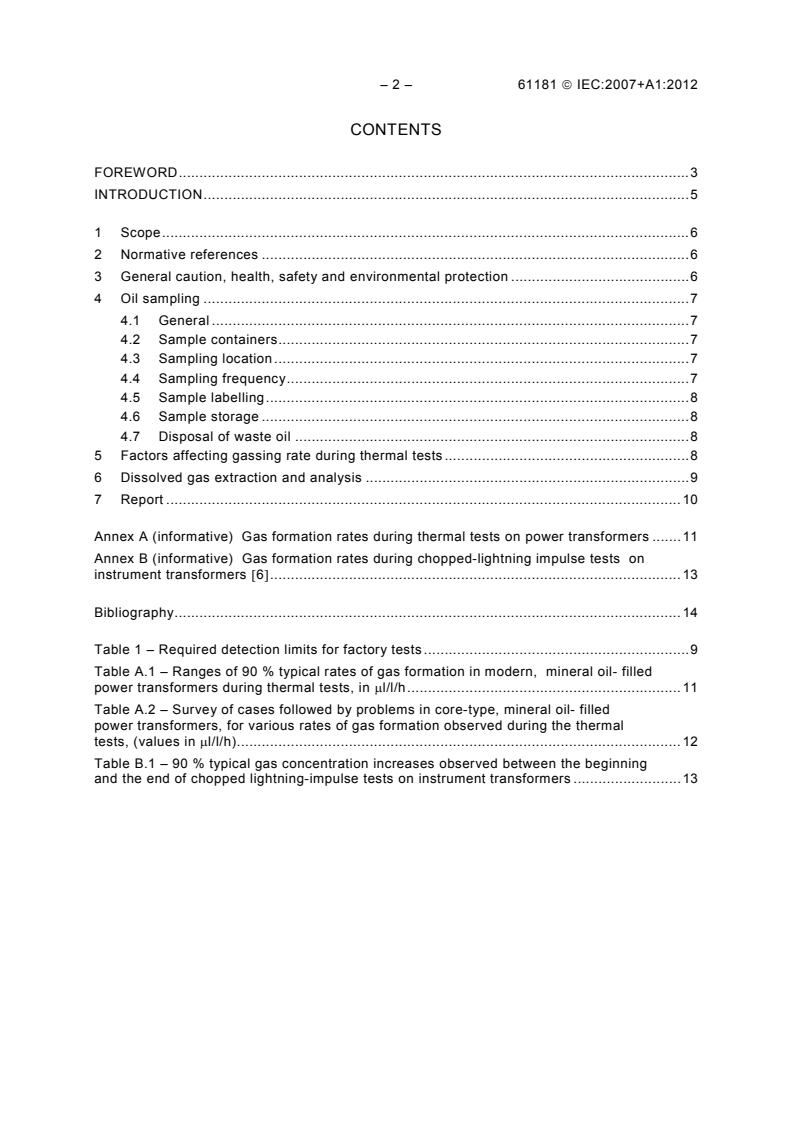
CONTENTS
FOREWORD . 3
INTRODUCTION . 5
1 Scope . 6
2 Normative references . 6
3 General caution, health, safety and environmental protection . 6
4 Oil sampling . 7
4.1 General . 7
4.2 Sample containers . 7
4.3 Sampling location . 7
4.4 Sampling frequency . 7
4.5 Sample labelling . 8
4.6 Sample storage . 8
4.7 Disposal of waste oil . 8
5 Factors affecting gassing rate during thermal tests . 8
6 Dissolved gas extraction and analysis . 9
7 Report . 10
Annex A (informative) Gas formation rates during thermal tests on power transformers . 11
Annex B (informative) Gas formation rates during chopped-lightning impulse tests on
instrument transformers [6] . 13
Bibliography . 14
Table 1 – Required detection limits for factory tests . 9
Table A.1 – Ranges of 90 % typical rates of gas formation in modern, mineral oil- filled
power transformers during thermal tests, in µl/l/h . 11
Table A.2 – Survey of cases followed by problems in core-type, mineral oil- filled
power transformers, for various rates of gas formation observed during the thermal
tests, (values in µl/l/h). 12
Table B.1 – 90 % typical gas concentration increases observed between the beginning
and the end of chopped lightning-impulse tests on instrument transformers . 13
61181 IEC:2007+A1:2012 – 3 –
INTERNATIONAL ELECTROTECHNICAL COMMISSION
____________
MINERAL OIL-FILLED ELECTRICAL EQUIPMENT –
APPLICATION OF DISSOLVED GAS ANALYSIS (DGA)
TO FACTORY TESTS ON ELECTRICAL EQUIPMENT
FOREWORD
1) The International Electrotechnical Commission (IEC) is a worldwide organization for standardization comprising
all national electrotechnical committees (IEC National Committees). The object of IEC is to promote
international co-operation on all questions concerning standardization in the electrical and electronic fields. To
this end and in addition to other activities, IEC publishes International Standards, Technical Specifications,
Technical Reports, Publicly Available Specifications (PAS) and Guides (hereafter referred to as “IEC
Publication(s)”). Their preparation is entrusted to technical committees; any IEC National Committee interested
in the subject dealt with may participate in this preparatory work. International, governmental and non-
governmental organizations liaising with the IEC also participate in this preparation. IEC collaborates closely
with the International Organization for Standardization (ISO) in accordance with conditions determined by
agreement between the two organizations.
2) The formal decisions or agreements of IEC on technical matters express, as nearly as possible, an international
consensus of opinion on the relevant subjects since each technical committee has representation from all
interested IEC National Committees.
3) IEC Publications have the form of recommendations for international use and are accepted by IEC National
Committees in that sense. While all reasonable efforts are made to ensure that the technical content of IEC
Publications is accurate, IEC cannot be held responsible for the way in which they are used or for any
misinterpretation by any end user.
4) In order to promote international uniformity, IEC National Committees undertake to apply IEC Publications
transparently to the maximum extent possible in their national and regional publications. Any divergence
between any IEC Publication and the corresponding national or regional publication shall be clearly indicated in
the latter.
5) IEC itself does not provide any attestation of conformity. Independent certification bodies provide conformity
assessment services and, in some areas, access to IEC marks of conformity. IEC is not responsible for any
services carried out by independent certification bodies.
6) All users should ensure that they have the latest edition of this publication.
7) No liability shall attach to IEC or its directors, employees, servants or agents including individual experts and
members of its technical committees and IEC National Committees for any personal injury, property damage or
other damage of any nature whatsoever, whether direct or indirect, or for costs (including legal fees) and
expenses arising out of the publication, use of, or reliance upon, this IEC Publication or any other IEC
Publications.
8) Attention is drawn to the Normative references cited in this publication. Use of the referenced publications is
indispensable for the correct application of this publication.
9) Attention is drawn to the possibility that some of the elements of this IEC Publication may be the subject of
patent rights. IEC shall not be held responsible for identifying any or all such patent rights.
This consolidated version of the official IEC Standard and its amendment has been prepared
for user convenience.
IEC 61181 edition 2.1 contains the second edition (2007) [documents 10/675/FDIS and 10/688/
RVD] and its amendment 1 (2012) [documents 10/881/FDIS and 10/886/RVD].
A vertical line in the margin shows where the base publication has been modified by
amendment 1. Additions and deletions are displayed in red, with deletions being struck
through.
– 4 – 61181 IEC:2007+A1:2012
International Standard IEC 61181 has been prepared by IEC technical committee 10: Fluids
for electrotechnical applications.
This edition includes the following significant technical changes with respect to the previous
edition:
a) the specific procedures used during factory tests (sampling location, sampling frequency,
gas extraction and chromatographic analysis in the laboratory) are described in more
detail;
b) information is provided in Annex A concerning the residual gas contents recommended
before thermal tests on power transformers, typical gas values observed during the tests
and cases where gas formation during the tests was followed by problems in the
transformers;
c) typical values observed during chopped lightning-impulse tests on instrument transformers
are indicated in Annex B.
This publication has been drafted in accordance with the ISO/IEC Directives, Part 2.
The committee has decided that the contents of the base publication and its amendments will
remain unchanged until the stability date indicated on the IEC web site under
"http://webstore.iec.ch" in the data related to the specific publication. At this date, the
publication will be
• reconfirmed,
• withdrawn,
• replaced by a revised edition, or
• amended.
IMPORTANT – The “colour inside” logo on the cover page of this publication indicates
that it contains colours which are considered to be useful for the correct understanding
of its contents. Users should therefore print this publication using a colour printer.
61181 IEC:2007+A1:2012 – 5 –
INTRODUCTION
IEC technical committee 10, responsible for IEC 61181, has prepared guidelines for
performing DGA measurements during factory testing on equipment filled with mineral
insulating oil in order to ensure consistency in the industry and improve the confidence with
which the results will be used.
DGA is used routinely as a standard quality control procedure during and after factory tests
on electrical equipment, for example during temperature-rise and chopped lightning-impulse
tests, to indicate that a design meets specified requirements. Due to the small quantities of
gases generated during factory tests, specific requirements are necessary for the sampling
and analysis of oil samples and the interpretation of results.
Acceptance criteria are beyond the scope of TC 10. Attention is drawn, however, to the fact
do not apply any more to transformers
that the guidelines issued by CIGRE in 1993-1995 [1]
manufactured today, the design of which having been improved. Examples of values actually
observed today are indicated in Annexes A and B.
———————
Figures in square brackets refer to the bibliography.
– 6 – 61181 IEC:2007+A1:2012
MINERAL OIL-FILLED ELECTRICAL EQUIPMENT –
APPLICATION OF DISSOLVED GAS ANALYSIS (DGA)
TO FACTORY TESTS ON ELECTRICAL EQUIPMENT
1 Scope
This International Standard specifies oil-sampling procedures, analysis requirements and
procedures, and recommends sensitivity, repeatability and accuracy criteria for the application
of dissolved gas analysis (DGA) to factory testing of new power transformers, reactors and
instrument transformers filled with mineral insulating oil when DGA testing has been specified.
The most effective and useful application of DGA techniques to factory testing is during the
performance of long-term tests, typically temperature-rise (heat run) and overloading tests on
power transformers and reactors, also impulse tests on instrument transformers. DGA may
also be valuable for over-excitation tests run over an extended period of time.
Experience with DGA results, before and after short-time dielectric tests, indicates that DGA
is normally less sensitive than electrical and acoustic methods for detecting partial
discharges. However, DGA will indicate when these partial discharges become harmful to the
insulation and may be detected by inspection [2].
2 Normative references
The following referenced document is indispensable for the application of this document. For
dated references, only the edition cited applies. For undated references, the latest edition of
the referenced document (including any amendments) applies.
IEC 60567: Guide for the sampling of gases and of oil from oil-filled electrical equipment and
for the analysis of free and dissolved gases
IEC 60475:2011, Method of sampling insulating liquids
IEC 60567:2011, Oil-filled electrical equipment – Sampling of gases and analysis of free and
dissolved gases – Guidance
3 General caution, health, safety and environmental protection
This standard does not purport to address all the safety problems associated with its use. It is
the responsibility of the user of the standard to establish appropriate health and safety
practices and determine the applicability of regulatory limitations prior to use.
The mineral insulating oils which are the subject of this standard should be handled with due
regard to personal hygiene. Direct contact with the eyes may cause irritation. In the case of
eye contact, irrigation with copious quantities of clean running water should be carried out
and medical advice sought. Some of the tests specified in this standard involve the use of
processes that could lead to a hazardous situation. Attention is drawn to the relevant standard
for guidance.
This standard is applicable to mineral insulating oils and used sample containers, the disposal
or decontamination of which must be done according to local regulations. Every precaution
should be taken to prevent release of mineral oil into the environment.
61181 IEC:2007+A1:2012 – 7 –
4 Oil sampling
4.1 General
Sampling of oil shall be carried out using apparatus and methods complying with IEC 60567
60475:2011.
It is recommended that samples be taken by qualified personnel, trained to operate in
accordance with IEC 60567 60475:2011.
Samples shall be taken in duplicate (test sample and spare sample).
4.2 Sample containers
The most appropriate container is a gas-tight glass syringe of suitable capacity and fitted with
a three-way sampling cock. For storage and transportation, stainless steel caps may also be
used.
Alternative sample containers conforming to IEC 60567 60475:2011 are acceptable.
4.3 Sampling location
Oil samples shall be representative of the bulk of the oil in the equipment. In power
transformers, oil samples shall be taken from the main oil stream (e.g. at the ground level of
the pipes circulating the oil through the radiators, when the pump is in operation, or using a
metal pipe to bring the oil from the top oil valve to the ground). Points outside the main oil
stream (e.g. from the bottom valve of the tank) shall be disregarded. For instrument
transformers, follow the indications of manufacturers.
When using syringes, draining of at least 2 l of oil is recommended before sampling (when
using bottles, twice the volume of the bottle or 5 l). When using bottles, a piece of oil-
compatible tubing should be used from the oil valve to the bottom of the bottle, and the bottle
filled with oil from the bottom up.
NOTE These provisions are not applicable to electrical equipment of small oil volume.
4.4 Sampling frequency
4.4.1 Thermal tests on power transformers
Irrespective of the type and duration of the test, oil samples for DGA shall be taken before the
test begins and after the conclusion of the test.
Intermediate samples may be taken during the test depending on its duration and nature as
they may be essential to improve the precision of the data and the reliability of their
evaluation. Practices to that respect vary widely, and it is left to the user to decide the number
of samples to be taken.
Oil sampling at the followings stages of the thermal tests has been found useful:
– after filling the transformer with degassed oil (for quality control of the drying and filling
process);
– one day to one week later, depending on the transformer (when impregnation of oil in
paper is completed);
– before start of thermal test;
– every 2 h during the tests, or at different test intervals depending on test duration and
transformer design;
– at the end of test only;
– 8 – 61181 IEC:2007+A1:2012
– 24 h or more after the test is completed (to allow for equilibrium to be completed);
– some users recommend analysis of the duplicate and intermediate samples only if found
necessary later.
If the cooling system of the unit under test includes oil pumps, they should be operated 2 h
before the first oil sample is taken and kept running until the last oil sample is taken, except
for any period the test conditions require the pumps to be turned off.
NOTE In the case of dielectric tests on power transformers, oil sampling may be performed:
− before first HV test.
− after all dielectric tests.
4.4.2 Impulse tests on instrument transformers
An oil sample shall be taken before the chopped lightning-impulse test. A second oil sample
shall be taken 72 h after the test to assure the diffusion of the small quantities of gas
generated during the test.
NOTE 1 During dielectric tests, the oil in an instrument transformer is virtually stationary and even convective
movement is restricted. Consequently, the diffusion of small quantities of gas generated to the sampling point may
take a considerable time. It is essential that the manufacturer and purchaser reach an agreement on the time the
last sample should be taken.
NOTE 2 Between the beginning and the end of impulse tests, instrument transformers should not be subjected to
other tests.
4.5 Sample labelling
Oil samples should be properly labelled before dispatch to the laboratory with the following
minimum information:
– identification of equipment;
– date and time of sampling;
– nature of factory test;
– sampling point;
– top oil temperature.
4.6 Sample storage
To prevent oxidation, the samples shall be shielded from direct light by wrapping the
container in aluminium foil or by storing in an opaque enclosure.
4.7 Disposal of waste oil
Waste oil shall be disposed of according to local regulations.
5 Factors affecting gassing rate during thermal tests
Gas measurements are used to detect the effect of abnormal temperatures in windings, leads,
magnetic circuit, structural elements, or from abnormal leakage flux. The design of these
transformer parts therefore has an influence on gas production rate. Other important design
aspects that may affect production rate are:
– oil to cellulose mass ratio: if there is less oil to absorb the gas produced, higher gassing
rates will be observed;
– paper type or quality (thermally upgraded or not, Nomex);
– oil type or brand (stray gassing tendency);
– in some transformers: paints, glues, stainless steel and other materials;
61181 IEC:2007+A1:2012 – 9 –
– cooling method and cooling efficiency;
– test duration.
Gassing rate is strongly dependent on temperature and air content. It should be noted that
there is always some gassing, although very low, during all thermal tests.
Oxygen concentration is normally low since the oil is initially degassed. Sometimes the oil can
be oxygenated to a given range of concentrations, such as 8 000 µl/l to 12 000 µl/l, to
increase gas formation. In case of a nitrogen-cushioned transformer, considerable amounts of
gases may diffuse from the oil.
6 Dissolved gas extraction and analysis
Gases dissolved in oil should be extracted and analysed by gas chromatography in
accordance with IEC 60567:2011, with the detection limits of the overall determination
indicated in Table 1.
Table 1 – Required detection limits for factory tests
Concentrations
Gas
µl/l µmol/l
Hydrogen 2 0,08
Hydrocarbons 0,1 0,004
Carbon monoxide 5 0,2
Carbon dioxide 10 0,4
Oxygen 500 21
Nitrogen 2000 84
Oil samples should be analysed as soon as possible after being taken and in no case later
than seven days afterwards.
The recommended methods of gas extraction for factory tests, as indicated in
IEC 60567:2011, are the Toepler and partial degassing methods, including their Mercury Free
versions, since they allow a higher gas extraction efficiency at the low gas concentration
levels observed during factory tests. Head space may be used if a sufficient sensitivity and
accuracy can be reached.
When using partial degassing, the following adaptations for factory tests are recommended:
– use a gas burette of smaller volume;
– run a blank (with no oil injected) to check for vacuum leaks in the extraction system;
– use an extraction system dedicated to factory tests (to avoid contamination by routine oil
samples containing high levels of fault gases);
– if this is not possible, perform a full extraction procedure on a sample of degassed oil
before running the factory test samples;
– if a better precision is desired, use a larger volume of oil (e.g., a 50 ml or 100 ml syringe).
– 10 – 61181 IEC:2007+A1:2012
When using Toepler method, the following adaptations are recommended:
– if it is known before gas extraction that the oil used has been well degassed (total volume
< 1 %), introduce a measured volume (e.g. 1 ml to 2 ml) of argon into the oil syringe (to
increase the precision on the reading of the total gas measured in the burette);
– if after gas extraction the extracted gas volume is too small for precise quantification,
introduce e.g. 1 ml or 1,5 ml of argon to the extracted gas, so that there is sufficient gas
volume to carry out the analysis;
– alternatively, when the total gas volume is too small to obtain a reading on the burette,
lower the mercury level and take a reading at reduced pressure, then correct to
atmospheric pressure;
– flush with air then put under vacuum (to decontaminate the extraction system from
previous analyses). A full extraction procedure on a sample of degassed oil may also be
used where the apparatus may be contaminated from routine samples;
– an alternative procedure consists in increasing the volume of oil used (typically, twice the
amount used for routine analysis).
The use of high sensitivity capillary columns, as in example 2 of Table 3 4 of IEC 60567:2011
is recommended.
In addition to adequate sensitivity levels, a very good repeatability r is necessary to prevent
misinterpretation of results. Consequently, it is essential for all samples to be analysed by the
same laboratory, by highly-trained qualified personnel, and within a short period of time. It is
also recommended that the laboratory repeatability be regularly monitored. A required criteria
for repeatability at low gas concentrations, as indicated in IEC 60567:2011, is:
r ≤ S
where S is the required detection limit.
The objective of the DGA determinations is the detection of very small differences between oil
samples. A calculated difference is significant only if it is larger than the repeatability (for
analyses performed within a short period of time, e.g., one day), or than the reproducibility or
by default the accuracy (for analyses performed over a longer period of time), as indicated in
9.3 of IEC 60567:2011.
The required accuracy, deduced from round robin tests performed by IEC TC 10 at low gas
levels (1 µl/l to 3 µl/l of the hydrocarbons, 2,5 µl/l of H , 5 µl/l of CO and 40 µl/l of CO ), is
2 2
±44 %.
7 Report
The report should include the following information:
– testing laboratory;
– identification of equipment tested;
– sampling location;
– DGA results on each sample, in µl/l or µmol/l (total volume of gas, oxygen and nitrogen
may conveniently be expressed in percent of oil volume);
– rate of generation of gases in µl/l/h.
61181 IEC:2007+A1:2012 – 11 –
Annex A
(informative)
Gas formation rates during thermal tests on power transformers
Because of the small gas quantities formed during factory tests, the oil used in the equipment
tested is usually degassed to eliminate any gases previously present that might interfere with
test diagnoses. Typical residual air contents recommended are < 0,5 % in large power
transformers (>100 MVA), <1 % in medium power transformers (between 20 MVA and
100 MVA) and up to 2 % in smaller power transformers and distribution transformers.
It has been shown by CIGRE TF 15/12-01-11 [2] that the use of thermally “stray gassing” oils
will not significantly interfere with test diagnoses, except in the case of very strongly stray
gassing oils. However, when possible, it might be better to use a non- or mildly- stray gassing
oil in transformers for the tests. Any other accidental source of gases (from welds, tap
changer, etc) should be carefully avoided.
Ranges of 90 % typical rates of gas formation observed during thermal tests, performed
according to IEC 60076-2 or the IEEE/ ANSI Guide [3], [4] on modern conservator-type
transformers, are indicated in Table A.1 below. Values in Table A.1 have been reported by
three major manufacturers of power transformers and four large electrical utilities, operating
in seven different countries.
Table A.1 – Ranges of 90 % typical rates of gas formation in modern,
mineral oil-filled power transformers during thermal tests, in µl/l/h
H Cn H + Cn CO CO
2 2 2
Power transformers 0,1 - 1,3 0,04 - 0,3 0,1 - 1,6 0,4 - 2 5 - 18
Shell-type 4
Special cases 1,7 0,5 2,2 5 20
H H + Cn CO
Power transformers Cn CO
2 2 2
Core-type 0,4 – 2 5 – 18
0,1 – 1,3 0,04 – 0,3 0,1 – 1,6
Shell-type 4 16 – 30
Special cases 1,7 0,5 2,2 5 20
NOTE 1 “Special cases” in Table A.1 correspond to transformers with materials compatibility problems (e.g.
reactions with interior paints), or filled with a strongly stray gassing oil, which are used in some countries.
NOTE 2 The calculation of 90 % typical values is described in reference [2] and in IEC 60599 [5].
NOTE 3 C H typically is not generated during the tests and is below the detection limit.
2 2
NOTE 4 C = CH + C H + C H + C H .
n 4 2 6 2 4 2 2
Warning: Values in Table A.1 are not “acceptable limit values” but values observed in 90 % of
the transformer populations tested. Acceptable limit values (acceptance criteria) are outside
the scope of this standard and should be agreed by user and manufacturer in advance of
testing.
– 12 – 61181 IEC:2007+A1:2012
Table A.2 indicates the number of cases where problems were found (and not found) during
thermal tests, or when the transformer was put back in service following the tests, for various
rates of gas formation observed during the tests.
Table A.2 – Survey of cases followed by problems in core-type, mineral oil- filled power
transformers, for various rates of gas formation observed during the thermal tests,
(values in µl/l/h)
H + Cn Total number Number of cases
of cases followed by problems
<0,5 215 1
0,5 - 1 36 1
1 - 2 21 4
2 - 5 12 4
5 - 10 4 2
>10 3 3
NOTE 1 Values in Table A.2 are coming from CIGRE (1993) [1] and from other cases reported to TC 10.
NOTE 2 C = CH + C H + C H + C H .
n 4 2 6 2 4 2 2
Warning: Table A.2 is based on a limited number of cases and provided as a general
information only. It cannot be used to calculate acceptable limit values.
61181 IEC:2007+A1:2012 – 13 –
Annex B
(informative)
Gas formation rates during chopped-lightning impulse tests
on instrument transformers [6]
Because of the small gas quantities formed during factory tests, the oil used in the equipment
tested is usually degassed to eliminate any gases previously present that might interfere with
test diagnoses.
NOTE Materials incompatibility may increase the dissolved gas content measured before the tests. This has been
observed in healthy transformers and also in new instruments transformers that had never been energized.
The 90 % typical gas concentration increases reported by one major manufacturer of
instrument transformers between the beginning and the end of chopped lightning-impulse
tests are indicated in Table B.1, in µl/l.
Table B.1 – 90 % typical gas concentration increases observed between the beginning
and the end of chopped lightning-impulse tests on instrument transformers
H CH C H C H C H CO
2 4 2 4 2 6 2 2
Gas concentration
increase, in µl/l 15 4 1 1,5 0,5 15
Warning: Values in Table B.1 are not “acceptable limit values”, but values observed in 90 %
of the transformer populations tested. Acceptable limit values after the tests (acceptance
criteria) are outside the scope of this standard and should be agreed by user and
manufacturer in advance of testing.
– 14 – 61181 IEC:2007+A1:2012
Bibliography
[1] BAEHR, R. Dissolved Gas Analysis During Heat-Run Tests of Power Transformers,
Report of CIGRE WG 12.09, April 1993. Published in a summarized version in Electra,
No.161, August 1995
[2] DUVAL, M. et al., Recent developments in DGA interpretation, Final Report of CIGRE
TF15/12-01-11, CIGRE Brochure No. 296 (2006) and in Electra No. 226 (June 2006)
page 56
[3] IEC 60076, Power transformers
[4] IEEE Standard C57.12.90, IEEE Test Code for Liquid-Immersed Distribution, Power and
Regulating Transformers and Guide for Short-Circuit Testing of Distribution and Power
Transformers
[5] IEC 60599, Mineral oil-impregnated electrical equipment in service – Guide to the
interpretation of dissolved and free gases analysis
[6] IEC 60044(all parts), Instrument transformers
___________
– 16 – 61181 CEI:2007+A1:2012
SOMMAIRE
AVANT-PROPOS . 17
INTRODUCTION . 19
1 Domaine d'application . 20
2 Références normatives . 20
3 Précautions générales, protection de la santé, de la sécurité et de l'environnement . 20
4 Échantillonnage de l'huile . 21
4.1 Généralités. 21
4.2 Récipients d’échantillon . 21
4.3 Point d'échantillonnage . 21
4.4 Fréquence d'échantillonnage . 21
4.5 Identification des échantillons . 22
4.6 Stockage des échantillons . 22
4.7 Élimination de l’huile usagée . 23
5 Facteurs influençant la vitesse de formation de gaz pendant les essais
d’échauffement . 23
6 Extraction et analyse des gaz dissous . 23
7 Rapport . 25
Annexe A (informative) Vitesses de formation de gaz pendant les essais
d’échauffement sur les transformateurs de puissance . 26
Annexe B (informative) Vitesses de formation de gaz pendant les essais de choc de
foudre coupé sur les transformateurs de mesure [6] . 28
Bibliographie . 29
Tableau 1 – Seuils de détection exigés pour les essais en usine . 23
Tableau A.1 – Gammes de vitesses de formation de gaz typiques à 90 % dans des
transformateurs de puissance modernes imprégnés d’huile minérale pendant les
essais d’échauffement, en µl/l/h . 26
Tableau A.2 – Relevé des cas suivis de problèmes dans des transformateurs de
puissance à colonnes remplis d’huile, pour différentes vitesses de formation de gaz
observés pendant les essais d’échauffement, en µl/l/h . 27
Tableau B.1 – Augmentation de concentration de gaz typiques à 90 % dans des
transformateurs de mesure entre le début et la fin des essais de choc de foudre coupé. 28
61181 CEI:2007+A1:2012 – 17 –
COMMISSION ÉLECTROTECHNIQUE INTERNATIONALE
____________
MATÉRIELS ÉLECTRIQUES IMPRÉGNÉS D’HUILE MINÉRALE –
APPLICATION DE L'ANALYSE DES GAZ DISSOUS (AGD)
LORS D'ESSAIS EN USINE DE MATÉRIELS ÉLECTRIQUES
AVANT-PROPOS
1) La Commission Electrotechnique Internationale (CEI) est une organisation mondiale de normalisation
composée de l'ensemble des comités électrotechniques nationaux (Comités nationaux de la CEI). La CEI a
pour objet de favoriser la coopération internationale pour toutes les questions de normalisation dans les
domaines de l'électricité et de l'électronique. A cet effet, la CEI – entre autres activités – publie des Normes
internationales, des Spécifications techniques, des Rapports techniques, des Spécifications accessibles au
public (PAS) et des Guides (ci-après dénommés "Publication(s) de la CEI"). Leur élaboration est confiée à des
comités d'études, aux travaux desquels tout Comité national intéressé par le sujet traité peut participer. Les
organisations internationales, gouvernementales et non gouvernementales, en liaison avec la CEI, participent
également aux travaux. La CEI collabore étroitement avec l'Organisation Internationale de Normalisation (ISO),
selon des conditions fixées par accord entre les deux organisations.
2) Les décisions ou accords officiels de la CEI concernant les questions techniques représentent, dans la mesure
du possible, un accord international sur les sujets étudiés, étant donné que les Comités nationaux de la CEI
intéressés sont représentés dans chaque comité d’études.
3) Les Publications de la CEI se présentent sous la forme de recommandations internationales et sont agréées
comme telles par les Comités nationaux de la CEI. Tous les efforts raisonnables sont entrepris afin que la CEI
s'assure de l'exactitude du contenu technique de ses publications; la CEI ne peut pas être tenue responsable
de l'éventuelle mauvaise utilisation ou interprétation qui en est faite par un quelconque utilisateur final.
4) Dans le but d'encourager l'uniformité internationale, les Comités nationaux de la CEI s'engagent, dans toute la
mesure possible, à appliquer de façon transparente les Publications de la CEI dans leurs publications
nationales et régionales. Toutes divergences entre toutes Publications de la CEI et toutes publications
nationales ou régionales correspondantes doivent être indiquées en termes clairs dans ces dernières.
5) La CEI elle-même ne fournit aucune attestation de conformité. Des organismes de certification indépendants
fournissent des services d'évaluation de conformité et, dans certains secteurs, accèdent aux marques de
conformité de la CEI. La CEI n'est responsable d'aucun des services effectués par les organismes de
certification indépendants.
6) Tous les utilisateurs doivent s'assurer qu'ils sont en possession de la dernière édition de cette publication.
7) Aucune responsabilité ne doit être imputée à la CEI, à ses administrateurs, employés, auxiliaires ou
mandataires, y compris ses experts particuliers et les membres de ses comités d'études et des Comités
nationaux de la CEI, pour tout préjudice causé en cas de dommages corporels et matériels, ou de tout autre
dommage de quelque nature que ce soit, directe ou indirecte, ou pour supporter les coûts (y compris les frais
de justice) et les dépenses découlant de la publication ou de l'utilisation de cette Publication de la CEI ou de
toute autre Publication de la CEI, ou au crédit qui lui est accordé.
8) L'attention est attirée sur les références normatives citées dans cette publication. L'utilisation de publications
référencées est obligatoire pour une application correcte de la présente publication.
9) L’attention est attirée sur le fait que certains des éléments de la présente Publication de la CEI peuvent faire
l’objet de droits de brevet. La CEI ne saurait être tenue pour responsable de ne pas avoir identifié de tels droits
de brevets et de ne pas avoir signalé leur existence.
Cette version consolidée de la Norme IEC officielle et de son amendement a été préparée pour
la commodité de l'utilisateur.
La CEI 61181 édition 2.1 contient la deuxième édition (2007) [documents 10/675/FDIS et 10/688/
RVD] et son amendement 1 (2012) [documents 10/881/FDIS et 10/886/RVD].
Une ligne verticale dans la marge indique où la publication de base a été modifiée par
l'amendement 1. Les ajouts et les suppressions apparaissent en rouge, les suppressions sont
barrées.
– 18 – 61181 CEI:2007+A1:2012
La Norme internationale CEI 61181 a été établie par le comité d'étude 10 de la CEI: Fluides
pour applications électrotechniques.
Cette édition inclut les modifications techniques majeures suivantes par rapport à l’édition
précédente:
a) les procédures spécifiques utilisées pendant les essais en usine (points et fréquence
d’échantillonnage, extraction des gaz et analyse chromatographique en laboratoire) sont
décrites avec plus de détails;
b) l’Annexe A fournit des informations sur les teneurs en gaz résiduelles qui sont
recommandées avant les essais thermiques sur les transformateurs de puissance, sur les
valeurs typiques de gaz observées pendant les essais, et sur les cas où la formation de
gaz pendant les essais a été suivie de problèmes dans les transformateurs;
c) l’Annexe B indique les valeurs typiques observées pendant les essais en choc de foudre
coupé sur les transformateurs de mesure.
Cette publication a été rédigée selon les Directives ISO/CEI, Partie 2.
Le comité a décidé que le contenu de la publication de base et de ses amendements ne sera
pas modifié avant la date de stabilité indiquée sur le site web de la CEI sous
"http://webstore.iec.ch" dans les données relatives à la publication recherchée. A cette date,
la publication sera
• reconduite,
• supprimée,
• remplacée par une édition révisée, ou
• amendée.
IMPORTANT – Le logo "colour inside" qui se trouve sur la page de couverture de cette
publication indique qu'elle contient
...