

IEC 60296:2020
(Main)Fluids for electrotechnical applications – Mineral insulating oils for electrical equipment
General Information
- Abstract
IEC 60296:2020 provides specifications and test methods for unused and recycled mineral insulating oils. It applies to mineral oil delivered according to the contractual agreement, intended for use in transformers, switchgear and similar electrical equipment in which oil is required for insulation and heat transfer. Both unused oil and recycled oil under the scope of this document have not been used in, nor been in contact with electrical equipment or other equipment not required for manufacture, storage or transport.
Unused oils are obtained by refining, modifying and/or blending of petroleum products and other hydrocarbons from virgin feedstock.
Recycled oils are produced from oils previously used as mineral insulating oils in electrical equipment that have been subjected to re-refining or reclaiming (regeneration) by processes employed offsite. Such oils will have originally been supplied in compliance with a recognized unused mineral insulating oil specification. This document does not differentiate between the methods used to recycle mineral insulating oil. Oils treated on-site (see IEC 60422) are not within the scope of this document.
Oils with and without additives are both within the scope of this document.
This document does not apply to mineral insulating oils used as impregnating medium in cables or capacitors.
This fifth edition cancels and replaces the fourth edition published in 2012. This edition constitutes a technical revision.
This edition includes the following significant technical changes with respect to the previous edition:
– This International Standard is applicable to specifications and test methods for unused and recycled mineral insulating oils in the delivered state.
– Within the transformer insulating oils, two groups, Type A and Type B, are defined, based on their performance.
– A new method for stray gassing under thermo-oxidative stress of mineral insulating oils, which has been tested in a joint round robin test (RRT) between CIGRE D1 and IEC technical committee 10, has been included.
- Status
- Published
- Publication Date
- 25-Jun-2020
- Technical Committee
- TC 10 - Fluids for electrotechnical applications
- Drafting Committee
- MT 38 - TC 10/MT 38
- Current Stage
- PPUB - Publication issued
- Start Date
- 26-Jun-2020
- Completion Date
- 19-Jun-2020
Overview
IEC 60296:2020 is an international standard published by the International Electrotechnical Commission (IEC) covering mineral insulating oils used in electrical equipment. These oils serve critical functions in transformers, switchgear, and similar electrical systems by providing electrical insulation and heat dissipation. This 2020 edition supersedes the 2012 version and incorporates substantial technical updates including classification enhancements and new test methods.
The standard applies to both unused mineral insulating oils-produced from virgin hydrocarbon feedstock via refining, modifying, or blending-and recycled oils that have undergone re-refining or reclamation processes offsite. It excludes oils treated onsite and those used as impregnating media in cables or capacitors. Oils with or without additives fall within the scope of IEC 60296:2020.
Key Topics
- Mineral insulating oil types: The standard defines two performance classes - Type A (fully inhibited high-grade oils) and Type B (uninhibited and inhibited standard-grade oils).
- Specifications and testing: IEC 60296 outlines properties such as viscosity, pour point, water content, breakdown voltage, density, acidity, and oxidation stability, leveraging standardized test methods.
- Additives and chemical content: Detailed requirements for additives such as antioxidants, metal passivators, pour point depressants, and limits on potentially corrosive sulfur and polychlorinated biphenyls (PCBs).
- Health, safety, and environment (HSE) considerations: Evaluation of flash point, aromatic content, and polycyclic aromatic hydrocarbons (PAHs) to ensure compliance with environmental and safety regulations.
- New stray gassing test method: Introduces an advanced procedure for assessing stray gassing under thermo-oxidative stress, validated through joint international round-robin testing between IEC and CIGRE.
- Labelling and classification: Standardized labelling requirements facilitate consistent identification, classification, sampling, and delivery protocols enhancing supply chain and operational reliability.
- Compatibility and miscibility: Guidelines on how mineral insulating oils should interact with existing oils in electrical equipment to avoid adverse effects.
Applications
IEC 60296:2020 is vital for manufacturers, suppliers, and users of mineral insulating oils in electrotechnical equipment. Its applications include:
- Transformer oils: Ensuring oils meet performance and safety criteria for insulation and cooling of power and distribution transformers.
- Switchgear fluids: Providing specifications to maintain dielectric strength, thermal stability, and chemical compatibility in switchgear apparatus.
- Oil re-refining and recycling: Establishing quality standards for recycled mineral oils to guarantee safety and operational reliability in electrical equipment.
- Quality assurance and procurement: Helping procurement teams specify compliant mineral oil grades for contracts and supply chain consistency.
- Equipment testing and maintenance: Supporting maintenance personnel in monitoring oil properties and detecting degradation, contamination, or unsafe conditions.
Related Standards
- IEC 60422: Guidelines on mineral insulating oil maintenance and treatment on-site, complementing IEC 60296’s focus on delivered oils.
- CIGRE D1 documents: Collaborative research on mineral oil properties and testing methods, particularly in stray gassing behavior.
- ISO 8217: Although mainly marine fuels, it provides context on hydrocarbon-based fluids refining relevant to mineral oil production methods.
- IEC 60694: Relates to general requirements for high-voltage switchgear and controlgear where mineral oils are frequently used.
- IEC 61198: Covers requirements for sampling mineral insulating oils ensuring representative testing in line with IEC 60296.
Keywords: IEC 60296, mineral insulating oil, transformer oil, electrical equipment insulation, mineral oil standards, recycled mineral oil, insulating fluids, electrotechnical applications, oil test methods, dielectric strength, stray gassing test, antioxidants, sulfur content, oil classification, electrical transformer maintenance.
Relations
- Effective Date
- 09-Feb-2026
- Effective Date
- 09-Feb-2026
- Effective Date
- 09-Feb-2026
- Effective Date
- 09-Feb-2026
- Effective Date
- 09-Feb-2026
- Effective Date
- 09-Feb-2026
- Effective Date
- 09-Feb-2026
- Effective Date
- 05-Sep-2023
Get Certified
Connect with accredited certification bodies for this standard

IMQ S.p.A. (Certification)
Italian electrical product certification.

SLG Prüf- und Zertifizierungs GmbH
German testing and certification body.

UL Solutions
Global safety science company with testing, inspection and certification.
Sponsored listings
Frequently Asked Questions
IEC 60296:2020 is a standard published by the International Electrotechnical Commission (IEC). Its full title is "Fluids for electrotechnical applications – Mineral insulating oils for electrical equipment". This standard covers: IEC 60296:2020 provides specifications and test methods for unused and recycled mineral insulating oils. It applies to mineral oil delivered according to the contractual agreement, intended for use in transformers, switchgear and similar electrical equipment in which oil is required for insulation and heat transfer. Both unused oil and recycled oil under the scope of this document have not been used in, nor been in contact with electrical equipment or other equipment not required for manufacture, storage or transport. Unused oils are obtained by refining, modifying and/or blending of petroleum products and other hydrocarbons from virgin feedstock. Recycled oils are produced from oils previously used as mineral insulating oils in electrical equipment that have been subjected to re-refining or reclaiming (regeneration) by processes employed offsite. Such oils will have originally been supplied in compliance with a recognized unused mineral insulating oil specification. This document does not differentiate between the methods used to recycle mineral insulating oil. Oils treated on-site (see IEC 60422) are not within the scope of this document. Oils with and without additives are both within the scope of this document. This document does not apply to mineral insulating oils used as impregnating medium in cables or capacitors. This fifth edition cancels and replaces the fourth edition published in 2012. This edition constitutes a technical revision. This edition includes the following significant technical changes with respect to the previous edition: – This International Standard is applicable to specifications and test methods for unused and recycled mineral insulating oils in the delivered state. – Within the transformer insulating oils, two groups, Type A and Type B, are defined, based on their performance. – A new method for stray gassing under thermo-oxidative stress of mineral insulating oils, which has been tested in a joint round robin test (RRT) between CIGRE D1 and IEC technical committee 10, has been included.
IEC 60296:2020 provides specifications and test methods for unused and recycled mineral insulating oils. It applies to mineral oil delivered according to the contractual agreement, intended for use in transformers, switchgear and similar electrical equipment in which oil is required for insulation and heat transfer. Both unused oil and recycled oil under the scope of this document have not been used in, nor been in contact with electrical equipment or other equipment not required for manufacture, storage or transport. Unused oils are obtained by refining, modifying and/or blending of petroleum products and other hydrocarbons from virgin feedstock. Recycled oils are produced from oils previously used as mineral insulating oils in electrical equipment that have been subjected to re-refining or reclaiming (regeneration) by processes employed offsite. Such oils will have originally been supplied in compliance with a recognized unused mineral insulating oil specification. This document does not differentiate between the methods used to recycle mineral insulating oil. Oils treated on-site (see IEC 60422) are not within the scope of this document. Oils with and without additives are both within the scope of this document. This document does not apply to mineral insulating oils used as impregnating medium in cables or capacitors. This fifth edition cancels and replaces the fourth edition published in 2012. This edition constitutes a technical revision. This edition includes the following significant technical changes with respect to the previous edition: – This International Standard is applicable to specifications and test methods for unused and recycled mineral insulating oils in the delivered state. – Within the transformer insulating oils, two groups, Type A and Type B, are defined, based on their performance. – A new method for stray gassing under thermo-oxidative stress of mineral insulating oils, which has been tested in a joint round robin test (RRT) between CIGRE D1 and IEC technical committee 10, has been included.
IEC 60296:2020 is classified under the following ICS (International Classification for Standards) categories: 29.040.10 - Insulating oils. The ICS classification helps identify the subject area and facilitates finding related standards.
IEC 60296:2020 has the following relationships with other standards: It is inter standard links to EN ISO 19069-2:2024, EN ISO 16396-2:2022, EN ISO 10350-2:2020, EN ISO 17855-2:2024, EN ISO 21304-2:2021, EN ISO 10350-1:2025, EN ISO 19063-2:2020, IEC 60296:2012. Understanding these relationships helps ensure you are using the most current and applicable version of the standard.
IEC 60296:2020 is available in PDF format for immediate download after purchase. The document can be added to your cart and obtained through the secure checkout process. Digital delivery ensures instant access to the complete standard document.
Standards Content (Sample)
IEC 60296 ®
Edition 5.0 2020-06
INTERNATIONAL
STANDARD
NORME
INTERNATIONALE
colour
inside
Fluids for electrotechnical applications – Mineral insulating oils for electrical
equipment
Fluides pour applications électrotechniques – Huiles minérales isolantes pour
matériel électrique
All rights reserved. Unless otherwise specified, no part of this publication may be reproduced or utilized in any form
or by any means, electronic or mechanical, including photocopying and microfilm, without permission in writing from
either IEC or IEC's member National Committee in the country of the requester. If you have any questions about IEC
copyright or have an enquiry about obtaining additional rights to this publication, please contact the address below or
your local IEC member National Committee for further information.
Droits de reproduction réservés. Sauf indication contraire, aucune partie de cette publication ne peut être reproduite
ni utilisée sous quelque forme que ce soit et par aucun procédé, électronique ou mécanique, y compris la photocopie
et les microfilms, sans l'accord écrit de l'IEC ou du Comité national de l'IEC du pays du demandeur. Si vous avez des
questions sur le copyright de l'IEC ou si vous désirez obtenir des droits supplémentaires sur cette publication, utilisez
les coordonnées ci-après ou contactez le Comité national de l'IEC de votre pays de résidence.
IEC Central Office Tel.: +41 22 919 02 11
3, rue de Varembé info@iec.ch
CH-1211 Geneva 20 www.iec.ch
Switzerland
About the IEC
The International Electrotechnical Commission (IEC) is the leading global organization that prepares and publishes
International Standards for all electrical, electronic and related technologies.
About IEC publications
The technical content of IEC publications is kept under constant review by the IEC. Please make sure that you have the
latest edition, a corrigendum or an amendment might have been published.
IEC publications search - webstore.iec.ch/advsearchform Electropedia - www.electropedia.org
The advanced search enables to find IEC publications by a The world's leading online dictionary on electrotechnology,
variety of criteria (reference number, text, technical containing more than 22 000 terminological entries in English
committee,…). It also gives information on projects, replaced and French, with equivalent terms in 16 additional languages.
and withdrawn publications. Also known as the International Electrotechnical Vocabulary
(IEV) online.
IEC Just Published - webstore.iec.ch/justpublished
Stay up to date on all new IEC publications. Just Published IEC Glossary - std.iec.ch/glossary
details all new publications released. Available online and 67 000 electrotechnical terminology entries in English and
once a month by email. French extracted from the Terms and Definitions clause of
IEC publications issued since 2002. Some entries have been
IEC Customer Service Centre - webstore.iec.ch/csc collected from earlier publications of IEC TC 37, 77, 86 and
If you wish to give us your feedback on this publication or CISPR.
need further assistance, please contact the Customer Service
Centre: sales@iec.ch.
A propos de l'IEC
La Commission Electrotechnique Internationale (IEC) est la première organisation mondiale qui élabore et publie des
Normes internationales pour tout ce qui a trait à l'électricité, à l'électronique et aux technologies apparentées.
A propos des publications IEC
Le contenu technique des publications IEC est constamment revu. Veuillez vous assurer que vous possédez l’édition la
plus récente, un corrigendum ou amendement peut avoir été publié.
Recherche de publications IEC - Electropedia - www.electropedia.org
webstore.iec.ch/advsearchform Le premier dictionnaire d'électrotechnologie en ligne au
La recherche avancée permet de trouver des publications IEC monde, avec plus de 22 000 articles terminologiques en
en utilisant différents critères (numéro de référence, texte, anglais et en français, ainsi que les termes équivalents dans
comité d’études,…). Elle donne aussi des informations sur les 16 langues additionnelles. Egalement appelé Vocabulaire
projets et les publications remplacées ou retirées. Electrotechnique International (IEV) en ligne.
IEC Just Published - webstore.iec.ch/justpublished Glossaire IEC - std.iec.ch/glossary
Restez informé sur les nouvelles publications IEC. Just 67 000 entrées terminologiques électrotechniques, en anglais
Published détaille les nouvelles publications parues. et en français, extraites des articles Termes et Définitions des
Disponible en ligne et une fois par mois par email. publications IEC parues depuis 2002. Plus certaines entrées
antérieures extraites des publications des CE 37, 77, 86 et
Service Clients - webstore.iec.ch/csc CISPR de l'IEC.
Si vous désirez nous donner des commentaires sur cette
publication ou si vous avez des questions contactez-nous:
sales@iec.ch.
IEC 60296 ®
Edition 5.0 2020-06
INTERNATIONAL
STANDARD
NORME
INTERNATIONALE
colour
inside
Fluids for electrotechnical applications – Mineral insulating oils for electrical
equipment
Fluides pour applications électrotechniques – Huiles minérales isolantes pour
matériel électrique
INTERNATIONAL
ELECTROTECHNICAL
COMMISSION
COMMISSION
ELECTROTECHNIQUE
INTERNATIONALE
ICS 29.040.10 ISBN 978-2-8322-8377-6
– 2 – IEC 60296:2020 © IEC 2020
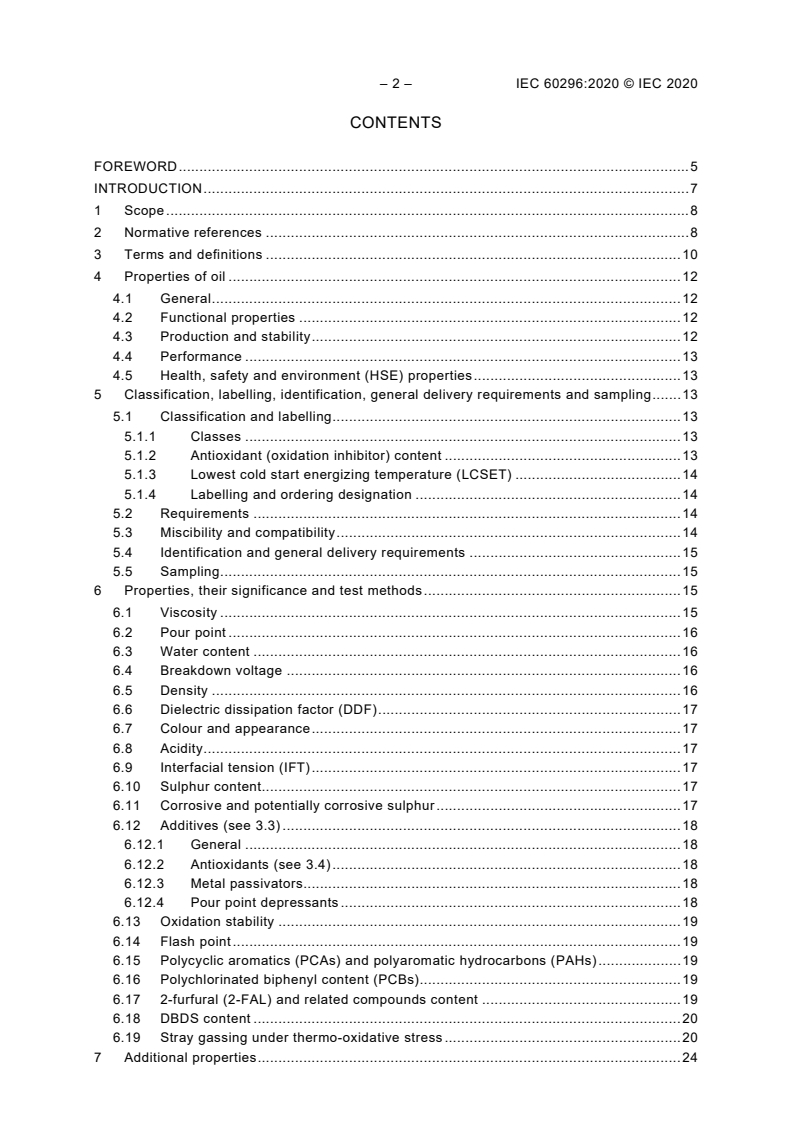
CONTENTS
FOREWORD . 5
INTRODUCTION . 7
1 Scope . 8
2 Normative references . 8
3 Terms and definitions . 10
4 Properties of oil . 12
4.1 General . 12
4.2 Functional properties . 12
4.3 Production and stability . 12
4.4 Performance . 13
4.5 Health, safety and environment (HSE) properties . 13
5 Classification, labelling, identification, general delivery requirements and sampling . 13
5.1 Classification and labelling . 13
5.1.1 Classes . 13
5.1.2 Antioxidant (oxidation inhibitor) content . 13
5.1.3 Lowest cold start energizing temperature (LCSET) . 14
5.1.4 Labelling and ordering designation . 14
5.2 Requirements . 14
5.3 Miscibility and compatibility . 14
5.4 Identification and general delivery requirements . 15
5.5 Sampling. 15
6 Properties, their significance and test methods . 15
6.1 Viscosity . 15
6.2 Pour point . 16
6.3 Water content . 16
6.4 Breakdown voltage . 16
6.5 Density . 16
6.6 Dielectric dissipation factor (DDF) . 17
6.7 Colour and appearance . 17
6.8 Acidity . 17
6.9 Interfacial tension (IFT) . 17
6.10 Sulphur content. 17
6.11 Corrosive and potentially corrosive sulphur . 17
6.12 Additives (see 3.3) . 18
6.12.1 General . 18
6.12.2 Antioxidants (see 3.4) . 18
6.12.3 Metal passivators. 18
6.12.4 Pour point depressants . 18
6.13 Oxidation stability . 19
6.14 Flash point . 19
6.15 Polycyclic aromatics (PCAs) and polyaromatic hydrocarbons (PAHs) . 19
6.16 Polychlorinated biphenyl content (PCBs). 19
6.17 2-furfural (2-FAL) and related compounds content . 19
6.18 DBDS content . 20
6.19 Stray gassing under thermo-oxidative stress . 20
7 Additional properties . 24
7.1 General . 24
7.2 Electrostatic charging tendency (ECT) . 24
7.3 Gassing tendency . 24
7.4 Thermal properties . 25
7.5 Properties connected with consistency (aromatic content, distribution of
PAHs, refractive index) . 25
7.6 Lubricating properties . 25
7.7 Particle content . 25
7.8 Foaming. 25
7.9 Transformer oil test equivalents . 25
Annex A (normative) Method for stray gassing under thermo-oxidative stress . 26
A.1 Overview of the method . 26
A.2 Required materials . 26
A.3 Pretreatment of syringes . 26
A.4 Procedure A: stray gassing under oxidative conditions (high oxygen content) . 27
A.4.1 Pretreatment of mineral oil . 27
A.4.2 Filling syringes with mineral oil . 27
A.4.3 Incubation procedure . 27
A.4.4 Dissolved gas analysis . 27
A.5 Procedure B: stray gassing under inert conditions (low oxygen content) . 27
A.6 Reporting . 28
A.6.1 Test report . 28
A.6.2 Evaluation of the stray gassing behaviour of the oil . 28
A.7 Precision data . 28
A.7.1 General . 28
A.7.2 Repeatability . 28
A.7.3 Reproducibility . 28
A.8 Results of the RRT. 29
A.8.1 General . 29
A.8.2 Stray gassing pattern 1 . 29
A.8.3 Stray gassing pattern 2 . 30
A.8.4 Stray gassing pattern 3 . 31
A.8.5 Stray gassing pattern 4 . 32
Annex B (informative) Potentially corrosive sulphur . 33
B.1 Mechanism of copper sulphide deposition . 33
B.2 Corrosive sulphur compounds in oil . 33
B.3 Detection of corrosive sulphur compounds in oils containing passivators . 33
B.3.1 General . 33
B.3.2 Procedure 1 . 34
B.3.3 Procedure 2 . 34
Annex C (informative) Contamination of oils with silicone. 35
Annex D (informative) Transformer oil test equivalents . 36
Bibliography . 38
Figure A.1 – Syringes with and without copper . 27
Figure A.2 – Stray gassing pattern 1 . 29
Figure A.3 – Stray gassing pattern 2 . 30
Figure A.4 – Stray gassing pattern 3 . 31
– 4 – IEC 60296:2020 © IEC 2020
Figure A.5 – Stray gassing pattern 4 . 32
Table 1 – Meaning of the identifying letter codes in the ordering designation of mineral
oil according to IEC 60296 . 14
Table 2 – Maximum viscosity and pour point of mineral insulating oil . 16
Table 3 – General specifications, Type A (fully inhibited high grade oils) . 21
Table 4 – General specifications, Type B (uninhibited and inhibited
standard grade oils) . 23
Table D.1 – Some transformer oil test equivalents . 36
INTERNATIONAL ELECTROTECHNICAL COMMISSION
____________
FLUIDS FOR ELECTROTECHNICAL APPLICATIONS –
MINERAL INSULATING OILS FOR ELECTRICAL EQUIPMENT
FOREWORD
1) The International Electrotechnical Commission (IEC) is a worldwide organization for standardization comprising
all national electrotechnical committees (IEC National Committees). The object of IEC is to promote
international co-operation on all questions concerning standardization in the electrical and electronic fields. To
this end and in addition to other activities, IEC publishes International Standards, Technical Specifications,
Technical Reports, Publicly Available Specifications (PAS) and Guides (hereafter referred to as “IEC
Publication(s)”). Their preparation is entrusted to technical committees; any IEC National Committee interested
in the subject dealt with may participate in this preparatory work. International, governmental and non-
governmental organizations liaising with the IEC also participate in this preparation. IEC collaborates closely
with the International Organization for Standardization (ISO) in accordance with conditions determined by
agreement between the two organizations.
2) The formal decisions or agreements of IEC on technical matters express, as nearly as possible, an international
consensus of opinion on the relevant subjects since each technical committee has representation from all
interested IEC National Committees.
3) IEC Publications have the form of recommendations for international use and are accepted by IEC National
Committees in that sense. While all reasonable efforts are made to ensure that the technical content of IEC
Publications is accurate, IEC cannot be held responsible for the way in which they are used or for any
misinterpretation by any end user.
4) In order to promote international uniformity, IEC National Committees undertake to apply IEC Publications
transparently to the maximum extent possible in their national and regional publications. Any divergence
between any IEC Publication and the corresponding national or regional publication shall be clearly indicated in
the latter.
5) IEC itself does not provide any attestation of conformity. Independent certification bodies provide conformity
assessment services and, in some areas, access to IEC marks of conformity. IEC is not responsible for any
services carried out by independent certification bodies.
6) All users should ensure that they have the latest edition of this publication.
7) No liability shall attach to IEC or its directors, employees, servants or agents including individual experts and
members of its technical committees and IEC National Committees for any personal injury, property damage or
other damage of any nature whatsoever, whether direct or indirect, or for costs (including legal fees) and
expenses arising out of the publication, use of, or reliance upon, this IEC Publication or any other IEC
Publications.
8) Attention is drawn to the Normative references cited in this publication. Use of the referenced publications is
indispensable for the correct application of this publication.
9) Attention is drawn to the possibility that some of the elements of this IEC Publication may be the subject of
patent rights. IEC shall not be held responsible for identifying any or all such patent rights.
International Standard IEC 60296 has been prepared by IEC technical committee 10: Fluids
for electrotechnical applications.
This fifth edition cancels and replaces the fourth edition published in 2012. This edition
constitutes a technical revision.
This edition includes the following significant technical changes with respect to the previous
edition:
– This International Standard is applicable to specifications and test methods for unused
and recycled mineral insulating oils in the delivered state.
– Within the transformer insulating oils, two groups, Type A and Type B, are defined, based
on their performance.
– A new method for stray gassing under thermo-oxidative stress of mineral insulating oils,
which has been tested in a joint round robin test (RRT) between CIGRE D1 and
IEC technical committee 10, has been included.
– 6 – IEC 60296:2020 © IEC 2020
The text of this International Standard is based on the following documents:
FDIS Report on voting
10/1117/FDIS 10/1118/RVD
Full information on the voting for the approval of this International Standard can be found in
the report on voting indicated in the above table.
This document has been drafted in accordance with the ISO/IEC Directives, Part 2.
The committee has decided that the contents of this document will remain unchanged until the
stability date indicated on the IEC web site under "http://webstore.iec.ch" in the data related
to the specific document. At this date, the document will be
• reconfirmed,
• withdrawn,
• replaced by a revised edition, or
• amended.
IMPORTANT – The 'colour inside' logo on the cover page of this publication indicates
that it contains colours which are considered to be useful for the correct
understanding of its contents. Users should therefore print this document using a
colour printer.
INTRODUCTION
WARNING – This document does not purport to address all the safety problems associated
with its use. It is the responsibility of the user of this document to establish appropriate health
and safety practices and determine the applicability of regulatory limitations prior to use.
The mineral insulating oils which are the subject of this document should be handled in
compliance with local regulations and suppliers safety data-sheets.
This document is applicable to mineral insulating oils, chemicals and used sample containers.
The disposal of these items should be carried out according to local regulations with regard to
their impact on the environment.
– 8 – IEC 60296:2020 © IEC 2020
FLUIDS FOR ELECTROTECHNICAL APPLICATIONS –
MINERAL INSULATING OILS FOR ELECTRICAL EQUIPMENT
1 Scope
This document provides specifications and test methods for unused and recycled mineral
insulating oils (see Clause 3 for definitions). It applies to mineral oil delivered according to the
contractual agreement, intended for use in transformers, switchgear and similar electrical
equipment in which oil is required for insulation and heat transfer. Both unused oil and
recycled oil under the scope of this document have not been used in, nor been in contact with
electrical equipment or other equipment not required for manufacture, storage or transport.
Unused oils are obtained by refining, modifying and/or blending of petroleum products and
other hydrocarbons from virgin feedstock.
Recycled oils are produced from oils previously used as mineral insulating oils in electrical
equipment that have been subjected to re-refining or reclaiming (regeneration) by processes
employed offsite. Such oils will have originally been supplied in compliance with a recognized
unused mineral insulating oil specification. This document does not differentiate between the
methods used to recycle mineral insulating oil. Oils treated on-site (see IEC 60422) are not
within the scope of this document.
Oils with and without additives are both within the scope of this document.
This document does not apply to mineral insulating oils used as impregnating medium in
cables or capacitors.
2 Normative references
The following documents are referred to in the text in such a way that some or all of their
content constitutes requirements of this document. For dated references, only the edition
cited applies. For undated references, the latest edition of the referenced document (including
any amendments) applies.
IEC 60156, Insulating liquids – Determination of the breakdown voltage at power frequency –
Test method
IEC 60247, Insulating liquids – Measurement of relative permittivity, dielectric dissipation
factor (tan δ) and d.c. resistivity
IEC 60422:2013, Mineral insulating oils in electrical equipment – Supervision and
maintenance guidance
IEC 60475, Method of sampling liquid dielectrics
IEC 60567:2011, Oil-filled electrical equipment – Sampling of gases and analysis of free and
dissolved gases – Guidance
IEC 60628:1985, Gassing of insulating liquids under electrical stress and ionization
IEC 60666:2010, Detection and determination of specified additives in mineral insulating oils
IEC 60814, Insulating liquids – Oil-impregnated paper and pressboard – Determination of
water by automatic coulometric Karl Fischer titration
IEC 60970, Insulating liquids – Methods for counting and sizing particles
IEC 61125:2018, Insulating liquids – Test methods for oxidation stability – Test method for
evaluating the oxidation stability of insulating liquids in the delivered state
IEC 61198, Mineral insulating oils – Methods for the determination of 2-furfural and related
compounds
IEC 61619, Insulating liquids – Contamination by polychlorinated biphenyls (PCBs) – Method
of determination by capillary column gas chromatography
IEC 61620, Insulating liquids – Determination of the dielectric dissipation factor by
measurement of the conductance and capacitance – Test method
IEC 61868, Mineral insulating oils – Determination of kinematic viscosity at very low
temperatures
IEC 62021-1, Insulating liquids – Determination of acidity – Part 1: Automatic potentiometric
titration
IEC 62021-2, Insulating liquids – Determination of acidity – Part 2: Colourimetric titration
IEC 62535:2008, Insulating liquids – Test method for detection of potentially corrosive sulphur
in used and unused insulating oils
IEC 62697-1, Test methods for quantitative determination of corrosive sulfur compounds in
unused and used insulating liquids – Part 1: Test method for quantitative determination of
dibenzyldisulfide (DBDS)
IEC 62961, Insulating liquids – Test methods for the determination of interfacial tension of
insulating liquids – Determination with the ring method
ISO 2049, Petroleum products, Determination of colour (ASTM scale)
ISO 2719, Determination of flash point – Pensky-Martens closed cup method
ISO 3016, Petroleum and related products from natural or synthetic sources – Determination
of pour point
ISO 3104, Petroleum products – Transparent and opaque liquids – Determination of kinematic
viscosity and calculation of dynamic viscosity
ISO 3675, Crude petroleum and liquid petroleum products – Laboratory determination of
density – Hydrometer method
ISO 3819, Laboratory glassware –Beakers
ISO 8754, Petroleum products – Determination of sulphur content – Energy-dispersive X-ray
fluorescence spectrometry
ISO 12185, Crude petroleum and petroleum products – Determination of density – Oscillating
U-tube method
– 10 – IEC 60296:2020 © IEC 2020
ISO 14596, Petroleum products – Determination of sulphur content – Wavelength-dispersive
X-ray fluorescence spectrometry
ASTM D971, Standard Test Method for Interfacial Tension of Oil Against Water by the Ring
Method
ASTM D1500, Standard Test Method for ASTM Color of Petroleum Products (ASTM Color
Scale)
ASTM D6591, Standard Test Method for Determination of Aromatic Hydrocarbon Types in
Middle Distillates – High Performance Liquid Chromatography Method with Refractive Index
Detection
ASTM D7042, Standard Test Method for Dynamic Viscosity and Density of Liquids by
Stabinger Viscometer (and the Calculation of Kinematic Viscosity)
ASTM D7896, Standard Test Method for Thermal Conductivity, Thermal Diffusivity and
Volumetric Heat Capacity of Engine Coolants and Related Fluids by Transient Hot Wire Liquid
Thermal Conductivity Method
DIN 51353, Testing of insulating oils; detection of corrosive sulphur; Silver strip test
IP 346, Determination of polycyclic aromatics in unused lubricating base oils and asphaltene
free petroleum fractions – Dimethyl sulfoxide extraction refractive index method
3 Terms and definitions
For the purposes of this document, the following terms and definitions apply.
ISO and IEC maintain terminological databases for use in standardization at the following
addresses:
• IEC Electropedia: available at http://www.electropedia.org/
• ISO Online browsing platform: available at http://www.iso.org/obp
3.1
mineral insulating oil
insulating liquid for transformers and similar electrical equipment (e.g. switchgear, tap-
changers), derived from petroleum products and/or other hydrocarbons
Note 1 to entry: Mineral insulating oils include unused (3.8) and recycled (3.9) mineral insulating oils.
[SOURCE: IEC 60050-212:2010, 212-17-02, modified – "for transformers and similar electrical
equipment, (e.g. switchgear, tap-changers)" added, "crudes" replaced with "petroleum
products and/or other hydrocarbons" and note to entry added.]
3.2
low temperature switchgear oil
mineral insulating oil for oil-filled switchgear for outdoor applications in very cold climatic
conditions
3.3
additive
chemical substance that is added to mineral insulating oil in order to improve certain
characteristics
EXAMPLES Antioxidants, metal passivators, metal deactivators, electrostatic charging tendency depressants,
gassing tendency modifier, pour point depressants, anti-foam agents and refining process improvers.
[SOURCE: IEC 60050-212:2010, 212-17-13, modified – "specific" replaced with "chemical",
"an insulating material or liquid in small proportion" replaced with "mineral insulating oil" and
examples added.]
3.4
antioxidant
oxidation inhibitor
additive incorporated in mineral insulating oil that improves oxidation stability
Note 1 to entry: DBPC = 2,6-di-tert-butyl-para-cresol; DBP = 2,6-di-tert-butyl-phenol.
Note 2 to entry: For the purposes of this document, the oxidation inhibitor is a synthetic chemical substance of
the phenolic type, such as DBPC and DBP described in IEC 60666.
[SOURCE: IEC 60050-212:2010, 212-17-14, modified – "an insulating material to reduce or
delay degradation by oxidation" replaced with "mineral insulating oil that improves oxidation
stability" and note replaced with notes to entry.]
3.4.1
other antioxidant additive
antioxidant additive of the sulphur-, amine- or phosphorous- type
Note 1 to entry: Sulphur-type additives do not include dibenzyldisulphide (DBDS) or other potentially corrosive
sulphur compounds.
3.4.2
passivator
additive used primarily as corrosion deactivator and sometimes as electrostatic charging
depressant
Note 1 to entry: It can also improve the oxidation stability, by reducing the catalytic effect of copper on oxidation
of the oil
3.5
uninhibited oil (U)
mineral insulating oil containing no oxidation inhibitor or other antioxidant additives
Note 1 to entry: No inhibitor means that the total inhibitor content is below the detection limit of 0,01 % indicated
in IEC 60666.
[SOURCE: IEC 60050-212:2010, 212-17-19, modified – In the term, deletion of "insulating", in
the definition "antioxidant, but which may contain other additives" replaced with "oxidation
inhibitor or other antioxidant additives" and note replaced with the note to entry.]
3.6
trace inhibited oil (T)
mineral insulating oil containing minimum 0,01 % and less than 0,08 % of total inhibitor
content as measured in IEC 60666
3.7
inhibited oil (I)
mineral insulating oil containing a minimum of 0,08 % and a maximum of 0,40 % of total
inhibitor content as measured in IEC 60666
3.8
unused mineral insulating oil (V)
mineral insulating oil, obtained by refining, modifying and/or blending of petroleum products
and other hydrocarbons and that has not been used in, nor been in contact with electrical
equipment or other equipment not required for manufacture, storage or transport
– 12 – IEC 60296:2020 © IEC 2020
Note 1 to entry: In some countries unused mineral oil is described as virgin oil.
Note 2 to entry: The manufacturer and supplier of unused mineral insulating oil shall take reasonable precautions
to ensure that there is no contamination with polychlorinated biphenyls or terphenyls (PCB, PCT) or other
contaminants.
3.9
recycled mineral insulating oil (R)
mineral insulating oil previously used in electrical equipment that has been subjected to re-
refining or reclaiming (regeneration) after removal from the electrical equipment
Note 1 to entry: Any blend of unused and recycled oils is to be considered as recycled.
Note 2 to entry: The characteristics of recycled oil are heavily dependent on the oil from which it was recycled,
the original refining technique, the service history and the type of recycling process.
Note 3 to entry: Natural or added antioxidants originally present in the oil might have been depleted in service or
removed by the recycling process. The oxidation stability therefore needs to be restored/improved and is usually
achieved by the addition of an oxidation inhibitor.
Note 4 to entry: Such recycled oils are often produced from mixtures of mineral insulating oils of different origins.
The manufacturer and supplier of recycled mineral insulating oil shall take reasonable precautions to ensure that
there is no contamination with polychlorinated biphenyls or terphenyls (PCB, PCT) or other contaminants.
3.10
reclaimed mineral insulating oil
regenerated mineral insulating oil
recycled mineral insulating oil used in electrical equipment, which has been subjected after
removal from the electrical equipment to chemical and physical processing to reduce soluble
and insoluble contaminants
3.11
re-refined mineral insulating oil
recycled mineral insulating oil used in electrical equipment that has been removed from
service and subjected to a process similar to that used for the production of unused mineral
insulating oil from virgin feedstock, in order to reduce the level of undesired compounds
Note 1 to entry: Such re-refined oils are often produced from mixtures of mineral insulating oils of different origins
including processes such as distillation and hydrogenation.
4 Properties of oil
4.1 General
Oil characteristics are listed in Table 2, Table 3 and Table 4 and in Clause 6 and Clause 7.
4.2 Functional properties
These are properties of oil that have an impact on its function as a liquid for insulation and
heat transfer.
NOTE Functional properties include viscosity, density, pour point, water content, breakdown voltage, dielectric
dissipation factor, as well as specific heat capacity, thermal conductivity and expansion coefficient.
4.3 Production and stability
These are properties of oil that are influenced by the quality and type of refining and
additives.
NOTE 1 These can include appearance, interfacial tension, sulphur content, acidity, corrosive sulphur, potentially
corrosive sulphur, 2-furfural and related compounds content and stray gassing.
NOTE 2 Properties like aromatic content, refractive index or/and distribution of aromatic type of compounds can
provide valuable information on consistency of a certain oil product.
4.4 Performance
These are properties that are related to the long-term behaviour of oil in service and/or its
reaction to high electrical or thermal stresses. In terms of performance, transformer insulating
oils are divided into Type A (Table 3) and Type B (Table 4).
4.5 Health, safety and environment (HSE) properties
These are oil properties related to safe handling and environmental protection.
NOTE Examples can include flash point, density, PCA (polycyclic aromatics) and PCB/PCT (polychlorinated
biphenyls/ terphenyls) content.
5 Classification, labelling, identification, general delivery requirements and
sampling
5.1 Classification and labelling
5.1.1 Classes
For the purposes of this document, mineral insulating oils are classified into two classes:
– transformer oils;
– low temperature switchgear oils.
Within the transformer oils two groups of oils are defined: Type A (Table 3) and Type B
(Table 4).
Type A insulating oils are fully inhibited ("I" according to 5.1.2) and deliver higher oxidation
stability than Type B.
Type B insulating oils can be uninhibited ("U"), trace inhibited ("T") or fully inhibited ("I") and
deliver good resistance to oil degradation and provide good oxidation stability.
Inhibitor concentration for inhibited oil in service needs to be monitored and eventually
maintained. This is described in IEC 60422.
NOTE During base oil refining some components such as aromatic and polycyclic aromatic compounds are
removed depending on the severity and type of refining process.
Uninhibited oils are typically made from base oil(s) with the aim to retain a balance of removable components,
some of which are easily oxidized, while others provide some protection against the normal oxidation process. The
refining process is optimized to retain certain sulphur and aromatic compounds which act as natural antioxidants.
However, since the natural antioxidants are not as effective as synthetic antioxidants, the uninhibited oils will
exhibit less oxidative stability compared to inhibited oils.
Uninhibited oil contains a certain amount of so called natural antioxidants, some of them present from the
beginning (mostly sulphur-containing acting as secondary antioxidants), others being formed as intermediates by
oxidative processes (mostly oxidation of aromatic compounds then acting as radical scavengers). Inhibited oil is a
blend of base oil(s) with a synthetic antioxidant. The additive response and the resulting oxidation stability of the
inhibited oil depends very much on the refining severity. The antioxidant is added to control the oxidation
processes. The inhibitor acts as radical scavenger and protects the base oil hydrocarbons – depending on the
degree of refining – from oxidation. Oils with very high oxidative stability are inhibited oils and can be achieved by
blending very severely treated base oil and antioxidant.
5.1.2 Antioxidant (oxidation inhibitor) content
Mineral insulating oils are classified into three groups, according to the content of antioxidant
additive:
– uninhibited mineral insulating oils: marked with U;
– trace inhibited mineral insulating oils: marked with T;
– 14 – IEC 60296:2020 © IEC 2020
– inhibited mineral insulating oils: marked with I.
5.1.3 Lowest cold start energizing temperature (LCSET)
LCSET shall be −30 °C unless otherwise specified. If a different LCSET is specified it shall be
chosen from values of Table 2.
5.1.4 Labelling and ordering designation
For the purpose of declaration, mineral insulating oils shall be labelled as:
V: unused mineral insulating oil as defined in 3.8.
R: recycled mineral insulating oil as defined in 3.9.
The ordering designation for insulating oil according to IEC 60296 shall follow the order:
Equipment/Declaration/Type/Antioxidant according to the scheme in Table 1.
Table 1 – Meaning of the identifying letter codes in the ordering
designation of mineral oil according to IEC 60296
First Letter = Equipment T – Transformer S – Switchgear
Second Letter = Declaration V – Unused (Virgin) R – Recycled
A – Specification B – Specification
Third Letter = Type
Type A Type B
Fourth Letter = Antioxidant I – inhibited U – uninhibited T – trace inhibited
EXAMPLE 1 For order for inhibited high grade recycled oil for transformers: TRAI.
EXAMPLE 2 For order for uninhibited unused oil for transformers: TVBU.
EXAMPLE 3 For order for inhibited high grade unused oil for switchgear: SVAI.
EXAMPLE 4 For order for trace inhibited recycled oil for switchgear: SRBT.
Mineral insulating oils with non-standard specification such as LCSET, pour point etc. shall be
declared separately.
5.2 Requirements
General requirements of this document are given in Table 3 and Table 4.
Additional properties are defined under Clause 7.
5.3 Miscibility and compatibility
Mineral oils according to this document are generally considered miscible and compatible if
the characteristics of their mixture are not less favourable than those of the worst individual
oil.
All mineral insulating oils according to this document are physically miscible with each other
and are considered to result, after homogenization, in a single homogeneous phase and
without precipitation of insoluble substances, or formation of turbidity. The mixture, however,
can show different properties, for example density, viscosity, total sulphur content, oxidation
stability or stray gassing from the original oils.
Mineral insulating oils of the same class and type (5.1.1), the same group (5.1.2), same
LCSET (5.1.3) and containing the same types of additives are considered to be compatible
with each other in mixtures up to 10 % with no need for additional testing.
If oils of different class or type (5.1.1), or group (5.1.2), or LCSET (5.1.3) or type of additives
are mixed, the resulting mixture shall be classified and tested according to this document, see
Table 3 and Table 4.
A procedure to perform miscibility tests in service and a set of recommended investigations
are described in IEC 60422:2013, 5.12.
5.4 Identification and general delivery requirements
Identification and general delivery requirements are as follows:
a) Oil is normally delivered in bulk, rail tank cars, tank containers or packed in drums or
intermediate bulk containers (IBC). These shall be clean and suitable for this purpose to
avoid any contamination. The supplier shall take all precautions to ensure the delivery
product will be in accordance with the requirements of this document.
b) All types of oil containers shall carry at least the following marking
...