

IEC 60422:2024
(Main)Mineral insulating oils in electrical equipment - Supervision and maintenance guidance
General Information
- Abstract
IEC 60422:2024 provides monitoring guidance and procedures that are required for the use and maintenance of mineral insulating oils and other hydrocarbon-based liquids in transformers and other electrical equipment, including strategic spares and tanks for holding spare parts and components.
This document is applicable to mineral insulating oils, originally supplied conforming to IEC 60296, in transformers, switchgear and other electrical apparatus where oil sampling is reasonably practicable, and where the normal operating conditions specified in the equipment specifications apply.
This document is also intended to assist the power equipment operator to evaluate the condition of the oil and maintain it in a serviceable condition. It also provides a common basis for the preparation of more specific and complete local codes of practice.
The document includes recommendations on tests and evaluation procedures, and outlines methods for reconditioning and reclaiming oil, and the decontamination of oil contaminated with PCBs.
NOTE The condition monitoring of electrical equipment, for example by analysis of dissolved gases, furanic compounds or other means, is outside the scope of this document.
- Status
- Published
- Publication Date
- 17-Jul-2024
- Technical Committee
- TC 10 - Fluids for electrotechnical applications
- Drafting Committee
- MT 22 - TC 10/MT 22
- Current Stage
- PPUB - Publication issued
- Start Date
- 18-Jul-2024
- Completion Date
- 19-Jul-2024
Overview
IEC 60422:2024 is the latest international standard providing essential supervision and maintenance guidance for mineral insulating oils used in electrical equipment. These oils, primarily utilized in transformers, switchgear, and other electrical apparatus, are critical for ensuring effective insulation and cooling. This standard covers monitoring practices, diagnostic testing, and maintenance procedures to uphold oil quality and equipment reliability over operational lifetimes. It specifically applies to mineral insulating oils conforming to IEC 60296 and includes considerations for strategic spares and oil storage tanks, with attention to minimizing oil degradation and contamination risks including PCBs.
Key Topics
- Oil Properties and Degradation: Understanding physical and chemical changes in mineral insulating oils that can affect electrical insulation performance, including acidity, water content, and oxidation.
- Sampling Procedures: Correct techniques for oil sampling from in-service equipment to obtain representative results for analysis.
- Diagnostic Testing: Guidelines for in-service oil testing covering parameters such as:
- Breakdown voltage (BDV)
- Water content in oil and solid insulation
- Dielectric dissipation factor and resistivity
- Acidity and inhibitor levels
- Sediment, sludge, and particulate content
- Electrical and physical properties including flash point and viscosity
- Polychlorinated biphenyls (PCBs) contamination detection
- Evaluation and Interpretation: Criteria for assessing oil condition, condition classification, and decision-making on maintenance actions.
- Oil Handling and Storage: Best practices to prevent contamination, degradation during storage, and handling of spare oils.
- Oil Replacement and Treatment: Procedures to safely replace, recondition, or reclaim mineral oils while minimizing environmental and operational impacts.
- Decontamination of PCB-contaminated Oils: Recommended processes for treating oils with PCBs to comply with environmental safety.
- Compatibility and Additives: Considerations for mixing oils and adding metal passivators or inhibitors to maintain oil quality under operational stresses.
Applications
IEC 60422:2024 serves as a comprehensive reference for power utilities, transformer manufacturers, maintenance teams, and electrical equipment operators responsible for:
- Extending the service life of mineral insulating oils in electrical apparatus.
- Implementing systematic oil quality monitoring to detect early signs of deterioration.
- Planning timely maintenance and corrective actions based on diagnostic results.
- Managing oil in strategic spares and storage tanks to ensure readiness and safety.
- Handling oils contaminated with PCBs to adhere to environmental regulations.
- Improving equipment reliability and minimizing unplanned outages due to insulation failures.
- Supporting the development of localized codes of practice customized to operational environments.
This standard promotes a common understanding of best practices in oil supervision and maintenance, directly contributing to safer and more efficient electrical power systems.
Related Standards
- IEC 60296: Specification for unused mineral insulating oils, establishing quality benchmarks.
- IEC 60475: Testing methods for insulating oils including breakdown voltage and chemical analysis.
- IEC 60567: Guidelines for the sampling of insulating oils from electrical equipment.
- IEC 60599: Techniques for dissolved gas analysis in transformer oils (complementary but outside the scope of IEC 60422).
- IEC 61198: Measurement of water content in insulating oil and paper.
- IEC 61619: Guide to maintenance and management of transformers immersed in mineral oil.
Leveraging IEC 60422:2024 in conjunction with these standards enables comprehensive electrical equipment maintenance programs and aligns oil quality management practices with international norms.
Keywords: mineral insulating oil, electrical equipment, transformers, IEC 60422, maintenance guidance, oil monitoring, oil sampling, diagnostic testing, oil reconditioning, PCB decontamination, electrical insulation, power equipment operation, oil quality management.
Relations
- Effective Date
- 05-Sep-2023
- Effective Date
- 05-Sep-2023
Get Certified
Connect with accredited certification bodies for this standard

IMQ S.p.A. (Certification)
Italian electrical product certification.

SLG Prüf- und Zertifizierungs GmbH
German testing and certification body.

UL Solutions
Global safety science company with testing, inspection and certification.
Sponsored listings
Frequently Asked Questions
IEC 60422:2024 is a standard published by the International Electrotechnical Commission (IEC). Its full title is "Mineral insulating oils in electrical equipment - Supervision and maintenance guidance". This standard covers: IEC 60422:2024 provides monitoring guidance and procedures that are required for the use and maintenance of mineral insulating oils and other hydrocarbon-based liquids in transformers and other electrical equipment, including strategic spares and tanks for holding spare parts and components. This document is applicable to mineral insulating oils, originally supplied conforming to IEC 60296, in transformers, switchgear and other electrical apparatus where oil sampling is reasonably practicable, and where the normal operating conditions specified in the equipment specifications apply. This document is also intended to assist the power equipment operator to evaluate the condition of the oil and maintain it in a serviceable condition. It also provides a common basis for the preparation of more specific and complete local codes of practice. The document includes recommendations on tests and evaluation procedures, and outlines methods for reconditioning and reclaiming oil, and the decontamination of oil contaminated with PCBs. NOTE The condition monitoring of electrical equipment, for example by analysis of dissolved gases, furanic compounds or other means, is outside the scope of this document.
IEC 60422:2024 provides monitoring guidance and procedures that are required for the use and maintenance of mineral insulating oils and other hydrocarbon-based liquids in transformers and other electrical equipment, including strategic spares and tanks for holding spare parts and components. This document is applicable to mineral insulating oils, originally supplied conforming to IEC 60296, in transformers, switchgear and other electrical apparatus where oil sampling is reasonably practicable, and where the normal operating conditions specified in the equipment specifications apply. This document is also intended to assist the power equipment operator to evaluate the condition of the oil and maintain it in a serviceable condition. It also provides a common basis for the preparation of more specific and complete local codes of practice. The document includes recommendations on tests and evaluation procedures, and outlines methods for reconditioning and reclaiming oil, and the decontamination of oil contaminated with PCBs. NOTE The condition monitoring of electrical equipment, for example by analysis of dissolved gases, furanic compounds or other means, is outside the scope of this document.
IEC 60422:2024 is classified under the following ICS (International Classification for Standards) categories: 29.040.10 - Insulating oils. The ICS classification helps identify the subject area and facilitates finding related standards.
IEC 60422:2024 has the following relationships with other standards: It is inter standard links to IEC 60422:2013/COR1:2013, IEC 60422:2013. Understanding these relationships helps ensure you are using the most current and applicable version of the standard.
IEC 60422:2024 is available in PDF format for immediate download after purchase. The document can be added to your cart and obtained through the secure checkout process. Digital delivery ensures instant access to the complete standard document.
Standards Content (Sample)
IEC 60422 ®
Edition 5.0 2024-07
INTERNATIONAL
STANDARD
NORME
INTERNATIONALE
Mineral insulating oils in electrical equipment – Supervision and maintenance
guidance
Huiles minérales isolantes dans les matériels électriques – Lignes directrices
pour la maintenance et la surveillance
All rights reserved. Unless otherwise specified, no part of this publication may be reproduced or utilized in any form
or by any means, electronic or mechanical, including photocopying and microfilm, without permission in writing from
either IEC or IEC's member National Committee in the country of the requester. If you have any questions about IEC
copyright or have an enquiry about obtaining additional rights to this publication, please contact the address below or
your local IEC member National Committee for further information.
Droits de reproduction réservés. Sauf indication contraire, aucune partie de cette publication ne peut être reproduite ni
utilisée sous quelque forme que ce soit et par aucun procédé, électronique ou mécanique, y compris la photocopie et
les microfilms, sans l'accord écrit de l'IEC ou du Comité national de l'IEC du pays du demandeur. Si vous avez des
questions sur le copyright de l'IEC ou si vous désirez obtenir des droits supplémentaires sur cette publication, utilisez
les coordonnées ci-après ou contactez le Comité national de l'IEC de votre pays de résidence.
IEC Secretariat Tel.: +41 22 919 02 11
3, rue de Varembé info@iec.ch
CH-1211 Geneva 20 www.iec.ch
Switzerland
About the IEC
The International Electrotechnical Commission (IEC) is the leading global organization that prepares and publishes
International Standards for all electrical, electronic and related technologies.
About IEC publications
The technical content of IEC publications is kept under constant review by the IEC. Please make sure that you have the
latest edition, a corrigendum or an amendment might have been published.
IEC publications search - webstore.iec.ch/advsearchform IEC Products & Services Portal - products.iec.ch
The advanced search enables to find IEC publications by a Discover our powerful search engine and read freely all the
variety of criteria (reference number, text, technical publications previews, graphical symbols and the glossary.
committee, …). It also gives information on projects, replaced With a subscription you will always have access to up to date
and withdrawn publications. content tailored to your needs.
IEC Just Published - webstore.iec.ch/justpublished
Electropedia - www.electropedia.org
Stay up to date on all new IEC publications. Just Published
The world's leading online dictionary on electrotechnology,
details all new publications released. Available online and once
containing more than 22 500 terminological entries in English
a month by email.
and French, with equivalent terms in 25 additional languages.
Also known as the International Electrotechnical Vocabulary
IEC Customer Service Centre - webstore.iec.ch/csc
(IEV) online.
If you wish to give us your feedback on this publication or need
further assistance, please contact the Customer Service
Centre: sales@iec.ch.
A propos de l'IEC
La Commission Electrotechnique Internationale (IEC) est la première organisation mondiale qui élabore et publie des
Normes internationales pour tout ce qui a trait à l'électricité, à l'électronique et aux technologies apparentées.
A propos des publications IEC
Le contenu technique des publications IEC est constamment revu. Veuillez vous assurer que vous possédez l’édition la
plus récente, un corrigendum ou amendement peut avoir été publié.
Recherche de publications IEC - IEC Products & Services Portal - products.iec.ch
webstore.iec.ch/advsearchform Découvrez notre puissant moteur de recherche et consultez
La recherche avancée permet de trouver des publications IEC gratuitement tous les aperçus des publications, symboles
en utilisant différents critères (numéro de référence, texte, graphiques et le glossaire. Avec un abonnement, vous aurez
comité d’études, …). Elle donne aussi des informations sur les toujours accès à un contenu à jour adapté à vos besoins.
projets et les publications remplacées ou retirées.
Electropedia - www.electropedia.org
IEC Just Published - webstore.iec.ch/justpublished
Le premier dictionnaire d'électrotechnologie en ligne au monde,
Restez informé sur les nouvelles publications IEC. Just
avec plus de 22 500 articles terminologiques en anglais et en
Published détaille les nouvelles publications parues.
français, ainsi que les termes équivalents dans 25 langues
Disponible en ligne et une fois par mois par email.
additionnelles. Egalement appelé Vocabulaire
Electrotechnique International (IEV) en ligne.
Service Clients - webstore.iec.ch/csc
Si vous désirez nous donner des commentaires sur cette
publication ou si vous avez des questions contactez-nous:
sales@iec.ch.
IEC 60422 ®
Edition 5.0 2024-07
INTERNATIONAL
STANDARD
NORME
INTERNATIONALE
Mineral insulating oils in electrical equipment – Supervision and maintenance
guidance
Huiles minérales isolantes dans les matériels électriques – Lignes directrices
pour la maintenance et la surveillance
INTERNATIONAL
ELECTROTECHNICAL
COMMISSION
COMMISSION
ELECTROTECHNIQUE
INTERNATIONALE
ICS 29.040.10 ISBN 978-2-8322-9202-0
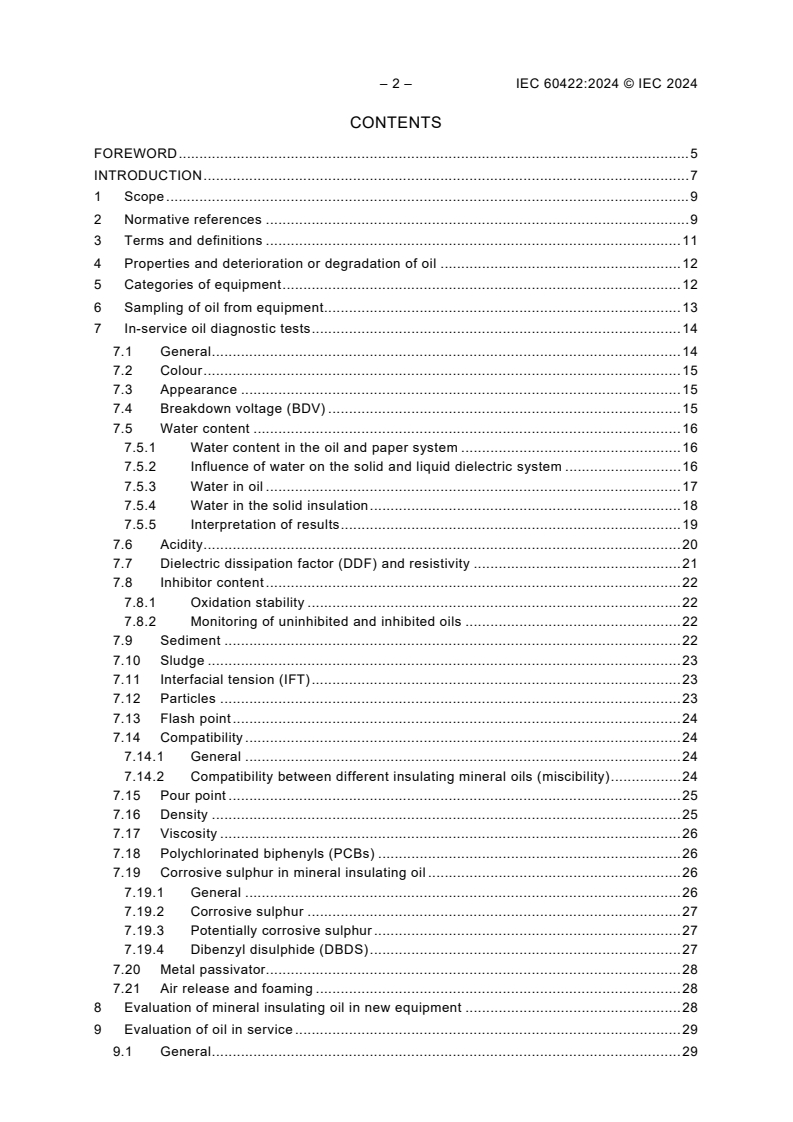
– 2 – IEC 60422:2024 © IEC 2024
CONTENTS
FOREWORD . 5
INTRODUCTION . 7
1 Scope . 9
2 Normative references . 9
3 Terms and definitions . 11
4 Properties and deterioration or degradation of oil . 12
5 Categories of equipment . 12
6 Sampling of oil from equipment. 13
7 In-service oil diagnostic tests . 14
7.1 General . 14
7.2 Colour . 15
7.3 Appearance . 15
7.4 Breakdown voltage (BDV) . 15
7.5 Water content . 16
7.5.1 Water content in the oil and paper system . 16
7.5.2 Influence of water on the solid and liquid dielectric system . 16
7.5.3 Water in oil . 17
7.5.4 Water in the solid insulation . 18
7.5.5 Interpretation of results . 19
7.6 Acidity . 20
7.7 Dielectric dissipation factor (DDF) and resistivity . 21
7.8 Inhibitor content . 22
7.8.1 Oxidation stability . 22
7.8.2 Monitoring of uninhibited and inhibited oils . 22
7.9 Sediment . 22
7.10 Sludge . 23
7.11 Interfacial tension (IFT) . 23
7.12 Particles . 23
7.13 Flash point . 24
7.14 Compatibility . 24
7.14.1 General . 24
7.14.2 Compatibility between different insulating mineral oils (miscibility) . 24
7.15 Pour point . 25
7.16 Density . 25
7.17 Viscosity . 26
7.18 Polychlorinated biphenyls (PCBs) . 26
7.19 Corrosive sulphur in mineral insulating oil . 26
7.19.1 General . 26
7.19.2 Corrosive sulphur . 27
7.19.3 Potentially corrosive sulphur . 27
7.19.4 Dibenzyl disulphide (DBDS) . 27
7.20 Metal passivator. 28
7.21 Air release and foaming . 28
8 Evaluation of mineral insulating oil in new equipment . 28
9 Evaluation of oil in service . 29
9.1 General . 29
9.2 Frequency of examination of oils in service . 30
9.3 Testing procedures . 31
9.3.1 General . 31
9.3.2 Field tests . 31
9.3.3 Laboratory tests . 32
9.4 Classification of the condition of oils in service . 32
9.4.1 General . 32
9.4.2 Transformers . 32
9.4.3 Tap-changers . 32
9.4.4 Instrument and protection transformers. 33
9.4.5 Circuit breakers and switchgear . 33
9.4.6 Oil filled and OIP bushings . 33
9.5 Corrective action . 34
10 Interpretation of results . 35
11 Handling and storage. 45
12 Replacement of oil in electrical equipment . 46
12.1 Replacement of oil in transformers with an U below 72,5 kV and in
m
switchgear and associated equipment . 46
12.2 Replacement of oil in transformers with an U of 72,5 kV and above. 46
m
12.3 Replacement of oil in electrical equipment contaminated with PCBs . 47
13 Addition of metal passivators to in-service oil . 47
14 Treatment . 47
14.1 Warning . 47
14.2 Classification of treatment processes . 48
14.2.1 General . 48
14.2.2 Off-line (de-energized) vs on-line (energized) treatment . 48
14.2.3 Batch vs continuous mode treatment . 49
14.3 Reconditioning (degassing, drying and filtration) . 49
14.3.1 General . 49
14.3.2 Reconditioning equipment. 50
14.3.3 Application to electrical equipment . 52
14.4 Reclaiming . 53
14.4.1 General . 53
14.4.2 Reclaiming by percolation with single use sorbents . 54
14.4.3 Reclaiming process using reactivating sorbents . 54
14.4.4 Renewal of additives . 56
14.5 Removal of PCBs using dehalogenation and related processes . 56
14.5.1 General . 56
14.5.2 Dehalogenation processes using sodium and lithium derivatives . 56
14.5.3 Dehalogenation processes using polyethylene glycol and potassium
hydroxide (KPEG) . 56
14.5.4 Dehalogenation in continuous mode by closed circuit process . 56
14.5.5 Corrosive sulphur removal using KPEG . 57
14.6 Criteria for oil reclamation and treatments . 57
Annex A (normative) Criteria for reclamation and treatments . 58
A.1 General . 58
A.2 Key parameters to measure before and after reclamation . 58
A.3 Addition of inhibitor after reclamation . 59
– 4 – IEC 60422:2024 © IEC 2024
A.4 Time and location of sampling . 60
Annex B (informative) General guideline for moisture %RS for continuous online
monitoring . 61
Annex C (informative) Normalizing water in oil for comparison and trending (historical
practice) . 62
C.1 General . 62
C.2 Sampling temperature at or above 35 °C . 62
Annex D (informative) Material compatibility . 64
Annex E (informative) Test method for determination of sediment and sludge . 66
E.1 Sediment determination . 66
E.2 Sludge determination . 66
Annex F (informative) Contamination of oils with silicone . 67
Bibliography . 68
Figure 1 – Water solubility curves for unused mineral oil as adapted from literature [5]
(according to Formula (3)) . 18
Figure 2 – Hysteresis loops of %RS vs. oil temperature in transformers with 3 different
water content levels [5] . 20
Figure 3 – Correlation between resistivity and dissipation factor [6] . 21
Figure C.1 – Normalization factors according to Formula (C.2) . 63
Table 1 – Categories of equipment . 13
Table 2 – Tests for in-service mineral insulating oils . 14
Table 3 – Recommended limits for mineral insulating oils after filling in new electrical
equipment prior to first energization at site . 29
Table 4 – Recommended frequency of testing . 31
Table 5 – Transformers and reactors – Application and interpretation of tests . 35
Table 6 – Tap-changers – Application and interpretation of tests . 41
Table 7 – Instrument and protection transformers – Application and interpretation of
tests . 42
Table 8 – Circuit breakers and switchgear – Application and interpretation of tests . 43
Table 9 – Oil filled and OIP bushings – Application and interpretation of tests . 44
Table 10 – Summary of typical actions . 45
Table 11 – Conditions for processing mineral insulating oils (both inhibited and
uninhibited) . 50
Table 12 – Beta ratio related to filter efficiency . 51
Table A.1 – Parameters where limits should be agreed upon . 58
Table A.2 – Parameters where limits should not necessarily be set but should be
measured for baseline and trending . 59
Table B.1 – Moisture %RS, continuous online monitoring, general guideline . 61
INTERNATIONAL ELECTROTECHNICAL COMMISSION
____________
MINERAL INSULATING OILS IN ELECTRICAL EQUIPMENT –
SUPERVISION AND MAINTENANCE GUIDANCE
FOREWORD
1) The International Electrotechnical Commission (IEC) is a worldwide organization for standardization comprising
all national electrotechnical committees (IEC National Committees). The object of IEC is to promote international
co-operation on all questions concerning standardization in the electrical and electronic fields. To this end and
in addition to other activities, IEC publishes International Standards, Technical Specifications, Technical Reports,
Publicly Available Specifications (PAS) and Guides (hereafter referred to as “IEC Publication(s)”). Their
preparation is entrusted to technical committees; any IEC National Committee interested in the subject dealt with
may participate in this preparatory work. International, governmental and non-governmental organizations liaising
with the IEC also participate in this preparation. IEC collaborates closely with the International Organization for
Standardization (ISO) in accordance with conditions determined by agreement between the two organizations.
2) The formal decisions or agreements of IEC on technical matters express, as nearly as possible, an international
consensus of opinion on the relevant subjects since each technical committee has representation from all
interested IEC National Committees.
3) IEC Publications have the form of recommendations for international use and are accepted by IEC National
Committees in that sense. While all reasonable efforts are made to ensure that the technical content of IEC
Publications is accurate, IEC cannot be held responsible for the way in which they are used or for any
misinterpretation by any end user.
4) In order to promote international uniformity, IEC National Committees undertake to apply IEC Publications
transparently to the maximum extent possible in their national and regional publications. Any divergence between
any IEC Publication and the corresponding national or regional publication shall be clearly indicated in the latter.
5) IEC itself does not provide any attestation of conformity. Independent certification bodies provide conformity
assessment services and, in some areas, access to IEC marks of conformity. IEC is not responsible for any
services carried out by independent certification bodies.
6) All users should ensure that they have the latest edition of this publication.
7) No liability shall attach to IEC or its directors, employees, servants or agents including individual experts and
members of its technical committees and IEC National Committees for any personal injury, property damage or
other damage of any nature whatsoever, whether direct or indirect, or for costs (including legal fees) and
expenses arising out of the publication, use of, or reliance upon, this IEC Publication or any other IEC
Publications.
8) Attention is drawn to the Normative references cited in this publication. Use of the referenced publications is
indispensable for the correct application of this publication.
9) IEC draws attention to the possibility that the implementation of this document may involve the use of (a)
patent(s). IEC takes no position concerning the evidence, validity or applicability of any claimed patent rights in
respect thereof. As of the date of publication of this document, IEC had not received notice of (a) patent(s), which
may be required to implement this document. However, implementers are cautioned that this may not represent
the latest information, which may be obtained from the patent database available at https://patents.iec.ch. IEC
shall not be held responsible for identifying any or all such patent rights.
IEC 60422 has been prepared by IEC technical committee 10: Fluids for electrotechnical
applications. It is an International Standard.
This fifth edition cancels and replaces the fourth edition published in 2013. This edition
constitutes a technical revision.
This edition includes the following significant technical changes with respect to the previous
edition:
a) This new edition represents a major revision of the fourth edition, bringing this document in
line with the latest developments in oil condition monitoring. New interpretation tables have
been created, containing limits for oil parameters specific to plant type with suggested
corrective actions in the tables and new test methods.
b) The action limits for all oil tests have been revised and changes made where necessary to
enable users to use current methodology and comply with requirements and regulations
affecting safety and environmental aspects.
– 6 – IEC 60422:2024 © IEC 2024
c) Category O has been removed and is now incorporated within category A.
d) Online moisture interpretation is now incorporated.
e) More guidance on oil treatment (including reclamation criteria) is now available.
f) Guidance has been updated regarding corrosive sulphur.
g) In addition, this document incorporates changes introduced in associated standards since
the fourth edition was published.
The text of this International Standard is based on the following documents:
Draft Report on voting
10/1233/FDIS 10/1239/RVD
Full information on the voting for its approval can be found in the report on voting indicated in
the above table.
The language used for the development of this International Standard is English.
This document was drafted in accordance with ISO/IEC Directives, Part 2, and developed in
accordance with ISO/IEC Directives, Part 1 and ISO/IEC Directives, IEC Supplement, available
at www.iec.ch/members_experts/refdocs. The main document types developed by IEC are
described in greater detail at www.iec.ch/publications.
The committee has decided that the contents of this document will remain unchanged until the
stability date indicated on the IEC website under webstore.iec.ch in the data related to the
specific document. At this date, the document will be
• reconfirmed,
• withdrawn, or
• revised.
IMPORTANT – The "colour inside" logo on the cover page of this document indicates
that it contains colours which are considered to be useful for the correct understanding
of its contents. Users should therefore print this document using a colour printer.
INTRODUCTION
Insulating mineral oils are used in electrical equipment employed in the generation,
transmission, distribution, and use of electrical energy.
Monitoring and maintaining oil quality is essential to ensure the reliable operation of oil-filled
electrical equipment. Codes of practice for this purpose have been established by electrical
power authorities, power companies and industries in many countries.
A review of current experience reveals a wide variation of procedures and guidance. It is
possible, however, to compare the value and significance of standardized oil tests and to
recommend uniform criteria for the evaluation of test data.
If a certain amount of oil deterioration (by degradation or contamination) is exceeded, there is
inevitably some erosion of safety margins and the question of the risk of failure should be
considered. While the quantification of the risk can be very difficult, a first step involves the
identification of potential effects of increased deterioration. The philosophy underlying this
document is to furnish users with as broad a base of understanding of oil quality deterioration
as is available, so that they can make informed decisions on inspection and maintenance
practices.
Mineral oils are valuable resources and should be utilised accordingly. Used mineral oils are,
by most regulations, deemed to be controlled waste. If spills occur, this can have a negative
environmental impact especially if the oil is contaminated by persistent organic pollutants such
as polychlorinated biphenyls (PCBs).
This document, whilst technically sound, is mainly intended to serve as a common basis for the
preparation of more specific and complete codes of practice by users in the light of local
circumstances. Sound engineering judgement will have to be exerted in seeking the best
compromise between technical requirements and economic factors.
Reference should also be made to instructions from the equipment manufacturer.
General caution
This document does not purport to address all the safety problems associated with its use. It is
the responsibility of the user of this document to establish appropriate health and safety
practices and determine the applicability of regulatory limitations prior to use.
The handling of mineral oils can be subject to local regulatory requirements and suppliers’
safety datasheets.
Environment, health, and safety
This document is applicable to mineral oils, chemicals and used sample containers. The
disposal of these items can be subject to local regulatory requirements regarding their impact
on the environment.
Attention is drawn to the fact that, at the time of writing this document, some mineral oils in
service are known to be contaminated to some degree with other liquids, for example, silicone
oils and PCBs.
Because of this, safety countermeasures should be taken to avoid risks to workers, the public
and the environment during the life of the equipment, by strictly controlling spills and emissions.
The disposal or decontamination of these oils can be subject to local regulatory requirements.
Every precaution should be taken to prevent release of mineral oil into the environment.
– 8 – IEC 60422:2024 © IEC 2024
Typically, each country has specific regulations around health and safety. Safety Data Sheets
(SDS) are normally used by the industry internationally and are usually written in accordance
with an international regulation set (such as REACH [1] ). Please consult the SDS from the
suppliers of the insulating product that is used. These documents provide essential information
regarding health, safety, and environmental impacts.
___________
Numbers in square brackets refer to the Bibliography.
MINERAL INSULATING OILS IN ELECTRICAL EQUIPMENT –
SUPERVISION AND MAINTENANCE GUIDANCE
1 Scope
This document provides monitoring guidance and procedures that are required for the use and
maintenance of mineral insulating oils and other hydrocarbon-based liquids in transformers and
other electrical equipment, including strategic spares and tanks for holding spare parts and
components.
This document is applicable to mineral insulating oils, originally supplied conforming to
IEC 60296, in transformers, switchgear and other electrical apparatus where oil sampling is
reasonably practicable, and where the normal operating conditions specified in the equipment
specifications apply.
This document is also intended to assist the power equipment operator to evaluate the condition
of the oil and maintain it in a serviceable condition. It also provides a common basis for the
preparation of more specific and complete local codes of practice.
The document includes recommendations on tests and evaluation procedures, and outlines
methods for reconditioning and reclaiming oil, and the decontamination of oil contaminated with
PCBs.
NOTE The condition monitoring of electrical equipment, for example by analysis of dissolved gases, furanic
compounds or other means, is outside the scope of this document.
2 Normative references
The following documents are referred to in the text in such a way that some or all of their content
constitutes requirements of this document. For dated references, only the edition cited applies.
For undated references, the latest edition of the referenced document (including any
amendments) applies.
IEC 60156, Insulating liquids – Determination of the breakdown voltage at power frequency –
Test method
IEC 60247, Insulating liquids – Measurement of relative permittivity, dielectric dissipation factor
(tan δ) and d.c. resistivity
IEC 60296:2020, Fluids for electrotechnical applications – Mineral insulating oils for electrical
equipment
IEC 60475, Method of sampling insulating liquids
IEC 60666:2010, Detection and determination of specified additives in mineral insulating oils
IEC 60814, Insulating liquids – Oil-impregnated paper and pressboard – Determination of water
by automatic coulometric Karl Fischer titration
IEC 60970, Insulating liquids – Methods for counting and sizing particles
IEC 61125:2018, Insulating liquids – Test methods for oxidation stability – Test method for
evaluating the oxidation stability of insulating liquids in the delivered state
– 10 – IEC 60422:2024 © IEC 2024
IEC 61619, Insulating liquids – Contamination by polychlorinated biphenyls (PCBs) – Method
of determination by capillary column gas chromatography
IEC 62021-1, Insulating liquids – Determination of acidity – Part 1: Automatic potentiometric
titration
IEC 62021-2, Insulating liquids – Determination of acidity – Part 2: Colourimetric titration
IEC 62535:2008, Insulating liquids – Test method for detection of potentially corrosive sulphur
in used and unused insulating oil
IEC 62697-1, Test methods for quantitative determination of corrosive sulfur compounds in
unused and used insulating liquids – Part 1: Test method for quantitative determination of
dibenzyldisulfide (DBDS)
IEC 62961, Insulating liquids – Test methods for the determination of interfacial tension of
insulating liquids – Determination with the ring method
ISO 2049, Petroleum products – Determination of colour (ASTM scale)
ISO 2719, Determination of flash point – Pensky-Martens closed cup method
ISO 3016, Petroleum and related products from natural or synthetic sources – Determination of
pour point
ISO 3104, Petroleum products – Transparent and opaque liquids – Determination of kinematic
viscosity and calculation of dynamic viscosity
ISO 3675, Crude petroleum and liquid petroleum products – Laboratory determination of density
– Hydrometer method
ISO 6247, Petroleum products – Determination of foaming characteristics of lubricating oils
ISO 9120, Petroleum and related products – Determination of air-release properties of steam
turbine and other oils – Impinger method
ISO 12185, Crude petroleum and petroleum products – Determination of density – Oscillating
U-tube method
ASTM D971, Standard Test Method for Interfacial Tension of Insulating Liquids Against Water
by the Ring Method
ASTM D7042, Standard Test Method for Dynamic Viscosity and Density of Liquids by Stabinger
Viscometer (and the Calculation of Kinematic Viscosity)
DIN 51353, Testing of insulating oils – Detection of corrosive sulphur – Silver strip test
3 Terms and definitions
For the purposes of this document, the following terms and definitions apply.
ISO and IEC maintain terminology databases for use in standardization at the following
addresses:
• IEC Electropedia: available at https://www.electropedia.org/
• ISO Online browsing platform: available at https://www.iso.org/obp
NOTE ASTM and IEEE terminologies are available on:
• ASTM D2864: Standard Terminology Relating to Electrical Insulating Liquids and Gases [2]
• IEEE C57.12.80: Standard Terminology for Power and Distribution Transformers [3]
3.1
local regulations
regulations pertinent to the particular process in the country concerned
Note 1 to entry: Such regulations can include local, regional or national legislation or internal regulations set by the
owner or operator of the equipment. Such regulations can refer to operational, environmental or health and safety
issues. A detailed risk assessment, including consideration of such regulations, will usually be required.
3.2
routine tests (Group 1)
minimum tests required to monitor the oil and to ensure that it is suitable for continued service
Note 1 to entry: If the results obtained from these tests do not exceed recommended action limits, usually no further
tests are considered necessary until the next regular period for inspection but, under certain perceived conditions,
complementary tests can be deemed prudent.
3.3
complementary tests (Group 2)
additional tests, which can be used to obtain further specific information about the quality of the
oil, and can be used to assist in the evaluation of the oil for continued use in service
3.4
special investigative tests (Group 3)
tests used mainly to determine the suitability of the oil for the type of equipment in use and to
ensure compliance with environmental and operational considerations
3.5
reconditioning
process that eliminates or reduces gases, water, solid particles, and contaminants by physical
processing only
3.6
reclamation
process that eliminates or reduces soluble and insoluble polar contaminants from the oil by
chemical and physical processing
3.7
PCBs decontamination
process that eliminates or reduces PCBs contamination from mineral oil
– 12 – IEC 60422:2024 © IEC 2024
4 Properties and deterioration or degradation of oil
The reliable performance of mineral insulating oil in an insulation system depends upon certain
basic oil characteristics that can affect the overall performance of the electrical equipment.
Certain properties of oil are necessary to accomplish its multiple roles of dielectric insulation,
cooling, arc-quenching and lubrication. Oil needs to possess certain properties, in particular:
• high dielectric strength to withstand the electric stresses imposed in service;
• sufficiently low viscosity so that its ability to circulate and transfer heat is not impaired;
• adequate viscosity range and lubricity to ensure fault-free operation and endurance of
mechanical equipment, such as tap-changers, over the whole temperature range;
• adequate low-temperature properties down to the lowest temperature expected at the
installation site;
• resistance to oxidation and pyrolytic degradation (by switching arcs) to maximize service
life;
• non-corrosive or detrimental to electrical plant construction materials that it is in contact
with.
In service, mineral oil degrades due to the conditions of use. In many applications, insulating
oil is in contact with air and is therefore subject to oxidation. Elevated temperatures accelerate
degradation. The presence of metals, organo-metallic compounds, or both, can act as a catalyst
for oxidation. Changes in colour, the formation of acidic compounds and, at an advanced stage
of oxidation, precipitation of sludge can occur. Dielectric and, in extreme cases, thermal
properties can be impaired.
In addition to oxidation products, many other undesirable contaminants, such as water, solid
particles and oil-soluble polar compounds can accumulate in the oil during service, and affect
its electrical properties. The presence of such contaminants and any oil degradation products
are indicated by a change in one or more properties as described in Table 2.
Deterioration of other constructional materials, which can interfere with the proper functioning
of the electrical equipment and shorten its working life, can also be indicated by changes in oil
properties.
The decision on when to carry out an intervention is normally the responsibility of the asset
owner and is usually part of a wider asset management strategy. When making intervention
decisions, consideration should not only be given to the condition of the oil but also to the age
and general condition of the plant item and its operational environment and duty. Carrying out
an expensive intervention on an asset that is reaching end of life is not cost effective,
alternatively not carrying out an intervention on a relatively new plant item even when certain
intervention limits have not yet been reached can contribute to accelerated ageing and
reduction in the projected asset life.
5 Categories of equipment
To take into account different user requirements, equipment has been placed in various
categories, as shown in Table 1.
Table 1 – Categories of equipment
Category Transformers and reactors
Category A Power transformers and reactors with an U above 170 kV. Power transformers of any rated
m
voltage where continuity of supply is vital and similar equipment for special applications
operating under onerous condition.
Power transformers and reactors with an U above 72,5 kV and up to and including 170 kV
Category B
m
(other than those in Category A).
Category C Power transformers and reactors for MV/LV application, e.g. U up to and including 72,5 kV
m
(distribution transformers) and traction transformers (other than those in Category A).
Instrument and protection transformers
Category D Instrument and protection transformers with an U above 170 kV.
m
Category E Instrument and protection transformers with an U up to and including 170 kV.
m
Tap-changers
Category F Diverter tanks of on-load tap-changers, including combined selector and diverter tanks.
Circuit breakers and switchgear
Category G Oil-filled circuit breakers, oil-filled switches, AC metal-enclosed switchgear and control gear
with an U exceeding 72,5 kV.
m
Category H Oil-filled circuit breakers, oil-filled switches, AC metal-enclosed switchgear and control gear
with an U up to and including 72,5 kV.
m
Oil filled and OIP bushings
Category K Bushings with an U above 170 kV.
m
Category L Bushings with an U up to and including 170 kV.
m
NOTE 1 Separated selector tanks of on-load tap-changers belong to the same category as the associated
transformer.
NOTE 2 Regardless of size or voltage, a risk assessment can justify condition-monitoring techniques usually
appropriate to a higher classification.
NOTE 3 For practical and economic reasons, some electrical utilities can decide that their small transformers up
to 1 MVA and 36 kV are not included in this classification. Routine monitoring programmes can be considered
uneconomical for this type of equipment. Where a monitoring programme is required for these transformers, the
guidelines given for Category C should be adequate.
NOTE 4 U is the highest voltage for equipment. This was referred to as "nominal system voltage" in previous
m
editions.
6 Sampling of oil from equipment
Sampling in accordance with IEC 60475, shall be performed by an experienced person with
adequate training, using approved sample conta
...