

IEC 61039:2025
(Main)Classification of insulating liquids
General Information
- Abstract
IEC 61039:2025 establishes the detailed classification of the N family (insulating liquids) that belongs to class L (lubricants, industrial oils and related products) in accordance with ISO 8681 and ISO 6743-99, affecting product categories that include products derived from petroleum processing, synthetic chemical products and synthetic and natural esters.
- Status
- Published
- Publication Date
- 16-Feb-2025
- Technical Committee
- TC 10 - Fluids for electrotechnical applications
- Drafting Committee
- MT 36 - TC 10/MT 36
- Current Stage
- PPUB - Publication issued
- Start Date
- 17-Feb-2025
- Completion Date
- 28-Feb-2025
Buy Documents
REDLINE IEC 61039:2025 CMV - Classification of insulating liquids/17/2025
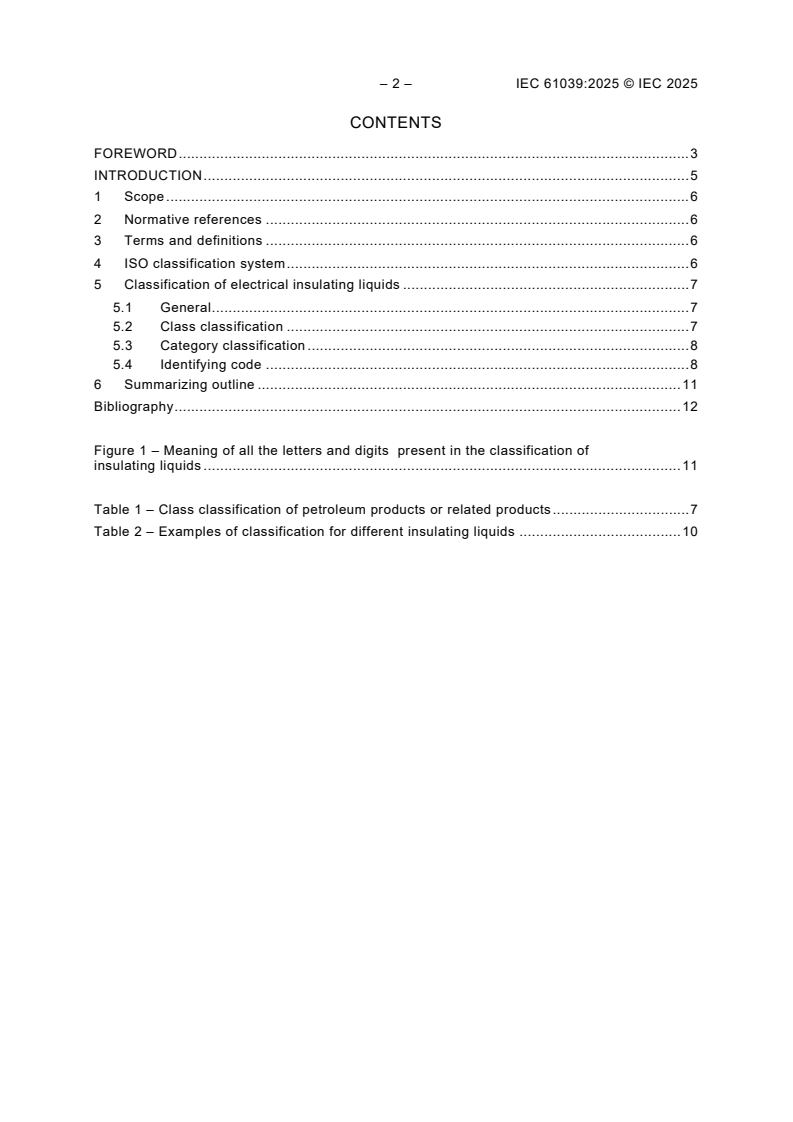
IEC 61039:2025 - Classification of insulating liquids Released:2/17/2025
Overview
IEC 61039:2025 is the latest international standard issued by the International Electrotechnical Commission (IEC) for the classification of insulating liquids. This third edition, published in February 2025, updates and revises the classification methods for insulating liquids belonging to the N family, classified under class L for lubricants, industrial oils, and related products.
The standard applies to unused electrical insulating liquids derived from petroleum processing, synthetic chemical products, and synthetic or natural esters. It aligns with ISO 8681 and ISO 6743-99 classification systems to ensure consistency and uniformity in product categorization worldwide. IEC 61039:2025 facilitates accurate identification and classification essential for manufacturers, users, and regulatory bodies involved in electrical insulation technologies.
Key Topics
Scope and Application
IEC 61039:2025 covers the classification framework for insulating liquids used in electrical equipment, focusing on unused liquids. It provides guidelines to categorize these liquids systematically based on their chemical origin and functional properties.ISO-based Classification System
The standard employs the ISO 8681 classification principles, assigning codes comprised of letters and numbers to specify the class, category, and detailed identification of insulating liquids:- Class Letter: Indicates the product category (e.g., L for lubricants and related products).
- Category Code: Four letters, starting with 'N' to denote the insulating liquid family.
- Identification Code: A seven-digit number offering precise liquid classification.
Class Letters and Definitions (Table 1)
- F: Fuels
- S: Solvents and raw materials for chemical industry
- L: Lubricants, industrial oils, and related products (insulating liquids fall under this class)
- W: Waxes
- B: Bitumen
Category Classification
The first letter ‘N’ identifies electrical insulating liquids, followed by specific characters defining subcategories based on chemical composition and properties. Compliance with sector-specific standards (e.g., IEC 60296 for mineral oils) takes precedence when applicable.Health, Safety, and Environmental Considerations
The standard stresses the importance of careful handling of insulating liquids, advising on personal hygiene and environmental protection measures due to the potential hazards of spillage and exposure.
Applications
IEC 61039:2025 serves multiple industries and use cases where insulating liquids play a critical role:
Electrical Equipment Manufacturing
Producers of transformers, capacitors, and switchgear depend on standardized insulating liquids to ensure product quality, longevity, and safety.Quality Control and Testing Laboratories
Classification aids labs in testing and verifying insulating liquid specifications against recognized industry standards.Regulatory Compliance and Certification
Facilitates conformity assessments by independent bodies by providing a universal classification system which underpins certification processes.Environmental and Safety Management
Helps companies implement safe handling and disposal procedures by recognizing the properties and environmental impact of different insulating liquids.Research and Development
Guides R&D efforts into new synthetic and natural ester-based insulating liquids meeting the evolving technical and ecological requirements.
Related Standards
IEC 61039:2025 complements and references several essential standards for insulating liquids and petroleum products classification:
ISO 8681 - Petroleum Products and Lubricants Classification
Establishes the overall rules and structure of classification codes used in IEC 61039.ISO 6743-99 - Lubricants and Related Products Classification
Specifies the family classification for insulating liquids.IEC 60296 - Mineral Insulating Oils for Electrical Equipment
Provides specific requirements and classification for mineral oil-based insulating liquids.ISO 2592 - Flash and Fire Point Determination
Critical test methods referenced for assessing safety characteristics of insulating liquids.OECD 301:1992 - Ready Biodegradability Testing Guidelines
Environmental assessment protocols applicable to biodegradable insulating liquids.ASTM D240 - Heat of Combustion Test Method
Used for determining energy content and combustion properties.
Conclusion
IEC 61039:2025 offers a comprehensive, internationally recognized framework to classify electrical insulating liquids accurately. Its alignment with ISO standards ensures consistency and facilitates global trade, quality control, environmental safety, and regulatory compliance. The classification system supports a variety of product types including petroleum-derived oils, synthetic chemicals, and ester-based liquids, reflecting innovations and sustainability trends in the electrical insulation sector.
For professionals involved in the production, testing, or regulation of insulating liquids, IEC 61039:2025 serves as an indispensable reference document, enhancing safety, reliability, and interoperability in electrotechnical applications.
Relations
- Effective Date
- 05-Sep-2023
Buy Documents
REDLINE IEC 61039:2025 CMV - Classification of insulating liquids/17/2025
IEC 61039:2025 - Classification of insulating liquids Released:2/17/2025
Get Certified
Connect with accredited certification bodies for this standard

IMQ S.p.A. (Certification)
Italian electrical product certification.

SLG Prüf- und Zertifizierungs GmbH
German testing and certification body.

UL Solutions
Global safety science company with testing, inspection and certification.
Sponsored listings
Frequently Asked Questions
IEC 61039:2025 is a standard published by the International Electrotechnical Commission (IEC). Its full title is "Classification of insulating liquids". This standard covers: IEC 61039:2025 establishes the detailed classification of the N family (insulating liquids) that belongs to class L (lubricants, industrial oils and related products) in accordance with ISO 8681 and ISO 6743-99, affecting product categories that include products derived from petroleum processing, synthetic chemical products and synthetic and natural esters.
IEC 61039:2025 establishes the detailed classification of the N family (insulating liquids) that belongs to class L (lubricants, industrial oils and related products) in accordance with ISO 8681 and ISO 6743-99, affecting product categories that include products derived from petroleum processing, synthetic chemical products and synthetic and natural esters.
IEC 61039:2025 is classified under the following ICS (International Classification for Standards) categories: 29.040.10 - Insulating oils. The ICS classification helps identify the subject area and facilitates finding related standards.
IEC 61039:2025 has the following relationships with other standards: It is inter standard links to IEC 61039:2008. Understanding these relationships helps ensure you are using the most current and applicable version of the standard.
IEC 61039:2025 is available in PDF format for immediate download after purchase. The document can be added to your cart and obtained through the secure checkout process. Digital delivery ensures instant access to the complete standard document.
Standards Content (Sample)
IEC 61039 ®
Edition 3.0 2025-02
COMMENTED VERSION
INTERNATIONAL
STANDARD
Classification of insulating liquids
All rights reserved. Unless otherwise specified, no part of this publication may be reproduced or utilized in any form
or by any means, electronic or mechanical, including photocopying and microfilm, without permission in writing from
either IEC or IEC's member National Committee in the country of the requester. If you have any questions about IEC
copyright or have an enquiry about obtaining additional rights to this publication, please contact the address below or
your local IEC member National Committee for further information.
IEC Secretariat Tel.: +41 22 919 02 11
3, rue de Varembé info@iec.ch
CH-1211 Geneva 20 www.iec.ch
Switzerland
About the IEC
The International Electrotechnical Commission (IEC) is the leading global organization that prepares and publishes
International Standards for all electrical, electronic and related technologies.
About IEC publications
The technical content of IEC publications is kept under constant review by the IEC. Please make sure that you have the
latest edition, a corrigendum or an amendment might have been published.
IEC publications search - webstore.iec.ch/advsearchform IEC Products & Services Portal - products.iec.ch
The advanced search enables to find IEC publications by a Discover our powerful search engine and read freely all the
variety of criteria (reference number, text, technical publications previews, graphical symbols and the glossary.
committee, …). It also gives information on projects, replaced With a subscription you will always have access to up to date
and withdrawn publications. content tailored to your needs.
IEC Just Published - webstore.iec.ch/justpublished
Electropedia - www.electropedia.org
Stay up to date on all new IEC publications. Just Published
The world's leading online dictionary on electrotechnology,
details all new publications released. Available online and
containing more than 22 500 terminological entries in English
once a month by email.
and French, with equivalent terms in 25 additional languages.
Also known as the International Electrotechnical Vocabulary
IEC Customer Service Centre - webstore.iec.ch/csc
(IEV) online.
If you wish to give us your feedback on this publication or
need further assistance, please contact the Customer Service
Centre: sales@iec.ch.
IEC 61039 ®
Edition 3.0 2025-02
COMMENTED VERSION
INTERNATIONAL
STANDARD
Classification of insulating liquids
INTERNATIONAL
ELECTROTECHNICAL
COMMISSION
ICS 29.040.10 ISBN 978-2-8327-0242-0
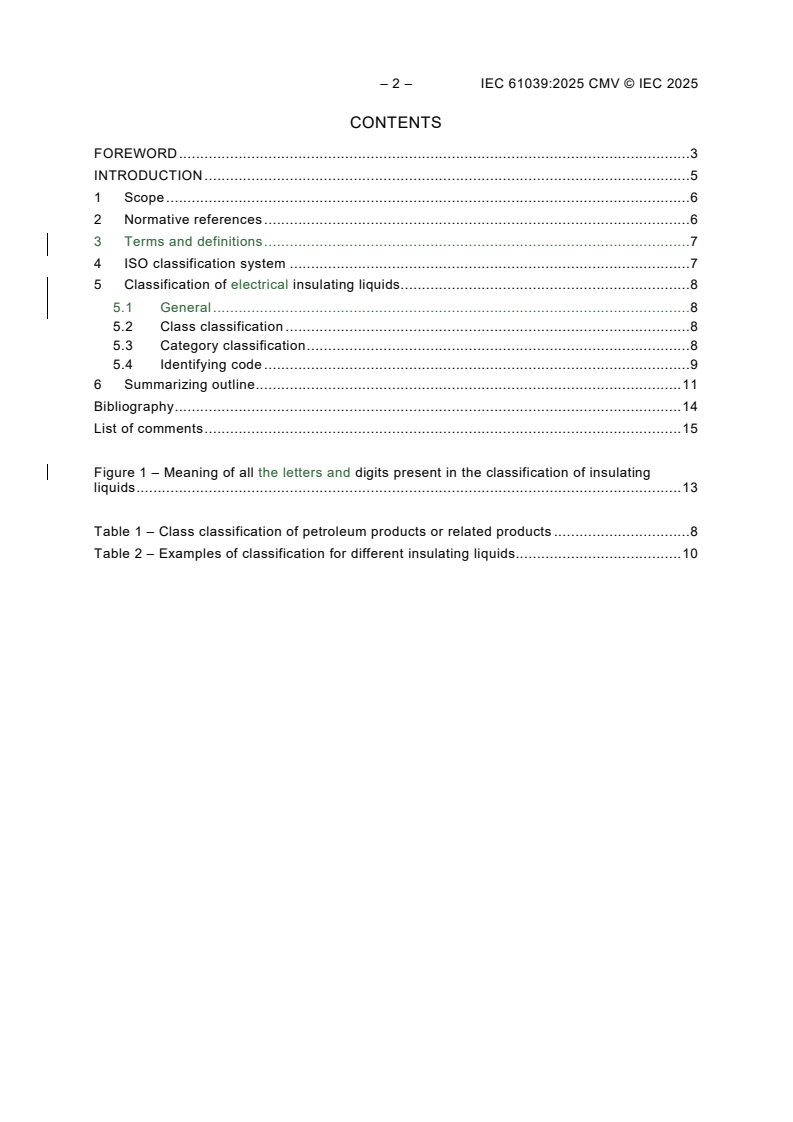
– 2 – IEC 61039:2025 CMV © IEC 2025
CONTENTS
FOREWORD .3
INTRODUCTION .5
1 Scope .6
2 Normative references .6
3 Terms and definitions .7
4 ISO classification system .7
5 Classification of electrical insulating liquids .8
5.1 General .8
5.2 Class classification .8
5.3 Category classification .8
5.4 Identifying code .9
6 Summarizing outline . 11
Bibliography . 14
List of comments . 15
Figure 1 – Meaning of all the letters and digits present in the classification of insulating
liquids . 13
Table 1 – Class classification of petroleum products or related products .8
Table 2 – Examples of classification for different insulating liquids . 10
INTERNATIONAL ELECTROTECHNICAL COMMISSION
____________
CLASSIFICATION OF INSULATING LIQUIDS
FOREWORD
1) The International Electrotechnical Commission (IEC) is a worldwide organization for standardization comprising
all national electrotechnical committees (IEC National Committees). The object of IEC is to promote international
co-operation on all questions concerning standardization in the electrical and electronic fields. To this end and
in addition to other activities, IEC publishes International Standards, Technical Specifications, Technical Reports,
Publicly Available Specifications (PAS) and Guides (hereafter referred to as “IEC Publication(s)”). Their
preparation is entrusted to technical committees; any IEC National Committee interested in the subject dealt with
may participate in this preparatory work. International, governmental and non-governmental organizations liaising
with the IEC also participate in this preparation. IEC collaborates closely with the International Organization for
Standardization (ISO) in accordance with conditions determined by agreement between the two organizations.
2) The formal decisions or agreements of IEC on technical matters express, as nearly as possible, an international
consensus of opinion on the relevant subjects since each technical committee has representation from all
interested IEC National Committees.
3) IEC Publications have the form of recommendations for international use and are accepted by IEC National
Committees in that sense. While all reasonable efforts are made to ensure that the technical content of IEC
Publications is accurate, IEC cannot be held responsible for the way in which they are used or for any
misinterpretation by any end user.
4) In order to promote international uniformity, IEC National Committees undertake to apply IEC Publications
transparently to the maximum extent possible in their national and regional publications. Any divergence between
any IEC Publication and the corresponding national or regional publication shall be clearly indicated in the latter.
5) IEC itself does not provide any attestation of conformity. Independent certification bodies provide conformity
assessment services and, in some areas, access to IEC marks of conformity. IEC is not responsible for any
services carried out by independent certification bodies.
6) All users should ensure that they have the latest edition of this publication.
7) No liability shall attach to IEC or its directors, employees, servants or agents including individual experts and
members of its technical committees and IEC National Committees for any personal injury, property damage or
other damage of any nature whatsoever, whether direct or indirect, or for costs (including legal fees) and
expenses arising out of the publication, use of, or reliance upon, this IEC Publication or any other IEC
Publications.
8) Attention is drawn to the Normative references cited in this publication. Use of the referenced publications is
indispensable for the correct application of this publication.
9) IEC draws attention to the possibility that the implementation of this document may involve the use of (a)
patent(s). IEC takes no position concerning the evidence, validity or applicability of any claimed patent rights in
respect thereof. As of the date of publication of this document, IEC had not received notice of (a) patent(s), which
may be required to implement this document. However, implementers are cautioned that this may not represent
the latest information, which may be obtained from the patent database available at https://patents.iec.ch. IEC
shall not be held responsible for identifying any or all such patent rights.
This commented version (CMV) of the official standard IEC 61039:2025 edition 3.0 allows
the user to identify the changes made to the previous IEC 61039:2008
edition 2.0. Furthermore, comments from IEC TC 10 experts are provided to explain the
reasons of the most relevant changes, or to clarify any part of the content.
A vertical bar appears in the margin wherever a change has been made. Additions are in
green text, deletions are in strikethrough red text. Experts' comments are identified by a
blue-background number. Mouse over a number to display a pop-up note with the
comment.
This publication contains the CMV and the official standard. The full list of comments is
available at the end of the CMV.
– 4 – IEC 61039:2025 CMV © IEC 2025
IEC 61039 has been prepared by IEC technical committee 10: Fluids for electrotechnical
applications. It is an International Standard.
This third edition cancels and replaces the second edition published in 2008. This edition
constitutes a technical revision.
This edition includes the following significant technical changes with respect to the previous
edition:
a) updating of the classification of insulating liquids, taking into account the largest number
possible of substances that have, or may have, a possible application in electrical
components.
The text of this International Standard is based on the following documents:
Draft Report on voting
10/1249/FDIS 10/1258/RVD
Full information on the voting for its approval can be found in the report on voting indicated in
the above table.
The language used for the development of this International Standard is English.
This document was drafted in accordance with ISO/IEC Directives, Part 2, and developed in
accordance with ISO/IEC Directives, Part 1 and ISO/IEC Directives, IEC Supplement, available
at www.iec.ch/members_experts/refdocs. The main document types developed by IEC are
described in greater detail at www.iec.ch/publications.
The committee has decided that the contents of this document will remain unchanged until the
stability date indicated on the IEC website under webstore.iec.ch in the data related to the
specific document. At this date, the document will be
• reconfirmed,
• withdrawn, or
• revised.
INTRODUCTION
WARNING – Health and safety
This document does not purport to address all the safety problems associated with its use. It is
the responsibility of the user of this document to establish appropriate health and safety
practices and determine the applicability of regulatory limitations prior to use.
The insulating liquids which are the subject of this document should be handled with due regard
to personal hygiene. Direct contact with eyes may can cause slight irritation. In the case of eye
contact, irrigation with copious quantities of clean running water should be carried out and
medical advice sought.
Some of the tests specified in this document involve the use of processes that could lead to a
hazardous situation. Attention is drawn to the relevant standard for guidance.
WARNING – Environment
This document involves insulating liquids, chemicals and used sample containers. The disposal
of these items should can be carried out in accordance with current national legislation subject
to regulatory requirements with regard to their impact on the environment.
All insulating liquids that float on water are generally a water hazard, as they reduce oxygen
ingress into the water. No liquid, regardless of its classification, can be freely spilled in the
environment. The handling of insulating liquids can be subject to regulatory requirements with
regard to their impact on the environment 1. Every precaution should be taken to prevent the
release of insulating liquids into the environment.
– 6 – IEC 61039:2025 CMV © IEC 2025
CLASSIFICATION OF INSULATING LIQUIDS
1 Scope
This document establishes the detailed classification of the N family (insulating liquids) that
belongs to class L (lubricants, industrial oils and related products) in accordance with ISO 8681
and ISO 6743-99, affecting product categories that include products derived from petroleum
processing, synthetic chemical products and synthetic and natural esters.
This document applies to unused liquids. For liquids in service, additional testing can be
required to ensure compliance with this document. 2
2 Normative references 3
The following documents are referred to in the text in such a way that some or all of their content
constitutes requirements of this document. For dated references, only the edition cited applies.
For undated references, the latest edition of the referenced document (including any
amendments) applies.
IEC/TS 60076-14:2004, Power transformers – Part 14: Design and application of liquid-
immersed power transformers using high-temperature insulation materials
IEC 60296:2003, Fluids for electrotechnical applications – Unused Mineral insulating
oils for transformers and switchgear electrical equipment
IEC 60465:1988, Specification for unused insulating mineral oils for cables with oil ducts
IEC 60836:2005, Specifications for unused silicone insulating liquids for electrotechnical
purposes
IEC 60867:1993, Insulating liquids – Specifications for unused liquids based on synthetic
aromatic hydrocarbons
IEC 60963:1988, Specification for unused polybutenes
IEC 61099:1992, Specifications for unused synthetic organic esters for electrical purposes
ISO 1928:1995, Solid mineral fuels – Determination of gross calorific value
by the bomb calorimetric method, and calculation of net calorific value
ISO 2592:2000, Petroleum and related products – Determination of flash and fire points –
Cleveland open cup method
ISO 6743-99:2002, Lubricants, industrial oils and related products (class L) – Classification –
Part 99: General
ISO 8681:1986, Petroleum products and lubricants – Method of classification – Definition of
classes
OECD 301:1992, OECD guidelines for testing of chemicals – Ready biodegradability
ASTM D240-02, Standard test method for heat of combustion of liquid hydrocarbon fuels by
bomb calorimeter
3 Terms and definitions
No terms and definitions are listed in this document.
ISO and IEC maintain terminology databases for use in standardization at the following
addresses: 4
• IEC Electropedia: available at https://www.electropedia.org/
• ISO Online browsing platform: available at https://www.iso.org/obp
4 ISO classification system
ISO 8681 sets out the main rules of the classification system that applies to petroleum products,
lubricants and related products. This document sets out the classification method which can be
used for electrical insulating liquids.
ISO 8681 suggests, as far as possible, to choose the application field as the main principle for
the classification of petroleum products, lubricants, and related products. It also suggests
classifying on the basis of the product typology, for example fuels are classified first of all on
the basis of typology and secondly on the basis of end use.
The ISO classification principle is based on the allocation of a code consisting of letters and
numbers for the main classes and categories of petroleum products.
The complete nomination consists of:
– the initials "ISO";
– the class of the petroleum product or related product, indicated by a letter (see Table 1),
which has to shall be clearly separated from the other symbols;
– the category, indicated by a group of four letters ranging from 1 to 4, the first one always
identifying the family to which it belongs and the others assuming a meaning, appropriately
explained in the reference standard, which depends on the particular category of concerned
products;
– (optional) some numbers, which can be added, to complete the nomination and that have a
meaning appropriately explained in the reference standard for that particular category of
products.
In compliance with ISO 8681, the code should have the following general form:
ISO – CLASS – CATEGORY – (eventual) NUMBERS (if applicable)
or the short form:
CLASS – CATEGORY – (eventual) NUMBERS (if applicable)
– 8 – IEC 61039:2025 CMV © IEC 2025
5 Classification of electrical insulating liquids 5
5.1 General
In accordance with ISO 8681, the classification system indicates the products with a nomination
that includes:
– the abbreviation "ISO";
– the class of the petroleum products or related products indicated by a letter that in this
document has the meaning defined in Table 1;
– the category indicated by four letters whose meaning is explained in 5.3;
– a seven-figuredigit number that makes up the identification code (described in 5.4).
5.2 Class classification
The class of petroleum products or related products is indicated by a letter having the meaning
reported in Table 1.
Table 1 – Class classification of petroleum products or related products
Class Indication
F Fuels
S Solvents and raw materials for chemical industry
L Lubricants, industrial oils and related products
W Waxes
B Bitumen
In accordance with the ISO/IEC agreement ISO 6743-99:2002, the electrical insulating liquids
belong to class L "lubricants, industrial oils and related products".
5.3 Category classification
In the case where the specific classification of insulating liquids is described in the
corresponding standard, it shall have priority over the classification given in this document. For
example, for mineral oils, IEC 60296 shall be applied. 6
The four letters identify the category, with the following meaning:
• First letter
The first letter, which identifies the insulating liquid family, will be N: Electrical insulation
(ISO 6743-99:2002, Table 1).
• Second letter
The second letter identifies the main application field as follows:
– C capacitors;
– T transformers and switching equipment;
– S switching equipment operating at temperature lower than −10 °C;
– Y cables.
NOTE 1 In order to provide an indication of fire behaviour of insulating liquids, and also wishing to benefit from the
experience gained by CT 14 of CENELEC, the following parameters have been added as well as the classifications
"fire point" and "low heat value". These employ the same classification criteria as the ones used for IEC 61100:1992.
• Third letter
The third letter identifies the eventual presence of antioxidant additives, if applicable. Liquids
may contain different antioxidants and different levels of antioxidants. Check with
corresponding liquid standards 7. The third letter is defined as:
– U if no antioxidant additives are present;
– T if additives are present in trace (% wt. < 0,08);
– I if antioxidant additives are present (percentage > 0,08 % wt).
NOTE 2 In this document Classification I also encompasses category T according to IEC 60296.
• Fourth letter
The fourth letter identifies the fire point as determined in accordance with ISO 2592. At the time
of writing of this document, liquids falling into category L are being phased out from use. There
is no IEC International Standard covering such liquids. 8
– O if the fire point is ≤ < 300 °C;
– K if the fire point is > ≥ 300 °C;
– L if the fire point of the liquid is not detectable.
NOTE 2 IEC TC10 usually adopts ISO 2719:2002 in order to measure the flash point using the Pensky-Martens
methodology (closed cup). If the value of the flash point determined by this method is < 250 °C, then the product is
classified with the letter “O”; if the flash point is > 250 °C, then the product is classified with the letter “K”, and, if
there is no detectable flash point, the product is classified with the letter “L”.
5.4 Identifying code
To complete the nomination, a seven-figuredigit number is added, with the following meaning:
• First three figures digits
The first three figures digits correspond to the last three numbers digits of the code that
identifies the eventual IEC reference standard identifier, if applicable, using number 000 in the
case where the IEC reference standard is missing.
• Fourth figure digit
The fourth figure digit identifies the eventual IEC sub-classification, if applicable, using number
0 if there is no sub-classification. Examples of sub-classifications occur with IEC 60867
(aromatic hydrocarbons, Table 2 of this document, rows 5, 6, 7) and IEC 63012 (modified and
blended esters, Table 2 of this document, row 12). See Table 2 for reference. 9
• Fifth figure digit
The fifth figure digit identifies the net calorific value as determined in accordance with
ASTM D240 (also known as the low heat value), as follows:
– 1 if the low heat value is ≥ 42 MJ/kg;
– 2 if the low heat value is < 42 MJ/kg and ≥ 32 MJ/Kg;
– 3 if the low heat value is < 32 MJ/kg.
• Sixth figure digit
The sixth figure digit identifies the eventual "lowest cold start energizing temperature" (LCSET)
defined as follows.
The information below is based largely on IEC 60296: 10
– 0 if LCSET is not prescribed known;
– 1 if LCSET is ≥ 0 °C;
– 10 – IEC 61039:2025 CMV © IEC 2025
– 2 if 0 °C > LCSET ≥ −10 °C;
– 3 if −10 °C > LCSET ≥ −30 °C;
– 4 if −30 °C > LCSET ≥ −40 °C.
• Seventh figure digit
The seventh figure digit identifies the biodegradability of the insulating liquid, according to
OECD 301:1992 methods B, C or F, defined as follows.
Note different methods may give different results.
– 0 if liquid is not biodegradable; (ThOD removed ≤ 20 %)
– 1 if liquid is slightly inherently biodegradable; (40 % ≥ ThOD removed > 20 %)
– 2 if liquid is well readily biodegradable; (70 % ≥ ThOD removed > 40 %). 11
– 3 if liquid is fully biodegradable. (ThOD removed > 70 %)
Table 2 depicts some examples of classification for different insulating liquids.
Note that the disposal of these items can be subject to regulatory requirements with regard to
their impact on the environment. Refer to the environmental warning in the introduction. 12
Table 2 – Examples of classification for different insulating liquids
Type of the insulating liquid
Comments/
examples
Mineral insulating oil for transformers
1 L NTUO 296 – 43 MJ/kg −7 Slight Inherent
with combustion fire point equal to
13 200 °C, low heat value (net calorific
value) equal to 43 MJ/kg, non-inhibited,
with LCSET = −7 °C
L-NTUO-2960121
Mineral insulating oil for transformers
2 L NTTK 296 – 43 MJ/kg −7 Slight Inherent
with combustion fire point equal to 350
NTIK
< 300 °C, low heat value equal to
43 MJ/kg, inhibited in trace, with LCSET
= −7 °C
L-NTTKNTIO-2960121
Mineral insulating oil for transformers
3 L NTIO 296 – 43 MJ/kg −7 Slight Inherent
with combustion fire point equal to
200 °C, low heat value equal to
43 MJ/kg, inhibited, with LCSET = −7 °C
L-NTIO-2960121
Mineral insulating oil for switching
4 L NSIO 296 – 43 MJ/kg −30 Slight Inherent
equipment operating at low temperature
with combustion fire point equal to
200 °C low heat value equal to 43 MJ/kg,
inhibited, with LCSET = −30 °C
L-NSIO-2960131
IEC sheet 1 of IEC 60867
5 L NYUO 867 1 43 MJ/kg – Slight Inherent
alkyl benzene: for cables, uninhibited,
fire point < 300 °C
L-NYUO-8671101
Example
Class
Category
IEC standard
identification
IEC sub-
classification
Low heat value
(ASTM D240-02)
LCSET (°C)
Bio-
degradability
Type of the insulating liquid
Comments/
examples
6 L NCUO 867 2 43 MJ/kg – Slight Inherent IEC sheet 2, alkyl bibenzyl:
IEC sheet 2, of IEC 60867,
alkyldiphenylethanes: for capacitors,
uninhibited, fire point < 300 °C, LCSET
not defined
L-NCUO-867211018672101
7 L NCUO 867 3 43 MJ/kg – Slight Inherent IEC sheet 3, alkyl naphthalene
IEC sheet 3, of IEC 60867,
methylpolyarylmethanes uninhibited, for
capacitors, fire point < 300 °C, LCSET
not defined
L-NCUO-867311018673101
IEC 60836 – unused silicone liquids for
8 L NTUK 836 – < 32 MJ/kg ≤ −40 Not
transformers, uninhibited, fire
biodegradable
point > 300 °C
L-NTUK-83603008360340
Synthetic ester with fire point > 300 °C
9 L NTIK 099 – > 42 MJ/Kg – Readily
for transformers,
biodegradable
L-NTIK-0990102
Synthetic ester with fire point < 300 °C,
10 L NTIO 012 – < 42 MJ/Kg – Readily
inhibited
biodegradable
L-NTIO-0120202
Natural ester with fire point > 300 °C,
11 L NTIK 770 – < 42 MJ/Kg – Readily
inhibited
biodegradable
L-NTIK-7700202
Modified ester for transformers with fire
12 L NTIO 012 _ < 42 MJ/Kg – Readily
point < 300 °C, inhibited, no defined
biodegradable
LCSET
L-NTIO0120202
6 Summarizing outline
Figure 1 summarizes how to build up a code for classifying an insulating liquid.
Example
Class
Category
IEC standard
identification
IEC sub-
classification
Low heat value
(ASTM D240-02)
LCSET (°C)
Bio-
degradability
– 12 – IEC 61039:2025 CMV © IEC 2025
Application Presence of
field additives
Family Fire point
Number
ISO
Class Category
Last three
figures of IEC
reference
Biodegradability
standard
IEC Low heat
LCSET
sub-classification valuer
IEC 1288/08
Figure 1 – Meaning of all the letters and digits
present in the classification of insulating liquids
– 14 – IEC 61039:2025 CMV © IEC 2025
Bibliography 15
IEC 61100 :1992, Classification of insulating liquids according to fire-point and net calorific
value
IEC 60836, Specifications for unused silicone insulating liquids for electrotechnical purposes
IEC 60867, Insulating liquids – Specifications for unused liquids based on synthetic aromatic
hydrocarbons
IEC 61099, Insulating liquids – Specifications for unused synthetic organic esters for electrical
purposes
IEC 62770, Fluids for electrotechnical applications – Unused natural esters for transformers
and similar electrical equipment
IEC 63012, Insulating liquids – Unused modified or blended esters for electrotechnical
applications
etermination of flash point – Pensky-Martens closed cup method
ISO 2719:2002, D
ISO 6743-99:2002, Lubricants, industrial oils and related products (class L) – Classification –
Part 99: General
List of comments
1 Additional wording is inserted to alert the reader of the latest environmental position on oils
that float on water, which most electrical insulating liquids do.
2 Wording is added to remind the reader that the standard only applies to unused liquids.
3 The normative references list is updated since the previous edition of this standard.
4 Web addresses for terms and definitions reference documents are added for clarity.
5 The heading of this chapter reminds the reader that the section applies to electrical
insulating liquids.
6 Statement is added to remind the reader that specific classifications given in fluid specific
standards (e.g. IEC 60296 for mineral oils) take precedent over classifications derived from
this standard.
7 Wording is added to remind the reader that different manufacturers of a type of liquid may
use different types and concentrations of antioxidants in their liquids, even if the liquids fall
into the same type, e.g. synthetic esters.
8 Wording is added to advise that category L liquids (e.g. PCB) are being phased out of use.
9 Wording is added to explain sub-classes.
10 Wording is added to explain where LCSET information comes from.
11 Biodegradable terms are aligned with OECD terminology.
12 Wording is added to underline the importance of proper liquid disposal.
13 Biodegradation category is aligned with OECD terminology.
14 Examples 9 to 12 are added for clarity in categorizing non mineral oils.
15 The bibliography list is updated since the previous edition of this standard.
___________
IEC 61039 ®
Edition 3.0 2025-02
INTERNATIONAL
STANDARD
NORME
INTERNATIONALE
Classification of insulating liquids
Classification des liquides isolants
– 2 – IEC 61039:2025 © IEC 2025
CONTENTS
FOREWORD . 3
INTRODUCTION . 5
1 Scope . 6
2 Normative references . 6
3 Terms and definitions . 6
4 ISO classification system . 6
5 Classification of electrical insulating liquids . 7
5.1 General . 7
5.2 Class classification . 7
5.3 Category classification . 8
5.4 Identifying code . 8
6 Summarizing outline . 11
Bibliography . 12
Figure 1 – Meaning of all the letters and digits present in the classification of
insulating liquids . 11
Table 1 – Class classification of petroleum products or related products . 7
Table 2 – Examples of classification for different insulating liquids . 10
INTERNATIONAL ELECTROTECHNICAL COMMISSION
____________
CLASSIFICATION OF INSULATING LIQUIDS
FOREWORD
1) The International Electrotechnical Commission (IEC) is a worldwide organization for standardization comprising
all national electrotechnical committees (IEC National Committees). The object of IEC is to promote international
co-operation on all questions concerning standardization in the electrical and electronic fields. To this end and
in addition to other activities, IEC publishes International Standards, Technical Specifications, Technical Reports,
Publicly Available Specifications (PAS) and Guides (hereafter referred to as “IEC Publication(s)”). Their
preparation is entrusted to technical committees; any IEC National Committee interested in the subject dealt with
may participate in this preparatory work. International, governmental and non-governmental organizations liaising
with the IEC also participate in this preparation. IEC collaborates closely with the International Organization for
Standardization (ISO) in accordance with conditions determined by agreement between the two organizations.
2) The formal decisions or agreements of IEC on technical matters express, as nearly as possible, an international
consensus of opinion on the relevant subjects since each technical committee has representation from all
interested IEC National Committees.
3) IEC Publications have the form of recommendations for international use and are accepted by IEC National
Committees in that sense. While all reasonable efforts are made to ensure that the technical content of IEC
Publications is accurate, IEC cannot be held responsible for the way in which they are used or for any
misinterpretation by any end user.
4) In order to promote international uniformity, IEC National Committees undertake to apply IEC Publications
transparently to the maximum extent possible in their national and regional publications. Any divergence between
any IEC Publication and the corresponding national or regional publication shall be clearly indicated in the latter.
5) IEC itself does not provide any attestation of conformity. Independent certification bodies provide conformity
assessment services and, in some areas, access to IEC marks of conformity. IEC is not responsible for any
services carried out by independent certification bodies.
6) All users should ensure that they have the latest edition of this publication.
7) No liability shall attach to IEC or its directors, employees, servants or agents including individual experts and
members of its technical committees and IEC National Committees for any personal injury, property damage or
other damage of any nature whatsoever, whether direct or indirect, or for costs (including legal fees) and
expenses arising out of the publication, use of, or reliance upon, this IEC Publication or any other IEC
Publications.
8) Attention is drawn to the Normative references cited in this publication. Use of the referenced publications is
indispensable for the correct application of this publication.
9) IEC draws attention to the possibility that the implementation of this document may involve the use of (a)
patent(s). IEC takes no position concerning the evidence, validity or applicability of any claimed patent rights in
respect thereof. As of the date of publication of this document, IEC had not received notice of (a) patent(s), which
may be required to implement this document. However, implementers are cautioned that this may not represent
the latest information, which may be obtained from the patent database available at https://patents.iec.ch. IEC
shall not be held responsible for identifying any or all such patent rights.
IEC 61039 has been prepared by IEC technical committee 10: Fluids for electrotechnical
applications. It is an International Standard.
This third edition cancels and replaces the second edition published in 2008. This edition
constitutes a technical revision.
This edition includes the following significant technical changes with respect to the previous
edition:
a) updating of the classification of insulating liquids, taking into account the largest number
possible of substances that have, or may have, a possible application in electrical
components.
– 4 – IEC 61039:2025 © IEC 2025
The text of this International Standard is based on the following documents:
Draft Report on voting
10/1249/FDIS 10/1258/RVD
Full information on the voting for its approval can be found in the report on voting indicated in
the above table.
The language used for the development of this International Standard is English.
This document was drafted in accordance with ISO/IEC Directives, Part 2, and developed in
accordance with ISO/IEC Directives, Part 1 and ISO/IEC Directives, IEC Supplement, available
at www.iec.ch/members_experts/refdocs. The main document types developed by IEC are
described in greater detail at www.iec.ch/publications.
The committee has decided that the contents of this document will remain unchanged until the
stability date indicated on the IEC website under webstore.iec.ch in the data related to the
specific document. At this date, the document will be
• reconfirmed,
• withdrawn, or
• revised.
INTRODUCTION
WARNING – Health and safety
This document does not purport to address all the safety problems associated with its use. It is
the responsibility of the user of this document to establish appropriate health and safety
practices and determine the applicability of regulatory limitations prior to use.
The insulating liquids which are the subject of this document should be handled with due regard
to personal hygiene. Direct contact with eyes can cause slight irritation. In the case of eye
contact, irrigation with copious quantities of clean running water should be carried out and
medical advice sought.
Some of the tests specified in this document involve the use of processes that could lead to a
hazardous situation. Attention is drawn to the relevant standard for guidance.
WARNING – Environment
This document involves insulating liquids, chemicals and used sample containers. The disposal
of these items can be subject to regulatory requirements with regard to their impact on the
environment.
All insulating liquids that float on water are generally a water hazard, as they reduce oxygen
ingress into the water. No liquid, regardless of its classification, can be freely spilled in the
environment. The handling of insulating liquids can be subject to regulatory requirements with
regard to their impact on the environment. Every precaution should be taken to prevent the
release of insulating liquids into the environment.
– 6 – IEC 61039:2025 © IEC 2025
CLASSIFICATION OF INSULATING LIQUIDS
1 Scope
This document establishes the detailed classification of the N family (insulating liquids) that
belongs to class L (lubricants, industrial oils and related products) in accordance with ISO 8681
and ISO 6743-99, affecting product categories that include products derived from petroleum
processing, synthetic chemical products and synthetic and natural esters.
This document applies to unused liquids. For liquids in service, additional testing can be
required to ensure compliance with this document.
2 Normative references
The following documents are referred to in the text in such a way that some or all of their content
constitutes requirements of this document. For dated references, only the edition cited applies.
For undated references, the latest edition of the referenced document (including any
amendments) applies.
IEC 60296, Fluids for electrotechnical applications – Mineral insulating oils for electrical
equipment
ISO 2592, Petroleum and related products – Determination of flash and fire points – Cleveland
open cup method
ISO 8681, Petroleum products and lubricants – Method of classification – Definition of classes
OECD 301:1992, OECD guidelines for testing of chemicals – Ready biodegradability
ASTM D240, Standard test method for heat of combustion of liquid hydrocarbon fuels by bomb
calorimeter
3 Terms and definitions
No terms and definitions are listed in this document.
ISO and IEC maintain terminology databases for use in standardization at the following
addresses:
• IEC Electropedia: available at https://www.electropedia.org/
• ISO Online browsing platform: available at https://www.iso.org/obp
4 ISO classification system
ISO 8681 sets out the main rules of the classification system that applies to petroleum products,
lubricants and related products. This document sets out the classification method which can be
used for electrical insulating liquids.
ISO 8681 suggests, as far as possible, to choose the application field as the main principle for
the classification of petroleum products, lubricants, and related products. It also suggests
classifying on the basis of the product typology, for example fuels are classified first of all on
the basis of typology and secondly on the basis of end use.
The ISO classification principle is based on the allocation of a code consisting of letters and
numbers for the main classes and categories of petroleum products.
The complete nomination consists of:
– the initials "ISO";
– the class of the petroleum product or related product, indicated by a letter (see Table 1),
which shall be clearly separated from the other symbols;
– the category, indicated by a group of four letters, the first one always identifying the family
to which it belongs and the others assuming a meaning, appropriately explained in the
reference standard, which depends on the particular category of concerned products;
– (optional) some numbers, which can be added, to complete the nomination and that have a
meaning appropriately explained in the reference standard for that particular category of
products.
In compliance with ISO 8681, the code should have the following general form:
ISO – CLASS – CATEGORY –NUMBERS (if applicable)
or the short form:
CLASS – CATEGORY –NUMBERS (if applicable)
5 Classification of electrical insulating liquids
5.1 General
In accordance with ISO 8681, the classification system indicates the products with a nomination
that includes:
– the abbreviation "ISO";
– the class of the petroleum products or related products indicated by a letter that in this
document has the meaning defined in Table 1;
– the category indicated by four letters whose meaning is explained in 5.3;
– a seven-digit number that makes up the identification code (described in 5.4).
5.2 Class classification
The class of petroleum products or related products is indicated by a letter having the meaning
reported in Table 1.
Table 1 – Class classification of petroleum products or related products
Class Indication
F Fuels
S Solvents and raw materials for chemical industry
L Lubricants, industrial oils and related products
W Waxes
B Bitumen
In accordance with ISO 6743-99:2002, the electrical insulating liquids belong to class L
"lubricants, industrial oils and related products".
– 8 – IEC 61039:2025 © IEC 2025
5.3 Category classification
In the case where the specific classification of insulating liquids is described in the
corresponding standard, it shall have priority over the classification given in this document. For
example, for mineral oils, IEC 60296 shall be applied.
The four letters identify the category, with the following meaning:
• First letter
The first letter, which identifies the insulating liquid family, will be N: Electrical insulation
(ISO 6743-99:2002, Table 1).
• Second letter
The second letter identifies the main application field as follows:
– C capacitors;
– T transformers and switching equipment;
– S switching equipment operating at temperature lower than −10 °C;
– Y cables.
NOTE 1 In order to provide an indication of fire behaviour of insulating liquids, and also wishing to benefit from the
experience gained by CT 14 of CENELEC, the following parameters have been added as well as the classifications
"fire point" and "low heat value".
• Third letter
The third letter identifies the presence of antioxidant additives, if applicable. Liquids may
contain different antioxidants and different levels of antioxidants. Check with corresponding
liquid standards. The third letter i
...
IEC 61039 ®
Edition 3.0 2025-02
INTERNATIONAL
STANDARD
NORME
INTERNATIONALE
Classification of insulating liquids
Classification des liquides isolants
All rights reserved. Unless otherwise specified, no part of this publication may be reproduced or utilized in any form
or by any means, electronic or mechanical, including photocopying and microfilm, without permission in writing from
either IEC or IEC's member National Committee in the country of the requester. If you have any questions about IEC
copyright or have an enquiry about obtaining additional rights to this publication, please contact the address below or
your local IEC member National Committee for further information.
Droits de reproduction réservés. Sauf indication contraire, aucune partie de cette publication ne peut être reproduite ni
utilisée sous quelque forme que ce soit et par aucun procédé, électronique ou mécanique, y compris la photocopie et
les microfilms, sans l'accord écrit de l'IEC ou du Comité national de l'IEC du pays du demandeur. Si vous avez des
questions sur le copyright de l'IEC ou si vous désirez obtenir des droits supplémentaires sur cette publication, utilisez
les coordonnées ci-après ou contactez le Comité national de l'IEC de votre pays de résidence.
IEC Secretariat Tel.: +41 22 919 02 11
3, rue de Varembé info@iec.ch
CH-1211 Geneva 20 www.iec.ch
Switzerland
About the IEC
The International Electrotechnical Commission (IEC) is the leading global organization that prepares and publishes
International Standards for all electrical, electronic and related technologies.
About IEC publications
The technical content of IEC publications is kept under constant review by the IEC. Please make sure that you have the
latest edition, a corrigendum or an amendment might have been published.
IEC publications search - webstore.iec.ch/advsearchform IEC Products & Services Portal - products.iec.ch
The advanced search enables to find IEC publications by a Discover our powerful search engine and read freely all the
variety of criteria (reference number, text, technical publications previews, graphical symbols and the glossary.
committee, …). It also gives information on projects, replaced With a subscription you will always have access to up to date
and withdrawn publications. content tailored to your needs.
IEC Just Published - webstore.iec.ch/justpublished
Electropedia - www.electropedia.org
Stay up to date on all new IEC publications. Just Published
The world's leading online dictionary on electrotechnology,
details all new publications released. Available online and once
containing more than 22 500 terminological entries in English
a month by email.
and French, with equivalent terms in 25 additional languages.
Also known as the International Electrotechnical Vocabulary
IEC Customer Service Centre - webstore.iec.ch/csc
(IEV) online.
If you wish to give us your feedback on this publication or need
further assistance, please contact the Customer Service
Centre: sales@iec.ch.
A propos de l'IEC
La Commission Electrotechnique Internationale (IEC) est la première organisation mondiale qui élabore et publie des
Normes internationales pour tout ce qui a trait à l'électricité, à l'électronique et aux technologies apparentées.
A propos des publications IEC
Le contenu technique des publications IEC est constamment revu. Veuillez vous assurer que vous possédez l’édition la
plus récente, un corrigendum ou amendement peut avoir été publié.
Recherche de publications IEC - IEC Products & Services Portal - products.iec.ch
webstore.iec.ch/advsearchform Découvrez notre puissant moteur de recherche et consultez
La recherche avancée permet de trouver des publications IEC gratuitement tous les aperçus des publications, symboles
en utilisant différents critères (numéro de référence, texte, graphiques et le glossaire. Avec un abonnement, vous aurez
comité d’études, …). Elle donne aussi des informations sur les toujours accès à un contenu à jour adapté à vos besoins.
projets et les publications remplacées ou retirées.
Electropedia - www.electropedia.org
IEC Just Published - webstore.iec.ch/justpublished
Le premier dictionnaire d'électrotechnologie en ligne au monde,
Restez informé sur les nouvelles publications IEC. Just
avec plus de 22 500 articles terminologiques en anglais et en
Published détaille les nouvelles publications parues.
français, ainsi que les termes équivalents dans 25 langues
Disponible en ligne et une fois par mois par email.
additionnelles. Egalement appelé Vocabulaire
Electrotechnique International (IEV) en ligne.
Service Clients - webstore.iec.ch/csc
Si vous désirez nous donner des commentaires sur cette
publication ou si vous avez des questions contactez-nous:
sales@iec.ch.
IEC 61039 ®
Edition 3.0 2025-02
INTERNATIONAL
STANDARD
NORME
INTERNATIONALE
Classification of insulating liquids
Classification des liquides isolants
INTERNATIONAL
ELECTROTECHNICAL
COMMISSION
COMMISSION
ELECTROTECHNIQUE
INTERNATIONALE
ICS 29.040.10 ISBN 978-2-8327-0162-1
– 2 – IEC 61039:2025 © IEC 2025
CONTENTS
FOREWORD . 3
INTRODUCTION . 5
1 Scope . 6
2 Normative references . 6
3 Terms and definitions . 6
4 ISO classification system . 6
5 Classification of electrical insulating liquids . 7
5.1 General . 7
5.2 Class classification . 7
5.3 Category classification . 8
5.4 Identifying code . 8
6 Summarizing outline . 11
Bibliography . 12
Figure 1 – Meaning of all the letters and digits present in the classification of
insulating liquids . 11
Table 1 – Class classification of petroleum products or related products . 7
Table 2 – Examples of classification for different insulating liquids . 10
INTERNATIONAL ELECTROTECHNICAL COMMISSION
____________
CLASSIFICATION OF INSULATING LIQUIDS
FOREWORD
1) The International Electrotechnical Commission (IEC) is a worldwide organization for standardization comprising
all national electrotechnical committees (IEC National Committees). The object of IEC is to promote international
co-operation on all questions concerning standardization in the electrical and electronic fields. To this end and
in addition to other activities, IEC publishes International Standards, Technical Specifications, Technical Reports,
Publicly Available Specifications (PAS) and Guides (hereafter referred to as “IEC Publication(s)”). Their
preparation is entrusted to technical committees; any IEC National Committee interested in the subject dealt with
may participate in this preparatory work. International, governmental and non-governmental organizations liaising
with the IEC also participate in this preparation. IEC collaborates closely with the International Organization for
Standardization (ISO) in accordance with conditions determined by agreement between the two organizations.
2) The formal decisions or agreements of IEC on technical matters express, as nearly as possible, an international
consensus of opinion on the relevant subjects since each technical committee has representation from all
interested IEC National Committees.
3) IEC Publications have the form of recommendations for international use and are accepted by IEC National
Committees in that sense. While all reasonable efforts are made to ensure that the technical content of IEC
Publications is accurate, IEC cannot be held responsible for the way in which they are used or for any
misinterpretation by any end user.
4) In order to promote international uniformity, IEC National Committees undertake to apply IEC Publications
transparently to the maximum extent possible in their national and regional publications. Any divergence between
any IEC Publication and the corresponding national or regional publication shall be clearly indicated in the latter.
5) IEC itself does not provide any attestation of conformity. Independent certification bodies provide conformity
assessment services and, in some areas, access to IEC marks of conformity. IEC is not responsible for any
services carried out by independent certification bodies.
6) All users should ensure that they have the latest edition of this publication.
7) No liability shall attach to IEC or its directors, employees, servants or agents including individual experts and
members of its technical committees and IEC National Committees for any personal injury, property damage or
other damage of any nature whatsoever, whether direct or indirect, or for costs (including legal fees) and
expenses arising out of the publication, use of, or reliance upon, this IEC Publication or any other IEC
Publications.
8) Attention is drawn to the Normative references cited in this publication. Use of the referenced publications is
indispensable for the correct application of this publication.
9) IEC draws attention to the possibility that the implementation of this document may involve the use of (a)
patent(s). IEC takes no position concerning the evidence, validity or applicability of any claimed patent rights in
respect thereof. As of the date of publication of this document, IEC had not received notice of (a) patent(s), which
may be required to implement this document. However, implementers are cautioned that this may not represent
the latest information, which may be obtained from the patent database available at https://patents.iec.ch. IEC
shall not be held responsible for identifying any or all such patent rights.
IEC 61039 has been prepared by IEC technical committee 10: Fluids for electrotechnical
applications. It is an International Standard.
This third edition cancels and replaces the second edition published in 2008. This edition
constitutes a technical revision.
This edition includes the following significant technical changes with respect to the previous
edition:
a) updating of the classification of insulating liquids, taking into account the largest number
possible of substances that have, or may have, a possible application in electrical
components.
– 4 – IEC 61039:2025 © IEC 2025
The text of this International Standard is based on the following documents:
Draft Report on voting
10/1249/FDIS 10/1258/RVD
Full information on the voting for its approval can be found in the report on voting indicated in
the above table.
The language used for the development of this International Standard is English.
This document was drafted in accordance with ISO/IEC Directives, Part 2, and developed in
accordance with ISO/IEC Directives, Part 1 and ISO/IEC Directives, IEC Supplement, available
at www.iec.ch/members_experts/refdocs. The main document types developed by IEC are
described in greater detail at www.iec.ch/publications.
The committee has decided that the contents of this document will remain unchanged until the
stability date indicated on the IEC website under webstore.iec.ch in the data related to the
specific document. At this date, the document will be
• reconfirmed,
• withdrawn, or
• revised.
INTRODUCTION
WARNING – Health and safety
This document does not purport to address all the safety problems associated with its use. It is
the responsibility of the user of this document to establish appropriate health and safety
practices and determine the applicability of regulatory limitations prior to use.
The insulating liquids which are the subject of this document should be handled with due regard
to personal hygiene. Direct contact with eyes can cause slight irritation. In the case of eye
contact, irrigation with copious quantities of clean running water should be carried out and
medical advice sought.
Some of the tests specified in this document involve the use of processes that could lead to a
hazardous situation. Attention is drawn to the relevant standard for guidance.
WARNING – Environment
This document involves insulating liquids, chemicals and used sample containers. The disposal
of these items can be subject to regulatory requirements with regard to their impact on the
environment.
All insulating liquids that float on water are generally a water hazard, as they reduce oxygen
ingress into the water. No liquid, regardless of its classification, can be freely spilled in the
environment. The handling of insulating liquids can be subject to regulatory requirements with
regard to their impact on the environment. Every precaution should be taken to prevent the
release of insulating liquids into the environment.
– 6 – IEC 61039:2025 © IEC 2025
CLASSIFICATION OF INSULATING LIQUIDS
1 Scope
This document establishes the detailed classification of the N family (insulating liquids) that
belongs to class L (lubricants, industrial oils and related products) in accordance with ISO 8681
and ISO 6743-99, affecting product categories that include products derived from petroleum
processing, synthetic chemical products and synthetic and natural esters.
This document applies to unused liquids. For liquids in service, additional testing can be
required to ensure compliance with this document.
2 Normative references
The following documents are referred to in the text in such a way that some or all of their content
constitutes requirements of this document. For dated references, only the edition cited applies.
For undated references, the latest edition of the referenced document (including any
amendments) applies.
IEC 60296, Fluids for electrotechnical applications – Mineral insulating oils for electrical
equipment
ISO 2592, Petroleum and related products – Determination of flash and fire points – Cleveland
open cup method
ISO 8681, Petroleum products and lubricants – Method of classification – Definition of classes
OECD 301:1992, OECD guidelines for testing of chemicals – Ready biodegradability
ASTM D240, Standard test method for heat of combustion of liquid hydrocarbon fuels by bomb
calorimeter
3 Terms and definitions
No terms and definitions are listed in this document.
ISO and IEC maintain terminology databases for use in standardization at the following
addresses:
• IEC Electropedia: available at https://www.electropedia.org/
• ISO Online browsing platform: available at https://www.iso.org/obp
4 ISO classification system
ISO 8681 sets out the main rules of the classification system that applies to petroleum products,
lubricants and related products. This document sets out the classification method which can be
used for electrical insulating liquids.
ISO 8681 suggests, as far as possible, to choose the application field as the main principle for
the classification of petroleum products, lubricants, and related products. It also suggests
classifying on the basis of the product typology, for example fuels are classified first of all on
the basis of typology and secondly on the basis of end use.
The ISO classification principle is based on the allocation of a code consisting of letters and
numbers for the main classes and categories of petroleum products.
The complete nomination consists of:
– the initials "ISO";
– the class of the petroleum product or related product, indicated by a letter (see Table 1),
which shall be clearly separated from the other symbols;
– the category, indicated by a group of four letters, the first one always identifying the family
to which it belongs and the others assuming a meaning, appropriately explained in the
reference standard, which depends on the particular category of concerned products;
– (optional) some numbers, which can be added, to complete the nomination and that have a
meaning appropriately explained in the reference standard for that particular category of
products.
In compliance with ISO 8681, the code should have the following general form:
ISO – CLASS – CATEGORY –NUMBERS (if applicable)
or the short form:
CLASS – CATEGORY –NUMBERS (if applicable)
5 Classification of electrical insulating liquids
5.1 General
In accordance with ISO 8681, the classification system indicates the products with a nomination
that includes:
– the abbreviation "ISO";
– the class of the petroleum products or related products indicated by a letter that in this
document has the meaning defined in Table 1;
– the category indicated by four letters whose meaning is explained in 5.3;
– a seven-digit number that makes up the identification code (described in 5.4).
5.2 Class classification
The class of petroleum products or related products is indicated by a letter having the meaning
reported in Table 1.
Table 1 – Class classification of petroleum products or related products
Class Indication
F Fuels
S Solvents and raw materials for chemical industry
L Lubricants, industrial oils and related products
W Waxes
B Bitumen
In accordance with ISO 6743-99:2002, the electrical insulating liquids belong to class L
"lubricants, industrial oils and related products".
– 8 – IEC 61039:2025 © IEC 2025
5.3 Category classification
In the case where the specific classification of insulating liquids is described in the
corresponding standard, it shall have priority over the classification given in this document. For
example, for mineral oils, IEC 60296 shall be applied.
The four letters identify the category, with the following meaning:
• First letter
The first letter, which identifies the insulating liquid family, will be N: Electrical insulation
(ISO 6743-99:2002, Table 1).
• Second letter
The second letter identifies the main application field as follows:
– C capacitors;
– T transformers and switching equipment;
– S switching equipment operating at temperature lower than −10 °C;
– Y cables.
NOTE 1 In order to provide an indication of fire behaviour of insulating liquids, and also wishing to benefit from the
experience gained by CT 14 of CENELEC, the following parameters have been added as well as the classifications
"fire point" and "low heat value".
• Third letter
The third letter identifies the presence of antioxidant additives, if applicable. Liquids may
contain different antioxidants and different levels of antioxidants. Check with corresponding
liquid standards. The third letter is defined as:
– U if no antioxidant additives are present;
– I if antioxidant additives are present.
NOTE 2 In this document Classification I also encompasses category T according to IEC 60296.
• Fourth letter
The fourth letter identifies the fire point as determined in accordance with ISO 2592. At the time
of writing of this document, liquids falling into category L are being phased out from use. There
is no IEC International Standard covering such liquids.
– O if the fire point is < 300 °C;
– K if the fire point is ≥ 300 °C;
– L if the fire point of the liquid is not detectable.
5.4 Identifying code
To complete the nomination, a seven-digit number is added, with the following meaning:
• First three digits
The first three digits correspond to the last three digits of the IEC reference standard identifier,
if applicable, using number 000 in the case where the IEC reference standard is missing.
• Fourth digit
The fourth digit identifies the IEC sub-classification, if applicable, using number 0 if there is no
sub-classification. Examples of sub-classifications occur with IEC 60867 (aromatic
hydrocarbons, Table 2 of this document, rows 5, 6, 7) and IEC 63012 (modified and blended
esters, Table 2 of this document, row 12). See Table 2 for reference.
• Fifth digit
The fifth digit identifies the net calorific value as determined in accordance with ASTM D240
(also known as the low heat value), as follows:
– 1 if the low heat value is ≥ 42 MJ/kg;
– 2 if the low heat value is < 42 MJ/kg and ≥ 32 MJ/Kg;
– 3 if the low heat value is < 32 MJ/kg.
• Sixth digit
The sixth digit identifies the "lowest cold start energizing temperature" (LCSET) defined as
follows.
The information below is based largely on IEC 60296:
– 0 if LCSET is not known;
– 1 if LCSET is ≥ 0 °C;
– 2 if 0 °C > LCSET ≥ −10 °C;
– 3 if −10 °C > LCSET ≥ −30 °C;
– 4 if −30 °C > LCSET ≥ −40 °C.
• Seventh digit
The seventh digit identifies the biodegradability of the insulating liquid, according to OECD 301:
methods B, C or F, defined as follows.
Note different methods may give different results.
– 0 if liquid is not biodegradable
– 1 if liquid is inherently biodegradable;
– 2 if liquid is readily biodegradable.
Note that the disposal of these items can be subject to regulatory requirements with regard to
their impact on the environment. Refer to the environmental warning in the introduction.
– 10 – IEC 61039:2025 © IEC 2025
Table 2 – Examples of classification for different insulating liquids
Type of the insulating liquid
Comments
Mineral insulating oil for transformers with
1 L NTUO 296 – 43 MJ/kg −7 Inherent
fire point equal to 200 °C, low heat value (net
calorific value) equal to 43 MJ/kg,
non-inhibited, with LCSET = −7 °C
L-NTUO-2960121
Mineral insulating oil for transformers with
2 L NTIK 296 – 43 MJ/kg −7 Inherent
fire point equal to < 300 °C, low heat value
equal to 43 MJ/kg, inhibited in trace, with
LCSET = −7 °C
L-NTIO-2960121
Mineral insulating oil for transformers with
3 L NTIO 296 – 43 MJ/kg −7 Inherent
fire point equal to 200 °C, low heat value
equal to 43 MJ/kg, inhibited, with
LCSET = −7 °C
L-NTIO-2960121
Mineral insulating oil for switching equipment
4 L NSIO 296 – 43 MJ/kg −30 Inherent
operating at low temperature with fire point
equal to 200 °C low heat value equal to
43 MJ/kg, inhibited, with LCSET = −30 °C
L-NSIO-2960131
5 L NYUO 867 1 43 MJ/kg – Inherent IEC sheet 1 of IEC 60867
alkyl benzene: for cables, uninhibited, fire
point < 300 °C
L-NYUO-8671101
IEC sheet 2, of IEC 60867,
6 L NCUO 867 2 43 MJ/kg – Inherent
alkyldiphenylethanes: for capacitors,
uninhibited, fire point < 300 °C, LCSET not
defined
L-NCUO-8672101
IEC sheet 3, of IEC 60867,
7 L NCUO 867 3 43 MJ/kg – Inherent
methylpolyarylmethanes uninhibited, for
capacitors, fire point < 300 °C, LCSET not
defined
L-NCUO-8673101
IEC 60836 – unused silicone liquids for
8 L NTUK 836 – < 32 MJ/kg ≤ −40 Not
transformers, uninhibited, fire point > 300 °C
biodegradable
L-NTUK-8360340
Synthetic ester with fire point > 300 °C for
9 L NTIK 099 – > 42 MJ/Kg – Readily
transforme
...