

IEC 60475:2022
(Main)Method of sampling insulating liquids
General Information
- Abstract
IEC 60475:2022 is applicable to the sampling procedure used for insulating liquids in delivery containers and in electrical equipment such as power and instrument transformers, reactors, bushings, oil-filled cables, oil-filled tank-type capacitors, switchgear and load tap changers (LTCs). This document applies to liquids the viscosity of which at the sampling temperature is less than 1 500 mm2/s (or cSt). It applies to mineral oils and non-mineral oils (such as synthetic esters, natural esters, vegetable oils or silicones).
- Status
- Published
- Publication Date
- 24-May-2022
- Technical Committee
- TC 10 - Fluids for electrotechnical applications
- Drafting Committee
- MT 20 - TC 10/MT 20
- Current Stage
- PPUB - Publication issued
- Start Date
- 25-May-2022
- Completion Date
- 17-Jun-2022
Buy Documents
REDLINE IEC 60475:2022 CMV - Method of sampling insulating liquids Released:5/25/2022
IEC 60475:2022 - Method of sampling insulating liquids Released:5/25/2022
Overview - IEC 60475:2022 (Method of sampling insulating liquids)
IEC 60475:2022 defines standardized procedures for sampling insulating liquids used in electrical equipment and delivery containers. The standard covers both mineral oils and non‑mineral insulating liquids (for example synthetic esters, natural esters, vegetable oils, silicones) with a viscosity below 1 500 mm2/s (cSt) at sampling temperature. It is Edition 3.0 (2022) and updates the 2011 edition, adding practical annexes (notably Annex C on oil sampling from bushings).
Key topics and technical requirements
- Scope and applicability
- Sampling in delivery containers (drums, tankers) and in-service electrical equipment (power/instrument transformers, reactors, bushings, oil‑filled cables, tank capacitors, switchgear, LTCs).
- Sampling strategy
- Definitions and selection of composite, individual, and average samples.
- Guidance to take samples from the part of a container or equipment where contamination is likely to be highest.
- Sample quantities
- Typical sample sizes referenced (e.g., 2 L for many tests; 1 L individual samples for dielectric strength evaluation).
- Sampling methods and equipment
- Approved sampling media and techniques: thief/cream dippers, pipettes, siphons (delivery containers); syringes, ampoules, flexible metal bottles, glass/rigid metal bottles, plastic bottles (equipment and lab samples).
- Separate procedures for sampling by syringe, ampoule, bottles, etc. (see clauses 4.2.2–4.2.6).
- Sample integrity, storage and transport
- Requirements for container selection, sealing, labelling and safe transport to the test laboratory.
- Annex B provides a procedure for testing syringe integrity; Annex A covers intermediate/average sampling methods.
- Health, safety and environment
- Cautions about handling insulating oils, eye contact, and potential PCB contamination of service oils and disposal/regulatory considerations.
Applications - who uses IEC 60475 and why
- Power utilities and grid operators - routine condition assessment and forensic sampling of transformers, LTCs and switchgear.
- Transformer and equipment manufacturers - factory acceptance sampling and delivery inspections.
- Oil suppliers and logistics - sampling of drums, tankers and batches to verify quality on delivery.
- Independent testing laboratories and certification bodies - standardized sample acceptance, handling and chain-of-custody procedures.
- Maintenance and asset management teams - trending oil quality, diagnostics and end‑of‑service decisions.
Practical benefits: ensures representative, reproducible samples, minimizes contamination or degradation during collection/transport, and supports reliable laboratory diagnostics (dissolved gas analysis, dielectric tests, particle counts, contamination and chemical analyses).
Related standards and references
- IEC 60567 - Sampling of gases and analysis of free and dissolved gases (DGA guidance).
- IEC 60970 - Methods for counting and sizing particles in insulating liquids.
Keywords: IEC 60475:2022, sampling insulating liquids, insulating oil sampling, transformer oil sampling, composite sample, sample containers, oil sampling procedures.
Relations
- Effective Date
- 05-Sep-2023
Buy Documents
REDLINE IEC 60475:2022 CMV - Method of sampling insulating liquids Released:5/25/2022
IEC 60475:2022 - Method of sampling insulating liquids Released:5/25/2022
Get Certified
Connect with accredited certification bodies for this standard

IMQ S.p.A. (Certification)
Italian electrical product certification.

SLG Prüf- und Zertifizierungs GmbH
German testing and certification body.

UL Solutions
Global safety science company with testing, inspection and certification.
Sponsored listings
Frequently Asked Questions
IEC 60475:2022 is a standard published by the International Electrotechnical Commission (IEC). Its full title is "Method of sampling insulating liquids". This standard covers: IEC 60475:2022 is applicable to the sampling procedure used for insulating liquids in delivery containers and in electrical equipment such as power and instrument transformers, reactors, bushings, oil-filled cables, oil-filled tank-type capacitors, switchgear and load tap changers (LTCs). This document applies to liquids the viscosity of which at the sampling temperature is less than 1 500 mm2/s (or cSt). It applies to mineral oils and non-mineral oils (such as synthetic esters, natural esters, vegetable oils or silicones).
IEC 60475:2022 is applicable to the sampling procedure used for insulating liquids in delivery containers and in electrical equipment such as power and instrument transformers, reactors, bushings, oil-filled cables, oil-filled tank-type capacitors, switchgear and load tap changers (LTCs). This document applies to liquids the viscosity of which at the sampling temperature is less than 1 500 mm2/s (or cSt). It applies to mineral oils and non-mineral oils (such as synthetic esters, natural esters, vegetable oils or silicones).
IEC 60475:2022 is classified under the following ICS (International Classification for Standards) categories: 29.040.10 - Insulating oils. The ICS classification helps identify the subject area and facilitates finding related standards.
IEC 60475:2022 has the following relationships with other standards: It is inter standard links to IEC 60475:2011. Understanding these relationships helps ensure you are using the most current and applicable version of the standard.
IEC 60475:2022 is available in PDF format for immediate download after purchase. The document can be added to your cart and obtained through the secure checkout process. Digital delivery ensures instant access to the complete standard document.
Standards Content (Sample)
IEC 60475 ®
Edition 3.0 2022-05
COMMENTED VERSION
INTERNATIONAL
STANDARD
colour
inside
Method of sampling insulating liquids
All rights reserved. Unless otherwise specified, no part of this publication may be reproduced or utilized in any form
or by any means, electronic or mechanical, including photocopying and microfilm, without permission in writing from
either IEC or IEC's member National Committee in the country of the requester. If you have any questions about IEC
copyright or have an enquiry about obtaining additional rights to this publication, please contact the address below or
your local IEC member National Committee for further information.
IEC Secretariat Tel.: +41 22 919 02 11
3, rue de Varembé info@iec.ch
CH-1211 Geneva 20 www.iec.ch
Switzerland
About the IEC
The International Electrotechnical Commission (IEC) is the leading global organization that prepares and publishes
International Standards for all electrical, electronic and related technologies.
About IEC publications
The technical content of IEC publications is kept under constant review by the IEC. Please make sure that you have the
latest edition, a corrigendum or an amendment might have been published.
IEC publications search - webstore.iec.ch/advsearchform IEC Products & Services Portal - products.iec.ch
The advanced search enables to find IEC publications by a
Discover our powerful search engine and read freely all the
variety of criteria (reference number, text, technical publications previews. With a subscription you will always
committee, …). It also gives information on projects, replaced have access to up to date content tailored to your needs.
and withdrawn publications.
Electropedia - www.electropedia.org
IEC Just Published - webstore.iec.ch/justpublished
The world's leading online dictionary on electrotechnology,
Stay up to date on all new IEC publications. Just Published
containing more than 22 300 terminological entries in English
details all new publications released. Available online and
and French, with equivalent terms in 19 additional languages.
once a month by email.
Also known as the International Electrotechnical Vocabulary
(IEV) online.
IEC Customer Service Centre - webstore.iec.ch/csc
If you wish to give us your feedback on this publication or
need further assistance, please contact the Customer Service
Centre: sales@iec.ch.
IEC 60475 ®
Edition 3.0 2022-05
COMMENTED VERSION
INTERNATIONAL
STANDARD
colour
inside
Method of sampling insulating liquids
INTERNATIONAL
ELECTROTECHNICAL
COMMISSION
ICS 29.040.10 ISBN 978-2-8322-3524-9
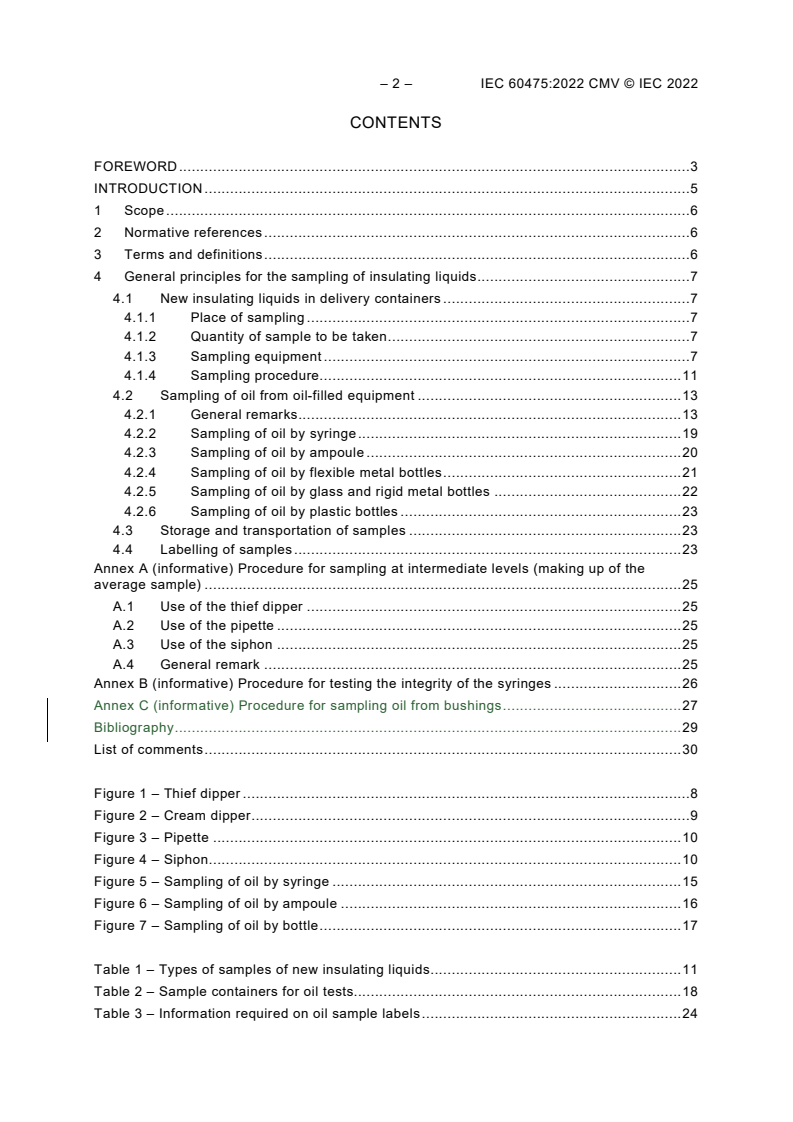
– 2 – IEC 60475:2022 CMV © IEC 2022
CONTENTS
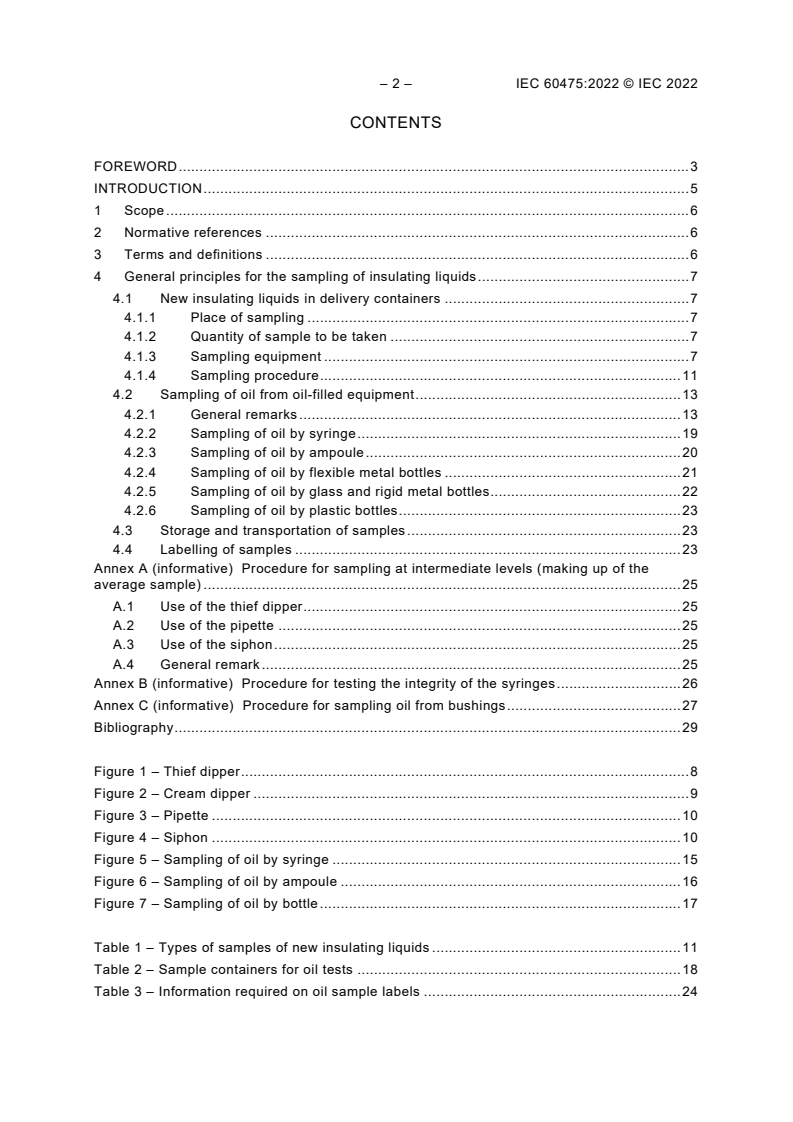
FOREWORD .3
INTRODUCTION .5
1 Scope .6
2 Normative references .6
3 Terms and definitions .6
4 General principles for the sampling of insulating liquids .7
4.1 New insulating liquids in delivery containers .7
4.1.1 Place of sampling .7
4.1.2 Quantity of sample to be taken .7
4.1.3 Sampling equipment .7
4.1.4 Sampling procedure . 11
4.2 Sampling of oil from oil-filled equipment . 13
4.2.1 General remarks . 13
4.2.2 Sampling of oil by syringe . 19
4.2.3 Sampling of oil by ampoule . 20
4.2.4 Sampling of oil by flexible metal bottles . 21
4.2.5 Sampling of oil by glass and rigid metal bottles . 22
4.2.6 Sampling of oil by plastic bottles . 23
4.3 Storage and transportation of samples . 23
4.4 Labelling of samples . 23
Annex A (informative) Procedure for sampling at intermediate levels (making up of the
average sample) . 25
A.1 Use of the thief dipper . 25
A.2 Use of the pipette . 25
A.3 Use of the siphon . 25
A.4 General remark . 25
Annex B (informative) Procedure for testing the integrity of the syringes . 26
Annex C (informative) Procedure for sampling oil from bushings . 27
Bibliography . 29
List of comments . 30
Figure 1 – Thief dipper .8
Figure 2 – Cream dipper .9
Figure 3 – Pipette . 10
Figure 4 – Siphon . 10
Figure 5 – Sampling of oil by syringe . 15
Figure 6 – Sampling of oil by ampoule . 16
Figure 7 – Sampling of oil by bottle . 17
Table 1 – Types of samples of new insulating liquids . 11
Table 2 – Sample containers for oil tests. 18
Table 3 – Information required on oil sample labels . 24
INTERNATIONAL ELECTROTECHNICAL COMMISSION
____________
METHOD OF SAMPLING INSULATING LIQUIDS
FOREWORD
1) The International Electrotechnical Commission (IEC) is a worldwide organization for standardization comprising
all national electrotechnical committees (IEC National Committees). The object of IEC is to promote international
co-operation on all questions concerning standardization in the electrical and electronic fields. To this end and
in addition to other activities, IEC publishes International Standards, Technical Specifications, Technical Reports,
Publicly Available Specifications (PAS) and Guides (hereafter referred to as “IEC Publication(s)”). Their
preparation is entrusted to technical committees; any IEC National Committee interested in the subject dealt with
may participate in this preparatory work. International, governmental and non-governmental organizations liaising
with the IEC also participate in this preparation. IEC collaborates closely with the International Organization for
Standardization (ISO) in accordance with conditions determined by agreement between the two organizations.
2) The formal decisions or agreements of IEC on technical matters express, as nearly as possible, an international
consensus of opinion on the relevant subjects since each technical committee has representation from all
interested IEC National Committees.
3) IEC Publications have the form of recommendations for international use and are accepted by IEC National
Committees in that sense. While all reasonable efforts are made to ensure that the technical content of IEC
Publications is accurate, IEC cannot be held responsible for the way in which they are used or for any
misinterpretation by any end user.
4) In order to promote international uniformity, IEC National Committees undertake to apply IEC Publications
transparently to the maximum extent possible in their national and regional publications. Any divergence between
any IEC Publication and the corresponding national or regional publication shall be clearly indicated in the latter.
5) IEC itself does not provide any attestation of conformity. Independent certification bodies provide conformity
assessment services and, in some areas, access to IEC marks of conformity. IEC is not responsible for any
services carried out by independent certification bodies.
6) All users should ensure that they have the latest edition of this publication.
7) No liability shall attach to IEC or its directors, employees, servants or agents including individual experts and
members of its technical committees and IEC National Committees for any personal injury, property damage or
other damage of any nature whatsoever, whether direct or indirect, or for costs (including legal fees) and
expenses arising out of the publication, use of, or reliance upon, this IEC Publication or any other IEC
Publications.
8) Attention is drawn to the Normative references cited in this publication. Use of the referenced publications is
indispensable for the correct application of this publication.
9) Attention is drawn to the possibility that some of the elements of this IEC Publication may be the subject of patent
rights. IEC shall not be held responsible for identifying any or all such patent rights.
This commented version (CMV) of the official standard IEC 60475:2022 edition 3.0 allows
the user to identify the changes made to the previous IEC 60475:2011 edition 2.0.
Futhermore, comments from IEC TC 10 experts are provided to explain the reasons of the
most relevant changes, or to clarify any part of the content.
A vertical bar appears in the margin wherever a change has been made. Additions are in
green text, deletions are in strikethrough red text. Experts' comments are identified by a
blue-background number. Mouse over a number to display a pop-up note with the
comment.
This publication contains the CMV and the official standard. The full list of comments is
available at the end of the CMV.
– 4 – IEC 60475:2022 CMV © IEC 2022
IEC 60475 has been prepared by IEC technical committee 10: Fluids for electrotechnical
applications. It is an International Standard.
This third edition cancels and replaces the second edition published in 2011. This edition
constitutes a technical revision.
This edition includes the following significant technical changes with respect to the previous
edition:
a) addition of a new Annex C on sampling of oil from bushings, at the request of IEC
subcommittee 36A, in order to transfer to IEC 60475 the corresponding contents of
IEC TR 61464 relating to oil sampling from bushings;
b) deletion of NOTE 2 in 4.2.1.2.
The text of this International Standard is based on the following documents:
Draft Report on voting
10/1163/FDIS 10/1173/RVD
Full information on the voting for its approval can be found in the report on voting indicated in
the above table.
The language used for the development of this International Standard is English.
This document was drafted in accordance with ISO/IEC Directives, Part 2, and developed in
accordance with ISO/IEC Directives, Part 1 and ISO/IEC Directives, IEC Supplement, available
at www.iec.ch/members_experts/refdocs. The main document types developed by IEC are
described in greater detail at www.iec.ch/publications.
The committee has decided that the contents of this document will remain unchanged until the
stability date indicated on the IEC website under webstore.iec.ch in the data related to the
specific document. At this date, the document will be
• reconfirmed,
• withdrawn,
• replaced by a revised edition, or
• amended.
IMPORTANT – The 'colour inside' logo on the cover page of this publication indicates that it
contains colours which are considered to be useful for the correct understanding of its
contents. Users should therefore print this document using a colour printer.
INTRODUCTION
General caution, health, safety and environmental protection
WARNING – This document does not purport to address all the safety problems associated with
its use. It is the responsibility of the user of this document to establish appropriate health and
safety practices and determine the applicability of regulatory limitations prior to use.
The insulating oils which are the subject of this document should be handled with due regard
to personal hygiene. Direct contact with the eyes may can cause irritation. In the case of eye
contact, irrigation with copious quantities of clean running water should be carried out and
medical advice sought. Some of the tests specified in this document involve the use of
processes that could lead to a hazardous situation. Attention is drawn to the relevant standard
for guidance.
Environment
This document is applicable to mineral oils and non-mineral oils, chemicals and used sample
containers.
Attention is drawn to the fact that some mineral oils in service may can still be contaminated to
some degree by PCBs. If this is the case, safety countermeasures should be taken to avoid
risks to workers, the public and the environment during the life of the equipment, by strictly
controlling spills and emissions. The disposal or decontamination of these oils should be carried
out strictly according to local regulations can be subject to regulatory requirements with regard
to their impact on the environment. Every precaution should be taken to prevent release of
mineral oil and non-mineral oil into the environment.
– 6 – IEC 60475:2022 CMV © IEC 2022
METHOD OF SAMPLING INSULATING LIQUIDS
1 Scope
This document is applicable to the sampling procedure to be used for insulating liquids in
delivery containers and in electrical equipment such as power and instrument transformers,
reactors, bushings, oil-filled cables, oil-filled tank-type capacitors, switchgear and load tap
changers (LTCs).
This document applies to liquids the viscosity of which at the sampling temperature is less than
1 500 mm /s (or cSt). It applies to mineral oils and non-mineral oils (such as synthetic esters,
natural esters, vegetable oils or silicones).
2 Normative references
The following documents are referred to in the text in such a way that some or all of their content
constitutes requirements of this document. For dated references, only the edition cited applies.
For undated references, the latest edition of the referenced document (including any
amendments) applies.
IEC 60567:2011, Oil-filled electrical equipment – Sampling of gases and analysis of free and
dissolved gases – Guidance
IEC 60970, Insulating liquids – Methods for counting and sizing particles
3 Terms and definitions
For the purposes of this document, the following terms and definitions apply.
ISO and IEC maintain terminology databases for use in standardization at the following
addresses:
• IEC Electropedia: available at https://www.electropedia.org/
• ISO Online browsing platform: available at https://www.iso.org/obp
3.1
delivery container
container used to store, transport and deliver batches of oil
EXAMPLE Drum, rail tanker, road tanker, flexible plastic bag.
3.2
electrical equipment
equipment filled with insulating oil
EXAMPLE Power and instrument transformers, reactors, bushings, oil-filled cables, oil-filled tank-type capacitors,
switchgear and load tap changers (LTCs).
3.3
sampling equipment
equipment used for sampling oil from delivery containers (e.g. sampling probes, such as dippers
or siphons) and from electrical equipment (e.g. connecting tubing and drain valve adapters)
Note 1 to entry: Sampling equipment also includes sample containers, waste oil containers and other accessories.
3.4
sample container
container or other device used to store and transport samples of oil for analysis
EXAMPLE Syringe, bottle, ampoule.
Note 1 to entry: Sample containers include accessories such as valves, tubing or caps attached to the container.
4 General principles for the sampling of insulating liquids
4.1 New insulating liquids in delivery containers
4.1.1 Place of sampling
The sample shall be taken from the part of the delivery container where the insulating liquid is
likely to be most heavily contaminated. To evaluate the quality of a consignment, two types of
samples may be normally taken:
a) composite sample: mixture of samples taken at the same level in several containers;
b) individual sample: sample or mixture of samples taken at the same level in one container.
From a delivery, individual samples of 1 l may be taken from different containers for the electric
strength test. Further tests may be carried out on these samples and a complete examination
on the mixture of these (composite sample).
In certain cases, it may can be useful to constitute an average sample within the container. An
average sample is a mixture of samples taken at different levels in one container.
1) tankers: samples should be taken from each tanker as described in 4.1.4.2 below;
2) drums: samples should be taken as described in 4.1.4.3 below.
In the case of a single drum, this shall be sampled.
In case there is more than one drum of a lot of oil, sampling procedures should be negotiated
between supplier and user. For example, samples can be taken from 10 % of drums or at least
two drums, whichever the largest.
4.1.2 Quantity of sample to be taken
This depends on the tests to be performed and the procedures used.
Typically, 2 l are taken.
4.1.3 Sampling equipment
4.1.3.1 General
Since the results of the tests included in IEC requirements for insulating liquids can greatly
depend on the impurities in the sample, it is essential to observe the following precautions:
– separate sampling equipment shall be reserved exclusively for each type of liquid. All seals
and tubing used should be compatible with the insulating liquid to be sampled;
– the equipment shall be clean and dry, following the cleaning procedures described in
4.2.1.6. Particular care should be taken to ensure the absence of any traces of solid
impurities, such as dust, fibres, etc. The use of rags for cleaning is not permitted.
– 8 – IEC 60475:2022 CMV © IEC 2022
4.1.3.2 Sampling probes
As examples, four types of sampling probes are described below. Other probes may also be
used, provided they do not introduce any contamination. Stainless steel and aluminium are
suitable.
a) Sampling from tankers
The thief dipper shown in Figure 1 is suitable for taking samples at the bottom of the
container. This is a dipper constructed of stainless steel or aluminium tubes and castings,
machine-finished all over. It shall be sufficiently heavy to sink in the liquid. It should always
be suspended by means of a metal wire or chain. String or other fibrous materials shall not
be used.
The cream dipper is used for taking top samples of insulating liquids. This probe shall be
constructed as shown in Figure 2 and shall be of stainless steel.
Dimensions in millimetres
Figure 1 – Thief dipper
Dimensions in millimetres
Figure 2 – Cream dipper
b) Sampling from drums
The pipette shown in Figure 3 enables samples to be taken at the bottom of drums. This
pipette has a capacity of about 500 ml.
Another probe to take samples at the bottom is shown in Figure 4; it is a siphon with a glass,
stainless steel or aluminium tube having an internal diameter of about 13 mm for taking off
the sample liquid, and a metal tube (internal diameter 5 mm) for applying pressure. Both
tubes are set in an oil-resistant bung whose dimensions correspond to the diameter of the
bung hole in the drum. Commercial versions of this equipment are available. When possible,
glass is preferable for probes illustrated in Figure 3 and Figure 4.
The cream dipper (Figure 2) may be used for taking top samples.
– 10 – IEC 60475:2022 CMV © IEC 2022
Dimensions in millimetres
Figure 3 – Pipette
Dimensions in millimetres
Figure 4 – Siphon
4.1.3.3 Sample containers
For storing and transporting samples, depending on the oil test to be performed, sample
containers of appropriate volume shall be used. Different types of sample containers are
indicated in 4.2.1.5.
For the mixing of different samples, a special sample container made of glass with a capacity
of at least 6 l shall be used. These special sample containers shall be closed in a manner that
allows them to be sealed, by means of oil-resistant plastic or compatible rubber tubing or screw
caps equipped with a polytetrafluoroethylene (PTFE) lining. Natural rubber tubing and/or seals
are not permitted. PTFE and polypropylene (PP) seals are acceptable.
Each sample container shall have a label on which are marked all the indications necessary to
identify the contents, i.e. the markings of the drums or tanks, date of sampling and the name of
the recipient.
4.1.3.4 Cleaning of sampling equipment
Sampling equipment shall be cleaned following the procedures described in 4.2.1.6.
4.1.4 Sampling procedure
4.1.4.1 General remarks
According to general principles for sampling (see 4.1.1), samples of new insulating liquid shall
be taken from the bottom of the delivery container, where the contamination is likely to be the
greatest. But in certain cases, an average sample is also of interest.
NOTE 1 To obtain an average sample, samples are taken at intermediate levels in tanks or drums. Examples of
procedures are given in Annex A. A procedure is indicated in the NOTE in 4.1.4.2 a) for obtaining the equivalent of
an average sample.
In Table 1 different cases are considered:
Table 1 – Types of samples of new insulating liquids
Type of delivery Recommended Equipment to be used Procedure Recommended
sampling quantity
Composite Pipette (Figure 3) 4.1.4.2 3 × 2 l
Drums or
Siphon (Figure 4) 4.1.4.2 1 l or 2 l
Individual
Thief dipper (Figure 1) 4.1.4.1 b) 3 × 2 l
or
Tankers Individual
None (valve) 4.1.4.1 a)
Pipette
or Annex A
Drums Average
Siphon ( Figure 3 and
Figure 4) 3 × 2 l
Thief dipper (Figure 1)
Tankers Average or
None (valve) 4.1.4.1 a)
NOTE 2 Before sampling from tankers, sufficient oil should be is pumped from the end of the delivery pipe, as
required by indicated in 4.1.4.2.
Every precaution shall be taken during sampling in order to avoid contamination of the insulating
liquids. Outdoor sampling of insulating liquids in rain, fog or high wind is only permitted if all
precautions have been taken to avoid contamination of the liquid. In this special case, the use
of a cover is necessary.
– 12 – IEC 60475:2022 CMV © IEC 2022
Condensation shall be avoided by warming the sampling equipment so as to be above the
ambient air temperature. Before use, the equipment shall be rinsed with the liquid being
sampled. The operator shall be warned not to permit his let their hands to come into contact
with the surfaces of sampling equipment subsequently in contact with the oil. The insulating
liquids shall be protected against light irradiation during transportation and storage.
mediately. It is
On arrival at the laboratory, the sampling container shall not be opened im
necessary to wait until the temperature of the sample is the same as the room temperature.
4.1.4.2 Sampling from tankers
Insulating liquids may be sampled either through the tank outlet or by a thief dipper or by a
cream dipper.
a) Sampling through the tank outlet
By this procedure, it is possible to obtain a sample representative of the bottom of the tank
after the tank has been allowed to stand for at least 1 h after the vehicle has arrived.
NOTE It may be possible, by this procedure, to obtain the equivalent of an average sample, if the sampling is
done directly after the vehicle has arrived.
In this case, the sampling procedure shall be as follows:
– remove the outlet valve shield, if fitted;
– remove all visible dirt and dust from the valve by means of lint-free clean cloths or oil-
resistant synthetic sponges;
– the outlet system (pump, delivery pipe), if incorporated, shall be started or opened as
appropriate in order to get a sample;
– open the valve and allow to flow, slowly, at least 10 l of insulating liquid into a waste oil
container. In any case, discard at least an amount of oil equivalent to the volume of the
pipe;
– rinse sampling bottles with the insulating liquid;
– fill sampling bottles at constant flow to avoid turbulence.
b) Sampling with a thief dipper or a cream dipper
This sampling should be carried out after the tank has been allowed to stand for at least 1 h
after the vehicle has arrived.
1) Procedure with the thief dipper (Figure 1) (bottom samples)
For taking bottom samples (i.e. within 1 cm to 2 cm from the bottom of the tank) the
dipper is lowered until the projecting stem of the valve rod strikes the bottom of the tank.
The dipper then fills. Filling is complete when no more air bubbles escape. The dipper
is then withdrawn and its contents poured into the sample container (in the case of an
individual sample) or into the special glass sample container for collecting and mixing
the various samples taken (in the case of a composite sample). In this latter case, the
sample container(s) is (are) filled with the mixture so obtained. During pouring of the
liquid, avoid forming air bubbles by pouring too quickly.
2) Procedure with the cream dipper (Figure 2) (top samples)
With the valve closed, fill the cream dipper by slowly immersing it in the liquid to be
sampled until the rim is just below the surface of the liquid so that it will flow slowly into
the dipper. Discard the first filling. Refill the dipper as above and transfer the sample to
the sample container by allowing it to flow from the bottom orifice against the side of the
sample container and not in a stream into the bottom of the sample container. Repeat
the operation until sufficient liquid is obtained to fill the sample container (individual
sample) or the special glass sample container used for mixing samples depending on
the type of sample to be obtained.
4.1.4.3 Sampling from drums
Samples should be taken after the drums have been allowed to stand for at least 8 h with the
bung uppermost, protected against rain and rainwater. For sampling the bottom (i.e. 3 mm up),
the pipette (Figure 3) or the siphon pressure thief (Figure 4) may be used.
For taking a sample from the surface layer of the liquid, the cream dipper (Figure 2) may be
used.
Examples of procedures:
a) Use of pipette (Figure 3) (bottom samples)
– block the upper orifice of the pipette with the thumb, and then immerse the pipette in the
liquid to the bottom of the drum;
– remove the thumb to allow liquid to enter the pipette;
– again close the upper end of the pipette with the thumb and withdraw the pipette;
– the first filling is used for rinsing the pipette; transfer the next fillings into either a sample
container (individual sample) or the special glass sample container for mixing samples
(composite sample) (see 4.1.4.2 b)) taking care not to form air bubbles during pouring
the liquid.
b) Use of siphon (Figure 4) (bottom samples)
– fit the bung in which are set the riser and pressure tubes into the bung hole of the drum
and ensure that this seal is airtight;
– dip the lower end of the riser tube to about 3 mm from the bottom of the drum;
– raise the pressure inside the drum by means of the air bulb;
– run off enough liquid to rinse the tube and then run off the required quantity directly into
the sample container (individual sample) or the special glass sample container for mixing
samples (composite sample) (see 4.1.4.2 b)) taking care not to form air bubbles during
pouring of the liquid.
c) Use of cream dipper device (Figure 2) (top samples)
See 4.1.4.2 b).
4.1.4.4 Sampling report
The sampling report shall give all the information necessary for identifying the sample as well
as any details or special information likely to be of help to those entrusted with the tests. The
type of sample (i.e. composite, individual or average sample) shall be specified. A copy of the
report shall accompany each sample. The distribution of samples shall be in accordance with
the agreed procedure, for example as given in the sales contract.
4.2 Sampling of oil from oil-filled equipment
4.2.1 General remarks
4.2.1.1 Safety and quality of sampling
The manufacturer's instructions for taking oil samples from the electrical equipment shall be
followed. Particular attention shall be paid to the safety precautions to be taken.
Ensure that the oil in the energized electrical equipment is not under a negative pressure when
taking an oil sample, since this could introduce air bubbles in the oil, induce electrical short-
circuits in the equipment and put the sampling personnel at risk.
During sampling of oil, precautions should be taken to deal with any sudden release of oil and
avoid oil spillage.
– 14 – IEC 60475:2022 CMV © IEC 2022
It is important to bear in mind that receiving a qualitative and a representative sample is crucial
for obtaining a reliable assessment of the electrical equipment. Even the most sophisticated
analytical and diagnosis methods cannot overcome faulty samples.
In all cases, oil sampling should be performed by properly and specifically trained personnel,
especially for low volume equipment (e.g. instrument transformers).
4.2.1.2 Place of sampling
The selection of points from which samples are drawn should be made with care. Normally, the
sample should be taken from a point where it is representative of the bulk of the oil in the
equipment (for example, from the bottom oil drain valve or the oil sampling valve). It will
sometimes be necessary, however, to draw samples deliberately where they are not expected
to be representative (for example, in trying to locate the site of a fault, such as from the tap
changer, selector switch or gas relay).
The methods described are suitable for large oil-volume equipment such as power transformers.
With small oil-volume equipment, it is essential to ensure that the total volume of oil drawn off
does not endanger the operation of the equipment.
NOTE 1 For transformers with two sampling valves, the following procedure should be used:
open the outer valve first, followed by the second one. This is particularly important to avoid
entrance of air into the transformers.
NOTE 2 When sampling from bushings or from instrument transformers or cables, the manufacturer’s instructions
should be followed carefully. Failure to do so may lead to serious damage and equipment failure. The oil sampling
should be carried out on de-energized equipment. When sampling, precautions should be taken to deal with any
sudden release of oil. Samples should be taken with the off-load equipment in its normal position in order to assess
correctly the equipment condition.
Sampling by syringe is the procedure recommended for bushings by IEC subcommittee 36A. In the case of bushings
fitted with a sampling point at the mounting flange, the described procedure applies.
In the case of bushings not fitted with a sampling point at mounting flange, it may be possible to take a sample from
the top of the bushing. The manufacturer’s instructions should be consulted to determine a suitable position. Insert
one end of the sampling tube into the bushing, from the top, and connect the other end to the three-way stopcock on
the syringe, using plastic coupling, then follow the same procedure.
In the case of bushings pressurized at ambient temperature, the procedure is not applicable, and reference should
be made to the instructions of the equipment manufacturer.
4.2.1.3 Cleaning of sampling point
Cleaning of the sampling equipment and flushing of the sampling point shall be done to prevent
contamination of oil samples.
The blank flange or cover (11) of the sampling valve in Figure 5, Figure 6 and Figure 7 a) is
removed and the outlet cleaned with a lint-free cloth or oil-resistant synthetic sponge to remove
all visible dirt.
The drain valve is flushed with a sufficient quantity of oil (typically, 2 l to 5 l), under a turbulent
flow, to eliminate any contaminants (water and particles) that might have accumulated in the
drain valve and at its orifice.
Use protection gloves, preferably made of nitrile rubber, and a bucket for waste oil. The
sampling point shall be cleaned each time a new sample of oil is taken.
For measuring water content in oil, sampling shall be carried out preferably during days when
the humidity of the air is as low as possible, to prevent moisture condensation on sampling
equipment and contamination of the oil sample.
The temperature of oil at sampling point shall be measured with a thermometer placed in the
flow of oil and indicated on the sample, to ensure the calculation of the relative humidity of oil,
also recording whether or not the fans and pumps are running. In both cases, the method used
to measure the temperature shall be indicated.
Key
a flushing position 1 syringe
b wetting and flushing of syringe 2 stopcock
c emptying of syringe 3 flexible connecting tubing
d taking of sample 4 three-way valve
e disconnecting of syringe 5 equipment sampling valve
7 waste vessel
11 blank flange
Figure 5 – Sampling of oil by syringe
– 16 – IEC 60475:2022 CMV © IEC 2022
Key
2 stopcock 7 waste vessel
3 flexible connecting tubing 11 blank flange
5 equipment sampling valve 28 sampling tube
Figure 6 – Sampling of oil by ampoule
a) Example of sampling by bottle
b) Example of seal cap for bottle
Key
3 flexible connecting tubing 29 bottle
5 equipment sampling valve 30 hard plastic screw cap
7 waste vessel 31 conical soft polyethylene seal
11 blank flange
Figure 7 – Sampling of oil by bottle
4.2.1.4 Connection between sampling point and sampling device
The connection between the tubing and the electrical equipment will depend upon the
equipment. If a sampling valve suitable for fitting onto tubing has not been provided, it may can
be necessary to use a drilled flange or a bored oil-proof rubber bung on a drain or filling
connection. Special drain valve adapters may be used if available.
Attach a piece of oil-compatible plastic or rubber tubing to connect the sampling point to the
sampling device. This tubing should be as short as possible. To avoid contamination by the
previous oil sample, use a new piece of tubing, or flush the tube well and wash its outer surface
with the next oil to be sampled.
, Tygon®),
Suitable tubing should be made for example of perfluorinated material (e.g. Viton®
PTFE or metal, not PVC.
___________
Viton® and Tygon® are examples of suitable products available commercially. This information is given for the
convenience of users of this document and does not constitute an endorsement by IEC of these products.
– 18 – IEC 60475:2022 CMV © IEC 2022
4.2.1.5 Choice of sample container
Table 2 indicates the different types of sample containers that can be used depending on the
oil analysis to be made.
Table 2 – Sample containers for oil tests
Sample container Syringe Flexible Bottle Flexible Ampoule Ampoule Oil volume
bottle bottle
Material Glass Metal Glass Plastic Glass Metal ml
Oil test
Dissolved gases Y Y Y Y Y 25 to 100
Water Y Y Y 20
Dielectric dissipation Y Y Y Y 200
factor
Particles Y Y Y Y 100
Breakdown voltage Y Y 500 to 1 000
Other chemical and Y Y Y 250
physical tests
All tests 1 000 to 2 000
Volume (ml) 25 to 250 125 to 2 500 125 25 to 250
Key
Y = Yes
Metal or plastic containers may be preferred where adequate protection of glass containers is
not available for the transportation of oil samples.
For dissolved gas analysis (DGA), to minimize losses of the low solubility gases (H and CO)
and pick-up of air at low total gas contents, it is critical to strictly follow the sampling procedures
of 4.2.2 to 4.2.5, particularly with bottles and ampoules. In addition, only the materials
recommended for caps, gaskets, valves and tubing of sample containers should be used by
well-trained and experienced personnel familiar with those containers.
When using bottles for DGA, water and breakdown voltage, care should be taken to minimize
air contact with the oil sample during sampling and analysis.
The use of plastic bottles is not permitted for DGA, water and dielectric strength, since ambient
cur by diffusion through the plastic. For the other
air contamination and gas losses may can oc
tests, plastic bottles should be made of a compatible plastic (such as high-density polyethylene
(HDPE), polypropylene or polycarbonate), which does not contaminate the oil with additives
contained in the plastic. Each new type of plastic (and glass) bottle should be tested for
compatibility with oil.
The recommendations of 4.2.1.3 and 4.2.1.6 (cleaning of sampling point and sampling
equipment) should be followed strictly for water content, dielectric strength, dielectric
dissipation factor, interfacial tension and particles content.
The other physical and chemical tests (viscosity, density, acidity, DBPC, furans and PCB
contents, etc.) are less affected by the sample containers and sampling procedures used.
4.2.1.6 Cleaning of sampling equipment
4.2.1.6.1 Use of disposable sample containers
Use of disposable, pre-cleaned metal, plastic and glass bottles having a known level of
cleanliness for dust and humidity has been found by several users more convenient than
cleaning them. Such sampling devices are relatively inexpensive and available from several
vendors of labware or veterinarian equipment. To verify that the cleanliness of disposable
bottles is acceptable, a few un-cleaned and cleaned bottles can be tested in parallel.
4.2.1.6.2 Cleaning procedures
Non-disposable sampling devices may be cleaned in a dishwasher using a detergent, and rinsed
with tap water (without detergent in the rinse aid compartment of the dishwasher). A last,
optional rinse with de-ionized water may be used.
Sampling equipment and containers may also be cleaned with normal heptane.
After cleaning, the sampling devices are dried in an oven at typically 100 °C until fully dried,
then allowed to cool in the oven or a dry box.
After drying, they shall be immediately closed to protect from contamination and not opened
until just before use.
Appropriate cleaning of sample containers is critical for DDF and interfacial tension, which are
particularly sensitive to contamination. They should not be cleaned with solvents.
Dedicated sampling containers shall be cleaned according to IEC 60970 are recommended for
measuring particles content in oil.
4.2.2 Sampling of oil by syringe
4.2.2.1 Sampling equipment
The following sample equipment shall be used:
a) Graduated gas-tight syringes of a size suitable for containing adequate oil sample volume
(20 ml to 250 ml), and equipped preferably with a three-way plastic valve made of nylon
body and polypropylene (PP) barrel, or with a three-way stainless steel valve. The use of
syringes with matched piston and barrel is preferred when sampling for DGA in order to
allow the piston to flow freely with oil volume variations, and to avoid pressure and vacuum
build-up in the syringe and breakage during handling. Plastic syringes should not be used.
For plastic three-way valves, a new valve should be used each time an oil sample is taken
and not recycled, because it may can be contaminated with the previous oil sample and lose
its gas tightness when used several times. For added protection during transportation, a
stainless steel Luer-Lock cap may be placed on top of the three-way valve. This cap may
be recycled after use.
NOTE Priming the piston with clean, degassed oil has been found useful to avoid the formation of bubbles
along the piston when introducing the oil sample for DGA analysis. The use of a low viscosity water-soluble
lubricant has also been found useful for DGA.
The size of sample required depends on the likely concentration of gas in the sample, the
analytical techniques and the sensitivity required. For DGA after factory tests, a 250 ml
syringe has been found convenient.
See Annex B.
– 20 – IEC 60475:2022 CMV © IEC 2022
b) Transport containers, designed to hold the syringe firmly in place during transport but which
allow the syringe plunger freedom to move and prevent its tip from contacting the container
whatever its position during transportation. Cardboard boxes with removable inner
cardboard flaps that hold the barrel in place have been found convenient for that purpose.
Metal or plastic cylinders with inside foam packing have also been found appropriate for
transportation. When sampling for DGA, the syringe should preferably be transported in the
vertical position, piston upwards, to avoid the formation of bubbles in oil.
4.2.2.2 Sampling procedure
See Figure 5.
a) The electrical equipment is connected as shown in Figure 5 a), and its sampling valve (5)
opened.
b) The three-way valve (4) is adjusted (position A) to allow 1 l to 2 l of oil to flow to waste (7).
c) The three-way valve (4) is then turned (position B) to allow oil to enter the syringe slowly
(Figure 5 b)). The plunger should not be withdrawn but allowed to move back under the
pressure of the oil.
d) The three-way valve (4) is then turned (position C) to allow the oil in the syri
...
IEC 60475 ®
Edition 3.0 2022-05
INTERNATIONAL
STANDARD
NORME
INTERNATIONALE
Method of sampling insulating liquids
Méthode d’échantillonnage des liquides isolants
All rights reserved. Unless otherwise specified, no part of this publication may be reproduced or utilized in any form
or by any means, electronic or mechanical, including photocopying and microfilm, without permission in writing from
either IEC or IEC's member National Committee in the country of the requester. If you have any questions about IEC
copyright or have an enquiry about obtaining additional rights to this publication, please contact the address below or
your local IEC member National Committee for further information.
Droits de reproduction réservés. Sauf indication contraire, aucune partie de cette publication ne peut être reproduite
ni utilisée sous quelque forme que ce soit et par aucun procédé, électronique ou mécanique, y compris la photocopie
et les microfilms, sans l'accord écrit de l'IEC ou du Comité national de l'IEC du pays du demandeur. Si vous avez des
questions sur le copyright de l'IEC ou si vous désirez obtenir des droits supplémentaires sur cette publication, utilisez
les coordonnées ci-après ou contactez le Comité national de l'IEC de votre pays de résidence.
IEC Secretariat Tel.: +41 22 919 02 11
3, rue de Varembé info@iec.ch
CH-1211 Geneva 20 www.iec.ch
Switzerland
About the IEC
The International Electrotechnical Commission (IEC) is the leading global organization that prepares and publishes
International Standards for all electrical, electronic and related technologies.
About IEC publications
The technical content of IEC publications is kept under constant review by the IEC. Please make sure that you have the
latest edition, a corrigendum or an amendment might have been published.
IEC publications search - webstore.iec.ch/advsearchform IEC Products & Services Portal - products.iec.ch
The advanced search enables to find IEC publications by a Discover our powerful search engine and read freely all the
variety of criteria (reference number, text, technical publications previews. With a subscription you will always
committee, …). It also gives information on projects, replaced have access to up to date content tailored to your needs.
and withdrawn publications.
Electropedia - www.electropedia.org
IEC Just Published - webstore.iec.ch/justpublished
The world's leading online dictionary on electrotechnology,
Stay up to date on all new IEC publications. Just Published
containing more than 22 300 terminological entries in English
details all new publications released. Available online and
and French, with equivalent terms in 19 additional languages.
once a month by email.
Also known as the International Electrotechnical Vocabulary
(IEV) online.
IEC Customer Service Centre - webstore.iec.ch/csc
If you wish to give us your feedback on this publication or
need further assistance, please contact the Customer Service
Centre: sales@iec.ch.
A propos de l'IEC
La Commission Electrotechnique Internationale (IEC) est la première organisation mondiale qui élabore et publie des
Normes internationales pour tout ce qui a trait à l'électricité, à l'électronique et aux technologies apparentées.
A propos des publications IEC
Le contenu technique des publications IEC est constamment revu. Veuillez vous assurer que vous possédez l’édition la
plus récente, un corrigendum ou amendement peut avoir été publié.
Recherche de publications IEC - IEC Products & Services Portal - products.iec.ch
webstore.iec.ch/advsearchform Découvrez notre puissant moteur de recherche et consultez
La recherche avancée permet de trouver des publications IEC gratuitement tous les aperçus des publications. Avec un
en utilisant différents critères (numéro de référence, texte, abonnement, vous aurez toujours accès à un contenu à jour
comité d’études, …). Elle donne aussi des informations sur adapté à vos besoins.
les projets et les publications remplacées ou retirées.
Electropedia - www.electropedia.org
IEC Just Published - webstore.iec.ch/justpublished
Le premier dictionnaire d'électrotechnologie en ligne au
Restez informé sur les nouvelles publications IEC. Just
monde, avec plus de 22 300 articles terminologiques en
Published détaille les nouvelles publications parues.
anglais et en français, ainsi que les termes équivalents dans
Disponible en ligne et une fois par mois par email.
19 langues additionnelles. Egalement appelé Vocabulaire
Electrotechnique International (IEV) en ligne.
Service Clients - webstore.iec.ch/csc
Si vous désirez nous donner des commentaires sur cette
publication ou si vous avez des questions contactez-nous:
sales@iec.ch.
IEC 60475 ®
Edition 3.0 2022-05
INTERNATIONAL
STANDARD
NORME
INTERNATIONALE
Method of sampling insulating liquids
Méthode d’échantillonnage des liquides isolants
INTERNATIONAL
ELECTROTECHNICAL
COMMISSION
COMMISSION
ELECTROTECHNIQUE
INTERNATIONALE
ICS 29.040.10 ISBN 978-2-8322-3484-6
– 2 – IEC 60475:2022 © IEC 2022
CONTENTS
FOREWORD . 3
INTRODUCTION . 5
1 Scope . 6
2 Normative references . 6
3 Terms and definitions . 6
4 General principles for the sampling of insulating liquids . 7
4.1 New insulating liquids in delivery containers . 7
4.1.1 Place of sampling . 7
4.1.2 Quantity of sample to be taken . 7
4.1.3 Sampling equipment . 7
4.1.4 Sampling procedure . 11
4.2 Sampling of oil from oil-filled equipment . 13
4.2.1 General remarks . 13
4.2.2 Sampling of oil by syringe . 19
4.2.3 Sampling of oil by ampoule . 20
4.2.4 Sampling of oil by flexible metal bottles . 21
4.2.5 Sampling of oil by glass and rigid metal bottles . 22
4.2.6 Sampling of oil by plastic bottles . 23
4.3 Storage and transportation of samples . 23
4.4 Labelling of samples . 23
Annex A (informative) Procedure for sampling at intermediate levels (making up of the
average sample) . 25
A.1 Use of the thief dipper . 25
A.2 Use of the pipette . 25
A.3 Use of the siphon . 25
A.4 General remark . 25
Annex B (informative) Procedure for testing the integrity of the syringes . 26
Annex C (informative) Procedure for sampling oil from bushings . 27
Bibliography . 29
Figure 1 – Thief dipper . 8
Figure 2 – Cream dipper . 9
Figure 3 – Pipette . 10
Figure 4 – Siphon . 10
Figure 5 – Sampling of oil by syringe . 15
Figure 6 – Sampling of oil by ampoule . 16
Figure 7 – Sampling of oil by bottle . 17
Table 1 – Types of samples of new insulating liquids . 11
Table 2 – Sample containers for oil tests . 18
Table 3 – Information required on oil sample labels . 24
INTERNATIONAL ELECTROTECHNICAL COMMISSION
____________
METHOD OF SAMPLING INSULATING LIQUIDS
FOREWORD
1) The International Electrotechnical Commission (IEC) is a worldwide organization for standardization comprising
all national electrotechnical committees (IEC National Committees). The object of IEC is to promote international
co-operation on all questions concerning standardization in the electrical and electronic fields. To this end and
in addition to other activities, IEC publishes International Standards, Technical Specifications, Technical Reports,
Publicly Available Specifications (PAS) and Guides (hereafter referred to as “IEC Publication(s)”). Their
preparation is entrusted to technical committees; any IEC National Committee interested in the subject dealt with
may participate in this preparatory work. International, governmental and non-governmental organizations liaising
with the IEC also participate in this preparation. IEC collaborates closely with the International Organization for
Standardization (ISO) in accordance with conditions determined by agreement between the two organizations.
2) The formal decisions or agreements of IEC on technical matters express, as nearly as possible, an international
consensus of opinion on the relevant subjects since each technical committee has representation from all
interested IEC National Committees.
3) IEC Publications have the form of recommendations for international use and are accepted by IEC National
Committees in that sense. While all reasonable efforts are made to ensure that the technical content of IEC
Publications is accurate, IEC cannot be held responsible for the way in which they are used or for any
misinterpretation by any end user.
4) In order to promote international uniformity, IEC National Committees undertake to apply IEC Publications
transparently to the maximum extent possible in their national and regional publications. Any divergence between
any IEC Publication and the corresponding national or regional publication shall be clearly indicated in the latter.
5) IEC itself does not provide any attestation of conformity. Independent certification bodies provide conformity
assessment services and, in some areas, access to IEC marks of conformity. IEC is not responsible for any
services carried out by independent certification bodies.
6) All users should ensure that they have the latest edition of this publication.
7) No liability shall attach to IEC or its directors, employees, servants or agents including individual experts and
members of its technical committees and IEC National Committees for any personal injury, property damage or
other damage of any nature whatsoever, whether direct or indirect, or for costs (including legal fees) and
expenses arising out of the publication, use of, or reliance upon, this IEC Publication or any other IEC
Publications.
8) Attention is drawn to the Normative references cited in this publication. Use of the referenced publications is
indispensable for the correct application of this publication.
9) Attention is drawn to the possibility that some of the elements of this IEC Publication may be the subject of patent
rights. IEC shall not be held responsible for identifying any or all such patent rights.
IEC 60475 has been prepared by IEC technical committee 10: Fluids for electrotechnical
applications. It is an International Standard.
This third edition cancels and replaces the second edition published in 2011. This edition
constitutes a technical revision.
This edition includes the following significant technical changes with respect to the previous
edition:
a) addition of a new Annex C on sampling of oil from bushings, at the request of IEC
subcommittee 36A, in order to transfer to IEC 60475 the corresponding contents of
IEC TR 61464 relating to oil sampling from bushings;
b) deletion of NOTE 2 in 4.2.1.2.
– 4 – IEC 60475:2022 © IEC 2022
The text of this International Standard is based on the following documents:
Draft Report on voting
10/1163/FDIS 10/1173/RVD
Full information on the voting for its approval can be found in the report on voting indicated in
the above table.
The language used for the development of this International Standard is English.
This document was drafted in accordance with ISO/IEC Directives, Part 2, and developed in
accordance with ISO/IEC Directives, Part 1 and ISO/IEC Directives, IEC Supplement, available
at www.iec.ch/members_experts/refdocs. The main document types developed by IEC are
described in greater detail at www.iec.ch/publications.
The committee has decided that the contents of this document will remain unchanged until the
stability date indicated on the IEC website under webstore.iec.ch in the data related to the
specific document. At this date, the document will be
• reconfirmed,
• withdrawn,
• replaced by a revised edition, or
• amended.
INTRODUCTION
General caution, health, safety and environmental protection
WARNING – This document does not purport to address all the safety problems associated with
its use. It is the responsibility of the user of this document to establish appropriate health and
safety practices and determine the applicability of regulatory limitations prior to use.
The insulating oils which are the subject of this document should be handled with due regard
to personal hygiene. Direct contact with the eyes can cause irritation. In the case of eye contact,
irrigation with copious quantities of clean running water should be carried out and medical
advice sought. Some of the tests specified in this document involve the use of processes that
could lead to a hazardous situation. Attention is drawn to the relevant standard for guidance.
This document is applicable to mineral oils and non-mineral oils, chemicals and used sample
containers.
Attention is drawn to the fact that some mineral oils in service can still be contaminated to some
degree by PCBs. If this is the case, safety countermeasures should be taken to avoid risks to
workers, the public and the environment during the life of the equipment, by strictly controlling
spills and emissions. The disposal or decontamination of these oils can be subject to regulatory
requirements with regard to their impact on the environment. Every precaution should be taken
to prevent release of mineral oil and non-mineral oil into the environment.
– 6 – IEC 60475:2022 © IEC 2022
METHOD OF SAMPLING INSULATING LIQUIDS
1 Scope
This document is applicable to the sampling procedure used for insulating liquids in delivery
containers and in electrical equipment such as power and instrument transformers, reactors,
bushings, oil-filled cables, oil-filled tank-type capacitors, switchgear and load tap changers
(LTCs).
This document applies to liquids the viscosity of which at the sampling temperature is less than
1 500 mm /s (or cSt). It applies to mineral oils and non-mineral oils (such as synthetic esters,
natural esters, vegetable oils or silicones).
2 Normative references
The following documents are referred to in the text in such a way that some or all of their content
constitutes requirements of this document. For dated references, only the edition cited applies.
For undated references, the latest edition of the referenced document (including any
amendments) applies.
IEC 60567:2011, Oil-filled electrical equipment – Sampling of gases and analysis of free and
dissolved gases – Guidance
IEC 60970, Insulating liquids – Methods for counting and sizing particles
3 Terms and definitions
For the purposes of this document, the following terms and definitions apply.
ISO and IEC maintain terminology databases for use in standardization at the following
addresses:
• IEC Electropedia: available at https://www.electropedia.org/
• ISO Online browsing platform: available at https://www.iso.org/obp
3.1
delivery container
container used to store, transport and deliver batches of oil
EXAMPLE Drum, rail tanker, road tanker, flexible plastic bag.
3.2
electrical equipment
equipment filled with insulating oil
EXAMPLE Power and instrument transformers, reactors, bushings, oil-filled cables, oil-filled tank-type capacitors,
switchgear and load tap changers (LTCs).
3.3
sampling equipment
equipment used for sampling oil from delivery containers (e.g. sampling probes, such as dippers
or siphons) and from electrical equipment (e.g. connecting tubing and drain valve adapters)
Note 1 to entry: Sampling equipment also includes sample containers, waste oil containers and other accessories.
3.4
sample container
container or other device used to store and transport samples of oil for analysis
EXAMPLE Syringe, bottle, ampoule.
Note 1 to entry: Sample containers include accessories such as valves, tubing or caps attached to the container.
4 General principles for the sampling of insulating liquids
4.1 New insulating liquids in delivery containers
4.1.1 Place of sampling
The sample shall be taken from the part of the delivery container where the insulating liquid is
likely to be most heavily contaminated. To evaluate the quality of a consignment, two types of
samples may be normally taken:
a) composite sample: mixture of samples taken at the same level in several containers;
b) individual sample: sample or mixture of samples taken at the same level in one container.
From a delivery, individual samples of 1 l may be taken from different containers for the electric
strength test. Further tests may be carried out on these samples and a complete examination
on the mixture of these (composite sample).
In certain cases, it can be useful to constitute an average sample within the container. An
average sample is a mixture of samples taken at different levels in one container.
1) tankers: samples should be taken from each tanker as described in 4.1.4.2 below;
2) drums: samples should be taken as described in 4.1.4.3 below.
In the case of a single drum, this shall be sampled.
In case there is more than one drum of a lot of oil, sampling procedures should be negotiated
between supplier and user. For example, samples can be taken from 10 % of drums or at least
two drums, whichever the largest.
4.1.2 Quantity of sample to be taken
This depends on the tests to be performed and the procedures used.
Typically, 2 l are taken.
4.1.3 Sampling equipment
4.1.3.1 General
Since the results of the tests included in IEC requirements for insulating liquids can greatly
depend on the impurities in the sample, it is essential to observe the following precautions:
– separate sampling equipment shall be reserved exclusively for each type of liquid. All seals
and tubing used should be compatible with the insulating liquid to be sampled;
– the equipment shall be clean and dry, following the cleaning procedures described in
4.2.1.6. Particular care should be taken to ensure the absence of any traces of solid
impurities, such as dust, fibres. The use of rags for cleaning is not permitted.
– 8 – IEC 60475:2022 © IEC 2022
4.1.3.2 Sampling probes
As examples, four types of sampling probes are described below. Other probes may also be
used, provided they do not introduce any contamination. Stainless steel and aluminium are
suitable.
a) Sampling from tankers
The thief dipper shown in Figure 1 is suitable for taking samples at the bottom of the
container. This is a dipper constructed of stainless steel or aluminium tubes and castings,
machine-finished all over. It shall be sufficiently heavy to sink in the liquid. It should always
be suspended by means of a metal wire or chain. String or other fibrous materials shall not
be used.
The cream dipper is used for taking top samples of insulating liquids. This probe shall be
constructed as shown in Figure 2 and shall be of stainless steel.
Dimensions in millimetres
Figure 1 – Thief dipper
Dimensions in millimetres
Figure 2 – Cream dipper
b) Sampling from drums
The pipette shown in Figure 3 enables samples to be taken at the bottom of drums. This
pipette has a capacity of about 500 ml.
Another probe to take samples at the bottom is shown in Figure 4; it is a siphon with a glass,
stainless steel or aluminium tube having an internal diameter of about 13 mm for taking off
the sample liquid, and a metal tube (internal diameter 5 mm) for applying pressure. Both
tubes are set in an oil-resistant bung whose dimensions correspond to the diameter of the
bung hole in the drum. Commercial versions of this equipment are available. When possible,
glass is preferable for probes illustrated in Figure 3 and Figure 4.
The cream dipper (Figure 2) may be used for taking top samples.
– 10 – IEC 60475:2022 © IEC 2022
Dimensions in millimetres
Figure 3 – Pipette
Dimensions in millimetres
Figure 4 – Siphon
4.1.3.3 Sample containers
For storing and transporting samples, depending on the oil test to be performed, sample
containers of appropriate volume shall be used. Different types of sample containers are
indicated in 4.2.1.5.
For the mixing of different samples, a special sample container made of glass with a capacity
of at least 6 l shall be used. These special sample containers shall be closed in a manner that
allows them to be sealed, by means of oil-resistant plastic or compatible rubber tubing or screw
caps equipped with a polytetrafluoroethylene (PTFE) lining. Natural rubber tubing and/or seals
are not permitted. PTFE and polypropylene (PP) seals are acceptable.
Each sample container shall have a label on which are marked all the indications necessary to
identify the contents, i.e. the markings of the drums or tanks, date of sampling and the name of
the recipient.
4.1.3.4 Cleaning of sampling equipment
Sampling equipment shall be cleaned following the procedures described in 4.2.1.6.
4.1.4 Sampling procedure
4.1.4.1 General remarks
According to general principles for sampling (see 4.1.1), samples of new insulating liquid shall
be taken from the bottom of the delivery container, where the contamination is likely to be the
greatest. But in certain cases, an average sample is also of interest.
NOTE 1 To obtain an average sample, samples are taken at intermediate levels in tanks or drums. Examples of
procedures are given in Annex A. A procedure is indicated in the NOTE in 4.1.4.2 a) for obtaining the equivalent of
an average sample.
In Table 1 different cases are considered:
Table 1 – Types of samples of new insulating liquids
Type of delivery Recommended Equipment to be used Procedure Recommended
sampling quantity
Composite Pipette (Figure 3) 4.1.4.2 3 × 2 l
Drums or
Siphon (Figure 4) 4.1.4.2 1 l or 2 l
Individual
Thief dipper (Figure 1) 4.1.4.1 b) 3 × 2 l
or
Tankers Individual
None (valve) 4.1.4.1 a)
Pipette
or Annex A
Drums Average
Siphon ( Figure 3 and
Figure 4) 3 × 2 l
Thief dipper (Figure 1)
Tankers Average or
None (valve) 4.1.4.1 a)
NOTE 2 Before sampling from tankers, sufficient oil is pumped from the end of the delivery pipe, as indicated in
4.1.4.2.
Every precaution shall be taken during sampling in order to avoid contamination of the insulating
liquids. Outdoor sampling of insulating liquids in rain, fog or high wind is only permitted if all
precautions have been taken to avoid contamination of the liquid. In this special case, the use
of a cover is necessary.
– 12 – IEC 60475:2022 © IEC 2022
Condensation shall be avoided by warming the sampling equipment so as to be above the
ambient air temperature. Before use, the equipment shall be rinsed with the liquid being
sampled. The operator shall be warned not to let their hands come into contact with the surfaces
of sampling equipment subsequently in contact with the oil. The insulating liquids shall be
protected against light irradiation during transportation and storage.
On arrival at the laboratory, the sampling container shall not be opened immediately. It is
necessary to wait until the temperature of the sample is the same as the room temperature.
4.1.4.2 Sampling from tankers
Insulating liquids may be sampled either through the tank outlet or by a thief dipper or by a
cream dipper.
a) Sampling through the tank outlet
By this procedure, it is possible to obtain a sample representative of the bottom of the tank
after the tank has been allowed to stand for at least 1 h after the vehicle has arrived.
NOTE It may be possible, by this procedure, to obtain the equivalent of an average sample, if the sampling is
done directly after the vehicle has arrived.
In this case, the sampling procedure shall be as follows:
– remove the outlet valve shield, if fitted;
– remove all visible dirt and dust from the valve by means of lint-free clean cloths or oil-
resistant synthetic sponges;
– the outlet system (pump, delivery pipe), if incorporated, shall be started or opened as
appropriate in order to get a sample;
– open the valve and allow to flow, slowly, at least 10 l of insulating liquid into a waste oil
container. In any case, discard at least an amount of oil equivalent to the volume of the
pipe;
– rinse sampling bottles with the insulating liquid;
– fill sampling bottles at constant flow to avoid turbulence.
b) Sampling with a thief dipper or a cream dipper
This sampling should be carried out after the tank has been allowed to stand for at least 1 h
after the vehicle has arrived.
1) Procedure with the thief dipper (Figure 1) (bottom samples)
For taking bottom samples (i.e. within 1 cm to 2 cm from the bottom of the tank) the
dipper is lowered until the projecting stem of the valve rod strikes the bottom of the tank.
The dipper then fills. Filling is complete when no more air bubbles escape. The dipper
is then withdrawn and its contents poured into the sample container (in the case of an
individual sample) or into the special glass sample container for collecting and mixing
the various samples taken (in the case of a composite sample). In this latter case, the
sample container(s) is (are) filled with the mixture so obtained. During pouring of the
liquid, avoid forming air bubbles by pouring too quickly.
2) Procedure with the cream dipper (Figure 2) (top samples)
With the valve closed, fill the cream dipper by slowly immersing it in the liquid to be
sampled until the rim is just below the surface of the liquid so that it will flow slowly into
the dipper. Discard the first filling. Refill the dipper as above and transfer the sample to
the sample container by allowing it to flow from the bottom orifice against the side of the
sample container and not in a stream into the bottom of the sample container. Repeat
the operation until sufficient liquid is obtained to fill the sample container (individual
sample) or the special glass sample container used for mixing samples depending on
the type of sample to be obtained.
4.1.4.3 Sampling from drums
Samples should be taken after the drums have been allowed to stand for at least 8 h with the
bung uppermost, protected against rain and rainwater. For sampling the bottom (i.e. 3 mm up),
the pipette (Figure 3) or the siphon pressure thief (Figure 4) may be used.
For taking a sample from the surface layer of the liquid, the cream dipper (Figure 2) may be
used.
Examples of procedures:
a) Use of pipette (Figure 3) (bottom samples)
– block the upper orifice of the pipette with the thumb, and then immerse the pipette in the
liquid to the bottom of the drum;
– remove the thumb to allow liquid to enter the pipette;
– again close the upper end of the pipette with the thumb and withdraw the pipette;
– the first filling is used for rinsing the pipette; transfer the next fillings into either a sample
container (individual sample) or the special glass sample container for mixing samples
(composite sample) (see 4.1.4.2 b)) taking care not to form air bubbles during pouring
the liquid.
b) Use of siphon (Figure 4) (bottom samples)
– fit the bung in which are set the riser and pressure tubes into the bung hole of the drum
and ensure that this seal is airtight;
– dip the lower end of the riser tube to about 3 mm from the bottom of the drum;
– raise the pressure inside the drum by means of the air bulb;
– run off enough liquid to rinse the tube and then run off the required quantity directly into
the sample container (individual sample) or the special glass sample container for mixing
samples (composite sample) (see 4.1.4.2 b)) taking care not to form air bubbles during
pouring of the liquid.
c) Use of cream dipper device (Figure 2) (top samples)
See 4.1.4.2 b).
4.1.4.4 Sampling report
The sampling report shall give all the information necessary for identifying the sample as well
as any details or special information likely to be of help to those entrusted with the tests. The
type of sample (i.e. composite, individual or average sample) shall be specified. A copy of the
report shall accompany each sample. The distribution of samples shall be in accordance with
the agreed procedure, for example as given in the sales contract.
4.2 Sampling of oil from oil-filled equipment
4.2.1 General remarks
4.2.1.1 Safety and quality of sampling
The manufacturer's instructions for taking oil samples from the electrical equipment shall be
followed. Particular attention shall be paid to the safety precautions to be taken.
Ensure that the oil in the energized electrical equipment is not under a negative pressure when
taking an oil sample, since this could introduce air bubbles in the oil, induce electrical short-
circuits in the equipment and put the sampling personnel at risk.
During sampling of oil, precautions should be taken to deal with any sudden release of oil and
avoid oil spillage.
– 14 – IEC 60475:2022 © IEC 2022
It is important to bear in mind that receiving a qualitative and a representative sample is crucial
for obtaining a reliable assessment of the electrical equipment. Even the most sophisticated
analytical and diagnosis methods cannot overcome faulty samples.
In all cases, oil sampling should be performed by properly and specifically trained personnel,
especially for low volume equipment (e.g. instrument transformers).
4.2.1.2 Place of sampling
The selection of points from which samples are drawn should be made with care. Normally, the
sample should be taken from a point where it is representative of the bulk of the oil in the
equipment (for example, from the bottom oil drain valve or the oil sampling valve). It will
sometimes be necessary, however, to draw samples deliberately where they are not expected
to be representative (for example, in trying to locate the site of a fault, such as from the tap
changer, selector switch or gas relay).
The methods described are suitable for large oil-volume equipment such as power transformers.
With small oil-volume equipment, it is essential to ensure that the total volume of oil drawn off
does not endanger the operation of the equipment.
For transformers with two sampling valves, the following procedure should be used: open the
outer valve first, followed by the second one. This is particularly important to avoid entrance of
air into the transformers.
4.2.1.3 Cleaning of sampling point
Cleaning of the sampling equipment and flushing of the sampling point shall be done to prevent
contamination of oil samples.
The blank flange or cover (11) of the sampling valve in Figure 5, Figure 6 and Figure 7 a) is
removed and the outlet cleaned with a lint-free cloth or oil-resistant synthetic sponge to remove
all visible dirt.
The drain valve is flushed with a sufficient quantity of oil (typically, 2 l to 5 l), under a turbulent
flow, to eliminate any contaminants (water and particles) that might have accumulated in the
drain valve and at its orifice.
Use protection gloves, preferably made of nitrile rubber, and a bucket for waste oil. The
sampling point shall be cleaned each time a new sample of oil is taken.
For measuring water content in oil, sampling shall be carried out during days when the humidity
of the air is as low as possible, to prevent moisture condensation on sampling equipment and
contamination of the oil sample.
The temperature of oil at sampling point shall be measured with a thermometer placed in the
flow of oil and indicated on the sample, to ensure the calculation of the relative humidity of oil,
also recording whether or not the fans and pumps are running. In both cases, the method used
to measure the temperature shall be indicated.
Key
a flushing position 1 syringe
b wetting and flushing of syringe 2 stopcock
c emptying of syringe 3 flexible connecting tubing
d taking of sample 4 three-way valve
e disconnecting of syringe 5 equipment sampling valve
7 waste vessel
11 blank flange
Figure 5 – Sampling of oil by syringe
– 16 – IEC 60475:2022 © IEC 2022
Key
2 stopcock 7 waste vessel
3 flexible connecting tubing 11 blank flange
5 equipment sampling valve 28 sampling tube
Figure 6 – Sampling of oil by ampoule
a) Example of sampling by bottle
b) Example of seal cap for bottle
Key
3 flexible connecting tubing 29 bottle
5 equipment sampling valve 30 hard plastic screw cap
7 waste vessel 31 conical soft polyethylene seal
11 blank flange
Figure 7 – Sampling of oil by bottle
4.2.1.4 Connection between sampling point and sampling device
The connection between the tubing and the electrical equipment will depend upon the
equipment. If a sampling valve suitable for fitting onto tubing has not been provided, it can be
necessary to use a drilled flange or a bored oil-proof rubber bung on a drain or filling connection.
Special drain valve adapters may be used if available.
Attach a piece of oil-compatible plastic or rubber tubing to connect the sampling point to the
sampling device. This tubing should be as short as possible. To avoid contamination by the
previous oil sample, use a new piece of tubing, or flush the tube well and wash its outer surface
with the next oil to be sampled.
Suitable tubing should be made for example of perfluorinated material (e.g. Viton® , Tygon®),
PTFE or metal, not PVC.
___________
Viton® and Tygon® are examples of suitable products available commercially. This information is given for the
convenience of users of this document and does not constitute an endorsement by IEC of these products.
– 18 – IEC 60475:2022 © IEC 2022
4.2.1.5 Choice of sample container
Table 2 indicates the different types of sample containers that can be used depending on the
oil analysis to be made.
Table 2 – Sample containers for oil tests
Sample container Syringe Flexible Bottle Flexible Ampoule Ampoule Oil volume
bottle bottle
Material Glass Metal Glass Plastic Glass Metal ml
Oil test
Dissolved gases Y Y Y Y Y 25 to 100
Water Y Y Y 20
Dielectric dissipation Y Y Y Y 200
factor
Particles Y Y Y Y 100
Breakdown voltage Y Y 500 to 1 000
Other chemical and Y Y Y 250
physical tests
All tests 1 000 to 2 000
Volume (ml) 25 to 250 125 to 2 500 125 25 to 250
Key
Y = Yes
Metal or plastic containers may be preferred where adequate protection of glass containers is
not available for the transportation of oil samples.
For dissolved gas analysis (DGA), to minimize losses of the low solubility gases (H and CO)
and pick-up of air at low total gas contents, it is critical to strictly follow the sampling procedures
of 4.2.2 to 4.2.5, particularly with bottles and ampoules. In addition, only the materials
recommended for caps, gaskets, valves and tubing of sample containers should be used by
well-trained and experienced personnel familiar with those containers.
When using bottles for DGA, water and breakdown voltage, care should be taken to minimize
air contact with the oil sample during sampling and analysis.
The use of plastic bottles is not permitted for DGA, water and dielectric strength, since ambient
air contamination and gas losses can occur by diffusion through the plastic. For the other tests,
plastic bottles should be made of a compatible plastic (such as high-density polyethylene
(HDPE), polypropylene or polycarbonate), which does not contaminate the oil with additives
contained in the plastic. Each new type of plastic (and glass) bottle should be tested for
compatibility with oil.
The recommendations of 4.2.1.3 and 4.2.1.6 (cleaning of sampling point and sampling
equipment) should be followed strictly for water content, dielectric strength, dielectric
dissipation factor, interfacial tension and particles content.
The other physical and chemical tests (viscosity, density, acidity, DBPC, furans and PCB
contents, etc.) are less affected by the sample containers and sampling procedures used.
4.2.1.6 Cleaning of sampling equipment
4.2.1.6.1 Use of disposable sample containers
Use of disposable, pre-cleaned metal, plastic and glass bottles having a known level of
cleanliness for dust and humidity has been found by several users more convenient than
cleaning them. Such sampling devices are relatively inexpensive and available from several
vendors of labware or veterinarian equipment. To verify that the cleanliness of disposable
bottles is acceptable, a few un-cleaned and cleaned bottles can be tested in parallel.
4.2.1.6.2 Cleaning procedures
Non-disposable sampling devices may be cleaned in a dishwasher using a detergent, and rinsed
with tap water (without detergent in the rinse aid compartment of the dishwasher). A last,
optional rinse with de-ionized water may be used.
Sampling equipment and containers may also be cleaned with normal heptane.
After cleaning, the sampling devices are dried in an oven at typically 100 °C until fully dried,
then allowed to cool in the oven or a dry box.
After drying, they shall be immediately closed to protect from contamination and not opened
until just before use.
Appropriate cleaning of sample containers is critical for DDF and interfacial tension, which are
particularly sensitive to contamination. They should not be cleaned with solvents.
Dedicated sampling containers shall be cleaned according to IEC 60970 for measuring particles
content in oil.
4.2.2 Sampling of oil by syringe
4.2.2.1 Sampling equipment
The following sample equipment shall be used:
a) Graduated gas-tight syringes of a size suitable for containing adequate oil sample volume
(20 ml to 250 ml), and equipped preferably with a three-way plastic valve made of nylon
body and polypropylene (PP) barrel, or with a three-way stainless steel valve. The use of
syringes with matched piston and barrel is preferred when sampling for DGA in order to
allow the piston to flow freely with oil volume variations, and to avoid pressure and vacuum
build-up in the syringe and breakage during handling. Plastic syringes should not be used.
For plastic three-way valves, a new valve should be used each time an oil sample is taken
and not recycled, because it can be contaminated with the previous oil sample and lose its
gas tightness when used several times. For added protection during transportation, a
stainless steel Luer-Lock cap may be placed on top of the three-way valve. This cap may
be recycled after use.
NOTE Priming the piston with clean, degassed oil has been found useful to avoid the formation of bubbles
along the piston when introducing the oil sample for DGA analysis. The use of a low viscosity water-soluble
lubricant has also been found useful for DGA.
The size of sample required depends on the likely concentration of gas in the sample, the
analytical techniques and the sensitivity required. For DGA after factory tests, a 250 ml
syringe has been found convenient.
See Annex B.
– 20 – IEC 60475:2022 © IEC 2022
b) Transport containers, designed to hold the syringe firmly in place during transport but which
allow the syringe plunger freedom to move and prevent its tip from contacting the container
whatever its position during transportation. Cardboard boxes with removable inner
cardboard flaps that hold the barrel in place have been found convenient for that purpose.
Metal or plastic cylinders with inside foam packing have also been found appropriate for
transportation. When sampling for DGA, the syringe should preferably be transported in the
vertical position, piston upwards, to avoid the formation of bubbles in oil.
4.2.2.2 Sampling procedure
See Figure 5.
a) The electrical equipment is connected as shown in Figure 5 a), and its sampling valve (5)
opened.
b) The three-way valve (4) is adjusted (position A) to allow 1 l to 2 l of oil to flow to waste (7).
c) The three-way valve (4) is then turned (position B) to allow oil to enter the syringe slowly
(Figure 5 b)). The plunger should not be withdrawn but allowed to move back under the
pressure of the oil.
d) The three-way valve (4) is then turned (position
...