

IEC 62226-3-1:2007/AMD1:2016
(Amendment)Amendment 1 - Exposure to electric or magnetic fields in the low and intermediate frequency range - Methods for calculating the current density and internal electric field induced in the human body - Part 3-1: Exposure to electric fields - Analytical and 2D numerical models
General Information
- Abstract
- Status
- Published
- Publication Date
- 06-Oct-2016
- Technical Committee
- TC 106 - Methods for the assessment of electric, magnetic and electromagnetic fields associated with human exposure
- Drafting Committee
- MT 62226-3-1 - TC 106/MT 62226-3-1
- Current Stage
- PPUB - Publication issued
- Start Date
- 07-Oct-2016
- Completion Date
- 30-Nov-2016
Buy Documents
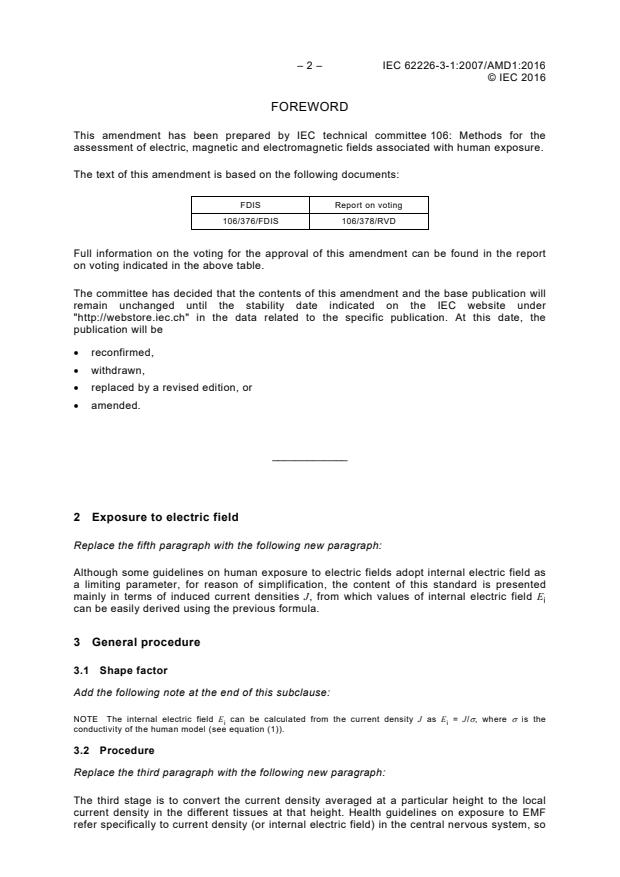
IEC 62226-3-1:2007/AMD1:2016 - Amendment 1 - Exposure to electric or magnetic fields in the low and intermediate frequency range - Methods for calculating the current density and internal electric field induced in the human body - Part 3-1: Exposure to electric fields - Analytical and 2D numerical models Released:10/7/2016
Overview
IEC 62226-3-1:2007/AMD1:2016 is an important amendment to the international standard developed by the International Electrotechnical Commission (IEC). It addresses human exposure to electric fields in the low and intermediate frequency ranges, focusing on methods for quantifying the induced current density and internal electric fields within the human body. This standard, part 3-1 of the IEC 62226 series, provides updated analytical and two-dimensional (2D) numerical models that enable precise calculation and assessment of exposure levels - critical for ensuring compliance with safety limits and health guidelines related to electromagnetic fields (EMF).
The amendment refines calculation methods, introduces updated shape factors, and clarifies the relationship between induced current densities and internal electric fields, with a focus on exposure in sensitive areas like the spinal cord in the neck. It serves as a global reference for electrical and electronic industries to assess low-frequency electric field exposure risks effectively.
Key Topics
Analytical and 2D Numerical Models: IEC 62226-3-1/AMD1 introduces enhanced analytical solutions and 2D computational models to estimate induced current density (J) and internal electric field (Eᵢ) in the human body for electric fields exposure.
Human Body Modeling: Highlights the importance of applying shape factors and conductivity parameters to derive localized current densities, especially in the central nervous system region like the spinal cord in the neck, where exposure effects are critical due to anatomy.
Calculation Procedures:
- Conversion of averaged current densities at specific body heights to localized densities in tissues.
- Use of conductivity values (σ) to calculate internal electric fields from current density data (Eᵢ = J/σ).
- Updated mathematical expressions for determining external electric field strength required to produce exposure limits inside the body.
Exposure Limits and Safety Guidelines: Connects the calculated internal fields and current densities to basic restrictions defined by recognized health agencies (e.g., ICNIRP) – ensuring adherence to occupational and public exposure limits.
Comparison of Models: The amendment compares analytical model results to numerical simulations for different reference human models (adult male, female, and children), validating the consistency and conservativeness of the models.
Influence of Conductivity: Notes the dependency of internal electric fields on tissue conductivity, underlining the importance of accurate biological parameter selection in exposure assessment.
Practical Examples: Provides illustrative calculations for converting current density restrictions into corresponding external electric field strength values, aiding real-world application and compliance checks.
Applications
Electric and Electronic Industry Compliance: Utilized by manufacturers and safety engineers to ensure devices and installations comply with low-frequency electric field exposure limits.
Occupational Health and Safety: Helps occupational health specialists assess worker exposure in environments with significant low or intermediate frequency electric fields, such as electrical substations or industrial settings.
Medical and Research Institutions: Supports biomedical researchers studying the effects of electric fields on human tissues using standardized calculation methodology.
Regulatory Bodies and Standards Development: Provides scientifically grounded methods for regulators to formulate or update exposure guidelines and verification protocols.
Environmental Safety Assessment: Used to evaluate public exposure from power lines, electrical appliances, and infrastructures generating low-frequency electric fields.
Related Standards
IEC 62226 Series: Covers comprehensive methods for assessing human exposure to electric, magnetic, and electromagnetic fields across various frequency ranges.
ICNIRP Guidelines 2010: Internationally recognized guidelines for limiting exposure to time-varying electric and magnetic fields, referenced within this standard for establishing exposure limits.
IEC Technical Committee 106 Outputs: The responsible IEC technical committee that produces standards and amendments concerning EMF exposure assessment methods.
Other Low-Frequency EMF Exposure Standards: National and international standards that align with or complement IEC 62226-3-1, providing frameworks for occupational and general public protection.
By adhering to IEC 62226-3-1:2007/AMD1:2016, industries and regulators can adopt rigorous, analytical, and numerical methodologies to accurately quantify electric field exposure in humans - ensuring health and safety compliance in environments involving electric and magnetic fields at low and intermediate frequencies. This standard supports informed decision-making and risk mitigation strategies by linking precise scientific modeling with practical exposure limits.
Relations
- Effective Date
- 05-Sep-2023
Buy Documents
IEC 62226-3-1:2007/AMD1:2016 - Amendment 1 - Exposure to electric or magnetic fields in the low and intermediate frequency range - Methods for calculating the current density and internal electric field induced in the human body - Part 3-1: Exposure to electric fields - Analytical and 2D numerical models Released:10/7/2016
Get Certified
Connect with accredited certification bodies for this standard

BSMI (Bureau of Standards, Metrology and Inspection)
Taiwan's standards and inspection authority.
Sponsored listings
Frequently Asked Questions
IEC 62226-3-1:2007/AMD1:2016 is a standard published by the International Electrotechnical Commission (IEC). Its full title is "Amendment 1 - Exposure to electric or magnetic fields in the low and intermediate frequency range - Methods for calculating the current density and internal electric field induced in the human body - Part 3-1: Exposure to electric fields - Analytical and 2D numerical models". This standard covers: Amendment 1 - Exposure to electric or magnetic fields in the low and intermediate frequency range - Methods for calculating the current density and internal electric field induced in the human body - Part 3-1: Exposure to electric fields - Analytical and 2D numerical models
Amendment 1 - Exposure to electric or magnetic fields in the low and intermediate frequency range - Methods for calculating the current density and internal electric field induced in the human body - Part 3-1: Exposure to electric fields - Analytical and 2D numerical models
IEC 62226-3-1:2007/AMD1:2016 is classified under the following ICS (International Classification for Standards) categories: 17.220.20 - Measurement of electrical and magnetic quantities. The ICS classification helps identify the subject area and facilitates finding related standards.
IEC 62226-3-1:2007/AMD1:2016 has the following relationships with other standards: It is inter standard links to IEC 62226-3-1:2007. Understanding these relationships helps ensure you are using the most current and applicable version of the standard.
IEC 62226-3-1:2007/AMD1:2016 is available in PDF format for immediate download after purchase. The document can be added to your cart and obtained through the secure checkout process. Digital delivery ensures instant access to the complete standard document.
Standards Content (Sample)
IEC 62226-3-1 ®
Edition 1.0 2016-10
INTERNATIONAL
STANDARD
NORME
INTERNATIONALE
AM ENDMENT 1
AM ENDEMENT 1
Exposure to electric or magnetic fields in the low and intermediate frequency
range – Methods for calculating the current density and internal electric field
induced in the human body –
Part 3-1: Exposure to electric fields – Analytical and 2D numerical models
Exposition aux champs électriques ou magnétiques à basse et moyenne
fréquence – Méthodes de calcul des densités de courant induit et des champs
électriques induits dans le corps humain –
Partie 3-1: Exposition à des champs électriques – Modèles analytiques et
numériques 2D
IEC 62226-3-1:2007-05/AMD1:2016-10(en-fr)
All rights reserved. Unless otherwise specified, no part of this publication may be reproduced or utilized in any form
or by any means, electronic or mechanical, including photocopying and microfilm, without permission in writing from
either IEC or IEC's member National Committee in the country of the requester. If you have any questions about IEC
copyright or have an enquiry about obtaining additional rights to this publication, please contact the address below or
your local IEC member National Committee for further information.
Droits de reproduction réservés. Sauf indication contraire, aucune partie de cette publication ne peut être reproduite
ni utilisée sous quelque forme que ce soit et par aucun procédé, électronique ou mécanique, y compris la photocopie
et les microfilms, sans l'accord écrit de l'IEC ou du Comité national de l'IEC du pays du demandeur. Si vous avez des
questions sur le copyright de l'IEC ou si vous désirez obtenir des droits supplémentaires sur cette publication, utilisez
les coordonnées ci-après ou contactez le Comité national de l'IEC de votre pays de résidence.
IEC Central Office Tel.: +41 22 919 02 11
3, rue de Varembé Fax: +41 22 919 03 00
CH-1211 Geneva 20 info@iec.ch
Switzerland www.iec.ch
About the IEC
The International Electrotechnical Commission (IEC) is the leading global organization that prepares and publishes
International Standards for all electrical, electronic and related technologies.
About IEC publications
The technical content of IEC publications is kept under constant review by the IEC. Please make sure that you have the
latest edition, a corrigenda or an amendment might have been published.
IEC Catalogue - webstore.iec.ch/catalogue Electropedia - www.electropedia.org
The stand-alone application for consulting the entire The world's leading online dictionary of electronic and
bibliographical information on IEC International Standards, electrical terms containing 20 000 terms and definitions in
Technical Specifications, Technical Reports and other English and French, with equivalent terms in 15 additional
documents. Available for PC, Mac OS, Android Tablets and languages. Also known as the International Electrotechnical
iPad. Vocabulary (IEV) online.
IEC publications search - www.iec.ch/searchpub IEC Glossary - std.iec.ch/glossary
The advanced search enables to find IEC publications by a 65 000 electrotechnical terminology entries in English and
variety of criteria (reference number, text, technical French extracted from the Terms and Definitions clause of
committee,…). It also gives information on projects, replaced IEC publications issued since 2002. Some entries have been
and withdrawn publications. collected from earlier publications of IEC TC 37, 77, 86 and
CISPR.
IEC Just Published - webstore.iec.ch/justpublished
Stay up to date on all new IEC publications. Just Published IEC Customer Service Centre - webstore.iec.ch/csc
details all new publications released. Available online and If you wish to give us your feedback on this publication or
also once a month by email. need further assistance, please contact the Customer Service
Centre: csc@iec.ch.
A propos de l'IEC
La Commission Electrotechnique Internationale (IEC) est la première organisation mondiale qui élabore et publie des
Normes internationales pour tout ce qui a trait à l'électricité, à l'électronique et aux technologies apparentées.
A propos des publications IEC
Le contenu technique des publications IEC est constamment revu. Veuillez vous assurer que vous possédez l’édition la
plus récente, un corrigendum ou amendement peut avoir été publié.
Catalogue IEC - webstore.iec.ch/catalogue Electropedia - www.electropedia.org
Application autonome pour consulter tous les renseignements Le premier dictionnaire en ligne de termes électroniques et
bibliographiques sur les Normes internationales, électriques. Il contient 20 000 termes et définitions en anglais
Spécifications techniques, Rapports techniques et autres et en français, ainsi que les termes équivalents dans 15
documents de l'IEC. Disponible pour PC, Mac OS, tablettes langues additionnelles. Egalement appelé Vocabulaire
Android et iPad. Electrotechnique International (IEV) en ligne.
Recherche de publications IEC - www.iec.ch/searchpub Glossaire IEC - std.iec.ch/glossary
La recherche avancée permet de trouver des publications IEC 65 000 entrées terminologiques électrotechniques, en anglais
en utilisant différents critères (numéro de référence, texte, et en français, extraites des articles Termes et Définitions des
comité d’études,…). Elle donne aussi des informations sur les publications IEC parues depuis 2002. Plus certaines entrées
projets et les publications remplacées ou retirées. antérieures extraites des publications des CE 37, 77, 86 et
CISPR de l'IEC.
IEC Just Published - webstore.iec.ch/justpublished
Restez informé sur les nouvelles publications IEC. Just Service Clients - webstore.iec.ch/csc
Published détaille les nouvelles publications parues. Si vous désirez nous donner des commentaires sur cette
Disponible en ligne et aussi une fois par mois par email. publication ou si vous avez des questions contactez-nous:
csc@iec.ch.
IEC 62226-3-1 ®
Edition 1.0 2016-10
INTERNATIONAL
STANDARD
NORME
INTERNATIONALE
AM ENDMENT 1
AM ENDEMENT 1
Exposure to electric or magnetic fields in the low and intermediate frequency
range – Methods for calculating the current density and internal electric field
induced in the human body –
Part 3-1: Exposure to electric fields – Analytical and 2D numerical models
Exposition aux champs électriques ou magnétiques à basse et moyenne
fréquence – Méthodes de calcul des densités de courant induit et des champs
électriques induits dans le corps humain –
Partie 3-1: Exposition à des champs électriques – Modèles analytiques et
numériques 2D
INTERNATIONAL
ELECTROTECHNICAL
COMMISSION
COMMISSION
ELECTROTECHNIQUE
INTERNATIONALE
ICS 17.220.20 ISBN 978-2-8322-3666-6
– 2 – IEC 62226-3-1:2007/AMD1:2016
© IEC 2016
FOREWORD
This amendment has been prepared by IEC technical committee 106: Methods for the
assessment of electric, magnetic and electromagnetic fields associated with human exposure.
The text of this amendment is based on the following documents:
FDIS Report on voting
106/376/FDIS 106/378/RVD
Full information on the voting for the approval of this amendment can be found in the report
on voting indicated in the above table.
The committee has decided that the contents of this amendment and the base publication will
remain unchanged until the stability date indicated on the IEC website under
"http://webstore.iec.ch" in the data related to the specific publication. At this date, the
publication will be
• reconfirmed,
• withdrawn,
• replaced by a revised edition, or
• amended.
_____________
2 Exposure to electric field
Replace the fifth paragraph with the following new paragraph:
Although some guidelines on human exposure to electric fields adopt internal electric field as
a limiting parameter, for reason of simplification, the content of this standard is presented
mainly in terms of induced current densities J, from which values of internal electric field E
i
can be easily derived using the previous formula.
3 General procedure
3.1 Shape factor
Add the following note at the end of this subclause:
NOTE The internal electric field E can be calculated from the current density J as E = J/σ, where σ is the
i i
conductivity of the human model (see equation (1)).
3.2 Procedure
Replace the third paragraph with the following new paragraph:
The third stage is to convert the current density averaged at a particular height to the local
current density in the different tissues at that height. Health guidelines on exposure to EMF
refer specifically to current density (or internal electric field) in the central nervous system, so
© IEC 2016
the particular area of interest within the body is the spinal cord in the neck, due to the small
cross section of the neck, which concentrates the current (or internal electric field) in that
region.
5.2.1 Analytical
Replace the paragraph immediately above Figure 8 with the following new paragraph and
note:
Figure 9 gives the result of the analytical calculation of the local current density J , for a field
s
magnitude of 1 kV/m at 50 Hz.
NOTE The internal electric field E can be calculated from the current density J as E = J/σ, where σ is the
i i
conductivity of the human model.
Replace the title of Figure 8 with the following new title:
Figure 8 – Calculation of the shape factor for electric field K for a spheroid
E
exposed to an unperturbed electric field
5.3.1 Analytical
Replace Table 4 with the following new paragraph and table:
For the basic restrictions in terms of internal electric fields, i.e. E : 20 mV/m (public) and
iBR
100 mV/m (occupational), the external electric field E required to produce an internal
BR
electric field equal to the basic restriction E is found by the following relation:
iBR
σE
iBR
E =
BR
J (neck)
A
where σ is the conductivity of the human model.
Table 4 – Electric field E required to produce
BR
basic restrictions J or E in the neck at 50 Hz
BR iBR
Reference Reference
man woman
J , current density in neck per kV/m, mA/m 0,244 0,286
A
Circumference at base of neck, m 0,425 0,368
E , electric field for a 2 mA/m basic restriction in the
BR
8,2 7,0
neck, kV/m
E , electric fi
...