

IEC PAS 62267:2005
(Main)Railway applications - Automated Urban Guided Transport (AUGT) safety requirements
- Abstract
Is a Publicly Available Specification covering general high-level safety requirements for all types of automated urban guided transit systems with independent self-propelled trains operating on an exclusive guideway. Deals with safety requirements needed to compensate for the absence of the driver or attendant staff.
- Status
- Replaced
- Publication Date
- 14-Dec-2005
- Technical Committee
- TC 9 - Electrical equipment and systems for railways
- Drafting Committee
- WG 3 - TA 5/WG 3
- Current Stage
- DELPUB - Deleted publication - 99 Deleted
- Start Date
- 09-Jul-2009


Relations
- Effective Date
- 05-Sep-2023
Get Certified
Connect with accredited certification bodies for this standard

IRIS Certification (UNIFE)
International Railway Industry Standard certification.

TÜV SÜD Rail GmbH
TÜV SÜD railway certification services.

Bureau Veritas Railway Certification
Railway and transportation certification.
Sponsored listings
Frequently Asked Questions
IEC PAS 62267:2005 is a technical specification published by the International Electrotechnical Commission (IEC). Its full title is "Railway applications - Automated Urban Guided Transport (AUGT) safety requirements". This standard covers: Is a Publicly Available Specification covering general high-level safety requirements for all types of automated urban guided transit systems with independent self-propelled trains operating on an exclusive guideway. Deals with safety requirements needed to compensate for the absence of the driver or attendant staff.
Is a Publicly Available Specification covering general high-level safety requirements for all types of automated urban guided transit systems with independent self-propelled trains operating on an exclusive guideway. Deals with safety requirements needed to compensate for the absence of the driver or attendant staff.
IEC PAS 62267:2005 is classified under the following ICS (International Classification for Standards) categories: 45.060.01 - Railway rolling stock in general. The ICS classification helps identify the subject area and facilitates finding related standards.
IEC PAS 62267:2005 has the following relationships with other standards: It is inter standard links to IEC 62267:2009. Understanding these relationships helps ensure you are using the most current and applicable version of the standard.
IEC PAS 62267:2005 is available in PDF format for immediate download after purchase. The document can be added to your cart and obtained through the secure checkout process. Digital delivery ensures instant access to the complete standard document.
Standards Content (Sample)
PUBLICLY
IEC
AVAILABLE
PAS 62267
SPECIFICATION
First edition
Pre-Standard
2005-12
Railway applications –
Automated Urban Guided Transport (AUGT)
safety requirements
Reference number
IEC/PAS 62267:2005(E)
Publication numbering
As from 1 January 1997 all IEC publications are issued with a designation in the
60000 series. For example, IEC 34-1 is now referred to as IEC 60034-1.
Consolidated editions
The IEC is now publishing consolidated versions of its publications. For example,
edition numbers 1.0, 1.1 and 1.2 refer, respectively, to the base publication, the
base publication incorporating amendment 1 and the base publication incorporating
amendments 1 and 2.
Further information on IEC publications
The technical content of IEC publications is kept under constant review by the IEC,
thus ensuring that the content reflects current technology. Information relating to
this publication, including its validity, is available in the IEC Catalogue of
publications (see below) in addition to new editions, amendments and corrigenda.
Information on the subjects under consideration and work in progress undertaken
by the technical committee which has prepared this publication, as well as the list
of publications issued, is also available from the following:
• IEC Web Site (www.iec.ch)
• Catalogue of IEC publications
The on-line catalogue on the IEC web site (www.iec.ch/searchpub) enables you to
search by a variety of criteria including text searches, technical committees
and date of publication. On-line information is also available on recently issued
publications, withdrawn and replaced publications, as well as corrigenda.
• IEC Just Published
This summary of recently issued publications (www.iec.ch/online_news/ justpub)
is also available by email. Please contact the Customer Service Centre (see
below) for further information.
• Customer Service Centre
If you have any questions regarding this publication or need further assistance,
please contact the Customer Service Centre:
Email: custserv@iec.ch
Tel: +41 22 919 02 11
Fax: +41 22 919 03 00
PUBLICLY
IEC
AVAILABLE
PAS 62267
SPECIFICATION
First edition
Pre-Standard
2005-12
Railway applications –
Automated Urban Guided Transport (AUGT)
safety requirements
IEC 2005 Copyright - all rights reserved
No part of this publication may be reproduced or utilized in any form or by any means, electronic or
mechanical, including photocopying and microfilm, without permission in writing from the publisher.
International Electrotechnical Commission, 3, rue de Varembé, PO Box 131, CH-1211 Geneva 20, Switzerland
Telephone: +41 22 919 02 11 Telefax: +41 22 919 03 00 E-mail: inmail@iec.ch Web: www.iec.ch
PRICE CODE
Commission Electrotechnique Internationale
v
International Electrotechnical Commission
Международная Электротехническая Комиссия
For price, see current catalogue
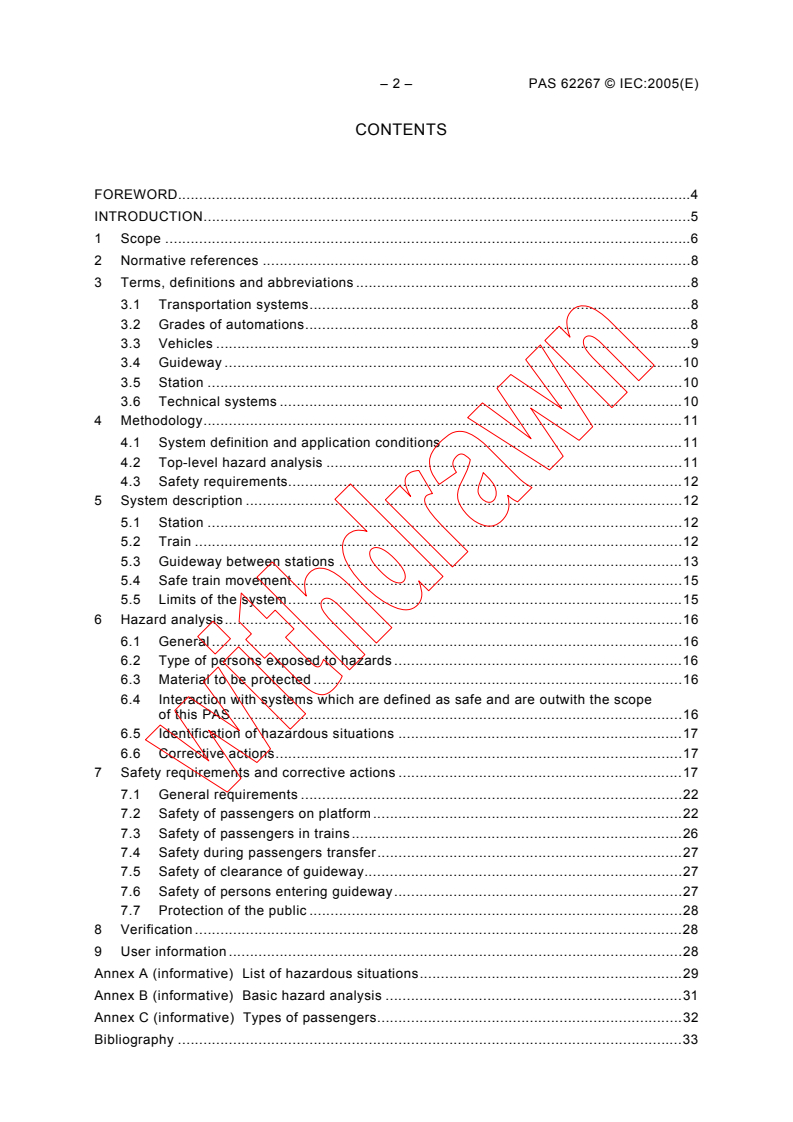
– 2 – PAS 62267 © IEC:2005(E)
CONTENTS
FOREWORD.4
INTRODUCTION.5
1 Scope .6
2 Normative references .8
3 Terms, definitions and abbreviations .8
3.1 Transportation systems.8
3.2 Grades of automations.8
3.3 Vehicles .9
3.4 Guideway .10
3.5 Station .10
3.6 Technical systems .10
4 Methodology.11
4.1 System definition and application conditions.11
4.2 Top-level hazard analysis .11
4.3 Safety requirements.12
5 System description .12
5.1 Station .12
5.2 Train .12
5.3 Guideway between stations .13
5.4 Safe train movement.15
5.5 Limits of the system.15
6 Hazard analysis.16
6.1 General .16
6.2 Type of persons exposed to hazards .16
6.3 Material to be protected .16
6.4 Interaction with systems which are defined as safe and are outwith the scope
of this PAS .16
6.5 Identification of hazardous situations .17
6.6 Corrective actions.17
7 Safety requirements and corrective actions .17
7.1 General requirements .22
7.2 Safety of passengers on platform .22
7.3 Safety of passengers in trains.26
7.4 Safety during passengers transfer.27
7.5 Safety of clearance of guideway.27
7.6 Safety of persons entering guideway.27
7.7 Protection of the public .28
8 Verification .28
9 User information .28
Annex A (informative) List of hazardous situations.29
Annex B (informative) Basic hazard analysis .31
Annex C (informative) Types of passengers.32
Bibliography .33
PAS 62267 © IEC:2005(E) – 3 –
Figure 1 – Description of the life-cycle phase .11
Figure 2 – Areas of subsystem station.12
Figure 3 – Guideway.14
Figure 4 – Guideway with level crossing .14
Figure 5 – Guideway and storage area .15
Table 1 – Grades of automation .6
Table 2 – Minimum set of top-level hazards (under consideration) .18
Table B.1 – Hazards to be covered by basic function .31
– 4 – PAS 62267 © IEC:2005(E)
INTERNATIONAL ELECTROTECHNICAL COMMISSION
____________
RAILWAY APPLICATIONS –
AUTOMATED URBAN GUIDED TRANSPORT (AUGT)
SAFETY REQUIREMENTS
FOREWORD
1) The International Electrotechnical Commission (IEC) is a worldwide organization for standardization comprising
all national electrotechnical committees (IEC National Committees). The object of IEC is to promote international
co-operation on all questions concerning standardization in the electrical and electronic fields. To this end and in
addition to other activities, IEC publishes International Standards, Technical Specifications, Technical Reports,
Publicly Available Specifications (PAS) and Guides (hereafter referred to as “IEC Publication(s)”). Their
preparation is entrusted to technical committees; any IEC National Committee interested in the subject dealt with
may participate in this preparatory work. International, governmental and non-governmental organizations liaising
with the IEC also participate in this preparation. IEC collaborates closely with the International Organization for
Standardization (ISO) in accordance with conditions determined by agreement between the two organizations.
2) The formal decisions or agreements of IEC on technical matters express, as nearly as possible, an international
consensus of opinion on the relevant subjects since each technical committee has representation from all
interested IEC National Committees.
3) IEC Publications have the form of recommendations for international use and are accepted by IEC National
Committees in that sense. While all reasonable efforts are made to ensure that the technical content of IEC
Publications is accurate, IEC cannot be held responsible for the way in which they are used or for any
misinterpretation by any end user.
4) In order to promote international uniformity, IEC National Committees undertake to apply IEC Publications
transparently to the maximum extent possible in their national and regional publications. Any divergence between
any IEC Publication and the corresponding national or regional publication shall be clearly indicated in the latter.
5) IEC provides no marking procedure to indicate its approval and cannot be rendered responsible for any
equipment declared to be in conformity with an IEC Publication.
6) All users should ensure that they have the latest edition of this publication.
7) No liability shall attach to IEC or its directors, employees, servants or agents including individual experts and
members of its technical committees and IEC National Committees for any personal injury, property damage or
other damage of any nature whatsoever, whether direct or indirect, or for costs (including legal fees) and
expenses arising out of the publication, use of, or reliance upon, this IEC Publication or any other IEC
Publications.
8) Attention is drawn to the Normative references cited in this publication. Use of the referenced publications is
indispensable for the correct application of this publication.
9) Attention is drawn to the possibility that some of the elements of this IEC Publication may be the subject of
patent rights. IEC shall not be held responsible for identifying any or all such patent rights.
A PAS is a technical specification not fulfilling the requirements for a standard but made
available to the public.
IEC-PAS 62267 has been processed by IEC technical committee 9, Electrical equipment and
systems for railways. It defines the essential safety requirements for an Automated Urban
Guided Transit system (AUGT).
The text of this PAS is based on the This PAS was approved for
following document: publication by the P-members of the
committee concerned as indicated in
the following document
Draft PAS Report on voting
9/868/PAS 9/898/RVD
Following publication of this PAS, which is a pre-standard publication, the technical committee
or subcommittee concerned will transform it into an International Standard.
This PAS shall remain valid for an initial maximum period of three years starting from
2005-12. The validity may be extended for a single three-year period, following which it shall be
revised to become another type of normative document or shall be withdrawn.
PAS 62267 © IEC:2005(E) – 5 –
INTRODUCTION
This Publicly Available Specification is a generic guideline providing recommendations which
can help transport authorities and authorities having jurisdiction to define appropriate and safe
Automated Urban Guided Transport (AUGT) requirements for their specific application, taking
into account that the requirements are determined by their own specific risk analysis, as is
required in the life-cycle RAMS process according to IEC 62278 with respect to the different
risk acceptance principles in the world.
The recommendation of this PAS for the definition of global and generic safety requirements is
based on the experience coming from proven solutions throughout the world.
Due to the diversity of possible technical solutions that may be adopted in different
circumstances, the requirements defined by this PAS should be considered as minimum
requirements. Each technical solution chosen or aspects of a particular topographic,
environmental, social or legal consideration may generate their own additional safety
requirements. It is expected that hazard analysis is carried out to establish any such additional
requirements.
Therefore, the PAS does not prescribe specific equipment or means necessary to mitigate the
various hazards. Rather, it prescribes a list of foreseeable hazards to be followed, as a
minimum, in the mandatory and comprehensive safety analysis of each project with respect to
the driver and staff functions replaced by automated equipment. Additionally, it describes
possible and proven solutions that may be considered in the comprehensive safety analysis of
each project.
However, the PAS does not take into account all different hazards that may arise from the large
number of different applications used in the world. Also, this PAS cannot describe completely
all the safety measures needed for each specific application.
Moreover, the PAS does not necessarily require choosing a safety measure for each possible
hazard where the associated risk is already considered tolerable. As stated in IEC 62278, it is
the responsibility of the transport authority in agreement with the authority having jurisdiction
and with respect to their specific risk acceptance principles and legal requirements, to decide
on the tolerability of each hazard and on the implementation of a specific safety measure.
It has to be taken into account that the PAS is basically a specification related to railway
applications. To avoid contradictions with all other standards, even non-IEC standards, which
are relevant in the field of railway applications including civil engineering, no values or
considerations which obstruct existing standards in their field of application are given. Specific
values or considerations are only used if they are exclusively used for AUGT purposes. If
values are used, then their derivation and its basis are provided in the informative annexes.
NOTE WG 39 of TC 9 wishes to publish the state of its document reflecting the situation at June 2005. Attention is
drawn to the fact that this document is incomplete. Consequently, the recommendations described in the present
PAS are subject to changes by WG 39.
– 6 – PAS 62267 © IEC:2005(E)
RAILWAY APPLICATIONS –
AUTOMATED URBAN GUIDED TRANSPORT (AUGT)
SAFETY REQUIREMENTS
1 Scope
This Publicly Available Specification covers general high-level safety requirements for all types
of automated urban guided transit systems with independent self-propelled trains operating on
an exclusive guideway.
This PAS deals with safety requirements needed to compensate for the absence of the driver or
attendant staff who are typically responsible for the activities mentioned in Table 1. Table 1
describes the relationship between the grade of automation and basic system functions.
The requirements are restricted to the transit system as defined in Clause 5 and to Driverless
Train Operation (DTO) and Unattended Train Operation (UTO) modes of operation as defined
in 3.2 (see the shaded areas in Table 1).
Table 1 – Grades of automation
Non- Semi-
Driverless Unattended
On-sight train automated automated
train train
operation train train
operation operation
Basic functions of train
operation operation
operation TOS
DTO UTO
NTO STO
GOA0 GOA1 GOA2 GOA3 GOA4
Ensuring safe Ensure safe route x S S S S
movement of (points
trains command/control
in system)
Ensure safe x S S S S
separation of
trains
Ensure safe x x S S S
speed (partly
supervised by
system)
Driving Control x x S S S
acceleration and
braking
Supervising Prevent collision x x x S S
guideway with obstacles
Prevent collision x x x S S
with persons on
tracks
Supervising Control x x x x S
passenger passengers doors
transfer
Prevent person x x x x S
injuries between
cars or between
platform and train
Ensure safe x x x x S
starting
conditions
PAS 62267 © IEC:2005(E) – 7 –
Non- Semi-
Driverless Unattended
On-sight train automated automated
train train
operation train train
operation operation
Basic functions of train
operation operation
operation TOS
DTO UTO
STO
NTO
GOA0 GOA1 GOA2 GOA3 GOA4
Operating a Set in/set off x x x x S
train operation
Supervise the x x x x S
status of the train
Ensuring Perform train x x x x S and/or
detection and diagnostic, detect staff in OCC
management fire/smoke and
of emergency detect derailment,
situations handle
emergency
situations
(call/evacuation,
supervision)
NOTE x = the responsibility of operations staff (may be realised by technical system);
S = shall be realized by technical system.
This PAS does not specifically look at security issues. However, aspects of safety requirements
may apply to assuring security within the transit system.
NOTE The definitions of “security” and “safety” are given in IEC 62278.
The application of this PAS is subsidiary to the responsibility of the transport authority in
accordance with its respective supervisory body and specific laws and decrees applicable to
the transport system location.
The application of this PAS must take account of
• social risk acceptance in different cultures or different national legal regulations (for
example, SHOREI, BOStrab) or principles (for example, GAME, ALARP, MEM);
• laws and decrees in different states;
• special or different requirements coming from the authority having jurisdiction or from an
independent assessor in charge of the specific project;
• the responsibility for “safe operation“ by the transport authority.
This PAS does not apply to the following types of transportation systems, unless specifically
required by the system owner.
• Automated People Movers (APM) operating entirely inside a privileged environment such as
an airport, a commercial centre, a leisure resort;
• amusement rides and roller-coasters, generally featuring a single station so that
passengers board and alight the system at the same location;
• Intercity and mainline train services, generally operating in a rural environment on part of
their routes;
• cable-driven systems;
• systems featuring electronically guided vehicles (with optical sensors, or magnetic sensors,
or similar devices/systems.
The PAS is not concerned with risk arising during work for construction, installation,
modification and dismantling of the system.
– 8 – PAS 62267 © IEC:2005(E)
This PAS is not concerned with pre-existing DTO or UTO systems (for definitions, see 3.2) that
were designed before this PAS took effect.
In the case of upgrading an existing transit system to a DTO or UTO system, the risks
associated with the existing system are outside the scope of this PAS. However, the risk
assessment process described herein may be relevant, and its application is at the discretion of
the safety authority having jurisdiction.
In the case of extending or modifying an existing DTO or UTO system in operation, this PAS
applies only if the change is significant as determined by the safety authority having
jurisdiction; but the risks due to the relationship with the unchanged parts of existing systems
(rolling stock, traction power supply, signalling, platforms) shall be taken into account.
2 Normative references
The following referenced documents are indispensable for the application of this document. For
dated references, only the edition cited applies. For undated references, the latest edition of
the referenced document (including any amendments) applies.
IEC 62278, Railway applications – Specification and demonstration of reliability, availability,
maintainability and safety (RAMS)
3 Terms, definitions and abbreviations
For the purposes of this document, the following terms, definitions and abbreviations apply.
3.1 Transportation systems
3.1.1 Automated Urban Guided Transport (AUGT)
metropolitan scale urban system featuring DTO or UTO, as defined below, with self-propelled
vehicles mechanically guided on a guideway, which is separated from general road and
pedestrian traffic, operating in an urban environment, and open to the general public without
restrictions:
a) systems accepting exclusively automated trains are called “closed systems”;
b) systems accepting a mixed traffic of automated trains and conventional trains (i.e.,
manually operated or semi-automated) are called “open systems”
3.1.2 Automated People Movers (APM)
See ASCE (American Society of Civil Engineers) standard 21: Automated People Movers –
Part 1.
3.2 Grades of automations
3.2.1 On-sight Train Operation (TOS)
operation in which the driver (i.e. the train operator) has full responsibility and no technical
system is required to supervise his activities
3.2.2 Non-automated Train Operation (NTO)
operation in which the driver (i.e., the train operator) is in the front cabin of the train observing
the guideway and stopping the train in case of a hazardous situation. Acceleration and braking
are controlled by the driver in conformance with wayside signals or cab-signalling. The
PAS 62267 © IEC:2005(E) – 9 –
signalling system and any associated wayside system supervise the activities of the driver;
however, with respect to the signals and the speed, this supervision may be discrete, semi-
continuous or continuous. Safe departure of the train from the station, including door closing, is
the responsibility of the operations staff whether onboard the train or on the station platform
3.2.3 Semi-automated Train Operation (STO)
operation in which the driver is in the front cabin of the train observing the guideway and
stopping the train in case of a hazardous situation. Acceleration and braking is automated and
the speed is supervised continuously by the system. Safe departure of the train from the station
is the responsibility of the operations staff, whether on board the train or on the station platform
3.2.4 Driverless Train Operation (DTO)
operation in which additional control and detection systems are needed compared with STO
because there is no driver in the front cabin of the train to observe the guideway and stop the
train in case of a hazardous situation.
An operations staff person is necessary onboard. Safe departure of the train from the station,
including door closing (open point), can be the responsibility of the operations staff or may be
done automatically
3.2.5 Unattended Train Operation (UTO)
operation in which additional control and detection systems are needed compared to DTO
because there is no on-board operations staff person necessary.
Safe departure of the train from the station, including door closing, is done automatically
3.2.6 Automated transit system
DTO or UTO mode
3.2.7 Conventional transit system
TOS, NTO or STO mode
3.3 Vehicles
3.3.1 independent train
train which is constructed (designed) for independent train operation
3.3.2 dependent train
train which is designed for operation with other traffic
3.3.3 passenger cabin
part of a train which is used for the transport of passengers
3.3.4 passenger transfer door
train door which provides the passenger transfer between the passenger cabin and the platform
in the stations. It could also be used as an emergency exit in cases of hazardous situations,
when the status of the passenger cabin changes into an unsafe status
– 10 – PAS 62267 © IEC:2005(E)
3.4 Guideway
3.4.1 independent guideway
guideway which is independent from other traffic on account of its location or its form of
construction. Level crossings (as defined in 5.3) may be part of an independent guideway
3.4.2 dynamic envelope
space around the track which is required as safe room for the train during motion
3.4.3 safety space of guideway
space beside the track, which persons can occupy without danger of being struck by passing
trains
3.5 Station
3.5.1 platform
area of station which is built for passenger transfer between train and station
3.5.2 waiting area
area of platform, which is safely separated from the dynamic envelope of moving trains and
where persons should wait for approaching trains
3.5.3 passenger transfer area
area of platform, directly adjacent to the dynamic envelope which is intended for the for the
passage of passengers during transfer between waiting area and train; the area in which
boarding and alighting occurs
3.5.4 platform track
To be defined
3.6 Technical systems
3.6.1 Automated Train Control (ATC) system
system for automatically controlling train movement, enforcing train safety, and directing train
operation. ATC includes automatic train protection and may include automatic train operation
and/or automatic train supervision
3.6.2 Automated Train Protection (ATP) system
safety-related subsystem within the automatic train control system that maintains safe route,
protection against collisions and excessive speed and other hazardous situations
3.6.3 Automated Train Operation (ATO) system
subsystem within the automatic train control system which performs any or all of the functions
of speed regulation, programmed stopping, door control, performance-level regulation or other
functions otherwise assigned to the train operator
PAS 62267 © IEC:2005(E) – 11 –
3.6.4 Automated Train Supervision (ATS) system
subsystem within the automatic train control system that monitors trains, adjusts the
performance of individual trains to maintain schedules, and provides data to adjust service to
minimize inconvenience otherwise caused by irregularities
4 Methodology
The methodology used for deriving the safety requirements given in this PAS is based on the
principles of the first steps described in the life-cycle phase of IEC 62278 (Figure 1).
Concept
Methodology
System definition and
Operate the
of this PAS
application conditions
system
Top level hazard
analysis
Modification and retrofit
Operation and
maintenance
Risk analysis
Safety
System requirements
requirements
System acceptance Performance monitoring
De-commissioning and
disposal
Apportionment of system System validation
(including safety acceptance
requirements
and commissioning)
Design and implementation Installation
Design and
Manufacture
manufacturing
Figure 1 – Description of the life-cycle phase
4.1 System definition and application conditions
The elements, the transit system, the boundaries and the application conditions of the system
are defined in Clause 5. The basic functions of train operation, no matter what grade of
automation applies, and the functions to be covered by a system for DTO and UTO are defined
in Table 1.
4.2 Top-level hazard analysis
a) Identification of hazardous situations taking into account all safety-related functions to
be covered by the system if there is
• no train driver in the front train cabin (DTO);
• no operational staff necessarily onboard trains (UTO)
b) Identification of safeguards which are able to compensate for the absence of train driver
with corrective actions and measures.
– 12 – PAS 62267 © IEC:2005(E)
4.3 Safety requirements
The safety requirements for each safeguard are described in Clause 7.
NOTE This PAS does not state the choice of corrective action or the acceptable level of residual risk. This should
be done for the specific application under the responsibility of the authority having jurisdiction, in a way which
a) allocates the hazards of the specific application and required risk reduction with respect to the specific safety
culture and accepted residual risk;
b) defines the quality of safeguards by describing safety-related requirements and functions embedded in the
overall functionality of the specific system;
c) assigns Safety Integrity Levels (SIL) to the defined safeguards and their functions.
5 System description
AUGT is a system which
• transports passengers from one station to another;
• uses automated self-propelled trains;
• runs on an exclusive guideway;
• allows train operation independent from other traffic;
• provides conditions of safe train movement.
Based on this basic system description, the following subsystems can be defined.
5.1 Station
Locality which allows passenger access to the system by transfer from the public environment
to the trains (i.e., boarding and alighting activity).
The subsystem station is divided into a number of areas as shown in Figure 2 and defined
below.
• The waiting area (which is defined as safe under the circumstances of escape in the case of
the emergency purposes of this PAS) is by definition outside the transport system and
therefore it is not covered within the scope of this PAS.
• The passenger transfer area (platform edge zone) which must ensure a safe passenger
transfer between station and train.
• The platform track which is used by moving trains to ensure transport.
Waiting area
Passenger transfer area
Platform track
Figure 2 – Areas of subsystem station
5.2 Train
The system element which operates within the guideway and, under regular conditions, moves
along the guideway and stops in the stations for passenger transfer.
PAS 62267 © IEC:2005(E) – 13 –
The train can be a
• single vehicle;
• composition of single vehicles, forming a unit, which can not be decoupled in regular
operation;
• composition of single vehicles or of multi-vehicle units which can be decoupled in regular
operation.
The subsystem train is divided into
• the passenger cabin (compartment) which is defined as a safe area if
– a safe train movement is provided;
– adequate safeguard is provided against external events impacting on the train, for
example, an obstacle on the guideway, on the platform, etc., adequate safeguard
against internal hazardous events impacting on passengers, for example, fire;
• the staff (drivers) cabin when included;
• passenger/transfer doors;
• other train doors or additional emergency exits if provided.
The train itself with its drive, bogies, passenger cabin is defined as safe if the general
requirements for mechanical and electrical train construction are fulfilled and safe guiding of
wheels is provided. This is not within the scope of this PAS.
The train subassemblies comprising the propulsion/braking system, bogies and guidance
equipment, signalling system, mechanical and electrical aspects of the passenger
compartment, communications systems, and other such elements of the train subsystem are
not part of the scope of this PAS. However, functional design requirements for the train
subassemblies may be dictated or influenced by the safety requirements contained in this PAS.
5.3 Guideway between stations
The subsystem guideway (see Figure 3) is divided into
• the construction (bridge, tunnel verge, track), which is defined as safe if the requirements
for safe buildings (static system) and safe guiding of wheels are fulfilled, which is not within
the scope of this PAS and defined as outside the system;
• the clearance of guideway which means the space above the track which is required as safe
space for the train during motion;
• the safety space of the guideway including emergency exits, if the construction of the
guideway is laid out for specific rescue reasons, and which is not within the scope of this
PAS and is defined as being outside the system.
– 14 – PAS 62267 © IEC:2005(E)
Station B
Station A
Walkway (optional)
Track
Clearance of guideway
Safety Space (optional)
Emergency exit (optional)
Figure 3 – Guideway
A special type of guideway is a level crossing, which can be used alternately by moving trains
or other non-automated traffic which crosses the guideway at a prescribed location (level
crossing) and with complete traffic crossing control and supervision.
Level crossings are within the scope of this PAS (see Figure 4).
Level crossing
Station B
Station A
Track
Clearance of guideway
Safety Space (optional)
Figure 4 – Guideway with level crossing
A special type of fully automated guideway (Figure 5) is a storage area, which can be used
• for storing trains, which are not in use for passenger service; or
• for receiving trains out of passenger service and dispatching trains into passenger service.
PAS 62267 © IEC:2005(E) – 15 –
Station A
Track
Clearance of guideway
Safety Area (optional)
Figure 5 – Guideway and storage area
5.4 Safe train movement
The following basic functions which ensure safe train movement and are typical to STO train
control systems consisting of the following are outside the scope of this PAS.
• Setting routes and ensuring safety of routes.
• Transmitting movement instructions to train.
• Supervising technically the movement of trains and controlling deviations from the safe state.
5.5 Limits of the system
The following items are included in the system:
• train as defined in 5.2;
• service vehicles;
• platform edge interface;
• right of way:
– clearance of guideway (automated section):
¾ passenger service track;
¾ siding track;
¾ depot track;
– emergency walkway and safety areas;
– level crossing;
• equipment rooms;
• control centre;
• traction power along the guideway.
In particular, the following subsets are excluded:
• stations (except for transfer area on the edge of the station platform) and the associated
lifts, escalators;
• tunnels, bridges, structures;
• areas where trains cannot be operated automatically (for example, the workshop);
• power distribution system.
– 16 – PAS 62267 © IEC:2005(E)
6 Hazard analysis
Hazards covered by this PAS are those associated with the items of 6.5.
6.1 General
All terms and abbreviations used in the risk analysis are defined in IEC 62278.
6.2 Type of persons exposed to hazards
6.2.1 Passengers
People using the system.
Passengers may have different levels of awareness, mobility and capacity to react to
hazardous situations.
6.2.2 Staff
Persons who are involved in the train operation process as employees of transport authority or
employees of other involved entities.
Note that there are different types of staff:
• operational staff;
• maintenance staff;
• rescue staff;
• external staff (maintenance and cleaning).
6.2.3 Public
Persons who are outside the system and may be affected by the hazardous situations of the
system.
6.3 Material to be protected
6.3.1 Train
6.3.2 Buildings
6.3.3 Belongings of passengers
6.3.4 Animals
The risk should be addressed.
6.4 Interaction with systems which are defined as safe and are outwith the scope of
this PAS
As a basis of hazard analysis, first of all, those hazards shall be identified by comparison with
NTO and STO, which exist due to the fact that
• in DTO, there is no driver in the front cabin of the train;
• in UTO, there is no operational staff necessarily present in the train.
Secondly, it shall be verified additionally which consequences are given under the
circumstances of DTO and MTO for systems which are defined as safe before (for example,
safe guiding of the train, safe bridges, safe routes).
PAS 62267 © IEC:2005(E) – 17 –
The basic requirement is that a transport system for DTO and UTO shall at least be operated
with the same safety level as any conventional system. (The safety quality is the result of the
realization of technical and functional requirements and operational rules.)
6.5 Identification of hazardous situations
The list in Annex A identifies only top-level hazards due to the absence of a driver or on-board
staff in accordance with the basic functions defined in Table 1 which require technical
solutions.
6.6 Corrective actions
A list of possible corrective actions is given in Table B.1.
7 Safety requirements and corrective actions
Safety requirements given in this PAS are supplementary to the safety requirements for a
conventional transit system.
A hazard analysis for the specific application shall be performed. Table 2 gives a minimum set
of top-level hazards to be considered for DTO and UTO aspects.
Subsequent subclauses describe some of the possible corrective actions against the given
hazards.
The choice of the corrective actions shall be based on the risk tolerability criteria for the
specific application.
There are four kinds of safeguards used to mitigate hazardous conditions.
a) Prevention of accident through the application of equipment and facilities designed to
avoid hazardous situations (for example, platform screen).
b) Detection of hazardous situations and avoiding an accident.
c) Provision of warning information for passengers or other persons (for example, warning
means, announcements such as "mind the gap").
d) Performance of operational procedures (rules).
– 18 – PAS 62267 © IEC:2005(E)
Table 2 – Minimum set of top-level hazards (under consideration)
Basic function
to be replaced drivers Hazardous situation Possible corrective action Description*
responsibility by system
Supervising guideway to Person in station at platform Full platform doors 1
prevent collisions with edge
persons on track
Half-height platform doors 2
Platform fences 3
Warning line 4
Detection devices 5
Staff surveillance 6
Emergency stop switch (possibly 7
including traction power off)
Public address system 8
Rules 9
Person in station in platform Rules 10
track
Warning line 11
Staff surveillance 12
Emergency stop switch (possibly 13
including traction power off)
Detection devices 14
Half-height platform doors 15
Full platform doors 16
Platform fences 17
Public emergency call system 18
Person leaving platform area Platform end door detection 19
(towards track between
station) at the platform end
Full-height platform end door 20
Rules 21
Platform end warning line 22
Staff supervision 23
Emergency stop switch (possibly 24
including traction power off)
Detection devices 25
Half-height platform end doors 26
Platform end walls 27
Platform end fences 28
Public emergency call system 29
Public address system 30
Person leaving platform area Platform track intrusion detection 31
(towards track between
stations) from the platform
track
Half-height platform doors 32
Full platform doors 33
PAS 62267 © IEC:2005(E) – 19 –
Basic function
to be replaced drivers Hazardous situation Possible corrective action Description*
responsibility by system
Rules 34
Warning line 35
Staff surveillance 36
Emergency stop switch (possibly 37
including traction power off)
Detection device 38
Platform fence 39
Public emergency call system 40
Public address system 41
Train approaching staff Training and education for staff 42
already being in track-bound
safety area between stations
Avoiding automated train 43
operation during works
Staff communication equipment 44
Train approaching Segregated guideway 45
unauthorized person already
being on track between
stations
Laws and regulations 46
Avoiding undetected entering from 47
train
Avoiding undetected entering from 48
neighbouring stations
Train approaching Rules 49
passengers to track in
evacuation situation
Staff communication equipment 50
Train stopping device by OCC 51
Switch-off of power supply if
necessary
(Safe door alarm handling)
Safe walkway 52
Supervising passengers Entrapment and drag Safety devices on passenger 53
transfer and control transfer doors
passenger doors
Public address system 54
Public emergency call system
Doors closing announcement
Audio and visual warning
Emergency stop on board 55
Emergency stop switch (possibly 56
including traction power off) on
platform
Rules 57
Staff surveillance 58
– 20 – PAS 62267 © IEC:2005(E)
Basic function
to be replaced drivers Hazardous situation Possible corrective action Description*
responsibility by system
Supervising passengers Fall of passenger from the Barrier between cars of train 59
transfer to prevent persons platform between cars of train
injuries between cars or
between platform and train
Barrier on the platform edge in the 60
alignment of the gap
Wayside detection device 61
Half-height platform doors 62
Full platform doors 63
Platform fence 64
On-board detection device 65
between cars of train
Staff surveillance 66
Marks of train doors areas on the 67
platform
Refuge under the platform 68
Fall of passenger between Design rules: maximum gap 69
cars and platform edge
Gap filler on board 70
Gap filler on the platform 71
Detection system on board 72
Detection system on the platform 73
Staff surveillance 74
Refuge area under the platform 75
Emergency stop on
...