

IEC 62267:2009
(Main)Railway applications - Automated urban guided transport (AUGT) - Safety requirements
General Information
- Abstract
IEC 62267:2009 covers high-level safety requirements applicable to automated urban guided transport systems, with driverless or unattended self-propelled trains, operating on an exclusive guideway. Deals with the safety requirements needed to compensate for the absence of a driver or attendant staff who would otherwise be responsible for some or all of train operation functions, depending on the level of automation of the system.
- Status
- Published
- Publication Date
- 08-Jul-2009
- Technical Committee
- TC 9 - Electrical equipment and systems for railways
- Drafting Committee
- WG 45 - TC 9/WG 45
- Current Stage
- PPUB - Publication issued
- Start Date
- 09-Jul-2009
- Completion Date
- 31-Jul-2009



Overview
IEC 62267:2009 is an international standard developed by the International Electrotechnical Commission (IEC) that addresses safety requirements for Automated Urban Guided Transport (AUGT) systems. These systems operate fully or partially without drivers or attendants on exclusive guideways, such as automated metro lines and driverless urban transit systems. The standard defines high-level safety requirements crucial for compensating for the absence of onboard personnel responsible for train operations depending on the automation level.
This document provides a comprehensive framework for ensuring safe system design, operation, and maintenance in automated urban railway applications. It covers safety aspects ranging from hazard analysis to emergency management and operational procedures, tailored specifically to AUGT systems.
Key Topics
Scope and Application Conditions
Focuses on high-level safety requirements for driverless or unattended self-propelled trains operating on dedicated guideways in urban environments, including terminology and definitions relevant to automated transport systems.System Description and Boundaries
Details the architecture of the system including stations, trains, guideways, and depots, outlining the operational limits and interfaces critical for safety.Hazard Analysis and Identification of Risk Scenarios
Includes supervised safety measures to prevent collisions with obstacles or people, injury prevention in passenger transfer zones, control of train status, and management of emergency situations.Safety Requirements for System Elements
Addresses safeguards for platforms (both open and enclosed), trains (door supervision, emergency exits, derailment detection, fire and smoke detection), guideways (intrusion detection, physical barriers), and transfer areas.Operational Rules and Emergency Procedures
Specifies rules for emergency evacuation, fire emergencies, vandalism, and stranded train removal; instructions for safe start-up and shut down of operations.Safety Verification and Documentation
Describes verification processes, documentation requirements, and responsibilities essential for confirming compliance throughout the lifecycle of AUGT systems.Upgrading Existing Systems
Provides guidance on safety requirements when upgrading conventional lines to driverless train operations (DTO) or unattended train operations (UTO).
Applications
IEC 62267:2009 applies to a wide range of urban automated guided transport systems, including:
- Driverless metros and light rail transit systems operating without onboard staff
- Fully automated people movers at airports or urban centers
- Urban transit networks employing unattended train control for improved efficiency and safety
- New installations and existing systems transitioning to higher grades of automation
- Systems designed to ensure passenger safety during unattended operation in critical areas such as platforms, guideways, and transfer points
Adopting IEC 62267 ensures that safety is systematically managed during the design, installation, commissioning, and maintenance of automated transit systems, thereby reducing operational risks and safeguarding passengers, staff, and the public.
Related Standards
- IEC 62278 – Railway applications: Specification and demonstration of reliability, availability, maintainability and safety (RAMS)
- IEC 61508 – Functional safety of electrical/electronic/programmable electronic safety-related systems
- IEC 62425 – Safety-related communication in signaling systems
- ISO 2382 – Vocabulary of terms in automation and control
- Various national standards and regulations for urban transit safety and railway operations
Compliance with IEC 62267 complements these standards by focusing specifically on safety requirements unique to automated urban guided transport, especially where drivers or attendants are absent.
Keywords: IEC 62267, automated urban guided transport, AUGT safety, driverless train safety, unattended train operation, urban transit automation, railway safety standard, platform safety, guideway safeguards, emergency procedures for automated trains, railway hazard analysis, IEC railway standards.
Relations
- Effective Date
- 05-Sep-2023
Get Certified
Connect with accredited certification bodies for this standard

IRIS Certification (UNIFE)
International Railway Industry Standard certification.

TÜV SÜD Rail GmbH
TÜV SÜD railway certification services.

Bureau Veritas Railway Certification
Railway and transportation certification.
Sponsored listings
Frequently Asked Questions
IEC 62267:2009 is a standard published by the International Electrotechnical Commission (IEC). Its full title is "Railway applications - Automated urban guided transport (AUGT) - Safety requirements". This standard covers: IEC 62267:2009 covers high-level safety requirements applicable to automated urban guided transport systems, with driverless or unattended self-propelled trains, operating on an exclusive guideway. Deals with the safety requirements needed to compensate for the absence of a driver or attendant staff who would otherwise be responsible for some or all of train operation functions, depending on the level of automation of the system.
IEC 62267:2009 covers high-level safety requirements applicable to automated urban guided transport systems, with driverless or unattended self-propelled trains, operating on an exclusive guideway. Deals with the safety requirements needed to compensate for the absence of a driver or attendant staff who would otherwise be responsible for some or all of train operation functions, depending on the level of automation of the system.
IEC 62267:2009 is classified under the following ICS (International Classification for Standards) categories: 45.060.01 - Railway rolling stock in general. The ICS classification helps identify the subject area and facilitates finding related standards.
IEC 62267:2009 has the following relationships with other standards: It is inter standard links to IEC PAS 62267:2005. Understanding these relationships helps ensure you are using the most current and applicable version of the standard.
IEC 62267:2009 is available in PDF format for immediate download after purchase. The document can be added to your cart and obtained through the secure checkout process. Digital delivery ensures instant access to the complete standard document.
Standards Content (Sample)
IEC 62267 ®
Edition 1.0 2009-07
INTERNATIONAL
STANDARD
NORME
INTERNATIONALE
Railway applications – Automated urban guided transport (AUGT) – Safety
requirements
Applications ferroviaires – Transports guidés urbains automatiques (AUGT) –
Exigences de sécurité
All rights reserved. Unless otherwise specified, no part of this publication may be reproduced or utilized in any form or by
any means, electronic or mechanical, including photocopying and microfilm, without permission in writing from either IEC or
IEC's member National Committee in the country of the requester.
If you have any questions about IEC copyright or have an enquiry about obtaining additional rights to this publication,
please contact the address below or your local IEC member National Committee for further information.
Droits de reproduction réservés. Sauf indication contraire, aucune partie de cette publication ne peut être reproduite
ni utilisée sous quelque forme que ce soit et par aucun procédé, électronique ou mécanique, y compris la photocopie
et les microfilms, sans l'accord écrit de la CEI ou du Comité national de la CEI du pays du demandeur.
Si vous avez des questions sur le copyright de la CEI ou si vous désirez obtenir des droits supplémentaires sur cette
publication, utilisez les coordonnées ci-après ou contactez le Comité national de la CEI de votre pays de résidence.
IEC Central Office
3, rue de Varembé
CH-1211 Geneva 20
Switzerland
Email: inmail@iec.ch
Web: www.iec.ch
About the IEC
The International Electrotechnical Commission (IEC) is the leading global organization that prepares and publishes
International Standards for all electrical, electronic and related technologies.
About IEC publications
The technical content of IEC publications is kept under constant review by the IEC. Please make sure that you have the
latest edition, a corrigenda or an amendment might have been published.
ƒ Catalogue of IEC publications: www.iec.ch/searchpub
The IEC on-line Catalogue enables you to search by a variety of criteria (reference number, text, technical committee,…).
It also gives information on projects, withdrawn and replaced publications.
ƒ IEC Just Published: www.iec.ch/online_news/justpub
Stay up to date on all new IEC publications. Just Published details twice a month all new publications released. Available
on-line and also by email.
ƒ Electropedia: www.electropedia.org
The world's leading online dictionary of electronic and electrical terms containing more than 20 000 terms and definitions
in English and French, with equivalent terms in additional languages. Also known as the International Electrotechnical
Vocabulary online.
ƒ Customer Service Centre: www.iec.ch/webstore/custserv
If you wish to give us your feedback on this publication or need further assistance, please visit the Customer Service
Centre FAQ or contact us:
Email: csc@iec.ch
Tel.: +41 22 919 02 11
Fax: +41 22 919 03 00
A propos de la CEI
La Commission Electrotechnique Internationale (CEI) est la première organisation mondiale qui élabore et publie des
normes internationales pour tout ce qui a trait à l'électricité, à l'électronique et aux technologies apparentées.
A propos des publications CEI
Le contenu technique des publications de la CEI est constamment revu. Veuillez vous assurer que vous possédez
l’édition la plus récente, un corrigendum ou amendement peut avoir été publié.
ƒ Catalogue des publications de la CEI: www.iec.ch/searchpub/cur_fut-f.htm
Le Catalogue en-ligne de la CEI vous permet d’effectuer des recherches en utilisant différents critères (numéro de référence,
texte, comité d’études,…). Il donne aussi des informations sur les projets et les publications retirées ou remplacées.
ƒ Just Published CEI: www.iec.ch/online_news/justpub
Restez informé sur les nouvelles publications de la CEI. Just Published détaille deux fois par mois les nouvelles
publications parues. Disponible en-ligne et aussi par email.
ƒ Electropedia: www.electropedia.org
Le premier dictionnaire en ligne au monde de termes électroniques et électriques. Il contient plus de 20 000 termes et
définitions en anglais et en français, ainsi que les termes équivalents dans les langues additionnelles. Egalement appelé
Vocabulaire Electrotechnique International en ligne.
ƒ Service Clients: www.iec.ch/webstore/custserv/custserv_entry-f.htm
Si vous désirez nous donner des commentaires sur cette publication ou si vous avez des questions, visitez le FAQ du
Service clients ou contactez-nous:
Email: csc@iec.ch
Tél.: +41 22 919 02 11
Fax: +41 22 919 03 00
IEC 62267 ®
Edition 1.0 2009-07
INTERNATIONAL
STANDARD
NORME
INTERNATIONALE
Railway applications – Automated urban guided transport (AUGT) – Safety
requirements
Applications ferroviaires – Transports guidés urbains automatiques (AUGT) –
Exigences de sécurité
INTERNATIONAL
ELECTROTECHNICAL
COMMISSION
COMMISSION
ELECTROTECHNIQUE
PRICE CODE
INTERNATIONALE
XB
CODE PRIX
ICS 45.060 ISBN 978-2-88910-653-0
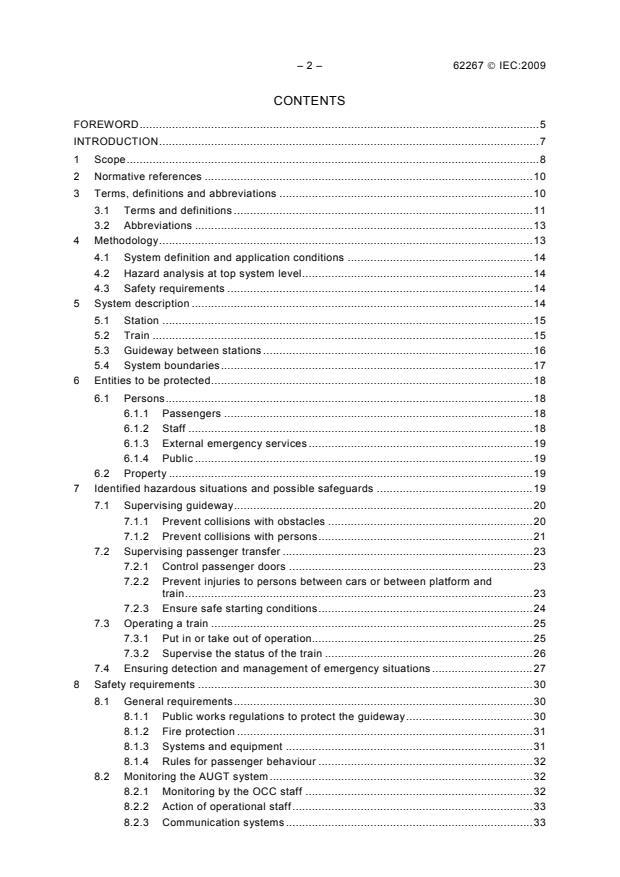
– 2 – 62267 © IEC:2009
CONTENTS
FOREWORD.5
INTRODUCTION.7
1 Scope.8
2 Normative references .10
3 Terms, definitions and abbreviations .10
3.1 Terms and definitions .11
3.2 Abbreviations .13
4 Methodology.13
4.1 System definition and application conditions .14
4.2 Hazard analysis at top system level.14
4.3 Safety requirements .14
5 System description .14
5.1 Station .15
5.2 Train .15
5.3 Guideway between stations .16
5.4 System boundaries.17
6 Entities to be protected.18
6.1 Persons.18
6.1.1 Passengers .18
6.1.2 Staff .18
6.1.3 External emergency services .19
6.1.4 Public .19
6.2 Property .19
7 Identified hazardous situations and possible safeguards .19
7.1 Supervising guideway.20
7.1.1 Prevent collisions with obstacles .20
7.1.2 Prevent collisions with persons.21
7.2 Supervising passenger transfer .23
7.2.1 Control passenger doors .23
7.2.2 Prevent injuries to persons between cars or between platform and
train.23
7.2.3 Ensure safe starting conditions.24
7.3 Operating a train .25
7.3.1 Put in or take out of operation.25
7.3.2 Supervise the status of the train .26
7.4 Ensuring detection and management of emergency situations .27
8 Safety requirements .30
8.1 General requirements.30
8.1.1 Public works regulations to protect the guideway.30
8.1.2 Fire protection .31
8.1.3 Systems and equipment .31
8.1.4 Rules for passenger behaviour .32
8.2 Monitoring the AUGT system.32
8.2.1 Monitoring by the OCC staff .32
8.2.2 Action of operational staff.33
8.2.3 Communication systems .33
62267 © IEC:2009 – 3 –
8.3 Operational rules.34
8.3.1 Rules for rescue of passengers .34
8.3.2 Rules for fire emergency.34
8.3.3 Rules for foreseeable vandalism.35
8.3.4 Rules for checking guideway clearance .35
8.3.5 Rules for start-up and shut down of operations .35
8.3.6 Rules for train operations in the depot .36
8.3.7 Rules for trains to be put in or taken out of operation.36
8.3.8 Rules for stranded train removal.36
8.4 Safeguards on platforms .36
8.4.1 Common safeguards for enclosed and open platforms.37
8.4.2 Enclosed platforms .39
8.4.3 Open platforms with detection systems.41
8.5 Safeguards in trains .41
8.5.1 Door closed supervision .42
8.5.2 Door release for passenger transfer .42
8.5.3 Door release for emergency opening .43
8.5.4 Emergency exits .43
8.5.5 On board obstacle detection device .43
8.5.6 Derailment detection device .43
8.5.7 On board video surveillance .44
8.5.8 Public address system (train) .44
8.5.9 On board announcement for taking a train out of operation.44
8.5.10 Emergency stop demand on board .44
8.5.11 Emergency call device on board .45
8.5.12 Fire and smoke detection (train) .45
8.5.13 Train status supervision and testing.45
8.5.14 Manual operation.46
8.5.15 Safe speed during automatic coupling .46
8.5.16 Reaction to unexpected train movement .46
8.5.17 Warning means in the train for evacuation .46
8.6 Safeguards for passenger transfer area.46
8.6.1 Train immobilisation during passenger transfer.47
8.6.2 Safeguards related to the opening of the doors.47
8.6.3 Safeguards related to the closing of the doors .47
8.6.4 Marking of train door areas on the platform .48
8.6.5 Surveillance by operational staff.49
8.6.6 Safeguards related to gap between train and platform .49
8.6.7 Safeguards related to coupling area between cars.51
8.6.8 Safeguards related to space between train and platform screen .51
8.6.9 Safeguards to protect passengers from electrocution after falling into
the gap .51
8.7 Safeguards for guideway .51
8.7.1 Segregated guideway .52
8.7.2 Warning means along the guideway .52
8.7.3 Physical barriers along the track.52
8.7.4 Physical barriers beside bridges .52
8.7.5 Intrusion detection device between platform track and guideway
between stations .52
– 4 – 62267 © IEC:2009
8.7.6 Guideway intrusion detection device.53
8.7.7 Wayside obstacle detection device .53
8.7.8 Platform end door with controlled access.53
8.7.9 Emergency exit from physically segregated guideway.53
8.7.10 Fire and smoke detection (guideway between stations) .53
8.7.11 Water flooding protection.54
8.7.12 Level crossing .54
8.7.13 Work zones .55
8.8 Safeguards for transfer areas and depots.55
9 Information for use .56
10 Specific safety requirements for upgrading existing lines to DTO or UTO .56
11 Verification of safety.57
11.1 Documentation and responsibilities .58
11.2 Verification process.58
Annex A (informative) Role of the OCC.60
Bibliography.61
Figure 1 – Life Cycle Phases covered by this standard (see Figure 10 of IEC 62278) .13
Figure 2 – Boundary of the station subsystem.15
Figure 3 – Boundary of the “guideway between stations” subsystem .16
Figure 4 – Boundary of the “guideway between stations” subsystem with level crossing .17
Figure 5 – Boundary of the “guideway between stations” subsystem with sidings.17
Figure 6 – Verification of safety .58
Figure A.1 – Role of the OCC in the safety of the system.60
Table 1 – Grades of automation.9
Table 2 – Prevent collisions with obstacles .20
Table 3 – Prevent collisions with persons .21
Table 4 – Prevent injuries to persons associated with opening and closing passenger
transfer doors .23
Table 5 – Prevent injuries to persons between cars or between platform and train.24
Table 6 – Prevent passenger injury during train starting.25
Table 7 – Prevent harm to passengers in relation to taking the train out of operation or
putting the train in operation .26
Table 8 – Prevent injury to person resulting from train failures.26
Table 9 – Prevent injury to persons related to emergency situations .27
62267 © IEC:2009 – 5 –
INTERNATIONAL ELECTROTECHNICAL COMMISSION
_____________
RAILWAY APPLICATIONS –
AUTOMATED URBAN GUIDED TRANSPORT (AUGT) –
SAFETY REQUIREMENTS
FOREWORD
1) The International Electrotechnical Commission (IEC) is a worldwide organization for standardization comprising
all national electrotechnical committees (IEC National Committees). The object of IEC is to promote
international co-operation on all questions concerning standardization in the electrical and electronic fields. To
this end and in addition to other activities, IEC publishes International Standards, Technical Specifications,
Technical Reports, Publicly Available Specifications (PAS) and Guides (hereafter referred to as “IEC
Publication(s)”). Their preparation is entrusted to technical committees; any IEC National Committee interested
in the subject dealt with may participate in this preparatory work. International, governmental and non-
governmental organizations liaising with the IEC also participate in this preparation. IEC collaborates closely
with the International Organization for Standardization (ISO) in accordance with conditions determined by
agreement between the two organizations.
2) The formal decisions or agreements of IEC on technical matters express, as nearly as possible, an international
consensus of opinion on the relevant subjects since each technical committee has representation from all
interested IEC National Committees.
3) IEC Publications have the form of recommendations for international use and are accepted by IEC National
Committees in that sense. While all reasonable efforts are made to ensure that the technical content of IEC
Publications is accurate, IEC cannot be held responsible for the way in which they are used or for any
misinterpretation by any end user.
4) In order to promote international uniformity, IEC National Committees undertake to apply IEC Publications
transparently to the maximum extent possible in their national and regional publications. Any divergence
between any IEC Publication and the corresponding national or regional publication shall be clearly indicated in
the latter.
5) IEC provides no marking procedure to indicate its approval and cannot be rendered responsible for any
equipment declared to be in conformity with an IEC Publication.
6) All users should ensure that they have the latest edition of this publication.
7) No liability shall attach to IEC or its directors, employees, servants or agents including individual experts and
members of its technical committees and IEC National Committees for any personal injury, property damage or
other damage of any nature whatsoever, whether direct or indirect, or for costs (including legal fees) and
expenses arising out of the publication, use of, or reliance upon, this IEC Publication or any other IEC
Publications.
8) Attention is drawn to the normative references cited in this publication. Use of the referenced publications is
indispensable for the correct application of this publication.
9) Attention is drawn to the possibility that some of the elements of this IEC Publication may be the subject of
patent rights. IEC shall not be held responsible for identifying any or all such patent rights.
This International Standard has been prepared by IEC technical committee 9: Electrical
equipment and systems for railways.
This standard cancels and replaces IEC/PAS 62267:2005.
The text of this standard is based on the following documents:
FDIS Report on voting
9/1261/FDIS 9/1272/RVD
Full information on the voting for the approval of this standard can be found in the report on
voting indicated in the above table.
This publication has been drafted in accordance with the ISO/IEC Directives, Part 2.
– 6 – 62267 © IEC:2009
The committee has decided that the contents of this publication will remain unchanged until
the maintenance result date indicated on the IEC web site under "http://webstore.iec.ch" in
the data related to the specific publication. At this date, the publication will be
• reconfirmed,
• withdrawn,
• replaced by a revised edition, or
• amended.
62267 © IEC:2009 – 7 –
INTRODUCTION
This International Standard is a generic guideline providing recommendations to assist railway
authorities and safety regulatory authorities to define safety requirements appropriate to
AUGT systems. The generic requirements recommended in this standard are based on the
experience gained from AUGT systems already in operation. Safety requirements for each
specific application, however, can only be defined from the results of a risk analysis, taking
into consideration the conditions in which the AUGT system is to be set up and based on the
risk acceptance principles prevailing in the local environment. The standard applicable for
conducting a mandatory and comprehensive risk analysis of an AUGT system is IEC 62278
(RAMS).
In view of the diversity of the technical solutions that may be adopted for new AUGT systems
and the diversity of operational conditions, the list of generic hazardous situations considered
in this standard should be regarded as a minimum list. The requirements for a safeguard as
described in this standard are intended as minimum requirements in case a specific safeguard
is applied to mitigate the related hazardous situation. However, the specific risk analysis may
show that some requirements of a chosen safeguard should be modified to take into account
some specific conditions. Each specific design of the new AUGT system and each aspect of
the specific topographic, environmental, social or legal environment of the new AUGT system
can also generate new hazards and therefore may require additional safety requirements. A
specific hazard analysis to identify additional requirements or requirements to be modified is
therefore always a necessity.
This standard, therefore, does not and could not prescribe any specific means that could,
without a fail, mitigate risks arising from hazardous situations. Rather, it identifies a list of
foreseeable hazardous situations, derived from the elementary consideration that functions
assumed by the driver and staff in conventional systems are replaced in AUGT systems by
automated functions or other safeguards. It is the purpose of this standard that this list of
hazardous situations should be carefully considered during the risk analysis carried out for
any new AUGT system.
In addition to generic hazardous situations, this standard also describes possible and widely
implemented safeguards that the specific risk analysis may well show to be adapted to the
specific application.
It should be noted that not all hazardous situations identified in the context of one or other of
the large number of different AUGT systems already in operation in the world have
necessarily been covered in this standard. Nor would it have been necessarily helpful. Neither
could this standard describe all the possible safeguards demanded by each and every specific
application.
This standard does not require that a safeguard be put in place for every generic hazardous
situation identified. This is because often, the risk associated with a hazardous situation may
be assessed as tolerable without the need for a safeguard. According to IEC 62278, it is the
responsibility of the railway authority, in agreement with the Safety Regulatory Authority
having jurisdiction, to decide on the tolerability of each risk and on the necessity of a specific
safeguard, taking into account their specific risk acceptance criteria and legal requirements
that are applicable for the specific AUGT application.
– 8 – 62267 © IEC:2009
RAILWAY APPLICATIONS –
AUTOMATED URBAN GUIDED TRANSPORT (AUGT) –
SAFETY REQUIREMENTS
1 Scope
This International Standard covers high-level safety requirements applicable to automated
urban guided transport systems, with driverless or unattended self-propelled trains, operating
on an exclusive guideway.
This standard only deals with the safety requirements needed to compensate for the absence
of a driver or attendant staff who would otherwise be responsible for some or all of train
operation functions (see Table 1), depending on the level of automation of the system (see
shaded areas in Table 1 and see 3.1 for a definition of the different grades of automation).
The requirements of this standard are restricted to transports systems as defined in Clause 5
and to DTO and UTO as defined in 3.1.4 and 3.1.20, respectively (see the shaded areas in
Table 1).
62267 © IEC:2009 – 9 –
Table 1 – Grades of automation
Non- Semi-
On-sight Driverless Unattended
automated automated
train train train
train train
operation operation operation
operation operation
Basic functions of train operation
TOS NTO STO DTO UTO
GOA0 GOA1 GOA2 GOA3 GOA4
X
(points
Ensure safe route command/ S S S S
control in
system)
Ensuring safe
movement of
Ensure safe separation
X S S S S
trains
of trains
X
(partly
Ensure safe speed X S S S
supervised
by system)
Control acceleration
Driving X X S S S
and braking
Prevent collision with obstacles X X X S S
Supervising
guideway
Prevent collision with persons X X X S S
Control passengers doors X X X X or S S
Supervising
Prevent injuries to persons
passenger
between cars or between X X X X or S S
transfer
platform and train
Ensure safe starting conditions X X X X or S S
Put in or take out of operation X X X X S
Operating a
train Supervise the status
X X X X S
of the train
Ensuring Perform train diagnostic, detect
detection and fire/smoke and detect
S and/or
management derailment, handle emergency X X X X
staff in OCC
of emergency situations (call/evacuation,
situations supervision)
NOTE
X = responsibility of operations staff (may be realised by technical system).
S = realised by technical system.
This standard does not specifically look at security issues. However, aspects of safety
requirements may apply to assuring security within the transport system.
NOTE The definitions of “security” and “safety” are given by IEC 62278.
Application of this standard is subsidiary to the responsibility of the transport authority and the
safety regulatory authority (see IEC 62278) and to the specific laws and decrees applicable
within the prevailing environment (economic, social, political, etc.) where the transport system
is located, taking into account:
• social risk acceptance in different cultures or different national legal regulations (e.g.
SHOREI, BOStrab) or principles (e.g. GAME, ALARP);
• laws and decrees in different states;
• special or different requirements specified by the safety regulatory authority or by an
independent assessor in charge of the specific application;
– 10 – 62267 © IEC:2009
• the responsibility for ”safe operation“ by the transport authority.
This standard does not apply to the following types of transport systems, unless specifically
required by the Transport Authority:
• APMs (Automated People Movers) operating entirely inside a privileged environment such
as an airport, a commercial centre or a leisure resort;
• amusement rides and roller-coasters, generally featuring a single station so that
passengers board and alight the system at the same location;
• intercity and mainline train services, generally operating in a rural environment on part of
their routes;
• cable-driven systems;
• systems featuring electronically guided vehicles with optical sensors, magnetic sensors,
or similar devices/systems.
This standard is not concerned with risks arising during works for construction, installation,
modification and dismantling of a system.
This standard is not concerned with pre-existing DTO or UTO systems (see definitions in 3.1)
that were designed before this standard took effect.
In the case of upgrading an existing transport system to a DTO or UTO system, the risks
associated with the existing system are outside the scope of this standard. However, this
standard and the risk analysis process described are relevant for the additional subsystems
and possibly for the transition process itself. Therefore, the application of the standard is at
the discretion of the safety regulatory authority.
In the case of extending or modifying an existing DTO or UTO system in operation, this
standard applies only if the change is significant as determined by the safety regulatory
authority. However, the risks due to the relationship with the unchanged parts of existing
systems (e.g. rolling stock, traction power supply, signalling and platforms) should be taken
into account.
2 Normative references
The following referenced documents are indispensable for the application of this document.
For dated references, only the edition cited applies. For undated references, the latest edition
of the referenced document (including any amendments) applies.
IEC 62278:2002, Railway applications – Specification and demonstration of reliability,
availability, maintainability and safety (RAMS)
IEC 62290-1, Railway applications – Urban guided transport management and
command/control systems – Part 1: System principles and fundamental concepts
IEC 62425, Railway applications – Communication, signalling and processing systems –
Safety related electronic systems for signalling
3 Terms, definitions and abbreviations
For the purposes of this document, the following terms, definitions and abbreviations apply.
62267 © IEC:2009 – 11 –
3.1 Terms and definitions
3.1.1
Automated Urban Guided Transport
AUGT
system featuring driverless or unattended train operation (as defined below) with self-
propelled, guided vehicles, operating on an exclusive guideway
3.1.2
conventional system
system operated in TOS, NTO or STO
3.1.3
doors closed and locked
doors are considered as being in a closed and locked state if they cannot be opened by
passengers
3.1.4
Driverless Train Operation
DTO
train operated with operations staff present on board the train but not accelerating or braking
and not responsible for observing the guideway in front of the train and stopping the train in
case of a hazardous situation. Safe departure of the train from the station, including door
closing, is either the responsibility of operations staff or of the technical system
3.1.5
exclusive guideway
guideway intended to be used only by one transport system without interference with other
types of transport systems
3.1.6
grade of automation
automation level of train operation resulting from sharing responsibility for given basic
functions of train operation between operations staff and technical system
3.1.7
guideway clearance
pre-defined space around the track defined relatively to the track and such that trains in
motion cannot, while under operating conditions, come into contact with persons or property
fully outside this space
3.1.8
Non-automated Train Operation
NTO
train operation where the driver (i.e., train operator) is in the front cabin of the train observing
the guideway and stopping the train in case of a hazardous situation. Acceleration and
braking are controlled by the driver in conformance with wayside signals or cab-signalling.
The signalling system supervises the activities of the driver. This supervision may be discrete,
semi-continuous or continuous. Safe departure of the train from the station, including door
closing, is the responsibility of the operations staff whether on board the train or on the
station platform
3.1.9
On Sight Train Operation
TOS
train operation where the driver has full responsibility and no technical system is required to
supervise his activities. However, points (switches) and single tracks can be partially
supervised by the system
– 12 – 62267 © IEC:2009
3.1.10
Operations Control Centre
OCC
centre from which operation of the line or the network is supervised and managed
3.1.11
passenger cabin
part of the train used for carrying passengers
3.1.12
passenger transfer area
area of the platform directly adjacent to the guideway clearance intended for the passage of
passengers during transfer between the platform waiting area and a train
3.1.13
passenger transfer door
train door which provides access for passenger transfer between the passenger cabin and a
station platform; can also be used as an emergency exit in cases of hazardous situations (e.g.
fire, hazardous fumes)
3.1.14
platform track
area of track located in a station in front of the platform (see Figure 2)
3.1.15
platform waiting area
area of platform where passengers wait for approaching trains, separated from the guideway
clearance by the passenger transfer area
3.1.16
safety space
area beside the guideway clearance where persons can shelter and not be endangered by
moving trains
3.1.17
Semi-automated Train Operation
STO
train operation where operations staff is located in the front cabin of the train observing the
guideway and stopping the train in case of a hazardous situation. Acceleration and braking is
automated and the speed is supervised continuously by the system. Safe departure of the
train from the station is under the responsibility of the operations staff, whether on board the
train or on the station platform
3.1.18
transfer area
area where the transfer of a train between automated and non-automated areas is made
3.1.19
transport authority
entity which is responsible for safe and orderly operation of a transport system
NOTE For safety aspects, the term “transport authority” is equivalent to the term “railway authority” as used in
IEC 62278.
3.1.20
Unattended Train Operation
UTO
train operated without any operations staff on board (all functions are the responsibility of the
technical system)
62267 © IEC:2009 – 13 –
3.1.21
zero speed status
safety-related information indicating that the speed of the train is below a pre-defined limit
whereby the system considers the train as stopped
3.2 Abbreviations
ALARP As Low As Reasonably Practicable
AUGT Automated Urban Guided Transport
DTO Driverless Train Operation
GAME Globalement Au Moins Equivalent (French safety principle meaning “globally at
least equivalent”)
GOA Grade Of Automation
NTO Non-automated Train Operation
OCC Operations Control Centre
SRA Safety Regulatory Authority
STO Semi-automated Train Operation
TA Transport Authority
TOS On-sight Train Operation
UTO Unattended Train Operation
4 Methodology
Methodology used for deriving generic safety requirements given in this standard is based on
the principles of life cycle phases described in IEC 62278. Figure 1 below shows the V
representation of system life cycle and highlights the activities of the methodology.
Life cycle of specific
AUGT application
Concept
Generic approach
of IEC 62267
System Definition
System Definition
and Application
and Application
Operation and Modification
Conditions
Conditions
Maintenance and Retrofit
Hazard Analysis at
Risk Analysis
top system level
Performance De-commissioning
Monitoring and Disposal
Safety
System
System
Requirements Requirements
Acceptance
Apportionment
System Validation,
of System
including Safety
Requirements
Acceptance and
Commissioning
Design and
Installation
Implementation
Manufacture
IEC 1029/09
Figure 1 – Life cycle phases covered by this standard (see Figure 10 of IEC 62278)
The methodology consists of the following sequence of activities (shown by the shaded areas
in Figure 1):
– 14 – 62267 © IEC:2009
• defining a generic AUGT system and its application conditions;
• performing a hazard analysis at the top system level;
• deriving safety requirements.
These activities are briefly described below.
4.1 System definition and application conditions
Clause 5 defines a generic AUGT system, subsystems, their boundaries and application
conditions. The basic functions of train operation considered are those covered under DTO
and UTO only and shown as shaded in Table 1. System definition clarifies application
conditions as a basis for the generic hazard analysis and enables comparability with specific
applications.
4.2 Hazard analysis at top system level
A hazard analysis at top system level has been conducted for the generic system defined in
Clause 5.
In the sense of this standard the hazard analysis comprises:
• determination of hazardous situations;
• identification of possible causes for identified hazardous situations;
• allocation of possible safeguards.
Hazardous situations considered are those that arise in an AUGT system when there is:
• no train driver in the front train cabin (i.e. DTO);
• no operational staff on board trains (i.e. UTO).
4.3 Safety requirements
As result of the hazard analysis at top system level, possible safeguards, which are able to
compensate for the absence of a train driver in the front cabin, or any operational staff on
board the train, have been identified and are listed in Clause 7. For each safeguard listed in
Tables 2 to 9, Clause 8 gives the corresponding safety requirements. Safeguards and
requirements also take into account the consensus of operational experience gained from a
number of automated systems currently in operation.
This standard does not state the choice of safeguards nor the acceptable level of residual risk
which may vary depending on the local safety culture. The tasks for setting safety policy or
safety targets or for defining safety acceptance or risk tolerability criteria are the responsibility
of the relevant SRA that has jurisdiction over the application. Safety requirements derived
may result in different levels of residual risk and therefore the solution chosen depends on the
risk acceptance by the relevant SRA.
5 System description
An Automated Urban Guided Transport (AUGT) is a system which
• transports passengers between stations,
• uses automated self-propelled trains,
• runs on an exclusive guideway,
• allows train operation independent from other traffic,
• provides conditions of safe train movement.
62267 © IEC:2009 – 15 –
The subsystems (stations, trains and guideway between stations) and their boundaries,
shown as doted lines in the figures below, are described in the subclauses below.
5.1 Station
Locality which allows passengers access to the system by transfer from the public
environment to the trains (i.e. boarding and alighting activity).
The subsystem station is divided into a number of areas as shown in Figure 2 and defined
below:
• the platform waiting area, considered for the purpose of this standard as safe area where
persons are not endangered by moving trains. The platform waiting area is by definition
outside the scope of this standard;
• the passenger transfer area (platform edge zone) used for passenger transfer between a
platform waiting area and a train, but where passengers would be endangered by moving
trains or falls;
• the platform track which is used by moving trains to ensure transport.
Platform waiting area
Passenger transfer area
Guideway clearance
Platform track
Subsystem
boundary
IEC 1030/09
Figure 2 – Boundary of the station subsystem
5.2 Train
The subsystem that operates within the guideway and, under regular conditions, moves along
the guideway and stops in the stations for passenger transfer.
The train can be a
• single vehicle,
• composition of single vehicles, forming a unit, which cannot be decoupled in regular
operation,
• composition of single vehicles or of units which can be decoupled in regular operation.
The subsystem train is divided into:
• the passenger cabin, which is defined as a safe area if a safe train movement is ensured
and adequate safeguards are provided against external events impacting on the train,
e.g. obstacle on the guideway; or impacting on passengers, e.g. fire;
• the staff (drivers) cabin if provided;
• passenger/transfer doors;
• other train doors or additional emergency exits, if provided.
– 16 – 62267 © IEC:2009
The train itself with its drive, bogies and passenger cabin is defined as safe if the general
requirement
...