

IEC 61375-1:2026
(Main)Electronic railway equipment - Train communication network (TCN) - Part 1: General architecture
General Information
- Abstract
IEC 61375-1:2026 applies to the architecture of data communication systems in open trains, i.e. it covers the architecture of a communication system for the data communication between vehicles of the said open trains, the data communication within the vehicles and the data communication from train to the ground. The applicability of IEC 61375-1 to the train network technologies allows for interoperability of individual vehicles within open trains in international traffic. The data communication systems inside vehicles are given as recommended solutions to cope with the said TCN. In any case, proof of compatibility between a proposed train backbone and a proposed consist network will have to be brought by the supplier. IEC 61375-1 might be additionally applicable to closed trains and multiple unit trains when so agreed between purchaser and supplier. This fourth edition cancels and replaces the third edition published in 2012. This edition constitutes a technical revision.
This edition includes the following significant technical changes with respect to the previous edition:
a) Extension of train backbone topologies: aggregated and segregated topology;
b) Added independent consist orientation check with segregated train backbone topology;
c) Introduction of wireless technologies: wireless train backbone and wireless consist network;
d) Possibility of virtual networks;
e) Definition of data classes and protocol requirements suitable for the OMTS domain;
f) New clause about cybersecurity in train communication networks.
- Status
- Published
- Publication Date
- 04-Mar-2026
- Technical Committee
- TC 9 - Electrical equipment and systems for railways
- Drafting Committee
- WG 43 - TC 9/WG 43
- Current Stage
- PPUB - Publication issued
- Start Date
- 05-Mar-2026
- Completion Date
- 19-Dec-2025
Buy Documents

REDLINE IEC 61375-1:2026 RLV - Electronic railway equipment - Train communication network (TCN) - Part 1: General architecture

IEC 61375-1:2026 - Matériel électronique ferroviaire - Réseau embarqué de train (TCN) - Partie 1: Architecture générale

iec61375-1{ed4.0}en - Electronic railway equipment - Train communication network (TCN) - Part 1: General architecture
Overview
IEC 61375-1:2026 is the fourth edition of the International Electrotechnical Commission (IEC) standard that establishes the general architecture for train communication networks (TCN), focusing on electronic railway equipment. This standard is specifically intended for open trains, addressing how data communication should be structured between vehicles, within individual vehicles, and from train to ground systems. By defining core architectural principles, IEC 61375-1:2026 enables interoperability among vehicles in international railway operations, enhancing flexibility, safety, and operational effectiveness in modern rail networks.
As the backbone of railway data communication, the standard supports developments in networking technologies, including the use of Ethernet, wireless communication, and cybersecurity measures, reflecting the growing need for robust, scalable, and secure train communication solutions.
Key Topics
Hierarchical Network Structure
- Definition of TCN as a two-tier system with a train backbone and consist networks for seamless data interchange across connected rail vehicles.
- Rules for interfacing consist networks (vehicle-level networks) with the train backbone (network interlinking vehicles).
Network Topologies
- Extension of train backbone topologies to support both aggregated and segregated arrangements.
- Support for various consist network configurations, including bus and switched architectures.
Advanced Connectivity
- Introduction of wireless technologies for both train backbone and consist networks, facilitating reliable connections in modern and legacy train sets.
- Possibility for deploying virtual networks within the TCN architecture, increasing network flexibility and efficiency.
Data Classes and Protocol Requirements
- Classification of data and definition of protocol requirements suitable for operational management and telematic services (OMTS).
Cybersecurity Integration
- Inclusion of dedicated guidelines and requirements for cybersecurity to safeguard communication channels against unauthorized access and cyberattacks.
- Lifecycle approach to security considerations, from design to maintenance.
Compatibility and Interoperability
- Recommendations for ensuring compatibility between train backbone and consist networks.
- Allowance for use in closed trains and multiple unit trains through purchaser-supplier agreement.
Applications
IEC 61375-1:2026 applies extensively across the railway industry, offering practical benefits in the following scenarios:
International Freight and Passenger Transport
- Ensures interoperability between rolling stock from different manufacturers and operators, simplifying international rail traffic management.
Modernization and Upgrades
- Supports integration of new technologies, such as wireless backbones and switched networks, into existing fleets, promoting future-proof solutions.
Safety and Security
- Facilitates implementation of standardized cybersecurity measures, enhancing overall system resilience and trackside-to-train data confidentiality.
Operational Efficiency
- Enables real-time data exchange for operational and multimedia services, supporting functions like propulsion control, diagnostics, passenger information, and onboard entertainment.
Procurement and System Design
- Provides a common technical foundation for tendering processes, helping suppliers and buyers align on train communication system requirements.
Related Standards
IEC 61375 Series
- Subsequent parts provide detailed specifications for train backbone communication (IEC 61375-2) and consist network implementations (IEC 61375-3).
IEC 62443
- Cybersecurity standards referenced for implementing protection measures within railway communication systems.
CLC/TS 50701
- Technical specifications regarding railway cybersecurity, referenced for terminology and best security practices.
IEC 60050-811
- Offers essential terms and vocabulary for understanding railway communication networks.
Adopting IEC 61375-1:2026 ensures that railway communication networks are interoperable, scalable, and secure, supporting both current and next-generation rail systems around the world.
Relations
- Effective Date
- 05-Sep-2023
Buy Documents
REDLINE IEC 61375-1:2026 RLV - Electronic railway equipment - Train communication network (TCN) - Part 1: General architecture
IEC 61375-1:2026 - Matériel électronique ferroviaire - Réseau embarqué de train (TCN) - Partie 1: Architecture générale
iec61375-1{ed4.0}en - Electronic railway equipment - Train communication network (TCN) - Part 1: General architecture
Get Certified
Connect with accredited certification bodies for this standard

IRIS Certification (UNIFE)
International Railway Industry Standard certification.

TÜV SÜD Rail GmbH
TÜV SÜD railway certification services.

Bureau Veritas Railway Certification
Railway and transportation certification.
Sponsored listings
Frequently Asked Questions
IEC 61375-1:2026 is a standard published by the International Electrotechnical Commission (IEC). Its full title is "Electronic railway equipment - Train communication network (TCN) - Part 1: General architecture". This standard covers: IEC 61375-1:2026 applies to the architecture of data communication systems in open trains, i.e. it covers the architecture of a communication system for the data communication between vehicles of the said open trains, the data communication within the vehicles and the data communication from train to the ground. The applicability of IEC 61375-1 to the train network technologies allows for interoperability of individual vehicles within open trains in international traffic. The data communication systems inside vehicles are given as recommended solutions to cope with the said TCN. In any case, proof of compatibility between a proposed train backbone and a proposed consist network will have to be brought by the supplier. IEC 61375-1 might be additionally applicable to closed trains and multiple unit trains when so agreed between purchaser and supplier. This fourth edition cancels and replaces the third edition published in 2012. This edition constitutes a technical revision. This edition includes the following significant technical changes with respect to the previous edition: a) Extension of train backbone topologies: aggregated and segregated topology; b) Added independent consist orientation check with segregated train backbone topology; c) Introduction of wireless technologies: wireless train backbone and wireless consist network; d) Possibility of virtual networks; e) Definition of data classes and protocol requirements suitable for the OMTS domain; f) New clause about cybersecurity in train communication networks.
IEC 61375-1:2026 applies to the architecture of data communication systems in open trains, i.e. it covers the architecture of a communication system for the data communication between vehicles of the said open trains, the data communication within the vehicles and the data communication from train to the ground. The applicability of IEC 61375-1 to the train network technologies allows for interoperability of individual vehicles within open trains in international traffic. The data communication systems inside vehicles are given as recommended solutions to cope with the said TCN. In any case, proof of compatibility between a proposed train backbone and a proposed consist network will have to be brought by the supplier. IEC 61375-1 might be additionally applicable to closed trains and multiple unit trains when so agreed between purchaser and supplier. This fourth edition cancels and replaces the third edition published in 2012. This edition constitutes a technical revision. This edition includes the following significant technical changes with respect to the previous edition: a) Extension of train backbone topologies: aggregated and segregated topology; b) Added independent consist orientation check with segregated train backbone topology; c) Introduction of wireless technologies: wireless train backbone and wireless consist network; d) Possibility of virtual networks; e) Definition of data classes and protocol requirements suitable for the OMTS domain; f) New clause about cybersecurity in train communication networks.
IEC 61375-1:2026 is classified under the following ICS (International Classification for Standards) categories: 45.060.01 - Railway rolling stock in general. The ICS classification helps identify the subject area and facilitates finding related standards.
IEC 61375-1:2026 has the following relationships with other standards: It is inter standard links to IEC 61375-1:2012. Understanding these relationships helps ensure you are using the most current and applicable version of the standard.
IEC 61375-1:2026 is available in PDF format for immediate download after purchase. The document can be added to your cart and obtained through the secure checkout process. Digital delivery ensures instant access to the complete standard document.
Standards Content (Sample)
IEC 61375-1 ®
Edition 4.0 2026-03
INTERNATIONAL
STANDARD
REDLINE VERSION
Electronic railway equipment - Train communication network (TCN) -
Part 1: General architecture
ICS 45.060.01 ISBN 978-2-8327-1132-3
All rights reserved. Unless otherwise specified, no part of this publication may be reproduced or utilized in any form or
by any means, electronic or mechanical, including photocopying and microfilm, without permission in writing from either
IEC or IEC's member National Committee in the country of the requester. If you have any questions about IEC copyright
or have an enquiry about obtaining additional rights to this publication, please contact the address below or your local
IEC member National Committee for further information.
IEC Secretariat Tel.: +41 22 919 02 11
3, rue de Varembé info@iec.ch
CH-1211 Geneva 20 www.iec.ch
Switzerland
About the IEC
The International Electrotechnical Commission (IEC) is the leading global organization that prepares and publishes
International Standards for all electrical, electronic and related technologies.
About IEC publications
The technical content of IEC publications is kept under constant review by the IEC. Please make sure that you have the
latest edition, a corrigendum or an amendment might have been published.
IEC publications search - IEC Products & Services Portal - products.iec.ch
webstore.iec.ch/advsearchform Discover our powerful search engine and read freely all the
The advanced search enables to find IEC publications by a publications previews, graphical symbols and the glossary.
variety of criteria (reference number, text, technical With a subscription you will always have access to up to date
committee, …). It also gives information on projects, content tailored to your needs.
replaced and withdrawn publications.
Electropedia - www.electropedia.org
The world's leading online dictionary on electrotechnology,
IEC Just Published - webstore.iec.ch/justpublished
Stay up to date on all new IEC publications. Just Published containing more than 22 500 terminological entries in English
details all new publications released. Available online and and French, with equivalent terms in 25 additional languages.
once a month by email. Also known as the International Electrotechnical Vocabulary
(IEV) online.
IEC Customer Service Centre - webstore.iec.ch/csc
If you wish to give us your feedback on this publication or
need further assistance, please contact the Customer
Service Centre: sales@iec.ch.
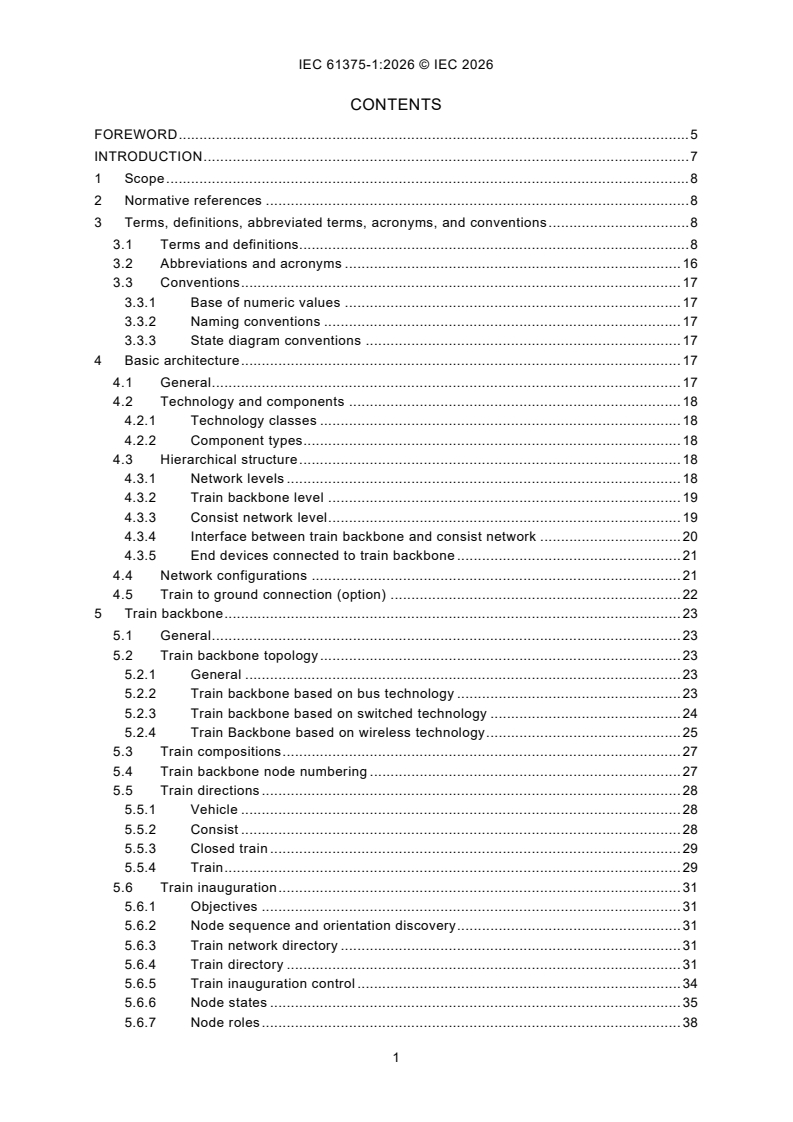
CONTENTS
FOREWORD . 5
INTRODUCTION . 7
1 Scope . 8
2 Normative references . 8
3 Terms, definitions, abbreviated terms, acronyms, and conventions . 8
3.1 Terms and definitions. 8
3.2 Abbreviations and acronyms . 18
3.3 Conventions . 19
3.3.1 Requirement conventions .
3.3.1 Base of numeric values . 20
3.3.2 Naming conventions . 20
3.3.3 State diagram conventions . 20
4 Basic architecture . 20
4.1 Contents of this clause General . 20
4.2 GeneralTechnology and components . 21
4.2.1 Technology classes . 21
4.2.2 Component types . 21
4.3 Hierarchical structure . 21
4.3.1 Network levels . 21
4.3.2 Train backbone level . 22
4.3.3 Consist network level . 22
4.3.4 Interface between train backbone and consist network . 23
4.3.5 End devices connected to train backbone . 24
4.4 Network configurations . 24
4.5 Train to ground connection (option) . 25
5 Train backbone . 26
5.1 Contents of this clause General . 26
5.2 Train backbone topology . 26
5.2.1 General . 26
5.2.2 Train backbone based on bus technology . 26
5.2.3 Train backbone based on switched technology . 27
5.2.4 Train Backbone based on wireless technology . 28
5.3 Train compositions . 30
5.4 Train backbone node numbering . 30
5.5 Train directions . 31
5.5.1 Vehicle . 31
5.5.2 Consist . 31
5.5.3 Closed train . 32
5.5.4 Train . 32
5.6 Train inauguration . 34
5.6.1 Objectives . 34
5.6.2 Node sequence and orientation discovery . 34
5.6.3 Train network directory . 34
5.6.4 Train directory . 34
5.6.5 Train inauguration control . 38
5.6.6 Node states . 40
5.6.7 Node roles . 44
5.6.8 Performance . 44
5.6.9 Independent consist orientation check (Option) . 44
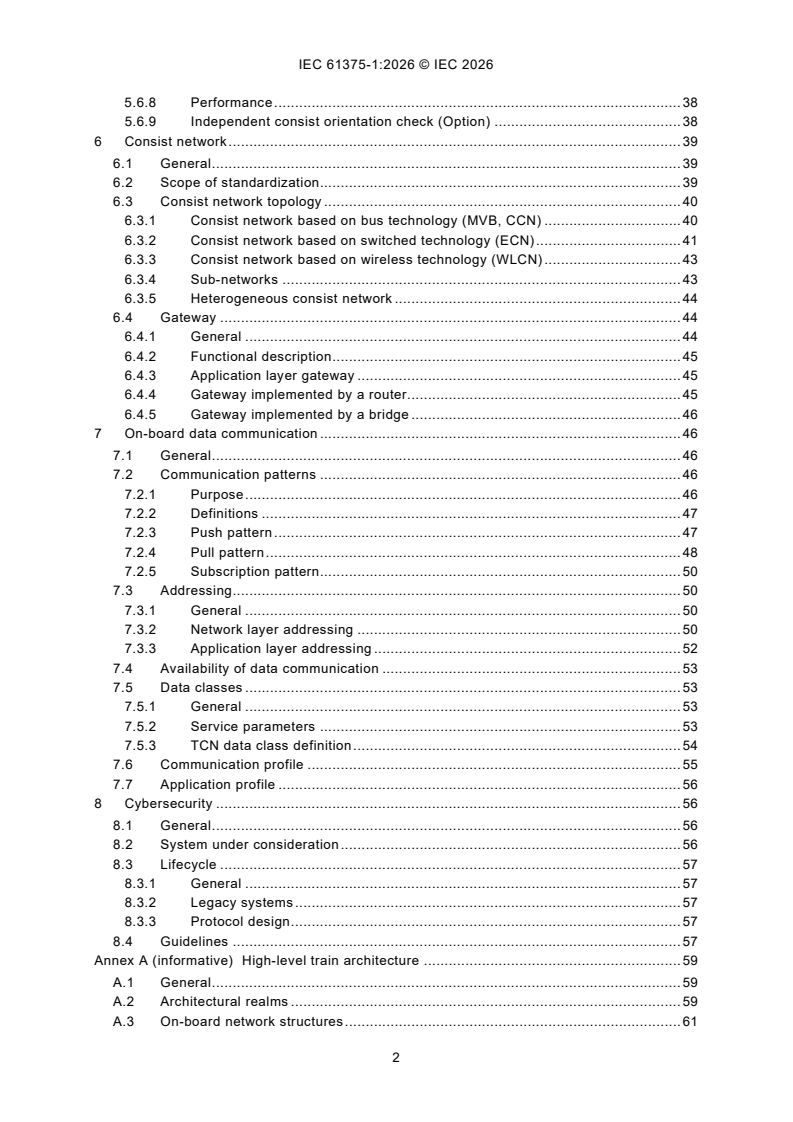
6 Consist network . 45
6.1 Contents of this clauseGeneral . 45
6.2 Scope of standardization. 45
6.3 Consist network topology . 46
6.3.1 Consist network based on bus technology (MVB, CANopen CCN) . 46
6.3.2 Consist network based on switched technology (ECN) . 47
6.3.3 Consist network based on wireless technology (WLCN) . 50
6.3.4 Sub-networks . 50
6.3.5 Heterogeneous consist network . 52
6.4 Gateway . 52
6.4.1 General . 52
6.4.2 Functional description . 52
6.4.3 Application layer gateway . 53
6.4.4 Gateway implemented by a router. 55
6.4.5 Gateway implemented by a bridge . 55
7 On-board data communication . 56
7.1 General . 56
7.2 Communication patterns . 56
7.2.1 Purpose . 56
7.2.2 Definitions . 56
7.2.3 Push pattern . 56
7.2.4 Pull pattern . 58
7.2.5 Subscription pattern. 59
7.3 Addressing . 59
7.3.1 General . 59
7.3.2 Network layer addressing . 59
7.3.3 Application layer addressing . 61
7.4 Availability of data communication . 62
7.5 Data classes . 62
7.5.1 General . 62
7.5.2 Service parameters . 62
7.5.3 TCN data class definition . 64
7.6 Communication profile . 65
7.7 Application profile . 65
8 Cybersecurity . 65
8.1 General . 65
8.2 System under consideration . 66
8.3 Lifecycle . 66
8.3.1 General . 66
8.3.2 Legacy systems . 66
8.3.3 Protocol design . 66
8.4 Guidelines . 66
Annex A (informative) High-level train architecture . 68
A.1 General . 68
A.2 Architectural realms . 68
A.3 On-board network structures . 70
Bibliography . 72
Figure 1 – Train backbone and consist network . 21
Figure 2 – Example of consist with 2 consist networks . 22
Figure 3 – End device connected to the train backbone (example) . 24
Figure 4 – Communication between train and ground (example) . 25
Figure 5 – Interfaces between consists . 26
Figure 6 – Train backbone bus topology . 27
Figure 7 – Train backbone switched topology (aggregated transmission media) . 27
Figure 8 – Train backbone switched topology (segregated transmission media) . 28
Figure 9 – Wireless train backbone mesh topology . 28
Figure 10 – Wireless train backbone base station topology . 29
Figure 11 – Wireless train backbone mesh topology for redundancy . 29
Figure 12 – Wireless train backbone base station topology for redundancy . 30
Figure 13 – Directions and orientation in a vehicle . 31
Figure 14 – Directions and orientations in a consist (example) . 32
Figure 15 – Directions and orientations in a closed train . 32
Figure 16 – Directions and orientations in train (TCN directions) . 33
Figure 17 – Structure of train network directory (example) . 36
Figure 18 – Train inauguration block diagram . 41
Figure 19 – Train inauguration state chart . 43
Figure 20 – Independent orientation check with BEACON telegrams . 44
Figure 21 – Consist network standard interfaces . 46
Figure 22 – Consist network (bus technology) . 46
Figure 23 – Local service .
Figure 24 – Unconfirmed service.
Figure 25 – Confirmed service .
Figure 26 – Provider initiated services .
Figure 23 – Consist switches . 47
Figure 24 – Examples of consist network topologies (switched technology) . 49
Figure 25 – End device connected to two consist switches . 49
Figure 26 – Wireless consist network . 50
Figure 27 – Sub-networks in a consist network . 51
Figure 28 – Implementation example for two vehicle busses . 52
Figure 29 – Example of heterogeneous train control network architecture . 52
Figure 30 – Point to point communication pattern (push) . 57
Figure 31 – Point to multi-point communication pattern (push) . 57
Figure 32 – Point to point communication pattern (pull) . 58
Figure 33 – Point to multi-point communication pattern (pushpull). 58
Figure 34 – Subscription communication pattern . 59
Figure A.1 – Example of architectural realm structure . 69
Figure A.2 – Examples for network segregation of on-board physical networks . 70
Table 1 – Train composition changes . 30
Table 2 – Train network specific parameters (example) . 37
Table 3 – Consist network specific parameters (example) . 37
Table 4 – Vehicle specific parameters (example) . 38
Table 5 – Device specific parameters (example) . 38
Table 6 – Point to point (Push). 57
Table 7 – Point to multi-point (Push) . 57
Table 8 – Point to point (Pull) . 58
Table 9 – Point to multi-point (Pull) . 59
Table 10 – Service parameters . 62
Table 11 – Principal data classes. 64
INTERNATIONAL ELECTROTECHNICAL COMMISSION
____________
Electronic railway equipment - Train communication network (TCN) -
Part 1: General architecture
FOREWORD
1) The International Electrotechnical Commission (IEC) is a worldwide organization for standardization comprising
all national electrotechnical committees (IEC National Committees). The object of IEC is to promote international
co-operation on all questions concerning standardization in the electrical and electronic fields. To this end and
in addition to other activities, IEC publishes International Standards, Technical Specifications, Technical Reports,
Publicly Available Specifications (PAS) and Guides (hereafter referred to as "IEC Publication(s)"). Their
preparation is entrusted to technical committees; any IEC National Committee interested in the subject dealt with
may participate in this preparatory work. International, governmental and non-governmental organizations liaising
with the IEC also participate in this preparation. IEC collaborates closely with the International Organization for
Standardization (ISO) in accordance with conditions determined by agreement between the two organizations.
2) The formal decisions or agreements of IEC on technical matters express, as nearly as possible, an international
consensus of opinion on the relevant subjects since each technical committee has representation from all
interested IEC National Committees.
3) IEC Publications have the form of recommendations for international use and are accepted by IEC National
Committees in that sense. While all reasonable efforts are made to ensure that the technical content of IEC
Publications is accurate, IEC cannot be held responsible for the way in which they are used or for any
misinterpretation by any end user.
4) In order to promote international uniformity, IEC National Committees undertake to apply IEC Publications
transparently to the maximum extent possible in their national and regional publications. Any divergence between
any IEC Publication and the corresponding national or regional publication shall be clearly indicated in the latter.
5) IEC itself does not provide any attestation of conformity. Independent certification bodies provide conformity
assessment services and, in some areas, access to IEC marks of conformity. IEC is not responsible for any
services carried out by independent certification bodies.
6) All users should ensure that they have the latest edition of this publication.
7) No liability shall attach to IEC or its directors, employees, servants or agents including individual experts and
members of its technical committees and IEC National Committees for any personal injury, property damage or
other damage of any nature whatsoever, whether direct or indirect, or for costs (including legal fees) and
expenses arising out of the publication, use of, or reliance upon, this IEC Publication or any other IEC
Publications.
8) Attention is drawn to the Normative references cited in this publication. Use of the referenced publications is
indispensable for the correct application of this publication.
9) IEC draws attention to the possibility that the implementation of this document may involve the use of (a)
patent(s). IEC takes no position concerning the evidence, validity or applicability of any claimed patent rights in
respect thereof. As of the date of publication of this document, IEC had not received notice of (a) patent(s), which
may be required to implement this document. However, implementers are cautioned that this may not represent
the latest information, which may be obtained from the patent database available at https://patents.iec.ch. IEC
shall not be held responsible for identifying any or all such patent rights.
This redline version of the official IEC Standard allows the user to identify the changes made
to the previous edition IEC 61375-1:2012. A vertical bar appears in the margin wherever a
change has been made. Additions are in green text, deletions are in strikethrough red text.
IEC 61375-1 has been prepared by IEC technical committee 9: Electrical equipment and
systems for railways. It is an International Standard.
This fourth edition cancels and replaces the third edition published in 2012. This edition
constitutes a technical revision.
This edition includes the following significant technical changes with respect to the previous
edition:
a) Extension of train backbone topologies: aggregated and segregated topology;
b) Added independent consist orientation check with segregated train backbone topology;
c) Introduction of wireless technologies: wireless train backbone and wireless consist network;
d) Possibility of virtual networks;
e) Definition of data classes and protocol requirements suitable for the OMTS domain;
f) New clause about cybersecurity in train communication networks.
The text of this International Standard is based on the following documents:
Draft Report on voting
9/3252/FDIS 9/3293/RVD
Full information on the voting for its approval can be found in the report on voting indicated in
the above table.
The language used for the development of this International Standard is English.
This document was drafted in accordance with ISO/IEC Directives, Part 2, and developed in
accordance with ISO/IEC Directives, Part 1 and ISO/IEC Directives, IEC Supplement, available
at www.iec.ch/members_experts/refdocs. The main document types developed by IEC are
described in greater detail at www.iec.ch/publications.
A list of all parts of IEC 61375 series, under the general title Electronic railway equipment -
Train communication network (TCN), can be found on the IEC website.
The committee has decided that the contents of this document will remain unchanged until the
stability date indicated on the IEC website under webstore.iec.ch in the data related to the
specific document. At this date, the document will be
– reconfirmed,
– withdrawn, or
– revised.
INTRODUCTION
IEC 61375-1 defines the general architecture of the Train Communication Network (TCN) to
achieve compatibility between consist networks and train backbones defined by the IEC 61375
series.
The creation of this fourth edition of the standard has been motivated by advances in
technology, namely in the fields of Ethernet communication, wireless communication, and
cybersecurity, which made it necessary to adapt or to extend some sections of the TCN general
architecture. These changes will then further on be reflected in the detailed technical
specifications given in subsequent parts of the IEC 61375 series.
The TCN has a hierarchical structure with two levels of networks, a train backbone and a consist
network:
a) for interconnecting vehicles in closed or open trains, this document specifies train
backbones with different characteristics.
b) for connecting standard on-board equipment, this document specifies consist networks with
different characteristics.
The general architecture of the TCN, which is defined in this document, shall does
c) establish the rules for interconnecting consist networks with train backbones, as
1) identifying the interfaces;
2) defining the principles of how train topology changes can be discovered;
3) defining the basic communication services provided by train backbones to be used by
consist networks;
d) establish basic rules for the train backbone and for the consist network;
e) establish rules for communalities commonalities in operation, as:
1) patterns for the communication between users;
2) addressing principles;
3) data classes to be supported;
e) establish rules to support cybersecurity of the TCN.
1 Scope
This part of IEC 61375 applies to the architecture of data communication systems in open trains,
i.e. it covers the architecture of a communication system for the data communication between
vehicles of the said open trains, the data communication within the vehicles and the data
communication from train to the ground.
The applicability of this part of IEC 61375 to the train network technologies allows for
interoperability of individual vehicles within open trains in international traffic. The data
communication systems inside vehicles are given as recommended solutions to cope with the
said TCN. In any case, proof of compatibility between a proposed train backbone and a
proposed consist network will have to be brought by the supplier.
This part of IEC 61375 may might be additionally applicable to closed trains and multiple unit
trains when so agreed between purchaser and supplier.
NOTE 1 For definitions of open trains, multiple unit trains and closed trains, see Clause 3.
NOTE 2 Road vehicles such as buses and trolley buses are not considered in this part of IEC 61375.
2 Normative references
The following documents, in whole or in part, are normatively referenced in this document and
are indispensable for its application. For dated references, only the edition cited applies. For
undated references, the latest edition of the referenced document (including any amendments)
applies.
ISO/IEC 7498-1, Information Technology – Open Systems Interconnection – Basic Reference
Model: The Basic Model
ISO/IEC 8824-1:2002, Information technology – Abstract Syntax Notation One (ASN.1):
specification of basic notation
ISO/IEC 9646-1:1994, Information technology – Open Systems Interconnection – Conformance
testing methodology and framework – Part 1: General concepts
ISO/IEC 19501:2005, Information technology – Open Distributed Processing – Unified Modeling
Language (UML) Version 1.4.2
UIC CODE 556, Information transmission in the train (train-bus)
There are no normative references in this document.
3 Terms, definitions, abbreviated terms, acronyms, and conventions
3.1 Terms and definitions
For the purposes of this document, the following terms and definitions apply.
ISO and IEC maintain terminology databases for use in standardization at the following
addresses:
– IEC Electropedia: available at https://www.electropedia.org/
– ISO Online browsing platform: available at https://www.iso.org/obp
3.1.1
active train backbone node
train backbone node receiving a sequence number during train inauguration and forwarding
user data packets between consist network and train backbone
3.1.2
application layer
upper layer in the OSI model, interfacing directly to the application
[SOURCE: IEC 60050-811:2017, 811-37-03]
3.1.3
application layer interface
definition of the services offered by the application layer
3.1.3
application process
element within a real open system which performs the information processing for a particular
application
[SOURCE: IEC 60050-811:2017, 811-37-05]
3.1.4
bridge
device which stores and forwards frames from one bus to
another on the base of their link layer addresses
[SOURCE: IEC 60050-811:2017, 811-37-09]
3.1.5
broadcast
nearly simultaneous transmission of the same information to several destinations
Note 1 to entry: Broadcast in the TCN is not considered reliable, i.e. some destinations may can receive the
information and others not.
[SOURCE: IEC 60050-811:2017, 811-37-10]
3.1.6
bus
communication medium which broadcasts the same
information to all attached participants at nearly the same time, allowing all devices to obtain
the same sight of its state, at least for the purpose of arbitration
3.1.7
closed train
train composed of one or a set of consists, where the train composition does not change during
normal operation
EXAMPLE Metro, suburban train, or high-speed train unit.
Note 1 to entry: Consists are coupled in a workshop to establish a closed train for operation.
[SOURCE: IEC 60050-811:2017, 811-37-17]
3.1.8
communication device
device connected to the consist network or train backbone with the ability to transport, source
or sink data
[SOURCE: IEC 60050-811:2017, 811-37-18]
3.1.10
composition
number and characteristics of the vehicles forming a train
3.1.11
configuration
definition of the topology of a network, the devices connected to it, their capabilities and the
traffic they produce; by extension, the operation of loading the devices with the configuration
information before going to regular operation
3.1.9
consist
train set
rake of coaches
single vehicle or a group of vehicles which are not separated during normal operation, and
which contains no, one or several consist networks
EXAMPLE The vehicles of a consist are steadily connected in a workshop, and automatic couplers are
mounted at both ends of the consist to facilitate the coupling and de-coupling of complete consists in the
workshop or during operation.
Note 1 to entry: A consist can contain no, one or several consist networks.
[SOURCE: IEC 60050-811:2017, 811-37-20]
3.1.10
consist network
communication network interconnecting communication devices in one consist
Note 1 to entry: Consist networks do not spread beyond consist boundaries.
[SOURCE: IEC 60050-811:2017, 811-37-21]
3.1.11
consist network address
network address, which does not change after train inauguration and which is used to address
communication device in the own consist network
3.1.12
consist sequence number
sequence number of the consist in the train as obtained during train inauguration
3.1.13
consist switch
consist network node
network component used in consist network based on switched technology (ECN). See “switch”
3.1.58.
[SOURCE: IEC 60050-811:2017, 811-37-22]
3.1.17
consumer
receiver of a message at the transport layer (see: “producer” 3.1.47)
3.1.14
cybersecurity
set of activities and measures taken with the objective to identify,
protect against, detect, respond to, and recover from unauthorized access or cyberattack which
could lead to an accident, an unsafe situation, or railway application performance degradation
[SOURCE: CLC/TS 50701:2023, 3.1.32]
3.1.18
destination device
receiver of a data packet (see: “source device” 3.1.55 )
3.1.15
end device
unit connected to one consist network or to one set of consist networks prepared for redundancy
reasons
[SOURCE: IEC 60050-811:2017, 811-37-33]
3.1.16
end node
node which terminates the train backbone
[SOURCE: IEC 60050-811:2017, 811-37-34]
3.1.17
essential function
function or capability that is required to maintain health, safety, the environment and availability
for the equipment under control
Note 1 to entry: Essential functions include, but are not limited to, the safety instrumented function (SIF), the control
function and the ability of the operator to view and manipulate the equipment under control. The loss of essential
functions is commonly termed loss of protection, loss of control and loss of view respectively. In some industries
additional functions such as history can be considered essential.
[SOURCE: IEC 62443-4-2:2019, 3.1.20]
3.1.18
function
application process which exchanges messages with
another application process
3.1.19
gateway
connection between different communication technologies
connection between different busses at the application
layer requiring application-dependent data analysis and protocol conversion
3.1.20
group address
address of a multicast group to which a device belongs
[SOURCE: IEC 60050-811:2017, 811-37-45]
3.1.24
inauguration
operation executed in case of composition change, which gives all nodes of the train backbone
their train backbone address, their orientation and information about all named nodes on the
same backbone
3.1.21
integrity
property of a system to recognize and to reject wrong data
in case of malfunction of its parts
3.1.22
intermediate node
node which establishes continuity between two bus sections connected to it, but does not
terminate them
[SOURCE: IEC 60050-811:2017, 811-37-49]
3.1.27
jumper cable
cable connecting the trunk cables of two consecutive vehicles, possibly of a larger cross-section
than the trunk cable, and which is plugged by hand in the case of the UIC-cable. There are
generally two jumper cables between vehicles
3.1.23
linear topology
topology where the nodes are connected in series, with two nodes each connected to only one
other node and all others each connected to two other nodes (i.e. connected in the shape of a
line)
[SOURCE: IEC 61784-2 IEC 60050-811:2017, 811-37-51]
3.1.24
local area network
part of a network characterized by a common medium
access and address space
[SOURCE: IEC 60050-811:2017, 811-37-60]
3.1.25
medium access control
sublayer of the link layer, which controls the access to the
medium (arbitration, mastership transfer, polling)
3.1.26
medium
physical carrier of the signal: electrical wires, optical fibers,
etc.
3.1.27
message
data item transmitted in one or several packets
information which is transmitted in one or several packets from a
sender to one or more receivers
[SOURCE: IEC 60050-821:2017, 821-11-29]
3.1.33
mobile train unit
part of a train which shall be uniquely addressable from ground. A mobile train unit provides
one active mobile communication gateway for train to ground communication.
3.1.28
multicast
transmission of the same message to a group of receivers, identified by their group address
Note 1 to entry: The term "multicast" is used even if the group includes all receivers.
[SOURCE: IEC 60050-811:2017, 811-37-66]
3.1.29
multimedia data
data used for onboard multimedia and telematic services (OMTS), like video/audio streams or
file transfer
3.1.30
multiple unit train
a train consisting of a set of closed trains, where the composition of the set may change during
normal operation
train comprising one or more train-units which can be controlled simultaneously from one cab
and able to operate at normal speed in either direction without re-marshalling
[SOURCE: IEC 60050-811:2017, 811-02-12]
3.1.31
network
set of possibly different communication systems which
interchange information in a commonly agreed way
[SOURCE: IEC 60050-811:2017, 811-37-68]
3.1.32
network address
address which identifies a communication device on network layer
[SOURCE: IEC 60050-811:2017, 811-37-69]
3.1.33
network device
component used to set up consist networks and train networks
Note 1 to entry: These components may can be passive components like cables or connectors, active unmanaged
components like repeaters, media converters or (unmanaged) switches, or managed active components like
gateways, routers and (managed) switches.
[SOURCE: IEC 60050-811:2017, 811-37-70, modified – Note 1 to entry has been modified.]
3.1.34
network layer
layer in the OSI model responsible for routing between different busses
[SOURCE: IEC 60050-811:2017, 811-37-72]
3.1.35
network management
operations necessary to remotely configure, monitor,
diagnose and maintain the network
[SOURCE: IEC 60050-811:2017, 811-37-73]
3.1.41
node
device on the train backbone, which may act as a gateway between train backbone and consist
network
3.1.36
octet
byte
8-bit word stored in memory or transmitted as a unit
ordered set of eight binary digits, operated on as an entity
[SOURCE: IEC 60050-171:2019, 171-02-12, modified – removal of Note to entry.]
3.1.37
open train
train composed of one or a set of consists, where the configuration may can change during
operation, as for instance locomotive hauled international UIC trains
EXAMPLE Locomotive-hauled international UIC (International Union of Railways, the international railways
operators association) trains.
[SOURCE: IEC 60050-811:2017, 811-37-79]
3.1.38
operator
enterprise or organization which is operating trains
3.1.39
operational data
data critical for train operation (TCMS), like propulsion control, brake control, doors control,
lighting control or heating, ventilation, and air conditioning control
3.1.40
packet
unit of a message (information, acknowledgement, or
control) transmitted by protocols on network or transport layer
3.1.46
passive train backbone node
train backbone node which is in standby to an active train backbone node in a consist network
3.1.47
producer
sender of a message at the transport layer (see: “consumer” 3.1.17)
3.1.48
publisher
source of a dataset for broadcasting (see: “subscriber” 3.1.57)
3.1.41
realm
logical concept structuring train functions along coherent boundaries
3.1.42
receiver
electronic device which may can receive signals from the
physical medium
3.1.43
repeater
< in a train communication network> connection at the physical layer between bus segments,
providing an extension of the bus beyond the limits permitted by passive means
Note 1 to entry: The connected segments operate at the same speed and with the same protocol. The delay
introduced by a repeater is in the order of one bit duration.
[SOURCE: IEC 60050-811:2017, 811-37-90]
3.1.51
residual error rate
probability of integrity breach (unrecognized wrong bit) per transmitted bit
3.1.44
ring topology
active network where each node is connected in series to two other nodes
Note 1 to entry: Ring may can also be referred to as loop.
[SOURCE: IEC 61918 IEC 60050-811:2017, 811-37-91]
3.1.45
router
connection between two busses at the network layer, which
forwards datagrams from one bus to another on the base of their network address
3.1.46
safety integrity
ability of a safety-related system to achieve its required safety functions under all the stated
conditions within a stated operational environment and within a stated duration
[SOURCE: IEC 60050-821:2017, 821-12-54]
3.1.47
service
capabilities and features of a sub-system (e.g. a
communication layer) provided to a user
[SOURCE: IEC 60050-811:2017, 811-37-93]
3.1.55
source device
sender of a data packet (see: “destination device” 3.1.18)
3.1.56
sporadic data
transmission of data on a demand basis
3.1.57
subscriber
one of the sinks of a broadcast dataset (see: “publisher” 3.1.48)
3.1.48
system under consideration
collection of assets that are needed to provide and operate
a railway application including any relevant network infrastructure assets
Note 1 to entry: In a cybersecurity context as defined in IEC 62443-3-2:2020, a system under consideration consists
of one or more zones and related conduits. All assets within a system under consideration belong to either a zone
or conduit.
3.1.49
switch
MAC bridge as defined i
...
IEC 61375-1 ®
Edition 4.0 2026-03
NORME
INTERNATIONALE
Matériel électronique ferroviaire - Réseau embarqué de train (TCN) -
Partie 1: Architecture générale
ICS 45.060.01 ISBN 978-2-8327-1057-9
Droits de reproduction réservés. Sauf indication contraire, aucune partie de cette publication ne peut être reproduite ni
utilisée sous quelque forme que ce soit et par aucun procédé, électronique ou mécanique, y compris la photocopie et
les microfilms, sans l'accord écrit de l'IEC ou du Comité national de l'IEC du pays du demandeur. Si vous avez des
questions sur le copyright de l'IEC ou si vous désirez obtenir des droits supplémentaires sur cette publication, utilisez
les coordonnées ci-après ou contactez le Comité national de l'IEC de votre pays de résidence.
IEC Secretariat Tel.: +41 22 919 02 11
3, rue de Varembé info@iec.ch
CH-1211 Geneva 20 www.iec.ch
Switzerland
A propos de l'IEC
La Commission Electrotechnique Internationale (IEC) est la première organisation mondiale qui élabore et publie des
Normes internationales pour tout ce qui a trait à l'électricité, à l'électronique et aux technologies apparentées.
A propos des publications IEC
Le contenu technique des publications IEC est constamment revu. Veuillez vous assurer que vous possédez l’édition la
plus récente, un corrigendum ou amendement peut avoir été publié.
Recherche de publications IEC - IEC Products & Services Portal - products.iec.ch
webstore.iec.ch/advsearchform Découvrez notre puissant moteur de recherche et consultez
La recherche avancée permet de trouver des publications gratuitement tous les aperçus des publications, symboles
IEC en utilisant différents critères (numéro de référence, graphiques et le glossaire. Avec un abonnement, vous aurez
texte, comité d’études, …). Elle donne aussi des toujours accès à un contenu à jour adapté à vos besoins.
informations sur les projets et les publications remplacées
ou retirées. Electropedia - www.electropedia.org
Le premier dictionnaire d'électrotechnologie en ligne au
IEC Just Published - webstore.iec.ch/justpublished monde, avec plus de 22 500 articles terminologiques en
Restez informé sur les nouvelles publications IEC. Just anglais et en français, ainsi que les termes équivalents
dans 25 langues additionnelles. Egalement appelé
Published détaille les nouvelles publications parues.
Disponible en ligne et une fois par mois par email. Vocabulaire Electrotechnique International (IEV) en ligne.
Service Clients - webstore.iec.ch/csc
Si vous désirez nous donner des commentaires sur cette
publication ou si vous avez des questions contactez-
nous: sales@iec.ch.
SOMMAIRE
AVANT-PROPOS . 5
INTRODUCTION . 7
1 Domaine d'application . 8
2 Références normatives . 8
3 Termes, définitions, abréviations, acronymes et conventions . 8
3.1 Termes et définitions . 8
3.2 Abréviations et acronymes . 16
3.3 Conventions . 17
3.3.1 Base des valeurs numériques . 17
3.3.2 Conventions d'appellation . 17
3.3.3 Conventions de diagramme d'état . 18
4 Architecture de base . 18
4.1 Généralités . 18
4.2 Technologie et composants . 18
4.2.1 Classes de technologie . 18
4.2.2 Types de composants . 18
4.3 Structure hiérarchique. 19
4.3.1 Niveaux de réseau . 19
4.3.2 Niveau de réseau central de train . 19
4.3.3 Niveau de réseau de rame . 20
4.3.4 Interface entre le réseau central de train et le réseau de rame . 21
4.3.5 Dispositifs terminaux reliés au réseau central de train . 21
4.4 Configurations de réseau . 22
4.5 Liaison train-sol (option) . 22
5 Réseau central de train . 23
5.1 Généralités . 23
5.2 Topologie du réseau central de train . 24
5.2.1 Généralités . 24
5.2.2 Réseau central de train basé sur la technologie de bus . 24
5.2.3 Réseau central de train basé sur une technologie commutée . 25
5.2.4 Réseau central de train basé sur une technologie sans fil . 26
5.3 Compositions de train . 28
5.4 Numérotation du nœud de réseau central de train . 28
5.5 Directions de train . 29
5.5.1 Véhicule . 29
5.5.2 Rame. 29
5.5.3 Rame non modifiable . 30
5.5.4 Train . 30
5.6 Inauguration de train . 32
5.6.1 Objectifs . 32
5.6.2 Découverte de la séquence et de l'orientation des nœuds . 32
5.6.3 Répertoire de réseau de train . 32
5.6.4 Répertoire de trains . 32
5.6.5 Commande de l’inauguration de train. 35
5.6.6 Etats des nœuds . 36
5.6.7 Rôles des nœuds . 39
5.6.8 Performances . 39
5.6.9 Vérification indépendante de l'orientation de la rame (option) . 39
6 Réseau de rame . 40
6.1 Généralités . 40
6.2 Domaine d’application de normalisation . 40
6.3 Topologie de réseau de rame. 41
6.3.1 Réseau de rame basé sur la technologie de bus (MVB, CCN) . 41
6.3.2 Réseau de rame basé sur la technologie commutée (ECN) . 42
6.3.3 Réseau de rame basé sur la technologie sans fil (WLCN) . 44
6.3.4 Sous-réseaux . 44
6.3.5 Réseau de rame hétérogène . 45
6.4 Passerelle . 45
6.4.1 Généralités . 45
6.4.2 Description fonctionnelle . 46
6.4.3 Passerelle de couche application . 46
6.4.4 Passerelle mise en œuvre par un routeur . 47
6.4.5 Passerelle mise en œuvre par un pont . 47
7 Communication des données embarquées . 48
7.1 Généralités . 48
7.2 Configurations de réseau de communication . 48
7.2.1 Objet . 48
7.2.2 Définitions . 48
7.2.3 Configuration push . 49
7.2.4 Configuration pull . 50
7.2.5 Configuration de souscription . 51
7.3 Adressage . 52
7.3.1 Généralités . 52
7.3.2 Adressage de couche de réseau . 52
7.3.3 Adressage de couche application . 53
7.4 Disponibilité de la communication de données . 54
7.5 Classes de données. 54
7.5.1 Généralités . 54
7.5.2 Paramètres de service . 54
7.5.3 Définition des classes de données TCN . 56
7.6 Profil de communication . 57
7.7 Profil d’application . 57
8 Cybersécurité . 58
8.1 Généralités . 58
8.2 Système à l’étude . 58
8.3 Cycle de vie . 58
8.3.1 Généralités . 58
8.3.2 Systèmes existants . 58
8.3.3 Conception du protocole . 59
8.4 Lignes directrices . 59
Annexe A (informative) Architecture de train de haut niveau . 60
A.1 Généralités . 60
A.2 Domaines architecturaux . 60
A.3 Structures de réseau embarquées . 62
Bibliographie . 65
Figure 1 – Réseau central de train et réseau de rame . 19
Figure 2 – Exemple de rame avec deux réseaux de rame . 20
Figure 3 – Dispositif terminal relié au réseau central de train (exemple) . 22
Figure 4 – Exemple de communication train-sol . 23
Figure 5 – Interfaces entre rames . 24
Figure 6 – Topologie de bus de réseau central de train . 24
Figure 7 – Topologie commutée de réseau central de train (supports de transmission
agrégés) . 25
Figure 8 – Topologie commutée de réseau central de train (supports de transmission
séparés) . 26
Figure 9 – Topologie maillée de réseau central de train sans fil . 26
Figure 10 – Topologie de station de base de réseau central de train sans fil . 27
Figure 11 – Topologie maillée de réseau central de train sans fil pour la redondance . 27
Figure 12 – Topologie de station de base de réseau central de train sans fil pour la
redondance . 28
Figure 13 – Directions et orientation d’un véhicule . 29
Figure 14 – Directions et orientation d’une rame (exemple) . 29
Figure 15 – Directions et orientations d’une rame non modifiable. 30
Figure 16 – Directions et orientations d’un train (Directions TCN) . 31
Figure 17 – Structure du répertoire de train (exemple) . 33
Figure 18 – Organigramme d’inauguration de train. 37
Figure 19 – Diagramme d’état d’inauguration de train . 38
Figure 20 – Vérification indépendante de l'orientation avec les télégrammes BEACON . 39
Figure 21 – Interfaces normalisées de réseau de rame . 41
Figure 22 – Réseau de rame (technologie de bus) . 42
Figure 24 – Exemples de topologies de réseau de rame (technologie commutée) . 43
Figure 25 – Dispositif terminal relié à deux commutateurs de rame . 43
Figure 26 – Réseau de rame sans fil . 44
Figure 27 – Sous-réseaux d’un réseau de rame . 45
Figure 28 – Exemple de mise en œuvre pour deux bus de véhicule . 45
Figure 29 – Exemple d’architecture de réseau de commande de train hétérogène . 46
Figure 30 – Configuration de communication point à point (push) . 49
Figure 31 – Configuration de communication point à multipoint (push) . 49
Figure 32 – Configuration de communication point à point (pull) . 50
Figure 33 – Configuration de communication point à multipoint (pull) . 51
Figure 34 – Configuration de communication de souscription . 51
Figure A.1 – Exemple de structure du domaine architectural . 61
Figure A.2 – Exemples pour la séparation des réseaux physiques embarqués . 63
Tableau 1 – Changements de composition de train . 28
Tableau 2 – Paramètres spécifiques au train (exemple) . 34
Tableau 3 – Paramètres spécifiques à la rame (exemple) . 34
Tableau 4 – Paramètres spécifiques au véhicule (exemple) . 34
Tableau 5 – Paramètres spécifiques au dispositif (exemple) . 35
Tableau 6 – Point à point (Push) . 49
Tableau 7 – Point à multipoint (Push) . 50
Tableau 8 – Point à point (Pull) . 50
Tableau 9 – Point à multipoint (Pull) . 51
Tableau 10 – Paramètres de service . 55
Tableau 11 – Principales classes de données . 56
COMMISSION ÉLECTROTECHNIQUE INTERNATIONALE
____________
Matériel électronique ferroviaire - Réseau embarqué de train (TCN) -
Partie 1: Architecture générale
AVANT-PROPOS
1) La Commission Electrotechnique Internationale (IEC) est une organisation mondiale de normalisation composée
de l'ensemble des comités électrotechniques nationaux (Comités nationaux de l’IEC). L’IEC a pour objet de
favoriser la coopération internationale pour toutes les questions de normalisation dans les domaines de
l'électricité et de l'électronique. A cet effet, l’IEC – entre autres activités – publie des Normes internationales,
des Spécifications techniques, des Rapports techniques, des Spécifications accessibles au public (PAS) et des
Guides (ci-après dénommés « Publication(s) de l’IEC »). Leur élaboration est confiée à des comités d'études,
aux travaux desquels tout Comité national intéressé par le sujet traité peut participer. Les organisations
internationales, gouvernementales et non gouvernementales, en liaison avec l’IEC, participent également aux
travaux. L’IEC collabore étroitement avec l'Organisation Internationale de Normalisation (ISO), selon des
conditions fixées par accord entre les deux organisations.
2) Les décisions ou accords officiels de l’IEC concernant les questions techniques représentent, dans la mesure du
possible, un accord international sur les sujets étudiés, étant donné que les Comités nationaux de l’IEC intéressés
sont représentés dans chaque comité d’études.
3) Les Publications de l’IEC se présentent sous la forme de recommandations internationales et sont agréées
comme telles par les Comités nationaux de l’IEC. Tous les efforts raisonnables sont entrepris afin que l’IEC
s'assure de l'exactitude du contenu technique de ses publications; l’IEC ne peut pas être tenue responsable de
l'éventuelle mauvaise utilisation ou interprétation qui en est faite par un quelconque utilisateur final.
4) Dans le but d'encourager l'uniformité internationale, les Comités nationaux de l’IEC s'engagent, dans toute la
mesure possible, à appliquer de façon transparente les Publications de l’IEC dans leurs publications nationales
et régionales. Toutes divergences entre toutes Publications de l’IEC et toutes publications nationales ou
régionales correspondantes doivent être indiquées en termes clairs dans ces dernières.
5) L’IEC elle-même ne fournit aucune attestation de conformité. Des organismes de certification indépendants
fournissent des services d'évaluation de conformité et, dans certains secteurs, accèdent aux marques de
conformité de l’IEC. L’IEC n'est responsable d'aucun des services effectués par les organismes de certification
indépendants.
6) Tous les utilisateurs doivent s'assurer qu'ils sont en possession de la dernière édition de cette publication.
7) Aucune responsabilité ne doit être imputée à l’IEC, à ses administrateurs, employés, auxiliaires ou mandataires,
y compris ses experts particuliers et les membres de ses comités d'études et des Comités nationaux de l’IEC,
pour tout préjudice causé en cas de dommages corporels et matériels, ou de tout autre dommage de quelque
nature que ce soit, directe ou indirecte, ou pour supporter les coûts (y compris les frais de justice) et les dépenses
découlant de la publication ou de l'utilisation de cette Publication de l’IEC ou de toute autre Publication de l’IEC,
ou au crédit qui lui est accordé.
8) L'attention est attirée sur les références normatives citées dans cette publication. L'utilisation de publications
référencées est obligatoire pour une application correcte de la présente publication.
L’IEC attire l’attention sur le fait que la mise en application du présent document peut entraîner l’utilisation d’un ou
de plusieurs brevets. L’IEC ne prend pas position quant à la preuve, à la validité et à l’applicabilité de tout droit
de brevet revendiqué à cet égard. À la date de publication du présent document, l’IEC n'avait pas reçu notification
qu’un ou plusieurs brevets pouvaient être nécessaires à sa mise en application. Toutefois, il y a lieu d’avertir les
responsables de la mise en application du présent document que des informations plus récentes sont
susceptibles de figurer dans la base de données de brevets, disponible à l'adresse https://patents.iec.ch. L’IEC
ne saurait être tenue pour responsable de ne pas avoir identifié de tels droits de brevets et de ne pas avoir
signalé leur existence.
L’IEC 61375-1 a été établie par le comité d'études 9 de l'IEC: Matériels et systèmes électriques
ferroviaires. Il s’agit d’une Norme internationale.
Cette quatrième édition annule et remplace la troisième édition publiée en 2012. Cette édition
constitue une révision technique.
Cette édition inclut également les modifications techniques majeures suivantes par rapport à
l'édition précédente:
a) Extension des topologies de réseau central de train: topologie agrégée et séparée
b) Ajout d'une vérification indépendante de l'orientation de la rame avec une topologie séparée
de réseau central de train
c) Introduction des technologies sans fil: réseau central de train sans fil et réseau de rame
sans fil
d) Possibilité de réseaux virtuels
e) Définition des classes de données et des exigences de protocole adaptées au domaine
OMTS
f) Nouvel article sur la cybersécurité dans les réseaux embarqués de train
Le texte de cette Norme internationale est issu des documents suivants:
Projet Rapport de vote
9/3252/FDIS 9/3293/RVD
Le rapport de vote indiqué dans le tableau ci-dessus donne toute information sur le vote ayant
abouti à l'approbation de cette norme.
La langue employée pour l'élaboration de cette Norme internationale est l'anglais.
Cette publication a été rédigée selon les Directives ISO/IEC, Partie 2, et élaborée selon les
Directives ISO/IEC, Partie 1 et les Directives ISO/IEC, Supplément IEC, disponibles à l'adresse
suivante: www.iec.ch/members_experts/refdocs. Les principaux types de documents élaborés
par l'IEC sont décrits plus en détail sur le site internet: www.iec.ch/publications.
Une liste de toutes les parties de la série IEC 61375, présentées sous le titre général Matériel
électronique ferroviaire - Réseau embarqué de train(TCN), peut être consultée sur le site web
de la CEI.
Le comité a décidé que le contenu de ce document ne sera pas modifié avant la date de stabilité
indiquée sur le site web de l’IEC sous webstore.iec.ch dans les données relatives au document
recherché. A cette date, le document sera
– reconduit,
– supprimé, ou
– révisé.
INTRODUCTION
L’IEC 61375-1 définit l’architecture générale du Réseau Embarqué de Train (TCN, de l’anglais
Train Communication Network) permettant d’obtenir la compatibilité entre les réseaux de rame
et les réseaux centraux de train définis par la série de normes IEC 61375.
La création de cette quatrième édition de la norme a été motivée par les avancées
technologiques, notamment dans les domaines de la communication Ethernet, de la
communication sans fil et de la cybersécurité, qui ont rendu nécessaire l'adaptation ou
l’extension de certaines sections de l'architecture générale du Réseau Embarqué de Train. Ces
modifications seront ensuite reflétées dans les spécifications techniques détaillées données
dans les parties suivantes de la série de normes IEC 61375.
Le Réseau Embarqué de Train a une structure hiérarchisée avec deux niveaux de réseaux, un
réseau central de train et un réseau de rame:
a) pour relier les véhicules de trains à composition non modifiable ou variable, le présent
document spécifie des réseaux centraux de trains avec différentes caractéristiques;
b) pour relier des équipements standards embarqués, le présent document spécifie des
réseaux de rame avec différentes caractéristiques.
L’architecture générale du Réseau Embarqué de Train, qui est définie dans le présent document
c) établit les règles permettant de relier les réseaux de rame aux réseaux centraux de trains,
telles que:
1) identifier les interfaces;
2) définir les principes permettant de déterminer les changements topologiques des trains;
3) définir les services de communication de base fournis par les réseaux centraux de trains
destinés à être utilisés par les réseaux de rame;
d) établit les règles de base pour le réseau central de train et pour le réseau de rame;
e) établit les règles pour les points communs en exploitation, telles que:
1) les formes de communication entre les utilisateurs;
2) les principes d’adressage;
3) les classes de données à prendre en charge;
f) établit les règles pour prendre en charge la cybersécurité du Réseau Embarqué de Train.
1 Domaine d'application
La présente partie de l’IEC 61375 s’applique à l’architecture des systèmes de communication
de données dans les trains à composition variable, c’est-à-dire qu’elle couvre l’architecture
d’un système de communication de données entre les véhicules des trains considérés, les
communications de données dans les véhicules et les communications de données train-sol.
L'application de la présente partie de l’IEC 61375 aux technologies de réseau de train permet
l'interopérabilité de véhicules individuels dans des trains à composition variable en trafic
international. Les systèmes de communication de données dans les véhicules sont donnés
comme solutions recommandées pour fonctionner avec ledit TCN. Dans tous les cas, le
fournisseur devra apporter la preuve de la compatibilité entre un réseau central de train proposé
et un réseau de rame proposé.
Par ailleurs, la présente partie de l’IEC 61375 pourrait s'appliquer aux rames non modifiables
et aux trains à unités multiples après accord entre acheteur et fournisseur.
NOTE 1 Pour la définition des trains à composition variable, trains à unités multiples et rames non modifiables,
voir l’Article 3.
NOTE 2 Les véhicules routiers comme les bus et les trolleybus ne sont pas traités dans la présente partie de
l’IEC 61375.
2 Références normatives
Le présent document ne contient aucune référence normative.
3 Termes, définitions, abréviations, acronymes et conventions
3.1 Termes et définitions
Pour les besoins du présent document, les termes et définitions suivants s’appliquent.
L'ISO et l'IEC tiennent à jour des bases de données terminologiques destinées à être utilisées
en normalisation, consultables aux adresses suivantes:
– IEC Electropedia: disponible à l'adresse https://www.electropedia.org/
– ISO Online browsing platform: disponible à l'adresse https://www.iso.org/obp
3.1.1
nœud de réseau central de train actif
nœud de réseau central de train réceptionnant un numéro de séquence lors de l’inauguration
de train et transférant les paquets de données utilisateur entre le réseau de rame et le réseau
central de train
3.1.2
couche application
couche supérieure du modèle OSI en interface directe avec l'application
[SOURCE: IEC 60050-811:2017, 811-37-03]
3.1.3
processus d’application
élément d’un système ouvert réel qui effectue le traitement de l’information pour une application
particulière
[SOURCE: IEC 60050-811:2017, 811-37-05]
3.1.4
pont
dispositif qui stocke et retransmet les trames d'un bus à
l'autre en fonction de leurs adresses de couche liaison
[SOURCE: IEC 60050-811:2017, 811-37-09]
3.1.5
diffusion
transmission quasi simultanée des mêmes informations vers plusieurs destinataires
Note 1 à l'article: La diffusion sur TCN n'est pas considérée comme fiable, c’est-à-dire que certains destinataires
peuvent recevoir les informations et d’autres pas.
[SOURCE: IEC 60050-811:2017, 811-37-10]
3.1.6
bus
support de communication qui diffuse la même information
quasiment au même instant à tous les équipements concernés, ce qui permet à tous les
systèmes d'avoir une vue identique de son état, au moins dans le cas d'un arbitrage
3.1.7
rame non modifiable
train composé d’une rame ou d’un ensemble de rames, dont la composition n'est pas modifiée
en exploitation normale
EXEMPLE Métros, trains suburbains ou rames à grande vitesse.
Note 1 à l'article: Les rames sont accouplées en atelier afin de constituer une rame non modifiable pour
exploitation.
[SOURCE: IEC 60050-811:2017, 811-37-17]
3.1.8
dispositif de communication
dispositif relié au réseau de rame ou au réseau central de train avec la capacité de transporter,
émettre ou recevoir des données
[SOURCE: IEC 60050-811:2017, 811-37-18]
3.1.9
rame
véhicule unique ou groupe de véhicules qui ne sont pas séparés en exploitation normale
Note 1 à l'article: Une rame peut comporter aucun, un seul ou plusieurs réseaux de rame.
[SOURCE: IEC 60050-811:2017, 811-37-20]
3.1.10
réseau de rame
réseau de communication reliant des dispositifs de communication dans une rame
Note 1 à l'article: Les réseaux de rame ne s’étendent pas au-delà des limites de rame.
[SOURCE: IEC 60050-811:2017, 811-37-21]
3.1.11
adresse réseau de rame
adresse réseau qui n’est pas modifiée après l’inauguration de train et qui est utilisée pour
l’adressage du dispositif de communication dans le propre réseau de rame
3.1.12
numéro de séquence de rame
numéro de séquence de la rame dans le train obtenu lors de l’inauguration du train
3.1.13
commutateur (contacteur, interrupteur) de rame
composant de réseau utilisé dans le réseau de rame sur la base de la technologie commutée
[SOURCE: IEC 60050-811:2017, 811-37-22]
3.1.14
cybersécurité
ensemble d'activités et de mesures prises dans le but
d’identifier, protéger contre, détecter, réagir et récupérer d’un accès non autorisé ou à une
cyberattaque susceptible d’entraîner un accident, une situation dangereuse ou une dégradation
des performances des applications ferroviaires
[SOURCE: CLC/TS 50701:2023, 3.1.32]
3.1.15
dispositif terminal
entité reliée à un réseau de rame ou à un ensemble de réseaux de rame préparé pour des
raisons de redondance
[SOURCE: IEC 60050-811:2017, 811-37-33]
3.1.16
nœud terminal
nœud d’extrémité du réseau central de train
[SOURCE: IEC 60050-811:2017, 811-37-34]
3.1.17
fonction essentielle
fonction ou capacité requise pour garder sous contrôle la santé, la sécurité, l’environnement et
la disponibilité de l’équipement sous contrôle
Note 1 à l'article: Les fonctions essentielles comprennent, sans s'y limiter, la fonction instrumentée de sécurité
(SIF, de l’anglais Safety Instrumented Function), la fonction de contrôle et la capacité de l'opérateur à visualiser et
manipuler l'équipement sous contrôle. La perte de fonctions essentielles est communément appelée perte de
protection, perte de contrôle et perte de vue respectivement. Des fonctions supplémentaires telles que l’historique
peuvent être considérées comme essentielles dans certaines industries.
[SOURCE: IEC 62443-4-2:2019, 3.1.20]
3.1.18
fonction
processus d’application qui échange des messages avec
un autre processus d’application
3.1.19
passerelle
liaison entre différents bus à la couche application qui
demande une analyse des données dépendant de l’application et une conversion de protocole
3.1.20
adresse de groupe
adresse d'un groupe de distribution auquel appartient un dispositif
[SOURCE: IEC 60050-811:2017, 811-37-45]
3.1.21
intégrité
capacité d'un système à reconnaître et à éliminer des
données erronées en cas de dysfonctionnement de ses éléments constitutifs
3.1.22
nœud intermédiaire
nœud qui établit la continuité entre deux sections de bus qui lui sont connectées, mais qui
n'assure pas leur terminaison
[SOURCE: IEC 60050-811:2017, 811-37-49]
3.1.23
topologie linéaire
topologie de liaison en série des nœuds selon laquelle deux nœuds sont reliés chacun à un
seul autre nœud, les nœuds restants étant tous reliés à deux autres nœuds (c’est-à-dire reliés
sous la forme d’une ligne)
[SOURCE: IEC 60050-811:2017, 811-37-51]
3.1.24
réseau local
portion d’un réseau caractérisée par un mode unique
d'accès et par un espace d'adressage unique
[SOURCE: IEC 60050-811:2017, 811-37-60]
3.1.25
contrôle d’accès au support
sous-couche de la couche liaison qui contrôle l'accès au
support (arbitrage, transfert de maîtrise, interrogation)
3.1.26
support
support physique de propagation du signal: câbles
électriques, fibres optiques, etc.
3.1.27
message
information transmise en un ou plusieurs paquets par un
émetteur vers un ou plusieurs récepteurs
[SOURCE: IEC 60050-821:2017, 821-11-29]
3.1.28
distribution
transmission d’un même message à un groupe de destinataires identifiés par leur adresse de
groupe
Note 1 à l'article: Le terme « distribution » est utilisé même si le groupe comprend tous les destinataires.
[SOURCE: IEC 60050-811:2017, 811-37-66]
3.1.29
données multimédia
données utilisées pour les services multimédia et télématiques embarqués (OMTS), comme les
flux vidéo/audio ou le transfert de fichiers
3.1.30
train à unités multiples
train comprenant une ou plusieurs unités de train qui peuvent être commandées simultanément
depuis une cabine et capables de circuler à vitesse normale dans les deux sens sans nouvelle
répartition
[SOURCE: IEC 60050-811:2017, 811-02-12]
3.1.31
réseau
ensemble de différents systèmes possibles de
communication qui échangent de l'information selon un moyen communément accepté
[SOURCE: IEC 60050-811:2017, 811-37-68]
3.1.32
adresse réseau
adresse qui identifie un dispositif de communication sur une couche de réseau
[SOURCE: IEC 60050-811:2017, 811-37-69]
3.1.33
dispositif réseau
composant utilisé pour la configuration de réseaux de rame et de réseaux de trains
Note 1 à l'article: Il peut s’agir de composants passifs tels que des câbles ou des connecteurs, de composants
actifs non gérés tels que des répéteurs, des convertisseurs de supports ou des commutateurs (non gérés), ou de
composants actifs gérés tels que des passerelles, des routeurs et des commutateurs (gérés).
[SOURCE: IEC 60050-811:2017, 811-37-70, modifiée – Note 1 à l’article modifiée.]
3.1.34
couche de réseau
couche du modèle OSI assurant le routage entre les différents bus
[SOURCE: IEC 60050-811:2017, 811-37-72]
3.1.35
gestion de réseau
opérations nécessaires à la configuration, la surveillance,
le diagnostic et la maintenance à distance du réseau
[SOURCE: IEC 60050-811:2017, 811-37-73]
3.1.36
octet
byte
ensemble ordonné de huit éléments binaires, traité comme un tout
[SOURCE: IEC 60050-171:2019, 171-02-12, modifié – Note 1 à l'article supprimé.]
3.1.37
train à composition variable
train composé d’une rame ou d’un ensemble de rames, dont la configuration peut changer en
exploitation
EXEMPLE Les trains internationaux UIC (Union Internationale des Chemins de fer, association internationale des
opérateurs de chemins de fer) tractés par une locomotive.
[SOURCE: IEC 60050-811:2017, 811-37-79]
3.1.38
opérateur
entreprise ou organisme dont l’activité consiste à exploiter des trains
3.1.39
données opérationnelles
données critiques pour l'exploitation des trains (TCMS), comme la commande de la propulsion,
la commande des freins, la commande des portes, la commande de l’éclairage ou du chauffage,
la commande de la ventilation et de la climatisation
3.1.40
paquet
unité de message (information, acquittement ou
commande) transmise sur la couche de réseau ou la couche transport par des protocoles
3.1.41
domaine
concept logique permettant de structurer les fonctions du train à travers des frontières
cohérentes
3.1.42
récepteur
dispositif électronique qui peut recevoir des signaux en
provenance du support physique
3.1.43
répéteur
interconnexion entre segments de bus au niveau de la couche physique permettant une
extension du bus au-delà des limites permises par des composants passifs
Note 1 à l'article: Les segments interconnectés fonctionnent à la même vitesse et selon le même protocole. Le
retard introduit par un répéteur est de l'ordre d'un temps de bit.
[SOURCE: IEC 60050-811:2017, 811-37-90]
3.1.44
topologie en anneau
réseau actif dont chaque nœud est relié en série à deux autres nœuds
Note 1 à l'article: L’anneau peut également être désigné comme une boucle.
[SOURCE: IEC 60050-811:2017, 811-37-91]
3.1.45
routeur
interconnexion entre deux bus au niveau de la couche de
réseau, le transfert de datagrammes d’un bus sur l’autre s’effectuant sur la base de leur adresse
réseau
3.1.46
intégrité de sécurité
aptitude d’un système relatif à la sécurité à remplir ses fonctions de sécurité requises dans
toutes les conditions spécifiées, au sein d’un environnement opérationnel spécifié et pendant
une durée donnée
[SOURCE: IEC 60050-821:2017, 821-12-54]
3.1.47
service
capacités et moyens d'un sous-système (une couche de
communication, par exemple) offerts à un utilisateur
[SOURCE: IEC 60050-811:2017, 811-37-93]
3.1.48
système à l’étude
ensemble d'actifs nécessaires à la mise à disposition et
à l'exploitation d'une application ferroviaire, y compris tous les actifs d'infrastructure de réseau
pertinents
Note 1 à l'article: Dans un contexte de cybersécurité tel que défini dans l’IEC 62443-3-2:2020, un système à l’étude
est constitué d’une ou plusieurs zones et conduits associés. Tous les actifs d’un système à l’étude appartiennent à
une zone ou à un conduit.
3.1.49
commutateur
pont MAC tel que défini dans l’IEEE 802.1Q
Note 1 à l'article: MAC signifie « Contrôle d’Accès au Support » (de l’anglais Medium Access Control), sous-couche
au sein de la couche liaison décidant quel dispositif est autorisé à émettre vers le bus.
[SOURCE: IEC 60050-811:2017, 811-37-101]
3.1.50
topographie
structure de données décrivant les nœuds connectés au réseau central de train, incluant leur
adresse, orientation, position et descripteur de nœud
[SOURCE: IEC 60050-811:2017, 811-37-105]
3.1.51
topologie
interconnexion de câbles et nombre de dispositifs éventuels dans un réseau donné
[SOURCE: IEC 60050-811:2017, 811-37-106]
3.1.52
train
combinaison de matériels roulants attelés
Note 1 à l'article: Le matériel roulant comprend les locomotives de pousse.
[SOURCE: IEC 60050-811:2017, 811-01-08]
3.1.53
réseau embarqué de train
réseau de communication de données permettant de connecter des équipements électroniques
programmables embarqués sur des véhicules ferroviaires
[SOURCE: IEC 60050-811:2017, 811-37-108]
3.1.54
réseau central de train
bus de train
bus connectant les rames d'un train, en particulier le bus de train filaire, et qui est conforme
aux protocoles TCN
[SOURCE: IEC 60050-811:2017, 811-37-107]
3.1.55
nœud de réseau central de train
nœud
dispositif placé sur le réseau central de train, pouvant
servir de passerelle entre le réseau central de train et le réseau de rame
[SOURCE: IEC 60050-811:2017, 811-37-74, modifié – "noeud de réseau central de train" ajouté
comme terme préfére.]
3.1.56
numéro de nœud de réseau central de train
adresse du nœud
numéro du nœud
numéro unique attribué à un nœud lors de l'inauguration de train indiquant la position du nœud
de réseau central de train sur le réseau central de train
Note 1 à l'article: Ce numéro peut faire partie de l'adresse réseau de train et être utilisé pour adresser les d
...
IEC 61375-1 ®
Edition 4.0 2026-03
INTERNATIONAL
STANDARD
Electronic railway equipment - Train communication network (TCN) -
Part 1: General architecture
ICS 45.060.01 ISBN 978-2-8327-1057-9
All rights reserved. Unless otherwise specified, no part of this publication may be reproduced or utilized in any form or
by any means, electronic or mechanical, including photocopying and microfilm, without permission in writing from either
IEC or IEC's member National Committee in the country of the requester. If you have any questions about IEC copyright
or have an enquiry about obtaining additional rights to this publication, please contact the address below or your local
IEC member National Committee for further information.
IEC Secretariat Tel.: +41 22 919 02 11
3, rue de Varembé info@iec.ch
CH-1211 Geneva 20 www.iec.ch
Switzerland
About the IEC
The International Electrotechnical Commission (IEC) is the leading global organization that prepares and publishes
International Standards for all electrical, electronic and related technologies.
About IEC publications
The technical content of IEC publications is kept under constant review by the IEC. Please make sure that you have the
latest edition, a corrigendum or an amendment might have been published.
IEC publications search - IEC Products & Services Portal - products.iec.ch
webstore.iec.ch/advsearchform Discover our powerful search engine and read freely all the
The advanced search enables to find IEC publications by a publications previews, graphical symbols and the glossary.
variety of criteria (reference number, text, technical With a subscription you will always have access to up to date
committee, …). It also gives information on projects, content tailored to your needs.
replaced and withdrawn publications.
Electropedia - www.electropedia.org
The world's leading online dictionary on electrotechnology,
IEC Just Published - webstore.iec.ch/justpublished
Stay up to date on all new IEC publications. Just Published containing more than 22 500 terminological entries in English
details all new publications released. Available online and and French, with equivalent terms in 25 additional languages.
once a month by email. Also known as the International Electrotechnical Vocabulary
(IEV) online.
IEC Customer Service Centre - webstore.iec.ch/csc
If you wish to give us your feedback on this publication or
need further assistance, please contact the Customer
Service Centre: sales@iec.ch.
CONTENTS
FOREWORD . 5
INTRODUCTION . 7
1 Scope . 8
2 Normative references . 8
3 Terms, definitions, abbreviated terms, acronyms, and conventions . 8
3.1 Terms and definitions. 8
3.2 Abbreviations and acronyms . 16
3.3 Conventions . 17
3.3.1 Base of numeric values . 17
3.3.2 Naming conventions . 17
3.3.3 State diagram conventions . 17
4 Basic architecture . 17
4.1 General . 17
4.2 Technology and components . 18
4.2.1 Technology classes . 18
4.2.2 Component types . 18
4.3 Hierarchical structure . 18
4.3.1 Network levels . 18
4.3.2 Train backbone level . 19
4.3.3 Consist network level . 19
4.3.4 Interface between train backbone and consist network . 20
4.3.5 End devices connected to train backbone . 21
4.4 Network configurations . 21
4.5 Train to ground connection (option) . 22
5 Train backbone . 23
5.1 General . 23
5.2 Train backbone topology . 23
5.2.1 General . 23
5.2.2 Train backbone based on bus technology . 23
5.2.3 Train backbone based on switched technology . 24
5.2.4 Train Backbone based on wireless technology . 25
5.3 Train compositions . 27
5.4 Train backbone node numbering . 27
5.5 Train directions . 28
5.5.1 Vehicle . 28
5.5.2 Consist . 28
5.5.3 Closed train . 29
5.5.4 Train . 29
5.6 Train inauguration . 31
5.6.1 Objectives . 31
5.6.2 Node sequence and orientation discovery . 31
5.6.3 Train network directory . 31
5.6.4 Train directory . 31
5.6.5 Train inauguration control . 34
5.6.6 Node states . 35
5.6.7 Node roles . 38
5.6.8 Performance . 38
5.6.9 Independent consist orientation check (Option) . 38
6 Consist network . 39
6.1 General . 39
6.2 Scope of standardization. 39
6.3 Consist network topology . 40
6.3.1 Consist network based on bus technology (MVB, CCN) . 40
6.3.2 Consist network based on switched technology (ECN) . 41
6.3.3 Consist network based on wireless technology (WLCN) . 43
6.3.4 Sub-networks . 43
6.3.5 Heterogeneous consist network . 44
6.4 Gateway . 44
6.4.1 General . 44
6.4.2 Functional description . 45
6.4.3 Application layer gateway . 45
6.4.4 Gateway implemented by a router. 45
6.4.5 Gateway implemented by a bridge . 46
7 On-board data communication . 46
7.1 General . 46
7.2 Communication patterns . 46
7.2.1 Purpose . 46
7.2.2 Definitions . 47
7.2.3 Push pattern . 47
7.2.4 Pull pattern . 48
7.2.5 Subscription pattern. 50
7.3 Addressing . 50
7.3.1 General . 50
7.3.2 Network layer addressing . 50
7.3.3 Application layer addressing . 52
7.4 Availability of data communication . 53
7.5 Data classes . 53
7.5.1 General . 53
7.5.2 Service parameters . 53
7.5.3 TCN data class definition . 54
7.6 Communication profile . 55
7.7 Application profile . 56
8 Cybersecurity . 56
8.1 General . 56
8.2 System under consideration . 56
8.3 Lifecycle . 57
8.3.1 General . 57
8.3.2 Legacy systems . 57
8.3.3 Protocol design . 57
8.4 Guidelines . 57
Annex A (informative) High-level train architecture . 59
A.1 General . 59
A.2 Architectural realms . 59
A.3 On-board network structures . 61
Bibliography . 63
Figure 1 – Train backbone and consist network . 18
Figure 2 – Example of consist with 2 consist networks . 19
Figure 3 – End device connected to the train backbone (example) . 21
Figure 4 – Communication between train and ground (example) . 22
Figure 5 – Interfaces between consists . 23
Figure 6 – Train backbone bus topology . 24
Figure 7 – Train backbone switched topology (aggregated transmission media) . 24
Figure 8 – Train backbone switched topology (segregated transmission media) . 25
Figure 9 – Wireless train backbone mesh topology . 25
Figure 10 – Wireless train backbone base station topology . 26
Figure 11 – Wireless train backbone mesh topology for redundancy . 26
Figure 12 – Wireless train backbone base station topology for redundancy . 27
Figure 13 – Directions and orientation in a vehicle . 28
Figure 14 – Directions and orientations in a consist (example) . 29
Figure 15 – Directions and orientations in a closed train . 29
Figure 16 – Directions and orientations in train (TCN directions) . 30
Figure 17 – Structure of train directory (example) . 32
Figure 18 – Train inauguration block diagram . 36
Figure 19 – Train inauguration state chart . 37
Figure 20 – Independent orientation check with BEACON telegrams . 38
Figure 21 – Consist network standard interfaces . 40
Figure 22 – Consist network (bus technology) . 40
Figure 23 – Consist switches . 41
Figure 24 – Examples of consist network topologies (switched technology) . 42
Figure 25 – End device connected to two consist switches . 42
Figure 26 – Wireless consist network . 43
Figure 27 – Sub-networks in a consist network . 44
Figure 28 – Implementation example for two vehicle busses . 44
Figure 29 – Example of heterogeneous train control network architecture . 45
Figure 30 – Point to point communication pattern (push) . 47
Figure 31 – Point to multi-point communication pattern (push) . 48
Figure 32 – Point to point communication pattern (pull) . 49
Figure 33 – Point to multi-point communication pattern (pull) . 49
Figure 34 – Subscription communication pattern . 50
Figure A.1 – Example of architectural realm structure . 60
Figure A.2 – Examples for network segregation of on-board physical networks . 61
Table 1 – Train composition changes . 27
Table 2 – Train specific parameters (example) . 33
Table 3 – Consist specific parameters (example) . 33
Table 4 – Vehicle specific parameters (example) . 33
Table 5 – Device specific parameters (example) . 34
Table 6 – Point to point (Push). 48
Table 7 – Point to multi-point (Push) . 48
Table 8 – Point to point (Pull) . 49
Table 9 – Point to multi-point (Pull) . 50
Table 10 – Service parameters . 53
Table 11 – Principal data classes. 55
INTERNATIONAL ELECTROTECHNICAL COMMISSION
____________
Electronic railway equipment - Train communication network (TCN) -
Part 1: General architecture
FOREWORD
1) The International Electrotechnical Commission (IEC) is a worldwide organization for standardization comprising
all national electrotechnical committees (IEC National Committees). The object of IEC is to promote international
co-operation on all questions concerning standardization in the electrical and electronic fields. To this end and
in addition to other activities, IEC publishes International Standards, Technical Specifications, Technical Reports,
Publicly Available Specifications (PAS) and Guides (hereafter referred to as "IEC Publication(s)"). Their
preparation is entrusted to technical committees; any IEC National Committee interested in the subject dealt with
may participate in this preparatory work. International, governmental and non-governmental organizations liaising
with the IEC also participate in this preparation. IEC collaborates closely with the International Organization for
Standardization (ISO) in accordance with conditions determined by agreement between the two organizations.
2) The formal decisions or agreements of IEC on technical matters express, as nearly as possible, an international
consensus of opinion on the relevant subjects since each technical committee has representation from all
interested IEC National Committees.
3) IEC Publications have the form of recommendations for international use and are accepted by IEC National
Committees in that sense. While all reasonable efforts are made to ensure that the technical content of IEC
Publications is accurate, IEC cannot be held responsible for the way in which they are used or for any
misinterpretation by any end user.
4) In order to promote international uniformity, IEC National Committees undertake to apply IEC Publications
transparently to the maximum extent possible in their national and regional publications. Any divergence between
any IEC Publication and the corresponding national or regional publication shall be clearly indicated in the latter.
5) IEC itself does not provide any attestation of conformity. Independent certification bodies provide conformity
assessment services and, in some areas, access to IEC marks of conformity. IEC is not responsible for any
services carried out by independent certification bodies.
6) All users should ensure that they have the latest edition of this publication.
7) No liability shall attach to IEC or its directors, employees, servants or agents including individual experts and
members of its technical committees and IEC National Committees for any personal injury, property damage or
other damage of any nature whatsoever, whether direct or indirect, or for costs (including legal fees) and
expenses arising out of the publication, use of, or reliance upon, this IEC Publication or any other IEC
Publications.
8) Attention is drawn to the Normative references cited in this publication. Use of the referenced publications is
indispensable for the correct application of this publication.
9) IEC draws attention to the possibility that the implementation of this document may involve the use of (a)
patent(s). IEC takes no position concerning the evidence, validity or applicability of any claimed patent rights in
respect thereof. As of the date of publication of this document, IEC had not received notice of (a) patent(s), which
may be required to implement this document. However, implementers are cautioned that this may not represent
the latest information, which may be obtained from the patent database available at https://patents.iec.ch. IEC
shall not be held responsible for identifying any or all such patent rights.
IEC 61375-1 has been prepared by IEC technical committee 9: Electrical equipment and
systems for railways. It is an International Standard.
This fourth edition cancels and replaces the third edition published in 2012. This edition
constitutes a technical revision.
This edition includes the following significant technical changes with respect to the previous
edition:
a) Extension of train backbone topologies: aggregated and segregated topology;
b) Added independent consist orientation check with segregated train backbone topology;
c) Introduction of wireless technologies: wireless train backbone and wireless consist network;
d) Possibility of virtual networks;
e) Definition of data classes and protocol requirements suitable for the OMTS domain;
f) New clause about cybersecurity in train communication networks.
The text of this International Standard is based on the following documents:
Draft Report on voting
9/3252/FDIS 9/3293/RVD
Full information on the voting for its approval can be found in the report on voting indicated in
the above table.
The language used for the development of this International Standard is English.
This document was drafted in accordance with ISO/IEC Directives, Part 2, and developed in
accordance with ISO/IEC Directives, Part 1 and ISO/IEC Directives, IEC Supplement, available
at www.iec.ch/members_experts/refdocs. The main document types developed by IEC are
described in greater detail at www.iec.ch/publications.
A list of all parts of IEC 61375 series, under the general title Electronic railway equipment -
Train communication network (TCN), can be found on the IEC website.
The committee has decided that the contents of this document will remain unchanged until the
stability date indicated on the IEC website under webstore.iec.ch in the data related to the
specific document. At this date, the document will be
– reconfirmed,
– withdrawn, or
– revised.
INTRODUCTION
IEC 61375-1 defines the general architecture of the Train Communication Network (TCN) to
achieve compatibility between consist networks and train backbones defined by the IEC 61375
series.
The creation of this fourth edition of the standard has been motivated by advances in
technology, namely in the fields of Ethernet communication, wireless communication, and
cybersecurity, which made it necessary to adapt or to extend some sections of the TCN general
architecture. These changes will then further on be reflected in the detailed technical
specifications given in subsequent parts of the IEC 61375 series.
The TCN has a hierarchical structure with two levels of networks, a train backbone and a consist
network:
a) for interconnecting vehicles in closed or open trains, this document specifies train
backbones with different characteristics.
b) for connecting standard on-board equipment, this document specifies consist networks with
different characteristics.
The general architecture of the TCN, which is defined in this document, does
c) establish the rules for interconnecting consist networks with train backbones, as
1) identifying the interfaces;
2) defining the principles of how train topology changes can be discovered;
3) defining the basic communication services provided by train backbones to be used by
consist networks;
d) establish basic rules for the train backbone and for the consist network;
e) establish rules for commonalities in operation, as:
1) patterns for the communication between users;
2) addressing principles;
3) data classes to be supported;
f) establish rules to support cybersecurity of the TCN.
1 Scope
This part of IEC 61375 applies to the architecture of data communication systems in open trains,
i.e. it covers the architecture of a communication system for the data communication between
vehicles of the said open trains, the data communication within the vehicles and the data
communication from train to the ground.
The applicability of this part of IEC 61375 to the train network technologies allows for
interoperability of individual vehicles within open trains in international traffic. The data
communication systems inside vehicles are given as recommended solutions to cope with the
said TCN. In any case, proof of compatibility between a proposed train backbone and a
proposed consist network will have to be brought by the supplier.
This part of IEC 61375 might be additionally applicable to closed trains and multiple unit trains
when so agreed between purchaser and supplier.
NOTE 1 For definitions of open trains, multiple unit trains and closed trains, see Clause 3.
NOTE 2 Road vehicles such as buses and trolley buses are not considered in this part of IEC 61375.
2 Normative references
There are no normative references in this document.
3 Terms, definitions, abbreviated terms, acronyms, and conventions
3.1 Terms and definitions
For the purposes of this document, the following terms and definitions apply.
ISO and IEC maintain terminology databases for use in standardization at the following
addresses:
– IEC Electropedia: available at https://www.electropedia.org/
– ISO Online browsing platform: available at https://www.iso.org/obp
3.1.1
active train backbone node
train backbone node receiving a sequence number during train inauguration and forwarding
user data packets between consist network and train backbone
3.1.2
application layer
upper layer in the OSI model, interfacing directly to the application
[SOURCE: IEC 60050-811:2017, 811-37-03]
3.1.3
application process
element within a real open system which performs the information processing for a particular
application
[SOURCE: IEC 60050-811:2017, 811-37-05]
3.1.4
bridge
device which stores and forwards frames from one bus to
another on the base of their link layer addresses
[SOURCE: IEC 60050-811:2017, 811-37-09]
3.1.5
broadcast
nearly simultaneous transmission of the same information to several destinations
Note 1 to entry: Broadcast in the TCN is not considered reliable, i.e. some destinations can receive the information
and others not.
[SOURCE: IEC 60050-811:2017, 811-37-10]
3.1.6
bus
communication medium which broadcasts the same
information to all attached participants at nearly the same time, allowing all devices to obtain
the same sight of its state, at least for the purpose of arbitration
3.1.7
closed train
train composed of one or a set of consists, where the train composition does not change during
normal operation
EXAMPLE Metro, suburban train, or high-speed train unit.
Note 1 to entry: Consists are coupled in a workshop to establish a closed train for operation.
[SOURCE: IEC 60050-811:2017, 811-37-17]
3.1.8
communication device
device connected to the consist network or train backbone with the ability to transport, source
or sink data
[SOURCE: IEC 60050-811:2017, 811-37-18]
3.1.9
consist
single vehicle or a group of vehicles which are not separated during normal operation
Note 1 to entry: A consist can contain no, one or several consist networks.
[SOURCE: IEC 60050-811:2017, 811-37-20]
3.1.10
consist network
communication network interconnecting communication devices in one consist
Note 1 to entry: Consist networks do not spread beyond consist boundaries.
[SOURCE: IEC 60050-811:2017, 811-37-21]
3.1.11
consist network address
network address, which does not change after train inauguration and which is used to address
communication device in the own consist network
3.1.12
consist sequence number
sequence number of the consist in the train as obtained during train inauguration
3.1.13
consist switch
network component used in consist network based on switched technology
[SOURCE: IEC 60050-811:2017, 811-37-22]
3.1.14
cybersecurity
set of activities and measures taken with the objective to identify,
protect against, detect, respond to, and recover from unauthorized access or cyberattack which
could lead to an accident, an unsafe situation, or railway application performance degradation
[SOURCE: CLC/TS 50701:2023, 3.1.32]
3.1.15
end device
unit connected to one consist network or to one set of consist networks prepared for redundancy
reasons
[SOURCE: IEC 60050-811:2017, 811-37-33]
3.1.16
end node
node which terminates the train backbone
[SOURCE: IEC 60050-811:2017, 811-37-34]
3.1.17
essential function
function or capability that is required to maintain health, safety, the environment and availability
for the equipment under control
Note 1 to entry: Essential functions include, but are not limited to, the safety instrumented function (SIF), the control
function and the ability of the operator to view and manipulate the equipment under control. The loss of essential
functions is commonly termed loss of protection, loss of control and loss of view respectively. In some industries
additional functions such as history can be considered essential.
[SOURCE: IEC 62443-4-2:2019, 3.1.20]
3.1.18
function
application process which exchanges messages with
another application process
3.1.19
gateway
connection between different busses at the application
layer requiring application-dependent data analysis and protocol conversion
3.1.20
group address
address of a multicast group to which a device belongs
[SOURCE: IEC 60050-811:2017, 811-37-45]
3.1.21
integrity
property of a system to recognize and to reject wrong data
in case of malfunction of its parts
3.1.22
intermediate node
node which establishes continuity between two bus sections connected to it, but does not
terminate them
[SOURCE: IEC 60050-811:2017, 811-37-49]
3.1.23
linear topology
topology where the nodes are connected in series, with two nodes each connected to only one
other node and all others each connected to two other nodes (i.e. connected in the shape of a
line)
[SOURCE: IEC 60050-811:2017, 811-37-51]
3.1.24
local area network
part of a network characterized by a common medium
access and address space
[SOURCE: IEC 60050-811:2017, 811-37-60]
3.1.25
medium access control
sublayer of the link layer, which controls the access to the
medium (arbitration, mastership transfer, polling)
3.1.26
medium
physical carrier of the signal: electrical wires, optical fibers,
etc.
3.1.27
message
information which is transmitted in one or several packets from a
sender to one or more receivers
[SOURCE: IEC 60050-821:2017, 821-11-29]
3.1.28
multicast
transmission of the same message to a group of receivers, identified by their group address
Note 1 to entry: The term "multicast" is used even if the group includes all receivers.
[SOURCE: IEC 60050-811:2017, 811-37-66]
3.1.29
multimedia data
data used for onboard multimedia and telematic services (OMTS), like video/audio streams or
file transfer
3.1.30
multiple unit train
train comprising one or more train-units which can be controlled simultaneously from one cab
and able to operate at normal speed in either direction without re-marshalling
[SOURCE: IEC 60050-811:2017, 811-02-12]
3.1.31
network
set of possibly different communication systems which
interchange information in a commonly agreed way
[SOURCE: IEC 60050-811:2017, 811-37-68]
3.1.32
network address
address which identifies a communication device on network layer
[SOURCE: IEC 60050-811:2017, 811-37-69]
3.1.33
network device
component used to set up consist networks and train networks
Note 1 to entry: These components can be passive components like cables or connectors, active unmanaged
components like repeaters, media converters or (unmanaged) switches, or managed active components like
gateways, routers and (managed) switches.
[SOURCE: IEC 60050-811:2017, 811-37-70, modified – Note 1 to entry has been modified.]
3.1.34
network layer
layer in the OSI model responsible for routing between different busses
[SOURCE: IEC 60050-811:2017, 811-37-72]
3.1.35
network management
operations necessary to remotely configure, monitor,
diagnose and maintain the network
[SOURCE: IEC 60050-811:2017, 811-37-73]
3.1.36
octet
byte
ordered set of eight binary digits, operated on as an entity
[SOURCE: IEC 60050-171:2019, 171-02-12, modified – removal of Note to entry.]
3.1.37
open train
train composed of one or a set of consists, where the configuration can change during operation
EXAMPLE Locomotive-hauled international UIC (International Union of Railways, the international railways
operators association) trains.
[SOURCE: IEC 60050-811:2017, 811-37-79]
3.1.38
operator
enterprise or organization which is operating trains
3.1.39
operational data
data critical for train operation (TCMS), like propulsion control, brake control, doors control,
lighting control or heating, ventilation, and air conditioning control
3.1.40
packet
unit of a message (information, acknowledgement, or
control) transmitted by protocols on network or transport layer
3.1.41
realm
logical concept structuring train functions along coherent boundaries
3.1.42
receiver
electronic device which can receive signals from the
physical medium
3.1.43
repeater
< in a train communication network> connection at the physical layer between bus segments,
providing an extension of the bus beyond the limits permitted by passive means
Note 1 to entry: The connected segments operate at the same speed and with the same protocol. The delay
introduced by a repeater is in the order of one bit duration.
[SOURCE: IEC 60050-811:2017, 811-37-90]
3.1.44
ring topology
active network where each node is connected in series to two other nodes
Note 1 to entry: Ring can also be referred to as loop.
[SOURCE: IEC 60050-811:2017, 811-37-91]
3.1.45
router
connection between two busses at the network layer, which
forwards datagrams from one bus to another on the base of their network address
3.1.46
safety integrity
ability of a safety-related system to achieve its required safety functions under all the stated
conditions within a stated operational environment and within a stated duration
[SOURCE: IEC 60050-821:2017, 821-12-54]
3.1.47
service
capabilities and features of a sub-system (e.g. a
communication layer) provided to a user
[SOURCE: IEC 60050-811:2017, 811-37-93]
3.1.48
system under consideration
collection of assets that are needed to provide and operate
a railway application including any relevant network infrastructure assets
Note 1 to entry: In a cybersecurity context as defined in IEC 62443-3-2:2020, a system under consideration consists
of one or more zones and related conduits. All assets within a system under consideration belong to either a zone
or conduit.
3.1.49
switch
MAC bridge as defined in IEEE 802.1Q
Note 1 to entry: MAC means "Medium Access Control", a sub-layer within the Link Layer ruling which device is
entitled to send on the bus.
[SOURCE: IEC 60050-811:2017, 811-37-101]
3.1.50
topography
data structure describing the nodes attached to the train backbone, including their address,
orientation, position and node descriptor
[SOURCE: IEC 60050-811:2017, 811-37-105]
3.1.51
topology
possible cable interconnection and number of devices in a given network
[SOURCE: IEC 60050-811:2017, 811-37-106]
3.1.52
train
combination of rolling stock coupled together
Note 1 to entry: Rolling stock includes banking locomotives.
[SOURCE: IEC 60050-811:2017, 811-01-08]
3.1.53
train communication network
data communication network for connecting programmable electronic equipment on-board rail
vehicles
[SOURCE: IEC 60050-811:2017, 811-37-108]
3.1.54
train backbone
train bus
bus connecting the consists of a train, in particular the wire train bus, and which conforms to
the TCN protocols
[SOURCE: IEC 60050-811:2017, 811-37-107]
3.1.55
train backbone node
node
device on the train backbone that acts as a gateway
between the train backbone and the consist network
[SOURCE: IEC 60050-811:2017, 811-37-74, modified – "train backbone node" has been added
as preferred term.]
3.1.56
train backbone node number
node address
node number
unique number assigned to a node during train inauguration indicating the position of the train
backbone node on the train backbone
Note 1 to entry: This number can be used as part of the train network address for addressing devices in the consist,
the train backbone node belongs to, from any location in the train.
3.1.57
train composition
sequence, orientation and characteristics of consists which represent a train
3.1.58
train directory
data structure which describes the train composition and provides user information about the
consists
3.1.59
train inauguration
operation executed in case of train composition change, which gives all nodes of the train
backbone their train backbone node number, their orientation and information about all named
nodes on the same backbone, and which determines the actual train composition
3.1.60
train network address
dynamic network address, which is used to address communication devices in other consist
networks
Note 1 to entry: The train network address can change after each inauguration.
[SOURCE: IEC 60050-811:2017, 811-37-109]
3.1.61
train network directory
data structure which describes the sequence of train backbone nodes, the sequence of consist
networks and the orientation of the consists in which the nodes are located
3.1.62
transport layer
layer of the OSI model responsible for end-to-end flow control and error recovery
[SOURCE: IEC 60050-811:2017, 811-37-113]
3.1.63
wireless access point
active network device, using a wireless network interface to offer access to the consist network
3.1.64
wireless end device
active end device, using a wireless network interface to exchange data within the consist
network
3.2 Abbreviations and acronyms
ALG Application layer gateway
BER Bit error rate
CAN Controller Area Network
CCN CANOpen Consist Network
CCS Command, control and signalling
CCU Consist control unit
CN Consist network
CPS Communication protocol stack
ECN Ethernet Consist Network
ED End device
ETB Ethernet train backbone
ETBN Ethernet train backbone node
GCG Ground communication gateway
HFR Hazardous failure rate
HVAC Heat, ventilation and air conditioning
IEEE Institute of Electrical and Electronics Engineers
IP Internet Protocols
IT Information technology
LAN Local area network
MAC Medium Access Control
MCG Mobile communication gateway
MVB Multifunction vehicle bus
ND Network device
OMTN OnBoard Multimedia and Telematic Network
OMTS OnBoard Multimedia and Telematic Services
OSI Open System Interconnection
OT Operational technology
QoS Quality of service
RFC Request for comments
RFID Radio frequency identification
SuC System under consideration
SW Software
TB Train backbone
TBN Train backbone node
TC Train connectivity
TCMS Train control and management system
TCN Train communication network
TPN Train passenger network
UIC International Union of Railways
UML Unified modelling language
URI Uniform resource identifier
VLAN Virtual local area network
WAP Wireless access point
WED Wireless end device
WiFi Wireless fidelity
WLCN Wireless consist network
WLTB
...