

IEC TS 63444:2026
(Main)Industrial networks - Ethernet-APL port profile / Ethernet-SPE profile specification
General Information
- Abstract
IEC TS 63444:2026 is applicable to process automation equipment using a 10BASE-T1L compliant Physical Layer (PHY). Ethernet-APL intrinsically safe profiles with different predefined entity or limitation parameters (for example voltage, current, power, capacitance, inductance, cable length) simplify the examination of the interconnection of different Ethernet-APL ports. Furthermore, this document is also applicable to factory and building automation and control equipment using a 10BASE-T1L compliant, and Power over Data Lines (PoDL) compliant Physical Layer (PHY) for non-intrinsically safe Ethernet installations.
NOTE In this document the term Ethernet-SPE is used for PoDL compliant PHY.
The following technical features are part of this document:
- topology with trunk and spur installation capability;
- 2-wire technology (full-duplex communication data rate of 10 Mbit/s);
- long distance (refers to cable lengths of several hundred meters, with spans up to 1 000 m);
- intrinsic safety (installation of Ethernet-capable field devices in hazardous areas);
- power supply to field devices over the same 2-wire cable used for data communication;
- non-intrinsically safe Ethernet installation in factory and building automation.
This second edition cancels and replaces the first edition published in 2023. This edition constitutes a technical revision.
This edition includes the following significant technical changes with respect to the previous edition:
a) new power class for Ethernet-APL;
b) addition of Ethernet-SPE;
c) clarification of usability of Ethernet-APL in non-hazardous locations.
- Status
- Published
- Publication Date
- 03-Jun-2026
- Technical Committee
- SC 65C - Industrial networks
- Drafting Committee
- PT 63444 - TC 65/SC 65C/PT 63444
- Current Stage
- PPUB - Publication issued
- Start Date
- 04-Jun-2026
- Completion Date
- 29-May-2026
Buy Documents
IEC TS 63444:2026 - Industrial networks - Ethernet-APL port profile / Ethernet-SPE profile specification
REDLINE IEC TS 63444:2026 RLV - Industrial networks - Ethernet-APL port profile / Ethernet-SPE profile specification
Overview
IEC TS 63444:2026 is a technical specification from the International Electrotechnical Commission (IEC) focusing on the profiles for Ethernet-APL (Advanced Physical Layer) and Ethernet-SPE (Single Pair Ethernet) port configurations in industrial networks. This standard plays a vital role in specifying how 10BASE-T1L compliant Physical Layers (PHYs) are used to enable efficient and safe Ethernet connectivity in process automation, factory automation, and building automation environments.
The standard addresses both intrinsically safe and non-intrinsically safe Ethernet installations, covering a broad spectrum of industrial and commercial use cases. It highlights features such as 2-wire technology, long-distance communications, trunk and spur topologies, and power delivery over data lines (PoDL). The second edition introduces key revisions, including a new power class for Ethernet-APL, expanded support for Ethernet-SPE, and updated guidance for non-hazardous installations.
Key Topics
- Topology and Installation: Supports trunk and spur installations, enhancing flexible network layouts ideal for both process plants and building infrastructures.
- 2-Wire Technology: Enables full-duplex communication at 10 Mbit/s over a single twisted pair, streamlining cabling and installation.
- Long-Distance Communication: Designed for reliable ethernet transmission over cable lengths reaching up to 1,000 meters.
- Intrinsic Safety: Facilitates the safe deployment of Ethernet-enabled field devices in hazardous industrial zones using predefined safety parameters (e.g., voltage, current, cable length, capacitance, inductance).
- Power over Data Lines (PoDL): Integrates data and power delivery through the same 2-wire connection, reducing infrastructure complexity.
- Factory and Building Automation: Addresses not only process automation but also applications in non-hazardous manufacturing and commercial environments with PoDL-compliant PHY.
- Port Profile Classification: Clarifies interoperability at the port level with detailed port, power, and protection classes for seamless connection of devices.
Applications
IEC TS 63444:2026 is highly applicable for organizations that design, integrate, or maintain modern industrial networks, especially in:
- Process Automation: Supports safe and efficient deployment of smart field devices in potentially explosive atmospheres, ensuring compliance with global intrinsic safety requirements.
- Factory Automation: Facilitates streamlined network infrastructure using Single Pair Ethernet and PoDL, supporting flexible, scalable, and cost-effective layouts for manufacturing plants.
- Building Automation: Enables smart building solutions by simplifying network cabling and power distribution in extensive facilities.
- Device and System Integration: Assists manufacturers and system integrators in ensuring interoperability of Ethernet-APL and Ethernet-SPE devices at the port level, supporting easier upgrades and expansions.
- Engineering and Maintenance: Provides standardized profiles to simplify examination and validation of interconnections, reducing engineering efforts and maintenance risks.
Related Standards
For comprehensive conformity and best practices, IEC TS 63444:2026 should be considered in alignment with the following standards:
- IEEE Std 802.3-2022: Defines the foundational Ethernet physical layer, including 10BASE-T1L and PoDL requirements.
- IEC TS 60079-47: Specifies the 2-WISE concept for 2-wire intrinsically safe Ethernet in hazardous areas.
- IEC 61158-2: Outlines industrial communication network physical layer, relevant for process networks.
- IEC 63171: Addresses requirements for connectors used in single-pair Ethernet installations.
- IEC 61643-21: Covers surge protective devices for telecom and signaling networks, including Ethernet.
- ISO/IEC 11801-1: Provides requirements on generic cabling systems for customer premises.
- IEC 60079-11 / -14 / -25: Key for equipment and installation practices in explosive atmospheres.
IEC TS 63444:2026 enhances the effectiveness and reliability of industrial Ethernet networks, providing clarity and safety for both hazardous and non-hazardous environments through clearly defined port, power, and topological specifications. This ensures robust, future-proofed digital infrastructure for industrial and building operations.
Relations
- Effective Date
- 05-Oct-2024
Buy Documents
IEC TS 63444:2026 - Industrial networks - Ethernet-APL port profile / Ethernet-SPE profile specification
REDLINE IEC TS 63444:2026 RLV - Industrial networks - Ethernet-APL port profile / Ethernet-SPE profile specification
Get Certified
Connect with accredited certification bodies for this standard

IMQ S.p.A. (Certification)
Italian electrical product certification.

SLG Prüf- und Zertifizierungs GmbH
German testing and certification body.

UL Solutions
Global safety science company with testing, inspection and certification.
Sponsored listings
Frequently Asked Questions
IEC TS 63444:2026 is a technical specification published by the International Electrotechnical Commission (IEC). Its full title is "Industrial networks - Ethernet-APL port profile / Ethernet-SPE profile specification". This standard covers: IEC TS 63444:2026 is applicable to process automation equipment using a 10BASE-T1L compliant Physical Layer (PHY). Ethernet-APL intrinsically safe profiles with different predefined entity or limitation parameters (for example voltage, current, power, capacitance, inductance, cable length) simplify the examination of the interconnection of different Ethernet-APL ports. Furthermore, this document is also applicable to factory and building automation and control equipment using a 10BASE-T1L compliant, and Power over Data Lines (PoDL) compliant Physical Layer (PHY) for non-intrinsically safe Ethernet installations. NOTE In this document the term Ethernet-SPE is used for PoDL compliant PHY. The following technical features are part of this document: - topology with trunk and spur installation capability; - 2-wire technology (full-duplex communication data rate of 10 Mbit/s); - long distance (refers to cable lengths of several hundred meters, with spans up to 1 000 m); - intrinsic safety (installation of Ethernet-capable field devices in hazardous areas); - power supply to field devices over the same 2-wire cable used for data communication; - non-intrinsically safe Ethernet installation in factory and building automation. This second edition cancels and replaces the first edition published in 2023. This edition constitutes a technical revision. This edition includes the following significant technical changes with respect to the previous edition: a) new power class for Ethernet-APL; b) addition of Ethernet-SPE; c) clarification of usability of Ethernet-APL in non-hazardous locations.
IEC TS 63444:2026 is applicable to process automation equipment using a 10BASE-T1L compliant Physical Layer (PHY). Ethernet-APL intrinsically safe profiles with different predefined entity or limitation parameters (for example voltage, current, power, capacitance, inductance, cable length) simplify the examination of the interconnection of different Ethernet-APL ports. Furthermore, this document is also applicable to factory and building automation and control equipment using a 10BASE-T1L compliant, and Power over Data Lines (PoDL) compliant Physical Layer (PHY) for non-intrinsically safe Ethernet installations. NOTE In this document the term Ethernet-SPE is used for PoDL compliant PHY. The following technical features are part of this document: - topology with trunk and spur installation capability; - 2-wire technology (full-duplex communication data rate of 10 Mbit/s); - long distance (refers to cable lengths of several hundred meters, with spans up to 1 000 m); - intrinsic safety (installation of Ethernet-capable field devices in hazardous areas); - power supply to field devices over the same 2-wire cable used for data communication; - non-intrinsically safe Ethernet installation in factory and building automation. This second edition cancels and replaces the first edition published in 2023. This edition constitutes a technical revision. This edition includes the following significant technical changes with respect to the previous edition: a) new power class for Ethernet-APL; b) addition of Ethernet-SPE; c) clarification of usability of Ethernet-APL in non-hazardous locations.
IEC TS 63444:2026 is classified under the following ICS (International Classification for Standards) categories: 29.240 - Power transmission and distribution networks. The ICS classification helps identify the subject area and facilitates finding related standards.
IEC TS 63444:2026 has the following relationships with other standards: It is inter standard links to IEC TS 63444:2023. Understanding these relationships helps ensure you are using the most current and applicable version of the standard.
IEC TS 63444:2026 is available in PDF format for immediate download after purchase. The document can be added to your cart and obtained through the secure checkout process. Digital delivery ensures instant access to the complete standard document.
Standards Content (Sample)
IEC TS 63444 ®
Edition 2.0 2026-06
TECHNICAL
SPECIFICATION
Industrial networks - Ethernet-APL port profile / Ethernet-SPE profile
specification
ICS 29.240 ISBN 978-2-8327-1226-9
All rights reserved. Unless otherwise specified, no part of this publication may be reproduced or utilized in any form or
by any means, electronic or mechanical, including photocopying and microfilm, without permission in writing from either
IEC or IEC's member National Committee in the country of the requester. If you have any questions about IEC copyright
or have an enquiry about obtaining additional rights to this publication, please contact the address below or your local
IEC member National Committee for further information.
IEC Secretariat Tel.: +41 22 919 02 11
3, rue de Varembé info@iec.ch
CH-1211 Geneva 20 www.iec.ch
Switzerland
About the IEC
The International Electrotechnical Commission (IEC) is the leading global organization that prepares and publishes
International Standards for all electrical, electronic and related technologies.
About IEC publications
The technical content of IEC publications is kept under constant review by the IEC. Please make sure that you have the
latest edition, a corrigendum or an amendment might have been published.
IEC publications search - IEC Products & Services Portal - products.iec.ch
webstore.iec.ch/advsearchform Discover our powerful search engine and read freely all the
The advanced search enables to find IEC publications by a publications previews, graphical symbols and the glossary.
variety of criteria (reference number, text, technical With a subscription you will always have access to up to date
committee, …). It also gives information on projects, content tailored to your needs.
replaced and withdrawn publications.
Electropedia - www.electropedia.org
The world's leading online dictionary on electrotechnology,
IEC Just Published - webstore.iec.ch/justpublished
Stay up to date on all new IEC publications. Just Published containing more than 22 500 terminological entries in English
details all new publications released. Available online and and French, with equivalent terms in 25 additional languages.
once a month by email. Also known as the International Electrotechnical Vocabulary
(IEV) online.
IEC Customer Service Centre - webstore.iec.ch/csc
If you wish to give us your feedback on this publication or
need further assistance, please contact the Customer
Service Centre: sales@iec.ch.
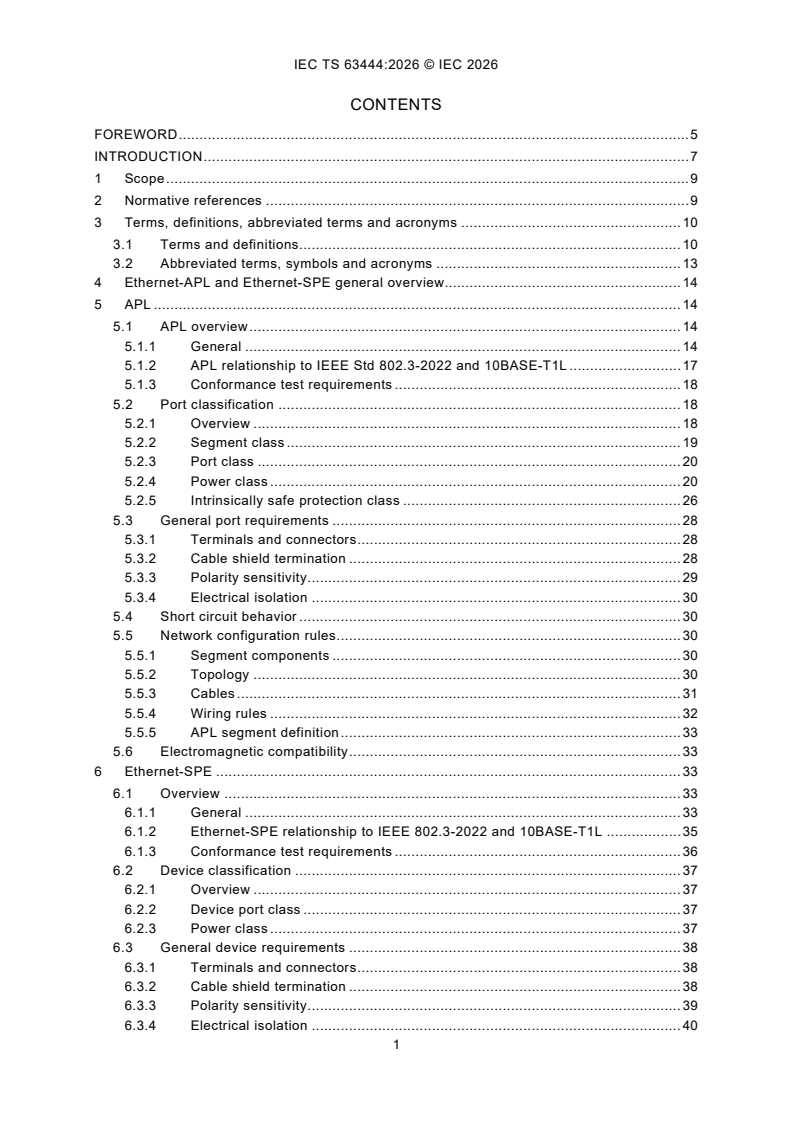
CONTENTS
FOREWORD . 5
INTRODUCTION . 7
1 Scope . 9
2 Normative references . 9
3 Terms, definitions, abbreviated terms and acronyms . 10
3.1 Terms and definitions. 10
3.2 Abbreviated terms, symbols and acronyms . 13
4 Ethernet-APL and Ethernet-SPE general overview. 14
5 APL . 14
5.1 APL overview . 14
5.1.1 General . 14
5.1.2 APL relationship to IEEE Std 802.3-2022 and 10BASE-T1L . 17
5.1.3 Conformance test requirements . 18
5.2 Port classification . 18
5.2.1 Overview . 18
5.2.2 Segment class . 19
5.2.3 Port class . 20
5.2.4 Power class . 20
5.2.5 Intrinsically safe protection class . 26
5.3 General port requirements . 28
5.3.1 Terminals and connectors . 28
5.3.2 Cable shield termination . 28
5.3.3 Polarity sensitivity . 29
5.3.4 Electrical isolation . 30
5.4 Short circuit behavior . 30
5.5 Network configuration rules . 30
5.5.1 Segment components . 30
5.5.2 Topology . 30
5.5.3 Cables . 31
5.5.4 Wiring rules . 32
5.5.5 APL segment definition . 33
5.6 Electromagnetic compatibility . 33
6 Ethernet-SPE . 33
6.1 Overview . 33
6.1.1 General . 33
6.1.2 Ethernet-SPE relationship to IEEE 802.3-2022 and 10BASE-T1L . 35
6.1.3 Conformance test requirements . 36
6.2 Device classification . 37
6.2.1 Overview . 37
6.2.2 Device port class . 37
6.2.3 Power class . 37
6.3 General device requirements . 38
6.3.1 Terminals and connectors . 38
6.3.2 Cable shield termination . 38
6.3.3 Polarity sensitivity . 39
6.3.4 Electrical isolation . 40
6.3.5 Short circuit behavior . 40
6.4 Network configuration rules . 40
6.4.1 Segment components . 40
6.4.2 Ethernet-SPE transmission channel definition . 40
6.4.3 Topology . 41
6.4.4 Cables . 43
6.4.5 Wiring rules . 43
6.5 Electromagnetic compatibility . 43
Annex A (normative) APL connectors . 44
A.1 General . 44
A.2 M8 and M12 connectors . 45
A.2.1 General . 45
A.2.2 Requirements . 45
A.2.3 Pin assignment . 45
A.3 Printed circuit board and modular terminal blocks . 46
A.3.1 General . 46
A.3.2 Requirements . 46
A.3.3 Pin assignment . 47
A.4 Junction terminal blocks . 48
A.4.1 General . 48
A.4.2 Requirements . 48
A.4.3 Pin assignment . 48
Annex B (normative) Auxiliary devices . 49
B.1 General requirements . 49
B.2 Surge protection . 49
Annex C (normative) Ethernet-SPE connectors . 51
C.1 General . 51
C.2 Pin assignment . 52
Annex D (informative) Ethernet-SPE power cable length calculation . 55
Annex E (informative) Ethernet-SPE interconnection module . 57
Annex F (informative) Connecting Ethernet-APL devices to Ethernet-SPE switch. 58
Bibliography . 59
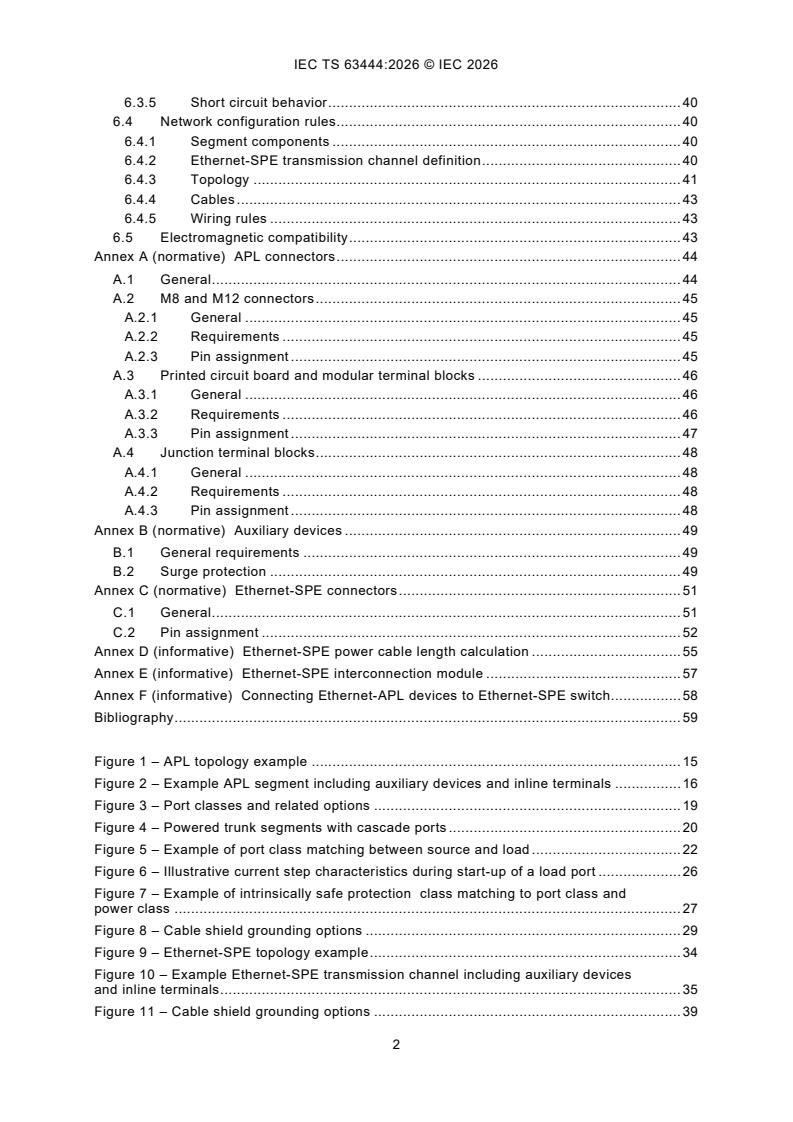
Figure 1 – APL topology example . 15
Figure 2 – Example APL segment including auxiliary devices and inline terminals . 16
Figure 3 – Port classes and related options . 19
Figure 4 – Powered trunk segments with cascade ports . 20
Figure 5 – Example of port class matching between source and load . 22
Figure 6 – Illustrative current step characteristics during start-up of a load port . 26
Figure 7 – Example of intrinsically safe protection class matching to port class and
power class . 27
Figure 8 – Cable shield grounding options . 29
Figure 9 – Ethernet-SPE topology example . 34
Figure 10 – Example Ethernet-SPE transmission channel including auxiliary devices
and inline terminals . 35
Figure 11 – Cable shield grounding options . 39
Figure A.1 – Port class to connector type matching . 45
Figure A.2 – Pin assignment of the plug and socket M8 A-coding connectors . 46
Figure A.3 – Pin assignment of the plug and socket M12 A-coding connectors. 46
Figure A.4 – Examples of modular pluggable terminal blocks . 48
Figure A.5 – Representative junction terminal block . 48
Figure B.1 – Basic circuit diagram of coordination between surge protector and
powered APL port . 49
Figure B.2 – Parallel connection of an SPD to an APL segment . 50
Figure C.1 – Port class to connector type matching . 52
Figure C.2 – Pin assignment of the plug and socket M8 connectors ("Type I") . 53
Figure C.3 – Pin assignment of the plug M12 hybrid connector ("Type I") . 53
Figure C.4 – Pin assignment of the plug and socket M12 connectors ("Type I") . 53
Figure C.5 – Pin assignment of the plug and socket IP20 connectors ("Type I") . 54
Figure E.1 – Coupler from AWG18 cable to AWG22 connector interface (IEC 63171) . 57
Figure F.1 – Ethernet-SPE to Ethernet-APL adapter example . 58
Table 1 – IEEE Std 802.3-2022 PHY, management and power options . 17
Table 2 – Segment class . 19
Table 3 – Port classes . 20
Table 4 – Power classes . 21
Table 5 – Electrical characteristics of power classes . 22
Table 6 – Electrical characteristics for trunk ports . 23
Table 7 – Electrical characteristics for spur ports . 25
Table 8 – Intrinsically safe protection class . 27
Table 9 – Minimum required shielding options of a port . 28
Table 10 – Polarity sensitivity . 29
Table 11 – Cable category system . 32
Table 12 – IEEE Std 802.3-2022 PHY, management and power options . 36
Table 13 – Class power requirements matrix for PSE, power interface (PI), and PD for
classes 10 to 15 . 38
Table 14 – PSE power availability matrix for PSE and PD for class 10 through 15 . 38
Table 15 – Minimum required shielding options . 39
Table 16 – Basic Ethernet-SPE transmission channel characteristics (data only) . 41
Table 17 – Basic Ethernet-SPE transmission channel characteristics (Data and Power) . 42
Table A.1 – Supported terminal block/connector types . 44
Table A.2 – Electrical requirements terminal block/connector . 44
Table A.3 – Pin assignments for plug and socket M8 and M12 A-coding connectors . 46
Table A.4 – Pin assignments for 3 position terminal blocks . 47
Table A.5 – Pin assignments for 4 position terminal blocks . 47
Table A.6 – Pin assignments for 6 position terminal blocks . 47
Table C.1 – Supported terminal block/connector types . 51
Table C.2 – Electrical requirements Ethernet-SPE connectors (Type I) . 51
Table C.3 – Standard requirements of M12 hybrid Ethernet-SPE connector ("Type I") . 52
Table C.4 – Pin assignments for Ethernet-SPE connectors (2 pins) . 53
Table C.5 – Pin assignment for Ethernet-SPE M12 hybrid connectors . 53
Table D.1 – DC loop resistance calculation for power class 10 to 15 . 55
Table D.2 – DC loop resistance for cable sizes AWG13 to AWG24 . 55
Table D.3 – Additional DC loop resistance . 56
Table D.4 – Calculated cable length on power class and wire size . 56
INTERNATIONAL ELECTROTECHNICAL COMMISSION
____________
Industrial networks -
Ethernet-APL port profile / Ethernet-SPE profile specification
FOREWORD
1) The International Electrotechnical Commission (IEC) is a worldwide organization for standardization comprising
all national electrotechnical committees (IEC National Committees). The object of IEC is to promote international
co-operation on all questions concerning standardization in the electrical and electronic fields. To this end and
in addition to other activities, IEC publishes International Standards, Technical Specifications, Technical Reports,
Publicly Available Specifications (PAS) and Guides (hereafter referred to as “IEC Publication(s)”). Their
preparation is entrusted to technical committees; any IEC National Committee interested in the subject dealt with
may participate in this preparatory work. International, governmental and non-governmental organizations liaising
with the IEC also participate in this preparation. IEC collaborates closely with the International Organization for
Standardization (ISO) in accordance with conditions determined by agreement between the two organizations.
2) The formal decisions or agreements of IEC on technical matters express, as nearly as possible, an international
consensus of opinion on the relevant subjects since each technical committee has representation from all
interested IEC National Committees.
3) IEC Publications have the form of recommendations for international use and are accepted by IEC National
Committees in that sense. While all reasonable efforts are made to ensure that the technical content of IEC
Publications is accurate, IEC cannot be held responsible for the way in which they are used or for any
misinterpretation by any end user.
4) In order to promote international uniformity, IEC National Committees undertake to apply IEC Publications
transparently to the maximum extent possible in their national and regional publications. Any divergence between
any IEC Publication and the corresponding national or regional publication shall be clearly indicated in the latter.
5) IEC itself does not provide any attestation of conformity. Independent certification bodies provide conformity
assessment services and, in some areas, access to IEC marks of conformity. IEC is not responsible for any
services carried out by independent certification bodies.
6) All users should ensure that they have the latest edition of this publication.
7) No liability shall attach to IEC or its directors, employees, servants or agents including individual experts and
members of its technical committees and IEC National Committees for any personal injury, property damage or
other damage of any nature whatsoever, whether direct or indirect, or for costs (including legal fees) and
expenses arising out of the publication, use of, or reliance upon, this IEC Publication or any other IEC
Publications.
8) Attention is drawn to the Normative references cited in this publication. Use of the referenced publications is
indispensable for the correct application of this publication.
9) IEC draws attention to the possibility that the implementation of this document may involve the use of (a)
patent(s). IEC takes no position concerning the evidence, validity or applicability of any claimed patent rights in
respect thereof. As of the date of publication of this document, IEC had not received notice of (a) patent(s), which
may be required to implement this document. However, implementers are cautioned that this may not represent
the latest information, which may be obtained from the patent database available at https://patents.iec.ch. IEC
shall not be held responsible for identifying any or all such patent rights.
IEC TS 63444 has been prepared by subcommittee 65C: Industrial networks, of IEC technical
committee 65: Industrial-process measurement, control and automation. It is a Technical
Specification.
This second edition cancels and replaces the first edition published in 2023. This edition
constitutes a technical revision.
This edition includes the following significant technical changes with respect to the previous
edition:
a) new power class for Ethernet-APL;
b) addition of Ethernet-SPE;
c) clarification of usability of Ethernet-APL in non-hazardous locations.
The text of this Technical Specification is based on the following documents:
Draft Report on voting
65C/1386/DTS 65C/1411/RVDTS
Full information on the voting for its approval can be found in the report on voting indicated in
the above table.
The language used for the development of this Technical Specification is English.
This document was drafted in accordance with ISO/IEC Directives, Part 2, and developed in
accordance with ISO/IEC Directives, Part 1 and ISO/IEC Directives, IEC Supplement, available
at www.iec.ch/members_experts/refdocs. The main document types developed by IEC are
described in greater detail at www.iec.ch/publications.
The committee has decided that the contents of this document will remain unchanged until the
stability date indicated on the IEC website under webstore.iec.ch in the data related to the
specific document. At this date, the document will be
– reconfirmed,
– withdrawn, or
– revised.
INTRODUCTION
TM
IEEE Std 802.3 -2022, Clause 146, specifies the Ethernet Physical Layer 10BASE-T1L,
suitable to be used for full-duplex communication over a single balanced pair of conductors.
This physical layer is specifically designed for industrial applications, supporting the main
requirements for advanced, robust process control and monitoring in safe or hazardous areas.
The primary physical layer solution focuses on four requirements:
– support of single pair cables providing both communication and optional power;
– increased data bandwidth, 10 Mbit/s;
– support of extended Ethernet cable length of up to 1 km;
– support of intrinsically safe protection for use in hazardous areas.
IEEE Std 802.3-2022, Clause 146, only specifies the digital communication method and its
electrical characteristics. To achieve interoperability between the various interconnected
components at different parts of the network, a further set of specifications and classifications
are supportive when applying this new physical layer for industrial applications.
TM
In addition, IEEE Std 802.3 -2022, Clause 104, as corrected and amended by
IEEE Std 802.3dd-2022 specifies the Power over Data Lines (PoDL) of Single-Pair Ethernet.
This clause specifies two optional power entities. These entities allow devices to supply or draw
power using the cabling that may be used for data transmission. PoDL does not support intrinsic
safety and is optimized for applications that do not require intrinsic safety.
The "Ethernet Advanced Physical Layer" (Ethernet-APL or APL) standardizes 2-wire (single-
pair) industrial Ethernet supporting the "2-WISE" (IEC TS 60079-47) intrinsically safe concept.
Clause 146 is referenced and extended, and Clause 104 is replaced with an alternate power
method. Ethernet-SPE standardizes non-intrinsically safe single-pair industrial Ethernet for
process automation, factory automation and building automation. Clause 146 and Clause 104
(PoDL) are referenced and extended. Ethernet-SPE can be used in combination with
Ethernet-APL.
The first part of this document specifies 2-WISE compliant Ethernet-APL port profiles for use in
hazardous and non-hazardous with and without power. Ethernet-APL intrinsically safe profiles
facilitate the examination of the interconnection of different Ethernet-APL ports. Most common
industrial rated connectors for use in process industries are part of this document. A multi-
length cable category system maintains communication integrity, while permitting cable
constructions optimized for specific applications or environmental ratings. The second part of
this document specifies Ethernet-SPE profiles without intrinsic safety for use in non-hazardous
locations, with and without power. This also includes hazardous locations not requiring intrinsic
safety.
Ethernet-APL and Ethernet-SPE impact the various physical layers in IEC 61158-2 and its
associated Types. This document provides a neutral approach for the new Advanced Physical
Layer which can be then transferred to the next editions of different IEC intrinsically safe
fieldbus documents. The following documents are representative of potentially affected next
editions: IEC 61158-2, the IEC 61784-1 series, the IEC 61784-2 series, IEC 61918 and the
IEC 61784-5 series.
This document is not intended to assure interoperability at the product level but only at the port
level. No reference is made to any Ethernet-based communication protocol above the physical
layer.
NOTE 1 As a simplification, this document describes some applications as 'requiring 2-WISE'. Ethernet-APL
supports intrinsic safety with 2-WISE can suit these applications. This document describes other applications as 'not
requiring 2-WISE'. Ethernet-SPE does not support intrinsic safety (and therefore not 2-WISE) and suits these
applications (Ethernet-APL can also be used).
NOTE 2 Heating of cable due to remote powering is not considered in this document. Information is supplied by
ISO/IEC TS 29125.
1 Scope
This document is applicable to process automation equipment using a 10BASE-T1L compliant
Physical Layer (PHY). Ethernet-APL intrinsically safe profiles with different predefined entity or
limitation parameters (for example voltage, current, power, capacitance, inductance, cable
length) simplify the examination of the interconnection of different Ethernet-APL ports.
Furthermore, this document is also applicable to factory and building automation and control
equipment using a 10BASE-T1L compliant, and Power over Data Lines (PoDL) compliant
Physical Layer (PHY) for non-intrinsically safe Ethernet installations.
NOTE In this document the term Ethernet-SPE is used for PoDL compliant PHY.
The following technical features are part of this document:
– topology with trunk and spur installation capability;
– 2-wire technology (full-duplex communication data rate of 10 Mbit/s);
– long distance (refers to cable lengths of several hundred meters, with spans up to 1 000 m);
– intrinsic safety (installation of Ethernet-capable field devices in hazardous areas);
– power supply to field devices over the same 2-wire cable used for data communication;
– non-intrinsically safe Ethernet installation in factory and building automation.
2 Normative references
The following documents are referred to in the text in such a way that some or all of their content
constitutes requirements of this document. For dated references, only the edition cited applies.
For undated references, the latest edition of the referenced document (including any
amendments) applies.
IEC 60079-11, Explosive atmospheres - Part 11: Equipment protection by intrinsic safety "i"
IEC 60079-14, Explosive atmospheres - Part 14: Electrical installations design, selection and
installation of equipment, including initial inspection
IEC 60079-25, Explosive atmospheres - Part 25: Intrinsically safe electrical systems
IEC TS 60079-47:2021, Explosive atmospheres - Part 47: Equipment protection by 2-wire
intrinsically safe ethernet concept (2-WISE)
IEC 61010-1, Safety requirements for electrical equipment for measurement, control, and
laboratory use - Part 1: General requirements
IEC 61076-2-101, Connectors for electronic equipment - Product requirements - Part 2-101:
Circular connectors - Detail specification for circular connectors for M12 connectors with screw-
locking
IEC 61076-2-104, Connectors for electronic equipment - Product requirements - Part 2-104:
Circular connectors - Detail specification for circular connectors with M8 screw-locking or snap-
locking
IEC 61156-13, Multicore and symmetrical pair/quad cables for digital communications - Part 13:
Symmetrical single pair cables with transmission characteristics up to 20 MHz - Horizontal floor
wiring - Sectional specification
IEC 61156-14, Multicore and symmetrical pair/quad cables for digital communications - Part 14:
Symmetrical single pair cables with transmission characteristics up to 20 MHz - Work area
wiring - Sectional specification
IEC 61158-2:2023, Industrial communication networks - Fieldbus specifications - Part 2:
Physical layer specification and service definition
IEC 61643-21, Low voltage surge protective devices - Part 21: Surge protective devices
connected to telecommunications and signalling networks - Requirements and test methods
IEC 63171:2025, Connectors for electrical and electronic equipment - Shielded or unshielded
free and fixed connectors for balanced single-pair data transmission with current‑carrying
capacity - General requirements and tests
ISO/IEC 11801-1:2017, Information technology - Generic cabling for customer premises -
Part 1: General requirements
ISO/IEC 11801-1:2017/AMD1:2025
IEEE Std 802.3-2022, IEEE Standard for Ethernet
IEEE Std 802.3dd-2022, IEEE Standard for Ethernet, Amendment 1: Power over Data Lines of
Single Pair Ethernet
3 Terms, definitions, abbreviated terms and acronyms
3.1 Terms and definitions
For the purposes of this document, the following terms and definitions apply.
ISO and IEC maintain terminology databases for use in standardization at the following
addresses:
– IEC Electropedia: available at https://www.electropedia.org/
– ISO Online browsing platform: available at https://www.iso.org/obp
3.1.1
Advanced Physical Layer
APL
physical layer based on 10BASE-T1L according to IEEE Std 802.3-2022 with additional optional
features like intrinsic safety, power over 2 wires
Note 1 to entry: Additional requirements for use in process industries are specified in this document.
3.1.2
APL segment
segment that consists of two APL ports, each containing a 10BASE-T1L compatible PHY,
connected at each end of a two-wire, shielded cable
Note 1 to entry: An APL segment can optionally be equipped with a maximum of two auxiliary devices and can
contain up to 10 inline terminal connections. An auxiliary device corresponds to one inline connection; for example,
having two auxiliary devices connected to one APL segment will reduce the number of inline connections by two.
Note 2 to entry: An APL segment is either a trunk or a spur.
3.1.3
APL switch
Ethernet switch including at least one APL compliant port
3.1.4
APL port
electrical and mechanical interface of a device to an APL segment
3.1.5
auxiliary device
device which is connected within an APL segment and does not include a 10BASE-T1L PHY
Note 1 to entry: Auxiliary devices are specified in Annex B.
Note 2 to entry: An auxiliary device can comprise a power load or introduce communication signal insertion losses.
EXAMPLE A surge protector is an example of an auxiliary device.
3.1.6
cable stub
unterminated branch of the segment cable
3.1.7
cascade port
APL port used in powered daisy chain networks
Note 1 to entry: If the cascade port is used in a powered ring network it shall be either a power source port or a
power load port depending on the status of the ring.
3.1.8
inline connection
mated device or combination of devices, including terminations used to connect cables or cable
elements to other cables or application specific equipment
3.1.9
current event
change of load current during power-up sequence with a specific characteristic
Note 1 to entry: A current event can be either a current step or a current spike.
3.1.10
field switch
APL switch having at least one port to which a spur can be connected
3.1.11
port
interface between a device and an APL segment
3.1.12
port class
port powering characteristics
3.1.13
power switch
APL switch including at least one port feeding power into a trunk
3.1.14
power interface
PI
mechanical and electrical interface between the PoDL power sourcing equipment (PSE) or
PoDL powered device (PD) and the transmission medium
3.1.15
physical layer
PHY
lowest layer of a communication system model, primarily concerned with the transmission of
raw bit streams over a physical medium, which encompasses the hardware technologies that
interface with the medium, such as cables, switches, and network interface cards
Note 1 to entry: The physical layer defines the electrical, optical, and mechanical characteristics that enable the
data to travel across the network.
3.1.16
data only port
Ethernet-SPE port implementing the 10BASE-T1L PHY (IEEE Std 802.3-2022, Clause 146) without PoDL
3.1.17
power source equipment port
segment of an equipment using power over data line technology
3.1.18
powered device port
segment of a device using power over data line technology
3.1.19
overcurrent condition
condition when a power load port draws more than the minimum continuously provided current
I of the power source port
PS(min)
3.1.20
Ethernet-SPE device
device with one of two optional PHY interfaces, a PoDL interface or a data only interface
3.1.21
Ethernet-SPE port
either PoDL interface of a device with one of two optional power entities, a PSE or PD for use
with supported single balanced twisted-pair Ethernet Physical Layers
TM
(see IEEE Std 802.3 -2022, Clause 104.1 as corrected and amended by
IEEE Std 802.3dd-2022) or interface for data only communication
3.1.22
Ethernet-SPE transmission channel
segment that consists of two Ethernet-SPE ports, connected at each end of a single pair,
shielded cable
3.1.23
spur
segment which connects a field device to a field switch
3.1.24
segment
point-to-point connection between two APL ports
3.1.25
surge protective device
SPD
electrical device that is used to protect electronic equipment against electrical surges and
voltage spikes
Note 1 to entry: A SPD is an auxiliary device.
3.1.26
trunk
segment which connects a power switch to a field switch or a field switch to a field switch
3.1.27
2-WISE
2-wire intrinsically safe Ethernet concept based on APL with standardized limits for intrinsic
safety parameters, designed to simplify the examination process for components and cable
parameters within APL segments
[SOURCE: IEC TS 60079-47:2021, 3.3, modified − a new term has been assigned.]
3.1.28
2.4 V operating mode
pp
10BASE-T1L compliant operating mode with a signal amplitude of 2,4 V
pp
Note 1 to entry: This mode is used on APL trunk segments.
3.1.29
1.0 V operating mode
pp
10BASE-T1L operating mode with a signal amplitude of 1,0 V
pp
Note 1 to entry: This mode is used on APL spur segments.
3.2 Abbreviated terms, symbols and acronyms
C unlimited input capacitance of a load port
in
E initial inrush energy of a load port or cascade port during power-up, caused by
in
charging-up its input capacitance
EMC electromagnetic compatibility
Ex indicates that the electrical equipment corresponds to one or more of the types
of protection which are subject of the standards IEC 60079-0 or IEC 60079-11
I maximum current during a current spike event of a load port during start-up
CSp(max)
I minimum continuously provided current at the power source terminals except
PS(min)
during inrush or an overcurrent condition
I minimum consumed current at the power load terminals except during inrush or
PL(min)
an overcurrent condition
I maximum consumed current at the power load terminals during an under voltage
PL(max)
condition
I reverse current for polarity sensitive power load ports
PL(reverse)
minimum available power at the power load terminals
P
PL(min)
P minimum available output power at the power source terminals
PS(min)
PSANEXT power sum alien near end crosstalk loss
PSAFEXT power sum alien far end crosstalk loss
Q electric charge during a current spike event for a load port during power-up
CSp
R internal resistance of a power source port
out
U maximum allowed voltage at the power source terminals over the full range of
PS(max)
operating conditions
U minimum available output voltage at the power source terminals over the full
PS(min)
range of operation conditions
U minimum available voltage at the power load terminals
PL(min)
4 Ethernet-APL and Ethernet-SPE general overview
This document describes the technical applications of Ethernet-APL and Ethernet-SPE as a
whole. Both Ethernet-APL and Ethernet-SPE are based on the same 10BASE-T1L transmission
standard as specified in IEEE Std 802.3-2022, Clause 146. Ethernet-APL has been specifically
specified for intrinsic safety applications in process automation. Nevertheless, Ethernet-APL
can also be used in non-hazardous applications for process automation and also for factory
automation and building automation.
Ethernet-APL and Ethernet-SPE each specify uniquely optimized power supply solutions for the
communication pair. Due to this fact and the technical applicability of both Ethernet-APL and
Ethernet-SPE in applications not requiring 2-WISE, it makes sense to describe both in one
document. The document is structured so that Ethernet-APL and its port profiles are described
in one main chapter and the technical solution for Ethernet-SPE in combination with Ethernet-
APL is described in a separate main chapter.
5 APL
5.1 APL overview
5.1.1 General
APL has been specifically designed to modernize digital instrumentation solutions used for
industrial process control, offering enhanced features of communication, powering and device
control in between Zone 2, 1 and 0, or Zone 20, 21 and 22.
Figure 1 illustrates an example of an APL network connected to a control network. The
communication link between the control network and the APL segment is performed through a
power switch, which additionally feeds power onto the APL trunk. A field switch is connected to
the opposite end of the APL trunk, which is powered by the trunk, whereon it feeds the power
to each spur port and to a second trunk port. The second trunk port provides a new powered
trunk segment for a second field switch and so on. Each spur port finally terminates at a field
device, which may also be powered in accordance with the applicable hazardous area
classification. Field devices, which shall be intrinsically safe certified, can be located within any
rated hazardous area. The number of cascaded field switches is limited because of the available
power. To calculate the number of cascaded field switches, the following applies: the output
power of the source port is the input power of the load port minus the power consumption of
the device and minus the internal losses.
It is strongly recommended to maintain cable type continuity in an APL segment as to minimize
the effect of insertion and return loss.
Figure 1 – APL topology example
An APL trunk shall be conformant to IEEE Std 802.3-2022, Clause 146, 10BASE-T1L link
segment definition in "2.4 V operating mode" and an APL spur shall comply with
pp
IEEE Std 802.3-2022, Clause 146, 10BASE-T1L link segment definition in "1.0 V operating
pp
mode". An APL segment can comprise either a trunk or a spur.
As shown in Figure 2, an APL segment comprises two ports connected to each end of a trunk
or spur cable, with auxiliary devices and terminal blocks or connectors in between. A spur
always ends at a field device. The cable, optional auxiliary devices and junction terminals are
defined within this specification.
For powered segments, one source port provides power into the segment, and the load port or
the auxiliary device consumes power from the segment.
For use in hazardous areas according to IEC 60079-14, in which intrinsically safe rated circuits
are required, the ports can be classified as intrinsically safe according to level of protection ia,
ib, or ic.
NOTE A particular national or regional standard, code or directive can use other particular notations, differing from
international IEC notations.
Different terminal blocks are supported with terminal options as screw-type or spring-force-type.
NOTE 1 Auxiliary devices can cause additional insertion loss for example by integrated inline resistors.
NOTE 2 An auxiliary device, typically a surge protector, does not contain a PHY.
Figure 2 – Example APL segment including auxiliary devices and inline terminals
...
IEC TS 63444 ®
Edition 2.0 2026-06
TECHNICAL
SPECIFICATION
REDLINE VERSION
Industrial networks - Ethernet-APL port profile / Ethernet-SPE profile
specification
ICS 29.240 ISBN 978-2-8327-1308-2
All rights reserved. Unless otherwise specified, no part of this publication may be reproduced or utilized in any form or
by any means, electronic or mechanical, including photocopying and microfilm, without permission in writing from either
IEC or IEC's member National Committee in the country of the requester. If you have any questions about IEC copyright
or have an enquiry about obtaining additional rights to this publication, please contact the address below or your local
IEC member National Committee for further information.
IEC Secretariat Tel.: +41 22 919 02 11
3, rue de Varembé info@iec.ch
CH-1211 Geneva 20 www.iec.ch
Switzerland
About the IEC
The International Electrotechnical Commission (IEC) is the leading global organization that prepares and publishes
International Standards for all electrical, electronic and related technologies.
About IEC publications
The technical content of IEC publications is kept under constant review by the IEC. Please make sure that you have the
latest edition, a corrigendum or an amendment might have been published.
IEC publications search - IEC Products & Services Portal - products.iec.ch
webstore.iec.ch/advsearchform Discover our powerful search engine and read freely all the
The advanced search enables to find IEC publications by a publications previews, graphical symbols and the glossary.
variety of criteria (reference number, text, technical With a subscription you will always have access to up to date
committee, …). It also gives information on projects, content tailored to your needs.
replaced and withdrawn publications.
Electropedia - www.electropedia.org
IEC Just Published - webstore.iec.ch/justpublished The world's leading online dictionary on electrotechnology,
Stay up to date on all new IEC publications. Just Published containing more than 22 500 terminological entries in English
details all new publications released. Available online and and French, with equivalent terms in 25 additional languages.
once a month by email. Also known as the International Electrotechnical Vocabulary
(IEV) online.
IEC Customer Service Centre - webstore.iec.ch/csc
If you wish to give us your feedback on this publication or
need further assistance, please contact the Customer
Service Centre: sales@iec.ch.
CONTENTS
FOREWORD . 5
INTRODUCTION . 1
1 Scope . 9
2 Normative references . 9
3 Terms, definitions, abbreviated terms and acronyms . 10
3.1 Terms and definitions. 10
3.2 Abbreviated terms, symbols and acronyms . 13
4 Ethernet-APL and Ethernet-SPE general overview. 14
5 APL . 14
5.1 APL overview . 14
5.1.1 General . 14
5.1.2 APL relationship to IEEE Std 802.3-2022 and 10BASE-T1L . 17
5.1.3 Conformance test requirements . 18
5.2 Port classification . 18
5.2.1 Overview . 18
5.2.2 Segment class . 19
5.2.3 Port class . 20
5.2.4 Power class . 20
5.2.5 Intrinsically safe protection class . 26
5.3 General port requirements . 28
5.3.1 Terminals and connectors . 28
5.3.2 Cable shield termination . 28
5.3.3 Polarity sensitivity . 29
5.3.4 Electrical isolation . 30
5.4 Short circuit behavior . 30
5.5 Network configuration rules . 30
5.5.1 Segment components . 30
5.5.2 Topology . 30
5.5.3 Cables . 31
5.5.4 Wiring rules . 32
5.5.5 APL segment definition . 33
5.6 Electromagnetic compatibility . 33
6 Ethernet-SPE . 33
6.1 Overview . 33
6.1.1 General . 33
6.1.2 Ethernet-SPE relationship to IEEE 802.3-2022 and 10BASE-T1L . 35
6.1.3 Conformance test requirements . 36
6.2 Device classification . 37
6.2.1 Overview . 37
6.2.2 Device port class . 37
6.2.3 Power class . 37
6.3 General device requirements . 38
6.3.1 Terminals and connectors . 38
6.3.2 Cable shield termination . 38
6.3.3 Polarity sensitivity . 39
6.3.4 Electrical isolation . 40
6.3.5 Short circuit behavior . 40
6.4 Network configuration rules . 40
6.4.1 Segment components . 40
6.4.2 Ethernet-SPE transmission channel definition . 40
6.4.3 Topology . 41
6.4.4 Cables . 43
6.4.5 Wiring rules . 43
6.5 Electromagnetic compatibility . 43
Annex A (normative) APL connectors . 44
A.1 General . 44
A.2 M8 and M12 connectors . 45
A.2.1 General . 45
A.2.2 Requirements . 45
A.2.3 Pin assignment . 45
A.3 Printed circuit board and modular terminal blocks . 46
A.3.1 General . 46
A.3.2 Requirements . 46
A.3.3 Pin assignment . 47
A.4 Junction terminal blocks . 48
A.4.1 General . 48
A.4.2 Requirements . 48
A.4.3 Pin assignment . 48
Annex B (normative) Auxiliary devices . 49
B.1 General requirements . 49
B.2 Surge protection . 49
Annex C (normative) Ethernet-SPE connectors . 51
C.1 General . 51
C.2 Pin assignment . 52
Annex D (informative) Ethernet-SPE power cable length calculation . 55
Annex E (informative) Ethernet-SPE interconnection module . 57
Annex F (informative) Connecting Ethernet-APL devices to Ethernet-SPE switch. 58
Bibliography . 59
Figure 1 – APL topology example . 15
Figure 2 – Example APL segment including auxiliary devices and inline terminals . 16
Figure 3 – Port classes and related options . 19
Figure 4 – Powered trunk segments with cascade ports . 20
Figure 5 – Example of port class matching between source and load . 22
Figure 6 – Illustrative current step characteristics during start-up of a load port . 26
Figure 7 – Example of intrinsically safe protection class matching to port class and
power class . 27
Figure 8 – Cable shield grounding options . 29
Figure 9 – Ethernet-SPE topology example . 34
Figure 10 – Example Ethernet-SPE transmission channel including auxiliary devices
and inline terminals . 35
Figure 11 – Cable shield grounding options . 39
Figure A.1 – Port class to connector type matching . 45
Figure A.2 – Pin assignment of the plug and socket M8 A-coding connectors . 46
Figure A.3 – Pin assignment of the plug and socket M12 A-coding connectors. 46
Figure A.4 – Examples of modular pluggable terminal blocks . 48
Figure A.5 – Representative junction terminal block . 48
Figure B.1 – Basic circuit diagram of coordination between surge protector and
powered APL port . 49
Figure B.2 – Parallel connection of an SPD to an APL segment . 50
Figure C.1 – Port class to connector type matching . 52
Figure C.2 – Pin assignment of the plug and socket M8 connectors ("Type I") . 53
Figure C.3 – Pin assignment of the plug M12 hybrid connector ("Type I") . 53
Figure C.4 – Pin assignment of the plug and socket M12 connectors ("Type I") . 53
Figure C.5 – Pin assignment of the plug and socket IP20 connectors ("Type I") . 54
Figure E.1 – Coupler from AWG18 cable to AWG22 connector interface (IEC 63171) . 57
Figure F.1 – Ethernet-SPE to Ethernet-APL adapter example . 58
Table 1 – IEEE Std 802.3-2022 PHY, management and power options . 17
Table 2 – Segment class . 19
Table 3 – Port classes . 20
Table 4 – Power classes . 21
Table 5 – Electrical characteristics of power classes . 22
Table 6 – Electrical characteristics for trunk ports . 23
Table 7 – Electrical characteristics for spur ports . 25
Table 8 – Intrinsically safe protection class . 27
Table 9 – Minimum required shielding options of a port . 28
Table 10 – Polarity sensitivity . 29
Table 11 – Cable category system . 32
Table 12 – IEEE Std 802.3-2022 PHY, management and power options . 36
Table 13 – Class power requirements matrix for PSE, power interface (PI), and PD for
classes 10 to 15 . 38
Table 14 – PSE power availability matrix for PSE and PD for class 10 through 15 . 38
Table 15 – Minimum required shielding options . 39
Table 16 – Basic Ethernet-SPE transmission channel characteristics (data only) . 41
Table 17 – Basic Ethernet-SPE transmission channel characteristics (Data and Power) . 42
Table A.1 – Supported terminal block/connector types . 44
Table A.2 – Electrical requirements terminal block/connector . 44
Table A.3 – Pin assignments for plug and socket M8 and M12 A-coding connectors . 46
Table A.4 – Pin assignments for 3 position terminal blocks . 47
Table A.5 – Pin assignments for 4 position terminal blocks . 47
Table A.6 – Pin assignments for 6 position terminal blocks . 47
Table C.1 – Supported terminal block/connector types . 51
Table C.2 – Electrical requirements Ethernet-SPE connectors (Type I) . 51
Table C.3 – Standard requirements of M12 hybrid Ethernet-SPE connector ("Type I") . 52
Table C.4 – Pin assignments for Ethernet-SPE connectors (2 pins) . 53
Table C.5 – Pin assignment for Ethernet-SPE M12 hybrid connectors . 53
Table D.1 – DC loop resistance calculation for power class 10 to 15 . 55
Table D.2 – DC loop resistance for cable sizes AWG13 to AWG24 . 55
Table D.3 – Additional DC loop resistance . 56
Table D.4 – Calculated cable length on power class and wire size . 56
INTERNATIONAL ELECTROTECHNICAL COMMISSION
____________
Industrial networks -
Ethernet-APL port profile / Ethernet-SPE profile specification
FOREWORD
1) The International Electrotechnical Commission (IEC) is a worldwide organization for standardization comprising
all national electrotechnical committees (IEC National Committees). The object of IEC is to promote international
co-operation on all questions concerning standardization in the electrical and electronic fields. To this end and
in addition to other activities, IEC publishes International Standards, Technical Specifications, Technical Reports,
Publicly Available Specifications (PAS) and Guides (hereafter referred to as “IEC Publication(s)”). Their
preparation is entrusted to technical committees; any IEC National Committee interested in the subject dealt with
may participate in this preparatory work. International, governmental and non-governmental organizations liaising
with the IEC also participate in this preparation. IEC collaborates closely with the International Organization for
Standardization (ISO) in accordance with conditions determined by agreement between the two organizations.
2) The formal decisions or agreements of IEC on technical matters express, as nearly as possible, an international
consensus of opinion on the relevant subjects since each technical committee has representation from all
interested IEC National Committees.
3) IEC Publications have the form of recommendations for international use and are accepted by IEC National
Committees in that sense. While all reasonable efforts are made to ensure that the technical content of IEC
Publications is accurate, IEC cannot be held responsible for the way in which they are used or for any
misinterpretation by any end user.
4) In order to promote international uniformity, IEC National Committees undertake to apply IEC Publications
transparently to the maximum extent possible in their national and regional publications. Any divergence between
any IEC Publication and the corresponding national or regional publication shall be clearly indicated in the latter.
5) IEC itself does not provide any attestation of conformity. Independent certification bodies provide conformity
assessment services and, in some areas, access to IEC marks of conformity. IEC is not responsible for any
services carried out by independent certification bodies.
6) All users should ensure that they have the latest edition of this publication.
7) No liability shall attach to IEC or its directors, employees, servants or agents including individual experts and
members of its technical committees and IEC National Committees for any personal injury, property damage or
other damage of any nature whatsoever, whether direct or indirect, or for costs (including legal fees) and
expenses arising out of the publication, use of, or reliance upon, this IEC Publication or any other IEC
Publications.
8) Attention is drawn to the Normative references cited in this publication. Use of the referenced publications is
indispensable for the correct application of this publication.
9) IEC draws attention to the possibility that the implementation of this document may involve the use of (a)
patent(s). IEC takes no position concerning the evidence, validity or applicability of any claimed patent rights in
respect thereof. As of the date of publication of this document, IEC had not received notice of (a) patent(s), which
may be required to implement this document. However, implementers are cautioned that this may not represent
the latest information, which may be obtained from the patent database available at https://patents.iec.ch. IEC
shall not be held responsible for identifying any or all such patent rights.
This redline version of the official IEC Standard allows the user to identify the changes made
to the previous edition IEC TS 63444:2023. A vertical bar appears in the margin wherever a
change has been made. Additions are in green text, deletions are in strikethrough red text.
IEC TS 63444 has been prepared by subcommittee 65C: Industrial networks, of IEC technical
committee 65: Industrial-process measurement, control and automation. It is a Technical
Specification.
This second edition cancels and replaces the first edition published in 2023. This edition
constitutes a technical revision.
This edition includes the following significant technical changes with respect to the previous
edition:
a) new power class for Ethernet-APL;
b) addition of Ethernet-SPE;
c) clarification of usability of Ethernet-APL in non-hazardous locations.
The text of this Technical Specification is based on the following documents:
Draft Report on voting
65C/1386/DTS 65C/1411/RVDTS
Full information on the voting for its approval can be found in the report on voting indicated in
the above table.
The language used for the development of this Technical Specification is English.
This document was drafted in accordance with ISO/IEC Directives, Part 2, and developed in
accordance with ISO/IEC Directives, Part 1 and ISO/IEC Directives, IEC Supplement, available
at www.iec.ch/members_experts/refdocs. The main document types developed by IEC are
described in greater detail at www.iec.ch/publications.
The committee has decided that the contents of this document will remain unchanged until the
stability date indicated on the IEC website under webstore.iec.ch in the data related to the
specific document. At this date, the document will be
– reconfirmed,
– withdrawn, or
– revised.
INTRODUCTION
TM
IEEE Std 802.3 -2022, Clause 146, specifies the Ethernet Physical Layer 10BASE-T1L,
suitable to be used for full-duplex communication over a single balanced pair of conductors.
This physical layer is specifically designed for industrial applications, supporting the main
requirements for advanced, robust process control and monitoring in safe or hazardous areas.
The primary physical layer solution focuses on four requirements:
– support of single pair cables providing both communication and optional power;
– increased data bandwidth, 10 Mbit/s;
– support of extended Ethernet cable length of up to 1 km;
– support of intrinsically safe protection for use in hazardous areas.
IEEE Std 802.3-2022, Clause 146, only specifies the digital communication method and its
electrical characteristics. To assure achieve interoperability between the various
interconnected components at different parts of the network, a further set of specifications and
classifications are supportive when applying this new physical layer for industrial applications
requires a further set of specifications and classifications. The "Ethernet Advanced Physical
Layer" (Ethernet-APL or APL) references and standardizes industrial automation extensions.
TM
In addition, IEEE Std 802.3 -2022, Clause 104, as corrected and amended by
IEEE Std 802.3dd-2022 specifies the Power over Data Lines (PoDL) of Single-Pair Ethernet.
This clause specifies two optional power entities. These entities allow devices to supply or draw
power using the cabling that may be used for data transmission. PoDL does not support intrinsic
safety and is optimized for applications that do not require intrinsic safety.
The "Ethernet Advanced Physical Layer" (Ethernet-APL or APL) standardizes 2-wire (single-
pair) industrial Ethernet supporting the "2-WISE" (IEC TS 60079-47) intrinsically safe concept.
Clause 146 is referenced and extended, and Clause 104 is replaced with an alternate power
method. Ethernet-SPE standardizes non-intrinsically safe single-pair industrial Ethernet for
process automation, factory automation and building automation. Clause 146 and Clause 104
(PoDL) are referenced and extended. Ethernet-SPE can be used in combination with
Ethernet-APL.
The first part of this document specifies 2-WISE compliant Ethernet-APL port profiles for use in
hazardous and non-hazardous areas, with and without power. Ethernet-APL intrinsically safe
profiles facilitate the examination of the interconnection of different Ethernet-APL ports. Most
common industrial rated connectors for use in process industries are part of this document. A
multi-length cable category system maintains communication integrity, while permitting cable
constructions optimized for specific applications or environmental ratings. The second part of
this document specifies Ethernet-SPE profiles without intrinsic safety for use in non-hazardous
locations, with and without power. This also includes hazardous locations not requiring intrinsic
safety.
Ethernet-APL and Ethernet-SPE impact the various physical layers in IEC 61158-2 and its
associated Types. This document provides a neutral approach for the new Advanced Physical
Layer which can be then transferred to the next editions of different IEC intrinsically safe
fieldbus documents. The following documents are representative of potentially affected next
editions: IEC 61158-2, the IEC 61784-1 series, the IEC 61784-2 series, IEC 61918 and the
IEC 61784-5 series.
This document is not intended to assure interoperability at the product level but only at the port
level. No reference is made to any Ethernet-based communication protocol above the physical
layer.
NOTE 1 As a simplification, this document describes some applications as 'requiring 2-WISE'. Ethernet-APL
supports intrinsic safety with 2-WISE can suit these applications. This document describes other applications as 'not
requiring 2-WISE'. Ethernet-SPE does not support intrinsic safety (and therefore not 2-WISE) and suits these
applications (Ethernet-APL can also be used).
NOTE 2 Heating of cable due to remote powering is not considered in this document. Information is supplied by
ISO/IEC TS 29125.
1 Scope
This document is applicable to process automation equipment using a 10BASE-T1L compliant
(see IEEE Std 802.3-2022, Clause 146) Physical Layer (PHY). Ethernet-APL intrinsically safe
profiles with different predefined entity or limitation parameters (for example voltage, current,
power, capacitance, inductance, cable length) simplify the examination of the interconnection
of different Ethernet-APL ports. Furthermore, this document is also applicable to factory and
building automation and control equipment using a 10BASE-T1L compliant, and Power over
Data Lines (PoDL) compliant Physical Layer (PHY) for non-intrinsically safe Ethernet
installations.
NOTE In this document the term Ethernet-SPE is used for PoDL compliant PHY.
The following technical features are part of this document:
– topology with trunk/ and spur installation capability;
– 2-wire technology (full-duplex communication data rate of 10 Mbit/s);
– long distance (refers to cable lengths of several hundred meters, with spans up to 1 000 m);
– intrinsic safety (installation of Ethernet-capable field devices in hazardous areas);
– power supply to field devices over the same 2-wire cable used for data communication;
– non-intrinsically safe Ethernet installation in factory and building automation.
2 Normative references
The following documents are referred to in the text in such a way that some or all of their content
constitutes requirements of this document. For dated references, only the edition cited applies.
For undated references, the latest edition of the referenced document (including any
amendments) applies.
IEC 60079-11, Explosive atmospheres - Part 11: Equipment protection by intrinsic safety "i"
IEC 60079-14, Explosive atmospheres - Part 14: Electrical installations design, selection and
erection installation of equipment, including initial inspection
IEC 60079-25, Explosive atmospheres - Part 25: Intrinsically safe electrical systems
IEC TS 60079-47:2021, Explosive atmospheres - Part 47: Equipment protection by 2-wire
intrinsically safe ethernet concept (2-WISE)
IEC 61010-1, Safety requirements for electrical equipment for measurement, control, and
laboratory use - Part 1: General requirements
IEC 61076-2-101, Connectors for electronic equipment - Product requirements - Part 2-101:
Circular connectors - Detail specification for circular connectors for M12 connectors with screw-
locking
IEC 61076-2-104, Connectors for electronic equipment - Product requirements - Part 2-104:
Circular connectors - Detail specification for circular connectors with M8 screw-locking or snap-
locking
IEC 61156-13, Multicore and symmetrical pair/quad cables for digital communications - Part 13:
Symmetrical single pair cables with transmission characteristics up to 20 MHz - Horizontal floor
wiring - Sectional specification
IEC 61156-14, Multicore and symmetrical pair/quad cables for digital communications - Part 14:
Symmetrical single pair cables with transmission characteristics up to 20 MHz - Work area
wiring - Sectional specification
IEC 61158-2:2023, Industrial communication networks - Fieldbus specifications - Part 2:
Physical layer specification and service definition
IEC 61643-21, Low voltage surge protective devices - Part 21: Surge protective devices
connected to telecommunications and signalling networks - Performance Requirements and
testing test methods
IEC 63171:2025, Connectors for electrical and electronic equipment - Shielded or unshielded
free and fixed connectors for balanced single-pair data transmission with current‑carrying
capacity - General requirements and tests
ISO/IEC 11801-1:2017, Information technology - Generic cabling for customer premises -
Part 1: General requirements
ISO/IEC 11801-1:2017/AMD1:2025
IEEE Std 802.3-2022, IEEE Standard for Ethernet
ASTM D4566-05, Standard Test Methods for Electrical Performance Properties of Insulations
and Jackets for Telecommunications Wire and Cable; available at < ASTM D4566-05 - Standard
Test Methods for Electrical Performance Properties of Insulations and Jackets for
Telecommunications Wire and Cable (ansi.org)> [viewed 2023-10-13]
IEEE Std 802.3dd-2022, IEEE Standard for Ethernet, Amendment 1: Power over Data Lines of
Single Pair Ethernet
3 Terms, definitions, abbreviated terms and acronyms
3.1 Terms and definitions
For the purposes of this document, the following terms and definitions apply.
ISO and IEC maintain terminology databases for use in standardization at the following
addresses:
– IEC Electropedia: available at https://www.electropedia.org/
– ISO Online browsing platform: available at https://www.iso.org/obp
3.1.1
Advanced Physical Layer
APL
physical layer based on 10BASE-T1L according to IEEE Std 802.3-2022 with additional optional
features like intrinsic safety, power over 2 wires
Note 1 to entry: Additional requirements for use in process industries are specified in this document.
3.1.2
APL segment
segment that consists of two APL ports, each containing a 10BASE-T1L compatible PHY,
connected at each end of a two-wire, shielded cable
Note 1 to entry: An APL segment can optionally be equipped with a maximum of two auxiliary devices and can
contain up to 10 inline terminal connections. An auxiliary device corresponds to one inline connection; for example,
having two auxiliary devices connected to one APL segment will reduce the number of inline connections by two.
Note 2 to entry: An APL segment is either a trunk or a spur.
3.1.3
APL switch
Ethernet switch including at least one APL compliant port
3.1.4
APL port
electrical and mechanical interface of a device to an APL segment
3.1.5
auxiliary device
device which is connected within an APL segment and does not include a 10BASE-T1L PHY
Note 1 to entry: Auxiliary devices are specified in Annex B.
Note 2 to entry: An auxiliary device can comprise a power load or introduce communication signal insertion losses.
EXAMPLE A surge protector is an example of an auxiliary device.
3.1.6
cable stub
unterminated branch of the segment cable
3.1.7
cascade port
APL port used in powered daisy chain networks
Note 1 to entry: If the cascade port is used in a powered ring network it shall be either a power source port or a
power load port depending on the status of the ring.
3.1.8
inline connection
mated device or combination of devices, including terminations used to connect cables or cable
elements to other cables or application specific equipment
3.1.9
current event
change of load current during power-up sequence with a specific characteristic
Note 1 to entry: A current event could can be either a current step or a current spike.
3.1.10
field switch
APL switch having at least one port to which a spur can be connected
3.1.11
port
interface between a device and an APL segment
3.1.12
port class
port powering characteristics
3.1.13
power switch
APL switch including at least one port feeding power into a trunk
3.1.14
power interface
PI
mechanical and electrical interface between the PoDL power sourcing equipment (PSE) or
PoDL powered device (PD) and the transmission medium
3.1.15
physical layer
PHY
physical layer circuitry required to implement physical layer functions
lowest layer of a communication system model, primarily concerned with the transmission of
raw bit streams over a physical medium, which encompasses the hardware technologies that
interface with the medium, such as cables, switches, and network interface cards
Note 1 to entry: The physical layer defines the electrical, optical, and mechanical characteristics that enable the
data to travel across the network.
3.1.16
data only port
Ethernet-SPE port implementing the 10BASE-T1L PHY (IEEE Std 802.3-2022, Clause 146) without PoDL
3.1.17
power source equipment port
segment of an equipment using power over data line technology
3.1.18
powered device port
segment of a device using power over data line technology
3.1.19
overcurrent condition
condition when a power load port draws more than the minimum continuously provided current
I of the power source port
PS(min)
3.1.20
Ethernet-SPE device
device with one of two optional PHY interfaces, a PoDL interface or a data only interface
3.1.21
Ethernet-SPE port
either PoDL interface of a device with one of two optional power entities, a PSE or PD for use
with supported single balanced twisted-pair Ethernet Physical Layers
TM
(see IEEE Std 802.3 -2022, Clause 104.1 as corrected and amended by
IEEE Std 802.3dd-2022) or interface for data only communication
3.1.22
Ethernet-SPE transmission channel
segment that consists of two Ethernet-SPE ports, connected at each end of a single pair,
shielded cable
3.1.23
spur
segment which connects a field device to a field switch
3.1.24
segment
point-to-point connection between two APL ports
3.1.25
surge protective device
SPD
electrical device that is used to protect electronic equipment against electrical surges and
voltage spikes
Note 1 to entry: A SPD is an auxiliary device.
3.1.26
trunk
segment which connects a power switch to a field switch or a field switch to a field switch
3.1.27
2-WISE
2-wire intrinsically safe Ethernet concept based on APL with standardized limits for intrinsic
safety parameters, designed to simplify the examination process for components and cable
parameters within APL segments
[SOURCE: IEC TS 60079-47:2021, 3.3, modified − a new term has been assigned.]
3.1.28
operating mode
2.4 V
pp
10BASE-T1L compliant operating mode with a signal amplitude of 2,4 V
pp
Note 1 to entry: This mode is used on APL trunk segments.
3.1.29
1.0 V operating mode
pp
10BASE-T1L operating mode with a signal amplitude of 1,0 V
pp
Note 1 to entry: This mode is used on APL spur segments.
3.2 Abbreviated terms, symbols and acronyms
C unlimited input capacitance of a load port
in
E initial inrush energy of a load port or cascade port during power-up, caused by
in
charging-up its input capacitance
EMC electromagnetic compatibility
Ex indicates that the electrical equipment corresponds to one or more of the types
of protection which are subject of the standards IEC 60079-0 or IEC 60079-11
I maximum current during a current spike event of a load port during start-up
CSp(max)
I minimum continuously provided current at the power source terminals except
PS(min)
during inrush or an overcurrent condition
I minimum consumed current at the power load terminals except during inrush or
PL(min)
an overcurrent condition
I maximum consumed current at the power load terminals during an under voltage
PL(max)
condition
I reverse current for polarity sensitive power load ports
PL(reverse)
P minimum available power at the power load terminals
PL(min)
P minimum available output power at the power source terminals
PS(min)
PSANEXT power sum alien near end crosstalk loss
PSAFEXT power sum alien far end crosstalk loss
Q electric charge during a current spike event for a load port during power-up
CSp
R internal resistance of a power source port
out
U maximum allowed voltage at the power source terminals over the full range of
PS(max)
operating conditions
U minimum available output voltage at the power source terminals over the full
PS(min)
range of operation conditions
U minimum available voltage at the power load terminals
PL(min)
4 Ethernet-APL and Ethernet-SPE general overview
This document describes the technical applications of Ethernet-APL and Ethernet-SPE as a
whole. Both Ethernet-APL and Ethernet-SPE are based on the same 10BASE-T1L transmission
standard as specified in IEEE Std 802.3-2022, Clause 146. Ethernet-APL has been specifically
specified for intrinsic safety applications in process automation. Nevertheless, Ethernet-APL
can also be used in non-hazardous applications for process automation and also for factory
automation and building automation.
Ethernet-APL and Ethernet-SPE each specify uniquely optimized power supply solutions for the
communication pair. Due to this fact and the technical applicability of both Ethernet-APL and
Ethernet-SPE in applications not requiring 2-WISE, it makes sense to describe both in one
document. The document is structured so that Ethernet-APL and its port profiles are described
in one main chapter and the technical solution for Ethernet-SPE in combination with Ethernet-
APL is described in a separate main chapter.
5 APL
5.1 APL overview
5.1.1 General
APL has been specifically designed to modernize digital instrumentation solutions used for
industrial process control, offering enhanced features of communication, powering and device
control in between Zone 2, 1 and 0, or Zone 20, 21 and 22.
Figure 1 illustrates an example of an APL network connected to a control network. The
communication link between the control network and the APL segment is performed through a
power switch, which additionally feeds power onto the APL trunk. A field switch is connected to
the opposite end of the APL trunk, which is powered by the trunk, whereon it feeds the power
to each spur port and to a second trunk port. The second trunk port provides a new powered
trunk segment for a second field switch and so on. Each spur port finally terminates at a field
device, which may also be powered in accordance with the applicable hazardous area
classification. Field devices, which shall be intrinsically safe certified, can be located within any
rated hazardous area. The number of cascaded field switches is limited because of the available
power. To calculate the number of cascaded field switches, the following applies: the output
power of the source port is the input power of the load port minus the power consumption of
the device and minus the internal losses.
It is strongly recommended to maintain cable type continuity in an APL segment as to minimize
the effect of insertion and return loss.
Figure 1 – APL topology example
An APL trunk shall be conformant to IEEE Std 802.3-2022, Clause 146, 10BASE-T1L link
segment definition in "2.4 V operating mode" and an APL spur shall comply with
pp
IEEE Std 802.3-2022, Clause 146, 10BASE-T1L link segment definition in "1.0 V operating
pp
mode". An APL segment can comprise either a trunk or a spur.
As shown in Figure 2, an APL segment comprises two ports connected to each end of a trunk
or spur cable, with auxiliary devices and terminal blocks or connectors in between. A spur
always ends at a field device. The cable, optional auxiliary devices and junction terminals are
defined within this spec
...