


IEC SRD 62913-1:2019
(Main)Generic smart grid requirements - Part 1: Specific application of the Use Case methodology for defining generic smart grid requirements according to the IEC systems approach
General Information
- Abstract
IEC SRD 62913-1:2019 describes a common approach for IEC technical committees to define generic smart grid requirements for further standardization work. It uses as input the Use Case methodology defined as part of the IEC 62559 series, and provides a more detailed methodology for describing Use Cases and extracting requirements from these Use Cases. This is necessary to achieve a consistent and homogeneous description of generic requirements for the different areas which make up the smart grid environment.
- Status
- Published
- Publication Date
- 16-May-2019
- Technical Committee
- SyC Smart Energy - Smart Energy
- Drafting Committee
- WG 6 - SyC Smart Energy/WG 6
- Current Stage
- DELPUB - Deleted Publication
- Start Date
- 29-Aug-2022
- Completion Date
- 09-Jul-2021
Buy Documents
IEC SRD 62913-1:2019 - Generic smart grid requirements - Part 1: Specific application of the Use Case methodology for defining generic smart grid requirements according to the IEC systems approach
Overview
IEC SRD 62913-1:2019 - "Generic smart grid requirements – Part 1" defines a common, systems-based methodology for deriving generic smart grid requirements from Use Cases. Built on the IEC systems approach and the IEC 62559 Use Case methodology, this SRD provides guidance, templates and a UML profile to ensure consistent, homogeneous requirement descriptions across smart grid standardization work.
Key topics
- Use Case methodology applied to smart grids: Detailed guidance on describing Use Cases and extracting functional and non‑functional requirements using the IEC 62559 approach.
- Systems approach: How to apply an IEC systems perspective to smart energy domains, breaking down scope and linking to conceptual models (e.g., SGAM-like views).
- Role and actor harmonization: Principles and governance for naming, harmonizing and managing domain roles/actors to avoid ambiguity across committees.
- Requirements capture levels: Structured levels of detail (business/process → system → technical) for capturing generic smart grid requirements.
- UML modelling: A dedicated UML Use Case profile and recommended diagrams (overview, domain, scenario, activity) for formal modelling and traceability.
- Governance and management: Recommended working principles, Use Case Manager function, and reporting templates to coordinate TC roadmaps and role models.
- Annexes and practical templates: Mappings to IEC 62559 templates, example telecommunication non‑functional requirements, lists of existing actors and conceptual models.
Practical applications
IEC SRD 62913-1 is intended to be a practical toolkit for creating reusable, harmonized smart grid requirements that feed into standards development. Typical uses:
- Creating a consistent repository of smart grid Use Cases and derived requirements for cross‑committee standardization.
- Translating high‑level business processes into system and technical requirements for utilities, vendors and integrators.
- Defining role/actor taxonomies to align terminology across domains (generation, distribution, market, customer).
- Producing UML-based documentation to support interoperability, architecture mapping and requirements traceability.
Who should use this standard
- IEC technical committees and standards developers preparing smart energy standards.
- Systems and solution architects in utilities and grid operators who map business Use Cases to system requirements.
- Vendors and integrators creating interoperable products and interfaces for smart grid environments.
- Policymakers and program managers coordinating smart grid projects requiring aligned requirements and governance.
Related standards
- IEC 62559 series (Use Case methodology) - primary input and alignment.
- Standards/frames addressing Smart Grid Architecture Models (SGAM/SGAM‑like conceptual models) - referenced for mapping and domain views.
Keywords: IEC SRD 62913-1, smart grid requirements, Use Case methodology, IEC 62559, systems approach, UML, role model, smart energy, generic requirements.
Relations
- Effective Date
- 05-Sep-2023
Buy Documents
IEC SRD 62913-1:2019 - Generic smart grid requirements - Part 1: Specific application of the Use Case methodology for defining generic smart grid requirements according to the IEC systems approach
Get Certified
Connect with accredited certification bodies for this standard

IMQ S.p.A. (Certification)
Italian electrical product certification.

SLG Prüf- und Zertifizierungs GmbH
German testing and certification body.

UL Solutions
Global safety science company with testing, inspection and certification.
Sponsored listings
Frequently Asked Questions
IEC SRD 62913-1:2019 is a standard published by the International Electrotechnical Commission (IEC). Its full title is "Generic smart grid requirements - Part 1: Specific application of the Use Case methodology for defining generic smart grid requirements according to the IEC systems approach". This standard covers: IEC SRD 62913-1:2019 describes a common approach for IEC technical committees to define generic smart grid requirements for further standardization work. It uses as input the Use Case methodology defined as part of the IEC 62559 series, and provides a more detailed methodology for describing Use Cases and extracting requirements from these Use Cases. This is necessary to achieve a consistent and homogeneous description of generic requirements for the different areas which make up the smart grid environment.
IEC SRD 62913-1:2019 describes a common approach for IEC technical committees to define generic smart grid requirements for further standardization work. It uses as input the Use Case methodology defined as part of the IEC 62559 series, and provides a more detailed methodology for describing Use Cases and extracting requirements from these Use Cases. This is necessary to achieve a consistent and homogeneous description of generic requirements for the different areas which make up the smart grid environment.
IEC SRD 62913-1:2019 is classified under the following ICS (International Classification for Standards) categories: 29.020 - Electrical engineering in general; 29.240 - Power transmission and distribution networks. The ICS classification helps identify the subject area and facilitates finding related standards.
IEC SRD 62913-1:2019 has the following relationships with other standards: It is inter standard links to IEC SRD 62913-1:2022. Understanding these relationships helps ensure you are using the most current and applicable version of the standard.
IEC SRD 62913-1:2019 is available in PDF format for immediate download after purchase. The document can be added to your cart and obtained through the secure checkout process. Digital delivery ensures instant access to the complete standard document.
Standards Content (Sample)
IEC SRD 62913-1 ®
Edition 1.0 2019-05
SYSTEMS
REFERENCE DELIVERABLE
colour
inside
Generic smart grid requirements –
Part 1: Specific application of the Use Case methodology for defining generic
smart grid requirements according to the IEC systems approach
All rights reserved. Unless otherwise specified, no part of this publication may be reproduced or utilized in any form
or by any means, electronic or mechanical, including photocopying and microfilm, without permission in writing from
either IEC or IEC's member National Committee in the country of the requester. If you have any questions about IEC
copyright or have an enquiry about obtaining additional rights to this publication, please contact the address below or
your local IEC member National Committee for further information.
IEC Central Office Tel.: +41 22 919 02 11
3, rue de Varembé info@iec.ch
CH-1211 Geneva 20 www.iec.ch
Switzerland
About the IEC
The International Electrotechnical Commission (IEC) is the leading global organization that prepares and publishes
International Standards for all electrical, electronic and related technologies.
About IEC publications
The technical content of IEC publications is kept under constant review by the IEC. Please make sure that you have the
latest edition, a corrigendum or an amendment might have been published.
IEC publications search - webstore.iec.ch/advsearchform Electropedia - www.electropedia.org
The advanced search enables to find IEC publications by a The world's leading online dictionary on electrotechnology,
variety of criteria (reference number, text, technical containing more than 22 000 terminological entries in English
committee,…). It also gives information on projects, replaced and French, with equivalent terms in 16 additional languages.
and withdrawn publications. Also known as the International Electrotechnical Vocabulary
(IEV) online.
IEC Just Published - webstore.iec.ch/justpublished
Stay up to date on all new IEC publications. Just Published IEC Glossary - std.iec.ch/glossary
details all new publications released. Available online and 67 000 electrotechnical terminology entries in English and
once a month by email. French extracted from the Terms and Definitions clause of
IEC publications issued since 2002. Some entries have been
IEC Customer Service Centre - webstore.iec.ch/csc collected from earlier publications of IEC TC 37, 77, 86 and
If you wish to give us your feedback on this publication or CISPR.
need further assistance, please contact the Customer Service
Centre: sales@iec.ch.
IEC SRD 62913-1 ®
Edition 1.0 2019-05
SYSTEMS
REFERENCE DELIVERABLE
colour
inside
Generic smart grid requirements –
Part 1: Specific application of the Use Case methodology for defining generic
smart grid requirements according to the IEC systems approach
INTERNATIONAL
ELECTROTECHNICAL
COMMISSION
ICS 29.020; 29.240 ISBN 978-2-8322-6879-7
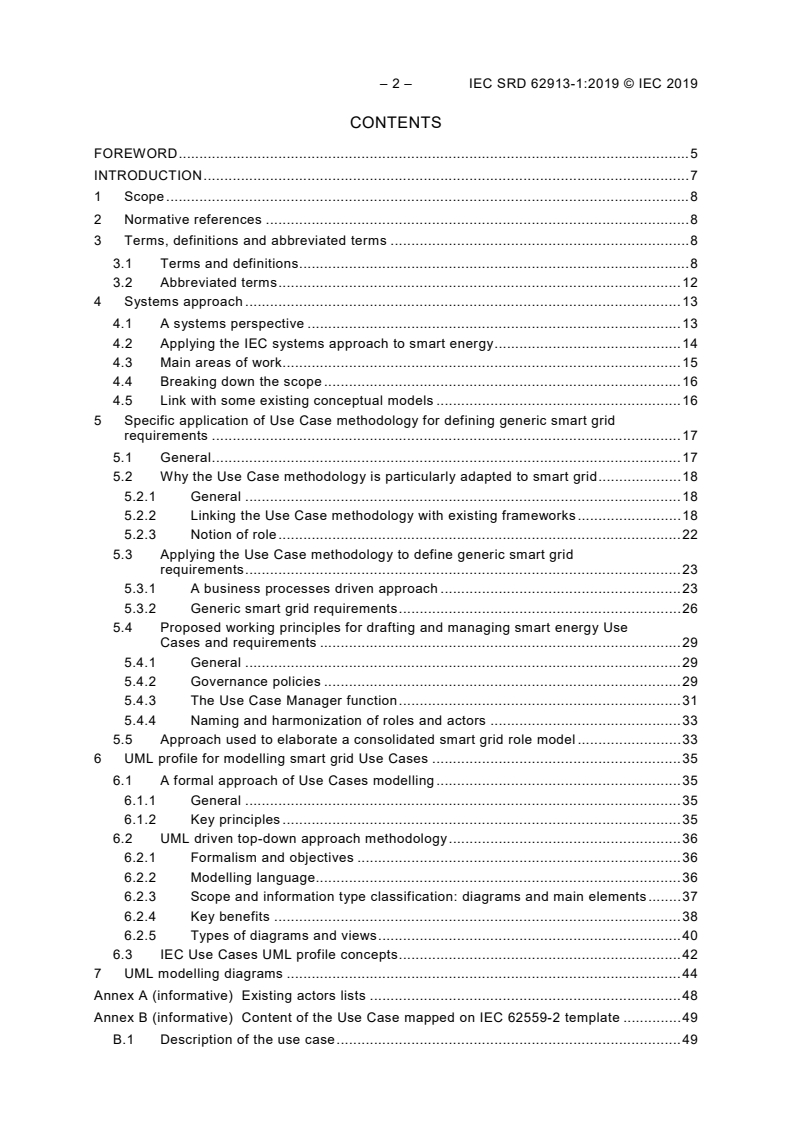
– 2 – IEC SRD 62913-1:2019 © IEC 2019
CONTENTS
FOREWORD . 5
INTRODUCTION . 7
1 Scope . 8
2 Normative references . 8
3 Terms, definitions and abbreviated terms . 8
3.1 Terms and definitions . 8
3.2 Abbreviated terms . 12
4 Systems approach . 13
4.1 A systems perspective . 13
4.2 Applying the IEC systems approach to smart energy . 14
4.3 Main areas of work. 15
4.4 Breaking down the scope . 16
4.5 Link with some existing conceptual models . 16
5 Specific application of Use Case methodology for defining generic smart grid
requirements . 17
5.1 General . 17
5.2 Why the Use Case methodology is particularly adapted to smart grid . 18
5.2.1 General . 18
5.2.2 Linking the Use Case methodology with existing frameworks . 18
5.2.3 Notion of role . 22
5.3 Applying the Use Case methodology to define generic smart grid
requirements . 23
5.3.1 A business processes driven approach . 23
5.3.2 Generic smart grid requirements . 26
5.4 Proposed working principles for drafting and managing smart energy Use
Cases and requirements . 29
5.4.1 General . 29
5.4.2 Governance policies . 29
5.4.3 The Use Case Manager function . 31
5.4.4 Naming and harmonization of roles and actors . 33
5.5 Approach used to elaborate a consolidated smart grid role model . 33
6 UML profile for modelling smart grid Use Cases . 35
6.1 A formal approach of Use Cases modelling . 35
6.1.1 General . 35
6.1.2 Key principles . 35
6.2 UML driven top-down approach methodology . 36
6.2.1 Formalism and objectives . 36
6.2.2 Modelling language. 36
6.2.3 Scope and information type classification: diagrams and main elements . 37
6.2.4 Key benefits . 38
6.2.5 Types of diagrams and views . 40
6.3 IEC Use Cases UML profile concepts . 42
7 UML modelling diagrams . 44
Annex A (informative) Existing actors lists . 48
Annex B (informative) Content of the Use Case mapped on IEC 62559-2 template . 49
B.1 Description of the use case . 49
B.1.1 Name of use case . 49
B.1.2 Version management . 49
B.1.3 Scope and objectives of use case . 49
B.1.4 Narrative of use case . 49
B.1.5 Key performance indicators (KPI) . 50
B.1.6 Use case conditions. 50
B.1.7 Further information to the use case for classification / mapping . 50
B.1.8 General remarks . 50
B.2 Diagrams of use case . 50
B.3 Technical details . 51
B.3.1 Actors . 51
B.3.2 References . 51
B.4 Step by step analysis of use case . 51
B.4.1 Overview of scenarios . 51
B.4.2 Steps – Scenarios . 52
B.5 Information exchanged . 52
B.6 Requirements (optional) . 52
B.7 Common terms and definitions . 52
B.8 Custom information (optional) . 53
B.9 IEC 62559-2 UML Modelling . 53
Annex C (informative) Example of telecommunication related non-functional
requirement . 55
Annex D (informative) Existing smart grid conceptual models . 56
Bibliography . 58
Figure 1 – The GridWise Architecture Council’s Model (NIST, 2012) . 19
Figure 2 – Simplification of the GWAC model (CEN/CENELEC/ETSI, 2014) . 19
Figure 3 – Smart grid plane domains and hierarchical zones . 20
Figure 4 – The Smart Grid Architecture Model (CEN-CENELEC-ETSI, 2014) . 21
Figure 5 – Interactions between the Use Case methodology and the Smart Grid
Architecture Model (based on CEN-CENELEC-ETSI, 2014) . 22
Figure 6 – Defining smart grid requirements methodology . 23
Figure 7 – Point of view of a domain role . 24
Figure 8 – The first two levels of detail used to capture generic smart grid
requirements . 25
Figure 9 – The levels of detail used to capture generic smart grid requirements. 26
Figure 10 – Generic smart grid functional and non-functional requirements captured in
Use Cases . 28
Figure 11 – Indicative interactions between SyC Smart Energy and smart energy TCs
for drafting Use Cases . 30
Figure 12 – Example of representation of a domain’s role model . 34
Figure 13 – Example of representation of relations between roles . 35
Figure 14 – Four-layer model architecture . 37
Figure 15 – UML Use Case profile for the IEC SRD 62913 series aligned with the
IEC 62559 series . 40
Figure 16 – Use Case overview diagram . 41
Figure 17 – Domain overview diagram . 41
– 4 – IEC SRD 62913-1:2019 © IEC 2019
Figure 18 – BUC-SUC relations diagram . 42
Figure 19 – Mapping between Use Case concepts and architecture concepts . 44
Figure 20 – Domain overview concepts UML model . 45
Figure 21 – Use Case overview concepts UML model . 45
Figure 22 – Scenario overview concepts UML model . 46
Figure 23 – Activity overview concepts UML model . 47
Figure B.1 – Use Case mapping to IEC 62559-2 . 53
Figure B.2 – Use Case mapping to IEC 62559-2 – Scenario and activities . 54
Figure D.1 – NIST/SGIP Smart Grid Conceptual Model . 56
Figure D.2 – M490 domains . 57
Table 2 – Differences between business and system Use Cases . 12
Table 1 – Links between SGAM and IEC SRD 62913 domains . 17
Table 3 – Reporting of a Technical Committee Use Cases roadmap . 32
Table 4 – Reporting on roles used in a Technical Committee Use Case . 33
Table 5 – Use Cases concepts . 43
Table C.1 – Example of telecommunication related non-functional requirement . 55
Table D.1 – NIST/SGIP domains . 56
Table D.2 – SGAM domains . 57
INTERNATIONAL ELECTROTECHNICAL COMMISSION
____________
GENERIC SMART GRID REQUIREMENTS –
Part 1: Specific application of the Use Case methodology for defining
generic smart grid requirements according to the IEC systems approach
FOREWORD
1) The International Electrotechnical Commission (IEC) is a worldwide organization for standardization comprising
all national electrotechnical committees (IEC National Committees). The object of IEC is to promote
international co-operation on all questions concerning standardization in the electrical and electronic fields. To
this end and in addition to other activities, IEC publishes International Standards, Technical Specifications,
Technical Reports, Publicly Available Specifications (PAS) and Guides (hereafter referred to as “IEC
Publication(s)”). Their preparation is entrusted to technical committees; any IEC National Committee interested
in the subject dealt with may participate in this preparatory work. International, governmental and non-
governmental organizations liaising with the IEC also participate in this preparation. IEC collaborates closely
with the International Organization for Standardization (ISO) in accordance with conditions determined by
agreement between the two organizations.
2) The formal decisions or agreements of IEC on technical matters express, as nearly as possible, an international
consensus of opinion on the relevant subjects since each technical committee has representation from all
interested IEC National Committees.
3) IEC Publications have the form of recommendations for international use and are accepted by IEC National
Committees in that sense. While all reasonable efforts are made to ensure that the technical content of IEC
Publications is accurate, IEC cannot be held responsible for the way in which they are used or for any
misinterpretation by any end user.
4) In order to promote international uniformity, IEC National Committees undertake to apply IEC Publications
transparently to the maximum extent possible in their national and regional publications. Any divergence
between any IEC Publication and the corresponding national or regional publication shall be clearly indicated in
the latter.
5) IEC itself does not provide any attestation of conformity. Independent certification bodies provide conformity
assessment services and, in some areas, access to IEC marks of conformity. IEC is not responsible for any
services carried out by independent certification bodies.
6) All users should ensure that they have the latest edition of this publication.
7) No liability shall attach to IEC or its directors, employees, servants or agents including individual experts and
members of its technical committees and IEC National Committees for any personal injury, property damage or
other damage of any nature whatsoever, whether direct or indirect, or for costs (including legal fees) and
expenses arising out of the publication, use of, or reliance upon, this IEC Publication or any other IEC
Publications.
8) Attention is drawn to the Normative references cited in this publication. Use of the referenced publications is
indispensable for the correct application of this publication.
9) Attention is drawn to the possibility that some of the elements of this IEC Publication may be the subject of
patent rights. IEC shall not be held responsible for identifying any or all such patent rights.
IEC SRD 62913-1, which is a Systems Reference Deliverable, has been prepared by
IEC systems committee Smart Energy.
The text of this Systems Reference Deliverable is based on the following documents:
Draft SRD Report on voting
SyCSmartEnergy/80/DTS SyCSmartEnergy/100/RVDTS
Full information on the voting for the approval of this Systems Reference Deliverable can be
found in the report on voting indicated in the above table.
This document has been drafted in accordance with the ISO/IEC Directives, Part 2.
A list of all parts in the IEC SRD 62913 series, published under the general title Generic smart
grid requirements, can be found on the IEC website.
– 6 – IEC SRD 62913-1:2019 © IEC 2019
The committee has decided that the contents of this document will remain unchanged until the
stability date indicated on the IEC website under "http://webstore.iec.ch" in the data related to
the specific document. At this date, the document will be
• reconfirmed,
• withdrawn,
• replaced by a revised edition, or
• amended.
A bilingual version of this publication may be issued at a later date.
IMPORTANT – The 'colour inside' logo on the cover page of this publication indicates
that it contains colours which are considered to be useful for the correct
understanding of its contents. Users should therefore print this document using a
colour printer.
INTRODUCTION
IEC SRD 62913 generic smart grid requirements are needed to fulfil the SG3 decision 2 made
by the SMB at its February 2010 meeting (SMB/4204/DL, Decision 137/10) requesting the
need to describe all the functional and system requirements for all smart grid applications.
The IEC Smart Grid Standardization Roadmap states that “the standardization process should
offer a formal path between the application as “requested” by smart grid (stakeholders) and
the standards themselves, i.e. a “top-down” process”, whilst at the same time recognizing that
for various reasons in many cases this path has not been the one implemented. This has in
turn led to inconsistencies in standards.
The purpose of the IEC’s systems approach is to ensure and improve the interoperability
between smart energy systems and components. This approach is based on the business
needs expressed by the market. The main purpose of capturing and sharing generic smart
grid requirements is the constitution of a basis for coming standardization work, with
standards ensuring and facilitating the deployment of smart grid applications.
A working group has been set up within IEC SyC Smart Energy in order to capture the smart
grid requirements derived from the market needs, using a standardized approach based on
Use Cases as described in the IEC 62559 series. This work is building on existing Use Cases,
namely within the IEC when they exist, and is carried out collaboratively with the experts of
the relevant technical committees.
IEC SRD 62913 will deliver an applicable methodology to draft Use Cases (IEC SRD 62913-1),
clarifying ‘who does what’ with regards to smart energy Use Cases, and it will also initiate the
process of listing, organizing and making available the Use Cases which carry the smart
energy requirements which should be addressed by the IEC core technical standards
(IEC SRD 62913-2). The IEC's systems approach will require adapted tools and processes to
facilitate its implementation, and until they are available to the IEC National Committees and
experts, IEC SRD 62913-2 should be understood as the first stepping stone towards this
systems approach implementation. IEC SRD 62913-3 will be a roles database, based on a
harmonized naming methodology, to ensure consistency when drafting smart energy Use
Cases. This will provide a consistent and ready-to-use framework for all standardization
stakeholders.
Use Cases in the top-down approach of IEC SyC Smart Energy (C/1845/RV) are tools to
identify smart grid requirements used to assess situations in standards (gaps or overlaps) and
in that way contribute to interoperability. These requirements may also be used further as
input for interoperability profiles for the testing phase.
These requirements should then feed into the work carried out by IEC SyC Smart Energy with
other technical committees in order to ensure the technical standards are developed taking
into account the needs and priorities of the smart grid market.
This document corresponds to the specific application of the Use Case methodology for
defining generic smart grid requirements according to the IEC systems approach
– 8 – IEC SRD 62913-1:2019 © IEC 2019
GENERIC SMART GRID REQUIREMENTS –
Part 1: Specific application of the Use Case methodology for defining
generic smart grid requirements according to the IEC systems approach
1 Scope
This part of IEC SRD 62913 describes a common approach for IEC technical committees to
define generic smart grid requirements for further standardization work. It uses as input the
Use Case methodology defined as part of the IEC 62559 series, and provides a more detailed
methodology for describing Use Cases and extracting requirements from these Use Cases.
This is necessary to achieve a consistent and homogeneous description of generic
requirements for the different areas which make up the smart grid environment.
2 Normative references
There are no normative references in this document.
3 Terms, definitions and abbreviated terms
3.1 Terms and definitions
For the purposes of this document, the following terms and definitions apply.
ISO and IEC maintain terminological databases for use in standardization at the following
addresses:
• IEC Electropedia: available at http://www.electropedia.org/
• ISO Online browsing platform: available at http://www.iso.org/obp
3.1.1
activity
part of a scenario that can be executed by one or more roles
Note 1 to entry: The details of an activity are described through actions. However, if it is necessary, intermediate
levels can be created where activities describe an activity.
3.1.2
actor
entity that communicates and interacts
Note 1 to entry: These actors can include people, software applications, systems, databases, and even the power
system itself.
Note 2 to entry: In IEC SRD 62913 this term includes the concepts of business role and system role involved in
Use Cases.
[SOURCE: IEC 62559-2:2015, 3.2]
3.1.3
business case
explanation or set of reasons describing how a business decision will improve a business,
product, etc. and how it will affect costs and profits and attract investments
Note 1 to entry: Equivalent to strategic goals and principles which drive business processes.
3.1.4
business process
chain of logical connected, repetitive activities that utilizes the enterprise’s resources to refine
an object (physical or mental) for the purpose of achieving specified and measurable
results/products for internal or external customers
Note 1 to entry: In the context of IEC SRD 62913, the business processes describe the sequenced interactions
between several roles of a system.
Note 2 to entry: Business processes can be described or modelled as business Use Cases.
[SOURCE: Ericsson Quality Institute (1993): Business Process Management, Gothenburg,
Sweden]
3.1.5
business role
role describing a finite set of responsibilities that is assumed by a party
Note 1 to entry: Organizations, organizational entities and physical persons are examples of business roles.
3.1.6
cluster
group of items organized by criteria
3.1.7
consumer
end user of electricity
Note 1 to entry: Consumers never generate or store the use of electricity.
Note 2 to entry: Traditionally, three consumer types are discussed: residential, industrial and commercial.
3.1.8
demand response
DR
action resulting from management of the electricity demand in response to supply conditions
[SOURCE: IEC 60050-617:2011, 617-04-16]
3.1.9
domain
group of related subjects of standardization
[SOURCE: IEC 60050-901:2013, 901-01-03, modified – The term “field of standardization” has
been replaced by “domain”.]
3.1.10
functional requirement
requirement that describes what the system must do
Note 1 to entry: They are actions in response to events, or actions performed autonomously. They represent
operations and features provided.
[SOURCE: IEC PAS 62559:2008, 7.2.6.2]
3.1.11
level of maturity
one of a set of structured levels that describe how well a process, or Use Case, is
implemented through an organization and relates to its degree of formality, optimization and
reliability
– 10 – IEC SRD 62913-1:2019 © IEC 2019
Note 1 to entry: Proposed levels of maturity:
– Level "Already implemented": the process is implemented in and between several organizations, it is well
defined, reliable, sustainable and few uncertainties remain in its framework (regulatory, business or
technological).
– Level "Adjustments in progress": the process is implemented in a few organizations, it is well defined but
subject to remaining major uncertainties in its framework (regulatory, business or technological).
– Level "Explorative": the process is tested in very few organizations, it is not completely defined and subject to
numerous major uncertainties in its framework (regulatory, business or technological).
3.1.12
non-functional requirement
NFR
requirement that describes what qualities the system must contain from an execution and
performance perspective
Note 1 to entry: These are also known as “constraints”, “behaviour”, “criteria”, “performance targets”, etc. They
set limits or controls on how well the system performs the functional requirements.
Note 2 to entry: Non-functional requirements include: reliability, security, usability, upgradeability, expandability,
scalability, compatibility, safety, performance, and conformance.
[SOURCE: IEC PAS 62559:2008, 7.2.6.2]
3.1.13
prosumer
end user of electricity who may also generate, store and manage the use of electricity
3.1.14
requirement
provision that conveys criteria to be fulfilled
[SOURCE: IEC 60050-901:2013, 901-05-05]
3.1.15
role
type of actor which has responsibilities and represents the external intended behaviour of a
party
EXAMPLE A legally defined market participant (e.g. grid operator, customer), a generic role which represents a
bundle of possible roles (e.g. flexibility operator) or an artificially defined body needed for generic process and Use
Case descriptions.
Note 1 to entry: IEC SRD 62913 series uses two kinds of role: business roles and system roles.
Note 2 to entry: Legally or generically defined external actors can be named and identified by their roles.
[SOURCE: SG-CG/M490/C:2012-12]
3.1.16
scenario
possible sequence of interactions
[SOURCE: SG-CG/M490/E:2012-12; definition 3.10]
3.1.17
service
specific transaction satisfied by a business process involving two or more roles
3.1.18
smart grid
electric power system that utilizes information exchange and control technologies, distributed
computing and associated sensors and actuators
Note 1 to entry: Purposes of smart grids are, for example,
– to integrate the behaviour and actions of the network users and other stakeholders,
– to efficiently deliver sustainable, economic and secure electricity supplies.
[SOURCE: IEC 60050-617:2011, 617-04-13, modified – The second part of the definition has
been moved to a Note to entry.]
3.1.19
smart grid function
transformation of a number of input data, collected with the use of information and
communication technologies, into a number of technical results to enable one or several
business processes of the electric power system
Note 1 to entry: The implementation of smart grid functions requires the coordinated use of a series of equipment
and software (generally called smart grid systems, such as AMI or DER management system).
Note 2 to entry: Smart grid functions and the associated interactions between systems, devices and operators can
be described or modelled as system Use Cases.
3.1.20
system
set of interrelated elements considered in a defined context as a whole and separated from
their environment
Note 1 to entry: System is defined in the systems activities Administrative Circular AC/33/2013 as: “a group of
interacting, interrelated, or independent elements forming a purposeful whole of a complexity that requires specific
structures and work methods in order to support applications and services relevant to IEC stakeholders”.
[SOURCE: IEC 62559-2:2015, 3.7]
3.1.21
system role
role describing a finite set of functionalities that is assumed by an entity
Note 1 to entry: Device, information system and equipment are examples of system roles.
3.1.22
transmission of electricity
transfer in bulk of electricity, from generating stations to areas of consumption
[SOURCE: IEC 60050-601:1985, 601-01-09]
3.1.23
use case
specification of a set of actions performed by a system, which yields an observable result that
is, typically, of value for one or more actors or other stakeholders of the system
[SOURCE: SG-CG/M490/E:2012-12]
Note 1 to entry: There are two types of Use Case:
– Business Use Cases describe how business roles interact to execute a business process. These processes are
derived from services, i.e. business transactions, which have previously been identified.
– 12 – IEC SRD 62913-1:2019 © IEC 2019
– System Use Cases describe how system and/or business roles of a given system interact to perform a smart
grid function required to enable or facilitate the business processes described in business Use Cases. Their
purpose is to detail the execution of those processes from an information system perspective.
Note 2 to entry: Since a smart grid function can be used to enable or facilitate more than one business process, a
system Use Case can be linked to more than one business Use Case.
Table 2 highlights the differences between these two types of Use Case.
Table 1 – Differences between business and system Use Cases
Type of Use Case Description Roles involved
Business roles (organizations,
Business Use Cases Depicts a business process – Expected
organizational entities or physical
(BUC) to be system agnostic
persons)
Depicts a function or sub-function
System Use Cases Business roles and system roles
supporting one or several business
(SUC) (devices, information system)
processes
3.2 Abbreviated terms
AMI advanced metering infrastructures
BPMN business process model and notation
BUC-SUC business use case-system use case
CCTS core component technical specification
CEN European Committee for Standardization
CENELEC European Committee for Electrotechnical Standardization
CIM common information model
DER distributed energy resources
DSO distribution system operator
ebIX European forum for energy business information exchange
EES electrical energy storage
EFET European federation of energy traders
ENTSO-E European network of transmission system operators for electricity
ETSI European Telecommunications Standards Institute
EURELECTRIC Union of the Electricity Industry
EV electric vehicle
EVSE electric vehicle supply equipment
GWAC GridWise® Architecture Council
HV high voltage
LV-MV low voltage-medium voltage
MDA model driven architecture
NFR non-functional requirement
NIST US National Institute of Standards and Technology
SDO standards development organization
___________
This information is given for the convenience of users of this document and does not constitute an endorsement
by IEC.
SGAM smart grid architecture model
SMB IEC Standardization Management Board
TSO transmission system operator
UML unified modelling language
UN/Cefact United Nations/centre for trade facilitation and electronic business
WAN-IAN wide area network – internet area network
XML extensible markup language
4 Systems approach
4.1 A systems perspective
As stated in the Administrative Circular AC/33/2013: As part of the system approach
implemented by the IEC, systems committees have been defined to work "at the systems
instead of the product level to define reference architectures, Use Cases and appropriate
standards and guidance on the interfaces, functionality and interaction of a system …".
The multiplicity of technologies and their convergence in many new and emerging markets,
however – particularly those involving large-scale infrastructure – now demand a top-down
approach to standardization, starting at the system or system-architecture rather than at the
product level. System standards are also increasingly required in sectors such as environment,
safety and health.
Although the introduction of such processes in the IEC began some years ago, a major effort
is now required to improve understanding of them and to widen their application. It will be
necessary to take account of the implied need for increased co-operation with many other
standards-developing organizations, as well as with relevant non-standards bodies in the
international arena. There will also be implications for the IEC’s conformity assessment
systems and processes.
Use Cases are used to facilitate co-operation at a system level with other standards
development organizations (SDOs), non-traditional players of electrotechnology, regional
organizations and users of smart energy systems closing the many open loops. Inside IEC
they provide a convergence platform with overall system level value for support and guidance
of the technical committees and other standards development groups, both inside and outside
the IEC.
In order to achieve interoperability, Use Cases are used, in a top-down approach of
IEC SyC Smart Energy, to derive generic smart grid requirements further used to assess
situations in standards (gaps and overlaps) and so contribute to interoperability through better
standardization. Note that Use Cases also provide a solid platform to define the testing cases
to specify interfaces.
As defined in IEC 60050-617:2011, 617-04-13, a smart grid is an “electric power system that
utilizes information exchange and control technologies, distributed computing and associated
sensors and actuators, for purposes such as:
• to integrate the behaviour and actions of the network users and other stakeholders,
• to efficiently deliver sustainable, economic and secure electricity supplies.”
Smart energy in addition to smart grid includes heat and gas in its scope as interactions.
IEC SyC Smart Energy explores needs to optimize the energy use between electricity, heat
and gas and seek value through a larger range of flexibility possibilities (technologies, cost).
The use of the term ‘generic’ in this document needs to be clarified. IEC standards need to
address the maximum number of requirements needed by its stakeholders, namely those that
– 14 – IEC SRD 62913-1:2019 © IEC 2019
bring value to several actors and that are not project specific. Use Cases are a tool to capture
requirements, and the importance or the relevance of a requirement is not just determined by
the number of Use Cases that capture it (although it may be a valid indication). A regulatory
requirement, for example, will be considered a priority in one geography and perhaps not in
another. The fact that there is only one Use Case that captures that regulatory requirement
does not diminish the importance of the requirement, nor the fact that it needs to be
addressed.
4.2 Applying the IEC systems approach to smart energy
“Systems committees (SyC) aim to extend the use of strategic or other horizontal groups to
bridge areas covered by more than one or two TCs or SCs.”
Although definitions like the one above (from the IEC website) help understand the IEC
systems approach, certain clarifications are useful to help understand the scope of
IEC SRD 62913.
a) SyC Smart Energy is tasked with consolidating and ensuring the consistency of the
generic smart grid requirements, as well as the actors and terminology, for the smart
energy domain.
– This work is carried out according to the Use Case methodology in standardization as
described in the IEC 62559 series, which includes the management processes of the
IEC Use Case Repository (UCR) as well as a Use Case template (IEC 62559-2).
– Use Cases are the basis to identify the smart grid standardization requirements as well
as components of the working architectures.
– Ensuring consistency means also ensuring the consistency of the naming of the actors.
A proposed naming methodology is included in IEC SRD 62913.
– The specific application of the Use Case methodology for defining generic smart grid
requirements according to the IEC systems approach is the purpose of this document.
b) SyC Smart Energy will achieve its task by supporting TCs to draft Use Cases.
– This document provides methodology and drafting guidelines to draft Use Cases,
differentiating between business and system Use Cases.
– Use Cases are a common language to identify and describes requirements inside a TC
and between TCs.
– TCs continue to provide in-depth technical knowledge of a considered domain.
– SyC Smart Energy needs to ensure that market drivers are captured in the business
Use Cases (“WHY”) and can contribute on drafting system Use Cases when relevant.
This is important because it is via the aggregation of system Use Cases and system
actors that a global architecture will emerge, and that is needed to determine whether
there are any gaps in the existing standards (thus completing the IEC’s Smart Grid
Standards Map).
– The purpose of IEC SRD 62913-2 (all parts) is to initiate the process of listing,
organizing, making available the Use Cases which carry the smart energy
requirements which will be addressed by the IEC core technical standards. The IEC's
systems approach will require adapted tools and processes to facilitate its
implementation, and until they are available to IEC National Committees and experts,
IEC SRD 62913-2 can be seen as the first stepping stone towards this systems
approach implementation.
– The current content of IEC SRD 62913-2 is not exhaustive, but the current content
represents the priorities for the smart energy domain at the time of publication. It is
important that the content in terms of Use Cases and requirements continues to grow
to encompass the requirements of the broad smart energy stakeholders (both within
the IEC community as well as more generally the other market stakeholders).
– The purpose of the work carried out in SyC Smart Energy is to ensure consistency in
the way requirements are gathered, shared and addressed by the IEC, and to improve
the efficiency of the production of technical standards by reducing the time it takes to
identify gaps or overlaps in the existing technical standards and address these
situations. The fact that SyCs are organized to interact regularly with the market
stakeholders (inside as well as outside the IEC) will ensure that standardization work
is aligned on the market priorities at any given time, and so ultimately help improve the
delivery acceptance of the IEC core standards.
– Note that system Use Cases can describe different and conflicting approaches to
address the same requirement.
– For the avoidance of doubt, SyC Smart Energy and all its working groups are not and
never had the intention of being a ‘control mechanism’ on the publications of technical
standards.
c) SyC Smart Energy works on what is needed for “further” standardization work in the smart
energy domain.
– The standardization process taking into account the systems approach focuses on the
priorities today which need further standardization as it will be an impossible task to
include all existing Use Cases and requirements according to the IEC SRD 62913
methodology.
– The scope covers “what changes or what is new” – although potentially this can cover
more. Ultimately, any Use Case which brings value to several actors of the electric
power system is of interest to the IEC.
– The basis of work is the on-going standardization work in the TCs and potentially also
new market needs – that determines the priorities for the SyC Smart Energy working
grou
...