

IEC 60079-1:1990/AMD2:1998
(Amendment)Amendment 2 - Electrical apparatus for explosive gas atmospheres - Part 1: Construction and verification test of flameproof enclosures of electrical apparatus
General Information
- Abstract
- Status
- Published
- Publication Date
- 14-May-1998
- Technical Committee
- TC 31 - Equipment for explosive atmospheres
- Current Stage
- DELPUB - Deleted Publication
- Start Date
- 01-Mar-2001
- Completion Date
- 28-Aug-2026
Buy Documents
IEC 60079-1:1990/AMD2:1998 - Amendment 2 - Electrical apparatus for explosive gas atmospheres - Part 1: Construction and verification test of flameproof enclosures of electrical apparatus Released:5/15/1998
Overview
IEC 60079-1:1990/AMD2:1998 is an important amendment to the international standard governing the construction and verification testing of flameproof enclosures for electrical apparatus used in explosive gas atmospheres. Developed by IEC Technical Committee 31, Subcommittee 31A, this amendment enhances requirements for breathing and draining devices as certified Ex components. It aims to ensure the highest safety and performance in hazardous environments by specifying rigorous design, testing, and certification criteria for these critical enclosure components.
Key Topics
Flameproof Enclosure Construction
Defines mounting methods for breathing and draining devices, including soldering, sealing, or mechanical fixing, to ensure a reliable and replaceable unit on flameproof enclosures.Type Testing Requirements
Specifies comprehensive tests including overpressure resistance, thermal endurance, and internal ignition non-transmission to verify device integrity under explosive conditions. Key test pressures vary by gas group (I, IIA, IIB, IIC) with strict acceptance criteria for deformation or damage.Overpressure Testing
Devices undergo rigorous tests at pressures ranging from 1,200 kPa to 4,000 kPa depending on gas group. Successful completion confirms structural integrity without permanent deformation or loss of flameproof properties.Thermal Testing
Evaluates device behavior under thermal stress using a multi-section test rig and controlled ignition sources. Devices must prevent flame transmission and avoid continuous burning, ensuring safe operation within assigned temperature classes.Ignition Transmission Tests
Employs standardized test rigs to confirm devices do not allow flame propagation inside the enclosure during simulated ignition events across different gas groups, enhancing overall explosion protection.Certification and Marking
Each breathing and draining device must be certified by the original manufacturer and marked clearly per IEC 60079-0 standards. Certification documentation includes reference pressure, temperature class, test results, gas group applicability, and mounting instructions ensuring traceability and compliance.
Applications
IEC 60079-1 Amendment 2 is critical for industries operating in hazardous locations where explosive gas atmospheres may exist, such as:
Oil and Gas Extraction and Processing
Protects electrical equipment in oil rigs and refineries from explosion risks caused by flammable gases.Chemical and Petrochemical Manufacturing
Ensures safe enclosure of electrical apparatus handling volatile compounds.Mining Operations
Maintains safety of electrical gear in underground environments with methane or coal dust hazards.Pharmaceutical Production
Secures electrical devices when handling volatile solvents in cleanrooms or production lines.Energy and Utilities
Applies to power generation and distribution assets in explosive atmosphere zones.
The amendment’s requirements optimize safety and reliability by standardizing breathing and draining components, preventing ignition transmission, and ensuring easy maintenance and replacement of critical enclosure parts.
Related Standards
IEC 60079-0: General requirements for electrical apparatus used in explosive atmospheres
Provides fundamental marking and documentation requirements referenced in this amendment.IEC 60079-11: Intrinsic Safety
Covers safety principles complementing flameproof enclosure protection.IEC 60079-17: Electrical installations inspection and maintenance
Ensures ongoing compliance and safety of explosive atmosphere equipment.ISO/IEC 80079 series
Broader standards addressing explosive atmospheres and associated electrical apparatus design and testing.
Summary
IEC 60079-1:1990/AMD2:1998 is a vital amendment that strengthens flameproof enclosure safety by detailing construction, rigorous testing protocols, and certification procedures for breathing and draining devices as Ex components. Its application spans multiple hazardous industries, providing clear requirements to prevent ignition and ensure device integrity in explosive gas atmospheres. Compliance promotes safer electrical installations, reduces risk of explosions, and aligns with internationally recognized safety benchmarks.
Relations
- Effective Date
- 05-Sep-2023
- Effective Date
- 05-Sep-2023
Buy Documents
IEC 60079-1:1990/AMD2:1998 - Amendment 2 - Electrical apparatus for explosive gas atmospheres - Part 1: Construction and verification test of flameproof enclosures of electrical apparatus Released:5/15/1998
Get Certified
Connect with accredited certification bodies for this standard

IMQ S.p.A. (Certification)
Italian electrical product certification.

SLG Prüf- und Zertifizierungs GmbH
German testing and certification body.

UL Solutions
Global safety science company with testing, inspection and certification.
Sponsored listings
Frequently Asked Questions
IEC 60079-1:1990/AMD2:1998 is a standard published by the International Electrotechnical Commission (IEC). Its full title is "Amendment 2 - Electrical apparatus for explosive gas atmospheres - Part 1: Construction and verification test of flameproof enclosures of electrical apparatus". This standard covers: Amendment 2 - Electrical apparatus for explosive gas atmospheres - Part 1: Construction and verification test of flameproof enclosures of electrical apparatus
Amendment 2 - Electrical apparatus for explosive gas atmospheres - Part 1: Construction and verification test of flameproof enclosures of electrical apparatus
IEC 60079-1:1990/AMD2:1998 is classified under the following ICS (International Classification for Standards) categories: 29.260.20 - Electrical apparatus for explosive atmospheres. The ICS classification helps identify the subject area and facilitates finding related standards.
IEC 60079-1:1990/AMD2:1998 has the following relationships with other standards: It is inter standard links to IEC 60079-1:1990, IEC 60079-1:2001. Understanding these relationships helps ensure you are using the most current and applicable version of the standard.
IEC 60079-1:1990/AMD2:1998 is available in PDF format for immediate download after purchase. The document can be added to your cart and obtained through the secure checkout process. Digital delivery ensures instant access to the complete standard document.
Standards Content (Sample)
NORME CEI
INTERNATIONALE
IEC
60079-1
INTERNATIONAL
STANDARD
AMENDEMENT 2
AMENDMENT 2
1998-05
Amendement 2
Matériel électrique pour atmosphères explosives
gazeuses –
Partie 1:
Construction, vérification et essais des enveloppes
antidéflagrantes de matériel électrique
Amendment 2
Electrical apparatus for explosive gas
atmospheres –
Part 1:
Construction and verification test of flameproof
enclosures of electrical apparatus
IEC 1998 Droits de reproduction réservés Copyright - all rights reserved
International Electrotechnical Commission 3, rue de Varembé Geneva, Switzerland
Telefax: +41 22 919 0300 e-mail: inmail@iec.ch IEC web site http: //www.iec.ch
CODE PRIX
Commission Electrotechnique Internationale
F
PRICE CODE
International Electrotechnical Commission
Pour prix, voir catalogue en vigueur
For price, see current catalogue
– 2 – 60079-1 amend. 2 © CEI:1998
AVANT-PROPOS
Le présent amendement a été établi par le sous-comité 31A: Enveloppes antidéflagrantes, du
comité d'études 31 de la CEI: Matériel électrique pour atmosphères explosives.
Le texte de cet amendement est issu des documents suivants:
FDIS Rapport de vote
31A/71+71A/FDIS 31A/72/RVD
Le rapport de vote indiqué dans le tableau ci-dessus donne toute information sur le vote ayant
abouti à l'approbation de cet amendement.
___________
Page 86
Annexe B
Ajouter, après le paragraphe B.11.3.2.2 de l'amendement 1, le nouvel article suivant:
B.12 Dispositifs de respiration et dispositifs de drainage
utilisés en tant que composants Ex
En complément à B.1 jusqu'à B.8 inclus, les prescriptions suivantes doivent être appliquées
aux dispositifs de respiration et aux dispositifs de drainage qui sont certifiés en tant que
composants Ex.
B.12.1 Dispositions de montage des éléments et du composant
Les éléments de respiration et de drainage doivent être soudés ou scellés conformément à 4.5,
ou fixés par d'autres méthodes dans une partie de montage appropriée pour former le
composant de montage.
Le composant de montage est fixé par des brides ou par des fermetures ou vissé dans
l'enveloppe de telle sorte qu'il puisse être remplaçable en bloc et conforme aux prescriptions
correspondantes de l'article 4 ainsi que de l'article 9 si approprié.
B.12.2 Essais de type des dispositifs de respiration et de drainage utilisés
comme composants Ex
La fixation du dispositif échantillon à l'essai doit être effectuée à l'extrémité de l'enveloppe de
l'appareillage d'essai de la même manière que lors de son montage sur une enveloppe
antidéflagrante. L'essai doit être réalisé sur l'échantillon après l'essai de choc de B.10 et
conformément à B.12.2.1, B.12.2.2 et B.12.2.3 comme suit:
NOTE – L'essai de choc peut être réalisé sur l'échantillon, séparément de l'enveloppe d'essai s'il est monté sur un
plateau qui forme l'extrémité de l'enveloppe de l'appareillage d'essai.
Pour les dispositifs à passages non mesurables, la dimension des pores de l'échantillon doit
être égale ou supérieure à 85 % de la dimension maximale des pores spécifiée.
60079-1 Amend. 2 © IEC:1998 – 3 –
FOREWORD
This amendment has been prepared by IEC subcommittee 31A: Flameproof enclosures, of IEC
technical committee 31: Electrical apparatus for explosive atmospheres.
The text of this amendment is based on the following documents:
FDIS Report on voting
31A/71+71A/FDIS 31A/72/RVD
Full information on the voting for the approval of this amendment can be found in the report on
voting indicated in the above table.
___________
Page 87
Annex B
Add, after subclause B.11.3.2.2 of amendment 1, the following new clause:
B.12 Breathing devices and draining devices when used as Ex components
In addition to B.1 to B.8 inclusive, the following requirements shall apply to breathing and
draining devices which are certified as Ex components.
B.12.1 Mounting arrangements of the elements and component
The breathing and draining elements shall be sintered or cemented in accordance with 4.5, or
fixed by other methods into a suitable mounting part to form the mounting component.
The mounting component is secured by clamping or by fasteners or screwed into the enclosure
as a replaceable unit and complying with the relevant requirements of clause 4 and, where
appropriate, clause 9.
B.12.2 Type tests for breathing and draining devices used as Ex components
Attachment of the sample device under test shall be made on the end of the test rig enclosure
in the same manner as it would normally be mounted on a flameproof enclosure. The test shall
be performed on the sample after the impact test of B.10 and in accordance with B.12.2.1 to
B.12.2.3, as follows:
NOTE – The impact test may be performed on the sample, separate from the test enclosure when it is mounted on a
plate that forms the end part of the test rig enclosure.
For devices with non-measurable paths, the pore size of the sample shall be not less than
85 % of the specified maximum pore size.
– 4 – 60079-1 amend. 2 © CEI:1998
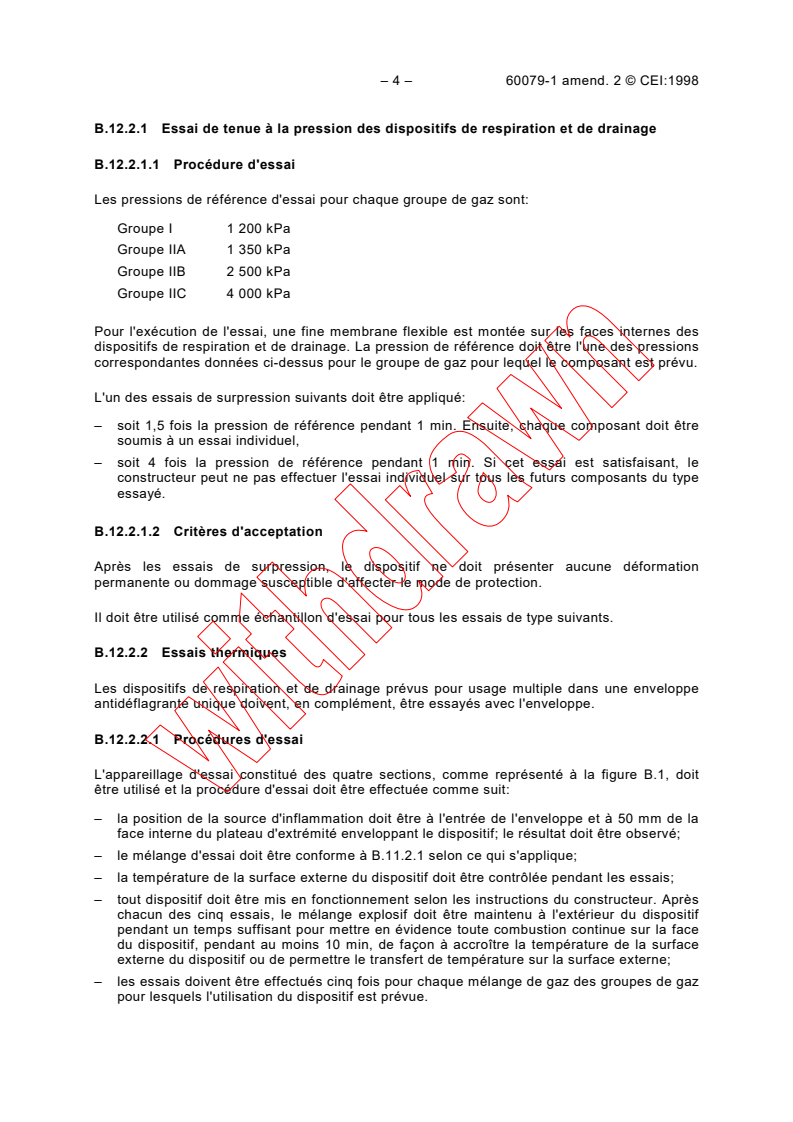
B.12.2.1 Essai de tenue à la pression des dispositifs de respiration et de drainage
B.12.2.1.1 Procédure d'essai
Les pressions de référence d'essai pour chaque groupe de gaz sont:
Groupe I 1 200 kPa
Groupe IIA 1 350 kPa
Groupe IIB 2 500 kPa
Groupe IIC 4 000 kPa
Pour l'exécution de l'essai, une fine membrane flexible est montée sur les faces internes des
dispositifs de respiration et de drainage. La pression de référence doit être l'une des pressions
correspondantes données ci-dessus pour le groupe de gaz pour lequel le composant est prévu.
L'un des essais de surpression suivants doit être appliqué:
– soit 1,5 fois la pression de référence pendant 1 min. Ensuite, chaque composant doit être
soumis à un essai individuel,
– soit 4 fois la pression de référence pendant 1 min. Si cet essai est satisfaisant, le
constructeur peut ne pas effectuer l'essai individuel sur tous les futurs composants du type
essayé.
B.12.2.1.2 Critères d'acceptation
Après les essais de surpression, le dispositif ne doit présenter aucune déformation
permanente ou dommage susceptible d'affecter le mode de protection.
Il doit être utilisé comme échantillon d'essai pour tous les essais de type suivants.
B.12.2.2 Essais thermiques
Les dispositifs de respiration et de drainage prévus pour usage multiple dans une enveloppe
antidéflagrante unique doivent, en complément, être essayés avec l'enveloppe.
B.12.2.2.1 Procédures d'essai
L'appareillage d'essai constitué des quatre sections, comme représenté à la figure B.1, doit
être utilisé et la procédure d'essai doit être effectuée comme suit:
– la position de la source d'inflammation doit être à l'entrée de l'enveloppe et à 50 mm de la
face interne du plateau d'extrémité enveloppant le dispositif; le résultat doit être observé;
– le mélange d'essai doit être conforme à B.11.2.1 selon ce qui s'applique;
– la température de la surface externe du dispositif doit être contrôlée pendant les essais;
– tout dispositif doit être mis en fonctionnement selon les instructions du constructeur. Après
chacun des cinq essais, le mélange explosif doit être maintenu à l'extérieur du dispositif
pendant un temps suffisant pour mettre en évidence toute combustion continue sur la face
du dispositif, pendant au moins 10 min, de façon à accroître la température de la surface
externe du dispositif ou de permettre le transfert de température sur la surface externe;
– les essais doivent être effectués cinq fois pour chaque mélange de gaz des groupes de gaz
pour lesquels l'utilisation du dispositif est prévue.
60079-1 Amend. 2 © IEC:1998 – 5 –
B.12.2.1 Test of the ability of the breathing and draining device to withstand pressure
B.12.2.1.1 Test procedure
The reference test pressures in each gas group are:
Group I 1 200 kPa
Group IIA 1 350 kPa
Group IIB 2 500 kPa
Group IIC 4 000 kPa
For the purpose of the test, a thin flexible membrane is fitted over the inner surfaces of the
breathing and draining devices. The reference pressure shall be one of the relevant pressures
given above for the gas group for which the component is intended.
One of the following overpressure tests shall be applied:
– 1,5 times the reference pressure for a period of 1 min. Then each component shall be
submitted to a routine test, or
– 4 times the reference pressure for a period of 1 min. If this test is successful, the
manufacturer is not required to apply the routine test to all future components of the tested
type.
B.12.2.1.2 Acceptance criteria
After the overpressure tests, the device shall show no permanent deformation or damage
affecting the type of protection.
It shall be used as the test sample for all subsequent type tests.
B.12.2.2 Thermal tests
Breathing and draining devices intended for multiple use in any single flameproof enclosure
shall be tested additionally with the enclosure.
B.12.2.2.1 Test procedure
The test rig assembly with all four sections, as shown in figure B.1, shall be used, and the test
procedure shall be carried out as follows:
– the position of the ignition source shall be at the enclosure inlet and 50 mm from the inside
of the end plate, housing the device and the results observed;
– the test mixtures shall be as for B.11.2.1, as appropriate;
– the temperature of the external surface of the device shall be monitored during tests;
– any device shall be operated as specified by the manufacturer's documentation. After each
of five tests the explosive mixture shall be maintained external to the device for a sufficient
time to allow any continuous burning on the face of the device to become evident, for at
least 10 min so as to increase the temperature of the external surface of the device or to
make temperature transfer to the outer face possible;
– the tests shall be carried out five times for each
...