

IEC/IEEE 60079-30-2:2025
(Main)Explosive atmospheres - Part 30-2: Electrical resistance trace heating - Guidance on application for design, installation and maintenance
General Information
- Abstract
IEC/IEEE 60079-30-2:2025 is available as IEC/IEEE 60079-30-2:2025 RLV which contains the International Standard and its Redline version, showing all changes of the technical content compared to the previous edition.IEC/IEEE 60079-30-2:2025 provides guidance for the application of electrical resistance trace heating systems in areas where explosive atmospheres can be present, with the exclusion of those classified as requiring Equipment Protection Level (EPL) Ga or Da (traditional relationship to Zone 0 and Zone 20 respectively). This document also provides guidance for explosive atmospheres incorporating the Division method of area classification that can be applied by some users of this document.
This document provides recommendations for the design, installation, maintenance and repair of trace heating systems including associated control and monitoring equipment. It does not cover devices that operate by induction heating, skin effect heating or direct pipeline heating, nor those intended for stress relieving.
This second edition of IEC/IEEE 60079-30-2 cancels and replaces the first edition of IEC/IEEE 60079-30-2 published in 2015.
This edition includes the following significant technical changes with respect to the previous edition:
a) a general review and updating of the first edition;
b) the addition of Annex I – Other applications of trace heating in explosive atmospheres.
The significance of changes between IEC/IEEE 60079-30-2, Edition 1.0 (2015) and IEC/IEEE 60079-30-2, Edition 2.0 (this document) can be found on the foreword of this document.
- Status
- Published
- Publication Date
- 14-Sep-2025
- Technical Committee
- TC 31 - Equipment for explosive atmospheres
- Drafting Committee
- MT 60079-30 - TC 31/MT 60079-30
- Current Stage
- PPUB - Publication issued
- Start Date
- 15-Sep-2025
- Completion Date
- 05-Sep-2025
Buy Documents
IEC/IEEE 60079-30-2:2025 - Explosive atmospheres - Part 30-2: Electrical resistance trace heating - Guidance on application for design, installation and maintenance/15/2025
IEC/IEEE 60079-30-2:2025 RLV - Explosive atmospheres - Part 30-2: Electrical resistance trace heating - Guidance on application for design, installation and maintenance Released:9/15/2025
Overview
IEC/IEEE 60079-30-2:2025 - "Explosive atmospheres - Part 30-2: Electrical resistance trace heating" is the 2nd edition guidance document for electrical resistance trace heating used where explosive atmospheres may occur. Published as an RLV (Redline Version), it includes the full International Standard and a redline showing technical changes since the 2015 edition. It provides practical recommendations for the design, installation, maintenance and repair of trace heating systems and associated control/monitoring equipment, while excluding systems for EPL Ga/Da (traditional Zone 0/Zone 20) and heating by induction, skin effect, direct pipeline heating or stress-relief processes.
Key topics and technical requirements
This standard covers technical guidance across system lifecycle stages. Main topics include:
- Application considerations - area classification, corrosive environments, and process temperature accuracy (Types I–III).
- Thermal insulation - selection of insulating materials, weather barriers (cladding), optimal thickness and double-insulation practices.
- System design - trace heater selection (including site-fabricated options), maximum temperature determination, long-run and flow-pattern issues, dead-leg and chimney effects, earthing and power system requirements.
- Control & monitoring - sensor and controller selection, location, alarm design, integrated control strategies and earth-fault protection.
- Installation recommendations - pre-installation testing, wiring, terminations, insulation work, commissioning and documentation.
- Maintenance & repairs - troubleshooting, fault location, repair techniques (in-line splices, junction boxes), testing and record keeping.
- Informative annexes - heat-loss calculations for pipes and vessels, heat-up/cool-down guidance, example commissioning/maintenance records, and frost heave prevention (Annex I).
Practical applications
IEC/IEEE 60079-30-2:2025 is directly applicable to:
- Freeze protection and process temperature maintenance for pipes, valves and vessels.
- Flow assurance (preventing solids, wax or hydrates) in oil, gas and petrochemical facilities.
- Freeze prevention in utilities, chemical plants, terminals and onshore/offshore installations. The guidance supports safe trace heating design that reduces ignition risk in hazardous areas and ensures reliable long-term operation.
Who should use this standard
- Design engineers and EPCs specifying trace heating systems
- Installation contractors and site supervisors
- Maintenance teams and asset owners/operators
- Safety, inspection and compliance professionals
- Instrumentation and control engineers
Related standards
Refer to the broader IEC/IEEE 60079 series for general explosive-atmosphere requirements and other protection concepts. The RLV format helps stakeholders quickly see what technical changes were made from the previous edition.
Relations
- Effective Date
- 05-Sep-2023
Buy Documents
IEC/IEEE 60079-30-2:2025 - Explosive atmospheres - Part 30-2: Electrical resistance trace heating - Guidance on application for design, installation and maintenance/15/2025
IEC/IEEE 60079-30-2:2025 RLV - Explosive atmospheres - Part 30-2: Electrical resistance trace heating - Guidance on application for design, installation and maintenance Released:9/15/2025
Get Certified
Connect with accredited certification bodies for this standard

IMQ S.p.A. (Certification)
Italian electrical product certification.

SLG Prüf- und Zertifizierungs GmbH
German testing and certification body.

UL Solutions
Global safety science company with testing, inspection and certification.
Sponsored listings
Frequently Asked Questions
IEC/IEEE 60079-30-2:2025 is a standard published by the International Electrotechnical Commission (IEC). Its full title is "Explosive atmospheres - Part 30-2: Electrical resistance trace heating - Guidance on application for design, installation and maintenance". This standard covers: IEC/IEEE 60079-30-2:2025 is available as IEC/IEEE 60079-30-2:2025 RLV which contains the International Standard and its Redline version, showing all changes of the technical content compared to the previous edition.IEC/IEEE 60079-30-2:2025 provides guidance for the application of electrical resistance trace heating systems in areas where explosive atmospheres can be present, with the exclusion of those classified as requiring Equipment Protection Level (EPL) Ga or Da (traditional relationship to Zone 0 and Zone 20 respectively). This document also provides guidance for explosive atmospheres incorporating the Division method of area classification that can be applied by some users of this document. This document provides recommendations for the design, installation, maintenance and repair of trace heating systems including associated control and monitoring equipment. It does not cover devices that operate by induction heating, skin effect heating or direct pipeline heating, nor those intended for stress relieving. This second edition of IEC/IEEE 60079-30-2 cancels and replaces the first edition of IEC/IEEE 60079-30-2 published in 2015. This edition includes the following significant technical changes with respect to the previous edition: a) a general review and updating of the first edition; b) the addition of Annex I – Other applications of trace heating in explosive atmospheres. The significance of changes between IEC/IEEE 60079-30-2, Edition 1.0 (2015) and IEC/IEEE 60079-30-2, Edition 2.0 (this document) can be found on the foreword of this document.
IEC/IEEE 60079-30-2:2025 is available as IEC/IEEE 60079-30-2:2025 RLV which contains the International Standard and its Redline version, showing all changes of the technical content compared to the previous edition.IEC/IEEE 60079-30-2:2025 provides guidance for the application of electrical resistance trace heating systems in areas where explosive atmospheres can be present, with the exclusion of those classified as requiring Equipment Protection Level (EPL) Ga or Da (traditional relationship to Zone 0 and Zone 20 respectively). This document also provides guidance for explosive atmospheres incorporating the Division method of area classification that can be applied by some users of this document. This document provides recommendations for the design, installation, maintenance and repair of trace heating systems including associated control and monitoring equipment. It does not cover devices that operate by induction heating, skin effect heating or direct pipeline heating, nor those intended for stress relieving. This second edition of IEC/IEEE 60079-30-2 cancels and replaces the first edition of IEC/IEEE 60079-30-2 published in 2015. This edition includes the following significant technical changes with respect to the previous edition: a) a general review and updating of the first edition; b) the addition of Annex I – Other applications of trace heating in explosive atmospheres. The significance of changes between IEC/IEEE 60079-30-2, Edition 1.0 (2015) and IEC/IEEE 60079-30-2, Edition 2.0 (this document) can be found on the foreword of this document.
IEC/IEEE 60079-30-2:2025 is classified under the following ICS (International Classification for Standards) categories: 29.260.20 - Electrical apparatus for explosive atmospheres. The ICS classification helps identify the subject area and facilitates finding related standards.
IEC/IEEE 60079-30-2:2025 has the following relationships with other standards: It is inter standard links to IEC/IEEE 60079-30-2:2015. Understanding these relationships helps ensure you are using the most current and applicable version of the standard.
IEC/IEEE 60079-30-2:2025 is available in PDF format for immediate download after purchase. The document can be added to your cart and obtained through the secure checkout process. Digital delivery ensures instant access to the complete standard document.
Standards Content (Sample)
IEC/IEEE 60079-30-2 ®
Edition 2.0 2025-09
INTERNATIONAL
STANDARD
Explosive atmospheres -
Part 30-2: Electrical resistance trace heating - Guidance on application for
design, installation and maintenance
ICS 29.260.20 ISBN 978-2-8327-0630-5
All rights reserved. Unless otherwise specified, no part of this publication may be reproduced or utilized in any form or
by any means, electronic or mechanical, including photocopying and microfilm, without permission in writing being
secured. Requests for permission to reproduce should be addressed to either IEC at the address below or IEC’s
member Natio nal Committee in the country of the requester or from IEEE.
IEC Secretariat Institute of Electrical and Electronics Engineers, Inc.
3, rue de Varembé 3 Park Avenue
CH-1211 Geneva 20 New York, NY 10016-5997
Switzerland United States of America
Tel.: +41 22 919 02 11 stds.ipr@ieee.org
info@iec.ch www.ieee.org
www.iec.ch
About the IEC
The International Electrotechnical Commission (IEC) is the leading global organization that prepares and publishes
International Standards for all electrical, electronic and related technologies.
About the IEEE
IEEE is the world’s largest professional association dedicated to advancing technological innovation and excellence for the
benefit of humanity. IEEE and its members inspire a global community through its highly cited publications, conferences,
technology standards, and professional and educational activities.
About IEC/IEEE publications
The technical content of IEC/IEEE publications is kept under constant review by the IEC and IEEE. Please make sure that
you have the latest edition, a corrigendum or an amendment might have been published.
IEC publications search - webstore.iec.ch/advsearchform IEC Products & Services Portal - products.iec.ch
The advanced search enables to find IEC publications by a Discover our powerful search engine and read freely all the
variety of criteria (reference number, text, technical publications previews, graphical symbols and the glossary. With a
committee, …). It also gives information on projects, replaced subscription you will always have access to up to date content
and withdrawn publications. tailored to your needs.
IEC Just Published - webstore.iec.ch/justpublished
Electropedia - www.electropedia.org
Stay up to date on all new IEC publications. Just Published
The world's leading online dictionary on electrotechnology,
details all new publications released. Available online and
containing more than 22 500 terminological entries in English and
once a month by email.
French, with equivalent terms in 25 additional languages. Also
known as the International Electrotechnical Vocabulary (IEV)
IEC Customer Service Centre - webstore.iec.ch/csc
online.
If you wish to give us your feedback on this publication or need
further assistance, please contact the Customer Service
Centre: sales@iec.ch.
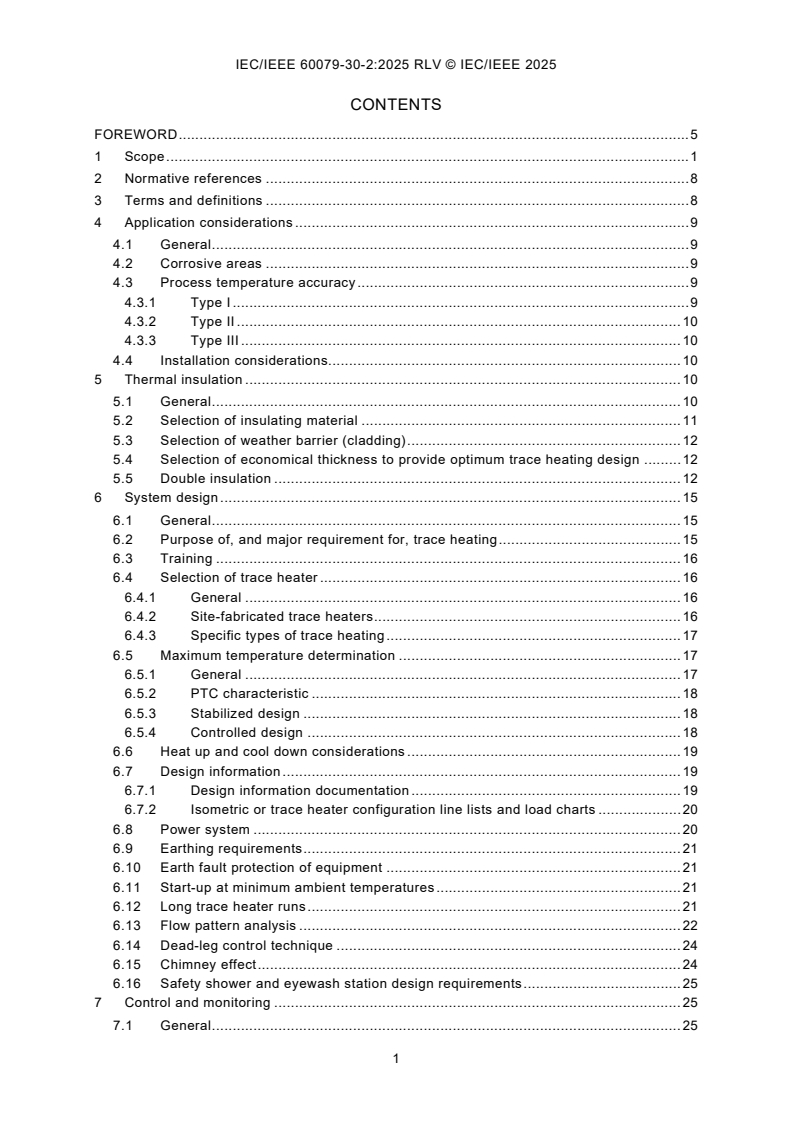
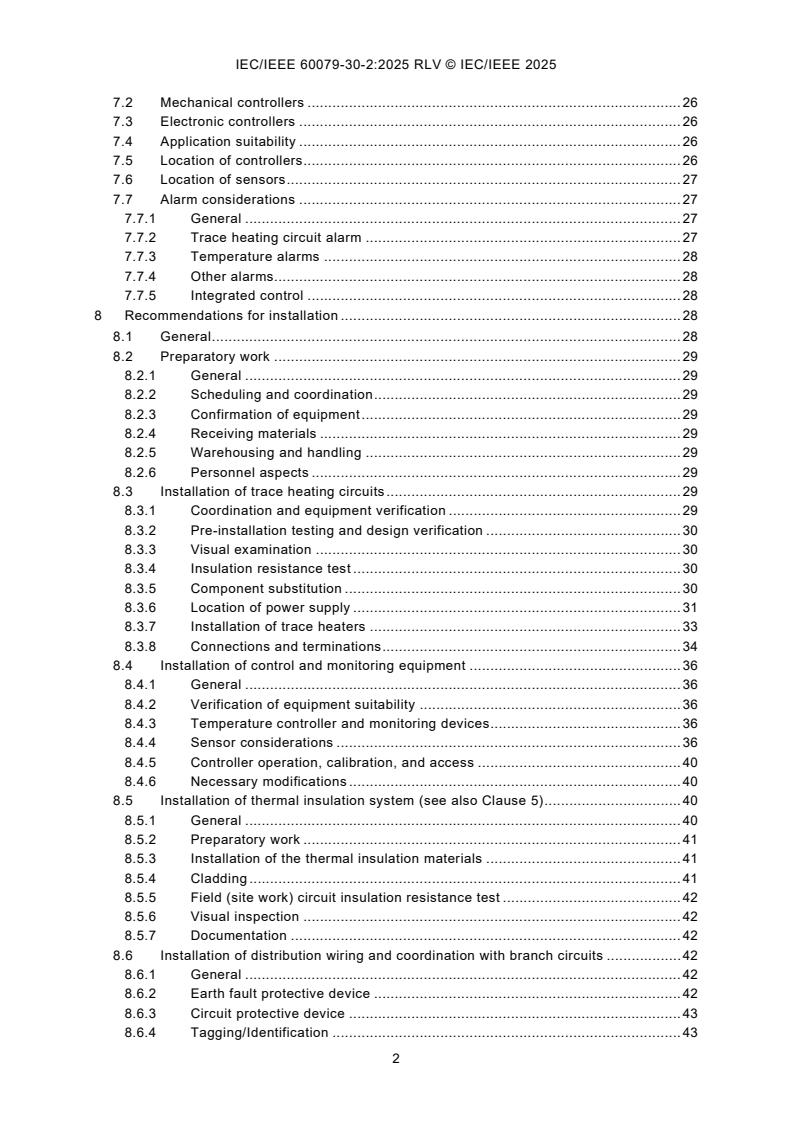
CONTENTS
FOREWORD . 5
1 Scope . 8
2 Normative references . 8
3 Terms and definitions . 8
4 Application considerations . 9
4.1 General . 9
4.2 Corrosive areas . 9
4.3 Process temperature accuracy . 9
4.3.1 Type I . 9
4.3.2 Type II . 9
4.3.3 Type III . 10
4.4 Installation considerations. 10
5 Thermal insulation . 10
5.1 General . 10
5.2 Selection of insulating material . 11
5.3 Selection of weather barrier (cladding) . 12
5.4 Selection of economical thickness to provide optimum trace heating design . 12
5.5 Double insulation . 12
6 System design . 15
6.1 General . 15
6.2 Purpose of, and major requirement for, trace heating . 15
6.3 Training . 16
6.4 Selection of trace heater . 16
6.4.1 General . 16
6.4.2 Site-fabricated trace heaters . 16
6.4.3 Specific types of trace heating . 17
6.5 Maximum temperature determination . 17
6.5.1 General . 17
6.5.2 PTC characteristic . 18
6.5.3 Stabilized design . 18
6.5.4 Controlled design . 18
6.6 Heat up and cool down considerations . 19
6.7 Design information . 19
6.7.1 Design information documentation . 19
6.7.2 Isometric or trace heater configuration line lists and load charts . 20
6.8 Power system . 20
6.9 Earthing requirements . 21
6.10 Earth fault protection of equipment . 21
6.11 Start-up at minimum ambient temperatures . 21
6.12 Long trace heater runs . 21
6.13 Flow pattern analysis . 22
6.14 Dead-leg control technique . 23
6.15 Chimney effect . 23
6.16 Safety shower and eyewash station design requirements . 24
7 Control and monitoring . 24
7.1 General . 24
7.2 Mechanical controllers . 25
7.3 Electronic controllers . 25
7.4 Application suitability . 25
7.5 Location of controllers . 25
7.6 Location of sensors . 25
7.7 Alarm considerations . 26
7.7.1 General . 26
7.7.2 Trace heating circuit alarm . 26
7.7.3 Temperature alarms . 26
7.7.4 Other alarms. 27
7.7.5 Integrated control . 27
8 Recommendations for installation . 27
8.1 General . 27
8.2 Preparatory work . 27
8.2.1 General . 27
8.2.2 Scheduling and coordination . 28
8.2.3 Confirmation of equipment . 28
8.2.4 Receiving materials . 28
8.2.5 Warehousing and handling . 28
8.2.6 Personnel aspects . 28
8.3 Installation of trace heating circuits . 28
8.3.1 Coordination and equipment verification . 28
8.3.2 Pre-installation testing and design verification . 29
8.3.3 Visual examination . 29
8.3.4 Insulation resistance test . 29
8.3.5 Component substitution . 29
8.3.6 Location of power supply . 29
8.3.7 Installation of trace heaters . 31
8.3.8 Connections and terminations . 32
8.4 Installation of control and monitoring equipment . 34
8.4.1 General . 34
8.4.2 Verification of equipment suitability . 34
8.4.3 Temperature controller and monitoring devices . 34
8.4.4 Sensor considerations . 34
8.4.5 Controller operation, calibration, and access . 38
8.4.6 Necessary modifications . 38
8.5 Installation of thermal insulation system (see also Clause 5) . 38
8.5.1 General . 38
8.5.2 Preparatory work . 38
8.5.3 Installation of the thermal insulation materials . 38
8.5.4 Cladding . 39
8.5.5 Field (site work) circuit insulation resistance test . 39
8.5.6 Visual inspection . 39
8.5.7 Documentation . 40
8.6 Installation of distribution wiring and coordination with branch circuits . 40
8.6.1 General . 40
8.6.2 Earth fault protective device . 40
8.6.3 Circuit protective device . 40
8.6.4 Tagging/Identification . 40
8.7 Commissioning . 40
8.7.1 Pre-commissioning check . 40
8.7.2 Functional check and final documentation . 40
9 Maintenance . 42
9.1 General . 42
9.2 Fault location . 42
9.3 Fault rectification . 42
10 Repairs . 42
10.1 General . 42
10.2 Practicability of repair to electric trace heaters . 43
10.2.1 Mechanical damage . 43
10.2.2 Damage due to corrosion . 43
10.2.3 Damage due to overheating . 43
10.3 Repair techniques for electrical trace heaters . 43
10.3.1 General . 43
10.3.2 In-line splice . 43
10.3.3 Connection via junction box . 43
10.4 Earthing . 44
10.5 Testing . 44
Annex A (informative) Example of design data record . 45
Annex B (informative) Checklist for installation requirements . 47
Annex C (informative) Example of trace heater commissioning record . 48
Annex D (informative) Example of maintenance schedule and log record . 49
Annex E (informative) Pipe heat loss considerations - Heat loss formula and example
calculations. 50
Annex F (informative) Vessel heat loss considerations . 56
F.1 General . 56
F.2 Insulation heat loss (Q ). 56
ins
F.3 Slab surface areas (Q ) . 57
slab
F.4 Support heat loss (Q ) . 58
supt
F.5 Manhole heat loss (Q ) . 58
manhole
F.6 Convection coefficient formulae . 59
F.6.1 General . 59
F.6.2 Free convection, nonfluid surface, any orientation (h , h , h ) . 59
i co o
F.6.3 Forced convection, any orientation (h ) . 60
F.6.4 Radiation component, all coefficients (h , h , h , h ) . 60
f i co o
Annex G (informative) Heat up and cool down considerations . 62
G.1 Heat up . 62
G.2 Cool down . 63
Annex H (informative) Method to determine equivalent thicknesses of insulating
cements . 65
Annex I (informative) Frost heave prevention . 66
I.1 General . 66
I.2 Design information . 66
I.2.1 General . 66
I.2.2 Construction details of the floor . 67
I.2.3 Electrical considerations . 67
I.3 Heat load determination . 67
I.3.1 General . 67
I.3.2 Trace heater layout and component mounting . 69
I.3.3 Electrical design . 69
I.4 Control and monitoring system design . 70
I.4.1 Control options . 70
I.4.2 Monitoring . 70
I.5 Special design considerations . 70
I.6 Installation . 70
I.7 Maintenance . 71
I.7.1 General . 71
I.7.2 Training of maintenance personnel . 71
I.7.3 Frequency of inspection . 71
I.7.4 Maintenance program documentation . 71
I.7.5 Visual evaluation . 72
I.7.6 Electrical evaluation . 72
I.7.7 Review of the electrical protection system . 72
I.8 Repair . 72
Bibliography . 73
Figure 1 – Thermal insulation - Weather-barrier installation . 13
Figure 2 – Typical temperature profile . 14
Figure 3 – Flow pattern analysis example . 22
Figure 4 – Bypass example . 23
Figure 5 – Typical installation of control sensor or sensor for high temperature limiter . 36
Figure 6 – High temperature limiter sensor on sheath of trace heater . 36
Figure 7 – High temperature limiter sensor as artificial hot spot . 37
Figure E.1 – Assumed temperature gradients . 51
Figure I.1 – Typical frost heave prevention substructure . 66
Figure I.2 – Frost heave prevention power requirements . 69
Table 1 – Pre-installation checks . 30
Table A.1 – Example of design data record . 45
Table B.1 – Example of pre-commissioning check and trace heater installation record. 47
Table C.1 – Example of trace heater commissioning record . 48
Table D.1 – Example of maintenance schedule and log record . 49
Explosive atmospheres -
Part 30-2: Electrical resistance trace heating -
Guidance on application for design, installation and maintenance
FOREWORD
1) The International Electrotechnical Commission (IEC) is a worldwide organization for standardization comprising
all national electrotechnical committees (IEC National Committees). The object of IEC is to promote international
co-operation on all questions concerning standardization in the electrical and electronic fields. To this end and
in addition to other activities, IEC publishes International Standards, Technical Specifications, Technical Reports,
Publicly Available Specifications (PAS) and Guides (hereafter referred to as "IEC document(s)"). Their
preparation is entrusted to technical committees; any IEC National Committee interested in the subject dealt with
may participate in this preparatory work. International, governmental and non-governmental organizations liaising
with the IEC also participate in this preparation.
IEEE Standards documents are developed within IEEE Societies and Standards Coordinating Committees of the
IEEE Standards Association (IEEE SA) Standards Board. IEEE develops its standards through a consensus
development process, approved by the American National Standards Institute, which brings together volunteers
representing varied viewpoints and interests to achieve the final product. Volunteers are not necessarily members
of IEEE and serve without compensation. While IEEE administers the process and establishes rules to promote
fairness in the consensus development process, IEEE does not independently evaluate, test, or verify the
accuracy of any of the information contained in its standards. Use of IEEE Standards documents is wholly
voluntary. IEEE documents are made available for use subject to important notices and legal disclaimers (see
https://standards.ieee.org/ipr/disclaimers.html for more information).
IEC collaborates closely with IEEE in accordance with conditions determined by agreement between the two
organizations. This Dual Logo International Standard was jointly developed by the IEC and IEEE under the terms
of that agreement.
2) The formal decisions of IEC on technical matters express, as nearly as possible, an international consensus of
opinion on the relevant subjects since each technical committee has representation from all interested IEC
National Committees. The formal decisions of IEEE on technical matters, once consensus within IEEE Societies
and Standards Coordinating Committees has been reached, is determined by a balanced ballot of materially
interested parties who indicate interest in reviewing the proposed standard. Final approval of the IEEE standards
document is given by the IEEE Standards Association (IEEE SA) Standards Board.
3) IEC/IEEE Publications have the form of recommendations for international use and are accepted by IEC National
Committees/IEEE Societies in that sense. While all reasonable efforts are made to ensure that the technical
content of IEC/IEEE Publications is accurate, IEC or IEEE cannot be held responsible for the way in which they
are used or for any misinterpretation by any end user.
4) In order to promote international uniformity, IEC National Committees undertake to apply IEC Publications
(including IEC/IEEE Publications) transparently to the maximum extent possible in their national and regional
publications. Any divergence between any IEC/IEEE Publication and the corresponding national or regional
publication shall be clearly indicated in the latter.
5) IEC and IEEE do not provide any attestation of conformity. Independent certification bodies provide conformity
assessment services and, in some areas, access to IEC marks of conformity. IEC and IEEE are not responsible
for any services carried out by independent certification bodies.
6) All users should ensure that they have the latest edition of this publication.
7) No liability shall attach to IEC or IEEE or their directors, employees, servants or agents including individual
experts and members of technical committees and IEC National Committees, or volunteers of IEEE Societies and
the Standards Coordinating Committees of the IEEE Standards Association (IEEE SA) Standards Board, for any
personal injury, property damage or other damage of any nature whatsoever, whether direct or indirect, or for
costs (including legal fees) and expenses arising out of the publication, use of, or reliance upon, this IEC/IEEE
Publication or any other IEC or IEEE Publications.
8) Attention is drawn to the normative references cited in this publication. Use of the referenced publications is
indispensable for the correct application of this publication.
9) Attention is drawn to the possibility that implementation of this IEC/IEEE Publication may require use of material
covered by patent rights. By publication of this standard, no position is taken with respect to the existence or
validity of any patent rights in connection therewith. IEC or IEEE shall not be held responsible for identifying
Essential Patent Claims for which a license may be required, for conducting inquiries into the legal validity or
scope of Patent Claims or determining whether any licensing terms or conditions provided in connection with
submission of a Letter of Assurance, if any, or in any licensing agreements are reasonable or non-discriminatory.
Users of this standard are expressly advised that determination of the validity of any patent rights, and the risk
of infringement of such rights, is entirely their own responsibility.
IEC/IEEE 60079-30-2 has been prepared by IEC technical committee 31: Equipment for
explosive atmospheres, in cooperation with the Petroleum & Chemical Industry Committee of
the IEEE Industrial Applications Society under the IEC/IEEE Dual Logo Agreement.
This document is published as an IEC/IEEE Dual Logo standard.
Users of this document are advised that interpretation sheets clarifying the interpretation of this
document can be published. Interpretation sheets are available from the IEC webstore and can
be found in the “history” tab of the page for each document.
This second edition of IEC/IEEE 60079-30-2 cancels and replaces the first edition of
IEC/IEEE 60079-30-2 published in 2015.
This edition includes the following significant technical changes with respect to the previous
edition:
a) a general review and updating of the first edition;
b) the addition of Annex I - Other applications of trace heating in explosive atmospheres.
The significance of changes between IEC/IEEE 60079-30-2, Edition 1.0 (2015) and
IEC/IEEE 60079-30-2, Edition 2.0 (this document) is as listed below:
Type
Changes Clause Minor and Extension Major
editorial technical
changes changes
The addition of Annex I - Frost heave prevention Annex I X
NOTE The technical changes referred to include the significance of technical changes in the revised IEC Standard,
but they do not form an exhaustive list of all modifications from the previous version.
Explanations:
A) Definitions
Minor and editorial changes
clarification
decrease of technical requirements
minor technical change
editorial corrections
These are changes which modify requirements in an editorial or a minor technical way. They
include changes of the wording to clarify technical requirements without any technical change,
or a reduction in level of existing requirement.
Extension addition of technical options
These are changes which add new or modify existing technical requirements, in a way that new
options are given, but without increasing requirements for equipment that was fully compliant
with the previous document. Therefore, these will not have to be addressed for products in
conformity with the preceding edition.
Major technical changes addition of technical requirements
increase of technical requirements
These are changes to technical requirements (addition, increase of the level or removal) made
in a way that a product in conformity with the preceding edition will not always be able to fulfil
the requirements given in the later edition. These changes have to be addressed for products
in conformity with the preceding edition. For these changes additional information is provided
in clause B) below.
NOTE These changes represent current technological knowledge. However, these changes should not normally
have an influence on equipment already placed on the market.
B) Information about the background of 'Major technical changes'
None.
The text of this International Standard is based on the following IEC documents:
Draft Report on voting
31/1868/FDIS 31/1894/RVD
Full information on the voting for its approval can be found in the report on voting indicated in
the above table.
The language used for the development of this International Standard is English.
This document was drafted in accordance with the rules given in the ISO/IEC Directives, Part 2,
available at www.iec.ch/members_experts/refdocs. The main document types developed by IEC
are described in greater detail at www.iec.ch/publications/.
This document is to be used in conjunction with IEC/IEEE 60079-30-1, Explosive atmospheres
- Part 30-1: Electrical resistance trace heating - General and testing requirements.
A list of all parts of IEC 60079 series, under the general title Explosive atmospheres, can be
found on the IEC website.
The IEC Technical Committee and IEEE Technical Committee have decided that the contents
of this document will remain unchanged until the stability date indicated on the IEC website
under webstore.iec.ch in the data related to the specific document. At this date, the document
will be
– reconfirmed,
– withdrawn, or
– revised.
1 Scope
This part of IEC 60079 provides guidance for the application of electrical resistance trace
heating systems in areas where explosive atmospheres can be present, with the exclusion of
those classified as requiring Equipment Protection Level (EPL) Ga or Da (traditional relationship
to Zone 0 and Zone 20 respectively). This document also provides guidance for explosive
atmospheres incorporating the Division method of area classification that can be applied by
some users of this document. ®
NOTE Information on the Division method is given in NFPA 70 [1] and CSA C22.1 [2].
This document provides recommendations for the design, installation, maintenance and repair
of trace heating systems including associated control and monitoring equipment. It does not
cover devices that operate by induction heating, skin effect heating or direct pipeline heating,
nor those intended for stress relieving.
2 Normative references
The following documents are referred to in the text in such a way that some or all of their content
constitutes requirements of this document. For dated references, only the edition cited applies.
For undated references, the latest edition of the referenced document (including any
amendments) applies.
IEC 60050-426, International Electrotechnical Vocabulary (IEV) - Part 426: Explosive
atmospheres
IEC 60079-0, Explosive atmospheres - Part 0: Equipment - General requirements
IEC 60079-14, Explosive atmospheres - Part 14: Electrical installations design, selection and
erection
IEC 60079-15, Explosive atmospheres - Part 15: Equipment protection by type of protection "n"
IEC 60079-17, Explosive atmospheres - Part 17: Electrical installations inspection and
maintenance
IEC/IEEE 60079-30-1:2025, Explosive atmospheres - Part 30-1: Electrical resistance trace
heating - General and testing requirements
3 Terms and definitions
For the purposes of this document, the terms and definitions given in IEC 60050-426,
IEC 60079-0 and IEC/IEEE 60079-30-1 and the following apply.
ISO and IEC maintain terminology databases for use in standardization at the following
addresses:
– IEC Electropedia: available at https://www.electropedia.org/
– ISO Online browsing platform: available at https://www.iso.org/obp
3.1
minimum ambient temperature
lowest ambient temperature specified at which trace heating is operable and performs according
to specified requirements (and on which heat-loss calculations are based)
3.2
dead leg
segment of process piping segregated from the normal flow pattern for the purpose of providing
a heat loss reference
3.3
design loading
minimum power that meets the design requirements, in the specified adverse conditions
(minimum ambient and maximum wind velocity), after voltage and resistance tolerances and
appropriate safety factors have been considered
4 Application considerations
4.1 General
This part of IEC 60079 supplements the requirements specified in IEC 60079-14, IEC 60079-17
and IEC/IEEE 60079-30-1.
For trace heating systems that are to be installed in locations where EPLs Gb, Gc, Db or Dc
are required, and/or to cover the requirements in Annex E of IEC/IEEE 60079-30-1, full details
of the area classifications are specified. Where special considerations apply or where site
conditions can be especially onerous, these conditions are detailed in the trace heating
specification. Additional guidance specific to frost heave environments is given in Annex I.
The specification for heating systems to be installed on mobile equipment or skid units (for
example, relocatable structures) should accommodate the adverse conditions in which the trace
heating system can be used.
Where any parts of the trace heating system are likely to be exposed, those parts should be
suitable for the environment.
4.2 Corrosive areas
All components of electric trace heating systems should be selected verifying that they are
compatible with any corrosive materials that can be encountered during the lifetime of the
system. Trace heating systems operating in corrosive environments have a higher potential for
failure than in non-corrosive environments. Deterioration of the thermal insulation system is
made worse by corrosion of the weather barrier and the possibility of moisture leaks soaking
the thermal insulation.
4.3 Process temperature accuracy
4.3.1 Type I
A Type I process is one for which the temperature should be maintained above a minimum
point. Ambient sensing control may be acceptable. Large blocks of power may be controlled by
means of a single temperature controller and an electrical distribution panel board. Heat input
can be provided unnecessarily at times and wide temperature excursions should be tolerable.
Energy efficiency can be improved through the use of dead leg control or ambient proportional
control techniques (see 6.14).
4.3.2 Type II
A Type II process is one for which the temperature should be maintained within a moderate
band. Control by mechanical thermostats is typical.
4.3.3 Type III
A Type III process is one for which the temperature should be controlled within a narrow band.
Electronic controllers using thermocouple or resistance-temperature detector (RTD) process
temperature sensors facilitate field (work site) calibration and provide maximum flexibility in the
selection of temperature alarm and monitoring functions. Heat input capability can be provided
to preheat an empty pipe or raise the fluid temperature, or both, within a specified range and
time interval. Type III systems require strict adherence to flow patterns and thermal insulation
systems.
Temperature-sensing systems such as fiber optic distributed temperature sensing can enhance
the safety and reliability of the temperature-sensitive fluid applications.
4.4 Installation considerations
If failure of any part of the trace heating system can result in a safety or process problem, then
the trace heating system can be considered as a critical component of the total process. The
temperature control and circuit monitoring requirements of an application may be defined
according to the temperature control types described in 4.3.
When trace heating is critical to the process, circuit monitoring for correct operation, malfunction
alarms, and back-up trace heaters should be specified. Spare or back-up controllers can be
specified to be automatically activated in the event of a fault being indicated by the
monitoring/alarm system. Back-up trace heaters can allow maintenance or repairs to be
performed without a process shutdown and can be used to enhance reliability.
5 Thermal insulation
5.1 General
The selection, installation and maintenance of thermal insulation is a key component in the
performance of an electrical trace heating system. The thermal insulation system is normally
designed to limit heat loss with the trace heating system compensating for the remainder.
Therefore, problems with thermal insulation have a direct impact on the overall system
performance.
The primary function of thermal insulation is to reduce the rate of heat transfer from a surface
that is operating at a temperature other than ambient. This reduction of energy loss can:
– reduce operating expenses;
– improve system performance;
– increase system output capability.
Prior to any heat loss analysis for an electrically traced pipeline, vessel or other mechanical
equipment, a review of the selection of the thermal insulation system is recommended. The
principal areas for consideration are as follows:
– selection of a thermal insulation material;
– selection of a weather barrier (cladding);
– selection of the economic insulation thickness with consideration for optimum trace heater
design;
– selection of the proper insulation size.
Information about the equivalent thickness of insulating cements is given in Annex H.
5.2 Selection of insulating material
The following are important aspects to be considered when selecting an insulation material.
These factors should be considered and the selection optimised according to the operator's
criteria:
– temperature rating;
– thermal conductivity, λ, of the insulation;
– mechanical properties;
– chemical compatibility and corrosion resistance;
– moisture resistance;
– health risks during installation;
– fire resistance;
– toxicological properties when exposed to fire;
– costs.
Insulation materials commonly available include:
– expanded silica;
– mineral fiber;
– cellular glass;
– urethane;
– fiberglass;
– calcium silicate;
– polyisocyanurate;
– perlite silicate;
– rock wool;
– aerogel.
For soft insulants (mineral fiber, fiberglass, etc.), actual pipe size insulation may be used in
many cases by banding the insulation tightly. Care should be taken to prevent the trace heater
from being buried within the insulation, which can cause damage to the trace heater or restrict
proper heat transfer. As an alternative, the next largest pipe size insulation that can easily
enclose pipe and electric trace heater is also acceptable. Rigid insulation (calcium silicate,
expanded silica, cellular glass, etc.), may be pipe-size insulation if board sections are cut to fit
the longitudinal joint. This type of installation technique is commonly referred to as an extended
leg installation. Alternatively, the next largest insulation size may be selected to accommodate
the trace heater. In all cases, the insulation size and thickness should be clearly specified.
Insulation for valves, flanges, pumps, instruments, and other irregularly shaped equipment may
be constructed for the particular configuration. This can be fabricated from block, insulation
segments or flexible removable covers.
Non-insulated or partially insulated pipe
...
IEC/IEEE 60079-30-2 ®
Edition 2.0 2025-09
INTERNATIONAL
STANDARD
REDLINE VERSION
Explosive atmospheres -
Part 30-2: Electrical resistance trace heating - Guidance on application for
design, installation and maintenance
ICS 29.260.20 ISBN 978-2-8327-0728-9
All rights reserved. Unless otherwise specified, no part of this publication may be reproduced or utilized in any form or
by any means, electronic or mechanical, including photocopying and microfilm, without permission in writing being
secured. Requests for permission to reproduce should be addressed to either IEC at the address below or IEC’s
member Natio nal Committee in the country of the requester or from IEEE.
IEC Secretariat Institute of Electrical and Electronics Engineers, Inc.
3, rue de Varembé 3 Park Avenue
CH-1211 Geneva 20 New York, NY 10016-5997
Switzerland United States of America
Tel.: +41 22 919 02 11 stds.ipr@ieee.org
info@iec.ch www.ieee.org
www.iec.ch
About the IEC
The International Electrotechnical Commission (IEC) is the leading global organization that prepares and publishes
International Standards for all electrical, electronic and related technologies.
About the IEEE
IEEE is the world’s largest professional association dedicated to advancing technological innovation and excellence for the
benefit of humanity. IEEE and its members inspire a global community through its highly cited publications, conferences,
technology standards, and professional and educational activities.
About IEC/IEEE publications
The technical content of IEC/IEEE publications is kept under constant review by the IEC and IEEE. Please make sure that
you have the latest edition, a corrigendum or an amendment might have been published.
IEC publications search - webstore.iec.ch/advsearchform IEC Products & Services Portal - products.iec.ch
The advanced search enables to find IEC publications by a Discover our powerful search engine and read freely all the
variety of criteria (reference number, text, technical publications previews, graphical symbols and the glossary. With a
committee, …). It also gives information on projects, replaced subscription you will always have access to up to date content
and withdrawn publications. tailored to your needs.
IEC Just Published - webstore.iec.ch/justpublished
Electropedia - www.electropedia.org
Stay up to date on all new IEC publications. Just Published
The world's leading online dictionary on electrotechnology,
details all new publications released. Available online and
containing more than 22 500 terminological entries in English and
once a month by email.
French, with equivalent terms in 25 additional languages. Also
known as the International Electrotechnical Vocabulary (IEV)
IEC Customer Service Centre - webstore.iec.ch/csc
online.
If you wish to give us your feedback on this publication or need
further assistance, please contact the Customer Service
Centre: sales@iec.ch.
CONTENTS
FOREWORD . 5
1 Scope . 1
2 Normative references . 8
3 Terms and definitions . 8
4 Application considerations . 9
4.1 General . 9
4.2 Corrosive areas . 9
4.3 Process temperature accuracy . 9
4.3.1 Type I . 9
4.3.2 Type II . 10
4.3.3 Type III . 10
4.4 Installation considerations. 10
5 Thermal insulation . 10
5.1 General . 10
5.2 Selection of insulating material . 11
5.3 Selection of weather barrier (cladding) . 12
5.4 Selection of economical thickness to provide optimum trace heating design . 12
5.5 Double insulation . 12
6 System design . 15
6.1 General . 15
6.2 Purpose of, and major requirement for, trace heating . 15
6.3 Training . 16
6.4 Selection of trace heater . 16
6.4.1 General . 16
6.4.2 Site-fabricated trace heaters . 16
6.4.3 Specific types of trace heating . 17
6.5 Maximum temperature determination . 17
6.5.1 General . 17
6.5.2 PTC characteristic . 18
6.5.3 Stabilized design . 18
6.5.4 Controlled design . 18
6.6 Heat up and cool down considerations . 19
6.7 Design information . 19
6.7.1 Design information documentation . 19
6.7.2 Isometric or trace heater configuration line lists and load charts . 20
6.8 Power system . 20
6.9 Earthing requirements . 21
6.10 Earth fault protection of equipment . 21
6.11 Start-up at minimum ambient temperatures . 21
6.12 Long trace heater runs . 21
6.13 Flow pattern analysis . 22
6.14 Dead-leg control technique . 24
6.15 Chimney effect . 24
6.16 Safety shower and eyewash station design requirements . 25
7 Control and monitoring . 25
7.1 General . 25
7.2 Mechanical controllers . 26
7.3 Electronic controllers . 26
7.4 Application suitability . 26
7.5 Location of controllers . 26
7.6 Location of sensors . 27
7.7 Alarm considerations . 27
7.7.1 General . 27
7.7.2 Trace heating circuit alarm . 27
7.7.3 Temperature alarms . 28
7.7.4 Other alarms. 28
7.7.5 Integrated control . 28
8 Recommendations for installation . 28
8.1 General . 28
8.2 Preparatory work . 29
8.2.1 General . 29
8.2.2 Scheduling and coordination . 29
8.2.3 Confirmation of equipment . 29
8.2.4 Receiving materials . 29
8.2.5 Warehousing and handling . 29
8.2.6 Personnel aspects . 29
8.3 Installation of trace heating circuits . 29
8.3.1 Coordination and equipment verification . 29
8.3.2 Pre-installation testing and design verification . 30
8.3.3 Visual examination . 30
8.3.4 Insulation resistance test . 30
8.3.5 Component substitution . 30
8.3.6 Location of power supply . 31
8.3.7 Installation of trace heaters . 33
8.3.8 Connections and terminations . 34
8.4 Installation of control and monitoring equipment . 36
8.4.1 General . 36
8.4.2 Verification of equipment suitability . 36
8.4.3 Temperature controller and monitoring devices . 36
8.4.4 Sensor considerations . 36
8.4.5 Controller operation, calibration, and access . 40
8.4.6 Necessary modifications . 40
8.5 Installation of thermal insulation system (see also Clause 5) . 40
8.5.1 General . 40
8.5.2 Preparatory work . 41
8.5.3 Installation of the thermal insulation materials . 41
8.5.4 Cladding . 41
8.5.5 Field (site work) circuit insulation resistance test . 42
8.5.6 Visual inspection . 42
8.5.7 Documentation . 42
8.6 Installation of distribution wiring and coordination with branch circuits . 42
8.6.1 General . 42
8.6.2 Earth fault protective device . 42
8.6.3 Circuit protective device . 43
8.6.4 Tagging/Identification . 43
8.7 Commissioning . 43
8.7.1 Pre-commissioning check . 43
8.7.2 Functional check and final documentation . 43
9 Maintenance . 44
9.1 General . 44
9.2 Fault location . 45
9.3 Fault rectification . 45
10 Repairs . 45
10.1 General . 45
10.2 Practicability of repair to electric trace heaters . 45
10.2.1 Mechanical damage . 45
10.2.2 Damage due to corrosion . 46
10.2.3 Damage due to overheating . 46
10.3 Repair techniques for electrical trace heaters . 46
10.3.1 General . 46
10.3.2 In-line splice . 46
10.3.3 Connection via junction box . 46
10.4 Earthing . 46
10.5 Testing . 46
Annex A (informative) Example of design data record . 47
Annex B (informative) Checklist for installation requirements . 50
Annex C (informative) Example of trace heater commissioning record . 51
Annex D (informative) Example of maintenance schedule and log record . 52
Annex E (informative) Pipe heat loss considerations - Heat loss formula and example
calculations. 53
Annex F (informative) Vessel heat loss considerations . 60
F.1 General . 60
F.2 Insulation heat loss (Q ). 60
ins
F.3 Slab surface areas (Q ) . 61
slab
F.4 Support heat loss (Q ) . 62
supt
F.5 Manhole heat loss (Q ) . 62
manhole
F.6 Convection coefficient formulae . 63
F.6.1 General . 63
F.6.2 Free convection, nonfluid surface, any orientation (h , h , h ) . 63
i co o
F.6.3 Forced convection, any orientation (h ) . 64
F.6.4 Radiation component, all coefficients (h , h , h , h ) . 64
f i co o
Annex G (informative) Heat up and cool down considerations . 66
G.1 Heat up . 66
G.2 Cool down . 67
Annex H (informative) Method to determine equivalent thicknesses of insulating
cements . 69
Annex I (informative) Frost heave prevention . 70
I.1 General . 70
I.2 Design information . 70
I.2.1 General . 70
I.2.2 Construction details of the floor . 71
I.2.3 Electrical considerations . 71
I.3 Heat load determination . 71
I.3.1 General . 71
I.3.2 Trace heater layout and component mounting . 73
I.3.3 Electrical design . 73
I.4 Control and monitoring system design . 74
I.4.1 Control options . 74
I.4.2 Monitoring . 74
I.5 Special design considerations . 74
I.6 Installation . 74
I.7 Maintenance . 75
I.7.1 General . 75
I.7.2 Training of maintenance personnel . 75
I.7.3 Frequency of inspection . 75
I.7.4 Maintenance program documentation . 75
I.7.5 Visual evaluation . 76
I.7.6 Electrical evaluation . 76
I.7.7 Review of the electrical protection system . 76
I.8 Repair . 76
Bibliography . 77
Figure 1 – Thermal insulation - Weather-barrier installation . 13
Figure 2 – Typical temperature profile . 14
Figure 3 – Flow pattern analysis example . 23
Figure 4 – Bypass example . 24
Figure 5 – Typical installation of control sensor and or sensor for high temperature
limiting control limiter . 38
Figure 6 – Limiting device High temperature limiter sensor on sheath of trace heater . 39
Figure 7 – Limiting device High temperature limiter sensor as artificial hot spot . 39
Figure E.1 – Assumed temperature gradients . 54
Figure I.1 – Typical frost heave prevention substructure . 70
Figure I.2 – Frost heave prevention power requirements . 73
Table 1 – Pre-installation checks . 32
Table A.1 – Example of design data record . 47
Table B.1 – Example of pre-commissioning check and trace heater installation record. 50
Table C.1 – Example of trace heater commissioning record . 51
Table D.1 – Example of maintenance schedule and log record . 52
Explosive atmospheres -
Part 30-2: Electrical resistance trace heating -
Guidance on application for design, installation and maintenance
FOREWORD
1) The International Electrotechnical Commission (IEC) is a worldwide organization for standardization comprising
all national electrotechnical committees (IEC National Committees). The object of IEC is to promote international
co-operation on all questions concerning standardization in the electrical and electronic fields. To this end and
in addition to other activities, IEC publishes International Standards, Technical Specifications, Technical Reports,
Publicly Available Specifications (PAS) and Guides (hereafter referred to as "IEC document(s)"). Their
preparation is entrusted to technical committees; any IEC National Committee interested in the subject dealt with
may participate in this preparatory work. International, governmental and non-governmental organizations liaising
with the IEC also participate in this preparation.
IEEE Standards documents are developed within IEEE Societies and Standards Coordinating Committees of the
IEEE Standards Association (IEEE SA) Standards Board. IEEE develops its standards through a consensus
development process, approved by the American National Standards Institute, which brings together volunteers
representing varied viewpoints and interests to achieve the final product. Volunteers are not necessarily members
of IEEE and serve without compensation. While IEEE administers the process and establishes rules to promote
fairness in the consensus development process, IEEE does not independently evaluate, test, or verify the
accuracy of any of the information contained in its standards. Use of IEEE Standards documents is wholly
voluntary. IEEE documents are made available for use subject to important notices and legal disclaimers (see
https://standards.ieee.org/ipr/disclaimers.html for more information).
IEC collaborates closely with IEEE in accordance with conditions determined by agreement between the two
organizations. This Dual Logo International Standard was jointly developed by the IEC and IEEE under the terms
of that agreement.
2) The formal decisions of IEC on technical matters express, as nearly as possible, an international consensus of
opinion on the relevant subjects since each technical committee has representation from all interested IEC
National Committees. The formal decisions of IEEE on technical matters, once consensus within IEEE Societies
and Standards Coordinating Committees has been reached, is determined by a balanced ballot of materially
interested parties who indicate interest in reviewing the proposed standard. Final approval of the IEEE standards
document is given by the IEEE Standards Association (IEEE SA) Standards Board.
3) IEC/IEEE Publications have the form of recommendations for international use and are accepted by IEC National
Committees/IEEE Societies in that sense. While all reasonable efforts are made to ensure that the technical
content of IEC/IEEE Publications is accurate, IEC or IEEE cannot be held responsible for the way in which they
are used or for any misinterpretation by any end user.
4) In order to promote international uniformity, IEC National Committees undertake to apply IEC Publications
(including IEC/IEEE Publications) transparently to the maximum extent possible in their national and regional
publications. Any divergence between any IEC/IEEE Publication and the corresponding national or regional
publication shall be clearly indicated in the latter.
5) IEC and IEEE do not provide any attestation of conformity. Independent certification bodies provide conformity
assessment services and, in some areas, access to IEC marks of conformity. IEC and IEEE are not responsible
for any services carried out by independent certification bodies.
6) All users should ensure that they have the latest edition of this publication.
7) No liability shall attach to IEC or IEEE or their directors, employees, servants or agents including individual
experts and members of technical committees and IEC National Committees, or volunteers of IEEE Societies and
the Standards Coordinating Committees of the IEEE Standards Association (IEEE SA) Standards Board, for any
personal injury, property damage or other damage of any nature whatsoever, whether direct or indirect, or for
costs (including legal fees) and expenses arising out of the publication, use of, or reliance upon, this IEC/IEEE
Publication or any other IEC or IEEE Publications.
8) Attention is drawn to the normative references cited in this publication. Use of the referenced publications is
indispensable for the correct application of this publication.
9) Attention is drawn to the possibility that implementation of this IEC/IEEE Publication may require use of material
covered by patent rights. By publication of this standard, no position is taken with respect to the existence or
validity of any patent rights in connection therewith. IEC or IEEE shall not be held responsible for identifying
Essential Patent Claims for which a license may be required, for conducting inquiries into the legal validity or
scope of Patent Claims or determining whether any licensing terms or conditions provided in connection with
submission of a Letter of Assurance, if any, or in any licensing agreements are reasonable or non-discriminatory.
Users of this standard are expressly advised that determination of the validity of any patent rights, and the risk
of infringement of such rights, is entirely their own responsibility.
This redline version of the official IEC Standard allows the user to identify the changes made
to the previous edition IEC/IEEE 60079-30-2:2015. A vertical bar appears in the margin
wherever a change has been made. Additions are in green text, deletions are in strikethrough
red text.
IEC/IEEE 60079-30-2 has been prepared by IEC technical committee 31: Equipment for
explosive atmospheres, in cooperation with the Petroleum & Chemical Industry Committee of
the IEEE Industrial Applications Society under the IEC/IEEE Dual Logo Agreement.
This document is published as an IEC/IEEE Dual Logo standard.
Users of this document are advised that interpretation sheets clarifying the interpretation of this
document can be published. Interpretation sheets are available from the IEC webstore and can
be found in the “history” tab of the page for each document.
This second edition of IEC/IEEE 60079-30-2 cancels and replaces the first edition of
IEC/IEEE 60079-30-2 published in 2015.
This edition includes the following significant technical changes with respect to the previous
edition:
a) a general review and updating of the first edition;
b) the addition of Annex I - Other applications of trace heating in explosive atmospheres.
The significance of changes between IEC/IEEE 60079-30-2, Edition 1.0 (2015) and
IEC/IEEE 60079-30-2, Edition 2.0 (this document) is as listed below:
Type
Changes Clause Minor and Extension Major
editorial technical
changes changes
The addition of Annex I - Frost heave prevention Annex I X
NOTE The technical changes referred to include the significance of technical changes in the revised IEC Standard,
but they do not form an exhaustive list of all modifications from the previous version.
Explanations:
A) Definitions
Minor and editorial changes
clarification
decrease of technical requirements
minor technical change
editorial corrections
These are changes which modify requirements in an editorial or a minor technical way. They
include changes of the wording to clarify technical requirements without any technical change,
or a reduction in level of existing requirement.
Extension addition of technical options
These are changes which add new or modify existing technical requirements, in a way that new
options are given, but without increasing requirements for equipment that was fully compliant
with the previous document. Therefore, these will not have to be addressed for products in
conformity with the preceding edition.
Major technical changes addition of technical requirements
increase of technical requirements
These are changes to technical requirements (addition, increase of the level or removal) made
in a way that a product in conformity with the preceding edition will not always be able to fulfil
the requirements given in the later edition. These changes have to be addressed for products
in conformity with the preceding edition. For these changes additional information is provided
in clause B) below.
NOTE These changes represent current technological knowledge. However, these changes should not normally
have an influence on equipment already placed on the market.
B) Information about the background of 'Major technical changes'
None.
The text of this International Standard is based on the following IEC documents:
Draft Report on voting
31/1868/FDIS 31/1894/RVD
Full information on the voting for its approval can be found in the report on voting indicated in
the above table.
The language used for the development of this International Standard is English.
This document was drafted in accordance with the rules given in the ISO/IEC Directives, Part 2,
available at www.iec.ch/members_experts/refdocs. The main document types developed by IEC
are described in greater detail at www.iec.ch/publications/.
This document is to be used in conjunction with IEC/IEEE 60079-30-1, Explosive atmospheres
- Part 30-1: Electrical resistance trace heating - General and testing requirements.
A list of all parts of IEC 60079 series, under the general title Explosive atmospheres, can be
found on the IEC website.
The IEC Technical Committee and IEEE Technical Committee have decided that the contents
of this document will remain unchanged until the stability date indicated on the IEC website
under webstore.iec.ch in the data related to the specific document. At this date, the document
will be
– reconfirmed,
– withdrawn, or
– revised.
1 Scope
This part of IEC 60079 provides guidance for the application of electrical resistance trace
heating systems in areas where explosive atmospheres may can be present, with the exclusion
of those classified as requiring Equipment Protection Level (EPL) Ga/ or Da (traditional
relationship to Zone 0 and Zone 20 respectively). This document also provides guidance for
explosive atmospheres incorporating the Division method of area classification that may can be
applied by some users of this document. ®
NOTE Information on the Division method is given in NFPA 70 [1] and CSA C22.1 [2].
This document provides recommendations for the design, installation, maintenance and repair
of trace heating systems including associated control and monitoring equipment. It does not
cover devices that operate by induction heating, skin effect heating or direct pipeline heating,
nor those intended for stress relieving.
2 Normative references
The following documents are referred to in the text in such a way that some or all of their content
constitutes requirements of this document. For dated references, only the edition cited applies.
For undated references, the latest edition of the referenced document (including any
amendments) applies.
IEC 60050-426, International Electrotechnical Vocabulary (IEV) - Part 426: Equipment for
Explosive atmospheres
IEC 60079-0, Explosive atmospheres - Part 0: Equipment - General requirements
IEC 60079-14, Explosive atmospheres - Part 14: Electrical installations design, selection and
erection
IEC 60079-15, Explosive atmospheres - Part 15: Equipment protection by type of protection "n"
IEC 60079-17, Explosive atmospheres - Part 17: Electrical installations inspection and
maintenance
IEC/IEEE 60079-30-1:2025, Explosive atmospheres - Part 30-1: Electrical resistance trace
heating - General and testing requirements
3 Terms and definitions
For the purposes of this document, the terms and definitions given in IEC 60050-426,
IEC 60079-0 and IEC/IEEE 60079-30-1 and the following apply.
ISO and IEC maintain terminology databases for use in standardization at the following
addresses:
– IEC Electropedia: available at https://www.electropedia.org/
– ISO Online browsing platform: available at https://www.iso.org/obp
3.1
minimum ambient temperature
lowest ambient temperature specified at which trace heating is operable and performs according
to specified requirements (and on which heat-loss calculations are based)
3.2
dead leg
segment of process piping segregated from the normal flow pattern for the purpose of providing
a heat loss reference
3.3
design loading
minimum power that meets the design requirements, in the specified adverse conditions
(minimum ambient and maximum wind velocity), after voltage and resistance tolerances and
appropriate safety factors have been considered
4 Application considerations
4.1 General
This part of IEC 60079 supplements the requirements specified in IEC 60079-14, IEC 60079-17
and IEC/IEEE 60079-30-1.
Where trace heating systems are to be installed in explosive atmospheres, full details of the
area classifications shall be specified. The specification shall state, as applicable, the required
equipment protection levels Gb, Gc, Db, and Dc (traditional relationship to Zone 1, Zone 2,
Zone 21, and Zone 22 respectively), and/or the Division 1 and Division 2 explosive
atmospheres, the gas or dust groups, and temperature classification. Where special
considerations apply or where site conditions may be especially onerous, these conditions shall
be detailed in the trace heating specification.
For trace heating systems that are to be installed in locations where EPLs Gb, Gc, Db or Dc
are required, and/or to cover the requirements in Annex E of IEC/IEEE 60079-30-1, full details
of the area classifications are specified. Where special considerations apply or where site
conditions can be especially onerous, these conditions are detailed in the trace heating
specification. Additional guidance specific to frost heave environments is given in Annex I.
The specification for heating systems to be installed on mobile equipment or skid units (for
example, relocatable structures) should accommodate the adverse conditions in which the trace
heating system may can be used.
Where any parts of the trace heating system are likely to be exposed, those parts should be
suitable for the environment.
4.2 Corrosive areas
All components of electric trace heating systems should be examined to verify selected verifying
that they are compatible with any corrosive materials that may can be encountered during the
lifetime of the system. Trace heating systems operating in corrosive environments have a higher
potential for failure than in non-corrosive environments. Deterioration of the thermal insulation
system is made worse by corrosion of the weather barrier and the possibility of moisture leaks
soaking the thermal insulation.
4.3 Process temperature accuracy
4.3.1 Type I
A Type I process is one for which the temperature should be maintained above a minimum
point. Ambient sensing control may be acceptable. Large blocks of power may be controlled by
means of a single control device temperature controller and an electrical distribution panel
board. Heat input may can be provided unnecessarily at times and wide temperature excursions
should be tolerable. Energy efficiency may can be improved through the use of dead -leg control
or ambient proportional control techniques (see 6.14).
4.3.2 Type II
A Type II process is one for which the temperature should be maintained within a moderate
band. Control by mechanical thermostats is typical.
4.3.3 Type III
A Type III process is one for which the temperature should be controlled within a narrow band.
Electronic controllers using thermocouple or resistance-temperature detector (RTD) process
temperature sensors facilitate field (work site) calibration and provide maximum flexibility in the
selection of temperature alarm and monitoring functions. Heat input capability may can be
provided to preheat an empty pipe or raise the fluid temperature, or both, within a specified
range and time interval. Type III systems require strict adherence to flow patterns and thermal
insulation systems.
Temperature-sensing systems such as fiber optic distributed temperature sensing can enhance
the safety and reliability of the temperature-sensitive fluid applications.
4.4 Installation considerations
If failure of any part of the trace heating system can result in a safety or process problem, then
the trace heating system may can be considered as a critical component of the total process.
The temperature control and circuit monitoring requirements of an application may be defined
according to the temperature control types described in 4.3.
When trace heating is critical to the process, circuit monitoring for correct operation, malfunction
alarms, and back-up trace heaters should be considered specified. Spare or back-up controllers
can be specified to be automatically activated in the event of a fault being indicated by the
monitoring/alarm system. Back-up trace heaters may can allow maintenance or repairs to be
performed without a process shutdown and may can be used to enhance reliability.
5 Thermal insulation
5.1 General
The selection, installation and maintenance of thermal insulation is a key component in the
performance of an electrical trace heating system. The thermal insulation system is normally
designed to limit heat loss with the trace heating system compensating for the remainder.
Therefore, problems with thermal insulation have a direct impact on the overall system
performance.
The primary function of thermal insulation is to reduce the rate of heat transfer from a surface
that is operating at a temperature other than ambient. This reduction of energy loss may can:
– reduce operating expenses;
– improve system performance;
– increase system output capability.
Prior to any heat loss analysis for an electrically traced pipeline, vessel or other mechanical
equipment, a review of the selection of the thermal insulation system is recommended. The
principal areas for consideration are as follows:
– selection of a thermal insulation material;
– selection of a weather barrier (cladding);
– selection of the economic insulation thickness with consideration for optimum trace heater
design;
– selection of the proper insulation size.
Information about the equivalent thickness of insulating cements is given in Annex H.
5.2 Selection of insulating material
The following are important aspects to be considered when selecting an insulation material.
These factors should be considered and the selection optimised according to the operator's
criteria:
– temperature rating;
– thermal conductivity, λ, of the insulation;
– mechanical properties;
– chemical compatibility and corrosion resistance;
– moisture resistance;
– health risks during installation;
– fire resistance;
– toxicological properties when exposed to fire;
– costs.
Insulation materials commonly available include:
– expanded silica;
– mineral fiber;
– cellular glass;
– urethane;
– fiberglass;
– calcium silicate;
– polyisocyanurate;
– perlite silicate;
–
...