

IEC 60079-28:2025
(Main)Explosive atmospheres - Part 28: Protection of equipment and transmission systems using optical radiation
General Information
- Abstract
IEC 60079-28:2025 specifies additional requirements for Ex Equipment, Ex associated equipment or Ex Components containing optical systems emitting optical radiation, which is exposed to explosive atmospheres. These additional requirements are applicable for all equipment groups and all Equipment Protection Levels (EPL).
This document contains requirements for optical radiation in the wavelength range from 380 nm to 10 µm. It covers the following ignition mechanisms:
• Optical radiation is absorbed by surfaces or particles, causing them to heat up, and under certain circumstances this might allow them to attain a temperature which will ignite a surrounding explosive atmosphere.
• In rare special cases, direct laser induced breakdown of the gas at the focus of a strong beam, producing plasma and a shock wave both eventually acting as ignition source. These processes can be supported by a solid material close to the breakdown point.
• Annex A provides guidance when considering ignition mechanisms that influence the hazard of optics in explosive atmospheres.
This document applies to
a) laser equipment; and
b) optical fibre equipment; and
c) any optical system that converts light into convergent beams with focal points within the hazardous area only.
This document does not apply to:
d) laser equipment for EPL Mb, Gb, Gc, Db or Dc applications which complies with Class 1 limits in accordance with IEC 60825-1; or
e) Single or multiple optical fibre cables not part of optical fibre equipment if the cables:
1) comply with the relevant industrial standards for optical fibre cables, along with additional protective means, for example robust cabling, conduit or raceway (for EPL Gb, Db, Mb, Gc or Dc); or
2) comply with the relevant industrial standards for optical fibre cables (for EPL Gc or Dc); or
f) Optical radiation sources as defined in i) to iii) above where the optical radiation is fully contained in an enclosure complying with one of the following Types of Protection suitable for the EPL, or the minimum ingress protection rating specified:
1) flameproof "d" enclosures (IEC 60079-1); or
2) pressurized "p" enclosures (IEC 60079-2); or
3) restricted breathing "nR" enclosure (IEC 60079-15); or
4) dust protection "t" enclosures" (IEC 60079-31); or
5) an enclosure that provides a minimum ingress protection of IP 6X and where no internal absorbers are to be expected and complying with "Tests of enclosures" in IEC 60079-0.
This document does not cover ignition by ultraviolet radiation and by absorption of the radiation in the explosive mixture itself. Explosive absorbers or absorbers that contain their own oxidizer as well as catalytic absorbers are also outside the scope of this document.
This document supplements and modifies the general requirements of IEC 60079-0. Where a requirement of this document conflicts with a requirement of IEC 60079-0, the requirement of this document takes precedence.
This third edition cancels and replaces the second edition published in 2015. This edition constitutes a technical revision
- Status
- Published
- Publication Date
- 20-Nov-2025
- Technical Committee
- TC 31 - Equipment for explosive atmospheres
- Drafting Committee
- MT 60079-28 - TC 31/MT 60079-28
- Current Stage
- PPUB - Publication issued
- Start Date
- 21-Nov-2025
- Completion Date
- 21-Nov-2025
Buy Documents

IEC 60079-28:2025 - Explosive atmospheres - Part 28: Protection of equipment and transmission systems using optical radiation Released:11/21/2025

IEC 60079-28:2025 - Atmospheres explosives - Partie 28 : Protection du matériel et des systemes de transmission utilisant le rayonnement optique Released:11/21/2025

IEC 60079-28:2025 - Explosive atmospheres - Part 28: Protection of equipment and transmission systems using optical radiation Released:11/21/2025
Overview - IEC 60079-28:2025 (Explosive atmospheres - Optical radiation)
IEC 60079-28:2025 is the third edition international standard that sets additional requirements for equipment and transmission systems using optical radiation in hazardous (explosive) atmospheres. It covers optical wavelengths from 380 nm to 10 µm and applies to laser equipment, optical fibre equipment, and optical systems that produce convergent beams with focal points inside the hazardous area. The standard supplements and modifies IEC 60079-0 and takes precedence where conflicts occur.
Key technical topics and requirements
- Scope & exclusions
- Addresses ignition mechanisms most relevant in practice: absorption-heating of surfaces/particles and, for strong pulsed beams, laser-induced gas breakdown (plasma/shock).
- Excludes ultraviolet ignition mechanisms and direct absorption ignition of the explosive mixture by the radiation itself.
- Lists exclusions for Class 1 lasers under IEC 60825-1, certain standalone fibre cables, and radiation fully contained in compliant enclosures.
- Types of Protection
- Defines protection concepts for optical radiation such as inherently safe "op is", protected "op pr", and optical system with interlock "op sh".
- Cross-references established enclosure Types of Protection (flameproof "d", pressurized "p", restricted breathing "nR", dust protection "t") and minimum ingress protection (IP6X) where applicable.
- Radiation characteristics
- Separate requirements for continuous-wave and pulsed radiation, including over-power/energy fault protection.
- Provides tables for safe optical power and irradiance by equipment group, EPL and temperature class (detailed in the standard).
- Verification, testing and marking
- Specifies type verifications and tests (optical detectors, optical power, irradiance) and marking requirements for compliance and traceability.
- Guidance annexes
- Annex A explains ignition mechanisms; Annex B outlines typical fibre cable design; Annex C and other informative material support assessment of pulsed radiation.
Practical applications
- Use IEC 60079-28:2025 when designing, certifying or installing:
- Laser systems and optical transmitters in petrochemical plants, mining, or dust-hazard environments
- Optical fibre equipment and transmission links that traverse or terminate inside hazardous zones
- Sensors, measurement, and material-processing optics located within classified areas
- It helps manufacturers and system integrators define safety measures (power limits, interlocks, enclosures) to achieve required Equipment Protection Levels (EPLs).
Who should use this standard
- Product designers and OEMs of lasers and optical equipment
- Certification bodies and test laboratories
- Plant safety engineers, installers and maintenance teams
- Compliance officers and auditors responsible for explosive-atmosphere safety
Related standards
- IEC 60079-0 (general Ex requirements)
- IEC 60079-1, -2, -15, -31 (Types of Protection / enclosures)
- IEC 60079-10-1 / 10-2 (area classification)
- IEC 60825-1 (laser safety limits)
Relations
- Effective Date
- 19-Jul-2024
- Effective Date
- 15-Sep-2023
Buy Documents
IEC 60079-28:2025 - Explosive atmospheres - Part 28: Protection of equipment and transmission systems using optical radiation Released:11/21/2025
IEC 60079-28:2025 - Atmospheres explosives - Partie 28 : Protection du matériel et des systemes de transmission utilisant le rayonnement optique Released:11/21/2025
IEC 60079-28:2025 - Explosive atmospheres - Part 28: Protection of equipment and transmission systems using optical radiation Released:11/21/2025
Get Certified
Connect with accredited certification bodies for this standard

IMQ S.p.A. (Certification)
Italian electrical product certification.

SLG Prüf- und Zertifizierungs GmbH
German testing and certification body.

UL Solutions
Global safety science company with testing, inspection and certification.
Sponsored listings
Frequently Asked Questions
IEC 60079-28:2025 is a standard published by the International Electrotechnical Commission (IEC). Its full title is "Explosive atmospheres - Part 28: Protection of equipment and transmission systems using optical radiation". This standard covers: IEC 60079-28:2025 specifies additional requirements for Ex Equipment, Ex associated equipment or Ex Components containing optical systems emitting optical radiation, which is exposed to explosive atmospheres. These additional requirements are applicable for all equipment groups and all Equipment Protection Levels (EPL). This document contains requirements for optical radiation in the wavelength range from 380 nm to 10 µm. It covers the following ignition mechanisms: • Optical radiation is absorbed by surfaces or particles, causing them to heat up, and under certain circumstances this might allow them to attain a temperature which will ignite a surrounding explosive atmosphere. • In rare special cases, direct laser induced breakdown of the gas at the focus of a strong beam, producing plasma and a shock wave both eventually acting as ignition source. These processes can be supported by a solid material close to the breakdown point. • Annex A provides guidance when considering ignition mechanisms that influence the hazard of optics in explosive atmospheres. This document applies to a) laser equipment; and b) optical fibre equipment; and c) any optical system that converts light into convergent beams with focal points within the hazardous area only. This document does not apply to: d) laser equipment for EPL Mb, Gb, Gc, Db or Dc applications which complies with Class 1 limits in accordance with IEC 60825-1; or e) Single or multiple optical fibre cables not part of optical fibre equipment if the cables: 1) comply with the relevant industrial standards for optical fibre cables, along with additional protective means, for example robust cabling, conduit or raceway (for EPL Gb, Db, Mb, Gc or Dc); or 2) comply with the relevant industrial standards for optical fibre cables (for EPL Gc or Dc); or f) Optical radiation sources as defined in i) to iii) above where the optical radiation is fully contained in an enclosure complying with one of the following Types of Protection suitable for the EPL, or the minimum ingress protection rating specified: 1) flameproof "d" enclosures (IEC 60079-1); or 2) pressurized "p" enclosures (IEC 60079-2); or 3) restricted breathing "nR" enclosure (IEC 60079-15); or 4) dust protection "t" enclosures" (IEC 60079-31); or 5) an enclosure that provides a minimum ingress protection of IP 6X and where no internal absorbers are to be expected and complying with "Tests of enclosures" in IEC 60079-0. This document does not cover ignition by ultraviolet radiation and by absorption of the radiation in the explosive mixture itself. Explosive absorbers or absorbers that contain their own oxidizer as well as catalytic absorbers are also outside the scope of this document. This document supplements and modifies the general requirements of IEC 60079-0. Where a requirement of this document conflicts with a requirement of IEC 60079-0, the requirement of this document takes precedence. This third edition cancels and replaces the second edition published in 2015. This edition constitutes a technical revision
IEC 60079-28:2025 specifies additional requirements for Ex Equipment, Ex associated equipment or Ex Components containing optical systems emitting optical radiation, which is exposed to explosive atmospheres. These additional requirements are applicable for all equipment groups and all Equipment Protection Levels (EPL). This document contains requirements for optical radiation in the wavelength range from 380 nm to 10 µm. It covers the following ignition mechanisms: • Optical radiation is absorbed by surfaces or particles, causing them to heat up, and under certain circumstances this might allow them to attain a temperature which will ignite a surrounding explosive atmosphere. • In rare special cases, direct laser induced breakdown of the gas at the focus of a strong beam, producing plasma and a shock wave both eventually acting as ignition source. These processes can be supported by a solid material close to the breakdown point. • Annex A provides guidance when considering ignition mechanisms that influence the hazard of optics in explosive atmospheres. This document applies to a) laser equipment; and b) optical fibre equipment; and c) any optical system that converts light into convergent beams with focal points within the hazardous area only. This document does not apply to: d) laser equipment for EPL Mb, Gb, Gc, Db or Dc applications which complies with Class 1 limits in accordance with IEC 60825-1; or e) Single or multiple optical fibre cables not part of optical fibre equipment if the cables: 1) comply with the relevant industrial standards for optical fibre cables, along with additional protective means, for example robust cabling, conduit or raceway (for EPL Gb, Db, Mb, Gc or Dc); or 2) comply with the relevant industrial standards for optical fibre cables (for EPL Gc or Dc); or f) Optical radiation sources as defined in i) to iii) above where the optical radiation is fully contained in an enclosure complying with one of the following Types of Protection suitable for the EPL, or the minimum ingress protection rating specified: 1) flameproof "d" enclosures (IEC 60079-1); or 2) pressurized "p" enclosures (IEC 60079-2); or 3) restricted breathing "nR" enclosure (IEC 60079-15); or 4) dust protection "t" enclosures" (IEC 60079-31); or 5) an enclosure that provides a minimum ingress protection of IP 6X and where no internal absorbers are to be expected and complying with "Tests of enclosures" in IEC 60079-0. This document does not cover ignition by ultraviolet radiation and by absorption of the radiation in the explosive mixture itself. Explosive absorbers or absorbers that contain their own oxidizer as well as catalytic absorbers are also outside the scope of this document. This document supplements and modifies the general requirements of IEC 60079-0. Where a requirement of this document conflicts with a requirement of IEC 60079-0, the requirement of this document takes precedence. This third edition cancels and replaces the second edition published in 2015. This edition constitutes a technical revision
IEC 60079-28:2025 is classified under the following ICS (International Classification for Standards) categories: 29.260.20 - Electrical apparatus for explosive atmospheres. The ICS classification helps identify the subject area and facilitates finding related standards.
IEC 60079-28:2025 has the following relationships with other standards: It is inter standard links to IEC 60079-28:2015/ISH1:2019, IEC 60079-28:2015. Understanding these relationships helps ensure you are using the most current and applicable version of the standard.
IEC 60079-28:2025 is available in PDF format for immediate download after purchase. The document can be added to your cart and obtained through the secure checkout process. Digital delivery ensures instant access to the complete standard document.
Standards Content (Sample)
IEC 60079-28 ®
Edition 3.0 2025-11
INTERNATIONAL
STANDARD
Explosive atmospheres -
Part 28: Protection of equipment and transmission systems using optical
radiation
ICS 29.260.20 ISBN 978-2-8327-0789-0
All rights reserved. Unless otherwise specified, no part of this publication may be reproduced or utilized in any form or
by any means, electronic or mechanical, including photocopying and microfilm, without permission in writing from either
IEC or IEC's member National Committee in the country of the requester. If you have any questions about IEC copyright
or have an enquiry about obtaining additional rights to this publication, please contact the address below or your local
IEC member National Committee for further information.
IEC Secretariat Tel.: +41 22 919 02 11
3, rue de Varembé info@iec.ch
CH-1211 Geneva 20 www.iec.ch
Switzerland
About the IEC
The International Electrotechnical Commission (IEC) is the leading global organization that prepares and publishes
International Standards for all electrical, electronic and related technologies.
About IEC publications
The technical content of IEC publications is kept under constant review by the IEC. Please make sure that you have the
latest edition, a corrigendum or an amendment might have been published.
IEC publications search - IEC Products & Services Portal - products.iec.ch
webstore.iec.ch/advsearchform Discover our powerful search engine and read freely all the
The advanced search enables to find IEC publications by a
publications previews, graphical symbols and the glossary.
variety of criteria (reference number, text, technical With a subscription you will always have access to up to date
committee, …). It also gives information on projects, content tailored to your needs.
replaced and withdrawn publications.
Electropedia - www.electropedia.org
IEC Just Published - webstore.iec.ch/justpublished The world's leading online dictionary on electrotechnology,
Stay up to date on all new IEC publications. Just Published containing more than 22 500 terminological entries in English
details all new publications released. Available online and and French, with equivalent terms in 25 additional languages.
once a month by email. Also known as the International Electrotechnical Vocabulary
(IEV) online.
IEC Customer Service Centre - webstore.iec.ch/csc
If you wish to give us your feedback on this publication or
need further assistance, please contact the Customer
Service Centre: sales@iec.ch.
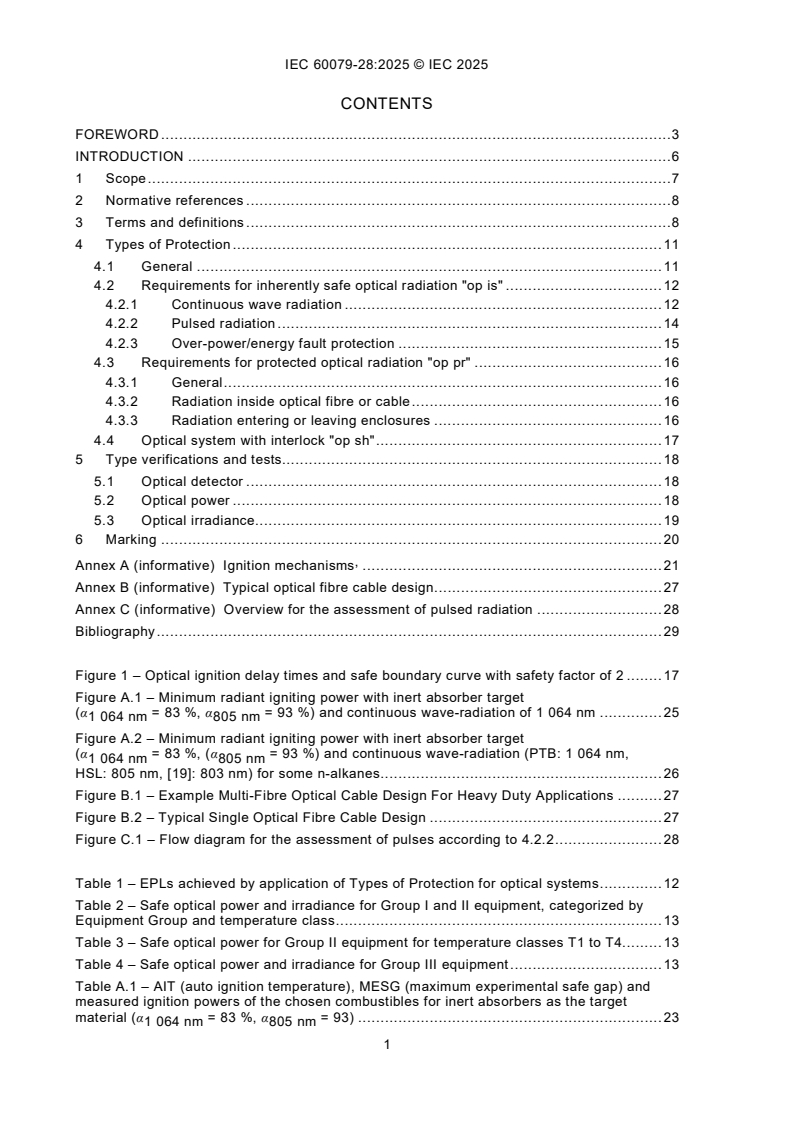
CONTENTS
FOREWORD . 3
INTRODUCTION . 6
1 Scope . 7
2 Normative references . 8
3 Terms and definitions . 8
4 Types of Protection . 11
4.1 General . 11
4.2 Requirements for inherently safe optical radiation "op is" . 12
4.2.1 Continuous wave radiation . 12
4.2.2 Pulsed radiation . 14
4.2.3 Over-power/energy fault protection . 15
4.3 Requirements for protected optical radiation "op pr" . 16
4.3.1 General . 16
4.3.2 Radiation inside optical fibre or cable . 16
4.3.3 Radiation entering or leaving enclosures . 16
4.4 Optical system with interlock "op sh" . 17
5 Type verifications and tests. 18
5.1 Optical detector . 18
5.2 Optical power . 18
5.3 Optical irradiance . 19
6 Marking . 20
,
Annex A (informative) Ignition mechanisms . 21
Annex B (informative) Typical optical fibre cable design . 27
Annex C (informative) Overview for the assessment of pulsed radiation . 28
Bibliography . 29
Figure 1 – Optical ignition delay times and safe boundary curve with safety factor of 2 . 17
Figure A.1 – Minimum radiant igniting power with inert absorber target
(α = 83 %, α = 93 %) and continuous wave-radiation of 1 064 nm . 25
1 064 nm 805 nm
Figure A.2 – Minimum radiant igniting power with inert absorber target
(α = 83 %, (α = 93 %) and continuous wave-radiation (PTB: 1 064 nm,
1 064 nm 805 nm
HSL: 805 nm, [19]: 803 nm) for some n-alkanes . 26
Figure B.1 – Example Multi-Fibre Optical Cable Design For Heavy Duty Applications . 27
Figure B.2 – Typical Single Optical Fibre Cable Design . 27
Figure C.1 – Flow diagram for the assessment of pulses according to 4.2.2 . 28
Table 1 – EPLs achieved by application of Types of Protection for optical systems . 12
Table 2 – Safe optical power and irradiance for Group I and II equipment, categorized by
Equipment Group and temperature class . 13
Table 3 – Safe optical power for Group II equipment for temperature classes T1 to T4. 13
Table 4 – Safe optical power and irradiance for Group III equipment . 13
Table A.1 – AIT (auto ignition temperature), MESG (maximum experimental safe gap) and
measured ignition powers of the chosen combustibles for inert absorbers as the target
material (α = 83 %, α = 93) . 23
1 064 nm 805 nm
i,min
Table A.2 – Comparison of measured minimum igniting optical pulse energy (Q ) at
e,p
90 μm beam diameter with auto ignition temperatures (AIT) and minimum ignition
energies (MIE) from literature [20] at concentrations in percent by volume (φ) . 26
INTERNATIONAL ELECTROTECHNICAL COMMISSION
____________
Explosive atmospheres -
Part 28: Protection of equipment and transmission
systems using optical radiation
FOREWORD
1) The International Electrotechnical Commission (IEC) is a worldwide organization for standardization comprising all
national electrotechnical committees (IEC National Committees). The object of IEC is to promote international co-
operation on all questions concerning standardization in the electrical and electronic fields. To this end and in addition
to other activities, IEC publishes International Standards, Technical Specifications, Technical Reports, Publicly
Available Specifications (PAS) and Guides (hereafter referred to as "IEC Publication(s)"). Their preparation is
entrusted to technical committees; any IEC National Committee interested in the subject dealt with may participate
in this preparatory work. International, governmental and non-governmental organizations liaising with the IEC also
participate in this preparation. IEC collaborates closely with the International Organization for Standardization (ISO)
in accordance with conditions determined by agreement between the two organizations.
2) The formal decisions or agreements of IEC on technical matters express, as nearly as possible, an international
consensus of opinion on the relevant subjects since each technical committee has representation from all interested
IEC National Committees.
3) IEC Publications have the form of recommendations for international use and are accepted by IEC National
Committees in that sense. While all reasonable efforts are made to ensure that the technical content of IEC
Publications is accurate, IEC cannot be held responsible for the way in which they are used or for any
misinterpretation by any end user.
4) In order to promote international uniformity, IEC National Committees undertake to apply IEC Publications
transparently to the maximum extent possible in their national and regional publications. Any divergence between
any IEC Publication and the corresponding national or regional publication shall be clearly indicated in the latter.
5) IEC itself does not provide any attestation of conformity. Independent certification bodies provide conformity
assessment services and, in some areas, access to IEC marks of conformity. IEC is not responsible for any services
carried out by independent certification bodies.
6) All users should ensure that they have the latest edition of this publication.
7) No liability shall attach to IEC or its directors, employees, servants or agents including individual experts and
members of its technical committees and IEC National Committees for any personal injury, property damage or other
damage of any nature whatsoever, whether direct or indirect, or for costs (including legal fees) and expenses arising
out of the publication, use of, or reliance upon, this IEC Publication or any other IEC Publications.
8) Attention is drawn to the Normative references cited in this publication. Use of the referenced publications is
indispensable for the correct application of this publication.
9) IEC draws attention to the possibility that the implementation of this document may involve the use of (a) patent(s).
IEC takes no position concerning the evidence, validity or applicability of any claimed patent rights in respect thereof.
As of the date of publication of this document, IEC had not received notice of (a) patent(s), which may be required
to implement this document. However, implementers are cautioned that this may not represent the latest information,
which may be obtained from the patent database available at https://patents.iec.ch. IEC shall not be held responsible
for identifying any or all such patent rights.
IEC 60079-28 has been prepared by IEC technical committee 31 Equipment for explosive
atmospheres. It is an International Standard.
This International Standard is to be used in conjunction with IEC 60079-0.
Users of this document are advised that interpretation sheets clarifying the interpretation of this
document can be published. Interpretation sheets are available from the IEC webstore and can be
found in the "history" tab of the page for each document.
This third edition cancels and replaces the second edition published in 2015. This edition
constitutes a technical revision.
The significance of the changes between the current edition of IEC 60079-28 (Edition 3) and
IEC 60079-28 (Edition 2) is as listed below:
Significance of changes with respect to IEC 60079-28:2015
Type
Significant Changes Clause Minor and Extension Major
editorial technical
changes changes
Ignition test is removed Clause 6;
Annex A C1
(of Ed.2)
Clarification of the applicability of IEC 60079-28 for laser
equipment, optical fibre equipment and any optical system
1 X
that converts light into convergent beams with focal points
within the hazardous area only.
Change title from "Radiation inside enclosures" to
"Radiation entering or leaving enclosures" and text
4.3.3 X
reworded
The structure of this document was modified; new clause
5 X
"Type verifications and tests" added
New subclause "Optical detector" 5.1 X
The possibility to do calculations for the assessment of
5.2 X
optical power is clarified
Additional examples for the marking are added. 6 X
Annex C removed Annex C X
(of Ed.2)
NOTE 1 The technical changes referred to include the significance of technical changes in the revised IEC Standard,
but they do not form an exhaustive list of all modifications from the previous version. More guidance can be found by
referring to the Redline Version of the standard.
Explanation of the types of significant changes:
a) Definitions
1) Minor and editorial clarification
changes:
decrease of technical requirements
minor technical change
editorial corrections
These are changes which modify requirements in an editorial or a minor technical way. They
include changes of the wording to clarify technical requirements without any technical
change, or a reduction in level of existing requirement.
2) Extension: addition of technical options
These are changes which add new or modify existing technical requirements, in a way that
new options are given, but without increasing requirements for equipment that was fully
compliant with the previous standard. Therefore, these will not have to be considered for
products in conformity with the preceding edition.
3) Major technical addition of technical requirements
changes:
increase of technical requirements
These are changes to technical requirements (addition, increase of the level or removal)
made in a way that a product in conformity with the preceding edition will not always be able
to fulfil the requirements given in the later edition. These changes have to be considered for
products in conformity with the preceding edition. For these changes additional information
is provided in clause B) below.
NOTE 2 These changes represent current technological knowledge. However, these changes should not
normally have an influence on equipment already placed on the market.
b) Information about the background of changes
C1 The alternative option of an ignition test is removed because questions have been
raised regarding the repeatability of the verification test across test labs. Additionally,
it was identified that an application of a safety factor is not sufficiently defined and
not possible to apply for real test samples.
The text of this International Standard is based on the following documents:
Draft Report on voting
31/1887/FDIS 31/1933/RVD
Full information on the voting for the approval of this International Standard can be found in the
report on voting indicated in the above table.
The language used for the development of this International Standard is English.
This document was drafted in accordance with ISO/IEC Directives, Part 2, and developed in
accordance with ISO/IEC Directives, Part 1 and ISO/IEC Directives, IEC Supplement, available at
www.iec.ch/members_experts/refdocs. The main document types developed by IEC are described
in greater detail at www.iec.ch/publications.
A list of all parts in the IEC 60079 series, published under the general title Explosive atmospheres,
can be found on the IEC website.
The committee has decided that the contents of this document will remain unchanged until the
stability date indicated on the IEC website under webstore.iec.ch in the data related to the specific
document. At this date, the document will be
– reconfirmed,
– withdrawn, or
– revised.
INTRODUCTION
Optical systems in the form of light sources utilizing optical components such as filters or lenses,
optical fibres etc. include but are not limited to communications, surveying, sensing and
measurement. In material processing, optical radiation of high irradiance is used. Where the
installation is inside or close to explosive atmospheres, the radiation from such systems can pass
through these atmospheres. Depending on the characteristics of the radiation it might then be able
to ignite a surrounding explosive atmosphere. The presence or absence of an additional absorber,
such as particles, significantly influences the ignition.
There are four possible ignition mechanisms:
a) Optical radiation is absorbed by surfaces or particles, causing them to heat up, and under
certain circumstances this might allow them to attain a temperature which will ignite a
surrounding explosive atmosphere.
b) Thermal ignition of a gas volume, where the optical wavelength matches an absorption band
of the gas or vapour.
c) Photochemical ignition due to photo dissociation of oxygen molecules by radiation in the
ultraviolet wavelength range.
d) Direct laser induced breakdown of the gas or vapour at the focus of a strong beam, producing
plasma and a shock wave both eventually acting as ignition source. These processes can be
supported by a solid material close to the breakdown point.
The most likely case of ignition occurring in practice with lowest radiation power of ignition
capability is case a). Under some conditions for pulsed radiation, case d) also will become relevant.
These two cases are addressed in this document. Although it is important that users be aware of
ignition mechanisms b) and c) explained above, they are not addressed in this document due to
the very special situation with ultraviolet radiation and with the absorption properties of most gases
(see Annex A).
This document describes precautions and requirements to be taken when using optical radiation
in explosive gas or dust atmospheres.
There are optical systems outside the scope of this document because the optical radiation
associated with these systems is considered not to be a risk of ignition for the following reasons:
– due to low radiated power or divergent light; and
– as hot surfaces created due to a too small distance from the radiation source to an absorber
which is already considered by general requirements for lighting equipment.
When optical systems are associated with electrical Ex Equipment and where the electrical Ex
Equipment is located in a hazardous area then other parts of the IEC 60079 series will also apply.
This document provides guidance for:
– Ignition hazards associated with optical systems in explosive atmospheres as defined in
IEC 60079-10-1 and IEC 60079-10-2; and
– Control of ignition hazards from Ex Equipment using optical radiation in explosive atmospheres.
1 Scope
This part of IEC 60079 specifies additional requirements for Ex Equipment, Ex associated
equipment or Ex Components containing optical systems emitting optical radiation, which is
exposed to explosive atmospheres. These additional requirements are applicable for all equipment
groups and all Equipment Protection Levels (EPL).
This document contains requirements for optical radiation in the wavelength range from 380 nm to
10 µm. It covers the following ignition mechanisms:
– Optical radiation is absorbed by surfaces or particles, causing them to heat up, and under
certain circumstances this might allow them to attain a temperature which will ignite a
surrounding explosive atmosphere.
– In rare special cases, direct laser induced breakdown of the gas at the focus of a strong beam,
producing plasma and a shock wave both eventually acting as ignition source. These processes
can be supported by a solid material close to the breakdown point.
– Annex A provides guidance when considering ignition mechanisms that influence the hazard
of optics in explosive atmospheres.
NOTE 1 See a) and d) of the Introduction.
This document applies to
a) laser equipment; and
b) optical fibre equipment; and
c) any optical system that converts light into convergent beams with focal points within the
hazardous area only.
This document does not apply to:
d) laser equipment for EPL Mb, Gb, Gc, Db or Dc applications which complies with Class 1 limits
in accordance with IEC 60825-1; or
NOTE 2 The Class 1 limits are below 15 mW measured at a distance from the optical radiation source in accordance
with IEC 60825-1, with this measured distance reflected in the Ex application. The Class 1 limit values are not
considered capable of igniting an explosive atmosphere.
NOTE 3 Compliance with Class 1 limits is typically documented in the form of a datasheet or user manual provided
by the manufacturer of the laser equipment.
e) Single or multiple optical fibre cables not part of optical fibre equipment if the cables:
1) comply with the relevant industrial standards for optical fibre cables, along with additional
protective means, for example robust cabling, conduit or raceway (for EPL Gb, Db, Mb, Gc
or Dc); or
2) comply with the relevant industrial standards for optical fibre cables (for EPL Gc or Dc); or
f) Optical radiation sources as defined in a) to c) above where the optical radiation is fully
contained in an enclosure complying with one of the following Types of Protection suitable for
the EPL, or the minimum ingress protection rating specified:
NOTE 4 Fully contained means that no optical radiation can escape.
1) flameproof "d" enclosures (IEC 60079-1); or
NOTE 5 A flameproof "d" enclosure is suitable because an ignition due to optical radiation in combination with
absorbers inside the enclosure is contained.
2) pressurized "p" enclosures (IEC 60079-2); or
NOTE 6 A pressurized "p" enclosure is suitable because there is protection against ingress of an explosive
atmosphere.
3) restricted breathing "nR" enclosure (IEC 60079-15); or
NOTE 7 A restricted breathing "nR" enclosure is suitable because there is protection against ingress of an
explosive atmosphere.
4) dust protection "t" enclosures" (IEC 60079-31); or
NOTE 8 A dust protection "t" enclosure is suitable because there is protection against ingress of an explosive
dust atmosphere.
5) an enclosure that provides a minimum ingress protection of IP 6X and where no internal
absorbers are to be expected and complying with "Tests of enclosures" in IEC 60079-0.
NOTE 9 An enclosure of a minimum ingress protection of IP 6X and complying with "Tests of enclosures" in
IEC 60079-0 is suitable because there is protection against the ingress of absorbers. It is anticipated that when
the enclosures are opened, entrance of any absorbers is avoided.
This document does not cover ignition by ultraviolet radiation and by absorption of the radiation in
the explosive mixture itself. Explosive absorbers or absorbers that contain their own oxidizer as
well as catalytic absorbers are also outside the scope of this document.
This document supplements and modifies the general requirements of IEC 60079-0. Where a
requirement of this document conflicts with a requirement of IEC 60079-0, the requirement of this
document takes precedence.
2 Normative references
The following documents are referred to in the text in such a way that some or all of their content
constitutes requirements of this document. For dated references, only the edition cited applies.
For undated references, the latest edition of the referenced document (including any amendments)
applies.
IEC 60079-0, Explosive atmospheres - Part 0: Equipment - General requirements
IEC 60079-1, Explosive atmospheres - Part 1: Equipment protection by flameproof enclosures "d"
IEC 60079-7, Explosive atmospheres - Part 7: Equipment protection by increased safety "e"
IEC 60079-11, Explosive atmospheres - Part 11: Equipment protection by intrinsic safety "i"
IEC 60079-15, Explosive atmospheres - Part 15: Equipment protection by type of protection "n"
IEC 60825-2, Safety of laser products - Part 2: Safety of optical fibre communication systems
(OFCS)
3 Terms and definitions
For the purposes of this document, the following terms and definitions apply.
ISO and IEC maintain terminology databases for use in standardization at the following addresses:
– IEC Electropedia: available at https://www.electropedia.org/
– ISO Online browsing platform: available at https://www.iso.org/obp
NOTE Additional definitions applicable to explosive atmospheres can be found in IEC 60050-426.
3.1
absorption
conversion of electromagnetic wave energy into another form of
energy, for instance heat
3.2
beam diameter
beam width
distance between two diametrically opposed points where the irradiance is a specified fraction of
the beam's peak irradiance
Note 1 to entry: The concept is most commonly applied to beams that are circular or nearly circular in cross-section.
[SOURCE: IEC 60050-731:1991/AMD6:2021-04, 731-01-35, modified - Note 2 to entry deleted.]
3.3
beam strength
optical beam's power, irradiance, energy, or radiant exposure
3.4
fibre bundle
assembly of unbuffered optical fibres
[SOURCE: IEC 60050-731:1991, 731-04-09]
3.5
fibre optic terminal device
assembly including one or more opto-electronic devices which converts an electrical signal into an
optical signal, and/or vice versa, which is designed to be connected to at least one optical fibre
Note 1 to entry: A fibre optic terminal device always has one or more integral fibre optic connector(s) or optical fibre
pigtail(s).
[SOURCE: IEC 60050-731:1991, 731-06-44]
3.6
optical radiation types of protection
3.6.1
inherently safe optical radiation
"op is"
visible or infrared radiation that is incapable of producing sufficient energy under normal or
specified fault conditions to ignite a specific explosive atmosphere
Note 1 to entry: This definition is analogous to the term "intrinsically safe" applied to electrical circuits.
Note 2 to entry: Inherently safe optical radiation means that the visible or infrared radiation is incapable of supplying
sufficient energy under normal or specified fault conditions to ignite a specific explosive atmosphere. The concept is a
beam strength limitation approach to safety. Ignition by an optically irradiated target absorber requires the least amount
of energy, power, or irradiance of the identified ignition mechanisms in the visible and infrared spectrum. The inherently
safe concept applies to unconfined radiation and does not require maintaining an absorber-free environment.
3.6.2
protected optical radiation
"op pr"
visible or infrared radiation that is confined inside optical fibre or other transmission medium under
normal constructions or constructions with additional mechanical protection based on the
assumption that there is no escape of radiation from the confinement
3.6.3
optical system with interlock
"op sh"
system to confine visible or infrared radiation inside optical fibre or other transmission medium
with interlock cut-off provided to reliably reduce the unconfined beam strength to safe levels within
a specified time in case the confinement fails and the radiation becomes unconfined
3.7
irradiance
DEPRECATED: intensity
radiant power incident on an element of a surface divided by the area of that element
[SOURCE: IEC 60050-731:1991, 731-01-25]
3.8
light
visible radiation
optical radiation capable of causing a visual sensation directly on a human being
Note 1 to entry: Nominally covering the wavelength in vacuum range of 380 nm to 800 nm.
Note 2 to entry: In the laser and optical communication fields, custom and practice in the English language have
extended usage of the term light to include the much broader portion of the electromagnetic spectrum that can be handled
by the basic optical techniques used for the visible spectrum.
[SOURCE: IEC 60050-731:1991, 731-01-04]
3.9
optical fibre
waveguide shaped as a filament, made of dielectric materials for guiding optical waves
[SOURCE: IEC 60050-151:2019, 151-12-35]
3.10
optical fibre cable
assembly comprising one or more optical fibres or fibre bundles inside a common covering
designed to protect them against mechanical stresses and other environmental influences while
retaining the transmission quality of the fibres
[SOURCE: IEC 60050-731:1991, 731-04-01]
3.11
optical power
radiant power
time rate of flow of radiant energy with time
[SOURCE: IEC 60050-731:1991, 731-01-22]
3.12
optical radiation
electromagnetic radiation at wavelengths in vacuum between the region of transition to X-rays and
the region of transition to radio waves, that is approximately between 1 nm and 1 mm
Note 1 to entry: In the context of this document, the term "optical" refers to wavelengths ranging from 380 nm to 10 μm.
[SOURCE: IEC 60050-731:1991, 731-01-03, modified - addition of Note 1 to entry.]
3.13
protected optical fibre cable
optical fibre cable protected from releasing optical radiation into the atmosphere during normal
operating conditions and foreseeable malfunctions by additional armouring, conduit, cable tray or
raceway
3.14
radiant exposure
radiant energy incident on an element of a surface divided by the area of that element
3.15
optical system
arrangement of optical or other components which form elements of a light emitting source
Note 1 to entry: The optical system is deemed to include the source, optical components including filters or lenses
where these are appropriate.
[SOURCE: IEC 60050-845:2020, 845-31-118, modified - "sign" replaced by "source" in definition,
Note 1 to entry modified.]
4 Types of Protection
4.1 General
The following three Types of Protection can be applied to prevent ignitions by optical radiation in
explosive atmospheres:
a) inherently safe optical radiation, Type of Protection "op is";
b) protected optical radiation, Type of Protection "op pr"; and
c) optical system with interlock, Type of Protection "op sh".
The EPLs that can be achieved by the application of Types of Protection for optical systems are
shown in Table 1.
Table 1 – EPLs achieved by application of Types of Protection for optical systems
Type(s) of Protection EPLs
Ga, Da, Ma Gb, Db, Mb Gc, Dc
Inherently safe optical radiation "op is" (see 4.2)
– safe with two faults or using optical source based on the Yes Yes Yes
thermal failure characteristic (see 4.2.3)
– safe with one fault or using optical source based on the thermal No Yes Yes
failure characteristic (see 4.2.3)
– safe in normal operation No No Yes
Protected fibre optic media with ignition capable beam "op pr"
(see 4.3)
– with additional mechanical protection No Yes Yes
– according to fibre manufacturers specification for normal No No Yes
industrial use, but without additional mechanical protection
1)
Gb, Db, Mb Gc, Dc
Ga , Ma
Fibre optic media with ignition capable beam interlocked in case of
fibre breakage "op sh" (see 4.4)
2) 1) 1)
– Protected fibre optic cable "op pr" for Gb/ Mb + shutdown
Yes Yes Yes
functional safety system based on ignition delay time of the
explosive gas atmosphere
2)
– Protected fibre optic cable "op pr" for Gc/Dc + shutdown No Yes
Yes
functional safety system based on eye protection delay times
(IEC 60825-2)
– Unprotected fibre optic cable (not "op pr") + shutdown No No Yes
functional safety system based on eye protection delay times
(IEC 60825-2)
None (unconfined, ignition capable beam) No No No
1)
Only applicable for Group I and Group IIA temperature class T1 and T2
2)
Shutdown system safe with one fault
4.2 Requirements for inherently safe optical radiation "op is"
4.2.1 Continuous wave radiation
For Group I, the optical power or optical irradiance shall not exceed the values listed in Table 2.
For Group II,
– the optical power or optical irradiance shall not exceed the values listed in Table 2, or
– for temperature classes T1, T2, T3 and T4, the optical power shall not exceed the values listed
in Table 3.
For Group III, the optical power or optical irradiance shall not exceed the values listed in Table 4.
Table 2 – Safe optical power and irradiance for Group I and II equipment,
categorized by Equipment Group and temperature class
Optical radiation sources with Can be used for the Remarks
following explosive
Radiated power Irradiance
atmospheres
(temperature classes in
(no irradiance limit (no radiated power limit
combination with
applies) applies)
equipment groups)
mW
mW/mm
No limit to the involved
≤ 150 IIA with T1, T2 or T3, and I
irradiated area
IIA, IIB independent of T-
No limit to the involved
≤ 35 Class, IIC with T1, T2, T3
irradiated area
or T4, and I
No limit to the involved
≤ 15 All atmospheres
irradiated area
Irradiated areas limited to
≤ 20 IIA with T1, T2 or T3, and I
≤ 30 mm
No limit to the involved
≤ 5 All atmospheres
irradiated area
NOTE For "op is", the use of the term 'temperature class' when applying this table does not relate to the maximum
temperature measured on the equipment. Instead, it relates to the ignition properties of the gases associated with
the various equipment groups.
Table 3 – Safe optical power for Group II equipment for temperature classes T1 to T4
limited irradiated area Maximum radiated power value
mW
mm
–3
< 4 * 10
–3
≥ 4 * 10
–2
≥ 1,8 * 10
–2
≥ 4 * 10
≥ 0,2 80
≥ 0,8 100
≥ 2,9 115
≥ 8 200
≥ 70 < 130 400
2 2
For irradiated areas equal to or above 130 mm the irradiance limit of 5 mW/mm applies (see Table 2).
Table 4 – Safe optical power and irradiance for Group III equipment
Equipment Group IIIA, IIIB and IIIC
EPL Da Db Dc
Radiated power (no irradiance limit applies) mW ≤ 35 ≤ 35 ≤ 35
≤ 5 ≤ 5 ≤ 10
Irradiance (no radiated power limit applies) mW/mm
Compliance with Table 2, Table 4 or Table 3 shall be based on the following:
a) measurement of the maximum optical power in accordance with 5.2; or
b) measurement of the maximum optical irradiance in accordance with 5.3; or
c) calculation based on comparison of optical parameters with electrical parameters in
accordance with 5.2.
4.2.2 Pulsed radiation
4.2.2.1 General
Optical pulse duration for Gc or Dc equipment may be determined based on modulation frequency
and duty cycle ratings specified by the manufacturer. For example, pulse duration (or 'on-time') is
equal to the product of the period (or 'time between pulses') and the duty cycle, with the period
being equal to the inverse of the frequency.
Optical pulse duration for Ga, Gb, Da, Db, Ma or Mb equipment shall be measured under required
fault conditions in accordance with the over-power/energy fault protection criteria required for
'Optical devices incorporating the inherently safe concept'. An electrical oscilloscope may be used
to measure the pulse duration of the voltage at the input to the optical device under each fault
condition.
The flow diagram in Annex C shows the assessment procedure for Group II.
4.2.2.2 Optical pulse duration of less than or equal to 1 s for Group II
For optical pulse duration of less than 1 ms, as determined in accordance with the applicable EPL,
the optical pulse energy shall not exceed the minimum spark ignition energy (MIE) of the respective
explosive gas atmosphere.
For optical pulse duration from 1 ms to 1 s inclusive, as determined in accordance with the
applicable equipment protection level, an optical pulse energy equal to 10 times the MIE of the
explosive gas atmosphere shall not be exceeded.
For a single pulse, optical pulse energy is equal to the product of the average power and the optical
pulse duration of that single pulse.
NOTE In accordance with the 'Comparison of measured minimum igniting optical pulse energy (Qe,pi,min) at 90 μm
beam diameter with auto ignition temperatures (AIT) and minimum ignition energies (MIE) from literature Table A.2, the
applicable minimum spark ignition energy (MIE) is based on the equipment group subdivision.
The MIE values for the application of this document are:
– Group IIA: 240 μJ
– Group IIB: 82 μJ
– Group IIC: 17 μJ
4.2.2.3 Optical pulse duration greater than 1 s for Group II
For optical pulse durations greater than 1 s, the peak power shall be measured in accordance with
the 'Continuous wave radiation' requirements and shall not exceed the safety levels for continuous
wave radiation (see 4.2.1, Table 2 or Table 3). Regardless of the involved EPL, such pulses are
considered as continuous wave radiation.
4.2.2.4 Additional requirements for optical pulse trains for Group II
For optical pulse trains involving pulse duration less than or equal to 1 s, the following shall apply:
a) For all repetition rates, compliance with the single pulse criterion according 4.2.2.2 applies for
each pulse.
b) For repetition rates above 100 Hz, the average power shall not exceed the safety levels for
continuous wave radiation in Table 2 or Table 3.
c) For repetition rates at or below 100 Hz, the average power shall not exceed the safety levels
for continuous wave radiation in Table 2 or Table 3.
4.2.2.5 Additional requirements for optical pulses for Group I and Group III equipment
The output parameters of optical sources of equipment for EPL Ma or Mb and Da or Db shall not
exceed 0,1 mJ/mm for pulse lasers or pulse light sources with pulse intervals of at least 5 s.
The output parameters of optical sources of equipment of EPL Dc shall not exceed 0,5 mJ/mm
for pulse lasers or pulse light sources.
Radiation sources with pulse intervals of less than 5 s are regarded as continuous wave sources.
4.2.3 Over-power/energy fault protection
4.2.3.1 General
Optical devices incorporating the inherently safe concept shall provide over-power/energy fault
protection to prevent excessive beam strengths in explosive atmospheres. The risk/hazard
analysis shall determine if additional limitation is required. The failure modes of the optical source,
the driver circuitry, and the intended EPL shall be considered during normal operation and during
fault conditions to determine the requirement for additional limitation.
4.2.3.2 Self-limiting optical sources
Optical sources such as laser diodes, light-emitting diodes (LED) or lamps will fail if over-heated
under over-power fault conditions. The thermal failure characteristic of certain optical sources
provides the necessary over-power fault protection if a test of 10 samples shows that a defined
fail-safe shutdown or foldback will occur (see 5.2 and 5.3). The highest obtained optical output
power value of the 10 samples shall be taken as the maximum power or irradiance value. The
thermal failure characteristic of such low power optical sources is acceptable to provide adequate
over-power protection for any EPL.
4.2.3.3 Optical sources requiring power limiting circuitry
Where the beam strength of the optical device is limited by the driver circuitry, the faults to be
considered apply to that circuitry and not to the optical device itself.
An LED current limited by the driver circuitry to values within the data sheet specifications is not
considered to exceed the maximum forward voltage given in the data sheet for that current.
Faults to be considered include the opening or shorting of any component that could impact the
beam strength of the optical device. Printed wiring board traces need not be considered for
shorting because they comply with the creepage distance, clearance or through solid insulation
requirements of the relevant general industrial standard.
Electrical circuits such as current and/or voltage limiters placed between the optical source and
the electrical power source may provide over-power fault protection. Electrical over-power fault
protection shall be provided to the degree necessary for the intended EPL. For Ga, Da or Ma
equipment, current and/or voltage limiters shall provide over-power fault protection in normal
operation and after one or two faults are applied to the current and/or voltage limiter. For Gb, Db
or Mb equipment, over-power fault protection shall be provided in normal operation and after one
fault is applied to the current and/or voltage limiter. For Gc or Dc equipment the rated electrical
values shall be taken without assuming any fault.
4.3 Requirements for protected optical radiation "op pr"
4.3.1 General
This concept requires radiation to be confined inside optical fibre or other transmission medium
based on the assumption that there is no escape of radiation from the confinement. In this case
the performance of the confinement defines the safety level of the system, "op pr". Safety levels
that are applicable include EPL Gb or Gc and Db or Dc and Mb. (see Table 1).
All optical components shall be suitable for the ratings and temperature range for which they are
used.
NOTE It is not a requirement of this document that conformity to the specification of the components be verified.
4.3.2 Radiation inside optical fibre or cable
The optical fibre or cable protects the release of optical radiation into the atmosphere during
normal operating conditions. For EPL Gb, Db or Mb protected optical fibre cables shall be used
provided by additional uninterrupted armouring, conduit, cable tray, or raceway. For optical fibres
or cables, that exit the end-equipment enclosure, a pull test shall be performed according to
IEC 60079-11. Annex B is a representative drawing of a typical optical fibre cable design.
Internal or external cables can be terminated / spliced from one fibre (from a cable) to another
fibre (in a new cable) by using dedicated coupler or joining kits giving a fixed termination. For
external termination/splicing, the cable connection shall provide equivalent mechanical strength to
that of the cable. The procedure to perform field connections shall be detailed in the instructions.
NOTE 1 This can be achieved by using mechanical clamping or snap connection.
For EPL Gc or Dc optical fibre or cables and internal pluggable factory connections that comply
with the applicable industrial standard are suitable. External optical fibre or cable field connections
shall comply with the external plug and socket outlet requirements from IEC 60079-0 suitable for
the EPL.
For EPL Gb, Db or Mb, optical fibre or cables connected via internal pluggable factory connections
shall comply with the pluggable connection requirements from IEC 60079-7. External optical fibre
or cable field connections shall comply with the external plug and socket outlet requirements from
IEC 60079-0 for the required EPL.
NOTE 2 Typical examples are connections in split-boxes.
NOTE 3 Optical fibre or cable alone is not Ex equipment.
4.3.3 Radiation entering or leaving enclosures
Ignition capable radiation entering or leaving enclosures shall be protected in accordance with
4.3.2 and the enclosure shall comply with recognised Types of Prote
...
IEC 60079-28 ®
Edition 3.0 2025-11
NORME
INTERNATIONALE
Atmosphères explosives -
Partie 28: Protection du matériel et des systèmes de transmission utilisant le
rayonnement optique
ICS 29.260.20 ISBN 978-2-8327-0789-0
Droits de reproduction réservés. Sauf indication contraire, aucune partie de cette publication ne peut être reproduite ni
utilisée sous quelque forme que ce soit et par aucun procédé, électronique ou mécanique, y compris la photocopie et
les microfilms, sans l'accord écrit de l'IEC ou du Comité national de l'IEC du pays du demandeur. Si vous avez des
questions sur le copyright de l'IEC ou si vous désirez obtenir des droits supplémentaires sur cette publication, utilisez
les coordonnées ci-après ou contactez le Comité national de l'IEC de votre pays de résidence.
IEC Secretariat Tel.: +41 22 919 02 11
3, rue de Varembé info@iec.ch
CH-1211 Geneva 20 www.iec.ch
Switzerland
A propos de l'IEC
La Commission Electrotechnique Internationale (IEC) est la première organisation mondiale qui élabore et publie des
Normes internationales pour tout ce qui a trait à l'électricité, à l'électronique et aux technologies apparentées.
A propos des publications IEC
Le contenu technique des publications IEC est constamment revu. Veuillez vous assurer que vous possédez l’édition la
plus récente, un corrigendum ou amendement peut avoir été publié.
Recherche de publications IEC - IEC Products & Services Portal - products.iec.ch
webstore.iec.ch/advsearchform Découvrez notre puissant moteur de recherche et consultez
La recherche avancée permet de trouver des publications gratuitement tous les aperçus des publications, symboles
IEC en utilisant différents critères (numéro de référence, graphiques et le glossaire. Avec un abonnement, vous aurez
texte, comité d’études, …). Elle donne aussi des toujours accès à un contenu à jour adapté à vos besoins.
informations sur les projets et les publications remplacées
ou retirées. Electropedia - www.electropedia.org
Le premier dictionnaire d'électrotechnologie en ligne au
IEC Just Published - webstore.iec.ch/justpublished monde, avec plus de 22 500 articles terminologiques en
Restez informé sur les nouvelles publications IEC. Just anglais et en français, ainsi que les termes équivalents
Published détaille les nouvelles publications parues. dans 25 langues additionnelles. Egalement appelé
Disponible en ligne et une fois par mois par email. Vocabulaire Electrotechnique International (IEV) en ligne.
Service Clients - webstore.iec.ch/csc
Si vous désirez nous donner des commentaires sur cette
publication ou si vous avez des questions contactez-
nous: sales@iec.ch.
SOMMAIRE
AVANT-PROPOS . 3
INTRODUCTION . 6
1 Domaine d'application . 7
2 Références normatives . 8
3 Termes et définitions . 9
4 Modes de protection . 12
4.1 Généralités . 12
4.2 Exigences pour les rayonnements optiques à sécurité intrinsèque "op is" . 13
4.2.1 Rayonnement d'onde entretenue . 13
4.2.2 Rayonnement à impulsions . 14
4.2.3 Protection contre les défauts de surpuissance et d'énergie . 16
4.3 Exigences pour rayonnement optique protégé "op pr" . 17
4.3.1 Généralités . 17
4.3.2 Rayonnement à l'intérieur d'une fibre optique ou d'un câble . 17
4.3.3 Rayonnement entrant ou sortant des enveloppes . 17
4.4 Système optique avec asservissement "op sh" . 18
5 Vérifications et essais de type . 19
5.1 Détecteur optique . 19
5.2 Puissance optique. 19
5.3 Éclairement optique . 20
6 Marquage. 21
,
Annexe A (informative) Mécanismes d'inflammation . 23
Annexe B (informative) Conception type de câbles à fibres optiques . 29
Annexe C (informative) Vue d'ensemble de l'évaluation du rayonnement à impulsions . 30
Bibliographie . 31
Figure 1 – Retards d'inflammation optique et courbe de limite de sécurité avec un facteur
de sécurité de 2 . 18
Figure A.1 – Puissance d'inflammation rayonnante minimale avec cible d'absorbeur inerte
(α = 83 %, α = 93 %) et rayonnement d'onde entretenue de 1 064 nm . 27
1 064 nm 805 nm
Figure A.2 – Puissance d'inflammation rayonnante minimale avec cible d'absorbeur inerte
(α = 83 %, (α = 93 %) et rayonnement d'onde entretenue
1 064 nm 805 nm
(PTB: 1 064 nm, HSL: 805 nm, [19]: 803 nm) pour certains n-alkylbenzènes . 28
Figure B.1 – Exemple de conception de câble optique multifibre pour applications à haut
rendement . 29
Figure B.2 – Conception type de câble à fibre optique unique . 29
Figure C.1 – Schéma fonctionnel pour l'évaluation des impulsions selon 4.2.2 . 30
Tableau 1 – EPL atteints par l'application des modes de protection pour les systèmes
optiques . 12
Tableau 2 – Puissance optique et éclairement sûrs pour le matériel des Groupes I et II,
par catégorie de groupe de matériel et de classe de température . 13
Tableau 3 – Puissance optique de sécurité pour le matériel du Groupe II pour les classes
de température T1 à T4 . 14
Tableau 4 – Puissance optique et éclairement sûrs pour le matériel du Groupe III . 14
Tableau A.1 – AIT (température d'auto-inflammation), MESG (intervalle de sécurité
expérimental maximal, maximum experimental safe gap) et puissances d'inflammation
mesurées des combustibles choisis pour absorbeurs inertes comme matériau cible
(α = 83 %, α = 93) . 25
1 064 nm 805 nm
Tableau A.2 – Comparaison de l'énergie d'impulsion optique d'inflammation minimale
i,min
mesurée (Q ) à faisceau de diamètre de 90 μm avec des températures
e,p
d'auto-inflammation (AIT) et des énergies d'inflammation minimales (MIE) de l'ouvrage de
référence [20] à des concentrations en pourcentage par volume (φ . 28
COMMISSION ÉLECTROTECHNIQUE INTERNATIONALE
____________
Atmosphères explosives -
Partie 28: Protection du matériel et des systèmes de transmission utilisant
le rayonnement optique
AVANT-PROPOS
1) La Commission Électrotechnique Internationale (IEC) est une organisation mondiale de normalisation composée de
l'ensemble des comités électrotechniques nationaux (Comités nationaux de l'IEC). L'IEC a pour objet de favoriser la
coopération internationale pour toutes les questions de normalisation dans les domaines de l'électricité et de
l'électronique. À cet effet, l'IEC – entre autres activités – publie des Normes internationales, des Spécifications
techniques, des Rapports techniques, des Spécifications accessibles au public (PAS) et des Guides (ci-après
dénommés "Publication(s) de l'IEC"). Leur élaboration est confiée à des comités d'études, aux travaux desquels tout
Comité national intéressé par le sujet traité peut participer. Les organisations internationales, gouvernementales et
non gouvernementales, en liaison avec l'IEC, participent également aux travaux. L'IEC collabore étroitement avec
l'Organisation Internationale de Normalisation (ISO), selon des conditions fixées par accord entre les deux
organisations.
2) Les décisions ou accords officiels de l'IEC concernant les questions techniques représentent, dans la mesure du
possible, un accord international sur les sujets étudiés, étant donné que les Comités nationaux de l'IEC intéressés
sont représentés dans chaque comité d'études.
3) Les Publications de l'IEC se présentent sous la forme de recommandations internationales et sont agréées comme
telles par les Comités nationaux de l'IEC. Tous les efforts raisonnables sont entrepris afin que l'IEC s'assure de
l'exactitude du contenu technique de ses publications; l'IEC ne peut pas être tenue responsable de l'éventuelle
mauvaise utilisation ou interprétation qui en est faite par un quelconque utilisateur final.
4) Dans le but d'encourager l'uniformité internationale, les Comités nationaux de l'IEC s'engagent, dans toute la mesure
possible, à appliquer de façon transparente les Publications de l'IEC dans leurs publications nationales et régionales.
Toutes divergences entre toutes Publications de l'IEC et toutes publications nationales ou régionales
correspondantes doivent être indiquées en termes clairs dans ces dernières.
5) L'IEC elle-même ne fournit aucune attestation de conformité. Des organismes de certification indépendants
fournissent des services d'évaluation de conformité et, dans certains secteurs, accèdent aux marques de conformité
de l'IEC. L'IEC n'est responsable d'aucun des services effectués par les organismes de certification indépendants.
6) Tous les utilisateurs doivent s'assurer qu'ils sont en possession de la dernière édition de cette publication.
7) Aucune responsabilité ne doit être imputée à l'IEC, à ses administrateurs, employés, auxiliaires ou mandataires, y
compris ses experts particuliers et les membres de ses comités d'études et des Comités nationaux de l'IEC, pour
tout préjudice causé en cas de dommages corporels et matériels, ou de tout autre dommage de quelque nature que
ce soit, directe ou indirecte, ou pour supporter les coûts (y compris les frais de justice) et les dépenses découlant
de la publication ou de l'utilisation de cette Publication de l'IEC ou de toute autre Publication de l'IEC, ou au crédit
qui lui est accordé.
8) L'attention est attirée sur les références normatives citées dans cette publication. L'utilisation de publications
référencées est obligatoire pour une application correcte de la présente publication.
9) L'IEC attire l'attention sur le fait que la mise en application du présent document peut entraîner l'utilisation d'un ou
de plusieurs brevets. L'IEC ne prend pas position quant à la preuve, à la validité et à l'applicabilité de tout droit de
brevet revendiqué à cet égard. À la date de publication du présent document, l'IEC n'avait pas reçu notification qu'un
ou plusieurs brevets pouvaient être nécessaires à sa mise en application. Toutefois, il y a lieu d'avertir les
responsables de la mise en application du présent document que des informations plus récentes sont susceptibles
de figurer dans la base de données de brevets, disponible à l'adresse https://patents.iec.ch. L'IEC ne saurait être
tenue pour responsable de ne pas avoir identifié de tels droits de brevets.
L'IEC 60079-28 a été établie par le comité technique 31 de l'IEC Équipements pour atmosphères
explosives. Il s'agit d'une Norme internationale.
La présente Norme internationale doit être utilisée conjointement avec l'IEC 60079-0.
Les utilisateurs du présent document sont informés que des fiches d'interprétation clarifiant son
interprétation peuvent être publiées. Les fiches d'interprétation sont disponibles sur le webstore
de l'IEC et sont disponibles dans l'onglet "historique" de la page de chaque document.
Cette troisième édition annule et remplace la deuxième édition parue en 2015. Cette édition
constitue une révision technique.
Le contenu des modifications entre la présente édition de l'IEC 60079-28, (Édition 3) et
l'IEC 60079-28 (Édition 2) est précisé ci-dessous:
Signification des modifications par rapport à l'IEC 60079-28:2015
Type
Modifications majeures Article / Modifications Extension Modifications
Paragraphe mineures et techniques
rédactionnelles majeures
L'essai d'inflammation est supprimé Article 6;
Annexe A C1
(sur Éd.2)
Clarification de l'applicabilité de l'IEC 60079-28 pour
les équipements à laser, les équipements à fibres
optiques et tout système optique qui convertit la 1 X
lumière en faisceaux convergents avec des points
focaux situés dans la zone dangereuse uniquement.
Changement du titre ("Rayonnement entrant ou
sortant des enveloppes" au lieu de "Rayonnement à 4.3.3 X
l'intérieur des enveloppes") et reformulation du texte
Modification de la structure du présent document;
ajout d'un nouvel article "Vérifications et essais de 5 X
type"
Nouveau paragraphe "Détecteur optique" 5.1 X
Clarification de la possibilité d'effectuer des calculs
5.2 X
pour l'évaluation de la puissance optique
Des exemples supplémentaires de marquage sont
6 X
ajoutés.
Annexe C supprimée Annexe C X
(sur Éd.2)
NOTE 1 Les modifications techniques désignées incluent l'importance des modifications techniques apportées dans la
version révisée de la norme IEC, mais elles ne constituent pas une liste exhaustive de toutes les modifications par
rapport à la version précédente. D'autres recommandations peuvent être trouvées en se référant à la version "Redline"
de la norme.
Explication des types de modifications majeures:
a) Définitions
1) Modifications clarification
mineures et
réduction des exigences techniques
rédactionnelles:
modification technique mineure
corrections d'ordre rédactionnel
Il s'agit de modifications qui modifient les exigences de manière éditoriale ou sur des points
techniques mineurs. Elles comprennent des modifications de formulation visant à clarifier les
exigences techniques sans aucune modification technique, ou une réduction du niveau des
exigences existantes.
2) Extension: ajout d'options techniques
Il s'agit de modifications qui ajoutent de nouvelles exigences techniques ou modifient les
existantes pour proposer de nouvelles options sans augmenter pour autant le niveau des
exigences pour les matériels totalement conformes à la norme précédente. Par conséquent,
ces modifications ne doivent pas être prises en compte dans le cas de produits conformes à
l'édition précédente.
3) Modifications ajout d'exigences techniques
techniques majeures:
augmentation des exigences techniques
Il s'agit de modifications apportées aux exigences techniques (ajout, augmentation du niveau
ou suppression) permettant d'indiquer qu'un produit conforme à l'édition précédente n'est pas
toujours en mesure de satisfaire aux exigences données dans la dernière édition.
Ces modifications doivent être prises en compte dans le cas de produits conformes à l'édition
précédente. Concernant ces modifications, des informations supplémentaires sont données
dans l'Article B) ci-dessous.
NOTE 2 Ces modifications reflètent les connaissances technologiques actuelles. Il convient néanmoins que ces
modifications n'aient en principe pas d'influence sur les matériels déjà commercialisés.
b) Informations sur le contexte des modifications
C1 L'option alternative d'un essai d'inflammation est supprimée car des questions ont
été soulevées concernant la répétabilité de l'essai de vérification parmi les
laboratoires d'essai. De plus, il a été constaté que l'application d'un coefficient de
sécurité n'est pas suffisamment définie et qu'il n'est pas possible de l'appliquer pour
des échantillons d'essai réels.
Le texte de cette Norme internationale est issu des documents suivants:
Projet Rapport de vote
31/1887/FDIS 31/1933/RVD
Le rapport de vote indiqué dans le tableau ci-dessus donne toute information sur le vote ayant
abouti à l'approbation de cette Norme internationale.
La langue employée pour l'élaboration de cette Norme internationale est l'anglais.
Ce document a été rédigé selon les Directives ISO/IEC, Partie 2, il a été développé selon les
Directives ISO/IEC, Partie 1 et les Directives ISO/IEC, Supplément IEC, disponibles sous
www.iec.ch/members_experts/refdocs. Les principaux types de documents développés par l'IEC
sont décrits plus en détail sous www.iec.ch/publications.
Une liste de toutes les parties de la série IEC 60079, publiées sous le titre général
Atmosphères explosives, peut être consultée sur le site web de l'IEC.
Le comité a décidé que le contenu de ce document ne sera pas modifié avant la date de stabilité
indiquée sur le site web de l'IEC sous webstore.iec.ch dans les données relatives au document
recherché. À cette date, le document sera
– reconduit,
– supprimé, ou
– révisé.
INTRODUCTION
Les systèmes optiques se présentant sous la forme de sources lumineuses utilisant des
composants optiques tels que des filtres ou des lentilles, des fibres optiques, etc. comprennent,
entre autres, les communications, les relevés, la détection et la mesure. Dans les traitements de
matériau, des rayonnements optiques de fort éclairement sont utilisés. Lorsque l'installation est
située dans des atmosphères explosives ou à proximité, le rayonnement de tels systèmes peut
traverser ces atmosphères. Selon ses caractéristiques, le rayonnement peut alors être capable
d'enflammer une atmosphère explosive environnante. La présence ou l'absence d'absorbeurs
supplémentaires tels que des particules a une influence significative sur l'inflammation.
Il existe quatre mécanismes possibles d'inflammation:
a) le rayonnement optique est absorbé par les surfaces ou particules, provoquant leur
échauffement et, dans certaines circonstances, celles-ci peuvent atteindre une température
qui amorce l'inflammation de l'atmosphère explosive environnante;
b) l'inflammation thermique d'un volume de gaz, où la longueur d'onde optique correspond à une
bande d'absorption du gaz ou de la vapeur;
c) l'inflammation photochimique due à la photodissociation des molécules d'oxygène par le
rayonnement dans l'étendue des longueurs d'onde des ultraviolets;
d) le craquage direct d'un gaz ou de la vapeur par laser, au point de focalisation d'un faisceau
puissant, produisant un plasma et une onde de choc, les deux agissant en définitive comme
source d'inflammation. Ces processus peuvent prendre naissance dans un matériau solide
proche de son point de craquage.
En pratique, le cas le plus probable d'inflammation à partir de la puissance minimale
d'inflammation d'un rayonnement est le cas a). Dans certaines conditions pour le rayonnement à
impulsions, le cas d) devient applicable. Le présent document traite ces deux cas. Bien qu'il soit
important que les mécanismes d'inflammation b) et c) expliqués ci-dessus soient connus des
utilisateurs; ils ne sont cependant pas repris dans le présent document à cause de la situation très
particulière du rayonnement ultraviolet et des propriétés d'absorption de la plupart des gaz (voir
Annexe A).
Le présent document décrit les précautions à prendre et les exigences lors de l'utilisation de
rayonnements optiques dans des atmosphères explosives gazeuses ou poussiéreuses.
Il existe des systèmes optiques ne relevant pas du domaine d'application du présent document du
fait que le rayonnement optique associé à ces systèmes n'est pas considéré comme un risque
d'inflammation pour les raisons suivantes:
– en raison d'une faible puissance rayonnée ou d'une lumière divergente; et
– étant donné que les surfaces chaudes, créées en raison d'une trop faible distance entre la
source de rayonnement et un absorbeur, sont déjà couvertes par les exigences générales des
matériels d'éclairage.
Lorsque des systèmes optiques sont associés à un appareil Ex électrique, et lorsque l'appareil Ex
électrique est situé dans une zone dangereuse, d'autres parties de la série IEC 60079 s'appliquent
également. Le présent document fournit des recommandations relatives:
– aux dangers d'inflammation associés aux systèmes optiques situés dans des atmosphères
explosives telles que définies dans l'IEC 60079-10-1 et l'IEC 60079-10-2; et
– à la surveillance des dangers d'inflammation des appareils Ex utilisant le rayonnement optique
dans des atmosphères explosives.
1 Domaine d'application
La présente partie de l'IEC 60079 spécifie les exigences supplémentaires applicables aux
appareils Ex, aux appareils associés Ex ou aux composants Ex contenant des systèmes optiques
émettant un rayonnement optique, qui sont exposés à des atmosphères explosives. Ces exigences
supplémentaires s'appliquent à tous les groupes d'appareils et à tous les niveaux de protection du
matériel (EPL, Equipment Protection Levels).
Le présent document contient les exigences relatives aux rayonnements optiques dans la plage
de longueurs d'onde comprise entre 380 nm et 10 µm. Il couvre les mécanismes d'allumage
suivants:
– le rayonnement optique est absorbé par les surfaces ou particules, provoquant leur
échauffement et, dans certaines circonstances, celles-ci peuvent atteindre une température
qui amorce l'inflammation de l'atmosphère explosive environnante;
– dans certains cas rares particuliers, le craquage direct d'un gaz par laser, au point de
focalisation d'un faisceau puissant, produisant un plasma et une onde de choc, les deux
agissant en définitive comme source d'inflammation. Ces processus peuvent prendre
naissance dans un matériau solide proche de son point de craquage;
– Annexe A fournit des recommandations lors de l'examen des mécanismes d'inflammation qui
influencent le danger optique dans les atmosphères explosives.
NOTE 1 Voir les points a) et d) de l'introduction.
Le présent document s'applique:
a) aux équipements laser; et
b) aux équipements à fibres optiques; et
c) à tout système optique qui convertit la lumière en faisceaux convergents avec des points
focaux situés dans la zone dangereuse uniquement.
Le présent document ne s'applique pas:
d) aux équipements laser pour les applications EPL Mb, Gb, Gc, Db ou Dc qui satisfont aux limites
de Classe 1 conformément à l'IEC 60825-1;
NOTE 2 Les limites de Classe 1 sont inférieures à 15 mW mesurées à une certaine distance de la source de
rayonnement optique conformément à l'IEC 60825-1, cette distance mesurée étant reflétée dans l'application Ex.
Les valeurs limites de Classe 1 ne sont pas considérées comme capables d'allumer une atmosphère explosive.
NOTE 3 La conformité aux limites de Classe 1 est généralement documentée sous la forme d'une fiche technique
ou d'un manuel d'utilisation fourni par le fabricant de l'équipement laser.
e) aux câbles à fibres optiques simples ou multiples ne faisant pas partie des équipements à
fibres optiques si les câbles:
1) satisfont aux normes industrielles pertinentes pour les câbles à fibres optiques, ainsi que
les moyens de protection supplémentaires, comme les câblages robustes, les conduits ou
les chemins (pour EPL Gb, Db, Mb, Gc ou Dc); ou
2) satisfont aux normes industrielles pertinentes pour les câble à fibres optiques (pour EPL
Gc ou Dc); ou
f) aux sources de rayonnement optique telles que définies aux points a) à c) ci-dessus, lorsque le
rayonnement optique est totalement contenu dans une enveloppe satisfaisant à l'un des modes
de protection suivants adaptés à l'EPL, ou à la caractéristique assignée minimale de protection
contre les pénétrations spécifiée:
NOTE 4 Totalement contenu signifie qu'aucun rayonnement optique ne peut s'échapper.
1) les enveloppes "d" antidéflagrantes (IEC 60079-1); ou
NOTE 5 Une enveloppe "d" antidéflagrante est appropriée car elle contient une inflammation due au
rayonnement optique associée à des absorbeurs à l'intérieur de l'enveloppe.
2) des enveloppes "p" sous pression (IEC 60079-2); ou
NOTE 6 Une enveloppe "p" sous pression est appropriée car il existe une protection contre la pénétration
d'une atmosphère explosive.
3) une enveloppe "nR" à respiration limitée (IEC 60079-15); ou
NOTE 7 Une enveloppe "nR" à respiration limitée est appropriée car il existe une protection contre la
pénétration d'une atmosphère explosive.
4) les enveloppes "t" de protection contre la poussière (IEC 60079-31); ou
NOTE 8 Une enveloppe "t" de protection contre la poussière est appropriée car il existe une protection contre
la pénétration d'une atmosphère explosive de poussière.
5) une enveloppe qui fournit une protection minimale contre la pénétration IP 6X et
lorsqu'aucun absorbeur interne n'est attendu, et qui satisfait aux "Essais des enveloppes"
de l'IEC 60079-0.
NOTE 9 Une enveloppe présentant une protection minimale contre la pénétration IP 6X et satisfaisant aux
"Essais des enveloppes" de l'IEC 60079-0 est appropriée car il existe une protection contre la pénétration des
absorbeurs. Il est prévu que lorsque les enveloppes sont ouvertes, l'entrée de tout absorbeur soit évitée.
Le présent document ne couvre pas l'inflammation par rayonnement ultraviolet et par absorption
du rayonnement dans le mélange explosif lui-même. Les absorbeurs explosifs ou absorbeurs qui
contiennent leur propre oxydant/comburant de même que les absorbeurs catalytiques sont
également hors du domaine d'application du présent document.
Le présent document complète et modifie les exigences générales de l'IEC 60079-0. Lorsqu'une
exigence du présent document entre en conflit avec une exigence de l'IEC 60079-0, l'exigence du
présent document prévaut.
2 Références normatives
Les documents suivants sont cités dans le texte de sorte qu'ils constituent, pour tout ou partie de
leur contenu, des exigences du présent document. Pour les références datées, seule l'édition citée
s'applique. Pour les références non datées, la dernière édition du document de référence
s'applique (y compris les éventuels amendements).
IEC 60079-0, Atmosphères explosives - Partie 0: Matériel - Exigences générales
IEC 60079-1, Atmosphères explosives - Partie 1: Protection du matériel par enveloppes
antidéflagrantes "d"
IEC 60079-7, Atmosphères explosives - Partie 7: Protection du matériel par sécurité augmentée
"e"
IEC 60079-11, Atmosphères explosives - Partie 11: Protection de l'équipement par sécurité
intrinsèque "i"
IEC 60079-15, Atmosphères explosives - Partie 15: Protection du matériel par mode de protection
"n"
IEC 60825-2, Sécurité des appareils à laser - Partie 2: Sécurité des systèmes de
télécommunications par fibres optiques (STFO)
3 Termes et définitions
Pour les besoins du présent document, les termes et définitions suivants s'appliquent.
L'ISO et l'IEC tiennent à jour des bases de données terminologiques destinées à être utilisées en
normalisation, consultables aux adresses suivantes:
– IEC Electropedia: disponible à l'adresse https://www.electropedia.org/
– ISO Online browsing platform: disponible à l'adresse https://www.iso.org/obp
NOTE Des définitions supplémentaires applicables aux atmosphères explosives peuvent être consultées dans
l'IEC 60050-426.
3.1
absorption
conversion de l'énergie d'une onde électromagnétique en une
énergie d'une autre forme, par exemple en chaleur
3.2
diamètre d'un faisceau
largeur de faisceau
distance entre les deux points d'une droite normale à l'axe d'un faisceau électromagnétique, où la
puissance surfacique est réduite à une fraction spécifiée de sa valeur maximale sur l'axe
Note 1 à l'article: Le concept de diamètre d'un faisceau est surtout employé dans le cas d'un faisceau de section droite
circulaire ou presque circulaire.
[SOURCE: IEC 60050-731:1991/AMD6:2021-04, 731-01-35, modifié - Note 2 à l'article
supprimée.]
3.3
force du faisceau
puissance du faisceau optique, son éclairement, son énergie ou son exposition énergétique
3.4
faisceau de fibres
assemblage de fibres optiques sans revêtement protecteur
[SOURCE: IEC 60050-731:1991, 731-04-09]
3.5
terminal de liaison optique
appareil comprenant un ou plusieurs dispositifs optoélectroniques, qui convertissent un signal
électrique en signal optique ou vice versa, et qui est connectable à une ou plusieurs fibres optiques
Note 1 à l'article: Un dispositif d'extrémité de fibre optique possède un ou plusieurs connecteurs ou fibres amorces.
[SOURCE: IEC 60050-731:1991, 731-06-44]
3.6
modes de protection contre les rayonnements optiques
3.6.1
rayonnement optique à sécurité intrinsèque
"op is"
rayonnement visible ou infrarouge qui est incapable de produire suffisamment d'énergie dans des
conditions normales ou des conditions de défaut spécifiées pour provoquer l'inflammation d'une
atmosphère explosive spécifique
Note 1 à l'article: Cette définition est analogue au terme "sécurité intrinsèque" appliqué aux circuits électriques.
Note 2 à l'article: Rayonnement optique à sécurité intrinsèque signifie que le rayonnement visible ou infrarouge n'est
pas susceptible de fournir une énergie suffisante dans des conditions normales ou de défaut spécifiées capable de
provoquer l'inflammation d'une atmosphère explosive spécifique. Le concept est une approche de la sécurité par la
limitation de la force du faisceau. L'inflammation d'un corps absorbant exposé optiquement est le mécanisme
d'inflammation qui exige le moins d'énergie, de puissance ou d'éclairement dans le domaine visible ou infrarouge. Le
concept de sécurité intrinsèque s'applique aux rayonnements non confinés et n'exige pas le maintien d'un environnement
sans absorption.
3.6.2
rayonnement optique protégé
"op pr"
rayonnement visible ou infrarouge qui est confiné à l'intérieur d'une fibre optique ou d'un autre
milieu de transmission dans des constructions normales ou des constructions comportant une
protection mécanique supplémentaire, en supposant qu'aucun rayonnement ne s'échappe du
confinement
3.6.3
système optique asservi
"op sh"
système de confinement d'un rayonnement visible ou infrarouge à l'intérieur d'une fibre optique ou
d'un autre milieu de transmission possédant une coupure asservie prévue pour réduire de manière
fiable la force du faisceau non confiné à des niveaux sûrs dans un délai spécifié au cas où le
confinement échoue et où le rayonnement n'est plus confiné
3.7
éclairement énergétique
DÉCONSEILLÉ: intensité
quotient de la puissance rayonnante reçue par un élément d'une surface, par l'aire de cet élément
[SOURCE: IEC 60050-731:1991, 731-01-25]
3.8
lumière
rayonnement visible
rayonnement optique susceptible de produire directement une sensation visuelle chez l'être
humain
Note 1 à l'article: Les limites du domaine spectral de la lumière sont nominalement fixées à des longueurs d'onde dans
le vide voisines de 380 nm et 800 nm.
Note 2 à l'article: Le terme "lumière" est parfois appliqué à des rayonnements s'étendant en dehors du domaine visible,
par exemple dans les télécommunications optiques et la technique des lasers, mais cet usage n'est pas recommandé
en français.
[SOURCE: IEC 60050-731:1991, 731-01-04]
3.9
fibre optique
guide d'ondes en forme de filament, composé de substances diélectriques et destiné à guider des
ondes optiques
[SOURCE: IEC 60050-151:2019, 151-12-35]
3.10
câble à fibres optiques
ensemble comportant une ou plusieurs fibres optiques ou un ou plusieurs faisceaux de fibres sous
une enveloppe commune de façon à les protéger contre les contraintes mécaniques et les agents
extérieurs tout en conservant la qualité de transmission des fibres
[SOURCE: IEC 60050-731:1991, 731-04-01]
3.11
puissance optique
puissance rayonnante
dérivée de l'énergie rayonnante par rapport au temps
[SOURCE: IEC 60050-731:1991, 731-01-22]
3.12
rayonnement optique
rayonnement électromagnétique dont les longueurs d'onde dans le vide sont comprises entre le
domaine de transition vers les rayons X et le domaine de transition vers les ondes radioélectriques,
soit entre 1 nm et 1 mm environ
Note 1 à l'article: Dans le contexte du présent document, le terme "optique" se réfère aux longueurs d'onde de 380 nm
à 10 μm.
[SOURCE: IEC 60050-731:1991, 731-01-03, modifié - ajout de la Note 1 à l'article.]
3.13
câble à fibres optiques protégé
câble à fibres optiques avec une protection constituée d'une armure, d'un conduit ou d'un chemin
de câbles supplémentaire empêchant le rayonnement optique de s'échapper dans l'atmosphère
dans des conditions de fonctionnement normales ou de dysfonctionnements prévisibles
3.14
exposition énergétique
énergie rayonnante reçue par un élément de surface divisée par l'aire de cet élément
3.15
système optique
disposition de composants optiques ou autres composants qui constituent les éléments d'une
source électroluminescente
Note 1 à l'article: Il est considéré que le système optique inclut la source, ainsi que les composants optiques, y compris
les filtres ou lentilles lorsque ceux-ci sont appropriés.
[SOURCE: IEC 60050-845:2020, 845-31-118, modifié - "signe" remplacé par "source" dans la
définition, Note 1 à l'article modifiée.]
4 Modes de protection
4.1 Généralités
Les trois modes de protection suivants peuvent être appliqués pour éviter l'inflammation par
rayonnement optique dans les atmosphères explosives:
a) le rayonnement optique à sécurité intrinsèque, mode de protection "op is";
b) le rayonnement optique protégé, mode de protection "op pr"; et
c) le système optique avec asservissement, mode de protection "op sh".
Les EPL qui peuvent être obtenus par l'application des modes de protection pour les systèmes
optiques sont représentés dans le Tableau 1.
Tableau 1 – EPL atteints par l'application des modes de protection pour les systèmes
optiques
Mode(s) de protection EPL
Ga, Da, Ma Gb, Db, Mb Gc, Dc
Rayonnement optique à sécurité intrinsèque, "op is" (voir 4.2)
– sûr avec deux défauts ou utilisant une source optique basée sur Oui Oui Oui
la caractéristique de défaillance thermique (voir 4.2.3)
– sûr avec un défaut ou utilisant une source optique basée sur la Non Oui Oui
caractéristique de défaillance thermique (voir 4.2.3)
– sûr en fonctionnement normal Non Non Oui
Fibre optique protégée, ayant un faisceau capable d'inflammation
"op pr" (voir 4.3)
– avec protection mécanique supplémentaire Non Oui Oui
– conforme à la spécification du fabricant de fibres pour utilisation Non Non Oui
industrielle normale, mais sans protection mécanique
supplémentaire
1)
Gb, Db, Mb Gc, Dc
Ga , Ma
Fibre optique ayant un faisceau capable d'inflammation asservi en
cas de rupture de fibre "op sh" (voir 4.4)
2) 1) 1)
– Câble à fibres optiques protégé "op pr" pour Gb/Mb + système
Oui Oui Oui
de sécurité fonctionnelle d'arrêt basé sur le retard
d'inflammation de l'atmosphère explosive gazeuse
2)
– Câble à fibres optiques protégé "op pr" pour Gc/Dc + système Non Oui
Oui
de sécurité fonctionnelle d'arrêt basé sur les retards pour
protection visuelle (IEC 60825-2)
– Câble à fibres optiques non protégé (non "op pr") + système de Non Non Oui
sécurité fonctionnelle d'arrêt basé sur les retards pour
protection visuelle (IEC 60825-2)
Aucun (non confiné, faisceau capable d'inflammation) Non Non Non
1)
Uniquement applicable aux classes de température T1 et T2 du Groupe I et du Groupe IIA
2)
Système d'arrêt sûr avec un défaut
4.2 Exigences pour les rayonnements optiques à sécurité intrinsèque "op is"
4.2.1 Rayonnement d'onde entretenue
Pour le Groupe I, la puissance optique ou l'éclairement optique ne doit pas dépasser les valeurs
énumérées dans le Tableau 2.
Pour le Groupe II,
– la puissance optique ou l'éclairement optique ne doit pas dépasser les valeurs énumérées dans
le Tableau 2, ou
– pour les classes de température T1, T2, T3 et T4, la puissance optique ne doit pas dépasser
les valeurs indiquées au Tableau 3.
Pour le Groupe III, la puissance optique ou l'éclairement optique ne doit pas dépasser les valeurs
énumérées dans le Tableau 4.
Tableau 2 – Puissance optique et éclairement sûrs pour le matériel des Groupes I et II, par
catégorie de groupe de matériel et de classe de température
Sources de rayonnement optique avec Peut être utilisé pour les Remarques
atmosphères explosives
Puissance rayonnée Éclairement énergétique
suivantes (classes de
(aucune limite (aucune limite de température en
combinaison avec les
d'éclairement ne puissance rayonnée ne
groupes de matériels)
s'applique) s'applique)
mW
mW/mm
Aucune limite à la surface
≤ 150 IIA avec T1, T2 ou T3, et I
exposée impliquée
IIA, IIB indépendant de la
Aucune limite à la surface
≤ 35 classe T, IIC avec T1, T2,
exposée impliquée
T3 ou T4, et I
Aucune limite à la surface
≤ 15 Toutes les atmosphères
exposée impliquée
Surfaces exposées
≤ 20 IIA avec T1, T2 ou T3, et I
limitées à ≤ 30 mm
Aucune limite à la surface
≤ 5 Toutes les atmosphères
exposée impliquée
NOTE Pour "op is", l'utilisation du terme "classe de température" appliqué à ce tableau ne concerne pas la
température maximale mesurée sur le matériel. Elle concerne plutôt les propriétés d'inflammation des gaz associés
aux divers groupes de matériels.
Tableau 3 – Puissance optique de sécurité pour le matériel du Groupe II pour les classes
de température T1 à T4
Surface exposée limitée Valeur maximale de puissance rayonnée
mW
mm
–3
< 4 * 10
–3
≥ 4 * 10
–2
≥ 1,8 * 10
–2
≥ 4 * 10
≥ 0,2 80
≥ 0,8 100
≥ 2,9 115
≥ 8 200
≥ 70 < 130 400
2 2
Pour les surfaces exposées supérieures ou égales à 130 mm , la limite d'éclairement de 5 mW/mm s'applique
(voir Tableau 2).
Tableau 4 – Puissance optique et éclairement sûrs pour le matériel du Groupe III
Groupe de matériel IIIA, IIIB et IIIC
EPL Da Db Dc
Puissance rayonnée (aucune limite d'éclairement ne s'applique) mW ≤ 35 ≤ 35 ≤ 35
≤ 5 ≤ 5 ≤ 10
Éclairement (aucune limite de puissance rayonnée ne s'applique) mW/mm
La conformité au Tableau 2, au Tableau 4 ou au Tableau 3 doit être fondée sur:
a) la mesure de la puissance optique maximale conformément au 5.2; ou
b) la mesure de l'éclairement optique maximal conformément au 5.3; ou
c) le calcul fondé sur la comparaison des paramètres optiques avec des paramètres électriques
conformément au 5.2.
4.2.2 Rayonnement à impulsions
4.2.2.1 Généralités
La durée de l'impulsion optique pour un matériel Gc ou Dc peut être déterminée sur la base de la
fréquence de modulation et du cycle de service assigné spécifié par le fabricant. Par exemple, la
durée de l'impulsion (ou "état fermé") est égale au produit de la période (ou "durée entre les
impulsions") et du cycle de service, la période étant égale à l'inverse de la fréquence.
La durée de l'impulsion optique pour un matériel Ga, Gb, Da, Db, Ma ou Mb doit être mesurée
dans des conditions de défaut exigées conformes aux critères de protection contre les défauts de
surpuissance et d'énergie exigés pour les "dispositifs optiques intégrant le concept de sécurité
intrinsèque". Un oscilloscope électrique peut être utilisé pour mesurer la durée d'impulsion de la
tension à l'entrée du dispositif optique dans chaque condition de défaut.
Le schéma fonctionnel en Annexe C représente la procédure d'évaluation pour le Groupe II.
4.2.2.2 Durée d'impulsion optique inférieure ou égale à 1 s pour le Groupe II
Pendant une durée d'impulsion optique de moins de 1 ms, telle que déterminée conformément au
niveau de protection du matériel applicable, l'énergie de l'impulsion optique ne doit pas dépasser
l'énergie d'inflammation par étincelle minimale (MIE, minimum ignition energy) de l'atmosphère
explosive gazeuse respective.
Pendant une durée d'impulsion optique comprise entre 1 ms et 1 s, telle que déterminée
conformément au niveau de protection du matériel applicable, une énergie d'impulsion optique
égale à 10 fois la MIE de l'atmosphère explosive gazeuse ne doit pas être dépassée.
Pour une impulsion unique, l'énergie d'impulsion optique est égale au produit de la puissance
moyenne et de la durée de l'impulsion optique de cette impulsion unique.
NOTE Conformément à la comparaison de l'énergie d'impulsion optique d'inflammation minimale mesurée (Qe, pi, min)
à un diamètre de faisceau de 90 μm avec des températures d'auto-inflammation (AIT, auto ignition temperatures) et des
énergies d'inflammation minimales (MIE) du Tableau A.2 de l'ouvrage de référence, l'énergie d'inflammation par étincelle
minimale applicable (MIE) est basée sur la subdivision du groupe du matériel.
Les valeurs de MIE pour l'application du présent document sont les suivantes:
– Groupe IIA: 240 μJ
– Groupe IIB: 82 μJ
– Groupe IIC: 17 μJ
4.2.2.3 Durée d'impulsion optique supérieure à 1 s pour le Groupe II
Pendant les durées d'impulsion optique supérieures à 1 s, la puissance de crête doit être mesurée
conformément aux exigences relatives aux "rayonnements d'onde entretenue" et ne doit pas
dépasser les niveaux de sécurité pour le rayonnement d'onde entretenue (voir 4.2.1, Tableau 2 ou
Tableau 3). Quel que soit l'EPL concerné, ces impulsions sont considérées comme des
rayonnements d'onde entretenue.
4.2.2.4 Exigences supplémentaires pour les trains d'impulsions optiques pour le
Groupe II
Pour les trains d'impulsions optiques impliquant une durée d'impulsion inférieure ou égale à 1 s,
ce qui suit doit s'appliquer:
a) pour toutes les fréquences de répétition, le seul critère d'impulsion conformément à 4.2.2.2
s'applique pour chaque impulsion;
b) pour les fréquences de répétition supérieures à 100 Hz, la puissance moyenne ne doit pas
dépasser les niveaux de sécurité pour le rayonnement d'onde entretenue du Tableau 2 ou du
Tableau 3.
c) Pour les fréquences de répétition inférieures ou égales à 100 Hz, la puissance moyenne ne
doit pas dépasser les niveaux de sécurité pour le rayonnement d'onde entretenue du Tableau
2 ou du Tableau 3.
4.2.2.5 Exigences supplémentaires pour les impulsions optiques des matériels du
Groupe I et du Groupe III
Les paramètres de sortie des sources optiques des matériels
...
IEC 60079-28 ®
Edition 3.0 2025-11
INTERNATIONAL
STANDARD
NORME
INTERNATIONALE
Explosive atmospheres -
Part 28: Protection of equipment and transmission systems using optical
radiation
Atmosphères explosives -
Partie 28: Protection du matériel et des systèmes de transmission utilisant le
rayonnement optique
ICS 29.260.20 ISBN 978-2-8327-0789-0
All rights reserved. Unless otherwise specified, no part of this publication may be reproduced or utilized in any form or
by any means, electronic or mechanical, including photocopying and microfilm, without permission in writing from either
IEC or IEC's member National Committee in the country of the requester. If you have any questions about IEC copyright
or have an enquiry about obtaining additional rights to this publication, please contact the address below or your local
IEC member National Committee for further information.
Droits de reproduction réservés. Sauf indication contraire, aucune partie de cette publication ne peut être reproduite ni
utilisée sous quelque forme que ce soit et par aucun procédé, électronique ou mécanique, y compris la photocopie et
les microfilms, sans l'accord écrit de l'IEC ou du Comité national de l'IEC du pays du demandeur. Si vous avez des
questions sur le copyright de l'IEC ou si vous désirez obtenir des droits supplémentaires sur cette publication, utilisez
les coordonnées ci-après ou contactez le Comité national de l'IEC de votre pays de résidence.
IEC Secretariat Tel.: +41 22 919 02 11
3, rue de Varembé info@iec.ch
CH-1211 Geneva 20 www.iec.ch
Switzerland
About the IEC
The International Electrotechnical Commission (IEC) is the leading global organization that prepares and publishes
International Standards for all electrical, electronic and related technologies.
About IEC publications
The technical content of IEC publications is kept under constant review by the IEC. Please make sure that you have the
latest edition, a corrigendum or an amendment might have been published.
IEC publications search - IEC Products & Services Portal - products.iec.ch
webstore.iec.ch/advsearchform Discover our powerful search engine and read freely all the
The advanced search enables to find IEC publications by a publications previews, graphical symbols and the glossary.
variety of criteria (reference number, text, technical With a subscription you will always have access to up to date
committee, …). It also gives information on projects, content tailored to your needs.
replaced and withdrawn publications.
Electropedia - www.electropedia.org
IEC Just Published - webstore.iec.ch/justpublished The world's leading online dictionary on electrotechnology,
Stay up to date on all new IEC publications. Just Published containing more than 22 500 terminological entries in English
details all new publications released. Available online and and French, with equivalent terms in 25 additional languages.
once a month by email. Also known as the International Electrotechnical Vocabulary
(IEV) online.
IEC Customer Service Centre - webstore.iec.ch/csc
If you wish to give us your feedback on this publication or
need further assistance, please contact the Customer
Service Centre: sales@iec.ch.
A propos de l'IEC
La Commission Electrotechnique Internationale (IEC) est la première organisation mondiale qui élabore et publie des
Normes internationales pour tout ce qui a trait à l'électricité, à l'électronique et aux technologies apparentées.
A propos des publications IEC
Le contenu technique des publications IEC est constamment revu. Veuillez vous assurer que vous possédez l’édition la
plus récente, un corrigendum ou amendement peut avoir été publié.
Recherche de publications IEC - IEC Products & Services Portal - products.iec.ch
webstore.iec.ch/advsearchform Découvrez notre puissant moteur de recherche et consultez
La recherche avancée permet de trouver des publications gratuitement tous les aperçus des publications, symboles
IEC en utilisant différents critères (numéro de référence, graphiques et le glossaire. Avec un abonnement, vous aurez
texte, comité d’études, …). Elle donne aussi des toujours accès à un contenu à jour adapté à vos besoins.
informations sur les projets et les publications remplacées
ou retirées. Electropedia - www.electropedia.org
Le premier dictionnaire d'électrotechnologie en ligne au
IEC Just Published - webstore.iec.ch/justpublished monde, avec plus de 22 500 articles terminologiques en
Restez informé sur les nouvelles publications IEC. Just anglais et en français, ainsi que les termes équivalents
Published détaille les nouvelles publications parues. dans 25 langues additionnelles. Egalement appelé
Disponible en ligne et une fois par mois par email. Vocabulaire Electrotechnique International (IEV) en ligne.
Service Clients - webstore.iec.ch/csc
Si vous désirez nous donner des commentaires sur cette
publication ou si vous avez des questions contactez-
nous: sales@iec.ch.
CONTENTS
FOREWORD . 3
INTRODUCTION . 6
1 Scope . 7
2 Normative references . 8
3 Terms and definitions . 8
4 Types of Protection . 11
4.1 General . 11
4.2 Requirements for inherently safe optical radiation "op is" . 12
4.2.1 Continuous wave radiation . 12
4.2.2 Pulsed radiation . 14
4.2.3 Over-power/energy fault protection . 15
4.3 Requirements for protected optical radiation "op pr" . 16
4.3.1 General . 16
4.3.2 Radiation inside optical fibre or cable . 16
4.3.3 Radiation entering or leaving enclosures . 16
4.4 Optical system with interlock "op sh" . 17
5 Type verifications and tests. 18
5.1 Optical detector . 18
5.2 Optical power . 18
5.3 Optical irradiance . 19
6 Marking . 20
,
Annex A (informative) Ignition mechanisms . 21
Annex B (informative) Typical optical fibre cable design . 27
Annex C (informative) Overview for the assessment of pulsed radiation . 28
Bibliography . 29
Figure 1 – Optical ignition delay times and safe boundary curve with safety factor of 2 . 17
Figure A.1 – Minimum radiant igniting power with inert absorber target
(α = 83 %, α = 93 %) and continuous wave-radiation of 1 064 nm . 25
1 064 nm 805 nm
Figure A.2 – Minimum radiant igniting power with inert absorber target
(α = 83 %, (α = 93 %) and continuous wave-radiation (PTB: 1 064 nm,
1 064 nm 805 nm
HSL: 805 nm, [19]: 803 nm) for some n-alkanes . 26
Figure B.1 – Example Multi-Fibre Optical Cable Design For Heavy Duty Applications . 27
Figure B.2 – Typical Single Optical Fibre Cable Design . 27
Figure C.1 – Flow diagram for the assessment of pulses according to 4.2.2 . 28
Table 1 – EPLs achieved by application of Types of Protection for optical systems . 12
Table 2 – Safe optical power and irradiance for Group I and II equipment, categorized by
Equipment Group and temperature class . 13
Table 3 – Safe optical power for Group II equipment for temperature classes T1 to T4. 13
Table 4 – Safe optical power and irradiance for Group III equipment . 13
Table A.1 – AIT (auto ignition temperature), MESG (maximum experimental safe gap) and
measured ignition powers of the chosen combustibles for inert absorbers as the target
material (α = 83 %, α = 93) . 23
1 064 nm 805 nm
i,min
Table A.2 – Comparison of measured minimum igniting optical pulse energy (Q ) at
e,p
90 μm beam diameter with auto ignition temperatures (AIT) and minimum ignition
energies (MIE) from literature [20] at concentrations in percent by volume (φ) . 26
INTERNATIONAL ELECTROTECHNICAL COMMISSION
____________
Explosive atmospheres -
Part 28: Protection of equipment and transmission
systems using optical radiation
FOREWORD
1) The International Electrotechnical Commission (IEC) is a worldwide organization for standardization comprising all
national electrotechnical committees (IEC National Committees). The object of IEC is to promote international co-
operation on all questions concerning standardization in the electrical and electronic fields. To this end and in addition
to other activities, IEC publishes International Standards, Technical Specifications, Technical Reports, Publicly
Available Specifications (PAS) and Guides (hereafter referred to as "IEC Publication(s)"). Their preparation is
entrusted to technical committees; any IEC National Committee interested in the subject dealt with may participate
in this preparatory work. International, governmental and non-governmental organizations liaising with the IEC also
participate in this preparation. IEC collaborates closely with the International Organization for Standardization (ISO)
in accordance with conditions determined by agreement between the two organizations.
2) The formal decisions or agreements of IEC on technical matters express, as nearly as possible, an international
consensus of opinion on the relevant subjects since each technical committee has representation from all interested
IEC National Committees.
3) IEC Publications have the form of recommendations for international use and are accepted by IEC National
Committees in that sense. While all reasonable efforts are made to ensure that the technical content of IEC
Publications is accurate, IEC cannot be held responsible for the way in which they are used or for any
misinterpretation by any end user.
4) In order to promote international uniformity, IEC National Committees undertake to apply IEC Publications
transparently to the maximum extent possible in their national and regional publications. Any divergence between
any IEC Publication and the corresponding national or regional publication shall be clearly indicated in the latter.
5) IEC itself does not provide any attestation of conformity. Independent certification bodies provide conformity
assessment services and, in some areas, access to IEC marks of conformity. IEC is not responsible for any services
carried out by independent certification bodies.
6) All users should ensure that they have the latest edition of this publication.
7) No liability shall attach to IEC or its directors, employees, servants or agents including individual experts and
members of its technical committees and IEC National Committees for any personal injury, property damage or other
damage of any nature whatsoever, whether direct or indirect, or for costs (including legal fees) and expenses arising
out of the publication, use of, or reliance upon, this IEC Publication or any other IEC Publications.
8) Attention is drawn to the Normative references cited in this publication. Use of the referenced publications is
indispensable for the correct application of this publication.
9) IEC draws attention to the possibility that the implementation of this document may involve the use of (a) patent(s).
IEC takes no position concerning the evidence, validity or applicability of any claimed patent rights in respect thereof.
As of the date of publication of this document, IEC had not received notice of (a) patent(s), which may be required
to implement this document. However, implementers are cautioned that this may not represent the latest information,
which may be obtained from the patent database available at https://patents.iec.ch. IEC shall not be held responsible
for identifying any or all such patent rights.
IEC 60079-28 has been prepared by IEC technical committee 31 Equipment for explosive
atmospheres. It is an International Standard.
This International Standard is to be used in conjunction with IEC 60079-0.
Users of this document are advised that interpretation sheets clarifying the interpretation of this
document can be published. Interpretation sheets are available from the IEC webstore and can be
found in the "history" tab of the page for each document.
This third edition cancels and replaces the second edition published in 2015. This edition
constitutes a technical revision.
The significance of the changes between the current edition of IEC 60079-28 (Edition 3) and
IEC 60079-28 (Edition 2) is as listed below:
Significance of changes with respect to IEC 60079-28:2015
Type
Significant Changes Clause Minor and Extension Major
editorial technical
changes changes
Ignition test is removed Clause 6;
Annex A C1
(of Ed.2)
Clarification of the applicability of IEC 60079-28 for laser
equipment, optical fibre equipment and any optical system
1 X
that converts light into convergent beams with focal points
within the hazardous area only.
Change title from "Radiation inside enclosures" to
"Radiation entering or leaving enclosures" and text
4.3.3 X
reworded
The structure of this document was modified; new clause
5 X
"Type verifications and tests" added
New subclause "Optical detector" 5.1 X
The possibility to do calculations for the assessment of
5.2 X
optical power is clarified
Additional examples for the marking are added. 6 X
Annex C removed Annex C X
(of Ed.2)
NOTE 1 The technical changes referred to include the significance of technical changes in the revised IEC Standard,
but they do not form an exhaustive list of all modifications from the previous version. More guidance can be found by
referring to the Redline Version of the standard.
Explanation of the types of significant changes:
a) Definitions
1) Minor and editorial clarification
changes:
decrease of technical requirements
minor technical change
editorial corrections
These are changes which modify requirements in an editorial or a minor technical way. They
include changes of the wording to clarify technical requirements without any technical
change, or a reduction in level of existing requirement.
2) Extension: addition of technical options
These are changes which add new or modify existing technical requirements, in a way that
new options are given, but without increasing requirements for equipment that was fully
compliant with the previous standard. Therefore, these will not have to be considered for
products in conformity with the preceding edition.
3) Major technical addition of technical requirements
changes:
increase of technical requirements
These are changes to technical requirements (addition, increase of the level or removal)
made in a way that a product in conformity with the preceding edition will not always be able
to fulfil the requirements given in the later edition. These changes have to be considered for
products in conformity with the preceding edition. For these changes additional information
is provided in clause B) below.
NOTE 2 These changes represent current technological knowledge. However, these changes should not
normally have an influence on equipment already placed on the market.
b) Information about the background of changes
C1 The alternative option of an ignition test is removed because questions have been
raised regarding the repeatability of the verification test across test labs. Additionally,
it was identified that an application of a safety factor is not sufficiently defined and
not possible to apply for real test samples.
The text of this International Standard is based on the following documents:
Draft Report on voting
31/1887/FDIS 31/1933/RVD
Full information on the voting for the approval of this International Standard can be found in the
report on voting indicated in the above table.
The language used for the development of this International Standard is English.
This document was drafted in accordance with ISO/IEC Directives, Part 2, and developed in
accordance with ISO/IEC Directives, Part 1 and ISO/IEC Directives, IEC Supplement, available at
www.iec.ch/members_experts/refdocs. The main document types developed by IEC are described
in greater detail at www.iec.ch/publications.
A list of all parts in the IEC 60079 series, published under the general title Explosive atmospheres,
can be found on the IEC website.
The committee has decided that the contents of this document will remain unchanged until the
stability date indicated on the IEC website under webstore.iec.ch in the data related to the specific
document. At this date, the document will be
– reconfirmed,
– withdrawn, or
– revised.
INTRODUCTION
Optical systems in the form of light sources utilizing optical components such as filters or lenses,
optical fibres etc. include but are not limited to communications, surveying, sensing and
measurement. In material processing, optical radiation of high irradiance is used. Where the
installation is inside or close to explosive atmospheres, the radiation from such systems can pass
through these atmospheres. Depending on the characteristics of the radiation it might then be able
to ignite a surrounding explosive atmosphere. The presence or absence of an additional absorber,
such as particles, significantly influences the ignition.
There are four possible ignition mechanisms:
a) Optical radiation is absorbed by surfaces or particles, causing them to heat up, and under
certain circumstances this might allow them to attain a temperature which will ignite a
surrounding explosive atmosphere.
b) Thermal ignition of a gas volume, where the optical wavelength matches an absorption band
of the gas or vapour.
c) Photochemical ignition due to photo dissociation of oxygen molecules by radiation in the
ultraviolet wavelength range.
d) Direct laser induced breakdown of the gas or vapour at the focus of a strong beam, producing
plasma and a shock wave both eventually acting as ignition source. These processes can be
supported by a solid material close to the breakdown point.
The most likely case of ignition occurring in practice with lowest radiation power of ignition
capability is case a). Under some conditions for pulsed radiation, case d) also will become relevant.
These two cases are addressed in this document. Although it is important that users be aware of
ignition mechanisms b) and c) explained above, they are not addressed in this document due to
the very special situation with ultraviolet radiation and with the absorption properties of most gases
(see Annex A).
This document describes precautions and requirements to be taken when using optical radiation
in explosive gas or dust atmospheres.
There are optical systems outside the scope of this document because the optical radiation
associated with these systems is considered not to be a risk of ignition for the following reasons:
– due to low radiated power or divergent light; and
– as hot surfaces created due to a too small distance from the radiation source to an absorber
which is already considered by general requirements for lighting equipment.
When optical systems are associated with electrical Ex Equipment and where the electrical Ex
Equipment is located in a hazardous area then other parts of the IEC 60079 series will also apply.
This document provides guidance for:
– Ignition hazards associated with optical systems in explosive atmospheres as defined in
IEC 60079-10-1 and IEC 60079-10-2; and
– Control of ignition hazards from Ex Equipment using optical radiation in explosive atmospheres.
1 Scope
This part of IEC 60079 specifies additional requirements for Ex Equipment, Ex associated
equipment or Ex Components containing optical systems emitting optical radiation, which is
exposed to explosive atmospheres. These additional requirements are applicable for all equipment
groups and all Equipment Protection Levels (EPL).
This document contains requirements for optical radiation in the wavelength range from 380 nm to
10 µm. It covers the following ignition mechanisms:
– Optical radiation is absorbed by surfaces or particles, causing them to heat up, and under
certain circumstances this might allow them to attain a temperature which will ignite a
surrounding explosive atmosphere.
– In rare special cases, direct laser induced breakdown of the gas at the focus of a strong beam,
producing plasma and a shock wave both eventually acting as ignition source. These processes
can be supported by a solid material close to the breakdown point.
– Annex A provides guidance when considering ignition mechanisms that influence the hazard
of optics in explosive atmospheres.
NOTE 1 See a) and d) of the Introduction.
This document applies to
a) laser equipment; and
b) optical fibre equipment; and
c) any optical system that converts light into convergent beams with focal points within the
hazardous area only.
This document does not apply to:
d) laser equipment for EPL Mb, Gb, Gc, Db or Dc applications which complies with Class 1 limits
in accordance with IEC 60825-1; or
NOTE 2 The Class 1 limits are below 15 mW measured at a distance from the optical radiation source in accordance
with IEC 60825-1, with this measured distance reflected in the Ex application. The Class 1 limit values are not
considered capable of igniting an explosive atmosphere.
NOTE 3 Compliance with Class 1 limits is typically documented in the form of a datasheet or user manual provided
by the manufacturer of the laser equipment.
e) Single or multiple optical fibre cables not part of optical fibre equipment if the cables:
1) comply with the relevant industrial standards for optical fibre cables, along with additional
protective means, for example robust cabling, conduit or raceway (for EPL Gb, Db, Mb, Gc
or Dc); or
2) comply with the relevant industrial standards for optical fibre cables (for EPL Gc or Dc); or
f) Optical radiation sources as defined in a) to c) above where the optical radiation is fully
contained in an enclosure complying with one of the following Types of Protection suitable for
the EPL, or the minimum ingress protection rating specified:
NOTE 4 Fully contained means that no optical radiation can escape.
1) flameproof "d" enclosures (IEC 60079-1); or
NOTE 5 A flameproof "d" enclosure is suitable because an ignition due to optical radiation in combination with
absorbers inside the enclosure is contained.
2) pressurized "p" enclosures (IEC 60079-2); or
NOTE 6 A pressurized "p" enclosure is suitable because there is protection against ingress of an explosive
atmosphere.
3) restricted breathing "nR" enclosure (IEC 60079-15); or
NOTE 7 A restricted breathing "nR" enclosure is suitable because there is protection against ingress of an
explosive atmosphere.
4) dust protection "t" enclosures" (IEC 60079-31); or
NOTE 8 A dust protection "t" enclosure is suitable because there is protection against ingress of an explosive
dust atmosphere.
5) an enclosure that provides a minimum ingress protection of IP 6X and where no internal
absorbers are to be expected and complying with "Tests of enclosures" in IEC 60079-0.
NOTE 9 An enclosure of a minimum ingress protection of IP 6X and complying with "Tests of enclosures" in
IEC 60079-0 is suitable because there is protection against the ingress of absorbers. It is anticipated that when
the enclosures are opened, entrance of any absorbers is avoided.
This document does not cover ignition by ultraviolet radiation and by absorption of the radiation in
the explosive mixture itself. Explosive absorbers or absorbers that contain their own oxidizer as
well as catalytic absorbers are also outside the scope of this document.
This document supplements and modifies the general requirements of IEC 60079-0. Where a
requirement of this document conflicts with a requirement of IEC 60079-0, the requirement of this
document takes precedence.
2 Normative references
The following documents are referred to in the text in such a way that some or all of their content
constitutes requirements of this document. For dated references, only the edition cited applies.
For undated references, the latest edition of the referenced document (including any amendments)
applies.
IEC 60079-0, Explosive atmospheres - Part 0: Equipment - General requirements
IEC 60079-1, Explosive atmospheres - Part 1: Equipment protection by flameproof enclosures "d"
IEC 60079-7, Explosive atmospheres - Part 7: Equipment protection by increased safety "e"
IEC 60079-11, Explosive atmospheres - Part 11: Equipment protection by intrinsic safety "i"
IEC 60079-15, Explosive atmospheres - Part 15: Equipment protection by type of protection "n"
IEC 60825-2, Safety of laser products - Part 2: Safety of optical fibre communication systems
(OFCS)
3 Terms and definitions
For the purposes of this document, the following terms and definitions apply.
ISO and IEC maintain terminology databases for use in standardization at the following addresses:
– IEC Electropedia: available at https://www.electropedia.org/
– ISO Online browsing platform: available at https://www.iso.org/obp
NOTE Additional definitions applicable to explosive atmospheres can be found in IEC 60050-426.
3.1
absorption
conversion of electromagnetic wave energy into another form of
energy, for instance heat
3.2
beam diameter
beam width
distance between two diametrically opposed points where the irradiance is a specified fraction of
the beam's peak irradiance
Note 1 to entry: The concept is most commonly applied to beams that are circular or nearly circular in cross-section.
[SOURCE: IEC 60050-731:1991/AMD6:2021-04, 731-01-35, modified - Note 2 to entry deleted.]
3.3
beam strength
optical beam's power, irradiance, energy, or radiant exposure
3.4
fibre bundle
assembly of unbuffered optical fibres
[SOURCE: IEC 60050-731:1991, 731-04-09]
3.5
fibre optic terminal device
assembly including one or more opto-electronic devices which converts an electrical signal into an
optical signal, and/or vice versa, which is designed to be connected to at least one optical fibre
Note 1 to entry: A fibre optic terminal device always has one or more integral fibre optic connector(s) or optical fibre
pigtail(s).
[SOURCE: IEC 60050-731:1991, 731-06-44]
3.6
optical radiation types of protection
3.6.1
inherently safe optical radiation
"op is"
visible or infrared radiation that is incapable of producing sufficient energy under normal or
specified fault conditions to ignite a specific explosive atmosphere
Note 1 to entry: This definition is analogous to the term "intrinsically safe" applied to electrical circuits.
Note 2 to entry: Inherently safe optical radiation means that the visible or infrared radiation is incapable of supplying
sufficient energy under normal or specified fault conditions to ignite a specific explosive atmosphere. The concept is a
beam strength limitation approach to safety. Ignition by an optically irradiated target absorber requires the least amount
of energy, power, or irradiance of the identified ignition mechanisms in the visible and infrared spectrum. The inherently
safe concept applies to unconfined radiation and does not require maintaining an absorber-free environment.
3.6.2
protected optical radiation
"op pr"
visible or infrared radiation that is confined inside optical fibre or other transmission medium under
normal constructions or constructions with additional mechanical protection based on the
assumption that there is no escape of radiation from the confinement
3.6.3
optical system with interlock
"op sh"
system to confine visible or infrared radiation inside optical fibre or other transmission medium
with interlock cut-off provided to reliably reduce the unconfined beam strength to safe levels within
a specified time in case the confinement fails and the radiation becomes unconfined
3.7
irradiance
DEPRECATED: intensity
radiant power incident on an element of a surface divided by the area of that element
[SOURCE: IEC 60050-731:1991, 731-01-25]
3.8
light
visible radiation
optical radiation capable of causing a visual sensation directly on a human being
Note 1 to entry: Nominally covering the wavelength in vacuum range of 380 nm to 800 nm.
Note 2 to entry: In the laser and optical communication fields, custom and practice in the English language have
extended usage of the term light to include the much broader portion of the electromagnetic spectrum that can be handled
by the basic optical techniques used for the visible spectrum.
[SOURCE: IEC 60050-731:1991, 731-01-04]
3.9
optical fibre
waveguide shaped as a filament, made of dielectric materials for guiding optical waves
[SOURCE: IEC 60050-151:2019, 151-12-35]
3.10
optical fibre cable
assembly comprising one or more optical fibres or fibre bundles inside a common covering
designed to protect them against mechanical stresses and other environmental influences while
retaining the transmission quality of the fibres
[SOURCE: IEC 60050-731:1991, 731-04-01]
3.11
optical power
radiant power
time rate of flow of radiant energy with time
[SOURCE: IEC 60050-731:1991, 731-01-22]
3.12
optical radiation
electromagnetic radiation at wavelengths in vacuum between the region of transition to X-rays and
the region of transition to radio waves, that is approximately between 1 nm and 1 mm
Note 1 to entry: In the context of this document, the term "optical" refers to wavelengths ranging from 380 nm to 10 μm.
[SOURCE: IEC 60050-731:1991, 731-01-03, modified - addition of Note 1 to entry.]
3.13
protected optical fibre cable
optical fibre cable protected from releasing optical radiation into the atmosphere during normal
operating conditions and foreseeable malfunctions by additional armouring, conduit, cable tray or
raceway
3.14
radiant exposure
radiant energy incident on an element of a surface divided by the area of that element
3.15
optical system
arrangement of optical or other components which form elements of a light emitting source
Note 1 to entry: The optical system is deemed to include the source, optical components including filters or lenses
where these are appropriate.
[SOURCE: IEC 60050-845:2020, 845-31-118, modified - "sign" replaced by "source" in definition,
Note 1 to entry modified.]
4 Types of Protection
4.1 General
The following three Types of Protection can be applied to prevent ignitions by optical radiation in
explosive atmospheres:
a) inherently safe optical radiation, Type of Protection "op is";
b) protected optical radiation, Type of Protection "op pr"; and
c) optical system with interlock, Type of Protection "op sh".
The EPLs that can be achieved by the application of Types of Protection for optical systems are
shown in Table 1.
Table 1 – EPLs achieved by application of Types of Protection for optical systems
Type(s) of Protection EPLs
Ga, Da, Ma Gb, Db, Mb Gc, Dc
Inherently safe optical radiation "op is" (see 4.2)
– safe with two faults or using optical source based on the Yes Yes Yes
thermal failure characteristic (see 4.2.3)
– safe with one fault or using optical source based on the thermal No Yes Yes
failure characteristic (see 4.2.3)
– safe in normal operation No No Yes
Protected fibre optic media with ignition capable beam "op pr"
(see 4.3)
– with additional mechanical protection No Yes Yes
– according to fibre manufacturers specification for normal No No Yes
industrial use, but without additional mechanical protection
1)
Gb, Db, Mb Gc, Dc
Ga , Ma
Fibre optic media with ignition capable beam interlocked in case of
fibre breakage "op sh" (see 4.4)
2) 1) 1)
– Protected fibre optic cable "op pr" for Gb/ Mb + shutdown
Yes Yes Yes
functional safety system based on ignition delay time of the
explosive gas atmosphere
2)
– Protected fibre optic cable "op pr" for Gc/Dc + shutdown No Yes
Yes
functional safety system based on eye protection delay times
(IEC 60825-2)
– Unprotected fibre optic cable (not "op pr") + shutdown No No Yes
functional safety system based on eye protection delay times
(IEC 60825-2)
None (unconfined, ignition capable beam) No No No
1)
Only applicable for Group I and Group IIA temperature class T1 and T2
2)
Shutdown system safe with one fault
4.2 Requirements for inherently safe optical radiation "op is"
4.2.1 Continuous wave radiation
For Group I, the optical power or optical irradiance shall not exceed the values listed in Table 2.
For Group II,
– the optical power or optical irradiance shall not exceed the values listed in Table 2, or
– for temperature classes T1, T2, T3 and T4, the optical power shall not exceed the values listed
in Table 3.
For Group III, the optical power or optical irradiance shall not exceed the values listed in Table 4.
Table 2 – Safe optical power and irradiance for Group I and II equipment,
categorized by Equipment Group and temperature class
Optical radiation sources with Can be used for the Remarks
following explosive
Radiated power Irradiance
atmospheres
(temperature classes in
(no irradiance limit (no radiated power limit
combination with
applies) applies)
equipment groups)
mW
mW/mm
No limit to the involved
≤ 150 IIA with T1, T2 or T3, and I
irradiated area
IIA, IIB independent of T-
No limit to the involved
≤ 35 Class, IIC with T1, T2, T3
irradiated area
or T4, and I
No limit to the involved
≤ 15 All atmospheres
irradiated area
Irradiated areas limited to
≤ 20 IIA with T1, T2 or T3, and I
≤ 30 mm
No limit to the involved
≤ 5 All atmospheres
irradiated area
NOTE For "op is", the use of the term 'temperature class' when applying this table does not relate to the maximum
temperature measured on the equipment. Instead, it relates to the ignition properties of the gases associated with
the various equipment groups.
Table 3 – Safe optical power for Group II equipment for temperature classes T1 to T4
limited irradiated area Maximum radiated power value
mW
mm
–3
< 4 * 10
–3
≥ 4 * 10
–2
≥ 1,8 * 10
–2
≥ 4 * 10
≥ 0,2 80
≥ 0,8 100
≥ 2,9 115
≥ 8 200
≥ 70 < 130 400
2 2
For irradiated areas equal to or above 130 mm the irradiance limit of 5 mW/mm applies (see Table 2).
Table 4 – Safe optical power and irradiance for Group III equipment
Equipment Group IIIA, IIIB and IIIC
EPL Da Db Dc
Radiated power (no irradiance limit applies) mW ≤ 35 ≤ 35 ≤ 35
≤ 5 ≤ 5 ≤ 10
Irradiance (no radiated power limit applies) mW/mm
Compliance with Table 2, Table 4 or Table 3 shall be based on the following:
a) measurement of the maximum optical power in accordance with 5.2; or
b) measurement of the maximum optical irradiance in accordance with 5.3; or
c) calculation based on comparison of optical parameters with electrical parameters in
accordance with 5.2.
4.2.2 Pulsed radiation
4.2.2.1 General
Optical pulse duration for Gc or Dc equipment may be determined based on modulation frequency
and duty cycle ratings specified by the manufacturer. For example, pulse duration (or 'on-time') is
equal to the product of the period (or 'time between pulses') and the duty cycle, with the period
being equal to the inverse of the frequency.
Optical pulse duration for Ga, Gb, Da, Db, Ma or Mb equipment shall be measured under required
fault conditions in accordance with the over-power/energy fault protection criteria required for
'Optical devices incorporating the inherently safe concept'. An electrical oscilloscope may be used
to measure the pulse duration of the voltage at the input to the optical device under each fault
condition.
The flow diagram in Annex C shows the assessment procedure for Group II.
4.2.2.2 Optical pulse duration of less than or equal to 1 s for Group II
For optical pulse duration of less than 1 ms, as determined in accordance with the applicable EPL,
the optical pulse energy shall not exceed the minimum spark ignition energy (MIE) of the respective
explosive gas atmosphere.
For optical pulse duration from 1 ms to 1 s inclusive, as determined in accordance with the
applicable equipment protection level, an optical pulse energy equal to 10 times the MIE of the
explosive gas atmosphere shall not be exceeded.
For a single pulse, optical pulse energy is equal to the product of the average power and the optical
pulse duration of that single pulse.
NOTE In accordance with the 'Comparison of measured minimum igniting optical pulse energy (Qe,pi,min) at 90 μm
beam diameter with auto ignition temperatures (AIT) and minimum ignition energies (MIE) from literature Table A.2, the
applicable minimum spark ignition energy (MIE) is based on the equipment group subdivision.
The MIE values for the application of this document are:
– Group IIA: 240 μJ
– Group IIB: 82 μJ
– Group IIC: 17 μJ
4.2.2.3 Optical pulse duration greater than 1 s for Group II
For optical pulse durations greater than 1 s, the peak power shall be measured in accordance with
the 'Continuous wave radiation' requirements and shall not exceed the safety levels for continuous
wave radiation (see 4.2.1, Table 2 or Table 3). Regardless of the involved EPL, such pulses are
considered as continuous wave radiation.
4.2.2.4 Additional requirements for optical pulse trains for Group II
For optical pulse trains involving pulse duration less than or equal to 1 s, the following shall apply:
a) For all repetition rates, compliance with the single pulse criterion according 4.2.2.2 applies for
each pulse.
b) For repetition rates above 100 Hz, the average power shall not exceed the safety levels for
continuous wave radiation in Table 2 or Table 3.
c) For repetition rates at or below 100 Hz, the average power shall not exceed the safety levels
for continuous wave radiation in Table 2 or Table 3.
4.2.2.5 Additional requirements for optical pulses for Group I and Group III equipment
The output parameters of optical sources of equipment for EPL Ma or Mb and Da or Db shall not
exceed 0,1 mJ/mm for pulse lasers or pulse light sources with pulse intervals of at least 5 s.
The output parameters of optical sources of equipment of EPL Dc shall not exceed 0,5 mJ/mm
for pulse lasers or pulse light sources.
Radiation sources with pulse intervals of less than 5 s are regarded as continuous wave sources.
4.2.3 Over-power/energy fault protection
4.2.3.1 General
Optical devices incorporating the inherently safe concept shall provide over-power/energy fault
protection to prevent excessive beam strengths in explosive atmospheres. The risk/hazard
analysis shall determine if additional limitation is required. The failure modes of the optical source,
the driver circuitry, and the intended EPL shall be considered during normal operation and during
fault conditions to determine the requirement for additional limitation.
4.2.3.2 Self-limiting optical sources
Optical sources such as laser diodes, light-emitting diodes (LED) or lamps will fail if over-heated
under over-power fault conditions. The thermal failure characteristic of certain optical sources
provides the necessary over-power fault protection if a test of 10 samples shows that a defined
fail-safe shutdown or foldback will occur (see 5.2 and 5.3). The highest obtained optical output
power value of the 10 samples shall be taken as the maximum power or irradiance value. The
thermal failure characteristic of such low power optical sources is acceptable to provide adequate
over-power protection for any EPL.
4.2.3.3 Optical sources requiring power limiting circuitry
Where the beam strength of the optical device is limited by the driver circuitry, the faults to be
considered apply to that circuitry and not to the optical device itself.
An LED current limited by the driver circuitry to values within the data sheet specifications is not
considered to exceed the maximum forward voltage given in the data sheet for that current.
Faults to be considered include the opening or shorting of any component that could impact the
beam strength of the optical device. Printed wiring board traces need not be considered for
shorting because they comply with the creepage distance, clearance or through solid insulation
requirements of the relevant general industrial standard.
Electrical circuits such as current and/or voltage limiters placed between the optical source and
the electrical power source may provide over-power fault protection. Electrical over-power fault
protection shall be provided to the degree necessary for the intended EPL. For Ga, Da or Ma
equipment, current and/or voltage limiters shall provide over-power fault protection in normal
operation and after one or two faults are applied to the current and/or voltage limiter. For Gb, Db
or Mb equipment, over-power fault protection shall be provided in normal operation and after one
fault is applied to the current and/or voltage limiter. For Gc or Dc equipment the rated electrical
values shall be taken without assuming any fault.
4.3 Requirements for protected optical radiation
...