

IEC 60079-28:2015
(Main)Explosive atmospheres - Part 28: Protection of equipment and transmission systems using optical radiation
General Information
- Abstract
IEC 60079-28:2015 specifies the requirements, testing and marking of equipment emitting optical radiation intended for use in explosive atmospheres. It also covers equipment located outside the explosive atmosphere or protected by a Type of Protection listed in IEC 60079-0, but which generates optical radiation that is intended to enter an explosive atmosphere. It covers Groups I, II and III, and EPLs Ga, Gb, Gc, Da, Db, Dc, Ma and Mb. This standard does not cover ignition by ultraviolet radiation and by absorption of the radiation in the explosive mixture itself. Explosive absorbers or absorbers that contain their own oxidizer as well as catalytic absorbers are also outside the scope of this standard. This second edition cancels and replaces the first edition, published in 2006, and constitutes a technical revision. Refer to the Foreword of the document for a complete listing of the technical changes between edition 2.0 and previous edition of the document. Keywords: equipment emitting optical radiation intended for use in explosive atmospheres
The Interpretation sheet 1 of November 2019 have been included in this copy.
- Status
- Published
- Publication Date
- 26-May-2015
- Technical Committee
- TC 31 - Equipment for explosive atmospheres
- Drafting Committee
- MT 60079-28 - TC 31/MT 60079-28
Buy Documents
IEC 60079-28:2015 RLV - Explosive atmospheres - Part 28: Protection of equipment and transmission systems using optical radiation Released:5/27/2015
IEC 60079-28:2015 - Explosive atmospheres - Part 28: Protection of equipment and transmission systems using optical radiation Released:5/27/2015
Overview
IEC 60079-28:2015 - Explosive atmospheres - Part 28 - Protection of equipment and transmission systems using optical radiation - specifies requirements, testing and marking for equipment that emits optical radiation intended to be used in or to transmit radiation into explosive atmospheres. The edition includes Interpretation Sheet 1 (2019) clarifying applicability with IEC 60079-0. The standard covers Groups I, II and III and Equipment Protection Levels EPLs Ga, Gb, Gc, Da, Db, Dc, Ma and Mb.
The standard excludes ignition by ultraviolet radiation, ignition by absorption in the explosive mixture itself, and devices such as explosive absorbers or catalytic absorbers that contain their own oxidizer.
Key topics and requirements
- Scope and applicability - laser equipment, optical fibre equipment and other convergent light sources where light is focused into the hazardous area; and explicit exceptions (e.g., Class 1 lasers per IEC 60825-1 and divergent sources).
- Types of protection - concepts and design requirements for:
- inherently safe optical radiation (op is),
- protected optical radiation (op pr),
- optical systems with interlock for fibre breakage (op sh).
- Risk levels and EPL mapping - relationship between ignition risk, EPL and suitable protection measures.
- Ignition testing and type verification - test set-up, reference tests, ignition criteria, mixtures, safety factors and specific pulse/continuous-wave test procedures.
- Enclosure protection and exclusions - use of flameproof “d”, pressurized “p”, restricted breathing “nR”, dust protection “t”, or minimum ingress protection IP6X to prevent ingress of absorbers.
- Marking and documentation - required marking information for certified equipment.
- Annexes - ignition mechanisms, optical fibre cable design, ignition hazard assessment and alternative risk assessment methods.
Practical applications
IEC 60079-28 is applied where optical equipment could present an ignition source in hazardous locations:
- Laser systems, fibre-optic transmitters and receivers used in oil & gas, petrochemical, chemical processing and mining.
- Optical inspection, sensing, communication (fibre links) and laser-based measurement equipment installed in Zone/Division hazardous areas.
- Design and certification of intrinsically safe optical modules, optical fibre assemblies and protective enclosures.
Who should use this standard
- Manufacturers of lasers, fibre-optic equipment and optical transmitters intended for explosive atmospheres.
- Design and safety engineers specifying equipment for hazardous locations.
- Certification and conformity assessment bodies, test laboratories and ExCB/ExTL assessors.
- Plant operators, integrators and maintenance teams implementing safe optical systems in explosive environments.
Related standards
- IEC 60079-0 (general requirements for Ex equipment)
- IEC 60825-1 (laser safety classification)
- IEC 60079 series standards for specific Types of Protection (e.g., IEC 60079-1, -2, -15, -31)
Keywords: IEC 60079-28, optical radiation, explosive atmospheres, laser safety, optical fibre, inherently safe optical, EPL, ignition testing, types of protection.
Relations
- Effective Date
- 25-Aug-2026
- Effective Date
- 25-Aug-2026
- Effective Date
- 25-Aug-2026
- Effective Date
- 08-Jul-2026
- Effective Date
- 10-Feb-2026
- Effective Date
- 15-Sep-2023
- Effective Date
- 05-Sep-2023
- Effective Date
- 05-Sep-2023
- Effective Date
- 05-Sep-2023
- Effective Date
- 05-Sep-2023
- Effective Date
- 05-Sep-2023
Buy Documents
IEC 60079-28:2015 RLV - Explosive atmospheres - Part 28: Protection of equipment and transmission systems using optical radiation Released:5/27/2015
IEC 60079-28:2015 - Explosive atmospheres - Part 28: Protection of equipment and transmission systems using optical radiation Released:5/27/2015
Get Certified
Connect with accredited certification bodies for this standard

IMQ S.p.A. (Certification)
Italian electrical product certification.

SLG Prüf- und Zertifizierungs GmbH
German testing and certification body.

UL Solutions
Global safety science company with testing, inspection and certification.
Sponsored listings
Frequently Asked Questions
IEC 60079-28:2015 is a standard published by the International Electrotechnical Commission (IEC). Its full title is "Explosive atmospheres - Part 28: Protection of equipment and transmission systems using optical radiation". This standard covers: IEC 60079-28:2015 specifies the requirements, testing and marking of equipment emitting optical radiation intended for use in explosive atmospheres. It also covers equipment located outside the explosive atmosphere or protected by a Type of Protection listed in IEC 60079-0, but which generates optical radiation that is intended to enter an explosive atmosphere. It covers Groups I, II and III, and EPLs Ga, Gb, Gc, Da, Db, Dc, Ma and Mb. This standard does not cover ignition by ultraviolet radiation and by absorption of the radiation in the explosive mixture itself. Explosive absorbers or absorbers that contain their own oxidizer as well as catalytic absorbers are also outside the scope of this standard. This second edition cancels and replaces the first edition, published in 2006, and constitutes a technical revision. Refer to the Foreword of the document for a complete listing of the technical changes between edition 2.0 and previous edition of the document. Keywords: equipment emitting optical radiation intended for use in explosive atmospheres The Interpretation sheet 1 of November 2019 have been included in this copy.
IEC 60079-28:2015 specifies the requirements, testing and marking of equipment emitting optical radiation intended for use in explosive atmospheres. It also covers equipment located outside the explosive atmosphere or protected by a Type of Protection listed in IEC 60079-0, but which generates optical radiation that is intended to enter an explosive atmosphere. It covers Groups I, II and III, and EPLs Ga, Gb, Gc, Da, Db, Dc, Ma and Mb. This standard does not cover ignition by ultraviolet radiation and by absorption of the radiation in the explosive mixture itself. Explosive absorbers or absorbers that contain their own oxidizer as well as catalytic absorbers are also outside the scope of this standard. This second edition cancels and replaces the first edition, published in 2006, and constitutes a technical revision. Refer to the Foreword of the document for a complete listing of the technical changes between edition 2.0 and previous edition of the document. Keywords: equipment emitting optical radiation intended for use in explosive atmospheres The Interpretation sheet 1 of November 2019 have been included in this copy.
IEC 60079-28:2015 is classified under the following ICS (International Classification for Standards) categories: 29.260.20 - Electrical apparatus for explosive atmospheres. The ICS classification helps identify the subject area and facilitates finding related standards.
IEC 60079-28:2015 has the following relationships with other standards: It is inter standard links to EN ISO 20257-1:2020, EN ISO 12643-1:2023, EN ISO 80079-36:2016, EN ISO 16315:2016, EN 61800-2:2015, IEC 60079-28:2025, IEC 60079-28:2006/ISH2:2019, IEC 60079-28:2006/COR1:2010, IEC 60079-28:2006/ISH1:2014, IEC 60079-28:2006, IEC 60079-28:2015/ISH1:2019. Understanding these relationships helps ensure you are using the most current and applicable version of the standard.
IEC 60079-28:2015 is available in PDF format for immediate download after purchase. The document can be added to your cart and obtained through the secure checkout process. Digital delivery ensures instant access to the complete standard document.
Standards Content (Sample)
IEC 60079-28 ®
Edition 2.0 2015-05
REDLINE VERSION
INTERNATIONAL
STANDARD
colour
inside
Explosive atmospheres –
Part 28: Protection of equipment and transmission systems using optical
radiation
All rights reserved. Unless otherwise specified, no part of this publication may be reproduced or utilized in any form
or by any means, electronic or mechanical, including photocopying and microfilm, without permission in writing from
either IEC or IEC's member National Committee in the country of the requester. If you have any questions about IEC
copyright or have an enquiry about obtaining additional rights to this publication, please contact the address below or
your local IEC member National Committee for further information.
IEC Central Office Tel.: +41 22 919 02 11
3, rue de Varembé info@iec.ch
CH-1211 Geneva 20 www.iec.ch
Switzerland
About the IEC
The International Electrotechnical Commission (IEC) is the leading global organization that prepares and publishes
International Standards for all electrical, electronic and related technologies.
About IEC publications
The technical content of IEC publications is kept under constant review by the IEC. Please make sure that you have the
latest edition, a corrigenda or an amendment might have been published.
IEC Catalogue - webstore.iec.ch/catalogue Electropedia - www.electropedia.org
The stand-alone application for consulting the entire The world's leading online dictionary of electronic and
bibliographical information on IEC International Standards, electrical terms containing 21 000 terms and definitions in
Technical Specifications, Technical Reports and other English and French, with equivalent terms in 16 additional
documents. Available for PC, Mac OS, Android Tablets and languages. Also known as the International Electrotechnical
iPad. Vocabulary (IEV) online.
IEC publications search - webstore.iec.ch/advsearchform IEC Glossary - std.iec.ch/glossary
The advanced search enables to find IEC publications by a 67 000 electrotechnical terminology entries in English and
variety of criteria (reference number, text, technical French extracted from the Terms and Definitions clause of
committee,…). It also gives information on projects, replaced IEC publications issued since 2002. Some entries have been
and withdrawn publications. collected from earlier publications of IEC TC 37, 77, 86 and
CISPR.
IEC Just Published - webstore.iec.ch/justpublished
Stay up to date on all new IEC publications. Just Published IEC Customer Service Centre - webstore.iec.ch/csc
details all new publications released. Available online and If you wish to give us your feedback on this publication or
also once a month by email. need further assistance, please contact the Customer Service
Centre: sales@iec.ch.
IEC 60079-28 ®
Edition 2.0 2015-05
REDLINE VERSION
INTERNATIONAL
STANDARD
colour
inside
Explosive atmospheres –
Part 28: Protection of equipment and transmission systems using optical
radiation
INTERNATIONAL
ELECTROTECHNICAL
COMMISSION
ICS 29.260.20 ISBN 978-2-8322-2709-1
IEC 2019
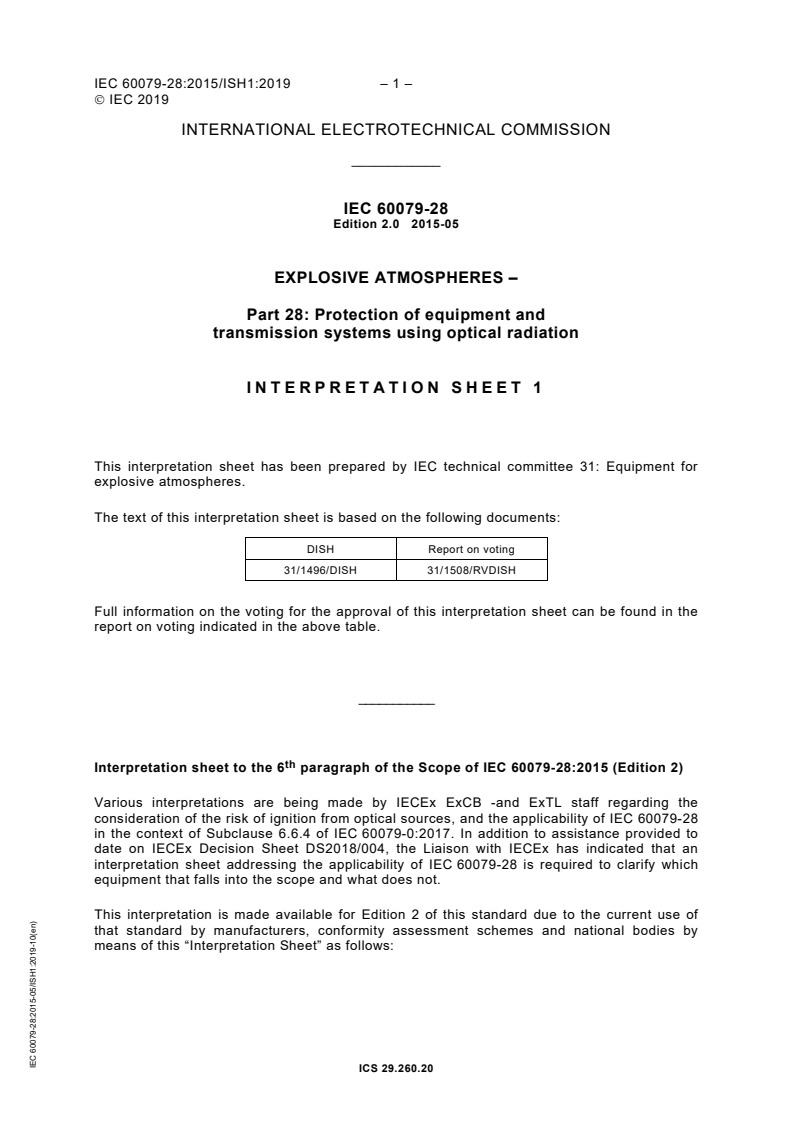
INTERNATIONAL ELECTROTECHNICAL COMMISSION
____________
IEC 60079-28
Edition 2.0 2015-05
EXPLOSIVE ATMOSPHERES –
Part 28: Protection of equipment and
transmission systems using optical radiation
INTERPRETATION SHEET 1
This interpretation sheet has been prepared by IEC technical committee 31: Equipment for
explosive atmospheres.
The text of this interpretation sheet is based on the following documents:
DISH Report on voting
31/1496/DISH 31/1508/RVDISH
Full information on the voting for the approval of this interpretation sheet can be found in the
report on voting indicated in the above table.
___________
th
Interpretation sheet to the 6 paragraph of the Scope of IEC 60079-28:2015 (Edition 2)
Various interpretations are being made by IECEx ExCB -and ExTL staff regarding the
consideration of the risk of ignition from optical sources, and the applicability of IEC 60079-28
in the context of Subclause 6.6.4 of IEC 60079-0:2017. In addition to assistance provided to
date on IECEx Decision Sheet DS2018/004, the Liaison with IECEx has indicated that an
interpretation sheet addressing the applicability of IEC 60079-28 is required to clarify which
equipment that falls into the scope and what does not.
This interpretation is made available for Edition 2 of this standard due to the current use of
that standard by manufacturers, conformity assessment schemes and national bodies by
means of this “Interpretation Sheet” as follows:
ICS 29.260.20
– 2 – IEC 60079-28:2015/ISH1:2019
IEC 2019
Details of interpretation:
optical radiation
th
Interpretation of the 6 paragraph of the Scope:
th
Question: The 6 paragraph including the items 1) to 5) describes the equipment excepted
from the Scope of this standard. The understanding of the listed exceptions is ambiguous.
Therefore, it is possible that IEC 60079-28 is not applied in all situations where it is relevant.
In addition, the potential confusion can be compounded by the wording of the exceptions.
When should the requirements of IEC 60079-28 be applied to Ex Equipment, including
Equipment assemblies and Ex Components that include an optical radiation source based on
Subclause 6.6.4 “Lasers, luminaries, and other non-divergent continuous wave optical
sources” in IEC 60079-0:2017 (Edition 7)?
Interpretation:
This standard applies to
i) laser equipment; and
ii) optical fibre equipment; and
iii) any other convergent light sources or beams where light is focussed in one single point
within the hazardous area.
NOTE 2 Some optical elements such as lenses and reflectors are able to convert divergent light into a
convergent beam.
This standard does not apply to:
1) laser equipment for EPL Mb, Gb or Gc and Db or Dc applications which complies with
Class 1 limits in accordance with IEC 60825-1; or
NOTE 3 The referenced Class 1 limits are those that involve emission limits below 15 mW measured at a
distance from the optical radiation source in accordance with IEC 60825-1, with this measured distance
reflected in the Ex application.
2) divergent light sources or beams where light is not focussed within the hazardous area; or
3) Single or multiple optical fibre cables not part of optical fibre equipment if the cables:
a) comply with the relevant industrial standards, along with additional protective means,
e.g. robust cabling, conduit or raceway (for EPL Gb, Db, Mb, Gc or Dc); or
b) comply with the relevant industrial standards (for EPL Gc or Dc).; or
4) Optical radiation sources as defined in i. to iii. above where the optical radiation is fully
contained in an enclosure complying with one of the followings Types of Protection
suitable for the EPL, or the minimum ingress protection rating specified:
a) flameproof "d" enclosures (IEC 60079-1); or
NOTE 4 A flameproof “d” enclosure is suitable because an ignition due to optical radiation in combination
with absorbers inside the enclosure is contained.
b) pressurized "p" enclosures (IEC 60079-2); or
NOTE 5 A pressurized “p” enclosure is suitable because there is protection against ingress of an
explosive atmosphere.
c) restricted breathing “nR” enclosure (IEC 60079-15); or
NOTE 6 A restricted breathing “nR” enclosure is suitable because there is protection against ingress of
an explosive atmosphere.
d) dust protection "t" enclosures" (IEC 60079-31); or
NOTE 7 A dust protection “t” enclosure is suitable because there is protection against ingress of an
explosive dust atmosphere.
IEC 2019
e) an enclosure that provides a minimum ingress protection of IP 6X and where no
internal absorbers are to be expected and complying with “Tests of enclosures” in
IEC 60079-0.
NOTE 8 An enclosure of a minimum ingress protection of IP 6X and complying with “Tests of enclosures”
in IEC 60079-0 is suitable because there is protection against the ingress of absorbers. It is anticipated
that when the enclosures are opened, entrance of any absorbers is avoided.
– 2 – IEC 60079-28:2015 RLV © IEC 2015
CONTENTS
FOREWORD . 4
INTR ODUCTION . 8
1 Scope . 10
2 Normative references. 11
3 Terms and definitions . 12
4 General requirements . 15
4.1 Optical equipment .
4.2 Risk levels .
5 Types of protection . 16
5.1 General . 16
5.2 Requirements for inherently safe optical radiation “op is” . 17
5.2.1 General . 17
5.2.2 Continuous wave radiation . 17
5.2.3 Pulsed radiation . 21
5.2.4 Ignition tests . 23
5.2.5 Optical devices incorporating the inherently safe concept
Over-power/energy fault protection . 23
5.3 Requirements for protected optical radiation “op pr” . 24
5.3.1 General . 24
5.3.2 Radiation inside optical fibre or cable , etc. (no mechanical damage to
be expected) . 24
5.3.3 Radiation inside enclosures . 25
5.4 Optical radiation system with interlock with optical fibre breakage “op sh” . 25
5.5 Suitability of types of protection .
6 Type verifications and tests . 28
6.1 Test set-up for ignition tests . 28
6.1.1 General . 28
6.1.2 Energy and power measurements .
6.1.2 Test vessel . 28
6.1.3 Ignition criterion Criteria to determine ignition . 28
6.1.4 Mixture temperature .
6.1.5 Mixture pressure .
6.1.6 Safety factor .
6.2 Reference test Verification of suitability of test set-up for type tests . 29
6.2.1 Reference gas . 29
6.2.2 Reference absorber . 29
6.2.3 Reference test for continuous wave radiation and pulses above 1 s
duration . 29
6.2.4 Reference test for pulsed radiation below 1 ms pulse duration . 30
6.3 Test mixture Type tests . 30
6.3.1 Ignition tests with continuous wave radiation and pulses above 1 s
duration . 30
6.3.2 Ignition tests with single pulses less than 1 ms duration . 30
6.3.3 Tests for pulse trains and pulses from 1 ms to 1 s duration . 31
6.3.4 Absorber targets for type tests . 31
6.3.5 Test acceptance criteria and safety factors . 32
6.4 Tests for pulse trains and pulses between 1 ms and 1 s duration .
7 Marking . 32
7.1 General .
7.2 Marking information .
7.3 Examples of marking .
Annex A (normative informative) Reference test data . 34
Annex B (informative) Ignition mechanisms . 35
Annex C (normative) Ignition hazard assessment . 40
Annex D (informative) Typical optical fibre cable design . 42
Annex E (informative) Introduction of an alternative risk assessment method
encompassing “equipment protection levels” for Ex equipment .
Annex E (normative) Flow diagram for the assessment of pulses . 48
Bibliography . . 49
Figure 1 – Figure B.1 with limit lines for intermediate areas for non-combustible targets, T1 –
T4 atmospheres, apparatus group IIA, IIB or IIC
Figure 1 – Optical ignition delay times and safe boundary curve with safety factor of 2 . 26
Figure B.1 – Minimum radiant igniting power with inert absorber target (
=83 %, =93 %) and continuous wave-radiation of 1064 nm . 38
nm 805 nm
Figure B.2 – Minimum radiant igniting power with inert absorber target
( nm=83 %, nm=93 %) and continuous wave-radiation (PTB: 1064 nm,
1 064 805
HSL: 805 nm, [8]: 803 nm) for some n-alkanes . 39
Figure C.1 – Ignition hazard assessment . 40
Figure D.1 – Example Multi-Fibre Optical Cable Design For Heavy Duty Applications . 42
Figure D.2 – Typical Single Optical Fibre Cable Design . 42
Figure E.1 – Flow diagram for the assessment of pulses according to 5.2.3 . 48
Table 1 – Relationship between EPL and the probability of an ignition source .
Table 1 – EPLs achieved by application of types of protection for optical systems . 16
Table 2 – Safe optical power and irradiance for hazardous locations Group I and II
equipment, categorized by apparatus equipment group and temperature class . 17
Table 3 – Optical interlock availability or ignition risk reduction factor by EPL .
Table 4 – Application of types of protection for optic systems based on EPLs .
Table 3 – Safe optical power and irradiance for Group III equipment . 18
Table 4 – Safe limit values for intermediate area, Group I or II, constant power, T1 –
T4 atmospheres, equipment Groups IIA, IIB or IIC (Data derived from Figure B.1
including a safety factor) . . 19
Table A.1 – reference values for ignition tests with a mixture of propane in air at 40 °C
mixture temperature . . 34
Table B.1 – AIT (auto ignition temperature), MESG (maximum experimental safe gap)
and measured ignition powers of the chosen combustibles for inert absorbers as the
target material ( =83 %, =93) . 37
1 064 nm 805 nm
Table B.2 – Comparison of measured minimum igniting optical pulse energy
i,min
(Q ) at 90 m beam diameter with auto ignition temperatures (AIT) and
e,p
minimum ignition energies (MIE) from literature [9] at concentrations in percent by
volume () . 39
Table E.1 – Traditional relationship of EPLs to zones (no additional risk assessment) .
Table E.2 – Description of risk of ignition protection provided .
– 4 – IEC 60079-28:2015 RLV © IEC 2015
INTERNATIONAL ELECTROTECHNICAL COMMISSION
____________
EXPLOSIVE ATMOSPHERES –
Part 28: Protection of equipment and transmission
systems using optical radiation
FOREWORD
1) The International Electrotechnical Commission (IEC) is a worldwide organization for standardization comprising
all national electrotechnical committees (IEC National Committees). The object of IEC is to promote
international co-operation on all questions concerning standardization in the electrical and electronic fields. To
this end and in addition to other activities, IEC publishes International Standards, Technical Specifications,
Technical Reports, Publicly Available Specifications (PAS) and Guides (hereafter referred to as “IEC
Publication(s)”). Their preparation is entrusted to technical committees; any IEC National Committee interested
in the subject dealt with may participate in this preparatory work. International, governmental and non-
governmental organizations liaising with the IEC also participate in this preparation. IEC collaborates closely
with the International Organization for Standardization (ISO) in accordance with conditions determined by
agreement between the two organizations.
2) The formal decisions or agreements of IEC on technical matters express, as nearly as possible, an international
consensus of opinion on the relevant subjects since each technical committee has representation from all
interested IEC National Committees.
3) IEC Publications have the form of recommendations for international use and are accepted by IEC National
Committees in that sense. While all reasonable efforts are made to ensure that the technical content of IEC
Publications is accurate, IEC cannot be held responsible for the way in which they are used or for any
misinterpretation by any end user.
4) In order to promote international uniformity, IEC National Committees undertake to apply IEC Publications
transparently to the maximum extent possible in their national and regional publications. Any divergence
between any IEC Publication and the corresponding national or regional publication shall be clearly indicated in
the latter.
5) IEC itself does not provide any attestation of conformity. Independent certification bodies provide conformity
assessment services and, in some areas, access to IEC marks of conformity. IEC is not responsible for any
services carried out by independent certification bodies.
6) All users should ensure that they have the latest edition of this publication.
7) No liability shall attach to IEC or its directors, employees, servants or agents including individual experts and
members of its technical committees and IEC National Committees for any personal injury, property damage or
other damage of any nature whatsoever, whether direct or indirect, or for costs (including legal fees) and
expenses arising out of the publication, use of, or reliance upon, this IEC Publication or any other IEC
Publications.
8) Attention is drawn to the Normative references cited in this publication. Use of the referenced publications is
indispensable for the correct application of this publication.
9) Attention is drawn to the possibility that some of the elements of this IEC Publication may be the subject of
patent rights. IEC shall not be held responsible for identifying any or all such patent rights.
This redline version of the official IEC Standard allows the user to identify the changes
made to the previous edition. A vertical bar appears in the margin wherever a change
has been made. Additions are in green text, deletions are in strikethrough red text.
International Standard IEC 60079-28 has been prepared by IEC technical committee 31:
Equipment for explosive atmospheres.
This second edition cancels and replaces the first edition, published in 2006, and constitutes
a technical revision.
The significance of the changes between IEC 60079-28, Edition 2.0 (2015) and IEC 60079-28,
Edition 1.0 (2006), is as listed below:
Significance of changes with respect to IEC 60079-28:2006
Type
Significant Changes Clause Minor and Extension Major
editorial technical
changes changes
Scope: Expansion to include Group III and EPLs Da, Db and x
Dc
Scope: Clarification and list of exclusions for optical 1 x
radiation sources
Normative references: Deletion of IEC 60079-10, and 2 x
addition of IEC 60050-426 and 60050-731
Terms and definitions: Some definitions not used in the 3 x
standard deleted. New definitions added.
General requirements: Introduction of an ignition hazard 4 x
assessment moved to 4, statement for presence of
absorbers added, Explanation of EPLs deleted
Table 1: EPLs versus protection types moved from 5.5 to 5.1 x x
5.1, table modified and extended
Structure of Table 2 changed and extended explanation in 5.2.2.1 x
the notes, but with the same limit values
Table 3 for Group III added 5.2.2.1 x
Table 4 replaces Figure 1 for better application 5.2.2.1 x
Detailed requirements for the measurement of optical power 5.2.2.2 x
added
Detailed requirements for the measurement of optical 5.2.2.3 x
irradiance added
Requirements for the assessment of optical pulses for 5.2.3.1 x
Group II much more detailed 5.2.3.2
5.2.3.3
5.2.3.4
Requirements for the assessment of optical pulses for 5.2.3.5 x
Group I and Group III added
Ignition tests: Notes 1 and 2 added 5.2.4 x
Over-power/energy fault protection: Title changed and 5.2.5 x
wording modified for clarity
Radiation inside optical fibre or cable: requirements added, 5.3.2 C1
e.g. pull test
Radiation inside enclosures: IP 6X enclosures, “p” or “t” 5.3.3 x
enclosures added
Optical system with interlock “op sh” 5.4 x
Table 3 deleted, Figure 1 with interlock cutoff delay times
added
Type verifications and tests: structure changed (editorial, 6 x
without changing the requirements)
Marking: markings required by IEC 60079-0 deleted. 7 x
Examples of marking: example with combination of op is
with other types of protection added
– 6 – IEC 60079-28:2015 RLV © IEC 2015
Type
Significant Changes Clause Minor and Extension Major
editorial technical
changes changes
Ignition hazard assessment: Flow chart in Figure C.1 Annex C x
modified for better understanding
Old Annex E (Introduction of EPLs) deleted. New Annex E Annex E x
provides a flow chart for the assessment of pulses
according to 5.2.3
Relevant IEC-Standards moved to Clause 2 Formerly x
Annex F
Explanation of the Types of Significant Changes:
A) Definitions
1) Minor and editorial changes: – Clarification
– Decrease of technical requirements
– Minor technical change
– Editorial corrections
These are changes which modify requirements in an editorial or a minor technical way. They include changes of
the wording to clarify technical requirements without any technical change, or a reduction in level of existing
requirement.
2) Extension: Addition of technical options
These are changes which add new or modify existing technical requirements, in a way that new options are given,
but without increasing requirements for equipment that was fully compliant with the previous standard. Therefore,
these will not have to be considered for products in conformity with the preceding edition.
3) Major technical changes: – addition of technical requirements
– increase of technical requirements
These are changes to technical requirements (addition, increase of the level or removal) made in a way that a
product in conformity with the preceding edition will not always be able to fulfil the requirements given in the later
edition. These changes have to be considered for products in conformity with the preceding edition. For these
changes additional information is provided in clause B) below.
Note These changes represent current technological knowledge. However, these changes should not normally
have an influence on equipment already placed on the market.
B) Information about the background of ‘Major technical changes’
C1 For the protection concept “protected radiation op pr” some requirements like a pull test for optical fibres or
cables have been added.
The text of this standard is based on the following documents:
FDIS Report on voting
31/1178/FDIS 31/1193/RVD
Full information on the voting for the approval of this standard can be found in the report on
voting indicated in the above table.
This publication has been drafted in accordance with the ISO/IEC Directives, Part 2.
A list of all parts in the IEC 60079 series, published under the general title Explosive
atmospheres, can be found on the IEC website.
The committee has decided that the contents of this publication will remain unchanged until
the stability date indicated on the IEC web site under "http://webstore.iec.ch" in the data
related to the specific publication. At this date, the publication will be
reconfirmed,
withdrawn,
replaced by a revised edition, or
amended.
The contents of the interpretation sheet of November 2019 have been included in this copy.
IMPORTANT – The 'colour inside' logo on the cover page of this publication indicates
that it contains colours which are considered to be useful for the correct
understanding of its contents. Users should therefore print this document using a
colour printer.
– 8 – IEC 60079-28:2015 RLV © IEC 2015
INTRODUCTION
Optical equipment in the form of lamps, lasers, LEDs, optical fibers etc. is increasingly used
for communications, surveying, sensing and measurement. In material processing, optical
radiation of high irradiance is used. Often Where the installation is inside or close to
potentially explosive atmospheres, and the radiation from such equipment may pass through
these atmospheres. Depending on the characteristics of the radiation it might then be able to
ignite a surrounding explosive atmosphere. The presence or absence of an additional
absorber, such as particles, significantly influences the ignition.
There are four possible ignition mechanisms:
a) Optical radiation is absorbed by surfaces or particles, causing them to heat up, and under
certain circumstances this may allow them to attain a temperature which will ignite a
surrounding explosive atmosphere.
b) Thermal ignition of a gas volume, where the optical wavelength matches an absorption
band of the gas or vapour.
c) Photochemical ignition due to photo dissociation of oxygen molecules by radiation in the
ultraviolet wavelength range.
d) Direct laser induced breakdown of the gas or vapour at the focus of a strong beam,
producing plasma and a shock wave both eventually acting as ignition source. These
processes can be supported by a solid material close to the breakdown point.
The most likely case of ignition occurring in practice with lowest radiation power of ignition
capability is case a). Under some conditions for pulsed radiation, case d) also will become
relevant. These two cases are addressed in this standard. Although one should be aware of
ignition mechanism b) and c) explained above, they are not addressed in this standard due to
the very special situation with ultraviolet radiation and with the absorption properties of most
gases (see Annex A).
This standard describes precautions and requirements to be taken when using optical
radiation transmitting equipment in explosive gas or dust atmospheres. It also outlines a test
method, which can be used in special cases to verify that a beam is not ignition capable under
selected test conditions, if the optical limit values cannot be guaranteed by assessment or
beam strength measurement.
There is equipment outside the scope of this standard because the optical radiation
associated with this equipment is considered not to be a risk of ignition for the following
reasons:
– due to low radiated power or divergent light, and
– as hot surfaces created due to a too small distance from the radiation source to an
absorber which is already considered by general requirements for lighting equipment.
Optical equipment is used in most cases in conjunction with electrical equipment, for which
clear and detailed requirements and standards for use in potentially explosive atmospheres
exist. One purpose of this standard is to inform industry about potential ignition hazards
associated with the use of optical systems in hazardous locations as defined in IEC 60079-10
and the adequate protection methods.
In most cases the optical equipment is associated with electrical equipment and where the
electrical equipment is located in a hazardous area then other parts of the IEC 60079 series
will also apply. This standard provides guidance for:
a) Ignition hazards associated with optical systems in explosive atmospheres as defined in
IEC 60079-10-1 and IEC 60079-10-2, and,
b) Control of ignition hazards from equipment using optical radiation in explosive
atmospheres.
This standard is related to the integrated system used to control the ignition hazard from
equipment using optical radiation in hazardous locations explosive atmospheres.
– 10 – IEC 60079-28:2015 RLV © IEC 2015
EXPLOSIVE ATMOSPHERES –
Part 28: Protection of equipment and transmission
systems using optical radiation
1 Scope
This part of IEC 60079 explains the potential ignition hazard from equipment using optical
radiation intended for use in explosive gas atmospheres. It also covers equipment, which
itself is located outside but its emitted optical radiation enters such atmospheres. It describes
precautions and requirements to be taken when using optical radiation transmitting equipment
in explosive gas atmospheres. It also outlines a test method, which can be used to verify a
beam is not ignition capable under selected test conditions, if the optical limit values cannot
be guaranteed by assessment or beam strength measurement.
This part of IEC 60079 specifies the requirements, testing and marking of equipment emitting
optical radiation intended for use in explosive atmospheres. It also covers equipment located
outside the explosive atmosphere or protected by a Type of Protection listed in IEC 60079-0,
but which generates optical radiation that is intended to enter an explosive atmosphere. It
covers Groups I, II and III, and EPLs Ga, Gb, Gc, Da, Db, Dc, Ma and Mb.
This standard contains requirements for optical radiation in the wavelength range from
380 nm to 10 µm. It covers the following ignition mechanisms:
• Optical radiation is absorbed by surfaces or particles, causing them to heat up, and under
certain circumstances this may allow them to attain a temperature which will ignite a
surrounding explosive atmosphere.
• In rare special cases, direct laser induced breakdown of the gas at the focus of a strong
beam, producing plasma and a shock wave both eventually acting as ignition source.
These processes can be supported by a solid material close to the breakdown point.
NOTE 1 See a) and d) of the introduction.
This standard does not cover ignition by ultraviolet radiation and by absorption of the radiation
in the explosive mixture itself. Explosive absorbers or absorbers that contain their own
oxidizer as well as catalytic absorbers are also outside the scope of this standard.
This standard specifies requirements for equipment intended for use under atmospheric
conditions.
This standard supplements and modifies the general requirements of IEC 60079-0. Where a
requirement of this standard conflicts with a requirement of IEC 60079-0, the requirement of
this standard takes precedence.
NOTE 2 Although one should be aware of ignition mechanism b) and c) explained in the introduction, they are not
addressed in this standard due to the very special situation with ultraviolet radiation and with the absorption
properties of most gases (see Annex B).
NOTE 3 Safety requirements to reduce human exposure hazards from fibre optic communication systems are
found in IEC 60825-2:2000.
NOTE 4 Types of protection "op is", "op pr", and "op sh" can provide equipment protection levels (EPL) Ga, Gb, or
Gc. For further information, see Annex E.
This standard applies to optical fibre equipment and optical equipment, including LED and
laser equipment, with the exception of the equipment detailed below:
1) Non-array divergent LEDs used for example to show equipment status or backlight
function.
2) All luminaires (fixed, portable or transportable), hand lights and caplights; intended to be
supplied by mains (with or without galvanic isolation) or powered by batteries:
– with continuous divergent light sources (for all EPLs),
– with LED light sources (for EPL Gc or Dc only).
NOTE 2 Continuous divergent LED light sources for other than EPL Gc or Dc are not excluded from the
standard due to the uncertainty of potential ignition concerns regarding high irradiance.
3) Optical radiation sources for EPL Mb, Gb or Gc and Db or Dc applications which comply
with Class 1 limits in accordance with IEC 60825-1.
NOTE 3 The referenced Class 1 limits are those that involve emission limits below 15 mW measured at a
distance from the optical radiation source in accordance with IEC 60825-1, with this measured distance
reflected in the Ex application.
4) Single or multiple optical fibre cables not part of optical fibre equipment if the cables:
– comply with the relevant industrial standards, along with additional protective means,
e.g. robust cabling, conduit or raceway (for EPL Gb, Db, Mb, Gc or Dc),
– comply with the relevant industrial standards (for EPL Gc or Dc).
5) Enclosed equipment involving an enclosure that fully contains the optical radiation and
that complies with a suitable type of protection as required by the involved EPL, with the
enclosure complying with one of the following conditions:
– An enclosure for which an ignition due to optical radiation in combination with
absorbers inside the enclosure would be acceptable such as flameproof "d" enclosures
(IEC 60079-1), or
– An enclosure for which protection regarding ingress of an explosive gas atmosphere is
provided, such as pressurized "p" enclosures (IEC 60079-2), restricted breathing “nR”
enclosure (IEC 60079-15), or
– An enclosure for which protection regarding ingress of an explosive dust atmosphere is
provided, such as dust protection "t" enclosures" (IEC 60079-31), or
– An enclosure for which protection regarding ingress of absorbers is provided (such as
IP 6X enclosures) and where no internal absorbers are to be expected.
NOTE 4 For these scope exclusions based on enclosure constructions, it is anticipated that the enclosures are
not opened in the explosive atmosphere, so that ingress is protected.
2 Normative references
The following documents, in whole or in part, are normatively referenced in this document and
are indispensable for its application. For dated references, only the edition cited applies. For
undated references, the latest edition of the referenced document (including any
amendments) applies.
IEC 60050, International Electrotechnical Vocabulary
IEC 60079 (all parts), Electrical apparatus for explosive gas atmospheres
IEC 60079-0, Electrical apparatus for explosive gas atmospheres Explosive atmospheres –
Part 0: Equipment – General requirements
IEC 60079-1, Explosive atmospheres – Part 1: Equipment protection by flameproof
enclosures "d"
IEC 60079-10, Electrical apparatus for explosive gas atmospheres – Part 10: Classification of
hazardous areas
– 12 – IEC 60079-28:2015 RLV © IEC 2015
IEC 60079-11, Explosive atmospheres – Part 11: Equipment protection by intrinsic safety "i"
IEC 60079-15, Explosive atmospheres – Part 15: Equipment protection by type of
protection "n"
IEC 60825-2, Safety of laser products – Part 2: Safety of optical fibre communication systems
(OFCS)
IEC 61508 (all parts), Functional safety of electrical/electronic/programmable electronic
safety-related systems
IEC 61511 (all parts), Functional safety – Safety instrumented systems for the process
industry sector
3 Terms and definitions
For the purposes of this document, the terms and definitions given in IEC 60050-426,
IEC 60050-731, IEC 60079-0 and the following apply.
NOTE Additional definitions applicable to explosive atmospheres can be found in IEC 60050-426 [1] .
3.1
absorption
in a propagation medium, the conversion of electromagnetic wave energy into another form of
energy, for instance heat
[SOURCE: IEC 60050-731:1991, 731-03-14]
3.2
beam diameter (or beam width)
distance between two diametrically opposed points where the irradiance is a specified fraction
of the beam's peak irradiance
Note 1 to entry: Most commonly applied to beams that are circular or nearly circular in cross section.
[SOURCE: IEC 60050-731:1991, 731-01-35]
3.3
beam strength
optical beam’s power, irradiance, energy, or radiant exposure
3.4
core
central region of an optical fibre through which most of the optical power is transmitted
[SOURCE: IEC 60050-731:1991, 731-02-04]
3.5
cladding
dielectric material of an optical fibre surrounding the core
[SOURCE: IEC 60050-731:1991, 731-02-05]
___________
Figures in square brackets refer to the bibliography.
3.6
fibre bundle
assembly of unbuffered optical fibres
[SOURCE: IEC 60050-731:1991, 731-04-09]
3.7
fibre optic terminal device
assembly including one or more opto-electronic devices which converts an electrical signal
into an optical signal, and/or vice versa, which is designed to be connected to at least one
optical fibre
Note 1 to entry: A fibre optic terminal device always has one or more integral fibre optic connector(s) or optical
fibre pigtail(s).
[SOURCE: IEC 60050-731:1991, 731-06-44]
3.8
optical radiation types of protection
3.8.1
inherently safe optical radiation
“op is”
visible or infrared radiation that is incapable of producing sufficient energy under normal or
specified fault conditions to ignite a specific hazardous atmospheric mixture explosive
atmosphere
Note 1 to entry: This definition is analogous to the term “intrinsically safe” applied to electrical circuits.
3.8.2
protected optical radiation
“op pr”
visible or infrared radiation that is confined inside optical fibre or other transmission medium
under normal constructions or constructions with additional mechanical protection based on
the assumption that there is no escape of radiation from the confinement
3.8.3
optical system with interlock
“op sh”
system to confine visible or infrared radiation inside optical fibre or other transmission
medium with interlock cut-off provided to reliably reduce the unconfined beam strength to safe
levels within a specified time in case the confinement fails and the radiation becomes
unconfined
3.9
irradiance
DEPRECATED: intensity
radiant power incident on an element of a surface divided by the area of that element
[SOURCE: IEC 60050-731:1991, 731-1-25]
3.10
light (or visible radiation)
optical radiation capable of causing a visual sensation directly on a human being
Note 1 to entry: Nominally covering the wavelength in vacuum range of 380 nm to 800 nm.
Note 2 to entry: In the laser and optical communication fields, custom and practice in the English language have
extended usage of the term light to include the much broader portion of the electromagnetic spectrum that can be
handled by the basic optical techniques used for the visible spectrum.
– 14 – IEC 60079-28:2015 RLV © IEC 2015
[SOURCE: IEC 60050-731:1991, 731-01-04]
3.11
minimum ignition energy
MIE
lowest electrical energy stored in a capacitor which upon discharge is sufficient to effect
ignition of the most ignitable explosive atmosphere under specified test conditions
3.11
optical fibre
filament shaped optical waveguide made of dielectric materials
[SOURCE: IEC 60050-731:1991, 731-02-01])
3.12
optical fibre cable
assembly comprising one or more optical fibres or fibre bundles inside a common covering
designed to protect them against mechanical stresses and other environmental influences
while retaining the transmission qualities of the fibres
[SOURCE: IEC 60050-731:1991, 731-04-01]
3.14
optical fibre communication system
OFCS
engineered, end-to-end assembly for the generation, transference and reception of optical
radiation arising from lasers, LEDs or optical amplifiers, in which the transference is by means
of optical fibre for communication and/or control purposes
3.15
free space optical communication system
FSOCS
an installed, portable, or temporarily mounted, through-the-air system typically used, intended
or promoted for voice, data or multimedia
...
IEC 60079-28 ®
Edition 2.0 2015-05
INTERNATIONAL
STANDARD
NORME
INTERNATIONALE
colour
inside
Explosive atmospheres –
Part 28: Protection of equipment and transmission systems using optical
radiation
Atmosphères explosives –
Partie 28: Protection du matériel et des systèmes de transmission utilisant le
rayonnement optique
All rights reserved. Unless otherwise specified, no part of this publication may be reproduced or utilized in any form
or by any means, electronic or mechanical, including photocopying and microfilm, without permission in writing from
either IEC or IEC's member National Committee in the country of the requester. If you have any questions about IEC
copyright or have an enquiry about obtaining additional rights to this publication, please contact the address below or
your local IEC member National Committee for further information.
Droits de reproduction réservés. Sauf indication contraire, aucune partie de cette publication ne peut être reproduite
ni utilisée sous quelque forme que ce soit et par aucun procédé, électronique ou mécanique, y compris la photocopie
et les microfilms, sans l'accord écrit de l'IEC ou du Comité national de l'IEC du pays du demandeur. Si vous avez des
questions sur le copyright de l'IEC ou si vous désirez obtenir des droits supplémentaires sur cette publication, utilisez
les coordonnées ci-après ou contactez le Comité national de l'IEC de votre pays de résidence.
IEC Central Office Tel.: +41 22 919 02 11
3, rue de Varembé Fax: +41 22 919 03 00
CH-1211 Geneva 20 info@iec.ch
Switzerland www.iec.ch
About the IEC
The International Electrotechnical Commission (IEC) is the leading global organization that prepares and publishes
International Standards for all electrical, electronic and related technologies.
About IEC publications
The technical content of IEC publications is kept under constant review by the IEC. Please make sure that you have the
latest edition, a corrigenda or an amendment might have been published.
IEC Catalogue - webstore.iec.ch/catalogue Electropedia - www.electropedia.org
The stand-alone application for consulting the entire The world's leading online dictionary of electronic and
bibliographical information on IEC International Standards, electrical terms containing more than 30 000 terms and
Technical Specifications, Technical Reports and other definitions in English and French, with equivalent terms in 15
documents. Available for PC, Mac OS, Android Tablets and additional languages. Also known as the International
iPad. Electrotechnical Vocabulary (IEV) online.
IEC publications search - www.iec.ch/searchpub IEC Glossary - std.iec.ch/glossary
The advanced search enables to find IEC publications by a More than 60 000 electrotechnical terminology entries in
variety of criteria (reference number, text, technical English and French extracted from the Terms and Definitions
committee,…). It also gives information on projects, replaced clause of IEC publications issued since 2002. Some entries
and withdrawn publications. have been collected from earlier publications of IEC TC 37,
77, 86 and CISPR.
IEC Just Published - webstore.iec.ch/justpublished
Stay up to date on all new IEC publications. Just Published IEC Customer Service Centre - webstore.iec.ch/csc
details all new publications released. Available online and If you wish to give us your feedback on this publication or
also once a month by email. need further assistance, please contact the Customer Service
Centre: csc@iec.ch.
A propos de l'IEC
La Commission Electrotechnique Internationale (IEC) est la première organisation mondiale qui élabore et publie des
Normes internationales pour tout ce qui a trait à l'électricité, à l'électronique et aux technologies apparentées.
A propos des publications IEC
Le contenu technique des publications IEC est constamment revu. Veuillez vous assurer que vous possédez l’édition la
plus récente, un corrigendum ou amendement peut avoir été publié.
Catalogue IEC - webstore.iec.ch/catalogue Electropedia - www.electropedia.org
Application autonome pour consulter tous les renseignements
Le premier dictionnaire en ligne de termes électroniques et
bibliographiques sur les Normes internationales,
électriques. Il contient plus de 30 000 termes et définitions en
Spécifications techniques, Rapports techniques et autres
anglais et en français, ainsi que les termes équivalents dans
documents de l'IEC. Disponible pour PC, Mac OS, tablettes
15 langues additionnelles. Egalement appelé Vocabulaire
Android et iPad.
Electrotechnique International (IEV) en ligne.
Recherche de publications IEC - www.iec.ch/searchpub
Glossaire IEC - std.iec.ch/glossary
Plus de 60 000 entrées terminologiques électrotechniques, en
La recherche avancée permet de trouver des publications IEC
en utilisant différents critères (numéro de référence, texte, anglais et en français, extraites des articles Termes et
comité d’études,…). Elle donne aussi des informations sur les Définitions des publications IEC parues depuis 2002. Plus
projets et les publications remplacées ou retirées. certaines entrées antérieures extraites des publications des
CE 37, 77, 86 et CISPR de l'IEC.
IEC Just Published - webstore.iec.ch/justpublished
Service Clients - webstore.iec.ch/csc
Restez informé sur les nouvelles publications IEC. Just
Published détaille les nouvelles publications parues. Si vous désirez nous donner des commentaires sur cette
Disponible en ligne et aussi une fois par mois par email. publication ou si vous avez des questions contactez-nous:
csc@iec.ch.
IEC 60079-28 ®
Edition 2.0 2015-05
INTERNATIONAL
STANDARD
NORME
INTERNATIONALE
colour
inside
Explosive atmospheres –
Part 28: Protection of equipment and transmission systems using optical
radiation
Atmosphères explosives –
Partie 28: Protection du matériel et des systèmes de transmission utilisant le
rayonnement optique
INTERNATIONAL
ELECTROTECHNICAL
COMMISSION
COMMISSION
ELECTROTECHNIQUE
INTERNATIONALE
ICS 29.260.20 ISBN 978-2-8322-2679-7
IEC 2019
INTERNATIONAL ELECTROTECHNICAL COMMISSION
____________
IEC 60079-28
Edition 2.0 2015-05
EXPLOSIVE ATMOSPHERES –
Part 28: Protection of equipment and
transmission systems using optical radiation
INTERPRETATION SHEET 1
This interpretation sheet has been prepared by IEC technical committee 31: Equipment for
explosive atmospheres.
The text of this interpretation sheet is based on the following documents:
DISH Report on voting
31/1496/DISH 31/1508/RVDISH
Full information on the voting for the approval of this interpretation sheet can be found in the
report on voting indicated in the above table.
___________
th
Interpretation sheet to the 6 paragraph of the Scope of IEC 60079-28:2015 (Edition 2)
Various interpretations are being made by IECEx ExCB -and ExTL staff regarding the
consideration of the risk of ignition from optical sources, and the applicability of IEC 60079-28
in the context of Subclause 6.6.4 of IEC 60079-0:2017. In addition to assistance provided to
date on IECEx Decision Sheet DS2018/004, the Liaison with IECEx has indicated that an
interpretation sheet addressing the applicability of IEC 60079-28 is required to clarify which
equipment that falls into the scope and what does not.
This interpretation is made available for Edition 2 of this standard due to the current use of
that standard by manufacturers, conformity assessment schemes and national bodies by
means of this “Interpretation Sheet” as follows:
ICS 29.260.20
– 2 – IEC 60079-28:2015/ISH1:2019
IEC 2019
Details of interpretation:
optical radiation
th
Interpretation of the 6 paragraph of the Scope:
th
Question: The 6 paragraph including the items 1) to 5) describes the equipment excepted
from the Scope of this standard. The understanding of the listed exceptions is ambiguous.
Therefore, it is possible that IEC 60079-28 is not applied in all situations where it is relevant.
In addition, the potential confusion can be compounded by the wording of the exceptions.
When should the requirements of IEC 60079-28 be applied to Ex Equipment, including
Equipment assemblies and Ex Components that include an optical radiation source based on
Subclause 6.6.4 “Lasers, luminaries, and other non-divergent continuous wave optical
sources” in IEC 60079-0:2017 (Edition 7)?
Interpretation:
This standard applies to
i) laser equipment; and
ii) optical fibre equipment; and
iii) any other convergent light sources or beams where light is focussed in one single point
within the hazardous area.
NOTE 2 Some optical elements such as lenses and reflectors are able to convert divergent light into a
convergent beam.
This standard does not apply to:
1) laser equipment for EPL Mb, Gb or Gc and Db or Dc applications which complies with
Class 1 limits in accordance with IEC 60825-1; or
NOTE 3 The referenced Class 1 limits are those that involve emission limits below 15 mW measured at a
distance from the optical radiation source in accordance with IEC 60825-1, with this measured distance
reflected in the Ex application.
2) divergent light sources or beams where light is not focussed within the hazardous area; or
3) Single or multiple optical fibre cables not part of optical fibre equipment if the cables:
a) comply with the relevant industrial standards, along with additional protective means,
e.g. robust cabling, conduit or raceway (for EPL Gb, Db, Mb, Gc or Dc); or
b) comply with the relevant industrial standards (for EPL Gc or Dc).; or
4) Optical radiation sources as defined in i. to iii. above where the optical radiation is fully
contained in an enclosure complying with one of the followings Types of Protection
suitable for the EPL, or the minimum ingress protection rating specified:
a) flameproof "d" enclosures (IEC 60079-1); or
NOTE 4 A flameproof “d” enclosure is suitable because an ignition due to optical radiation in combination
with absorbers inside the enclosure is contained.
b) pressurized "p" enclosures (IEC 60079-2); or
NOTE 5 A pressurized “p” enclosure is suitable because there is protection against ingress of an
explosive atmosphere.
c) restricted breathing “nR” enclosure (IEC 60079-15); or
NOTE 6 A restricted breathing “nR” enclosure is suitable because there is protection against ingress of
an explosive atmosphere.
d) dust protection "t" enclosures" (IEC 60079-31); or
NOTE 7 A dust protection “t” enclosure is suitable because there is protection against ingress of an
explosive dust atmosphere.
IEC 2019
e) an enclosure that provides a minimum ingress protection of IP 6X and where no
internal absorbers are to be expected and complying with “Tests of enclosures” in
IEC 60079-0.
NOTE 8 An enclosure of a minimum ingress protection of IP 6X and complying with “Tests of enclosures”
in IEC 60079-0 is suitable because there is protection against the ingress of absorbers. It is anticipated
that when the enclosures are opened, entrance of any absorbers is avoided.
– 2 – IEC 60079-28:2015 © IEC 2015
CONTENTS
FOREWORD . 4
INTRODUCTION . 8
1 Scope . 9
2 Normative references . 10
3 Terms and definitions . 10
4 General requirements . 13
5 Types of protection . 13
5.1 General . 13
5.2 Requirements for inherently safe optical radiation “op is” . 14
5.2.1 General . 14
5.2.2 Continuous wave radiation . 14
5.2.3 Pulsed radiation . 18
5.2.4 Ignition tests . 19
5.2.5 Over-power/energy fault protection . 19
5.3 Requirements for protected optical radiation “op pr” . 20
5.3.1 General . 20
5.3.2 Radiation inside optical fibre or cable . 20
5.3.3 Radiation inside enclosures . 21
5.4 Optical system with interlock “op sh” . 21
6 Type verifications and tests . 22
6.1 Test set-up for ignition tests . 22
6.1.1 General . 22
6.1.2 Test vessel . 22
6.1.3 Criteria to determine ignition . 23
6.2 Verification of suitability of test set-up for type tests . 23
6.2.1 Reference gas . 23
6.2.2 Reference absorber . 23
6.2.3 Reference test for continuous wave radiation and pulses above 1 s
duration . 23
6.2.4 Reference test for pulsed radiation below 1 ms pulse duration . 23
6.3 Type tests . 24
6.3.1 Ignition tests with continuous wave radiation and pulses above 1 s
duration . 24
6.3.2 Ignition tests with single pulses less than 1 ms duration . 24
6.3.3 Tests for pulse trains and pulses from 1 ms to 1 s duration . 24
6.3.4 Absorber targets for type tests . 24
6.3.5 Test acceptance criteria and safety factors . 25
7 Marking . 25
Annex A (informative) Reference test data . 27
Annex B (informative) Ignition mechanisms . 28
Annex C (normative) Ignition hazard assessment . 33
Annex D (informative) Typical optical fibre cable design . 35
Annex E (normative) Flow diagram for the assessment of pulses . 36
Bibliography . 37
Figure 1 – Optical ignition delay times and safe boundary curve with safety factor of 2 . 22
Figure B.1 – Minimum radiant igniting power with inert absorber target (α
=83 %, α =93 %) and continuous wave-radiation of 1064 nm . 31
nm 805 nm
Figure B.2 – Minimum radiant igniting power with inert absorber target
(α nm=83 %, α nm=93 %) and continuous wave-radiation (PTB: 1064 nm,
1 064 805
HSL: 805 nm, [8]: 803 nm) for some n-alkanes . 32
Figure C.1 – Ignition hazard assessment . 33
Figure D.1 – Example Multi-Fibre Optical Cable Design For Heavy Duty Applications . 35
Figure D.2 – Typical Single Optical Fibre Cable Design . 35
Figure E.1 – Flow diagram for the assessment of pulses according to 5.2.3 . 36
Table 1 – EPLs achieved by application of types of protection for optical systems . 13
Table 2 – Safe optical power and irradiance for Group I and II equipment, categorized
by Equipment Group and temperature class . 15
Table 3 – Safe optical power and irradiance for Group III equipment . 15
Table 4 – Safe limit values for intermediate area, Group I or II, constant power, T1 –
T4 atmospheres, equipment Groups IIA, IIB or IIC (Data derived from Figure B.1
including a safety factor) . 16
Table A.1 – Reference values for ignition tests with a mixture of propane in air at
40 °C mixture temperature . 27
Table B.1 – AIT (auto ignition temperature), MESG (maximum experimental safe gap)
and measured ignition powers of the chosen combustibles for inert absorbers as the
target material (α =83 %, α =93) . 30
1 064 nm 805 nm
Table B.2 – Comparison of measured minimum igniting optical pulse energy
i,min
(Q ) at 90 µm beam diameter with auto ignition temperatures (AIT) and
e,p
minimum ignition energies (MIE) from literature [9] at concentrations in percent by
volume (ϕ) . 32
– 4 – IEC 60079-28:2015 © IEC 2015
INTERNATIONAL ELECTROTECHNICAL COMMISSION
____________
EXPLOSIVE ATMOSPHERES –
Part 28: Protection of equipment and transmission
systems using optical radiation
FOREWORD
1) The International Electrotechnical Commission (IEC) is a worldwide organization for standardization comprising
all national electrotechnical committees (IEC National Committees). The object of IEC is to promote
international co-operation on all questions concerning standardization in the electrical and electronic fields. To
this end and in addition to other activities, IEC publishes International Standards, Technical Specifications,
Technical Reports, Publicly Available Specifications (PAS) and Guides (hereafter referred to as “IEC
Publication(s)”). Their preparation is entrusted to technical committees; any IEC National Committee interested
in the subject dealt with may participate in this preparatory work. International, governmental and non-
governmental organizations liaising with the IEC also participate in this preparation. IEC collaborates closely
with the International Organization for Standardization (ISO) in accordance with conditions determined by
agreement between the two organizations.
2) The formal decisions or agreements of IEC on technical matters express, as nearly as possible, an international
consensus of opinion on the relevant subjects since each technical committee has representation from all
interested IEC National Committees.
3) IEC Publications have the form of recommendations for international use and are accepted by IEC National
Committees in that sense. While all reasonable efforts are made to ensure that the technical content of IEC
Publications is accurate, IEC cannot be held responsible for the way in which they are used or for any
misinterpretation by any end user.
4) In order to promote international uniformity, IEC National Committees undertake to apply IEC Publications
transparently to the maximum extent possible in their national and regional publications. Any divergence
between any IEC Publication and the corresponding national or regional publication shall be clearly indicated in
the latter.
5) IEC itself does not provide any attestation of conformity. Independent certification bodies provide conformity
assessment services and, in some areas, access to IEC marks of conformity. IEC is not responsible for any
services carried out by independent certification bodies.
6) All users should ensure that they have the latest edition of this publication.
7) No liability shall attach to IEC or its directors, employees, servants or agents including individual experts and
members of its technical committees and IEC National Committees for any personal injury, property damage or
other damage of any nature whatsoever, whether direct or indirect, or for costs (including legal fees) and
expenses arising out of the publication, use of, or reliance upon, this IEC Publication or any other IEC
Publications.
8) Attention is drawn to the Normative references cited in this publication. Use of the referenced publications is
indispensable for the correct application of this publication.
9) Attention is drawn to the possibility that some of the elements of this IEC Publication may be the subject of
patent rights. IEC shall not be held responsible for identifying any or all such patent rights.
International Standard IEC 60079-28 has been prepared by IEC technical committee 31:
Equipment for explosive atmospheres.
This second edition cancels and replaces the first edition, published in 2006, and constitutes
a technical revision.
The significance of the changes between IEC 60079-28, Edition 2.0 (2015) and IEC 60079-28,
Edition 1.0 (2006), is as listed below:
Significance of changes with respect to IEC 60079-28:2006
Type
Significant Changes Clause Minor and Extension Major
editorial technical
changes changes
Scope: Expansion to include Group III and EPLs Da, Db and x
Dc
Scope: Clarification and list of exclusions for optical 1 x
radiation sources
Normative references: Deletion of IEC 60079-10, and 2 x
addition of IEC 60050-426 and 60050-731
Terms and definitions: Some definitions not used in the 3 x
standard deleted. New definitions added.
General requirements: Introduction of an ignition hazard 4 x
assessment moved to 4, statement for presence of
absorbers added, Explanation of EPLs deleted
Table 1: EPLs versus protection types moved from 5.5 to 5.1 x x
5.1, table modified and extended
Structure of Table 2 changed and extended explanation in 5.2.2.1 x
the notes, but with the same limit values
Table 3 for Group III added 5.2.2.1 x
Table 4 replaces Figure 1 for better application 5.2.2.1 x
Detailed requirements for the measurement of optical power 5.2.2.2 x
added
Detailed requirements for the measurement of optical 5.2.2.3 x
irradiance added
Requirements for the assessment of optical pulses for 5.2.3.1 x
Group II much more detailed 5.2.3.2
5.2.3.3
5.2.3.4
Requirements for the assessment of optical pulses for 5.2.3.5 x
Group I and Group III added
Ignition tests: Notes 1 and 2 added 5.2.4 x
Over-power/energy fault protection: Title changed and 5.2.5 x
wording modified for clarity
Radiation inside optical fibre or cable: requirements added, 5.3.2 C1
e.g. pull test
Radiation inside enclosures: IP 6X enclosures, “p” or “t” 5.3.3 x
enclosures added
Optical system with interlock “op sh” 5.4 x
Table 3 deleted, Figure 1 with interlock cutoff delay times
added
Type verifications and tests: structure changed (editorial, 6 x
without changing the requirements)
Marking: markings required by IEC 60079-0 deleted. 7 x
Examples of marking: example with combination of op is
with other types of protection added
Ignition hazard assessment: Flow chart in Figure C.1 Annex C x
modified for better understanding
Old Annex E (Introduction of EPLs) deleted. New Annex E Annex E x
provides a flow chart for the assessment of pulses
according to 5.2.3
Relevant IEC-Standards moved to Clause 2 Formerly x
Annex F
– 6 – IEC 60079-28:2015 © IEC 2015
Explanation of the Types of Significant Changes:
A) Definitions
1) Minor and editorial changes: – Clarification
– Decrease of technical requirements
– Minor technical change
– Editorial corrections
These are changes which modify requirements in an editorial or a minor technical way. They include changes of
the wording to clarify technical requirements without any technical change, or a reduction in level of existing
requirement.
2) Extension: Addition of technical options
These are changes which add new or modify existing technical requirements, in a way that new options are given,
but without increasing requirements for equipment that was fully compliant with the previous standard. Therefore,
these will not have to be considered for products in conformity with the preceding edition.
3) Major technical changes:
– addition of technical requirements
– increase of technical requirements
These are changes to technical requirements (addition, increase of the level or removal) made in a way that a
product in conformity with the preceding edition will not always be able to fulfil the requirements given in the later
edition. These changes have to be considered for products in conformity with the preceding edition. For these
changes additional information is provided in clause B) below.
Note These changes represent current technological knowledge. However, these changes should not normally
have an influence on equipment already placed on the market.
B) Information about the background of ‘Major technical changes’
C1 For the protection concept “protected radiation op pr” some requirements like a pull test for optical fibres or
cables have been added.
The text of this standard is based on the following documents:
FDIS Report on voting
31/1178/FDIS 31/1193/RVD
Full information on the voting for the approval of this standard can be found in the report on
voting indicated in the above table.
This publication has been drafted in accordance with the ISO/IEC Directives, Part 2.
A list of all parts in the IEC 60079 series, published under the general title Explosive
atmospheres, can be found on the IEC website.
The committee has decided that the contents of this publication will remain unchanged until
the stability date indicated on the IEC web site under "http://webstore.iec.ch" in the data
related to the specific publication. At this date, the publication will be
reconfirmed,
withdrawn,
replaced by a revised edition, or
amended.
The contents of the interpretation sheet of November 2019 have been included in this copy.
IMPORTANT – The 'colour inside' logo on the cover page of this publication indicates
that it contains colours which are considered to be useful for the correct
understanding of its contents. Users should therefore print this document using a
colour printer.
– 8 – IEC 60079-28:2015 © IEC 2015
INTRODUCTION
Optical equipment in the form of lamps, lasers, LEDs, optical fibers etc. is increasingly used
for communications, surveying, sensing and measurement. In material processing, optical
radiation of high irradiance is used. Where the installation is inside or close to explosive
atmospheres, the radiation from such equipment may pass through these atmospheres.
Depending on the characteristics of the radiation it might then be able to ignite a surrounding
explosive atmosphere. The presence or absence of an additional absorber, such as particles,
significantly influences the ignition.
There are four possible ignition mechanisms:
a) Optical radiation is absorbed by surfaces or particles, causing them to heat up, and under
certain circumstances this may allow them to attain a temperature which will ignite a
surrounding explosive atmosphere.
b) Thermal ignition of a gas volume, where the optical wavelength matches an absorption
band of the gas or vapour.
c) Photochemical ignition due to photo dissociation of oxygen molecules by radiation in the
ultraviolet wavelength range.
d) Direct laser induced breakdown of the gas or vapour at the focus of a strong beam,
producing plasma and a shock wave both eventually acting as ignition source. These
processes can be supported by a solid material close to the breakdown point.
The most likely case of ignition occurring in practice with lowest radiation power of ignition
capability is case a). Under some conditions for pulsed radiation case d) also will become
relevant. These two cases are addressed in this standard. Although one should be aware of
ignition mechanism b) and c) explained above, they are not addressed in this standard due to
the very special situation with ultraviolet radiation and with the absorption properties of most
gases (see Annex A).
This standard describes precautions and requirements to be taken when using optical
radiation transmitting equipment in explosive gas or dust atmospheres. It also outlines a test
method, which can be used in special cases to verify that a beam is not ignition capable under
selected test conditions, if the optical limit values cannot be guaranteed by assessment or
beam strength measurement.
There is equipment outside the scope of this standard because the optical radiation
associated with this equipment is considered not to be a risk of ignition for the following
reasons:
– due to low radiated power or divergent light, and
– as hot surfaces created due to a too small distance from the radiation source to an
absorber which is already considered by general requirements for lighting equipment.
In most cases the optical equipment is associated with electrical equipment and where the
electrical equipment is located in a hazardous area then other parts of the IEC 60079 series
will also apply. This standard provides guidance for:
a) Ignition hazards associated with optical systems in explosive atmospheres as defined in
IEC 60079-10-1 and IEC 60079-10-2, and,
b) Control of ignition hazards from equipment using optical radiation in explosive
atmospheres.
This standard is related to the integrated system used to control the ignition hazard from
equipment using optical radiation in explosive atmospheres.
EXPLOSIVE ATMOSPHERES –
Part 28: Protection of equipment and transmission
systems using optical radiation
1 Scope
This part of IEC 60079 specifies the requirements, testing and marking of equipment emitting
optical radiation intended for use in explosive atmospheres. It also covers equipment located
outside the explosive atmosphere or protected by a Type of Protection listed in IEC 60079-0,
but which generates optical radiation that is intended to enter an explosive atmosphere. It
covers Groups I, II and III, and EPLs Ga, Gb, Gc, Da, Db, Dc, Ma and Mb.
This standard contains requirements for optical radiation in the wavelength range from
380 nm to 10 µm. It covers the following ignition mechanisms:
• Optical radiation is absorbed by surfaces or particles, causing them to heat up, and under
certain circumstances this may allow them to attain a temperature which will ignite a
surrounding explosive atmosphere.
• In rare special cases, direct laser induced breakdown of the gas at the focus of a strong
beam, producing plasma and a shock wave both eventually acting as ignition source.
These processes can be supported by a solid material close to the breakdown point.
NOTE 1 See a) and d) of the introduction.
This standard does not cover ignition by ultraviolet radiation and by absorption of the radiation
in the explosive mixture itself. Explosive absorbers or absorbers that contain their own
oxidizer as well as catalytic absorbers are also outside the scope of this standard.
This standard specifies requirements for equipment intended for use under atmospheric
conditions.
This standard supplements and modifies the general requirements of IEC 60079-0. Where a
requirement of this standard conflicts with a requirement of IEC 60079-0, the requirement of
this standard takes precedence.
This standard applies to optical fibre equipment and optical equipment, including LED and
laser equipment, with the exception of the equipment detailed below:
1) Non-array divergent LEDs used for example to show equipment status or backlight
function.
2) All luminaires (fixed, portable or transportable), hand lights and caplights; intended to be
supplied by mains (with or without galvanic isolation) or powered by batteries:
– with continuous divergent light sources (for all EPLs),
– with LED light sources (for EPL Gc or Dc only).
NOTE 2 Continuous divergent LED light sources for other than EPL Gc or Dc are not excluded from the
standard due to the uncertainty of potential ignition concerns regarding high irradiance.
3) Optical radiation sources for EPL Mb, Gb or Gc and Db or Dc applications which comply
with Class 1 limits in accordance with IEC 60825-1.
NOTE 3 The referenced Class 1 limits are those that involve emission limits below 15 mW measured at a
distance from the optical radiation source in accordance with IEC 60825-1, with this measured distance
reflected in the Ex application.
4) Single or multiple optical fibre cables not part of optical fibre equipment if the cables:
– 10 – IEC 60079-28:2015 © IEC 2015
– comply with the relevant industrial standards, along with additional protective means,
e.g. robust cabling, conduit or raceway (for EPL Gb, Db, Mb, Gc or Dc),
– comply with the relevant industrial standards (for EPL Gc or Dc).
5) Enclosed equipment involving an enclosure that fully contains the optical radiation and
that complies with a suitable type of protection as required by the involved EPL, with the
enclosure complying with one of the following conditions:
– An enclosure for which an ignition due to optical radiation in combination with
absorbers inside the enclosure would be acceptable such as flameproof "d" enclosures
(IEC 60079-1), or
– An enclosure for which protection regarding ingress of an explosive gas atmosphere is
provided, such as pressurized "p" enclosures (IEC 60079-2), restricted breathing “nR”
enclosure (IEC 60079-15), or
– An enclosure for which protection regarding ingress of an explosive dust atmosphere is
provided, such as dust protection "t" enclosures" (IEC 60079-31), or
– An enclosure for which protection regarding ingress of absorbers is provided (such as
IP 6X enclosures) and where no internal absorbers are to be expected.
NOTE 4 For these scope exclusions based on enclosure constructions, it is anticipated that the enclosures are
not opened in the explosive atmosphere, so that ingress is protected.
2 Normative references
The following documents, in whole or in part, are normatively referenced in this document and
are indispensable for its application. For dated references, only the edition cited applies. For
undated references, the latest edition of the referenced document (including any
amendments) applies.
IEC 60050, International Electrotechnical Vocabulary
IEC 60079-0, Explosive atmospheres – Part 0: Equipment – General requirements
IEC 60079-1, Explosive atmospheres – Part 1: Equipment protection by flameproof enclosures
"d"
IEC 60079-11, Explosive atmospheres – Part 11: Equipment protection by intrinsic safety "i"
IEC 60079-15, Explosive atmospheres – Part 15: Equipment protection by type of protection
"n"
IEC 60825-2, Safety of laser products – Part 2: Safety of optical fibre communication systems
(OFCS)
3 Terms and definitions
For the purposes of this document, the terms and definitions given in IEC 60050-426,
IEC 60050-731, IEC 60079-0 and the following apply.
3.1
absorption
in a propagation medium, the conversion of electromagnetic wave energy into another form of
energy, for instance heat
[SOURCE: IEC 60050-731:1991, 731-03-14]
3.2
beam diameter (or beam width)
distance between two diametrically opposed points where the irradiance is a specified fraction
of the beam's peak irradiance
Note 1 to entry: Most commonly applied to beams that are circular or nearly circular in cross section.
[SOURCE: IEC 60050-731:1991, 731-01-35]
3.3
beam strength
optical beam’s power, irradiance, energy, or radiant exposure
3.4
core
central region of an optical fibre through which most of the optical power is transmitted
[SOURCE: IEC 60050-731:1991, 731-02-04]
3.5
cladding
dielectric material of an optical fibre surrounding the core
[SOURCE: IEC 60050-731:1991, 731-02-05]
3.6
fibre bundle
assembly of unbuffered optical fibres
[SOURCE: IEC 60050-731:1991, 731-04-09]
3.7
fibre optic terminal device
assembly including one or more opto-electronic devices which converts an electrical signal
into an optical signal, and/or vice versa, which is designed to be connected to at least one
optical fibre
Note 1 to entry: A fibre optic terminal device always has one or more integral fibre optic connector(s) or optical
fibre pigtail(s).
[SOURCE: IEC 60050-731:1991, 731-06-44]
3.8
optical radiation types of protection
3.8.1
inherently safe optical radiation
“op is”
visible or infrared radiation that is incapable of producing sufficient energy under normal or
specified fault conditions to ignite a specific explosive atmosphere
Note 1 to entry: This definition is analogous to the term “intrinsically safe” applied to electrical circuits.
3.8.2
protected optical radiation
“op pr”
visible or infrared radiation that is confined inside optical fibre or other transmission medium
under normal constructions or constructions with additional mechanical protection based on
the assumption that there is no escape of radiation from the confinement
– 12 – IEC 60079-28:2015 © IEC 2015
3.8.3
optical system with interlock
“op sh”
system to confine visible or infrared radiation inside optical fibre or other transmission
medium with interlock cut-off provided to reliably reduce the unconfined beam strength to safe
levels within a specified time in case the confinement fails and the radiation becomes
unconfined
3.9
irradiance
DEPRECATED: intensity
radiant power incident on an element of a surface divided by the area of that element
[SOURCE: IEC 60050-731:1991, 731-1-25]
3.10
light (or visible radiation)
optical radiation capable of causing a visual sensation directly on a human being
Note 1 to entry: Nominally covering the wavelength in vacuum range of 380 nm to 800 nm.
Note 2 to entry: In the laser and optical communication fields, custom and practice in the English language have
extended usage of the term light to include the much broader portion of the electromagnetic spectrum that can be
handled by the basic optical techniques used for the visible spectrum.
[SOURCE: IEC 60050-731:1991, 731-01-04]
3.11
optical fibre
filament shaped optical waveguide made of dielectric materials
[SOURCE: IEC 60050-731:1991, 731-02-01])
3.12
optical fibre cable
assembly comprising one or more optical fibres or fibre bundles inside a common covering
designed to protect them against mechanical stresses and other environmental influences
while retaining the transmission qualities of the fibres
[SOURCE: IEC 60050-731:1991, 731-04-01]
3.13
optical (or radiant) power
rate of flow of radiant energy with time
[SOURCE: IEC 60050-731:1991, 731-01-22]
3.14
optical radiation
electromagnetic radiation at wavelengths in vacuum between the region of transition to X-rays
and the region of transition to radio waves, that is approximately between 1 nm and 1000 µm
Note 1 to entry: In the context of this standard, the term “optical” refers to wavelengths ranging from 380 nm to
10 µm.
[SOURCE: IEC 60050-731:1991, 731-01-03, modified (addition of Note 1 to entry)]
3.15
protected optical fibre cable
optical fibre cable protected from releasing optical radiation into the atmosphere during
normal operating conditions and foreseeable malfunctions by additional armouring, conduit,
cable tray or raceway
3.16
radiant exposure
radiant energy incident on an element of a surface divided by the area of that element
4 General requirements
Electrical equipment and electrical Ex Components (e.g. fibre optic terminal devices) shall
comply with one or more of the specific electrical equipment protection technique standards
listed in IEC 60079-0 suitable for the application if intended to be installed inside the
hazardous area.
Optical equipment shall be subjected to a formally documented ignition hazard assessment
using the principles stated in Annex C. This assessment shall be made to determine which
possible optical ignition source can arise in the equipment under consideration, and which
measures may need to be taken to mitigate the risk of ignition.
If a source of optical radiation is inside an enclosure providing a protection of minimum IP 6X,
after the tests specified in IEC 60079-0 for enclosures, the ingress of absorbing targets from
the outside of the enclosure need not be taken into consideration, but the existence of internal
targets shall be taken into consideration. However where the optical radiation may leave such
an enclosure, the requirements of this standard also apply to the emitted optical radiation.
5 Types of protection
5.1 General
Three types of protection can be applied to prevent ignitions by optical radiation in explosive
atmospheres. These types of protection encompass the entire optical system.
These types of protection are:
a) inherently safe optical radiation, type of protection “op is”,
b) protected optical radiation, type of protection “op pr”, and
c) optical system with interlock , type of protection “op sh” .
Where the ignition hazard assessment given in Annex C shows that ignition due to optical
radiation may be possible, the
...