

IEC 60079-28:2006
(Main)Explosive atmospheres - Part 28: Protection of equipment and transmission systems using optical radiation
General Information
- Abstract
This part of IEC 60079 explains the potential ignition hazard from equipment using optical radiation intended for use in explosive gas atmospheres. It also covers equipment, which itself is located outside but its emitted optical radiation enters such atmospheres. It describes precautions and requirements to be taken when using optical radiation transmitting equipment in explosive gas atmospheres. The contents of the corrigendum of March 2010 and Interpretation sheet 1 of March 2014 have been included in this copy.
- Status
- Published
- Publication Date
- 23-Aug-2006
- Technical Committee
- TC 31 - Equipment for explosive atmospheres
- Drafting Committee
- PT 2.8 - TC 56/PT 2.8
- Current Stage
- DELPUB - Deleted Publication
- Start Date
- 27-May-2015
- Completion Date
- 28-Aug-2026
Overview
IEC 60079-28:2006 is an international standard developed by the International Electrotechnical Commission (IEC) that addresses the protection of equipment and transmission systems using optical radiation in explosive atmospheres. This standard is part 28 of the IEC 60079 series, which focuses on equipment used in potentially explosive gas atmospheres. It specifically outlines the potential ignition hazards posed by optical radiation equipment intended for use within these hazardous environments or where the optical radiation emitted by external equipment penetrates into explosive atmospheres.
The standard includes detailed requirements and precautions to mitigate risks associated with optical radiation sources, such as LED and laser equipment, and optical fiber transmission systems. It also clarifies exclusions and specifies applicable equipment under various Equipment Protection Levels (EPL) for categories such as Mb, Gb, and Gc. Updates encompass the corrigendum from March 2010 and an interpretation sheet from March 2014, providing clarity on scope and exclusions.
Key Topics
Scope and Application
The standard applies to optical fiber equipment and optical devices using optical radiation within explosive gas atmospheres, including both equipment located inside and outside those atmospheres where radiation may enter.Risk Assessment and Equipment Protection Levels (EPLs)
IEC 60079-28 defines the risk levels (Mb, Gb, Gc) and corresponding Requirements Protection Levels for using optical radiation equipment safely.Types of Protection for Optical Radiation Equipment
- Inherently Safe Optical Radiation (op is): Protection by limiting radiation intensity below ignition thresholds.
- Protected Optical Radiation (op pr): Shielding or enclosing optical sources to prevent ignition risks.
- Optical Radiation Interlock with Optical Fibre Breakage (op sh): A safety function that detects and interrupts radiation on fiber breakage.
Exclusions
Includes non-array divergent LEDs (e.g., status indicators), certain luminaires powered by mains or batteries in specified EPLs, single or multiple optical fiber cables not part of fiber optic equipment under prescribed industrial standards, and enclosed equipment with adequate optical containment (e.g., flameproof or pressurized enclosures).Testing, Verification, and Marking
Procedures for verifying compliance through ignition tests are included, alongside marking requirements to communicate protection levels and safety information of the optical equipment.
Applications
IEC 60079-28 is essential for manufacturers, engineers, and safety professionals involved in designing, installing, and maintaining optical radiation equipment intended for use in explosive gas atmospheres. Typical applications include:
Industrial Automation and Control Systems
Use of optical fiber-based communication systems and optical sensors in petrochemical plants, refineries, and gas processing facilities.Hazardous Area Lighting and Indicators
Deployment of intrinsically safe optical indicators and LED status displays in explosive dust or gas atmospheres.Optical Transmission Systems
Ensuring safe use of laser or LED optical transmission equipment that interfaces with or penetrates classified hazardous zones.Safety Instrumented Systems
Use of optical radiation for monitoring and control equipment that requires compliance with explosive atmosphere protection standards.
By adhering to IEC 60079-28, companies can reduce the risk of ignition due to optical radiation, ensuring operational safety and compliance with international hazardous area requirements.
Related Standards
IEC 60079 Series
The broader series covers various protection methods for electrical equipment in explosive atmospheres:- IEC 60079-0: General Requirements
- IEC 60079-1: Flameproof Enclosures "d"
- IEC 60079-11: Intrinsic Safety "i"
- IEC 60079-7: Increased Safety "e"
IEC 60825-1
Safety of laser products standard referenced for ensuring optical sources meet Class 1 radiation limits in hazardous environments.Industry Standards for Optical Fiber Cables
Provides additional guidelines for the physical protection of optical fiber cables used in explosive atmospheres, complementing IEC 60079-28 requirements.
Keywords: IEC 60079-28, explosive atmospheres, optical radiation protection, optical fiber equipment, intrinsically safe optical radiation, hazardous area equipment, equipment protection levels, optical transmission safety, IEC standards, explosion proof optical devices
Relations
- Effective Date
- 25-Aug-2026
- Effective Date
- 25-Aug-2026
- Effective Date
- 25-Aug-2026
- Referred By
EN ISO 21049:2004 - Pumps - Shaft sealing systems for centrifugal and rotary pumps (ISO 21049:2004) - Effective Date
- 25-Aug-2026
- Effective Date
- 25-Aug-2026
- Effective Date
- 25-Aug-2026
- Effective Date
- 10-Feb-2026
- Effective Date
- 05-Sep-2023
- Effective Date
- 05-Sep-2023
- Effective Date
- 05-Sep-2023
- Effective Date
- 05-Sep-2023
Get Certified
Connect with accredited certification bodies for this standard

IMQ S.p.A. (Certification)
Italian electrical product certification.

SLG Prüf- und Zertifizierungs GmbH
German testing and certification body.

UL Solutions
Global safety science company with testing, inspection and certification.
Sponsored listings
Frequently Asked Questions
IEC 60079-28:2006 is a standard published by the International Electrotechnical Commission (IEC). Its full title is "Explosive atmospheres - Part 28: Protection of equipment and transmission systems using optical radiation". This standard covers: This part of IEC 60079 explains the potential ignition hazard from equipment using optical radiation intended for use in explosive gas atmospheres. It also covers equipment, which itself is located outside but its emitted optical radiation enters such atmospheres. It describes precautions and requirements to be taken when using optical radiation transmitting equipment in explosive gas atmospheres. The contents of the corrigendum of March 2010 and Interpretation sheet 1 of March 2014 have been included in this copy.
This part of IEC 60079 explains the potential ignition hazard from equipment using optical radiation intended for use in explosive gas atmospheres. It also covers equipment, which itself is located outside but its emitted optical radiation enters such atmospheres. It describes precautions and requirements to be taken when using optical radiation transmitting equipment in explosive gas atmospheres. The contents of the corrigendum of March 2010 and Interpretation sheet 1 of March 2014 have been included in this copy.
IEC 60079-28:2006 is classified under the following ICS (International Classification for Standards) categories: 29.260.20 - Electrical apparatus for explosive atmospheres. The ICS classification helps identify the subject area and facilitates finding related standards.
IEC 60079-28:2006 has the following relationships with other standards: It is inter standard links to EN ISO 13705:2012, EN ISO 13705:2006, EN ISO 10438-1:2007, EN ISO 21049:2004, EN ISO 10440-1:2007, EN ISO 13631:2002, EN 61800-2:2015, IEC 60079-28:2006/COR1:2010, IEC 60079-28:2006/ISH2:2019, IEC 60079-28:2006/ISH1:2014, IEC 60079-28:2015. Understanding these relationships helps ensure you are using the most current and applicable version of the standard.
IEC 60079-28:2006 is available in PDF format for immediate download after purchase. The document can be added to your cart and obtained through the secure checkout process. Digital delivery ensures instant access to the complete standard document.
Standards Content (Sample)
NORME CEI
INTERNATIONALE
IEC
60079-28
INTERNATIONAL
Première édition
STANDARD
First edition
2006-08
Atmosphères explosives –
Partie 28:
Protection du matériel et des systèmes de
transmission utilisant le rayonnement optique
Explosive atmospheres –
Part 28:
Protection of equipment and transmission
systems using optical radiation
Numéro de référence
Reference number
CEI/IEC 60079-28:2006
Numérotation des publications Publication numbering
Depuis le 1er janvier 1997, les publications de la CEI As from 1 January 1997 all IEC publications are
sont numérotées à partir de 60000. Ainsi, la CEI 34-1 issued with a designation in the 60000 series. For
devient la CEI 60034-1. example, IEC 34-1 is now referred to as IEC 60034-1.
Editions consolidées Consolidated editions
Les versions consolidées de certaines publications de la The IEC is now publishing consolidated versions of its
CEI incorporant les amendements sont disponibles. Par publications. For example, edition numbers 1.0, 1.1
exemple, les numéros d’édition 1.0, 1.1 et 1.2 indiquent and 1.2 refer, respectively, to the base publication,
respectivement la publication de base, la publication de the base publication incorporating amendment 1 and
base incorporant l’amendement 1, et la publication de the base publication incorporating amendments 1
base incorporant les amendements 1 et 2. and 2.
Informations supplémentaires Further information on IEC publications
sur les publications de la CEI
Le contenu technique des publications de la CEI est The technical content of IEC publications is kept
constamment revu par la CEI afin qu'il reflète l'état under constant review by the IEC, thus ensuring that
actuel de la technique. Des renseignements relatifs à the content reflects current technology. Information
cette publication, y compris sa validité, sont dispo- relating to this publication, including its validity, is
nibles dans le Catalogue des publications de la CEI available in the IEC Catalogue of publications
(voir ci-dessous) en plus des nouvelles éditions, (see below) in addition to new editions, amendments
amendements et corrigenda. Des informations sur les and corrigenda. Information on the subjects under
sujets à l’étude et l’avancement des travaux entrepris consideration and work in progress undertaken by the
par le comité d’études qui a élaboré cette publication, technical committee which has prepared this
ainsi que la liste des publications parues, sont publication, as well as the list of publications issued,
également disponibles par l’intermédiaire de: is also available from the following:
• Site web de la CEI (www.iec.ch) • IEC Web Site (www.iec.ch)
• Catalogue des publications de la CEI • Catalogue of IEC publications
Le catalogue en ligne sur le site web de la CEI The on-line catalogue on the IEC web site
(www.iec.ch/searchpub) vous permet de faire des (www.iec.ch/searchpub) enables you to search by a
recherches en utilisant de nombreux critères, variety of criteria including text searches,
comprenant des recherches textuelles, par comité technical committees and date of publication. On-
d’études ou date de publication. Des informations en line information is also available on recently
ligne sont également disponibles sur les nouvelles issued publications, withdrawn and replaced
publications, les publications remplacées ou retirées, publications, as well as corrigenda.
ainsi que sur les corrigenda.
• IEC Just Published • IEC Just Published
Ce résumé des dernières publications parues This summary of recently issued publications
(www.iec.ch/online_news/justpub) est aussi dispo- (www.iec.ch/online_news/justpub) is also available
nible par courrier électronique. Veuillez prendre by email. Please contact the Customer Service
contact avec le Service client (voir ci-dessous) Centre (see below) for further information.
pour plus d’informations.
• Service clients • Customer Service Centre
Si vous avez des questions au sujet de cette If you have any questions regarding this
publication ou avez besoin de renseignements publication or need further assistance, please
supplémentaires, prenez contact avec le Service contact the Customer Service Centre:
clients:
Email: custserv@iec.ch Email: custserv@iec.ch
Tél: +41 22 919 02 11 Tel: +41 22 919 02 11
Fax: +41 22 919 03 00 Fax: +41 22 919 03 00
.
NORME CEI
INTERNATIONALE
IEC
60079-28
INTERNATIONAL
Première édition
STANDARD
First edition
2006-08
Atmosphères explosives –
Partie 28:
Protection du matériel et des systèmes de
transmission utilisant le rayonnement optique
Explosive atmospheres –
Part 28:
Protection of equipment and transmission
systems using optical radiation
IEC 2006 Droits de reproduction réservés Copyright - all rights reserved
Aucune partie de cette publication ne peut être reproduite ni No part of this publication may be reproduced or utilized in any
utilisée sous quelque forme que ce soit et par aucun procédé, form or by any means, electronic or mechanical, including
électronique ou mécanique, y compris la photocopie et les photocopying and microfilm, without permission in writing from
microfilms, sans l'accord écrit de l'éditeur. the publisher.
International Electrotechnical Commission, 3, rue de Varembé, PO Box 131, CH-1211 Geneva 20, Switzerland
Telephone: +41 22 919 02 11 Telefax: +41 22 919 03 00 E-mail: inmail@iec.ch Web: www.iec.ch
CODE PRIX
W
PRICE CODE
Commission Electrotechnique Internationale
International Electrotechnical Commission
МеждународнаяЭлектротехническаяКомиссия
Pour prix, voir catalogue en vigueur
For price, see current catalogue
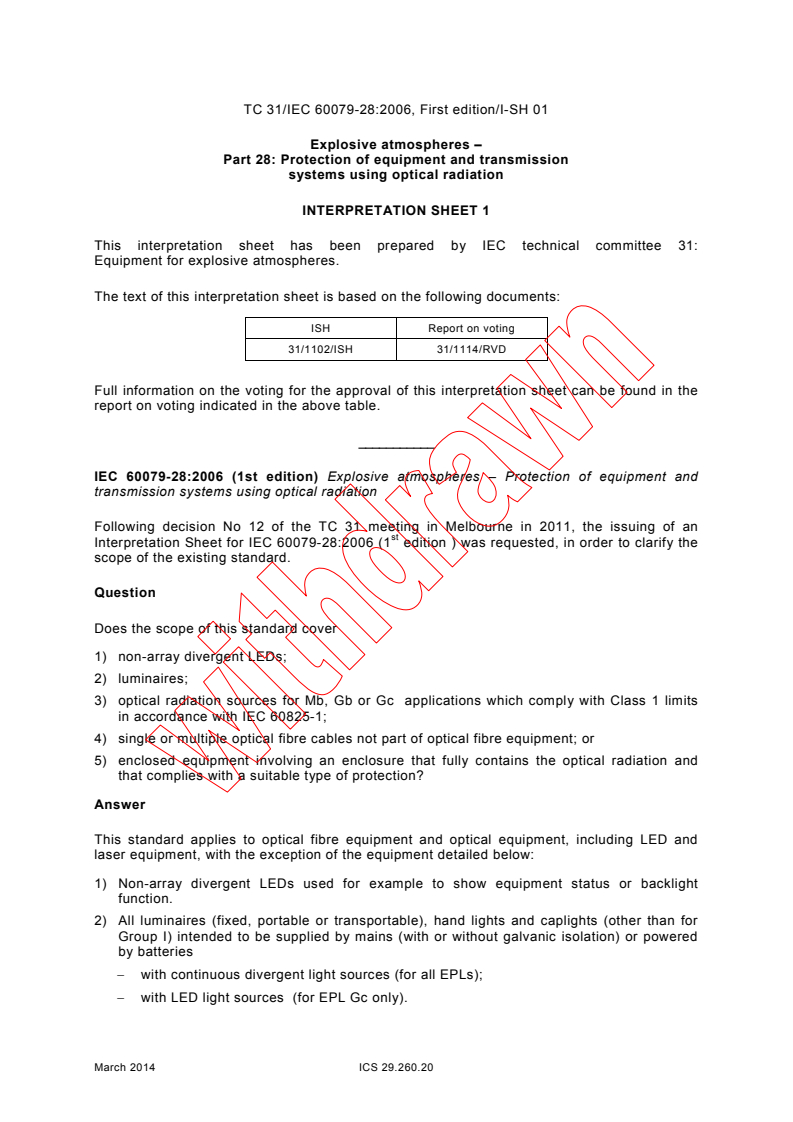
TC 31/IEC 60079-28:2006, First edition/I-SH 01
Explosive atmospheres –
Part 28: Protection of equipment and transmission
systems using optical radiation
INTERPRETATION SHEET 1
This interpretation sheet has been prepared by IEC technical committee 31:
Equipment for explosive atmospheres.
The text of this interpretation sheet is based on the following documents:
ISH Report on voting
31/1102/ISH 31/1114/RVD
Full information on the voting for the approval of this interpretation sheet can be found in the
report on voting indicated in the above table.
___________
transmission systems using optical radiation
Following decision No 12 of the TC 31 meeting in Melbourne in 2011, the issuing of an
st
Interpretation Sheet for IEC 60079-28:2006 (1 edition ) was requested, in order to clarify the
scope of the existing standard.
Question
Does the scope of this standard cover
1) non-array divergent LEDs;
2) luminaires;
3) optical radiation sources for Mb, Gb or Gc applications which comply with Class 1 limits
in accordance with IEC 60825-1;
4) single or multiple optical fibre cables not part of optical fibre equipment; or
5) enclosed equipment involving an enclosure that fully contains the optical radiation and
that complies with a suitable type of protection?
Answer
This standard applies to optical fibre equipment and optical equipment, including LED and
laser equipment, with the exception of the equipment detailed below:
1) Non-array divergent LEDs used for example to show equipment status or backlight
function.
2) All luminaires (fixed, portable or transportable), hand lights and caplights (other than for
Group I) intended to be supplied by mains (with or without galvanic isolation) or powered
by batteries
− with continuous divergent light sources (for all EPLs);
− with LED light sources (for EPL Gc only).
March 2014 ICS 29.260.20 French text overleaf
CE 31/IEC 60079-28:2006, Première édition/I-SH 01
Atmosphères explosives –
Partie 28: Protection du matériel et des systèmes de
transmission utilisant le rayonnement optique
FEUILLE D'INTERPRÉTATION 1
Cette feuille d’interprétation a été établie par le comité d'études 31 de l'IEC: Equipements
pour atmosphères explosives.
Le texte de cette feuille d’interprétation est issu des documents suivants:
ISH Rapport de vote
31/1102/ISH 31/1114/RVD
Le rapport de vote indiqué dans le tableau ci-dessus donne toute information sur le vote ayant
abouti à l'approbation de cette feuille d’interprétation.
___________
systèmes de transmission utilisant le rayonnement optique
Suivant la décision No 12 de la réunion du CE 31 en 2011 à Melbourne, il a été requis la
publication d'une Feuille d'Interprétation pour la 1ère édition de l'IEC 60079-28:2006 en vue
de clarifier le domaine d’application de la norme existante.
Question
Le domaine de définition de cette norme couvre-t-il
1) les LED à divergence non disposes en matrices;
2) les luminaires;
3) les sources de rayonnements optiques pour les applications Mb, Gb ou Gc qui sont
conformes aux limites de la Classe 1 conformément à l'IEC 60825-1;
4) les câbles à une ou plusieurs fibres optiques ne faisant pas partie de l'équipement à fibres
optiques; ou
5) le matériel sous enveloppe impliquant une enveloppe fournissant un confinement complet
du rayonnement optique et qui est conforme à un type approprié de protection?
Réponse
La présente norme est applicable aux matériels à fibres optiques et aux matériels optiques, y
compris les équipements laser et à LED, à l'exception des matériels énumérés ci-après :
1) Les LED à divergence non disposées en matrice, utilisées par exemple pour présenter
l'état de l'équipement ou pour la fonction de rétroéclairage.
2) Tous les luminaires (fixes, portatifs ou transportables), les lampes portatives et les
lampes-chapeaux (autres que celles du Groupe I) alimentés par un réseau (avec ou sans
isolation galvanique) ou alimentés par batterie
− avec des sources de lumière divergentes continues (pour tous les EPL, (Equipment
Protection Levels: niveaux de protection du matériel);
− avec des sources de lumière à LED (uniquement pour les EPL Gc).
Mars 2014 ICS 29.260.20 Texte anglais au verso
3) Optical radiation sources for Mb, Gb or Gc applications which comply with Class 1 limits in
accordance with IEC 60825-1.
4) Single or multiple optical fibre cables not part of optical fibre equipment if the cables
− comply with the relevant industrial standards, along with additional protective means,
e.g. robust cabling, conduit or raceway (for Gb, Mb or Gc );
− comply with the relevant industrial standards (for Gc).
5) Enclosed equipment involving an enclosure that fully contains the optical radiation and
that complies with a suitable type of protection as required by the involved EPL, with the
enclosure complying with one of the following conditions:
− an enclosure for which an ignition due to optical radiation in combination with
absorbers inside the enclosure would be acceptable (such as flameproof "d"
enclosures), or
− an enclosure for which protection regarding ingress of an explosive atmosphere is
provided, such as pressurized "p" enclosures, restricted breathing “nR” enclosure", or
− an enclosure for which protection regarding ingress of absorbers is provided (such as
IP 6X enclosures) and where no internal absorbers are to be expected.
NOTE For these scope exclusions it is anticipated that the enclosures are not opened in the explosive
atmosphere, so that ingress is protected.
March 2014 ICS 29.260.20 French text overleaf
3) Les sources de rayonnements optiques pour les applications Mb, Gb ou Gc qui sont
conformes aux limites de la Classe 1 conformément à l'IEC 60825-1.
4) Les câbles à une ou plusieurs fibres optiques ne faisant pas partie de l'équipement à
fibres optiques si les câbles
− sont conformes aux normes industrielles pertinentes, avec des moyens de protection
supplémentaires, par exemple, câblage robuste, conduit ou chemin de câbles (pour
Gb, Mb ou Gc);
− sont conformes aux normes industrielles pertinentes (pour Gc).
5) Le matériel sous enveloppe impliquant une enveloppe fournissant un confinement complet
du rayonnement optique et qui est conforme à un type approprié de protection tel que
requis par l'EPL concerné; l'enveloppe étant conforme à l'une des conditions suivantes:
− une enveloppe pour laquelle un allumage dû au rayonnement optique en combinaison
avec des absorbeurs à l'intérieur de cette enveloppe serait acceptable (par exemple,
enveloppes antidéflagrantes "d"), ou
− une enveloppe pour laquelle une protection contre la pénétration d’une atmosphère
explosive gazeuse est fournie, par exemple les enveloppes à surpression interne "p",
les enveloppes à respiration limitée “nR”, ou
− une enveloppe pour laquelle une protection liée à la pénétration des absorbeurs est
fournie (par exemple, les enveloppes à degré de protection IP 6X) et où aucun
absorbeur interne ne doit être prévu.
NOTE Pour ces exclusions du domaine d'application, il est prévu que les enveloppes ne soient pas ouvertes dans
l'atmosphère explosive, de sorte à assurer la protection contre la pénétration.
Mars 2014 ICS 29.260.20 Texte anglais au verso
– 2 – 60079-28 CEI:2006
SOMMAIRE
AVANT-PROPOS.6
INTRODUCTION.10
1 Domaine d'application .12
2 Références normatives.14
3 Termes et définitions .14
4 Exigences générales .20
4.1 Matériels optiques .20
4.2 Niveaux de risque .20
5 Modes de protection .22
5.1 Généralités.22
5.2 Exigences pour les rayonnements optiques à sécurité intrinsèque, mode de
protection «op is».22
5.3 Exigences pour rayonnement optique protégé «op pr» .26
5.4 Asservissement de rayonnement optique avec rupture de fibre optique «op sh».28
5.5 Adaptation des modes de protection.28
6 Vérification et essais de mode.30
6.1 Montage d’essai pour essais d’inflammation.30
6.2 Essai de référence .32
6.3 Mélanges d’essai.34
6.4 Essais pour trains d’impulsion et impulsions entre 1 ms et 1 s.34
7 Marquage .34
7.1 Généralités.34
7.2 Information de marquage.36
7.3 Exemples de marquage .36
Annexe A (normative) Données d’essai de référence .38
Annexe B (informative) Mécanismes d’inflammation .40
Annexe C (normative) Evaluation du risque d’inflammation .52
Annexe D (informative) Concept de câble à fibre optique typique.56
Annexe E (informative) Introduction à une méthode alternative d'évaluation des
risques incluant les « niveaux de protection du matériel » pour les matériels Ex .58
Bibliographie.68
Figure 1 – Figure B.1 avec les lignes de limite pour les surfaces intermédiaires pour
cibles non combustibles, atmosphères T1 – T4, groupe de matériel IIA, IIB ou IIC.24
Figure B.1 – Puissance d’inflammation rayonnante minimale avec cible d’absorbeur
inerte (α =83 %, α =93 %) et rayonnement d’onde continue de 1 064 nm.46
1 064 nm 805 nm
Figure B.2 – Puissance d’inflammation rayonnante minimale avec cible d’absorbeur
inerte (α =83 %, α =93 %) et rayonnement d’onde continue (PTB:
1 064 nm 805 nm
1 064 nm, HSL: 805 nm, [24]: 803 nm) pour certains n-alkylbenzènes .48
Figure C.1 – Evaluation du risque d’inflammation.52
Figure D.1 – Exemple de concept de câble optique à fibre multiple pour applications à
haut rendement.56
Figure D.2 – Concept de câble à fibre optique unique typique.56
60079-28 IEC:2006 – 3 –
CONTENTS
FOREWORD.7
INTRODUCTION.11
1 Scope.13
2 Normative references .15
3 Terms and definitions .15
4 General requirements .21
4.1 Optical equipment .21
4.2 Risk levels.21
5 Types of protection.23
5.1 General .23
5.2 Requirements for inherently safe optical radiation “op is” .23
5.3 Requirements for protected optical radiation “op pr” .27
5.4 Optical radiation interlock with optical fibre breakage “op sh” .29
5.5 Suitability of types of protection.29
6 Type verifications and tests .31
6.1 Test set-up for ignition tests .31
6.2 Reference test.33
6.3 Test mixtures .35
6.4 Tests for pulse trains and pulses between 1 ms and 1 s duration .35
7 Marking .35
7.1 General .35
7.2 Marking information.37
7.3 Examples of marking .37
Annex A (normative) Reference test data.39
Annex B (informative) Ignition mechanisms .41
Annex C (normative) Ignition hazard assessment.53
Annex D (informative) Typical optical fibre cable design .57
Annex E (informative) Introduction of an alternative risk assessment method
encompassing “equipment protection levels” for Ex equipment .59
Bibliography.69
Figure 1 – Figure B.1 with limit lines for intermediate areas for non-combustible
targets, T1 – T4 atmospheres, apparatus group IIA, IIB or IIC.25
Figure B.1 – Minimum radiant igniting power with inert absorber target (α
=83 %, α =93 %) and continuous wave-radiation of 1 064 nm.47
064 nm 805 nm
Figure B.2 – Minimum radiant igniting power with inert absorber target (α
=83 %, α =93 %) and continuous wave-radiation (PTB: 1 064 nm, HSL:
064 nm 805 nm
805 nm, [24]: 803 nm) for some n-alkanes .49
Figure C.1 – Ignition hazard assessment .53
Figure D.1 – Example multi-fibre optical cable design for heavy duty applications.57
Figure D.2 – Typical single optical fibre cable design.57
– 4 – 60079-28 CEI:2006
Tableau 1 – Relation entre EPL et probabilité d'une source d'inflammation.20
Tableau 2 – Puissance optique et éclairement sûrs pour les emplacements dangereux
par catégorie de groupe de matériel et de classe de température .22
Tableau 3 – Disponibilité d’asservissement optique ou facteur de réduction du risque
par EPL .28
Tableau 4 – Application des modes de protection pour les systèmes optiques basés
sur des EPLs .30
Tableau A.1 – Valeurs de référence pour essais d’inflammation avec un mélange de
propane dans l’air à une température de 40 °C .38
Tableau B.1 – AIT (température d’auto inflammation), MESG (intervalle de sécurité
expérimental maximal) et puissances d’inflammation mesurées des combustibles
choisis pour absorbeurs inertes comme matériau cible (α =83 %, α =93) .44
1 064 nm 805 nm
Tableau B.2 – Comparaison de l’énergie d’impulsion optique d’inflammation minimale
i,min
(Q ) à faisceau de diamètre 90 µm avec des températures d’auto inflammation
e,p
(AIT) et des énergies d’inflammation minimales (MIE) à partir de la littérature [25] à
des concentrations en pourcentage par volume (ϕ) .50
Tableau E.1 – Relation traditionnelle entre EPLs et zones (sans évaluation de risque
complémentaire) .62
Tableau E.2 – Description de la protection contre le risque d’inflammabilité fournie.64
60079-28 IEC:2006 – 5 –
Table 1 – Relationship between EPL and the probability of an ignition source.21
Table 2 – Safe optical power and irradiance for hazardous locations categorized by
apparatus group and temperature class .23
Table 3 – Optical interlock availability or ignition risk reduction factor by EPL.29
Table 4 – Application of types of protection for optic systems based on EPLs .31
Table A.1 – Reference values for ignition tests with a mixture of propane in air at
40 °C mixture temperature .39
Table B.1 – AIT (auto ignition temperature), MESG (maximum experimental safe gap)
and measured ignition powers of the chosen combustibles for inert absorbers as the
target material (α =83 %, α =93) .45
1 064 nm 805 nm
i,min
Table B.2 – Comparison of measured minimum igniting optical pulse energy (Q )
e,p
at 90 µm beam diameter with auto ignition temperatures (AIT) and minimum ignition
energies (MIE) from literature [25] at concentrations in percent by volume (ϕ) .51
Table E.1 – Traditional relationship of EPLs to zones (no additional risk assessment) .63
Table E.2 – Description of risk of ignition protection provided .65
– 6 – 60079-28 © CEI:2006
COMMISSION ÉLECTROTECHNIQUE INTERNATIONALE
____________
ATMOSPHÈRES EXPLOSIVES –
Partie 28: Protection du matériel et des systèmes
de transmission utilisant le rayonnement optique
AVANT-PROPOS
1) La Commission Electrotechnique Internationale (CEI) est une organisation mondiale de normalisation
composée de l'ensemble des comités électrotechniques nationaux (Comités nationaux de la CEI). La CEI a
pour objet de favoriser la coopération internationale pour toutes les questions de normalisation dans les
domaines de l'électricité et de l'électronique. A cet effet, la CEI – entre autres activités – publie des Normes
internationales, des Spécifications techniques, des Rapports techniques, des Spécifications accessibles au
public (PAS) et des Guides (ci-après dénommés "Publication(s) de la CEI"). Leur élaboration est confiée à des
comités d'études, aux travaux desquels tout Comité national intéressé par le sujet traité peut participer. Les
organisations internationales, gouvernementales et non gouvernementales, en liaison avec la CEI, participent
également aux travaux. La CEI collabore étroitement avec l'Organisation Internationale de Normalisation (ISO),
selon des conditions fixées par accord entre les deux organisations.
2) Les décisions ou accords officiels de la CEI concernant les questions techniques représentent, dans la mesure
du possible, un accord international sur les sujets étudiés, étant donné que les Comités nationaux de la CEI
intéressés sont représentés dans chaque comité d’études.
3) Les Publications de la CEI se présentent sous la forme de recommandations internationales et sont agréées
comme telles par les Comités nationaux de la CEI. Tous les efforts raisonnables sont entrepris afin que la CEI
s'assure de l'exactitude du contenu technique de ses publications; la CEI ne peut pas être tenue responsable
de l'éventuelle mauvaise utilisation ou interprétation qui en est faite par un quelconque utilisateur final.
4) Dans le but d'encourager l'uniformité internationale, les Comités nationaux de la CEI s'engagent, dans toute la
mesure possible, à appliquer de façon transparente les Publications de la CEI dans leurs publications
nationales et régionales. Toutes divergences entre toutes Publications de la CEI et toutes publications
nationales ou régionales correspondantes doivent être indiquées en termes clairs dans ces dernières.
5) La CEI elle-même ne fournit aucune attestation de conformité. Des organismes de certification indépendants
fournissent des services d'évaluation de conformité et, dans certains secteurs, accèdent aux marques de
conformité de la CEI. La CEI n'est responsable d'aucun des services effectués par les organismes de
certification indépendants.
6) Tous les utilisateurs doivent s'assurer qu'ils sont en possession de la dernière édition de cette publication.
7) Aucune responsabilité ne doit être imputée à la CEI, à ses administrateurs, employés, auxiliaires ou
mandataires, y compris ses experts particuliers et les membres de ses comités d'études et des Comités
nationaux de la CEI, pour tout préjudice causé en cas de dommages corporels et matériels, ou de tout autre
dommage de quelque nature que ce soit, directe ou indirecte, ou pour supporter les coûts (y compris les frais
de justice) et les dépenses découlant de la publication ou de l'utilisation de cette Publication de la CEI ou de
toute autre Publication de la CEI, ou au crédit qui lui est accordé.
8) L'attention est attirée sur les références normatives citées dans cette publication. L'utilisation de publications
référencées est obligatoire pour une application correcte de la présente publication.
9) L’attention est attirée sur le fait que certains des éléments de la présente Publication de la CEI peuvent faire
l’objet de droits de propriété intellectuelle ou de droits analogues. La CEI ne saurait être tenue pour
responsable de ne pas avoir identifié de tels droits de propriété et de ne pas avoir signalé leur existence.
La Norme internationale CEI 60079-28 a été établie par le comité d’études 31 de la CEI:
Equipements pour atmosphères explosives.
Le texte de la présente norme est issu des documents suivants:
FDIS Rapport de vote
31/631/FDIS 31/650/RVD
Le rapport de vote indiqué dans le tableau ci-dessus donne toute information sur le vote ayant
abouti à l'approbation de cette norme.
Cette publication a été rédigée selon les Directives ISO/CEI, Partie 2.
60079-28 © IEC:2006 – 7 –
INTERNATIONAL ELECTROTECHNICAL COMMISSION
____________
EXPLOSIVE ATMOSPHERES –
Part 28: Protection of equipment and transmission systems
using optical radiation
FOREWORD
1) The International Electrotechnical Commission (IEC) is a worldwide organization for standardization comprising
all national electrotechnical committees (IEC National Committees). The object of IEC is to promote
international co-operation on all questions concerning standardization in the electrical and electronic fields. To
this end and in addition to other activities, IEC publishes International Standards, Technical Specifications,
Technical Reports, Publicly Available Specifications (PAS) and Guides (hereafter referred to as
“IEC Publication(s)”). Their preparation is entrusted to technical committees; any IEC National Committee
interested in the subject dealt with may participate in this preparatory work. International, governmental and
non-governmental organizations liaising with the IEC also participate in this preparation. IEC collaborates
closely with the International Organization for Standardization (ISO) in accordance with conditions determined
by agreement between the two organizations.
2) The formal decisions or agreements of IEC on technical matters express, as nearly as possible, an international
consensus of opinion on the relevant subjects since each technical committee has representation from all
interested IEC National Committees.
3) IEC Publications have the form of recommendations for international use and are accepted by IEC National
Committees in that sense. While all reasonable efforts are made to ensure that the technical content of
IEC Publications is accurate, IEC cannot be held responsible for the way in which they are used or for any
misinterpretation by any end user.
4) In order to promote international uniformity, IEC National Committees undertake to apply IEC Publications
transparently to the maximum extent possible in their national and regional publications. Any divergence
between any IEC Publication and the corresponding national or regional publication shall be clearly indicated in
the latter.
5) IEC itself does not provide any attestation of conformity. Independent certification bodies provide conformity
assessment services and, in some areas, access to IEC marks of conformity. IEC is not responsible for any
services carried out by independent certification bodies.
6) All users should ensure that they have the latest edition of this publication.
7) No liability shall attach to IEC or its directors, employees, servants or agents including individual experts and
members of its technical committees and IEC National Committees for any personal injury, property damage or
other damage of any nature whatsoever, whether direct or indirect, or for costs (including legal fees) and
expenses arising out of the publication, use of, or reliance upon, this IEC Publication or any other
IEC Publications.
8) Attention is drawn to the Normative references cited in this publication. Use of the referenced publications is
indispensable for the correct application of this publication.
9) Attention is drawn to the possibility that some of the elements of this IEC Publication may be the subject of
patent rights. IEC shall not be held responsible for identifying any or all such patent rights.
International Standard IEC 60079-28 has been prepared by IEC technical committee 31:
Equipment for explosive atmospheres.
The text of this standard is based on the following documents:
FDIS Report on voting
31/631/FDIS 31/650/RVD
Full information on the voting for the approval of this standard can be found in the report on
voting indicated in the above table.
This publication has been drafted in accordance with the ISO/IEC Directives, Part 2.
– 8 – 60079-28 CEI:2006
Une liste de toutes les parties de la CEI 60079, sous le titre général Atmosphères explosives,
est disponible sur le site web de la CEI.
Le comité a décidé que le contenu de cette publication ne sera pas modifié avant la date de
maintenance indiquée sur le site web de la CEI sous «http://webstore.CEI.ch» dans les
données relatives à la publication recherchée. A cette date, la publication sera
• reconduite;
• supprimée;
• remplacée par une édition révisée, ou
• amendée.
Le contenu du corrigendum de mars 2010 et de la feuille d’interprétation de mars 2014 a été
pris en considération dans cet exemplaire.
60079-28 IEC:2006 – 9 –
A list of all parts of the IEC 60079 series, under the general title Explosives atmospheres, can
be found on the IEC website.
The committee has decided that the contents of this publication will remain unchanged until
the maintenance result date indicated on the IEC web site under "http://webstore.iec.ch" in
the data related to the specific publication. At this date, the publication will be
• reconfirmed;
• withdrawn;
• replaced by a revised edition, or
• amended.
The contents of the corrigendum of March 2010 and the Interpretation Sheet of March 2014
have been included in this copy.
– 10 – 60079-28 CEI:2006
INTRODUCTION
Les matériels optiques sous forme de lampes, lasers, diodes électroluminescentes (DEL),
fibres optiques, etc. sont de plus en plus utilisés dans la communication, la surveillance, la
détection et les mesures. Dans les procédés d’élaboration de matériaux, des rayonnements
optiques de fort éclairement sont utilisés. Les installations sont fréquemment à l’intérieur ou
proches d’atmosphères potentiellement explosives, et les rayonnements provenant de tels
matériels sont susceptibles de traverser ces atmosphères. Suivant ses caractéristiques, le
rayonnement peut être capable d’enflammer une atmosphère explosive environnante. La
présence ou l’absence d’un absorbeur supplémentaire a une influence significative sur
l’inflammation.
Il existe quatre mécanismes possibles d’inflammation.
a) Le rayonnement optique est absorbé par les surfaces ou particules, provoquant leur
échauffement et, dans certaines circonstances, celles ci peuvent atteindre une tempéra-
ture qui amorcera l’inflammation de l’atmosphère explosive environnante.
b) L’inflammation thermique d’un volume de gaz, où la longueur d’onde optique correspond
à une bande d’absorption du gaz.
c) L’inflammation photochimique due à la photodissociation des molécules d’oxygène par le
rayonnement dans l’étendue des longueurs d’ondes des ultraviolets.
d) Le craquage direct d’un gaz par laser, au point de focalisation d’un faisceau puissant,
produisant un plasma et une onde de choc, les deux agissant en définitive comme source
d’allumage. Ces processus peuvent se produire dans un matériau solide proche de son
point de craquage.
En pratique, le cas le plus probable d’inflammation à partir de la puissance minimale
d’inflammation d’un rayonnement est le cas a). Dans certaines conditions pour le
rayonnement à impulsion, le cas d) devient applicable.
Le matériel optique est utilisé dans la plupart des cas conjointement à un matériel électrique,
pour lequel il existe des exigences claires et détaillées et des normes pour l’utilisation en
atmosphères potentiellement explosives. Un des objectifs de cette norme est d’informer
l’industrie sur les risques d’inflammation potentiels associés à l’utilisation de systèmes
optiques dans des emplacements dangereux tels que définis dans la CEI 60079-10 et sur les
méthodes de protection adéquates.
Cette norme détaille le système intégré utilisé pour surveiller le risque d’inflammation des
matériels utilisant le rayonnement optique dans des emplacements dangereux.
60079-28 IEC:2006 – 11 –
INTRODUCTION
Optical equipment in the form of lamps, lasers, LEDs, optical fibers, etc. is increasingly used
for communications, surveying, sensing and measurement. In material processing, optical
radiation of high irradiance is used. Often the installation is inside or close to potentially
explosive atmospheres, and radiation from such equipment may pass through these
atmospheres. Depending on the characteristics of the radiation it might then be able to ignite
a surrounding explosive atmosphere. The presence or absence of an additional absorber
significantly influences the ignition.
There are four possible ignition mechanisms.
a) Optical radiation is absorbed by surfaces or particles, causing them to heat up, and, under
certain circumstances, this may allow them to attain a temperature which will ignite a
surrounding explosive atmosphere.
b) Thermal ignition of a gas volume, where the optical wavelength matches an absorption
band of the gas.
c) Photochemical ignition due to photo dissociation of oxygen molecules by radiation in the
ultraviolet wavelength range.
d) Direct laser induced breakdown of the gas at the focus of a strong beam, producing
plasma and a shock wave both eventually acting as the ignition source. These processes
can be supported by a solid material close to the breakdown point.
The most likely case of ignition occurring in practice with lowest radiation power of ignition
capability is case a). Under some conditions for pulsed radiation, case d) also will become
relevant.
Optical equipment is used in most cases in conjunction with electrical equipment, for which
clear and detailed requirements and standards for use in potentially explosive atmospheres
exist. One purpose of this standard is to inform industry about potential ignition hazards
associated with the use of optical systems in hazardous locations as defined in IEC 60079-10
and the adequate protection methods.
This standard details the integrated system used to control the ignition hazard from equipment
using optical radiation in hazardous locations.
– 12 – 60079-28 CEI:2006
ATMOSPHÈRES EXPLOSIVES –
Partie 28: Protection du matériel et des systèmes
de transmission utilisant le rayonnement optique
1 Domaine d'application
La présente partie de la CEI 60079 explique le risque d’inflammation potentiel à partir de
matériel utilisant un rayonnement optique et destiné à être utilisé en atmosphères explosives
gazeuses. Elle couvre également le matériel, lui-même situé à l’extérieur mais dont les
rayonnements optiques pénètrent de telles atmosphères. Elle décrit les précautions à prendre
et les exigences lors de l’utilisation de matériels transmettant des rayonnements optiques
dans des atmosphères explosives gazeuses. Elle souligne également une méthode d’essai,
qui peut être utilisée pour vérifier qu’un faisceau n’est pas capable d’inflammation dans des
conditions d’essai choisies, si les valeurs limites optiques ne peuvent être garanties par
l’évaluation ou la mesure de la force du faisceau.
Cette norme contient des exigences pour le rayonnement optique dans l’étendue de longueur
d’onde de 380 mm à 10 µm. Elle couvre les mécanismes d’inflammation suivants:
• le rayonnement optique est absorbé par les surfaces ou particules, provoquant leur
échauffement et, dans certaines circonstances, celles ci peuvent atteindre une
température qui amorcera l’inflammation de l’atmosphère explosive environnante;
• le craquage direct d’un gaz par laser, au point de focalisation d’un faisceau puissant,
produisant un plasma et une onde de choc, les deux agissant en définitive comme source
d’allumage. Ces processus peuvent prendre naissance dans des matériaux, à proximité du
point de claquage.
NOTE 1 Voir les points a) et d) de l’introduction.
Cette norme ne couvre pas l’inflammation par rayonnement ultraviolet et par absorption du
rayonnement dans le mélange explosif lui-même. Les absorbeurs explosifs ou absorbeurs qui
contiennent leur propre oxydant/comburant de même que les absorbeurs catalytiques sont
également hors du domaine de cette norme.
Cette norme spécifie les exigences pour les matériels destinés à l’utilisation dans des
conditions atmosphériques.
Cette norme complète et modifie les exigences générales de la CEI 60079-0. Lorsqu’une
exigence de cette norme entre en conflit avec une exigence de la CEI 60079-0, l’exigence de
cette norme prévaudra.
NOTE 2 Il convient que les mécanismes d’inflammation b) et c) expliqués dans l’introduction soient connus de
tous; ils ne sont cependant pas repris dans cette norme à cause de la situation très particulière du rayonnement
ultraviolet et des propriétés d’absorption de la plupart des gaz (voir Annexe B).
NOTE 3 Les exigences de sécurité pour limiter les dangers de l’exposition des personnes aux systèmes de
communication par fibres optiques se trouvent dans la CEI 60825-2:2000.
NOTE 4 Les modes de protection «op is», «op pr» et «op sh» peuvent fournir les niveaux de protection de
matériel (EPL) Ga, Gb ou Gc. Pour plus d’informations, voir l’Annexe E.
60079-28 IEC:2006 – 13 –
EXPLOSIVE ATMOSPHERES –
Part 28: Protection of equipment and transmission systems
using optical radiation
1 Scope
This part of IEC 60079 explains the potential ignition hazard from equipment using optical
radiation intended for use in explosive gas atmospheres. It also covers equipment, which
itself is located outside but its emitted optical radiation enters such atmospheres. It describes
precautions and requirements to be taken when using optical radiation tra
...