

IEC 60079-1:2001
(Main)Electrical apparatus for explosive gas atmospheres - Part 1: Flameproof enclosures "d"
General Information
- Abstract
The contents of the corrigendum of February 2007 have been included in this copy.
- Status
- Published
- Publication Date
- 26-Feb-2001
- Technical Committee
- TC 31 - Equipment for explosive atmospheres
- Current Stage
- DELPUB - Deleted Publication
- Start Date
- 06-Nov-2003
- Completion Date
- 28-Aug-2026
Overview - IEC 60079-1:2001 (Flameproof enclosures "d")
IEC 60079-1:2001 (Fourth edition, corrigendum Feb 2007 included) defines the specific construction and testing requirements for electrical apparatus employing the type of protection flameproof enclosure "d" for use in potentially explosive gas atmospheres. It supplements IEC 60079-0 (general requirements) and sets mandatory rules for enclosure design, joints, mechanical strength, entries, and verification/type tests to prevent transmission of an internal explosion to the surrounding atmosphere.
Key topics and technical requirements
- Flameproof joints and gaps - minimum widths (L), permitted gaps (i), and geometry requirements to stop flame propagation; guidance on cylindric and non-threaded joints.
- Maximum Experimental Safe Gap (MESG) - referenced testing concept for evaluating flamepath safety (see IEC 60079-1A).
- Shafts, bearings and operating rods - supplementary requirements addressing rotating parts and tolerances, including statistical tolerance treatment where appropriate.
- Breathing and draining devices - design, materials and testing for elements that allow pressure equalization and condensate escape without compromising flameproof integrity.
- Fasteners, threads and bolt holes - rules to ensure joints remain flameproof when assembled and after service.
- Materials and mechanical strength - material selection, corrosion protection (restrictions on coatings) and structural integrity requirements.
- Entries and cable glands - requirements for cable and conduit entries, with normative annexes providing additional details (Annexes A–C).
- Verification, type and routine tests - non-transmission tests, pressure tests, and routine inspection criteria used for certification and production control.
- Normative annexes - detailed provisions for crimped elements, non-measurable paths, and flameproof cable entries.
Applications and who uses this standard
IEC 60079-1 is used by:
- Manufacturers and designers of hazardous-area electrical equipment (motors, junction boxes, luminaires, switches).
- Test laboratories and certification bodies performing type tests and routine tests for flameproof enclosures.
- Engineering, inspection and maintenance teams in oil & gas, petrochemical, mining, marine, and power generation industries who specify or maintain equipment for explosive atmospheres.
- Regulatory and compliance specialists referencing standards for equipment marking, documentation and approval.
This standard is commonly referenced in certification and compliance workflows for hazardous-area equipment (e.g., IECEx and regional schemes such as ATEX).
Related standards
Key normative references include: IEC 60079-0, IEC 60079-1A, IEC 60079-7, IEC 60079-11, IEC 60112, IEC 60529, IEC 60061, IEC 60707 and several ISO standards (e.g., ISO 1210). These documents provide general requirements, supplementary tests and measurement methods relevant to flameproof design.
Relations
- Effective Date
- 05-Sep-2023
- Effective Date
- 05-Sep-2023
- Effective Date
- 05-Sep-2023
- Effective Date
- 05-Sep-2023
- Effective Date
- 05-Sep-2023
Get Certified
Connect with accredited certification bodies for this standard

IMQ S.p.A. (Certification)
Italian electrical product certification.

SLG Prüf- und Zertifizierungs GmbH
German testing and certification body.

UL Solutions
Global safety science company with testing, inspection and certification.
Sponsored listings
Frequently Asked Questions
IEC 60079-1:2001 is a standard published by the International Electrotechnical Commission (IEC). Its full title is "Electrical apparatus for explosive gas atmospheres - Part 1: Flameproof enclosures "d"". This standard covers: The contents of the corrigendum of February 2007 have been included in this copy.
The contents of the corrigendum of February 2007 have been included in this copy.
IEC 60079-1:2001 is classified under the following ICS (International Classification for Standards) categories: 29.260.20 - Electrical apparatus for explosive atmospheres. The ICS classification helps identify the subject area and facilitates finding related standards.
IEC 60079-1:2001 has the following relationships with other standards: It is inter standard links to IEC 60079-1:2001/COR1:2001, IEC 60079-1:1990, IEC 60079-1:1990/AMD2:1998, IEC 60079-1:2003, IEC 60079-1:2001/ISH1:2007. Understanding these relationships helps ensure you are using the most current and applicable version of the standard.
IEC 60079-1:2001 is available in PDF format for immediate download after purchase. The document can be added to your cart and obtained through the secure checkout process. Digital delivery ensures instant access to the complete standard document.
Standards Content (Sample)
INTERNAT IONAL IEC
STANDARD
60079-1
Fourth edi tion
2001-02
Electrical apparatus for ex plosive gas
atmospheres –
Part 1:
Flameproof enclos ures "d"
Matéri el électrique pour atmosphères explosives gazeuses –
Partie 1:
Envel oppe anti déflagr ante «d»
Reference number
IEC 60079 -1:2001( E)
Publication numbering
As from 1 January 1997 all IEC publications are issued with a designation in the
600 00 seri es. For exam pl e, IEC 34 -1 is now r eferr ed t o as IEC 60034-1.
Consolid at ed ed itions
The IEC is now publishing consolidated versions of its publications. For example,
edition numbers 1.0, 1.1 and 1.2 refer, respectively, to the base publication, the
bas e p ublication i nc or porating am endm ent 1 a nd the bas e pu blication incorp or ating
am endm ents 1 and 2.
Further information on IEC pub lications
The t echnical c ontent of IEC pu blications is k ept un de r constant re view by the IEC,
thus ensuring that the content reflects current technology. Information relating to
this publication, including its validity, is available in the IEC Catalogue of
publications (see below) in addition to new editions, amendments and corrigenda.
Information on the subjects under consideration and work in progress undertaken
by the technical committee which has prepared this publication, as well as the list
of publications issued, is also availabl e from t he f ollowing:
• IEC Web Site (www.iec. ch)
• Catalogue of IEC publications
The on-line catalogue on the IEC web site (www.iec.ch /catlg-e.htm ) enables
you to search by a variety of criteria including text searches, technical
committees and date of publication. On-line information is also available on
recently issued publications, withdrawn and replaced publications, as well as
corri ge nda.
• IEC Just Published
This summary of recently issued publications (www.iec.ch /JP.htm) is also
availabl e by em ail. Pleas e c ont act t he Custom er S ervice Centre (s ee below) for
furt he r i nf orm ation.
• Cust om er Service Centre
If you h av e a ny q uestions re gar di ng t his p ublication o r nee d further assistanc e,
pl eas e cont act t he C ustom er S ervice C ent re:
Email: cu stserv@iec.ch
Tel: +41 22 91 9 02 11
Fax: +41 22 91 9 03 00
INTERNATIONAL IEC
STANDARD
60079-1
Fourth edition
2001-02
Electrical apparatus for explosive gas
atmospheres –
Part 1:
Flameproof enclosures "d"
Matériel électrique pour atmosphères explosives gazeuses–
Partie 1:
Enveloppe antidéflagrante «d»
IEC 2001 Copyright - all rights reserved
No part of this publication may be reproduced or utilized in any form or by any means, electronic or
mechanical, including photocopying and microfilm, without permission in writing from the publisher.
International Electrotechnical Commission 3, rue de Varembé Geneva, Switzerland
Telefax: +41 22 919 0300 e-mail: inmail@iec.ch IEC web site http://www.iec.ch
Commission Electrotechnique Internationale
PRICE CODE
XA
International Electrotechnical Commission
For price, see current catalogue
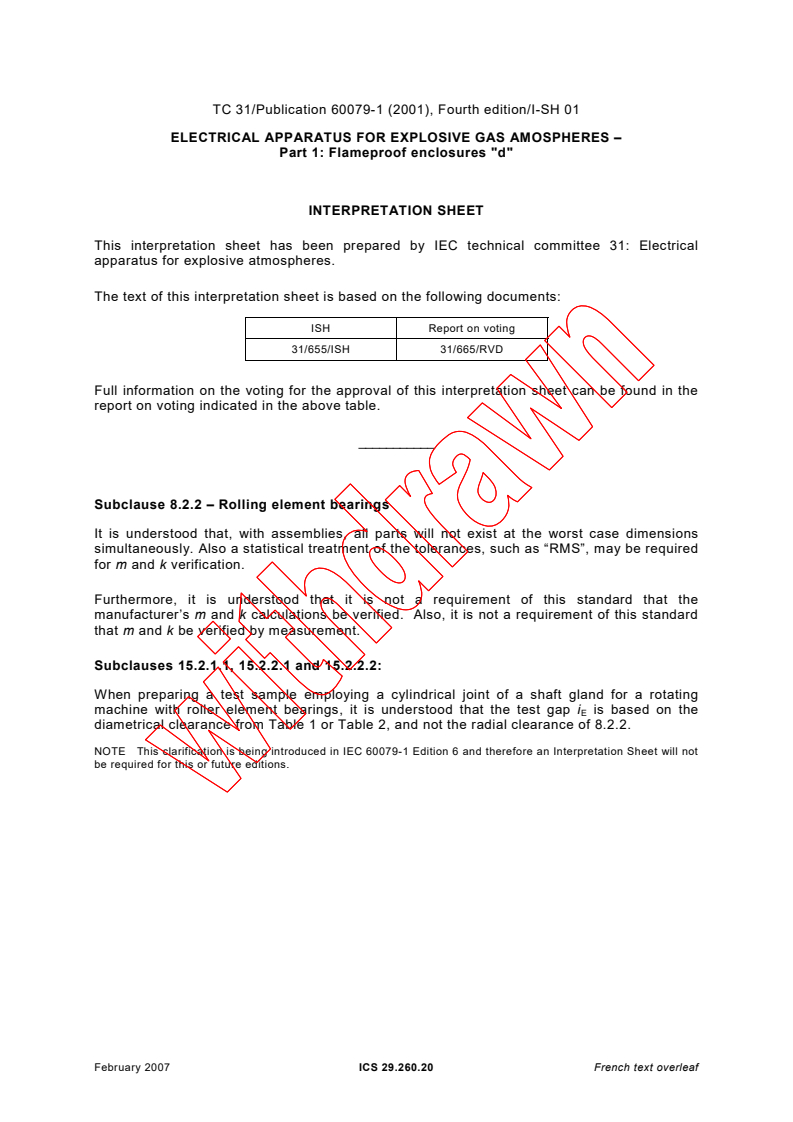
CE 31/Publication 60079-1 (2001), Quatrième édition/I-SH 01
MATÉRIEL ÉLECTRIQUE POUR ATMOSPHÈRES ÉLECTRIQUES GAZEUSES –
Partie 1: Enveloppes antidéflagrantes «d»
FEUILLE D'INTERPRÉTATION
Cette feuille d’interprétation a été établie par le comité d’études 31 de la CEI: Matériel
électrique pour atmosphères explosives.
Le texte de cette feuille d’interprétation est issue des documents suivants:
ISH Rapport de vote
31/655/ISH 31/665/RVD
Le rapport de vote indiqué dans le tableau ci-dessus donne toute information sur le vote ayant
abouti à l'approbation de cette feuille d’interprétation.
___________
Paragraphe 8.2.2 – Eléments de roulement de palier
Il est reconnu que dans un assemblage, toutes les pièces ne sont simultanément pas à leurs
dimensions les plus défavorables. Un traitement statistique des tolérances, comme la
méthode de la valeur quadratique moyenne (RMS) peut être requis pour la vérification de m
et k.
De plus il est admis que la présente norme n’exige pas que les calculs de m et de k du
constructeur soient vérifiés. Cette norme n’exige pas non plus que m et k soient vérifiés par
des mesures.
Paragraphes 15.2.1.1, 15.2.2.1 et 15.2.2.2 :
Lorsque l’on prépare un échantillon d’essai utilisant un joint cylindrique d’une traversée
d’arbre pour une machine tournante avec des éléments de roulement de palier , l’interstice
d’essai i est basé sur le jeu critique du diamètre du tableau 1 ou du tableau 2 et non sur la
E
jeu radial de 8.2.2.
NOTE Cette clarification a été introduite dans l’édition 6 de la CEI 60079-1 et cette « Feuille d’interprétation »
n’est donc pas nécessaire pour cette édition et les suivantes.
Février 2007 ICS 29.260.20 Texte anglais au verso
– 2 – 60079- 1 IEC:2001( E)
CONT ENTS
Page
FO REWORD . .3
Cl ause
1Scope . .5
2Normative referenc es .5
3Def initions . .6
4Appar atus gr ouping and tem per atur e classification .7
5Flam epr oof joints .8
6Cem ented joints . 17
7Oper ating r ods .17
8Supplem entary r equirements for s haf ts and bear ings . 18
9Light- tr ansmitting par ts . 21
10 Br eathing and dr aining devic es w hic h f orm par t of a flam epr oof enc los ure. 21
11 Fas teners, associated holes and clos ing devic es . 26
12 Materials and m ec hanic al strength of enc los ur es; m aterials inside the enc los ur es . 28
13 Entr ies for flam epr oof enc losures. 29
14 Verification and tes ts .31
15Type tes ts . . 31
16 Routine tes ts . . 40
17 Sw itc hgear for Group I . 41
18 Lam pholders and Iampcaps . 42
19 Non-metallic enc los ur es and non-metallic par ts of enc los ur es . 43
Annex A ( normative) Additional r equirements for crim ped ribbon elem ents of br eathing
and dr aining devic es . . 47
Annex B ( normative) Additional r equir em ents f or elem ents, with non-meas ur able paths,
of br eathing and dr aining devic es . 48
Annex C ( normative) Additional r equir em ents f or flam epr oof c able entries . 50
60079-1 IEC:2001(E)– 3 –
INTERNATIONAL ELECTROTECHNICAL COMMISSION
____________
ELECTRICAL APPARATUS FOR EXPLOSIVE GAS ATMOSPHERES –
Part 1: Flameproof enclosures "d"
FOREWORD
1) The IEC (International Electrotechnical Commission) is a worldwide organization for standardization comprising
all national electrotechnical committees (IEC National Committees). The object of the IEC is to promote
international co-operation on all questions concerning standardization in the electrical and electronic fields. To
this end and in addition to other activities, the IEC publishes International Standards. Their preparation is
entrusted to technical committees; any IEC National Committee interested in the subject dealt with may
participate in this preparatory work. International, governmental and non-governmental organizations liaising
with the IEC also participate in this preparation. The IEC collaborates closely with the International Organization
for Standardization (ISO) in accordance with conditions determined by agreement between the two
organizations.
2) The formal decisions or agreements of the IEC on technical matters express, as nearly as possible, an
international consensus of opinion on the relevant subjects since each technical committee has representation
from all interested National Committees.
3) The documents produced have the form of recommendations for international use and are published in the form
of standards, technical specifications, technical reports or guides and they are accepted by the National
Committees in that sense.
4) In order to promote international unification, IEC National Committees undertake to apply IEC International
Standards transparently to the maximum extent possible in their national and regional standards. Any
divergence between the IEC Standard and the corresponding national or regional standard shall be clearly
indicated in the latter.
5) The IEC provides no marking procedure to indicate its approval and cannot be rendered responsible for any
equipment declared to be in conformity with one of its standards.
6) Attention is drawn to the possibility that some of the elements of this International Standard may be the subject
of patent rights. The IEC shall not be held responsible for identifying any or all such patent rights.
International Standard IEC 60079-1 has been prepared by subcommittee 31A: Flameproof
enclosures, of IEC technical committee 31: Electrical apparatus for explosive atmospheres.
This fourth edition cancels and replaces the third edition published in 1990 and its amendments 1
(1993) and 2 (1998). This fourth edition constitutes a technical revision.
The text of this standard is based on the following documents:
FDIS Report on voting
31A/89/FDIS 31A/91/RVD
Full information on the voting for the approval of this standard can be found in the report on
voting indicated in the above table.
This publication has been drafted in accordance with the ISO/IEC Directives, Part 3.
This standard is to be read in conjunction with IEC 60079-0, the requirements of which apply to
electrical apparatus with flameproof enclosures.
Annexes A, B and C form an integral part of this standard.
– 4 – 60079-1 IEC:2001(E)
The committee has decided that the contents of this publication will remain unchanged until
2002-12. At this date, the publication will be
• reconfirmed;
• withdrawn;
• replaced by a revised edition, or
• amended.
A bilingual version of this publication may be issued at a later date.
The contents of the corrigendum of June 2001 have been included in this copy.
60079-1 IEC:2001(E)– 5 –
ELECTRICAL APPARATUS FOR EXPLOSIVE GAS ATMOSPHERES –
Part 1: Flameproof enclosures "d"
1 Scope
This part of IEC 60079 contains the specific requirements for the construction and testing of
electrical apparatus with the type of protection flameproof enclosure "d", intended for use in
potentially explosive gas atmospheres.
2 Normative references
The following normative documents contain provisions which, through reference in this text,
constitute provisions of this part of IEC 60079. For dated references, subsequent amendments
to, or revisions of, any of these publications do not apply. However, parties to agreements
based on this part of IEC 60079 are encouraged to investigate the possibility of applying the
most recent editions of the normative documents indicated below. For undated references, the
latest edition of the normative document referred to applies. Members of ISO and IEC maintain
registers of currently valid International Standards.
IEC 60061 (all parts), Lamp caps and holders together with gauges for the control of
interchangeability and safety
IEC 60079-0:1998, Electrical apparatus for explosive gas atmospheres – Part 0: General
requirements
IEC 60079-1A:1975, Electrical apparatus for explosive gas atmospheres – Part 1: Construction
and verification test of flameproof enclosures of electrical apparatus – First supplement:
Appendix D: Method of test for ascertainment of maximum experimental safe gap
IEC 60079-7:1990, Electrical apparatus for explosive gas atmospheres – Part 7: Increased
safety "e"
IEC 60079-11:1999, Electrical apparatus for explosive gas atmospheres – Part 11: Intrinsic
safety "i"
IEC 60112:1979, Method for determining the comparative and the proof tracking indices of solid
insulating materials under moist conditions
IEC 60529:1989, Degrees of protection provided by enclosures (IP Code)
IEC 60707:1981, Methods of test for the determination of the flammability of solid electrical
insulating materials when exposed to an igniting source
ISO 31-0:1992, Quantities and units – Part 0: General principles
ISO 185:1988, Grey cast iron – Classification
ISO 965-1:1980, ISO general-purpose metric screw threads – Tolerances – Part 1: Principles
and basic data
ISO 965-3:1980, ISO general-purpose metric screw threads – Tolerances – Part 3: Deviations
for constructional threads
– 6 –60079-1 IEC:2001(E)
ISO 1210:1982, Plastics – Determination of the burning behaviour of horizontal and vertical
specimens in contact with a small-flame ignition source
ISO 2738:1987, Permeable sintered metal materials – Determination of density, oil content, and
open porosity
ISO 4003:1977, Permeable sintered metal materials – Determination of bubble test pore size
ISO 4022:1987, Permeable sintered metal materials – Determination of fluid permeability
ISO 6892:1984, Metallic materials – Tensile testing
3 Definitions
For the purpose of this standard, the following definitions, in addition to those given in
IEC 60079-0, apply.
3.1
flameproof enclosure "d"
an enclosure in which the parts which can ignite an explosive atmosphere are placed and
which can withstand the pressure developed during an internal explosion of an explosive
mixture, and which prevents the transmission of the explosion to the explosive atmosphere
surrounding the enclosure
3.2
volume
total internal volume of the enclosure. However, for enclosures in which the contents are
essential in service, the volume to be considered is the remaining free volume
NOTE For luminaires, the volume is determined without lamps fitted.
3.3
flameproof joint
place where the corresponding surfaces of two parts of an enclosure come together, or the
conjunction of enclosures, and which prevents the transmission of an internal explosion to
the explosive atmosphere surrounding the enclosure
3.4
width of flameproof joint (L)
shortest path through a flameproof joint from the inside to the outside of an enclosure
3.5
distance (l)
shortest path through a flameproof joint, when the width of the joint L is interrupted by holes
intended for the passage of fasteners for assembling the parts of the flameproof enclosure
3.6
gap of flameproof joint (i)
distance between the corresponding surfaces of a flameproof joint when the electrical
apparatus enclosure has been assembled. For cylindrical surfaces, forming cylindricaI joints,
the gap is the difference between the diameters of the bore and the cylindrical component
60079-1 IEC:2001(E)– 7 –
3.7
maximum experimental safe gap (MESG) (for an explosive mixture)
maximum gap of a joint of 25 mm in width which prevents any transmission of an explosion in
10 tests made under the conditions specified in IEC 60079-1A
3.8
shaft
part of circular cross-section used for the transmission of rotary movement
3.9
operating rod
part used for the transmission of control movements which may be rotary or linear or a
combination of the two
3.10
pressure-piling
results of an ignition, in a compartment or subdivision of an enclosure, of a gas mixture pre-
compressed, for example, due to a primary ignition in another compartment or subdivision
3.11
quick-acting door or cover
door or cover provided with a device which permits opening or closing by a simple operation,
such as the movement of a lever or the rotation of a wheel. The device is arranged so that the
operation has two stages:
–one for locking or unlocking;
–another for opening or closing
3.12
door or cover fixed by threaded fasteners
door or cover, the opening or closing of which, requires the manipulation of one or more
threaded fasteners (screws, studs, bolts or nuts)
3.13
threaded door or cover
door or cover which is assembled to a flameproof enclosure by a threaded flameproof joint
3.14
breathing device
integral or separable part of a flameproof enclosure designed to permit exchange between the
atmosphere inside the enclosure and the surrounding atmosphere
3.15
draining device
integral or separable part of a flameproof enclosure designed to permit water formed by
condensation to escape from the enclosure
4 Apparatus grouping and temperature classification
The apparatus grouping and temperature classification defined in IEC 60079-0 for the use of
electrical apparatus in potentially explosive atmospheres apply to flameproof enclosures. The
subdivisions A, B, C for electrical apparatus of Group II also apply.
– 8 –60079-1 IEC:2001(E)
5 Flameproof joints
5.1 General requirements
All flameproof joints, whether permanently closed or designed to be opened from time to time,
shall comply, in the absence of pressure, with the appropriate requirements of clause 5.
The design of joints shall be appropriate to the mechanical constraints applied to them.
NOTE The values given in clause 5 constitute the necessary conditions. Additional measures may be necessary in
order to pass the non-transmission test of 15.2.
The surface of joints may be protected against corrosion.
Coating with paint or powder-coat finish is not permitted. Other coating material may be used if
the material and application procedure have been shown not to adversely affect the flameproof
properties of the joint.
5.2 Non-threaded joints
5.2.1 Width of joints (L)
The width of joints shall not be less than the minimum values given in tables 1 and 2. The width
of joints for cylindrical metallic parts press-fitted into the walls of a metallic flameproof
enclosure of a volume not greater than 2 000 cm may be reduced to 5 mm, if
–the design does not rely only on an interference fit to prevent the part being displaced
during the type tests of clause 15, and
–the assembly meets the impact test requirements of IEC 60079-0, taking the worst-case
interference fit tolerances into account, and
–the external diameter of the press-fitted part, where the width of the joint is measured, does
not exceed 60 mm.
5.2.2 Gap (i)
The gap, if one exists, between the surfaces of a joint shall nowhere exceed the maximum
values given in tables 1 and 2.
The surfaces of joints shall be such that their average roughness R (derived from
a
ISO 468:1982, Surface roughness – Parameters, their values and general rules for specifying
requirements – withdrawn 1998) does not exceed 6,3 μm.
For flanged joints there shall be no intentional gap between the surfaces, except for quick-
acting doors or covers.
For electrical apparatus of Group I, it shall be possible to check, directly or indirectly, the gaps
of flanged joints of covers and doors designed to be opened from time to time. Figure 1 shows
an example of construction for indirect checking of a flameproof joint.
60079-1 IEC:2001(E)– 9 –
Flame proof
enclosure
Cylindrical dowel
driven into hole
Cover
L
Width of joint Surface of cover
and dowel shall be
in the same plane
IEC 061/01
Figure 1 – Example of construction for indirect checking of a flanged
Group I flameproof joint
5.2.3 Spigot joints
For the determination of the width L of spigot joints, the following shall be taken into account:
–either the cylindrical part and the plane part (see figure 2).
(The gap, if one exists, between the surfaces of the joint shall nowhere exceed the
maximum values given in tables 1 and 2.)
–or the cylindrical part only (see figure 3);
(In this case the plane part need not comply with the requirements of tables 1 and 2.)
NOTE For gaskets see also 5.4.
c f
IEC 062/01 IEC 063/01
Figure 2 Figure 3
Key
L = c + d (I, IIA, IIB, IIC)
c ≥ 6,0 mm (IIC)
≥ 3,0 mm (I, IIA, IIB)
d ≥ 0,50 L (IIC)
f ≤ 1,0 mm (I, IIA, IIB, IIC)
1 Interior of enclosure
Figures 2 and 3 – Spigot joints
d f
L
– 10 –60079-1 IEC:2001(E)
5.2.4 Holes in joint surfaces
Where a plane joint or the plane part or partial cylindrical surface (see 5.2.6) of a joint is
interrupted by holes intended for the passage of threaded fasteners for assembling the parts of
a flameproof enclosure, the distance l to the edge of the hole shall be equal to or greater than
–6 mm when the width of joint L is less than 12,5 mm;
–8 mm when the width of joint L is equal to or greater than 12,5 mm but less than 25 mm;
–9 mm when the width of joint L is equal to or greater than 25 mm.
The distance I is determined as follows.
5.2.4.1 Flanged joints with holes outside the enclosure (see figures 4 and 6)
The distance l is measured between each hole and the inside of the enclosure.
5.2.4.2 Flanged joints with holes inside the enclosure (see figure 5)
The distance I is measured between each hole and the outside of the enclosure.
5.2.4.3 Spigot joints where, to the edges of the holes, the joint consists of a cylindrical
part and a plane part (see figure 7)
The distance I is
–the sum of the width a of the cylindrical part and the width b of the plane part, if f is less
than or equal to 1 mm and if the gap of the cylindrical part is less than or equal to 0,2 mm
for electrical apparatus of Groups I and IIA, 0,15 mm for electrical apparatus of Group IIB,
or 0,1 mm for electrical apparatus of Group IIC (reduced gap);
– the width b of the plane part alone, if either of the above-mentioned conditions is not met.
60079-1 IEC:2001(E)– 11 –
l
l
L
IEC 065/01
L
IEC 064/01
Figure 4 Figure 5
D f
L
l
≤
i 0,20 mm (I,IIA)
l
i ≤ 0,15 mm (IIB)
0,10 mm (IIC)
i ≤
L
IEC 066/01
i
IEC 067/01
Figure 6 Figure 7
L
L
l
IEC 069/01
l
IEC 068/01
Figure 8 Figure 9
Key
1 Interior of enclosure
Figures 4, 5, 6 – Holes in surfaces of flanged joints
Figures 7, 8, 9 – Holes in surfaces of spigot joints
f
a
– 12 –60079-1 IEC:2001(E)
5.2.4.4 Spigot joints where, to the edges of the holes, the joint consists only of the plane
part (see figures 8 and 9), in so far as plane joints are permitted (see 5.2.7)
The distance l is the width of the plane part between the inside of the enclosure and a hole,
where the hole is outside the enclosure (see figure 8), or between a hole and the outside of the
enclosure where the hole is inside the enclosure (see figure 9).
5.2.5 Conical joints
Where joints include conical surfaces, the width of the joint, and the gap normal to the joint
surfaces shall comply with the relevant values in tables 1 and 2. The gap shall be uniform through
the conical part. For electrical apparatus of Group IIC, the cone angle shall not exceed 5°.
NOTE The cone angle is taken to be the angle between the vertical axis of the cone and the surface of the cone.
5.2.6 Joints with partial cylindrical surfaces (not permitted for Group IIC)
There shall be no intentional gap between the two parts (see figure 10).
The width of the joint shall comply with the requirements of table 1.
The diameters of the cylindrical surfaces of the two parts forming the flameproof joint, and their
tolerances, shall ensure compliance with the relevant requirements for the gap of a cylindrical
joint as given in table 1.
IEC 070/01
Figure 10 – Example of a joint with partial cylindrical surfaces
5.2.7 Additional requirements for joints of electrical apparatus of Group IIC
Flanged joints are not permitted for electrical apparatus of Group IIC intended for use in
potentially explosive atmospheres containing acetylene except if the gap is ����� PP IRU
L ���� PP XS WR ��� FP .
5.2.8 Serrated joints
Serrated joints need not comply with the requirements of tables 1 and 2 but shall have
a) at least five fully engaged serrations; and
b) a pitch greater than or equal to 1,25 mm; and
c) an included angle of 60°.
60079-1 IEC:2001(E)– 13 –
Serrated joints shall not be used for moving parts.
Serrated joints shall satisfy the test requirements of 15.2, with the test gap, i , between the
E
mating serrations as specified in 15.2 based on the manufacturer’s maximum constructional
gap, i .
C
If the manufacturer’s maximum constructional gap is different than that shown in tables 1 or 2
for a flanged joint of the same length (determined by multiplying the pitch by the number of
serrations), the maximum constructional gap shall be given in the certificate and the apparatus
marked "X".
See figure 10.1.
Table 1 – Minimum width of joint and maximum gap for enclosures of Groups I, IIA, and IIB
Maximum gap
mm
Minimum
Type of joint width of
3 3 3 3
for volume (cm ) for volume (cm ) for volume (cm ) for volume (cm )
joint L
V ≤ 100 100 < V ≤ 500 500 < V ≤ 2 000 V > 2 000
mm
I IIA IIB I IIA IIB I IIA IIB I IIA IIB
Flanged, cylindrical 6 0,30 0,30 0,20––––– ––––
or spigot joints
9,5 0,35 0,30 0,20 0,35 0,30 0,20 –– ––––
12,5 0,40 0,30 0,20 0,40 0,30 0,20 0,40 0,30 0,20 0,40 0,20 0,15
25 0,50 0,40 0,20 0,50 0,40 0,20 0,50 0,40 0,20 0,50 0,40 0,20
Cylindrical Sleeve 6 0,30 0,30 0,20––––– ––––
joints for bearings
9,5 0,35 0,30 0,20 0,35 0,30 0,20 –– ––––
shaft glands
of rotating
12,5 0,40 0,35 0,25 0,40 0,30 0,20 0,40 0,30 0,20 0,40 0,20–
electrical
25 0,50 0,40 0,30 0,50 0,40 0,25 0,50 0,40 0,25 0,50 0,40 0,20
machines
with
40 0,60 0,50 0,40 0,60 0,50 0,30 0,60 0,50 0,30 0,60 0,50 0,25
Rolling- 6 0,45 0,45 0,30––––– ––––
element
9,5 0,50 0,45 0,35 0,50 0,40 0,25 –– ––––
bearings
12,5 0,60 0,50 0,40 0,60 0,45 0,30 0,60 0,45 0,30 0,60 0,30 0,20
25 0,75 0,60 0,45 0,75 0,60 0,40 0,75 0,60 0,40 0,75 0,60 0,30
40 0,80 0,75 0,60 0,80 0,75 0,45 0,80 0,75 0,45 0,80 0,75 0,40
NOTE Constructional values rounded according to ISO 31-0 should be taken when determining the maximum gap.
– 14 – 60079-1 IEC:2001(E)
Table 2 – Minimum width of joint and maximum gap for Group IIC enclosures
Maximum gap
Minimum
mm
width of
Type of joint
joint L
3 3 3 3
for volume cm for volume cm for volume cm for volume cm
mm
V > 2 000
V ≤≤≤≤ 100 100 < V ≤≤≤≤ 500 500 < V ≤≤≤≤ 2 000
6 0,10 –––
1)
Flanged joints 9,5 0,10 0,10 – –
15,8 0,10 0,10 0,04 –
25 0,10 0,10 0,04 0,04
c ≥ 6 mm 12,5 0,15 0,15 0,15
2) 2) 2) 2)
Spigot joints d ≥ 0,5 L 25 0,18 0,18 0,18 0,18
3) 3) 3) 3)
(figure 2) L = c + d 40 0,20 0,20 0,20 0,20
f ≤ 1 mm
6 0,10 –––
Cylindrical joints 9,5 0,10 0,10 –
Spigot joints 12,5 0,15 0,15 0,15 –
(figure 3) 25 0,15 0,15 0,15 0,15
40 0,20 0,20 0,20 0,20
6 0,15 –––
Cylindrical joints for shaft glands 9,5 0,15 0,15 –
Of rotating electrical machines 12,5 0,25 0,25 0,25 –
With rolling-element bearings 25 0,25 0,25 0,25 0,25
40 0,30 0,30 0,30 0,30
1)
Flanged joints are not permitted for explosive mixtures of acetylene and air except if the gap is ≤0,04 mm for
L ≥ 9,5 mm up to 500 cm .
2)
i of cylindrical part increased to 0,20 if f < 0,5.
T
3)
i of cylindrical part increased to 0,25 if f < 0,5.
T
NOTE The constructional values rounded according to ISO 31-0 should be taken when determining the maximum gap.
X
Y
Y ≥ 5T
T
α
Y
Test length =
1,5
X
≥
T 1,25 mm
α = 60°
IEC 071/01
Figure 10.1 – Example of serrated joint
60079-1 IEC:2001(E)– 15 –
5.3 Threaded joints
Threaded joints shall comply with the requirements in tables 3 or 4.
Table 3 – Cylindrical threaded joints
a
Pitch
≥0,7 mm
b
Thread form and quality of fit Medium or fine tolerance quality according to ISO 965-1 and ISO 965-3
Threads engaged
≥5
Depth of engagement
Volume <100 cm
≥5
Volume >100 cm
≥8 mm
a
Where the pitch exceeds 2 mm, special manufacturing precautions may be necessary (for example, more
threads engaged) to ensure that the electrical apparatus can pass the test for non-transmission of an
internal ignition which is prescribed in 15.2.
b
Cylindrical threaded joints which do not conform with the ISO 965-3, in respect of thread form or quality of fit,
are permitted if the test for non-transmission of an internal ignition that is prescribed in 15.2 is passed when the
width of the threaded joint specified by the manufacturer is reduced by the amount specified in table 6.
Table 4 – Taper threaded joints
Pitch ≥0,9 mm
Threads provided on each part ≥6
Threads engaged ≥5
The internal and external thread should have the same cone angle and thread form, which shall be defined.
NOTE Difficulties may be encountered in achieving the five thread engagement for tapered threads when using
standard gauging practice.
5.4 Gaskets (including O-rings)
If a gasket of compressible or elastic material is used, for example, to protect against the
ingress of moisture or dust or against leakage of a liquid, it shall be applied as a supplement,
that is to say neither be taken into account in the determination of the width of the flameproof
joint nor interrupt it.
The gasket shall then be mounted so that
–the permissible gap and width of flanged joints or the plane part of a spigot joint are
maintained;
–the minimum width of joint of a cylindrical joint or the cylindrical part of a spigot joint are
maintained before and after compression.
– 16 –60079-1 IEC:2001(E)
L
L
IEC 072/01 IEC 073/01
Figure 11 Figure 12
1 1
L L
IEC 074/01 IEC 075/01
Figure 13 Figure 14
L L
IEC 076/01 IEC 077/01
Figure 15 Figure 16
Key
1 Interior of enclosure
2 O-ring
3 Gasket
4 Metallic or metal sheath gasket
IEC 078/01
Figures 11 to 17 – Illustration of the requirements concerning gaskets
L
60079- 1 IEC:2001( E) – 17 –
Thes e requir em ents do not apply to c able entries (see 13.1) or to j oints w hic h c ontain a s ealing
gasket of metal or of a non-flammable compressible material with a metallic sheath. Such a
sealing gasket contributes to the explosion protection, and in this case the gap between each
surface of the plane part shall be measured after compression. The minimum width of the
cylindr ic al par t s hall be maintained bef or e and af ter compression.
5.5 Apparatus using capillaries
The capillaries shall either comply with the gap dimensions given in table 1 or table 2 for
cylindrical joints using 0 as the diameter of the inner part, or when the capillaries do not
conf orm to the gaps given in thes e tables , the apparatus s hall be c ertif ied if they pass the test
for non- tr ansmission of an inter nal ignition given in 15.2.
6 Cemented joints
6.1 General
Parts of a flam eproof enclosure m ay be cem ented either directly into the wall of the enclosure
so as to form with the latter an inseparable assembly, or into a metallic frame such that the
assem bly c an be r eplac ed as a unit without dam aging the c em ent.
If a joint which is cem ented does not fulfil the requirem ents of clause 5, in the absence of the
cem ent it s hall be s ubj ec ted to 23.4.7.3 and 23.4.7.4 of IEC 60079- 0.
6.2 Mechanical strength
Cem ented joints are only permitted to ensure the sealing of the flam eproof enclosure of which
they form a part. Arrangements shall be made in the construction so that the mechanical
strength of the assem bly does not depend upon the adhesion of the cem ent alone. Cem ented
joints shall comply with a test based on 15.3 with the relevant overpressure value given in
15.1.3.
6.3 Width of cemented jo ints
The shortest path through a cemented joint from the inside to the outside of a flameproof
enc losure of volume V s hall be
3≥3 mm ifV ≤ 10 cm
33≥6 mm if10 cm
3V > 100 cm≥ 10 mm if
7 Operating rods
Where an operating rod passes through the wall of a flameproof enclosure, the following
requirements s hall be met.
7.1 If the diameter of the operating rod exceeds the minimum width of the joint specified in
tables 1 and 2, the width of the joint shall be at least equal to this diameter but without,
how ever , having to exceed 25 mm.
7.2 If the diam etrical clearance is liable to be enlarged as a result of wear in normal service,
appr opr iate arrangem ents shall be made to f ac ilitate a r etur n to the or iginal state, f or ex am ple,
by m eans of a r eplac eable bus h. Alter natively, gap enlar gem ent due to wear m ay be pr evented
by the us e of bear ings c om plying with claus e 8.
– 18 –60079-1 IEC:2001(E)
8 Supplementary requirements for shafts and bearings
8.1 Joints of shafts
Flameproof joints of shafts of rotating electrical machines shall be arranged so as not to be
subject to wear in normal service.
The flameproof joint may be
–a cylindrical joint (see figures 18 and 21), or
–a labyrinth joint (see figures 19 and 21), or
–a joint with a floating gland (see figure 20).
8.1.1 Cylindrical joints
Where a cylindrical joint contains grooves for the retention of grease, the region containing the
grooves shall neither be taken into account when determining the width of a flameproof joint
nor interrupt it (see figure 18).
The minimum radial clearance k (see figure 21) of shafts of rotating electrical machines shall
not be less than 0,05 mm.
8.1.2 Labyrinth joints
Labyrinth joints which do not comply with the requirements of tables 1 and 2 may nevertheless
be considered as complying with the requirements of this standard if the tests specified in
clauses 14 through 16 are satisfied.
The minimum radial clearance k (see figure 21) of shafts of rotating electrical machines shall
not be less than 0,05 mm.
8.1.3 Joints with floating glands
The determination of the maximum degree of float of the gland shall take account of the
clearance in the bearing and the permissible wear of the bearing as specified by the
manufacturer. The gland may move freely radially with the shaft and axially on the shaft but it
shall remain concentric with it. A device shall prevent rotation of the gland (see figure 20).
Floating glands are not permitted for electrical apparatus of Group IIC.
60079-1 IEC:2001(E)– 19 –
L
Grooves for grease seals
IEC 079/01
Figure 18 – Example of cylindrical joint for shaft of rotating electrical machine
IEC 080/01
Figure 19 – Example of labyrinth joint for shaft of rotating electrical machine
– 20 –60079-1 IEC:2001(E)
L
IEC 081/01
Key
1 Gap
2 Stop to prevent rotation of gland
Figure 20 – Example of joint with floating gland for shaft of rotating electrical machine
k minimum radial clearance permissible
without rubbing
m maximal radial clearance taking k into account
D-d diametral clearance
k d m
D
IEC 082/01
Figure 21 – Joints of shaft glands of rotating electrical machines
L
60079-1 IEC:2001(E)– 21 –
8.2 Bearings
8.2.1 Sleeve bearings
A flameproof joint of a shaft gland associated with a sleeve bearing shall be provided in
addition to the joint of the sleeve bearing itself and shall have a width of joint at least equal to
the diameter of the shaft but not exceeding 25 mm.
If a cylindrical or labyrinth flameproof joint is used in a rotating electrical machine with sleeve
bearings, at least one face of the joint shall be of non-sparking metal (for example, leaded
brass) whenever the air gap between stator and rotor is greater than the minimum radial
clearance k (see figure 21) specified by the manufacturer. The minimum thickness of the non-
sparking metal shall be greater than the air gap.
Sleeve bearings are not permitted for rotating electrical machines of Group IIC.
8.2.2 Rolling-element bearings
In shaft glands equipped with rolling-element bearings, the maximum radial clearance m (see
figure 21) shall not exceed two-thirds of the maximum gap permitted for such glands in tables 1
and 2.
9 Light-transmitting parts
For light-transmitting parts of luminaires and for inspection windows of glass or plastic
materials of flameproof enclosures, the requirements of IEC 60079-0 apply.
NOTE Precautions should be taken so that the mountings of light-transmitting parts do not produce internal
mechanical stress in those parts.
10 Breathing and draining devices which form part of a flameproof enclosure
Breathing and draining devices shall incorporate permeable elements which can withstand the
pressure created by an internal explosion in the enclosure to which they are fitted, and which
shall prevent the transmission of the explosion to the explosive atmosphere surrounding the
enclosure.
They shall also withstand the dynamic effects of explosions within the flameproof enclosure
without permanent distortion or damage which would impair their flame-arresting properties.
They are not intended to withstand continuous burning on their surfaces.
These requirements apply equally to devices for the transmission of sound but do not cover
devices for
–relief of pressure in the event of internal explosion, or
–use with pressure lines containing gas which is capable of forming an explosive mixture
with air and is at a pressure in excess of 1,1 times atmospheric pressure.
10.1 Openings for breathing or draining
The openings for breathing or draining shall not be produced by deliberate enlargement of gaps
of flanged joints.
NOTE If for technical reasons breathing or draining devices have to be provided, they should be so constructed
that they are not liable to become inoperative in service (for example, because of the accumulation of dust or paint).
– 22 –60079-1 IEC:2001(E)
10.2 Composition limits
The composition limits of the materials used in the device shall be specified either directly or by
reference to an existing applicable specification.
The elements of breathing or draining devices for use in potentially explosive atmosphere containing
acetylene shall comprise not more than 60 % of copper by mass to limit acetylide formation.
10.3 Dimensions
The dimensions of the breathing and draining devices and their component parts shall be
specified.
10.4 Elements with measurable paths
Interstices and measurable lengths of path need not comply with the values given in tables 1
and 2 provided that the elements pass the tests of clauses 14 through 16.
Additional requirements for crimped ribbon elements are given in annex A.
10.5 Elements with non-measurable paths
Where the paths through the elements are not measurable (for example, sintered metal
elements), the element shall comply with the relevant requirements of annex B.
The elements are classified according to their density as well as their pore size in accordance
with the standard methods for the particular material and the particular manufacturing methods
(see annex B).
NOTE For functional reasons, it may also be necessary to state the fluid permeability and the open porosity
specified in accordance with the standard methods for the particular material and the particular manufacturing
methods (see annex B).
10.6 Removable devices
If a device can be dismantled, it shall be designed to avoid reduction or enlargement of the
openings during re-assembly.
10.7 Mounting arrangements of the elements
The breathing and draining elements shall be sintered, or fixed by other suitable methods
–either directly into the enclosure to form an integral part of the enclosure, or
–in a suitable mounting component, which is clamped or screwed into the enclosure so that it
is replaceable as a unit.
Alternatively, the element can be mounted, for example press-fitted in accordance with 5.2.1,
so as to form a flameproof joint. In this case, the appropriate requirements of clause 5 are to
be applied, with the exception that the surface roughness of the element need not comply with
5.2.2, if the element arrangement passes the type test in clauses 14 through 16.
If necessary, a clamping ring or similar means can be used to maintain the integrity of the
enclosure. The breathing or draining element can be mounted:
–either from within, in which case the accessibility of screws and clamping ring shall be
possible only from the inside, or
–from outside the enclosure, in which case the fasteners shall comply with clause 11.
60079-1 IEC:2001(E)– 23 –
10.8 Mechanical strength
The device and its guard, if any, shall, when mounted normally, pass the test for resistance to
impact in 23.4.7.7 of IEC 60079-0.
10.9 Breathing devices and draining devices when used as Ex components
The certification of breathing and draining devices as component devices is limited to
application on flameproof enclosure volumes of 3L or less.
NOTE A breathing and draining device may be used as an integral part of flameproof enclosure volumes larger
than 3L provided it is tested with the specific enclosure in accordance with 15.4.
In addition to clause 10 through 10.6 inclusive, the following requirements shall apply to
breathing and draining devices which are certified as Ex components.
10.9.1 Mounting arrangements of the elements and components
The breathing and draining elements shall be sintered or cemented in accordance with
clause 6, or fixed by other methods into a suitable mounting part to form the mounting
component.
The mounting component is secured by clamping or by fasteners or screwed into the enclosure
as a replaceable unit complying with the relevant requirements of clauses 5 and 6 and, where
appropriate, clause 11.
10.9.2 Type tests for breathing and draining devices used as Ex components
Attachment of the sample device under test shall be made on the end of the test rig enclosure
in the same manner as it would normally be mounted on a flameproof enclosure. The test shall
be performed on the sample after the impact test of 10.8 and in accordance with 10.9.2.1 to
10.9.2.3.
NOTE The impact test may be performed on the sample, separate from the test enclosure when it is mounted on a
plate that forms the end part of the test rig enclosure.
For devices with non-measurable paths, the pore size of the sample shall be not less than
85 % of the specified maximum pore size.
10.9.2.1 Test of the ability of the breathing an
...