

IEC 60079-0:2026
(Main)Explosive atmospheres - Part 0: Equipment - General requirements
- Abstract
IEC 60079-0:2026 is available as IEC 60079-0:2026 RLV which contains the International Standard and its Redline version, showing all changes of the technical content compared to the previous edition.
IEC 60079-0:2026 specifies the general requirements for construction, testing and marking of Ex Equipment and Ex Components intended for use in or associated with explosive atmospheres.
The standard atmospheric conditions (relating to the explosion characteristics of the atmosphere) for Ex Equipment are:
- temperature −20 °C to +60 °C;
- pressure 80 kPa (0,8 bar) to 110 kPa (1,1 bar); and
- air with normal oxygen content, typically a volume fraction of 21 %.
This IEC 60079-0:2026 and other documents supplementing this document specify additional test requirements for Ex Equipment operating outside the standard temperature range, but in some cases, further additional consideration and additional testing is required for Ex Equipment operating outside the standard atmospheric pressure range and standard oxygen content. Such additional testing is particularly relevant with respect to Types of Protection that depend on quenching of a flame such as 'flameproof enclosures "d"' (IEC 60079-1) or limitation of energy, 'intrinsic safety "i"' (IEC 60079-11). This eighth edition cancels and replaces the seventh edition, published in 2017. This edition constitutes a technical revision. Refer to the Foreword of the document for a complete listing of the technical changes between edition 8.0 and the previous edition of the document.
- Status
- Published
- Publication Date
- 15-Jun-2026
- Technical Committee
- TC 31 - Equipment for explosive atmospheres
- Drafting Committee
- WG 22 - TC 31/WG 22
- Current Stage
- PPUB - Publication issued
- Start Date
- 16-Jun-2026
- Completion Date
- 22-May-2026
Buy Documents
IEC 60079-0:2026 - Explosive atmospheres - Part 0: Equipment - General requirements
REDLINE IEC 60079-0:2026 RLV - Explosive atmospheres - Part 0: Equipment - General requirements
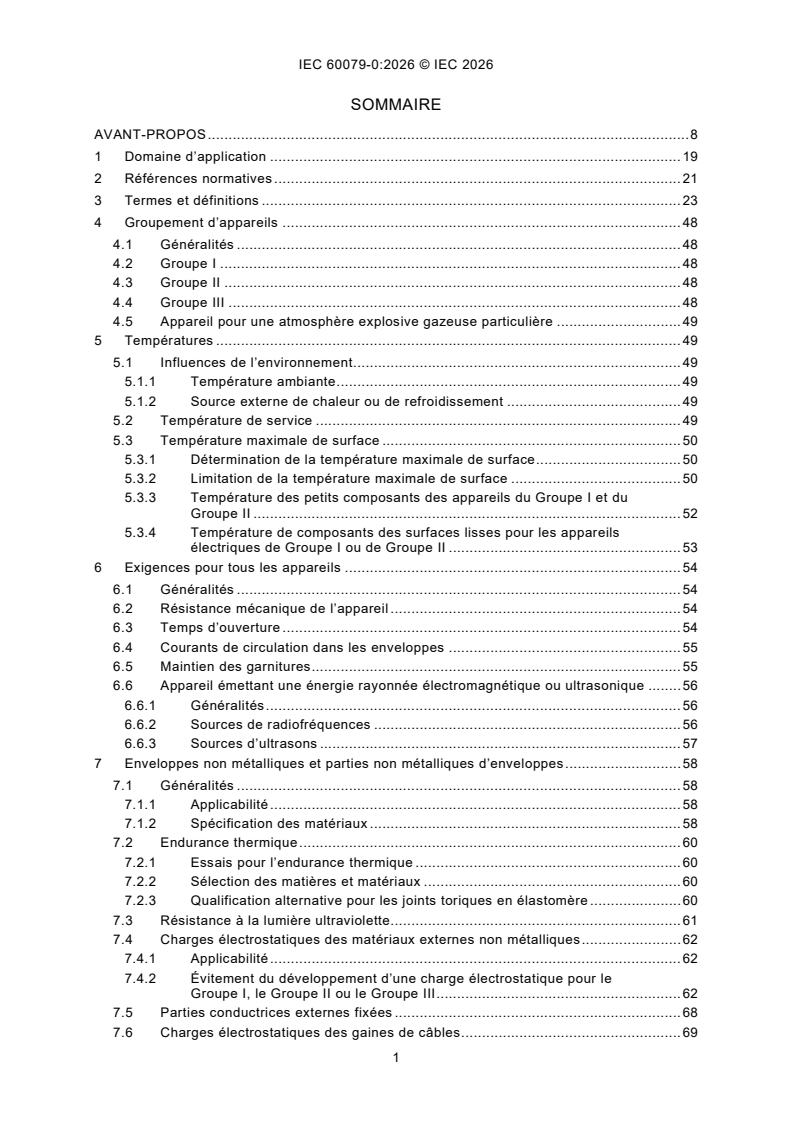
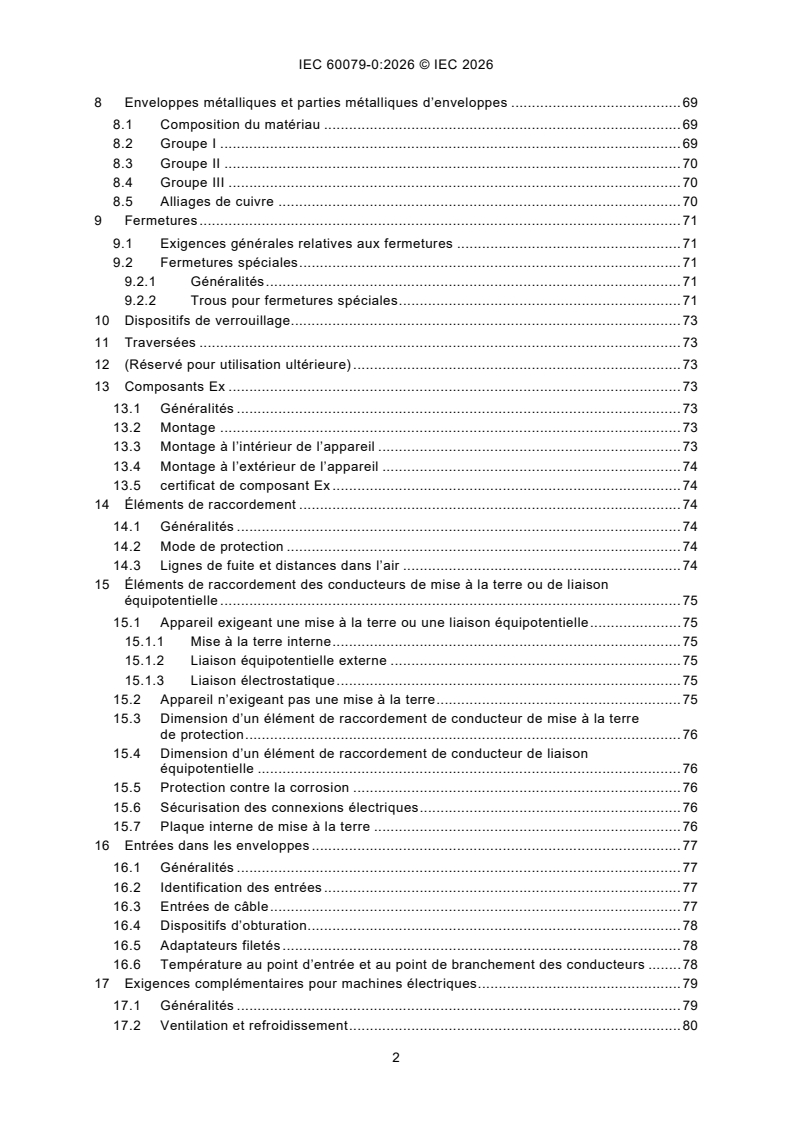
iec60079-0{ed8.0}fr - Atmospheres explosives - Partie 0: Appareils - Exigences générales
IEC 60079-0:2026 is an IEC International Standard for explosive atmospheres. It sets the general requirements for construction, testing and marking of Ex Equipment and Ex Components intended for use in or associated with explosive atmospheres. In practice, it is the base document for manufacturers, test laboratories and certification bodies that need a common starting point for hazardous-area equipment.
What does IEC 60079-0:2026 specify?
IEC 60079-0:2026 specifies the general requirements for Ex Equipment and Ex Components under defined atmospheric conditions, and it points to extra testing when equipment operates outside those conditions. It is also clear that the standard is focused on ignition-risk reduction, not on every possible safety hazard.
The normal atmospheric conditions used for the assessment are:
- temperature from -20 °C to +60 °C
- pressure from 80 kPa to 110 kPa
- air with normal oxygen content, typically 21 % by volume
IEC 60079-0:2026 is organized into clauses 1 to 30, followed by annexes A to H. Annex A and Annex B are normative, while Annexes C to H are informative.
| Annex | What it covers |
|---|---|
| A | Additional requirements for cable entries and cable passage devices, including construction, type tests, marking and instructions |
| B | Requirements for Ex Components |
| C | Example shock-test device |
| D | Electric machines fed by a converter |
| E | Temperature evaluation of electric machines |
| F | Recommended flowchart for testing non-metallic enclosures or parts |
| G | Recommended flowchart for cable-entry testing |
| H | Shaft voltages that can cause sparking in bearings or brush gear, and discharge-energy calculation |
IEC 60079-0:2026 does not address ignition sources such as adiabatic compression, shock waves, exothermic chemical reactions, spontaneous dust ignition, open flames, or hot gases and liquids. That matters in practice because a user still needs other controls and other standards for those hazards.
What are the key requirements of IEC 60079-0:2026?
IEC 60079-0:2026 builds the hazard-protection framework in layers. The most important requirements are about classification, temperature control, enclosure construction, wiring interfaces, product-specific additions, and the evidence needed for marking and certification.
Grouping and temperature limits
Clauses 4 and 5 set the equipment groups and the temperature basis for the rest of the document. IEC 60079-0:2026 uses Group I, Group II and Group III, and it also treats equipment for particular gaseous explosive atmospheres.
Clause 5 links the intended use environment to surface temperature control. In practice, the manufacturer has to define the ambient range, service temperature and maximum surface temperature for the equipment, then verify that the chosen mode of protection still works in that range.
The document also notes that equipment outside the normal temperature range needs additional test provisions, and that operation outside the normal pressure or oxygen conditions may require further consideration. For flameproof and intrinsic-safety type protection, that point matters because quenching and energy limitation can be affected by the atmosphere around the equipment.
Requirements that apply to all Ex Equipment
Clause 6 applies to all Ex Equipment. It covers mechanical resistance, opening time, current circulation in enclosures, gasket retention, and equipment that emits electromagnetic or ultrasonic energy.
The radiofrequency and pulse-energy limits in Tables 4 and 5 are especially important for transmitters, radars and similar sources. The practical meaning is simple: if the equipment can radiate energy, its normal operation must stay below the threshold values so the emission itself does not become an ignition source.
Non-metallic and metallic enclosures
Clauses 7 and 8 control enclosure materials. IEC 60079-0:2026 requires attention to thermal endurance, UV resistance, electrostatic behavior, and the selection of non-metallic and metallic materials used for housings and enclosure parts.
Tables 6 to 10 define limits for surface dimensions, layer thickness, and charge-related characteristics. In practice, this means enclosure material is not just a mechanical choice - it is part of the ignition-risk assessment and must stay suitable over time, including after UV exposure and surface ageing.
Closures, locking, terminals, grounding and cable entries
Clauses 9 to 16 cover closures, special closures, locking devices, traversals, Ex Components, terminals, grounding and cable entries. These are the places where protection is most often weakened during assembly or installation.
IEC 60079-0:2026 requires closures to stay secure, and when a locking device is used to maintain a protection mode, it must not be easy to defeat with a tool. Traversals used for in-situ wiring must be fixed against rotation, and grounding or bonding connections are sized using Table 11.
Cable entries have to maintain the protection mode while also providing strain relief and suitable identification. That matters because a well-designed enclosure can still lose its protection level if the cable entry is poorly chosen or incorrectly mounted.
Product-specific requirements
Clauses 17 to 23 add special requirements for electric machines, switchgear, external sockets and connector bases, luminaires, cap lamps and hand lamps, and equipment that incorporates cells and batteries. These clauses are where the standard becomes product-specific.
For electric machines, IEC 60079-0:2026 addresses ventilation, cooling and bearings. For converter-fed machines, Annex D is used to establish thermal behavior across the full speed and load range, and Annex E supports temperature evaluation.
For cells and batteries, the document covers interconnection, electrochemical systems, rated characteristics, interchangeability, leakage, orientation, replacement and removable battery packs. The practical effect is that the battery chemistry, the charging model and the replacement concept all have to be documented and reflected in the marking and instructions.
Documentation, tests, certificate, marking and instructions
Clauses 24 to 30 set the verification chain from drawings to finished marking. The prototype or sample must conform to the annexed drawings, and the type-test program includes enclosure impact, drop, IP degree of protection, thermal tests, thermal shock, small-component ignition, torsion of traversals, UV resistance, earth continuity, surface resistance, capacitance and transferred charge.
IEC 60079-0:2026 also requires a certificate confirming compliance with the document and the applicable related parts. For Ex Components, the certificate must clearly identify that it is not a certificate for a finished Ex Equipment item, and it must carry the limitations needed for correct final assembly.
Marking and instructions are part of the safety evidence, not an afterthought. They must tell the user the protection concept, the warnings, the battery information, and any special conditions such as converter use or temperature limits.
What terms does IEC 60079-0:2026 define?
IEC 60079-0:2026 defines the terms that make the rest of the document usable in design and certification work.
- ambient temperature - the temperature of the air or other medium close to the equipment or component, not the process temperature unless the item is fully immersed.
- associated equipment - electrical equipment that contains both intrinsically safe and non-intrinsically safe circuits, with construction that prevents the unsafe circuits from affecting the safe ones.
- Ex associated equipment - auxiliary equipment used together with Ex Equipment to keep the specific aspects of its protection mode working.
- AIT (Auto-Ignition Temperature) - the lowest surface temperature at which a specified flammable gas or vapour mixture ignites under the stated test conditions.
- composant Ex - an incomplete Ex part that needs further assessment before it can be incorporated into the final Ex Equipment.
- traversée - an insulating device that carries one or more insulated or bare conductors through an internal or external wall of an enclosure.
- entrée de câble - a device that introduces electrical or optical cable into an Ex enclosure while maintaining the protection mode and providing strain relief.
- ensemble de batteries remplaçable - a complete replaceable unit made of one or more interconnected batteries with additional protective components.
Who uses IEC 60079-0:2026?
IEC 60079-0:2026 is used by manufacturers of Ex Equipment and Ex Components, design engineers, test laboratories, certification bodies and quality managers. It is also used by buyers and specifiers who need to know whether a product can be selected for a hazardous-area application.
The standard is relevant to mining, oil and gas, chemical, dust-handling and other industries where explosive atmospheres may occur. It is especially useful for teams working on motors, switchgear, luminaires, battery-powered equipment and cable-entry products, because those are the areas where design, test and marking choices directly affect safe use.
What changed in IEC 60079-0:2026 from the previous edition?
IEC 60079-0:2026 is the eighth edition and it cancels and replaces the 2017 edition. The foreword describes it as a technical revision.
Main changes identified in the document include:
- the terms "appareil" and "appareil électrique" were revised where appropriate, with "appareil Ex" used consistently
- the use of the IP code terminology was revised for consistency
- the wording for volumetric fraction was clarified
- documentation is now more clearly referred to as annexed drawings
- a note was added to cover short-term thermal excursions
- IEC TS 60079-46, IEC TS 60079-47, IEC 62784 and ISO 80079-37 were added to the referenced material
- IEC 60079-20-1 was replaced by ISO/IEC 80079-20-1
- IEC 60243-2 was added
- the ambient-temperature range became a marking requirement when more than one range applies
The foreword also lists many clause-level revisions to definitions, batteries, wiring, cable entries, temperatures, markings and special equipment sections.
Which standards are used with IEC 60079-0:2026?
IEC 60079-0:2026 relies on a wide set of referenced standards for machine ratings, enclosure protection, materials, fasteners, insulation coordination and gas data.
- IEC 60034-1 and IEC 60034-5 - ratings and IP classification for rotating machines
- IEC 60079-1 and IEC 60079-26 - flameproof enclosures and combined or separated protection levels
- IEC 60086-1:2021 and IEC 60192 - battery and sodium-lamp requirements
- IEC 60216-1, IEC 60216-2, IEC 60243-1 and IEC 60243-2 - thermal ageing and dielectric-strength test methods
- IEC 60423, ISO 262, ISO 273, ISO 965-1, ISO 965-3, ISO 4014, ISO 4017, ISO 4026, ISO 4027, ISO 4028, ISO 4029, ISO 4032, ISO 4762, ISO 7380-1 and ISO 14583 - conduit dimensions, threads, screws, nuts, holes and related tolerances used in enclosure hardware
- ISO 3601-1 and ISO 3601-2 - O-ring dimensions and housing dimensions
- IEC 60529 and IEC 60664-1 - IP code and insulation coordination
- IEC 60947-1 and IEC 62626-1 - low-voltage switchgear and enclosed switch-disconnector requirements
- ISO 48-2, ISO 178, ISO 179, ISO 527-2, ISO 4892-2 and ANSI/UL 746B - material hardness, mechanical properties and UV ageing for non-metallic parts
- ISO/IEC 80079-20-1 - gas and vapour properties and test data used for classification
What does the IEC 60079-0:2026 document contain?
IEC 60079-0:2026 contains figures, tables, test methods, calculation methods and product-specific procedures that support design and certification work. The figures show typical batteries, battery compartments, removable battery packs, electrostatic bonding arrangements, threaded closure details, cable entries, and test arrangements for earth continuity and mechanical impact.
The tables cover temperature classes, component-size evaluations, RF threshold power and energy, electrostatic limits, grounding conductor sizes, shock-test conditions, thermal endurance schedules, warning text and converter parameters. Annex A adds a complete construction-and-test package for cable entries and cable passage devices, while Annexes D, E and H provide guidance for converter-fed machines, motor temperature evaluation and shaft-voltage discharge-energy calculations.
If you are checking a product design, these parts tell you what to measure, what to test and what to document. If you are checking a certification file, they show where the evidence for construction, type testing, marking and instructions is expected to come from.
Relations
- Effective Date
- 05-Sep-2023
- Effective Date
- 05-Sep-2023
- Effective Date
- 05-Sep-2023
- Effective Date
- 05-Sep-2023
Buy Documents
IEC 60079-0:2026 - Explosive atmospheres - Part 0: Equipment - General requirements
REDLINE IEC 60079-0:2026 RLV - Explosive atmospheres - Part 0: Equipment - General requirements
iec60079-0{ed8.0}fr - Atmospheres explosives - Partie 0: Appareils - Exigences générales
Get Certified
Connect with accredited certification bodies for this standard

IMQ S.p.A. (Certification)
Italian electrical product certification.

SLG Prüf- und Zertifizierungs GmbH
German testing and certification body.

UL Solutions
Global safety science company with testing, inspection and certification.
Sponsored listings
Frequently Asked Questions
IEC 60079-0:2026 is a standard published by the International Electrotechnical Commission (IEC). Its full title is "Explosive atmospheres - Part 0: Equipment - General requirements". This standard covers: IEC 60079-0:2026 is available as IEC 60079-0:2026 RLV which contains the International Standard and its Redline version, showing all changes of the technical content compared to the previous edition. IEC 60079-0:2026 specifies the general requirements for construction, testing and marking of Ex Equipment and Ex Components intended for use in or associated with explosive atmospheres. The standard atmospheric conditions (relating to the explosion characteristics of the atmosphere) for Ex Equipment are: - temperature −20 °C to +60 °C; - pressure 80 kPa (0,8 bar) to 110 kPa (1,1 bar); and - air with normal oxygen content, typically a volume fraction of 21 %. This IEC 60079-0:2026 and other documents supplementing this document specify additional test requirements for Ex Equipment operating outside the standard temperature range, but in some cases, further additional consideration and additional testing is required for Ex Equipment operating outside the standard atmospheric pressure range and standard oxygen content. Such additional testing is particularly relevant with respect to Types of Protection that depend on quenching of a flame such as 'flameproof enclosures "d"' (IEC 60079-1) or limitation of energy, 'intrinsic safety "i"' (IEC 60079-11). This eighth edition cancels and replaces the seventh edition, published in 2017. This edition constitutes a technical revision. Refer to the Foreword of the document for a complete listing of the technical changes between edition 8.0 and the previous edition of the document.
IEC 60079-0:2026 is available as IEC 60079-0:2026 RLV which contains the International Standard and its Redline version, showing all changes of the technical content compared to the previous edition. IEC 60079-0:2026 specifies the general requirements for construction, testing and marking of Ex Equipment and Ex Components intended for use in or associated with explosive atmospheres. The standard atmospheric conditions (relating to the explosion characteristics of the atmosphere) for Ex Equipment are: - temperature −20 °C to +60 °C; - pressure 80 kPa (0,8 bar) to 110 kPa (1,1 bar); and - air with normal oxygen content, typically a volume fraction of 21 %. This IEC 60079-0:2026 and other documents supplementing this document specify additional test requirements for Ex Equipment operating outside the standard temperature range, but in some cases, further additional consideration and additional testing is required for Ex Equipment operating outside the standard atmospheric pressure range and standard oxygen content. Such additional testing is particularly relevant with respect to Types of Protection that depend on quenching of a flame such as 'flameproof enclosures "d"' (IEC 60079-1) or limitation of energy, 'intrinsic safety "i"' (IEC 60079-11). This eighth edition cancels and replaces the seventh edition, published in 2017. This edition constitutes a technical revision. Refer to the Foreword of the document for a complete listing of the technical changes between edition 8.0 and the previous edition of the document.
IEC 60079-0:2026 is classified under the following ICS (International Classification for Standards) categories: 29.260.20 - Electrical apparatus for explosive atmospheres. The ICS classification helps identify the subject area and facilitates finding related standards.
IEC 60079-0:2026 has the following relationships with other standards: It is inter standard links to IEC 60079-0:2017, IEC 60079-0:2017/ISH1:2019, IEC 60079-0:2017/COR1:2020, IEC 60079-0:2017/ISH2:2019. Understanding these relationships helps ensure you are using the most current and applicable version of the standard.
IEC 60079-0:2026 is available in PDF format for immediate download after purchase. The document can be added to your cart and obtained through the secure checkout process. Digital delivery ensures instant access to the complete standard document.
Standards Content (Sample)
IEC 60079-0 ®
Edition 8.0 2026-06
INTERNATIONAL
STANDARD
Explosive atmospheres -
Part 0: Equipment - General requirements
ICS 29.260.20 ISBN 978-2-8327-1253-5
All rights reserved. Unless otherwise specified, no part of this publication may be reproduced or utilized in any form or
by any means, electronic or mechanical, including photocopying and microfilm, without permission in writing from either
IEC or IEC's member National Committee in the country of the requester. If you have any questions about IEC copyright
or have an enquiry about obtaining additional rights to this publication, please contact the address below or your local
IEC member National Committee for further information.
IEC Secretariat Tel.: +41 22 919 02 11
3, rue de Varembé info@iec.ch
CH-1211 Geneva 20 www.iec.ch
Switzerland
About the IEC
The International Electrotechnical Commission (IEC) is the leading global organization that prepares and publishes
International Standards for all electrical, electronic and related technologies.
About IEC publications
The technical content of IEC publications is kept under constant review by the IEC. Please make sure that you have the
latest edition, a corrigendum or an amendment might have been published.
IEC publications search - IEC Products & Services Portal - products.iec.ch
webstore.iec.ch/advsearchform Discover our powerful search engine and read freely all the
The advanced search enables to find IEC publications by a publications previews, graphical symbols and the glossary.
variety of criteria (reference number, text, technical With a subscription you will always have access to up to date
committee, …). It also gives information on projects, content tailored to your needs.
replaced and withdrawn publications.
Electropedia - www.electropedia.org
The world's leading online dictionary on electrotechnology,
IEC Just Published - webstore.iec.ch/justpublished
Stay up to date on all new IEC publications. Just Published containing more than 22 500 terminological entries in English
details all new publications released. Available online and and French, with equivalent terms in 25 additional languages.
once a month by email. Also known as the International Electrotechnical Vocabulary
(IEV) online.
IEC Customer Service Centre - webstore.iec.ch/csc
If you wish to give us your feedback on this publication or
need further assistance, please contact the Customer
Service Centre: sales@iec.ch.
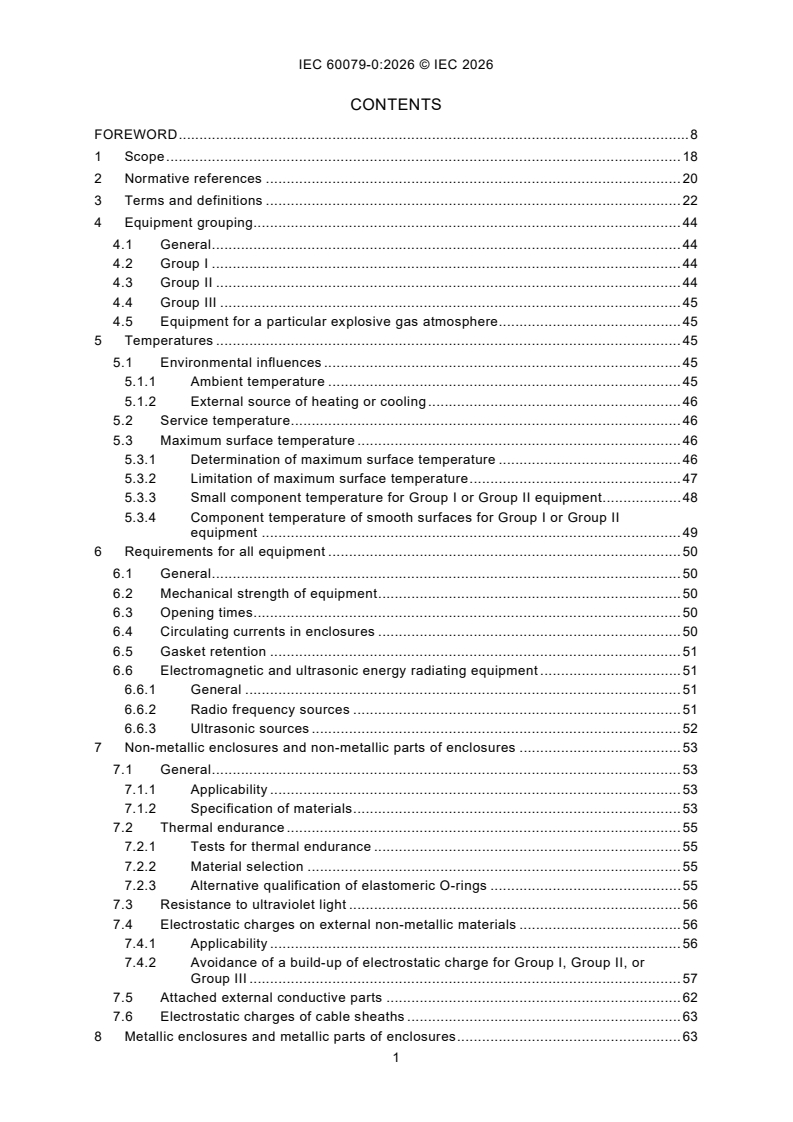
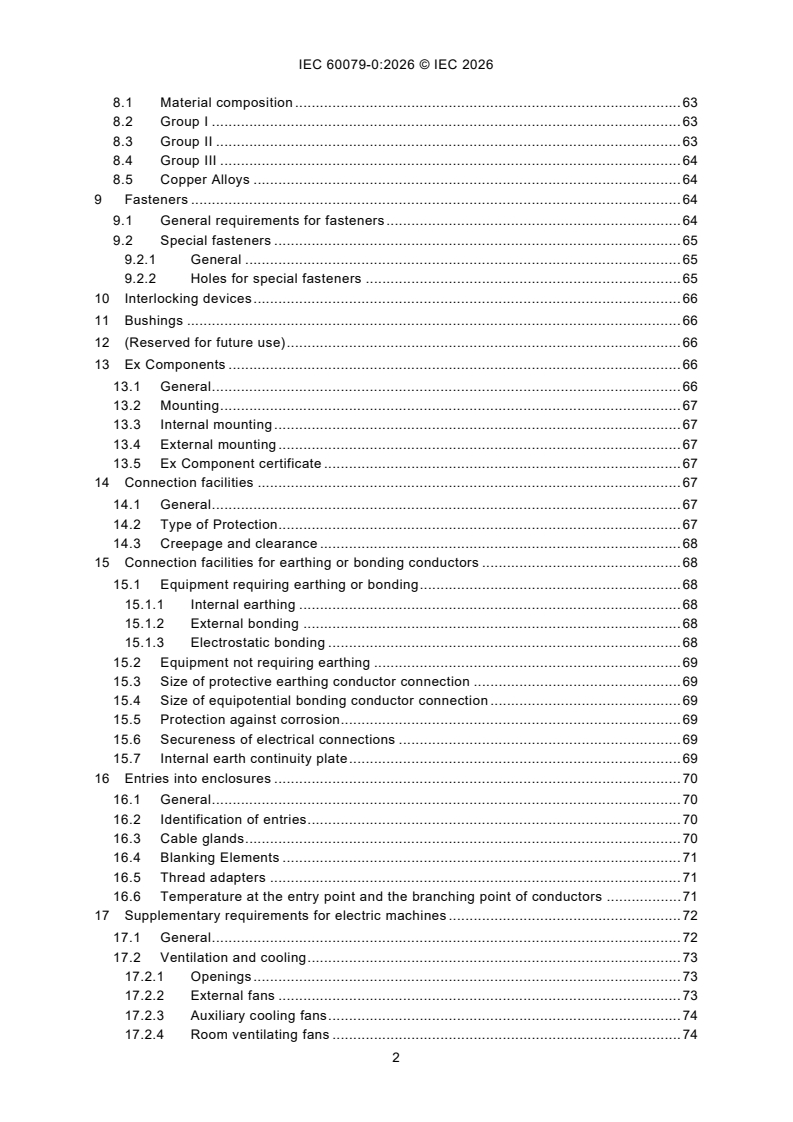
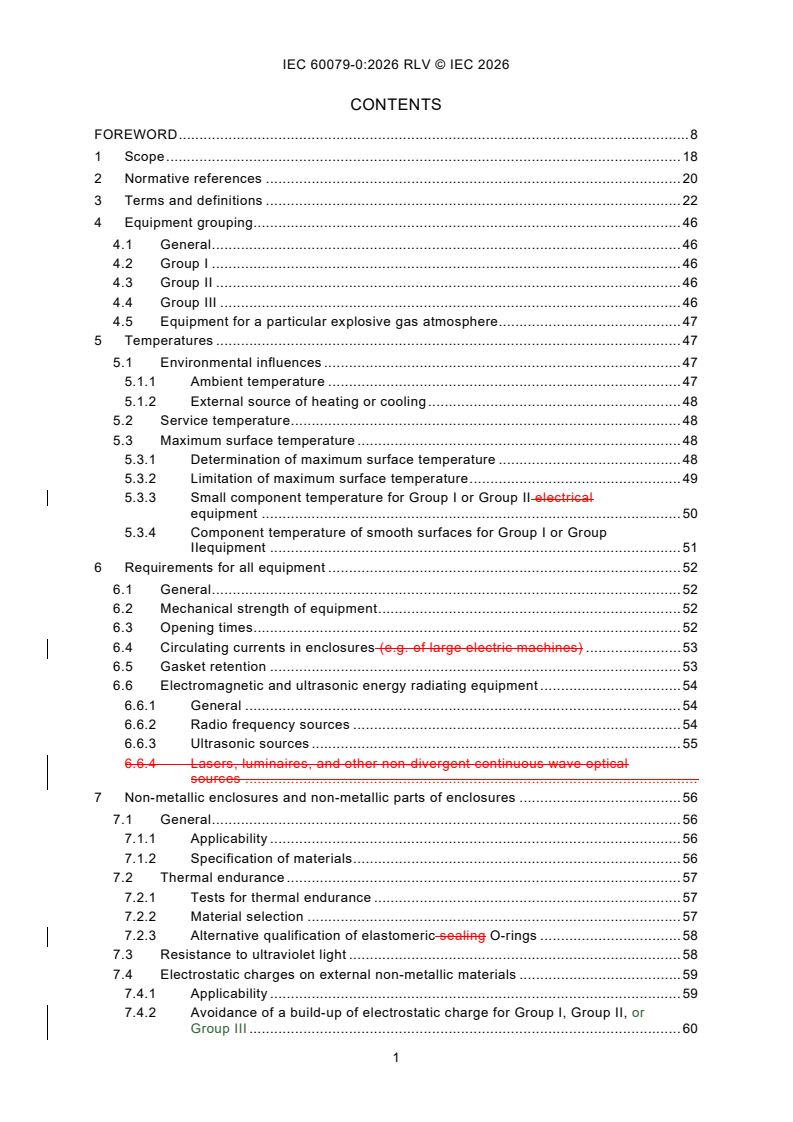
CONTENTS
FOREWORD . 8
1 Scope . 18
2 Normative references . 20
3 Terms and definitions . 22
4 Equipment grouping. 44
4.1 General . 44
4.2 Group I . 44
4.3 Group II . 44
4.4 Group III . 45
4.5 Equipment for a particular explosive gas atmosphere. 45
5 Temperatures . 45
5.1 Environmental influences . 45
5.1.1 Ambient temperature . 45
5.1.2 External source of heating or cooling . 46
5.2 Service temperature . 46
5.3 Maximum surface temperature . 46
5.3.1 Determination of maximum surface temperature . 46
5.3.2 Limitation of maximum surface temperature . 47
5.3.3 Small component temperature for Group I or Group II equipment . 48
5.3.4 Component temperature of smooth surfaces for Group I or Group II
equipment . 49
6 Requirements for all equipment . 50
6.1 General . 50
6.2 Mechanical strength of equipment . 50
6.3 Opening times. 50
6.4 Circulating currents in enclosures . 50
6.5 Gasket retention . 51
6.6 Electromagnetic and ultrasonic energy radiating equipment . 51
6.6.1 General . 51
6.6.2 Radio frequency sources . 51
6.6.3 Ultrasonic sources . 52
7 Non-metallic enclosures and non-metallic parts of enclosures . 53
7.1 General . 53
7.1.1 Applicability . 53
7.1.2 Specification of materials . 53
7.2 Thermal endurance . 55
7.2.1 Tests for thermal endurance . 55
7.2.2 Material selection . 55
7.2.3 Alternative qualification of elastomeric O-rings . 55
7.3 Resistance to ultraviolet light . 56
7.4 Electrostatic charges on external non-metallic materials . 56
7.4.1 Applicability . 56
7.4.2 Avoidance of a build-up of electrostatic charge for Group I, Group II, or
Group III . 57
7.5 Attached external conductive parts . 62
7.6 Electrostatic charges of cable sheaths . 63
8 Metallic enclosures and metallic parts of enclosures . 63
8.1 Material composition . 63
8.2 Group I . 63
8.3 Group II . 63
8.4 Group III . 64
8.5 Copper Alloys . 64
9 Fasteners . 64
9.1 General requirements for fasteners . 64
9.2 Special fasteners . 65
9.2.1 General . 65
9.2.2 Holes for special fasteners . 65
10 Interlocking devices . 66
11 Bushings . 66
12 (Reserved for future use) . 66
13 Ex Components . 66
13.1 General . 66
13.2 Mounting . 67
13.3 Internal mounting . 67
13.4 External mounting . 67
13.5 Ex Component certificate . 67
14 Connection facilities . 67
14.1 General . 67
14.2 Type of Protection . 67
14.3 Creepage and clearance . 68
15 Connection facilities for earthing or bonding conductors . 68
15.1 Equipment requiring earthing or bonding . 68
15.1.1 Internal earthing . 68
15.1.2 External bonding . 68
15.1.3 Electrostatic bonding . 68
15.2 Equipment not requiring earthing . 69
15.3 Size of protective earthing conductor connection . 69
15.4 Size of equipotential bonding conductor connection . 69
15.5 Protection against corrosion . 69
15.6 Secureness of electrical connections . 69
15.7 Internal earth continuity plate . 69
16 Entries into enclosures . 70
16.1 General . 70
16.2 Identification of entries . 70
16.3 Cable glands . 70
16.4 Blanking Elements . 71
16.5 Thread adapters . 71
16.6 Temperature at the entry point and the branching point of conductors . 71
17 Supplementary requirements for electric machines . 72
17.1 General . 72
17.2 Ventilation and cooling . 73
17.2.1 Openings . 73
17.2.2 External fans . 73
17.2.3 Auxiliary cooling fans . 74
17.2.4 Room ventilating fans . 74
17.3 Bearings . 75
18 Supplementary requirements for switchgear . 75
18.1 Flammable dielectric . 75
18.2 Disconnectors . 75
18.3 Group I – Provisions for locking . 76
18.4 Doors and covers . 76
19 Supplementary requirements for factory wiring between enclosures . 76
20 Supplementary requirements for external plugs, socket-outlets and appliance
inlets . 77
20.1 General . 77
20.2 Explosive gas atmospheres . 77
20.3 Explosive dust atmospheres . 78
20.4 Energized plugs . 78
21 Supplementary requirements for luminaires . 78
21.1 General . 78
21.2 Covers for luminaires of EPL Mb, Gb, or Db . 78
21.3 Covers for luminaires of EPL Gc or Dc . 78
21.4 Sodium lamps . 79
21.5 Replacement lamps . 79
22 Supplementary requirements for caplights and handlights . 79
22.1 Group I caplights . 79
22.2 Group II and Group III caplights and handlights . 79
23 Equipment incorporating cells and batteries. 79
23.1 General . 79
23.2 Interconnection of cells to form batteries . 80
23.3 Electrochemical systems of cells and batteries . 80
23.4 Cells in a battery . 82
23.5 Ratings of batteries . 82
23.6 Interchangeability . 82
23.7 Prohibition of charging of primary batteries . 82
23.8 Leakage . 82
23.9 Connections . 83
23.10 Orientation . 83
23.11 Replacement of cells or batteries . 83
23.12 Replaceable battery pack . 83
24 Documentation . 83
24.1 Schedule drawings . 83
24.2 Related drawings . 83
25 Compliance of prototype or sample with documents. 84
26 Type tests . 84
26.1 General . 84
26.2 Test configuration . 84
26.3 Tests in explosive test mixture . 84
26.4 Tests of enclosures . 84
26.4.1 Order of tests . 84
26.4.2 Resistance to impact . 86
26.4.3 Drop test . 88
26.4.4 Acceptance criteria . 89
26.4.5 Degree of protection (IP Code) by enclosures . 89
26.5 Thermal tests . 90
26.5.1 Temperature measurement . 90
26.5.2 Thermal shock test . 93
26.5.3 Small component ignition test (Group I and Group II) . 93
26.6 Torque test for bushings . 94
26.6.1 Test procedure . 94
26.6.2 Acceptance criteria . 95
26.7 Non-metallic enclosures or non-metallic parts of enclosures . 95
26.7.1 General . 95
26.7.2 Test temperatures . 95
26.8 Thermal endurance to heat . 95
26.9 Thermal endurance to cold. 97
26.10 Resistance to UV light. 97
26.10.1 General . 97
26.10.2 Light exposure . 98
26.10.3 Acceptance criteria . 98
26.11 Resistance to chemical agents for Group I equipment . 98
26.12 Earth continuity . 98
26.13 Surface resistance test of parts of enclosures of non-metallic materials . 100
26.14 Measurement of capacitance . 102
26.14.1 General . 102
26.14.2 Test procedure . 102
26.15 Verification of ratings of ventilating fans . 103
26.16 Alternative qualification of elastomeric O-rings . 103
26.17 Transferred charge test . 103
26.17.1 Test equipment . 103
26.17.2 Test sample . 107
26.17.3 Test procedure . 107
27 Routine tests . 108
28 Certificate . 108
29 Marking . 109
29.1 Applicability . 109
29.2 Location . 109
29.3 General . 109
29.4 Ex marking for explosive gas atmospheres . 110
29.5 Ex marking for explosive dust atmospheres . 112
29.6 Combined Types (or Levels) of Protection . 115
29.7 Multiple Types of Protection . 115
29.8 Ga equipment using two independent Gb Types (or Levels) of Protection . 115
29.9 Boundary . 116
29.10 Ex Components . 116
29.11 Small Ex Equipment and small Ex Components . 117
29.12 Extremely small Ex Equipment and extremely small Ex Components . 117
29.13 Alternative marking of Ex Equipment and Ex Components using digital
technology . 117
29.14 Warning markings . 118
29.15 Cells and batteries . 118
29.16 Electric machines supplied by a converter . 118
29.17 Examples of marking. 119
30 Instructions . 124
30.1 General . 124
30.2 Cells and batteries . 125
30.3 Electric machines . 125
30.4 Ventilating fans . 126
30.5 Cable glands . 127
Annex A (normative) Supplementary requirements for cable glands and cable transit
devices . 128
A.1 General . 128
A.2 Constructional requirements . 128
A.2.1 Cable sealing. 128
A.2.2 Filling compounds . 129
A.2.3 Clamping . 129
A.2.4 Lead-in of cable . 130
A.2.5 Release by a tool . 130
A.2.6 Fixing . 130
A.2.7 Degree of protection (IP Code) rating . 130
A.3 Type tests . 130
A.3.1 Tests of clamping of non-armoured and braided cables . 130
A.3.2 Tests of clamping of armoured cables . 134
A.3.3 Type test for resistance to impact . 135
A.3.4 Test for degree of protection (IP Code) rating of cable glands . 136
A.4 Marking . 137
A.4.1 Marking of cable glands . 137
A.4.2 Identification of cable-sealing rings . 137
A.5 Instructions . 138
Annex B (normative) Requirements for Ex Components . 139
Annex C (informative) Example of rig for resistance to impact test . 142
Annex D (informative) Electric machines supplied by a converter . 143
Annex E (informative) Temperature evaluation of electric machines . 144
Annex F (informative) Guidance flowchart for tests of non-metallic enclosures or non-
metallic parts of enclosures (26.4) . 147
Annex G (informative) Guidance flowchart for tests of cable glands . 148
Annex H (informative) Shaft voltages resulting in motor bearing or shaft brush
sparking discharge energy calculation . 150
H.1 General . 150
H.2 Assessment of the possibility of ignition using ignition energy calculation . 150
H.3 Shaft voltage determination for a rotating machine . 151
H.4 Capacitance "C" calculation for a rotating machine . 152
H.5 Energy "E" calculation for a rotating machine . 154
H.6 Assessment using reference curves . 154
Bibliography . 156
Figure 1 – Typical battery examples. 23
Figure 2 – Typical battery compartment . 25
Figure 3 – Typical replaceable battery pack . 26
Figure 4 – Shield with electrostatic bonding . 59
Figure 5 – Cylindrical shield with electrostatic bonding . 59
Figure 6 – Tolerances and clearance for threaded fasteners . 65
Figure 7 – Contact surface under head of fastener with a reduced shank . 66
Figure 8 – Cable gland. 72
Figure 9 – Conduit entry . 72
Figure 10 – Assembly of test sample for earth-continuity test . 100
Figure 11 – Test piece with electrodes . 101
Figure 12 – Compression set of an O-ring . 103
Figure 13 – Example of non-oscillating pulse trace (1) . 104
Figure 14 – Example of faulty oscillating pulse trace (1) . 105
Figure 15 – Shunt with four parallel resistors . 105
Figure 16 – Schematic drawing of the method shunt and oscilloscope . 106
Figure 17 – Zero-line trace (1) with low noise . 106
Figure A.1 – Cable sealing and clamping . 129
Figure A.2 – Rounded edge of the point of entry of the flexible cable . 130
Figure A.3 – Example of a seal with multiple openings . 131
Figure A.4 – Example of rig for resistance to impact test . 136
Figure C.1 – Example of rig for resistance to impact test . 142
Figure F.1 – Non-metallic enclosures or non-metallic parts of enclosures . 147
Figure G.1 – Guidance flowchart for tests of cable glands . 149
Figure H.1 – Capacitance stored in bearing clearance of sleeve bearing between
journal and outer bearing housing . 153
Figure H.2 – Air-gap between stator and rotor. 153
Figure H.3 – Typical surfaces that form capacitors from the motor shaft to earth . 154
Figure H.4 – Capacitive ignition curves . 155
Table 1 – Classification of maximum surface temperatures for Group II equipment . 47
Table 2 – Assessment of temperature classification according to component size . 49
Table 3 – Assessment of temperature classification Component surface area ≥ 20 mm . 49
Table 4 – Threshold power . 52
Table 5 – Threshold energy . 52
Table 6 – Limitation of surface areas . 59
Table 7 – Maximum diameter or width . 60
Table 8 – Limitation of thickness of non-metallic layer . 60
Table 9 – Maximum transferred charge . 60
Table 10 – Maximum capacitance of unearthed conductive parts . 62
Table 11 – Minimum cross-sectional area of PE conductors . 69
Table 12 – Primary cells . 80
Table 13 – Secondary cells . 81
Table 14 – Impact tests. 87
Table 15 – Torque to be applied to the stem of bushing used for connection facilities . 95
Table 16 – Thermal endurance test . 96
Table 17 – Thermal endurance tests – personal or portable equipment . 97
Table 18 – Text of warning markings . 118
Table 19 – Example of converter parameters . 126
Table B.1 – Applicability of clauses to Ex Components . 139
Table H.1 – Maximum permitted energy . 151
INTERNATIONAL ELECTROTECHNICAL COMMISSION
____________
Explosive atmospheres -
Part 0: Equipment - General requirements
FOREWORD
1) The International Electrotechnical Commission (IEC) is a worldwide organization for standardization comprising
all national electrotechnical committees (IEC National Committees). The object of IEC is to promote international
co-operation on all questions concerning standardization in the electrical and electronic fields. To this end and
in addition to other activities, IEC publishes International Standards, Technical Specifications, Technical Reports,
Publicly Available Specifications (PAS) and Guides (hereafter referred to as "IEC Publication(s)"). Their
preparation is entrusted to technical committees; any IEC National Committee interested in the subject dealt with
may participate in this preparatory work. International, governmental and non-governmental organizations liaising
with the IEC also participate in this preparation. IEC collaborates closely with the International Organization for
Standardization (ISO) in accordance with conditions determined by agreement between the two organizations.
2) The formal decisions or agreements of IEC on technical matters express, as nearly as possible, an international
consensus of opinion on the relevant subjects since each technical committee has representation from all
interested IEC National Committees.
3) IEC Publications have the form of recommendations for international use and are accepted by IEC National
Committees in that sense. While all reasonable efforts are made to ensure that the technical content of IEC
Publications is accurate, IEC cannot be held responsible for the way in which they are used or for any
misinterpretation by any end user.
4) In order to promote international uniformity, IEC National Committees undertake to apply IEC Publications
transparently to the maximum extent possible in their national and regional publications. Any divergence between
any IEC Publication and the corresponding national or regional publication shall be clearly indicated in the latter.
5) IEC itself does not provide any attestation of conformity. Independent certification bodies provide conformity
assessment services and, in some areas, access to IEC marks of conformity. IEC is not responsible for any
services carried out by independent certification bodies.
6) All users should ensure that they have the latest edition of this publication.
7) No liability shall attach to IEC or its directors, employees, servants or agents including individual experts and
members of its technical committees and IEC National Committees for any personal injury, property damage or
other damage of any nature whatsoever, whether direct or indirect, or for costs (including legal fees) and
expenses arising out of the publication, use of, or reliance upon, this IEC Publication or any other IEC
Publications.
8) Attention is drawn to the Normative references cited in this publication. Use of the referenced publications is
indispensable for the correct application of this publication.
9) IEC draws attention to the possibility that the implementation of this document may involve the use of (a)
patent(s). IEC takes no position concerning the evidence, validity or applicability of any claimed patent rights in
respect thereof. As of the date of publication of this document, IEC had not received notice of (a) patent(s), which
may be required to implement this document. However, implementers are cautioned that this may not represent
the latest information, which may be obtained from the patent database available at https://patents.iec.ch. IEC
shall not be held responsible for identifying any or all such patent rights.
IEC 60079-0 has been prepared by IEC technical committee 31: Equipment for explosive
atmospheres. It is an International Standard.
This eighth edition cancels and replaces the seventh edition, published in 2017. This edition
constitutes a technical revision.
Users of this document are advised that interpretation sheets clarifying the interpretation of this
document can be published. Interpretation sheets are available from the IEC webstore and can
be found in the "history" tab of the page for each document.
The significance of the changes between IEC 60079-0:2017 (Edition 7) and IEC 60079-0:—
(Edition 8) are as listed below:
Type
Minor and Major
Explanation of the significance of the changes Clause editorial Extension technical
changes changes
Equipment replaced by Ex Equipment where
General X
appropriate
Electrical equipment replaced by equipment where
General X
appropriate
Use of term degree of protection (IP Code) reviewed
General X
throughout the document for consistency
Clarify the use of volume fraction terms General X
Clarified the documentation is more clearly specified
General X
as schedule drawings.
Added NOTE 4 to address short-term thermal
1 X
excursions
IEC TS 60079-46 added 1 X
IEC TS 60079-47 is added 1 X
IEC 62784 is added 1 X
ISO 80079-37 is added 1 X
IEC 60079-20-1 is replaced by ISO/IEC 80079-20-1 2 X
IEC 60243-2 is added 2 X
Admitted term minimum ignition temperature of an
explosive gas atmosphere added. Standard number 3.6 X
corrected
Definition for reverse charging clarified 3.7.10 X
Figure added to typical battery compartment 3.7.14
Definition for brush discharge added 3.8 X
Definition for bushing clarified to be an insulating
3.10 X
device
Note 1 to entry for certificate revised to use
declaration, acceptance, and certification terms in 3.13 X
accordance with ISO/IEC 17000
Note 1 to entry for coating added to clarify application
3.14 X
in standards for explosive atmospheres
Definition for continuous operating temperature revised
to show that it is a manufacturer defined property. 3.21 X
Added admitted term continuous service temperature
Term comparable converter added along with domain
3.22.2 X
added
Definition for dust clarified along with Note 1 to entry 3.25 X
Note 2 to entry for conductive dust added to clarify
3.25.2 X
how metal dust is considered
Term electrostatic bonding along with admitted terms
electrostatic bonded and electrostatically bonded
3.30 X
added
Note 1 to entry for portable equipment clarified to
include equipment that is carried, but intended to be
3.33.5 X
hand-held when in use
Term EPL G- added 3.35.7 X
Term EPL D- added 3.35.11 X
Term and definition for explosion-protected added 3.36 X
Definition for Ex Component clarified 3.39 X
Type
Minor and Major
Explanation of the significance of the changes Clause editorial Extension technical
changes changes
Definition for Ex Component Enclosure added 3.40 X
Definition for explosive atmosphere revised to include
3.42 X
mist in accordance with IEC 60079-10-1
Note 1 to entry for free space clarified to address
3.48 X
space in components
Term and definition for insulation coordination added
3.55 X
from IEC 60050-442-09-01
Term and definition for isolated circuit added 3.55.1 X
Term and definition for macro-environment added 3.55.2 X
Definition for mains circuit clarified 3.55.3 X
Note 2 to entry for mains supply clarified to address
3.55.4 X
transients
Term and definition for micro-environment added 3.55.5 X
Term and
...
IEC 60079-0 ®
Edition 8.0 2026-06
INTERNATIONAL
STANDARD
REDLINE VERSION
Explosive atmospheres -
Part 0: Equipment - General requirements
ICS 29.260.20 ISBN 978-2-8327-1342-6
All rights reserved. Unless otherwise specified, no part of this publication may be reproduced or utilized in any form or
by any means, electronic or mechanical, including photocopying and microfilm, without permission in writing from either
IEC or IEC's member National Committee in the country of the requester. If you have any questions about IEC copyright
or have an enquiry about obtaining additional rights to this publication, please contact the address below or your local
IEC member National Committee for further information.
IEC Secretariat Tel.: +41 22 919 02 11
3, rue de Varembé info@iec.ch
CH-1211 Geneva 20 www.iec.ch
Switzerland
About the IEC
The International Electrotechnical Commission (IEC) is the leading global organization that prepares and publishes
International Standards for all electrical, electronic and related technologies.
About IEC publications
The technical content of IEC publications is kept under constant review by the IEC. Please make sure that you have the
latest edition, a corrigendum or an amendment might have been published.
IEC publications search - IEC Products & Services Portal - products.iec.ch
webstore.iec.ch/advsearchform Discover our powerful search engine and read freely all the
The advanced search enables to find IEC publications by a publications previews, graphical symbols and the glossary.
variety of criteria (reference number, text, technical With a subscription you will always have access to up to date
committee, …). It also gives information on projects, content tailored to your needs.
replaced and withdrawn publications.
Electropedia - www.electropedia.org
The world's leading online dictionary on electrotechnology,
IEC Just Published - webstore.iec.ch/justpublished
Stay up to date on all new IEC publications. Just Published containing more than 22 500 terminological entries in English
details all new publications released. Available online and and French, with equivalent terms in 25 additional languages.
once a month by email. Also known as the International Electrotechnical Vocabulary
(IEV) online.
IEC Customer Service Centre - webstore.iec.ch/csc
If you wish to give us your feedback on this publication or
need further assistance, please contact the Customer
Service Centre: sales@iec.ch.
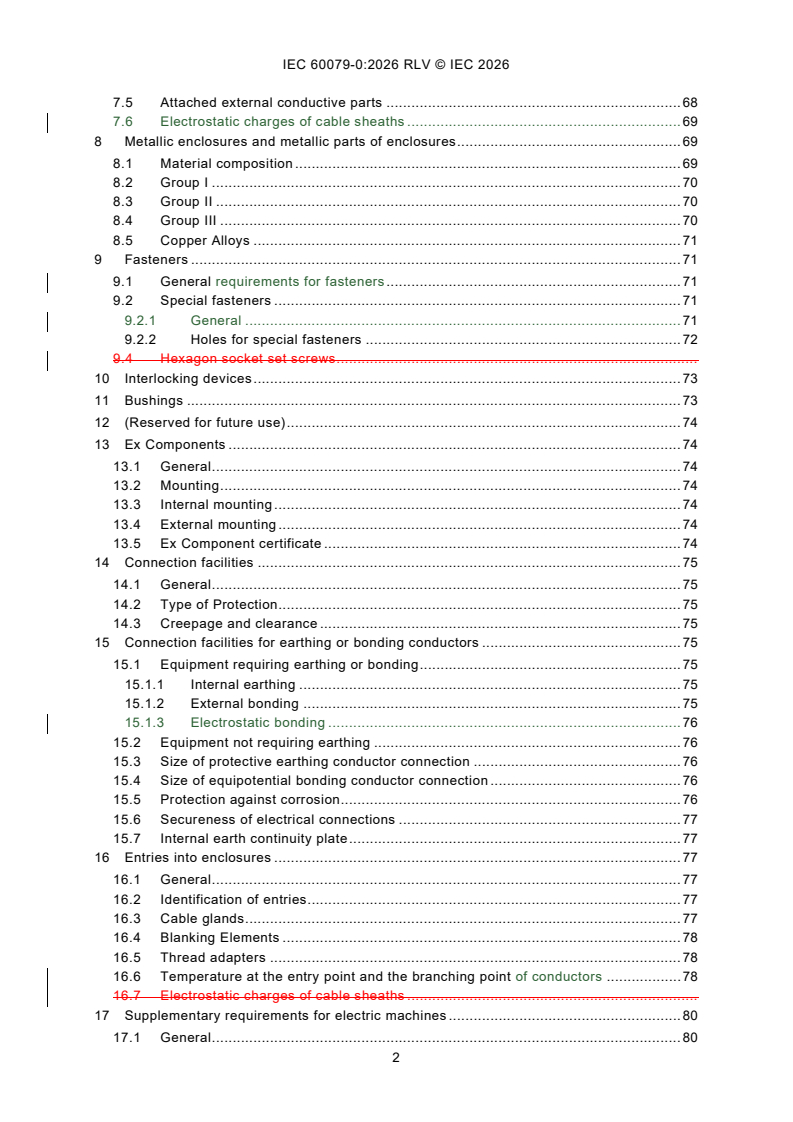
CONTENTS
FOREWORD . 8
1 Scope . 18
2 Normative references . 20
3 Terms and definitions . 22
4 Equipment grouping. 46
4.1 General . 46
4.2 Group I . 46
4.3 Group II . 46
4.4 Group III . 46
4.5 Equipment for a particular explosive gas atmosphere. 47
5 Temperatures . 47
5.1 Environmental influences . 47
5.1.1 Ambient temperature . 47
5.1.2 External source of heating or cooling . 48
5.2 Service temperature . 48
5.3 Maximum surface temperature . 48
5.3.1 Determination of maximum surface temperature . 48
5.3.2 Limitation of maximum surface temperature . 49
5.3.3 Small component temperature for Group I or Group II electrical
equipment . 50
5.3.4 Component temperature of smooth surfaces for Group I or Group
IIequipment . 51
6 Requirements for all equipment . 52
6.1 General . 52
6.2 Mechanical strength of equipment . 52
6.3 Opening times. 52
6.4 Circulating currents in enclosures (e.g. of large electric machines) . 53
6.5 Gasket retention . 53
6.6 Electromagnetic and ultrasonic energy radiating equipment . 54
6.6.1 General . 54
6.6.2 Radio frequency sources . 54
6.6.3 Ultrasonic sources . 55
6.6.4 Lasers, luminaires, and other non-divergent continuous wave optical
sources .
7 Non-metallic enclosures and non-metallic parts of enclosures . 56
7.1 General . 56
7.1.1 Applicability . 56
7.1.2 Specification of materials . 56
7.2 Thermal endurance . 57
7.2.1 Tests for thermal endurance . 57
7.2.2 Material selection . 57
7.2.3 Alternative qualification of elastomeric sealing O-rings . 58
7.3 Resistance to ultraviolet light . 58
7.4 Electrostatic charges on external non-metallic materials . 59
7.4.1 Applicability . 59
7.4.2 Avoidance of a build-up of electrostatic charge for Group I, Group II, or
Group III . 60
7.5 Attached external conductive parts . 68
7.6 Electrostatic charges of cable sheaths . 69
8 Metallic enclosures and metallic parts of enclosures . 69
8.1 Material composition . 69
8.2 Group I . 70
8.3 Group II . 70
8.4 Group III . 70
8.5 Copper Alloys . 71
9 Fasteners . 71
9.1 General requirements for fasteners . 71
9.2 Special fasteners . 71
9.2.1 General . 71
9.2.2 Holes for special fasteners . 72
9.4 Hexagon socket set screws .
10 Interlocking devices . 73
11 Bushings . 73
12 (Reserved for future use) . 74
13 Ex Components . 74
13.1 General . 74
13.2 Mounting . 74
13.3 Internal mounting . 74
13.4 External mounting . 74
13.5 Ex Component certificate . 74
14 Connection facilities . 75
14.1 General . 75
14.2 Type of Protection . 75
14.3 Creepage and clearance . 75
15 Connection facilities for earthing or bonding conductors . 75
15.1 Equipment requiring earthing or bonding . 75
15.1.1 Internal earthing . 75
15.1.2 External bonding . 75
15.1.3 Electrostatic bonding . 76
15.2 Equipment not requiring earthing . 76
15.3 Size of protective earthing conductor connection . 76
15.4 Size of equipotential bonding conductor connection . 76
15.5 Protection against corrosion . 76
15.6 Secureness of electrical connections . 77
15.7 Internal earth continuity plate . 77
16 Entries into enclosures . 77
16.1 General . 77
16.2 Identification of entries . 77
16.3 Cable glands . 77
16.4 Blanking Elements . 78
16.5 Thread adapters . 78
16.6 Temperature at the entry point and the branching point of conductors . 78
16.7 Electrostatic charges of cable sheaths .
17 Supplementary requirements for electric machines . 80
17.1 General . 80
17.2 Ventilation and cooling . 80
17.2.1 Ventilation Openings . 80
17.2.2 Materials for External fans . 80
17.2.3 Auxiliary motor cooling fans . 81
17.2.4 Room ventilating fans . 81
17.3 Bearings . 82
18 Supplementary requirements for switchgear . 83
18.1 Flammable dielectric . 83
18.2 Disconnectors . 83
18.3 Group I – Provisions for locking . 83
18.4 Doors and covers . 83
19 Reserved for future use Supplementary requirements for factory wiring between
enclosures . 84
20 Supplementary requirements for external plugs, socket-outlets and connectors for
field wiring connection appliance inlets . 84
20.1 General . 84
20.2 Explosive gas atmospheres . 85
20.3 Explosive dust atmospheres . 85
20.4 Energized plugs . 85
21 Supplementary requirements for luminaires . 85
21.1 General . 85
21.2 Covers for luminaires of EPL Mb, EPL Gb, or EPL Db . 86
21.3 Covers for luminaires of EPL Gc or EPL Dc . 86
21.4 Sodium lamps . 86
21.5 Replacement lamps . 87
22 Supplementary requirements for caplights and handlights . 87
22.1 Group I caplights . 87
22.2 Group II and Group III caplights and handlights . 87
23 Equipment incorporating cells and batteries. 87
23.1 General . 87
23.2 Interconnection of cells to form batteries . 87
23.3 Cell types Electrochemical systems of cells and batteries . 87
23.4 Cells in a battery . 90
23.5 Ratings of batteries . 90
23.6 Interchangeability . 90
23.7 Prohibition of charging of primary batteries . 90
23.8 Leakage . 90
23.9 Connections . 91
23.10 Orientation . 91
23.11 Replacement of cells or batteries . 91
23.12 Replaceable battery pack . 91
24 Documentation . 91
24.1 Schedule drawings . 91
24.2 Related drawings . 91
25 Compliance of prototype or sample with documents. 92
26 Type tests . 92
26.1 General . 92
26.2 Test configuration . 92
26.3 Tests in explosive test mixture . 92
26.4 Tests of enclosures . 92
26.4.1 Order of tests . 92
26.4.2 Resistance to impact . 94
26.4.3 Drop test . 97
26.4.4 Acceptance criteria . 98
26.4.5 Degree of protection (IP Code) by enclosures . 98
26.5 Thermal tests . 99
26.5.1 Temperature measurement . 99
26.5.2 Thermal shock test . 102
26.5.3 Small component ignition test (Group I and Group II) . 103
26.6 Torque test for bushings . 104
26.6.1 Test procedure . 104
26.6.2 Acceptance criteria . 104
26.7 Non-metallic enclosures or non-metallic parts of enclosures . 105
26.7.1 General . 105
26.7.2 Test temperatures . 105
26.8 Thermal endurance to heat . 105
26.9 Thermal endurance to cold. 106
26.10 Resistance to UV light. 106
26.10.1 General . 106
26.10.2 Light exposure . 107
26.10.3 Acceptance criteria . 107
26.11 Resistance to chemical agents for Group I equipment . 107
26.12 Earth continuity . 108
26.13 Surface resistance test of parts of enclosures of non-metallic materials . 109
26.14 Measurement of capacitance . 111
26.14.1 General . 111
26.14.2 Test procedure . 111
26.15 Verification of ratings of ventilating fans . 112
26.16 Alternative qualification of elastomeric sealing O-rings . 112
26.17 Transferred charge test . 113
26.17.1 Test equipment . 113
26.17.2 Test sample . 116
26.17.3 Test procedure . 117
27 Routine tests . 118
28 Manufacturer's responsibility .
28 Certificate . 119
29 Marking . 119
29.1 Applicability . 119
29.2 Location . 119
29.3 General . 120
29.4 Ex marking for explosive gas atmospheres . 121
29.5 Ex marking for explosive dust atmospheres . 123
29.6 Combined Types (or Levels) of Protection . 126
29.7 Multiple Types of Protection . 126
29.8 Ga equipment using two independent Gb Types (or Levels) of Protection . 127
29.9 Boundary wall . 127
29.10 Ex Components . 127
29.11 Small Ex Equipment and small Ex Components . 128
29.12 Extremely small Ex Equipment and extremely small Ex Components . 128
29.13 Alternative marking of Ex Equipment and Ex Components using digital
technology . 129
29.14 Warning markings . 129
29.15 Cells and batteries . 129
29.16 Electric machines operated with supplied by a converter . 130
29.17 Examples of marking. 130
30 Instructions . 135
30.1 General . 135
30.2 Cells and batteries . 136
30.3 Electric machines . 137
30.4 Ventilating fans . 138
30.5 Cable glands . 138
Annex A (normative) Supplementary requirements for cable glands and cable transit
devices . 139
A.1 General . 139
A.2 Constructional requirements . 140
A.2.1 Cable sealing. 140
A.2.2 Filling compounds . 140
A.2.3 Clamping . 140
A.2.4 Lead-in of cable . 141
A.2.5 Release by a tool . 141
A.2.6 Fixing . 141
A.2.7 Degree of protection (IP Code) rating . 141
A.3 Type tests . 142
A.3.1 Tests of clamping of non-armoured and braided cables . 142
A.3.2 Tests of clamping of armoured cables . 145
A.3.3 Type test for resistance to impact . 146
A.3.4 Test for degree of protection (IP Code) rating of cable glands . 147
A.4 Marking . 148
A.4.1 Marking of cable glands . 148
A.4.2 Identification of cable-sealing rings . 148
A.5 Instructions . 149
Annex B (normative) Requirements for Ex Components . 150
Annex C (informative) Example of rig for resistance to impact test . 153
Annex D (informative) Electric machines connected to converters supplied by a
converter . 154
Annex E (informative) Temperature evaluation of electric machines . 155
Annex F (informative) Guidance flowchart for tests of non-metallic enclosures or non-
metallic parts of enclosures (26.4) . 158
Annex G (informative) Guidance flowchart for tests of cable glands . 161
Annex H (informative) Shaft voltages resulting in motor bearing or shaft brush
sparking discharge energy calculation . 163
H.1 General . 163
H.2 Assessment of the risk possibility of ignition using ignition energy calculation . 163
H.3 Shaft voltage determination for a rotating machine . 164
H.4 Capacitance "C" calculation for a rotating machine . 165
H.5 Energy "E" calculation for a rotating machine . 167
H.6 Assessment using reference curves . 167
Bibliography . 169
Figure 1 – Typical battery examples. 24
Figure 2 – Typical battery compartment . 26
Figure 3 – Typical replaceable battery pack . 27
Figure 4 – Shield with electrostatic bonding . 65
Figure 5 – Cylindrical shield with electrostatic bonding . 65
Figure 6 – Tolerances and clearance for threaded fasteners . 72
Figure 7 – Contact surface under head of fastener with a reduced shank . 73
Figure 8 – Cable gland. 79
Figure 9 – Conduit entry . 79
Figure 10 – Assembly of test sample for earth-continuity test . 109
Figure 11 – Test piece with painted electrodes . 110
Figure 12 – Compression set of an O-ring . 112
Figure 13 – Example of non-oscillating pulse trace (1) . 114
Figure 14 – Example of faulty oscillating pulse trace (1) . 114
Figure 15 – Shunt with four parallel resistors . 115
Figure 16 – Schematic drawing of the method shunt and oscilloscope . 115
Figure 17 – Zero-line trace (1) with low noise . 116
Figure A.1 – Illustration of the terms used for cable glands Cable sealing and clamping . 140
Figure A.2 – Rounded edge of the point of entry of the flexible cable . 141
Figure A.3 – Example of a seal with multiple openings . 142
Figure A.4 – Example of rig for resistance to impact test . 147
Figure C.1 – Example of rig for resistance to impact test . 153
Figure F.1 – Non-metallic enclosures or non-metallic parts of enclosures . 160
Figure G.1 – Guidance flowchart for tests of cable glands . 162
Figure H.1 – Capacitance stored in bearing clearance of sleeve bearing between
journal and outer bearing housing . 166
Figure H.2 – Air-gap between stator and rotor. 166
Figure H.3 – Typical surfaces that form capacitors from the motor shaft to ground earth . 167
Figure H.4 – Capacitive ignition curves . 168
Table 1 – Ambient temperatures in service and additional marking .
Table 1 – Classification of maximum surface temperatures Group II electrical
equipment . 49
Table 2 – Assessment of temperature classification according to component size . 51
Table 3 – Assessment of temperature classification Component surface area ≥ 20 mm . 51
Table 4 – Threshold power . 54
Table 5 – Threshold energy . 54
Table 6 – Limitation of surface areas . 65
Table 7 – Maximum diameter or width . 66
Table 8 – Limitation of thickness of non-metallic layer . 66
Table 9 – Maximum transferred charge . 66
Table 10 – Maximum capacitance of unearthed conductive parts . 69
Table 11 – Minimum cross-sectional area of PE conductors . 76
Table 12 – Primary cells . 88
Table 13 – Secondary cells . 89
Table 14 – Tests for resistance to impact Impact tests . 96
Table 15 – Torque to be applied to the stem of bushing used for connection facilities . 104
Table 16 – Thermal endurance test . 105
Table 17 – Thermal endurance tests – personal or portable equipment . 106
Table 18 – Text of warning markings . 129
Table 19 – Example of type-test converter parameters. 137
Table B.1 – Applicability of clauses to Ex Components . 150
Table H.1 – Maximum permitted energy . 164
INTERNATIONAL ELECTROTECHNICAL COMMISSION
____________
Explosive atmospheres -
Part 0: Equipment - General requirements
FOREWORD
1) The International Electrotechnical Commission (IEC) is a worldwide organization for standardization comprising
all national electrotechnical committees (IEC National Committees). The object of IEC is to promote international
co-operation on all questions concerning standardization in the electrical and electronic fields. To this end and
in addition to other activities, IEC publishes International Standards, Technical Specifications, Technical Reports,
Publicly Available Specifications (PAS) and Guides (hereafter referred to as "IEC Publication(s)"). Their
preparation is entrusted to technical committees; any IEC National Committee interested in the subject dealt with
may participate in this preparatory work. International, governmental and non-governmental organizations liaising
with the IEC also participate in this preparation. IEC collaborates closely with the International Organization for
Standardization (ISO) in accordance with conditions determined by agreement between the two organizations.
2) The formal decisions or agreements of IEC on technical matters express, as nearly as possible, an international
consensus of opinion on the relevant subjects since each technical committee has representation from all
interested IEC National Committees.
3) IEC Publications have the form of recommendations for international use and are accepted by IEC National
Committees in that sense. While all reasonable efforts are made to ensure that the technical content of IEC
Publications is accurate, IEC cannot be held responsible for the way in which they are used or for any
misinterpretation by any end user.
4) In order to promote international uniformity, IEC National Committees undertake to apply IEC Publications
transparently to the maximum extent possible in their national and regional publications. Any divergence between
any IEC Publication and the corresponding national or regional publication shall be clearly indicated in the latter.
5) IEC itself does not provide any attestation of conformity. Independent certification bodies provide conformity
assessment services and, in some areas, access to IEC marks of conformity. IEC is not responsible for any
services carried out by independent certification bodies.
6) All users should ensure that they have the latest edition of this publication.
7) No liability shall attach to IEC or its directors, employees, servants or agents including individual experts and
members of its technical committees and IEC National Committees for any personal injury, property damage or
other damage of any nature whatsoever, whether direct or indirect, or for costs (including legal fees) and
expenses arising out of the publication, use of, or reliance upon, this IEC Publication or any other IEC
Publications.
8) Attention is drawn to the Normative references cited in this publication. Use of the referenced publications is
indispensable for the correct application of this publication.
9) IEC draws attention to the possibility that the implementation of this document may involve the use of (a)
patent(s). IEC takes no position concerning the evidence, validity or applicability of any claimed patent rights in
respect thereof. As of the date of publication of this document, IEC had not received notice of (a) patent(s), which
may be required to implement this document. However, implementers are cautioned that this may not represent
the latest information, which may be obtained from the patent database available at https://patents.iec.ch. IEC
shall not be held responsible for identifying any or all such patent rights.
IEC 60079-0 has been prepared by IEC technical committee 31: Equipment for explosive
atmospheres. It is an International Standard.
This eighth edition cancels and replaces the seventh edition, published in 2017. This edition
constitutes a technical revision.
Users of this document are advised that interpretation sheets clarifying the interpretation of this
document can be published. Interpretation sheets are available from the IEC webstore and can
be found in the "history" tab of the page for each document.
The significance of the changes between IEC 60079-0:2017 (Edition 7) and IEC 60079-0:—
(Edition 8) are as listed below:
Type
Minor and Major
Explanation of the significance of the changes Clause editorial Extension technical
changes changes
Equipment replaced by Ex Equipment where
General X
appropriate
Electrical equipment replaced by equipment where
General X
appropriate
Use of term degree of protection (IP Code) reviewed
General X
throughout the document for consistency
Clarify the use of volume fraction terms General X
Clarified the documentation is more clearly specified
General X
as schedule drawings.
Added NOTE 4 to address short-term thermal
1 X
excursions
IEC TS 60079-46 added 1 X
IEC TS 60079-47 is added 1 X
IEC 62784 is added 1 X
ISO 80079-37 is added 1 X
IEC 60079-20-1 is replaced by ISO/IEC 80079-20-1 2 X
IEC 60243-2 is added 2 X
Admitted term minimum ignition temperature of an
explosive gas atmosphere added. Standard number 3.6 X
corrected
Definition for reverse charging clarified 3.7.10 X
Figure added to typical battery compartment 3.7.14
Definition for brush discharge added 3.8 X
Definition for bushing clarified to be an insulating
3.10 X
device
Note 1 to entry for certificate revised to use
declaration, acceptance, and certification terms in 3.13 X
accordance with ISO/IEC 17000
Note 1 to entry for coating added to clarify application
3.14 X
in standards for explosive atmospheres
Definition for continuous operating temperature revised
to show that it is a manufacturer defined property. 3.21 X
Added admitted term continuous service temperature
Term comparable converter added along with domain
3.22.2 X
added
Definition for dust clarified along with Note 1 to entry 3.25 X
Note 2 to entry for conductive dust added to clarify
3.25.2 X
how metal dust is considered
Term electrostatic bonding along with admitted terms
electrostatic bonded and electrostatically bonded
3.30 X
added
Note 1 to entry for portable equipment clarified to
include equipment that is carried, but intended to be
3.33.5 X
hand-held when in use
Term EPL G- added 3.35.7 X
T
...
IEC 60079-0 ®
Edition 8.0 2026-06
NORME
INTERNATIONALE
Atmosphères explosives -
Partie 0: Appareils - Exigences générales
ICS 29.260.20 ISBN 978-2-8327-1253-5
Droits de reproduction réservés. Sauf indication contraire, aucune partie de cette publication ne peut être reproduite ni
utilisée sous quelque forme que ce soit et par aucun procédé, électronique ou mécanique, y compris la photocopie et
les microfilms, sans l'accord écrit de l'IEC ou du Comité national de l'IEC du pays du demandeur. Si vous avez des
questions sur le copyright de l'IEC ou si vous désirez obtenir des droits supplémentaires sur cette publication, utilisez
les coordonnées ci-après ou contactez le Comité national de l'IEC de votre pays de résidence.
IEC Secretariat Tel.: +41 22 919 02 11
3, rue de Varembé info@iec.ch
CH-1211 Geneva 20 www.iec.ch
Switzerland
A propos de l'IEC
La Commission Electrotechnique Internationale (IEC) est la première organisation mondiale qui élabore et publie des
Normes internationales pour tout ce qui a trait à l'électricité, à l'électronique et aux technologies apparentées.
A propos des publications IEC
Le contenu technique des publications IEC est constamment revu. Veuillez vous assurer que vous possédez l’édition la
plus récente, un corrigendum ou amendement peut avoir été publié.
Recherche de publications IEC - IEC Products & Services Portal - products.iec.ch
webstore.iec.ch/advsearchform Découvrez notre puissant moteur de recherche et consultez
La recherche avancée permet de trouver des publications gratuitement tous les aperçus des publications, symboles
IEC en utilisant différents critères (numéro de référence, graphiques et le glossaire. Avec un abonnement, vous aurez
texte, comité d’études, …). Elle donne aussi des toujours accès à un contenu à jour adapté à vos besoins.
informations sur les projets et les publications remplacées
ou retirées. Electropedia - www.electropedia.org
Le premier dictionnaire d'électrotechnologie en ligne au
IEC Just Published - webstore.iec.ch/justpublished monde, avec plus de 22 500 articles terminologiques en
Restez informé sur les nouvelles publications IEC. Just anglais et en français, ainsi que les termes équivalents
dans 25 langues additionnelles. Egalement appelé
Published détaille les nouvelles publications parues.
Disponible en ligne et une fois par mois par email. Vocabulaire Electrotechnique International (IEV) en ligne.
Service Clients - webstore.iec.ch/csc
Si vous désirez nous donner des commentaires sur cette
publication ou si vous avez des questions contactez-
nous: sales@iec.ch.
SOMMAIRE
AVANT-PROPOS . 8
1 Domaine d’application . 19
2 Références normatives . 21
3 Termes et définitions . 23
4 Groupement d’appareils . 48
4.1 Généralités . 48
4.2 Groupe I . 48
4.3 Groupe II . 48
4.4 Groupe III . 48
4.5 Appareil pour une atmosphère explosive gazeuse particulière . 49
5 Températures . 49
5.1 Influences de l’environnement . 49
5.1.1 Température ambiante . 49
5.1.2 Source externe de chaleur ou de refroidissement . 49
5.2 Température de service . 49
5.3 Température maximale de surface . 50
5.3.1 Détermination de la température maximale de surface . 50
5.3.2 Limitation de la température maximale de surface . 50
5.3.3 Température des petits composants des appareils du Groupe I et du
Groupe II . 52
5.3.4 Température de composants des surfaces lisses pour les appareils
électriques de Groupe I ou de Groupe II . 53
6 Exigences pour tous les appareils . 54
6.1 Généralités . 54
6.2 Résistance mécanique de l’appareil . 54
6.3 Temps d’ouverture . 54
6.4 Courants de circulation dans les enveloppes . 55
6.5 Maintien des garnitures . 55
6.6 Appareil émettant une énergie rayonnée électromagnétique ou ultrasonique . 56
6.6.1 Généralités . 56
6.6.2 Sources de radiofréquences . 56
6.6.3 Sources d’ultrasons . 57
7 Enveloppes non métalliques et parties non métalliques d’enveloppes . 58
7.1 Généralités . 58
7.1.1 Applicabilité . 58
7.1.2 Spécification des matériaux . 58
7.2 Endurance thermique . 60
7.2.1 Essais pour l’endurance thermique . 60
7.2.2 Sélection des matières et matériaux . 60
7.2.3 Qualification alternative pour les joints toriques en élastomère . 60
7.3 Résistance à la lumière ultraviolette. 61
7.4 Charges électrostatiques des matériaux externes non métalliques . 62
7.4.1 Applicabilité . 62
7.4.2 Évitement du développement d’une charge électrostatique pour le
Groupe I, le Groupe II ou le Groupe III . 62
7.5 Parties conductrices externes fixées . 68
7.6 Charges électrostatiques des gaines de câbles . 69
8 Enveloppes métalliques et parties métalliques d’enveloppes . 69
8.1 Composition du matériau . 69
8.2 Groupe I . 69
8.3 Groupe II . 70
8.4 Groupe III . 70
8.5 Alliages de cuivre . 70
9 Fermetures . 71
9.1 Exigences générales relatives aux fermetures . 71
9.2 Fermetures spéciales . 71
9.2.1 Généralités . 71
9.2.2 Trous pour fermetures spéciales . 71
10 Dispositifs de verrouillage. 73
11 Traversées . 73
12 (Réservé pour utilisation ultérieure) . 73
13 Composants Ex . 73
13.1 Généralités . 73
13.2 Montage . 73
13.3 Montage à l’intérieur de l’appareil . 73
13.4 Montage à l’extérieur de l’appareil . 74
13.5 certificat de composant Ex . 74
14 Éléments de raccordement . 74
14.1 Généralités . 74
14.2 Mode de protection . 74
14.3 Lignes de fuite et distances dans l’air . 74
15 Éléments de raccordement des conducteurs de mise à la terre ou de liaison
équipotentielle . 75
15.1 Appareil exigeant une mise à la terre ou une liaison équipotentielle . 75
15.1.1 Mise à la terre interne . 75
15.1.2 Liaison équipotentielle externe . 75
15.1.3 Liaison électrostatique . 75
15.2 Appareil n’exigeant pas une mise à la terre . 75
15.3 Dimension d’un élément de raccordement de conducteur de mise à la terre
de protection . 76
15.4 Dimension d’un élément de raccordement de conducteur de liaison
équipotentielle . 76
15.5 Protection contre la corrosion . 76
15.6 Sécurisation des connexions électriques . 76
15.7 Plaque interne de mise à la terre . 76
16 Entrées dans les enveloppes . 77
16.1 Généralités . 77
16.2 Identification des entrées . 77
16.3 Entrées de câble . 77
16.4 Dispositifs d’obturation . 78
16.5 Adaptateurs filetés . 78
16.6 Température au point d’entrée et au point de branchement des conducteurs . 78
17 Exigences complémentaires pour machines électriques . 79
17.1 Généralités . 79
17.2 Ventilation et refroidissement . 80
17.2.1 Orifices . 80
17.2.2 Ventilateurs extérieurs . 80
17.2.3 Ventilateurs auxiliaires de refroidissement . 81
17.2.4 Ventilateurs d’aération de locaux . 81
17.3 Paliers . 82
18 Exigences complémentaires pour appareillage de commutation . 83
18.1 Diélectrique inflammable . 83
18.2 Sectionneurs . 83
18.3 Groupe I – Dispositions de verrouillage . 84
18.4 Portes et couvercles . 84
19 Exigences supplémentaires pour le câblage d’usine entre des enveloppes . 84
20 Exigences complémentaires pour les prises de courant externes et les socles de
connecteur . 85
20.1 Généralités . 85
20.2 Atmosphères explosives gazeuses . 85
20.3 Atmosphères explosives de poussière . 86
20.4 Fiches sous tension . 86
21 Exigences complémentaires pour les luminaires . 86
21.1 Généralités . 86
21.2 Couvercles des luminaires d’EPL Mb, Gb ou Db . 86
21.3 Couvercles pour luminaires d’EPL Gc ou Dc . 87
21.4 Lampes à vapeur de sodium . 87
21.5 Lampes de remplacement . 87
22 Exigences complémentaires pour lampes-chapeaux et lampes à main . 87
22.1 Lampes-chapeaux du Groupe I . 87
22.2 Lampes-chapeaux et lampes à main du Groupe II et du Groupe III . 88
23 Appareil incorporant des éléments et des batteries . 88
23.1 Généralités . 88
23.2 Interconnexion d’éléments pour constituer des batteries . 88
23.3 Systèmes électrochimiques des éléments et batteries . 88
23.4 Éléments dans une batterie . 91
23.5 Caractéristiques assignées des batteries . 91
23.6 Interchangeabilité . 91
23.7 Interdiction de charge des piles . 92
23.8 Fuite . 92
23.9 Connexions . 92
23.10 Orientation . 92
23.11 Remplacement d’éléments ou de batteries . 92
23.12 Ensemble de batteries remplaçable . 92
24 Documentation . 93
24.1 Dessins annexés. 93
24.2 Dessins connexes . 93
25 Conformité du prototype ou de l’échantillon aux documents . 93
26 Essais de type . 93
26.1 Généralités . 93
26.2 Configuration d’essai . 93
26.3 Essais en présence de mélanges explosifs d’essai . 93
26.4 Essais des enveloppes . 94
26.4.1 Ordre des essais . 94
26.4.2 Résistance au choc mécanique . 96
26.4.3 Essai de chute . 98
26.4.4 Critères d’acceptation . 99
26.4.5 Degré de protection (code IP) procuré par les enveloppes . 99
26.5 Essais thermiques . 101
26.5.1 Mesurage de la température . 101
26.5.2 Essai de choc thermique . 103
26.5.3 Essai d’inflammation de petits composants (Groupe I et Groupe II) . 104
26.6 Essai de torsion des traversées . 105
26.6.1 Procédure d’essai . 105
26.6.2 Critères d’acceptation . 105
26.7 Enveloppes non métalliques ou parties non métalliques d’enveloppes . 106
26.7.1 Généralités . 106
26.7.2 Températures d’essai . 106
26.8 Endurance thermique à la chaleur . 106
26.9 Endurance thermique au froid . 108
26.10 Résistance à la lumière UV . 108
26.10.1 Généralités . 108
26.10.2 Exposition à la lumière . 108
26.10.3 Critères d’acceptation . 109
26.11 Résistance aux agents chimiques de l’appareil du Groupe I . 109
26.12 Continuité de terre . 109
26.13 Vérification de la résistance de surface de parties d’enveloppes en
matériaux non métalliques . 111
26.14 Mesurage de la capacité . 112
26.14.1 Généralités . 112
26.14.2 Procédure d’essai . 112
26.15 Vérification des caractéristiques assignées des ventilateurs d’aération . 113
26.16 Qualification alternative pour les joints toriques en élastomère . 113
26.17 Essai de la charge transférée . 114
26.17.1 Appareil d’essai . 114
26.17.2 Échantillon d’essai . 117
26.17.3 Procédure d’essai . 118
27 Essais individuels de série . 119
28 Certificat . 119
29 Marquage . 119
29.1 Applicabilité . 119
29.2 Emplacement . 119
29.3 Généralités . 119
29.4 Marquage Ex pour les atmosphères explosives gazeuses . 120
29.5 Marquage Ex pour les atmosphères explosives de poussière . 123
29.6 Modes de protection (ou niveaux) combinés . 126
29.7 Modes de protection multiples . 126
29.8 Appareil Ga utilisant deux modes (ou niveaux) de protection Gb
indépendants . 126
29.9 Limite . 126
29.10 Composants Ex . 127
29.11 Petits appareils Ex et composants Ex . 127
29.12 Appareils Ex et composants Ex extrêmement petits . 128
29.13 Marquage alternatif des appareils Ex et composants Ex en utilisant la
technologie numérique . 128
29.14 Marquages d’avertissement . 128
29.15 Éléments et batteries . 129
29.16 Machines électriques alimentées par un convertisseur . 129
29.17 Exemples de marquage . 130
30 Instructions . 134
30.1 Généralités . 134
30.2 Éléments et batteries . 136
30.3 Machines électriques . 136
30.4 Ventilateurs d’aération . 137
30.5 Entrées de câble . 137
Annexe A (normative) Exigences supplémentaires pour les entrées de câble et les
dispositifs de passage de câbles . 138
A.1 Généralités . 138
A.2 Exigences de construction . 139
A.2.1 Étanchéité du câble . 139
A.2.2 Composés de remplissage . 139
A.2.3 Amarrage . 140
A.2.4 Passage de câble . 140
A.2.5 Déblocage avec un outil . 140
A.2.6 Fixation . 141
A.2.7 Degré de protection assigné (code IP) . 141
A.3 Essais de type . 141
A.3.1 Essais d’amarrage des câbles non armés et des câbles tressés . 141
A.3.2 Essais d’amarrage des câbles armés . 145
A.3.3 Essai de type de résistance au choc mécanique . 146
A.3.4 Essai portant sur le degré de protection assigné (code IP) des entrées
de câble . 147
A.4 Marquage . 147
A.4.1 Marquage des entrées de câble . 147
A.4.2 Identification des joints d’étanchéité des câbles . 147
A.5 Instructions . 148
Annexe B (normative) Exigences pour les composants Ex . 149
Annexe C (informative) Exemple de dispositif d’essai pour l’essai de résistance au
choc mécanique . 152
Annexe D (informative) Machines électriques alimentées par un convertisseur . 153
Annexe E (informative) Évaluation de la température des machines électriques . 155
Annexe F (informative) Organigramme recommandé pour les essais des enveloppes
non métalliques ou des parties non métalliques d’enveloppes (26.4) . 159
Annexe G (informative) Organigramme recommandé pour les essais des entrées de
câble . 160
Annexe H (informative) Tensions dans les arbres donnant lieu à des étincelles dans
les paliers de moteurs ou les balais d’arbres – Calcul de l’énergie de décharge. 162
H.1 Généralités . 162
H.2 Appréciation de la possibilité d’inflammation par le biais du calcul de
l’énergie d’inflammation . 162
H.3 Détermination de la tension dans l’arbre d’une machine tournante . 164
H.4 Calcul de la capacité "C" d’une machine tournante. 164
H.5 Calcul de l’énergie "E" d’une machine tournante . 166
H.6 Évaluation à l’aide de courbes de référence . 167
Bibliographie . 169
Figure 1 – Exemples typiques de batteries . 25
Figure 2 – Compartiment de batterie typique . 27
Figure 3 – Ensemble de batteries remplaçable typique . 28
Figure 4 – Blindage à liaison électrostatique . 64
Figure 5 – Blindage cylindrique avec liaison électrostatique . 65
Figure 6 – Tolérances et distance dans l’air pour les fermetures filetées . 72
Figure 7 – Surface en contact sous la tête d’une fermeture à tige réduite . 72
Figure 8 – Entrée de câble . 79
Figure 9 – Entrée de conduit . 79
Figure 10 – Assemblage d’échantillon d’essai pour l’essai de continuité de terre . 110
Figure 11 – Éprouvette avec électrodes . 112
Figure 12 – Rémanence à la compression d’un joint torique. 114
Figure 13 – Exemple de trace d’impulsion non oscillante (1) . 115
Figure 14 – Exemple de trace d’impulsion oscillante défaillante (1) . 115
Figure 15 – Shunt avec quatre résistances parallèles . 116
Figure 16 – Schéma du shunt de la méthode et de l’oscilloscope . 116
Figure 17 – Trace de ligne zéro (1) avec faible bruit . 117
Figure A.1 – Étanchéité et amarrage du câble . 139
Figure A.2 – Arrondi du point d’entrée d’un câble souple . 140
Figure A.3 – Exemple de joint à plusieurs ouvertures . 141
Figure A.4 – Exemple de dispositif d’essai pour l’essai de résistance au choc
mécanique . 146
Figure C.1 – Exemple de dispositif d’essai pour l’essai de résistance au choc
mécanique . 152
Figure F.1 – Enveloppes non métalliques ou parties non métalliques d’enveloppes . 159
Figure G.1 – Organigramme recommandé pour les essais des entrées de câble . 161
Figure H.1 – Capacité stockée dans la distance dans l’air du palier à coussinet entre
le tourillon et le logement externe du palier . 165
Figure H.2 – Espace d’air situé entre le stator et le rotor . 166
Figure H.3 – Surfaces types que représentent les condensateurs entre l’arbre du
moteur et la terre . 166
Figure H.4 – Courbes d’inflammation capacitive . 168
Tableau 1 – Classement des températures maximales de surface pour les appareils
du Groupe II . 51
Tableau 2 – Évaluation du classement en température, en fonction de la taille
du composant . 53
Tableau 3 – Évaluation du classement en température, avec une surface de
composant ≥ 20 mm . 53
Tableau 4 – Puissance de seuil . 56
Tableau 5 – Énergie de seuil . 57
Tableau 6 – Limitations de surfaces . 65
Tableau 7 – Valeur maximale du diamètre ou de la largeur . 65
Tableau 8 – Limitation de l’épaisseur de la couche non métallique . 66
Tableau 9 – Charge transférée maximale . 66
Tableau 10 – Capacité maximale des parties conductrices non reliées à la terre . 69
Tableau 11 – Section minimale des conducteurs de mise à la terre de protection . 76
Tableau 12 – Piles . 89
Tableau 13 – Accumulateurs . 90
Tableau 14 – Essais de résistance au choc mécanique . 97
Tableau 15 – Couple à appliquer à la tige des traversées utilisées comme éléments de
raccordement . 105
Tableau 16 – Essai d’endurance thermique. 106
Tableau 17 – Essais d’endurance thermique – Appareils personnels ou portables . 107
Tableau 18 – Texte de marquage d’avertissement . 129
Tableau 19 – Exemple de paramètres d’un convertisseur . 136
Tableau B.1 – Applicabilité des articles aux composants Ex . 149
Tableau H.1 – Énergie maximale autorisée . 164
COMMISSION ÉLECTROTECHNIQUE INTERNATIONALE
____________
Atmosphères explosives -
Partie 0: Appareils - Exigences générales
AVANT-PROPOS
1) La Commission Électrotechnique Internationale (IEC) est une organisation mondiale de normalisation composée
de l’ensemble des comités électrotechniques nationaux (Comités nationaux de l’IEC). L’IEC a pour objet de
favoriser la coopération internationale pour toutes les questions de normalisation dans les domaines de
l’électricité et de l’électronique. À cet effet, l’IEC – entre autres activités – publie des Normes internationales,
des Spécifications techniques, des Rapports techniques, des Spécifications accessibles au public (PAS) et des
Guides (ci-après dénommés "Publication(s) de l’IEC"). Leur élaboration est confiée à des comités d’études, aux
travaux desquels tout Comité national intéressé par le sujet traité peut participer. Les organisations
internationales, gouvernementales et non gouvernementales, en liaison avec l’IEC, participent également aux
travaux. L’IEC collabore étroitement avec l’Organisation Internationale de Normalisation (ISO), selon des
conditions fixées par accord entre les deux organisations.
2) Les décisions ou accords officiels de l’IEC concernant les questions techniques représentent, dans la mesure du
possible, un accord international sur les sujets étudiés, étant donné que les Comités nationaux de l’IEC intéressés
sont représentés dans chaque comité d’études.
3) Les Publications de l’IEC se présentent sous la forme de recommandations internationales et sont agréées
comme telles par les Comités nationaux de l’IEC. Tous les efforts raisonnables sont entrepris afin que l’IEC
s’assure de l’exactitude du contenu technique de ses publications; l’IEC ne peut pas être tenue responsable de
l’éventuelle mauvaise utilisation ou interprétation qui en est faite par un quelconque utilisateur final.
4) Dans le but d’encourager l’uniformité internationale, les Comités nationaux de l’IEC s’engagent, dans toute la
mesure possible, à appliquer de façon transparente les Publications de l’IEC dans leurs publications nationales
et régionales. Toutes divergences entre toutes Publications de l’IEC et toutes publications nationales ou
régionales correspondantes doivent être indiquées en termes clairs dans ces dernières.
5) L’IEC elle-même ne fournit aucune attestation de conformité. Des organismes de certification indépendants
fournissent des services d’évaluation de conformité et, dans certains secteurs, accèdent aux marques de
conformité de l’IEC. L’IEC n’est responsable d’aucun des services effectués par les organismes de certification
indépendants.
6) Tous les utilisateurs doivent s’assurer qu’ils sont en possession de la dernière édition de cette publication.
7) Aucune responsabilité ne doit être imputée à l’IEC, à ses administrateurs, employés, auxiliaires ou mandataires,
y compris ses experts particuliers et les membres de ses comités d’études et des Comités nationaux de l’IEC,
pour tout préjudice causé en cas de dommages corporels et matériels, ou de tout autre dommage de quelque
nature que ce soit, directe ou indirecte, ou pour supporter les coûts (y compris les frais de justice) et les dépenses
découlant de la publication ou de l’utilisation de cette Publication de l’IEC ou de toute autre Publication de l’IEC,
ou au crédit qui lui est accordé.
8) L’attention est attirée sur les références normatives citées dans cette publication. L’utilisation de publications
référencées est obligatoire pour une application correcte de la présente publication.
9) L’IEC attire l’attention sur le fait que la mise en application du présent document peut entraîner l’utilisation d’un
ou de plusieurs brevets. L’IEC ne prend pas position quant à la preuve, à la validité et à l’applicabilité de tout
droit de brevet revendiqué à cet égard. À la date de publication du présent document, l’IEC n’avait pas reçu
notification qu’un ou plusieurs brevets pouvaient être nécessaires à sa mise en application. Toutefois, il y a lieu
d’avertir les responsables de la mise en application du présent document que des informations plus récentes
sont susceptibles de figurer dans la base de données de brevets, disponible à l’adresse https://patents.iec.ch.
L’IEC ne saurait être tenue pour responsable de ne pas avoir identifié de tels droits de propriété et averti de leur
existence.
L’IEC 60079-0 a été établie par le comité d’études 31 de l’IEC: Équipements pour atmosphères
explosives. Il s’agit d’une Norme internationale.
Cette huitième édition annule et remplace la septième édition parue en 2017. Cette édition
constitue une révision technique.
Les utilisateurs du présent document sont informés que des fiches d’interprétation clarifiant
l’interprétation de ce dernier peuvent être publiées. Ces fiches d’interprétation sont disponibles
sur le webstore de l’IEC, dans l’onglet "History" de la page de chaque document.
L’importance des modifications entre l’IEC 60079-0:2017, (Édition 7) et l’IEC 60079-0:—
(Édition 8) est indiquée ci-dessous:
Type
Modificati
ons Modificatio
mineures ns
Explication de l’importance des modifications Paragraphe Extension
et techniques
rédaction majeures
nelles
"Appareil" a été remplacé par "appareil Ex", le cas
Généralités X
échéant.
"Appareil électrique" a été remplacé par "appareil", le
Généralités X
cas échéant.
L’utilisation du terme degré de protection (code IP) a
été révisée tout au long du document par souci de Généralités X
cohérence.
L’utilisation du terme titre volumique a été clarifiée. Généralités X
La documentation est plus clairement désignée
Généralités X
dessins annexés.
La NOTE 4 a été ajoutée pour couvrir les excursions
1 X
thermiques à court terme.
L’IEC TS 60079-46 a été ajoutée. 1 X
L’IEC TS 60079-47 a été ajoutée. 1 X
L’IEC 62784 a été ajoutée. 1 X
L’ISO 80079-37 a été ajoutée. 1 X
L’IEC 60079-20-1 a été remplacée par
2 X
l’ISO/IEC 80079-20-1.
L’IEC 60243-2 a été ajoutée. 2 X
Le terme admis température minimale d’inflammation
d’une atmosphère explosive gazeuse a été ajouté. Le 3.6 X
numéro de la norme a été corrigé.
La définition de charge inversée a été clarifiée. 3.7.10 X
Une figure a été ajoutée pour le compartiment de
3.7.14
batterie typique.
Une définition a été ajoutée pour décharge en aigrette. 3.8 X
La définition de traversée a été clarifiée comme étant
3.10 X
un dispositif d’isolation.
La Note 1 à l’article pour certificat a été révisée pour
utiliser les termes déclaration, acceptati
...