

IEC GUIDE 109:2026
(Main)Environmental aspects - Inclusion in electrotechnical product standards
General Information
- Abstract
IEC Guide 109:2026 provides requirements and guidance on how to consider aspects resulting in impacts on the environment caused by electrotechnical products. It is intended for standards writers developing documents containing provisions relevant to environment as defined in this document.
This fourth edition cancels and replaces the third edition published in 2012.
This edition includes the following significant technical changes with respect to the previous edition:
a) provide standards writers with reference documents, especially horizontal standards, for alignment;
b) align with other guides (such as IEC Guide 108 and relevant documents published by other standards development organizations);
c) introduction of checklists and recommendations to help product committees identify relevant environmental issues to their products.
- Status
- Published
- Publication Date
- 18-Feb-2026
- Technical Committee
- IEC/TC - IEC/TC
Overview
IEC GUIDE 109:2026 is an internationally recognized standard developed by the International Electrotechnical Commission (IEC), addressing the inclusion of environmental aspects in electrotechnical product standards. The Guide provides comprehensive requirements and guidance to standards writers for assessing and mitigating environmental impacts associated with electrotechnical products throughout their entire life cycle. This fourth edition, published in 2026, aligns with other IEC and international standards and introduces checklists and practical recommendations to help product committees systematically evaluate environmental concerns relevant to their specific technologies.
Key Topics
IEC GUIDE 109:2026 covers several essential areas for standards writers and product developers, including:
- Environmental Impact Assessment: Outlines the basics of evaluating environmental impacts caused by electrotechnical products, such as climate change, resource depletion, pollution, biodiversity loss, and health hazards.
- Life Cycle Considerations: Emphasizes the importance of assessing inputs (materials, energy) and outputs (emissions, waste, by-products) at every stage of a product’s life, from raw material acquisition to end-of-life treatment.
- Resource Efficiency & Circularity: Highlights approaches to resource conservation, material efficiency, recycling, and the circular economy, promoting sustainable design and manufacturing.
- Hazardous Substances & Chemical Management: Provides guidance on addressing exposure to hazardous substances during production, product use, and end-of-life processing.
- Risk Assessment: Recommends risk assessment methodologies for quantifying and managing potential environmental hazards.
- Alignment & Reference Documents: Encourages alignment with horizontal standards, such as IEC Guide 108 and other documents from international standards organizations, ensuring harmonized approaches across different product standards.
- Environmental Checklists & Recommendations: Introduces practical checklists and guidance to enable standards writers to systematically identify and address relevant environmental issues.
- Integration with UN SDGs: Links environmental provisions in standards to relevant UN Sustainable Development Goals (SDGs), supporting global sustainability initiatives.
Applications
IEC GUIDE 109:2026 is principally intended for:
- Standards Writers and Committees: Assists technical committees in developing electrotechnical product standards that responsibly address environmental concerns at all life cycle stages.
- Product Designers and Manufacturers: Offers valuable insights for integrating environmental requirements into the design, production, use, and disposal stages of electrical and electronic products.
- Regulatory Authorities: Provides a reference for policy makers and regulators to benchmark mandatory environmental provisions when developing national standards and regulatory frameworks.
- Procurement Professionals: Supports environmentally responsible procurement strategies by ensuring products meet internationally recognized environmental performance criteria.
- Sustainability and Environmental Managers: Guides organizations in aligning their internal processes and products with global best practices for environmental protection and sustainability.
By adopting IEC GUIDE 109:2026, organizations and standardization bodies ensure that electrical and electronic products minimize negative environmental impacts, support circular economy objectives, and contribute to the achievement of the UN SDGs.
Related Standards
For effective implementation of environmental aspects in product standards, IEC GUIDE 109:2026 recommends reference and alignment with:
- IEC Guide 108 – Environmental aspects in electrotechnical standards (for horizontal alignment)
- IEC Guide 121 – Credible environmentally relevant performance assessment methods
- IEC Guide 123 – Management of horizontal functions within environmental areas
- ISO 14001 – Environmental management systems
- IEC 62430 – Environmentally conscious design (Ecodesign) principles
Staying current with these and other relevant international standards ensures robust, harmonized, and effective consideration of environmental aspects in electrotechnical product development and standardization. Adoption of IEC GUIDE 109:2026 helps all stakeholders in the electrotechnical sector build products that are aligned with global environmental goals and market requirements.
Relations
- Effective Date
- 05-Sep-2023
Get Certified
Connect with accredited certification bodies for this standard

BSI Group
BSI (British Standards Institution) is the business standards company that helps organizations make excellence a habit.

Bureau Veritas
Bureau Veritas is a world leader in laboratory testing, inspection and certification services.

DNV
DNV is an independent assurance and risk management provider.
Sponsored listings
Frequently Asked Questions
IEC GUIDE 109:2026 is a guide published by the International Electrotechnical Commission (IEC). Its full title is "Environmental aspects - Inclusion in electrotechnical product standards". This standard covers: IEC Guide 109:2026 provides requirements and guidance on how to consider aspects resulting in impacts on the environment caused by electrotechnical products. It is intended for standards writers developing documents containing provisions relevant to environment as defined in this document. This fourth edition cancels and replaces the third edition published in 2012. This edition includes the following significant technical changes with respect to the previous edition: a) provide standards writers with reference documents, especially horizontal standards, for alignment; b) align with other guides (such as IEC Guide 108 and relevant documents published by other standards development organizations); c) introduction of checklists and recommendations to help product committees identify relevant environmental issues to their products.
IEC Guide 109:2026 provides requirements and guidance on how to consider aspects resulting in impacts on the environment caused by electrotechnical products. It is intended for standards writers developing documents containing provisions relevant to environment as defined in this document. This fourth edition cancels and replaces the third edition published in 2012. This edition includes the following significant technical changes with respect to the previous edition: a) provide standards writers with reference documents, especially horizontal standards, for alignment; b) align with other guides (such as IEC Guide 108 and relevant documents published by other standards development organizations); c) introduction of checklists and recommendations to help product committees identify relevant environmental issues to their products.
IEC GUIDE 109:2026 is classified under the following ICS (International Classification for Standards) categories: 13.020.01 - Environment and environmental protection in general. The ICS classification helps identify the subject area and facilitates finding related standards.
IEC GUIDE 109:2026 has the following relationships with other standards: It is inter standard links to IEC GUIDE 109:2012. Understanding these relationships helps ensure you are using the most current and applicable version of the standard.
IEC GUIDE 109:2026 is available in PDF format for immediate download after purchase. The document can be added to your cart and obtained through the secure checkout process. Digital delivery ensures instant access to the complete standard document.
Standards Content (Sample)
IEC GUIDE 109 ®
Edition 4.0 2026-02
GUIDE
Environmental aspects - Inclusion in electrotechnical product standards
ICS 13.020.01 ISBN 978-2-8327-1090-6
All rights reserved. Unless otherwise specified, no part of this publication may be reproduced or utilized in any form or
by any means, electronic or mechanical, including photocopying and microfilm, without permission in writing from either
IEC or IEC's member National Committee in the country of the requester. If you have any questions about IEC copyright
or have an enquiry about obtaining additional rights to this publication, please contact the address below or your local
IEC member National Committee for further information.
IEC Secretariat Tel.: +41 22 919 02 11
3, rue de Varembé info@iec.ch
CH-1211 Geneva 20 www.iec.ch
Switzerland
About the IEC
The International Electrotechnical Commission (IEC) is the leading global organization that prepares and publishes
International Standards for all electrical, electronic and related technologies.
About IEC publications
The technical content of IEC publications is kept under constant review by the IEC. Please make sure that you have the
latest edition, a corrigendum or an amendment might have been published.
IEC publications search - IEC Products & Services Portal - products.iec.ch
webstore.iec.ch/advsearchform Discover our powerful search engine and read freely all the
The advanced search enables to find IEC publications by a publications previews, graphical symbols and the glossary.
variety of criteria (reference number, text, technical With a subscription you will always have access to up to date
committee, …). It also gives information on projects, content tailored to your needs.
replaced and withdrawn publications.
Electropedia - www.electropedia.org
The world's leading online dictionary on electrotechnology,
IEC Just Published - webstore.iec.ch/justpublished
Stay up to date on all new IEC publications. Just Published containing more than 22 500 terminological entries in English
details all new publications released. Available online and and French, with equivalent terms in 25 additional languages.
once a month by email. Also known as the International Electrotechnical Vocabulary
(IEV) online.
IEC Customer Service Centre - webstore.iec.ch/csc
If you wish to give us your feedback on this publication or
need further assistance, please contact the Customer
Service Centre: sales@iec.ch.
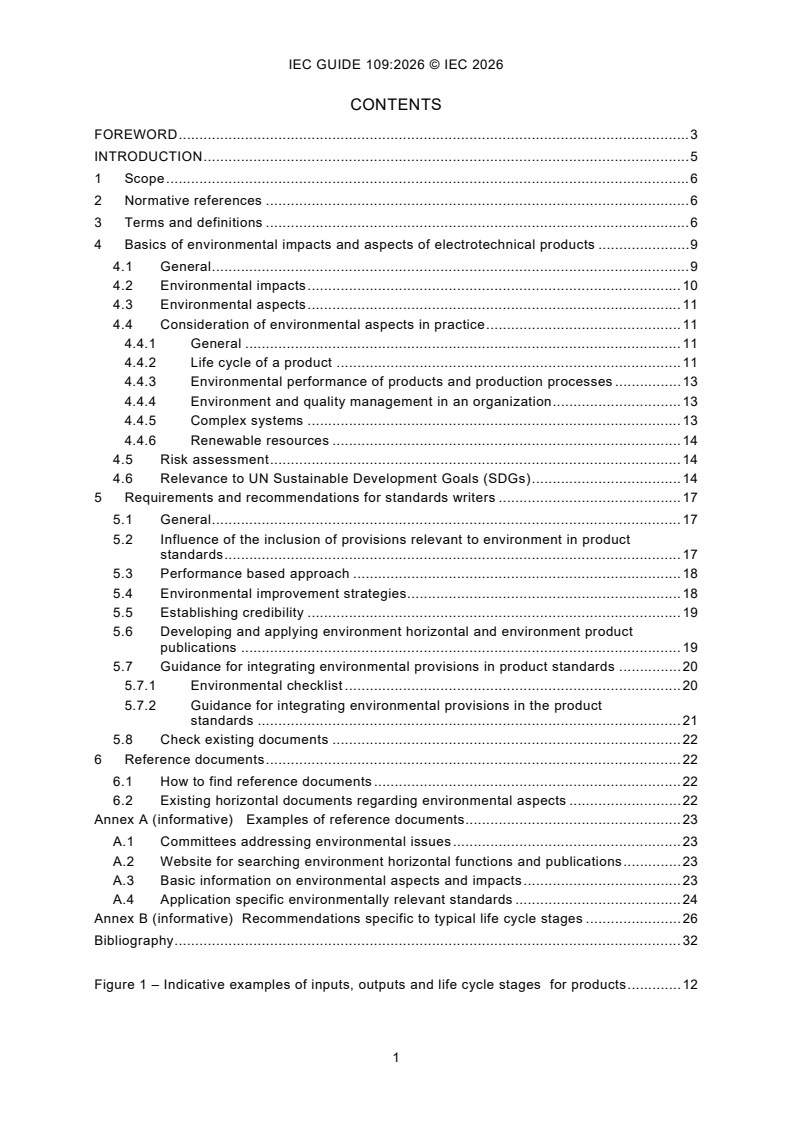
CONTENTS
FOREWORD . 3
INTRODUCTION . 5
1 Scope . 6
2 Normative references . 6
3 Terms and definitions . 6
4 Basics of environmental impacts and aspects of electrotechnical products . 9
4.1 General . 9
4.2 Environmental impacts . 10
4.3 Environmental aspects . 11
4.4 Consideration of environmental aspects in practice . 11
4.4.1 General . 11
4.4.2 Life cycle of a product . 11
4.4.3 Environmental performance of products and production processes . 13
4.4.4 Environment and quality management in an organization . 13
4.4.5 Complex systems . 13
4.4.6 Renewable resources . 14
4.5 Risk assessment . 14
4.6 Relevance to UN Sustainable Development Goals (SDGs) . 14
5 Requirements and recommendations for standards writers . 17
5.1 General . 17
5.2 Influence of the inclusion of provisions relevant to environment in product
standards . 17
5.3 Performance based approach . 18
5.4 Environmental improvement strategies . 18
5.5 Establishing credibility . 19
5.6 Developing and applying environment horizontal and environment product
publications . 19
5.7 Guidance for integrating environmental provisions in product standards . 20
5.7.1 Environmental checklist . 20
5.7.2 Guidance for integrating environmental provisions in the product
standards . 21
5.8 Check existing documents . 22
6 Reference documents . 22
6.1 How to find reference documents . 22
6.2 Existing horizontal documents regarding environmental aspects . 22
Annex A (informative) Examples of reference documents . 23
A.1 Committees addressing environmental issues . 23
A.2 Website for searching environment horizontal functions and publications . 23
A.3 Basic information on environmental aspects and impacts . 23
A.4 Application specific environmentally relevant standards . 24
Annex B (informative) Recommendations specific to typical life cycle stages . 26
Bibliography . 32
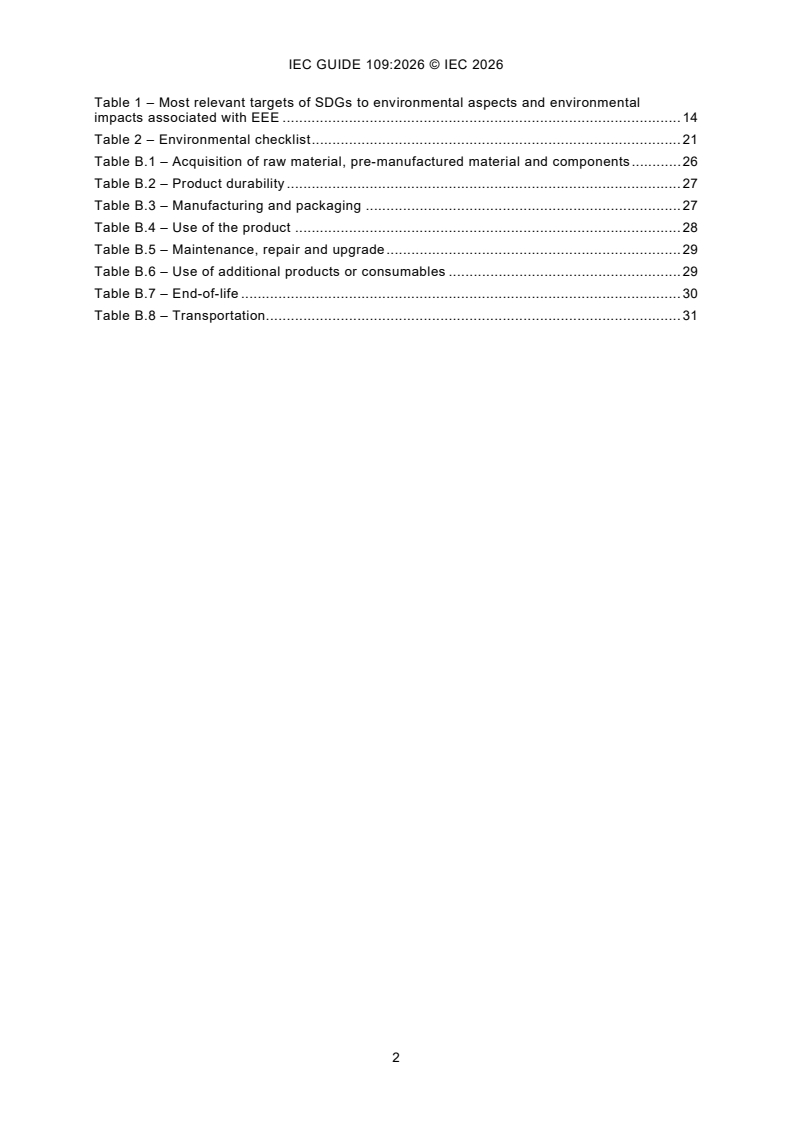
Figure 1 – Indicative examples of inputs, outputs and life cycle stages for products . 12
Table 1 – Most relevant targets of SDGs to environmental aspects and environmental
impacts associated with EEE . 14
Table 2 – Environmental checklist . 21
Table B.1 – Acquisition of raw material, pre-manufactured material and components . 26
Table B.2 – Product durability . 27
Table B.3 – Manufacturing and packaging . 27
Table B.4 – Use of the product . 28
Table B.5 – Maintenance, repair and upgrade . 29
Table B.6 – Use of additional products or consumables . 29
Table B.7 – End-of-life . 30
Table B.8 – Transportation. 31
INTERNATIONAL ELECTROTECHNICAL COMMISSION
______________
Environmental aspects -
Inclusion in electrotechnical product standards
FOREWORD
1) The International Electrotechnical Commission (IEC) is a worldwide organization for standardization comprising
all national electrotechnical committees (IEC National Committees). The object of IEC is to promote international
co-operation on all questions concerning standardization in the electrical and electronic fields. To this end and
in addition to other activities, IEC publishes International Standards, Technical Specifications, Technical Reports,
Publicly Available Specifications (PAS) and Guides (hereafter referred to as "IEC Publication(s)"). Their
preparation is entrusted to technical committees; any IEC National Committee interested in the subject dealt with
may participate in this preparatory work. International, governmental and non-governmental organizations liaising
with the IEC also participate in this preparation. IEC collaborates closely with the International Organization for
Standardization (ISO) in accordance with conditions determined by agreement between the two organizations.
2) The formal decisions or agreements of IEC on technical matters express, as nearly as possible, an international
consensus of opinion on the relevant subjects since each technical committee has representation from all
interested IEC National Committees.
3) IEC Publications have the form of recommendations for international use and are accepted by IEC National
Committees in that sense. While all reasonable efforts are made to ensure that the technical content of IEC
Publications is accurate, IEC cannot be held responsible for the way in which they are used or for any
misinterpretation by any end user.
4) In order to promote international uniformity, IEC National Committees undertake to apply IEC Publications
transparently to the maximum extent possible in their national and regional publications. Any divergence between
any IEC Publication and the corresponding national or regional publication shall be clearly indicated in the latter.
5) IEC itself does not provide any attestation of conformity. Independent certification bodies provide conformity
assessment services and, in some areas, access to IEC marks of conformity. IEC is not responsible for any
services carried out by independent certification bodies.
6) All users should ensure that they have the latest edition of this publication.
7) No liability shall attach to IEC or its directors, employees, servants or agents including individual experts and
members of its technical committees and IEC National Committees for any personal injury, property damage or
other damage of any nature whatsoever, whether direct or indirect, or for costs (including legal fees) and
expenses arising out of the publication, use of, or reliance upon, this IEC Publication or any other IEC
Publications.
8) Attention is drawn to the Normative references cited in this publication. Use of the referenced publications is
indispensable for the correct application of this publication.
9) Attention is drawn to the possibility that some of the elements of this IEC Publication may be the subject of patent
rights. IEC shall not be held responsible for identifying any or all such patent rights.
This fourth edition of IEC Guide 109 has been prepared, in accordance with
ISO/IEC Directives, Part 1, Annex A, by the IEC Advisory Committee on Environmental Aspects
(ACEA).
This fourth edition cancels and replaces the third edition published in 2012.
This edition includes the following significant technical changes with respect to the previous
edition:
a) provide standards writers with reference documents, especially horizontal standards, for
alignment;
b) align with other guides (such as IEC Guide 108 and relevant documents published by other
standards development organizations);
c) introduction of checklists and recommendations to help product committees identify relevant
environmental issues to their products.
The text of this IEC Guide is based on the following documents:
Draft Report on voting
SMBNC/76/DV SMBNC/77/RV
Full information on the voting for the approval of this Guide can be found in the report on voting
indicated in the above table.
The language used for the development of this Guide is English.
This document was drafted in accordance with ISO/IEC Directives, Part 2, and developed in
accordance with ISO/IEC Directives, Part 1 and ISO/IEC Directives, IEC Supplement, available
at www.iec.ch/members_experts/refdocs. The main document types developed by IEC are
described in greater detail at www.iec.ch/standardsdev/publications.
INTRODUCTION
This document provides requirements and recommendations to standards writers on how
environmental aspects are addressed as applicable during the development of IEC documents
including International Standards (IS), Technical Specifications (TS) and Publicly Available
Specifications (PAS).
The need to optimize impacts (i.e. reduce the adverse impacts or increase beneficial impacts)
1)
on the environment caused by environmental aspects of a product during all stages of its life
cycle from acquiring materials to manufacturing, distribution, use, and end-of-life treatment (e.g.
reuse and material recycling) is recognized around the world. The choices made at early phases
of product design and development largely determine what those impacts will be during each
stage of the life of the product. The task of making the optimal choices is very complex. For
example, choosing specifications that improve environmental aspects can involve difficult trade-
offs, such as a higher durability by changing the materials used can make the product less
recyclable.
Any standard that includes requirements for products can significantly influence the product’s
environmental aspects and the resultant impacts. Standards can promote flexibility in the
selection of the choices to improve environmental aspects. Furthermore, it is important that
standards addressing environmental aspects do not impede innovation in any sense. Standards
writers can encourage the protection of the environment, for instance, by specifying
requirements that lead to the appropriate design and manufacturing process and product use.
In this context, it is also important that standards writers give careful consideration to
environmental aspects when specifying test methods.
___________
1)
Although the term "product" has been used throughout this document, the concept also embraces systems,
services and processes as appropriate.
1 Scope
This document provides requirements and guidance on how to consider aspects resulting in
impacts on the environment caused by electrotechnical products. It is intended for standards
writers developing documents containing provisions relevant to environment as defined in this
document.
NOTE The IEC Standardization Management Board (SMB) has decided that Guides such as this one can have
mandatory requirements which shall be followed by all IEC committees developing technical work that falls within the
scope of the guide, as well as guidance which may or may not be followed. The mandatory requirements in this Guide
are identified by the use of “shall”. Statements that are only for guidance are identified by using the verb “should”.
(See IEC Directives Supplement Part 1, A.1.1.).
2 Normative references
The following documents are referred to in the text in such a way that some or all of their content
constitutes requirements of this document. For dated references, only the edition cited applies.
For undated references, the latest edition of the referenced document (including any
amendments) applies.
IEC Guide 123, Assignment and management of horizontal functions within the area of
environment
IEC Guide 121, Securing credible environmentally relevant performance assessment methods
in standards
3 Terms and definitions
For the purposes of this document, the following terms and definitions apply.
ISO and IEC maintain terminology databases for use in standardization at the following
addresses:
– IEC Electropedia: available at https://www.electropedia.org/
– ISO Online browsing platform: available at https://www.iso.org/obp
3.1
environment
surroundings in which a product or system exists, including air, water, land, natural resources,
flora, fauna, humans and their interrelation
Note 1 to entry: This term is defined in the context of environmental sustainability.
3.2
natural resource
part of nature that provides benefits to humans or underpins human well-being
[SOURCE: ISO 14050:2020 [2], 3.2.5]
3.3
environmental aspect
element of an organization's activities or products that can interact with the environment
Note 1 to entry: A significant environmental aspect has or can have a significant environmental impact.
3.4
environmental impact
change to the environment, whether adverse or beneficial, wholly or partly resulting from
environmental aspects
3.5
energy recovery
production of useful energy through direct and controlled combustion or other processing of
waste
Note 1 to entry: Waste incinerators producing hot water, steam and/or electricity are common means for energy
recovery.
[SOURCE: IEC 60050-904:2014, IEV 904-04-03]
3.6
substance
matter of constant composition best characterized by the entities (molecules, formula units,
atoms) it is composed of
Note 1 to entry: Physical properties such as density, refractive index, electric conductivity, melting point, etc.
characterize the substance.
Note 2 to entry: Formula unit is the smallest unit of a non-molecular substance, such as an ionic compound, covalent
network solid, or metal.
Note 3 to entry: Based on the IUPAC definition (C01039).
[SOURCE: IEC FDIS 60050-193:2026, IEV 193-03-04]
3.7
hazardous substance
substance that has, according to defined classification criteria, the potential for adversely
impacting human health or the environment or both
Note 1 to entry: The criteria for determining whether a substance is classified as hazardous are defined by law or
regulation.
3.8
input
material or energy which enters a life cycle stage of a product from raw material acquisition to
final disposal.
[SOURCE: IEC 60050-901:2013, IEV 901-07-05, modified – In the definition, "product system
at any stage" is replaced by "life cycle stage of a product"]
3.9
output
material or energy which leaves a life cycle stage of a product, from raw material acquisition to
final disposal
[SOURCE: IEC 60050-901:2013, IEV 901-07-06, modified – In the definition, "product system
at any stage" is replaced by "life cycle stage of a product"]
3.10
life cycle
consecutive and interlinked stages from raw material acquisition or generation from natural
resources to final disposal
[SOURCE: ISO 14050:2020, 3.6.1]
3.11
life cycle stage
life cycle phase
element of a life cycle
[SOURCE: IEC 62430:2019, 3.2.2]
3.12
end-of-life
end of life
EOL
life cycle stage of a product starting when it is removed from its use stage until the product has
either its life extended or is handed over for recovery
[SOURCE: IEC FDIS 60050-193:2026, IEV 193-05-07, modified – Note 1 to entry has been
removed]
3.13
life cycle thinking
LCT
life cycle perspective
LCP
consideration of all relevant environmental aspects of a product during its entire life cycle
[SOURCE: IEC 60050-904:2014, IEV 904-01-20, modified – “during the entire life cycle of
products” has been replaced with “of a product during its entire life cycle”]
3.14
pollution
all adverse effects on the environment caused by the release of organic or inorganic materials,
hazardous substances, radiation or noise
3.15
product
goods, service, or combination thereof
Note 1 to entry: This includes interconnected, interrelated goods or services.
Note 2 to entry: Software can be included in either goods or service.
[SOURCE: ISO 14050:2020, 3.5.12, modified – In the definition, the word “any” has been
removed, and the phrase “or combination thereof” has been added. Notes 1 and 2 to entry have
been added]
3.16
product standard
standard that specifies requirements to be fulfilled by a product or a group of products, to
establish its fitness for purpose
Note 1 to entry: A product standard can include in addition to the fitness for purpose requirements, directly or by
reference, aspects such as terminology, sampling, testing, packaging and labelling and, sometimes, processing
requirements.
Note 2 to entry: A product standard can be either complete or not, according to whether it specifies all or only a
part of the necessary requirements. In this respect, one can differentiate between standards such as dimensional,
material, and technical delivery standards.
[SOURCE: IEC 60050-901:2013, IEV 901-02-17, modified – In Note 1 and Note 2 to entry, “may”
has been replaced with “can”]
3.17
material recycling
controlled processing of material that has been recovered from end-of-life products or waste to
produce material of the same or similar type as the original material
EXAMPLE An ABS compound that is shredded and then recycled as ABS compound; an aluminium alloy that will
be recycled as an aluminium alloy. A thermoset that is shredded and used as filler in a thermoset material.
Note 1 to entry: Polymer materials are of the same type if they have the same base polymer such as PE, PP, ABS.
Metal materials of the same type share the same base metal (e.g. aluminium alloy).
Note 2 to entry: There can be variation in the performance or characteristics of the recycled material compared to
the original one.
Note 3 to entry: In some cases, the process of recovery and recycling cannot be distinguished from each other.
Note 4 to entry: If the produced material is of a different type from the original material, it is an alternate material.
Note 5 to entry: Material recycling excludes products or parts recovery, alternate material recovery and energy
recovery.
[SOURCE: IEC FDIS 60050-193:2026, IEV-193-04-13, modified – The figure and Note 6 to entry
have been deleted]
3.18
recycled material
material reprocessed from end-of-life products or waste that is of the same or similar type as
the original material and that is ready to be used in manufacturing of products
Note 1 to entry: Recycled material can be pre- or post-consumer.
Note 2 to entry: Recycled material refers to the sum of the various fractions of materials recovered from end-of-life
products or waste like metals, plastics, etc., excluding alternate material and material used to produce energy
[SOURCE: IEC FDIS 60050-193:2026, IEV-193-03-12]
3.19
provision
expression in the content of a normative document that takes the form of a statement, an
instruction, a recommendation or a requirement
Note 1 to entry: These types of provision are distinguished by the form of wording they employ; e.g. instructions
are expressed in the imperative mood, recommendations by the use of the auxiliary “should” and requirements by
the use of the auxiliary “shall”.
[SOURCE: IEC 60050-901:2013, IEV 901-05-01]
4 Basics of environmental impacts and aspects of electrotechnical products
4.1 General
Clause 4 describes the basics of environmental impacts and aspects of electrotechnical
products and is intended to be read by standards writers to familiarize themselves when
addressing environmentally relevant provisions.
4.2 Environmental impacts
The following are typical environmental impacts for standards writers to understand and
consider.
• Resource depletion
Besides the environmental impacts associated with resource acquisition (e.g. mining) and
use, resource depletion can be of great significance. Resource depletion refers to the
process of diminishing stocks of natural resources. Even in the case where deposits on
earth are not depleted, some resources are not freely available everywhere due to other
constraints, e.g. food, water and critical raw materials.
• Climate change
“Climate change means a change of climate which is attributed directly or indirectly to
human activity that alters the composition of the global atmosphere and which is in addition
to natural climate variability observed over comparable time periods.”
Climate change refers to long-term shifts in temperatures and weather patterns. Such shifts
can be natural, due to changes in the sun’s activity or large volcanic eruptions. But since
the 1800s, human activities have been the important contributor of climate change, primarily
due to the burning of fossil fuels like coal, oil and gas. Burning fossil fuels generates
greenhouse gas emissions that act like a blanket wrapped around the earth, trapping the
sun’s heat and raising temperatures. The main greenhouse gases that are causing climate
change are carbon dioxide and methane. These come from using fossil fuels for driving a
car or coal for heating a building, for example. Clearing land and cutting down forests can
also release carbon dioxide. Agriculture, oil and gas operations are major sources of
methane emissions. Energy, industry, transport, buildings, agriculture and land use are
among the main sectors causing greenhouse gas emissions. See more details at [7] .
• Pollution
Human activities including industrial ones that release pollutants into the air, land or water
cause environmental pollution and degradation in their quality. There are various types of
release that can have an impact on environment for which there is currently no international
consensus on the characterization and evaluation methods.
NOTE Pollution can be considered as a secondary environmental aspect that follows emission and ultimately
impacts health and environmental hazard.
• Biodiversity and ecosystem loss
Impacts on ecosystem include habitat alteration, the loss of biological diversity and other
long-term impacts on terrestrial and aquatic life.
• Health and environmental hazard
The health of the biosphere, including humans, can be affected by environmental hazards
such as air pollution or noise, as well as by chemicals to which humans can be exposed.
These hazards are also relevant to safety.
___________
Reproduced from the United Nations framework convention on climate change [6].
Numbers in square brackets refer to the Bibliography.
4.3 Environmental aspects
There are multiple environmental aspects causing diverse environmental impacts.
Electrotechnical products have the possibility to include aspects throughout their life cycle
(see 4.4).
a) Resource conservation, efficiency and circularity
Using fewer resources while delivering the same or better product functionality to users
leads to a higher resource efficiency and contributes to the avoidance of resource depletion.
This is relevant not only to a single product supplier but also to a broader value network of
diverse stakeholders.
The concept of "circular economy" is also relevant to electrotechnical products. The circular
economy is a generic concept highlighting the value of resources (e.g. products,
components, materials) that is to be maintained during and after their service life in an
economic system.
NOTE See Clause A.4 d) for standards addressing the circular economy concept in more details.
b) Hazardous substances and chemicals
The use of hazardous substances and chemicals to which the ecosystem, including humans,
can be exposed is a typical environmental concern. Such exposure can occur in the
workplace, during manufacturing and end-of-life treatment processes, or through use of
products.
c) Emissions, pollution and waste
Products emissions and releases of substances to the air, water, or soil can cause pollution
and climate change. The emission of greenhouse gases (GHGs) causes climate change.
Emissions of substances can cause environmental pollution. Pollution types are categorized
according to substances of concern, acceptable release limits, and allowable maximum
concentrations in each environmental medium. Aside from substances, noise, vibration and
radiation (e.g. heat) are also issues of pollution which have adverse effects on our
ecosystem.
4.4 Consideration of environmental aspects in practice
4.4.1 General
The following are examples of environmental aspects for practical consideration relevant to
electrotechnical products including systems and services.
4.4.2 Life cycle of a product
A product's environmental aspects and resulting impacts are largely determined by the inputs
that are used and the outputs that are generated at all stages of the product's life cycle. Inputs
and outputs are related to each other; changing any single input, either to alter the materials or
energy used, can affect other inputs and outputs (see Figure 1).
Figure 1 – Indicative examples of inputs, outputs and life cycle stages for products
a) Inputs
Inputs fall into two broad categories: material inputs and energy inputs.
1) Material inputs including natural resource (e.g. components, metal ores, oils, woods,
water) into the different stages of a product’s life cycle – from raw material acquisition,
manufacturing, transportation (including packaging and storage), use or maintenance,
reuse and material recycling, to final disposal of products – can produce a variety of
environmental impacts as stated in 4.2. In particular, continuous use of natural resources
can cause adverse environmental impacts such as resource depletion and ecosystem
degradation during many stages of the life cycle, including extraction, transportation,
processing and disposal.
2) Energy inputs are required at most stages of an electrotechnical product’s life cycle.
EXAMPLE Direct inputs are fossil fuels, nuclear, recovered waste, hydroelectric, geothermal, solar and
wind energy. Each energy source results in its own set of environmental impacts.
b) Outputs
Outputs generated during product's life cycle comprise the product itself, intermediates and
by-products, air emissions, water effluents, waste materials and other releases.
1) Air emissions comprising releases of gases, vapours, or particulate matter to the air.
Releases of toxic, corrosive, flammable, explosive, acidic, or odorous substances can
adversely affect flora, fauna, humans, etc., or contribute to other environmental impacts
such as depletion of stratospheric ozone layer or formation of smog. Air emissions can
be categorized as emanating from single or multiple sources, as treated and untreated,
and as the result of normal or emergency operations.
2) Discharges of substances into water (surface or ground) such as nutrients, and toxic,
corrosive, radioactive, persistent, accumulative or oxygen-depleting substances can
give rise to adverse environmental impacts including various pollution effects on aquatic
ecosystems and undesirable eutrophication of natural waters.
3) Water effluents including discharges from point as well as diffuse sources, treated as
well as untreated discharges, and discharges from normal operation as well as
accidental discharges.
4) Emissions into soil.
5) Waste materials comprising solid or liquid materials or products which are disposed of.
Waste materials can be produced at all stages of a product's life cycle. Waste materials
are subject to recycling, treatment, recovery or disposal techniques associated with
further inputs and outputs, which can contribute to adverse environmental impacts.
6) Other releases including noise, vibration, electromagnetic radiation (including visible
light) and waste heat.
4.4.3 Environmental performance of products and production processes
There are usually trade-offs between product performance (e.g. power or accuracy) and
associated environmental aspects. Environmental performance indicators such as energy
efficiency and material efficiency can be used to assess the balance of such trade-offs. There
is also a trade-off between economic aspects and environmental aspects.
Environmentally conscious design, or “ecodesign”, involves implementing a systematic
approach, such as is specified in standards including IEC 62430 [4] and ISO 14006 [8].
4.4.4 Environment and quality management in an organization
Establishing and maintaining environmental and quality management systems in organizations
can improve the environmental outcomes of their products and services. Examples of relevant
standards include ISO 14001 [8], which covers environmental management, and the standards
on quality management prepared by ISO/TC 176 (collectively known as the ISO 9000 family).
4.4.5 Complex systems
In addition to a single product, which can be a system embedding different functions, also a
complex system such as a system of systems, like a smart city, intelligent building, and
integrated transportation system are increasingly implemented in our society. The cyber-
physical system (CPS) is also a rapidly emerging example which has interactions between
physical and cyber spaces. Such a complex system possesses a feature of system of systems
(SOS), which is generally understood as a set of operationally and managerially independent
systems that are operated together for a period of time to achieve one or more stated purposes.
In order to identify the environmental aspects embedded in such a complex system, it is
important to analyse not only each subsystem, or component, but also possible interactions
between subsystems that can cause environmental impacts.
4.4.6 Renewable resources
Renewable resources include renewable energy and materials. Renewable energy is promoted
as an effective countermeasure for climate change since it does not emit GHGs during its use,
although it can have adverse environmental aspects (such as noise emission from a wind
turbine and spoiling the scenery with so called “mega solar panels”). Renewable materials such
as bioethanol and bioplastics can have lower environmental impact in terms of resource
depletion, prevention of pollution, and GHG emission; however, renewable materials can lead
to other adverse environmental aspects such as biodiversity losses.
4.5 Risk assessment
An environmental impact caused by relevant environmental aspects is recognized as an
environmental risk since an environmental aspect does not necessarily cause corresponding
environmental impacts with a 100 % certainty. For example, the risks relating to hazardous
substances are assessed by multiplying the intrinsic hazard of the substance and the exposure
that is the statistically estimated amount of the average intake per person. Risk assessment is
the basic methodology for quantifying environmental impacts from environmental aspects.
NOTE Further information on risk assessment is provided in ISO/IEC Guide 51 [10].
4.6 Relevance to UN Sustainable Development Goals (SDGs)
The 2030 Agenda for Sustainable Development, adopted by United Nations Member States in
2015, provides a shared blueprint for peace and prosperity for people and the planet, now and
into the future. At its heart are 17 Sustainable Development Goals (SDGs) [11], which are an
urgent call for action by all countries in a global partnership. Some of those goals have
relevance to environmental aspects or environmental impacts of electrical and electronic
equipment (EEE) as exemplified in Table 1.
Table 1 – Most relevant targets of SDGs to environmental aspects
and environmental impacts associated with EEE
a
Goal Relevance to environmental
SDGs and the most relevant targets
aspects or impacts (Examples)
Environmental pollution and
Goal 3: Good for health and well-being
hazardous chemical exposure
3.9 By 2030, substantially reduce the number of deaths and
can cause adverse impacts on
illnesses from hazardous chemicals and air, water and soil
human health and well-being
pollution and contamination
IEC standards can address how
electrical and electronic products
can avoid emissions of
(hazardous) chemicals to water,
air or land during manufacturing,
use, and end-of-life management
and so avoid adverse impacts on
human health and well-being
Goal 6: Clean water and sanitation IEC standards can address how
electrical and electronic products
6.3 By 2030, improve water quality by reducing pollution,
can avoid emissions of
eliminating dumping and minimizing release of hazardous
(hazardous) chemicals to water,
chemicals and materials, halving the proportion of untreated
manufacturing, use, and during
wastewater and substantially increasing recycling and safe
end-of-life treatment and so
reuse globally
avoid adverse impacts on human
health and well-being; They can
6.4 By 2030, substantially increase water-use efficiency across
also address the efficient
all sectors and ensure sustainable withdrawals and supply of
consumption of water especially
freshwater to address water scarcity and substantially reduce
during manufacturing, use, and
the number of people suffering from water scarcity
within recovery processes
a
Goal Relevance to environmental
SDGs and the most relevant targets
aspects or impacts (Examples)
Goal 7: Affordable and clean energy Renewable energy generation
technologies, such as wind
7.2 By 2030, increase substantially the share of renewable
turbine, photo voltaic, and
energy in the global energy mix
marine power generation are
directly relevant to this goal.
7.3 By 2030, double the global rate of improvement in energy
efficiency
IEC standards continue to
address energy usage efficiency
7.a By 2030, enhance international cooperation to facilitate
of electrical and electronic
access to clean energy research and technology, including
products.
renewable energy, energy efficiency and advanced and cleaner
fossil-fuel technology, and promote investment in energy
Additionally, IEC standards can
infrastructure and clean energy technology
address
7.b By 2030, expand infrastructure and upgrade technology for
– improvement of efficiency in
supplying modern and sustainable energy services for all in
the use of non-renewable
developing countries, in particular least developed countries,
power generation sources as
small island developing States and landlocked developing
well as availability, and
countries, in accordance with their respective programmes of
support – efficiency of renewable
energy sources such as wind,
solar and marine power
generation, as well as
– efficiency and availability of
clean energy sources such as
hydrogen and nuclear power
Goal 9: Industry, innovation and infrastructure Industrial facilities, consumer
products, and social
9.1 Develop quality, reliable, sustainable and resilient
infrastructure utilizing innovative
infrastructure, including regional and transborder infrastructure,
technologies such as electric
to support economic development and human well-being, with a
cars and smart buildings are
focus on affordable and equitable access for all
featured by their high energy
efficiency and low pollutant
9.4 By 2030, upgrade infrastructure and retrofit industries to
emission
make them sustainable, with increased resource-use efficiency
and greater adoption of clean and environmentally sound
technologies and industrial processes, with all countries taking
action in accordance with their respective capabilities
9.c Significantly increase access to information and
communications technology and strive to provide universal and
affordable access to the Internet in least developed countries
by 2020
A smart city is a typical example
Goal 11: Sustainable cities and communities
which includes various
11.3 By 2030, enhance inclusive and sustainable urbanization
advantageous aspects to
and capacity for participatory, integrated and sustainable
enhance sustainability of cities
human settlement planning and management in all countries
and communities
11.6 By 2030, reduce the adverse per capita environmental
impact of cities, including by paying special attention to air
quality and municipal and other waste management
a
Goal Relevance to environmental
SDGs and the most relevant targets
aspects or impacts (Examples)
Goal 12: Responsive consumption and production "Lean manufacturing" is a typical
example of responsive
12.2 By 2030, achieve the sustainable management and
production with low adverse
efficient use of natural resources
environmental impacts.
Consumer goods produced
12.4 By 2020, achieve the environmentally sound management
"circular by design" can
of chemicals and all wastes throughout their life cycle, in
contribute to sustainable
accordance with agreed international frameworks, and
consumption.
significantly reduce their release to air, water and soil in order
to minimize their adverse impacts on human health and the
Education of users to better
environment
maintain products and also to
accept to use products for longer
12.5 By 2030, substantially reduce waste generation through
or to reuse already used
prevention, reduction, recycling and reuse
products is key for the success
12.6 Encourage companies, especially large and transnational
of this SDG.
companies, to adopt sustainable practices and to integrate
"Substances and material
sustainability information into their reporting cycle
declarations" are effective ways
12.8 By 2030, ensure that people everywhere have the relevant of chemical management through
information and awareness for sustainable development and
supply chains including
lifestyles in harmony with nature
producers and suppliers.
12.a Support developing countries to strengthen their scientific
and technological capacity to move towards more sustainable
patterns of consumption and production
Goal 13: Climate change Products and processes with
high energy efficiency, power
13.1 Strengthen resilience and adaptive capacity to climate-
generation technologies with low
related hazards and natural disasters in all countries
GHG emission, and carbon
capture storage technology are
13.2 Integrate climate change measures into national policies,
directly relevant to mitigating
strategies and planning
climate change
13.3 Improve education, awareness-raising and human and
institutional capacity on climate change mitigation, adaptatio
...