

IEC 63366:2025
(Main)Product category rules for life cycle assessment of electrical and electronic products and systems
General Information
- Abstract
IEC 63366:2025 defines product category rules (PCR) for electrical and electronic products and systems (EEPS) to develop Type III environmental declarations for electrical and electronic products and systems (EEPS). It specifies the process and requirements on how to conduct life cycle assessment (LCA) in the context of environmental declarations.
This document provides common rules for:
a) LCA, including the requirements for developing default scenarios;
b) the LCA report;
c) the development of PSR.
This document provides further guidelines for environmental declarations.
The LCA principles and framework are based on ISO 14040 and ISO 14044, and are therefore out of scope of this document.
PCR is complemented by additional product-specific rules (PSR), which further define, for example, functional units and default scenarios in the product-specific context. Therefore, this document also provides guidance on how to develop PSR in corresponding technical committees.
This document has the status of a horizontal publication in accordance with IEC Guide 108. In accordance with IEC Guide 108, this generic essential horizontal standard is intended for use by product committees as a starting point in preparing PSR standards. Specific requirements developed by product committees in PSR standard take precedence over requirements in this standard.
When there is no PSR available in a product committee, this generic essential horizontal standard could be applied by LCA practitioners with recorded complementary specifications.
- Status
- Published
- Publication Date
- 05-Jun-2025
- Technical Committee
- TC 111 - Environmental standardization for electrical and electronic products and systems
- Drafting Committee
- WG 15 - TC 111/WG 15
- Current Stage
- PPUB - Publication issued
- Start Date
- 06-Jun-2025
- Completion Date
- 23-May-2025
Overview
IEC 63366:2025 is an international standard issued by the International Electrotechnical Commission (IEC) that establishes Product Category Rules (PCR) for the Life Cycle Assessment (LCA) of Electrical and Electronic Products and Systems (EEPS). This standard provides a harmonized framework enabling manufacturers, environmental consultants, and regulatory bodies to develop Type III environmental declarations based on LCA methodology.
The document specifies essential rules and requirements for conducting LCAs in the specific context of electrical and electronic products, ensuring transparency, comparability, and consistency of environmental data. While the fundamental LCA principles are based on ISO 14040 and ISO 14044 and are outside the scope of IEC 63366:2025, this standard complements those by defining common PCR frameworks and guidelines for the development of product-specific rules (PSR).
Key Topics
1. Life Cycle Assessment Procedures
- Functional Unit and Reference Flow: Clear definitions to ensure consistent evaluation across product categories.
- System Boundaries: Delineation of life cycle stages from raw material extraction through end-of-life treatment.
- Life Cycle Inventory (LCI): Collection guidelines for environmental input and output data related to EEPS.
- Scenario Development: Standardized default scenarios for transportation, use phase, and end-of-life.
- Impact Assessment: Recommended environmental impact categories for enabling verifiable declarations.
2. Product Category Rules (PCR)
- Provides common foundational rules for preparing PCRs for EEPS.
- Details on allocation rules, data quality requirements, system boundary conditions, and units of measurement.
- Procedures for extrapolation and aggregation of environmental impacts within product families.
3. Environmental Declaration Content
- LCA Reporting: Specifies detailed requirements for scope, inventory data, impact assessment results, and additional environmental information to be included in LCA reports.
- PSR Development Guidance: Supports technical committees in creating product-specific rules that tailor PCR to particular types or groups of electrical and electronic products.
4. Supplementary Information
- Annexes including recovery activities and allocation formulas related to circular economy principles.
- Recommended access to global LCA datasets and correlation with related standards such as EN 15804.
Applications
IEC 63366:2025 serves as a crucial tool to:
- Manufacturers of Electrical and Electronic Products: Establish environmental performance declarations that meet international standards and improve product sustainability communication.
- Environmental Consultants and LCA Practitioners: Apply a harmonized LCA methodology supported by clear PCR for consistent environmental evaluations of EEPS.
- Regulatory Bodies and Policy Makers: Develop environmental regulations and eco-labeling schemes based on credible LCA data and standardized environmental declarations.
- Certification and Conformity Assessment Organizations: Guide assessment criteria for environmental claims related to electrical and electronic products and systems.
By standardizing how life cycle assessment data is generated and reported, IEC 63366 helps optimize environmental impact reductions across design, production, use, and end-of-life phases of electrical and electronic devices.
Related Standards
IEC 63366:2025 aligns with and references several critical international standards to ensure robust environmental assessment:
- ISO 14040 & ISO 14044: Core life cycle assessment principles and framework standards which underpin the LCA methodology used in this document.
- IEC Guide 108: Provides the horizontal publication status usage guidelines for PCR as a starting point for product-specific rules development.
- EN 15804: European standard for environmental product declarations, with correlating life cycle stages and modules detailed in IEC 63366.
- Other Product-Specific Standards: Developed in parallel by IEC technical committees to complement the generic PCR with tailored PSR requirements for particular EEPS categories.
By adopting IEC 63366:2025, stakeholders gain a comprehensive, internationally recognized framework to conduct life cycle assessments specific to electrical and electronic products, enabling credible environmental performance declarations and fostering sustainable product development globally.
Get Certified
Connect with accredited certification bodies for this standard

BSI Group
BSI (British Standards Institution) is the business standards company that helps organizations make excellence a habit.

Bureau Veritas
Bureau Veritas is a world leader in laboratory testing, inspection and certification services.

DNV
DNV is an independent assurance and risk management provider.
Sponsored listings
Frequently Asked Questions
IEC 63366:2025 is a standard published by the International Electrotechnical Commission (IEC). Its full title is "Product category rules for life cycle assessment of electrical and electronic products and systems". This standard covers: IEC 63366:2025 defines product category rules (PCR) for electrical and electronic products and systems (EEPS) to develop Type III environmental declarations for electrical and electronic products and systems (EEPS). It specifies the process and requirements on how to conduct life cycle assessment (LCA) in the context of environmental declarations. This document provides common rules for: a) LCA, including the requirements for developing default scenarios; b) the LCA report; c) the development of PSR. This document provides further guidelines for environmental declarations. The LCA principles and framework are based on ISO 14040 and ISO 14044, and are therefore out of scope of this document. PCR is complemented by additional product-specific rules (PSR), which further define, for example, functional units and default scenarios in the product-specific context. Therefore, this document also provides guidance on how to develop PSR in corresponding technical committees. This document has the status of a horizontal publication in accordance with IEC Guide 108. In accordance with IEC Guide 108, this generic essential horizontal standard is intended for use by product committees as a starting point in preparing PSR standards. Specific requirements developed by product committees in PSR standard take precedence over requirements in this standard. When there is no PSR available in a product committee, this generic essential horizontal standard could be applied by LCA practitioners with recorded complementary specifications.
IEC 63366:2025 defines product category rules (PCR) for electrical and electronic products and systems (EEPS) to develop Type III environmental declarations for electrical and electronic products and systems (EEPS). It specifies the process and requirements on how to conduct life cycle assessment (LCA) in the context of environmental declarations. This document provides common rules for: a) LCA, including the requirements for developing default scenarios; b) the LCA report; c) the development of PSR. This document provides further guidelines for environmental declarations. The LCA principles and framework are based on ISO 14040 and ISO 14044, and are therefore out of scope of this document. PCR is complemented by additional product-specific rules (PSR), which further define, for example, functional units and default scenarios in the product-specific context. Therefore, this document also provides guidance on how to develop PSR in corresponding technical committees. This document has the status of a horizontal publication in accordance with IEC Guide 108. In accordance with IEC Guide 108, this generic essential horizontal standard is intended for use by product committees as a starting point in preparing PSR standards. Specific requirements developed by product committees in PSR standard take precedence over requirements in this standard. When there is no PSR available in a product committee, this generic essential horizontal standard could be applied by LCA practitioners with recorded complementary specifications.
IEC 63366:2025 is classified under the following ICS (International Classification for Standards) categories: 13.020.01 - Environment and environmental protection in general. The ICS classification helps identify the subject area and facilitates finding related standards.
IEC 63366:2025 is available in PDF format for immediate download after purchase. The document can be added to your cart and obtained through the secure checkout process. Digital delivery ensures instant access to the complete standard document.
Standards Content (Sample)
IEC 63366 ®
Edition 1.0 2025-06
INTERNATIONAL
STANDARD
NORME
INTERNATIONALE
HORIZONTAL PUBLICATION
PUBLICATION HORIZONTALE
Product category rules for life cycle assessment of electrical and electronic
products and systems
Règles de définition des catégories de produits pour l'analyse du cycle de vie
des produits et systèmes électriques et électroniques
ICS 13.020.01 ISBN 978-2-8327-0429-5
All rights reserved. Unless otherwise specified, no part of this publication may be reproduced or utilized in any form or
by any means, electronic or mechanical, including photocopying and microfilm, without permission in writing from either
IEC or IEC's member National Committee in the country of the requester. If you have any questions about IEC copyright
or have an enquiry about obtaining additional rights to this publication, please contact the address below or your local
IEC member National Committee for further information.
Droits de reproduction réservés. Sauf indication contraire, aucune partie de cette publication ne peut être reproduite ni
utilisée sous quelque forme que ce soit et par aucun procédé, électronique ou mécanique, y compris la photocopie et
les microfilms, sans l'accord écrit de l'IEC ou du Comité national de l'IEC du pays du demandeur. Si vous avez des
questions sur le copyright de l'IEC ou si vous désirez obtenir des droits supplémentaires sur cette publication, utilisez
les coordonnées ci-après ou contactez le Comité national de l'IEC de votre pays de résidence.
IEC Secretariat Tel.: +41 22 919 02 11
3, rue de Varembé info@iec.ch
CH-1211 Geneva 20 www.iec.ch
Switzerland
About the IEC
The International Electrotechnical Commission (IEC) is the leading global organization that prepares and publishes
International Standards for all electrical, electronic and related technologies.
About IEC publications
The technical content of IEC publications is kept under constant review by the IEC. Please make sure that you have the
latest edition, a corrigendum or an amendment might have been published.
IEC publications search - IEC Products & Services Portal - products.iec.ch
webstore.iec.ch/advsearchform Discover our powerful search engine and read freely all the
The advanced search enables to find IEC publications by a publications previews, graphical symbols and the glossary.
variety of criteria (reference number, text, technical With a subscription you will always have access to up to date
committee, …). It also gives information on projects, content tailored to your needs.
replaced and withdrawn publications.
Electropedia - www.electropedia.org
IEC Just Published - webstore.iec.ch/justpublished The world's leading online dictionary on electrotechnology,
Stay up to date on all new IEC publications. Just Published containing more than 22 500 terminological entries in English
details all new publications released. Available online and and French, with equivalent terms in 25 additional languages.
Also known as the International Electrotechnical Vocabulary
once a month by email.
(IEV) online.
IEC Customer Service Centre - webstore.iec.ch/csc
If you wish to give us your feedback on this publication or
need further assistance, please contact the Customer
Service Centre: sales@iec.ch.
A propos de l'IEC
La Commission Electrotechnique Internationale (IEC) est la première organisation mondiale qui élabore et publie des
Normes internationales pour tout ce qui a trait à l'électricité, à l'électronique et aux technologies apparentées.
A propos des publications IEC
Le contenu technique des publications IEC est constamment revu. Veuillez vous assurer que vous possédez l’édition la
plus récente, un corrigendum ou amendement peut avoir été publié.
Recherche de publications IEC - IEC Products & Services Portal - products.iec.ch
webstore.iec.ch/advsearchform Découvrez notre puissant moteur de recherche et consultez
La recherche avancée permet de trouver des publications gratuitement tous les aperçus des publications, symboles
IEC en utilisant différents critères (numéro de référence, graphiques et le glossaire. Avec un abonnement, vous aurez
texte, comité d’études, …). Elle donne aussi des toujours accès à un contenu à jour adapté à vos besoins.
informations sur les projets et les publications remplacées
ou retirées. Electropedia - www.electropedia.org
Le premier dictionnaire d'électrotechnologie en ligne au
IEC Just Published - webstore.iec.ch/justpublished monde, avec plus de 22 500 articles terminologiques en
Restez informé sur les nouvelles publications IEC. Just anglais et en français, ainsi que les termes équivalents
Published détaille les nouvelles publications parues. dans 25 langues additionnelles. Egalement appelé
Disponible en ligne et une fois par mois par email. Vocabulaire Electrotechnique International (IEV) en ligne.
Service Clients - webstore.iec.ch/csc
Si vous désirez nous donner des commentaires sur cette
publication ou si vous avez des questions contactez-
nous: sales@iec.ch.
– 2 – IEC 63366:2025 © IEC 2025
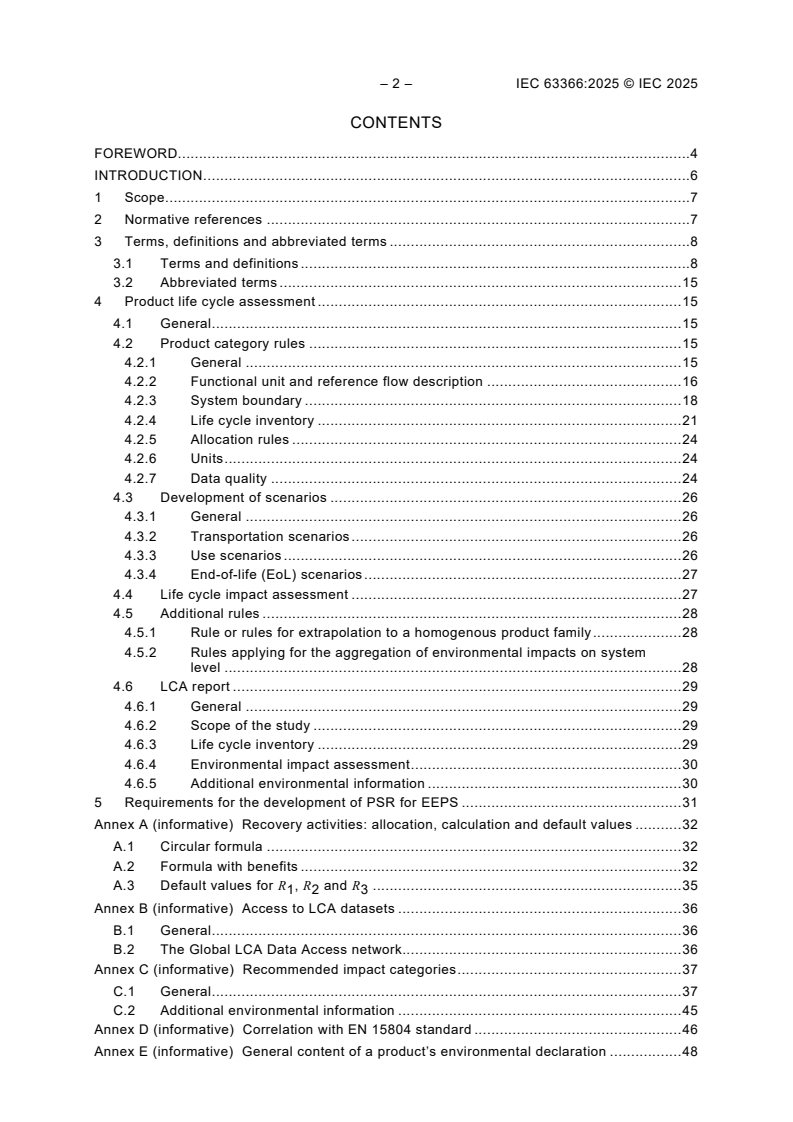
CONTENTS
FOREWORD. 4
INTRODUCTION . 6
1 Scope . 7
2 Normative references . 7
3 Terms, definitions and abbreviated terms . 8
3.1 Terms and definitions . 8
3.2 Abbreviated terms . 15
4 Product life cycle assessment . 15
4.1 General . 15
4.2 Product category rules . 15
4.2.1 General . 15
4.2.2 Functional unit and reference flow description . 16
4.2.3 System boundary . 18
4.2.4 Life cycle inventory . 21
4.2.5 Allocation rules . 24
4.2.6 Units . 24
4.2.7 Data quality . 24
4.3 Development of scenarios . 26
4.3.1 General . 26
4.3.2 Transportation scenarios . 26
4.3.3 Use scenarios . 26
4.3.4 End-of-life (EoL) scenarios . 27
4.4 Life cycle impact assessment . 27
4.5 Additional rules . 28
4.5.1 Rule or rules for extrapolation to a homogenous product family . 28
4.5.2 Rules applying for the aggregation of environmental impacts on system
level . 28
4.6 LCA report . 29
4.6.1 General . 29
4.6.2 Scope of the study . 29
4.6.3 Life cycle inventory . 29
4.6.4 Environmental impact assessment . 30
4.6.5 Additional environmental information . 30
5 Requirements for the development of PSR for EEPS . 31
Annex A (informative) Recovery activities: allocation, calculation and default values . 32
A.1 Circular formula . 32
A.2 Formula with benefits . 32
A.3 Default values for R , R and R . 35
1 2 3
Annex B (informative) Access to LCA datasets . 36
B.1 General . 36
B.2 The Global LCA Data Access network . 36
Annex C (informative) Recommended impact categories . 37
C.1 General . 37
C.2 Additional environmental information . 45
Annex D (informative) Correlation with EN 15804 standard . 46
Annex E (informative) General content of a product’s environmental declaration . 48
E.1 General . 48
E.2 List of information in environmental declarations . 48
E.2.1 Information about the manufacturer . 48
E.2.2 Description of the product group, the reference product and its
packaging . 48
E.2.3 Constitutive materials and substances . 48
E.2.4 Information on life cycle stages and potential impacts . 49
Annex F (informative) Example of a product’s environmental declaration . 50
F.1 General . 50
F.2 Basic example . 50
Bibliography . 54
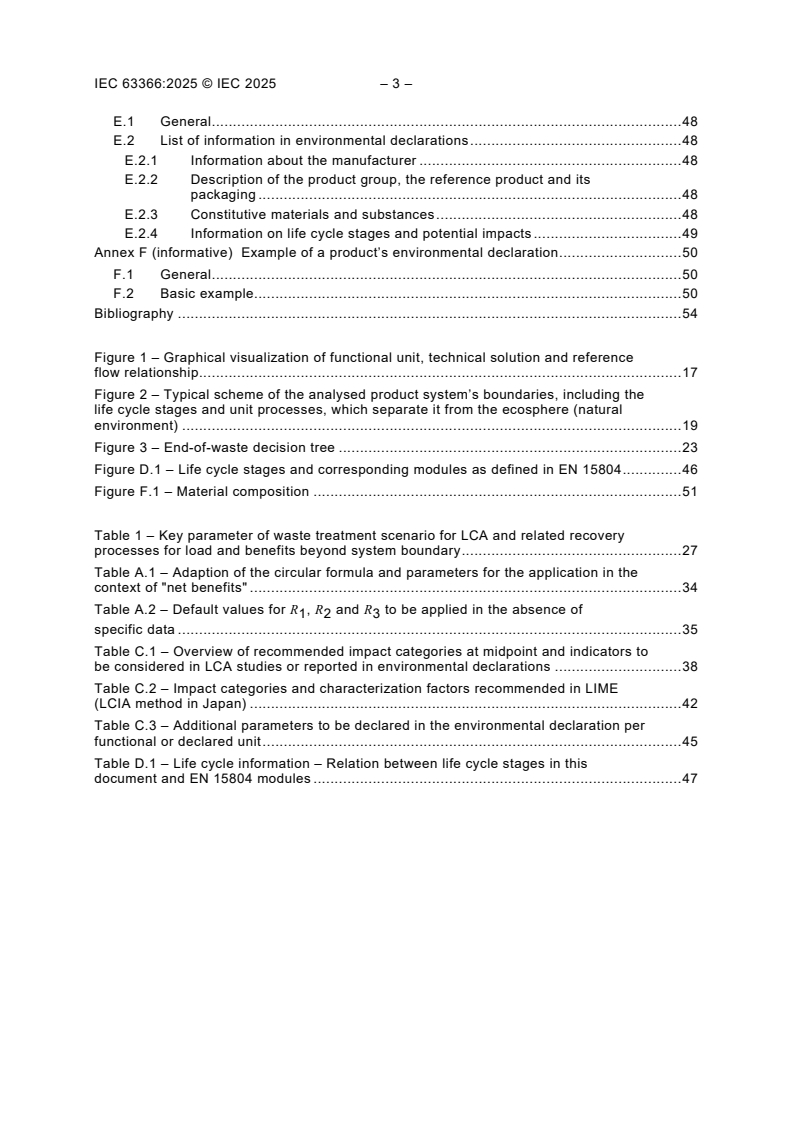
Figure 1 – Graphical visualization of functional unit, technical solution and reference
flow relationship . 17
Figure 2 – Typical scheme of the analysed product system’s boundaries, including the
life cycle stages and unit processes, which separate it from the ecosphere (natural
environment) . 19
Figure 3 – End-of-waste decision tree . 23
Figure D.1 – Life cycle stages and corresponding modules as defined in EN 15804 . 46
Figure F.1 – Material composition . 51
Table 1 – Key parameter of waste treatment scenario for LCA and related recovery
processes for load and benefits beyond system boundary . 27
Table A.1 – Adaption of the circular formula and parameters for the application in the
context of "net benefits" . 34
Table A.2 – Default values for R , R and R to be applied in the absence of
1 2 3
specific data . 35
Table C.1 – Overview of recommended impact categories at midpoint and indicators to
be considered in LCA studies or reported in environmental declarations . 38
Table C.2 – Impact categories and characterization factors recommended in LIME
(LCIA method in Japan) . 42
Table C.3 – Additional parameters to be declared in the environmental declaration per
functional or declared unit . 45
Table D.1 – Life cycle information – Relation between life cycle stages in this
document and EN 15804 modules . 47
– 4 – IEC 63366:2025 © IEC 2025
INTERNATIONAL ELECTROTECHNICAL COMMISSION
____________
PRODUCT CATEGORY RULES FOR LIFE CYCLE ASSESSMENT OF
ELECTRICAL AND ELECTRONIC PRODUCTS AND SYSTEMS
FOREWORD
1) The International Electrotechnical Commission (IEC) is a worldwide organization for standardization comprising
all national electrotechnical committees (IEC National Committees). The object of IEC is to promote international
co-operation on all questions concerning standardization in the electrical and electronic fields. To this end and
in addition to other activities, IEC publishes International Standards, Technical Specifications, Technical Reports,
Publicly Available Specifications (PAS) and Guides (hereafter referred to as “IEC Publication(s)”). Their
preparation is entrusted to technical committees; any IEC National Committee interested in the subject dealt with
may participate in this preparatory work. International, governmental and non-governmental organizations liaising
with the IEC also participate in this preparation. IEC collaborates closely with the International Organization for
Standardization (ISO) in accordance with conditions determined by agreement between the two organizations.
2) The formal decisions or agreements of IEC on technical matters express, as nearly as possible, an international
consensus of opinion on the relevant subjects since each technical committee has representation from all
interested IEC National Committees.
3) IEC Publications have the form of recommendations for international use and are accepted by IEC National
Committees in that sense. While all reasonable efforts are made to ensure that the technical content of IEC
Publications is accurate, IEC cannot be held responsible for the way in which they are used or for any
misinterpretation by any end user.
4) In order to promote international uniformity, IEC National Committees undertake to apply IEC Publications
transparently to the maximum extent possible in their national and regional publications. Any divergence between
any IEC Publication and the corresponding national or regional publication shall be clearly indicated in the latter.
5) IEC itself does not provide any attestation of conformity. Independent certification bodies provide conformity
assessment services and, in some areas, access to IEC marks of conformity. IEC is not responsible for any
services carried out by independent certification bodies.
6) All users should ensure that they have the latest edition of this publication.
7) No liability shall attach to IEC or its directors, employees, servants or agents including individual experts and
members of its technical committees and IEC National Committees for any personal injury, property damage or
other damage of any nature whatsoever, whether direct or indirect, or for costs (including legal fees) and
expenses arising out of the publication, use of, or reliance upon, this IEC Publication or any other IEC
Publications.
8) Attention is drawn to the Normative references cited in this publication. Use of the referenced publications is
indispensable for the correct application of this publication.
9) IEC draws attention to the possibility that the implementation of this document may involve the use of (a)
patent(s). IEC takes no position concerning the evidence, validity or applicability of any claimed patent rights in
respect thereof. As of the date of publication of this document, IEC had not received notice of (a) patent(s), which
may be required to implement this document. However, implementers are cautioned that this may not represent
the latest information, which may be obtained from the patent database available at https://patents.iec.ch. IEC
shall not be held responsible for identifying any or all such patent rights.
IEC 63366 has been prepared by IEC technical committee 111: Environmental standardization
for electrical and electronic products and systems. It is an International Standard.
This document has been given the status of a horizontal document in accordance with the
ISO/IEC Directives, Part 1.
The text of this International Standard is based on the following documents:
Draft Report on voting
111/804/FDIS 111/823/RVD
Full information on the voting for its approval can be found in the report on voting indicated in
the above table.
The language used for the development of this International Standard is English.
This document was drafted in accordance with ISO/IEC Directives, Part 2, and developed in
accordance with ISO/IEC Directives, Part 1 and ISO/IEC Directives, IEC Supplement, available
at www.iec.ch/members_experts/refdocs. The main document types developed by IEC are
described in greater detail at www.iec.ch/publications.
The committee has decided that the contents of this document will remain unchanged until the
stability date indicated on the IEC website under webstore.iec.ch in the data related to the
specific document. At this date, the document will be
• reconfirmed,
• withdrawn, or
• revised.
– 6 – IEC 63366:2025 © IEC 2025
INTRODUCTION
In recent years, environmental aspects of electrical and electronic products and systems (EEPS)
have gained in importance for interested parties, such as customers and regulators.
In addition to qualitative approaches already widely applied in the context of an environmentally
conscious design process, quantitative information on the potential environmental impacts of
the full life cycle of products have gained further interest. This generates the need to provide
harmonized rules for the underlying life cycle assessment (LCA) in order to provide robust and
consistent quantitative environmental data on EEPS, as well as to enable data aggregation at
system level, for example, buildings, power drive systems and control and protection cabinets.
The definition of product category rules (PCR), derived from ISO 14025, is an established
method for a consistent approach by setting minimum quality standards for LCA in the context
of environmental product declarations (EPD); hence, PCR is now defined as core rules in this
document for the variety of EEPS. It is also noted that comparability of Type III environmental
declarations as described in ISO 14025 depends on PCR.
On the basis of the overarching PCR set out as core rules for EEPS, product specific rules
(PSR) should be elaborated to further detail the requirements for the LCA in the specific context
of the products or systems in scope. This can be done, for example, by product specific
standardization committees or environmental declaration programmes.
Accordingly, IEC 63372 provides methodologies for quantification of greenhouse gas (GHG)
emissions, which could also be regarded as carbon footprint of a product – product category
rules (CFP–PCR) for EEPS.
PRODUCT CATEGORY RULES FOR LIFE CYCLE ASSESSMENT OF
ELECTRICAL AND ELECTRONIC PRODUCTS AND SYSTEMS
1 Scope
This document defines product category rules (PCR) for electrical and electronic products and
systems (EEPS) to develop Type III environmental declarations for electrical and electronic
products and systems (EEPS). It specifies the process and requirements on how to conduct life
cycle assessment (LCA) in the context of environmental declarations.
This document provides common rules for:
a) LCA, including the requirements for developing default scenarios;
b) the LCA report;
c) the development of PSR.
This document provides further guidelines for environmental declarations.
The LCA principles and framework are based on ISO 14040 and ISO 14044, and are therefore
out of scope of this document.
PCR is complemented by additional product-specific rules (PSR), which further define, for
example, functional units and default scenarios in the product-specific context. Therefore, this
document also provides guidance on how to develop PSR in corresponding technical
committees.
This document has the status of a horizontal publication in accordance with IEC Guide 108. In
accordance with IEC Guide 108, this generic essential horizontal standard is intended for use
by product committees as a starting point in preparing PSR standards. Specific requirements
developed by product committees in PSR standard take precedence over requirements in this
standard.
When there is no PSR available in a product committee, this generic essential horizontal
standard could be applied by LCA practitioners with recorded complementary specifications.
2 Normative references
The following documents are referred to in the text in such a way that some or all of their content
constitutes requirements of this document. For dated references, only the edition cited applies.
For undated references, the latest edition of the referenced document (including any
amendments) applies.
ISO/TS 14027, Environmental labels and declarations – Development of product category rules
ISO 14040:2006, Environmental management – Life cycle assessment – Principles and
framework
ISO 14044:2006, Environmental management – Life cycle assessment – Requirements and
guidelines
– 8 – IEC 63366:2025 © IEC 2025
3 Terms, definitions and abbreviated terms
For the purposes of this document, the following terms and definitions apply.
ISO and IEC maintain terminology databases for use in standardization at the following
addresses:
• IEC Electropedia: available at https://www.electropedia.org/
• ISO Online browsing platform: available at https://www.iso.org/obp
3.1 Terms and definitions
3.1.1
waste collection
gathering of waste, including the preliminary sorting and preliminary storage of waste for the
purpose of transport to a waste treatment facility or waste disposal site
3.1.2
co-product
any of two or more products coming from the same unit process or product system
Note 1 to entry: Co-product, by-product and product have the same status and are used for identification of several
distinguished flows of products from the same unit process. From co-product, by-product and product, waste is the
only output to be distinguished as a non-product.
[SOURCE: ISO 14040:2006, 3.10, modified – A note to entry has been added.]
3.1.3
cut-off criteria
specification of the amount of material or energy flow or the level of environmental significance
associated with unit processes or product system to be excluded from a study
[SOURCE: ISO 14040:2006, 3.18]
3.1.4
declared unit
quantity of the product used as a reference unit in a Type III environmental declaration or
footprint communication, based on one or more information modules
Note 1 to entry: Information module is a compilation of data covering a unit process or a combination of unit
processes that are part of the life cycle of a product.
[SOURCE: ISO 14050:2020, 3.7.11, modified – A note to entry had been added.]
3.1.5
disposal
any operation which is not recovery even where this operation has a reclamation of substances
or energy secondary consequences
[SOURCE: IEC TR 62635:2012, 3.1]
3.1.6
energy recovery
production of useful energy through direct and controlled combustion or other processing of
waste
Note 1 to entry: Waste incinerators producing hot water, steam and/or electricity are common means for energy
recovery.
[SOURCE: IEC 60050-904:2014, 904-04-03]
3.1.7
environment
surroundings in which a product or system exists, including air, water, land, natural resources,
flora, fauna, humans and their interrelation
[SOURCE: IEC Guide 109:2012, 3.3]
3.1.8
environmental aspect
element of an organization’s activities or products that can interact with the environment
Note 1 to entry: A significant environmental aspect has or can have a significant environmental impact.
[SOURCE: IEC Guide 109:2012, 3.4]
3.1.9
environmental claim
statement, symbol or graphic that indicates an environmental aspect of a product, including any
associated components and packaging
[SOURCE: ISO 14050:2020, 3.7.3]
3.1.10
environmental impact
change to the environment, whether adverse or beneficial, wholly or partly resulting from
environmental aspects
[SOURCE: IEC Guide 109:2012, 3.5, modified – In the definition, "an organization's" has been
omitted.]
3.1.11
environmental product declaration
environmental declaration
claim which indicates the environmental aspects of a product or service
Note 1 to entry: An environmental label or declaration may take the form of a statement, symbol or graphic on a
product or package label, in product literature, in technical bulletins, in advertising or in publicity, amongst other
things.
[SOURCE: ISO 6707-3:2022, 3.7.22]
3.1.12
environmental management system
part of the management system used to manage environmental aspects, fulfil compliance
obligations, and address risks and opportunities
[SOURCE: ISO 14001:2015, 3.1.2]
– 10 – IEC 63366:2025 © IEC 2025
3.1.13
functional unit
FU
quantified performance of a product system for use as a reference unit in life cycle assessment
[SOURCE: ISO 14040:2006, 3.20, modified – The abbreviated term "FU" and "in life cycle
assessment" have been added.]
3.1.14
hazardous substance
substance that has, according to defined classification criteria, the potential for adversely
impacting human health and/or the environment
Note 1 to entry: The criteria for determining whether a substance is classified as hazardous are defined by law or
regulation
[SOURCE: IEC Guide 109:2012, 3.6]
3.1.15
homogenous product family
subgroup of a product family based on the underlying technology or build where the
environmental impacts can reasonably be expected to be similar and therefore scalable over
the group through a function of certain physical characteristics, for example, power or weight
3.1.16
input
product, material or energy flow that enters a unit process
Note 1 to entry: Products and materials include raw materials, intermediate products and co-products.
[SOURCE: ISO 14040:2006, 3.21]
3.1.17
landfill
site used for the disposal of waste onto or into land (i.e. underground), including onsite waste
disposal sites and storage site used to store waste for more than one year
Note 1 to entry: Onsite waste disposal sites refer to sites where a producer of waste is carrying out its own waste
disposal at the place of production.
Note 2 to entry: Excluded are facilities where waste is unloaded in order to permit its preparation for further
transport for recovery, treatment or disposal elsewhere, and storage of waste prior to recovery or treatment for a
period less than three years as a general rule, or storage of waste prior to disposal for a period less than one year
3.1.18
LCA report
accompanying document to the life cycle assessment, used as a complement to the
environmental declaration giving further detailed information about the inputs, outputs, used
LCI-data and assumptions in regard to this document
Note 1 to entry: This LCA report is to be kept for justification purposes in terms of environmental declaration
verification or market surveillance.
3.1.19
life cycle
consecutive and interlinked stages of a product system, from raw material acquisition or
generation from natural resources to final disposal
Note 1 to entry: The phrase "life cycle phase" is sometimes used interchangeably with "life cycle stage"
[SOURCE: ISO 14040:2006, 3.1, modified – A note to entry has been added.]
3.1.20
life cycle assessment
LCA
compilation and evaluation of the inputs, outputs and the potential environmental impacts of a
product system throughout its life cycle
[SOURCE: ISO 14040:2006, 3.2]
3.1.21
material
substance or mixture of substances within a product or product part
[SOURCE: IEC 62474:2018, 3.15]
3.1.22
material recovery
material-processing operations including mechanical recycling, feedstock (chemical) recycling
and organic recycling, but excluding energy recovery
[SOURCE: ISO 15270:2008, 3.20]
3.1.23
organization
person or group of people that has its own functions with responsibilities, authorities and
relationships to achieve its objectives
[SOURCE: ISO 14001:2015, 3.1.4, modified – Note 1 to entry has been deleted.]
3.1.24
output
product, material or energy flow that leaves a unit process
Note 1 to entry: Products and materials include raw materials, intermediate products, co-products and releases.
[SOURCE: ISO 14040:2006, 3.25]
3.1.25
packaging
product that is used to protect or contain another product or part for one or several life cycle
phases
[SOURCE: ISO 14050:2020, 3.5.26, modified – The words "during transportation, storage,
marketing or use" have been replaced by “for one or several life cycle phases".]
3.1.26
primary data
quantified value of a unit process or an activity obtained from a direct measurement or a
calculation based on direct measurements at the original source
[SOURCE: ISO 14050:2020, 3.6.34]
3.1.27
product system
collection of unit processes with elementary and product flows, performing one or more defined
functions, and which models the life cycle of a product
[SOURCE: ISO 14040:2006, 3.28]
– 12 – IEC 63366:2025 © IEC 2025
3.1.28
process
set of interrelated or interacting activities which transforms inputs into outputs
Note 1 to entry: A process can be documented or not.
[SOURCE: ISO 14001:2015, 3.3.5]
3.1.29
product
output of an organization that can be produced without any transaction taking place between
the organization and the customer
Note 1 to entry: Production of a product is achieved without any transaction necessarily taking place between the
provider and customer but can often involve this service element upon its delivery to the customer.
Note 2 to entry: The dominant element of a product is that it is generally tangible.
Note 3 to entry: Hardware is tangible and its amount is a countable characteristic (for example, tyres). Processed
materials are tangible and their amount is a continuous characteristic (for example, fuel and soft drinks). Hardware
and processed materials are often referred to as goods. Software consists of information regardless of delivery
medium (for example, computer programme, mobile phone app, instruction manual, dictionary content, musical
composition copyright, driver's license).
[SOURCE: ISO 9000:2015, 3.7.6]
3.1.30
product category
group of products that can fulfil equivalent functions
Note 1 to entry: Product category is a general term; and it does not mean that all products within the product
category have the same function.
[SOURCE: ISO 14025:2006, 3.12, modified – A note to entry has been added.]
3.1.31
product category rules
PCR
set of specific rules, requirements and guidelines for developing Type III environmental
declarations for one or more product categories
[SOURCE: ISO 14025:2006, 3.5]
3.1.32
product group
subgroup of a product category comprising technologically or functionally similar products
3.1.33
product specific rules
PSR
set of specific rules, requirements and guidelines for developing Type III environmental
declarations for a product category
Note 1 to entry: Product specific rules are developed based upon and complementing the PCR.
Note 2 to entry: PCR and PSR are comparable concepts. To ensure consistency in the IEC community, PCR refers
to rules at EEPS level, and PSR refers to rules at product committee level.
[SOURCE: IEC TR 62839-1:2014, 3.2, modified – Notes 1 and 2 to entry have been added.]
3.1.34
raw material
primary or secondary material that is used to produce a product
Note 1 to entry: Secondary material includes recycled material.
[SOURCE: ISO 14040:2006, 3.15]
3.1.35
recovery
controlled process by which products, parts or materials are recovered from waste or waste is
used to produce energy
Note 1 to entry: Recovery is an operation by which value is regained from waste.
3.1.36
recycling
processing of waste materials for the original purpose or for other purposes, excluding energy
recovery
Note 1 to entry: Processing of waste materials is for use as secondary materials.
[SOURCE: IEC 60050-901:2013, 901-07-10, modified – Note 1 to entry has been replaced.]
3.1.37
reference flow
measure of the outputs from processes in a given product system required to fulfil the function
expressed by the functional unit
Note 1 to entry: The reference flows translate the abstract functional unit into specific product systems needed to
fulfil the required function with a required level of performance.
[SOURCE: ISO 14040:2006, 3.29, modified – A note to entry has been added.]
3.1.38
reference product
product or product system, modelled in the life cycle assessment and taken as reference to
extrapolate the environmental impact of other products or product systems matching the same
functional unit (i.e. homogeneous product family) and covered by the environmental declaration
3.1.39
reference service life
RSL
service life of a product, component, assembly or system which is known to be expected under
a particular set, i.e. a reference set, of in-use conditions and which can form the basis for
estimating the service life under other in-use conditions
[SOURCE: ISO 15686-1:2011, 3.22]
3.1.40
refurbishing
functional or aesthetical maintenance or repair of an item to restore to original, upgraded, or
other predetermined form and functionality
[SOURCE: IEC 60050-904:2014, 904-04-09]
– 14 – IEC 63366:2025 © IEC 2025
3.1.41
remanufacture
production process that creates products using parts taken from previously used products
[SOURCE: IEC 60050-904:2014, 904-04-10]
3.1.42
reuse
operation by which a product, or a part thereof, having reached the end of one use-stage is
used again for the same purpose for which it was conceived
[SOURCE: IEC TR 62635:2012, 3.18]
3.1.43
secondary data
data that do not fulfil the requirements for primary data
[SOURCE: ISO 14050:2020, 3.6.35]
3.1.44
substance
chemical elements and their compounds in the natural state or obtained by any production
process, including any additive necessary to preserve the stability of the product and any
impurities deriving from the process used, but excluding any solvent which may be separated
without affecting the stability of the substance or changing its composition
[SOURCE: IEC 62474:2018, 3.28]
3.1.45
update
write new data to a logical block without destroying the previous data
Note 1 to entry: After a block has been updated, a normal read returns the most recent generation of the data.
Earlier generations are still available after the update.
[SOURCE: ISO/IEC 14776-321:2002, 3.1.2.4, modified – The second part of the definition has
been moved to Note 1 to entry.]
3.1.46
upgrade
process of enhancing the functionality, performance, capacity or aesthetics of a product
Note 1 to entry: Upgrade may involve changes to the software, firmware and/or hardware.
[SOURCE: ISO 14009:2020, 3.2.27]
3.1.47
waste
any material or object which the holder discards or intends or is required to discard
[SOURCE: IEC TR 62635:2012, 3.20]
3.2 Abbreviated terms
CO -eq carbon dioxide equivalent
CRM critical raw materials
DSL declarable substance list
DU declared unit
EEPS electrical and electronic products and systems
EoL end of life
EPD environmental product declaration
EU European Union
FU functional unit
GLAD Global LCA Data Access network
GWP Global Warming Potential
ILCD International Life Cycle Data System
IPCC Intergovernmental Panel on Climate Change
LCA life cycle assessment
LCI lice cycle inventory
LCIA life cycle impact assessment
LIME Life-cycle Impact assessment Method based on Endpoint modeling
PCR product category rules
PEFCR product environmental footprint category rules
PSR product specific rules
RAM random access memory
RSL reference service life
WEEE waste electrical and electronic equipment
4 Product life cycle assessment
4.1 General
To quantify the potential environmental impacts caused by EEPS, LCA compliant
with ISO 14040 and ISO 14044 shall be performed. LCA results can then be used to identify
improvement potentials in terms of, for example, environmentally conscious design for product.
In addition, the requirements of these PCR and applicable PSR shall be applied in case the
LCA results are further intended to be used in external communication. This is valid when the
form of an environmental product declaration (EPD), as laid out in ISO 14025, is used.
4.2 Product category rules
4.2.1 General
The product category rules (PCR) provide a uniform approach to performing the LCA, serving
three purposes:
– to ensure a consistent quality of the LCA results;
– to enable data aggregation in larger systems, for example, buildings or industrial production
machinery;
– to serve as basis for environmental declarations using quantitative environmental impacts.
The PCR should be complemented with corresponding, product specific rules (PSR) to further
specify assumptions and methodology to be used for specific product families.
– 16 – IEC 63366:2025 © IEC 2025
PSR shall be developed in the respective product technical committees in accordance with the
requirements set out in this document. If there are no PSR available yet but there is the need
for quantitative environmental information based on LCA for a certain product group, the LCA
practitioner shall complete the missing specifications in accordance with the requirements of
ISO 14044 and shall disclose the specifications along with the evaluated data.
NOTE For the completion of the missing information, it is possible that various sources will be available, such as
environmental declaration programmes or PSR in standards by other product groups.
4.2.2 Functional unit and reference flow description
A product or system can have several functions and the main function or functions delivered to
the user shall be selected for the LCA study.
NOTE To determine the main function(s) of a product, the product document for market communication can be
consulted.
The functional unit (FU) is the quantification of the product or system main function or functions,
to which the inputs and outputs are related.
The functional unit shall be defined by:
a) the main function or functions delivered to the user;
b) the magnitude and level of performance to be achieved for the main function or functions.
This level shall be quantified and determined in accordance with the market habits,
regulatory requirements, standards and the technical state of the art;
c) the reference service life (RSL) for the reference product, corresponding to the stipulations
set out in a) and b).
The FU is used as a reference unit to allow comparison between different alternatives
(for example, products, systems or technical solutions) intended to provide the main functions
with the required level of performance.
In PSR development it shall be taken into account that the definition of the RSL could lead to
distortions of the usage scenarios between the products of the product group with a
considerable range of product life span, where the environmental impacts would be
underestimated for some products and overestimated for others. Hence this should be reflected
in the FU and RSL, as well as the EPD, for example, by providing annualized data.
Examples of functional units:
1) Motor: To provide 50 kW of (mechanical power), over 20 years RSL with 260 days of
operation per year and 16 operating hours per day.
2) Cables (energy distribution networks in the area of infrastructures): To transmit energy
expressed for 1 A over a distance of 1 km for 40 years and a 100 % use rate in accordance
with relevant standards (mention the relevant standards or refer to the product technical
data sheet).
3) Circuit breaker: To carry its rated current, without interruption for a period of 20 years, to
make and break its rated current for a defined number (3 000) cycles, to interrupt an
overload current at a specific multiple (N) of the rated current for a defined number (M)
times, where multiples N and M are defined in IEC 60947-2, to break and make a
short-circuit up to its rated ultimate short-circuit breaking capacity (I ) and its rated service
cu
short-circuit breaking capacity (I ), in accordance with IEC 60947-2.
cs
Each functional unit shall be further specified in PSR for each product or system family to
improve comparison between assessment results. If no PSR are available, the FU shall be
defined and documented in accordance with the requirements mentioned above and ISO 14040
and ISO 14044.
The reference flow describes all the needed flows to fulfil the functional unit. A specific
reference flow matches each specific technical solution fulfilling the functional unit.
The reference flow shall include:
a) The quantitative amount of product or products, for example, specified by mass in kilograms,
used to fulfil the functional unit: it will be named "reference product";
b) In addition, intermediate flows, for instance auxiliary materials and packaging, including
waste and discarded materials generated at each life cycle stage.
This relationship between functio
...