

IEC GUIDE 123:2025
(Main)Assignment and management of horizontal functions within the aspect environment
General Information
- Abstract
IEC GUIDE 123:2025 defines provisions for the implementation of IEC Guide 108 by ACEA and IEC committees within the area of environment.
It defines procedures for IEC committees to request the assignment of horizontal functions within the area of environment, giving the committee authority to develop one or more environment horizontal publications within the assigned horizontal function, as well as to manage the environment horizontal publications developed under the assigned horizontal function, and ACEA on how to assess and recommend (to the SMB) the assignment of horizontal functions within the area of environment to a committee, and to manage and supervise assigned environment horizontal functions and the respective environment horizontal publications and their correct application by product committees.
This Guide also describes the respective responsibilities of the developers and users of environment horizontal publications in order to ensure that the area of environment is dealt with in a comprehensive and coherent manner by the IEC technical community.
This Guide does not cover horizontal functions within the areas of energy efficiency and electromagnetic compatibility (EMC), which are covered by IEC Guide 118 and IEC Guide 107, respectively.
- Status
- Published
- Publication Date
- 19-Mar-2025
- Technical Committee
- IEC/TC - IEC/TC
- Current Stage
- PPUB - Publication issued
- Start Date
- 20-Mar-2025
- Completion Date
- 23-Apr-2025
Overview
IEC GUIDE 123:2025 provides essential provisions for the assignment and management of horizontal functions within the area of environment, specifically guiding the implementation of IEC Guide 108. Developed by the IEC Advisory Committee on Environmental Aspects (ACEA), this Guide standardizes processes for IEC technical committees to request, develop, and manage horizontal functions and related publications that address environmental considerations. IEC GUIDE 123:2025 plays a vital role in ensuring that environmental topics are handled consistently and coherently across IEC standards, avoiding contradictory requirements and duplication of work.
Key Topics
IEC GUIDE 123:2025 covers a broad scope of subjects within environmental horizontal functions, grouped by topic, to establish common practices and terminology across IEC committees. Key topics include:
Substances and Materials Management
- Substances compliance management
- Material and substances declaration
- Analytical test methods
Environmental Assessment
- Life cycle assessment (LCA)
- Product category rules (PCR)
- Environmental performance indicators and labels
Design for Environment
- Environmentally conscious design
- Product circularity, durability, and reliability
- Circular content and product life extension
End-of-Life Strategies
- Collection, logistics, and treatment of products
- Recycling, reusability, and material recovery
Knowledge Management
- Terms, definitions, concepts, and environmental data dictionaries
Each subject can serve as the basis for committees to request an environment horizontal function (ENV-HF), giving them the mandate to produce horizontal publications relevant to multiple areas of electrotechnology.
Applications
IEC GUIDE 123:2025 is practically applied by:
- Technical Committees: Committees can request the assignment of horizontal functions in specific environmental topics, enabling them to develop and maintain environment horizontal publications. This ensures environmental requirements are universally integrated across product standards.
- ACEA Oversight: The Advisory Committee on Environmental Aspects reviews requests, recommends assignments to the Standardization Management Board (SMB), and oversees implementation and revision of assigned functions.
- Harmonization of Standards: Product committees must apply relevant environment horizontal publications in their standards development, promoting uniformity and consistency throughout IEC’s publications.
- Process Optimization: By creating clear procedures for requesting and assigning horizontal functions, committees minimize overlaps, streamline responsibilities, and ensure comprehensive coverage of environmental topics.
The Guide supports a structured approach to environmental standardization, crucial for industries dealing with electrotechnical products and systems and aiming to meet environmental objectives efficiently.
Related Standards
Several related IEC Guides complement IEC GUIDE 123:2025 by addressing other horizontal functions critical to electrotechnical standardization:
- IEC Guide 108 – Guidelines for ensuring the coherence of IEC publications - Horizontal functions, horizontal publications and their application
- IEC Guide 109 – Environmental aspects - Inclusion in electrotechnical product standards
- IEC Guide 121 – Securing credible environmentally relevant performance assessment methods in standards
- IEC Guide 118 – Covers horizontal functions in energy efficiency (not within the scope of IEC GUIDE 123)
- IEC Guide 107 – Covers electromagnetic compatibility (EMC) horizontal functions
Practical Value
By providing clear, standardized procedures for the assignment and management of environmental horizontal functions, IEC GUIDE 123:2025:
- Promotes consistency and coherence in addressing environmental topics across all IEC standards
- Prevents duplication and conflicts between committees
- Facilitates collaboration and efficient knowledge sharing
- Streamlines the integration of environmental considerations in technical standards, supporting sustainability and global environmental objectives
Technical committees, product standard developers, and organizations aiming to harmonize environmental aspects in electrotechnical products will find IEC GUIDE 123:2025 invaluable for comprehensive and systematic standardization in the area of environment.
Get Certified
Connect with accredited certification bodies for this standard

BSI Group
BSI (British Standards Institution) is the business standards company that helps organizations make excellence a habit.

Bureau Veritas
Bureau Veritas is a world leader in laboratory testing, inspection and certification services.

DNV
DNV is an independent assurance and risk management provider.
Sponsored listings
Frequently Asked Questions
IEC GUIDE 123:2025 is a guide published by the International Electrotechnical Commission (IEC). Its full title is "Assignment and management of horizontal functions within the aspect environment". This standard covers: IEC GUIDE 123:2025 defines provisions for the implementation of IEC Guide 108 by ACEA and IEC committees within the area of environment. It defines procedures for IEC committees to request the assignment of horizontal functions within the area of environment, giving the committee authority to develop one or more environment horizontal publications within the assigned horizontal function, as well as to manage the environment horizontal publications developed under the assigned horizontal function, and ACEA on how to assess and recommend (to the SMB) the assignment of horizontal functions within the area of environment to a committee, and to manage and supervise assigned environment horizontal functions and the respective environment horizontal publications and their correct application by product committees. This Guide also describes the respective responsibilities of the developers and users of environment horizontal publications in order to ensure that the area of environment is dealt with in a comprehensive and coherent manner by the IEC technical community. This Guide does not cover horizontal functions within the areas of energy efficiency and electromagnetic compatibility (EMC), which are covered by IEC Guide 118 and IEC Guide 107, respectively.
IEC GUIDE 123:2025 defines provisions for the implementation of IEC Guide 108 by ACEA and IEC committees within the area of environment. It defines procedures for IEC committees to request the assignment of horizontal functions within the area of environment, giving the committee authority to develop one or more environment horizontal publications within the assigned horizontal function, as well as to manage the environment horizontal publications developed under the assigned horizontal function, and ACEA on how to assess and recommend (to the SMB) the assignment of horizontal functions within the area of environment to a committee, and to manage and supervise assigned environment horizontal functions and the respective environment horizontal publications and their correct application by product committees. This Guide also describes the respective responsibilities of the developers and users of environment horizontal publications in order to ensure that the area of environment is dealt with in a comprehensive and coherent manner by the IEC technical community. This Guide does not cover horizontal functions within the areas of energy efficiency and electromagnetic compatibility (EMC), which are covered by IEC Guide 118 and IEC Guide 107, respectively.
IEC GUIDE 123:2025 is classified under the following ICS (International Classification for Standards) categories: 13.020.01 - Environment and environmental protection in general. The ICS classification helps identify the subject area and facilitates finding related standards.
IEC GUIDE 123:2025 is available in PDF format for immediate download after purchase. The document can be added to your cart and obtained through the secure checkout process. Digital delivery ensures instant access to the complete standard document.
Standards Content (Sample)
IEC GUIDE 123 ®
Edition 1.0 2025-03
GUIDE
GUIDE
Assignment and management of horizontal functions within the area of
environment
Attribution et management des fonctions horizontales dans le domaine de
l’environnement
All rights reserved. Unless otherwise specified, no part of this publication may be reproduced or utilized in any form
or by any means, electronic or mechanical, including photocopying and microfilm, without permission in writing from
either IEC or IEC's member National Committee in the country of the requester. If you have any questions about IEC
copyright or have an enquiry about obtaining additional rights to this publication, please contact the address below or
your local IEC member National Committee for further information.
Droits de reproduction réservés. Sauf indication contraire, aucune partie de cette publication ne peut être reproduite ni
utilisée sous quelque forme que ce soit et par aucun procédé, électronique ou mécanique, y compris la photocopie et
les microfilms, sans l'accord écrit de l'IEC ou du Comité national de l'IEC du pays du demandeur. Si vous avez des
questions sur le copyright de l'IEC ou si vous désirez obtenir des droits supplémentaires sur cette publication, utilisez
les coordonnées ci-après ou contactez le Comité national de l'IEC de votre pays de résidence.
IEC Secretariat Tel.: +41 22 919 02 11
3, rue de Varembé info@iec.ch
CH-1211 Geneva 20 www.iec.ch
Switzerland
About the IEC
The International Electrotechnical Commission (IEC) is the leading global organization that prepares and publishes
International Standards for all electrical, electronic and related technologies.
About IEC publications
The technical content of IEC publications is kept under constant review by the IEC. Please make sure that you have the
latest edition, a corrigendum or an amendment might have been published.
IEC publications search - webstore.iec.ch/advsearchform IEC Products & Services Portal - products.iec.ch
The advanced search enables to find IEC publications by a Discover our powerful search engine and read freely all the
variety of criteria (reference number, text, technical publications previews, graphical symbols and the glossary.
committee, …). It also gives information on projects, replaced With a subscription you will always have access to up to date
and withdrawn publications. content tailored to your needs.
IEC Just Published - webstore.iec.ch/justpublished
Electropedia - www.electropedia.org
Stay up to date on all new IEC publications. Just Published
The world's leading online dictionary on electrotechnology,
details all new publications released. Available online and once
containing more than 22 500 terminological entries in English
a month by email.
and French, with equivalent terms in 25 additional languages.
Also known as the International Electrotechnical Vocabulary
IEC Customer Service Centre - webstore.iec.ch/csc
(IEV) online.
If you wish to give us your feedback on this publication or need
further assistance, please contact the Customer Service
Centre: sales@iec.ch.
A propos de l'IEC
La Commission Electrotechnique Internationale (IEC) est la première organisation mondiale qui élabore et publie des
Normes internationales pour tout ce qui a trait à l'électricité, à l'électronique et aux technologies apparentées.
A propos des publications IEC
Le contenu technique des publications IEC est constamment revu. Veuillez vous assurer que vous possédez l’édition la
plus récente, un corrigendum ou amendement peut avoir été publié.
Recherche de publications IEC - IEC Products & Services Portal - products.iec.ch
webstore.iec.ch/advsearchform Découvrez notre puissant moteur de recherche et consultez
La recherche avancée permet de trouver des publications IEC gratuitement tous les aperçus des publications, symboles
en utilisant différents critères (numéro de référence, texte, graphiques et le glossaire. Avec un abonnement, vous aurez
comité d’études, …). Elle donne aussi des informations sur les toujours accès à un contenu à jour adapté à vos besoins.
projets et les publications remplacées ou retirées.
Electropedia - www.electropedia.org
IEC Just Published - webstore.iec.ch/justpublished
Le premier dictionnaire d'électrotechnologie en ligne au monde,
Restez informé sur les nouvelles publications IEC. Just
avec plus de 22 500 articles terminologiques en anglais et en
Published détaille les nouvelles publications parues.
français, ainsi que les termes équivalents dans 25 langues
Disponible en ligne et une fois par mois par email.
additionnelles. Egalement appelé Vocabulaire
Electrotechnique International (IEV) en ligne.
Service Clients - webstore.iec.ch/csc
Si vous désirez nous donner des commentaires sur cette
publication ou si vous avez des questions contactez-nous:
sales@iec.ch.
IEC GUIDE 123 ®
Edition 1.0 2025-03
GUIDE
GUIDE
Assignment and management of horizontal functions within the area of
environment
Attribution et management des fonctions horizontales dans le domaine de
l’environnement
INTERNATIONAL
ELECTROTECHNICAL
COMMISSION
COMMISSION
ELECTROTECHNIQUE
INTERNATIONALE
ICS 13.020.01 ISBN 978-2-8327-0322-9
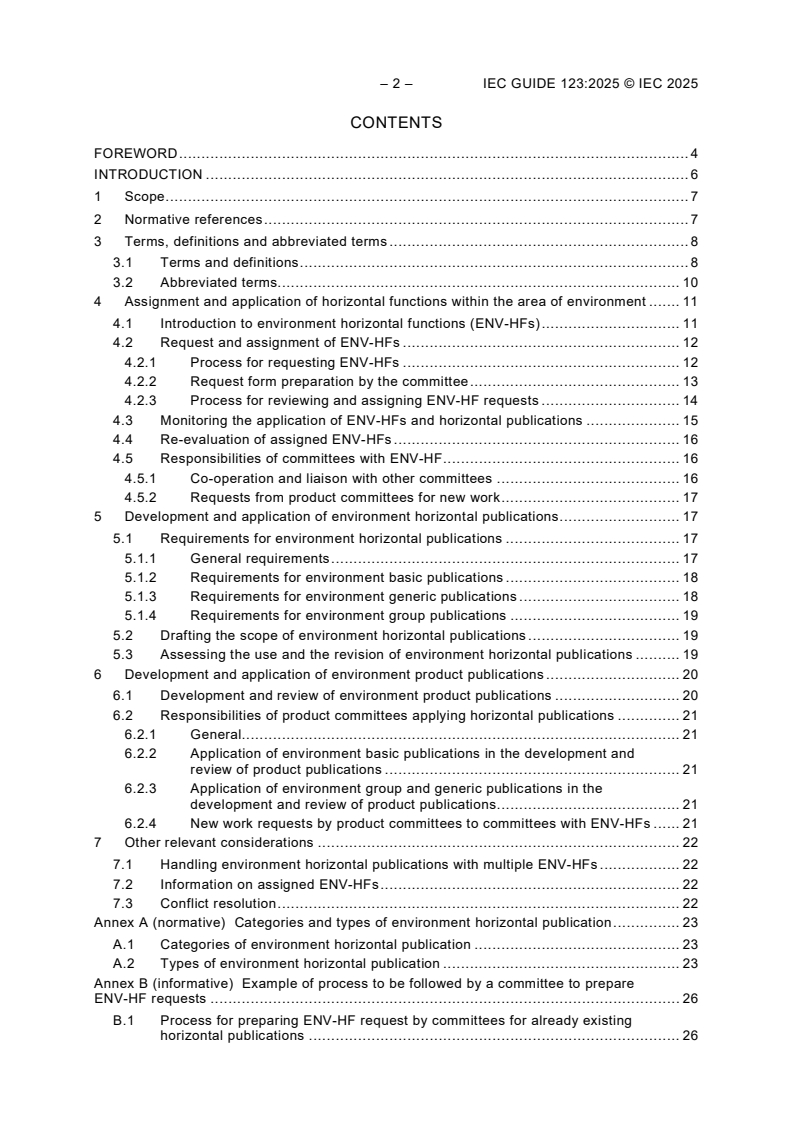
– 2 – IEC GUIDE 123:2025 © IEC 2025
CONTENTS
FOREWORD . 4
INTRODUCTION . 6
1 Scope . 7
2 Normative references . 7
3 Terms, definitions and abbreviated terms . 8
3.1 Terms and definitions . 8
3.2 Abbreviated terms. 10
4 Assignment and application of horizontal functions within the area of environment . 11
4.1 Introduction to environment horizontal functions (ENV-HFs) . 11
4.2 Request and assignment of ENV-HFs . 12
4.2.1 Process for requesting ENV-HFs . 12
4.2.2 Request form preparation by the committee . 13
4.2.3 Process for reviewing and assigning ENV-HF requests . 14
4.3 Monitoring the application of ENV-HFs and horizontal publications . 15
4.4 Re-evaluation of assigned ENV-HFs . 16
4.5 Responsibilities of committees with ENV-HF . 16
4.5.1 Co-operation and liaison with other committees . 16
4.5.2 Requests from product committees for new work . 17
5 Development and application of environment horizontal publications . 17
5.1 Requirements for environment horizontal publications . 17
5.1.1 General requirements . 17
5.1.2 Requirements for environment basic publications . 18
5.1.3 Requirements for environment generic publications . 18
5.1.4 Requirements for environment group publications . 19
5.2 Drafting the scope of environment horizontal publications . 19
5.3 Assessing the use and the revision of environment horizontal publications . 19
6 Development and application of environment product publications . 20
6.1 Development and review of environment product publications . 20
6.2 Responsibilities of product committees applying horizontal publications . 21
6.2.1 General. 21
6.2.2 Application of environment basic publications in the development and
review of product publications . 21
6.2.3 Application of environment group and generic publications in the
development and review of product publications . 21
6.2.4 New work requests by product committees to committees with ENV-HFs . 21
7 Other relevant considerations . 22
7.1 Handling environment horizontal publications with multiple ENV-HFs . 22
7.2 Information on assigned ENV-HFs . 22
7.3 Conflict resolution . 22
Annex A (normative) Categories and types of environment horizontal publication . 23
A.1 Categories of environment horizontal publication . 23
A.2 Types of environment horizontal publication . 23
Annex B (informative) Example of process to be followed by a committee to prepare
ENV-HF requests . 26
B.1 Process for preparing ENV-HF request by committees for already existing
horizontal publications . 26
B.2 Process for preparing ENV-HF request for new (to be developed) horizontal
publications. 27
Bibliography . 28
Figure 1 – Process for requesting and assigning ENV-HFs . 13
Figure 2 – Process for review of an ENV-HF request by ACEA . 15
Figure 3 – Monitoring assigned ENV-HFs . 16
Figure A.1 – Hierarchy of IEC publication categories and examples . 23
Figure A.2 – Types of environment horizontal publication . 24
Figure A.3 – Horizontal publications structure within the area of environment . 25
Table 1 – Typical topics and subjects of environment horizontal functions . 11
– 4 – IEC GUIDE 123:2025 © IEC 2025
INTERNATIONAL ELECTROTECHNICAL COMMISSION
____________
ASSIGNMENT AND MANAGEMENT OF HORIZONTAL FUNCTIONS
WITHIN THE AREA OF ENVIRONMENT
FOREWORD
1) The International Electrotechnical Commission (IEC) is a worldwide organization for standardization comprising
all national electrotechnical committees (IEC National Committees). The object of IEC is to promote international
co-operation on all questions concerning standardization in the electrical and electronic fields. To this end and
in addition to other activities, IEC publishes International Standards, Technical Specifications, Technical Reports,
Publicly Available Specifications (PAS) and Guides (hereafter referred to as "IEC Publication(s)"). Their
preparation is entrusted to technical committees; any IEC National Committee interested in the subject dealt with
may participate in this preparatory work. International, governmental and non-governmental organizations liaising
with the IEC also participate in this preparation. IEC collaborates closely with the International Organization for
Standardization (ISO) in accordance with conditions determined by agreement between the two organizations.
2) The formal decisions or agreements of IEC on technical matters express, as nearly as possible, an international
consensus of opinion on the relevant subjects since each technical committee has representation from all
interested IEC National Committees.
3) IEC Publications have the form of recommendations for international use and are accepted by IEC National
Committees in that sense. While all reasonable efforts are made to ensure that the technical content of IEC
Publications is accurate, IEC cannot be held responsible for the way in which they are used or for any
misinterpretation by any end user.
4) In order to promote international uniformity, IEC National Committees undertake to apply IEC Publications
transparently to the maximum extent possible in their national and regional publications. Any divergence between
any IEC Publication and the corresponding national or regional publication shall be clearly indicated in the latter.
5) IEC itself does not provide any attestation of conformity. Independent certification bodies provide conformity
assessment services and, in some areas, access to IEC marks of conformity. IEC is not responsible for any
services carried out by independent certification bodies.
6) All users should ensure that they have the latest edition of this publication.
7) No liability shall attach to IEC or its directors, employees, servants or agents including individual experts and
members of its technical committees and IEC National Committees for any personal injury, property damage or
other damage of any nature whatsoever, whether direct or indirect, or for costs (including legal fees) and
expenses arising out of the publication, use of, or reliance upon, this IEC Publication or any other IEC
Publications.
8) Attention is drawn to the Normative references cited in this publication. Use of the referenced publications is
indispensable for the correct application of this publication.
9) IEC draws attention to the possibility that the implementation of this document may involve the use of (a)
patent(s). IEC takes no position concerning the evidence, validity or applicability of any claimed patent rights in
respect thereof. As of the date of publication of this document, IEC had not received notice of (a) patent(s), which
may be required to implement this document. However, implementers are cautioned that this may not represent
the latest information, which may be obtained from the patent database available at https://patents.iec.ch. IEC
shall not be held responsible for identifying any or all such patent rights.
IEC Guide 123 has been prepared, in accordance with ISO/IEC Directives, Part 1, Annex A, by
the IEC Advisory Committee on Environmental Aspects (ACEA).
The text of this IEC Guide is based on the following documents:
Draft Report on voting
SMBNC/66/DV SMBNC/71/RV
Full information on the voting for the approval of this Guide can be found in the report on voting
indicated in the above table.
The language used for the development of this Guide is English.
This publication has been drafted in accordance with the ISO/IEC Directives, Part 2, and
developed in accordance with ISO/IEC Directives, Part 1 and ISO/IEC Directives, IEC
Supplement, available at www.iec.ch/members_experts/refdocs. The main document types
developed by IEC are described in greater detail at www.iec.ch/standardsdev/publications.
– 6 – IEC GUIDE 123:2025 © IEC 2025
INTRODUCTION
IEC Guide 108, Guidelines for ensuring the coherence of IEC publications – Horizontal
functions, horizontal publications and their application, defines and describes the concept of
horizontal functions and horizontal publications and their relationship with product publications.
It further defines the procedures for IEC technical committees, project committees,
subcommittees and systems committees (referred to as "committees" hereafter) and for
advisory committees, such as ACEA (the Advisory Committee on Environmental Aspects), in
relation to horizontal functions and horizontal publications.
This Guide was prepared by ACEA and defines provisions for the implementation of
IEC Guide 108 by ACEA and IEC committees within the area of environment. It is
complementary to IEC Guide 108 and provides provisions additional to those in IEC Guide 108
for horizontal and product publications that relate to the aspect environment.
In IEC Guide 108 the term "aspect" is used when referring to different areas of application such
as environment, safety, electromagnetic compatibility, etc. This is different from "environmental
aspect" (IEV 904-01-02), which is used in the context of environmental protection and
management. Therefore, to avoid confusion, in this Guide the term "aspect" of IEC Guide 108
was replaced by the term "area" or "area of application", which refers to the area of application
environment.
Committees dealing with subjects relating to environment for the whole, or for a specific part,
of their activities are required by SMB Decision 136/8 to follow the provisions of this Guide in
conjunction with the ISO/IEC Directives and IEC Guide 108.
The assignment by ACEA of an environment horizontal function (ENV-HF) to a committee is a
pre-condition for that committee to prepare environment horizontal publications. Such an
assignment is made with the purpose of:
– ensuring the consistency of IEC publications relating to environmental subjects common to
a number of committees by avoiding duplication of work and contradictory requirements;
– reducing the size and cost of lEC publications by avoiding duplication of texts;
– improving mutual understanding among engineers, scientists and managers of different
technical disciplines.
Product committees implement the requirements of such environment horizontal publications in
their product publications.
The implementation of this Guide will provide consistency of the provisions within the area of
environment across IEC publications. For this purpose, this Guide defines requirements and
other provisions for implementation by committees in order to limit overlaps and contradictory
requirements in the corpus of IEC publications.
ASSIGNMENT AND MANAGEMENT OF HORIZONTAL FUNCTIONS
WITHIN THE AREA OF ENVIRONMENT
1 Scope
This Guide defines provisions for the implementation of IEC Guide 108 by ACEA and IEC
committees within the area of environment.
NOTE 1 Environment here refers to the surroundings in which a product or system exists, including air, water, land,
natural resources, flora, fauna, humans and their interrelation.
It defines procedures for
– IEC committees to request the assignment of horizontal functions within the area of
environment, giving the committee authority to develop one or more environment horizontal
publications within the assigned horizontal function, as well as to manage the environment
horizontal publications developed under the assigned horizontal function, and
– ACEA on how to assess and recommend (to the SMB) the assignment of horizontal functions
within the area of environment to a committee, and to manage and supervise assigned
environment horizontal functions and the respective environment horizontal publications
and their correct application by product committees.
This Guide also describes the respective responsibilities of the developers and users of
environment horizontal publications in order to ensure that the area of environment is dealt with
in a comprehensive and coherent manner by the IEC technical community.
This Guide does not cover horizontal functions within the areas of energy efficiency and
electromagnetic compatibility (EMC), which are covered by IEC Guide 118 [1] and
IEC Guide 107 [2], respectively.
NOTE 2 The IEC Standardization Management Board (SMB) has decided that Guides such as this can have
mandatory requirements which shall be followed by all IEC committees developing technical work that falls within the
scope of the Guide, as well as guidance which may or may not be followed. The mandatory requirements in this
Guide are identified by the use of "shall". Statements that are only for guidance are identified by using the verb
"should". (See IEC Directives Supplement Part 1, A.1.1.)
2 Normative references
The following documents are referred to in the text in such a way that some or all of their content
constitutes requirements of this document. For dated references, only the edition cited applies.
For undated references, the latest edition of the referenced document (including any
amendments) applies.
IEC Guide 108, Guidelines for ensuring the coherence of IEC publications – Horizontal
functions, horizontal publications and their application
IEC Guide 109, Environmental aspects – Inclusion in electrotechnical product standards
IEC Guide 121, Securing credible environmentally relevant performance assessment methods
in standards
___________
Numbers in square brackets refer to the Bibliography.
– 8 – IEC GUIDE 123:2025 © IEC 2025
3 Terms, definitions and abbreviated terms
3.1 Terms and definitions
For the purposes of this document, the following terms and definitions apply.
ISO and IEC maintain terminological databases for use in standardization at the following
addresses:
• IEC Electropedia: available at http://www.electropedia.org/
• ISO Online browsing platform: available at http://www.iso.org/obp
3.1.1
environment
surroundings in which a product or system exists, including air, water, land, natural resources,
flora, fauna, humans and their interrelation
[SOURCE: IEC 60050-904:2014 [3], 904-01-01]
3.1.2
environmental aspect
element of an organization's activities or products that can interact with the environment
[SOURCE: IEC 60050-904:2014 [3], 904-01-02, modified – Note 1 to entry has been omitted.]
3.1.3
environmental impact
change to the environment (3.1.1), whether adverse or beneficial, wholly or partly resulting from
environmental aspects (3.1.2)
EXAMPLE Typical environmental impacts are resource depletion, ozone depletion, smog formation, eutrophication,
climate change, alteration of habitats, reduction of biological diversity and human exposure.
[SOURCE: IEC 60050-904:2014 [3], 904-01-03, modified – The example has been added.]
3.1.4
horizontal function
task assigned to a committee to prepare one or more horizontal publications (3.1.6) related to
a given scope
Note 1 to entry: The assignment of a horizontal function to a committee is a pre-condition for a committee to prepare
one or more horizontal publications (3.1.6) within the assigned horizontal function.
[SOURCE: IEC Guide 108:2019 [4], 3.1.2, modified – In Note 1 to entry, "one or more" and
"within the assigned horizontal function" have been added.]
3.1.5
environment horizontal function
ENV-HF
horizontal function (3.1.4) within the area of environment (3.1.1)
Note 1 to entry: An environment horizontal function allows for the development of basic publications (3.1.7), generic
publications (3.1.8) and group publications (3.1.9) within the area of environment (3.1.1).
3.1.6
horizontal publication
document dealing with a subject relevant to a number of committees and of crucial importance
to ensure the coherence amongst publications
Note 1 to entry: “Subject” in the definition refers to a subject within the area of environment (3.1.1),
e.g. environmentally conscious design.
Note 2 to entry: In accordance with IEC Guide 108:2019 [4], 4.1, "International Standards (IS) and Technical
Reports (TR) can be designated as a horizontal publication. A Technical Specification (TS) or a Publicly Available
Specification (PAS) cannot be designated as a horizontal publication. However, they can be intended to become a
horizontal publication once the TS or PAS becomes an International Standard. If this is the case, the scope of the
TS or PAS will clearly indicate the intention to become a horizontal publication in a future revision."
[SOURCE: IEC Guide 108:2019 [4], 3.1.3, modified – Notes 1 and 2 to entry have been added.]
3.1.7
basic publication
basic horizontal publication
horizontal publication (3.1.6) on the fundamental principles, concepts, graphical symbols,
terminology or technical characteristics of a specific subject, that specifies requirements for the
relevant product publications (3.1.11)
Note 1 to entry: A specific subject within the area of environment (3.1.1) is, for example, environmentally conscious
design.
Note 2 to entry: A basic publication is normally applied by the relevant product publications (3.1.11), irrespective
of the existence of a generic publication (3.1.8) or a group publication (3.1.9). In another words, dedicated group
publications (3.1.9) or dedicated product publications (3.1.11) cannot take precedence over basic publications.
Note 3 to entry: The definition has been derived from IEC Guide 108:2019 [4], 4.2 and revised to exclude the
requirement, and to add a note to entry to explain the relationship between basic, group and product horizontal
publications and a note to entry to provide the example.
3.1.8
generic publication
generic horizontal publication
horizontal publication (3.1.6) within a defined area of application, that is applicable when no
dedicated group publication (3.1.9) or product publication (3.1.11) exists
Note 1 to entry: Requirements in generic publications are generally less detailed than those in group publications
(3.1.9) or product publications (3.1.11). The scope of generic publications will generally be wider than that of group
publications or product publications, but not so specific as basic publications (3.1.7).
Note 2 to entry: A generic publication contains a number of options or solutions (toolbox) that can be selected and
applied to certain product types. It is therefore not intended to be applied directly to products since it requires some
level of interpretation by the user, although it can be applied to products in the absence of group publications (3.1.9)
or product publications (3.1.11).
Note 3 to entry: If dedicated group publications (3.1.9) or product publications (3.1.11) exist, they take precedence
over generic publications.
Note 4 to entry: The definition has been derived from IEC Guide 108:2019 [4], 4.2, and revised to exclude the
requirement, to replace the term "aspect" by "area of application" and to add note 2 to entry further detailing a generic
publication.
– 10 – IEC GUIDE 123:2025 © IEC 2025
3.1.9
group publication
group horizontal publication
horizontal publication (3.1.6) covering a specific group of products, generally within a defined
area of application, that is applicable by the relevant product publications (3.1.11)
Note 1 to entry: A product publication (3.1.11) in one committee can be designated a group publication applicable
to a group of products covered by two or more committees.
Note 2 to entry: A group publication is applicable to two or more committees.
Note 3 to entry: The definition has been derived from IEC Guide 108:2019 [4], 4.2, and revised to exclude the
requirement.
3.1.10
environment horizontal publication
horizontal publication (3.1.6) within the area of environment (3.1.1)
Note 1 to entry: Environment horizontal publications can be basic publications (3.1.7), generic publications (3.1.8)
or group publications (3.1.9). They can be further classified according to their type: essential, data, test method and
guidance.
3.1.11
product publication
document covering a specific product or family of related products within the scope of a single
product committee (3.1.13)
Note 1 to entry: Environment product publications deal with one or more subjects within the area of environment
(3.1.1).
[SOURCE: IEC Guide 108:2019 [4], 3.1.4, modified – Note 1 to entry has been added.]
3.1.12
Guide
document published by ISO or IEC giving rules, orientation, advice or recommendations relating
to international standardization
Note 1 to entry: Guides can address issues of interest to all users of documents published by ISO and IEC.
[SOURCE: ISO/IEC Directives Part 2, 2021, 3.1.7.]
3.1.13
product committee
committee with a scope that covers a specific family or group of products
[SOURCE: IEC Guide 108:2019 [4], 3.1.5, modified – In the definition, "which" has been
replaced by "that".]
3.2 Abbreviated terms
ACEA Advisory Committee on Environmental Aspects
CAG chairman's advisory group
CD committee draft
CDV committee draft for vote
CP collaboration platform
EMC electromagnetic compatibility
ENV-HF environment horizontal function
FDIS final draft International Standard
IS International Standard
NC IEC National Committee
NP new work item proposal
PAS Publicly Available Specification
SBP strategic business plan
SMB Standardization Management Board
TR Technical Report
TS Technical Specification
4 Assignment and application of horizontal functions within the area of
environment
4.1 Introduction to environment horizontal functions (ENV-HFs)
Clause 4 describes what an environment horizontal function (ENV-HF) is and the criteria to
define it. An ENV-HF refers to a task assigned to a committee to prepare one or more horizontal
publications related to a given scope (subject) within the area of environment covering a certain
product scope.
The term "environment" as used in this document is defined in 3.1.1.
Table 1 lists the subjects within the area of environment for which ENV-HFs can be assigned.
For easy reference, the non-exhaustive list of subjects is grouped by topic. This list is applicable
at the time of publication of this Guide and will evolve over time.
Table 1 – Typical topics and subjects of environment horizontal functions
Topic Subjects for which the environment horizontal function is assigned
Substances compliance management
Substances
Material and substances declaration
management and
Substance and material analytical test methods
assessment
Environmentally conscious use of materials (biobased, renewable, recycled, etc.)
Product category rules (PCR)
Life cycle assessment (LCA)
Environmental
Environmental footprint
assessment
Greenhouse gases (GHG)
Environmental performance (indicator, label, etc.)
Environmentally conscious design (ECD)
Design aspects Product circularity and circular product design
Durable and reliable products by design
Circular content (parts reuse, use recycled or renewable content)
Product life extension (durability, repair, reuse, upgrade)
Industrial product life extension (refurbish, remanufacture)
a
Material efficiency
End-of-life management (collection and logistics, depollution, treatment)
End-of-life products recovery (products and parts harvest for life extension)
End-of-life material recovery (recycling, recyclability)
Terms, definitions, and concept diagrams
Knowledge
management
Environment common data dictionary and ontologies
Other (to be specified)
This list of topics for ENV-HFs is maintained by ACEA. The latest version is included in the request form and can
be found on the ACEA dashboard [https://www.iec.ch/acea/supportingdocuments].
a
Part of resource efficiency and circular economy.
– 12 – IEC GUIDE 123:2025 © IEC 2025
The assignment of an ENV-HF to a committee gives that committee a mandate to develop one
or more environment horizontal publications (3.1.10) within the subject of the assigned function.
The environment horizontal publications can be categorized as basic, generic or group
publications. Clause 5 and Annex A give more details.
4.2 Request and assignment of ENV-HFs
4.2.1 Process for requesting ENV-HFs
In accordance with IEC Guide 108:2019 [4], the assignment of ENV-HFs is the responsibility of
the Advisory Committee on Environmental Aspects (ACEA), subject to confirmation by the
Standardization Management Board (SMB). The assignment of an ENV-HF to a committee is a
pre-condition for that committee to be allowed to develop one or more environment horizontal
publications within the scope of that ENV-HF.
Any committee may request ACEA to assign one or more ENV-HFs within the area of
environment. Figure 1 shows the process for requesting and assigning an ENV-HF and Annex B
provides an example of process to be used internally by a committee to prepare an ENV-HF
request.
The process shown in Figure 1 together with detailed explanation of the steps and decision
points is applicable to:
– committees that are currently preparing or intending to prepare environment horizontal
publications;
– committees that own legacy environment horizontal publications (previously known as
"horizontal standards") formerly approved by the SMB, for which the respective ENV-HF
shall be assigned to that committee.
1 Committee:
1a. Identifies one or more subjects in
the area of environment that are of
interest to another committee (or
committees) for which it intends to
prepare one or more horizontal
publications; or
1b. Owns publication covering one or
more subjects in the area of
environment that are of interest to
another committee (or committees)
for which it does not yet own an
environment horizontal function
(ENV-HF)
2 Committee completes the ENV-HF
request form, indicating amongst
other things the title of the requested
ENV-HF and the type of the
respective horizontal publication
3 Committee requests the assignment
of ENV-HF to ACEA by sending the
completed request form to
acea@iec.ch
4 ACEA reviews the request:
4a. ACEA approves the request and
recommends to the SMB the
assignment of the ENV-HF to the
committee; or
4b. ACEA disapproves and advises
committee to review the request (go
back to 2)
5 SMB reviews the recommendation for
ENV-HF:
5a. SMB approves, and the ENV-HF
is assigned to the committee; or
5b. SMB disapproves or has
additional recommendations to
committee (or both) (go back to 2)
Figure 1 – Process for requesting and assigning ENV-HFs
If an ENV-HF is requested in parallel with the development of the respective environment
horizontal publication, the ENV-HF request process shall be completed before the horizontal
publication reaches FDIS. This is important because it is not possible to assign the horizontal
status to a publication without the respective ENV-HF.
The "horizontal standard status" conferred in the past by the SMB (in accordance with
IEC Guide 108:1994 [5] or IEC Guide 108:2006 [6]) is now superseded, and for a publication to
have (and to retain) a status as a horizontal publication, the committee shall request the
assignment of an ENV-HF in accordance with the rules provided in this Guide.
4.2.2 Request form preparation by the committee
To request an ENV-HF, a committee shall complete the ACEA request form for ENV-HF
available at [https://www.iec.ch/acea/supportingdocuments]. The completed request form
should be sent to ACEA at acea@iec.ch for review and decision.
One request form shall be completed for each ENV-HF requested. The request form is expected
to be updated regularly and the latest version available at the ACEA dashboard shall apply
(taking precedence over earlier versions).
– 14 – IEC GUIDE 123:2025 © IEC 2025
Within the request form all necessary information about the ENV-HF being requested is
collected, in particular:
– a title for the requested ENV-HF and description of its content (including any exclusion, if
applicable);
– justification of the need for the ENV-HF, demonstrating the expected common benefits to
other committees;
– existing and/or new horizontal publications that fall under the requested ENV-HF, their
scope or draft scope and their classification according to category and type;
– list of committees and potentially existing group or product publications impacted by the
ENV-HF.
The title to be attributed to an ENV-HF shall be composed of two parts as follows:
a) the subject within the area of environment;
b) the product scope to which the ENV-HF is applicable.
EXAMPLE 1 Examples of title of ENV-HF are "Environmental conscious design applicable to any electrical or
electronic equipment", "Analytical test methods applicable to lighting equipment", etc.
A description of the ENV-HF including the various subjects (or specific items within a subject)
shall be included.
EXAMPLE 2 Examples of subjects and items included in the ENV-HF titled "Repair, reuse or upgrade of electrical
and electronic products and systems" are:
– methods to assess the proportion of reused parts in any type of electrical and electronic products and systems;
– methods to assess the ability to reuse products and parts of an electrical and electronic product or system at
the end-of-life;
– methods to assess the ability to repair products and parts of electrical and electronic products and systems;
– methods to assess the ability to upgrade products and parts of electrical and electronic products and systems.
Detailed instructions of how to complete the request form are available directly in the form.
4.2.3 Process for reviewing and assigning ENV-HF requests
The review process and actions carried out by ACEA after receipt of the completed request
form from a committee are detailed in Figure 2. The review of the HF request shall take place
by ACEA within 2 months after the receipt of the request (or otherwise as agreed with the
committee).
Committee requests the assignment of an ENV-HF by
sending a fully completed request form to acea@iec.ch
2 ACEA secretary pre-checks the request for
completeness:
• If OK, secretary sends confirmation of receipt to
committee, uploads the request into ACEA CP and
notifies ACEA members.
• If NOT OK, ACEA secretary returns request to
committee both with reasoning and
recommendation.
3 ACEA secretary and chair identify a request owner
within ACEA, who becomes responsible for this request
and respective ENV-HF maintenance.
4 ACEA request owner organizes a meeting with ACEA
members to review the request.
• If APPROVED, ACEA request owner prepares the
recommendation to SMB and presents to ACEA
members for a check.
• If NOT APPROVED, ACEA request owner
formulates and sends questions or
recommendations back to the requester committee
(via ACEA secretary).
NOTE Where needed, issues with other assigned horizontal
functions or horizontal publications will be dealt with by the
ACEA team performing the assessment (to be prepared by the
assessment owner).
5 Once the recommendation for the assignment of the
ENV-HF is completed, the ACEA secretary:
• sends it to the SMB for approval and tracks the
outcome;
• sends confirmation of the assignment of the ENV-
HF to the committee;
• updates the ACEA dashboard with the new ENV-
HF.
Figure 2 – Process for review of an ENV-HF request by ACEA
4.3 Monitoring the application of ENV-HFs and horizontal publications
The application of ENV-HFs is monitored by ACEA in two ways:
a) in relation to ENV-HFs assigned to a committee, by checking the conformity of the
environment horizontal publication or publications with the respective ENV-HF;
b) in relation to the application of environment horizontal publications by customer committees,
by checking whether it is correct (all aspects covered, overlap, conflicts, etc.).
The process for monitoring of an assigned ENV-HF and the development and use of the
respective environment horizontal publication is shown in Figure 3.
The ACEA dashboard [https://www.iec.ch/acea under the "Horizontal Functions" tab] provides
a list of assigned ENV-HFs to committees and links to the respective environment horizontal
publications.
Through this monitoring, ACEA can, for example, advise the committee of any needed
improvement of the environment horizontal publication or propose improvements or withdrawal
of the ENV-HF assigned. Also ACEA can identify improper application of an environment
horizontal publication by customer committees.
– 16 – IEC GUIDE 123:2025 © IEC 2025
1a Committee reports the use of its
horizontal publication or publications by
a customer committee to ACEA; or
1b ACEA carries out regular monitoring of
application of ENV-HF and respective
environment horizontal publications.
2 ACEA plans the review of:
• the application of an ENV-HF to
develop one or more horizontal
publications;
• the use of horizontal publications
by customer committees.
3 ACEA executes the review.
Review result conformant: ENV-HF and
horizontal publication successfully
monitored. Go to 5.
4 If review result is non-conformant,
ACEA consults with all relevant
committees and determines the
recommendation:
4a. ACEA recommends ENV-HF or
horizontal publication or publications
improvement; or
4b. If it is not possible to maintain ENV-
HF or horizontal publications, ACEA
recommends ENV-HF or horizontal
publications withdrawal to the SMB.
5 ACEA updates its database and its
dashboard with the outcome of the
ENV-HF (and respective publications)
monitoring review.
Figure 3 – Monitoring assigned ENV-HFs
4.4 Re-evaluation of assigned ENV-HFs
The assigned ENV-HF shall be regularly re-evaluated by ACEA as follows:
– periodic review every two years or otherwise in conjunction with the review of a new ENV-
HF request;
– consistency check of assigned ENV-HF with the scope of the IEC committee owner of the
ENV-HF;
– state of use of the ENV-HF (including environment horizontal publications and their
maintenance, or mention in a committee strategic business plan (SBP));
– check on potential conflicts with other already assigned ENV-HFs and respective horizontal
publications (clear boundary, gaps or overlaps, etc.).
The outcome of the periodic review will be made available on the ACEA dashboard.
4.5 Responsibilities of committees with ENV-HF
4.5.1 Co-operation and liaison with other committees
Secretaries of committees with an ENV-HF shall inform IEC Secretariat of any new work item
proposal (NP) relating to that horizontal function and indicate as far as possible those
committees which are likely to be affected. These committees shall be listed when the NP is
circulated.
A committee with an ENV-HF shall evaluate with the assistance of ACEA, the use of a similar
function by other committees. In particular, the committee shall assess the applicability of an
ENV-HF to other committees.
A committee with an ENV-HF shall respond to requests for liaison from product committees and
keep them informed about the progress of relevant work.
4.5.2 Requests from product commi
...