


IEC 62962:2019
(Main)Particular requirements for load-shedding equipment (LSE)
General Information
- Abstract
IEC 62962:2019 The purpose of this document is to provide requirements for equipment to be used in energy efficiency systems. This document covers load-shedding equipment (LSE).
Guidelines relating to safety for LSE as given in IEC Guide 110 have been followed.
This document applies to load-shedding equipment for household and similar uses. The load-shedding function is used in energy management systems to optimize the overall use of electrical energy including production and storage. Load-shedding can be used for example for energy efficiency purposes as per IEC 60364-8-1:2019.
- Status
- Published
- Publication Date
- 12-Sep-2019
- Technical Committee
- SC 23K - Electrical Energy Efficiency products
- Drafting Committee
- WG 1 - TC 23/SC 23K/WG 1
- Current Stage
- PPUB - Publication issued
- Start Date
- 13-Sep-2019
- Completion Date
- 04-Oct-2019
Overview
IEC 62962:2019 is an international standard published by the International Electrotechnical Commission (IEC) that defines particular requirements for load-shedding equipment (LSE). This standard specifically addresses equipment designed for use in energy efficiency and energy management systems in household and similar applications. Load-shedding equipment plays a crucial role in optimizing electrical energy consumption, production, and storage by selectively reducing electrical loads.
The standard follows safety guidelines outlined in IEC Guide 110 and aligns with energy efficiency practices such as those described in IEC 60364-8-1:2019. It provides comprehensive specifications on performance, design, testing, and classification of LSEs, ensuring optimal operation and safety within energy management frameworks.
Key Topics
- Scope and Application: IEC 62962 applies to load-shedding equipment intended for household and comparable uses, enabling energy management and efficiency.
- General Requirements: Details on operational conditions, architecture, and functional safety of LSE devices.
- Testing Protocols: Procedures for environmental and operational testing, including conditions for temperature, humidity, altitude, insulation resistance, and dielectric strength.
- Rated Values and Performance Criteria: Specifications of rated operational voltages, current limits, making and breaking capacities, frequency, and short-circuit current resistance.
- Classification: Categorization of LSEs by functional category, switching method, current adjustability, design, mounting type, terminal type, protection against external influences, and number of poles.
- Markings and Documentation: Guidelines for labels, identification, and documentation to ensure compliance and safe use.
- Electrical Safety: Protection measures against electric shock, including terminal design and testing to prevent hazards during operation and installation.
- Terminals and Connections: Requirements for copper conductor terminals including screw and screwless types, with robust mechanical strength, corrosion resistance, and reliable clamping mechanisms.
- Construction and Durability: Mechanical design standards related to insulating materials, fixing methods, knob attachments, operating means, and resistance to ageing and humidity.
- Operational Mechanisms: Requirements for mechanisms including position indication, locking, making and breaking actions, and status indicators to facilitate safe and reliable load-shedding operations.
Applications
IEC 62962:2019 is vital for manufacturers, system integrators, and regulatory bodies involved in the design, deployment, and certification of load-shedding equipment. Practical applications include:
- Residential Energy Management Systems: LSE devices compliant with IEC 62962 help households optimize electricity consumption, reducing costs and environmental footprint.
- Demand Response Solutions: Facilitates automated or manual load control during peak demand periods to maintain grid stability.
- Energy Storage Integration: Ensures balanced load distribution when electrical energy production and storage components operate concurrently.
- Safety Assurance: Establishes safety protocols preventing electric shock and system failures, vital for consumer protection and regulatory compliance.
- Smart Grid Components: Acts as an essential element within smart grid frameworks to enhance energy efficiency and operational reliability.
Related Standards
- IEC Guide 110: Provides overarching safety guidelines for electrical equipment, which are adhered to in the development of IEC 62962.
- IEC 60364-8-1:2019: Covers electrical installations and energy efficiency measures, forming a foundation upon which load-shedding functionalities are implemented.
- IEC 60439 and IEC 61439 Series: Standards related to low-voltage switchgear assemblies, often incorporating load-shedding devices.
- IEC 60947 Series: Pertains to low-voltage switchgear and controlgear, influencing switching components within LSEs.
- IEC 61508: Addresses functional safety of electrical systems, providing frameworks often referenced in safety-critical equipment design.
By complying with IEC 62962:2019, manufacturers ensure their load-shedding equipment meets rigorous performance, safety, and reliability standards, contributing to more efficient electrical energy management in residential and similar environments. This standard supports innovations in energy saving and smart technology integration, reinforcing global efforts toward sustainable electricity use.
Get Certified
Connect with accredited certification bodies for this standard

DNV
DNV is an independent assurance and risk management provider.

Lloyd's Register
Lloyd's Register is a global professional services organisation specialising in engineering and technology.
DNV Energy Systems
Energy and renewable energy certification.
Sponsored listings
Frequently Asked Questions
IEC 62962:2019 is a standard published by the International Electrotechnical Commission (IEC). Its full title is "Particular requirements for load-shedding equipment (LSE)". This standard covers: IEC 62962:2019 The purpose of this document is to provide requirements for equipment to be used in energy efficiency systems. This document covers load-shedding equipment (LSE). Guidelines relating to safety for LSE as given in IEC Guide 110 have been followed. This document applies to load-shedding equipment for household and similar uses. The load-shedding function is used in energy management systems to optimize the overall use of electrical energy including production and storage. Load-shedding can be used for example for energy efficiency purposes as per IEC 60364-8-1:2019.
IEC 62962:2019 The purpose of this document is to provide requirements for equipment to be used in energy efficiency systems. This document covers load-shedding equipment (LSE). Guidelines relating to safety for LSE as given in IEC Guide 110 have been followed. This document applies to load-shedding equipment for household and similar uses. The load-shedding function is used in energy management systems to optimize the overall use of electrical energy including production and storage. Load-shedding can be used for example for energy efficiency purposes as per IEC 60364-8-1:2019.
IEC 62962:2019 is classified under the following ICS (International Classification for Standards) categories: 27.015 - Energy efficiency. Energy conservation in general; 29.020 - Electrical engineering in general. The ICS classification helps identify the subject area and facilitates finding related standards.
IEC 62962:2019 is available in PDF format for immediate download after purchase. The document can be added to your cart and obtained through the secure checkout process. Digital delivery ensures instant access to the complete standard document.
Standards Content (Sample)
IEC 62962 ®
Edition 1.0 2019-09
INTERNATIONAL
STANDARD
NORME
INTERNATIONALE
colour
inside
Particular requirements for load-shedding equipment (LSE)
Exigences spécifiques pour les délesteurs (LSE)
All rights reserved. Unless otherwise specified, no part of this publication may be reproduced or utilized in any form
or by any means, electronic or mechanical, including photocopying and microfilm, without permission in writing from
either IEC or IEC's member National Committee in the country of the requester. If you have any questions about IEC
copyright or have an enquiry about obtaining additional rights to this publication, please contact the address below or
your local IEC member National Committee for further information.
Droits de reproduction réservés. Sauf indication contraire, aucune partie de cette publication ne peut être reproduite
ni utilisée sous quelque forme que ce soit et par aucun procédé, électronique ou mécanique, y compris la photocopie
et les microfilms, sans l'accord écrit de l'IEC ou du Comité national de l'IEC du pays du demandeur. Si vous avez des
questions sur le copyright de l'IEC ou si vous désirez obtenir des droits supplémentaires sur cette publication, utilisez
les coordonnées ci-après ou contactez le Comité national de l'IEC de votre pays de résidence.
IEC Central Office Tel.: +41 22 919 02 11
3, rue de Varembé info@iec.ch
CH-1211 Geneva 20 www.iec.ch
Switzerland
About the IEC
The International Electrotechnical Commission (IEC) is the leading global organization that prepares and publishes
International Standards for all electrical, electronic and related technologies.
About IEC publications
The technical content of IEC publications is kept under constant review by the IEC. Please make sure that you have the
latest edition, a corrigendum or an amendment might have been published.
IEC publications search - webstore.iec.ch/advsearchform Electropedia - www.electropedia.org
The advanced search enables to find IEC publications by a The world's leading online dictionary on electrotechnology,
variety of criteria (reference number, text, technical containing more than 22 000 terminological entries in English
committee,…). It also gives information on projects, replaced and French, with equivalent terms in 16 additional languages.
and withdrawn publications. Also known as the International Electrotechnical Vocabulary
(IEV) online.
IEC Just Published - webstore.iec.ch/justpublished
Stay up to date on all new IEC publications. Just Published IEC Glossary - std.iec.ch/glossary
details all new publications released. Available online and 67 000 electrotechnical terminology entries in English and
once a month by email. French extracted from the Terms and Definitions clause of
IEC publications issued since 2002. Some entries have been
IEC Customer Service Centre - webstore.iec.ch/csc collected from earlier publications of IEC TC 37, 77, 86 and
If you wish to give us your feedback on this publication or CISPR.
need further assistance, please contact the Customer Service
Centre: sales@iec.ch.
A propos de l'IEC
La Commission Electrotechnique Internationale (IEC) est la première organisation mondiale qui élabore et publie des
Normes internationales pour tout ce qui a trait à l'électricité, à l'électronique et aux technologies apparentées.
A propos des publications IEC
Le contenu technique des publications IEC est constamment revu. Veuillez vous assurer que vous possédez l’édition la
plus récente, un corrigendum ou amendement peut avoir été publié.
Recherche de publications IEC - Electropedia - www.electropedia.org
webstore.iec.ch/advsearchform Le premier dictionnaire d'électrotechnologie en ligne au
La recherche avancée permet de trouver des publications IEC monde, avec plus de 22 000 articles terminologiques en
en utilisant différents critères (numéro de référence, texte, anglais et en français, ainsi que les termes équivalents dans
comité d’études,…). Elle donne aussi des informations sur les 16 langues additionnelles. Egalement appelé Vocabulaire
projets et les publications remplacées ou retirées. Electrotechnique International (IEV) en ligne.
IEC Just Published - webstore.iec.ch/justpublished Glossaire IEC - std.iec.ch/glossary
Restez informé sur les nouvelles publications IEC. Just 67 000 entrées terminologiques électrotechniques, en anglais
Published détaille les nouvelles publications parues. et en français, extraites des articles Termes et Définitions des
Disponible en ligne et une fois par mois par email. publications IEC parues depuis 2002. Plus certaines entrées
antérieures extraites des publications des CE 37, 77, 86 et
Service Clients - webstore.iec.ch/csc CISPR de l'IEC.
Si vous désirez nous donner des commentaires sur cette
publication ou si vous avez des questions contactez-nous:
sales@iec.ch.
IEC 62962 ®
Edition 1.0 2019-09
INTERNATIONAL
STANDARD
NORME
INTERNATIONALE
colour
inside
Particular requirements for load-shedding equipment (LSE)
Exigences spécifiques pour les délesteurs (LSE)
INTERNATIONAL
ELECTROTECHNICAL
COMMISSION
COMMISSION
ELECTROTECHNIQUE
INTERNATIONALE
ICS 27.015; 29.020 ISBN 978-2-8322-7385-2
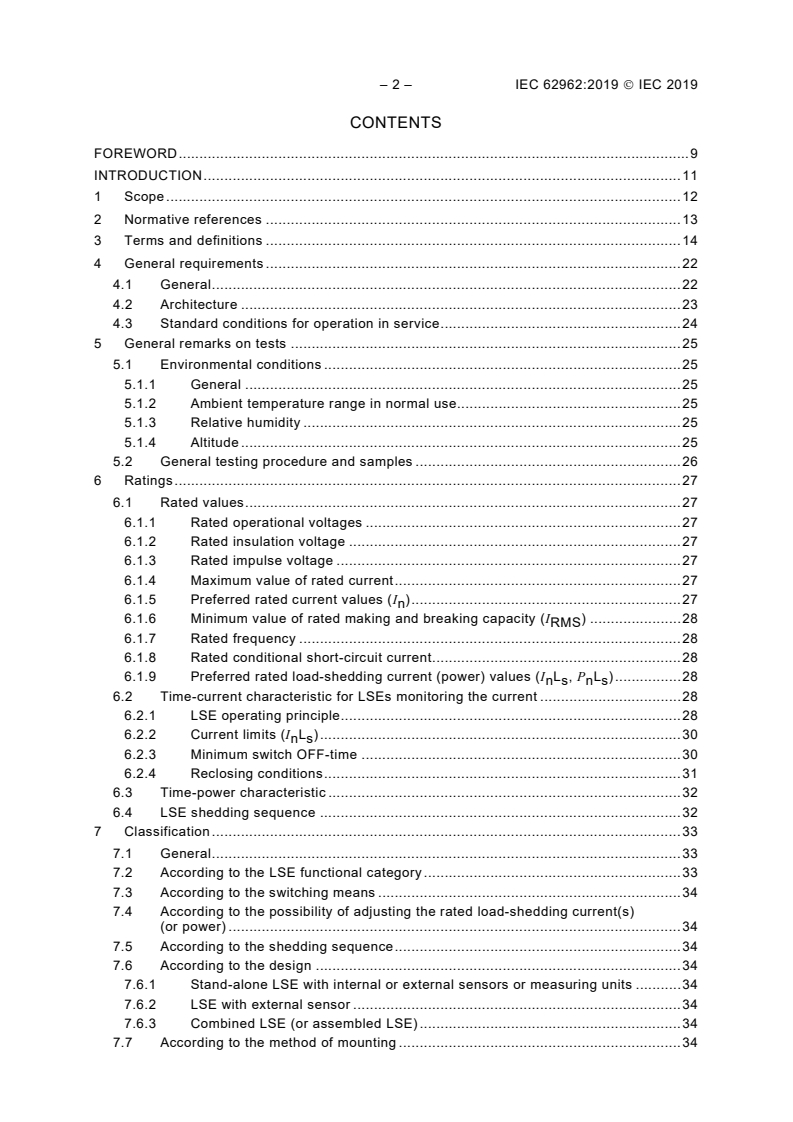
– 2 – IEC 62962:2019 IEC 2019
CONTENTS
FOREWORD . 9
INTRODUCTION . 11
1 Scope . 12
2 Normative references . 13
3 Terms and definitions . 14
4 General requirements . 22
4.1 General . 22
4.2 Architecture . 23
4.3 Standard conditions for operation in service . 24
5 General remarks on tests . 25
5.1 Environmental conditions . 25
5.1.1 General . 25
5.1.2 Ambient temperature range in normal use. 25
5.1.3 Relative humidity . 25
5.1.4 Altitude . 25
5.2 General testing procedure and samples . 26
6 Ratings . 27
6.1 Rated values . 27
6.1.1 Rated operational voltages . 27
6.1.2 Rated insulation voltage . 27
6.1.3 Rated impulse voltage . 27
6.1.4 Maximum value of rated current . 27
6.1.5 Preferred rated current values (I ) . 27
n
6.1.6 Minimum value of rated making and breaking capacity (I ) . 28
RMS
6.1.7 Rated frequency . 28
6.1.8 Rated conditional short-circuit current . 28
6.1.9 Preferred rated load-shedding current (power) values (I L , P L ) . 28
n s n s
6.2 Time-current characteristic for LSEs monitoring the current . 28
6.2.1 LSE operating principle . 28
6.2.2 Current limits (I L ) . 30
n s
6.2.3 Minimum switch OFF-time . 30
6.2.4 Reclosing conditions . 31
6.3 Time-power characteristic . 32
6.4 LSE shedding sequence . 32
7 Classification . 33
7.1 General . 33
7.2 According to the LSE functional category . 33
7.3 According to the switching means . 34
7.4 According to the possibility of adjusting the rated load-shedding current(s)
(or power) . 34
7.5 According to the shedding sequence . 34
7.6 According to the design . 34
7.6.1 Stand-alone LSE with internal or external sensors or measuring units . 34
7.6.2 LSE with external sensor . 34
7.6.3 Combined LSE (or assembled LSE) . 34
7.7 According to the method of mounting . 34
7.8 According to the type of terminals . 34
7.9 According to the contact openings . 34
7.10 According to the protection against external influences . 35
7.11 According to the number of poles . 35
7.12 According to the type of monitored parameters . 35
8 Markings and information . 35
8.1 General . 35
8.2 Test of markings . 36
9 Protection against electric shock . 36
9.1 General . 36
9.2 Test for protection against electric shock . 37
10 Terminals for external copper conductors . 40
10.1 General . 40
10.2 Terminals with screw clamping for external copper conductors . 40
10.2.1 General . 40
10.2.2 Conductor fitting . 46
10.2.3 Mechanical strength of terminals . 46
10.2.4 Resistance to corrosion of terminals . 46
10.2.5 Clamping effects on conductors . 46
10.2.6 Clamping reliability of terminals . 47
10.2.7 Clamping length of terminals . 48
10.2.8 Reliability of terminals . 49
10.2.9 Accidental loosening of earthing terminals . 49
10.2.10 Resistance to corrosion of earthing terminals . 49
10.2.11 Additional requirements for the design of pillar terminals . 50
10.2.12 Additional requirements for the design of lug terminals . 50
10.2.13 Additional requirements for terminals for the connection of external
conductors . 50
10.3 Screwless terminals for external copper conductors . 50
10.3.1 General . 50
10.3.2 Conductor fittings . 50
10.3.3 Connection of conductors . 51
10.3.4 Type of material . 51
10.3.5 Conductors clamping . 51
10.3.6 Operation of terminals . 51
10.3.7 Multi conductor terminals . 52
10.3.8 Introduction of conductors . 52
10.3.9 Fixing of terminals . 52
10.3.10 Mechanical strength. 52
10.3.11 Electrical and thermal stress resistance . 54
10.3.12 Mechanical reliability . 56
11 Constructional requirements . 59
11.1 General . 59
11.2 Mechanical requirements for insulating means . 59
11.3 Installation requirements . 59
11.4 Fixing of covers, cover plates and actuating members . 62
11.4.1 General . 62
11.4.2 Fixings based on screws or rivets . 63
– 4 – IEC 62962:2019 IEC 2019
11.4.3 Fixings which may be removed by applying a force perpendicular to the
surfaces . 63
11.4.4 Fixings which may be removed using a tool . 63
11.5 Attachment of knobs . 64
11.6 Mounting means . 64
11.7 Accessories . 64
12 Mechanism and operating means . 64
12.1 General . 64
12.2 Indication of the position . 65
12.3 Rest position . 65
12.4 Making and breaking . 65
12.5 Action of the mechanism without cover or cover plate . 65
12.6 Fixings and removal of operating means . 65
12.7 Locking . 66
12.8 Status indicators . 66
13 Resistance to ageing and humidity . 66
13.1 Resistance to ageing . 66
13.2 Resistance to humidity . 67
14 Insulation resistance and dielectric strength . 67
14.1 General . 67
14.2 Insulation resistance of the main circuit . 67
14.3 Dielectric strength of main circuits . 68
14.4 Insulation resistance and dielectric strength of other circuits . 70
14.5 Verification of impulse withstand voltages (across clearances and through
solid insulations) . 71
14.5.1 General testing procedure . 71
14.5.2 Verification of clearances with the impulse withstand voltage tests . 72
15 Temperature rise . 72
15.1 General . 72
15.2 Test setup . 73
15.3 Test procedure . 74
16 Making and breaking capacity . 76
17 Normal operation . 76
17.1 Functional tests: disconnection and reclosing . 76
17.1.1 General . 76
17.1.2 Disconnection tests . 77
17.1.3 Reclosing tests . 78
17.1.4 Load-shedding sequence(s) tests . 79
17.1.5 Remotely controlled LSE and LSE with connection to other external
equipment. 79
17.2 Endurance test . 79
18 Mechanical strength . 80
18.1 General . 80
18.2 Pendulum hammer test . 81
18.3 Covers, cover plates or actuating members – Accessibility to live parts . 89
18.3.1 General . 89
18.3.2 Verification of the non-removal of covers, cover plates or actuating
members . 89
18.3.3 Verification of the removal of covers, cover plates or actuating members. 89
18.4 Covers, cover plates or actuating members – Accessibility to non-earthed
metal parts separated from live parts . 90
18.5 Covers, cover plates or actuating members – Accessibility to insulating
parts, earthed metal parts, the live parts of SELV ≤ 25 V AC or metal parts
separated from live parts . 90
18.6 Covers, cover plates or actuating members – Application of gauges . 90
18.7 Grooves, holes and reverse tapers . 92
18.8 Rail mounted LSEs . 93
19 Resistance to heat . 94
19.1 General . 94
19.2 Basic heating test . 94
19.3 Ball-pressure test on parts of insulating material necessary to retain current-
carrying parts and parts of the earthing circuit in position . 95
19.4 Ball-pressure test on parts of insulating material not necessary to retain
current-carrying parts and parts of the earthing circuit in position. 95
20 Screws, current carrying capacity and connections . 95
20.1 General . 95
20.2 Correct insertion of screws . 96
20.3 Contact pressure of electrical connections . 97
20.4 Screws and rivets used both as electrical and mechanical connections . 97
20.5 Material of current-carrying parts . 97
20.6 Thread-forming and thread-cutting screws . 98
21 Creepage distances, clearances and distances through sealing compound . 98
21.1 General . 98
21.2 Measurements . 98
21.3 Insulating compound . 99
22 Resistance of insulating material to abnormal heat and fire . 101
22.1 General . 101
22.2 Glow-wire test . 101
23 Resistance to rusting . 103
24 EMC requirements . 104
24.1 General . 104
24.2 Immunity . 104
24.2.1 General . 104
24.2.2 Voltage dips and short interruptions . 105
24.2.3 Surge immunity test for 1,2/50 wave impulses . 105
24.2.4 Electrical fast transient/burst test . 106
24.2.5 Electrostatic discharge test . 106
24.2.6 Radiated electromagnetic field test . 107
24.2.7 Radio-frequency voltage test . 107
24.2.8 Power-frequency magnetic field test . 108
24.3 Emission . 108
24.3.1 General . 108
24.3.2 Low-frequency emission . 108
24.3.3 Radio-frequency emission . 108
25 Coordination with short-circuit devices . 108
25.1 General requirements for coordination . 108
25.2 Testing conditions . 108
25.2.1 Test circuit . 108
– 6 – IEC 62962:2019 IEC 2019
25.2.2 Tolerances on test quantities . 112
25.2.3 Power factor of the test circuit . 112
25.2.4 Power frequency recovery voltage . 113
25.2.5 Calibration of the test circuit . 113
25.2.6 Sequence of operations . 113
25.3 Tests of coordination between the LSE and the SCPD . 113
25.3.1 General . 113
25.3.2 Verification of the coordination at the rated conditional short-circuit
current (I ). 114
nc
25.3.3 Verification at the instantaneous tripping of the SCPD . 114
25.3.4 Condition of the LSE during and after tests . 114
26 Tests under abnormal conditions . 114
26.1 General . 114
26.2 Tests under fault conditions . 115
26.3 Overload tests . 116
27 Components . 116
27.1 Fuses. 117
27.2 Capacitors . 117
27.3 Resistors . 118
27.4 Automatic protective devices (other than fuses) . 118
27.4.1 General . 118
27.4.2 Cut-outs . 118
27.4.3 Automatic protective devices . 120
27.5 Transformers . 120
Annex A (normative) Test sequences and number of specimens . 121
Annex B (informative) Correspondence between ISO and AWG copper conductors . 123
Annex C (normative) Determination of clearances and creepage distances . 124
C.1 General . 124
C.2 Orientation and location of a creepage distance . 124
C.3 Creepage distances where more than one material is used . 124
C.4 Creepage distances split by floating conductive part . 124
C.5 Measurement of creepage distances and clearances . 124
Annex D (normative) Arrangement for the detection of the emission of ionized gases
during short-circuit tests . 128
Bibliography . 131
Figure 1 – Energy efficiency management system . 11
Figure 2 – LSE general architecture . 24
Figure 3 – Time-current characteristic of a Class A LSE . 29
Figure 4 – Joined test finger (test probe B according to IEC 61032:1997) . 38
Figure 5 – Test pin for checking the protection against electric shock . 40
Figure 6 – Terminals with stirrup . 41
Figure 7 – Pillar terminals . 41
Figure 8 – Screw terminals and stud terminals . 43
Figure 9 – Saddle terminals . 44
Figure 10 – Lug terminals . 45
Figure 11 – Test apparatus for checking damage to conductors . 54
Figure 12 – Information for deflection test . 57
Figure 13 – Determination of the direction of the forces to be applied . 61
Figure 14 – Direction for the conductor pull of 30 N for 1 min . 62
Figure 15 – Pendulum impact test apparatus . 82
Figure 16 – Pendulum impact test apparatus (striking element) . 83
Figure 17 – Mounting support of specimens . 84
Figure 18 – Mounting block for a flush type LSE . 85
Figure 19 – Example of mounting support of a panel board type LSE . 86
Figure 20 – Example of mounting support for a rear fixed LSE . 87
Figure 21 – Gauge (thickness: about 2 mm) for the verification of the outline of covers,
cover-plates or actuating members . 90
Figure 22 – Example of application of the gauge of Figure 21 on covers fixed without
screws on a mounting surface or supporting surface . 91
Figure 23 – Examples of applications of the gauge of Figure 21 . 92
Figure 24 – Gauge for verification of grooves, holes and reverse tapers . 93
Figure 25 – Sketch showing the direction of application of the gauge of Figure 24 . 93
Figure 26 – Application of forces on a rail-mounted LSE . 94
Figure 27 – Ball-pressure test apparatus. 95
Figure 28 – Thread-cutting screw . 96
Figure 29 – Thread-forming screw . 96
Figure 30 – Diagrammatic representation . 102
Figure 31 – Typical diagram for all coordination tests . 110
Figure 32 – Detail of impedances Z and Z . 110
Figure C.1 – Example 1 . 125
Figure C.2 – Example 2 . 125
Figure C.3 – Example 3 . 125
Figure C.4 – Example 4 . 126
Figure C.5 – Example 5 . 126
Figure C.6 – Example 6 . 126
Figure C.7 – Example 7 . 127
Figure D.1 – Test arrangement . 129
Figure D.2 – Grid . 130
Figure D.3 – Grid circuit . 130
Table 1 – Cross-sectional areas (S) of test copper conductors corresponding to the
rated currents . 26
Table 2 – Rated impulse voltage as a function of the nominal voltage of the installation . 27
Table 3 – Load-shedding classes . 30
Table 4 – Disconnecting time . 31
Table 5 – Load-shedding classes . 32
Table 6 – Disconnecting time . 32
Table 7 – Load-shedding functional categories . 33
Table 8 – Marking and position of marking . 35
– 8 – IEC 62962:2019 IEC 2019
Table 9 – Relationship between rated currents and connectable cross-sectional areas
of copper conductors . 39
Table 10 – Dimensions and tightening torque of pillar terminals . 42
Table 11 – Dimensions and tightening torque for screw and stud terminals . 44
Table 12 – Dimensions and tightening torque for saddle terminals . 45
Table 13 – Dimensions and tightening torque for lug terminals. 45
Table 14 – Tightening torque for the verification of the mechanical strength of screw-
type terminals . 47
Table 15 – Test values for pulling out test . 48
Table 16 – Relationship between rated currents and connectable cross-sectional areas
of copper conductors for screwless terminals . 51
Table 17 – Test values for flexion and pull out for copper conductors . 53
Table 18 – Test current for the verification of electrical and thermal stresses in normal
use of screwless terminals . 55
Table 19 – Cross-sectional areas of rigid copper conductors for deflection test of
screwless terminals . 58
Table 20 – Deflection test forces . 58
Table 21 – Forces to be applied to covers, cover-plates or actuating members whose
fixing is not dependent on screws . 63
Table 22 – Test voltage, points of application and minimum values of insulating
resistance for the verification of dielectric strength . 69
Table 23 – Test voltages of auxiliary circuits . 71
Table 24 – Test voltage for verification of impulse withstand voltage . 72
Table 25 – Temperature-rise test currents and cross-sectional areas of copper
conductors . 73
Table 26 – Permissible temperature rise values (based on Table 3 of IEC 60065:2001) . 75
Table 27 – Number of operations for normal operation test . 80
Table 28 – Height of fall for impact test . 88
Table 29 – Minimum clearances and creepage distances . 100
Table 30 – Immunity tests (overview) . 104
Table 31 – Voltage dip and short-interruption test values . 105
Table 32 – Surge immunity test voltages . 106
Table 33 – Fast transient test values . 106
Table 34 – Minimum values of I t and I . 111
p
Table 35 – Power factors for short-circuit tests . 112
Table 36 – Capacitors . 118
Table A.1 – Specimen for tests . 122
Table B.1 – Correspondence between ISO and AWG copper conductors . 123
INTERNATIONAL ELECTROTECHNICAL COMMISSION
____________
PARTICULAR REQUIREMENTS FOR
LOAD-SHEDDING EQUIPMENT (LSE)
FOREWORD
1) The International Electrotechnical Commission (IEC) is a worldwide organization for standardization comprising
all national electrotechnical committees (IEC National Committees). The object of IEC is to promote
international co-operation on all questions concerning standardization in the electrical and electronic fields. To
this end and in addition to other activities, IEC publishes International Standards, Technical Specifications,
Technical Reports, Publicly Available Specifications (PAS) and Guides (hereafter referred to as "IEC
Publication(s)"). Their preparation is entrusted to technical committees; any IEC National Committee interested
in the subject dealt with may participate in this preparatory work. International, governmental and non-
governmental organizations liaising with the IEC also participate in this preparation. IEC collaborates closely
with the International Organization for Standardization (ISO) in accordance with conditions determined by
agreement between the two organizations.
2) The formal decisions or agreements of IEC on technical matters express, as nearly as possible, an international
consensu
...