

IEC 60749-21:2025
(Main)Semiconductor devices - Mechanical and climatic test methods - Part 21: Solderability
General Information
- Abstract
IEC 60749-21:2025 establishes a standard procedure for determining the solderability of device package terminations that are intended to be joined to another surface using tin-lead (SnPb) or lead-free (Pb-free) solder for the attachment. This test method provides a procedure for “dip and look” solderability testing of through hole, axial and surface mount devices (SMDs) as well as an optional procedure for a board mounting solderability test for SMDs for the purpose of allowing simulation of the soldering process to be used in the device application. The test method also provides optional conditions for ageing. This test is considered destructive unless otherwise detailed in the relevant specification.
NOTE 1 This test method does not assess the effect of thermal stresses which can occur during the soldering process. More details can be found in IEC 60749‑15 or IEC 60749‑20.
NOTE 2 If a qualitative test method is preferred, the Wetting balance test method can be found in IEC 60068-2-69.
This edition includes the following significant technical changes with respect to the previous edition:
- revision to certain operating conditions in line with current working practices.
- Status
- Published
- Publication Date
- 08-Dec-2025
- Technical Committee
- TC 47 - Semiconductor devices
- Drafting Committee
- WG 2 - TC 47/WG 2
- Current Stage
- PPUB - Publication issued
- Start Date
- 09-Dec-2025
- Completion Date
- 02-Jan-2026
Buy Documents
IEC 60749-21:2025 - Semiconductor devices - Mechanical and climatic test methods - Part 21: Solderability/9/2025
IEC 60749-21:2025 RLV - Semiconductor devices - Mechanical and climatic test methods - Part 21: Solderability Released:12/9/2025
IEC 60749-21:2025 - Dispositifs à semiconducteurs - Méthodes d'essais mécaniques et climatiques - Partie 21: Brasabilité/9/2025
IEC 60749-21:2025 - Semiconductor devices - Mechanical and climatic test methods - Part 21: Solderability/9/2025
Overview
IEC 60749-21:2025 - Semiconductor devices: Mechanical and climatic test methods - Part 21: Solderability defines a standardized procedure for verifying the solderability of device package terminations intended for attachment with tin‑lead (SnPb) or lead‑free (Pb‑free) solder. The standard covers the common “dip and look” solderability test for through‑hole, axial and surface‑mount devices (SMDs) and provides an optional simulated board‑mounting (reflow) solderability procedure for SMDs. It also specifies optional ageing (preconditioning) methods. This test is normally considered destructive unless otherwise specified in a device specification.
Key topics and technical requirements
- Test methods
- Dip‑and‑look solderability testing for through‑hole, axial and SMD packages.
- Optional simulated board mounting (reflow) solderability test for SMDs to mimic application soldering.
- Preconditioning / ageing
- Optional steam ageing and high‑temperature storage conditions to simulate field or process exposure.
- Steam ageing arrangement requires specimens placed at least 40 mm above the water surface to avoid condensate dripping.
- Test apparatus and materials
- Solder bath: minimum 40 mm depth and ~300 ml volume (capable of holding ≥1 kg solder); temperature control within ±5 °C.
- Dipping device: controlled immersion/emersion rates and dwell time.
- Optical inspection: microscope magnification 10×–20× for visual assessment after soldering.
- SMD reflow equipment: stencil/screen, squeegee or spatula, test substrate, solder paste, reflow oven and flux‑removal solvent.
- Flux and solder
- Standard activated rosin flux compositions defined for SnPb and Pb‑free testing (colophony + diethylammonium hydrochloride in isopropanol), with precise composition limits described.
- Limitations
- The method does not evaluate thermal stress effects during soldering; see IEC 60749‑15 or IEC 60749‑20 for thermal stress tests.
- For quantitative wetting balance tests, refer to IEC 60068‑2‑69.
Practical applications and users
- Who uses it
- Semiconductor manufacturers and device packaging engineers for product qualification.
- Contract test laboratories and QA/reliability teams for incoming inspection and lot acceptance.
- PCB assemblers and process engineers for process validation and solderability troubleshooting.
- Procurement and compliance personnel for supplier qualification of termination finishes.
- Why it’s used
- To verify terminal finishes are wettable by SnPb or Pb‑free solders.
- To simulate assembly conditions (dip or reflow) and assess effects of ageing on solderability.
- To support reliability assessments, failure analysis and manufacturing yield improvements.
Related standards
- IEC 60749‑15, IEC 60749‑20 - thermal stress and solder joint reliability.
- IEC 60068‑2‑69 - wetting balance test method (qualitative/quantitative wetting).
- IEC 61190 series - solder alloys and flux requirements referenced for materials.
This 2025 edition (Edition 3.0) updates certain operating conditions to reflect current working practices while maintaining the established dip‑and‑look and simulated reflow solderability frameworks for semiconductor device package terminations.
Relations
- Effective Date
- 10-Jul-2024
Buy Documents
IEC 60749-21:2025 - Semiconductor devices - Mechanical and climatic test methods - Part 21: Solderability/9/2025
IEC 60749-21:2025 RLV - Semiconductor devices - Mechanical and climatic test methods - Part 21: Solderability Released:12/9/2025
IEC 60749-21:2025 - Dispositifs à semiconducteurs - Méthodes d'essais mécaniques et climatiques - Partie 21: Brasabilité/9/2025
IEC 60749-21:2025 - Semiconductor devices - Mechanical and climatic test methods - Part 21: Solderability/9/2025
Frequently Asked Questions
IEC 60749-21:2025 is a standard published by the International Electrotechnical Commission (IEC). Its full title is "Semiconductor devices - Mechanical and climatic test methods - Part 21: Solderability". This standard covers: IEC 60749-21:2025 establishes a standard procedure for determining the solderability of device package terminations that are intended to be joined to another surface using tin-lead (SnPb) or lead-free (Pb-free) solder for the attachment. This test method provides a procedure for “dip and look” solderability testing of through hole, axial and surface mount devices (SMDs) as well as an optional procedure for a board mounting solderability test for SMDs for the purpose of allowing simulation of the soldering process to be used in the device application. The test method also provides optional conditions for ageing. This test is considered destructive unless otherwise detailed in the relevant specification. NOTE 1 This test method does not assess the effect of thermal stresses which can occur during the soldering process. More details can be found in IEC 60749‑15 or IEC 60749‑20. NOTE 2 If a qualitative test method is preferred, the Wetting balance test method can be found in IEC 60068-2-69. This edition includes the following significant technical changes with respect to the previous edition: - revision to certain operating conditions in line with current working practices.
IEC 60749-21:2025 establishes a standard procedure for determining the solderability of device package terminations that are intended to be joined to another surface using tin-lead (SnPb) or lead-free (Pb-free) solder for the attachment. This test method provides a procedure for “dip and look” solderability testing of through hole, axial and surface mount devices (SMDs) as well as an optional procedure for a board mounting solderability test for SMDs for the purpose of allowing simulation of the soldering process to be used in the device application. The test method also provides optional conditions for ageing. This test is considered destructive unless otherwise detailed in the relevant specification. NOTE 1 This test method does not assess the effect of thermal stresses which can occur during the soldering process. More details can be found in IEC 60749‑15 or IEC 60749‑20. NOTE 2 If a qualitative test method is preferred, the Wetting balance test method can be found in IEC 60068-2-69. This edition includes the following significant technical changes with respect to the previous edition: - revision to certain operating conditions in line with current working practices.
IEC 60749-21:2025 is classified under the following ICS (International Classification for Standards) categories: 31.080.01 - Semiconductor devices in general. The ICS classification helps identify the subject area and facilitates finding related standards.
IEC 60749-21:2025 has the following relationships with other standards: It is inter standard links to IEC 60749-21:2011. Understanding these relationships helps ensure you are using the most current and applicable version of the standard.
IEC 60749-21:2025 is available in PDF format for immediate download after purchase. The document can be added to your cart and obtained through the secure checkout process. Digital delivery ensures instant access to the complete standard document.
Standards Content (Sample)
IEC 60749-21 ®
Edition 3.0 2025-12
INTERNATIONAL
STANDARD
Semiconductor devices - Mechanical and climatic test methods -
Part 21: Solderability
ICS 31.080.01 ISBN 978-2-8327-0902-3
All rights reserved. Unless otherwise specified, no part of this publication may be reproduced or utilized in any form or
by any means, electronic or mechanical, including photocopying and microfilm, without permission in writing from either
IEC or IEC's member National Committee in the country of the requester. If you have any questions about IEC copyright
or have an enquiry about obtaining additional rights to this publication, please contact the address below or your local
IEC member National Committee for further information.
IEC Secretariat Tel.: +41 22 919 02 11
3, rue de Varembé info@iec.ch
CH-1211 Geneva 20 www.iec.ch
Switzerland
About the IEC
The International Electrotechnical Commission (IEC) is the leading global organization that prepares and publishes
International Standards for all electrical, electronic and related technologies.
About IEC publications
The technical content of IEC publications is kept under constant review by the IEC. Please make sure that you have the
latest edition, a corrigendum or an amendment might have been published.
IEC publications search - IEC Products & Services Portal - products.iec.ch
webstore.iec.ch/advsearchform Discover our powerful search engine and read freely all the
The advanced search enables to find IEC publications by a publications previews, graphical symbols and the glossary.
variety of criteria (reference number, text, technical With a subscription you will always have access to up to date
committee, …). It also gives information on projects, content tailored to your needs.
replaced and withdrawn publications.
Electropedia - www.electropedia.org
The world's leading online dictionary on electrotechnology,
IEC Just Published - webstore.iec.ch/justpublished
Stay up to date on all new IEC publications. Just Published containing more than 22 500 terminological entries in English
details all new publications released. Available online and and French, with equivalent terms in 25 additional languages.
once a month by email. Also known as the International Electrotechnical Vocabulary
(IEV) online.
IEC Customer Service Centre - webstore.iec.ch/csc
If you wish to give us your feedback on this publication or
need further assistance, please contact the Customer
Service Centre: sales@iec.ch.
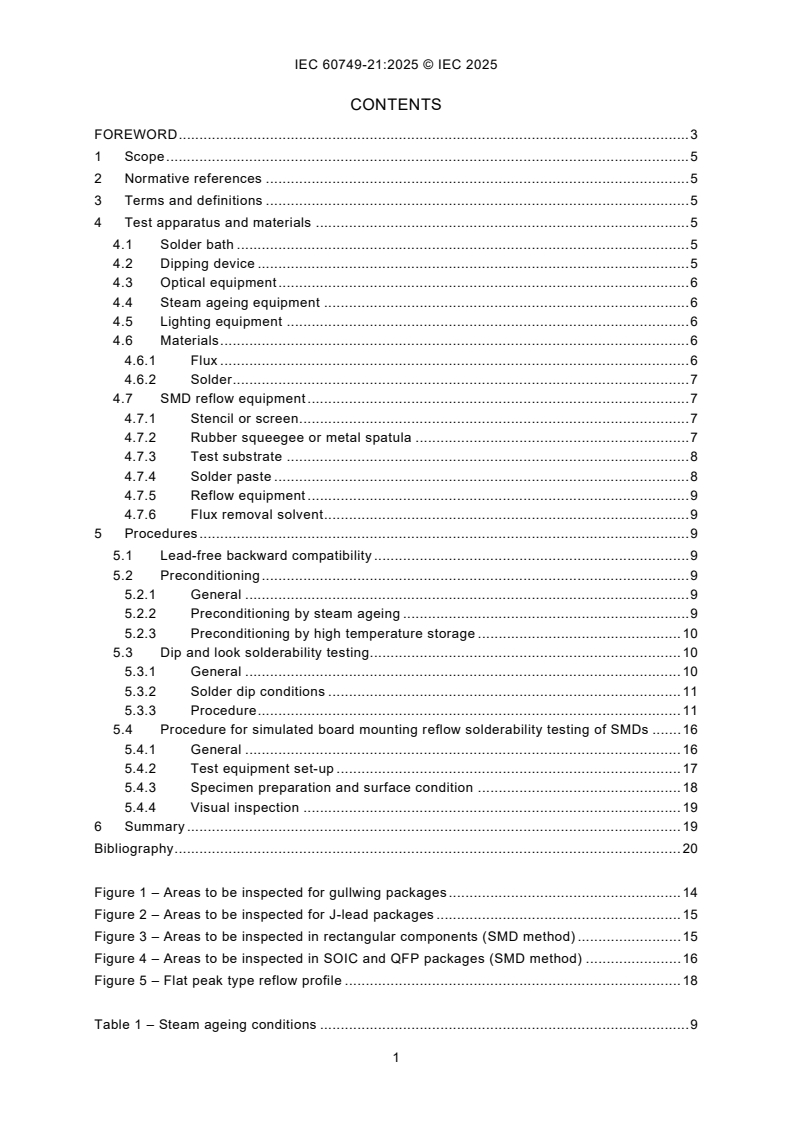
CONTENTS
FOREWORD . 3
1 Scope . 5
2 Normative references . 5
3 Terms and definitions . 5
4 Test apparatus and materials . 5
4.1 Solder bath . 5
4.2 Dipping device . 5
4.3 Optical equipment . 6
4.4 Steam ageing equipment . 6
4.5 Lighting equipment . 6
4.6 Materials . 6
4.6.1 Flux . 6
4.6.2 Solder . 7
4.7 SMD reflow equipment . 7
4.7.1 Stencil or screen . 7
4.7.2 Rubber squeegee or metal spatula . 7
4.7.3 Test substrate . 8
4.7.4 Solder paste . 8
4.7.5 Reflow equipment . 9
4.7.6 Flux removal solvent . 9
5 Procedures . 9
5.1 Lead-free backward compatibility . 9
5.2 Preconditioning . 9
5.2.1 General . 9
5.2.2 Preconditioning by steam ageing . 9
5.2.3 Preconditioning by high temperature storage . 10
5.3 Dip and look solderability testing . 10
5.3.1 General . 10
5.3.2 Solder dip conditions . 11
5.3.3 Procedure . 11
5.4 Procedure for simulated board mounting reflow solderability testing of SMDs . 16
5.4.1 General . 16
5.4.2 Test equipment set-up . 17
5.4.3 Specimen preparation and surface condition . 18
5.4.4 Visual inspection . 19
6 Summary . 19
Bibliography . 20
Figure 1 – Areas to be inspected for gullwing packages . 14
Figure 2 – Areas to be inspected for J-lead packages . 15
Figure 3 – Areas to be inspected in rectangular components (SMD method) . 15
Figure 4 – Areas to be inspected in SOIC and QFP packages (SMD method) . 16
Figure 5 – Flat peak type reflow profile . 18
Table 1 – Steam ageing conditions . 9
Table 2 – Altitude versus steam temperature . 10
Table 3 – Solder dip test conditions . 11
Table 4 – Maximum limits of solder bath contaminant . 13
INTERNATIONAL ELECTROTECHNICAL COMMISSION
____________
Semiconductor devices -
Mechanical and climatic test methods -
Part 21: Solderability
FOREWORD
1) The International Electrotechnical Commission (IEC) is a worldwide organization for standardization comprising
all national electrotechnical committees (IEC National Committees). The object of IEC is to promote international
co-operation on all questions concerning standardization in the electrical and electronic fields. To this end and
in addition to other activities, IEC publishes International Standards, Technical Specifications, Technical Reports,
Publicly Available Specifications (PAS) and Guides (hereafter referred to as “IEC Publication(s)”). Their
preparation is entrusted to technical committees; any IEC National Committee interested in the subject dealt with
may participate in this preparatory work. International, governmental and non-governmental organizations liaising
with the IEC also participate in this preparation. IEC collaborates closely with the International Organization for
Standardization (ISO) in accordance with conditions determined by agreement between the two organizations.
2) The formal decisions or agreements of IEC on technical matters express, as nearly as possible, an international
consensus of opinion on the relevant subjects since each technical committee has representation from all
interested IEC National Committees.
3) IEC Publications have the form of recommendations for international use and are accepted by IEC National
Committees in that sense. While all reasonable efforts are made to ensure that the technical content of IEC
Publications is accurate, IEC cannot be held responsible for the way in which they are used or for any
misinterpretation by any end user.
4) In order to promote international uniformity, IEC National Committees undertake to apply IEC Publications
transparently to the maximum extent possible in their national and regional publications. Any divergence between
any IEC Publication and the corresponding national or regional publication shall be clearly indicated in the latter.
5) IEC itself does not provide any attestation of conformity. Independent certification bodies provide conformity
assessment services and, in some areas, access to IEC marks of conformity. IEC is not responsible for any
services carried out by independent certification bodies.
6) All users should ensure that they have the latest edition of this publication.
7) No liability shall attach to IEC or its directors, employees, servants or agents including individual experts and
members of its technical committees and IEC National Committees for any personal injury, property damage or
other damage of any nature whatsoever, whether direct or indirect, or for costs (including legal fees) and
expenses arising out of the publication, use of, or reliance upon, this IEC Publication or any other IEC
Publications.
8) Attention is drawn to the Normative references cited in this publication. Use of the referenced publications is
indispensable for the correct application of this publication.
9) IEC draws attention to the possibility that the implementation of this document may involve the use of (a)
patent(s). IEC takes no position concerning the evidence, validity or applicability of any claimed patent rights in
respect thereof. As of the date of publication of this document, IEC had not received notice of (a) patent(s), which
may be required to implement this document. However, implementers are cautioned that this may not represent
the latest information, which may be obtained from the patent database available at https://patents.iec.ch. IEC
shall not be held responsible for identifying any or all such patent rights.
IEC 60749-21 has been prepared by IEC technical committee 47: Semiconductor devices. It is
an International Standard.
This third edition cancels and replaces the second edition published in 2011. This edition
constitutes a technical revision.
This edition includes the following significant technical changes with respect to the previous
edition:
a) revision to certain operating conditions in line with current working practices.
The text of this International Standard is based on the following documents:
Draft Report on voting
47/2961/FDIS 47/2982/RVD
Full information on the voting for its approval can be found in the report on voting indicated in
the above table.
The language used for the development of this International Standard is English.
This document was drafted in accordance with ISO/IEC Directives, Part 2, and developed in
accordance with ISO/IEC Directives, Part 1 and ISO/IEC Directives, IEC Supplement, available
at www.iec.ch/members_experts/refdocs. The main document types developed by IEC are
described in greater detail at www.iec.ch/publications.
A list of all parts in the IEC 60749 series, published under the general title Semiconductor
devices - Mechanical and climatic test methods can be found on the IEC website.
The committee has decided that the contents of this document will remain unchanged until the
stability date indicated on the IEC website under webstore.iec.ch in the data related to the
specific document. At this date, the document will be
– reconfirmed,
– withdrawn, or
– revised.
1 Scope
This part of IEC 60749 establishes a standard procedure for determining the solderability of
device package terminations that are intended to be joined to another surface using tin-lead
(SnPb) or lead-free (Pb-free) solder for the attachment.
This test method provides a procedure for “dip and look” solderability testing of through hole,
axial and surface mount devices (SMDs) as well as an optional procedure for a board mounting
solderability test for SMDs for the purpose of allowing simulation of the soldering process to be
used in the device application. The test method also provides optional conditions for ageing.
This test is considered destructive unless otherwise detailed in the relevant specification.
NOTE 1 This test method does not assess the effect of thermal stresses which can occur during the soldering
process. More details can be found in IEC 60749-15 or IEC 60749-20.
NOTE 2 If a qualitative test method is preferred, the Wetting balance test method can be found in IEC 60068-2-69.
2 Normative references
The following documents are referred to in the text in such a way that some or all of their content
constitutes requirements of this document. For dated references, only the edition cited applies.
For undated references, the latest edition of the referenced document (including any
amendments) applies.
IEC 61190-1-2:2014, Attachment materials for electronic assembly - Part 1-2: Requirements for
soldering pastes for high-quality interconnects in electronics assembly
IEC 61190-1-3:2017, Attachment materials for electronic assembly - Part 1-3: Requirements for
electronic grade solder alloys and fluxed and non-fluxed solid solders for electronic soldering
applications
3 Terms and definitions
No terms and definitions are listed in this document.
ISO and IEC maintain terminology databases for use in standardization at the following
addresses:
– ISO Online browsing platform: available at https://www.iso.org/obp
– IEC Electropedia: available at https://www.electropedia.org
4 Test apparatus and materials
4.1 Solder bath
The solder bath shall be not less than 40 mm in depth and not less than 300 ml in volume such
that it can contain at least 1 kg of solder. The apparatus shall be capable of maintaining the
solder at the specified temperature within ±5 °C. The solder in solder baths used for
solderability testing shall be analysed or replaced to ensure that the composition complies with
4.6.2.
4.2 Dipping device
A mechanical dipping device capable of controlling the rates of immersion and emersion of the
terminations and providing a dwell time (time of total immersion to the required depth) in the
solder bath as specified shall be used.
4.3 Optical equipment
An optical microscope capable of providing magnification inspection from 10× to 20× shall be
used.
4.4 Steam ageing equipment
A non-corrodible container and cover of sufficient size to allow the placement of specimens
inside the vessel shall be used. The specimens shall be placed such that the lowest portion of
the specimen is a minimum of 40 mm above the surface of the water. A suitable method of
supporting the specimens shall be improvised using non-contaminating material.
During steam ageing, the test devices should be located in a manner so as to prevent water
(steam condensate) from dripping on them.
4.5 Lighting equipment
A lighting system shall be used that will provide a uniform, non-glare, non-directional
illumination of the specimen.
4.6 Materials
4.6.1 Flux
Unless otherwise detailed in the relevant specification, the flux for SnPb solderability tests shall
be a standard activated rosin flux (type ROL1 in accordance with Table 2 of
IEC 61190-1-3:2017), having a composition of 25 % ± 0,5 % by weight of colophony and
0,15 % ± 0,01 % by weight of diethylammonium hydrochloride, in 74,85 % ± 0,5 % by weight of
in 2-propanol (isopropanol). The specific gravity of the standard activated rosin flux shall be
0,843 ± 0,005 at (25 °C ± 2) °C.
The specification shall be as follows:
– Colophony
• colour: to WW colour specification or paler;
• acid value (mg KOH/g colophony): 155 (minimum);
• softening point (ball and ring): 70 °C (minimum);
• flow point (Ubbelohde): 76 °C (minimum);
• ash: 0,05 % (maximum);
• solubility: A solution of the colophony in an equal part by weight of 2-propanol
(isopropanol) shall be clear, and after a week at room temperature there shall be no sign
of a deposit.
– 2-propanol (isopropanol)
• purity: minimum 99,5 % 2-propanol (isopropanol) by weight;
• acidity as acetic acid: maximum 0,002 % weight (other than carbon dioxide);
• non-volatile matter: maximum 2 mg per 100 ml.
Unless otherwise detailed in the relevant specification, the flux for Pb-free solderability tests
shall be standard activated rosin flux having a composition of 25 % ± 0,5 % by weight of
colophony and (0,39 % ± 0,01) % by weight of diethylammonium hydrochloride, in
(74,61 % ± 0,5) % by weight of isopropyl.
4.6.2 Solder
4.6.2.1 Tin-lead
Unless otherwise detailed in the relevant specification, the solder specification for SnPb shall
be as follows:
– chemical composition
The composition in percentage by weight shall be as follows:
– tin: 59 % to 61 %
– antimony: 0,5 % maximum
– copper: 0,1 % maximum
– arsenic: 0,05 % maximum
– iron: 0,02 % maximum
– lead: the remainder
The solder shall not contain such impurities as aluminium, zinc or cadmium in amounts which
will adversely affect the properties of the solder.
– melting temperature range
The melting temperature range of the 60 % solder is as follows:
– completely solid: 183 °C
– completely liquid: 188 °C
4.6.2.2 Lead-free
Unless otherwise detailed in the relevant specification, the solder specification for Pb-free shall
be as follows:
The composition in percentage by weight shall be as follows:
– tin: 95 % to 96,5 %
– silver: 3 % to 4 %
– copper: 0,5 % to 1 %
4.7 SMD reflow equipment
4.7.1 Stencil or screen
A stencil or screen with pad geometry opening that is appropriate for the terminals being tested.
Unless otherwise agreed upon between vendor and user, nominal stencil thickness should be
0,1 mm for terminals with less than 0,5 mm component lead pitch, 0,15 mm for a component
with lead pitch of 0,5 mm to 0,65 mm and 0,2 mm for a component with lead pitch greater than
0,65 mm.
4.7.2 Rubber squeegee or metal spatula
Solder paste shall be applied on to the stencil or screen using a spatula for fine pitch or a
squeegee for standard pitch.
4.7.3 Test substrate
SMD specimens for simulated board mounting reflow solderabilit
...
IEC 60749-21 ®
Edition 3.0 2025-12
INTERNATIONAL
STANDARD
REDLINE VERSION
Semiconductor devices - Mechanical and climatic test methods -
Part 21: Solderability
ICS 31.080.01 ISBN 978-2-8327-0940-5
All rights reserved. Unless otherwise specified, no part of this publication may be reproduced or utilized in any form or
by any means, electronic or mechanical, including photocopying and microfilm, without permission in writing from either
IEC or IEC's member National Committee in the country of the requester. If you have any questions about IEC copyright
or have an enquiry about obtaining additional rights to this publication, please contact the address below or your local
IEC member National Committee for further information.
IEC Secretariat Tel.: +41 22 919 02 11
3, rue de Varembé info@iec.ch
CH-1211 Geneva 20 www.iec.ch
Switzerland
About the IEC
The International Electrotechnical Commission (IEC) is the leading global organization that prepares and publishes
International Standards for all electrical, electronic and related technologies.
About IEC publications
The technical content of IEC publications is kept under constant review by the IEC. Please make sure that you have the
latest edition, a corrigendum or an amendment might have been published.
IEC publications search - IEC Products & Services Portal - products.iec.ch
webstore.iec.ch/advsearchform Discover our powerful search engine and read freely all the
The advanced search enables to find IEC publications by a publications previews, graphical symbols and the glossary.
variety of criteria (reference number, text, technical With a subscription you will always have access to up to date
committee, …). It also gives information on projects, content tailored to your needs.
replaced and withdrawn publications.
Electropedia - www.electropedia.org
The world's leading online dictionary on electrotechnology,
IEC Just Published - webstore.iec.ch/justpublished
Stay up to date on all new IEC publications. Just Published containing more than 22 500 terminological entries in English
details all new publications released. Available online and and French, with equivalent terms in 25 additional languages.
once a month by email. Also known as the International Electrotechnical Vocabulary
(IEV) online.
IEC Customer Service Centre - webstore.iec.ch/csc
If you wish to give us your feedback on this publication or
need further assistance, please contact the Customer
Service Centre: sales@iec.ch.
CONTENTS
FOREWORD . 3
1 Scope . 5
2 Normative references . 5
3 Terms and definitions . 5
4 Test apparatus and materials . 5
4.1 Solder bath . 5
4.2 Dipping device . 6
4.3 Optical equipment . 6
4.4 Steam ageing equipment . 6
4.5 Lighting equipment . 6
4.6 Materials . 6
4.6.1 Flux . 6
4.6.2 Solder . 7
4.7 SMD reflow equipment . 7
4.7.1 Stencil or screen . 7
4.7.2 Rubber squeegee or metal spatula . 7
4.7.3 Test substrate . 8
4.7.4 Solder paste . 8
4.7.5 Reflow equipment . 9
4.7.6 Flux removal solvent . 9
5 Procedures . 9
5.1 Lead-free backward compatibility . 9
5.2 Preconditioning . 9
5.2.1 General . 9
5.2.2 Preconditioning by steam ageing . 9
5.2.3 Preconditioning by high temperature storage . 10
5.3 Dip and look solderability testing . 10
5.3.1 General . 10
5.3.2 Solder dip conditions . 11
5.3.3 Procedure . 11
5.4 Procedure for simulated board mounting reflow solderability testing of SMDs . 16
5.4.1 General . 16
5.4.2 Test equipment set-up . 17
5.4.3 Specimen preparation and surface condition . 18
5.4.4 Visual inspection . 19
6 Summary . 19
Bibliography . 20
Figure 1 – Areas to be inspected for gullwing packages . 14
Figure 2 – Areas to be inspected for J-lead packages . 15
Figure 3 – Areas to be inspected in rectangular components (SMD method) . 15
Figure 4 – Areas to be inspected in SOIC and QFP packages (SMD method) . 16
Figure 5 – Flat peak type reflow profile . 18
Table 1 – Steam ageing conditions . 9
Table 2 – Altitude versus steam temperature . 10
Table 3 – Solder dip test conditions . 11
Table 4 – Maximum limits of solder bath contaminant . 13
INTERNATIONAL ELECTROTECHNICAL COMMISSION
____________
Semiconductor devices -
Mechanical and climatic test methods -
Part 21: Solderability
FOREWORD
1) The International Electrotechnical Commission (IEC) is a worldwide organization for standardization comprising
all national electrotechnical committees (IEC National Committees). The object of IEC is to promote international
co-operation on all questions concerning standardization in the electrical and electronic fields. To this end and
in addition to other activities, IEC publishes International Standards, Technical Specifications, Technical Reports,
Publicly Available Specifications (PAS) and Guides (hereafter referred to as “IEC Publication(s)”). Their
preparation is entrusted to technical committees; any IEC National Committee interested in the subject dealt with
may participate in this preparatory work. International, governmental and non-governmental organizations liaising
with the IEC also participate in this preparation. IEC collaborates closely with the International Organization for
Standardization (ISO) in accordance with conditions determined by agreement between the two organizations.
2) The formal decisions or agreements of IEC on technical matters express, as nearly as possible, an international
consensus of opinion on the relevant subjects since each technical committee has representation from all
interested IEC National Committees.
3) IEC Publications have the form of recommendations for international use and are accepted by IEC National
Committees in that sense. While all reasonable efforts are made to ensure that the technical content of IEC
Publications is accurate, IEC cannot be held responsible for the way in which they are used or for any
misinterpretation by any end user.
4) In order to promote international uniformity, IEC National Committees undertake to apply IEC Publications
transparently to the maximum extent possible in their national and regional publications. Any divergence between
any IEC Publication and the corresponding national or regional publication shall be clearly indicated in the latter.
5) IEC itself does not provide any attestation of conformity. Independent certification bodies provide conformity
assessment services and, in some areas, access to IEC marks of conformity. IEC is not responsible for any
services carried out by independent certification bodies.
6) All users should ensure that they have the latest edition of this publication.
7) No liability shall attach to IEC or its directors, employees, servants or agents including individual experts and
members of its technical committees and IEC National Committees for any personal injury, property damage or
other damage of any nature whatsoever, whether direct or indirect, or for costs (including legal fees) and
expenses arising out of the publication, use of, or reliance upon, this IEC Publication or any other IEC
Publications.
8) Attention is drawn to the Normative references cited in this publication. Use of the referenced publications is
indispensable for the correct application of this publication.
9) IEC draws attention to the possibility that the implementation of this document may involve the use of (a)
patent(s). IEC takes no position concerning the evidence, validity or applicability of any claimed patent rights in
respect thereof. As of the date of publication of this document, IEC had not received notice of (a) patent(s), which
may be required to implement this document. However, implementers are cautioned that this may not represent
the latest information, which may be obtained from the patent database available at https://patents.iec.ch. IEC
shall not be held responsible for identifying any or all such patent rights.
This redline version of the official IEC Standard allows the user to identify the changes made
to the previous edition IEC 60749-21:2011. A vertical bar appears in the margin wherever a
change has been made. Additions are in green text, deletions are in strikethrough red text.
IEC 60749-21 has been prepared by IEC technical committee 47: Semiconductor devices. It is
an International Standard.
This third edition cancels and replaces the second edition published in 2011. This edition
constitutes a technical revision.
This edition includes the following significant technical changes with respect to the previous
edition:
a) revision to certain operating conditions in line with current working practices.
The text of this International Standard is based on the following documents:
Draft Report on voting
47/2961/FDIS 47/2982/RVD
Full information on the voting for its approval can be found in the report on voting indicated in
the above table.
The language used for the development of this International Standard is English.
This document was drafted in accordance with ISO/IEC Directives, Part 2, and developed in
accordance with ISO/IEC Directives, Part 1 and ISO/IEC Directives, IEC Supplement, available
at www.iec.ch/members_experts/refdocs. The main document types developed by IEC are
described in greater detail at www.iec.ch/publications.
A list of all parts in the IEC 60749 series, published under the general title Semiconductor
devices - Mechanical and climatic test methods can be found on the IEC website.
The committee has decided that the contents of this document will remain unchanged until the
stability date indicated on the IEC website under webstore.iec.ch in the data related to the
specific document. At this date, the document will be
– reconfirmed,
– withdrawn, or
– revised.
1 Scope
This part of IEC 60749 establishes a standard procedure for determining the solderability of
device package terminations that are intended to be joined to another surface using tin-lead
(SnPb) or lead-free (Pb-free) solder for the attachment.
This test method provides a procedure for “dip and look” solderability testing of through hole,
axial and surface mount devices (SMDs) as well as an optional procedure for a board mounting
solderability test for SMDs for the purpose of allowing simulation of the soldering process to be
used in the device application. The test method also provides optional conditions for ageing.
This test is considered destructive unless otherwise detailed in the relevant specification.
NOTE 1 This test method is in general accord with IEC 60068, but due to specific requirements of semiconductors,
the following text is applied.
NOTE 21 This test method does not assess the effect of thermal stresses which may can occur during the soldering
process. Reference should be made More details can be found in IEC 60749-15 or IEC 60749-20.
NOTE 2 If a qualitative test method is preferred, the Wetting balance test method can be found in IEC 60068-2-69.
2 Normative references
The following documents are referred to in the text in such a way that some or all of their content
constitutes requirements of this document. For dated references, only the edition cited applies.
For undated references, the latest edition of the referenced document (including any
amendments) applies.
IEC 61190-1-2:20072014, Attachment materials for electronic assembly - Part 1-2:
Requirements for soldering pastes for high-quality interconnects in electronics assembly
IEC 61190-1-3:20072017, Attachment materials for electronic assembly - Part 1-3:
Requirements for electronic grade solder alloys and fluxed and non-fluxed solid solders for
electronic soldering applications
3 Terms and definitions
No terms and definitions are listed in this document.
ISO and IEC maintain terminology databases for use in standardization at the following
addresses:
– ISO Online browsing platform: available at https://www.iso.org/obp
– IEC Electropedia: available at https://www.electropedia.org
4 Test apparatus and materials
This test method requires the following equipment.
4.1 Solder bath
The solder bath shall be not less than 40 mm in depth and not less than 300 ml in volume such
that it can contain at least 1 kg of solder. The apparatus shall be capable of maintaining the
solder at the specified temperature within ±5 °C. The solder in solder baths used for
solderability testing shall be analysed or replaced to ensure that the composition complies with
4.6.2.
4.2 Dipping device
A mechanical dipping device capable of controlling the rates of immersion and emersion of the
terminations and providing a dwell time (time of total immersion to the required depth) in the
solder bath as specified shall be used.
4.3 Optical equipment
An optical microscope capable of providing magnification inspection from 10× to 20× shall be
used.
4.4 Steam ageing equipment
A non-corrodible container and cover of sufficient size to allow the placement of specimens
inside the vessel shall be used. The specimens shall be placed such that the lowest portion of
the specimen is a minimum of 40 mm above the surface of the water. A suitable method of
supporting the specimens shall be improvised using non-contaminating material.
NOTE During steam ageing, the test devices should be located in a manner so as to prevent
water (steam condensate) from dripping on them.
4.5 Lighting equipment
A lighting system shall be used that will provide a uniform, non-glare, non-directional
illumination of the specimen.
4.6 Materials
4.6.1 Flux
Unless otherwise detailed in the relevant specification, the flux for SnPb solderability tests shall
be a standard activated rosin flux (type ROL1 in accordance with Table 2 of
IEC 61190-1-3:2017), having a composition of 25 % ± 0,5 % by weight of colophony and
0,15 % ± 0,01 % by weight of diethylammonium hydrochloride, in 74,85 % ± 0,5 % by weight of
in 2-propanol (isopropanol). The specific gravity of the standard activated rosin flux shall be
0,843 ± 0,005 at (25 °C ± 2) °C.
The specification shall be as follows:
– Colophony
• colour: to WW colour specification or paler;
• acid value (mg KOH/g colophony): 155 (minimum);
• softening point (ball and ring): 70 °C (minimum);
• flow point (Ubbelohde): 76 °C (minimum);
• ash: 0,05 % (maximum);
• solubility: A solution of the colophony in an equal part by weight of 2-propanol
(isopropanol) shall be clear, and after a week at room temperature there shall be no sign
of a deposit.
– 2-propanol (isopropanol)
• purity: minimum 99,5 % 2-propanol (isopropanol) by weight;
• acidity as acetic acid: maximum 0,002 % weight (other than carbon dioxide);
• non-volatile matter: maximum 2 mg per 100 ml.
Unless otherwise detailed in the relevant specification, the flux for Pb-free solderability tests
shall be standard activated rosin flux having a composition of 25 % ± 0,5 % by weight of
colophony and (0,39 % ± 0,01) % by weight of diethylammonium hydrochloride, in
(74,61 % ± 0,5) % by weight of isopropyl.
4.6.2 Solder
4.6.2.1 Tin-lead
Unless otherwise detailed in the relevant specification, the solder specification for SnPb shall
be as follows:
– chemical composition
The composition in percentage by weight shall be as follows:
– tin: 59 % to 61 %
– antimony: 0,5 % maximum
– copper: 0,1 % maximum
– arsenic: 0,05 % maximum
– iron: 0,02 % maximum
– lead: the remainder
The solder shall not contain such impurities as aluminium, zinc or cadmium in amounts which
will adversely affect the properties of the solder.
– melting temperature range
The melting temperature range of the 60 % solder is as follows:
– completely solid: 183 °C
– completely liquid: 188 °C
4.6.2.2 Lead-free
Unless otherwise detailed in the relevant specification, the solder specification for Pb-free shall
be as follows:
The composition in percentage by weight shall be as follows:
– tin: 95 % to 96,5 %
– silver: 3 % to 4 %
– copper: 0,5 % to 1 %
4.7 SMD reflow equipment
4.7.1 Stencil or screen
A stencil or screen with pad geometry opening that is appropriate for the terminals being tested.
Unless otherwise agreed upon between vendor and user, nominal stencil thickness should be
0,1 mm for terminals with less than 0,5 mm component lead pitch, 0,15 mm for a component
with lead pitch of 0,5 mm to 0,65 mm and 0,2 mm for a component with lead pitch greater than
0,65 mm.
4.7.2 Rubber squeegee or metal spatula
Solder paste shall be applied on to the stencil or screen using a spatula for fine pitch or a
squeegee for standard pitch.
4.7.3 Test substrate
SMD specimens for simulated board mounting reflow solderability testing shall be evaluated
using a substrate.
NOTE 1 A ceramic (alumina 90 % – 98 %) may be used for all reflow requirements.
NOTE 2 A glass epoxy substrate may be used for all reflow requirements. The glass epoxy
substrate should be capable of withstanding the soldering temperature (e.g. it is not suitable
for hot plate soldering).
NOTE 3 For visual inspection of the tested device terminations, the test substrate should be
unmetallized (no lands).
4.7.4 Solder paste
4.7.4.1 Requirements
Unless otherwise specified, the composition of the solder paste shall be as follows.
4.7.4.2 Pb-containing paste
The solder composition shall be as specified in 4.6.2.
Unless otherwise specified in the relevant specification, the particle size of the solder powder
shall be 20 μm to 45 μm.
The composition of the flux shall be as specified in 4.6.1.
The viscosity range of the solder paste and method of measurement shall be detailed in the
relevant specification.
4.7.4.3 Pb-free paste
The solder composition shall be as specified in 4.6.2.
The solder powder size shall be 4 as defined in Table 2 of IEC 61190-1-2:20072014, as follows:
– no particle larger than 40µm ;
– less than 1 %, larger than 38 µm;
– at least 90 %, between 38 µm and 20 µm;
– less than 10 %, smaller than 22 µm.
– less than 0,5 %, larger than 50 μm;
– 10 % maximum, between 38 μm and 50 μm;
– 80 % minimum, between 20 μm and 40 μm;
– less than 10 %, smaller than 20 μm.
The shape of solder powder shall be spherical.
The flux to be used shall consist of 30 wt % of polymerization rosin (softening point,
approximately 95 °C), 30 wt % of dibasic acid degeneration rosin (softening point,
approximately 140 °C), 34,7 wt % of diethylene glycol monobutyl ether, 0,9 wt % of 1,3-
diphenylguanidine-HBr, 0,5 wt % of adipic acid (chlorine content less than 0,1 wt %) and 4 wt %
of stiffening castor oil.
The solder paste to be used shall consist of 88 wt % of solder powder and 12 wt % of flux. The
viscosity range shall be (180 ± 5) Pa s.
NOTE Paste storage and shelf life should be in accordance with manufacturer’s specifications.
4.7.5 Reflow equipment
Convection reflow ovens (preferred) or infrared reflow ovens capable of reaching the reflow
temperature profile of the paste may be used.
4.7.6 Flux removal solvent
Material used for cleaning flux from leads and terminations shall be capable of removing visible
flux residues and meet local environmental regulations.
5 Procedures
5.1 Lead-free backward compatibility
Typically, Pb containing terminations are evaluated using SnPb solderability test conditions and
Pb-free terminations use Pb-free test conditions. If Pb-free terminations are to be used in an
SnPb solder process (backward compatibility) then they should be evaluated using test
parameters consistent with standard SnPb SMT reflow conditions. The backward compatibility
test does not apply to Pb-free BGA type packages.
5.2 Preconditioning
5.2.1 General
Preconditioning, also known as accelerated ageing, is an optional step which may can be
required before solderability testing.
5.2.2 Preconditioning by steam ageing
5.2.2.1 Steam age preconditioning options
Steam age preconditioning options are given in Table 1.
Table 1 – Steam ageing conditions
Condition Exposure time
h ± 0,5
A 1
B 4
C 8
D 16
NOTE 1 Ageing may be interrupted once for 10 min maximum.
WARNING: Mounting should be such that water does not collect on the surface to be
tested.
NOTE 2 PRECAUTION: Mounting should be such that water does not collect on the surface to be tested.
NOTE 3 Unless otherwise stated in the relevant specification, steam age precondition B should
be used.
NOTE 4 Preconditioning in a moist environment in order to test the effects of moisture and soldering heat of surface
mount semiconductor packages is not part of this standard solderability test method. See IEC 60749-20.
NOTE 5 Steam age precondition A should be used for NiPd and NiPdAu plated finishes.
5.2.2.2 Steam ageing procedure
Prior to solder application, specimens may be subjected to ageing by exposure of the surfaces
to be tested to steam in the container specified in 4.4. The specimens shall be suspended so
that no portion of the specimen is less than 40 mm above the boiling, distilled or deionized
water for the specified exposure time. The water vapour temperature at the component lead
level shall be in accordance with Table 2.
The devices shall be removed from the test apparatus upon completion of the specified test
period.
Table 2 – Altitude versus steam temperature
Altitude Steam temperature
+3
m
°C
−5
0 – 600 93
601 – 1 250 91
1 251 – 1 850 89
Greater than 1 850 87
5.2.2.3 Cleaning of the system
The apparatus shall be drained and cleaned at least once per month, or prior to use. A more
frequent cleaning cycle may can be necessary as indicated by resistivity, visual or general
cleanliness of the water. No contaminating solvents shall be used.
5.2.2.4 Drying and storage procedures
Upon removing the test specimens from the apparatus, the parts may be dried using one of the
following procedures:
a) bake at 100 °C maximum for no more than 1 h in a dry atmosphere (dry nitrogen atmosphere
is recommended);
b) air dry at ambient temperature for a minimum of 15 min.
NOTE Parts not solderability tested within 2 h after removal from the ageing apparatus should
be stored in a desiccant jar or dry nitrogen cabinet for a maximum of 72 h before testing. The
parts should not be used for testing if they have exceeded the storage requirements.
5.2.3 Preconditioning by high temperature storage
As an alternative to steam ageing, specimens may be aged by high temperature storage at
150 °C ± 5 °C for between 4 h and 16 h.
5.3 Procedure for Dip and look solderability testing
5.3.1 General
The test procedure shall be performed on the number of terminations specified in the relevant
specification. During handling, care shall be exercised to prevent the surface to be tested from
being abraded or contaminated by grease, perspirants, etc.
All solderability testing shall be carried out under a fume hood in accordance with applicable
safety rules and procedures.
5.3.2 Solder dip conditions
Solderability test condition options are given in Table 3.
Table 3 – Solder dip test conditions
Condition Solder type Solder Dwell time
temperature
°C ± 5 s ± 0,5
A (SnPb, for SMDs only) Sn Pb 215245 5
B (SnPb, for SMD and through-hole) Sn Pb 235245 5
C (Pb-free, for SMD and through-hole) Pb free 245 5
D (Pb-free, backward compatibility) Sn Pb 215 5
5.3.3 Procedure
5.3.3.1 General
The test procedure shall consist of the following operations:
– preparation of the terminations, if applicable;
– ageing, if applicable;
– application of flux and immersion of the terminations into molten solder;
– examination and evaluation of the tested portions of the terminations.
5.3.3.2 Preparation of terminations
No wiping, cleaning, scraping or abrasive cleaning of the terminations shall be performed. Any
special preparation of the terminations, such as bending or reorientation prior to test, shall be
specified in the relevant specification. If the insulation on stranded wires needs to be removed,
it shall be done in a manner so as not to loosen the strands in the wire.
5.3.3.3 Ageing
Where required by the relevant specification, specimens shall be aged in accordance with 5.2.
5.3.3.4 Application of flux
5.3.3.4.1 General
The flux used shall conform with 4.6.1, unless otherwise specified. Terminations shall be
immersed (using a mechanical dipper) in the flux, which is at room ambient temperature, to the
minimum depth necessary to cover the surface to be tested. The fixturing should be designed
to avoid trapping of excess flux. The surface to be tested shall be immersed in the flux for a
period of 5 s to 10 s, and shall be drained 5 s to 20 s prior to dipping into the solder pot. The
flux shall be covered when not in use and discarded a minimum of once a day.
5.3.3.4.2 Surface mounted devices
For surface mount packages, that portion of the package lead that will be inspected shall be
covered by the flux application. Perform the test using the leads on only one side of the package
at a time. The fluxing and solder dipping operations shall be performed sequentially on the
leads of the package side under test.
NOTE 1 For fine pitch packages, alternate terminals may be removed for solder dipping to avoid
solder bridging between neighbouring terminals.
NOTE 2 For large heat capacity devices and gold-plated terminations, a preliminary heating is
permissible before solder dipping. This variant should be specified in the relevant specification.
5.3.3.4.3 All other devices
Unless otherwise specified in the relevant specification, terminations shall be immersed to the
seating plane or to within 1,5 mm of the body of the device under test.
5.3.3.4.4 Component termination attitude relative to flux and solder surfaces
Leaded through hole mounting (THM) 90°
Leaded surface mount (SM) 20° to 45° or 90°
Leadless surface mount (SM) 20° to 45°
5.3.3.5 Solder dip
5.3.3.5.1 General
The dross and burned flux shall be skimmed from the surface of the molten solder specified in
4.6.2. The molten solder shall be maintained at the specified temperature. The surface of the
molten solder shall be skimmed again just prior to immersing the terminations into the solder.
The part shall be attached to a dipping device (see 4.2) and the flux-covered terminations
immersed once in the molten solder to the same depth as specified in 5.3.3.4.1. The immersion
–1
and emersion rate shall be (25 ± 5) mm s and the dwell time in the solder bath shall be
10,0 s ± 0,5 s or 5,0 s ± 0,5 s (see Table 3), unless otherwise specified. After the dipping
process, the part shall be allowed to cool in the air. Residual flux shall be removed from the
terminations either by sequential rinses in isopropyl alcohol, or by a rinse in a suitable
commercial non-CFC solvent. If necessary, a soft damp cloth or cotton swab moistened with
clean isopropyl alcohol or solvent may be used to remove all remaining flux.
5.3.3.5.2 Solder dipping of gold plated terminations
Where required by the relevant specification, gold plated terminations may be cycled twice in
flux and solder. The first immersion is to scavenge the gold on the terminations.
5.3.3.5.3 Solder bath contaminants control
The solder in solder baths used for solderability testing shall be chemically or spectrographically
analysed or replaced each 30 operating days. The levels of contamination and Sn content must
shall be within those listed in Table 4.
5.3.3.6 Inspection and failure criteria
5.3.3.6.1 GeneralFlux removal
All flux is to be removed prior to visual inspection of the terminal surface.
5.3.3.6.2 Inspection magnification
Inspect all devices at 10× to 20× magnification.
5.3.3.6.3 Solder coverage
The areas to be inspected of each lead must shall have 95 % solder coverage minimum.
Table 4 – Maximum limits of solder bath contaminant
Contaminant weight percentage limit
Contaminant
SnPb Pb-free
Copper 0,300 0,750 To specification 1,100
Gold 0,200 0,500 0,200
Cadmium 0,005 0,010 0,005
Zinc 0,005 0,008 0,005
Aluminum 0,006 0,008 0,006
Antimony 0,500 0,500 0,200
Iron 0,020 0,020
Arsenic 0,030 0,030
Bismuth 0,250 0,250
Silver 0,100 0,750 To specification 4,000
Nickel 0,010 0,025 0,010 0,050
Lead To specification 0,100
NOTE 1 For SnPb, the tin content of the solder should be maintained within ±1,5 % of the nominal alloy being
used. Tin content should be tested at the same frequency as testing for copper/gold contamination. The balance
of the bath should shall be lead and/or the items listed above.
For Pb-free alloys, the tin content of the solder shall be maintained within ± 1 % of the nominal alloy being used.
The tin content shall be tested at the same frequency as testing for copper/silver concentration. The balance of the
bath shall be the items listed above.
Contamination limits for other Pb-free solder alloys (such as Sn96.5Ag3.0Cu0.5) may be used in accordance with
the relevant specification.
These limits are based on the alloys specified in 4.6.2. For other alloys the limits should be revised accordingly.
NOTE 2 For SnPb, the total of copper, gold, cadmium, zinc and aluminium contaminants should not exceed 0,4 %.
NOTE 1 The silver contamination limit is not applicable for Sn62Pb36Ag2: limits to be 1,75 % to 2,25 %.
NOTE 32 An operating day consists of any 8 h period, or any portion thereof, during which the solder is liquefied
and used.
NOTE 4 These limits are based on the alloys specified in 3.6.2. For other alloys the limits should be revised
accordingly.
5.3.3.6.4 Pinholes, voids, porosity, nonwetting, or dewetting
Pinholes, voids, porosity, nonwetting, or dewetting shall not exceed 5 % of the total area(s) to
be inspected. There shall be no solder bridging between any termination area and any other
metallization not connected to it by design. In the event that the solder dipping causes bridging,
the test shall not be considered a failure, provided that a local application of heat (e.g. gas,
soldering iron or redipping) results in solder pullback and no wetting of the dielectric area as
indicated by microscopic examination.
NOTE The total area of the surface to be tested (including all faces for rectangular leads) as
specified in 5.3.3.4.1 should be examined. In the case of a dispute, the percentage of coverage
with pinholes or voids should be determined by the actual measurement of those areas,
compared to the total area(s).
5.3.3.6.5 Definition of the areas to be inspected
a) Gullwing packages
For gullwing packages, the areas to be inspected are defined as all surfaces of the
termination at or below the plane of the top of the foot, excluding the top of the foot (see
Figure 1). Areas normally designed to be unplated (trim areas) are excluded.
b) J-lead packages
For J-lead packages, the areas to be inspected are the narrow portion of the termination
below the transition from the termination shoulder (see Figure 2). Only the three visible
surfaces shall be included. The termination tip is excluded.
c) Dual in line packages
For dual in line packages, the areas to be inspected are from the termination tip to a plane
0,5 mm above the seating plane.
d) Other packages
For packages other than described in a), b) or c), the areas to be inspected are those which
are 1,5 mm from the body and extend away from the body to the end of the lead or for a
distance of 25 mm.
View 1
View 2
NOTE Areas to be inspected = Surface A (underside of lead) up to 1 × T and edges B.
Figure 1 – Areas to be inspected for gullwing packages
View 1
View 2
NOTE Surfaces to be inspected = Surface A (equal to 2 × lead thickness) and edges B within 2 × T zone.
Figure 2 – Areas to be inspected for J-lead packages
NOTE Surfaces to be inspected = Surface A + B < ¼ T or 0,5 mm, whichever is less.
Figure 3 – Areas to be inspected in rectangular components (SMD method)
View 1
View 2
NOTE 1 Areas to be inspected = surface “A” (underside of lead) up to 1 × T.
NOTE 2 Surfaces “B” and “C” are excluded from the areas to be inspected.
Figure 4 – Areas to be inspected in SOIC and QFP packages (SMD method)
5.4 Procedure for simulated board mounting reflow solderability testing of SMDs
5.4.1 General
This is an optional procedure that may be used for surface mounted devices as an alternative
to the dip and look procedure of 5.3. Fine pitch gullwing leads (spacings < 0,5 mm) cannot be
tested adequately with the dip and look method. Also, dip and look are inappropriate for ball
grid arrays (BGAs).
Where required by the relevant specification, specimens may be aged, prior to solderability
testing, in accordance with 5.2.
NOTE For fine pitch packages, such as gullwing leads, alternate terminals may can be removed for solder dipping
to avoid solder bridging between neighbouring terminals.
5.4.2 Test equipment set-up
The reflow temperature profile parameters to be specified (see Figure 5, Flat peak type) are as
follows:
T minimum preheating temperature;
T maximum preheating temperature;
soldering temperature;
T
T peak temperature;
t preheating duration;
t soldering duration;
t peak temperature duration.
The reflow temperature profile parameters for wetting are as follows:
For SnPb reflow:
T = (120150 ± 5) °C;
T = (150170 ± 5) °C;
t = (60-12050-70) s;
T = 225215 °C;
t = (20 ± 5 50-70) s;
T = (230 ± 5) °C;
t = (10 ± 5) s.
For Pb-free reflow:
T = (150 ± 5) °C;
T = (180 ± 5) °C;
t = (60-120) s;
T = 235230 °C;
t = (20 ± 530-60) s;
T = (240250 ± 5) °C;
t = (10 ± 5) s.
NOTE These limits are based on the compositions specified in 4.6.2. For other compositions,
the limits should be modified accordingly.
Figure 5 – Flat peak type reflow profile
5.4.3 Specimen preparation and surface condition
All component leads or terminations shall be tested under the condition that they would normally
be in at the time of assembly soldering.
The specimens to be tested shall not be touched by fingers or otherwise contaminated, nor
shall the leads or terminations being tested be wiped, cleaned, scraped or abraded.
a) Place solder paste onto the screen and print the terminal pattern onto the ceramic by wiping
the paste over the screen using either a spatula for fine pitch or a squeegee for standard
pitch.
b) Remove the screen carefully so as to avoid smearing the paste print. Verify a paste print
equivalent in geometry to the terminal of the device to be tested.
c) Using tweezers, place the terminals of the unit on the solder paste print. Avoid touching the
unit so that the terminals will not be contaminated with skin oils. Verify part placement by
appropriate magnification.
NOTE A visual alignment tool is recommended for fine pitch parts and BGAs to aid in
placement accuracy.
d) Place the substrate on the applicable reflow equipment and subject the substrate and
components to the reflow process.
e) After reflow, carefully remove substrate with components and allow to cool.
f) After the specimen has cooled to room temperature, remove the component from the
substrate using tweezers. Terminals may adhere slightly to ceramic material due to flux
residue.
g) Remove any flux residue by using an appropriate cleaning solution.
5.4.4 Visual inspection
5.4.4.1 Visual magnification criteria
Each termination shall be examined using a magnification of 10× to 20×.
5.4.4.2 Accept/reject criteria
All terminations shall exhibit a continuous solder coating free from defects for a minimum of
95 % of the area to be inspected of any individual termination. Anomalies other than dewetting,
nonwetting, and pinholes are not cause for rejection. Exposed terminal metal is allowable on
the cut unplated end toe of surface mount components.
Examples of areas to be inspected for the various devices are contained in Figure 1, Figure 2,
Figure 3 and Figure 4.
6 Summary
The following details shall be specified in the relevant specification:
a) the procedure to be used, if other than “dip and look”;
b) the number of terminations of each part to be tested (see 5.3), and the quality level;
c) special preparation of terminations, if applicable (see 5.3.3.2);
d) ageing if required (see 5.2);
e) depth of immersion if other than specified in 5.3.3.4.1;
f) immersion and emersion rate and/or dwell time if other than specified in 5.3.3.5.1;
g) electrical measurements (parameters, conditions, subgroups, etc.) where required after test;
h) temperature of bath if different from that specified in 5.3.2;
i) flux type if different from that specified in 4.6.1.
Bibliography
IEC 60068 (all parts), Environmental testing
IEC 60068-2-69:2007, Environmental testing - Test Te: Solderability testing of electronic
components for surface mounting devices (SMD) by the wetting balance method Part 2-69: Test
Te/Tc: Solderability testing of electronic components and printed boards by the wetting balance
(force measurement) method
IEC 60749 (all parts), Semiconductor devices – Mechanical and climatic test methods
IEC 60749-15:2003, Semiconductor devices - Mechanical and climatic test methods - Part 15:
Resistance to soldering temperature for through-hole mounted devices
IEC 60749-20:2008, Semiconductor devices - Mechanical and climatic test methods - Part 20:
Resistance of plastic-encapsulated SMDs to the combined effect of moisture and soldering heat
___________
IEC 60749-21 ®
Edition 3.0 2025-12
INTERNATIONAL
STANDARD
NORME
INTERNATIONALE
Semiconductor devices - Mechanical and climatic test methods -
Part 21: Solderability
Dispositifs à semiconducteurs - Méthodes d'essais mécaniques et climatiques -
Partie 21: Brasabilité
ICS 31.080.01 ISBN 978-2-8327-0902-3
All rights reserved. Unless otherwise specified, no part of this publication may be reproduced or utilized in any form or
by any means, electronic or mechanical, including photocopying and microfilm, without permission in writing from either
IEC or IEC's member National Committee in the country of the requester. If you have any questions about IEC copyright
or have an enquiry about obtaining additional rights to this publication, please contact the address below or your local
IEC member National Committee for further information.
Droits de reproduction réservés. Sauf indication contraire, aucune partie de cette publication ne peut être reproduite ni
utilisée sous quelque forme que ce soit et par aucun procédé, électronique ou mécanique, y compris la photocopie et
les microfilms, san
...
IEC 60749-21 ®
Edition 3.0 2025-12
NORME
INTERNATIONALE
Dispositifs à semiconducteurs - Méthodes d'essais mécaniques et climatiques -
Partie 21: Brasabilité
ICS 31.080.01 ISBN 978-2-8327-0902-3
Droits de reproduction réservés. Sauf indication contraire, aucune partie de cette publication ne peut être reproduite ni
utilisée sous quelque forme que ce soit et par aucun procédé, électronique ou mécanique, y compris la photocopie et
les microfilms, sans l'accord écrit de l'IEC ou du Comité national de l'IEC du pays du demandeur. Si vous avez des
questions sur le copyright de l'IEC ou si vous désirez obtenir des droits supplémentaires sur cette publication, utilisez
les coordonnées ci-après ou contactez le Comité national de l'IEC de votre pays de résidence.
IEC Secretariat Tel.: +41 22 919 02 11
3, rue de Varembé info@iec.ch
CH-1211 Geneva 20 www.iec.ch
Switzerland
A propos de l'IEC
La Commission Electrotechnique Internationale (IEC) est la première organisation mondiale qui élabore et publie des
Normes internationales pour tout ce qui a trait à l'électricité, à l'électronique et aux technologies apparentées.
A propos des publications IEC
Le contenu technique des publications IEC est constamment revu. Veuillez vous assurer que vous possédez l’édition la
plus récente, un corrigendum ou amendement peut avoir été publié.
Recherche de publications IEC - IEC Products & Services Portal - products.iec.ch
webstore.iec.ch/advsearchform Découvrez notre puissant moteur de recherche et consultez
La recherche avancée permet de trouver des publications gratuitement tous les aperçus des publications, symboles
IEC en utilisant différents critères (numéro de référence, graphiques et le glossaire. Avec un abonnement, vous aurez
texte, comité d’études, …). Elle donne aussi des toujours accès à un contenu à jour adapté à vos besoins.
informations sur les projets et les publications remplacées
ou retirées. Electropedia - www.electropedia.org
Le premier dictionnaire d'électrotechnologie en ligne au
IEC Just Published - webstore.iec.ch/justpublished monde, avec plus de 22 500 articles terminologiques en
Restez informé sur les nouvelles publications IEC. Just anglais et en français, ainsi que les termes équivalents
dans 25 langues additionnelles. Egalement appelé
Published détaille les nouvelles publications parues.
Disponible en ligne et une fois par mois par email. Vocabulaire Electrotechnique International (IEV) en ligne.
Service Clients - webstore.iec.ch/csc
Si vous désirez nous donner des commentaires sur cette
publication ou si vous avez des questions contactez-
nous: sales@iec.ch.
SOMMAIRE
AVANT-PROPOS . 3
1 Domaine d’application . 5
2 Références normatives . 5
3 Termes et définitions . 5
4 Appareillage d’essai et matériaux . 5
4.1 Bain de brasage . 5
4.2 Dispositif d’immersion . 6
4.3 Équipement optique . 6
4.4 Équipement de vieillissement à la vapeur . 6
4.5 Équipement d’éclairage . 6
4.6 Matériaux . 6
4.6.1 Flux . 6
4.6.2 Brasure . 7
4.7 Équipement de refusion pour CMS . 7
4.7.1 Stencil ou écran . 7
4.7.2 Raclette en caoutchouc ou spatule métallique . 7
4.7.3 Substrat d’essai . 8
4.7.4 Pâte à braser . 8
4.7.5 Équipement de refusion . 9
4.7.6 Solvant de décapage . 9
5 Procédures . 9
5.1 Compatibilité ascendante sans plomb . 9
5.2 Préconditionnement . 9
5.2.1 Généralités . 9
5.2.2 Préconditionnement par vieillissement à la vapeur . 9
5.2.3 Préconditionnement par stockage à haute température. 10
5.3 Essai de brasabilité par immersion et examen visuel . 11
5.3.1 Généralités . 11
5.3.2 Conditions d’immersion dans la brasure . 11
5.3.3 Procédure . 11
5.4 Procédure pour les essais simulés de brasabilité par refusion pour le
montage sur carte à CMS . 17
5.4.1 Généralités . 17
5.4.2 Montage de l’équipement d’essai . 18
5.4.3 Préparation de l’éprouvette et état de surface. 19
5.4.4 Examen visuel . 20
6 Récapitulatif . 20
Bibliographie . 21
Figure 1 – Zones à examiner pour les boîtiers en aile de mouette . 15
Figure 2 – Zones à examiner pour les boîtiers à sortie en J . 16
Figure 3 – Zones à examiner pour les composants rectangulaires (Méthode CMS) . 16
Figure 4 – Zones à examiner pour les boîtiers SOEIC et QFP (Méthode CMS) . 17
Figure 5 – Courbe de refusion pour les types à valeur maximale de température plate . 19
Tableau 1 – Conditions de vieillissement à la vapeur . 9
Tableau 2 – Altitude et température de vapeur . 10
Tableau 3 – Conditions d’essai d’immersion dans la brasure . 11
Tableau 4 – Limites maximales des contaminants des bains de brasage . 13
COMMISSION ÉLECTROTECHNIQUE INTERNATIONALE
____________
Dispositifs à semiconducteurs -
Méthodes d’essais mécaniques et climatiques -
Partie 21: Brasabilité
AVANT-PROPOS
1) La Commission Électrotechnique Internationale (IEC) est une organisation mondiale de normalisation composée
de l’ensemble des comités électrotechniques nationaux (Comités nationaux de l’IEC). L’IEC a pour objet de
favoriser la coopération internationale pour toutes les questions de normalisation dans les domaines de
l’électricité et de l’électronique. À cet effet, l’IEC – entre autres activités – publie des Normes internationales,
des Spécifications techniques, des Rapports techniques, des Spécifications accessibles au public (PAS) et des
Guides (ci-après dénommés "Publication(s) de l’IEC"). Leur élaboration est confiée à des comités d’études, aux
travaux desquels tout Comité national intéressé par le sujet traité peut participer. Les organisations
internationales, gouvernementales et non gouvernementales, en liaison avec l’IEC, participent également aux
travaux. L’IEC collabore étroitement avec l’Organisation Internationale de Normalisation (ISO), selon des
conditions fixées par accord entre les deux organisations.
2) Les décisions ou accords officiels de l’IEC concernant les questions techniques représentent, dans la mesure du
possible, un accord international sur les sujets étudiés, étant donné que les Comités nationaux de l’IEC intéressés
sont représentés dans chaque comité d’études.
3) Les Publications de l’IEC se présentent sous la forme de recommandations internationales et sont agréées
comme telles par les Comités nationaux de l’IEC. Tous les efforts raisonnables sont entrepris afin que l’IEC
s’assure de l’exactitude du contenu technique de ses publications; l’IEC ne peut pas être tenue responsable de
l’éventuelle mauvaise utilisation ou interprétation qui en est faite par un quelconque utilisateur final.
4) Dans le but d’encourager l’uniformité internationale, les Comités nationaux de l’IEC s’engagent, dans toute la
mesure possible, à appliquer de façon transparente les Publications de l’IEC dans leurs publications nationales
et régionales. Toutes divergences entre toutes Publications de l’IEC et toutes publications nationales ou
régionales correspondantes doivent être indiquées en termes clairs dans ces dernières.
5) L’IEC elle-même ne fournit aucune attestation de conformité. Des organismes de certification indépendants
fournissent des services d’évaluation de conformité et, dans certains secteurs, accèdent aux marques de
conformité de l’IEC. L’IEC n’est responsable d’aucun des services effectués par les organismes de certification
indépendants.
6) Tous les utilisateurs doivent s’assurer qu’ils sont en possession de la dernière édition de cette publication.
7) Aucune responsabilité ne doit être imputée à l’IEC, à ses administrateurs, employés, auxiliaires ou mandataires,
y compris ses experts particuliers et les membres de ses comités d’études et des Comités nationaux de l’IEC,
pour tout préjudice causé en cas de dommages corporels et matériels, ou de tout autre dommage de quelque
nature que ce soit, directe ou indirecte, ou pour supporter les coûts (y compris les frais de justice) et les dépenses
découlant de la publication ou de l’utilisation de cette Publication de l’IEC ou de toute autre Publication de l’IEC,
ou au crédit qui lui est accordé.
8) L’attention est attirée sur les références normatives citées dans cette publication. L’utilisation de publications
référencées est obligatoire pour une application correcte de la présente publication.
9) L'IEC attire l'attention sur le fait que la mise en application du présent document peut entraîner l'utilisation d'un
ou de plusieurs brevets. L'IEC ne prend pas position quant à la preuve, à la validité et à l'applicabilité de tout
droit de brevet revendiqué à cet égard. À la date de publication du présent document, l'IEC n'a pas reçu
notification qu'un ou plusieurs brevets pouvaient être nécessaires à sa mise en application. Toutefois, il y a lieu
d'avertir les responsables de la mise en application du présent document que des informations plus récentes
sont susceptibles de figurer dans la base de données de brevets, disponible à l'adresse https://patents.iec.ch.
L'IEC ne saurait être tenue pour responsable de ne pas avoir identifié de tels droits de brevets.
L'IEC 60749-21 a été établie par le comité d’études 47 de l’IEC: Dispositifs à semiconducteurs.
Il s'agit d'une Norme internationale.
La présente norme annule et remplace la deuxième édition publiée en 2011 et constitue une
révision technique.
Cette troisième édition annule et remplace la deuxième édition parue en 2011. Cette édition
constitue une révision technique.
Cette édition inclut les modifications techniques majeures suivantes par rapport à l'édition
précédente:
a) révision de certaines conditions de fonctionnement en rapport avec les pratiques de travail
actuelles.
Le texte de cette Norme internationale est issu des documents suivants:
Projet Rapport de vote
47/2961/FDIS 47/2982/RVD
Le rapport de vote indiqué dans le tableau ci-dessus donne toute information sur le vote ayant
abouti à son approbation.
La langue employée pour l'élaboration de cette Norme internationale est l'anglais.
Ce document a été rédigé selon les Directives ISO/IEC, Partie 2, il a été développé selon les
Directives ISO/IEC, Partie 1 et les Directives ISO/IEC, Supplément IEC, disponibles sous
www.iec.ch/members_experts/refdocs. Les principaux types de documents développés par
l'IEC sont décrits plus en détail sous www.iec.ch/publications.
Une liste de toutes les parties de la série IEC 60749, publiées sous le titre général, Dispositifs
à semiconducteurs - Méthodes d’essais mécaniques et climatiques peut être consultée sur le
site Web de l’IEC.
Le comité a décidé que le contenu de ce document ne sera pas modifié avant la date de stabilité
indiquée sur le site web de l’IEC sous webstore.iec.ch dans les données relatives au document
recherché. À cette date, le document sera
– reconduit,
– supprimé, ou
– révisé.
1 Domaine d’application
La présente partie de l’IEC 60749 établit une procédure normalisée pour déterminer la
brasabilité des connexions de sortie des boîtiers de dispositifs qui sont destinées à être fixées
sur une autre surface en utilisant de la brasure étain-plomb (SnPb) ou sans plomb pour réaliser
cette fixation.
Cette méthode d’essai décrit une procédure pour les essais de brasabilité par "immersion et
examen visuel" des composants pour montage en surface (CMS), par trous traversants et axial,
ainsi qu’une procédure facultative d’essai de brasabilité pour des CMS pour montage en surface
sur carte, afin de permettre la simulation du processus de brasage devant être utilisé dans
l’application du dispositif. La méthode d’essai fournit également des conditions optionnelles
pour le vieillissement.
Cet essai est considéré comme destructif, sauf indication contraire dans la spécification
applicable.
NOTE 1 Cette méthode d’essai n'évalue pas l’effet des contraintes thermiques qui peuvent se produire pendant la
procédure de brasage. De plus amples détails sont fournis dans l’IEC 60749-15 ou l’IEC 60749-20.
NOTE 2 Si la préférence est donnée à une méthode d'essai qualitative, la méthode d'essai de la balance de
mouillage peut être consultée dans l'IEC 60068-2-69.
2 Références normatives
Les documents suivants sont cités dans le texte de sorte qu'ils constituent, pour tout ou partie
de leur contenu, des exigences du présent document. Pour les références datées, seule
l'édition citée s'applique. Pour les références non datées, la dernière édition du document de
référence s'applique (y compris les éventuels amendements).
IEC 61190-1-2:2014, Matériaux de fixation pour les assemblages électroniques - Partie 1-2:
Exigences relatives aux pâtes à braser pour les interconnexions de haute qualité dans les
assemblages de composants électroniques
IEC 61190-1-3:2017, Matériaux de fixation pour les assemblages électroniques - Partie 1-3:
Exigences relatives aux alliages à braser de catégorie électronique et brasure solide fluxée et
non-fluxée pour les applications de brasage électronique
3 Termes et définitions
Aucun terme n'est défini dans le présent document.
L'ISO et l'IEC tiennent à jour des bases de données terminologiques destinées à être utilisées
en normalisation consultables aux adresses suivantes:
– IEC Electropedia: disponible à l'adresse http://www.electropedia.org/
– ISO Online browsing platform: disponible à l'adresse http://www.iso.org/obp
4 Appareillage d’essai et matériaux
4.1 Bain de brasage
Le bain de brasage doit avoir une profondeur d’au moins 40 mm et un volume d’au moins 300 ml
pour contenir au moins 1 kg de brasure. L’appareillage doit être capable de maintenir la brasure
à la température spécifiée à ±5 °C. La brasure des bains de brasage utilisée pour les essais de
brasabilité doit être analysée ou remplacée pour s’assurer que la composition est conforme
à 4.6.2.
4.2 Dispositif d’immersion
Un dispositif mécanique d’immersion capable de contrôler les rythmes d’immersion et émersion
des connexions de sortie et d’offrir un temps de maintien (durée d’immersion totale à la
profondeur exigée) dans le bain de brasage comme spécifié doit être utilisé.
4.3 Équipement optique
Un microscope optique capable d’offrir un contrôle avec un grossissement de 10× à 20× doit
être utilisé.
4.4 Équipement de vieillissement à la vapeur
Un conteneur résistant à la corrosion et un couvercle de taille suffisante doivent être utilisés
pour placer des éprouvettes à l’intérieur du récipient. Les éprouvettes doivent être placées de
telle manière que leur partie la plus basse soit au minimum à 40 mm au-dessus de la surface
de l’eau. Une méthode adaptée de maintien des éprouvettes doit être trouvée en utilisant une
matière évitant tout risque de contamination.
Pendant le vieillissement à la vapeur, il convient de placer les dispositifs d’essai de manière à
éviter que l’eau (sous forme de vapeur condensée) s’égoutte sur eux.
4.5 Équipement d’éclairage
L’équipement d’éclairage à utiliser doit assurer un éclairement uniforme, non éblouissant, non
directionnel de l’éprouvette.
4.6 Matériaux
4.6.1 Flux
Sauf indication contraire dans la spécification applicable, le flux pour les essais de brasabilité
SnPb doit être composé d’un flux colophane activé normal (de type ROL1 conforme au
Tableau 2 de l’IEC 61190-1-3:2017) ayant une composition en masse de 25 % ± 0,5 % de
colophane et de 0,15 % ± 0,01 % de chlorhydrate de diéthyle d’ammonium, dans une
composition en masse de 74,85 % ± 0,5 % de solvant de 2-propanol (isopropanol). La gravité
spécifique du flux colophane activé normal doit être de 0,843 ± 0,005 à (25 °C ± 2) °C.
La spécification doit être la suivante:
– Colophane
• couleur: selon spécification de couleur WW ou plus pale;
• indice d’acidité (colophane mg KOH/g): 155 (au minimum);
• point de ramollissement (boule et anneau): 70 °C (minimum);
• point d’écoulement (selon Ubbelohde) 76 °C (au minimum);
• cendres: 0,05 % (au maximum);
• solubilité: Une solution de colophane dans une proportion égale en masse de 2-propanol
(isopropanol) doit être claire et ne doit présenter aucun signe de dépôt après une
semaine à température ambiante.
– 2-propanol (isopropanol)
• pureté: au minimum 99,5 % 2-propanol (isopropanol) en masse;
• acidité comme acide acétique: au maximum 0,002 % de la masse (autre que le dioxyde
de carbone);
• matière non volatile: au maximum 2 mg par 100 ml.
Sauf indication contraire dans la spécification applicable, le flux pour les essais de brasabilité
sans plomb doit être un flux colophane activé normal ayant une composition en masse de
25 % ± 0,5 % de colophane et de (0,39 ± 0,01) % de chlorhydrate de diéthylammonium, dans
une composition en masse de (74,61 ± 0,5) % d’isopropyle.
4.6.2 Brasure
4.6.2.1 Étain-plomb
Sauf indication contraire dans la spécification applicable, la spécification de brasure pour SnPb
doit être la suivante:
– composition chimique.
La composition en pourcentage en masse doit être la suivante:
– étain: 59 % à 61 % ;
– antimoine: 0,5 % au maximum;
– cuivre: 0,1 % au maximum;
– arsenic: 0,05 % au maximum;
– fer: 0,02 % au maximum;
– plomb: le reste.
La brasure ne doit pas contenir d’impuretés constituées d’aluminium, de zinc ou de cadmium
dans des quantités qui nuisent à ses propriétés.
– plage de températures de fusion
La plage de températures de fusion de la brasure à 60 % est la suivante:
– complètement solide: 183 °C;
– complètement liquide: 188 °C.
4.6.2.2 Sans plomb
Sauf indication contraire dans la spécification applicable, la spécification de brasure pour la
brasure sans plomb doit être la suivante:
La composition en pourcentage en masse doit être la suivante:
– étain: 95 % à 96,5 %;
– argent: 3 % à 4 %;
– cuivre: 0,5 % à 1 %.
4.7 Équipement de refusion pour CMS
4.7.1 Stencil ou écran
Un stencil ou un écran avec ouvertures géométriques de report qui sont appropriés aux bornes
en essai. Sauf accord contraire entre le vendeur et l’utilisateur, il convient que l’épaisseur
nominale du stencil soit de 0,1 mm pour les bornes avec un pas de sortie de composant inférieur
à 0,5 mm, de 0,15 mm pour un composant de pas de sortie entre 0,5 mm et 0,65 mm et de
0,2 mm pour un composant de pas de sortie supérieur à 0,65 mm.
4.7.2 Raclette en caoutchouc ou spatule métallique
La pâte à braser doit être appliquée sur le stencil ou l’écran en utilisant une spatule pour un
pas fin ou une raclette pour un pas normal.
4.7.3 Substrat d’essai
Les éprouvettes CMS pour les essais simulés de brasabilité par refusion pour le montage sur
carte doivent être évaluées en utilisant un substrat.
De la céramique (alumine 90 % - 98 %) peut être utilisée pour toutes les exigences en matière
de refusion.
Du substrat verre-époxy peut être utilisé pour toutes les exigences en matière de refusion. Il
convient que le substrat verre-époxy résiste à la température de brasage (il n’est pas adapté
au brasage sur plaque chauffante, par exemple).
Pour l’examen visuel des connexions de sortie des dispositifs soumis à essai, il convient que
le substrat d’essai ne soit pas métallisé (pas de pastilles).
4.7.4 Pâte à braser
4.7.4.1 Généralités
Sauf indication contraire, la composition de la pâte à braser doit être la suivante.
4.7.4.2 Pâte contenant du plomb
La composition de la brasure doit être conforme à 4.6.2.
Sauf indication contraire dans la spécification applicable, la dimension des particules de poudre
de brasage doit être comprise entre 20 μm et 45 μm.
La composition du flux doit être conforme à 4.6.1.
La plage de viscosité de la pâte à braser et la méthode de mesure doivent êt
...
IEC 60749-21 ®
Edition 3.0 2025-12
INTERNATIONAL
STANDARD
NORME
INTERNATIONALE
Semiconductor devices - Mechanical and climatic test methods -
Part 21: Solderability
Dispositifs à semiconducteurs - Méthodes d'essais mécaniques et climatiques -
Partie 21: Brasabilité
ICS 31.080.01 ISBN 978-2-8327-0902-3
All rights reserved. Unless otherwise specified, no part of this publication may be reproduced or utilized in any form or
by any means, electronic or mechanical, including photocopying and microfilm, without permission in writing from either
IEC or IEC's member National Committee in the country of the requester. If you have any questions about IEC copyright
or have an enquiry about obtaining additional rights to this publication, please contact the address below or your local
IEC member National Committee for further information.
Droits de reproduction réservés. Sauf indication contraire, aucune partie de cette publication ne peut être reproduite ni
utilisée sous quelque forme que ce soit et par aucun procédé, électronique ou mécanique, y compris la photocopie et
les microfilms, sans l'accord écrit de l'IEC ou du Comité national de l'IEC du pays du demandeur. Si vous avez des
questions sur le copyright de l'IEC ou si vous désirez obtenir des droits supplémentaires sur cette publication, utilisez
les coordonnées ci-après ou contactez le Comité national de l'IEC de votre pays de résidence.
IEC Secretariat Tel.: +41 22 919 02 11
3, rue de Varembé info@iec.ch
CH-1211 Geneva 20 www.iec.ch
Switzerland
About the IEC
The International Electrotechnical Commission (IEC) is the leading global organization that prepares and publishes
International Standards for all electrical, electronic and related technologies.
About IEC publications
The technical content of IEC publications is kept under constant review by the IEC. Please make sure that you have the
latest edition, a corrigendum or an amendment might have been published.
IEC publications search - IEC Products & Services Portal - products.iec.ch
webstore.iec.ch/advsearchform Discover our powerful search engine and read freely all the
The advanced search enables to find IEC publications by a publications previews, graphical symbols and the glossary.
variety of criteria (reference number, text, technical With a subscription you will always have access to up to date
committee, …). It also gives information on projects, content tailored to your needs.
replaced and withdrawn publications.
Electropedia - www.electropedia.org
IEC Just Published - webstore.iec.ch/justpublished The world's leading online dictionary on electrotechnology,
Stay up to date on all new IEC publications. Just Published containing more than 22 500 terminological entries in English
details all new publications released. Available online and and French, with equivalent terms in 25 additional languages.
once a month by email. Also known as the International Electrotechnical Vocabulary
(IEV) online.
IEC Customer Service Centre - webstore.iec.ch/csc
If you wish to give us your feedback on this publication or
need further assistance, please contact the Customer
Service Centre: sales@iec.ch.
A propos de l'IEC
La Commission Electrotechnique Internationale (IEC) est la première organisation mondiale qui élabore et publie des
Normes internationales pour tout ce qui a trait à l'électricité, à l'électronique et aux technologies apparentées.
A propos des publications IEC
Le contenu technique des publications IEC est constamment revu. Veuillez vous assurer que vous possédez l’édition la
plus récente, un corrigendum ou amendement peut avoir été publié.
Recherche de publications IEC - IEC Products & Services Portal - products.iec.ch
webstore.iec.ch/advsearchform Découvrez notre puissant moteur de recherche et consultez
La recherche avancée permet de trouver des publications gratuitement tous les aperçus des publications, symboles
IEC en utilisant différents critères (numéro de référence, graphiques et le glossaire. Avec un abonnement, vous aurez
texte, comité d’études, …). Elle donne aussi des toujours accès à un contenu à jour adapté à vos besoins.
informations sur les projets et les publications remplacées
ou retirées. Electropedia - www.electropedia.org
Le premier dictionnaire d'électrotechnologie en ligne au
IEC Just Published - webstore.iec.ch/justpublished monde, avec plus de 22 500 articles terminologiques en
Restez informé sur les nouvelles publications IEC. Just anglais et en français, ainsi que les termes équivalents
Published détaille les nouvelles publications parues. dans 25 langues additionnelles. Egalement appelé
Disponible en ligne et une fois par mois par email. Vocabulaire Electrotechnique International (IEV) en ligne.
Service Clients - webstore.iec.ch/csc
Si vous désirez nous donner des commentaires sur cette
publication ou si vous avez des questions contactez-
nous: sales@iec.ch.
CONTENTS
FOREWORD . 3
1 Scope . 5
2 Normative references . 5
3 Terms and definitions . 5
4 Test apparatus and materials . 5
4.1 Solder bath . 5
4.2 Dipping device . 5
4.3 Optical equipment . 6
4.4 Steam ageing equipment . 6
4.5 Lighting equipment . 6
4.6 Materials . 6
4.6.1 Flux . 6
4.6.2 Solder . 7
4.7 SMD reflow equipment . 7
4.7.1 Stencil or screen . 7
4.7.2 Rubber squeegee or metal spatula . 7
4.7.3 Test substrate . 8
4.7.4 Solder paste . 8
4.7.5 Reflow equipment . 9
4.7.6 Flux removal solvent . 9
5 Procedures . 9
5.1 Lead-free backward compatibility . 9
5.2 Preconditioning . 9
5.2.1 General . 9
5.2.2 Preconditioning by steam ageing . 9
5.2.3 Preconditioning by high temperature storage . 10
5.3 Dip and look solderability testing . 10
5.3.1 General . 10
5.3.2 Solder dip conditions . 11
5.3.3 Procedure . 11
5.4 Procedure for simulated board mounting reflow solderability testing of SMDs . 16
5.4.1 General . 16
5.4.2 Test equipment set-up . 17
5.4.3 Specimen preparation and surface condition . 18
5.4.4 Visual inspection . 19
6 Summary . 19
Bibliography . 20
Figure 1 – Areas to be inspected for gullwing packages . 14
Figure 2 – Areas to be inspected for J-lead packages . 15
Figure 3 – Areas to be inspected in rectangular components (SMD method) . 15
Figure 4 – Areas to be inspected in SOIC and QFP packages (SMD method) . 16
Figure 5 – Flat peak type reflow profile . 18
Table 1 – Steam ageing conditions . 9
Table 2 – Altitude versus steam temperature . 10
Table 3 – Solder dip test conditions . 11
Table 4 – Maximum limits of solder bath contaminant . 13
INTERNATIONAL ELECTROTECHNICAL COMMISSION
____________
Semiconductor devices -
Mechanical and climatic test methods -
Part 21: Solderability
FOREWORD
1) The International Electrotechnical Commission (IEC) is a worldwide organization for standardization comprising
all national electrotechnical committees (IEC National Committees). The object of IEC is to promote international
co-operation on all questions concerning standardization in the electrical and electronic fields. To this end and
in addition to other activities, IEC publishes International Standards, Technical Specifications, Technical Reports,
Publicly Available Specifications (PAS) and Guides (hereafter referred to as “IEC Publication(s)”). Their
preparation is entrusted to technical committees; any IEC National Committee interested in the subject dealt with
may participate in this preparatory work. International, governmental and non-governmental organizations liaising
with the IEC also participate in this preparation. IEC collaborates closely with the International Organization for
Standardization (ISO) in accordance with conditions determined by agreement between the two organizations.
2) The formal decisions or agreements of IEC on technical matters express, as nearly as possible, an international
consensus of opinion on the relevant subjects since each technical committee has representation from all
interested IEC National Committees.
3) IEC Publications have the form of recommendations for international use and are accepted by IEC National
Committees in that sense. While all reasonable efforts are made to ensure that the technical content of IEC
Publications is accurate, IEC cannot be held responsible for the way in which they are used or for any
misinterpretation by any end user.
4) In order to promote international uniformity, IEC National Committees undertake to apply IEC Publications
transparently to the maximum extent possible in their national and regional publications. Any divergence between
any IEC Publication and the corresponding national or regional publication shall be clearly indicated in the latter.
5) IEC itself does not provide any attestation of conformity. Independent certification bodies provide conformity
assessment services and, in some areas, access to IEC marks of conformity. IEC is not responsible for any
services carried out by independent certification bodies.
6) All users should ensure that they have the latest edition of this publication.
7) No liability shall attach to IEC or its directors, employees, servants or agents including individual experts and
members of its technical committees and IEC National Committees for any personal injury, property damage or
other damage of any nature whatsoever, whether direct or indirect, or for costs (including legal fees) and
expenses arising out of the publication, use of, or reliance upon, this IEC Publication or any other IEC
Publications.
8) Attention is drawn to the Normative references cited in this publication. Use of the referenced publications is
indispensable for the correct application of this publication.
9) IEC draws attention to the possibility that the implementation of this document may involve the use of (a)
patent(s). IEC takes no position concerning the evidence, validity or applicability of any claimed patent rights in
respect thereof. As of the date of publication of this document, IEC had not received notice of (a) patent(s), which
may be required to implement this document. However, implementers are cautioned that this may not represent
the latest information, which may be obtained from the patent database available at https://patents.iec.ch. IEC
shall not be held responsible for identifying any or all such patent rights.
IEC 60749-21 has been prepared by IEC technical committee 47: Semiconductor devices. It is
an International Standard.
This third edition cancels and replaces the second edition published in 2011. This edition
constitutes a technical revision.
This edition includes the following significant technical changes with respect to the previous
edition:
a) revision to certain operating conditions in line with current working practices.
The text of this International Standard is based on the following documents:
Draft Report on voting
47/2961/FDIS 47/2982/RVD
Full information on the voting for its approval can be found in the report on voting indicated in
the above table.
The language used for the development of this International Standard is English.
This document was drafted in accordance with ISO/IEC Directives, Part 2, and developed in
accordance with ISO/IEC Directives, Part 1 and ISO/IEC Directives, IEC Supplement, available
at www.iec.ch/members_experts/refdocs. The main document types developed by IEC are
described in greater detail at www.iec.ch/publications.
A list of all parts in the IEC 60749 series, published under the general title Semiconductor
devices - Mechanical and climatic test methods can be found on the IEC website.
The committee has decided that the contents of this document will remain unchanged until the
stability date indicated on the IEC website under webstore.iec.ch in the data related to the
specific document. At this date, the document will be
– reconfirmed,
– withdrawn, or
– revised.
1 Scope
This part of IEC 60749 establishes a standard procedure for determining the solderability of
device package terminations that are intended to be joined to another surface using tin-lead
(SnPb) or lead-free (Pb-free) solder for the attachment.
This test method provides a procedure for “dip and look” solderability testing of through hole,
axial and surface mount devices (SMDs) as well as an optional procedure for a board mounting
solderability test for SMDs for the purpose of allowing simulation of the soldering process to be
used in the device application. The test method also provides optional conditions for ageing.
This test is considered destructive unless otherwise detailed in the relevant specification.
NOTE 1 This test method does not assess the effect of thermal stresses which can occur during the soldering
process. More details can be found in IEC 60749-15 or IEC 60749-20.
NOTE 2 If a qualitative test method is preferred, the Wetting balance test method can be found in IEC 60068-2-69.
2 Normative references
The following documents are referred to in the text in such a way that some or all of their content
constitutes requirements of this document. For dated references, only the edition cited applies.
For undated references, the latest edition of the referenced document (including any
amendments) applies.
IEC 61190-1-2:2014, Attachment materials for electronic assembly - Part 1-2: Requirements for
soldering pastes for high-quality interconnects in electronics assembly
IEC 61190-1-3:2017, Attachment materials for electronic assembly - Part 1-3: Requirements for
electronic grade solder alloys and fluxed and non-fluxed solid solders for electronic soldering
applications
3 Terms and definitions
No terms and definitions are listed in this document.
ISO and IEC maintain terminology databases for use in standardization at the following
addresses:
– ISO Online browsing platform: available at https://www.iso.org/obp
– IEC Electropedia: available at https://www.electropedia.org
4 Test apparatus and materials
4.1 Solder bath
The solder bath shall be not less than 40 mm in depth and not less than 300 ml in volume such
that it can contain at least 1 kg of solder. The apparatus shall be capable of maintaining the
solder at the specified temperature within ±5 °C. The solder in solder baths used for
solderability testing shall be analysed or replaced to ensure that the composition complies with
4.6.2.
4.2 Dipping device
A mechanical dipping device capable of controlling the rates of immersion and emersion of the
terminations and providing a dwell time (time of total immersion to the required depth) in the
solder bath as specified shall be used.
4.3 Optical equipment
An optical microscope capable of providing magnification inspection from 10× to 20× shall be
used.
4.4 Steam ageing equipment
A non-corrodible container and cover of sufficient size to allow the placement of specimens
inside the vessel shall be used. The specimens shall be placed such that the lowest portion of
the specimen is a minimum of 40 mm above the surface of the water. A suitable method of
supporting the specimens shall be improvised using non-contaminating material.
During steam ageing, the test devices should be located in a manner so as to prevent water
(steam condensate) from dripping on them.
4.5 Lighting equipment
A lighting system shall be used that will provide a uniform, non-glare, non-directional
illumination of the specimen.
4.6 Materials
4.6.1 Flux
Unless otherwise detailed in the relevant specification, the flux for SnPb solderability tests shall
be a standard activated rosin flux (type ROL1 in accordance with Table 2 of
IEC 61190-1-3:2017), having a composition of 25 % ± 0,5 % by weight of colophony and
0,15 % ± 0,01 % by weight of diethylammonium hydrochloride, in 74,85 % ± 0,5 % by weight of
in 2-propanol (isopropanol). The specific gravity of the standard activated rosin flux shall be
0,843 ± 0,005 at (25 °C ± 2) °C.
The specification shall be as follows:
– Colophony
• colour: to WW colour specification or paler;
• acid value (mg KOH/g colophony): 155 (minimum);
• softening point (ball and ring): 70 °C (minimum);
• flow point (Ubbelohde): 76 °C (minimum);
• ash: 0,05 % (maximum);
• solubility: A solution of the colophony in an equal part by weight of 2-propanol
(isopropanol) shall be clear, and after a week at room temperature there shall be no sign
of a deposit.
– 2-propanol (isopropanol)
• purity: minimum 99,5 % 2-propanol (isopropanol) by weight;
• acidity as acetic acid: maximum 0,002 % weight (other than carbon dioxide);
• non-volatile matter: maximum 2 mg per 100 ml.
Unless otherwise detailed in the relevant specification, the flux for Pb-free solderability tests
shall be standard activated rosin flux having a composition of 25 % ± 0,5 % by weight of
colophony and (0,39 % ± 0,01) % by weight of diethylammonium hydrochloride, in
(74,61 % ± 0,5) % by weight of isopropyl.
4.6.2 Solder
4.6.2.1 Tin-lead
Unless otherwise detailed in the relevant specification, the solder specification for SnPb shall
be as follows:
– chemical composition
The composition in percentage by weight shall be as follows:
– tin: 59 % to 61 %
– antimony: 0,5 % maximum
– copper: 0,1 % maximum
– arsenic: 0,05 % maximum
– iron: 0,02 % maximum
– lead: the remainder
The solder shall not contain such impurities as aluminium, zinc or cadmium in amounts which
will adversely affect the properties of the solder.
– melting temperature range
The melting temperature range of the 60 % solder is as follows:
– completely solid: 183 °C
– completely liquid: 188 °C
4.6.2.2 Lead-free
Unless otherwise detailed in the relevant specification, the solder specification for Pb-free shall
be as follows:
The composition in percentage by weight shall be as follows:
– tin: 95 % to 96,5 %
– silver: 3 % to 4 %
– copper: 0,5 % to 1 %
4.7 SMD reflow equipment
4.7.1 Stencil or screen
A stencil or screen with pad geometry opening that is appropriate for the terminals being tested.
Unless otherwise agreed upon between vendor and user, nominal stencil thickness should be
0,1 mm for terminals with less than 0,5 mm component lead pitch, 0,15 mm for a component
with lead pitch of 0,5 mm to 0,65 mm and 0,2 mm for a component with lead pitch greater than
0,65 mm.
4.7.2 Rubber squeegee or metal spatula
Solder paste shall be applied on to the stencil or screen using a spatula for fine pitch or a
squeegee for standard pitch.
4.7.3 Test substrate
SMD specimens for simulated board mounting reflow solderability testing shall be evaluated
using a substrate.
A ceramic (alumina 90 % – 98 %) may be used for all reflow requirements.
A glass epoxy substrate may be used for all reflow requirements. The glass epoxy substrate
should be capable of withstanding the soldering temperature (e.g. it is not suitable for hot plate
soldering).
For visual inspection of the tested device terminations, the test substrate should be
unmetallized (no lands).
4.7.4 Solder paste
4.7.4.1 Requirements
Unless otherwise specified, the composition of the solder paste shall be as follows.
4.7.4.2 Pb-containing paste
The solder composition shall be as specified in 4.6.2.
Unless otherwise specified in the relevant specification, the particle size of the solder powder
shall be 20 μm to 45 μm.
The composition of the flux shall be as specified in 4.6.1.
The viscosity range of the solder paste and method of measurement shall be detailed in the
relevant specification.
4.7.4.3 Pb-free paste
The solder composition shall be as specified in 4.6.2.
The solder powder size shall be 4 as defined in Table 2 of IEC 61190-1-2:2014, as follows:
– less than 0,5 %, larger than 50 μm;
– 10 % maximum, between 38 μm and 50 μm;
– 80 % minimum, between 20 μm and 40 μm;
– less than 10 %, smaller than 20 μm.
The shape of solder powder shall be spherical.
The flux to be used shall consist of 30 wt % of polymerization rosin (softening point,
approximately 95 °C), 30 wt % of dibasic acid degeneration rosin (softening point,
approximately 140 °C), 34,7 wt % of diethylene glycol monobutyl ether, 0,9 wt % of 1,3-
diphenylguanidine-HBr, 0,5 wt % of adipic acid (chlorine content less than 0,1 wt %) and 4 wt %
of stiffening castor oil.
The solder paste to be used shall consist of 88 wt % of solder powder and 12 wt % of flux. The
viscosity range shall be (180 ± 5) Pa s.
Paste storage and shelf life should be in accordance with manufacturer’s specifications.
4.7.5 Reflow equipment
Convection reflow ovens (preferred) or infrared reflow ovens capable of reaching the reflow
temperature profile of the paste may be used.
4.7.6 Flux removal solvent
Material used for cleaning flux from leads and terminations shall be capable of removing visible
flux residues and meet local environmental regulations.
5 Procedures
5.1 Lead-free backward compatibility
Typically, Pb containing terminations are evaluated using SnPb solderability test conditions and
Pb-free terminations use Pb-free test conditions. If Pb-free terminations are to be used in an
SnPb solder process (backward compatibility) then they should be evaluated using test
parameters consistent with standard SnPb SMT reflow conditions. The backward compatibility
test does not apply to Pb-free BGA type packages.
5.2 Preconditioning
5.2.1 General
Preconditioning, also known as accelerated ageing, is an optional step which can be required
before solderability testing.
5.2.2 Preconditioning by steam ageing
5.2.2.1 Steam age preconditioning options
Steam age preconditioning options are given in Table 1.
Table 1 – Steam ageing conditions
Condition Exposure time
h ± 0,5
A 1
B 4
C 8
D 16
Ageing may be interrupted once for 10 min maximum.
WARNING: Mounting should be such that water does not collect on the surface to be
tested.
Unless otherwise stated in the relevant specification, steam age precondition B should be used.
NOTE Preconditioning in a moist environment in order to test the effects of moisture and soldering heat of surface
mount semiconductor packages is not part of this standard solderability test method. See IEC 60749-20.
Steam age precondition A should be used for NiPd and NiPdAu plated finishes.
5.2.2.2 Steam ageing procedure
Prior to solder application, specimens may be subjected to ageing by exposure of the surfaces
to be tested to steam in the container specified in 4.4. The specimens shall be suspended so
that no portion of the specimen is less than 40 mm above the boiling, distilled or deionized
water for the specified exposure time. The water vapour temperature at the component lead
level shall be in accordance with Table 2.
The devices shall be removed from the test apparatus upon completion of the specified test
period.
Table 2 – Altitude versus steam temperature
Altitude Steam temperature
m +3
°C
−5
0 – 600 93
601 – 1 250 91
1 251 – 1 850 89
Greater than 1 850 87
5.2.2.3 Cleaning of the system
The apparatus shall be drained and cleaned at least once per month, or prior to use. A more
frequent cleaning cycle can be necessary as indicated by resistivity, visual or general
cleanliness of the water. No contaminating solvents shall be used.
5.2.2.4 Drying and storage procedures
Upon removing the test specimens from the apparatus, the parts may be dried using one of the
following procedures:
a) bake at 100 °C maximum for no more than 1 h in a dry atmosphere (dry nitrogen atmosphere
is recommended);
b) air dry at ambient temperature for a minimum of 15 min.
Parts not solderability tested within 2 h after removal from the ageing apparatus should be
stored in a desiccant jar or dry nitrogen cabinet for a maximum of 72 h before testing. The parts
should not be used for testing if they have exceeded the storage requirements.
5.2.3 Preconditioning by high temperature storage
As an alternative to steam ageing, specimens may be aged by high temperature storage at
150 °C ± 5 °C for between 4 h and 16 h.
5.3 Dip and look solderability testing
5.3.1 General
The test procedure shall be performed on the number of terminations specified in the relevant
specification. During handling, care shall be exercised to prevent the surface to be tested from
being abraded or contaminated by grease, perspirants, etc.
All solderability testing shall be carried out under a fume hood in accordance with applicable
safety rules and procedures.
5.3.2 Solder dip conditions
Solderability test condition options are given in Table 3.
Table 3 – Solder dip test conditions
Condition Solder type Solder Dwell time
temperature
°C ± 5 s ± 0,5
A (SnPb, for SMDs only) Sn Pb 245 5
B (SnPb, for SMD and through-hole) Sn Pb 245 5
C (Pb-free, for SMD and through-hole) Pb free 245 5
D (Pb-free, backward compatibility) Sn Pb 215 5
5.3.3 Procedure
5.3.3.1 General
The test procedure shall consist of the following operations:
– preparation of the terminations, if applicable;
– ageing, if applicable;
– application of flux and immersion of the terminations into molten solder;
– examination and evaluation of the tested portions of the terminations.
5.3.3.2 Preparation of terminations
No wiping, cleaning, scraping or abrasive cleaning of the terminations shall be performed. Any
special preparation of the terminations, such as bending or reorientation prior to test, shall be
specified in the relevant specification. If the insulation on stranded wires needs to be removed,
it shall be done in a manner so as not to loosen the strands in the wire.
5.3.3.3 Ageing
Where required by the relevant specification, specimens shall be aged in accordance with 5.2.
5.3.3.4 Application of flux
5.3.3.4.1 General
The flux used shall conform with 4.6.1, unless otherwise specified. Terminations shall be
immersed (using a mechanical dipper) in the flux, which is at room ambient temperature, to the
minimum depth necessary to cover the surface to be tested. The fixturing should be designed
to avoid trapping of excess flux. The surface to be tested shall be immersed in the flux for a
period of 5 s to 10 s, and shall be drained 5 s to 20 s prior to dipping into the solder pot. The
flux shall be covered when not in use and discarded a minimum of once a day.
5.3.3.4.2 Surface mounted devices
For surface mount packages, that portion of the package lead that will be inspected shall be
covered by the flux application. Perform the test using the leads on only one side of the package
at a time. The fluxing and solder dipping operations shall be performed sequentially on the
leads of the package side under test.
For fine pitch packages, alternate terminals may be removed for solder dipping to avoid solder
bridging between neighbouring terminals.
For large heat capacity devices and gold-plated terminations, a preliminary heating is
permissible before solder dipping. This variant should be specified in the relevant specification.
5.3.3.4.3 All other devices
Unless otherwise specified in the relevant specification, terminations shall be immersed to the
seating plane or to within 1,5 mm of the body of the device under test.
5.3.3.4.4 Component termination attitude relative to flux and solder surfaces
Leaded through hole mounting (THM) 90°
Leaded surface mount (SM) 20° to 45° or 90°
Leadless surface mount (SM) 20° to 45°
5.3.3.5 Solder dip
5.3.3.5.1 General
The dross and burned flux shall be skimmed from the surface of the molten solder specified in
4.6.2. The molten solder shall be maintained at the specified temperature. The surface of the
molten solder shall be skimmed again just prior to immersing the terminations into the solder.
The part shall be attached to a dipping device (see 4.2) and the flux-covered terminations
immersed once in the molten solder to the same depth as specified in 5.3.3.4.1. The immersion
–1
and emersion rate shall be (25 ± 5) mm s and the dwell time in the solder bath shall be
10,0 s ± 0,5 s or 5,0 s ± 0,5 s (see Table 3), unless otherwise specified. After the dipping
process, the part shall be allowed to cool in the air. Residual flux shall be removed from the
terminations either by sequential rinses in isopropyl alcohol, or by a rinse in a suitable
commercial non-CFC solvent. If necessary, a soft damp cloth or cotton swab moistened with
clean isopropyl alcohol or solvent may be used to remove all remaining flux.
5.3.3.5.2 Solder dipping of gold plated terminations
Where required by the relevant specification, gold plated terminations may be cycled twice in
flux and solder. The first immersion is to scavenge the gold on the terminations.
5.3.3.5.3 Solder bath contaminants control
The solder in solder baths used for solderability testing shall be chemically or spectrographically
analysed or replaced each 30 operating days. The levels of contamination and Sn content shall
be within those listed in Table 4.
5.3.3.6 Inspection and failure criteria
5.3.3.6.1 Flux removal
All flux is to be removed prior to visual inspection of the terminal surface.
5.3.3.6.2 Inspection magnification
Inspect all devices at 10× to 20× magnification.
5.3.3.6.3 Solder coverage
The areas to be inspected of each lead shall have 95 % solder coverage minimum.
Table 4 – Maximum limits of solder bath contaminant
Contaminant weight percentage limit
Contaminant
SnPb Pb-free
Copper 0,750 1,100
Gold 0,500 0,200
Cadmium 0,010 0,005
Zinc 0,008 0,005
Aluminum 0,008 0,006
Antimony 0,500 0,200
Iron 0,020 0,020
Arsenic 0,030 0,030
Bismuth 0,250 0,250
Silver 0,750 4,000
Nickel 0,025 0,050
Lead To specification 0,100
For SnPb, the tin content of the solder should be maintained within ±1,5 % of the nominal alloy being used. Tin
content should be tested at the same frequency as testing for copper/gold contamination. The balance of the bath
shall be lead and/or the items listed above.
For Pb-free alloys, the tin content of the solder shall be maintained within ± 1 % of the nominal alloy being used.
The tin content shall be tested at the same frequency as testing for copper/silver concentration. The balance of the
bath shall be the items listed above.
Contamination limits for other Pb-free solder alloys (such as Sn96.5Ag3.0Cu0.5) may be used in accordance with
the relevant specification.
These limits are based on the alloys specified in 4.6.2. For other alloys the limits should be revised accordingly.
NOTE 1 The silver contamination limit is not applicable for Sn62Pb36Ag2: limits to be 1,75 % to 2,25 %.
NOTE 2 An operating day consists of any 8 h period, or any portion thereof, during which the solder is liquefied
and used.
5.3.3.6.4 Pinholes, voids, porosity, nonwetting, or dewetting
Pinholes, voids, porosity, nonwetting, or dewetting shall not exceed 5 % of the total area(s) to
be inspected. There shall be no solder bridging between any termination area and any other
metallization not connected to it by design. In the event that the solder dipping causes bridging,
the test shall not be considered a failure, provided that a local application of heat (e.g. gas,
soldering iron or redipping) results in solder pullback and no wetting of the dielectric area as
indicated by microscopic examination.
The total area of the surface to be tested (including all faces for rectangular leads) as specified
in 5.3.3.4.1 should be examined. In the case of a dispute, the percentage of coverage with
pinholes or voids should be determined by the actual measurement of those areas, compared
to the total area(s).
5.3.3.6.5 Definition of the areas to be inspected
a) Gullwing packages
For gullwing packages, the areas to be inspected are defined as all surfaces of the
termination at or below the plane of the top of the foot, excluding the top of the foot (see
Figure 1). Areas normally designed to be unplated (trim areas) are excluded.
b) J-lead packages
For J-lead packages, the areas to be inspected are the narrow portion of the termination
below the transition from the termination shoulder (see Figure 2). Only the three visible
surfaces shall be included. The termination tip is excluded.
c) Dual in line packages
For dual in line packages, the areas to be inspected are from the termination tip to a plane
0,5 mm above the seating plane.
d) Other packages
For packages other than described in a), b) or c), the areas to be inspected are those which
are 1,5 mm from the body and extend away from the body to the end of the lead or for a
distance of 25 mm.
View 1
View 2
NOTE Areas to be inspected = Surface A (underside of lead) up to 1 × T and edges B.
Figure 1 – Areas to be inspected for gullwing packages
View 1
View 2
NOTE Surfaces to be inspected = Surface A (equal to 2 × lead thickness) and edges B within 2 × T zone.
Figure 2 – Areas to be inspected for J-lead packages
NOTE Surfaces to be inspected = Surface A + B < ¼ T or 0,5 mm, whichever is less.
Figure 3 – Areas to be inspected in rectangular components (SMD method)
View 1
View 2
NOTE 1 Areas to be inspected = surface “A” (underside of lead) up to 1 × T.
NOTE 2 Surfaces “B” and “C” are excluded from the areas to be inspected.
Figure 4 – Areas to be inspected in SOIC and QFP packages (SMD method)
5.4 Procedure for simulated board mounting reflow solderability testing of SMDs
5.4.1 General
This is an optional procedure that may be used for surface mounted devices as an alternative
to the dip and look procedure of 5.3. Fine pitch gullwing leads (spacings < 0,5 mm) cannot be
tested adequately with the dip and look method. Also, dip and look are inappropriate for ball
grid arrays (BGAs).
Where required by the relevant specification, specimens may be aged, prior to solderability
testing, in accordance with 5.2.
NOTE For fine pitch packages, such as gullwing leads, alternate terminals can be removed for solder dipping to
avoid solder bridging between neighbouring terminals.
5.4.2 Test equipment set-up
The reflow temperature profile parameters to be specified (see Figure 5, Flat peak type) are as
follows:
T minimum preheating temperature;
T maximum preheating temperature;
soldering temperature;
T
T peak temperature;
t preheating duration;
t soldering duration;
t peak temperature duration.
The reflow temperature profile parameters for wetting are as follows:
For SnPb reflow:
T = (150 ± 5) °C;
T = (170 ± 5) °C;
t = (50-70) s;
T = 215 °C;
t = (50-70) s;
T = (230 ± 5) °C;
t = (10 ± 5) s.
For Pb-free reflow:
T = (150 ± 5) °C;
T = (180 ± 5) °C;
t = (60-120) s;
T = 230 °C;
t = (30-60) s;
T = (250 ± 5) °C;
t = (10 ± 5) s.
These limits are based on the compositions specified in 4.6.2. For other compositions, the limits
should be modified accordingly.
Figure 5 – Flat peak type reflow profile
5.4.3 Specimen preparation and surface condition
All component leads or terminations shall be tested under the condition that they would normally
be in at the time of assembly soldering.
The specimens to be tested shall not be touched by fingers or otherwise contaminated, nor
shall the leads or terminations being tested be wiped, cleaned, scraped or abraded.
a) Place solder paste onto the screen and print the terminal pattern onto the ceramic by wiping
the paste over the screen using either a spatula for fine pitch or a squeegee for standard
pitch.
b) Remove the screen carefully so as to avoid smearing the paste print. Verify a paste print
equivalent in geometry to the terminal of the device to be tested.
c) Using tweezers, place the terminals of the unit on the solder paste print. Avoid touching the
unit so that the terminals will not be contaminated with skin oils. Verify part placement by
appropriate magnification.
A visual alignment tool is recommended for fine pitch parts and BGAs to aid in placement
accuracy.
d) Place the substrate on the applicable reflow equipment and subject the substrate and
components to the reflow process.
e) After reflow, carefully remove substrate with components and allow to cool.
f) After the specimen has cooled to room temperature, remove the component from the
substrate using tweezers. Terminals may adhere slightly to ceramic material due to flux
residue.
g) Remove any flux residue by using an appropriate cleaning solution.
5.4.4 Visual inspection
5.4.4.1 Visual magnification criteria
Each termination shall be examined using a magnification of 10× to 20×.
5.4.4.2 Accept/reject criteria
All terminations shall exhibit a continuous solder coating free from defects for a minimum of
95 % of the area to be inspected of any individual termination. Anomalies other than dewetting,
nonwetting, and pinholes are not cause for rejection. Exposed terminal metal is allowable on
the cut unplated end toe of surface mount components.
Examples of areas to be inspected for the various devices are contained in Figure 1, Figure 2,
Figure 3 and Figure 4.
6 Summary
The following details shall be specified in the relevant specification:
a) the procedure to be used, if other than “dip and look”;
b) the number of terminations of each part to be tested (see 5.3), and the quality level;
c) special preparation of terminations, if applicable (see 5.3.3.2);
d) ageing if required (see 5.2);
e) depth of immersion if other than specified in 5.3.3.4.1;
f) immersion and emersion rate and/or dwell time if other than specified in 5.3.3.5.1;
g) electrical measurements (parameters, conditions, subgroups, etc.) where required after test;
h) temperature of bath if different from that specified in 5.3.2;
i) flux type if different from that specified in 4.6.1.
Bibliography
IEC 60068-2-69, Environmental testing - Part 2-69: Test Te/Tc: Solderability testing of
electronic components and printed boards by the wetting balance (force measurement) method
IEC 60749-15, Semiconductor devices - Mechanical and climatic test methods - Part 15:
Resistance to soldering temperature for through-hole mounted devices
IEC 60749-20, Semiconductor devices - Mechanical and climatic test methods - Part 20:
Resistance of plastic-encapsulated SMDs to the combined effect of moisture and soldering heat
___________
SOMMAIRE
AVANT-PROPOS . 3
1 Domaine d’application . 5
2 Références normatives .
...