

IEC 62007-1:2008
(Main)Semiconductor optoelectronic devices for fibre optic system applications - Part 1: Specification template for essential ratings and characteristics
General Information
- Abstract
IEC 62007-1:2008 provides a specification template for essential ratings and characteristics of the following categories of semiconductor optoelectronic devices to be used in the field of fibre optic systems and subsystems:
- semiconductor photoemitters;
- semiconductor photoelectric detectors; and
- monolithic or hybrid integrated optoelectronic devices and their modules.
This edition includes the following significant technical changes with respect to the previous edition:
- The title has been changed to indicate that this is a template;
- The definitions of some symbols and terms in IEC 62007-1 Ed.1 are revised in order to harmonize them with those in other SC 86C documents.
- A dated part in IEC 62007-1 ed.1 is removed and the other dated parts are updated.
Note: The field of this standard will henceforth be placed under the responsibility of IEC Technical Committee 86: Fibre optics.
- Status
- Published
- Publication Date
- 07-Oct-2008
- Technical Committee
- SC 86C - Fibre optic systems, sensing and active devices
- Current Stage
- DELPUB - Deleted Publication
- Start Date
- 30-Mar-2015
- Completion Date
- 28-Aug-2026
Buy Documents
IEC 62007-1:2008 - Semiconductor optoelectronic devices for fibre optic system applications - Part 1: Specification template for essential ratings and characteristics Released:10/8/2008
Overview
IEC 62007-1:2008 is an international standard published by the International Electrotechnical Commission (IEC) that provides a comprehensive specification template for the essential ratings and characteristics of semiconductor optoelectronic devices used in fibre optic system applications. This standard covers critical device categories including semiconductor photoemitters, photoelectric detectors, and integrated optoelectronic devices-both monolithic and hybrid-as well as their modules.
The 2008 edition (Edition 2.0) introduces significant updates that enhance harmonization with related IEC SC 86C documents by revising definitions, updating dated parts, and clarifying the template nature of the standard. The responsibility for this standard now lies with the IEC Technical Committee 86: Fibre optics.
Key Topics
IEC 62007-1:2008 focuses on standardizing the essential ratings and device characteristics critical for the reliable design, manufacturing, and application of key optoelectronic components in fibre optic systems:
- Semiconductor LEDs (Light Emitting Diodes): Specification of types, semiconductor materials, outlines, encapsulation details, absolute maximum ratings, electrical and optical characteristics.
- Laser Modules with Pigtails: Device types, semiconductor material properties, structural details, limiting values, and electrical/optical performance parameters.
- PIN Photodiodes: Classification, semiconductor materials, packaging, maximum rating constraints, and electrical/optical behavior.
- Avalanche Photodiodes (APDs): Definitions including materials and structural considerations, encapsulation, and operational characteristics.
- PIN-TIA Modules: Integration of photodiodes and transimpedance amplifiers with specifications on materials, structure, ratings, and electrical/optical data.
- Laser Diode Modules: Specifications for modules used for pumping optical fibre amplifiers and analogue transmission, including materials, structure, operating limits, and hazard information.
- LED Arrays: Identification of types, encapsulation details, limiting values, and performance characteristics.
- Optical Modulators: Device types for digital fibre optic applications, materials, structure, ratings, and operational characteristics, including safety considerations.
The standard includes detailed tables for limiting values and parameters such as maximum ratings, electrical characteristics (e.g., forward voltage, threshold current), and optical metrics (e.g., emission wavelength, modulation bandwidth) tailored for each device type.
Applications
IEC 62007-1:2008 is essential for manufacturers, designers, and engineers involved in the development and deployment of fibre optic communication systems and subsystems. Practical applications include:
- Designing semiconductor optoelectronic components that meet international benchmarks for performance and reliability in fibre optic networks.
- Establishing a unified framework for product specification, enabling consistency across global markets.
- Supporting quality assurance and testing processes by defining critical maximum ratings and characteristic parameters.
- Facilitating interoperability and compatibility in systems utilizing LEDs, laser diodes, photodiodes, and optical modulators.
- Enhancing safety through clear documentation of device hazards and operational limits.
- Guiding research and development efforts towards standard-compliant optoelectronic device innovations for high-speed data transmission and optical signal processing.
Related Standards
IEC 62007-1:2008 complements and harmonizes with other standards developed by IEC Technical Committee 86 and related subcommittees involved in fibre optics and optoelectronics, such as:
- IEC 60825 series for laser safety and classification.
- IEC 61300 series for fibre optic interconnecting devices and passive components.
- IEC 60793 and IEC 60794 for optical fibres and cables specifications.
- Other SC 86C work on photonic components, ensuring consistent terminology and measurement methods.
By aligning terminology and ratings definitions with these standards, IEC 62007-1:2008 helps create a cohesive regulatory and technical infrastructure supporting the global fibre optic industry.
Keywords: IEC 62007-1, semiconductor optoelectronic devices, fibre optic systems, specification template, photoemitters, photodiodes, avalanche photodiodes, PIN-TIA modules, laser diode modules, LED arrays, optical modulators, essential ratings, electrical characteristics, optical characteristics, fibre optic communication, IEC standards, Technical Committee 86, fibre optics industry.
Relations
- Effective Date
- 05-Sep-2023
- Effective Date
- 05-Sep-2023
- Effective Date
- 05-Sep-2023
Buy Documents
IEC 62007-1:2008 - Semiconductor optoelectronic devices for fibre optic system applications - Part 1: Specification template for essential ratings and characteristics Released:10/8/2008
Get Certified
Connect with accredited certification bodies for this standard

ANCE
Mexican certification and testing association.

Intertek Slovenia
Intertek testing, inspection, and certification services in Slovenia.

LNE (Laboratoire National de Métrologie et d'Essais)
French national laboratory for metrology and testing.
Sponsored listings
Frequently Asked Questions
IEC 62007-1:2008 is a standard published by the International Electrotechnical Commission (IEC). Its full title is "Semiconductor optoelectronic devices for fibre optic system applications - Part 1: Specification template for essential ratings and characteristics". This standard covers: IEC 62007-1:2008 provides a specification template for essential ratings and characteristics of the following categories of semiconductor optoelectronic devices to be used in the field of fibre optic systems and subsystems: - semiconductor photoemitters; - semiconductor photoelectric detectors; and - monolithic or hybrid integrated optoelectronic devices and their modules. This edition includes the following significant technical changes with respect to the previous edition: - The title has been changed to indicate that this is a template; - The definitions of some symbols and terms in IEC 62007-1 Ed.1 are revised in order to harmonize them with those in other SC 86C documents. - A dated part in IEC 62007-1 ed.1 is removed and the other dated parts are updated. Note: The field of this standard will henceforth be placed under the responsibility of IEC Technical Committee 86: Fibre optics.
IEC 62007-1:2008 provides a specification template for essential ratings and characteristics of the following categories of semiconductor optoelectronic devices to be used in the field of fibre optic systems and subsystems: - semiconductor photoemitters; - semiconductor photoelectric detectors; and - monolithic or hybrid integrated optoelectronic devices and their modules. This edition includes the following significant technical changes with respect to the previous edition: - The title has been changed to indicate that this is a template; - The definitions of some symbols and terms in IEC 62007-1 Ed.1 are revised in order to harmonize them with those in other SC 86C documents. - A dated part in IEC 62007-1 ed.1 is removed and the other dated parts are updated. Note: The field of this standard will henceforth be placed under the responsibility of IEC Technical Committee 86: Fibre optics.
IEC 62007-1:2008 is classified under the following ICS (International Classification for Standards) categories: 31.080.01 - Semiconductor devices in general; 31.260 - Optoelectronics. Laser equipment; 33.180.01 - Fibre optic systems in general. The ICS classification helps identify the subject area and facilitates finding related standards.
IEC 62007-1:2008 has the following relationships with other standards: It is inter standard links to IEC 62007-1:1997/AMD1:1998, IEC 62007-1:1997, IEC 62007-1:2015. Understanding these relationships helps ensure you are using the most current and applicable version of the standard.
IEC 62007-1:2008 is available in PDF format for immediate download after purchase. The document can be added to your cart and obtained through the secure checkout process. Digital delivery ensures instant access to the complete standard document.
Standards Content (Sample)
IEC 62007-1
Edition 2.0 2008-10
INTERNATIONAL
STANDARD
NORME
INTERNATIONALE
Semiconductor optoelectronic devices for fibre optic system applications –
Part 1: Specification template for essential ratings and characteristics
Dispositifs optoélectroniques à semiconducteurs pour application dans les
systèmes à fibres optiques –
Partie 1: Modèle de spécification relatif aux valeurs et caractéristiques
essentielles
All rights reserved. Unless otherwise specified, no part of this publication may be reproduced or utilized in any form or by
any means, electronic or mechanical, including photocopying and microfilm, without permission in writing from either IEC or
IEC's member National Committee in the country of the requester.
If you have any questions about IEC copyright or have an enquiry about obtaining additional rights to this publication,
please contact the address below or your local IEC member National Committee for further information.
Droits de reproduction réservés. Sauf indication contraire, aucune partie de cette publication ne peut être reproduite
ni utilisée sous quelque forme que ce soit et par aucun procédé, électronique ou mécanique, y compris la photocopie
et les microfilms, sans l'accord écrit de la CEI ou du Comité national de la CEI du pays du demandeur.
Si vous avez des questions sur le copyright de la CEI ou si vous désirez obtenir des droits supplémentaires sur cette
publication, utilisez les coordonnées ci-après ou contactez le Comité national de la CEI de votre pays de résidence.
IEC Central Office
3, rue de Varembé
CH-1211 Geneva 20
Switzerland
Email: inmail@iec.ch
Web: www.iec.ch
About the IEC
The International Electrotechnical Commission (IEC) is the leading global organization that prepares and publishes
International Standards for all electrical, electronic and related technologies.
About IEC publications
The technical content of IEC publications is kept under constant review by the IEC. Please make sure that you have the
latest edition, a corrigenda or an amendment might have been published.
ƒ Catalogue of IEC publications: www.iec.ch/searchpub
The IEC on-line Catalogue enables you to search by a variety of criteria (reference number, text, technical committee,…).
It also gives information on projects, withdrawn and replaced publications.
ƒ IEC Just Published: www.iec.ch/online_news/justpub
Stay up to date on all new IEC publications. Just Published details twice a month all new publications released. Available
on-line and also by email.
ƒ Electropedia: www.electropedia.org
The world's leading online dictionary of electronic and electrical terms containing more than 20 000 terms and definitions
in English and French, with equivalent terms in additional languages. Also known as the International Electrotechnical
Vocabulary online.
ƒ Customer Service Centre: www.iec.ch/webstore/custserv
If you wish to give us your feedback on this publication or need further assistance, please visit the Customer Service
Centre FAQ or contact us:
Email: csc@iec.ch
Tel.: +41 22 919 02 11
Fax: +41 22 919 03 00
A propos de la CEI
La Commission Electrotechnique Internationale (CEI) est la première organisation mondiale qui élabore et publie des
normes internationales pour tout ce qui a trait à l'électricité, à l'électronique et aux technologies apparentées.
A propos des publications CEI
Le contenu technique des publications de la CEI est constamment revu. Veuillez vous assurer que vous possédez
l’édition la plus récente, un corrigendum ou amendement peut avoir été publié.
ƒ Catalogue des publications de la CEI: www.iec.ch/searchpub/cur_fut-f.htm
Le Catalogue en-ligne de la CEI vous permet d’effectuer des recherches en utilisant différents critères (numéro de référence,
texte, comité d’études,…). Il donne aussi des informations sur les projets et les publications retirées ou remplacées.
ƒ Just Published CEI: www.iec.ch/online_news/justpub
Restez informé sur les nouvelles publications de la CEI. Just Published détaille deux fois par mois les nouvelles
publications parues. Disponible en-ligne et aussi par email.
ƒ Electropedia: www.electropedia.org
Le premier dictionnaire en ligne au monde de termes électroniques et électriques. Il contient plus de 20 000 termes et
définitions en anglais et en français, ainsi que les termes équivalents dans les langues additionnelles. Egalement appelé
Vocabulaire Electrotechnique International en ligne.
ƒ Service Clients: www.iec.ch/webstore/custserv/custserv_entry-f.htm
Si vous désirez nous donner des commentaires sur cette publication ou si vous avez des questions, visitez le FAQ du
Service clients ou contactez-nous:
Email: csc@iec.ch
Tél.: +41 22 919 02 11
Fax: +41 22 919 03 00
IEC 62007-1
Edition 2.0 2008-10
INTERNATIONAL
STANDARD
NORME
INTERNATIONALE
emiconductor optoelectronic devices for fibre optic system applications –
Part 1: Specification template for essential ratings and characteristics
Dispositifs optoélectroniques à semiconducteurs pour application dans les
systèmes à fibres optiques –
Partie 1: Modèle de spécification relatif aux valeurs et caractéristiques
essentielles
INTERNATIONAL
ELECTROTECHNICAL
COMMISSION
COMMISSION
ELECTROTECHNIQUE
PRICE CODE
INTERNATIONALE
W
CODE PRIX
ICS 33.180.01; 31.260; 31.080.01 ISBN 978-2-88910-605-9
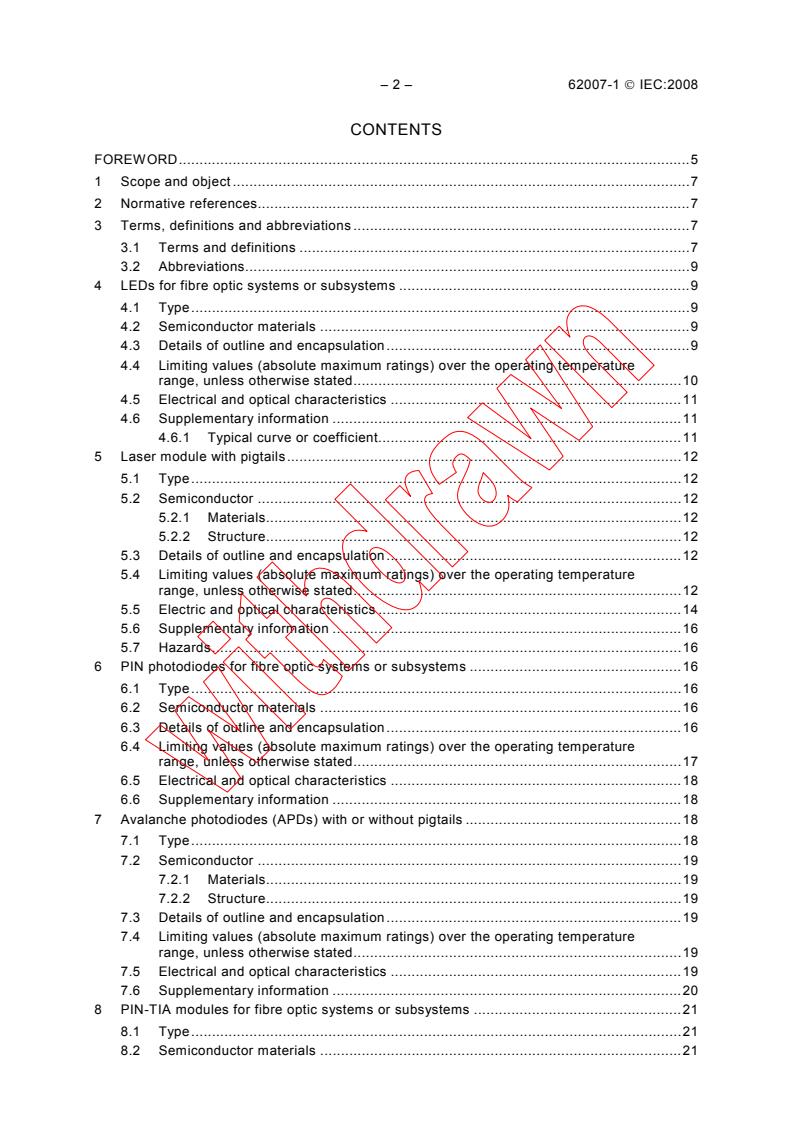
– 2 – 62007-1 © IEC:2008
CONTENTS
FOREWORD.5
1 Scope and object .7
2 Normative references.7
3 Terms, definitions and abbreviations .7
3.1 Terms and definitions .7
3.2 Abbreviations.9
4 LEDs for fibre optic systems or subsystems .9
4.1 Type.9
4.2 Semiconductor materials .9
4.3 Details of outline and encapsulation.9
4.4 Limiting values (absolute maximum ratings) over the operating temperature
range, unless otherwise stated.10
4.5 Electrical and optical characteristics .11
4.6 Supplementary information .11
4.6.1 Typical curve or coefficient.11
5 Laser module with pigtails.12
5.1 Type.12
5.2 Semiconductor .12
5.2.1 Materials.12
5.2.2 Structure.12
5.3 Details of outline and encapsulation.12
5.4 Limiting values (absolute maximum ratings) over the operating temperature
range, unless otherwise stated.12
5.5 Electric and optical characteristics .14
5.6 Supplementary information .16
5.7 Hazards.16
6 PIN photodiodes for fibre optic systems or subsystems .16
6.1 Type.16
6.2 Semiconductor materials .16
6.3 Details of outline and encapsulation.16
6.4 Limiting values (absolute maximum ratings) over the operating temperature
range, unless otherwise stated.17
6.5 Electrical and optical characteristics .18
6.6 Supplementary information .18
7 Avalanche photodiodes (APDs) with or without pigtails .18
7.1 Type.18
7.2 Semiconductor .19
7.2.1 Materials.19
7.2.2 Structure.19
7.3 Details of outline and encapsulation.19
7.4 Limiting values (absolute maximum ratings) over the operating temperature
range, unless otherwise stated.19
7.5 Electrical and optical characteristics .19
7.6 Supplementary information .20
8 PIN-TIA modules for fibre optic systems or subsystems .21
8.1 Type.21
8.2 Semiconductor materials .21
62007-1 © IEC:2008 – 3 –
8.3 Structure .21
8.4 Details of outline and encapsulation.21
8.5 Limiting values (absolute maximum ratings) over the operating temperature
range, unless otherwise stated.22
8.6 Operating conditions at T = 25 °C, unless otherwise stated .22
amb
8.7 Electrical and optical characteristics .23
8.8 Supplementary information .23
9 Laser diode modules for pumping an optical fibre amplifier.23
9.1 Type.23
9.2 Semiconductor materials .24
9.3 Structure .24
9.4 Details of outline and encapsulation.24
9.5 Limiting values (absolute maximum ratings) over the operating temperature
range, unless otherwise stated.25
9.6 Electrical and optical characteristics .26
9.7 Supplementary information .27
9.8 Hazards.27
10 Laser diode modules for fibre optic analogue transmission systems or subsystems .27
10.1 Type.27
10.2 Semiconductor materials .27
10.3 Structure .28
10.4 Details of outline and encapsulation.28
10.5 Limiting values (absolute maximum ratings) over the operating temperature
range, unless otherwise stated.28
10.6 Electrical and optical characteristics .29
10.7 Supplementary information .30
10.8 Hazards.31
11 LED arrays for fibre optic systems or subsystems.31
11.1 Type.31
11.2 Semiconductor materials .31
11.3 Details of outline and encapsulation.31
11.4 Limiting values (absolute maximum ratings) over the operating temperature
range, unless otherwise stated.32
11.5 Electrical and optical characteristics .33
11.6 Supplementary information .34
12 Optical modulators for digital fibre optic applications .34
12.1 Type.34
12.2 Materials .34
12.3 Structure .35
12.4 Details of outline and encapsulation.35
12.5 Limiting values (absolute maximum ratings) over the operating temperature
range, unless otherwise stated.35
12.6 Electrical and optical characteristics .36
12.7 Supplementary information .37
12.8 Hazards.37
Bibliography .38
Table 1 – Limiting values for LEDs .10
Table 2 – Electrical and optical characteristics for LEDs .11
– 4 – 62007-1 © IEC:2008
Table 3 – Electric and optical characteristics for laser modules with pigtails.14
Table 4 – Limiting values for PIN photodiodes .17
Table 5 – Electrical and optical characteristics for PIN photodiodes .18
Table 6 – Electrical and optical characteristics for avalanche photodiodes (APDs) with
or without pigtails .20
Table 7 – Limiting values for PIN-TIA modules .22
Table 8 – Operating conditions for PIN-TIA modules.22
Table 9 – Electrical and optical characteristics for PIN-TIA modules .23
Table 10 – Limiting values for laser diode modules for pumping an optical fibre amplifier .25
Table 11 – Electrical and optical characteristics for laser diode modules for pumping an
optical fibre amplifier.26
Table 12 – Limiting values for laser diode modules for fibre optic analogue transmission
systems or subsystems .28
Table 13 – Electrical and optical characteristics for laser diode modules for fibre optic
analogue transmission systems or subsystems.29
Table 14 – Limiting values for LED arrays.32
Table 15 – Electrical and optical characteristics for LED arrays .33
Table 16 – Limiting values for optical modulators for digital fibre optic applications .35
Table 17 – Electrical and optical characteristics for optical modulators for digital fibre
optic applications .36
62007-1 © IEC:2008 – 5 –
INTERNATIONAL ELECTROTECHNICAL COMMISSION
____________
SEMICONDUCTOR OPTOELECTRONIC DEVICES
FOR FIBRE OPTIC SYSTEM APPLICATIONS –
Part 1: Specification template for essential ratings and characteristics
FOREWORD
1) The International Electrotechnical Commission (IEC) is a worldwide organization for standardization comprising
all national electrotechnical committees (IEC National Committees). The object of IEC is to promote
international co-operation on all questions concerning standardization in the electrical and electronic fields. To
this end and in addition to other activities, IEC publishes International Standards, Technical Specifications,
Technical Reports, Publicly Available Specifications (PAS) and Guides (hereafter referred to as “IEC
Publication(s)”). Their preparation is entrusted to technical committees; any IEC National Committee interested
in the subject dealt with may participate in this preparatory work. International, governmental and non-
governmental organizations liaising with the IEC also participate in this preparation. IEC collaborates closely
with the International Organization for Standardization (ISO) in accordance with conditions determined by
agreement between the two organizations.
2) The formal decisions or agreements of IEC on technical matters express, as nearly as possible, an international
consensus of opinion on the relevant subjects since each technical committee has representation from all
interested IEC National Committees.
3) IEC Publications have the form of recommendations for international use and are accepted by IEC National
Committees in that sense. While all reasonable efforts are made to ensure that the technical content of IEC
Publications is accurate, IEC cannot be held responsible for the way in which they are used or for any
misinterpretation by any end user.
4) In order to promote international uniformity, IEC National Committees undertake to apply IEC Publications
transparently to the maximum extent possible in their national and regional publications. Any divergence
between any IEC Publication and the corresponding national or regional publication shall be clearly indicated in
the latter.
5) IEC provides no marking procedure to indicate its approval and cannot be rendered responsible for any
equipment declared to be in conformity with an IEC Publication.
6) All users should ensure that they have the latest edition of this publication.
7) No liability shall attach to IEC or its directors, employees, servants or agents including individual experts and
members of its technical committees and IEC National Committees for any personal injury, property damage or
other damage of any nature whatsoever, whether direct or indirect, or for costs (including legal fees) and
expenses arising out of the publication, use of, or reliance upon, this IEC Publication or any other IEC
Publications.
8) Attention is drawn to the Normative references cited in this publication. Use of the referenced publications is
indispensable for the correct application of this publication.
9) Attention is drawn to the possibility that some of the elements of this IEC Publication may be the subject of
patent rights. IEC shall not be held responsible for identifying any or all such patent rights.
International Standard IEC 62007-1 has been prepared by subcommittee 86C: Fibre optic
systems and active devices, of IEC technical committee 86: Fibre optics.
This second edition cancels and replaces the first edition published in 1997, and its
Amendment 1 (1998). It is a technical revision.
This edition includes the following significant technical changes with respect to the previous
edition.
1) The title has been changed to indicate that this is a template.
2) The definitions of some symbols and terms in IEC 62007-1 Ed.1 are revised in order to
harmonize them with those in other SC 86C documents. A dated part in IEC 62007-1 ed.1 is
removed and the other dated parts are updated.
NOTE The field of this standard will henceforth be placed under the responsibility of IEC technical committee 86:
Fibre optics.
– 6 – 62007-1 © IEC:2008
The text of this standard is based on the following documents:
FDIS Report on voting
86C/849/FDIS 86C/866/RVD
Full information on the voting for the approval of this standard can be found in the report on
voting indicated in the above table.
This publication has been drafted in accordance with the ISO/IEC Directives, Part 2.
A list of all parts of the IEC 62007 series can be found, under the general title Semiconductor
optoelectronic devices for fibre optic system applications, on the IEC website.
The committee has decided that the contents of this publication will remain unchanged until the
maintenance result date indicated on the IEC web site under "http://webstore.iec.ch" in the data
related to the specific publication. At this date, the publication will be
• reconfirmed;
• withdrawn;
• replaced by a revised edition; or
• amended.
62007-1 © IEC:2008 – 7 –
SEMICONDUCTOR OPTOELECTRONIC DEVICES
FOR FIBRE OPTIC SYSTEM APPLICATIONS –
Part 1: Specification template for essential ratings and characteristics
1 Scope and object
This part of IEC 62007 is a specification template for essential ratings and characteristics of
the following categories of semiconductor optoelectronic devices to be used in the field of fibre
optic systems and subsystems:
– semiconductor photoemitters;
– semiconductor photoelectric detectors;
– monolithic or hybrid integrated optoelectronic devices and their modules.
The object of this performance specification template is to provide a frame for the preparation
of detail specifications for the essential ratings and characteristics.
Detail specification writers may add specification parameters and/or groups of specification
parameters for particular applications. However, detail specification writers may not remove
specification parameters specified in this standard.
2 Normative references
The following referenced documents are indispensable for the application of this document. For
dated references, only the edition cited applies. For undated references, the latest edition of
the referenced document (including any amendments) applies.
IEC 60825 (all parts), Safety of laser products
IEC 60747-5-1, Discrete semiconductor devices and integrated circuits – Part 5-1:
Optoelectronic devices – General
3 Terms, definitions and abbreviations
For the purposes of this document, the following terms, definitions and abbreviations apply, as
well as terms and definitions concerning physical concepts, types of devices, general terms,
and ratings and characteristics given in IEC 60747-5-1.
3.1 Terms and definitions
3.1.1
PIN photodiode
photodiode with a large intrinsic region sandwiched between p- and n-doped semiconducting
regions used for the detection of optical radiation
NOTE Adapted from IEV 731-06-29, specialized
– 8 – 62007-1 © IEC:2008
3.1.2
avalanche photodiode
APD
photodiode operating with a bias voltage such that the primary photocurrent undergoes
amplification by cumulative multiplication of charge carriers.
NOTE Adapted from IEV 731-06-30, specialized.
3.1.3
relative intensity noise
RIN
quotient of the radiant power mean square fluctuations < ΔΦ > to the mean square radiant
e
power <Φ > , normalized to a frequency band of unit width
e
NOTE RIN is usually expressed in dB/Hz.
2 2
RIN = 10 log {< ΔΦ > (< Φ > × Δf )}
10 e e
3.1.4
spectral shift
Δλ
c
deviation of the peak-emission wavelength at a particular case temperature or a particular
forward current from its value at a specified reference case temperature or a specified
reference forward current, respectively
NOTE The specific reference temperature is usually 25 °C.
3.1.5
input reflection coefficient
s
quotient of the high frequency reflected voltage to the high frequency incident voltage
3.1.6
tracking error
E
tr
deviation of the radiant power at a particular case temperature from its value at a specified
reference case temperature
NOTE 1 The specific reference temperature is usually 25 °C.
NOTE 2 Specifications usually refer to the maximum deviation (absolute value) in two specified temperature
ranges below and above the specified reference case temperature.
NOTE 3 The tracking error is usually expressed as a percentage of the radiant power at the reference case
temperature.
3.1.7
(diode) responsivity R , R (of a photodiode)
D
quotient of the photocurrent I by the radiant power Φ at the optical port of the photodiode
p e
NOTE 1 If no ambiguity is likely to occur, the shorter term and letter symbol may be used.
NOTE 2 "Photodiode" means a complete device such as:
– chip itself;
– packaged component with window or pigtail.
62007-1 © IEC:2008 – 9 –
3.1.8
excess noise factor
F
e
noise resulting from the spatial and timing fluctuations of the avalanche carrier multiplication: it
is defined as the ratio of the noise power at a specified reverse bias to the amplified shot noise
of the photocurrent at a reference reverse bias
NOTE The reference reverse voltage should be sufficiently low that no carrier multiplication takes place but
sufficiently large that the device is fully depleted and has achieved its rated speed and responsivity.
3.2 Abbreviations
3.2.1
TEC
thermo-electric cooler
3.2.2
TIA
transimpedance amplifier
3.2.3
LED
light emitting diode
3.2.4
LD
laser diode
3.2.5
APD
avalanche photodiode
4 LEDs for fibre optic systems or subsystems
4.1 Type
Ambient-rated or case-rated LED with or without optical fibre pigtail for fibre optic systems or
subsystems.
4.2 Semiconductor materials
GaAs, GaAlAs, InGaAs, InP, etc.
4.3 Details of outline and encapsulation
4.3.1 IEC and/or national reference number of outline drawing.
4.3.2 Method of encapsulation: glass/metal/plastic/other.
4.3.3 Terminal identification and indication of any electrical connection between a terminal
and the case.
4.3.4 Characteristics of the optical port: relative orientation to mechanical axis, relative
position to mechanical axis, area, numerical aperture.
4.3.5 For devices with pigtail: information on the pigtail fibre, kind of protection, connector,
length.
– 10 – 62007-1 © IEC:2008
4.3.6 Information on the heat sink of the package.
4.4 Limiting values (absolute maximum ratings) over the operating temperature range,
unless otherwise stated
Table 1 – Limiting values for LEDs
Requirements
Subclauses Characteristics Symbols
Min. Max.
4.4.1 Storage temperature T x x
stg
4.4.2 Temperature
either 4.4.2.1 Ambient temperature T x x
amb
or 4.4.2.2 Case temperature T x x
case
4.4.3 Soldering temperature at maximum soldering time T x
sld
and minimum distance to case specified
4.4.4 Reverse voltage x
V
R
4.4.5 Continuous forward current I x
F
Derating curve or derating factor
4.4.6 Repetitive peak forward current at specified pulse I x
FRM
conditions (where appropriate)
Derating curve or derating factor (where appropriate)
4.4.7 Power dissipation P x
tot
Derating curve or derating factor (where appropriate)
4.4.8 For case-rated devices: T x
vj
Virtual junction temperature (where appropriate)
4.4.9 For devices with pigtail: r x
Bend radius of pigtail (at specified distance from the
case)
4.4.10 Shock x
4.4.11 Vibration x
4.4.12 Tensile force on devices with pigtail:
4.4.12.1 Untight structure:
– Tensile force on fibre along its axis F x
– Tensile force on cladding along its axis F x
4.4.12.2 Tight structure:
– Tensile force on pigtail along its axis F x
62007-1 © IEC:2008 – 11 –
4.5 Electrical and optical characteristics
Table 2 – Electrical and optical characteristics for LEDs
Requirements
Conditions at T or T = 25 °C
amb case
Subclauses Characteristics Symbols
unless otherwise stated
Min. Max.
4.5.1 Forward voltage V x
I or Φ specified
F
F e
4.5.2 Reverse current V specified I x
R R
4.5.3 Differential resistance r x
I or Φ specified d
F e
4.5.4 Total capacitance V , f specified C x
R tot
4.5.5 Noise parameter
either Relative intensity noise RIN x
I or Φ , f , Δf specified
F e o N
4.5.5.1 (where appropriate)
or 4.5.5.2 Carrier-to-noise ratio (where x
I or Φ , f , Δf , f , m specified C/N
F e c N m
appropriate)
4.5.6 Output parameter
a
either Radiant output power I specified (d.c. or pulse, or both) Φ x
x
F e
4.5.6.1
a
or 4.5.6.2 Forward current I x
Φ specified
F x
e
4.5.7 For devices without pigtail: x
I or Φ , angle φ specified θ
F e
1/2
Half-intensity angle (where
appropriate)
4.5.8 For devices without pigtail: I or Φ , angle φ specified Δθ x
F e
Misalignment angle (where
appropriate)
4.5.9 Spectral radiation bandwidth x
I or Φ specified Δλ
e
F
4.5.10 Bandwidth
either Switching times: DC current, x
4.5.10.1 – rise time input pulse current t x
r
– fall time pulse width and duty cycle specified x
t
f
– delay times (where x
t /
d(on)
appropriate)
t
– peak emission wavelengths d(off)
or 4.5.10.2 Cut-off frequency f x
I or Φ specified
e c
F
a
Where appropriate.
4.6 Supplementary information
4.6.1 Typical curve or coefficient
Provide the curve or coefficient in 4.6.1.1 or 4.6.1.2.
4.6.1.1 Typical curve or coefficient of radiant power versus temperature and typical curve of
radiant output power versus forward current (d.c. or pulse, as specified).
4.6.1.2 Typical curve or coefficient of radiant intensity versus temperature and typical curve of
radiant intensity versus forward current (d.c. or pulse, as specified).
4.6.2 Typical curve or coefficient of change in peak emission wavelength versus temperature.
4.6.3 Typical radiation diagram.
– 12 – 62007-1 © IEC:2008
4.6.4 Thermal resistance, ambient-rated or case-rated.
5 Laser module with pigtails
5.1 Type
The laser module consists of the following basic parts:
– laser diode
– pigtail
– photodiodes
– thermal sensor where appropriate
– TEC element
5.2 Semiconductor
5.2.1 Materials
The laser module consists of the following materials:
– laser diode e.g. GaAs, GaAlAs, InGaAsP, InP
– photodiode e.g. Ge, Si, GaInAs
⎫
– thermal sensor where appropriate
⎬
⎭
– TEC element
5.2.2 Structure
Laser diode, e.g.: gain guided, index guided, distributed feedback, etc.
5.3 Details of outline and encapsulation
5.3.1 IEC and/or national reference number of the outline drawing.
5.3.2 Method of encapsulation: glass/metal/plastic/other.
5.3.3 Terminal identification and indication of any electrical connection between a terminal
and the case.
5.3.4 Information on the pigtail fibre, e.g.: type of fibre, kind of protection, connector, length.
5.3.5 Information on the heatsinking of the package.
5.4 Limiting values (absolute maximum ratings) over the operating temperature range,
unless otherwise stated
General conditions
5.4.1 Minimum and maximum storage temperatures (T ).
stg
5.4.2 Minimum and maximum operating case temperatures (T ).
case
5.4.3 Minimum and maximum operating submount temperature (T ).
sub
).
5.4.4 Maximum soldering temperature (soldering time and minimum distance to case) (T
sld
62007-1 © IEC:2008 – 13 –
5.4.5 Minimum bend radius of pigtail (at specified distance from the case) (r).
5.4.6 Shock (maximum acceleration and pulse duration).
5.4.7 Vibration (maximum acceleration and frequency range).
5.4.8 Tensile force along cable axis.
5.4.8.1 Untight structure:
– Maximum tensile force on fibre (F).
– Maximum tensile force on cable (F).
5.4.8.2 Tight structure:
– Maximum tensile force on cable (F).
Laser diode
For laser module without TEC, derating curve or derating factor must be given for one of
following parameters, 5.4.10 to 5.4.13. For laser module with TEC, T equals to 25 °C.
sub
5.4.9 Maximum reverse voltage (V ).
R
5.4.10 Maximum continuous forward current (I ).
F
5.4.11 Maximum continuous radiant power (φ ).
e
5.4.12 Maximum pulsed forward current at stated frequency and pulse duration (I ).
FP
5.4.13 Maximum pulsed radiant power at stated frequency and pulse duration (φ ).
ep
Photodiode
5.4.14 Maximum reverse voltage (V ).
R
5.4.15 Maximum forward current (I ).
F
Thermal sensor (where appropriate)
5.4.16 Maximum ratings
5.4.16.1 Maximum power dissipation (P).
or
5.4.16.2 Maximum voltage supply (V).
Thermoelectric cooler (where appropriate)
).
5.4.17 Maximum cooler current under cooling and heating (I
PE
– 14 – 62007-1 © IEC:2008
5.5 Electric and optical characteristics
Table 3 – Electric and optical characteristics for laser modules with pigtails
Conditions at T = 25 °C
sub
for laser with TEC,
T or T = 25 °C for laser
amb case
Subclauses Characteristics Symbols Requirements
module without TEC
unless otherwise stated
A. Laser diode
5.5.1 Forward voltage V Max.
I or Φ specified
F
F e
5.5.2 Threshold current I Min. Max.
(TH)
5.5.3 Radiant power at I = I φ Max.
F TH e(TH)
threshold
5.5.4 Forward current above Max.
Φ specified ΔI
e F
threshold (for laser
T = T max. or T max.
case amb
module without TEC)
5.5.5 Differential efficacy (for Min. Max.
Φ or ΔI specified η
e F d
laser module without
T = T max. or T max.
case amb
TEC)
5.5.6 Spectral characteristics
5.5.6.1 Spectral characteristics
a
5.5.6.1.1 Peak emission Min. Max.
Φ or ΔI specified
λ
e F
p
wavelength
CW-operation
a
5.5.6.1.2 Spectral radiation Max.
Φ or ΔI specified λ
e F p
bandwidth FWHM
CW-operation
or Mode spacing and Φ or ΔI specified η Max.
m
e F
5.5.6.1.3 number of longitudinal
CW-operation
modes
b
5.5.6.1.4 Peak emission Min. Max.
Φ or ΔI specified
λ
e F
p
wavelength under
modulation condition specified
modulation
b
5.5.6.1.5 Spectral radiation Max.
Φ or ΔI specified λ
e F p
bandwidth under
modulation condition specified
modulation
5.5.6.2 Additional spectral
characteristics
a
and/or Centroidal wavelength Φ or ΔI specified Min. Max.
λ
e F avg
5.5.6.2.1
CW-operation
a
5.5.6.2.2 Spectral radiation Max.
Φ or ΔI specified
Δλ
e F
rms
r.m.s. bandwidth
or Mode spacing and Max.
Φ or ΔI specified ηm
e F
5.5.6.2.3 number of longitudinal
modes
b
5.5.6.2.4 Central wavelength under Φ or ΔI specified Min. Max.
λ
e F
modulation
modulation condition specified
b
5.5.6.2.5 Spectral radiation r.m.s. Max.
Φ or ΔI specified
Δλ
e F
rms
bandwidth under
modulation condition specified
modulation
5.5.7 Single spectral mode laser module under specified direct
modulation
5.5.7.1 Spectral mode width Max.
Φ or ΔI specified Δλ
e F L
modulation condition specified
5.5.7.2 Side-mode suppression Φ or ΔI specified SMSR Min.
e F
ratio
modulation condition specified
5.5.8 Spectral shift
62007-1 © IEC:2008 – 15 –
Conditions at T = 25 °C
sub
for laser with TEC,
T or T = 25 °C for laser
amb case
Subclauses Characteristics Symbols Requirements
module without TEC
unless otherwise stated
5.5.8.1 Spectral shift for module ΔI , ΔI , φ , φ Δλ Max.
F1 F2 e1 e2 c
with TEC
a a
5.5.8.2 Spectral shift for laser Max.
T or T , Δλ
amb case c
module without TEC
b b
T or T
amb case
5.5.9 Transient parameters
5.5.9.1 Rise time, t , Max.
r
⎫
fall time
Bias current ΔI or φ
t
F e
⎪ f
⎪
and/or input pulse current,
⎬
⎪
5.5.9.2 Turn-on time, width and duty cycle specified t , Max.
⎪ on
turn-off time
⎭
t
off
5.5.10 Cut-off frequency Φ or ΔI specified f Min. Max.
e F c
5.5.11 Carrier-to-noise ratio ΔI or Φ , Δf, f , m and f specified C/N Min.
F e m 0
B. Monitor photodiode
5.5.12 Dark current Max.
Φ = 0 I
e r(0)
V specified
R
5.5.13 Reverse current under Min. Max.
Φ or ΔI specified I
e F R(e)
optical radiation
V specified
R
5.5.14 Diode capacitance or
rise/fall time
either
5.5.14.1 Diode capacitance V and f specified C Max.
R tot
or
5.5.14.2 Rise time, Max.
Φ or ΔI specified t , t
e F r t
fall time
V specified
R
5.5.15 Tracking error
5.5.15.1 Tracking error E Max.
Φ or ΔI and V specified,
R1
e F R
Temperature range: 25 °C to T
case
min. or T min.
amb
and/or
5.5.15.2 Tracking error Max.
Φ or ΔI and V specified, E
e F R R2
Temperature range: 25 °C to T
case
min. or T min.
amb
C. Thermistor (where appropriate)
5.5.16 Resistance Thermistor current I specified R Min. Max.
tc
5.5.17 Slope of resistance Thermistor current I specified. ΔR/R Min. Max.
tc
Temperature range:
a b
T , T
sub sub
D. TEC current (where appropriate)
5.5.18 TEC current I Max.
Φ or ΔI specified,
PE
e F
Temperature range: T min. or
case
T max.
case
5.5.19 TEC voltage V Max.
Φ or ΔI specified,
PE
e F
Temperature range: T or T min.
case amb
and max.
a
CW-operation.
b
In modulation.
– 16 – 62007-1 © IEC:2008
5.6 Supplementary information
5.6.1 DC forward current of the laser diode corresponding to φ .
eoo
NOTE φ : radiant power value of the laser chip on submount, representative of the performance and reliability of
eoo
devices manufactured using the same technology and submitted to the same quality assurance procedures.
5.6.2 Response time of the thermistor temperature to the change of cooler current (where
appropriate).
5.6.3 Thermal resistance between laser diode junction and case (without cooler): R .
thj-c
5.6.4 s parameter.
5.7 Hazards
See IEC 60825.
6 PIN photodiodes for fibre optic systems or subsystems
6.1 Type
Ambient-rated or case-rated PIN photodiodes with or without optical fibre pigtail for fibre optic
systems or subsystems.
6.2 Semiconductor materials
Si, Ge, InGaAs, etc.
6.3 Details of outline and encapsulation
6.3.1 IEC and/or national reference number of outline drawing.
6.3.2 Method of encapsulation: glass/metal/plastic/other.
6.3.3 Terminal identification and indication of any electrical connection between a terminal
and the case.
6.3.4 Characteristics of the optical port: relative orientation to mechanical axis, relative
position to mechanical axis, area, numerical aperture.
6.3.5 For devices with pigtail: information on the pigtail fibre, type of fibre, kind of protection,
connector, length.
6.3.6 Information on the heat sink of the package.
62007-1 © IEC:2008 – 17 –
6.4 Limiting values (absolute maximum ratings) over the operating temperature range,
unless otherwise stated
Table 4 – Limiting values for PIN photodiodes
Requirements
Subclauses Characteristics Symbols
Min. Max.
6.4.1 Storage temperature T x x
stg
6.4.2 Temperature
either 6.4.2.1 Ambient temperature T x x
amb
or 6.4.2.2 Case temperature T x x
case
6.4.3 Soldering temperature at maximum soldering time T x
sld
and minimum distance to case specified
6.4.4 Reverse voltage V x
R
6.4.5 Power dissipation P x
tot
6.4.6 Radiant power on the sensitive area x
Φ
e
6.4.7 For devices with pigtail: r x
Bend radius of pigtail (at specified distance from the
case)
6.4.8 Shock x
6.4.9 Vibration x
6.4.10 Tensile force on devices with pigtail:
6.4.10.1 Untight structure:
– Tensile force on fibre along its axis x
F
– Tensile force on cladding along its axis x
F
6.4.10.2 Tight structure:
– Tensile force on pigtail along its axis F x
– 18 – 62007-1 © IEC:2008
6.5 Electrical and optical characteristics
Table 5 – Electrical and optical characteristics for PIN photodiodes
Requirements
Conditions at T or T = 25 °C
amb case
Subclauses Characteristics Symbols
unless otherwise stated
Min. Max.
6.5.1 Dark current
a
6.5.1.1 Dark current x
V specified, Φ = 0
IR(D)
R e
6.5.1.2 Dark current at high
V specified, Φ = 0
R e
b x
I
temperature R(D)
T or T specified
amb case
6.5.2 Total capacitance V , f specified, Φ = 0 C x
tot
R e
6.5.3 Noise current V , I , f , Δf , R , λ , Δλ specified I x
n
R R(e) 0 N L p
6.5.4 For devices without pigtail:
a
6.5.4.1 Sensitivity along the specified S , S x
V , λ , Δλ, Φ specified FD x
R p e
mechanical axis
6.5.4.2 Spatial uniformity of sensitivity V , λ , Δλ or Φ specified ΔS x
R p e
(where appropriate)
6.5.5 For devices with pigtail:
a
Sensitivity S , S x
V , λ , Δλ, Φ specified FD x
R p e
6.5.6 Bandwidth
either Switching time: V , λ , Δλ, pulse base Φ , pulse top t x
r
R p e1
6.5.6.1 – Rise time t x
t
Φ , R specified
e2 L
– Fall time x
t /
d(on)
– Delay times (where t
d(off)
appropriate) x
t
s
– Storage time
or Cut-off frequency f x
V , λ , Δλ, Φ , R specified c
R p e L
6.5.6.2
NOTE The specified voltage V is the same for all the characteristics, unless otherwise stated
R
a
Where appropriate.
b
Term and/or letter symbol under consideration.
6.6 Supplementary information
6.6.1 Typical curve of dark current versus voltage, at different temperatures.
...