

IEC 62007-2:1997/AMD1:1998
(Amendment)Amendment 1 - Semiconductor optoelectronic devices for fibre optic system applications - Part 2: Measuring methods
General Information
- Abstract
- Status
- Published
- Publication Date
- 24-Aug-1998
- Technical Committee
- SC 86C - Fibre optic systems, sensing and active devices
- Current Stage
- DELPUB - Deleted Publication
- Start Date
- 26-Jan-2009
- Completion Date
- 28-Aug-2026
Overview
IEC 62007-2:1997/AMD1:1998 is an important amendment to the international standard focusing on semiconductor optoelectronic devices used in fibre optic system applications. Specifically, Part 2 details measuring methods for evaluating the performance and characteristics of these devices. Prepared by the IEC Technical Committee 86 (Fibre Optics), this amendment introduces additional protocols and diagrams integral to precise and reliable measurements.
The document addresses critical testing procedures such as:
- Carrier to noise ratio (CNR) measurement of analogue lasers
- Optical modulation index definition and measurement
- Intermodulation distortion measurement on analogue PIN photodiodes
This amendment enhances the framework for ensuring the accuracy, reliability, and quality of optoelectronics in fibre optic communications, contributing to improved system performance and compatibility.
Key Topics
Carrier to Noise Ratio (CNR) Measurement
- Purpose: Assess the CNR of analogue lasers under multi-channel modulation conditions.
- Set-up: Utilizes a spectrum analyzer, photodetector, coupling capacitors, and signal sources generating multiple sinusoidal modulating tones.
- Procedure highlights:
- Maintain device coupling with minimal back-reflection
- Keep optical power within photodetector’s linear response range
- Calculate CNR considering carrier power, noise power, bandwidth, and correction factors for accurate dBc reporting
- Specified conditions cover ambient temperature, average radiant power, modulation index, wavelength, frequencies, and insertion losses.
Optical Modulation Index Measurement
- Definition: Ratio expressing modulation depth of the output optical signal based on maximum, minimum, and average signal currents.
- Measurement Methods:
- Setup 1 uses a spectrum analyzer or RF power meter with photodetector and DC biasing for average photocurrent measurement.
- Setup 2 uses a DC-coupled PIN photodiode directly connected to an oscilloscope for waveform visualization.
- Precautions: Control optical reflections to below -50 dB, ensure power level compliance with detector linearity, and impedance matching between components.
Intermodulation Distortions of Analogue PIN Photodiodes
- Focus: Measuring second- and third-order intermodulation distortion (IMD) under specific modulation conditions.
- Circuit includes two sinusoidal signal sources at distinct frequencies, laser diodes, current supplies, and optical couplers feeding into the DUT.
- Procedure involves balancing the modulated outputs to equal electrical amplitudes, then capturing the IMD waveform components on a spectrum analyzer.
- Results expressed as ratios of sideband amplitudes to fundamental signals illustrate device linearity and signal integrity.
Applications
IEC 62007-2:1997/AMD1:1998 applies broadly to sectors involved with fibre optic communications where semiconductor optoelectronic components such as lasers and photodiodes are critical.
- Telecommunications: Ensures reliable analogue signal transmission with high signal-to-noise integrity for cable TV, broadband, and high-speed internet networks.
- Optical Network Equipment Manufacturing: Standardizes test methods to guarantee performance consistency and interoperability across suppliers.
- Research and Development: Provides precise measurement techniques necessary for innovation, device optimization, and quality control in optoelectronics.
- Quality Assurance Laboratories: Employs standardized test setups and calculations for validating production units prior to deployment.
Related Standards
Compliance with IEC 62007-2:1997/AMD1:1998 is often complemented by other relevant fibre optics and optoelectronics standards:
- IEC 62007-1: Semiconductor optoelectronic devices for fibre optic systems - Part 1: Generic specification
- IEC 60793: Optical fibres - Generic specification(s)
- IEC 60825: Safety of laser products
- ITU-T G.694: Optical channel grid for DWDM applications
- IEEE 802.3: Ethernet standards including fibre optic physical layers
Together, these standards form a comprehensive framework guiding device performance, safety, measurement accuracy, and interoperability in fibre optic communications.
Keywords: IEC 62007-2, semiconductor optoelectronic devices, fibre optic systems, measuring methods, carrier to noise ratio, optical modulation index, intermodulation distortion, analogue laser testing, optical photodiode measurement, fibre optic communication standards.
Relations
- Effective Date
- 05-Sep-2023
- Effective Date
- 05-Sep-2023
Get Certified
Connect with accredited certification bodies for this standard

ANCE
Mexican certification and testing association.

Intertek Slovenia
Intertek testing, inspection, and certification services in Slovenia.

LNE (Laboratoire National de Métrologie et d'Essais)
French national laboratory for metrology and testing.
Sponsored listings
Frequently Asked Questions
IEC 62007-2:1997/AMD1:1998 is a standard published by the International Electrotechnical Commission (IEC). Its full title is "Amendment 1 - Semiconductor optoelectronic devices for fibre optic system applications - Part 2: Measuring methods". This standard covers: Amendment 1 - Semiconductor optoelectronic devices for fibre optic system applications - Part 2: Measuring methods
Amendment 1 - Semiconductor optoelectronic devices for fibre optic system applications - Part 2: Measuring methods
IEC 62007-2:1997/AMD1:1998 is classified under the following ICS (International Classification for Standards) categories: 31.080.01 - Semiconductor devices in general; 31.260 - Optoelectronics. Laser equipment; 33.180.01 - Fibre optic systems in general. The ICS classification helps identify the subject area and facilitates finding related standards.
IEC 62007-2:1997/AMD1:1998 has the following relationships with other standards: It is inter standard links to IEC 62007-2:1997, IEC 62007-2:2009. Understanding these relationships helps ensure you are using the most current and applicable version of the standard.
IEC 62007-2:1997/AMD1:1998 is available in PDF format for immediate download after purchase. The document can be added to your cart and obtained through the secure checkout process. Digital delivery ensures instant access to the complete standard document.
Standards Content (Sample)
NORME CEI
INTERNATIONALE
IEC
62007-2
INTERNATIONAL
STANDARD
AMENDEMENT 1
AMENDMENT 1
1998-08
Amendement 1
Dispositifs optoélectroniques à semiconducteurs
pour application dans les systèmes
à fibres optiques –
Partie 2:
Méthodes de mesure
Amendment 1
Semiconductor optoelectronic devices
for fibre optic system applications –
Part 2:
Measuring methods
IEC 1998 Droits de reproduction réservés Copyright - all rights reserved
International Electrotechnical Commission 3, rue de Varembé Geneva, Switzerland
Telefax: +41 22 919 0300 e-mail: inmail@iec.ch IEC web site http: //www.iec.ch
CODE PRIX
Commission Electrotechnique Internationale
H
PRICE CODE
International Electrotechnical Commission
Pour prix, voir catalogue en vigueur
For price, see current catalogue
– 2 – 62007-2 amend. 1 © CEI:1998
AVANT-PROPOS
Le présent amendement a été établi par le comité d'études 86 de la CEI: Fibres optiques.
Le texte de cet amendement est issu des documents suivants:
FDIS Rapport de vote
86/127/FDIS 86/135/RVD
Le rapport de vote indiqué dans le tableau ci-dessus donne toute information sur le vote ayant
abouti à l'approbation de cet amendement.
___________
Page 64
Ajouter, après le paragraphe 3.17, les nouveaux paragraphes 3.18 et 3.19 suivants et les
nouvelles figures 46, 47, 48 et 49 suivantes:
3.18 Méthode de mesure de rapport porteuse/bruit d’un laser analogique
a) Objectif
Mesurer le rapport porteuse/bruit (CNR) d’un laser analogique sous une modulation
multiplex spécifiée.
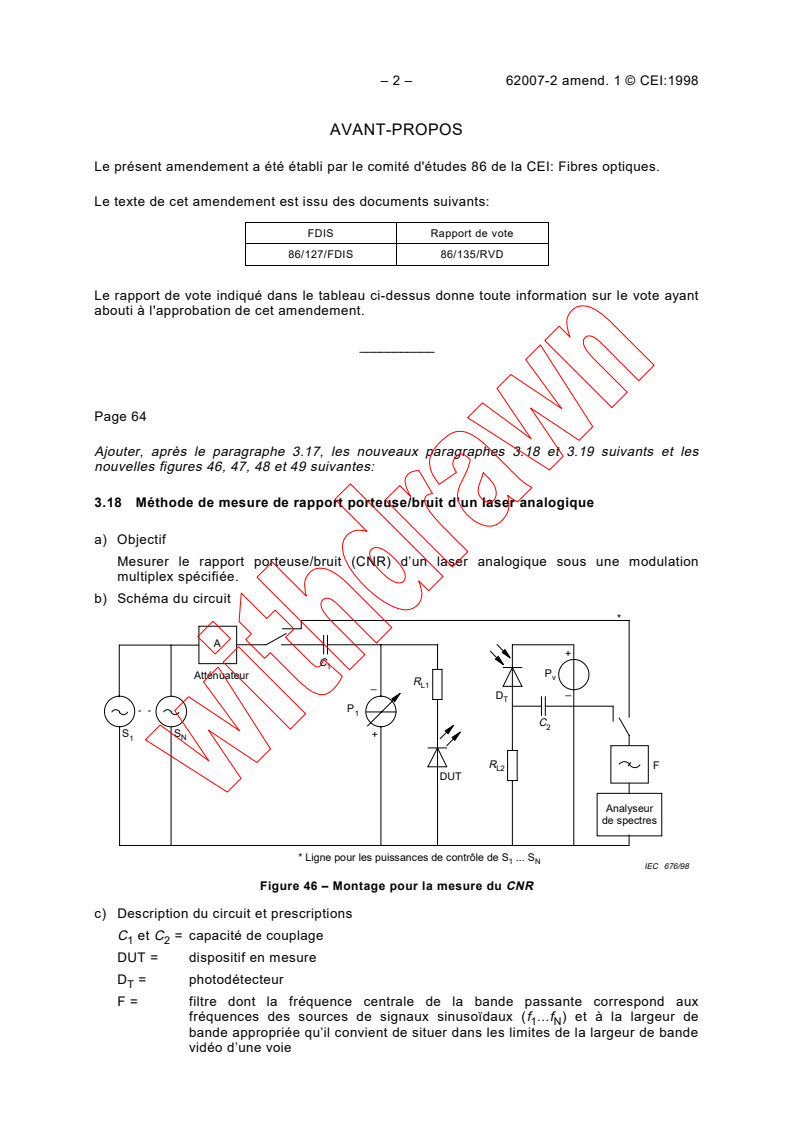
b) Schéma du circuit
*
A
+
C
P
Atténuateur
v
R
_ L1
_
D
T
P
C
S
S +
1 N
R
F
L2
DUT
Analyseur
de spectres
* Ligne pour les puissances de contrôle de S . S
1 N
IEC 676/98
Figure 46 – Montage pour la mesure du CNR
c) Description du circuit et prescriptions
C et C = capacité de couplage
1 2
DUT = dispositif en mesure
D = photodétecteur
T
F = filtre dont la fréquence centrale de la bande passante correspond aux
fréquences des sources de signaux sinusoïdaux (f .f ) et à la largeur de
1 N
bande appropriée qu’il convient de situer dans les limites de la largeur de bande
vidéo d’une voie
62007-2 Amend. 1 © IEC:1998 – 3 –
FOREWORD
This amendment has been prepared by IEC technical committee 86: Fibre optics.
The text of this amendment is based on the following documents:
FDIS Report on voting
86/127/FDIS 86/135/RVD
Full information on the voting for the approval of this amendment can be found in the
report on voting indicated in the above table.
___________
Page 65
Add, after subclause 3.17, the following new subclauses 3.18 and 3.19 and the following
new figures 46, 47, 48 and 49.
3.18 Measuring method for carrier to noise ratio of an analogue laser
a) Purpose
To measure the carrier to noise ratio (CNR) of an analogue laser under specified
multi-channel modulation.
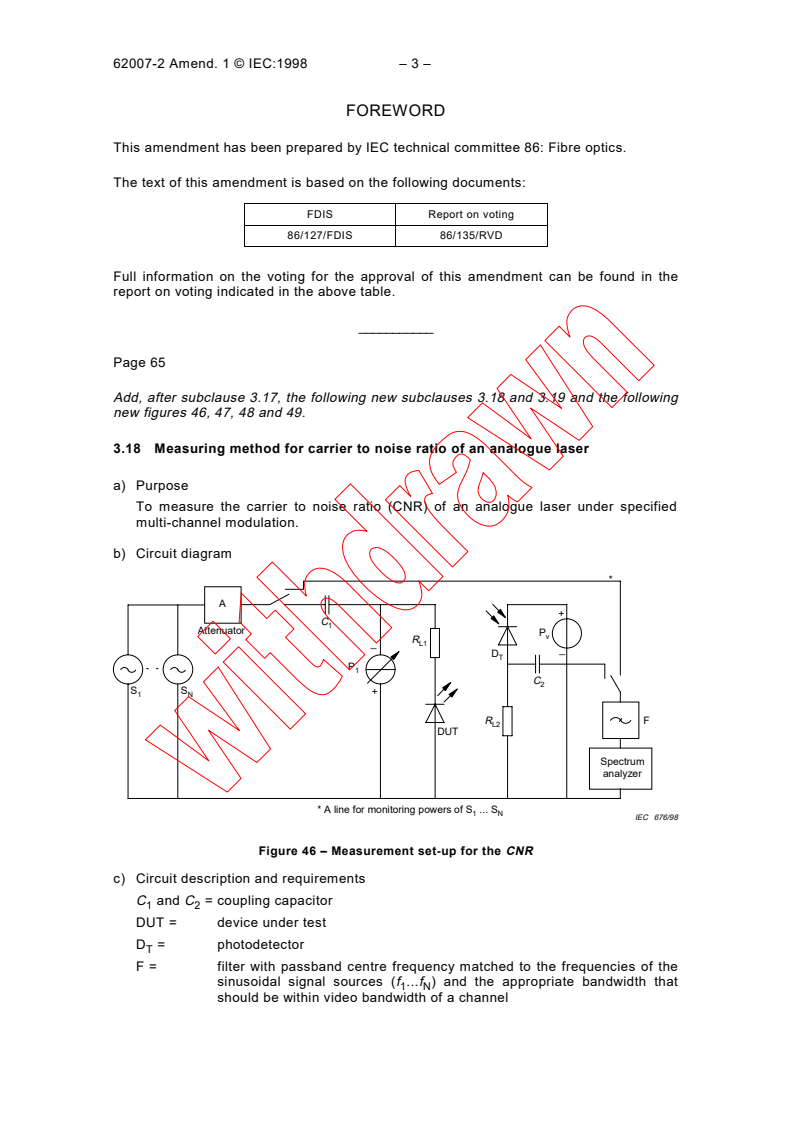
b) Circuit diagram
*
A
+
C
Attenuator
P
v
R
L1
_
_
D
T
P
C
S
S +
N
R F
L2
DUT
Spectrum
analyzer
* A line for monitoring powers of S . S
1 N
IEC 676/98
Figure 46 – Measurement set-up for the CNR
c) Circuit description and requirements
C and C = coupling capacitor
1 2
DUT = device under test
D = photodetector
T
F = filter with passband centre frequency matched to the frequencies of the
sinusoidal signal sources (f .f ) and the appropriate bandwidth that
1 N
should be within video bandwidth of a channel
– 4 – 62007-2 amend. 1 © CEI:1998
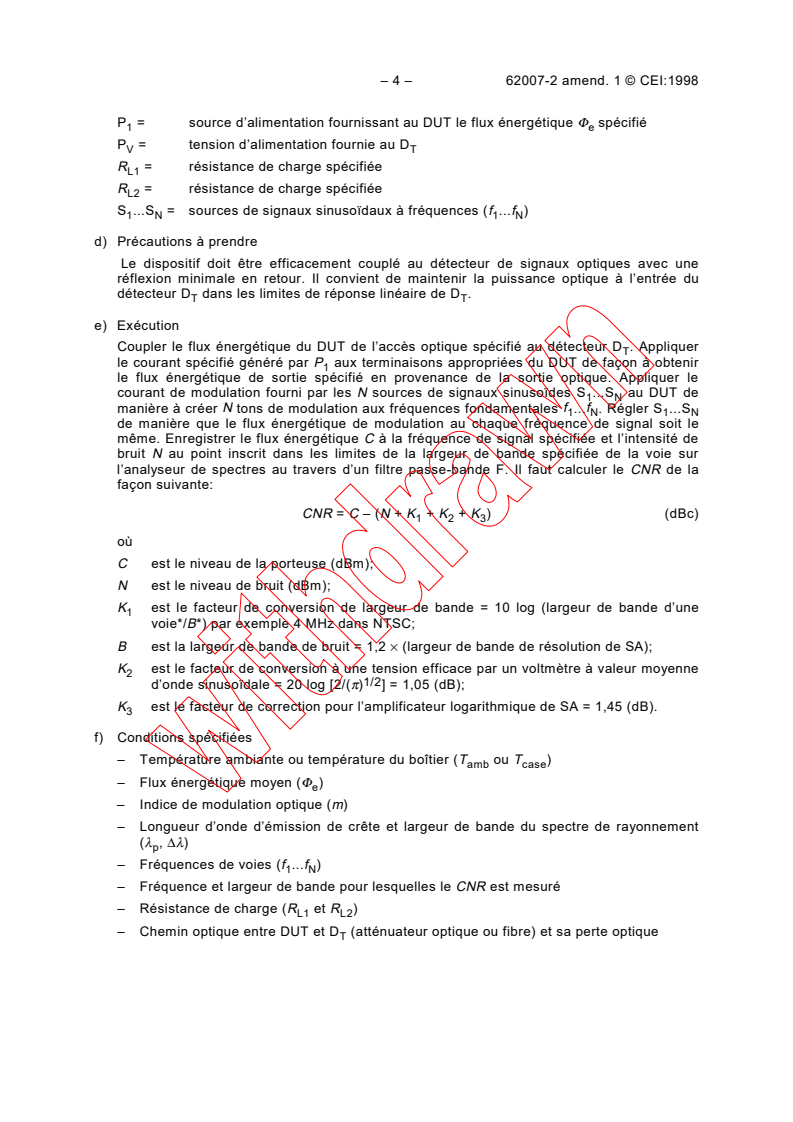
P = source d’alimentation fournissant au DUT le flux énergétique Φ spécifié
1 e
P = tension d’alimentation fournie au D
V T
R
= résistance de charge spécifiée
L1
R = résistance de charge spécifiée
L2
S .S = sources de signaux sinusoïdaux à fréquences (f .f )
1 N 1 N
d) Précautions à prendre
Le dispositif doit être efficacement couplé au détecteur de signaux optiques avec une
réflexion minimale en retour. Il convient de maintenir la puissance optique à l’entrée du
détecteur D dans les limites de réponse linéaire de D .
T T
e) Exécution
Coupler le flux énergétique du DUT de l’accès optique spécifié au détecteur D . Appliquer
T
le courant spécifié généré par P aux terminaisons appropriées du DUT de façon à obtenir
le flux énergétique de sortie spécifié en provenance de la sortie optique. Appliquer le
courant de modulation fourni par les N sources de signaux sinusoïdes S .S au DUT de
1 N
manière à créer N tons de modulation aux fréquences fondamentales f .f . Régler S .S
1 N 1 N
de manière que le flux énergétique de modulation au chaque fréquence de signal soit le
même. Enregistrer le flux énergétique C à la fréquence de signal spécifiée et l’intensité de
N
bruit au point inscrit dans les limites de la largeur de bande spécifiée de la voie sur
l’analyseur de spectres au travers d’un filtre passe-bande F. Il faut calculer le CNR de la
façon suivante:
CNR = C – (N + K + K + K)(dBc)
1 2 3
où
C est le niveau de la porteuse (dBm);
N
est le niveau de bruit (dBm);
K est le facteur de conversion de largeur de bande = 10 log (largeur de bande d’une
voie*/B*) par exemple 4 MHz dans NTSC;
B est la largeur de bande de bruit = 1,2 × (largeur de bande de résolution de SA);
K est le facteur de conversion à une tension efficace par un voltmètre à valeur moyenne
1/2
d’onde sinusoïdale = 20 log [2/(π) ] = 1,05 (dB);
K est le facteur de correction pour l’amplificateur logarithmique de SA = 1,45 (dB).
f) Conditions spécifiées
– Température ambiante ou température du boîtier (T ou T )
amb case
– Flux énergétique moyen (Φ )
e
– Indice de modulation optique (m)
– Longueur d’onde d’émission de crête et largeur de bande du spectre de rayonnement
(λ , Δλ)
p
– Fréquences de voies (f .f )
1 N
– Fréquence et largeur de bande pour lesquelles le CNR est mesuré
– Résistance de charge (R et R )
L1 L2
– Chemin optique entre DUT et D (atténuateur optique ou fibre) et sa perte optique
T
62007-2 Amend. 1 © IEC:1998 – 5 –
P = current supply to provide the specified radiant power Φ to DUT
1 e
P = voltage supply to D
V T
R = specified load resistor
L1
R = specified load resistor
L2
S .S = sinusoidal wave signal sources at frequencies (f .f )
1 N 1 N
d) Precautions to be observed
The device shall be effectively coupled to the optical signal detector with minimal
back reflection. The input optical power to the detector D should be kept within the
T
linear response range of D .
T
e) Measurement procedure
Couple radiant power of DUT from the specified optical port to the detector D . Apply
T
specified current generated by P to the appropriate terminations of DUT so as to
achieve the specified output radiant power from the optical port. Apply modulation
current from the N sinusoidal wave signal sources S .S to DUT so as to create N
1 N
modulation tones of signal frequencies f .f . Adjust S .S so that modulation
1 N 1 N
radiant power at each signal frequency is the same. Record the radiant power C
(namely carrier level) at the specified signal frequency and noise level N at the point
within the specified bandwidth of the channel on spectrum analyzer through a band
pass filter F. CNR is to be calculated by the following:
CNR = C – (N + K + K + K)(dBc)
1 2 3
where
C is the carrier level (dBm);
N is the noise level (dBm);
K B
is the bandwidth conversion factor = 10 log (bandwidth of a channel*/ *) e.g.
4 MHz in NTSC;
B is the noise bandwidth = 1,2 × (resolution bandwidth of SA);
K is the conversion factor to effective voltage by sinusoidal wave average volt meter
1/2
= 20 log [2/(π) ] = 1,05 (dB);
K is the correction factor for logarithmic amplifier of SA = 1,45 (dB)
f) Specified conditions
– Ambient or case temperature (T or T )
amb case
– Average radiant power (Φ )
e
– Optical modulation index (m)
– Peak-emission wavelength and spectral radiation bandwidth (λ , Δλ)
p
– Channel frequencies (f .f )
1 N
– Frequency and bandwidth that CNR is measured on
– Load resistance (R and R )
L1 L2
– Optical path between DUT and D (fibre or optical attenuator) and its optical loss
T
– 6 – 62007-2 amend. 1 © CEI:1998
3.19 Définition et méthode de mesure de l’indice de modulation optique
3.19.1 Définition
L’indice de modulation optique est défini de la façon suivante:
m = (i – i )/(i + i ) = i/i (1)
max min max min av
où
i est le courant de signal maximal (par porteuse);
max
i est le courant de signal minimal;
min
i est l’amplitude de courant de signal;
i est le courant de signal moyen indiqué en figure 47.
av
i
max
i
i
av
i
min
IEC 677/98
Figure 47 – Définition de l’indice de modulation optique
3.19.2 Méthode de mesure de l’indice de modulation optique
a) Objectif
Mesurer l’indice de modulation optique d’un transmetteur optique analogique dans des
conditions de modulation spécifiées.
b) Schéma du circuit
A
+
C
Atténuateur P
v
R
_ L1
_
D
T
P
C
+
S
1 Analyseur
de spectres/
R
L2
wattmètre
HF
DUT
IEC 678/98
Figure 48 – Montage pour la mesure de l’index de modulation optique
62007-2 Amend. 1 © IEC:1998 – 7 –
3.19 Definition and measuring method for optical modulation index
3.19.1 Definition
The optical modulation index is defined as follows:
m = (i – i ) / (i + i ) = i / i (1)
max min max min av
where
i is the maximum signal current (per carrier);
max
is the minimum signal current;
i
min
i is the signal current amplitude;
i is the average signal current as shown in figure 47.
av
i
max
i
i
av
i
min
IEC 677/98
Figure 47 – Definition of optical modulation index
3.19.2 Measuring method for optical modulation index
a) Purpose
To measure the optical modulation index of an analogue optical transmitter under
specified modulation conditions.
b) Circuit diagram
A
+
C
P
Attenuator
v
R
L1
_
_
D
T
P
C
S +
Spectrum
analyzer/
R
L2 RF power
meter
DUT
IEC 678/98
Figure 48 – Measurement set-up for the optical modulation index
– 8 – 62007-2 amend. 1 © CEI:1998
A
+
C
Atténuateur P
v
R
L1
_
_
D
T
P
C
S
+
R
L2
Oscilloscope
DUT
IEC 679/98
Figure 49 – Variante de montage pour la mesure de l’index de modulation optique
c) Description du circuit et prescriptions
S = source de signal
P = source d’alimentation de dispositif en mesure
P = tension d’alimentation de D
V T
DUT = dispositif en mesure
D = détecteur de signaux optiques
T
C et C = capacité de couplage
1 2
R et R = résistances de charge permettant d’adapter l’impédance pour DUT et D
L1 L2 T
d) Précautions à prendre
Il convient d’observer les précautions suivantes:
– Il convient de maintenir les niveaux de réflexion optique aussi bas que possible (de
préférence <–50 dB).
– Il convient que la puissance optique en entrée ne dépasse pas l’intervalle de sortie
linéaire spécifié pour le détecteur.
– Il convient que le détecteur corresponde soigneusement à l’impédance de l’analyseur
de spectres, du wa
...