

IEC 62007-2:2025
(Main)Semiconductor optoelectronic devices for fibre optic system applications - Part 2: Measuring methods
General Information
- Abstract
IEC 62007-2:2025 specifies measuring methods for characterizing semiconductor optoelectronic devices that are used in the field of fibre optic digital communication systems and subsystems. This third edition cancels and replaces the second edition published in 2009. This edition constitutes a technical revision. This edition includes the following significant technical changes with respect to the previous edition:
a) Modification of the definition of “optical fibre pigtail” in 3.1.3;
b) Correction of an error in Formula (1) for relative intensity noise;
c) Correction of an error in Formula (5);
d) Correction of errors in the title of Figure 11 and the text of 4.9 (replaced "LD" with "LED");
e) Clarification of how to calculate the 1 dB compression in 4.9;
f) Corrections of the circuit diagrams in Figure 2, Figure 5, Figure 11, Figure 17, Figure 18, Figure 19, Figure 20, and Figure 21;
g) Clarification of the measurement setup in 5.10 (Figure 28).
- Status
- Published
- Publication Date
- 10-Jul-2025
- Technical Committee
- SC 86C - Fibre optic systems, sensing and active devices
- Current Stage
- PPUB - Publication issued
- Start Date
- 11-Jul-2025
- Completion Date
- 08-Aug-2025
Buy Documents
IEC 62007-2:2025 - Semiconductor optoelectronic devices for fibre optic system applications - Part 2: Measuring methods Released:7/11/2025
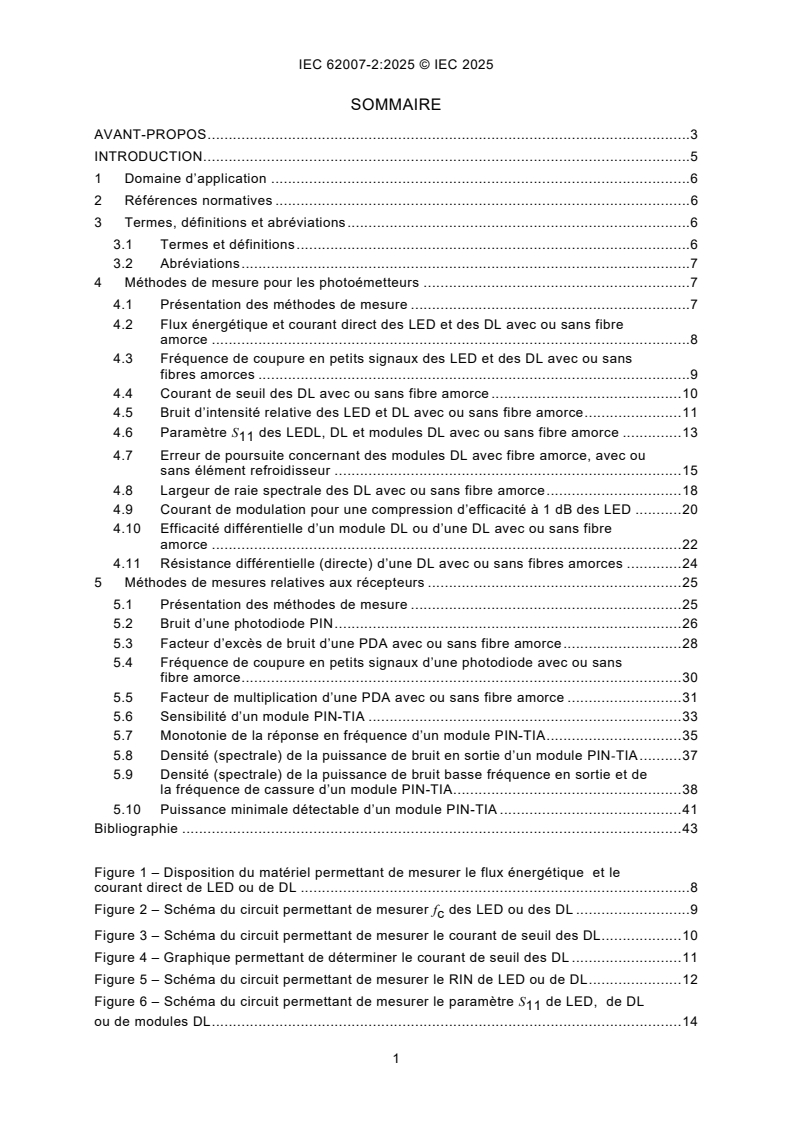
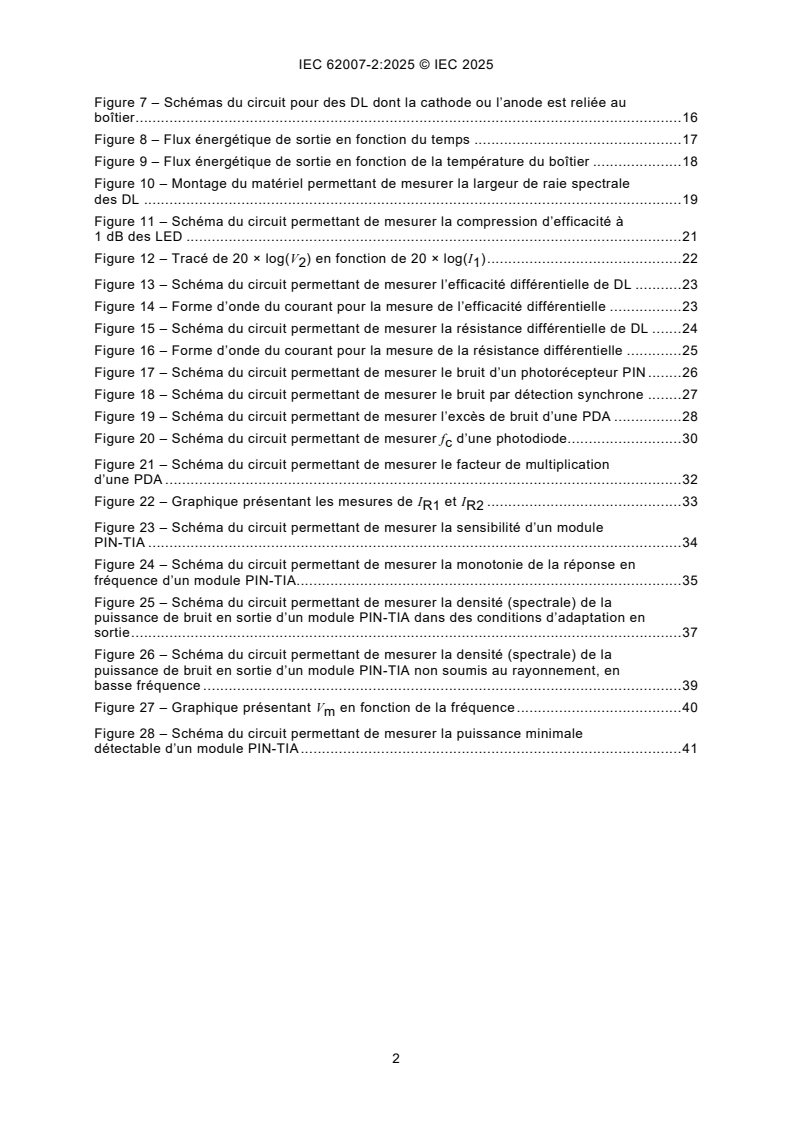
IEC 62007-2:2025 - Dispositifs optoélectroniques a semiconducteurs pour application dans les systemes fibroniques - Partie 2: Méthodes de mesure Released:7/11/2025
IEC 62007-2:2025 - Semiconductor optoelectronic devices for fibre optic system applications - Part 2: Measuring methods Released:7/11/2025
Overview
IEC 62007-2:2025 is an international standard developed by the International Electrotechnical Commission (IEC). Titled "Semiconductor optoelectronic devices for fibre optic system applications – Part 2: Measuring methods," this standard provides rigorous and standardized measuring methods for the characterization of semiconductor optoelectronic devices used in fibre optic digital communication systems and subsystems. As the third edition, IEC 62007-2:2025 replaces the previous edition from 2009, and introduces several technical revisions and clarifications to ensure precise, reliable, and up-to-date measurement procedures.
Key Topics
IEC 62007-2:2025 covers a broad range of vital measurement topics for optoelectronic components, including:
- Measurement of Optical and Electrical Properties: Specifies methods for evaluating radiant power, forward current, noise, frequency response, threshold current, and spectral linewidth.
- Component Coverage: Applies to both photoemitting devices (e.g., LEDs and laser diodes) and receiver devices (e.g., PIN photodiodes, APDs, and photoreceiver modules).
- Measurement Environments: Procedures accommodate devices with and without optical fibre pigtails and define how environmental variables like temperature are controlled during measurement.
- Terminology and Definitions: Updates definitions (such as "optical fibre pigtail") to reflect the latest industry understanding.
- Error Corrections and Clarifications: Addresses formula corrections and more explicit instructions on setup and procedure, reflecting updates for accuracy and user clarity.
- Diagram and Setup Updates: Revises essential circuit diagrams and measurement setups to eliminate ambiguity and error.
These topics support the consistent production and assessment of optoelectronic devices in fibre optic communication applications.
Applications
The standardized measuring methods defined in IEC 62007-2:2025 are crucial for manufacturers, testing laboratories, and system integrators working with:
- Digital Fibre Optic Communication Systems: Ensuring that transmitters (LEDs, LDs) and receivers (PIN, APD, PIN-TIA modules) are accurately characterized for performance-critical parameters.
- Quality Assurance and Compliance: Fostering repeatable and internationally recognized measurement practices that support procurement, manufacturing, and product validation.
- Research and Development: Facilitating advanced development efforts in optoelectronic device technology by establishing a common baseline for performance evaluation.
- Device Comparison and Specification: Enabling clear comparison of device performance across suppliers and platforms, reducing integration risk for fibre optic systems.
- Education and Training: Serving as a reference for academic and technical training in optoelectronics and fibre optic measurement techniques.
By applying IEC 62007-2:2025, stakeholders can achieve greater interoperability, component reliability, and compliance with global expectations for fibre optic system performance.
Related Standards
IEC 62007-2:2025 is part of a broader framework of fibre optics and optoelectronic device standards. Relevant and referenced standards include:
- IEC 62007-1: General specifications for semiconductor optoelectronic devices in fibre optic applications.
- IEC 60793 Series: Optical fibre product specifications.
- IEC 60794 Series: Optical fibre cable specifications.
- IEC 61754 & 61755 Series: Optical connector and connection interface standards.
- IEC Electropedia and ISO Online Browsing Platform: Authoritative sources for electrotechnical and optical terminology.
Adherence to IEC 62007-2:2025, together with related standards, ensures the foundation for high-quality, consistent measurement, characterization, and performance assessment of semiconductor optoelectronic devices in fibre optic digital communication systems.
For more information or to access the full text of IEC 62007-2:2025, visit the IEC Webstore or consult your local IEC National Committee.
Relations
- Effective Date
- 05-Sep-2023
Buy Documents
IEC 62007-2:2025 - Semiconductor optoelectronic devices for fibre optic system applications - Part 2: Measuring methods Released:7/11/2025
IEC 62007-2:2025 - Dispositifs optoélectroniques a semiconducteurs pour application dans les systemes fibroniques - Partie 2: Méthodes de mesure Released:7/11/2025
IEC 62007-2:2025 - Semiconductor optoelectronic devices for fibre optic system applications - Part 2: Measuring methods Released:7/11/2025
Get Certified
Connect with accredited certification bodies for this standard

ANCE
Mexican certification and testing association.

Intertek Slovenia
Intertek testing, inspection, and certification services in Slovenia.

LNE (Laboratoire National de Métrologie et d'Essais)
French national laboratory for metrology and testing.
Sponsored listings
Frequently Asked Questions
IEC 62007-2:2025 is a standard published by the International Electrotechnical Commission (IEC). Its full title is "Semiconductor optoelectronic devices for fibre optic system applications - Part 2: Measuring methods". This standard covers: IEC 62007-2:2025 specifies measuring methods for characterizing semiconductor optoelectronic devices that are used in the field of fibre optic digital communication systems and subsystems. This third edition cancels and replaces the second edition published in 2009. This edition constitutes a technical revision. This edition includes the following significant technical changes with respect to the previous edition: a) Modification of the definition of “optical fibre pigtail” in 3.1.3; b) Correction of an error in Formula (1) for relative intensity noise; c) Correction of an error in Formula (5); d) Correction of errors in the title of Figure 11 and the text of 4.9 (replaced "LD" with "LED"); e) Clarification of how to calculate the 1 dB compression in 4.9; f) Corrections of the circuit diagrams in Figure 2, Figure 5, Figure 11, Figure 17, Figure 18, Figure 19, Figure 20, and Figure 21; g) Clarification of the measurement setup in 5.10 (Figure 28).
IEC 62007-2:2025 specifies measuring methods for characterizing semiconductor optoelectronic devices that are used in the field of fibre optic digital communication systems and subsystems. This third edition cancels and replaces the second edition published in 2009. This edition constitutes a technical revision. This edition includes the following significant technical changes with respect to the previous edition: a) Modification of the definition of “optical fibre pigtail” in 3.1.3; b) Correction of an error in Formula (1) for relative intensity noise; c) Correction of an error in Formula (5); d) Correction of errors in the title of Figure 11 and the text of 4.9 (replaced "LD" with "LED"); e) Clarification of how to calculate the 1 dB compression in 4.9; f) Corrections of the circuit diagrams in Figure 2, Figure 5, Figure 11, Figure 17, Figure 18, Figure 19, Figure 20, and Figure 21; g) Clarification of the measurement setup in 5.10 (Figure 28).
IEC 62007-2:2025 is classified under the following ICS (International Classification for Standards) categories: 31.080.01 - Semiconductor devices in general; 31.260 - Optoelectronics. Laser equipment; 33.180.01 - Fibre optic systems in general. The ICS classification helps identify the subject area and facilitates finding related standards.
IEC 62007-2:2025 has the following relationships with other standards: It is inter standard links to IEC 62007-2:2009. Understanding these relationships helps ensure you are using the most current and applicable version of the standard.
IEC 62007-2:2025 is available in PDF format for immediate download after purchase. The document can be added to your cart and obtained through the secure checkout process. Digital delivery ensures instant access to the complete standard document.
Standards Content (Sample)
IEC 62007-2 ®
Edition 3.0 2025-07
INTERNATIONAL
STANDARD
Semiconductor optoelectronic devices for fibre optic system applications –
Part 2: Measuring methods
ICS 31.080.01; 31.260; 33.180.01 ISBN 978-2-8327-0572-8
All rights reserved. Unless otherwise specified, no part of this publication may be reproduced or utilized in any form or
by any means, electronic or mechanical, including photocopying and microfilm, without permission in writing from either
IEC or IEC's member National Committee in the country of the requester. If you have any questions about IEC copyright
or have an enquiry about obtaining additional rights to this publication, please contact the address below or your local
IEC member National Committee for further information.
IEC Secretariat Tel.: +41 22 919 02 11
3, rue de Varembé info@iec.ch
CH-1211 Geneva 20 www.iec.ch
Switzerland
About the IEC
The International Electrotechnical Commission (IEC) is the leading global organization that prepares and publishes
International Standards for all electrical, electronic and related technologies.
About IEC publications
The technical content of IEC publications is kept under constant review by the IEC. Please make sure that you have the
latest edition, a corrigendum or an amendment might have been published.
IEC publications search - IEC Products & Services Portal - products.iec.ch
webstore.iec.ch/advsearchform Discover our powerful search engine and read freely all the
publications previews, graphical symbols and the glossary.
The advanced search enables to find IEC publications by a
variety of criteria (reference number, text, technical With a subscription you will always have access to up to date
committee, …). It also gives information on projects, content tailored to your needs.
replaced and withdrawn publications.
Electropedia - www.electropedia.org
The world's leading online dictionary on electrotechnology,
IEC Just Published - webstore.iec.ch/justpublished
Stay up to date on all new IEC publications. Just Published containing more than 22 500 terminological entries in English
details all new publications released. Available online and and French, with equivalent terms in 25 additional languages.
once a month by email. Also known as the International Electrotechnical Vocabulary
(IEV) online.
IEC Customer Service Centre - webstore.iec.ch/csc
If you wish to give us your feedback on this publication or
need further assistance, please contact the Customer
Service Centre: sales@iec.ch.
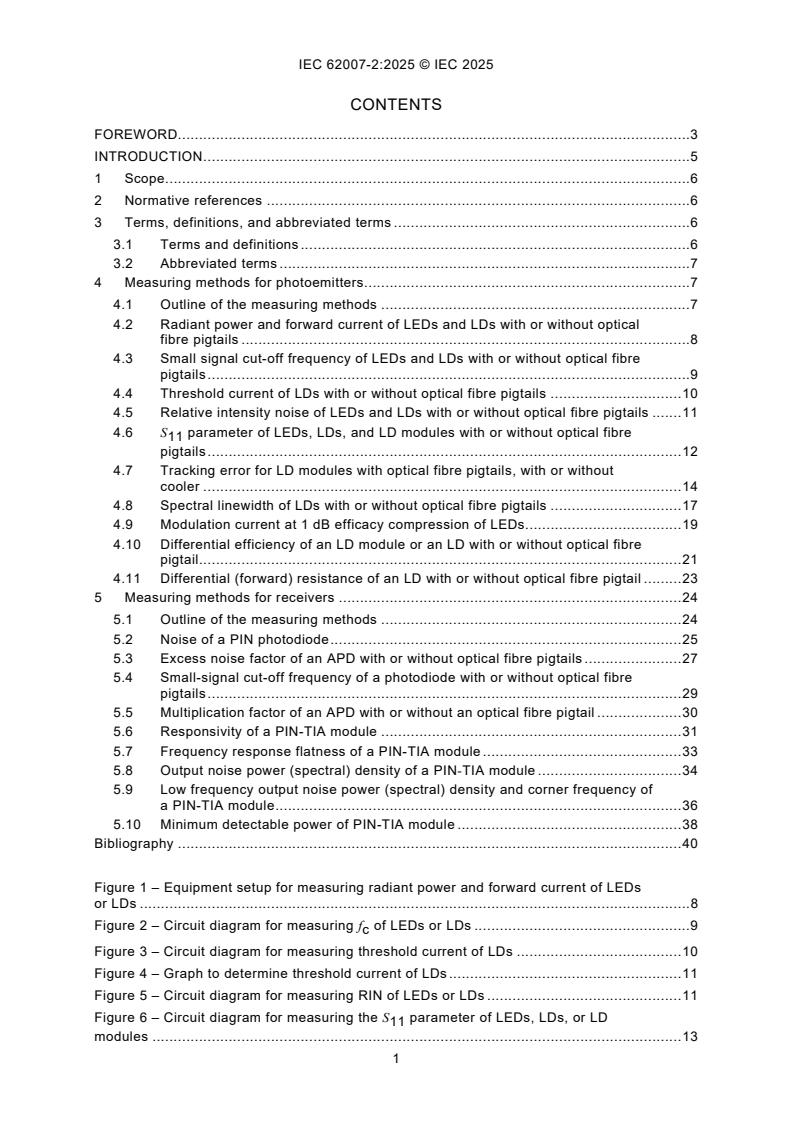
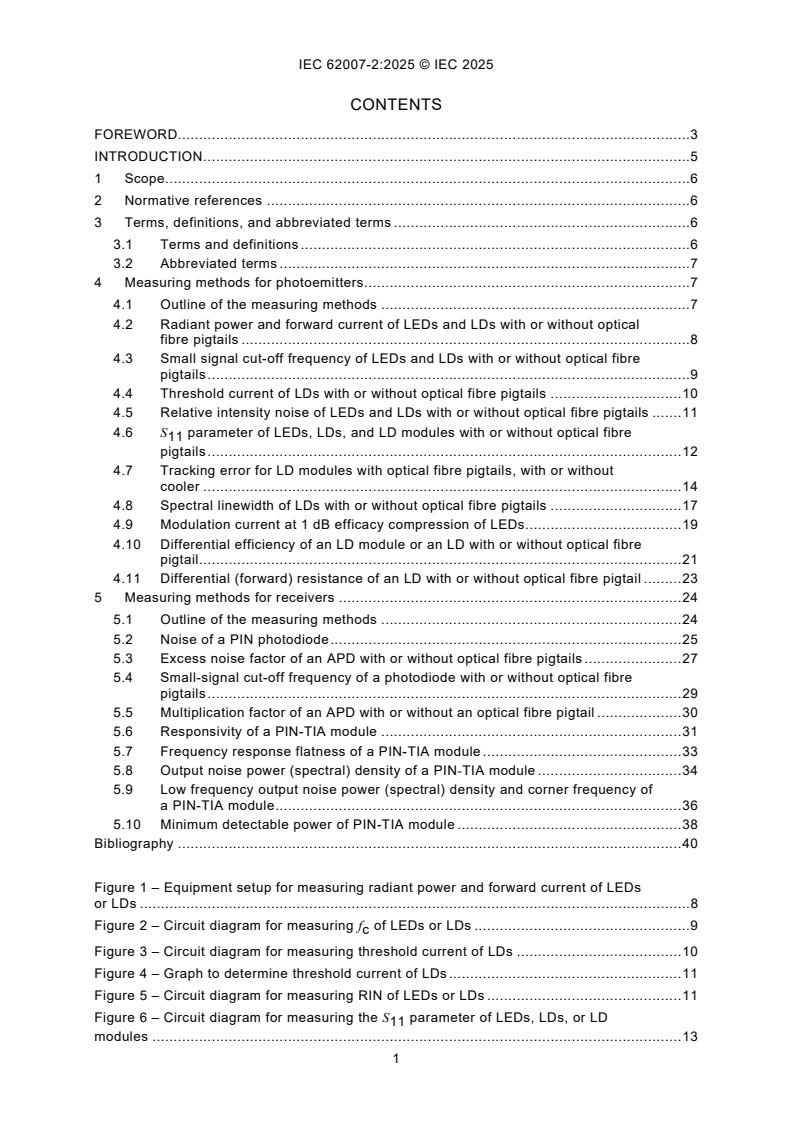
CONTENTS
FOREWORD. 3
INTRODUCTION . 5
1 Scope . 6
2 Normative references . 6
3 Terms, definitions, and abbreviated terms . 6
3.1 Terms and definitions . 6
3.2 Abbreviated terms . 7
4 Measuring methods for photoemitters . 7
4.1 Outline of the measuring methods . 7
4.2 Radiant power and forward current of LEDs and LDs with or without optical
fibre pigtails . 8
4.3 Small signal cut-off frequency of LEDs and LDs with or without optical fibre
pigtails . 9
4.4 Threshold current of LDs with or without optical fibre pigtails . 10
4.5 Relative intensity noise of LEDs and LDs with or without optical fibre pigtails . 11
4.6 S parameter of LEDs, LDs, and LD modules with or without optical fibre
pigtails . 12
4.7 Tracking error for LD modules with optical fibre pigtails, with or without
cooler . 14
4.8 Spectral linewidth of LDs with or without optical fibre pigtails . 17
4.9 Modulation current at 1 dB efficacy compression of LEDs . 19
4.10 Differential efficiency of an LD module or an LD with or without optical fibre
pigtail. 21
4.11 Differential (forward) resistance of an LD with or without optical fibre pigtail . 23
5 Measuring methods for receivers . 24
5.1 Outline of the measuring methods . 24
5.2 Noise of a PIN photodiode . 25
5.3 Excess noise factor of an APD with or without optical fibre pigtails . 27
5.4 Small-signal cut-off frequency of a photodiode with or without optical fibre
pigtails . 29
5.5 Multiplication factor of an APD with or without an optical fibre pigtail . 30
5.6 Responsivity of a PIN-TIA module . 31
5.7 Frequency response flatness of a PIN-TIA module . 33
5.8 Output noise power (spectral) density of a PIN-TIA module . 34
5.9 Low frequency output noise power (spectral) density and corner frequency of
a PIN-TIA module . 36
5.10 Minimum detectable power of PIN-TIA module . 38
Bibliography . 40
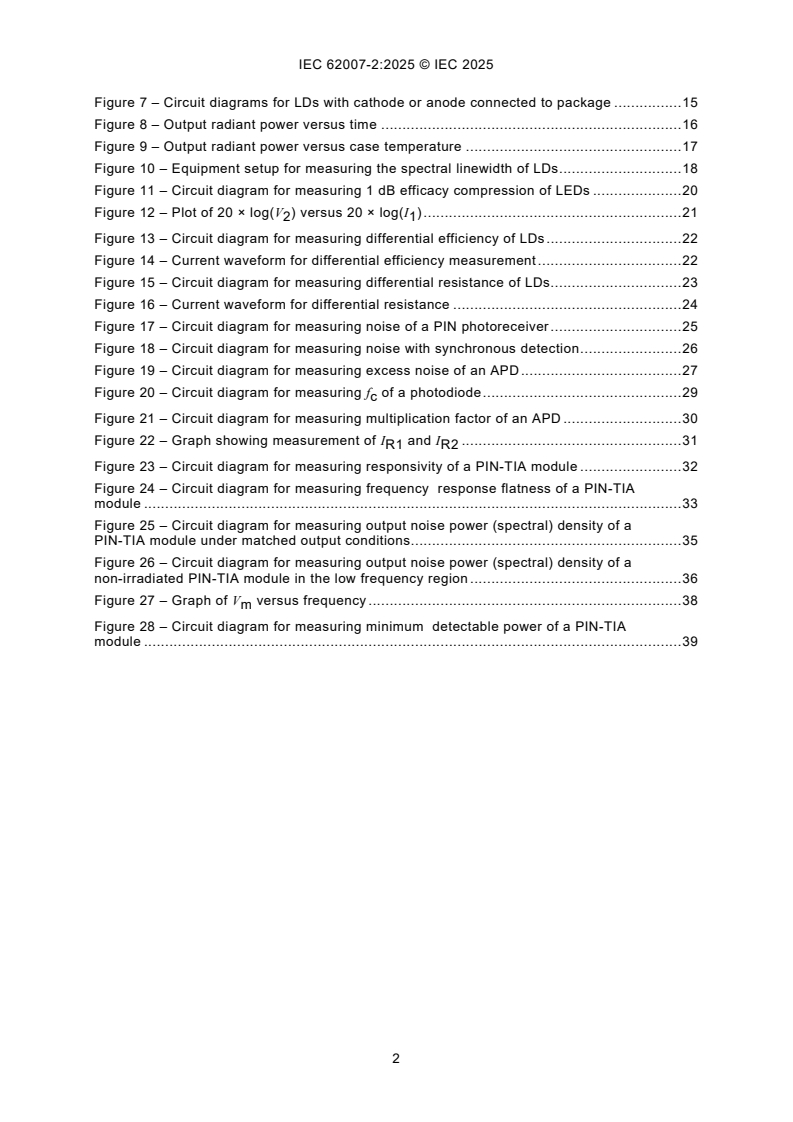
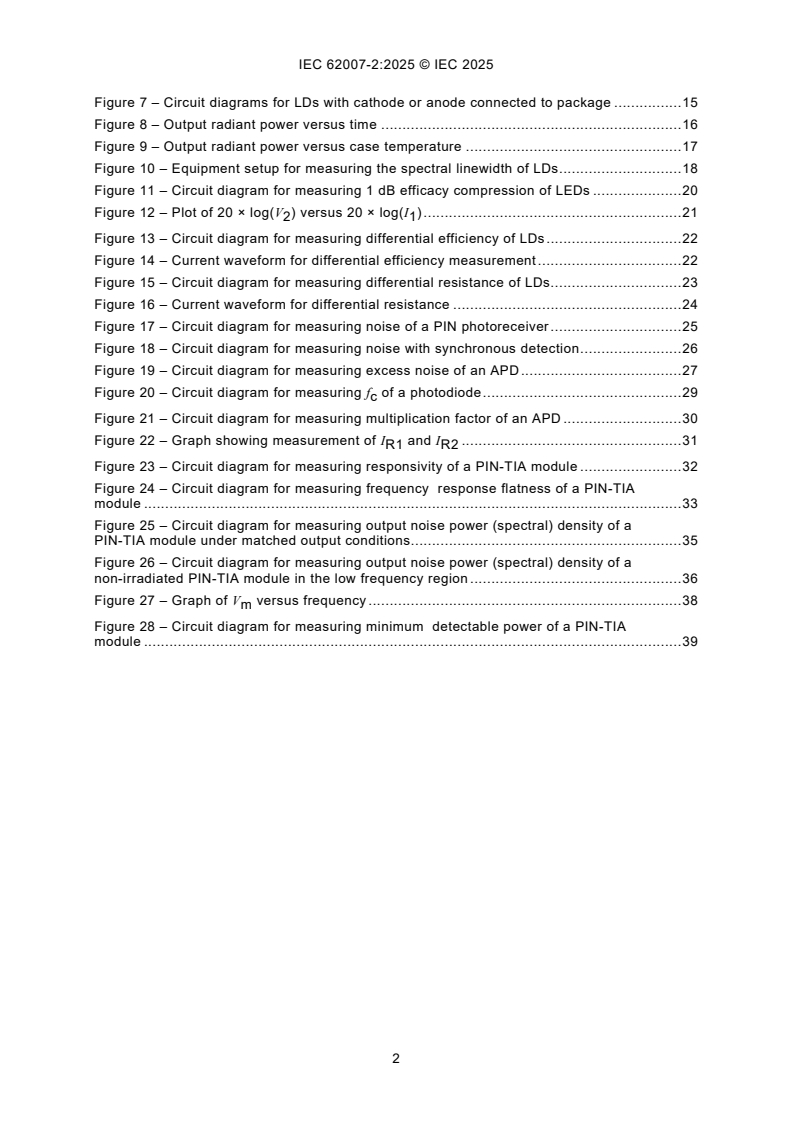
Figure 1 – Equipment setup for measuring radiant power and forward current of LEDs
or LDs . 8
Figure 2 – Circuit diagram for measuring f of LEDs or LDs . 9
c
Figure 3 – Circuit diagram for measuring threshold current of LDs . 10
Figure 4 – Graph to determine threshold current of LDs . 11
Figure 5 – Circuit diagram for measuring RIN of LEDs or LDs . 11
Figure 6 – Circuit diagram for measuring the S parameter of LEDs, LDs, or LD
modules . 13
Figure 7 – Circuit diagrams for LDs with cathode or anode connected to package . 15
Figure 8 – Output radiant power versus time . 16
Figure 9 – Output radiant power versus case temperature . 17
Figure 10 – Equipment setup for measuring the spectral linewidth of LDs . 18
Figure 11 – Circuit diagram for measuring 1 dB efficacy compression of LEDs . 20
Figure 12 – Plot of 20 × log(V ) versus 20 × log(I ) . 21
2 1
Figure 13 – Circuit diagram for measuring differential efficiency of LDs . 22
Figure 14 – Current waveform for differential efficiency measurement . 22
Figure 15 – Circuit diagram for measuring differential resistance of LDs . 23
Figure 16 – Current waveform for differential resistance . 24
Figure 17 – Circuit diagram for measuring noise of a PIN photoreceiver . 25
Figure 18 – Circuit diagram for measuring noise with synchronous detection . 26
Figure 19 – Circuit diagram for measuring excess noise of an APD . 27
Figure 20 – Circuit diagram for measuring f of a photodiode . 29
c
Figure 21 – Circuit diagram for measuring multiplication factor of an APD . 30
Figure 22 – Graph showing measurement of I and I . 31
R1 R2
Figure 23 – Circuit diagram for measuring responsivity of a PIN-TIA module . 32
Figure 24 – Circuit diagram for measuring frequency response flatness of a PIN-TIA
module . 33
Figure 25 – Circuit diagram for measuring output noise power (spectral) density of a
PIN-TIA module under matched output conditions . 35
Figure 26 – Circuit diagram for measuring output noise power (spectral) density of a
non-irradiated PIN-TIA module in the low frequency region . 36
Figure 27 – Graph of V versus frequency . 38
m
Figure 28 – Circuit diagram for measuring minimum detectable power of a PIN-TIA
module . 39
INTERNATIONAL ELECTROTECHNICAL COMMISSION
____________
Semiconductor optoelectronic devices
for fibre optic system applications -
Part 2: Measuring methods
FOREWORD
1) The International Electrotechnical Commission (IEC) is a worldwide organization for standardization comprising
all national electrotechnical committees (IEC National Committees). The object of IEC is to promote international
co-operation on all questions concerning standardization in the electrical and electronic fields. To this end and
in addition to other activities, IEC publishes International Standards, Technical Specifications, Technical Reports,
Publicly Available Specifications (PAS) and Guides (hereafter referred to as “IEC Publication(s)”). Their
preparation is entrusted to technical committees; any IEC National Committee interested in the subject dealt with
may participate in this preparatory work. International, governmental and non-governmental organizations liaising
with the IEC also participate in this preparation. IEC collaborates closely with the International Organization for
Standardization (ISO) in accordance with conditions determined by agreement between the two organizations.
2) The formal decisions or agreements of IEC on technical matters express, as nearly as possible, an international
consensus of opinion on the relevant subjects since each technical committee has representation from all
interested IEC National Committees.
3) IEC Publications have the form of recommendations for international use and are accepted by IEC National
Committees in that sense. While all reasonable efforts are made to ensure that the technical content of IEC
Publications is accurate, IEC cannot be held responsible for the way in which they are used or for any
misinterpretation by any end user.
4) In order to promote international uniformity, IEC National Committees undertake to apply IEC Publications
transparently to the maximum extent possible in their national and regional publications. Any divergence between
any IEC Publication and the corresponding national or regional publication shall be clearly indicated in the latter.
5) IEC itself does not provide any attestation of conformity. Independent certification bodies provide conformity
assessment services and, in some areas, access to IEC marks of conformity. IEC is not responsible for any
services carried out by independent certification bodies.
6) All users should ensure that they have the latest edition of this publication.
7) No liability shall attach to IEC or its directors, employees, servants or agents including individual experts and
members of its technical committees and IEC National Committees for any personal injury, property damage or
other damage of any nature whatsoever, whether direct or indirect, or for costs (including legal fees) and
expenses arising out of the publication, use of, or reliance upon, this IEC Publication or any other IEC
Publications.
8) Attention is drawn to the Normative references cited in this publication. Use of the referenced publications is
indispensable for the correct application of this publication.
9) IEC draws attention to the possibility that the implementation of this document may involve the use of (a)
patent(s). IEC takes no position concerning the evidence, validity or applicability of any claimed patent rights in
respect thereof. As of the date of publication of this document, IEC had not received notice of (a) patent(s), which
may be required to implement this document. However, implementers are cautioned that this may not represent
the latest information, which may be obtained from the patent database available at https://patents.iec.ch. IEC
shall not be held responsible for identifying any or all such patent rights.
IEC 62007-2 has been prepared by subcommittee 86C: Fibre optic systems, sensing and active
devices, of IEC technical committee 86: Fibre optics. It is an International Standard.
This third edition cancels and replaces the second edition published in 2009. This edition
constitutes a technical revision.
This edition includes the following significant technical changes with respect to the previous
edition:
a) Modification of the definition of “optical fibre pigtail” in 3.1.3;
b) Correction of an error in Formula (1) for relative intensity noise;
c) Correction of an error in Formula (5);
d) Correction of errors in the title of Figure 11 and the text of 4.9 (replaced "LD" with "LED");
e) Clarification of how to calculate the 1 dB compression in 4.9;
f) Corrections of the circuit diagrams in Figure 2, Figure 5, Figure 11, Figure 17, Figure 18,
Figure 19, Figure 20, and Figure 21;
g) Clarification of the measurement setup in 5.10 (Figure 28).
The text of this International Standard is based on the following documents:
Draft Report on voting
86C/1975/FDIS 86C/1985/RVD
Full information on the voting for its approval can be found in the report on voting indicated in
the above table.
The language used for the development of this International Standard is English.
This document was drafted in accordance with ISO/IEC Directives, Part 2, and developed in
accordance with ISO/IEC Directives, Part 1 and ISO/IEC Directives, IEC Supplement, available
at www.iec.ch/members_experts/refdocs. The main document types developed by IEC are
described in greater detail at www.iec.ch/publications.
A list of all parts of the IEC 62007 series can be found, under the general title Semiconductor
optoelectronic devices for fibre optic system applications, on the IEC website
The committee has decided that the contents of this document will remain unchanged until the
stability date indicated on the IEC website under webstore.iec.ch in the data related to the
specific document. At this date, the document will be
• reconfirmed,
• withdrawn, or
• revised.
INTRODUCTION
Semiconductor optical signal transmitters and receivers play important roles in optical
communication networks. This document covers the measurement procedures for evaluating
their optical and electrical properties that are important for applications in digital communication
systems. These properties are essential for specifying the performance of these devices.
1 Scope
This part of IEC 62007 specifies measuring methods for characterizing semiconductor
optoelectronic devices that are used in the field of fibre optic digital communication systems
and subsystems.
2 Normative references
There are no normative references in this document.
3 Terms, definitions, and abbreviated terms
3.1 Terms and definitions
For the purposes of this document, the following terms and definitions apply.
ISO and IEC maintain terminology databases for use in standardization at the following
addresses:
• IEC Electropedia: available at https://www.electropedia.org/
• ISO Online browsing platform: available at https://www.iso.org/obp
3.1.1
PIN photodiode
photodiode with a large intrinsic region sandwiched between P- and N-doped semiconducting
regions used for the detection of optical radiation
[SOURCE: IEC 60050-731:1991, 731-06-29, modified – the note was removed.]
3.1.2
avalanche photodiode
APD
photodiode operating with a bias voltage such that the primary photocurrent undergoes
amplification by cumulative multiplication of charge carriers
[SOURCE: IEC 60050-731:1991, 731-06-30, modified – the note was removed.]
3.1.3
optical fibre pigtail
short length of optical fibre, usually permanently attached to a component and intended to
facilitate jointing between that component and another optical fibre or component
[SOURCE: IEC 60050-731:1991, 731-05-08, modified – the note was removed.]
3.2 Abbreviated terms
AC alternating current
AL adjustable line
APD avalanche photodiode
BER bit-error ratio
DC direct current
LED light emitting diode
LD laser diode
NRZ non-return to zero
PD photodetector
RF radio frequency
RIN relative intensity noise
RMS root mean square
RZ return to zero
TIA transimpedance amplifier
TL test line
4 Measuring methods for photoemitters
4.1 Outline of the measuring methods
Light emitting diodes (LEDs) and laser diodes (LDs) have important opto-electronic properties,
which shall be specified when they are used in optical communication systems. The
measurement methods for characterizing these opto-electronic properties are described in 4.2
to 4.11, where each subclause covers the following topics:
a) Purpose,
b) One of the following items:
• Measurement equipment,
• Equipment setup,
• Circuit diagram,
• Circuit design and current waveform for measurement.
c) Equipment or circuit description and requirements,
d) Precautions to be observed,
e) Measurement procedures,
f) Specified conditions.
If a device is equipped with an optical fibre pigtail, all optical fibres and cables defined in the
IEC 60793 and IEC 60794 series are applicable. If an optical fibre pigtail is to be terminated
with an optical connector, all optical connectors defined in the IEC 61754 and IEC 61755 series
are applicable.
4.2 Radiant power and forward current of LEDs and LDs with or without optical fibre
pigtails
a) Purpose
To measure the radiant power Φ and the forward current I of LEDs and LDs, with or
e F
without optical fibre pigtails, under specified conditions.
b) Measurement equipment
Figure 1 shows the equipment setup for measuring the radiant power and forward current
of LEDs and LDs.
Figure 1 – Equipment setup for measuring radiant power
and forward current of LEDs or LDs
c) Equipment description and requirements
The radiation emitted by the device is subjected to multiple reflections from the walls of the
integrating sphere; this leads to a uniform irradiance of the surface proportional to the
emitted flux. A detector located in the walls of the sphere measures this irradiance. An
opaque screen shields the detector from the direct radiation of the device being measured.
d) Precautions to be observed
The device being measured, the screen, and the apertures shall be small compared to the
sphere surface.
The inner surface of the sphere and screen shall have a diffusing coating with a high uniform
reflection coefficient (0,8 minimum).
The sphere and detector assembly shall be calibrated.
The measured values for radiant power and forward current shall be corrected for variations
in peak-emission wavelength and radiation flux.
When the radiation emitted by the device being measured is pulsed, the detector shall time-
average the measured radiation.
e) Measurement procedure
The emitting device is positioned at the entrance of the integrating sphere, so that no direct
radiation will reach the detector.
For measurements of radiant power, the specified forward current I is applied to the device,
F
and the radiant power is measured by the photodetector.
For measurements of forward current, the current applied to the device is increased until
the specified radiant power Φ is achieved. The value of this current is recorded.
e
f) Specified conditions
• Ambient or case temperature.
• Radiant power (when measuring forward current).
• Forward current (when measuring radiant power).
4.3 Small signal cut-off frequency of LEDs and LDs with or without optical fibre
pigtails
a) Purpose
To measure the small signal cut-off frequency f of LEDs and LDs with or without optical
c
fibre pigtails, under specified conditions.
b) Circuit diagram
of LEDs and LDs.
Figure 2 shows a circuit diagram for measuring f
c
Key
D device being measured
G AC generator with adjustable frequency
G DC generator
PD photodetector
M measuring instrument for AC radiant power
C coupling capacitor
Figure 2 – Circuit diagram for measuring f of LEDs or LDs
c
c) Equipment description and requirements
No requirements for this item.
d) Precautions to be observed
The radiant power reflected back into the laser diode shall be minimized to avoid modulation
distortions, which could affect the accuracy of the measurement. The photodetector shall
have a frequency response greater than f .
c
e) Measurement procedure
For LEDs, the specified direct forward current or the direct forward current required to obtain
the specified radiant power is applied to the device being measured.
For laser diodes, the forward current is adjusted to a value which is equal to the continuous
forward current above threshold or which generates a specified radiant power.
The forward current is modulated using generator G at a low frequency f (less than f /100),
1 l c
and the AC radiant power is measured by instrument M (see Figure 2).
Keeping the modulation level constant, the modulation frequency is increased until the
output radiant power measured by M is reduced to 50 % of the value obtained at f .
l
This frequency is the small-signal cut-off frequency f .
c
f) Specified conditions
For light-emitting diodes (LED):
• ambient or case temperature;
• DC forward current or radiant power.
For the laser diodes (LD):
• ambient, case, or submount temperature;
• radiant power or difference between applied DC forward current and threshold
current of LD.
4.4 Threshold current of LDs with or without optical fibre pigtails
a) Purpose
To measure the threshold current of a laser diode, with or without optical fibre pigtails.
b) Circuit diagram
Figure 3 shows a circuit diagram for measuring threshold current of a laser diode.
Key
D device being measured
PD photodetector measuring incident radiant power
A ammeter
G generator (DC or pulsed current)
Figure 3 – Circuit diagram for measuring threshold current of LDs
c) Circuit description and requirements
For pulse measurement, the current generator, G, shall provide current pulses of the
required amplitude, duration and repetition rate.
d) Precautions to be observed
Radiant power reflected back into the laser diode shall be minimized. The limiting values of
and Φ ) shall not be overstepped.
the laser diode (I
F e
e) Measurement procedure
A forward current is applied to the diode and the relation between the incident radiant power
from the diode and the forward current is recorded.
The forward current at which the second derivative of the recorded curve showing incident
radiant power versus the forward current has its first maximum is determined (see Figure 4).
The forward current at this point is the threshold current I .
TH
f) Specified conditions
• Ambient, case or submount temperature.
• For pulse measurement, repetition frequency and pulse duration of the forward current.
Figure 4 illustrates how to determine the threshold current of LDs.
Key
I threshold current
TH
Figure 4 – Graph to determine threshold current of LDs
4.5 Relative intensity noise of LEDs and LDs with or without optical fibre pigtails
a) Purpose
To measure the relative intensity noise (RIN) of LEDs and LDs, with or without optical fibre
pigtails, under specified conditions.
b) Circuit diagram
Figure 5 shows a circuit diagram for measuring RIN of LEDs and LDs.
Key
G DC current generator
D device being measured
L lens system
forward current
I
F
PD photodetector
R load resistance
L
I reverse current of the photodetector under optical radiation
R(H)
G DC generator for PD bias voltage
AMP AC amplifier with gain G
F electrical filter with centre frequency f and equivalent noise bandwidth Δf
0 N
M measuring instrument (e.g. electrical power level meter)
C capacitance of bypass capacitor for DC voltage generator G
B 2
Figure 5 – Circuit diagram for measuring RIN of LEDs or LDs
c) Circuit description and requirements
No requirements for this item.
d) Precautions to be observed
Radiant power reflected back into the laser diode shall be minimized to avoid distortions
affecting accuracy of the measurements.
e) Measurement procedure
A DC current corresponding to the specified radiant power Φ is applied to the device. The
e
noise power N is measured by the measuring instrument M, and the reverse photo current
t
I of the photodetector is measured simultaneously under optical radiation.
R(H)
The LD or LED being measured is replaced by an optically broadband light source that emits
radiation in the same wavelength range as the LD or LED being measured.
The irradiating power of the broadband light source is adjusted to obtain the same reverse
current I of the photodetector as previously measured with the LED or LD. The
R(H)
corresponding noise power N , which consists of the photodetector shot-noise and the
d
electrical amplifier noise, is then measured by instrument M.
The RIN is expressed in dB/Hz and calculated from Formula (1).
NN−
td
Rf 10×log
( ) (1)
RIN 0 10
R ××G Δf × I
L N R(H)
where
f is the centre frequency of the electrical filter, expressed in Hz;
G is the gain of the electrical amplifier, expressed in linear units;
I is the reverse current of the photodetector, expressed in A;
R(H)
N is the noise power measured with the broadband light source, expressed in W;
d
N is the noise power measured with the LED or LD under test, expressed in W;
t
R is the gain of the load resistance of the PD, expressed in Ω;
L
Δf is the equivalent noise bandwidth of the electrical filter, expressed in Hz.
N
f) Specified conditions
• Ambient, case, or submount temperature of the LED or LD.
• Radiant power.
• Centre frequency and equivalent noise bandwidth of the electrical filter.
4.6 S parameter of LEDs, LDs, and LD modules with or without optical fibre pigtails
a) Purpose
To measure the real and imaginary parts (or modulus and phase) of the electrical input
characteristic of a device at a specified radiant power level and at a specified frequency.
The S parameter is the ratio of the (complex-valued) high-frequency voltage V reflected
11 rl
from the device to the high-frequency voltage V incident on the device electrical input port,
il
as shown in Formula (2).
V
rl
S =
(2)
V
il
=
An equivalent formula using complex impedances instead of complex voltages is given by
Formula (3).
ΖZ−
1 0
=
S
(3)
ZZ+
where
Z is the input impedance of the device being measured, expressed in Ω;
Z is the characteristic impedance of the measurement equipment, expressed in Ω.
b) Circuit diagram
Figure 6 shows the circuit diagram for measuring the S parameter of LEDs, LDs, and
LD modules.
Key
G RF generator
T bias-T circuit
CS DC source
DC1 directional coupler in forward direction
DC2 directional coupler in reverse direction
AL adjustable transmission line
NA network analyser
D device being measured (LED, LD, or LD module)
PM radiant power meter
TL test transmission line
Figure 6 – Circuit diagram for measuring the S parameter
of LEDs, LDs, or LD modules
c) Equipment description and requirements
No requirements for this item.
d) Precautions to be observed
The characteristic impedances of the transmission lines, generator, attenuators, device
measuring socket, bias-T circuit, and loads shall be matched to a common impedance
(usually 50 Ω) over the specified frequency range.
The RF power delivered by the RF generator shall be low enough to allow for linear
operation of the device being measured.
Ensure that the optical ports of the device D and the power meter PM are aligned.
e) Measurement procedure
• Calibration
• The adjustable line (AL) shall balance the test line (TL). This can be achieved by
performing the following procedure.
• A short circuit is connected to the electrical input line at the location of the device being
measured.
• The AC signal frequency is scanned around the specified frequency f, and the length of
the adjustable line is varied until a single point S is obtained on the Smith chart
(modulus equals 1 and phase equals 180°).
• Measurement
• The short circuit used in the calibration procedure is replaced by the device D. The
operating conditions of the device being measured are applied as specified (Φ and
e
T , T , or T ), and the value of S corresponding to the reflection coefficient of
case amb sub 11
the device D is obtained from the network analyser NA.
f) Specified conditions
• Ambient, case or submount temperature.
• Supply and drive conditions: Φ or I , ΔI , f, and modulation depth m.
e F F
4.7 Tracking error for LD modules with optical fibre pigtails, with or without cooler
a) Purpose
To measure the maximum variations of the tracking ratio between the fibre output radiant
power and the monitor diode photocurrent of a laser module over a specified temperature
range.
b) Circuit diagram
Figure 7 (a) shows the circuit diagram for the case where the laser cathode is connected to
the LD package, and Figure 7 (b) shows the same for the case where the laser anode is
connected to the LD package.
a) Laser diode with laser cathode connected to package
b) Laser diode with laser anode connected to package
Key
D device being measured
D monitor diode
M
PD calibrated photodetector
G DC current source, monitored through negative feedback by the photocurrent delivered by the monitor
photodiode
G DC voltage source
R load resistance
L
V DC voltmeter
DM
V DC voltmeter
R
D laser diode
L
Figure 7 – Circuit diagrams for LDs with cathode or anode connected to package
c) Equipment description and requirements
No requirements for this item.
d) Precautions to be observed
The optical radiant power reflected back to the laser diode shall be minimized.
The case temperature of the LD should be varied slowly enough to ensure that thermal
equilibrium takes place inside the module and, in the case of a module with cooler, that the
specified submount temperature T is stabilized.
sub
e) Measurement procedure
At each measuring point, the DC current from source G is adjusted until the monitor photo-
current is equal to the value obtained with the specified optical radiation power at 25 °C.
The case temperature is scanned over the specified range and the plot of the output radiant
power is recorded either versus time, as shown in Figure 8, or versus case temperature, as
shown in Figure 9.
The tracking errors expressed in percent are given by Formula (4) and Formula (5):
ΦΦ−
e min
e25 C
E ×100 (%)
(4)
R1
Φ
e25 C
Φ −Φ
e max
e25 C
E ×100 (%)
(5)
R2
Φ
e25 C
where
Փ is the minimal radiant power recorded during the temperature scan, expressed
e min
in W;
Փ is the maximal radiant power recorded during the scan, expressed in W;
e max
Փ is the radiant power measured at 25 °C, expressed in W.
e 25 °C
Figure 8 – Output radiant power versus time
=
=
Figure 9 – Output radiant power versus case temperature
f) Specified conditions
• Փ at 25 °C.
e
• Case or ambient temperature range T and T , or T and T .
case min case max amb min amb max
• Submount temperature T , where appropriate.
sub
• Bias voltage V of monitor photodiode D .
R M
4.8 Spectral linewidth of LDs with or without optical fibre pigtails
a) Purpose
To measure the spectral linewidth of LDs with or without optical fibre pigtails.
b) Equipment setup
Figure 10 shows the equipment setup and circuit diagram for measuring the spectral
linewidth of LDs.
Key
G DC current source
D device being measured
L1, L2, L3 lenses
OI optical isolator
AO acousto-optic modulator
AO/D driver for acousto-optic modulator
M mirror
P1 polarization adjustment device
F1, F2, F3 single mode fibres
OC optical coupler
PD photodetector
AMP amplifier
SA spectrum analyser
Figure 10 – Equipment setup for measuring the spectral linewidth of LDs
c) Equipment description and requirements
No requirements for this item.
d) Precautions to be observed
Radiation power reflected back into the laser diode shall be minimized.
Length of F3 should be sufficiently long to obtain a greater resolution than the spectral
linewidth of the device being measured D.
Modulation frequency should be higher than the spectral linewidth of the device D.
The specified DC current should be sufficiently stabilized so as not to broaden the measured
linewidth of the device D.
NOTE The length of fibre F3 determines the frequency resolution δf of the linewidth measurement, which is
given by:
0,75 c
δf =
πLn
where
c is the velocity of light, expressed in m/s;
L is the length of fibre F3, expressed in m;
n is the refractive index of fibre F3.
e) Measurement procedure
The specified DC current above threshold (ΔI ) or the forward current corresponding to a
F
specified radiant power (Փ ) is applied to the device D being measured.
e
The optical port of the device D is aligned to get maximum radiant power into the optical
fibres F1 and F3.
A peak corresponding to the modulation frequency of the acousto-optic modulator AO is
observed on the spectrum analyser. The polarization adjuster P1 is rotated until the peak is
maximal (corresponding to maximal interference between the radiation emerging from fibres
F1 and F3). The full width at half maximum of the observed peak is measured. The measured
value is twice the spectral linewidth of the device D.
f) Specified conditions
• Ambient, case, or submount temperature.
• Forward current above threshold ΔI or radiant power Փ .
F e
4.9 Modulation current at 1 dB efficacy compression of LEDs
a) Purpose
To measure the modulation current at 1 dB efficacy compression, denoted I , at a
F(1 dB)
specified modulation frequency and radiant output power.
b) Circuit diagram
Figure 11 shows the circuit diagram for measuring 1 dB efficacy compression of LEDs.
Key
D device being measured
G sine wave signal source
C capacitance of coupling capacitor
P power supply to provide the specified radiant power Փ to D
1 e
V AC voltmeter or broadband voltage measuring equipment for measuring V and V
1 2
R load resistor for matching the specified electrical impedance of D
L1
D optical signal detector
T
R load resistor for matching the specified electrical impedance of D
L2 T
P power supply to provide the operating voltage to D
2 T
F band-pass filter centre frequency matched to the frequency f of the sine wave signal source
A amplifier
C capacitance of bypass capacitor for DC voltage supply P
B 2
V modulation voltage
V detected signal voltage
Figure 11 – Circuit diagram for measuring 1 dB efficacy compression of LEDs
c) Equipment description and requirements
No requirements for this item.
d) Precautions to be observed
The optical output port of the device being measured shall be coupled as best as possible
to input port of the optical signal detector.
e) Measurement procedure
Couple the optical output of device D from the optical port to the detector D . Apply the
T
supply current from power supply P to the appropriate connections of D to generate the
specified output radiant power Փ from the output port of device D. Apply modulation current
e
from signal generator G at the specified modulation frequency. Record the detected signal
voltage V and the modulation voltage V while the modulation current is increased. The
2 1
modulation current I (I = V /R ) is determined from V using the value of R . Identify the
1 1 1 L1 1 L1
region for which there is a linear relationship between log(V ) and log(I ). Record the value
2 1
of I at which 20 × log(V ) is 1 dB below the value resulting from the projected linear region,
1 2
as shown in Figure 12. This value of I is the modulation current at 1 dB efficacy
compression, i.e. I .
F(1 dB)
NOTE 1 The value of V expressed in dB is given by 20 × log(V ), where V is expressed in V.
2 2 2
NOTE 2 The functions of the filter F and AC voltmeter V are typically incorporated in RF spectrum analyser
instruments. Such instruments can be used in place of the individual circuit elements shown in the circuit
description. With this substitution, the measured quantities are AC signal powers instead of signal amplitudes.
Figure 12 shows a plot of 20 × log(V ) versus 20 × log(I ), where V is expressed in V and
2 1 2
I is expressed in A.
Figure 12 – Plot of 20 × log(V ) versus 20 × log(I )
2 1
f) Specified conditions
• Ambient or case temperature, T or T .
amb case
• Load resistances R and R .
L1 L2
• Peak-emission wavelength and spectral radiation bandwidth of the light source (λ , Δλ).
p
• Radiant power Փ .
e
• Modulation frequency f.
4.10 Differential efficiency of an LD module or an LD with or without optical fibre
pigtail
a) Purpose
To measure the differential efficiency η of LD modules or LDs with or without optical fibre
d
pigtail.
b) Circuit diagram and current waveform
Figure 13 shows the circuit diagram for measuring differential efficiency of an LD and
Figure 14 shows the current waveform for differential efficiency measurement.
Key
D device being measured I forward current
F
PG current step generator V voltmeter
DT photodetector V device forward voltage as measured on the voltmeter
F
SP signal processing equipment
Figure 13 – Circuit diagram for measuring differential efficiency of LDs
Key
δI step-amplitude
F
τ step duration
Figure 14 – Current waveform for differential efficiency measurement
c) Equipment description and requirements
No requirements for this item.
d) Precautions to be observed
Radiant power reflected back into the laser diode shall be minimized. The limiting values of
the laser diode for I or Փ shall not be exceeded.
F e
e) Measurement procedure
The current waveform applied to the device shall be as shown in Figure 16, where δI is the
F
step-amplitude, with δI ≤ (1/20)ΔI , and τ is the step duration. The step duration shall be
F F
sufficiently long to allow the device to achieve thermal equilibrium.
NOTE If the step duration τ is too small, then thermal effects are not taken into account. A typical minimal
value for τ is 100 μs, which is close to the most common chip-to-heatsink thermal time constant.
Record I and Փ at each step level.
F e
Derive η from the ratio:
d
η = δՓ / δI , at ΔI or Փ specified.
d e F F e
f) Specified conditions
• Ambient or case temperature, or sub-mount temperature (T , T or T )
amb case sub
• Either forward current above threshold (ΔI ) or radiant power (Փ )
F e
4.11 Differential (forward) resistance of an LD with or without optical fibre pigtail
a) Purpose
To measure the differential (forward) resistance r of LDs with or without optical fibre pigtail.
d
b) Circuit diagram and current waveform
Figure 15 shows the circuit diagram for measuring differential resistance and Figure 16
shows the current waveform for differential resistance.
Key
D device being measured SP signal processing equipment
PG current step generator I forward current
F
V voltmeter V device forward voltage as measured on the voltmeter
F
DT photodetector
Figure 15 – Circuit diagram for measuring differential resistance of LDs
Key
δI step-amplitude
F
τ step duration
Figure 16 – Current waveform for differential resistance
c) Equipment description and requirements
No requirements for this item.
d) Precautions to be observed
The limiting values of the laser diode, I or Փ , shall not be exceeded.
F e
e) Measurement procedure
The current waveform applied to the device shall be as shown in Figure 16, where δI is the
F
step-amplitude and ≤ (1/20)ΔI .
F
Record I , V and Փ at each step level.
F F e
Derive r from the ratio:
d
r = δV / δI , at ΔI or Փ specified.
d F F F e
f) Specified conditions
• Ambient or case temperature, or submount temperature (T , T or T )
amb case sub
• Either forward current above threshold (ΔI ) or radiant power (Փ )
F e
5 Measuring methods for receivers
5.1 Outline of the measuring methods
The photodiodes have various opto-electronic properties. Some of them are important
specifications for using them in the optical communication systems. The measuring methods
for their opto-electronic properties are described in 5.2 to 5.10. Each subclause consists
...
IEC 62007-2 ®
Edition 3.0 2025-07
NORME
INTERNATIONALE
Dispositifs optoélectroniques à semiconducteurs pour application dans les
systèmes fibroniques –
Partie 2: Méthodes de mesure
ICS 31.080.01; 31.260; 33.180.01 ISBN 978-2-8327-0572-8
Droits de reproduction réservés. Sauf indication contraire, aucune partie de cette publication ne peut être reproduite ni
utilisée sous quelque forme que ce soit et par aucun procédé, électronique ou mécanique, y compris la photocopie et
les microfilms, sans l'accord écrit de l'IEC ou du Comité national de l'IEC du pays du demandeur. Si vous avez des
questions sur le copyright de l'IEC ou si vous désirez obtenir des droits supplémentaires sur cette publication, utilisez
les coordonnées ci-après ou contactez le Comité national de l'IEC de votre pays de résidence.
IEC Secretariat Tel.: +41 22 919 02 11
3, rue de Varembé info@iec.ch
CH-1211 Geneva 20 www.iec.ch
Switzerland
A propos de l'IEC
La Commission Electrotechnique Internationale (IEC) est la première organisation mondiale qui élabore et publie des
Normes internationales pour tout ce qui a trait à l'électricité, à l'électronique et aux technologies apparentées.
A propos des publications IEC
Le contenu technique des publications IEC est constamment revu. Veuillez vous assurer que vous possédez l’édition la
plus récente, un corrigendum ou amendement peut avoir été publié.
Recherche de publications IEC - IEC Products & Services Portal - products.iec.ch
webstore.iec.ch/advsearchform Découvrez notre puissant moteur de recherche et consultez
La recherche avancée permet de trouver des publications gratuitement tous les aperçus des publications, symboles
IEC en utilisant différents critères (numéro de référence, graphiques et le glossaire. Avec un abonnement, vous aurez
texte, comité d’études, …). Elle donne aussi des toujours accès à un contenu à jour adapté à vos besoins.
informations sur les projets et les publications remplacées
ou retirées. Electropedia - www.electropedia.org
Le premier dictionnaire d'électrotechnologie en ligne au
IEC Just Published - webstore.iec.ch/justpublished monde, avec plus de 22 500 articles terminologiques en
Restez informé sur les nouvelles publications IEC. Just anglais et en français, ainsi que les termes équivalents
Published détaille les nouvelles publications parues. dans 25 langues additionnelles. Egalement appelé
Disponible en ligne et une fois par mois par email. Vocabulaire Electrotechnique International (IEV) en ligne.
Service Clients - webstore.iec.ch/csc
Si vous désirez nous donner des commentaires sur cette
publication ou si vous avez des questions contactez-
nous: sales@iec.ch.
SOMMAIRE
AVANT-PROPOS . 3
INTRODUCTION . 5
1 Domaine d’application . 6
2 Références normatives . 6
3 Termes, définitions et abréviations . 6
3.1 Termes et définitions . 6
3.2 Abréviations . 7
4 Méthodes de mesure pour les photoémetteurs . 7
4.1 Présentation des méthodes de mesure . 7
4.2 Flux énergétique et courant direct des LED et des DL avec ou sans fibre
amorce . 8
4.3 Fréquence de coupure en petits signaux des LED et des DL avec ou sans
fibres amorces . 9
4.4 Courant de seuil des DL avec ou sans fibre amorce . 10
4.5 Bruit d’intensité relative des LED et DL avec ou sans fibre amorce . 11
4.6 Paramètre S des LEDL, DL et modules DL avec ou sans fibre amorce . 13
4.7 Erreur de poursuite concernant des modules DL avec fibre amorce, avec ou
sans élément refroidisseur . 15
4.8 Largeur de raie spectrale des DL avec ou sans fibre amorce . 18
4.9 Courant de modulation pour une compression d’efficacité à 1 dB des LED . 20
4.10 Efficacité différentielle d’un module DL ou d’une DL avec ou sans fibre
amorce . 22
4.11 Résistance différentielle (directe) d’une DL avec ou sans fibres amorces . 24
5 Méthodes de mesures relatives aux récepteurs . 25
5.1 Présentation des méthodes de mesure . 25
5.2 Bruit d’une photodiode PIN . 26
5.3 Facteur d’excès de bruit d’une PDA avec ou sans fibre amorce . 28
5.4 Fréquence de coupure en petits signaux d’une photodiode avec ou sans
fibre amorce . 30
5.5 Facteur de multiplication d’une PDA avec ou sans fibre amorce . 31
5.6 Sensibilité d’un module PIN-TIA . 33
5.7 Monotonie de la réponse en fréquence d’un module PIN-TIA . 35
5.8 Densité (spectrale) de la puissance de bruit en sortie d’un module PIN-TIA . 37
5.9 Densité (spectrale) de la puissance de bruit basse fréquence en sortie et de
la fréquence de cassure d’un module PIN-TIA . 38
5.10 Puissance minimale détectable d’un module PIN-TIA . 41
Bibliographie . 43
Figure 1 – Disposition du matériel permettant de mesurer le flux énergétique et le
courant direct de LED ou de DL . 8
Figure 2 – Schéma du circuit permettant de mesurer f des LED ou des DL . 9
c
Figure 3 – Schéma du circuit permettant de mesurer le courant de seuil des DL . 10
Figure 4 – Graphique permettant de déterminer le courant de seuil des DL . 11
Figure 5 – Schéma du circuit permettant de mesurer le RIN de LED ou de DL . 12
Figure 6 – Schéma du circuit permettant de mesurer le paramètre S de LED, de DL
ou de modules DL . 14
Figure 7 – Schémas du circuit pour des DL dont la cathode ou l’anode est reliée au
boîtier . 16
Figure 8 – Flux énergétique de sortie en fonction du temps . 17
Figure 9 – Flux énergétique de sortie en fonction de la température du boîtier . 18
Figure 10 – Montage du matériel permettant de mesurer la largeur de raie spectrale
des DL . 19
Figure 11 – Schéma du circuit permettant de mesurer la compression d’efficacité à
1 dB des LED . 21
Figure 12 – Tracé de 20 × log(V ) en fonction de 20 × log(I ) . 22
2 1
Figure 13 – Schéma du circuit permettant de mesurer l’efficacité différentielle de DL . 23
Figure 14 – Forme d’onde du courant pour la mesure de l’efficacité différentielle . 23
Figure 15 – Schéma du circuit permettant de mesurer la résistance différentielle de DL . 24
Figure 16 – Forme d’onde du courant pour la mesure de la résistance différentielle . 25
Figure 17 – Schéma du circuit permettant de mesurer le bruit d’un photorécepteur PIN . 26
Figure 18 – Schéma du circuit permettant de mesurer le bruit par détection synchrone . 27
Figure 19 – Schéma du circuit permettant de mesurer l’excès de bruit d’une PDA . 28
Figure 20 – Schéma du circuit permettant de mesurer f d’une photodiode . 30
c
Figure 21 – Schéma du circuit permettant de mesurer le facteur de multiplication
d’une PDA . 32
Figure 22 – Graphique présentant les mesures de I et I . 33
R1 R2
Figure 23 – Schéma du circuit permettant de mesurer la sensibilité d’un module
PIN-TIA . 34
Figure 24 – Schéma du circuit permettant de mesurer la monotonie de la réponse en
fréquence d’un module PIN-TIA . 35
Figure 25 – Schéma du circuit permettant de mesurer la densité (spectrale) de la
puissance de bruit en sortie d’un module PIN-TIA dans des conditions d’adaptation en
sortie . 37
Figure 26 – Schéma du circuit permettant de mesurer la densité (spectrale) de la
puissance de bruit en sortie d’un module PIN-TIA non soumis au rayonnement, en
basse fréquence . 39
Figure 27 – Graphique présentant V en fonction de la fréquence . 40
m
Figure 28 – Schéma du circuit permettant de mesurer la puissance minimale
détectable d’un module PIN-TIA . 41
COMMISSION ÉLECTROTECHNIQUE INTERNATIONALE
____________
Dispositifs optoélectroniques à semiconducteurs pour application dans
les systèmes fibroniques -
Partie 2: Méthodes de mesure
AVANT-PROPOS
1) La Commission Électrotechnique Internationale (IEC) est une organisation mondiale de normalisation composée
de l’ensemble des comités électrotechniques nationaux (Comités nationaux de l’IEC). L’IEC a pour objet de
favoriser la coopération internationale pour toutes les questions de normalisation dans les domaines de
l’électricité et de l’électronique. À cet effet, l’IEC – entre autres activités – publie des Normes internationales,
des Spécifications techniques, des Rapports techniques, des Spécifications accessibles au public (PAS) et des
Guides (ci-après dénommés "Publication(s) de l’IEC"). Leur élaboration est confiée à des comités d’études, aux
travaux desquels tout Comité national intéressé par le sujet traité peut participer. Les organisations
internationales, gouvernementales et non gouvernementales, en liaison avec l’IEC, participent également aux
travaux. L’IEC collabore étroitement avec l’Organisation Internationale de Normalisation (ISO), selon des
conditions fixées par accord entre les deux organisations.
2) Les décisions ou accords officiels de l’IEC concernant les questions techniques représentent, dans la mesure du
possible, un accord international sur les sujets étudiés, étant donné que les Comités nationaux de l’IEC intéressés
sont représentés dans chaque comité d’études.
3) Les Publications de l’IEC se présentent sous la forme de recommandations internationales et sont agréées
comme telles par les Comités nationaux de l’IEC. Tous les efforts raisonnables sont entrepris afin que l’IEC
s’assure de l’exactitude du contenu technique de ses publications; l’IEC ne peut pas être tenue responsable de
l’éventuelle mauvaise utilisation ou interprétation qui en est faite par un quelconque utilisateur final.
4) Dans le but d’encourager l’uniformité internationale, les Comités nationaux de l’IEC s’engagent, dans toute la
mesure possible, à appliquer de façon transparente les Publications de l’IEC dans leurs publications nationales
et régionales. Toutes divergences entre toutes Publications de l’IEC et toutes publications nationales ou
régionales correspondantes doivent être indiquées en termes clairs dans ces dernières.
5) L’IEC elle-même ne fournit aucune attestation de conformité. Des organismes de certification indépendants
fournissent des services d’évaluation de conformité et, dans certains secteurs, accèdent aux marques de
conformité de l’IEC. L’IEC n’est responsable d’aucun des services effectués par les organismes de certification
indépendants.
6) Tous les utilisateurs doivent s’assurer qu’ils sont en possession de la dernière édition de cette publication.
7) Aucune responsabilité ne doit être imputée à l’IEC, à ses administrateurs, employés, auxiliaires ou mandataires,
y compris ses experts particuliers et les membres de ses comités d’études et des Comités nationaux de l’IEC,
pour tout préjudice causé en cas de dommages corporels et matériels, ou de tout autre dommage de quelque
nature que ce soit, directe ou indirecte, ou pour supporter les coûts (y compris les frais de justice) et les dépenses
découlant de la publication ou de l’utilisation de cette Publication de l’IEC ou de toute autre Publication de l’IEC,
ou au crédit qui lui est accordé.
8) L’attention est attirée sur les références normatives citées dans cette publication. L’utilisation de publications
référencées est obligatoire pour une application correcte de la présente publication.
9) L’IEC attire l’attention sur le fait que la mise en application du présent document peut entraîner l’utilisation d’un
ou de plusieurs brevets. L’IEC ne prend pas position quant à la preuve, à la validité et à l’applicabilité de tout
droit de propriété revendiqué à cet égard. À la date de publication du présent document, l’IEC n’avait pas reçu
notification qu’un ou plusieurs brevets pouvaient être nécessaires à sa mise en application. Toutefois, il y a lieu
d’avertir les responsables de la mise en application du présent document que des informations plus récentes
sont susceptibles de figurer dans la base de données de brevets, disponible à l’adresse https://patents.iec.ch.
L’IEC ne saurait être tenue pour responsable de ne pas avoir identifié de tels droits de brevets.
L’IEC 62007-2 a été établie par le sous-comité 86C: Systèmes et dispositifs actifs et de
détection à fibres optiques, du comité d’études 86 de l’IEC: Fibres optiques. Il s’agit d’une
Norme internationale.
Cette troisième édition annule et remplace la deuxième édition parue en 2009. Cette édition
constitue une révision technique.
Cette édition inclut les modifications techniques majeures suivantes par rapport à l’édition
précédente:
a) modification de la définition de “fibre amorce” en 3.1.3;
b) correction d’une erreur dans la Formule (1) pour le bruit d’intensité relative;
c) correction d’une erreur dans la Formule (5);
d) correction d’erreurs dans le titre de la Figure 11 et du texte en 4.9 (remplacement de "DL"
par "LED");
e) clarification sur le mode de calcul de la compression à 1 dB en 4.9;
f) corrections des schémas du circuit de la Figure 2, la Figure 5, la Figure 11, la Figure 17, la
Figure 18, la Figure 19, la Figure 20 et la Figure 21;
g) clarification du montage de mesure en 5.10 (Figure 28).
Le texte de cette Norme internationale est issu des documents suivants:
Projet Rapport de vote
86C/1975/FDIS 86C/1985/RVD
Le rapport de vote indiqué dans le tableau ci-dessus donne toute information sur le vote ayant
abouti à son approbation.
La langue employée pour l’élaboration de cette Norme internationale est l’anglais.
Ce document a été rédigé selon les Directives ISO/IEC, Partie 2, il a été développé selon les
Directives ISO/IEC, Partie 1 et les Directives ISO/IEC, Supplément IEC, disponibles sous
www.iec.ch/members_experts/refdocs. Les principaux types de documents développés par
l’IEC sont décrits plus en détail sous www.iec.ch/publications.
Une liste de toutes les parties de la série IEC 62007, publiées sous le titre général Dispositifs
optoélectroniques à semiconducteurs pour application dans les systèmes à fibres optiques, se
trouve sur le site web de l’IEC.
Le comité a décidé que le contenu de ce document ne sera pas modifié avant la date de stabilité
indiquée sur le site web de l’IEC sous webstore.iec.ch dans les données relatives au document
recherché. À cette date, le document sera
• reconduit,
• supprimé, ou
• révisé.
INTRODUCTION
Les émetteurs et récepteurs de signaux optiques à semiconducteurs jouent des rôles importants
dans les réseaux de communication optiques. Le présent document traite des procédures de
mesure d’évaluation de leurs propriétés électriques et optiques importantes pour les
applications dans des systèmes de télécommunications numériques. Ces propriétés sont
essentielles à la spécification des performances de ces dispositifs.
1 Domaine d’application
La présente partie de l’IEC 62007 décrit les méthodes de mesure permettant de caractériser
les dispositifs optoélectroniques à semiconducteurs utilisés dans le domaine des systèmes et
sous-systèmes de télécommunications numériques fibroniques.
2 Références normatives
Le présent document ne contient aucune référence normative.
3 Termes, définitions et abréviations
3.1 Termes et définitions
Pour les besoins du présent document, les termes et définitions suivants s’appliquent.
L’ISO et l’IEC tiennent à jour des bases de données terminologiques destinées à être utilisées
en normalisation, consultables aux adresses suivantes:
• IEC Electropedia: disponible à l’adresse https://www.electropedia.org/
• ISO Online browsing platform: disponible à l’adresse https://www.iso.org/obp
3.1.1
photodiode PIN
photodiode dans laquelle une large région de semiconducteur intrinsèque est disposée entre
les régions semiconductrices de types P et N
[SOURCE: IEC 60050-731:1991, 731-06-29, modifié – la note a été supprimée.]
3.1.2
photodiode à avalanche
PDA
photodiode fonctionnant avec une tension de polarisation, de telle sorte que le courant
photoélectrique primaire subit une amplification par formation cumulative de porteurs de charge
[SOURCE: IEC 60050-731:1991, 731-06-30, modifié – la note a été supprimée.]
3.1.3
fibre amorce
fibre optique de courte longueur généralement fixée en permanence à un composant et destinée
à faciliter le raccordement de ce composant à une fibre optique ou à un autre composant
[SOURCE: IEC 60050-731:1991, 731-05-08, modifié – la note a été supprimée.]
3.2 Abréviations
AC Alternating Current (courant alternatif)
AL Adjustable Line (ligne de transmission réglable)
PDA PhotoDiode à Avalanche
BER Bit-Error Ratio (taux d’erreurs sur les bits)
DC Direct Current (courant continu)
LED Light Emitting Diode (diode électroluminescente)
DL diode laser
NRZ Non-Retour à Zéro
PD PhotoDétecteur
RF RadioFréquence
RIN Relative Intensity Noise (bruit d’intensité relative)
RMS Root Mean Square (valeur efficace)
RZ Retour à Zéro
TIA TransImpedance Amplifier (amplificateur transimpédance)
TL Test Line (ligne d’essai)
4 Méthodes de mesure pour les photoémetteurs
4.1 Présentation des méthodes de mesure
Les diodes électroluminescentes (LED) et les diodes laser (DL) ont d’importantes propriétés
optoélectroniques qui doivent être spécifiées lorsqu’elles sont utilisées dans des systèmes de
communications optiques. Les méthodes de mesure pour caractériser ces propriétés
optoélectroniques sont décrites de 4.2 à 4.11, chaque paragraphe couvrant les sujets suivants:
a) objet,
b) l’un des points suivants:
• matériel de mesure,
• montage du matériel,
• schéma du circuit,
• conception du circuit et forme d’onde du courant pour la mesure,
c) description du circuit/du matériel et exigences,
d) précautions à prendre,
e) procédures de mesure,
f) conditions spécifiées.
Si un dispositif est équipé d’une fibre amorce, toutes les fibres optiques et tous les câbles
définis dans les séries IEC 60793 et IEC 60794 s’appliquent. Si une fibre amorce doit être
équipée d’un connecteur optique à son extrémité, tous les connecteurs optiques définis dans
les séries IEC 61754 et IEC 61755 s’appliquent.
4.2 Flux énergétique et courant direct des LED et des DL avec ou sans fibre amorce
a) Objet
Mesurer le flux énergétique Φ et le courant direct I des LED et des DL, avec ou sans fibre
e F
amorce, dans des conditions spécifiées.
b) Matériel de mesure
La Figure 1 représente la disposition du matériel permettant de mesurer le flux énergétique
et le courant direct de LED et de DL.
Figure 1 – Disposition du matériel permettant de mesurer le flux énergétique
et le courant direct de LED ou de DL
c) Description du matériel et exigences
Le rayonnement émis par le dispositif est soumis à de multiples réflexions sur les parois de
la sphère intégrante; cela conduit à un éclairement énergétique uniforme de la surface,
proportionnel au flux émis. Un détecteur placé au niveau des parois de la sphère mesure
cet éclairement énergétique. Un écran opaque protège le détecteur du rayonnement direct
du dispositif en cours de mesure.
d) Précautions à prendre
Le dispositif en cours de mesure, l’écran et les orifices doivent être de petites dimensions
par rapport à la surface de la sphère.
La surface interne de la sphère et l’écran doivent être recouverts d’un revêtement diffusant
ayant un coefficient de réflexion élevé et uniforme (au moins 0,8).
L’ensemble sphère-détecteur doit être étalonné.
Les valeurs mesurées pour le flux énergétique et le courant direct doivent être corrigées
pour tenir compte des variations de la longueur d’onde d’émission crête et du flux de
rayonnement.
Si le rayonnement émis par le dispositif en cours de mesure fonctionne en impulsions, le
détecteur doit définir une moyenne dans le temps du rayonnement mesuré.
e) Procédure de mesure
Le dispositif émetteur est positionné au bord de la sphère intégrante, de façon qu’aucun
rayonnement direct n’atteigne le détecteur.
Pour les mesures du flux énergétique, le courant direct spécifié I est appliqué au dispositif
F
et le flux énergétique est mesuré par le photodétecteur.
Pour les mesures du courant direct, la valeur du courant appliqué au dispositif est
augmentée jusqu’à ce que le flux énergétique spécifié Φ soit atteint. La valeur de ce
e
courant est relevée.
f) Conditions spécifiées
• Température ambiante ou température du boîtier.
• Flux énergétique (lors de la mesure du courant direct).
• Courant direct (lors de la mesure du flux énergétique).
4.3 Fréquence de coupure en petits signaux des LED et des DL avec ou sans fibres
amorces
a) Objet
Mesurer la fréquence de coupure en petits signaux f des LED et des DL avec ou sans fibres
c
amorces, dans des conditions spécifiées.
b) Schéma du circuit
des LED et des DL.
La Figure 2 représente le schéma du circuit permettant de mesurer f
c
Légende
D dispositif en cours de mesure
G générateur de courant alternatif à fréquence variable
G générateur de courant continu
PD photodétecteur
M appareil de mesure du flux énergétique en courant alternatif
C condensateur de couplage
Figure 2 – Schéma du circuit permettant de mesurer f des LED ou des DL
c
c) Description du matériel et exigences
Aucune exigence pour cet alinéa.
d) Précautions à prendre
Le flux énergétique réfléchi dans la diode laser doit être réduit le plus possible afin d’éviter
les distorsions de modulation, qui pourraient affecter la précision de la mesure. La réponse
en fréquence du photodétecteur doit être supérieure à f .
c
e) Procédure de mesure
Pour les LED, appliquer au dispositif en cours de mesure le courant direct continu spécifié,
ou bien le courant direct continu qui est exigé pour obtenir le flux énergétique spécifié.
Pour les diodes laser, ajuster le courant direct à une valeur égale à celle du courant continu
direct au-dessus du seuil, ou qui génère un flux énergétique spécifié.
Moduler le courant direct par un générateur G à une fréquence basse f (inférieure à f
1 l c
/100) et mesurer le flux énergétique en courant alternatif à l’aide de l’appareil M (voir la
Figure 2).
En maintenant le niveau de modulation constant, la fréquence de modulation est augmentée
jusqu’à ce que le flux énergétique de sortie mesuré par M descende à 50 % de la valeur
obtenue à f .
l
Cette fréquence est la fréquence de coupure en petits signaux f .
c
f) Conditions spécifiées
Pour les diodes électroluminescentes (LED):
• température ambiante ou température du boîtier;
• courant direct continu ou flux énergétique.
Pour les diodes laser (DL):
• température ambiante, température du boîtier ou température de l’embase;
• flux énergétique ou différence entre le courant direct continu appliqué et le courant
de seuil de la DL.
4.4 Courant de seuil des DL avec ou sans fibre amorce
a) Objet
Mesurer le courant de seuil d’une diode laser, avec ou sans fibre amorce.
b) Schéma du circuit
La Figure 3 représente le circuit permettant de mesurer le courant de seuil d’une diode
laser.
Légende
D dispositif en cours de mesure
PD photodétecteur destiné à mesurer le flux énergétique incident
A ampèremètre
G générateur (de courant continu ou pulsé)
Figure 3 – Schéma du circuit permettant de mesurer le courant de seuil des DL
c) Description du circuit et exigences
Pour la mesure en impulsions, le générateur de courant, G, doit fournir des impulsions de
courant présentant l’amplitude, la durée et le taux de répétition exigés.
d) Précautions à prendre
Le flux énergétique réfléchi vers la diode laser doit être réduit le plus possible. Les valeurs
limites de la diode laser (I et Φ ) ne doivent pas être dépassées.
F e
e) Procédure de mesure
Appliquer un courant direct à la diode et enregistrer la relation entre le flux énergétique
incident provenant de la diode et le courant direct.
Déterminer la valeur du courant direct à laquelle la dérivée seconde de la courbe
enregistrée, qui représente le flux énergétique en fonction du courant direct, atteint son
premier maximum (voir la Figure 4). Le courant direct relevé à ce point est le courant de
seuil I .
TH
f) Conditions spécifiées
• Température ambiante température du boîtier ou température de l’embase.
• Pour les mesures en impulsions, fréquence de répétition et durée des impulsions du
courant direct.
La Figure 4 représente le mode de détermination du courant de seuil des DL.
Légende
I courant de seuil
TH
Figure 4 – Graphique permettant de déterminer le courant de seuil des DL
4.5 Bruit d’intensité relative des LED et DL avec ou sans fibre amorce
a) Objet
Mesurer le bruit d’intensité relative (RIN, Relative Intensity Noise) de LED et de DL, avec
ou sans fibre amorce, dans des conditions spécifiées.
b) Schéma du circuit
La Figure 5 représente le schéma du circuit permettant de mesurer le RIN de LED et de DL.
Légende
G générateur de courant continu
D dispositif en cours de mesure
L système de lentilles
I courant direct
F
PD photodétecteur
R résistance de charge
L
I courant inverse du photodétecteur sous rayonnement optique
R(H)
G générateur de courant continu pour la tension de polarisation du PD
AMP amplificateur alternatif de gain G
F filtre électrique de fréquence centrale f et largeur de bande de bruit équivalente Δf
0 N
M appareil de mesure (appareil de mesure de la puissance électrique, par exemple)
C capacité du condensateur de dérivation pour générateur de tension continue G
B 2
Figure 5 – Schéma du circuit permettant de mesurer le RIN de LED ou de DL
c) Description du circuit et exigences
Aucune exigence pour cet alinéa.
d) Précautions à prendre
Le flux énergétique réfléchi dans la diode laser doit être réduit le plus possible afin d’éviter
des distorsions pouvant affecter la précision des mesures.
e) Procédure de mesure
Appliquer au dispositif un courant continu correspondant au flux énergétique spécifié Φ .
e
La puissance de bruit N est mesurée par l’appareil de mesure M et le courant
t
photoélectrique inverse I du photodétecteur est mesuré simultanément sous
R(H)
rayonnement optique.
La DL ou la LED mesurée est remplacée par une source de rayonnement lumineux à large
bande optique qui émet un rayonnement dans la même plage de longueurs d’onde que la
DL ou la LED mesurée.
La puissance émise de la source de rayonnement lumineux à large bande est ajustée pour
obtenir le même courant inverse I du photodétecteur que celui mesuré précédemment
R(H)
avec la LED ou la DL. La puissance de bruit correspondante N , constituée du bruit de
d
grenaille du photodétecteur et du bruit de l’amplificateur électrique, est alors mesurée par
l’appareil M.
Le RIN est exprimé en dB/Hz et calculé à partir de la Formule (1).
NN−
td
Rf( ) 10×log
(1)
RIN 0 10
R ××G Δf × I
L N R(H)
où
f désigne la fréquence centrale du filtre électrique, exprimée en Hz;
G désigne le gain de l’amplificateur électrique, exprimé en unités linéaires;
I désigne le courant inverse du photodétecteur, exprimé en A;
R(H)
N désigne la puissance de bruit mesurée avec la source de rayonnement lumineux
d
à large bande, exprimée en W;
N désigne la puissance de bruit mesurée avec la LED ou la DL soumise à essai,
t
exprimée en W;
R désigne le gain de la résistance de charge du PD, exprimé en Ω;
L
Δf désigne la largeur de bande de bruit équivalente du filtre électrique, exprimée
N
en Hz.
f) Conditions spécifiées
• Température ambiante, température du boîtier ou température de l’embase de la LED
ou de la DL.
• Flux énergétique.
• Fréquence centrale et largeur de bande de bruit équivalente du filtre électrique.
4.6 Paramètre S des LEDL, DL et modules DL avec ou sans fibre amorce
a) Objet
Mesurer les parties réelle et imaginaire (ou module et phase) de la caractéristique d’entrée
électrique du dispositif pour un niveau de flux énergétique et une fréquence spécifiés.
Le paramètre S est le rapport de la tension haute fréquence (à valeur complexe) V
11 rl
réfléchie par le dispositif sur la tension haute fréquence V incidente sur le port d’entrée
il
électrique du dispositif, comme indiqué dans la Formule (2).
V
rl
S =
(2)
V
il
Une formule équivalente utilisant des impédances complexes au lieu de tensions complexes
est donnée par la Formule (3).
ΖZ−
1 0
S =
(3)
ZZ+
où
Z désigne l’impédance d’entrée du dispositif mesuré, exprimée en Ω;
Z désigne l’impédance caractéristique du matériel mesuré, exprimée en Ω.
b) Schéma du circuit
=
La Figure 6 représente le schéma du circuit permettant de mesurer le paramètre S de
LED, de DL et de modules DL.
Légende
G générateur RF
T circuit de polarisation T
CS source de courant continu
DC1 coupleur directionnel (direct)
DC2 coupleur directionnel (inversé)
AL ligne de transmission réglable
NA analyseur de réseau
D dispositif en cours de mesure (LED, DL ou module DL)
PM appareil de mesure du flux énergétique
TL ligne de transmission d’essai
Figure 6 – Schéma du circuit permettant de mesurer le paramètre S de LED,
de DL ou de modules DL
c) Description du matériel et exigences
Aucune exigence pour cet alinéa.
d) Précautions à prendre
L’impédance caractéristique des lignes de transmission, du générateur, des atténuateurs,
du support de mesure du dispositif, du circuit de polarisation T et des charges doit être
adaptée à une impédance commune (généralement de 50 Ω) dans la plage de fréquences
spécifiée.
La puissance RF fournie par le générateur RF doit rester suffisamment faible pour faciliter
un fonctionnement linéaire du dispositif en cours de mesure.
S’assurer que les ports optiques du dispositif D et de l’appareil de mesure de la puissance
PM sont alignés.
e) Procédure de mesure
• Étalonnage.
• La ligne réglable (AL, adjustable line) doit équilibrer la ligne d’essai (TL, test line). Ceci
peut être réalisé en appliquant la procédure suivante.
• Mettre en court-circuit la ligne d’entrée électrique au niveau du dispositif en cours de
mesure.
• La fréquence du signal en courant alternatif évolue autour de la fréquence spécifiée f,
et la longueur de la ligne réglable est modifiée jusqu’à obtenir un seul point S sur le
diagramme de Smith (le module est égal à 1 et la phase à 180°).
• Mesure.
• Le court-circuit utilisé dans la procédure d’étalonnage est remplacé par le dispositif D.
Les conditions de fonctionnement du dispositif en cours de mesure sont appliquées
comme spécifié (Φ et T , T ou T ), et la valeur de S correspondant au
e case amb sub 11
coefficient de réflexion du dispositif D est obtenue à partir de l’analyseur de réseau NA.
f) Conditions spécifiées
• Température ambiante température du boîtier ou température de l’embase.
• Conditions d’alimentation et de commande: Φ ou I , ΔI , f et profondeur de
e F F
modulation m.
4.7 Erreur de poursuite concernant des modules DL avec fibre amorce, avec ou sans
élément refroidisseur
a) Objet
Mesurer les variations maximales de l’erreur de poursuite entre le flux énergétique de sortie
de la fibre et le courant photoélectrique de la diode de contrôle d’un module laser dans une
plage de températures spécifiée.
b) Schéma du circuit
La Figure 7 (a) représente le schéma du circuit correspondant au cas où la cathode laser
est reliée au boîtier de la DL, tandis que la Figure 7 (b) représente le même schéma, mais
dans le cas où l’anode laser est reliée au boîtier de la DL.
a) Diode laser avec cathode laser reliée au boîtier
b) Diode laser avec anode laser reliée au boîtier
Légende
D dispositif en cours de mesure
D photodiode de contrôle
M
PD photodétecteur étalonné
G source de courant continu, commandée en contre-réaction négative par le courant photoélectrique fourni
par la photodiode de contrôle
G source de tension continue
R résistance de charge
L
V voltmètre pour courant continu
DM
V voltmètre pour courant continu
R
D diode laser
L
Figure 7 – Schémas du circuit pour des DL dont
la cathode ou l’anode est reliée au boîtier
c) Description du matériel et exigences
Aucune exigence pour cet alinéa.
d) Précautions à prendre
Le flux énergétique optique réfléchi sur la diode laser doit être réduit le plus possible.
Il convient que la température du boîtier de la DL soit soumise à des variations suffisamment
lentes, pour assurer que l’équilibre thermique se fasse à l’intérieur du module et, dans le
cas d’un module avec refroidissement, que la température de l’embase T spécifiée soit
sub
stabilisée.
e) Procédure de mesure
Pour chaque point de mesure, régler le courant continu généré par la source G de telle
façon que le courant photoélectrique de contrôle soit égal à la valeur obtenue avec le flux
énergétique optique spécifié à 25 °C.
Faire varier la température du boîtier dans la plage spécifiée et relever la valeur du flux
énergétique de sortie en fonction soit du temps, comme représenté à la Figure 8, soit de la
température du boîtier, comme représenté à la Figure 9.
Les erreurs de poursuite exprimées en pourcentage sont données par la Formule (4) et la
Formule (5):
ΦΦ−
e min
e25 C
E ×100 (%)
(4)
R1
Φ
e25 C
Φ −Φ
e max
e25 C
E ×100 (%)
(5)
R2
Φ
e25 C
où
Փ désigne le flux énergétique minimal enregistré pendant les variations de
e min
température, exprimé en W;
Փ désigne le flux énergétique maximal enregistré pendant les variations, exprimé
e max
en W;
Փ désigne le flux énergétique mesuré à 25 °C, exprimé en W.
e 25 °C
Figure 8 – Flux énergétique de sortie en fonction du temps
=
=
Figure 9 – Flux énergétique de sortie en fonction de la température du boîtier
f) Conditions spécifiées
• Փ à 25 °C.
e
• Plage de températures du boîtier ou plage de températures ambiantes T et T
case min case
, ou T et T .
max amb min amb max
• Température de l’embase T , le cas échéant.
sub
• Tension de polarisation V de la photodiode de contrôle D .
R M
4.8 Largeur de raie spectrale des DL avec ou sans fibre amorce
a) Objet
Mesurer la largeur de raie spectrale de DL avec ou sans fibre amorce.
b) Montage du matériel
La Figure 10 représente le montage du matériel et le schéma du circuit permettant de
mesurer la largeur de raie spectrale des DL.
Légende
G source de courant continu
D dispositif en cours de mesure
L1, L2, L3 lentilles
OI isolateur optique
AO modulateur acousto-optique
AO/D commande du modulateur acousto-optique
M miroir
P1 dispositif de réglage de la polarisation
F1, F2, F3 fibres unimodales
OC coupleur optique
PD photodétecteur
AMP amplificateur
SA analyseur de spectre
Figure 10 – Montage du matériel permettant de mesurer
la largeur de raie spectrale des DL
c) Description du matériel et exigences
Aucune exigence pour cet alinéa.
d) Précautions à prendre
Le flux énergétique qui est réfléchi dans la diode laser doit être réduit le plus possible.
Il convient que la longueur de F3 soit suffisante pour obtenir une plus grande résolution que
la largeur de raie spectrale du dispositif en cours de mesure D.
Il convient que la fréquence de modulation soit plus grande que la largeur de raie spectrale
du dispositif D.
Il convient que le courant continu spécifié soit suffisamment stabilisé pour ne pas augmenter
la largeur de raie mesurée du dispositif D.
NOTE La longueur de fibre F3 détermine la résolution en fréquence δf de la mesure de la largeur de raie, qui
est donnée par:
0,75 c
δf =
πLn
où
c désigne la vitesse de la lumière, exprimée en m/s;
L désigne la longueur de la fibre F3, exprimée en m;
n désigne l’indice de réfraction de la fibre F3.
e) Procédure de mesure
Appliquer le courant continu spécifié au-dessus du courant de seuil (ΔI ) ou le courant direct
F
correspondant à un flux énergétique spécifié (Փ ) au dispositif en cours de mesure D.
e
Aligner le port optique du dispositif D de façon à obtenir le flux énergétique maximal sur les
fibres optiques F1 et F3.
Une valeur crête correspondant à la fréquence de modulation du modulateur
acousto-optique AO est observée sur l’analyseur de spectre. Faire tourner le dispositif de
réglage de la polarisation P1 jusqu’à ce que la valeur crête soit maximale (correspondant à
des perturbations maximales entre le rayonnement au départ des fibres F1 et F3). Mesurer
la largeur totale à la moitié de la valeur crête maximale relevée. La valeur mesurée est
égale à deux fois la largeur de raie spectrale du dispositif D.
f) Conditions spécifiées
• Température ambiante, température du boîtier ou température de l’embase.
• Courant direct au-dessus du courant de seuil ΔI ou flux énergétique Փ .
F e
4.9 Courant de modulation pour une compression d’efficacité à 1 dB des LED
a) Objet
Mesurer le courant de modulation pour une compression d’efficacité à 1 dB, notée I ,
F(1 dB)
à une fréquence de modulation et un flux énergétique de sortie spécifiés.
b) Schéma du circuit
La Figure 11 représente le schéma du circuit permettant de mesurer la compression
d’efficacité à 1 dB des LED.
Légende
D dispositif en cours de mesure
G source de signal sinusoïdal
C capacité du condensateur de couplage
P source d’alimentation fournissant à D le flux énergétique Փ spécifié
1 e
V voltmètre pour tension alternative ou appareil de mesure de tension à large bande permettant de mesurer
V et V
1 2
R résistance de charge permettant d’adapter l’impédance électrique spécifiée pour D
L1
D détecteur de signaux optiques
T
R résistance de charge permettant d’adapter l’impédance électrique spécifiée du D
L2 T
P source d’alimentation fournissant à D la tension de fonctionnement
2 T
F filtre passe-bande dont la fréquence centrale correspond à la fréquence f de la source de signal
sinusoïdal
A amplificateur
C capacité du condensateur de dérivation pour la source de tension continue P
B 2
V tension de modulation
V tension du signal détectée
Figure 11 – Schéma du circuit permettant de mesurer
la compression d’efficacité à 1 dB des LED
c) Description du matériel et exigences
Aucune exigence pour cet alinéa.
d) Précautions à prendre
Le port de sortie optique du dispositif en cours de mesure doit être couplé autant que
possible à celui du détecteur de signaux optiques.
e) Procédure de mesure
Coupler la sortie optique du dispositif D au port optique du détecteur D . Appliquer le
T
courant d’alimentation de l’alimentation P aux connexions appropriées de D pour générer
le flux énergétique de sortie spécifié Փ au niveau du port de sortie du dispositif D. Appliquer
e
le courant de modulation du générateur de signaux G à la fréquence de modulation
spécifiée. Enregistrer la tension du signal détectée V et la tension de modulation V lors
2 1
de l’augmentation du courant de modulation. Le courant de modulation I (I = V /R ) est
1 1 1 L1
déterminé à partir de V , avec la valeur de R . Identifier la zone dans laquelle il existe une
1 L1
relation linéaire entre log(V ) et log(I ). Enregistrer la valeur de I pour laquelle 20×log(V )
2 1 1 2
est inférieure de 1 dB à la valeur résultant de la projection de la région linéaire, comme
représenté à la Figure 12. Cette valeur de I est la valeur du courant de modulation à une
compression d’efficacité à 1 dB, c’est-à-dire I .
F(1 dB)
NOTE 1 La valeur de V exprimée en dB est donnée par 20 × log(V ), où V est exprimé en V.
2 2 2
NOTE 2 Les fonctions du filtre, F, et du voltmètre à courant alternatif, V, sont habituellement incorporées dans
les an
...
IEC 62007-2 ®
Edition 3.0 2025-07
INTERNATIONAL
STANDARD
NORME
INTERNATIONALE
Semiconductor optoelectronic devices for fibre optic system applications –
Part 2: Measuring methods
Dispositifs optoélectroniques à semiconducteurs pour application dans les
systèmes fibroniques –
Partie 2: Méthodes de mesure
ICS 31.080.01, 31.260, 33.180.01 ISBN 978-2-8327-0572-8
All rights reserved. Unless otherwise specified, no part of this publication may be reproduced or utilized in any form or
by any means, electronic or mechanical, including photocopying and microfilm, without permission in writing from either
IEC or IEC's member National Committee in the country of the requester. If you have any questions about IEC copyright
or have an enquiry about obtaining additional rights to this publication, please contact the address below or your local
IEC member National Committee for further information.
Droits de reproduction réservés. Sauf indication contraire, aucune partie de cette publication ne peut être reproduite ni
utilisée sous quelque forme que ce soit et par aucun procédé, électronique ou mécanique, y compris la photocopie et
les microfilms, sans l'accord écrit de l'IEC ou du Comité national de l'IEC du pays du demandeur. Si vous avez des
questions sur le copyright de l'IEC ou si vous désirez obtenir des droits supplémentaires sur cette publication, utilisez
les coordonnées ci-après ou contactez le Comité national de l'IEC de votre pays de résidence.
IEC Secretariat Tel.: +41 22 919 02 11
3, rue de Varembé info@iec.ch
CH-1211 Geneva 20 www.iec.ch
Switzerland
About the IEC
The International Electrotechnical Commission (IEC) is the leading global organization that prepares and publishes
International Standards for all electrical, electronic and related technologies.
About IEC publications
The technical content of IEC publications is kept under constant review by the IEC. Please make sure that you have the
latest edition, a corrigendum or an amendment might have been published.
IEC publications search - IEC Products & Services Portal - products.iec.ch
webstore.iec.ch/advsearchform Discover our powerful search engine and read freely all the
The advanced search enables to find IEC publications by a publications previews, graphical symbols and the glossary.
variety of criteria (reference number, text, technical With a subscription you will always have access to up to date
committee, …). It also gives information on projects, content tailored to your needs.
replaced and withdrawn publications.
Electropedia - www.electropedia.org
IEC Just Published - webstore.iec.ch/justpublished The world's leading online dictionary on electrotechnology,
Stay up to date on all new IEC publications. Just Published containing more than 22 500 terminological entries in English
details all new publications released. Available online and and French, with equivalent terms in 25 additional languages.
Also known as the International Electrotechnical Vocabulary
once a month by email.
(IEV) online.
IEC Customer Service Centre - webstore.iec.ch/csc
If you wish to give us your feedback on this publication or
need further assistance, please contact the Customer
Service Centre: sales@iec.ch.
A propos de l'IEC
La Commission Electrotechnique Internationale (IEC) est la première organisation mondiale qui élabore et publie des
Normes internationales pour tout ce qui a trait à l'électricité, à l'électronique et aux technologies apparentées.
A propos des publications IEC
Le contenu technique des publications IEC est constamment revu. Veuillez vous assurer que vous possédez l’édition la
plus récente, un corrigendum ou amendement peut avoir été publié.
Recherche de publications IEC - IEC Products & Services Portal - products.iec.ch
webstore.iec.ch/advsearchform Découvrez notre puissant moteur de recherche et consultez
La recherche avancée permet de trouver des publications gratuitement tous les aperçus des publications, symboles
IEC en utilisant différents critères (numéro de référence, graphiques et le glossaire. Avec un abonnement, vous aurez
texte, comité d’études, …). Elle donne aussi des toujours accès à un contenu à jour adapté à vos besoins.
informations sur les projets et les publications remplacées
ou retirées. Electropedia - www.electropedia.org
Le premier dictionnaire d'électrotechnologie en ligne au
IEC Just Published - webstore.iec.ch/justpublished monde, avec plus de 22 500 articles terminologiques en
Restez informé sur les nouvelles publications IEC. Just anglais et en français, ainsi que les termes équivalents
Published détaille les nouvelles publications parues. dans 25 langues additionnelles. Egalement appelé
Disponible en ligne et une fois par mois par email. Vocabulaire Electrotechnique International (IEV) en ligne.
Service Clients - webstore.iec.ch/csc
Si vous désirez nous donner des commentaires sur cette
publication ou si vous avez des questions contactez-
nous: sales@iec.ch.
CONTENTS
FOREWORD. 3
INTRODUCTION . 5
1 Scope . 6
2 Normative references . 6
3 Terms, definitions, and abbreviated terms . 6
3.1 Terms and definitions . 6
3.2 Abbreviated terms . 7
4 Measuring methods for photoemitters . 7
4.1 Outline of the measuring methods . 7
4.2 Radiant power and forward current of LEDs and LDs with or without optical
fibre pigtails . 8
4.3 Small signal cut-off frequency of LEDs and LDs with or without optical fibre
pigtails . 9
4.4 Threshold current of LDs with or without optical fibre pigtails . 10
4.5 Relative intensity noise of LEDs and LDs with or without optical fibre pigtails . 11
4.6 S parameter of LEDs, LDs, and LD modules with or without optical fibre
pigtails . 12
4.7 Tracking error for LD modules with optical fibre pigtails, with or without
cooler . 14
4.8 Spectral linewidth of LDs with or without optical fibre pigtails . 17
4.9 Modulation current at 1 dB efficacy compression of LEDs . 19
4.10 Differential efficiency of an LD module or an LD with or without optical fibre
pigtail. 21
4.11 Differential (forward) resistance of an LD with or without optical fibre pigtail . 23
5 Measuring methods for receivers . 24
5.1 Outline of the measuring methods . 24
5.2 Noise of a PIN photodiode . 25
5.3 Excess noise factor of an APD with or without optical fibre pigtails . 27
5.4 Small-signal cut-off frequency of a photodiode with or without optical fibre
pigtails . 29
5.5 Multiplication factor of an APD with or without an optical fibre pigtail . 30
5.6 Responsivity of a PIN-TIA module . 31
5.7 Frequency response flatness of a PIN-TIA module . 33
5.8 Output noise power (spectral) density of a PIN-TIA module . 34
5.9 Low frequency output noise power (spectral) density and corner frequency of
a PIN-TIA module . 36
5.10 Minimum detectable power of PIN-TIA module . 38
Bibliography . 40
Figure 1 – Equipment setup for measuring radiant power and forward current of LEDs
or LDs . 8
Figure 2 – Circuit diagram for measuring f of LEDs or LDs . 9
c
Figure 3 – Circuit diagram for measuring threshold current of LDs . 10
Figure 4 – Graph to determine threshold current of LDs . 11
Figure 5 – Circuit diagram for measuring RIN of LEDs or LDs . 11
Figure 6 – Circuit diagram for measuring the S parameter of LEDs, LDs, or LD
modules . 13
Figure 7 – Circuit diagrams for LDs with cathode or anode connected to package . 15
Figure 8 – Output radiant power versus time . 16
Figure 9 – Output radiant power versus case temperature . 17
Figure 10 – Equipment setup for measuring the spectral linewidth of LDs . 18
Figure 11 – Circuit diagram for measuring 1 dB efficacy compression of LEDs . 20
Figure 12 – Plot of 20 × log(V ) versus 20 × log(I ) . 21
2 1
Figure 13 – Circuit diagram for measuring differential efficiency of LDs . 22
Figure 14 – Current waveform for differential efficiency measurement . 22
Figure 15 – Circuit diagram for measuring differential resistance of LDs . 23
Figure 16 – Current waveform for differential resistance . 24
Figure 17 – Circuit diagram for measuring noise of a PIN photoreceiver . 25
Figure 18 – Circuit diagram for measuring noise with synchronous detection . 26
Figure 19 – Circuit diagram for measuring excess noise of an APD . 27
Figure 20 – Circuit diagram for measuring f of a photodiode . 29
c
Figure 21 – Circuit diagram for measuring multiplication factor of an APD . 30
Figure 22 – Graph showing measurement of I and I . 31
R1 R2
Figure 23 – Circuit diagram for measuring responsivity of a PIN-TIA module . 32
Figure 24 – Circuit diagram for measuring frequency response flatness of a PIN-TIA
module . 33
Figure 25 – Circuit diagram for measuring output noise power (spectral) density of a
PIN-TIA module under matched output conditions . 35
Figure 26 – Circuit diagram for measuring output noise power (spectral) density of a
non-irradiated PIN-TIA module in the low frequency region . 36
Figure 27 – Graph of V versus frequency . 38
m
Figure 28 – Circuit diagram for measuring minimum detectable power of a PIN-TIA
module . 39
INTERNATIONAL ELECTROTECHNICAL COMMISSION
____________
Semiconductor optoelectronic devices
for fibre optic system applications -
Part 2: Measuring methods
FOREWORD
1) The International Electrotechnical Commission (IEC) is a worldwide organization for standardization comprising
all national electrotechnical committees (IEC National Committees). The object of IEC is to promote international
co-operation on all questions concerning standardization in the electrical and electronic fields. To this end and
in addition to other activities, IEC publishes International Standards, Technical Specifications, Technical Reports,
Publicly Available Specifications (PAS) and Guides (hereafter referred to as “IEC Publication(s)”). Their
preparation is entrusted to technical committees; any IEC National Committee interested in the subject dealt with
may participate in this preparatory work. International, governmental and non-governmental organizations liaising
with the IEC also participate in this preparation. IEC collaborates closely with the International Organization for
Standardization (ISO) in accordance with conditions determined by agreement between the two organizations.
2) The formal decisions or agreements of IEC on technical matters express, as nearly as possible, an international
consensus of opinion on the relevant subjects since each technical committee has representation from all
interested IEC National Committees.
3) IEC Publications have the form of recommendations for international use and are accepted by IEC National
Committees in that sense. While all reasonable efforts are made to ensure that the technical content of IEC
Publications is accurate, IEC cannot be held responsible for the way in which they are used or for any
misinterpretation by any end user.
4) In order to promote international uniformity, IEC National Committees undertake to apply IEC Publications
transparently to the maximum extent possible in their national and regional publications. Any divergence between
any IEC Publication and the corresponding national or regional publication shall be clearly indicated in the latter.
5) IEC itself does not provide any attestation of conformity. Independent certification bodies provide conformity
assessment services and, in some areas, access to IEC marks of conformity. IEC is not responsible for any
services carried out by independent certification bodies.
6) All users should ensure that they have the latest edition of this publication.
7) No liability shall attach to IEC or its directors, employees, servants or agents including individual experts and
members of its technical committees and IEC National Committees for any personal injury, property damage or
other damage of any nature whatsoever, whether direct or indirect, or for costs (including legal fees) and
expenses arising out of the publication, use of, or reliance upon, this IEC Publication or any other IEC
Publications.
8) Attention is drawn to the Normative references cited in this publication. Use of the referenced publications is
indispensable for the correct application of this publication.
9) IEC draws attention to the possibility that the implementation of this document may involve the use of (a)
patent(s). IEC takes no position concerning the evidence, validity or applicability of any claimed patent rights in
respect thereof. As of the date of publication of this document, IEC had not received notice of (a) patent(s), which
may be required to implement this document. However, implementers are cautioned that this may not represent
the latest information, which may be obtained from the patent database available at https://patents.iec.ch. IEC
shall not be held responsible for identifying any or all such patent rights.
IEC 62007-2 has been prepared by subcommittee 86C: Fibre optic systems, sensing and active
devices, of IEC technical committee 86: Fibre optics. It is an International Standard.
This third edition cancels and replaces the second edition published in 2009. This edition
constitutes a technical revision.
This edition includes the following significant technical changes with respect to the previous
edition:
a) Modification of the definition of “optical fibre pigtail” in 3.1.3;
b) Correction of an error in Formula (1) for relative intensity noise;
c) Correction of an error in Formula (5);
d) Correction of errors in the title of Figure 11 and the text of 4.9 (replaced "LD" with "LED");
e) Clarification of how to calculate the 1 dB compression in 4.9;
f) Corrections of the circuit diagrams in Figure 2, Figure 5, Figure 11, Figure 17, Figure 18,
Figure 19, Figure 20, and Figure 21;
g) Clarification of the measurement setup in 5.10 (Figure 28).
The text of this International Standard is based on the following documents:
Draft Report on voting
86C/1975/FDIS 86C/1985/RVD
Full information on the voting for its approval can be found in the report on voting indicated in
the above table.
The language used for the development of this International Standard is English.
This document was drafted in accordance with ISO/IEC Directives, Part 2, and developed in
accordance with ISO/IEC Directives, Part 1 and ISO/IEC Directives, IEC Supplement, available
at www.iec.ch/members_experts/refdocs. The main document types developed by IEC are
described in greater detail at www.iec.ch/publications.
A list of all parts of the IEC 62007 series can be found, under the general title Semiconductor
optoelectronic devices for fibre optic system applications, on the IEC website
The committee has decided that the contents of this document will remain unchanged until the
stability date indicated on the IEC website under webstore.iec.ch in the data related to the
specific document. At this date, the document will be
• reconfirmed,
• withdrawn, or
• revised.
INTRODUCTION
Semiconductor optical signal transmitters and receivers play important roles in optical
communication networks. This document covers the measurement procedures for evaluating
their optical and electrical properties that are important for applications in digital communication
systems. These properties are essential for specifying the performance of these devices.
1 Scope
This part of IEC 62007 specifies measuring methods for characterizing semiconductor
optoelectronic devices that are used in the field of fibre optic digital communication systems
and subsystems.
2 Normative references
There are no normative references in this document.
3 Terms, definitions, and abbreviated terms
3.1 Terms and definitions
For the purposes of this document, the following terms and definitions apply.
ISO and IEC maintain terminology databases for use in standardization at the following
addresses:
• IEC Electropedia: available at https://www.electropedia.org/
• ISO Online browsing platform: available at https://www.iso.org/obp
3.1.1
PIN photodiode
photodiode with a large intrinsic region sandwiched between P- and N-doped semiconducting
regions used for the detection of optical radiation
[SOURCE: IEC 60050-731:1991, 731-06-29, modified – the note was removed.]
3.1.2
avalanche photodiode
APD
photodiode operating with a bias voltage such that the primary photocurrent undergoes
amplification by cumulative multiplication of charge carriers
[SOURCE: IEC 60050-731:1991, 731-06-30, modified – the note was removed.]
3.1.3
optical fibre pigtail
short length of optical fibre, usually permanently attached to a component and intended to
facilitate jointing between that component and another optical fibre or component
[SOURCE: IEC 60050-731:1991, 731-05-08, modified – the note was removed.]
3.2 Abbreviated terms
AC alternating current
AL adjustable line
APD avalanche photodiode
BER bit-error ratio
DC direct current
LED light emitting diode
LD laser diode
NRZ non-return to zero
PD photodetector
RF radio frequency
RIN relative intensity noise
RMS root mean square
RZ return to zero
TIA transimpedance amplifier
TL test line
4 Measuring methods for photoemitters
4.1 Outline of the measuring methods
Light emitting diodes (LEDs) and laser diodes (LDs) have important opto-electronic properties,
which shall be specified when they are used in optical communication systems. The
measurement methods for characterizing these opto-electronic properties are described in 4.2
to 4.11, where each subclause covers the following topics:
a) Purpose,
b) One of the following items:
• Measurement equipment,
• Equipment setup,
• Circuit diagram,
• Circuit design and current waveform for measurement.
c) Equipment or circuit description and requirements,
d) Precautions to be observed,
e) Measurement procedures,
f) Specified conditions.
If a device is equipped with an optical fibre pigtail, all optical fibres and cables defined in the
IEC 60793 and IEC 60794 series are applicable. If an optical fibre pigtail is to be terminated
with an optical connector, all optical connectors defined in the IEC 61754 and IEC 61755 series
are applicable.
4.2 Radiant power and forward current of LEDs and LDs with or without optical fibre
pigtails
a) Purpose
To measure the radiant power Φ and the forward current I of LEDs and LDs, with or
e F
without optical fibre pigtails, under specified conditions.
b) Measurement equipment
Figure 1 shows the equipment setup for measuring the radiant power and forward current
of LEDs and LDs.
Figure 1 – Equipment setup for measuring radiant power
and forward current of LEDs or LDs
c) Equipment description and requirements
The radiation emitted by the device is subjected to multiple reflections from the walls of the
integrating sphere; this leads to a uniform irradiance of the surface proportional to the
emitted flux. A detector located in the walls of the sphere measures this irradiance. An
opaque screen shields the detector from the direct radiation of the device being measured.
d) Precautions to be observed
The device being measured, the screen, and the apertures shall be small compared to the
sphere surface.
The inner surface of the sphere and screen shall have a diffusing coating with a high uniform
reflection coefficient (0,8 minimum).
The sphere and detector assembly shall be calibrated.
The measured values for radiant power and forward current shall be corrected for variations
in peak-emission wavelength and radiation flux.
When the radiation emitted by the device being measured is pulsed, the detector shall time-
average the measured radiation.
e) Measurement procedure
The emitting device is positioned at the entrance of the integrating sphere, so that no direct
radiation will reach the detector.
For measurements of radiant power, the specified forward current I is applied to the device,
F
and the radiant power is measured by the photodetector.
For measurements of forward current, the current applied to the device is increased until
the specified radiant power Φ is achieved. The value of this current is recorded.
e
f) Specified conditions
• Ambient or case temperature.
• Radiant power (when measuring forward current).
• Forward current (when measuring radiant power).
4.3 Small signal cut-off frequency of LEDs and LDs with or without optical fibre
pigtails
a) Purpose
To measure the small signal cut-off frequency f of LEDs and LDs with or without optical
c
fibre pigtails, under specified conditions.
b) Circuit diagram
of LEDs and LDs.
Figure 2 shows a circuit diagram for measuring f
c
Key
D device being measured
G AC generator with adjustable frequency
G DC generator
PD photodetector
M measuring instrument for AC radiant power
C coupling capacitor
Figure 2 – Circuit diagram for measuring f of LEDs or LDs
c
c) Equipment description and requirements
No requirements for this item.
d) Precautions to be observed
The radiant power reflected back into the laser diode shall be minimized to avoid modulation
distortions, which could affect the accuracy of the measurement. The photodetector shall
have a frequency response greater than f .
c
e) Measurement procedure
For LEDs, the specified direct forward current or the direct forward current required to obtain
the specified radiant power is applied to the device being measured.
For laser diodes, the forward current is adjusted to a value which is equal to the continuous
forward current above threshold or which generates a specified radiant power.
The forward current is modulated using generator G at a low frequency f (less than f /100),
1 l c
and the AC radiant power is measured by instrument M (see Figure 2).
Keeping the modulation level constant, the modulation frequency is increased until the
output radiant power measured by M is reduced to 50 % of the value obtained at f .
l
This frequency is the small-signal cut-off frequency f .
c
f) Specified conditions
For light-emitting diodes (LED):
• ambient or case temperature;
• DC forward current or radiant power.
For the laser diodes (LD):
• ambient, case, or submount temperature;
• radiant power or difference between applied DC forward current and threshold
current of LD.
4.4 Threshold current of LDs with or without optical fibre pigtails
a) Purpose
To measure the threshold current of a laser diode, with or without optical fibre pigtails.
b) Circuit diagram
Figure 3 shows a circuit diagram for measuring threshold current of a laser diode.
Key
D device being measured
PD photodetector measuring incident radiant power
A ammeter
G generator (DC or pulsed current)
Figure 3 – Circuit diagram for measuring threshold current of LDs
c) Circuit description and requirements
For pulse measurement, the current generator, G, shall provide current pulses of the
required amplitude, duration and repetition rate.
d) Precautions to be observed
Radiant power reflected back into the laser diode shall be minimized. The limiting values of
and Φ ) shall not be overstepped.
the laser diode (I
F e
e) Measurement procedure
A forward current is applied to the diode and the relation between the incident radiant power
from the diode and the forward current is recorded.
The forward current at which the second derivative of the recorded curve showing incident
radiant power versus the forward current has its first maximum is determined (see Figure 4).
The forward current at this point is the threshold current I .
TH
f) Specified conditions
• Ambient, case or submount temperature.
• For pulse measurement, repetition frequency and pulse duration of the forward current.
Figure 4 illustrates how to determine the threshold current of LDs.
Key
I threshold current
TH
Figure 4 – Graph to determine threshold current of LDs
4.5 Relative intensity noise of LEDs and LDs with or without optical fibre pigtails
a) Purpose
To measure the relative intensity noise (RIN) of LEDs and LDs, with or without optical fibre
pigtails, under specified conditions.
b) Circuit diagram
Figure 5 shows a circuit diagram for measuring RIN of LEDs and LDs.
Key
G DC current generator
D device being measured
L lens system
forward current
I
F
PD photodetector
R load resistance
L
I reverse current of the photodetector under optical radiation
R(H)
G DC generator for PD bias voltage
AMP AC amplifier with gain G
F electrical filter with centre frequency f and equivalent noise bandwidth Δf
0 N
M measuring instrument (e.g. electrical power level meter)
C capacitance of bypass capacitor for DC voltage generator G
B 2
Figure 5 – Circuit diagram for measuring RIN of LEDs or LDs
c) Circuit description and requirements
No requirements for this item.
d) Precautions to be observed
Radiant power reflected back into the laser diode shall be minimized to avoid distortions
affecting accuracy of the measurements.
e) Measurement procedure
A DC current corresponding to the specified radiant power Φ is applied to the device. The
e
noise power N is measured by the measuring instrument M, and the reverse photo current
t
I of the photodetector is measured simultaneously under optical radiation.
R(H)
The LD or LED being measured is replaced by an optically broadband light source that emits
radiation in the same wavelength range as the LD or LED being measured.
The irradiating power of the broadband light source is adjusted to obtain the same reverse
current I of the photodetector as previously measured with the LED or LD. The
R(H)
corresponding noise power N , which consists of the photodetector shot-noise and the
d
electrical amplifier noise, is then measured by instrument M.
The RIN is expressed in dB/Hz and calculated from Formula (1).
NN−
td
Rf 10×log
( ) (1)
RIN 0 10
R ××G Δf × I
L N R(H)
where
f is the centre frequency of the electrical filter, expressed in Hz;
G is the gain of the electrical amplifier, expressed in linear units;
I is the reverse current of the photodetector, expressed in A;
R(H)
N is the noise power measured with the broadband light source, expressed in W;
d
N is the noise power measured with the LED or LD under test, expressed in W;
t
R is the gain of the load resistance of the PD, expressed in Ω;
L
Δf is the equivalent noise bandwidth of the electrical filter, expressed in Hz.
N
f) Specified conditions
• Ambient, case, or submount temperature of the LED or LD.
• Radiant power.
• Centre frequency and equivalent noise bandwidth of the electrical filter.
4.6 S parameter of LEDs, LDs, and LD modules with or without optical fibre pigtails
a) Purpose
To measure the real and imaginary parts (or modulus and phase) of the electrical input
characteristic of a device at a specified radiant power level and at a specified frequency.
The S parameter is the ratio of the (complex-valued) high-frequency voltage V reflected
11 rl
from the device to the high-frequency voltage V incident on the device electrical input port,
il
as shown in Formula (2).
V
rl
S =
(2)
V
il
=
An equivalent formula using complex impedances instead of complex voltages is given by
Formula (3).
ΖZ−
1 0
=
S
(3)
ZZ+
where
Z is the input impedance of the device being measured, expressed in Ω;
Z is the characteristic impedance of the measurement equipment, expressed in Ω.
b) Circuit diagram
Figure 6 shows the circuit diagram for measuring the S parameter of LEDs, LDs, and
LD modules.
Key
G RF generator
T bias-T circuit
CS DC source
DC1 directional coupler in forward direction
DC2 directional coupler in reverse direction
AL adjustable transmission line
NA network analyser
D device being measured (LED, LD, or LD module)
PM radiant power meter
TL test transmission line
Figure 6 – Circuit diagram for measuring the S parameter
of LEDs, LDs, or LD modules
c) Equipment description and requirements
No requirements for this item.
d) Precautions to be observed
The characteristic impedances of the transmission lines, generator, attenuators, device
measuring socket, bias-T circuit, and loads shall be matched to a common impedance
(usually 50 Ω) over the specified frequency range.
The RF power delivered by the RF generator shall be low enough to allow for linear
operation of the device being measured.
Ensure that the optical ports of the device D and the power meter PM are aligned.
e) Measurement procedure
• Calibration
• The adjustable line (AL) shall balance the test line (TL). This can be achieved by
performing the following procedure.
• A short circuit is connected to the electrical input line at the location of the device being
measured.
• The AC signal frequency is scanned around the specified frequency f, and the length of
the adjustable line is varied until a single point S is obtained on the Smith chart
(modulus equals 1 and phase equals 180°).
• Measurement
• The short circuit used in the calibration procedure is replaced by the device D. The
operating conditions of the device being measured are applied as specified (Φ and
e
T , T , or T ), and the value of S corresponding to the reflection coefficient of
case amb sub 11
the device D is obtained from the network analyser NA.
f) Specified conditions
• Ambient, case or submount temperature.
• Supply and drive conditions: Φ or I , ΔI , f, and modulation depth m.
e F F
4.7 Tracking error for LD modules with optical fibre pigtails, with or without cooler
a) Purpose
To measure the maximum variations of the tracking ratio between the fibre output radiant
power and the monitor diode photocurrent of a laser module over a specified temperature
range.
b) Circuit diagram
Figure 7 (a) shows the circuit diagram for the case where the laser cathode is connected to
the LD package, and Figure 7 (b) shows the same for the case where the laser anode is
connected to the LD package.
a) Laser diode with laser cathode connected to package
b) Laser diode with laser anode connected to package
Key
D device being measured
D monitor diode
M
PD calibrated photodetector
G DC current source, monitored through negative feedback by the photocurrent delivered by the monitor
photodiode
G DC voltage source
R load resistance
L
V DC voltmeter
DM
V DC voltmeter
R
D laser diode
L
Figure 7 – Circuit diagrams for LDs with cathode or anode connected to package
c) Equipment description and requirements
No requirements for this item.
d) Precautions to be observed
The optical radiant power reflected back to the laser diode shall be minimized.
The case temperature of the LD should be varied slowly enough to ensure that thermal
equilibrium takes place inside the module and, in the case of a module with cooler, that the
specified submount temperature T is stabilized.
sub
e) Measurement procedure
At each measuring point, the DC current from source G is adjusted until the monitor photo-
current is equal to the value obtained with the specified optical radiation power at 25 °C.
The case temperature is scanned over the specified range and the plot of the output radiant
power is recorded either versus time, as shown in Figure 8, or versus case temperature, as
shown in Figure 9.
The tracking errors expressed in percent are given by Formula (4) and Formula (5):
ΦΦ−
e min
e25 C
E ×100 (%)
(4)
R1
Φ
e25 C
Φ −Φ
e max
e25 C
E ×100 (%)
(5)
R2
Φ
e25 C
where
Փ is the minimal radiant power recorded during the temperature scan, expressed
e min
in W;
Փ is the maximal radiant power recorded during the scan, expressed in W;
e max
Փ is the radiant power measured at 25 °C, expressed in W.
e 25 °C
Figure 8 – Output radiant power versus time
=
=
Figure 9 – Output radiant power versus case temperature
f) Specified conditions
• Փ at 25 °C.
e
• Case or ambient temperature range T and T , or T and T .
case min case max amb min amb max
• Submount temperature T , where appropriate.
sub
• Bias voltage V of monitor photodiode D .
R M
4.8 Spectral linewidth of LDs with or without optical fibre pigtails
a) Purpose
To measure the spectral linewidth of LDs with or without optical fibre pigtails.
b) Equipment setup
Figure 10 shows the equipment setup and circuit diagram for measuring the spectral
linewidth of LDs.
Key
G DC current source
D device being measured
L1, L2, L3 lenses
OI optical isolator
AO acousto-optic modulator
AO/D driver for acousto-optic modulator
M mirror
P1 polarization adjustment device
F1, F2, F3 single mode fibres
OC optical coupler
PD photodetector
AMP amplifier
SA spectrum analyser
Figure 10 – Equipment setup for measuring the spectral linewidth of LDs
c) Equipment description and requirements
No requirements for this item.
d) Precautions to be observed
Radiation power reflected back into the laser diode shall be minimized.
Length of F3 should be sufficiently long to obtain a greater resolution than the spectral
linewidth of the device being measured D.
Modulation frequency should be higher than the spectral linewidth of the device D.
The specified DC current should be sufficiently stabilized so as not to broaden the measured
linewidth of the device D.
NOTE The length of fibre F3 determines the frequency resolution δf of the linewidth measurement, which is
given by:
0,75 c
δf =
πLn
where
c is the velocity of light, expressed in m/s;
L is the length of fibre F3, expressed in m;
n is the refractive index of fibre F3.
e) Measurement procedure
The specified DC current above threshold (ΔI ) or the forward current corresponding to a
F
specified radiant power (Փ ) is applied to the device D being measured.
e
The optical port of the device D is aligned to get maximum radiant power into the optical
fibres F1 and F3.
A peak corresponding to the modulation frequency of the acousto-optic modulator AO is
observed on the spectrum analyser. The polarization adjuster P1 is rotated until the peak is
maximal (corresponding to maximal interference between the radiation emerging from fibres
F1 and F3). The full width at half maximum of the observed peak is measured. The measured
value is twice the spectral linewidth of the device D.
f) Specified conditions
• Ambient, case, or submount temperature.
• Forward current above threshold ΔI or radiant power Փ .
F e
4.9 Modulation current at 1 dB efficacy compression of LEDs
a) Purpose
To measure the modulation current at 1 dB efficacy compression, denoted I , at a
F(1 dB)
specified modulation frequency and radiant output power.
b) Circuit diagram
Figure 11 shows the circuit diagram for measuring 1 dB efficacy compression of LEDs.
Key
D device being measured
G sine wave signal source
C capacitance of coupling capacitor
P power supply to provide the specified radiant power Փ to D
1 e
V AC voltmeter or broadband voltage measuring equipment for measuring V and V
1 2
R load resistor for matching the specified electrical impedance of D
L1
D optical signal detector
T
R load resistor for matching the specified electrical impedance of D
L2 T
P power supply to provide the operating voltage to D
2 T
F band-pass filter centre frequency matched to the frequency f of the sine wave signal source
A amplifier
C capacitance of bypass capacitor for DC voltage supply P
B 2
V modulation voltage
V detected signal voltage
Figure 11 – Circuit diagram for measuring 1 dB efficacy compression of LEDs
c) Equipment description and requirements
No requirements for this item.
d) Precautions to be observed
The optical output port of the device being measured shall be coupled as best as possible
to input port of the optical signal detector.
e) Measurement procedure
Couple the optical output of device D from the optical port to the detector D . Apply the
T
supply current from power supply P to the appropriate connections of D to generate the
specified output radiant power Փ from the output port of device D. Apply modulation current
e
from signal generator G at the specified modulation frequency. Record the detected signal
voltage V and the modulation voltage V while the modulation current is increased. The
2 1
modulation current I (I = V /R ) is determined from V using the value of R . Identify the
1 1 1 L1 1 L1
region for which there is a linear relationship between log(V ) and log(I ). Record the value
2 1
of I at which 20 × log(V ) is 1 dB below the value resulting from the projected linear region,
1 2
as shown in Figure 12. This value of I is the modulation current at 1 dB efficacy
compression, i.e. I .
F(1 dB)
NOTE 1 The value of V expressed in dB is given by 20 × log(V ), where V is expressed in V.
2 2 2
NOTE 2 The functions of the filter F and AC voltmeter V are typically incorporated in RF spectrum analyser
instruments. Such instruments can be used in place of the individual circuit elements shown in the circuit
description. With this substitution, the measured quantities are AC signal powers instead of signal amplitudes.
Figure 12 shows a plot of 20 × log(V ) versus 20 × log(I ), where V is expressed in V and
2 1 2
I is expressed in A.
Figure 12 – Plot of 20 × log(V ) versus 20 × log(I )
2 1
f) Specified conditions
• Ambient or case temperature, T or T .
amb case
• Load resistances R and R .
L1 L2
• Peak-emission wavelength and spectral radiation bandwidth of the light source (λ , Δλ).
p
• Radiant power Փ .
e
• Modulation frequency f.
4.10 Differential efficiency of an LD module or an LD with or without optical fibre
pigtail
a) Purpose
To measure the differential efficiency η of LD modules or LDs with or without optical fibre
d
pigtail.
b) Circuit diagram and current waveform
Figure 13 shows the circuit diagram for measuring differential efficiency of an LD and
Figure 14 shows the current waveform for differential efficiency measurement.
Key
D device being measured I forward current
F
PG current step generator V voltmeter
DT photodetector V device forward voltage as measured on the voltmeter
F
SP signal processing equipment
Figure 13 – Circuit diagram for measuring differential efficiency of LDs
Key
δI step-amplitude
F
τ step duration
Figure 14 – Current waveform for differential efficiency measurement
c) Equipment description and requirements
No requirements for this item.
d) Precautions to be observed
Radiant power reflected back into the laser diode shall be minimized. The limiting values of
the laser diode for I or Փ shall not be exceeded.
F e
e) Measurement procedure
The current waveform applied to the device shall be as shown in Figure 16, where δI is the
F
step-amplitud
...