

IEC 60695-6-2:2011
(Main)Fire hazard testing - Part 6-2: Smoke obscuration - Summary and relevance of test methods
General Information
- Abstract
IEC 60695-6-2:2011 provides a summary of the test methods that are used in the assessment of smoke obscuration. It presents a brief summary of static and dynamic test methods in common use, either as international standards or national or industry standards. It includes special observations on their relevance to electrotechnical products and their materials and to fire scenarios, and it gives recommendations on their use. This standard cancels and replaces IEC/TS 60695-6-2 published in 2005. This first edition constitutes a technical revision. The main changes with respect to the previous edition are listed below:
- this publication has been re-designated as an International Standard;
- updated normative references;
- updated terms and definitions; new test method Clause 7.3.2;
- numerous editorial changes of a technical nature throughout the publication.
It has the status of a horizontal standard in accordance with IEC Guide 104 and ISO/IEC Guide 51.
This publication is to be read in conjunction with IEC 60695-6-1:2005.
- Status
- Published
- Publication Date
- 24-Aug-2011
- Technical Committee
- TC 89 - Fire hazard testing
- Drafting Committee
- WG 11 - TC 89/WG 11
- Current Stage
- DELPUB - Deleted Publication
- Start Date
- 05-Jun-2018
- Completion Date
- 28-Aug-2026
Overview
IEC 60695-6-2:2011 is an international standard published by the International Electrotechnical Commission (IEC) focusing on fire hazard testing specifically related to smoke obscuration. This standard provides a comprehensive summary of existing test methods used to assess the obscuration caused by smoke generated in fires. It evaluates both static and dynamic test methods currently in use within international, national, and industry standards. Importantly, IEC 60695-6-2:2011 offers insights into the relevance of these methods in the context of electrotechnical products, their materials, and relevant fire scenarios. This standard supersedes the IEC/TS 60695-6-2:2005 and introduces updated terminology, references, and new test methods.
Key Topics
Smoke Obscuration Testing
The standard summarizes various test methodologies that measure smoke obscuration levels during fire hazard evaluations. These methods are categorized into:- Static test methods: Measuring smoke density or opacity under controlled, non-flowing conditions.
- Dynamic test methods: Assessing smoke generation in conditions where materials or products are exposed to evolving fire scenarios, often involving airflow.
Test Methods Overview
The standard provides detailed descriptions of several test methods, including but not limited to:- Testing in small smoke chambers (0.51 m or larger)
- Measurements of specific optical densities using dual-chamber apparatuses
- Cable smoke generation tests with samples mounted on horizontal and vertical ladders
- Cone calorimeter smoke density determination
Relevance to Electrotechnical Products
Special attention is given to how smoke obscuration tests apply to electrical and electronic equipment, where materials and fire behavior can differ significantly from other sectors. This ensures that smoke hazard assessments accurately reflect risks associated with electrotechnical materials.Technical Revisions
Key updates to the 2011 edition include:- Upgraded normative references
- New terms and definitions
- Introduction of a new test method detailed in Clause 7.3.2
- Editorial improvements enhancing clarity and technical accuracy
Applications
IEC 60695-6-2:2011 serves as a crucial guideline for manufacturers, testing laboratories, regulatory bodies, and safety assessors involved in fire safety of electrical and electronic products. Practical applications include:
Design and Material Selection
Helping engineers select materials that minimize smoke generation and improve safety during fires.Fire Safety Testing
Providing standardized smoke obscuration test methods for quality control and certification of electrotechnical products.Risk Assessment
Enabling evaluation of smoke-related hazards in fire scenarios, supporting the development of fire mitigation strategies.Compliance
Assisting manufacturers in meeting international safety standards focused on smoke hazards, which is essential for global market access.
Related Standards
IEC 60695-6-2:2011 is part of the broader IEC 60695 series, which covers various aspects of fire hazard testing:
- IEC 60695-6-1:2005 – Smoke obscuration general guidance, designed to be used in conjunction with IEC 60695-6-2.
- IEC 60695-6-30 & IEC 60695-6-31 – Focusing on small-scale static tests for smoke opacity and materials respectively.
Additionally, this standard aligns with guidelines from IEC Guide 104 and ISO/IEC Guide 51, emphasizing its status as a basic safety publication and supporting international consensus in safety testing protocols.
By adopting IEC 60695-6-2:2011, stakeholders ensure a globally harmonized approach to measuring and interpreting smoke obscuration - a critical factor in fire hazard evaluation of electrotechnical products. This improves fire safety outcomes and enhances the protection of life and property worldwide.
Relations
- Effective Date
- 05-Sep-2023
- Effective Date
- 05-Sep-2023
Get Certified
Connect with accredited certification bodies for this standard

IMQ S.p.A. (Certification)
Italian electrical product certification.

SLG Prüf- und Zertifizierungs GmbH
German testing and certification body.

UL Solutions
Global safety science company with testing, inspection and certification.
Sponsored listings
Frequently Asked Questions
IEC 60695-6-2:2011 is a standard published by the International Electrotechnical Commission (IEC). Its full title is "Fire hazard testing - Part 6-2: Smoke obscuration - Summary and relevance of test methods". This standard covers: IEC 60695-6-2:2011 provides a summary of the test methods that are used in the assessment of smoke obscuration. It presents a brief summary of static and dynamic test methods in common use, either as international standards or national or industry standards. It includes special observations on their relevance to electrotechnical products and their materials and to fire scenarios, and it gives recommendations on their use. This standard cancels and replaces IEC/TS 60695-6-2 published in 2005. This first edition constitutes a technical revision. The main changes with respect to the previous edition are listed below: - this publication has been re-designated as an International Standard; - updated normative references; - updated terms and definitions; new test method Clause 7.3.2; - numerous editorial changes of a technical nature throughout the publication. It has the status of a horizontal standard in accordance with IEC Guide 104 and ISO/IEC Guide 51. This publication is to be read in conjunction with IEC 60695-6-1:2005.
IEC 60695-6-2:2011 provides a summary of the test methods that are used in the assessment of smoke obscuration. It presents a brief summary of static and dynamic test methods in common use, either as international standards or national or industry standards. It includes special observations on their relevance to electrotechnical products and their materials and to fire scenarios, and it gives recommendations on their use. This standard cancels and replaces IEC/TS 60695-6-2 published in 2005. This first edition constitutes a technical revision. The main changes with respect to the previous edition are listed below: - this publication has been re-designated as an International Standard; - updated normative references; - updated terms and definitions; new test method Clause 7.3.2; - numerous editorial changes of a technical nature throughout the publication. It has the status of a horizontal standard in accordance with IEC Guide 104 and ISO/IEC Guide 51. This publication is to be read in conjunction with IEC 60695-6-1:2005.
IEC 60695-6-2:2011 is classified under the following ICS (International Classification for Standards) categories: 13.220.99 - Other standards related to protection against fire; 29.020 - Electrical engineering in general. The ICS classification helps identify the subject area and facilitates finding related standards.
IEC 60695-6-2:2011 has the following relationships with other standards: It is inter standard links to IEC TS 60695-6-2:2005, IEC 60695-6-2:2018. Understanding these relationships helps ensure you are using the most current and applicable version of the standard.
IEC 60695-6-2:2011 is available in PDF format for immediate download after purchase. The document can be added to your cart and obtained through the secure checkout process. Digital delivery ensures instant access to the complete standard document.
Standards Content (Sample)
IEC 60695-6-2 ®
Edition 1.0 2011-08
INTERNATIONAL
STANDARD
NORME
INTERNATIONALE
BASIC SAFETY PUBLICATION
PUBLICATION FONDAMENTALE DE SÉCURITÉ
Fire hazard testing –
Part 6-2: Smoke obscuration – Summary and relevance of test methods
Essais relatifs aux risques du feu –
Partie 6-2: Opacité des fumées – Résumé et pertinence des méthodes d'essais
All rights reserved. Unless otherwise specified, no part of this publication may be reproduced or utilized in any form or by
any means, electronic or mechanical, including photocopying and microfilm, without permission in writing from either IEC or
IEC's member National Committee in the country of the requester.
If you have any questions about IEC copyright or have an enquiry about obtaining additional rights to this publication,
please contact the address below or your local IEC member National Committee for further information.
Droits de reproduction réservés. Sauf indication contraire, aucune partie de cette publication ne peut être reproduite
ni utilisée sous quelque forme que ce soit et par aucun procédé, électronique ou mécanique, y compris la photocopie
et les microfilms, sans l'accord écrit de la CEI ou du Comité national de la CEI du pays du demandeur.
Si vous avez des questions sur le copyright de la CEI ou si vous désirez obtenir des droits supplémentaires sur cette
publication, utilisez les coordonnées ci-après ou contactez le Comité national de la CEI de votre pays de résidence.
IEC Central Office
3, rue de Varembé
CH-1211 Geneva 20
Switzerland
Email: inmail@iec.ch
Web: www.iec.ch
About the IEC
The International Electrotechnical Commission (IEC) is the leading global organization that prepares and publishes
International Standards for all electrical, electronic and related technologies.
About IEC publications
The technical content of IEC publications is kept under constant review by the IEC. Please make sure that you have the
latest edition, a corrigenda or an amendment might have been published.
Catalogue of IEC publications: www.iec.ch/searchpub
The IEC on-line Catalogue enables you to search by a variety of criteria (reference number, text, technical committee,…).
It also gives information on projects, withdrawn and replaced publications.
IEC Just Published: www.iec.ch/online_news/justpub
Stay up to date on all new IEC publications. Just Published details twice a month all new publications released. Available
on-line and also by email.
Electropedia: www.electropedia.org
The world's leading online dictionary of electronic and electrical terms containing more than 20 000 terms and definitions
in English and French, with equivalent terms in additional languages. Also known as the International Electrotechnical
Vocabulary online.
Customer Service Centre: www.iec.ch/webstore/custserv
If you wish to give us your feedback on this publication or need further assistance, please visit the Customer Service
Centre FAQ or contact us:
Email: csc@iec.ch
Tel.: +41 22 919 02 11
Fax: +41 22 919 03 00
A propos de la CEI
La Commission Electrotechnique Internationale (CEI) est la première organisation mondiale qui élabore et publie des
normes internationales pour tout ce qui a trait à l'électricité, à l'électronique et aux technologies apparentées.
A propos des publications CEI
Le contenu technique des publications de la CEI est constamment revu. Veuillez vous assurer que vous possédez
l’édition la plus récente, un corrigendum ou amendement peut avoir été publié.
Catalogue des publications de la CEI: www.iec.ch/searchpub/cur_fut-f.htm
Le Catalogue en-ligne de la CEI vous permet d’effectuer des recherches en utilisant différents critères (numéro de référence,
texte, comité d’études,…). Il donne aussi des informations sur les projets et les publications retirées ou remplacées.
Just Published CEI: www.iec.ch/online_news/justpub
Restez informé sur les nouvelles publications de la CEI. Just Published détaille deux fois par mois les nouvelles
publications parues. Disponible en-ligne et aussi par email.
Electropedia: www.electropedia.org
Le premier dictionnaire en ligne au monde de termes électroniques et électriques. Il contient plus de 20 000 termes et
définitions en anglais et en français, ainsi que les termes équivalents dans les langues additionnelles. Egalement appelé
Vocabulaire Electrotechnique International en ligne.
Service Clients: www.iec.ch/webstore/custserv/custserv_entry-f.htm
Si vous désirez nous donner des commentaires sur cette publication ou si vous avez des questions, visitez le FAQ du
Service clients ou contactez-nous:
Email: csc@iec.ch
Tél.: +41 22 919 02 11
Fax: +41 22 919 03 00
IEC 60695-6-2 ®
Edition 1.0 2011-08
INTERNATIONAL
STANDARD
NORME
INTERNATIONALE
BASIC SAFETY PUBLICATION
PUBLICATION FONDAMENTALE DE SÉCURITÉ
Fire hazard testing –
Part 6-2: Smoke obscuration – Summary and relevance of test methods
Essais relatifs aux risques du feu –
Partie 6-2: Opacité des fumées – Résumé et pertinence des méthodes d'essais
INTERNATIONAL
ELECTROTECHNICAL
COMMISSION
COMMISSION
ELECTROTECHNIQUE
PRICE CODE
INTERNATIONALE
CODE PRIX V
ICS 13.220.99; 29.020 ISBN 978-2-88912-625-5
– 2 – 60695-6-2 © IEC:2011
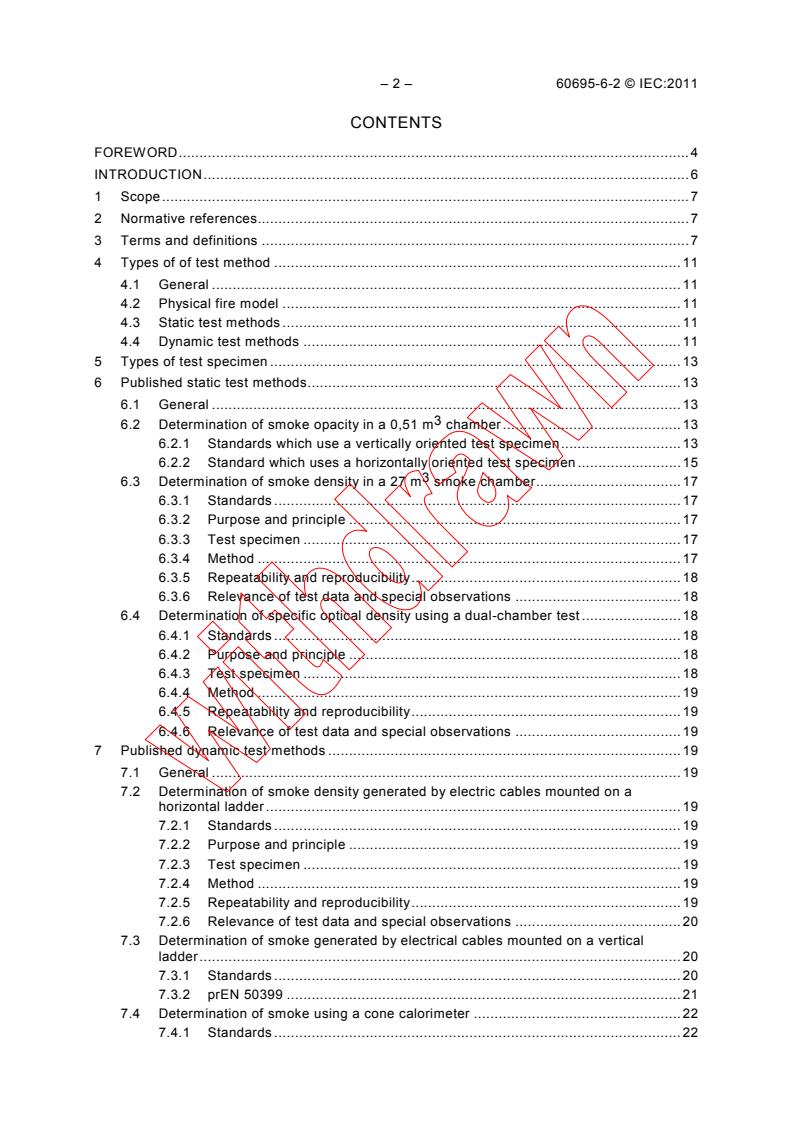
CONTENTS
FOREWORD . 4
INTRODUCTION . 6
1 Scope . 7
2 Normative references. 7
3 Terms and definitions . 7
4 Types of of test method . 11
4.1 General . 11
4.2 Physical fire model . 11
4.3 Static test methods . 11
4.4 Dynamic test methods . 11
5 Types of test specimen . 13
6 Published static test methods . 13
6.1 General . 13
6.2 Determination of smoke opacity in a 0,51 m chamber . 13
6.2.1 Standards which use a vertically oriented test specimen . 13
6.2.2 Standard which uses a horizontally oriented test specimen . 15
6.3 Determination of smoke density in a 27 m smoke chamber . 17
6.3.1 Standards . 17
6.3.2 Purpose and principle . 17
6.3.3 Test specimen . 17
6.3.4 Method . 17
6.3.5 Repeatability and reproducibility . 18
6.3.6 Relevance of test data and special observations . 18
6.4 Determination of specific optical density using a dual-chamber test . 18
6.4.1 Standards . 18
6.4.2 Purpose and principle . 18
6.4.3 Test specimen . 18
6.4.4 Method . 19
6.4.5 Repeatability and reproducibility . 19
6.4.6 Relevance of test data and special observations . 19
7 Published dynamic test methods . 19
7.1 General . 19
7.2 Determination of smoke density generated by electric cables mounted on a
horizontal ladder . 19
7.2.1 Standards . 19
7.2.2 Purpose and principle . 19
7.2.3 Test specimen . 19
7.2.4 Method . 19
7.2.5 Repeatability and reproducibility . 19
7.2.6 Relevance of test data and special observations . 20
7.3 Determination of smoke generated by electrical cables mounted on a vertical
ladder . 20
7.3.1 Standards . 20
7.3.2 prEN 50399 . 21
7.4 Determination of smoke using a cone calorimeter . 22
7.4.1 Standards . 22
60695-6-2 © IEC:2011 – 3 –
7.4.2 Purpose and principle . 22
7.4.3 Test specimen . 22
7.4.4 Method . 22
7.4.5 Repeatability and reproducibility . 23
7.4.6 Relevance of test data and special observations . 23
8 Overview of methods and relevance of data . 24
Annex A (informative) Repeatability and reproducibility data – NBS smoke chamber –
Interlaboratory tests from the French standard NF C20-902-1 and NF C20-902-2 . 27
Annex B (informative) Repeatability and reproducibility data – ISO 5659-2 . 28
Annex C (informative) Repeatability and reproducibility data – "Three metre cube"
smoke chamber – French interlaboratory tests according to IEC 61034-2 . 30
Annex D (informative) Repeatability and reproducibility data – NFPA 262 . 31
Annex E (informative) Precision data of smoke measurement in ISO 5660-2 . 32
Bibliography . 33
Table 1 – Characteristics of fire stages (ISO 19706) . 12
Table 2 – Overview of smoke test methods. 25
Table A.1 – Measurement of D . 27
m
Table B.1 – Measurement of D 10 . 28
s
Table B.2 – Test results for poly-carbonate. 28
Table B.3 – Test results for PVC flooring . 29
Table C.1 – Measurement of transmission expressed as a percentage . 30
Table E.1 – Combinations of materials of upholstered furniture . 32
Table E.2 – Repeatability and Reproducibility of specific extinction area (m /kg). 32
– 4 – 60695-6-2 © IEC:2011
INTERNATIONAL ELECTROTECHNICAL COMMISSION
____________
FIRE HAZARD TESTING –
Part 6-2: Smoke obscuration –
Summary and relevance of test methods
FOREWORD
1) The International Electrotechnical Commission (IEC) is a worldwide organization for standardization comprising
all national electrotechnical committees (IEC National Committees). The object of IEC is to promote
international co-operation on all questions concerning standardization in the electrical and electronic fields. To
this end and in addition to other activities, IEC publishes International Standards, Technical Specifications,
Technical Reports, Publicly Available Specifications (PAS) and Guides (hereafter referred to as “IEC
Publication(s)”). Their preparation is entrusted to technical committees; any IEC National Committee interested
in the subject dealt with may participate in this preparatory work. International, governmental and non-
governmental organizations liaising with the IEC also participate in this preparation. IEC collaborates closely
with the International Organization for Standardization (ISO) in accordance with conditions determined by
agreement between the two organizations.
2) The formal decisions or agreements of IEC on technical matters express, as nearly as possible, an international
consensus of opinion on the relevant subjects since each technical committee has representation from all
interested IEC National Committees.
3) IEC Publications have the form of recommendations for international use and are accepted by IEC National
Committees in that sense. While all reasonable efforts are made to ensure that the technical content of IEC
Publications is accurate, IEC cannot be held responsible for the way in which they are used or for any
misinterpretation by any end user.
4) In order to promote international uniformity, IEC National Committees undertake to apply IEC Publications
transparently to the maximum extent possible in their national and regional publications. Any divergence
between any IEC Publication and the corresponding national or regional publication shall be clearly indicated in
the latter.
5) IEC itself does not provide any attestation of conformity. Independent certification bodies provide conformity
assessment services and, in some areas, access to IEC marks of conformity. IEC is not responsible for any
services carried out by independent certification bodies.
6) All users should ensure that they have the latest edition of this publication.
7) No liability shall attach to IEC or its directors, employees, servants or agents including individual experts and
members of its technical committees and IEC National Committees for any personal injury, property damage or
other damage of any nature whatsoever, whether direct or indirect, or for costs (including legal fees) and
expenses arising out of the publication, use of, or reliance upon, this IEC Publication or any other IEC
Publications.
8) Attention is drawn to the Normative references cited in this publication. Use of the referenced publications is
indispensable for the correct application of this publication.
9) Attention is drawn to the possibility that some of the elements of this IEC Publication may be the subject of
patent rights. IEC shall not be held responsible for identifying any or all such patent rights.
International Standard IEC 60695-6-2 has been prepared by IEC technical committee 89: Fire
hazard testing.
This standard cancels and replaces IEC/TS 60695-6-2 published in 2005. This first edition
constitutes a technical revision.
The main changes with respect to the previous edition are listed below:
– this publication has been re-designated as an International Standard;
– updated normative references;
– updated terms and definitions;
– new test method Clause 7.3.2;
– numerous editorial changes of a technical nature throughout the publication.
60695-6-2 © IEC:2011 – 5 –
This standard is to be used in conjunction with IEC 60695-6-1.
It has the status of a basic safety publication in accordance with IEC Guide 104 and
ISO/IEC Guide 51.
The text of this standard is based on the following documents:
Enquiry draft Report on voting
89/1057/FDIS 89/1071/RVD
Full information on the voting for the approval of this standard can be found in the report on
voting indicated in the above table.
This publication has been drafted in accordance with the ISO/IEC Directives, Part 2.
A list of all parts of the IEC 60695 series, under the general title of Fire hazard testing, can be
found on the IEC website.
Part 6 consists of the following parts:
Part 6-1: Smoke obscuration – General guidance
Part 6-2: Smoke obscuration – Summary and relevance of test methods
Part 6-30: Guidance and test methods on the assessment of obscuration hazard of vision
caused by smoke opacity from electrotechnical products involved in fires – Small
scale static method – Determination of smoke opacity – Description of the
apparatus
Part 6-31: Smoke obscuration – Small-scale static test – Materials
The committee has decided that the contents of this publication will remain unchanged until the
stability date indicated on the IEC web site under "http://webstore.iec.ch" in the data related to
the specific publication. At this date, the publication will be
• reconfirmed,
• withdrawn,
• replaced by a revised edition, or
• amended.
– 6 – 60695-6-2 © IEC:2011
INTRODUCTION
The risk of fire needs to be considered in any electrical circuit, and the objective of component,
circuit and equipment design, and the choice of materials, is to reduce the likelihood of fire,
even in the event of foreseeable abnormal use, malfunction or failure.
Electrotechnical products, primarily as victims of fire, may nevertheless contribute to the fire.
One of the contributing hazards is the release of smoke, which may cause loss of vision and/or
disorientation which could impede escape from the building, or fire fighting.
This international standard describes smoke test methods in common use to assess the smoke
release from electrotechnical products, or from materials used in electrotechnical products. It
forms part of the IEC 60695-6 series which gives guidance to product committees wishing to
incorporate test methods for smoke obscuration in product standards.
60695-6-2 © IEC:2011 – 7 –
FIRE HAZARD TESTING –
Part 6-2: Smoke obscuration –
Summary and relevance of test methods
1 Scope
This part of IEC 60695 provides a summary of the test methods that are used in the
assessment of smoke obscuration. It presents a brief summary of static and dynamic test
methods in common use, either as international standards or national or industry standards. It
includes special observations on their relevance to electrotechnical products and their
materials and to fire scenarios, and it gives recommendations on their use.
This basic safety publication is intended for use by technical committees in the preparation of
standards in accordance with the principles laid down in IEC Guide 104 and ISO/IEC Guide 51.
One of the responsibilities of a technical committee is, wherever applicable, to make use of
basic safety publications in the preparation of its publications. The requirements, test methods
or test conditions of this basic safety publication will not apply unless specifically referred to or
included in the relevant publications.
2 Normative references
The following referenced documents are indispensable for the application of this document. For
dated references, only the edition cited applies. For undated references, the latest edition of
the referenced document (including any amendments) applies.
IEC 60695-6-1:2005, Fire hazard testing – Part 6-1: Smoke obscuration – General guidance
IEC Guide 104:, The preparation of safety publications and the use of basic safety publications
and group safety publications
ISO/IEC 13943:2008, Fire safety – Vocabulary
ISO 5725-2:1994, Accuracy (trueness and precision) of measurement methods and results –
Part 2: Basic method for the determination of repeatability and reproducibility of a standard
measurement method
ISO 19706:2007 , Guidelines for assessing the fire threat to people
3 Terms and definitions
For the purposes of this document, the terms and definitions given in ISO/IEC 13943, some of
which are reproduced below for users’ convenience, apply.
3.1
combustion
exothermic reaction of a substance with an oxidising agent
___________
This publication cancels and replaces ISO 9122-1:1989, Toxicity testing of fire effluents – Part 1: General.
– 8 – 60695-6-2 © IEC:2011
NOTE Combustion generally emits fire effluent accompanied by flames and/or glowing.
[ISO/IEC 13943, definition 4.46]
3.2
extinction area of smoke
product of the volume occupied by smoke and the extinction coefficient of the smoke
NOTE It is a measure of the amount of smoke, and the typical units are square metres (m ).
[ISO/IEC 13943, definition 4.92]
3.3
extinction coefficient
natural logarithm of the ratio of incident light intensity to transmitted light intensity, per unit light
path length
-1
NOTE Typical units are reciprocal metres (m ).
[ISO/IEC 13943, definition 4.93]
3.4
fire
(general) process of combustion characterized by the emission of heat and fire effluent and
usually accompanied by smoke, flame, glowing or a combination thereof
NOTE In the English language the term "fire" is used to designate three concepts, two of which, fire (3.5) and fire
(3.6), relate to specific types of self-supporting combustion with different meanings and two of them are designated
using two different terms in both French and German.
[ISO/IEC 13943, definition 4.96]
3.5
fire
(controlled) self-supporting combustion that has been deliberately arranged to provide useful
effects and is limited in its extent in time and space
[ISO/IEC 13943 definition 4.97]
3.6
fire
(uncontrolled) self-supporting combustion that has not been deliberately arranged to provide
useful effects and is not limited in its extent in time and space
[ISO/IEC 13943 definition 4.98]
3.7
fire effluent
totality of gases and aerosols, including suspended particles, created by combustion or
pyrolysis in a fire
[ISO/IEC 13943, definition 4.105]
3.8
fire hazard
physical object or condition with a potential for an undesirable consequence from fire
[ISO/IEC 13943, definition 4.112]
60695-6-2 © IEC:2011 – 9 –
3.9
fire model
fire simulation
calculation method that describes a system or process related to fire development, including
fire dynamics and the effects of fire
[ISO/IEC 13943, definition 4.116]
3.10
fire scenario
qualitative description of the course of a fire with respect to time, identifying key events that
characterise the studied fire and differentiate it from other possible fires
NOTE It typically defines the ignition and fire growth processes, the fully developed fire stage, the fire decay
stage, and the environment and systems that impact on the course of the fire.
[ISO/IEC 13943 definition 4.129]
3.11
heat flux
amount of thermal energy emitted, transmitted or received per unit area and per unit time
-2
NOTE The typical units are watts per square metre (W·m ).
[ISO/IEC 13943, definition 4.173]
3.12
ignition
sustained ignition (deprecated)
(general) initiation of combustion
[ISO/IEC 13943, definition 4.187]
3.13
ignition
sustained ignition (deprecated)
(flaming combustion) initiation of sustained flame
[ISO/IEC 13943 definition 4.188]
3.14
mass optical density of smoke
/(Δm L), where V is the volume of the test
optical density of smoke multiplied by a factor, V
chamber, Δm is the mass lost from the test specimen, and L is the light path length
2 -1
NOTE The typical units are square metres per gram (m × g ).
[ISO/IEC 13943, definition 4.225]
3.15
obscuration by smoke
reduction in the intensity of light due to its passage through smoke
cf. extinction area of smoke (3.2) and specific extinction area of smoke (3.23).
NOTE 1 In practice, obscuration by smoke is usually measured as the transmittance, which is normally expressed
as a percentage.
NOTE 2 Obscuration by smoke causes a reduction in visibility.
[ISO/IEC 13943 definition 4.242]
– 10 – 60695-6-2 © IEC:2011
3.16
optical density of smoke
measure of the attenuation of a light beam passing through smoke expressed as the logarithm
to the base 10 of the opacity of smoke
cf. specific optical density of smoke (3.24)
NOTE The optical density of smoke is dimensionless.
[ISO/IEC 13943, definition 4.244]
3.17
physical fire model
laboratory process, including the apparatus, the environment and the fire test procedure
intended to represent a certain phase of a fire
[ISO/IEC 13943, definition 4.251]
3.18
real-scale fire test
fire test that simulates a given application, taking into account the real scale, the real way the
item is installed and used, and the environment
NOTE Such a fire test normally assumes that the products are used in accordance with the conditions laid down
by the specifier and/or in accordance with normal practice.
[ISO/IEC 13943, definition 4.273]
3.19
small-scale fire test
fire test performed on a test specimen of small dimensions
NOTE A fire test performed on a test specimen of which the maximum dimension is less than 1 m is usually called
a small-scale fire test.
[ISO/IEC 13943, definition 4.292]
3.20
smoke
visible part of fire effluent
[ISO/IEC 13943, definition 4.293]
3.21
smoke production rate
amount of smoke produced per unit time in a fire or fire test
NOTE 1 It is calculated as the product of the volumetric flow rate of smoke and the extinction coefficient of the
smoke at the point of measurement.
2 -1
NOTE 2 The typical units are square metres per second (m × s ).
[ISO/IEC 13943 definition 4.295]
3.22
smoke release rate
see smoke production rate (3.21)
3.23
specific extinction area of smoke
extinction area of smoke produced by a test specimen in a given time period divided by the
mass lost from the test specimen in the same time period
60695-6-2 © IEC:2011 – 11 –
2 -1
NOTE The typical units are square metres per gram (m ·g ).
[ISO/IEC 13943 definition 4.301]
3.24
specific optical density of smoke
optical density of smoke multiplied by a geometric factor
NOTE 1 The geometric factor is V /(A⋅L), where V is the volume of the test chamber, A is the area of the exposed
surface of the test specimen, and L is the light path length.
NOTE 2 The use of the term “specific” does not denote “per unit mass” but rather denotes a quantity associated
with a particular test apparatus and area of the exposed surface of the test specimen.
NOTE 3 The specific optical density of smoke is dimensionless.
[ISO/IEC 13943 definition 4.303]
3.25
visibility
maximum distance at which an object of defined size, brightness and contrast can be seen and
recognized
[ISO/IEC 13943 definition 4.350]
4 Types of of test method
4.1 General
Test methods are characterised by whether they are static or dynamic and/or by the nature of
the test specimen.
4.2 Physical fire model
The amount and rate of smoke released from a given material or product is not an inherent
property of that material or product, but is critically dependent on the conditions under which
that material or product is burnt. Decomposition temperature, amount of ventilation and fuel
composition are the main variables which affect the composition of fire effluent, and hence the
amount of smoke and smoke production rate.
It is critical to show that the test conditions defined in a standardised test method (the physical
fire model) are relevant to, and replicate the desired stage of a real fire. ISO has published a
general classification of fire stages in ISO 19706, shown in Table 1. The important factors
affecting smoke production are oxygen concentration and irradiance/temperature.
4.3 Static test methods
A static smoke test is one in which the smoke generated is allowed to accumulate within the
test chamber. Some re-circulation and secondary combustion of smoke particles may occur.
The obscuration by smoke may be affected by deposition, agglomeration, stirring and
progressive oxygen depletion.
4.4 Dynamic test methods
A dynamic smoke test is one in which there is a continuous flow of fire effluent through the
measuring device without re-circulation. In this test, the smoke particles generated are not
allowed to accumulate and are dispersed in the controlled air flow through the test apparatus.
Decay of the smoke can occur in a dynamic test, and may involve coagulation of particles
and/or their deposition on cooling.
– 12 – 60695-6-2 © IEC:2011
Table 1 – Characteristics of fire stages (ISO 19706)
Fire stages Heat flux Oxygen volume % Fuel/air
Max. temperature °C
[CO] 100 ×[CO2]
to fuel equivalence
[CO2] ([CO2] + [CO])
surface ratio (plume)
2 Fuel surface Upper layer Entrained Exhausted
kW/m
v/v % efficiency
1. Non-flaming
a. self-sustaining not
d
450 to 800 25 to 85 20 20 0,1 to 1 50 to 90
(smouldering) applicable
b. oxidative pyrolysis from
a b c c
300 to 600 20 20 < 1
externally applied radiation
c. anaerobic pyrolysis from
b c c
100 to 500 0 0 >> 1
externally applied radiation
d e
2. Well-ventilated flaming 0 to 60 350 to 650 50 to 500 ≈ 20 ≈ 20 < 1 < 0,05 > 95
f
3. Under-ventilated flaming
a. small, localized fire,
a
generally in a poorly 0 to 30 300 to 600 50 to 500 15 to 20 5 to 10 > 1 0,2 to 0,4 70 to 80
ventilated compartment
g h i
b. post-flashover fire 50 to 150 350 to 650 > 600 < 15 < 5 > 1 0,1 to 0,4 70 to 90
a The upper limit is lower than for well-ventilated flaming combustion of a given combustible.
b The temperature in the upper layer of the fire room is most likely determined by the source of the externally applied radiation and room geometry.
c There are few data; but for pyrolysis, this ratio is expected to vary widely depending on the material chemistry and the local ventilation and thermal conditions.
d The fire’s oxygen consumption is small compared to that in the room or the inflow, the flame tip is below the hot gas upper layer or the upper layer is not yet
significantly vitiated to increase the CO yield significantly, the flames are not truncated by contact with another object, and the burning rate is controlled by the
availability of fuel.
e The ratio may be up to an order of magnitude higher for materials that are fire-resistant. There is no significant increase in this ratio for equivalence ratios up to
≈ 0,75. Between ≈ 0,75 and 1, some increase in this ratio may occur.
f The fire’s oxygen demand is limited by the ventilation opening(s); the flames extend into the upper layer.
g Assumed to be similar to well-ventilated flaming.
h The plume equivalence ratio has not been measured; the use of a global equivalence ratio is inappropriate.
i Instances of lower ratios have been measured. Generally, these result from secondary combustion outside the room vent.
60695-6-2 © IEC:2011 – 13 –
5 Types of test specimen
The test specimen may be a manufactured product, a component of a product, a simulated
product (representative of a portion of a manufactured product), a basic material (solid or
liquid), or a composite of materials.
6 Published static test methods
6.1 General
The static test methods reviewed below were selected on the basis that they are published
international, national or industry standards, and are in common usage in the electrotechnical
field. It is not intended to review all possible test methods.
NOTE These summaries are intended as a brief outline of the test methods, and should not be used in place of
full published standards.
6.2 Determination of smoke opacity in a 0,51 m chamber
6.2.1 Standards which use a vertically oriented test specimen
6.2.1.1 Standards
Two international and four national standards are based on testing a vertically oriented test
specimen in a single chamber of 0,51 m volume.
NOTE The chamber was developed in the USA by the National Bureau of Standards (now known as the National
Institute of Standards and Technology) and is often referred to as the “NBS chamber”.
These are: IEC/TR 60695-6-30 [1] and IEC 60695-6-31 [2], ASTM E662 [3], BS 6401 [4],
NF C20-902-1 [5] and NF C20-902-2 [6].
6.2.1.2 Purpose and principle
This small-scale fire test is used to assess the opacity of the smoke generated by a vertically
oriented test specimen of material exposed to a specified thermal irradiance, with or without
pilot flames, in a closed chamber 0,51 m in volume. The luminous flux through the smoke is
continuously recorded.
6.2.1.3 Test specimen
The test specimen is a flat piece 76,2 mm × 76,2 mm, with a maximum thickness of 25,4 mm.
6.2.1.4 Method
The method employs an electrical radiant energy source mounted so as to produce a heat flux
of 25 kW/m on a vertically mounted test specimen. Two modes of test are commonly used:
a) non-flaming, where only the radiant energy source is used, or
b) flaming, where a small burner is used in addition to the radiant energy source. This burner
produces a row of pilot flames along the lower edge of the test specimen, which ignite any
combustion products.
A photometric system using polychromatic white light, with a vertical light path is used to
measure the variation in light transmission during the test.
___________
Figures in square brackets refer to the Bibliography.
– 14 – 60695-6-2 © IEC:2011
Results are expressed in terms of specific optical density, D , which is calculated using the
S
following equation:
D = (V / AL) log (I /T )
s 10
where
V is the volume of smoke (i.e. the volume of the chamber);
A is the exposed surface area of the test specimen;
L is the path length of the light used to measure the smoke;
I is the incident luminous flux;
T is the transmitted luminous flux.
is related to the extinction area of the smoke (S) by the equation:
D
S
D = S / [A×ln(10) ]
s
i.e.
D = S / [2,303 × A]
s
where S is the extinction area of smoke.
NOTE D is used instead of D in NF C20-902-1 & -2 (see A.1).
m s
6.2.1.5 Repeatability and reproducibility
Repeatability and reproducibility have been determined in an interlaboratory trial, based on the
French standards NF C20-902-1 and NF C20-902-2.
The results, presented in accordance with ISO 5725-2, are given in Annex A.
6.2.1.6 Relevance of test data and special observations
Test methods based on the NBS smoke chamber have been in worldwide use since about
1970, primarily for material evaluation purposes. However, these methods have now, in many
cases, been superseded by ISO 5659-2 (see 6.2.2), which overcomes the following significant
limitations of the NBS method:
a) The heat flux is relatively low, and the air supply limited, which means that the method is
only able to replicate conditions found in ISO 19706 fire stages 1 b) and, possibly, 2 (see
Table 1).
b) The test specimen is small, vertically mounted and is essentially flat, which limits the scope
of the method to the evaluation of materials only, and excludes liquids and some
thermoplastics. Test specimens which swell towards the furnace also give problems, as the
incident heat flux experienced by the front of the test specimen increases significantly, and
the pilot flames can be extinguished, rendering the test invalid.
c) The limitations of the low heat flux and test specimen geometry mean that it is difficult to
establish a link between data from the NBS chamber and other fire scenarios.
Further limitations of methods based on the NBS smoke chamber include the following:
d) There is little or no correlation between data from this test, and the behaviour of products in
fires or real-scale fire tests.
e) There are no means of monitoring test specimen mass during the test.
f) The air supply is limited and the test specimen ceases to burn if the oxygen concentration
falls below approximately 14 %.
g) The deposition of smoke on the walls is significant.
60695-6-2 © IEC:2011 – 15 –
h) The repeatability and reproducibility of the method have been studied several times and
found to be very poor (see Annex A), and dependent on the nature of the material under
test. Materials with high flow, excessive swelling or irreproducible ignitability produce less
reliable results.
The method does however offer the useful option to evaluate smoke production from both
flaming and non-flaming combustion, albeit at a low heat flux.
The data generated are not suitable for use as input to fire hazard assessment or for fire safety
engineering.
Overall, this method is not recommended for further development for electrotechnical products.
Neither is it recommended as the basis for regulation or other controls on smoke release for
electrotechnical products, due to the limitations on the physical fire model and test specimen
geometry.
6.2.2 Standard which uses a horizontally oriented test specimen
6.2.2.1 Standard
One International standard, ISO 5659-2 [7], is based on the following method:
6.2.2.2 Purpose and principle
This test is used to assess the opacity of the smoke generated by a horizontally oriented test
specimen of material exposed to a specified thermal irradiance, with or without a pilot flame, in
a closed chamber 0,51 m in volume. The luminous flux through the smoke is continuously
measured and recorded.
NOTE This method uses essentially the same apparatus as described in 6.2.1, with the exception of modifications
to the source of thermal irradiance and test specimen orientation.
6.2.2.3 Test specimen
The test specimen is a flat piece 75 mm × 75 mm with a maximum thickness of 25 mm.
6.2.2.4 Method
This test method employs an electrically heated conical radiant energy source to expose
2 2
horizontally mounted test specimens to an incident flux of 25 kW/m or 50 kW/m . The heat
source consists of electrical windings contained within a truncated steel cone. The exposure
can be in flaming mode or in non-flaming mode, depending on whether or not a pilot flame,
consisting of a small gas burner, is used.
The test chamber is a closed chamber, 0,51 m in volume, and the smoke opacity is assessed
by means of a photometric system, with a white light shining vertically through the chamber.
The photodetector measures the decrease in light transmission due to the accumulation of
smoke.
Test specimens are placed horizontally under the conical radiant heater with a distance of
25 mm between the surface of the test specimen and the lower edge of the heater. For test
specimens which intumesce when exposed to the conical radiant heater, the distance should
be increased to 50 mm. The heat flux applied to the test specimen is calibrated, prior to the
tests, for the distance used.
The light transmission measurements are used to determine the specific optical density of
smoke.
– 16 – 60695-6-2 © IEC:2011
Optionally, the test specimen mass loss can also be monitored continuously during the test, by
means of a load cell located under the test specimen. If the load cell is used, the mass optical
density of smoke can also be determined.
Results are expressed in terms of specific optical density 10 min after the start of the test,
, which is calculated using the following equation:
D 10
s
D 10 = (V / AL) log (100 /T )
s 10 10
where
V is the volume of smoke (i.e. the volume of the chamber);
A is the exposed surface area of the test specimen;
L is the path length of the light used to measure the smoke;
T is the percentage transmittance after 10 min;
D 10 is related to the extinction area of the smoke produced after 10 min, S , by the
s (t=10 min
)
equation:
D 10 = S / [A × ln(10)], i.e.
s (t=10 min)
D 10 = S / [2,303 × A]
s (t=10 min)
Results can also be expressed in terms of mass optical density, D , by the equation:
mass
D = [ (V /L) log (100/T ) ] / Δm
mass 10
where
T is the percentage transmittance;
Δm is the mass consumed.
The relationship between D and the extinction area of the smoke is given by:
mass
S = D Δm ln(10) = 2,303 D Δm
mass mass
6.2.2.5 Repeatability and reproducibility
An interlaboratory trial involving eight laboratories has been carried out during the development
of ISO 5659-2. The results, presented in accordance with ISO 5725-2, are given in Table B.1 in
Annex B.
An additional interlaboratory trial involving ten laboratories has been carried out for two
intumescent plastics (polycarbonate and PVC flooring) using the test specimen-heater distance
of 50 mm, during a revision of ISO 5659-2. The results, presented in accordance with
ISO 5725-2, are given Table B.2 and Table B.3 in Annex B.
6.2.2.6 Relevance of test data and special observations
This method is based on the NBS smoke chamber method (see 6.1) and incorporates many
useful enhancements:
a) The test specimen is horizontally oriented, which allows for the evaluation of
thermoplastics. With further development this method may be suitable for liquids. However,
the method is still only suitable for essentially flat test specimens. Test specimens which
swell will still move towards the heat source and experience non-standard heat fluxes.
b) The maximum heat flux is increased to 50 kW/m , which means that the method can
replicate ISO 19706 fire stage 3a), in addition to stages 1b) and 2 (see Table 1). This heat
flux can also provide a greater discrimination between flame retardant materials.
60695-6-2 © IEC:2011 – 17 –
c) If mass loss rate data are recorded, they may be suitable for use as input to hazard
assessment, or to calculate mass optical density. The data generated may be suitable for
use as input to fire haz
...