


IEC TS 60695-6-2:2005
(Main)Fire hazard testing - Part 6-2: Smoke obscuration - Summary and relevance of test methods
General Information
- Abstract
Gives a summary of the test methods that are used in the assessment of smoke obscuration. It presents a brief summary of static and dynamic test methods in common use, either as international standards or national or industry standards. It includes special observations on their relevance to electrotechnical products and their materials and to fire scenarios, and it gives recommendations on their use. The main changes with respect to the previous edition are listed below: - updated normative references; - expanded terms and definitions; - numerous editorial changes of a technical nature throughout the publication. Has the status of a basic safety publication in accordance with IEC Guide 104.
- Status
- Replaced
- Publication Date
- 06-Jul-2005
- Technical Committee
- TC 89 - Fire hazard testing
- Drafting Committee
- WG 11 - TC 89/WG 11
- Current Stage
- DELPUB - Deleted Publication
- Start Date
- 25-Aug-2011
- Completion Date
- 28-Aug-2026
Relations
- Effective Date
- 05-Sep-2023
- Effective Date
- 05-Sep-2023
- Effective Date
- 05-Sep-2023
Get Certified
Connect with accredited certification bodies for this standard

IMQ S.p.A. (Certification)
Italian electrical product certification.

SLG Prüf- und Zertifizierungs GmbH
German testing and certification body.

UL Solutions
Global safety science company with testing, inspection and certification.
Sponsored listings
Frequently Asked Questions
IEC TS 60695-6-2:2005 is a technical specification published by the International Electrotechnical Commission (IEC). Its full title is "Fire hazard testing - Part 6-2: Smoke obscuration - Summary and relevance of test methods". This standard covers: Gives a summary of the test methods that are used in the assessment of smoke obscuration. It presents a brief summary of static and dynamic test methods in common use, either as international standards or national or industry standards. It includes special observations on their relevance to electrotechnical products and their materials and to fire scenarios, and it gives recommendations on their use. The main changes with respect to the previous edition are listed below: - updated normative references; - expanded terms and definitions; - numerous editorial changes of a technical nature throughout the publication. Has the status of a basic safety publication in accordance with IEC Guide 104.
Gives a summary of the test methods that are used in the assessment of smoke obscuration. It presents a brief summary of static and dynamic test methods in common use, either as international standards or national or industry standards. It includes special observations on their relevance to electrotechnical products and their materials and to fire scenarios, and it gives recommendations on their use. The main changes with respect to the previous edition are listed below: - updated normative references; - expanded terms and definitions; - numerous editorial changes of a technical nature throughout the publication. Has the status of a basic safety publication in accordance with IEC Guide 104.
IEC TS 60695-6-2:2005 is classified under the following ICS (International Classification for Standards) categories: 13.220.99 - Other standards related to protection against fire; 29.020 - Electrical engineering in general. The ICS classification helps identify the subject area and facilitates finding related standards.
IEC TS 60695-6-2:2005 has the following relationships with other standards: It is inter standard links to IEC 60695-6-2:2011, IEC 60695-6-2:2018, IEC TS 60695-6-2:2001. Understanding these relationships helps ensure you are using the most current and applicable version of the standard.
IEC TS 60695-6-2:2005 is available in PDF format for immediate download after purchase. The document can be added to your cart and obtained through the secure checkout process. Digital delivery ensures instant access to the complete standard document.
Standards Content (Sample)
SPÉCIFICATION CEI
TECHNIQUE
IEC
TS 60695-6-2
TECHNICAL
Deuxième édition
SPECIFICATION
Second edition
2005-07
PUBLICATION FONDAMENTALE DE SÉCURITÉ
BASIC SAFETY PUBLICATION
Essais relatifs aux risques du feu –
Partie 6-2:
Opacité des fumées –
Résumé et pertinence des méthodes d'essais
Fire hazard testing –
Part 6-2:
Smoke obscuration –
Summary and relevance of test methods
Numéro de référence
Reference number
CEI/IEC/TS 60695-6-2:2005
Numérotation des publications Publication numbering
Depuis le 1er janvier 1997, les publications de la CEI As from 1 January 1997 all IEC publications are
sont numérotées à partir de 60000. Ainsi, la CEI 34-1 issued with a designation in the 60000 series. For
devient la CEI 60034-1. example, IEC 34-1 is now referred to as IEC 60034-1.
Editions consolidées Consolidated editions
Les versions consolidées de certaines publications de la The IEC is now publishing consolidated versions of its
CEI incorporant les amendements sont disponibles. Par publications. For example, edition numbers 1.0, 1.1
exemple, les numéros d’édition 1.0, 1.1 et 1.2 indiquent and 1.2 refer, respectively, to the base publication,
respectivement la publication de base, la publication de the base publication incorporating amendment 1 and
base incorporant l’amendement 1, et la publication de the base publication incorporating amendments 1
base incorporant les amendements 1 et 2. and 2.
Informations supplémentaires Further information on IEC publications
sur les publications de la CEI
Le contenu technique des publications de la CEI est The technical content of IEC publications is kept
constamment revu par la CEI afin qu'il reflète l'état under constant review by the IEC, thus ensuring that
actuel de la technique. Des renseignements relatifs à the content reflects current technology. Information
cette publication, y compris sa validité, sont dispo- relating to this publication, including its validity, is
nibles dans le Catalogue des publications de la CEI available in the IEC Catalogue of publications
(voir ci-dessous) en plus des nouvelles éditions, (see below) in addition to new editions, amendments
amendements et corrigenda. Des informations sur les and corrigenda. Information on the subjects under
sujets à l’étude et l’avancement des travaux entrepris consideration and work in progress undertaken by the
par le comité d’études qui a élaboré cette publication, technical committee which has prepared this
ainsi que la liste des publications parues, sont publication, as well as the list of publications issued,
également disponibles par l’intermédiaire de: is also available from the following:
• Site web de la CEI (www.iec.ch) • IEC Web Site (www.iec.ch)
• Catalogue des publications de la CEI • Catalogue of IEC publications
Le catalogue en ligne sur le site web de la CEI The on-line catalogue on the IEC web site
(www.iec.ch/searchpub) vous permet de faire des (www.iec.ch/searchpub) enables you to search by a
recherches en utilisant de nombreux critères, variety of criteria including text searches,
comprenant des recherches textuelles, par comité technical committees and date of publication. On-
d’études ou date de publication. Des informations en line information is also available on recently
ligne sont également disponibles sur les nouvelles issued publications, withdrawn and replaced
publications, les publications remplacées ou retirées, publications, as well as corrigenda.
ainsi que sur les corrigenda.
• IEC Just Published • IEC Just Published
Ce résumé des dernières publications parues This summary of recently issued publications
(www.iec.ch/online_news/justpub) est aussi dispo- (www.iec.ch/online_news/justpub) is also available
nible par courrier électronique. Veuillez prendre by email. Please contact the Customer Service
contact avec le Service client (voir ci-dessous) Centre (see below) for further information.
pour plus d’informations.
• Service clients • Customer Service Centre
Si vous avez des questions au sujet de cette If you have any questions regarding this
publication ou avez besoin de renseignements publication or need further assistance, please
supplémentaires, prenez contact avec le Service contact the Customer Service Centre:
clients:
Email: custserv@iec.ch Email: custserv@iec.ch
Tél: +41 22 919 02 11 Tel: +41 22 919 02 11
Fax: +41 22 919 03 00 Fax: +41 22 919 03 00
.
SPÉCIFICATION CEI
TECHNIQUE
IEC
TS 60695-6-2
TECHNICAL
Deuxième édition
SPECIFICATION
Second edition
2005-07
PUBLICATION FONDAMENTALE DE SÉCURITÉ
BASIC SAFETY PUBLICATION
Essais relatifs aux risques du feu –
Partie 6-2:
Opacité des fumées –
Résumé et pertinence des méthodes d'essais
Fire hazard testing –
Part 6-2:
Smoke obscuration –
Summary and relevance of test methods
IEC 2005 Droits de reproduction réservés Copyright - all rights reserved
Aucune partie de cette publication ne peut être reproduite ni No part of this publication may be reproduced or utilized in any
utilisée sous quelque forme que ce soit et par aucun procédé, form or by any means, electronic or mechanical, including
électronique ou mécanique, y compris la photocopie et les photocopying and microfilm, without permission in writing from
microfilms, sans l'accord écrit de l'éditeur. the publisher.
International Electrotechnical Commission, 3, rue de Varembé, PO Box 131, CH-1211 Geneva 20, Switzerland
Telephone: +41 22 919 02 11 Telefax: +41 22 919 03 00 E-mail: inmail@iec.ch Web: www.iec.ch
CODE PRIX
V
PRICE CODE
Commission Electrotechnique Internationale
International Electrotechnical Commission
МеждународнаяЭлектротехническаяКомиссия
Pour prix, voir catalogue en vigueur
For price, see current catalogue
– 2 – TS 60695-6-2 CEI:2005
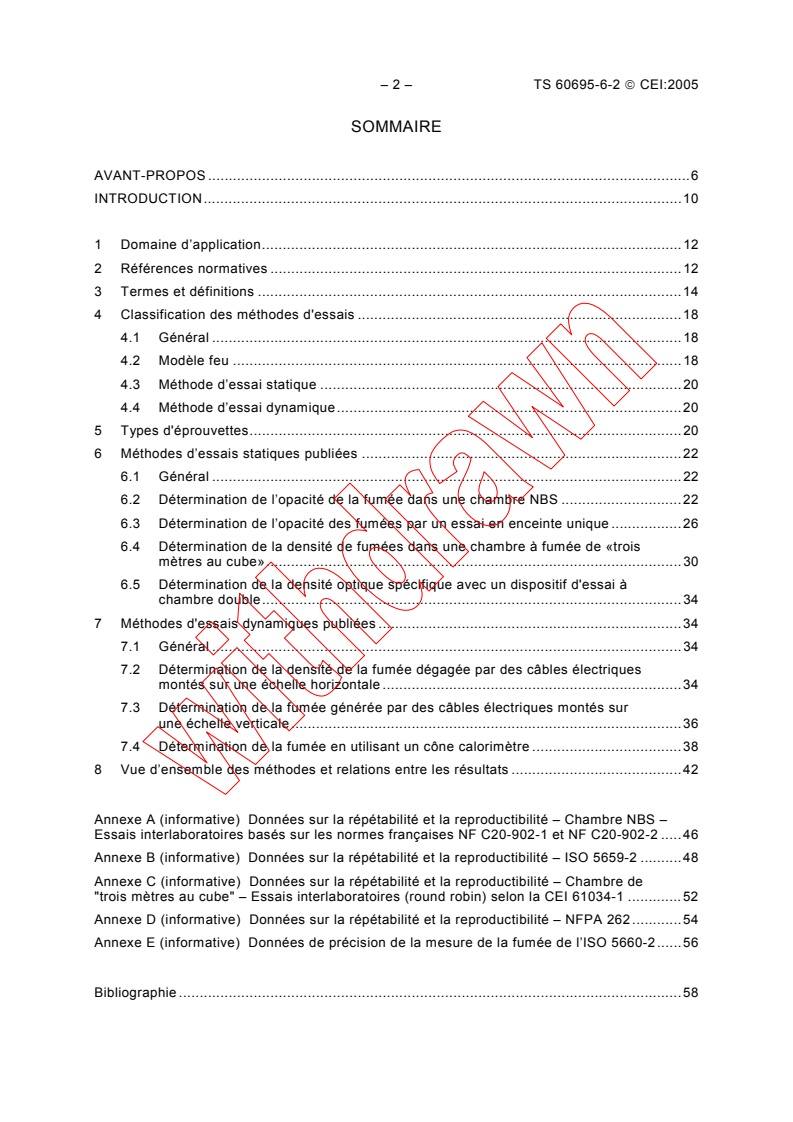
SOMMAIRE
AVANT-PROPOS .6
INTRODUCTION.10
1 Domaine d’application.12
2 Références normatives .12
3 Termes et définitions .14
4 Classification des méthodes d'essais .18
4.1 Général .18
4.2 Modèle feu .18
4.3 Méthode d’essai statique .20
4.4 Méthode d’essai dynamique.20
5 Types d'éprouvettes.20
6 Méthodes d’essais statiques publiées .22
6.1 Général .22
6.2 Détermination de l’opacité de la fumée dans une chambre NBS .22
6.3 Détermination de l’opacité des fumées par un essai en enceinte unique .26
6.4 Détermination de la densité de fumées dans une chambre à fumée de «trois
mètres au cube».30
6.5 Détermination de la densité optique spécifique avec un dispositif d'essai à
chambre double.34
7 Méthodes d'essais dynamiques publiées .34
7.1 Général .34
7.2 Détermination de la densité de la fumée dégagée par des câbles électriques
montés sur une échelle horizontale .34
7.3 Détermination de la fumée générée par des câbles électriques montés sur
une échelle verticale.36
7.4 Détermination de la fumée en utilisant un cône calorimètre .38
8 Vue d’ensemble des méthodes et relations entre les résultats .42
Annexe A (informative) Données sur la répétabilité et la reproductibilité – Chambre NBS –
Essais interlaboratoires basés sur les normes françaises NF C20-902-1 et NF C20-902-2 .46
Annexe B (informative) Données sur la répétabilité et la reproductibilité – ISO 5659-2 .48
Annexe C (informative) Données sur la répétabilité et la reproductibilité – Chambre de
"trois mètres au cube" – Essais interlaboratoires (round robin) selon la CEI 61034-1 .52
Annexe D (informative) Données sur la répétabilité et la reproductibilité – NFPA 262 .54
Annexe E (informative) Données de précision de la mesure de la fumée de l’ISO 5660-2.56
Bibliographie .58
TS 60695-6-2 IEC:2005 – 3 –
CONTENTS
FOREWORD.7
INTRODUCTION.11
1 Scope.13
2 Normative references.13
3 Terms and definitions .15
4 Classification of test methods .19
4.1 General .19
4.2 Fire model .19
4.3 Static test method.21
4.4 Dynamic test method .21
5 Types of test specimen .21
6 Published static test methods.23
6.1 General .23
6.2 Determination of smoke opacity in an NBS chamber .23
6.3 Determination of smoke opacity by a single-chamber test.27
6.4 Determination of smoke density in a “three metre cube” smoke chamber.31
6.5 Determination of specific optical density using a dual-chamber test .35
7 Published dynamic tests .35
7.1 General .35
7.2 Determination of smoke density generated by electric cables mounted on a
horizontal ladder .35
7.3 Determination of smoke generated by electrical cables mounted on a vertical
ladder.37
7.4 Determination of smoke using a cone calorimeter .39
8 Overview of methods and relevance of data .43
Annex A (informative) Repeatability and reproducibility data – NBS smoke chamber –
Interlaboratory tests from the French standards NF C20-902-1 and NF C20-902-2.47
Annex B (informative) Repeatability and reproducibility data – ISO 5659-2 .49
Annex C (informative) Repeatability and reproducibility data – "Three metre cube"
smoke chamber – French round robin tests according to IEC 61034-1 .53
Annex D (informative) Repeatability and reproducibility data – NFPA 262.55
Annex E (informative) Precision data of smoke measurement in ISO 5660-2.57
Bibliography .59
– 4 – TS 60695-6-2 CEI:2005
Tableau 1 – Classification générale des feux suivant l’ISO/TR 9122-1 .20
Tableau 2 – Vue d’ensemble des méthodes d’essais de fumée.44
Tableau A.1 – Valeurs de D .46
m
Tableau B.1 – Valeurs de D 10 .48
s
Tableau B.2 – Résultats d’essai pour le polycarbonate .48
Tableau B.3 – Résultats d’essai pour les revêtements de sol en PVC .50
Tableau C.1 – Valeurs du flux lumineux transmis en pourcentage.52
Tableau E.1 – Combinaisons de matériaux de meubles rembourrés.56
Tableau E.2 – Répétabilité et reproductibilité de la surface spécifique d’extinction (m /kg).56
TS 60695-6-2 IEC:2005 – 5 –
Table 1 – General classification of fires according to ISO/TR 9122-1 .21
Table 2 – Overview of smoke test methods.45
Table A.1 – Measurement of D .47
m
Table B.1 – Measurement of D 10.49
s
Table B.2 – Test results for poly-carbonate.49
Table B.3 – Test results for PVC flooring.51
Table C.1 – Measurement of transmission expressed as a percentage .53
Table E.1 – Combinations of materials of upholstered furniture.57
Table E.2 – Repeatability and reproducibility of specific extinction area (m /kg).57
– 6 – TS 60695-6-2 CEI:2005
COMMISSION ÉLECTROTECHNIQUE INTERNATIONALE
____________
ESSAIS RELATIFS AUX RISQUES DU FEU –
Partie 6-2: Opacité des fumées –
Résumé et pertinence des méthodes d'essais
AVANT-PROPOS
1) La Commission Electrotechnique Internationale (CEI) est une organisation mondiale de normalisation composée
de l'ensemble des comités électrotechniques nationaux (Comités nationaux de la CEI). La CEI a pour objet de
favoriser la coopération internationale pour toutes les questions de normalisation dans les domaines de
l'électricité et de l'électronique. A cet effet, la CEI – entre autres activités – publie des Normes internationales,
des Spécifications techniques, des Rapports techniques, des Spécifications accessibles au public (PAS) et des
Guides (ci-après dénommés "Publication(s) de la CEI"). Leur élaboration est confiée à des comités d'études,
aux travaux desquels tout Comité national intéressé par le sujet traité peut participer. Les organisations
internationales, gouvernementales et non gouvernementales, en liaison avec la CEI, participent également aux
travaux. La CEI collabore étroitement avec l'Organisation Internationale de Normalisation (ISO), selon des
conditions fixées par accord entre les deux organisations.
2) Les décisions ou accords officiels de la CEI concernant les questions techniques représentent, dans la mesure
du possible, un accord international sur les sujets étudiés, étant donné que les Comités nationaux intéressés
sont représentés dans chaque comité d’études.
3) Les Publications de la CEI se présentent sous la forme de recommandations internationales et sont agréées
comme telles par les Comités nationaux de la CEI. Tous les efforts raisonnables sont entrepris afin que la CEI
s'assure de l'exactitude du contenu technique de ses publications; la CEI ne peut pas être tenue responsable de
l'éventuelle mauvaise utilisation ou interprétation qui en est faite par un quelconque utilisateur final.
4) Dans le but d'encourager l'unification internationale, les Comités nationaux de la CEI s'engagent à appliquer de
façon transparente, dans toute la mesure possible, les normes internationales de la CEI dans leurs normes
nationales et régionales. Toutes divergences entre toutes Publications de la CEI et toutes publications
nationales ou régionales correspondantes doivent être indiquées en termes clairs dans ces dernières.
5) La CEI n’a prévu aucune procédure de marquage valant indication d’approbation et n'engage pas sa
responsabilité pour les équipements déclarés conformes à une de ses Publications.
6) Tous les utilisateurs doivent s'assurer qu'ils sont en possession de la dernière édition de cette publication.
7) Aucune responsabilité ne doit être imputée à la CEI, à ses administrateurs, employés, auxiliaires ou
mandataires, y compris ses experts particuliers et les membres de ses comités d'études et des Comités
nationaux de la CEI, pour tout préjudice causé en cas de dommages corporels et matériels, ou de tout autre
dommage de quelque nature que ce soit, directe ou indirecte, ou pour supporter les coûts (y compris les frais
de justice) et les dépenses découlant de la publication ou de l'utilisation de cette Publication de la CEI ou de
toute autre Publication de la CEI, ou au crédit qui lui est accordé.
8) L'attention est attirée sur les références normatives citées dans cette publication. L'utilisation de publications
référencées est obligatoire pour une application correcte de la présente publication.
9) L’attention est attirée sur le fait que certains des éléments de la présente Publication de la CEI peuvent faire
l’objet de droits de propriété intellectuelle ou de droits analogues. La CEI ne saurait être tenue pour
responsable de ne pas avoir identifié de tels droits de propriété et de ne pas avoir signalé leur existence.
La tâche principale des comités d’études de la CEI est l’élaboration des Normes
internationales. Exceptionnellement, un comité d’études peut proposer la publication d’une
spécification technique
• lorsqu’en dépit de maints efforts, l’accord requis ne peut être réalisé en faveur de la
publication d’une Norme internationale, ou
• lorsque le sujet en question est encore en cours de développement technique ou quand,
pour une raison quelconque, la possibilité d’un accord pour la publication d’une Norme
internationale peut être envisagée pour l’avenir mais pas dans l’immédiat.
Les spécifications techniques font l’objet d’un nouvel examen trois ans au plus tard après leur
publication afin de décider éventuellement de leur transformation en Normes internationales.
TS 60695-6-2 IEC:2005 – 7 –
INTERNATIONAL ELECTROTECHNICAL COMMISSION
____________
FIRE HAZARD TESTING –
Part 6-2: Smoke obscuration –
Summary and relevance of test methods
FOREWORD
1) The International Electrotechnical Commission (IEC) is a worldwide organization for standardization comprising
all national electrotechnical committees (IEC National Committees). The object of IEC is to promote
international co-operation on all questions concerning standardization in the electrical and electronic fields. To
this end and in addition to other activities, IEC publishes International Standards, Technical Specifications,
Technical Reports, Publicly Available Specifications (PAS) and Guides (hereafter referred to as “IEC
Publication(s)”). Their preparation is entrusted to technical committees; any IEC National Committee interested
in the subject dealt with may participate in this preparatory work. International, governmental and non-
governmental organizations liaising with the IEC also participate in this preparation. IEC collaborates closely
with the International Organization for Standardization (ISO) in accordance with conditions determined by
agreement between the two organizations.
2) The formal decisions or agreements of IEC on technical matters express, as nearly as possible, an international
consensus of opinion on the relevant subjects since each technical committee has representation from all
interested IEC National Committees.
3) IEC Publications have the form of recommendations for international use and are accepted by IEC National
Committees in that sense. While all reasonable efforts are made to ensure that the technical content of IEC
Publications is accurate, IEC cannot be held responsible for the way in which they are used or for any
misinterpretation by any end user.
4) In order to promote international uniformity, IEC National Committees undertake to apply IEC Publications
transparently to the maximum extent possible in their national and regional publications. Any divergence
between any IEC Publication and the corresponding national or regional publication shall be clearly indicated in
the latter.
5) IEC provides no marking procedure to indicate its approval and cannot be rendered responsible for any
equipment declared to be in conformity with an IEC Publication.
6) All users should ensure that they have the latest edition of this publication.
7) No liability shall attach to IEC or its directors, employees, servants or agents including individual experts and
members of its technical committees and IEC National Committees for any personal injury, property damage or
other damage of any nature whatsoever, whether direct or indirect, or for costs (including legal fees) and
expenses arising out of the publication, use of, or reliance upon, this IEC Publication or any other IEC
Publications.
8) Attention is drawn to the Normative references cited in this publication. Use of the referenced publications is
indispensable for the correct application of this publication.
9) Attention is drawn to the possibility that some of the elements of this IEC Publication may be the subject of
patent rights. IEC shall not be held responsible for identifying any or all such patent rights.
The main task of IEC technical committees is to prepare International Standards. In
exceptional circumstances, a technical committee may propose the publication of a technical
specification when
• the required support cannot be obtained for the publication of an International Standard,
despite repeated efforts, or
• The subject is still under technical development or where, for any other reason, there is the
future but no immediate possibility of an agreement on an International Standard.
Technical specifications are subject to review within three years of publication to decide
whether they can be transformed into International Standards.
– 8 – TS 60695-6-2 CEI:2005
La CEI 60695-6-2, qui est une spécification technique, a été établie par le comité d’études 89
de la CEI: Essais relatifs aux risques du feu.
Cette seconde édition annule et remplace la première édition publiée en 2001.
Les principales modifications par rapport à l'édition antérieure sont indiquées ci-dessous:
– mise à jour des références normatives;
– ajout de termes et de définitions;
– nombreuses modifications rédactionnelles de nature technique dans toute la publication.
La présente spécification technique doit être utilisée conjointement à la CEI 60695-6-1.
Elle a le statut de publication fondamentale de sécurité, conformément au Guide CEI 104.
Le texte de cette spécification technique est issu des documents suivants:
Projet d'enquête Rapport de vote
89/658/DTS 89/672A/RVC
Le rapport de vote indiqué dans le tableau ci-dessus donne toute information sur le vote ayant
abouti à l'approbation de cette spécification technique.
Cette publication a été rédigée selon les Directives ISO/CEI, Partie 2.
La CEI 60695-6, qui porte le titre général Essais relatifs aux risques du feu – Partie 6: Opacité
des fumées, comprend les parties suivantes:
Partie 6-1: Lignes directrices générales
Partie 6-2: Résumé et pertinence des méthodes d'essais
Partie 6-30: Guide et méthodes d’essai pour l’évaluation des dangers d’obscurcissement de
la vision par les fumées provenant de produits électrotechniques impliqués dans
des feux – Méthode statique à petite échelle – Détermination de l’opacité des
fumées – Description de l’appareillage
Partie 6-31: Méthode statique à petite échelle – Matériaux
Le comité a décidé que le contenu de cette publication ne sera pas modifié avant la date de
maintenance indiquée sur le site web de la CEI sous "http://webstore.iec.ch" dans les données
relatives à la publication recherchée. A cette date, la publication sera
• transformée en Norme internationale,
• reconduite,
• supprimée,
• remplacée par une édition révisée, ou
• amendée.
TS 60695-6-2 IEC:2005 – 9 –
IEC 60695-6-2, which is a technical specification, has been prepared by IEC technical
committee 89: Fire hazard testing.
This second edition cancels and replaces the first edition published in 2001.
The main changes with respect to the previous edition are listed below:
– updated normative references;
– expanded terms and definitions;
– numerous editorial changes of a technical nature throughout the publication.
This technical specification is to be used in conjunction with IEC 60695-6-1.
It has the status of a basic safety publication in accordance with IEC Guide 104.
The text of this technical specification is based on the following documents:
Enquiry draft Report on voting
89/658/DTS 89/672A/RVC
Full information on the voting for the approval of this technical specification can be found in the
report on voting indicated in the above table.
This publication has been drafted in accordance with the ISO/IEC Directives, Part 2.
IEC 60695-6, under the general heading Fire hazard testing – Part 6: Smoke obscuration,
consists of the following parts:
Part 6-1: General guidance
Part 6-2: Summary and relevance of test methods
Part 6-30: Guidance and test methods on the assessment of obscuration hazard of vision
caused by smoke opacity from electrotechnical products involved in fires – Small
scale static method – Determination of smoke opacity – Description of the
apparatus
Part 6-31: Small-scale static test – Materials
The committee has decided that the contents of this publication will remain unchanged until the
maintenance result date indicated on the IEC web site under "http://webstore.iec.ch" in the data
related to the specific publication. At this date, the publication will be
• transformed into an International standard,
• reconfirmed,
• withdrawn,
• replaced by a revised edition, or
• amended.
– 10 – TS 60695-6-2 CEI:2005
INTRODUCTION
Il est nécessaire que le risque d’incendie soit envisagé pour tout circuit électrique, et l’objectif
lors de la conception des composants, des circuits et des équipements ainsi que le choix des
matériaux est de réduire la probabilité d’incendie, même dans le cas d’une utilisation anormale
prévisible, d’un mauvais fonctionnement ou d’une défaillance.
Les produits électrotechniques, initialement victimes de l’incendie, peuvent néanmoins
contribuer à l’incendie. L’un des risques y participant est la production de fumée, qui peut
entraîner la perte de la vision et/ou une désorientation pouvant entraver l’évacuation des
immeubles ou la lutte contre l’incendie.
Cette spécification technique décrit des méthodes d’essais de mesure de la fumée, commu-
nément utilisées pour évaluer les fumées émises par les produits électrotechniques ou les
matériaux utilisés dans les produits électrotechniques. Elle fait partie de la série CEI 60695-6,
qui donne des indications aux comités de produits désirant incorporer des méthodes d’essais
sur l’obscurcissement par la fumée dans les normes de produit.
TS 60695-6-2 IEC:2005 – 11 –
INTRODUCTION
The risk of fire needs to be considered in any electrical circuit, and the objective of component,
circuit and equipment design, and the choice of materials, is to reduce the likelihood of fire,
even in the event of foreseeable abnormal use, malfunction or failure.
Electrotechnical products, primarily as victims of fire, may nevertheless contribute to the fire.
One of the contributing hazards is the release of smoke, which may cause loss of vision and/or
disorientation which could impede escape from the building, or fire fighting.
This technical specification describes smoke test methods in common use to assess the
smoke release from electrotechnical products, or from materials used in electrotechnical
products. It forms part of the IEC 60695-6 series which gives guidance to product committees
wishing to incorporate test methods for smoke obscuration in product standards.
– 12 – TS 60695-6-2 CEI:2005
ESSAIS RELATIFS AUX RISQUES DU FEU –
Partie 6-2: Opacité des fumées –
Résumé et pertinence des méthodes d'essais
1 Domaine d’application
La présente spécification technique donne un résumé des méthodes d'essais qui sont utilisées
pour évaluer l’obscurcissement par la fumée. Elle présente un bref résumé des méthodes
d'essais dynamiques et statiques communément utilisées, aussi bien comme normes
internationales ou nationales ou normes industrielles. Elle inclut des observations particulières
relatives à un scénario feu, pour les produits électrotechniques et leurs matériaux, et donne
des recommandations pour leurs utilisations.
L’une des responsabilités d’un comité d’études consiste, le cas échéant, à utiliser les
publications fondamentales de sécurité dans le cadre de l’élaboration de ses publications.
2 Références normatives
Les documents de référence suivants sont indispensables pour l'application du présent
document. Pour les références datées, seule l'édition citée s'applique. Pour les références non
datées, la dernière édition du document de référence s'applique (y compris les éventuels
amendements).
CEI 60695-4:2005, Essais relatifs aux risques du feu – Partie 4: Terminologie relative aux
essais au feu
CEI 60695-6-1, Essais relatifs aux risques du feu – Partie 6-1: Opacité des fumées – Lignes
directrices générales
CEI 61034-1, Mesure de la densité de fumées dégagées par des câbles brûlant dans des
conditions définies – Partie 1: Appareillage d’essai
Guide CEI 104, Elaboration des publications de sécurité et utilisation des publications
fondamentales de sécurité et publications groupées de sécurité
ISO/CEI 13943:2000, Sécurité au feu – Vocabulaire
ISO/CEI Guide 51, Aspects liés à la sécurité – Principes directeurs pour les inclure dans les
normes
ISO 5725-2, Exactitude (justesse et fidélité) des résultats et méthodes de mesure – Partie 2:
Méthode de base pour la détermination de la répétabilité et de la reproductibilité d’une méthode
de mesure normalisée
ISO/TR 9122-1:1989, Essais de toxicité des effluents du feu – Partie 1: Généralités
NF C20-902-1, Essais relatifs aux risques du feu – Méthodes d’essai – Détermination de
l’opacité des fumées en atmosphère non renouvelée – Partie 1: Méthodologie et dispositif
d’essai
___________
Ce document a été annulé.
TS 60695-6-2 IEC:2005 – 13 –
FIRE HAZARD TESTING –
Part 6-2: Smoke obscuration –
Summary and relevance of test methods
1 Scope
This technical specification gives a summary of the test methods that are used in the
assessment of smoke obscuration. It presents a brief summary of static and dynamic test
methods in common use, either as international standards or national or industry standards. It
includes special observations on their relevance to electrotechnical products and their
materials and to fire scenarios, and it gives recommendations on their use.
One of the responsibilities of a technical committee is, wherever applicable, to make use of
basic safety publications in the preparation of its publications.
2 Normative references
The following referenced documents are indispensable for the application of this document. For
dated references, only the edition cited applies. For undated references, the latest edition of
the referenced document (including any amendments) applies.
IEC 60695-4:2005, Fire hazard testing – Part 4: Terminology concerning fire tests
IEC 60695-6-1, Fire hazard testing – Part 6-1: Smoke obscuration – General guidance
IEC 61034-1, Measurement of smoke density of cables burning under defined conditions – Part
1: Test apparatus
IEC Guide 104, The preparation of safety publications and the use of basic safety publications
and group safety publications
ISO/IEC 13943:2000, Fire safety – Vocabulary
ISO/IEC Guide 51, Safety aspects – Guidelines for their inclusion in standards
ISO 5725-2, Accuracy (trueness and precision) of measurement methods and results – Part 2:
Basic method for the determination of repeatability and reproducibility of a standard
measurement method
ISO/TR 9122-1:1989, Toxicity testing of fire effluents – Part 1: General
NF C20-902-1, Fire hazard testing – Test methods – Determination of smoke opacity without
air change – Part 1: Methodology and test devices
___________
This document has been withdrawn.
– 14 – TS 60695-6-2 CEI:2005
NF C20-902-2, Essais relatifs aux risques du feu – Méthodes d’essai – Détermination de
l’opacité des fumées en atmosphère non renouvelée – Partie 2: Méthode d'essai pour
matériaux utilisés dans les câbles électriques et dans les câbles à fibres optiques
3 Termes et définitions
Pour les besoins du présent document, les termes et définitions suivantes s'appliquent, dont
certains sont tirés de l’ISO/CEI 13943 et de la CEI 60695-4.
3.1
combustion
réaction exothermique d'une substance avec un comburant
NOTE La combustion émet généralement des effluents accompagnés de flammes et/ou d'incandescence.
[ISO/CEI 13943, définition 23]
3.2
surface d’extinction de la fumée
produit du coefficient d’extinction par le volume occupé par la fumée
NOTE C’est une mesure de quantité de fumée.
[CEI 60695-4, définition 3.17]
3.3
coefficient d’extinction de la fumée
logarithme népérien de l’opacité de la fumée divisé par la longueur du faisceau lumineux utilisé
pour mesurer l’opacité de la fumée
[CEI 60695-4, définition 3.18]
3.4
feu
incendie
a) feu: combustion caractérisée par une émission de chaleur et d'effluents accompagnée de
fumée et/ou de flammes et/ou d'incandescence;
b) incendie: combustion rapide qui se développe sans contrôle dans le temps et dans l'espace
[CEI 60695-4, définition 3.19]
3.5
effluents du feu
ensemble des gaz, particules ou aérosols dégagés par combustion ou pyrolyse
[CEI 60695-4, définition 3.23]
3.6
risques du feu
danger d’incendie
possibilité de blessures ou de perte de la vie et/ou de dégâts matériels que représente un
incendie
[CEI 60695-4, définition 3.26]
TS 60695-6-2 IEC:2005 – 15 –
NF C20-902-2, Fire hazard testing – Test methods – Determination of smoke opacity without
air change – Part 2: Test methods for materials used in electric cables and in optical fibre
cables
3 Terms and definitions
For the purposes of this document the following definitions apply, some of which are taken
from ISO/IEC 13943 and IEC 60695-4.
3.1
combustion
exothermic reaction of a substance with an oxidiser
NOTE Combustion generally emits effluent accompanied by flames and/or visible light.
[ISO/IEC 13943, definition 23]
3.2
extinction area of smoke
product of the extinction coefficient and the volume occupied by the smoke
NOTE It is a measure of the amount of smoke.
[IEC 60695-4, definition 3.17]
3.3
extinction coefficient of smoke
natural logarithm of the opacity of smoke divided by the path length of the light used to
measure the smoke opacity
[IEC 60695-4, definition 3.18]
3.4
fire
a) process of combustion characterized by the emission of heat and effluent accompanied by
smoke, and/or flame, and/or glowing;
b) rapid combustion spreading uncontrolled in time and space
[IEC 60695-4, definition 3.19]
3.5
fire effluent
the total gaseous, particulate or aerosol effluent from combustion or pyrolysis
[IEC 60695-4, definition 3.23]
3.6
fire hazard
potential for injury or loss of life and/or damage to property from fire
[IEC 60695-4, definition 3.26]
– 16 – TS 60695-6-2 CEI:2005
3.7
modèle feu
procédé ou processus ayant pour but de représenter, de prédire ou de reproduire une ou
plusieurs étapes d'un feu, ou la transition entre deux étapes
[ISO/CEI 13943, définition 51]
3.8
scénario feu
description détaillée des conditions, y compris de l’environnement, dans lesquelles se
déroulent une ou plusieurs étapes d'un feu réel à un emplacement spécifique ou d'une
simulation dans un essai en vraie grandeur, depuis la situation avant le début jusqu'à la fin de
la combustion
[ISO/CEI 13943, définition 58]
3.9
éclairement énergétique
quantité d'énergie thermique émise, transmise ou reçue par unité de surface et de temps
NOTE Il est exprimé en watts par mètre carré.
[ISO/CEI 13943, définition 85]
3.10
allumage
action d'allumer
NOTE Le terme “ignition” a en français un sens très différent [état d'un corps en combustion].
[ISO/CEI 13943, définition 96]
3.11
densité optique massique de la fumée
densité optique multipliée par un facteur, V / (L × Δm), où V est le volume de la chambre
d’essai, Δm est la perte de masse de l’éprouvette d'essai, et L est la longueur du faisceau
lumineux
3.12
densité optique de la fumée
logarithme décimal de l’opacité de la fumée (lg(I/T)) (voir aussi densité optique spécifique)
[CEI 60695-4, définition 3.68]
3.13
essai en vraie grandeur
essai qui simule une situation d’utilisation finale dans la taille et le décor environnant
[CEI 60695-4, définition 3.73]
3.14
essai à petite échelle
essai qui peut être effectué sur une paillasse typique de laboratoire
[CEI 60695-4, définition 3.77]
TS 60695-6-2 IEC:2005 – 17 –
3.7
fire model
procedure or process intended to represent, predict or reproduce one or more phases of a fire,
or the transition between phases
[ISO/IEC 13943, definition 51]
3.8
fire scenario
detailed description of conditions, including environmental, of one or more stages from before
ignition to after completion of combustion in an actual fire at a specific location or in a real-
scale simulation
[ISO/IEC 13943, definition 58]
3.9
heat flux
amount of thermal energy emitted, transmitted or received per unit area and unit time
NOTE It is expressed in watts per square metre.
[ISO/IEC 13943, definition 85]
3.10
ignition
initiation of combustion
NOTE The term "ignition" in French has a very different meaning [state of body combustion].
[ISO/IEC 13943, definition 96]
3.11
mass optical density of smoke
optical density multiplied by a factor, V / (L × Δm), where V is the volume of the test chamber,
Δm is the mass loss of the test specimen and L is the light path length
3.12
optical density of smoke
common logarithm of the opacity of smoke (lg(I/T)) (see also specific optical density)
[IEC 60695-4, definition 3.68]
3.13
real-scale test
test which simulates an end-use situation in both size and surroundings
[IEC 60695-4, definition 3.73]
3.14
small-scale test
test which may be made on a typical laboratory bench
[IEC 60695-4, definition 3.77]
– 18 – TS 60695-6-2 CEI:2005
3.15
fumée
ensemble visible de particules solides et/ou liquides en suspension dans les gaz résultant
d'une combustion ou d'une pyrolyse
[CEI 60695-4, définition 3.79]
3.16
obscurcissement par la fumée
réduction de la visibilité due à la fumée
[CEI 60695-4, définition 3.80]
3.17
vitesse de production de fumée
surface d’extinction de la fumée produite, par unité de temps, par la combustion d’un matériau
dans des conditions d’essai spécifiées
3.18
vitesse de dégagement de fumée
voir "vitesse de production de fumée"
3.19
surface spécifique d’extinction de la fumée
surface d’extinction de la fumée divisée par la perte de masse de l’éprouvette
[CEI 60695-4, définition 3.83]
3.20
densité optique spécifique de la fumée
densité optique multipliée par un facteur géométrique V /AL, où V est le volume de la chambre
d’essai, A est l’aire de la surface exposée de l’éprouvette, et L est la longueur du faisceau
lumineux
NOTE L’utilisation du terme ‘spécifique’ ne signifie pas, dans ce cas-ci, 'masse par unité’, mais plutôt une quantité
sans dimension associée à un appareillage d’essai particulier et à une aire de surface d’éprouvette.
3.21
visibilité
distance maximale à laquelle un objet de taille, de brillance et de contraste définis peut être vu
et reconnu
4 Classification des méthodes d'essais
4.1 Général
La classification de la méthode d'essai est définie selon qu'il s'agit d'une méthode statique ou
dynamique, et/ou selon le type d'éprouvette d'essai.
4.2 Modèle feu
La quantité et la vitesse de dégagement de fumée pour un matériau ou un produit donné n'est
pas une propriété inhérente au matériau ou au produit, mais elle dépend étroitement de la
façon dont le matériau ou le produit est brûlé. La température de décomposition et l'importance
de la ventilation sont les variables principales qui affectent les effluents du feu, et donc la
quantité et la vitesse de dégagement de fumée.
TS 60695-6-2 IEC:2005 – 19 –
3.15
smoke
visible suspension of solid and/or liquid particles in gases resulting from combustion or
pyrolysis
[IEC 60695-4, definition 3.79]
3.16
smoke obscuration
reduction in visibility due to smoke
[IEC 60695-4, definition 3.80]
3.17
smoke production rate
extinction area of smoke produced, per unit time, by the combustion of a material under
specified test conditions
3.18
smoke release rate
see "smoke production rate"
3.19
specific extinction area of smoke
extinction area of smoke divided by the mass loss of the test specimen
[IEC 60695-4, definition 3.83]
3.20
specific optical density of smoke
optical density multiplied by a geometric factor V /AL, where V is the volume of the test
chamber, A is the exposed surface area of the test specimen and L is the light path length.
NOTE The use of the term ‘specific’ does not, in this case, denote 'per unit mass’ but rather denotes a
dimensionless quantity
...