


IEC 60747-5-7:2016
(Main)Semiconductor devices - Part 5-7: Optoelectronic devices - Photodiodes and phototransistors
General Information
- Abstract
IEC 60747-5-7:2016 specifies the terminology, the essential ratings and characteristics as well as the measuring methods of photodiodes (hereinafter referred to as "PDs") and phototransistors (hereinafter referred to as "PTs"). This standard replaces the clauses for photodiodes and phototransistors described in IEC 60747-5-1, IEC 60747-5-2 and IEC 60747-5-3, including their amendments. IEC 60747-5-1, IEC 60747-5-2 and IEC 60747-5-3, including their amendments, are replaced by the publications of IEC 60747-5-4, IEC 60747-5-5, IEC 60747-5-6 and IEC 60747-5-7 as a result of reconstruction.
- Status
- Published
- Publication Date
- 22-Feb-2016
- Technical Committee
- SC 47E - Discrete semiconductor devices
- Drafting Committee
- WG 9 - TC 47/SC 47E/WG 9
- Current Stage
- PPUB - Publication issued
- Start Date
- 23-Feb-2016
- Completion Date
- 15-Apr-2016
Overview
IEC 60747-5-7:2016 is an international standard published by the International Electrotechnical Commission (IEC) that focuses on semiconductor optoelectronic devices, specifically photodiodes (PDs) and phototransistors (PTs). This standard defines critical terminology, essential ratings and characteristics, and outlines precise measuring methods for these devices. It consolidates and replaces previous standards IEC 60747-5-1, IEC 60747-5-2, and IEC 60747-5-3 concerning photodiodes and phototransistors, streamlining the framework for these semiconductor components.
By establishing internationally agreed-upon definitions and performance metrics, IEC 60747-5-7:2016 ensures consistency in design, testing, and application of photodiodes and phototransistors across the electronics and optoelectronics industries.
Key Topics
Terminology & Definitions
The standard provides clear definitions of physical concepts related to optical and electromagnetic radiation, including terms such as optical radiation, visible radiation, infrared radiation, ultraviolet radiation, and the photoelectric effect. It defines device-specific terms including optical axis, optical port, photodiode, and phototransistor to standardize descriptions across manufacturers and users.Device Characteristics and Ratings
IEC 60747-5-7 specifies essential ratings and characteristics for photodiodes and phototransistors, including optical and electrical parameters. This includes switching times, photosensitivity, spectral response, and other performance indicators vital for device specification and comparison.Measurement Methods
Standardized procedures for measuring the performance of photodiodes and phototransistors are detailed. This includes evaluating current under optical radiation, handling device packaging variations (such as optical ports with or without fiber pigtails), and accounting for environmental and physical factors impacting device responsiveness.Optical Port Configurations
The document illustrates various optical port types used in photodiodes and phototransistors, such as devices with fiber pigtails, packaged devices without pigtails, and non-packaged devices. These configurations affect how devices interact with optical signals and are critical in defining sensitivity and operational characteristics.
Applications
IEC 60747-5-7:2016 plays a key role in industries and applications involving:
Optoelectronic Systems
Photodiodes and phototransistors are widely used in optical communication systems, light sensors, and photodetectors for various consumer and industrial electronics.Instrumentation and Sensing
Devices standardized under IEC 60747-5-7 are essential components in instrumentation involving light measurement, environmental sensing, and automation control systems.Medical Devices
Photodiodes and phototransistors are integral to medical diagnostic equipment requiring precise optical radiation detection such as pulse oximeters and imaging devices.Consumer Electronics
Components conforming to this standard are employed in remote controls, ambient light sensors in smartphones, and optical switches.Industrial Automation and Safety
Reliable, standardized photodetectors are crucial for safety systems, including light barriers and object detection in automation environments.
Related Standards
IEC 60747-5-7:2016 is part of the broader IEC 60747 series dealing with semiconductor devices. Other relevant parts in the series include:
IEC 60747-5-4, IEC 60747-5-5, IEC 60747-5-6 – These parts relate to other semiconductor optoelectronic devices, complementing the photodiode and phototransistor focus of 60747-5-7.
IEC 60050 Series – The International Electrotechnical Vocabulary (IEV) provides foundational terms and definitions referenced extensively within this document.
ISO/IEC Directives, Part 2 – Governing the preparation and drafting of international standards including IEC publications.
For comprehensive understanding and application, users of IEC 60747-5-7:2016 should seek the latest editions and amendments from authorized IEC distributors and consult complementary standards related to optoelectronic device components.
Keywords: IEC 60747-5-7, photodiodes, phototransistors, optoelectronic devices, semiconductor standards, optical radiation, device ratings, measurement methods, photodetectors, IEC standards, optical sensors.
Relations
- Effective Date
- 05-Sep-2023
- Effective Date
- 05-Sep-2023
- Effective Date
- 05-Sep-2023
- Effective Date
- 05-Sep-2023
- Effective Date
- 05-Sep-2023
- Effective Date
- 05-Sep-2023
- Effective Date
- 05-Sep-2023
Frequently Asked Questions
IEC 60747-5-7:2016 is a standard published by the International Electrotechnical Commission (IEC). Its full title is "Semiconductor devices - Part 5-7: Optoelectronic devices - Photodiodes and phototransistors". This standard covers: IEC 60747-5-7:2016 specifies the terminology, the essential ratings and characteristics as well as the measuring methods of photodiodes (hereinafter referred to as "PDs") and phototransistors (hereinafter referred to as "PTs"). This standard replaces the clauses for photodiodes and phototransistors described in IEC 60747-5-1, IEC 60747-5-2 and IEC 60747-5-3, including their amendments. IEC 60747-5-1, IEC 60747-5-2 and IEC 60747-5-3, including their amendments, are replaced by the publications of IEC 60747-5-4, IEC 60747-5-5, IEC 60747-5-6 and IEC 60747-5-7 as a result of reconstruction.
IEC 60747-5-7:2016 specifies the terminology, the essential ratings and characteristics as well as the measuring methods of photodiodes (hereinafter referred to as "PDs") and phototransistors (hereinafter referred to as "PTs"). This standard replaces the clauses for photodiodes and phototransistors described in IEC 60747-5-1, IEC 60747-5-2 and IEC 60747-5-3, including their amendments. IEC 60747-5-1, IEC 60747-5-2 and IEC 60747-5-3, including their amendments, are replaced by the publications of IEC 60747-5-4, IEC 60747-5-5, IEC 60747-5-6 and IEC 60747-5-7 as a result of reconstruction.
IEC 60747-5-7:2016 is classified under the following ICS (International Classification for Standards) categories: 31.080.99 - Other semiconductor devices. The ICS classification helps identify the subject area and facilitates finding related standards.
IEC 60747-5-7:2016 has the following relationships with other standards: It is inter standard links to IEC 60747-5-1:1997, IEC 60747-5-2:1997/AMD1:2002, IEC 60747-5-1:1997/AMD1:2001, IEC 60747-5-3:1997/AMD1:2002, IEC 60747-5-1:1997/AMD2:2002, IEC 60747-5-3:1997, IEC 60747-5-2:1997. Understanding these relationships helps ensure you are using the most current and applicable version of the standard.
IEC 60747-5-7:2016 is available in PDF format for immediate download after purchase. The document can be added to your cart and obtained through the secure checkout process. Digital delivery ensures instant access to the complete standard document.
Standards Content (Sample)
IEC 60747-5-7 ®
Edition 1.0 2016-02
INTERNATIONAL
STANDARD
NORME
INTERNATIONALE
Semiconductor devices –
Part 5-7: Optoelectronic devices – Photodiodes and phototransistors
Dispositifs à semiconducteurs –
Partie 5-7: Dispositifs optoélectroniques – Photodiodes et phototransistors
All rights reserved. Unless otherwise specified, no part of this publication may be reproduced or utilized in any form
or by any means, electronic or mechanical, including photocopying and microfilm, without permission in writing from
either IEC or IEC's member National Committee in the country of the requester. If you have any questions about IEC
copyright or have an enquiry about obtaining additional rights to this publication, please contact the address below or
your local IEC member National Committee for further information.
Droits de reproduction réservés. Sauf indication contraire, aucune partie de cette publication ne peut être reproduite
ni utilisée sous quelque forme que ce soit et par aucun procédé, électronique ou mécanique, y compris la photocopie
et les microfilms, sans l'accord écrit de l'IEC ou du Comité national de l'IEC du pays du demandeur. Si vous avez des
questions sur le copyright de l'IEC ou si vous désirez obtenir des droits supplémentaires sur cette publication, utilisez
les coordonnées ci-après ou contactez le Comité national de l'IEC de votre pays de résidence.
IEC Central Office Tel.: +41 22 919 02 11
3, rue de Varembé Fax: +41 22 919 03 00
CH-1211 Geneva 20 info@iec.ch
Switzerland www.iec.ch
About the IEC
The International Electrotechnical Commission (IEC) is the leading global organization that prepares and publishes
International Standards for all electrical, electronic and related technologies.
About IEC publications
The technical content of IEC publications is kept under constant review by the IEC. Please make sure that you have the
latest edition, a corrigenda or an amendment might have been published.
IEC Catalogue - webstore.iec.ch/catalogue Electropedia - www.electropedia.org
The stand-alone application for consulting the entire The world's leading online dictionary of electronic and
bibliographical information on IEC International Standards, electrical terms containing 20 000 terms and definitions in
Technical Specifications, Technical Reports and other English and French, with equivalent terms in 15 additional
documents. Available for PC, Mac OS, Android Tablets and languages. Also known as the International Electrotechnical
iPad. Vocabulary (IEV) online.
IEC publications search - www.iec.ch/searchpub IEC Glossary - std.iec.ch/glossary
The advanced search enables to find IEC publications by a 65 000 electrotechnical terminology entries in English and
variety of criteria (reference number, text, technical French extracted from the Terms and Definitions clause of
committee,…). It also gives information on projects, replaced IEC publications issued since 2002. Some entries have been
and withdrawn publications. collected from earlier publications of IEC TC 37, 77, 86 and
CISPR.
IEC Just Published - webstore.iec.ch/justpublished
Stay up to date on all new IEC publications. Just Published IEC Customer Service Centre - webstore.iec.ch/csc
details all new publications released. Available online and If you wish to give us your feedback on this publication or
also once a month by email. need further assistance, please contact the Customer Service
Centre: csc@iec.ch.
A propos de l'IEC
La Commission Electrotechnique Internationale (IEC) est la première organisation mondiale qui élabore et publie des
Normes internationales pour tout ce qui a trait à l'électricité, à l'électronique et aux technologies apparentées.
A propos des publications IEC
Le contenu technique des publications IEC est constamment revu. Veuillez vous assurer que vous possédez l’édition la
plus récente, un corrigendum ou amendement peut avoir été publié.
Catalogue IEC - webstore.iec.ch/catalogue Electropedia - www.electropedia.org
Application autonome pour consulter tous les renseignements
Le premier dictionnaire en ligne de termes électroniques et
bibliographiques sur les Normes internationales,
électriques. Il contient 20 000 termes et définitions en anglais
Spécifications techniques, Rapports techniques et autres
et en français, ainsi que les termes équivalents dans 15
documents de l'IEC. Disponible pour PC, Mac OS, tablettes
langues additionnelles. Egalement appelé Vocabulaire
Android et iPad.
Electrotechnique International (IEV) en ligne.
Recherche de publications IEC - www.iec.ch/searchpub
Glossaire IEC - std.iec.ch/glossary
La recherche avancée permet de trouver des publications IEC 65 000 entrées terminologiques électrotechniques, en anglais
en utilisant différents critères (numéro de référence, texte, et en français, extraites des articles Termes et Définitions des
comité d’études,…). Elle donne aussi des informations sur les publications IEC parues depuis 2002. Plus certaines entrées
projets et les publications remplacées ou retirées. antérieures extraites des publications des CE 37, 77, 86 et
CISPR de l'IEC.
IEC Just Published - webstore.iec.ch/justpublished
Service Clients - webstore.iec.ch/csc
Restez informé sur les nouvelles publications IEC. Just
Published détaille les nouvelles publications parues. Si vous désirez nous donner des commentaires sur cette
Disponible en ligne et aussi une fois par mois par email. publication ou si vous avez des questions contactez-nous:
csc@iec.ch.
IEC 60747-5-7 ®
Edition 1.0 2016-02
INTERNATIONAL
STANDARD
NORME
INTERNATIONALE
Semiconductor devices –
Part 5-7: Optoelectronic devices – Photodiodes and phototransistors
Dispositifs à semiconducteurs –
Partie 5-7: Dispositifs optoélectroniques – Photodiodes et phototransistors
INTERNATIONAL
ELECTROTECHNICAL
COMMISSION
COMMISSION
ELECTROTECHNIQUE
INTERNATIONALE
ICS 31.080.99 ISBN 978-2-8322-3189-0
– 2 – IEC 60747-5-7:2016 © IEC 2016
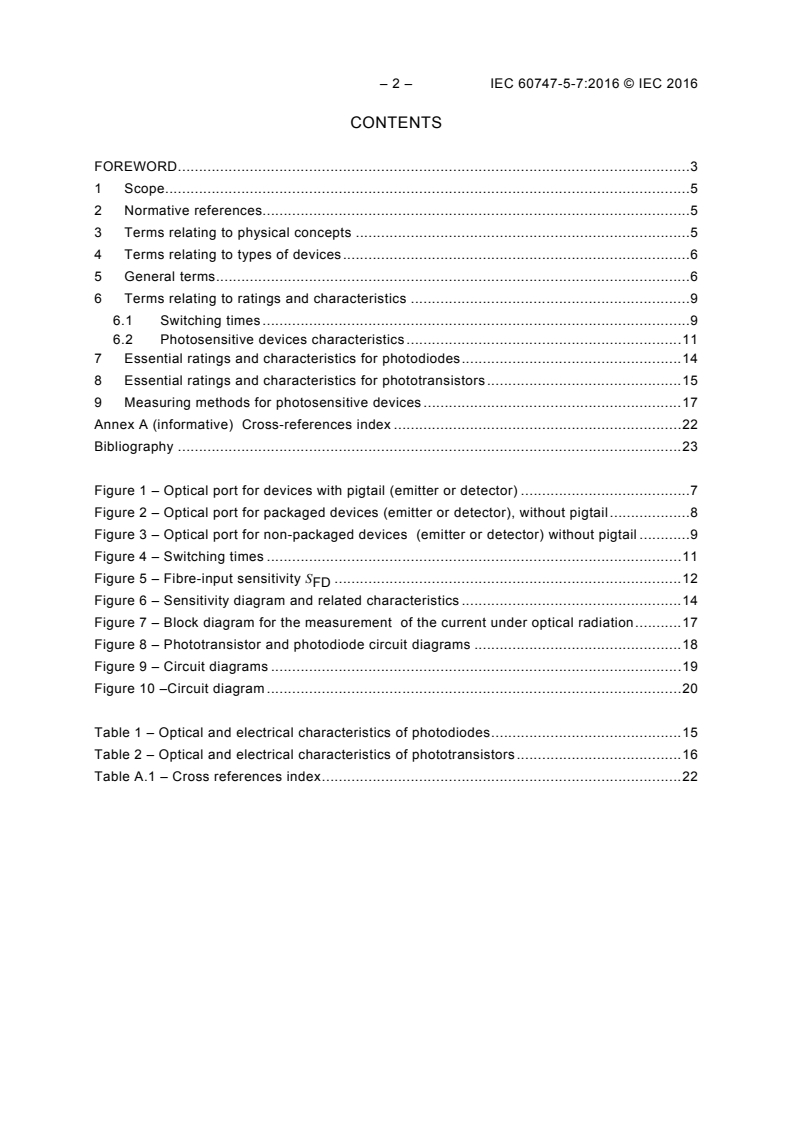
CONTENTS
FOREWORD . 3
1 Scope . 5
2 Normative references. 5
3 Terms relating to physical concepts . 5
4 Terms relating to types of devices . 6
5 General terms . 6
6 Terms relating to ratings and characteristics . 9
6.1 Switching times . 9
6.2 Photosensitive devices characteristics . 11
7 Essential ratings and characteristics for photodiodes . 14
8 Essential ratings and characteristics for phototransistors . 15
9 Measuring methods for photosensitive devices . 17
Annex A (informative) Cross-references index . 22
Bibliography . 23
Figure 1 – Optical port for devices with pigtail (emitter or detector) . 7
Figure 2 – Optical port for packaged devices (emitter or detector), without pigtail . 8
Figure 3 – Optical port for non-packaged devices (emitter or detector) without pigtail . 9
Figure 4 – Switching times . 11
Figure 5 – Fibre-input sensitivity S . 12
FD
Figure 6 – Sensitivity diagram and related characteristics . 14
Figure 7 – Block diagram for the measurement of the current under optical radiation . 17
Figure 8 – Phototransistor and photodiode circuit diagrams . 18
Figure 9 – Circuit diagrams . 19
Figure 10 –Circuit diagram . 20
Table 1 – Optical and electrical characteristics of photodiodes . 15
Table 2 – Optical and electrical characteristics of phototransistors . 16
Table A.1 – Cross references index . 22
INTERNATIONAL ELECTROTECHNICAL COMMISSION
____________
SEMICONDUCTOR DEVICES –
Part 5-7: Optoelectronic devices –
Photodiodes and phototransistors
FOREWORD
1) The International Electrotechnical Commission (IEC) is a worldwide organization for standardization comprising
all national electrotechnical committees (IEC National Committees). The object of IEC is to promote
international co-operation on all questions concerning standardization in the electrical and electronic fields. To
this end and in addition to other activities, IEC publishes International Standards, Technical Specifications,
Technical Reports, Publicly Available Specifications (PAS) and Guides (hereafter referred to as “IEC
Publication(s)”). Their preparation is entrusted to technical committees; any IEC National Committee interested
in the subject dealt with may participate in this preparatory work. International, governmental and non-
governmental organizations liaising with the IEC also participate in this preparation. IEC collaborates closely
with the International Organization for Standardization (ISO) in accordance with conditions determined by
agreement between the two organizations.
2) The formal decisions or agreements of IEC on technical matters express, as nearly as possible, an international
consensus of opinion on the relevant subjects since each technical committee has representation from all
interested IEC National Committees.
3) IEC Publications have the form of recommendations for international use and are accepted by IEC National
Committees in that sense. While all reasonable efforts are made to ensure that the technical content of IEC
Publications is accurate, IEC cannot be held responsible for the way in which they are used or for any
misinterpretation by any end user.
4) In order to promote international uniformity, IEC National Committees undertake to apply IEC Publications
transparently to the maximum extent possible in their national and regional publications. Any divergence
between any IEC Publication and the corresponding national or regional publication shall be clearly indicated in
the latter.
5) IEC itself does not provide any attestation of conformity. Independent certification bodies provide conformity
assessment services and, in some areas, access to IEC marks of conformity. IEC is not responsible for any
services carried out by independent certification bodies.
6) All users should ensure that they have the latest edition of this publication.
7) No liability shall attach to IEC or its directors, employees, servants or agents including individual experts and
members of its technical committees and IEC National Committees for any personal injury, property damage or
other damage of any nature whatsoever, whether direct or indirect, or for costs (including legal fees) and
expenses arising out of the publication, use of, or reliance upon, this IEC Publication or any other IEC
Publications.
8) Attention is drawn to the Normative references cited in this publication. Use of the referenced publications is
indispensable for the correct application of this publication.
9) Attention is drawn to the possibility that some of the elements of this IEC Publication may be the subject of
patent rights. IEC shall not be held responsible for identifying any or all such patent rights.
International Standard IEC 60747-5-7 has been prepared by subcommittee 47E: Discrete
semiconductor devices, of IEC technical committee 47: Semiconductor devices.
This standard replaces the clauses for photodiodes and phototransistors described in
IEC 60747-5-1, IEC 60747-5-2 and IEC 60747-5-3 including their amendments.
IEC 60747-5-1, IEC 60747-5-2 and IEC 60747-5-3, including their amendments, are replaced
by the publications of IEC 60747-5-4, IEC 60747-5-5, IEC 60747-5-6 and IEC 60747-5-7 as a
result of reconstruction.
___________
To be published.
– 4 – IEC 60747-5-7:2016 © IEC 2016
The text of this standard is based on the following documents:
CDV Report on voting
47E/471/CDV 47E/502/RVC
Full information on the voting for the approval of this standard can be found in the report on
voting indicated in the above table.
This publication has been drafted in accordance with the ISO/IEC Directives, Part 2.
A list of all parts in the IEC 60747 series, published under the general title Semiconductor
devices, can be found on the IEC website.
Future standards in this series will carry the new general title as cited above. Titles of existing
standards in this series will be updated at the time of the next edition.
SEMICONDUCTOR DEVICES –
Part 5-7: Optoelectronic devices –
Photodiodes and phototransistors
1 Scope
This part of IEC 60747 specifies the terminology, the essential ratings and characteristics as
well as the measuring methods of photodiodes (hereinafter referred to as “PDs”) and
phototransistors (hereinafter referred to as “PTs”).
2 Normative references
The following documents, in whole or in part, are normatively referenced in this document and
are indispensable for its application. For dated references, only the edition cited applies. For
undated references, the latest edition of the referenced document (including any
amendments) applies.
None.
3 Terms relating to physical concepts
3.1
electromagnetic radiation
radiation
1) emission or transfer of energy in the form of electromagnetic waves with the associated
photons
2) these electromagnetic waves or these photons
[SOURCE: IEC 60050-845:1987, 845-01-01, modified – The note has been deleted.]
3.2
optical radiation
electromagnetic radiation of wavelengths between the region of transition to X-rays (λ ≈1 nm)
and the region of transition to radio waves (λ ≈1 nm)
[SOURCE: IEC 60050- 845:1987, 845-01-02]
3.3
visible radiation
any optical radiation capable of causing a visual sensation directly
Note 1 to entry: There are no precise limits for the spectral range of visible radiation since they depend upon the
amount of radiant power reaching retina and the responsivity of the observer. The lower limit is generally taken
between 360 nm and 400 nm and the upper limit between 760 nm and 830 nm.
[SOURCE: IEC 60050-845:1987, 845-01-03]
3.4
infrared radiation
optical radiation for which the wavelengths are longer than those for visible radiation
[SOURCE: IEC 60050-845:1987, 845-01-04, modified – The note has been deleted.]
– 6 – IEC 60747-5-7:2016 © IEC 2016
3.5
ultraviolet radiation
optical radiation for which the wavelengths are shorter than those for visible radiation
[SOURCE: IEC 60050-845:1987, 845-01-05, modified – The note has been deleted.]
3.6
light
1) perceived light
2) visible radiation
Note 1 to entry: The word light is sometimes used in sense 2 for optical radiation extending outside the visible
range, but this usage is not recommended.
[SOURCE: IEC 60050-845:1987, 845-01-06, modified – Note 2 has been deleted because it
was not relevant.]
3.7
photoelectric effect
interaction between optical radiation and matter resulting in the absorption of photons and the
consequent generation of mobile charge carriers, thereby generating an electric potential or
current, or a change in electrical resistance, excluding electrical phenomena caused by
temperature changes
4 Terms relating to types of devices
4.1
semiconductor photosensitive device
semiconductor device that utilizes the photoelectric effect for detection of optical radiation
4.2
semiconductor optoelectronic device
1) semiconductor device that emits or detects or that is responsive to coherent or non-
coherent optical radiation
2) semiconductor device that utilizes such radiation for its internal purposes
4.3
photodiode
photoelectric detector in which a photocurrent is generated by absorption of optical radiation
in the neighbourhood of a p-n junction between two semiconductors, or a junction between a
semiconductor and a metal
[SOURCE: IEC 60050-845:1987,845-05-39]
4.4
phototransistor
transistor in which the current produced by the photoelectric effect in the neighbourhood of
the emitter-base junction acts as base current, which is amplified
5 General terms
5.1
optical axis
line about which the principal radiation or sensitivity pattern is centered
Note 1 to entry: Unless otherwise stated, the optical axis coincides with the direction of maximum radiation or
sensitivity.
5.2
optical port,
geometrical configuration, referenced to an external plane or surface of the device, that is
used to specify the optical radiation emitted from an emitting device or accepted by a
detecting device
Fibre cladding
y
Ref.: Fibre cladding
α
z
x
IEC
D
Figure 1a – Device with bare fibre pigtail
y
Connector
Ref.: Connector
α
z
x
D IEC
Figure 1b – Device with fibre pigtail connector attached
Key
α emission or acceptance angle
D diameter of the optical port
Ref. reference locus for the definition of the optical port
Figure 1 – Optical port for devices with pigtail (emitter or detector)
Ref.: Package outline
y
Package outline
α
z
x
D
IEC
Figure 2a – Device with window, but without lens
– 8 – IEC 60747-5-7:2016 © IEC 2016
y
α
α
Radiation sensitive chip,
z
area defined with reference
to package outline
Window front
Chip plane
x
plane (or sensitive area plane)
D
d ΔL
W
IEC
Key
d window thickness
W
α emission or acceptance angle
n refractive index of window material
∆L distance between window back plane and chip plane
Figure 2b – Detector with window, but without lens (chip referenced)
y
α
Ref.: Package outline
The internal optical system
z
shall be specified
x
D
IEC
Figure 2c – Detector with lens
y
L
α
z
x
D
IEC
Figure 2d – IRED with optical port that is not located
on the output window of the package
Key
α emission or acceptance angle
D diameter of the optical port
Ref. reference locus for the definition of the optical port
Figure 2 – Optical port for packaged devices (emitter or detector), without pigtail
y
Ref.: Chip or chip carrier
outlines
Note – Angle α may not be
required for detectors
Carrier
α
x
z
D
IEC
Key
α emission or acceptance angle
D diameter of the optical port
Ref. reference locus for the definition of the optical port
Figure 3 – Optical port for non-packaged devices
(emitter or detector) without pigtail
Note 1 to entry: The geometrical configuration shall be specified by the manufacturer by means of geometrical
information, e.g.:
– location, shape and size of the area of emission or acceptance,
– angle of emission or acceptance,
– other parameters, e.g. numerical aperture of optical fibre,
– orientation of optical axis.
Note 2 to entry: Figures 1, 2 and 3 above show examples of the optical port for emitting and detecting devices.
5.3
cladding
optical cladding
dielectric material of an optical fibre surrounding the core
[SOURCE: IEC 60050-731:1991, 731-02-05, modified – The term "optical cladding" has been
added.]
6 Terms relating to ratings and characteristics
6.1 Switching times
NOTE The specified lower and/or upper limit values referred to in concepts 6.1.1 to 6.1.7 are usually 10 % and
90 % of the amplitude of the pulses. Figure 4 illustrates the concept of switching times, and shows the relation
between switching times and the specified lower and/or upper limit values.
– 10 – IEC 60747-5-7:2016 © IEC 2016
6.1.1
turn-on delay time
t
d(on)
time interval between the lower specified value on the leading edge of the applied input pulse
and the lower specified value on the leading edge of the output pulse
6.1.2
rise time
t
r
time interval between the lower specified value and the upper specified value on the leading
edge of the output pulse
6.1.3
turn-on time
t
on
time interval between the lower specified value on the leading edge of the applied input pulse
and the upper specified value on the leading edge of the output pulse
t = t + t
on d(on) r
6.1.4
turn-off delay time
t
d(off)
time interval between the upper specified value on the trailing edge of the applied input pulse
and the upper specified value on the trailing edge of the output pulse
Note 1 to entry: If the turn-off delay time is mainly due to carrier storage (e.g. in the output transistor of a
photocoupler), the term "(carrier) storage time" and the letter symbol t are in use.
s
6.1.5
fall time
t
f
time interval between the upper specified value and the lower specified value on the trailing
edge of the output pulse
6.1.6
turn-off time
t
off
time interval between the upper specified value on the trailing edge of the applied input pulse
and the lower specified value on the trailing edge of the output pulse
t = t + t
off d(off) f
Relative input
100 %
Upper specified value
Lower specified value
t
Relative output
100 %
Upper specified value
Lower specified value
t t t t
t
d(on) r d(off) f
t t
on off
IEC
Figure 4 – Switching times
6.2 Photosensitive devices characteristics
NOTE The subscripts D for dark and P for photo are still under consideration.
6.2.1
reverse current under optical radiation,
I
R(H)
I
R(e)
I
R
total reverse current when the photodiode is exposed to incident optical radiation
6.2.2
dark current,
I
R(D)
reverse current in the absence of incident optical radiation
6.2.3
photocurrent,
I
p
part of the reverse current that is caused by incident optical radiation
I = I – I
P R(H) R(D)
– 12 – IEC 60747-5-7:2016 © IEC 2016
6.2.4
collector current under optical radiation,
I
C(H)
I
C(e)
I
C
total collector current when the phototransistor is exposed to incident optical radiation
6.2.5
collector-emitter dark current,
I
CEO
collector current in the absence of incident optical radiation
6.2.6
diode sensitivity,
sensitivity,
S
D
S
quotient of the photocurrent I , by the irradiance E (or illuminance E ) at the optical port of
P e v
the photodiode
I I
P P
S = or S =
D D
E E
e v
Note 1 to entry: If no ambiguity is likely to occur, the shorter term and letter symbol may be used.
6.2.7
fibre-input sensitivity,
fibre >
S
FD
quotient of the photocurrent I , by the radiant power φ (or luminous flux φ ) emitted from the
P e v
optical fibre, for specified values of the radial displacement r and the distance z of the front
end of the optical fibre, relative to the optical port of the photodiode as shown in Figure 5
I I
P P
S = or S =
FD FD
φ φ
e v
Note 1 to entry: If no ambiguity is likely to occur, the shorter term and letter symbol may be used.
Note 2 to entry: In specifications, usually curves are given showing S as a function of r and z.
FD
Optical port
r
Photocurrent I
p
z
Total radiant power φ
e
emitted from the fibre
IEC
Figure 5 – Fibre-input sensitivity S
FD
6.2.8
small-signal cut-off frequency,
f
cd
f
c
frequency at which, for constant small signal modulation depth of the input radiant power, the
demodulated signal power has decreased to half its low-frequency value
Note 1 to entry: When, for the measurement of f , in the case that the photocurrent of the photodiode or the
c
output voltage across the load resistance is observed, it should be noted that 1-to-2 decrease in the demodulated
signal power corresponds to 1-to-square root 2 decrease in the photocurrent or output voltage.
6.2.9
large-signal cut-off frequency,
f
CL
f
C
frequency at which, for constant large signal modulation depth of the input radiant power, the
demodulated signal power has decreased to half its low-frequency value
Note 1 to entry: Measurement should be done within the range that the linear response between the input radiant
power and the output photocurrent is assured.
6.2.10
sensitivity diagram,
diagram that characterizes the distribution of sensitivity
S = f(θ)
SEE: Figures 6a and 6b.
Note 1 to entry: The orientation of θ is indicated in Figures 6a and 6b. Unless otherwise stated, the distribution of
sensitivity should be specified in a plane. This plane includes the mechanical axis z.
Note 2 to entry: If the sensitivity pattern has a rotational symmetry to the z axis, the sensitivity diagram shall be
specified for one plane only.
Note 3 to entry: If the sensitivity pattern has no rotational symmetry to the z axis, sensitivity diagrams for various
angles θ shall be specified. Then the x, y and z directions shall be defined by a drawing in the detail specification.
6.2.11
half-sensitivity angle,
θ
S/2
in a sensitivity diagram, angle within which the sensitivity is greater than or equal to half the
maximum sensitivity
SEE: Figure 6b.
6.2.12
misalignment angle,
∆θ
in a sensitivity diagram, angle between the direction for maximum sensitivity (optical axis) and
the mechanical axis z
SEE: Figure 6b.
– 14 – IEC 60747-5-7:2016 © IEC 2016
z
Optical axis
z
I
θ
S
max
Mechanical axis
Δθ
θ
0,5 S
s/2
max
0,5 S
max
D
y
D
ϕ
x
IEC
IEC
Figure 6a Figure 6b
Figure 6 – Sensitivity diagram and related characteristics
6.2.13
peak-sensitivity wavelength,
λ
p
wavelength at which the spectral sensitivity is a maximum
7 Essential ratings and characteristics for photodiodes
The following ratings and characteristics apply to photodiodes (excluding devices for fibre
optic systems or subsystems):
a) Type
Ambient-rated or case-rated photodiode intended for small-signal and switching applications.
b) Semiconductor material
Silicon,GaAs, InP, etc.
c) Details of outline and encapsulation
1) IEC and/or national reference number of the outline drawing.
2) Method of encapsulation: glass/metal/plastic/other.
3) Terminal identification and indication of any connection between a terminal and the
case.
d) Limiting values (absolute maximum system) over the operating temperature range, unless
otherwise stated
1) Minimum and maximum storage temperatures (T ).
stg
2) Minimum and maximum operating ambient or case temperature (T or T ).
amb case
3) Maximum reverse voltage (V ).
R
4) Where appropriate:
– maximum total power dissipation (P ) up to ambient or case temperature of 25 °C,
tot
and
– derating factor above 25 °C (K ) or derating curve.
t
e) Optical and electrical characteristics
The optical and electrical characteristics of photodiodes are presented in Table 1 below.
Table 1 – Optical and electrical characteristics of photodiodes
Characteristics Conditions at Symbols Requirements
T or T = 25 °C,
amb case
unless otherwise stated
V specified I or I
Reverse current under Min.
R R(H) R(e)
a
irradiation E or E specified
v e
Dark current V specified, E = 0 I Max.
R e R
Dark current V specified, E = 0 I Max.
R e R
at a specified high temperature of T
amb
or T specified
case
Where appropriate, spectral V specified, E specified, at a short S Min.
R e
sensitivity
wavelength λ specified and at a longer
wavelength λ specified
S
Min.
Switching times (where Specified circuit
appropriate):
rise time and specified value of V , t Max.
R r
fall time E or E specified t Max.
v e r
or: Specified circuit
turn-on time and Specified value of V , t Max.
R on
turn-off time E or E specified t Max.
v e off
a
Illumination by standard illuminant A (according to IEC 60306-1) emitted from a filament tungsten lamp with
a colour temperature T = 2 855,6 K or with radiation from a defined monochromatic source.
f) Supplementary information
1) Diagram of typical sensitivity
2) Typical spectral diagram: a diagram graphically expressing relative spectral sensitivity
versus wavelength.
8 Essential ratings and characteristics for phototransistors
The following ratings and characteristics apply to phototransistors (excluding devices for fibre
optic systems or subsystems):
a) Type
Ambient-rated or case-rated phototransistor intended for small-signal and switching
applications.
b) Semiconductor material
Silicon, etc.
c) Polarity
NPN/PNP.
d) Details of outline and encapsulation
1) IEC and/or national reference number of the outline drawing.
2) Method of encapsulation: glass/metal/plastic/other.
3) Terminal identification and indication of any connection between a terminal and the
case.
e) Limiting values (absolute maximum system) over the operating temperature range, unless
otherwise stated
1) Minimum and maximum storage temperature (T ).
stg
2) Minimum and maximum operating ambient or case temperatures (T or T ).
amb case
– 16 – IEC 60747-5-7:2016 © IEC 2016
3) Maximum collector-emitter voltage with zero base current (V ).
CEO
4) Where an external base connection is present:
– Maximum collector-base voltage with zero emitter current (V ).
CBO
– Maximum emitter-base voltage with zero collector current (V ).
EBO
5) Where no external base connection is present:
– Maximum emitter-collector voltage (V ).
ECO
– Maximum continuous collector current (I ).
C
6) Where appropriate:
– maximum total power dissipation (P ) up to ambient or case temperature of 25 °C,
tot
and
– derating factor above 25 °C (K ) or derating curve.
t
f) Optical and electrical characteristics
The optical and electrical characteristics of phototransistors are presented in Table 2
below.
Table 2 – Optical and electrical characteristics of phototransistors
Characteristics Conditions at Symbols Requirements
T or T = 25 °C,
amb case
unless otherwise stated
b
Collector current under V specified, I = 0 I Min. Max.
CE B C(H)
irradiation
a
or E specified or I
E
v e C(e)
V specified, I = 0 I
Collector-emitter dark current Max.
CE B CEO
E = 0
e
Collector-emitter dark current V specified, I = 0 I Max.
CE B CEO
E = 0 at a specified high
e
temperature T or T
amb case
Collector-emitter breakdown I specified, I = 0, E = 0 V Min.
C B e (BR)CEO
voltage
Emitter-base breakdown I specified, E = 0 V Min.
E e (BR)CEO
voltage or, where no base
connection is present, emitter-
collector breakdown voltage
Collector-emitter saturation I specified, I = 0, E or E V Max.
C B v e CEsat
a
voltage specified
b
spectral sensibility I = 0, E specified, at a short S Min.
B e
wavelength λ specified and at a
S Min.
longer wavelength λ specified
b
Switching times : t Max.
r
rise time and fall time
t Max.
Specified circuit, specified values t
of V and I , E or E specified
CE C v e
t
or: Specified circuit, specified values Max.
on
turn-on time and turn-off time of V and I , E or E specified
CE C v e
t Max.
off
a
Illumination by standard illuminant A (according to IEC 60306-1) emitted from a tungsten filament lamp with
a colour temperature T = 2 855,6 K or with radiation from a defined monochromatic source.
b
where appropriate
g) Supplementary information
– Diagram of typical sensitivity:
Typical spectral diagram expressing relative spectral sensitivity versus wavelength.
9 Measuring methods for photosensitive devices
The following measuring methods apply for photosensitive devices:
a) Reverse current under optical radiation of photodiodes including devices with or without
pigtails (I or I ) and collector current under optical radiation of phototransistors
R(H) R(e)
(I or I )
C(H) C(e)
1) Purpose
To measure the reverse current under optical radiation of photodiodes including
devices with or without pigtails and the collector current under optical radiation of
phototransistors.
2) Measuring equipment
Figure 7 shows the block diagram for the measurement. One of the four following
variants shall be used:
– Variant 1
Rotation of the device around its mechanical axis for an accurate location of the
maximum value.
– Variant 2
Alignment of the device optical axis with that of the optical bench.
– Variant 3
Positioning according to a reference specified for the type of device envelope, to
obtain a reproducible mechanical orientation.
– Variant 4
For devices with pigtails.
Alignment of the optical port of the device to receive the radiant power with
focusing means.
Illuminant D or T
Monochromator
Optical axis
(variants 1 and 2)
Filter
or mechanical axis
A (variant 3)
or optical port
(variant 4)
Optional
Power supply
IEC
Key
D or T = device being measured
Figure 7 – Block diagram for the measurement
of the current under optical radiation
3) Circuit diagrams
Circuit diagrams for the measurement of the current under optical radiation of
phototransistors and photodiodes are shown in Figures 8a and 8b, respectively.
– 18 – IEC 60747-5-7:2016 © IEC 2016
µA µA
+ +
T
V
V
D
–
–
IEC IEC
Figure 8a – Phototransistor Figure 8b – Photodiode
Figure 8 – Phototransistor and photodiode circuit diagrams
4) Equipment description and requirements
The device being measured is fixed in a measuring socket that is mounted on a
calibrated optical bench (variant 1, 2, 3 or 4) or on a calibrated equipment (variant 3).
The illuminant shall be
either:
i) a standard illuminant (not monochromatic), consisting of a calibrated standard lamp,
with its regulated power supply and an ammeter;
or:
ii) a monochromatic illuminant consisting of either:
an equipment such as described in item i) above, plus an interference filter or any
other system (monochromator, etc.) having a specified or known peak-transmission
wavelength and spectral radiation bandwidth,
or:
any other calibrated device (for example a light-emitting diode or an infrared-
emitting diode), having a known peak-emission wavelength and spectral radiation
bandwidth.
For fibre optic devices with pigtails:
The illuminant such as described in item ii) shall be used.
5) Precautions to be observed
– Overheating the device being measured by optical radiation from the source shall
be avoided. For levels in excess of 200 W/m², a thermal shield arranged as a
shutter to limit the duration of exposure is recommended.
– Cleanliness of optical surfaces shall be ensured.
– Light sources shall be stabilized before being used for measurement purposes.
– When a standard illuminant is used as a light source, a diaphragm intended to
suppress parasitic radiation shall be placed in front of the device being measured.
For devices with pigtails:
Only the optical port of the device shall be irradiated.
6) Measurement procedure
The temperature conditions are set to the specified value.
The socket is placed at a distance from the illuminant corresponding to the specified
illuminance (irradiance).
The device to be measured is inserted into its socket and is biased at the specified
value.
For variant 1 only, the device is rotated around its mechanical axis. Read the minimum
and the maximum values of the current under irradiation on the ammeter.
For variant 2, 3 or 4, the value of the current under optical radiation is read on the
ammeter.
7) Specified conditions
– Ambient or case temperature.
– Bias of the device being measured (d.c. or pulse).
– Measuring method (variant).
– Illuminance or irradiance.
– Standard illuminant (not monochromatic) or wavelength and spectral radiation
bandwidth (monochromatic).
For devices with pigtails:
– ambient or case temperature;
– bias of the device being measured;
– radiant power into the optical port;
– wavelength and spectral radiation bandwidth of the light source.
b) Dark current for photodiodes I and dark currents for phototransistors
R
I , I , I
CEO ECO EBO
1) Purpose
To measure the dark current of photodiodes and the dark currents of phototransistors,
under specified conditions.
2) Circuit diagrams
Circuit diagrams for the measurement are shown in Figure 9.
R R
E = 0
e
E = 0
e
+ +
V V
D
D
– –
A A
IEC IEC
Figure 9a – Dark current Figure 9b – Collector-emitter dark current
of a photodiode I of a phototransistor I
R CEO
R R
E = 0 E = 0
e e
+ +
D
V V
D
– –
A
A
IEC IEC
Figure 9c – Emitter-collector dark current Figure 9d – Emitter-base dark current
of a phototransistor I of a phototransistor I
ECO EBO
Figure 9 – Circuit diagrams
3) Circuit description and requirements
– 20 – IEC 60747-5-7:2016 © IEC 2016
R = current limiting resistor
D = device being measured
4) Precautions to be observed
These parameters are very temperature-dependent and the accuracy of the
measurement largely depends on that with which the ambient temperature can be
maintained. Complete darkness is a necessary condition. Even ordinary daylight
illumination of the wire feed-through glass seals would falsify the measurement result.
The device should not be subjected to radiation within the spectral sensitivity range.
5) Measurement procedure
The temperature is set to the specified value. The device being in complete darkness,
the voltage is progressively increased from zero until the specified value is reached
and then the dark current is measured.
The test is stopped when the current reaches a specified limit.
6) Specified conditions
– Ambient temperature
– Voltage to be applied:
for I ;
• V
R R
• V for I ;
CE CEO
• V for I ;
EC ECO
• V for I .
EB EBO
c) Collector-emitter saturation voltage V of phototransistors
CE(sat)
1) Purpose
To measure the collector-emitter saturation voltage of phototransistors under specified
conditions.
2) Circuit diagram
The circuit diagram for the measurement is shown in Figure 10.
A
S
+
G
V
D
–
IEC
Figure 10 –Circuit diagram
3) Circuit description and requirements
S = optical radiation source
G = collector current generator
D = device being measured
4) Precautions to be observed
– Avoid overheating the device being measured by irradiation from the source. For
levels in excess of 200 W/m , a thermal shield arranged as a shutter to limit the
duration of exposure is recommended.
– Ensure cleanliness of optical surfaces.
– Optical radiation sources shall be stabilized before being used for measurement
purposes.
5) Measurement procedure
The temperature is set to the specified value.
The optical radiation source being stabilized to the specified value of E or E , the
e v
collector current is adjusted to the specified value and the collector-emitter saturation
voltage is measured.
6) Specified conditions
– Ambient temperature.
– Collector current.
– Illuminance or irradiance.
– Reference to standard illuminant (not monochromatic) or wavelength and spectral
bandwidth (monochromatic).
– Open base.
– 22 – IEC 60747-5-7:2016 © IEC 2016
Annex A
(informative)
Cross-references index
Table A.1 below shows the corresponding old references of IEC 60747-5-1, IEC 60747-5-2
and IEC 60747-5-3.
Table A.1 – Cross references index
New clause number New clause title Old publication Old clause/subclause
number
2 Normative references 60747-5-1 2
60747-5-2 2
60747-5-3 2
3 Terms relating to physical 60747-5-1 3
concepts
4 Terms relating to types of 60747-5-1 4.1, 4.10, 4.11
devices
5 General terms 60747-5-1 5
6 Terms relating to ratings 60747-5-1 6.1, 6.3
and characteristics
7 Essential ratings and 60747-5-2 5
characteristics for
photodiodes
8 Essential ratings and 60747-5-2 6
characteristics for
phototransistors
9 Measuring methods for 60747-5-3 4
photosensitive devices
Bibliography
IEC 60050 (all parts), International Electrotechnical Vocabulary (available at
http://www.electropedia.org )
IEC 60050 -731:1991, International Electrotechnical Vocabulary – Chapter 731: Optical fibre
communication
IEC 60050-845:1987, International Electrotechnical Vocabulary – Chapter 845: Lighting
IEC 60306-1, Measurement of photosensitive devices. Part 1: Basic recommendations
IEC 60747-5-4, Semiconductor devices – Discrete devices – Part 5-4: Optoelectronic devices
– Semiconductor lasers
IEC 60747-5-5, Semiconductor devices – Discrete devices – Part 5-5: Optoelectronic devices
– Photocouplers
IEC 60747-5-6 , Semiconductor devices – Part 5-6: Optoelectronic devices – Light emitting
diodes
IEC 62007-1, Semiconductor optoelectronic devices for fibre optic system applications –
Part 1: Specification template for essential ratings and characteristics
IEC 62007-2, Semiconductor optoelectronic devices for fibre optic system applications –
Part 2: Measuring methods
____________
___________
To be published.
– 24 – IEC 60747-5-7:2016 © IEC 2016
SOMMAIRE
AVANT-PROPOS . 25
1 Domaine d'application . 27
2 Références normatives . 27
3 Termes relatifs aux concepts physiques . 27
4 Termes relatifs aux types de dispositifs .
...