

IEC 60309-2:1999
(Main)Plugs, socket-outlets and couplers for industrial purposes - Part 2: Dimensional interchangeability requirements for pin and contact-tube accessories
General Information
- Abstract
Applies to plugs and socket-outlets, cable couplers with a rated operating voltage not exceeding 690 V, 500 Hz and a rated current not exceeding 125 A. , primarily intented for industrial use , either indoors or outdoors.
- Status
- Published
- Publication Date
- 22-May-2012
- Technical Committee
- SC 23H - Plugs, Socket-outlets and Couplers for industrial and similar applications, and for Electric Vehicles
- Drafting Committee
- MT 7 - TC 23/SC 23H/MT 7
- Current Stage
- DELPUB - Deleted Publication
- Start Date
- 18-Jun-2021
- Completion Date
- 31-Jul-2017
Buy Documents
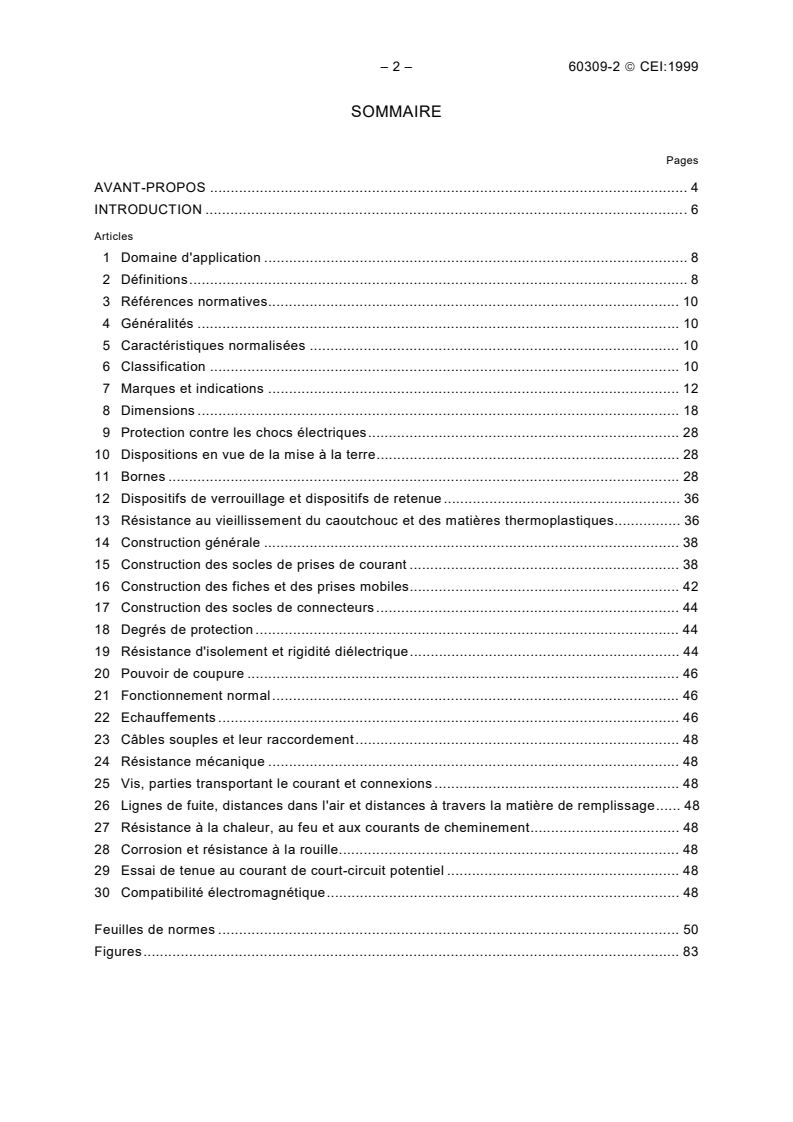
IEC 60309-2:1999 - Plugs, socket-outlets and couplers for industrial purposes - Part 2: Dimensional interchangeability requirements for pin and contact-tube accessories Released:4/12/1999
IEC 60309-2:1999+AMD1:2005 CSV - Plugs, socket-outlets and couplers for industrial purposes - Part 2: Dimensional interchangeability requirements for pin and contact-tube accessories Released:12/8/2005
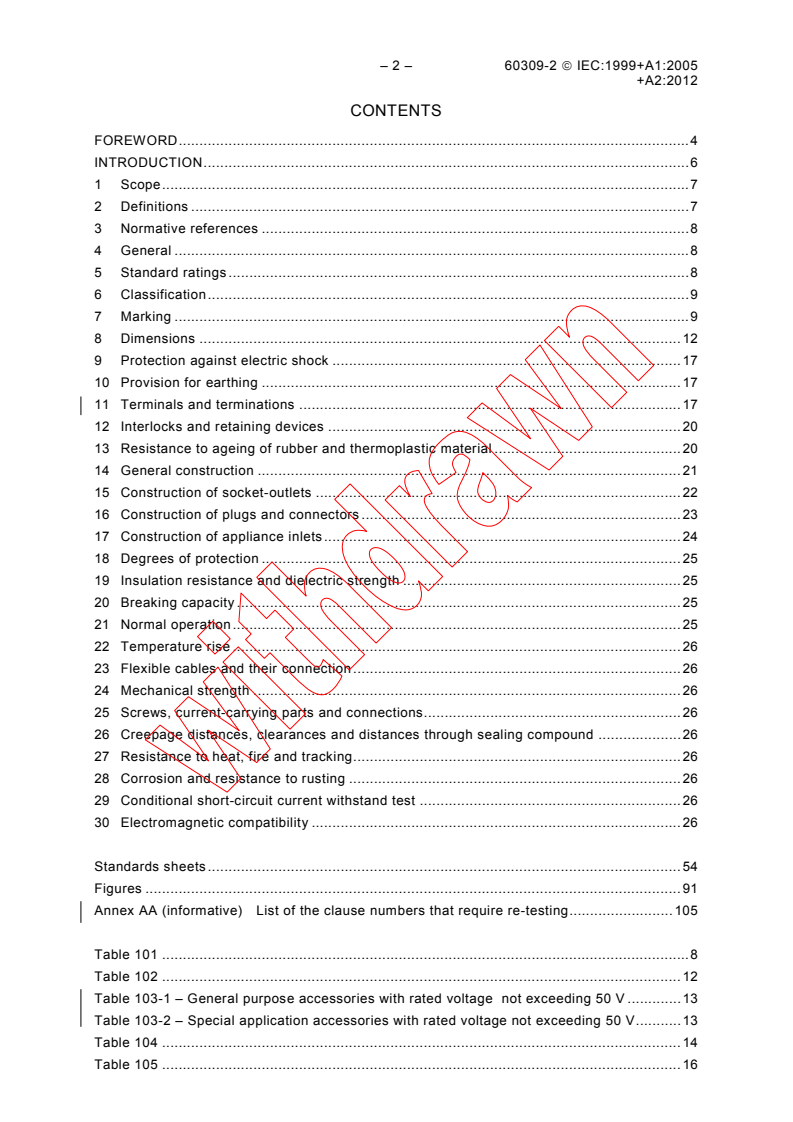
IEC 60309-2:1999+AMD1:2005+AMD2:2012 CSV - Plugs, socket-outlets and couplers for industrial purposes - Part 2: Dimensional interchangeability requirements for pin and contact-tube accessories Released:5/23/2012
Overview
IEC 60309-2:1999 is an international standard developed by the International Electrotechnical Commission (IEC) focusing on industrial electrical connectors. It specifically defines dimensional interchangeability requirements for pin and contact-tube accessories used in plugs, socket-outlets, and couplers for industrial applications. This standard applies to devices rated for operating voltages up to 1000 V, frequencies up to 500 Hz, and currents not exceeding 125 A.
Designed primarily for industrial use both indoors and outdoors, the standard ensures compatibility and safety of electrical connectors widely used in demanding environments such as construction sites, agriculture, and commercial facilities. It complements IEC 60309-1, which outlines general requirements for industrial plugs and socket-outlets.
Key Topics
Scope and Application
The standard covers plugs, socket-outlets, cable couplers, and appliance couplers with standardized pin and contact-tube configurations intended for voltages up to 1000 V and current ratings up to 125 A. It supports accessory use across ambient temperatures from –25 °C to 40 °C.Dimensional Interchangeability
Critical to ensuring accessories from different manufacturers are compatible, IEC 60309-2 specifies precise dimensions for pins and contact tubes to enable safe interchange without compromising performance.Technical Requirements
Detailed criteria include:- Marking and rating specifications
- Protection against electric shock
- Terminal and termination arrangements, covering screwless and insulation piercing types
- Mechanical strength and durability in harsh industrial conditions
- Temperature rise limits and resistance to ageing for rubber and thermoplastic materials
- Degrees of protection (ingress protection) and compliance with insulation resistance and dielectric strength requirements
- Requirements for earthing provisions, interlocks, and retaining devices to enhance user safety
Environmental and Safety Conditions
The standard applies to accessories used in environments with temperature variations and potential exposure to mechanical stress, corrosion, and electrical disturbances, ensuring reliable operation in industrial contexts.
Applications
IEC 60309-2 plays a vital role in various industrial sectors by standardizing the interfaces of plugs and connectors, enhancing equipment interoperability and safety, including:
- Industrial machinery connections on manufacturing floors where robust and compatible power connections are critical.
- Construction sites requiring rugged outdoor-capable plugs and socket-outlets for temporary power distribution.
- Agricultural equipment benefiting from durable connectors resistant to weather and mechanical impact.
- Commercial and event power supply setups supporting safe, standardized interconnections.
- Building services installations where equipment inlet connectors follow defined interchangeability to ensure safety and reliability.
The dimensional interchangeability specified in this standard simplifies maintenance, equipment replacement, and logistics by ensuring standardized parts fit and operate safely regardless of manufacturer.
Related Standards
- IEC 60309-1: General requirements for plugs, socket-outlets, and couplers for industrial purposes, providing overarching requirements complementary to IEC 60309-2.
- IEC 60906-1: Plugs and socket-outlets for household and similar purposes, detailing safe domestic design.
- IEC 60529: Degrees of protection provided by enclosures (IP Code), relevant for ensuring ingress protection of industrial connectors.
- ISO/IEC 60512: Tests for electromechanical components, including durability and mechanical testing that support IEC 60309 series compliance.
Summary
IEC 60309-2:1999 is a crucial international standard ensuring dimensional compatibility and safety of industrial plugs and connectors up to 1000 V and 125 A. It supports interoperability between devices of various manufacturers while maintaining high safety and performance standards in harsh and variable industrial environments. Compliance with this standard benefits industries by reducing equipment incompatibilities, enhancing user safety, and simplifying maintenance and installation processes.
For professionals and manufacturers dealing with industrial electrical connectors, adherence to IEC 60309-2 is essential to meet global quality benchmarks and regulatory expectations.
Relations
- Effective Date
- 25-Aug-2026
- Effective Date
- 25-Aug-2026
- Effective Date
- 25-Aug-2026
- Effective Date
- 25-Aug-2026
- Effective Date
- 25-Aug-2026
- Effective Date
- 05-Sep-2023
- Effective Date
- 05-Sep-2023
- Effective Date
- 05-Sep-2023
- Effective Date
- 05-Sep-2023
Buy Documents
IEC 60309-2:1999 - Plugs, socket-outlets and couplers for industrial purposes - Part 2: Dimensional interchangeability requirements for pin and contact-tube accessories Released:4/12/1999
IEC 60309-2:1999+AMD1:2005 CSV - Plugs, socket-outlets and couplers for industrial purposes - Part 2: Dimensional interchangeability requirements for pin and contact-tube accessories Released:12/8/2005
IEC 60309-2:1999+AMD1:2005+AMD2:2012 CSV - Plugs, socket-outlets and couplers for industrial purposes - Part 2: Dimensional interchangeability requirements for pin and contact-tube accessories Released:5/23/2012
Get Certified
Connect with accredited certification bodies for this standard

IMQ S.p.A. (Certification)
Italian electrical product certification.

SLG Prüf- und Zertifizierungs GmbH
German testing and certification body.

UL Solutions
Global safety science company with testing, inspection and certification.
Sponsored listings
Frequently Asked Questions
IEC 60309-2:1999 is a standard published by the International Electrotechnical Commission (IEC). Its full title is "Plugs, socket-outlets and couplers for industrial purposes - Part 2: Dimensional interchangeability requirements for pin and contact-tube accessories". This standard covers: Applies to plugs and socket-outlets, cable couplers with a rated operating voltage not exceeding 690 V, 500 Hz and a rated current not exceeding 125 A. , primarily intented for industrial use , either indoors or outdoors.
Applies to plugs and socket-outlets, cable couplers with a rated operating voltage not exceeding 690 V, 500 Hz and a rated current not exceeding 125 A. , primarily intented for industrial use , either indoors or outdoors.
IEC 60309-2:1999 is classified under the following ICS (International Classification for Standards) categories: 29.120.30 - Plugs, socket-outlets, couplers. The ICS classification helps identify the subject area and facilitates finding related standards.
IEC 60309-2:1999 has the following relationships with other standards: It is inter standard links to EN ISO 13297:2014, EN ISO 13297:2012, EN ISO 17409:2017, EN ISO 13297:2018, EN 609-1:2017, IEC 60309-2:1999/AMD2:2012, IEC 60309-2:1999/AMD1:2005, IEC 60309-2:2021, IEC 60309-2:1997. Understanding these relationships helps ensure you are using the most current and applicable version of the standard.
IEC 60309-2:1999 is available in PDF format for immediate download after purchase. The document can be added to your cart and obtained through the secure checkout process. Digital delivery ensures instant access to the complete standard document.
Standards Content (Sample)
NORME CEI
INTERNATIONALE IEC
60309-2
INTERNATIONAL
Quatrième édition
STANDARD
Fourth edition
1999-04
Prises de courant pour usages industriels –
Partie 2:
Règles d'interchangeabilité dimensionnelle
pour les appareils à broches et alvéoles
Plugs, socket-outlets and couplers
for industrial purposes –
Part 2:
Dimensional interchangeability requirements
for pin and contact-tube accessories
Numéro de référence
Reference number
CEI/IEC 60309-2:1999
Numéros des publications Numbering
Depuis le 1er janvier 1997, les publications de la CEI As from 1 January 1997 all IEC publications are
sont numérotées à partir de 60000. issued with a designation in the 60000 series.
Publications consolidées Consolidated publications
Les versions consolidées de certaines publications de Consolidated versions of some IEC publications
la CEI incorporant les amendements sont disponibles. including amendments are available. For example,
Par exemple, les numéros d’édition 1.0, 1.1 et 1.2 edition numbers 1.0, 1.1 and 1.2 refer, respectively, to
indiquent respectivement la publication de base, la the base publication, the base publication incor-
publication de base incorporant l’amendement 1, et la porating amendment 1 and the base publication
publication de base incorporant les amendements 1 incorporating amendments 1 and 2.
et 2.
Validité de la présente publication Validity of this publication
Le contenu technique des publications de la CEI est The technical content of IEC publications is kept
constamment revu par la CEI afin qu'il reflète l'état under constant review by the IEC, thus ensuring that
actuel de la technique. the content reflects current technology.
Des renseignements relatifs à la date de reconfir- Information relating to the date of the reconfirmation
mation de la publication sont disponibles dans le of the publication is available in the IEC catalogue.
Catalogue de la CEI.
Les renseignements relatifs à des questions à l’étude et Information on the subjects under consideration and
des travaux en cours entrepris par le comité technique work in progress undertaken by the technical
qui a établi cette publication, ainsi que la liste des committee which has prepared this publication, as well
publications établies, se trouvent dans les documents ci- as the list of publications issued, is to be found at the
dessous: following IEC sources:
• «Site web» de la CEI*
• IEC web site*
• Catalogue des publications de la CEI
• Catalogue of IEC publications
Publié annuellement et mis à jour
Published yearly with regular updates
régulièrement
(On-line catalogue)*
(Catalogue en ligne)*
• IEC Bulletin
• Bulletin de la CEI
Available both at the IEC web site* and
Disponible à la fois au «site web» de la CEI*
as a printed periodical
et comme périodique imprimé
Terminologie, symboles graphiques Terminology, graphical and letter
et littéraux
symbols
En ce qui concerne la terminologie générale, le lecteur For general terminology, readers are referred to
se reportera à la CEI 60050: Vocabulaire Electro-
IEC 60050: International Electrotechnical Vocabulary
technique International (VEI).
(IEV).
Pour les symboles graphiques, les symboles littéraux For graphical symbols, and letter symbols and signs
et les signes d'usage général approuvés par la CEI, le approved by the IEC for general use, readers are
lecteur consultera la CEI 60027: Symboles littéraux à referred to publications IEC 60027: Letter symbols to
utiliser en électrotechnique, la CEI 60417: Symboles
be used in electrical technology, IEC 60417: Graphical
graphiques utilisables sur le matériel. Index, relevé et
symbols for use on equipment. Index, survey and
compilation des feuilles individuelles, et la CEI 60617: compilation of the single sheets and IEC 60617:
Symboles graphiques pour schémas. Graphical symbols for diagrams.
* Voir adresse «site web» sur la page de titre.
* See web site address on title page.
NORME CEI
INTERNATIONALE IEC
60309-2
INTERNATIONAL
Quatrième édition
STANDARD
Fourth edition
1999-04
Prises de courant pour usages industriels –
Partie 2:
Règles d'interchangeabilité dimensionnelle
pour les appareils à broches et alvéoles
Plugs, socket-outlets and couplers
for industrial purposes –
Part 2:
Dimensional interchangeability requirements
for pin and contact-tube accessories
IEC 1999 Droits de reproduction réservés Copyright - all rights reserved
Aucune partie de cette publication ne peut être reproduite ni No part of this publication may be reproduced or utilized in
utilisée sous quelque forme que ce soit et par aucun procédé, any form or by any means, electronic or mechanical,
électronique ou mécanique, y compris la photo-copie et les including photocopying and microfilm, without permission in
microfilms, sans l'accord écrit de l'éditeur. writing from the publisher.
International Electrotechnical Commission 3, rue de Varembé Geneva, Switzerland
Telefax: +41 22 919 0300 e-mail: inmail@iec.ch IEC web site http://www.iec.ch
CODE PRIX
Commission Electrotechnique Internationale
X
PRICE CODE
International Electrotechnical Commission
Pour prix, voir catalogue en vigueur
For price, see current catalogue
– 2 – 60309-2 CEI:1999
SOMMAIRE
Pages
AVANT-PROPOS . 4
INTRODUCTION .6
Articles
1 Domaine d'application . 8
2 Définitions. 8
3 Références normatives. 10
4 Généralités . 10
5 Caractéristiques normalisées . 10
6 Classification . 10
7 Marques et indications . 12
8 Dimensions . 18
9 Protection contre les chocs électriques. 28
10 Dispositions en vue de la mise à la terre. 28
11 Bornes . 28
12 Dispositifs de verrouillage et dispositifs de retenue . 36
13 Résistance au vieillissement du caoutchouc et des matières thermoplastiques. 36
14 Construction générale . 38
15 Construction des socles de prises de courant . 38
16 Construction des fiches et des prises mobiles. 42
17 Construction des socles de connecteurs. 44
18 Degrés de protection . 44
19 Résistance d'isolement et rigidité diélectrique. 44
20 Pouvoir de coupure . 46
21 Fonctionnement normal. 46
22 Echauffements . 46
23 Câbles souples et leur raccordement. 48
24 Résistance mécanique . 48
25 Vis, parties transportant le courant et connexions . 48
26 Lignes de fuite, distances dans l'air et distances à travers la matière de remplissage. 48
27 Résistance à la chaleur, au feu et aux courants de cheminement. 48
28 Corrosion et résistance à la rouille. 48
29 Essai de tenue au courant de court-circuit potentiel . 48
30 Compatibilité électromagnétique. 48
Feuilles de normes . 50
Figures. 83
60309-2 IEC:1999 – 3 –
CONTENTS
Page
FOREWORD . 5
INTRODUCTION .7
Clause
1 Scope . 9
2 Definitions. 9
3 Normative references . 11
4 General. 11
5 Standard ratings.11
6 Classification . 11
7 Marking. 13
8 Dimensions . 19
9 Protection against electric shock . 29
10 Provision for earthing . 29
11 Terminals. 29
12 Interlocks and retaining devices. 37
13 Resistance to ageing of rubber and thermoplastic material . 37
14 General construction . 39
15 Construction of socket-outlets . 39
16 Construction of plugs and connectors . 43
17 Construction of appliance inlets . 45
18 Degrees of protection . 45
19 Insulation resistance and dielectric strength. 45
20 Breaking capacity. 47
21 Normal operation. 47
22 Temperature rise. 47
23 Flexible cables and their connection . 49
24 Mechanical strength . 49
25 Screws, current-carrying parts and connections . 49
26 Creepage distances, clearances and distances through sealing compound . 49
27 Resistance to heat, fire and tracking. 49
28 Corrosion and resistance to rusting . 49
29 Conditional short-circuit current withstand test. 49
30 Electromagnetic compatibility . 49
Standards sheets. 50
Figures. 83
– 4 – 60309-2 CEI:1999
COMMISSION ÉLECTROTECHNIQUE INTERNATIONALE
_________
PRISES DE COURANT POUR USAGES INDUSTRIELS –
Partie 2: Règles d'interchangeabilité dimensionnelle pour
les appareils à broches et alvéoles
AVANT-PROPOS
1) La CEI (Commission Electrotechnique Internationale) est une organisation mondiale de normalisation composée
de l'ensemble des comités électrotechniques nationaux (Comités nationaux de la CEI). La CEI a pour objet de
favoriser la coopération internationale pour toutes les questions de normalisation dans les domaines de
l'électricité et de l'électronique. A cet effet, la CEI, entre autres activités, publie des Normes internationales.
Leur élaboration est confiée à des comités d'études, aux travaux desquels tout Comité national intéressé par le
sujet traité peut participer. Les organisations internationales, gouvernementales et non gouvernementales, en
liaison avec la CEI, participent également aux travaux. La CEI collabore étroitement avec l'Organisation
Internationale de Normalisation (ISO), selon des conditions fixées par accord entre les deux organisations.
2) Les décisions ou accords officiels de la CEI concernant les questions techniques représentent, dans la mesure
du possible un accord international sur les sujets étudiés, étant donné que les Comités nationaux intéressés
sont représentés dans chaque comité d’études.
3) Les documents produits se présentent sous la forme de recommandations internationales. Ils sont publiés
comme normes, rapports techniques ou guides et agréés comme tels par les Comités nationaux.
4) Dans le but d'encourager l'unification internationale, les Comités nationaux de la CEI s'engagent à appliquer de
façon transparente, dans toute la mesure possible, les Normes internationales de la CEI dans leurs normes
nationales et régionales. Toute divergence entre la norme de la CEI et la norme nationale ou régionale
correspondante doit être indiquée en termes clairs dans cette dernière.
5) La CEI n’a fixé aucune procédure concernant le marquage comme indication d’approbation et sa responsabilité
n’est pas engagée quand un matériel est déclaré conforme à l’une de ses normes.
6) L’attention est attirée sur le fait que certains des éléments de la présente Norme internationale peuvent faire
l’objet de droits de propriété intellectuelle ou de droits analogues. La CEI ne saurait être tenue pour
responsable de ne pas avoir identifié de tels droits de propriété et de ne pas avoir signalé leur existence.
La Norme internationale CEI 60309-2 a été établie par le sous-comité 23H: Prises de courant à
usage industriel, du comité d'études 23 de la CEI: Petit appareillage.
Cette quatrième édition annule et remplace la troisième édition, parue en 1997.
La présente partie 2 doit être lue conjointement avec la partie 1.
Le texte de cette norme est issu des documents suivants:
FDIS Rapport de vote
23H/89/FDIS 23H/92/RVD
Le rapport de vote indiqué dans le tableau ci-dessus donne toute information sur le vote ayant
abouti à l'approbation de cette norme.
60309-2 IEC:1999 – 5 –
INTERNATIONAL ELECTROTECHNICAL COMMISSION
_________
PLUGS, SOCKET-OUTLETS AND COUPLERS FOR INDUSTRIAL PURPOSES –
Part 2: Dimensional interchangeability requirements for
pin and contact-tube accessories
FOREWORD
1) The IEC (International Electrotechnical Commission) is a worldwide organization for standardization comprising
all national electrotechnical committees (IEC National Committees). The object of the IEC is to promote
international co-operation on all questions concerning standardization in the electrical and electronic fields. To
this end and in addition to other activities, the IEC publishes International Standards. Their preparation is
entrusted to technical committees; any IEC National Committee interested in the subject dealt with may
participate in this preparatory work. International, governmental and non-governmental organizations liaising
with the IEC also participate in this preparation. The IEC collaborates closely with the International Organization
for Standardization (ISO) in accordance with conditions determined by agreement between the two
organizations.
2) The formal decisions or agreements of the IEC on technical matters express, as nearly as possible, an
international consensus of opinion on the relevant subjects since each technical committee has representation
from all interested National Committees.
3) The documents produced have the form of recommendations for international use and are published in the form
of standards, technical reports or guides and they are accepted by the National Committees in that sense.
4) In order to promote international unification, IEC National Committees undertake to apply IEC International
Standards transparently to the maximum extent possible in their national and regional standards. Any
divergence between the IEC Standard and the corresponding national or regional standard shall be clearly
indicated in the latter.
5) The IEC provides no marking procedure to indicate its approval and cannot be rendered responsible for any
equipment declared to be in conformity with one of its standards.
6) Attention is drawn to the possibility that some of the elements of this International Standard may be the subject
of patent rights. The IEC shall not be held responsible for identifying any or all such patent rights.
International Standard IEC 60309-2 has been prepared by subcommittee 23H: Industrial plugs
and socket-outlets, of IEC technical committee 23: Electrical accessories.
This fourth edition cancels and replaces the third edition published in 1997.
This part 2 shall be used in conjunction with part 1.
The text of this standard is based on the following documents:
FDIS Report on voting
23H/89/FDIS 23H/92/RVD
Full information on the voting for the approval of this standard can be found in the report on
voting indicated in the above table.
– 6 – 60309-2 CEI:1999
INTRODUCTION
La présente norme comporte plusieurs parties:
Partie 1: Règles générales, qui comprend les articles de caractère général.
Parties suivantes: Règles particulières, traitant de types particuliers. Les articles de ces règles
particulières représentent des compléments ou modifications aux articles correspondants de la
première partie. Si le texte des parties suivantes indique une «addition» ou un «remplacement»
des règles, essais ou commentaires pertinents de la première partie, ces changements sont
introduits dans les passages pertinents de la première partie, et ils deviennent alors des
parties de la norme. Lorsque aucune modification n'est nécessaire, les mots «L'article de la
première partie est applicable» sont utilisés.
60309-2 IEC:1999 – 7 –
INTRODUCTION
This standard is divided into several parts:
Part 1: General requirements, comprising clauses of a general character.
Subsequent parts: Particular requirements dealing with particular types. The clauses of these
particular requirements supplement or modify the corresponding clauses in Part 1. Where the
text of subsequent parts indicates an "addition" to or a "replacement" of the relevant
requirement, test specification or explanation of Part 1, these changes are made to the relevant
text of Part 1, which then becomes part of the standard. Where no change is necessary, the
words "This clause of Part 1 is applicable" are used.
– 8 – 60309-2 CEI:1999
PRISES DE COURANT POUR USAGES INDUSTRIELS –
Partie 2: Règles d'interchangeabilité dimensionnelle pour
les appareils à broches et alvéoles
1 Domaine d'application
Remplacement:
La présente norme s'applique aux prises de courant, aux prolongateurs et aux connecteurs
ayant une tension nominale d'emploi ne dépassant pas 690 V, 500 Hz et un courant nominal ne
dépassant pas 125 A, destinés essentiellement aux usages industriels, à l'intérieur ou à
l'extérieur des bâtiments.
NOTE – Toutes références aux appareils ayant un courant nominal dépassant 125 A dans la partie 1 ne sont plus
valables dans cette deuxième partie.
La présente norme s'applique aux prises de courant, aux prolongateurs et aux connecteurs
comportant des broches et des alvéoles de contact, ayant des configurations normalisées.
La présente norme s'applique aux prises de courant, aux prolongateurs et aux connecteurs,
désignés dans la suite du texte sous le nom d'appareils, pour usage dans une température
ambiante comprise normalement dans une plage de –25 °C à 40 °C.
L'usage de ces appareils dans des chantiers de construction et pour des applications
agricoles, commerciales et domestiques n'est pas exclu.
Les socles de prises de courant et les socles de connecteurs incorporés ou fixés au matériel
électrique sont compris dans le domaine d'application de la présente norme. La présente
norme s'applique aussi aux appareils destinés à être utilisés dans les installations à très basse
tension.
NOTE – La présente norme ne s'applique pas aux appareils destinés essentiellement aux usages domestiques et
aux usages généraux analogues.
Pour l'emploi dans des locaux présentant des conditions particulières, par exemple à bord des navires et dans les
locaux présentant des risques d'explosion, des prescriptions complémentaires peuvent être nécessaires.
2 Définitions
L'article de la partie 1 est applicable avec l'exception suivante:
Paragraphe complémentaire:
2.101
inverseur de phases
une fiche ou un socle de connecteur avec un dispositif permettant d'interchanger la position de
deux broches de phases sans les déconnecter des conducteurs
60309-2 IEC:1999 – 9 –
PLUGS, SOCKET-OUTLETS AND COUPLERS FOR INDUSTRIAL PURPOSES –
Part 2: Dimensional interchangeability requirements for
pin and contact-tube accessories
1 Scope
Replacement:
This standard applies to plugs and socket-outlets, cable couplers and appliance couplers with a
rated operating voltage not exceeding 690 V, 500 Hz and a rated current not exceeding 125 A,
primarily intended for industrial use, either indoors or outdoors.
NOTE – All references for accessories with a rated current of more than 125 A in part 1 are not applicable to this
part 2.
This standard applies to plugs and socket-outlets, cable couplers and appliance couplers with
pins and contact tubes of standardized configurations.
This standard applies to plugs and socket-outlets, cable couplers and appliance couplers,
hereinafter referred to as accessories, for use when the ambient temperature is normally within
the range –25 °C to 40 °C.
The use of these accessories on building sites and for agricultural, commercial and domestic
applications is not precluded.
Socket-outlets or appliance inlets incorporated in or fixed to electrical equipment are within the
scope of this standard. This standard also applies to accessories intended to be used in extra-
low voltage installations.
NOTE – This standard does not apply to accessories primarily intended for domestic and similar general purposes.
In locations where special conditions prevail, for example on board ship or where explosions are liable to occur,
additional requirements may be necessary.
2 Definitions
This clause of part 1 is applicable except as follows:
Additional subclause:
2.101
phase inverter
a plug or an appliance inlet with operating means to interchange the position of two phase pins
without disconnecting them from the conductors
– 10 – 60309-2 CEI:1999
3 Références normatives
L'article de la partie 1 est applicable avec l'exception suivante:
Addition:
CEI 60617-2: 1996, Symboles graphiques pour schémas – Partie 2: Eléments de symboles,
symboles distinctifs et autres symboles d'application générale
4 Généralités
L'article de la partie 1 est applicable avec l'exception suivante:
Paragraphe complémentaire:
4.101 Si des calibres sont utilisés, ils doivent être faits en acier trempé. Tous les coins
doivent être légèrement arrondis avec un rayon maximal de 0,1 mm et l'état de surface pour
N8
toutes les surfaces servant aux mesures doit être min., sauf spécification contraire.
Dans cette norme:
2P + inclut 2P + et 1P + N + et
3P + inclut 3P + et 2P + N +
à moins que le contraire ne soit explicitement spécifié (voir tableau 104).
5 Caractéristiques normalisées
L'article de la partie 1 est applicable avec l'exception suivante:
5.2 Remplacement:
Les courants nominaux normalisés sont donnés dans le tableau 101.
Tableau 101
Série I Série II
A A
16 20
32 30
63 60
125 100
6 Classification
L'article de la partie 1 est applicable avec l'exception suivante:
60309-2 IEC:1999 – 11 –
3 Normative references
This clause of part 1 is applicable except as follows:
Addition:
IEC 60617-2:1996, Graphical symbols for diagrams – Part 2: Symbol elements, qualifying
symbols and other symbols having general application
4 General
This clause of part 1 is applicable except as follows:
Additional subclause:
4.101 If gauges are used, they shall be of hardened steel, all corners shall be slightly
rounded-off with a maximum radius of 0,1 mm, and the surface finish for all measurement
N8
surfaces shall be min., if not otherwise specified.
In this standard:
2P + covers both 2P + and 1P + N + and
3P + covers both 3P + and 2P + N +
unless specifically excluded (see table 104).
5 Standard ratings
This clause of part 1 is applicable except as follows:
5.2 Replacement:
Standard rated currents are given in table 101.
Table 101
Series I Series II
A A
16 20
32 30
63 60
125 100
6 Classification
This clause of part 1 is applicable except as follows:
– 12 – 60309-2 CEI:1999
6.1.2 Remplacement:
D'après le degré de protection:
– soit conformément à la CEI 60529: IP44, IP67
– soit conformément au degré de protection contre l'humidité:
– appareils protégés contre les projections d'eau;
– appareils étanches à l'immersion.
Pour toute étude nouvelle, les degrés de protection conformément à la CEI 60529 doivent être
utilisés.
7 Marques et indications
L'article de la partie 1 est applicable avec l'exception suivante:
7.1 Modification:
Supprimer la note
Addition:
Le symbole indiquant la position du contact de terre ou de l'ergot ou de la rainure auxiliaire doit
être placé avant ou au-dessus du nombre indiquant la tension nominale d'emploi, et séparé de
celui-ci par une ligne.
Ces indications doivent être placées après celle du courant nominal, un trait les séparant si le
symbole indiquant la position du contact de terre ou de l'ergot ou de la rainure auxiliaire et le
nombre indiquant la tension nominale d'emploi sont séparés par une ligne oblique.
Si l'on utilise un symbole pour la nature du courant, il doit être placé aussitôt après ou
au-dessous de l'indication de la tension nominale d'emploi.
Pour les appareils triphasés il n'est pas nécessaire de marquer la tension phase neutre, si elle
existe.
L'indication du ou des courants nominaux, de la position du contact de terre ou de l'ergot ou de
la rainure auxiliaire, de la ou des tensions nominales d'emploi et de la nature du courant peut,
par exemple, avoir les formes suivantes:
Pour la série I:
9 h
, ou
16 A - 9 h/400 V~, ou 16 - 9 h/400~, ou 16 -
400 ~
9 h
16 A - 9 h/380-415 V~, ou 16 - 9 h/380-415~, ou 16 -
380 - 415 ~
6 h
32 A - 6 h/230/400 V~, ou 32 - 6 h/230/400~, ou 32 - , ou
230 / 400 ~
6 h
6 h / 220 / 380 V ~ 6 h / 220 / 380 ~
32 A - , ou 32 - , ou 32 -
220 / 380 ~
240 / 415 V ~ 240 / 415 V ~
240 / 415 ~
60309-2 IEC:1999 – 13 –
6.1.2 Replacement:
According to degrees of protection:
– either in accordance with IEC 60529: IP44, IP67
– or according to degree of protection against moisture:
– splash-proof accessories;
– watertight accessories.
For new designs, degrees of protection according to IEC 60529 shall be used.
7 Marking
This clause of part 1 is applicable except as follows:
7.1 Modification:
Delete the note
Addition:
The symbol indicating the position of the earthing contact or of the minor key or keyway shall
be placed before or above the figure for the rated operating voltage, and separated from it by a
line.
These markings shall be placed after that for rated current, separated from it by a dash if an
oblique line separates the symbol indicating the position of the earthing contact or of the minor
key or keyway from the figure for the rated operating voltage.
If a symbol for nature of supply is used, it shall be placed next to or below the marking for rated
operating voltage.
For three-phase accessories it is not necessary to mark the voltage phase to neutral, if any.
The marking for rated current(s), position of the earthing contact or the minor key, keyway,
rated operating voltage(s) and nature of supply accordingly may be as follows:
For series I:
9 h
16 A - 9 h/400 V~, or 16 - 9 h/400~, or 16 - , or
400 ~
9 h
16 A - 9 h/380-415 V~, or 16 - 9 h/380-415~, or 16 -
380 - 415 ~
6 h
32 A - 6 h/230/400 V~, or 32 - 6 h/230/400~, or 32 - , or
230 / 400 ~
6 h
6 h / 220 / 380 V ~ 6 h / 220 / 380 ~
32 A - , or 32 - , or 32 -
220 / 380 ~
240 / 415 V ~ 240 / 415 V ~
240 / 415 ~
– 14 – 60309-2 CEI:1999
Pour la série II
7 h
20 A - 7 h/480 V a.c. ou 20 A - 7 h/480~, ou 20 A -
480 ~
7 h
30 A - 7 h/480 V, 3 Phase, ou 30 A - 7 h/480, 3Φ, ou 30 A -
480 V, 3Φ
7 h
60 A - 7 h/277/480 V, 3 Phase Y, ou 60 A - 7 h/277/480, 3ΦY, ou 60 A -
277 / 480 V, 3Φ Y
Il est permis de mettre les symboles (~) pour courant alternatif et ( ou ) pour courant
continu après les valeurs (CEI 60617-2).
Les dessins figurant sur les feuilles de normes 2-I, 2-II, 2-III et 2-lV représentent des appareils
ayant le symbole 6 h, et ceux figurant sur les feuilles de normes 2-VIII et 2-lX représentent des
appareils ayant le symbole 12 h.
Pour les appareils de tension nominale d'emploi dépassant 50 V, le symbole indiquant la
position du contact de terre doit être une valeur suivie de la lettre h.
La valeur est déduite de la position de l'alvéole de terre, par comparaison à un cadran
d'horloge, le socle de prise de courant ou la prise mobile étant vu de devant et la rainure étant
sur la sixième heure.
Pour les appareils de tension nominale d'emploi ne dépassant pas 50 V, le symbole indiquant
la position de l'ergot doit être une valeur suivie de la lettre h.
La valeur est déduite de la position de l'ergot auxiliaire, par comparaison à un cadran
d'horloge, le socle de prise de courant ou la prise mobile étant vu de devant et l'ergot principal
étant sur la sixième heure.
Pour les fiches et les socles de connecteurs, le symbole indiquant la position du contact de
terre ou de la rainure auxiliaire doit être identique à celui du socle de prise de courant ou de la
prise mobile correspondante.
Les alvéoles des socles de prises de courant et des prises mobiles doivent se trouver dans le sens
de rotation des aiguilles d'une montre, si l'on regarde les alvéoles de l'avant conformément aux
feuilles de normes (voir aussi 7.5)
Les broches des fiches et des socles des connecteurs doivent se trouver dans l'ordre opposé,
si l'on regarde les broches de l'avant.
7.2 Modification:
Supprimer ce qui suit:
IPXX (chiffres correspondants). degré de protection selon la
CEI 60529
Ajouter ce qui suit:
Si le Code IP est utilisé, seul est permis ce qui suit:
– IP44. degré de protection selon la CEI 60529
– IP67. degré de protection selon la CEI 60529
60309-2 IEC:1999 – 15 –
For series II
7 h
20 A - 7 h/480 V a.c. or 20 A - 7 h/480~, or 20 A -
480 ~
7 h
30 A - 7 h/480 V, 3 Phase, or 30 A - 7 h/480, 3Φ, or 30 A -
480 V, 3Φ
7 h
60 A - 7 h/277/480 V, 3 Phase Y, or 60 A - 7 h/277/480, 3ΦY, or 60 A -
277 / 480 V, 3Φ Y
It is allowed to put the symbols for a.c. (~) and d.c. ( or ) after the values (IEC 60617-2).
The drawings of standard sheets 2-I, 2-II, 2-III and 2-lV show accessories with the symbol 6 h
and those of standard sheets 2-VIII and 2-lX accessories with the symbol 12 h.
For accessories having rated operating voltages exceeding 50 V, the symbol indicating the
position of the earthing contact shall be a numeral followed by the letter h.
The numeral is derived from the position of the earth contact tube, when compared with the
face of a clock, the socket-outlet or connector being viewed from the front with the keyway at
the sixth hour.
For accessories having rated operating voltages not exceeding 50 V, the symbol indicating the
position of the minor key shall be a numeral followed by the letter h.
The numeral is derived from the position of the minor key, when compared with the face of a
clock, the socket-outlet or connector being viewed from the front with the major key at the sixth
hour.
For plugs and appliance inlets, the symbol indicating the position of the earthing contact or the
minor keyway shall be the same as that for the corresponding socket-outlet or connector.
Contact tubes of socket-outlets and connectors shall be positioned in the clockwise order when
viewed from the front as shown in the standard sheets (see also 7.5).
Pins of plugs and appliance inlets shall be positioned in the opposite order viewed from the
front.
7.2 Modification:
Delete the following:
IPXX (relevant figures). degree of protection according to
IEC 60529
Add the following:
Where IP Code is used only the following are permitted:
– IP44. degree of protection according to IEC 60529
– IP67. degree of protection according to IEC 60529
– 16 – 60309-2 CEI:1999
7.4 Remplacement
Pour les fiches et les prises mobiles, le marquage spécifié en 7.1 doit être distingué lorsque
l'appareil est équipé de ses conducteurs et prêt à l'emploi.
L'indication de la tension d'isolement doit être portée sur la partie principale; elle ne doit pas
être visible lorsque l'appareil est installé et équipé de ses conducteurs comme en usage
normal.
NOTE 1 – L'expression «prêt à l'emploi» n'implique pas qu'une fiche ou une prise mobile soit engagée dans
l'appareil complémentaire.
NOTE 2 – L'expression «partie principale» d'une fiche ou d'une prise mobile désigne la partie qui porte les
contacts.
La conformité est vérifiée par examen.
7.5 Remplacement
Pour les appareils démontables les contacts doivent être repérés par les symboles suivants.
– pour les appareils avec trois contacts (phase + neutre + terre, ou, phase + phase + terre)
L / +, non marqué, ou
sauf pour la série II position 4 h et 5 h qui sont marqués comme suit:
N, non marqué, ou
– pour les appareils avec quatre contacts (trois phases + terre):
L1, L2, L3, ou ou en variante 1, 2, 3 ou
sauf pour la série II position 12 h (monophasé + trou central + monophasé + terre) qui est
marqué:
L1, N, L2, ou
– pour les appareils avec cinq contacts (trois phases + neutre + terre):
L1, L2, L3, N, ou ou en variante 1, 2, 3, N, ou
– pendant un temps, les indications R1, S2, T3 peuvent être utilisées à la place de L1, L2, L3.
Ces symboles doivent être placés près des bornes correspondantes; ils ne doivent pas être
placés sur des vis, des rondelles amovibles ou d'autres parties amovibles.
Pour les inverseurs de phases ces symboles doivent être conformes avec les prescriptions
de 7.1 dans une seule position. Dans l'autre position du dispositif d'inversion, le marquage des
phases n'a pas besoin d'être conforme.
NOTE – Aucun repérage n'est requis pour les bornes des conducteurs pilotes.
Les chiffres utilisés avec des lettres peuvent être écrits en indice. Il est recommandé d'utiliser, si possible, le
symbole
La conformité est vérifiée par inspection.
60309-2 IEC:1999 – 17 –
7.4 Replacement
For plugs and connectors, the marking specified in 7.1 shall be easily discernible when the
accessory is wired ready for use.
The marking for insulation voltage shall be on the main part; it shall not be visible when the
accessory is mounted and wired as in normal use.
NOTE 1 – The term "ready for use" does not imply that the plug or connector is engaged with its complementary
accessory.
NOTE 2 – The term "main part" of a plug or a connector means the part carrying the contacts.
Compliance is checked by inspection.
7.5 Replacement
For rewirable accessories, the contacts shall be indicated by the following symbols.
– for accessories with three contacts (phase + neutral + earth, or, phase + phase + earth):
L / +, unmarked, or
except for Series II clock position 4 h and 5 h which are marked:
N, unmarked, or
– for accessories with four contacts (three phase + earth):
L1, L2, L3, or or alternatively 1, 2, 3, or
except for Series II clock position 12 h (phase + centre tap + phase + earth) which is
marked:
L1, N, L2, or
– for accessories with five contacts (three phase + neutral + earth):
L1, L2, L3, N, or or alternatively 1, 2, 3, N or
– for a period of time the marking R1, S2, T3 may be used instead of L1, L2, L3.
These symbols shall be placed close to the relevant terminals; they shall not be placed on
screws, removable washers or other removable parts.
For phase inverters these symbols shall conform in one position with the requirements of 7.1.
In the other position of the inverting means, the phase marking need not conform.
NOTE – The terminals for pilot conductors are not required to be indicated.
The figures used with the letters may be written as an index. It is recommended that where practicable the
symbol be used.
Compliance is checked by inspection.
– 18 – 60309-2 CEI:1999
7.7 Modification:
Le paragraphe de la partie 1 est applicable avec l'adjonction suivante:
Ajouter:
Les appareils 2P + N + terre, 12 h, de la série II, doivent utiliser des indications de couleur orange.
8 Dimensions
L'article de la partie 1 est applicable avec les exceptions suivantes:
8.1 Remplacement:
Les appareils doivent être conformes aux feuilles de normes correspondantes suivantes:
– appareils de tension nominale supérieure à 50 V:
• 16/20 A et 32/30 A: . Feuilles 2-I et 2-II;
• 63/60 A et 125/100 A sans contact pilote: . Feuilles 2-III et 2-lV;
• 63/60 A et 125/100 A avec contact pilote: . Feuilles 2-IIIa et 2-lVa;
• verrouillage mécanique des appareils 16 A à 125 A . Feuille 2-V.
– appareils de tension nominale d'emploi inférieure ou égale à 50 V:
16/20 A et 32/30 A . Feuilles 2-VIII et 2-lX.
Des dérogations aux dimensions spécifiées dans les feuilles de normes ne sont admises que si
elles réalisent des avantages techniques et ne portent pas préjudice aux appareils conformes
aux feuilles de normes pour ce qui concerne leur destination et la sécurité, notamment du point
de vue de l'interchangeabilité et de la non-interchangeabilité.
La conformité est vérifiée au moyen de calibres ou par des mesures pour les dimensions qui
ne sont pas couvertes par les calibres.
– pour les appareils ayant une tension nominale d'emploi supérieure à 50 V, conformément à:
y figures 101 et 102, pour les socles de prises de courant et les prises mobiles;
y figures 107 et 108, pour les fiches et les socles de connecteurs;
– pour les appareils ayant une tension nominale d'emploi inférieure ou égale à 50 V,
conformément à:
yfigures 110 et 112, pour les appareils de 16/20 A et 32/30 A.
Les calibres doivent être déplacés dans l'axe de l'appareil avec les forces indiquées dans le
tableau 102 et appliquées pendant 1 min.
Tableau 102
Courant nominal
Tension nominale Force (max.) pour Force (max.) pour
d'emploi calibre «Entre» calibre «N'entre pas»
A
N ( )
V Série I Série II N −
Ne dépassant pas 50 V 16 20 150 30
32 30 150 30
60 20
Dépassant 50 V 16 20
32 30 90 30
63 60 165 55
125 100 240 80
60309-2 IEC:1999 – 19 –
7.7 Modification:
This subclause of part 1 is applicable except for the following addition:
Add:
The 2P + N + earth, 12 h, Series II accessories shall use the indicating colour orange.
8 Dimensions
This clause of part 1 is applicable except as follows:
8.1 Replacement:
Accessories shall comply with the relevant standard sheets as specified below:
– accessories having rated operating voltages exceeding 50 V:
• 16/20 A and 32/30 A: . Sheets 2-I and 2-II;
• 63/60 A and 125/100 A, without pilot contact: . Sheets 2-III and 2-IV;
• 63/60 A and 125/100 A, with pilot contact: . Sheets 2-IIIa and 2-IVa;
• mechanical interlock for 16 A to 125 A accessories . Sheet 2-V
– accessories having rated operating voltage not exceeding 50 V:
16/20 A and 32/30 A: .… Sheets 2-VIII and 2-IX.
Deviations from the dimensions specified in the standard sheets may be made, but only if they
provide a technical advantage and do not adversely affect the purpose and safety of the
accessories complying with the standard sheets, especially with regard to interchangeability
and non-interchangeability.
Compliance is checked by means of gauges or by measurement for those dimensions not
covered by gauges,
– for accessories having rated operating voltages exceeding 50 V according to:
• figures 101 and 102 for socket-outlets and connectors;
• figures 107 and 108 for plugs and appliance inlets;
– for accessories having rated operating voltages not exceeding 50 V according to:
• figures 110 and 112 for 16/20 A and 32/30 A accessories.
The gauges shall be moved axially to the centre line of the accessory with a force as shown in
the table 102, applied for 1 min.
Table 102
Rated current
Rated operating Force (max.) for Force (max.) for
voltage A "GO" gauge "NOT GO" gauge
N ( )
V N −1
Series I Series II
Not exceeding 50 V 16 20 150 30
32 30 150 30
Exceeding 50 V 16 20 60 20
32 30 90 30
63 60 165 55
125 100 240 80
– 20 – 60309-2 CEI:1999
Avant l'essai, l'échantillon de matériau isolant à l'essai doit être conservé à une température de
(20 ± 5) °C et à une humidité relative comprise entre 45 % et 75 % pendant quatre semaines.
Pour les appareils de tension nominale
...
IEC 60309-2
Edition 4.1 2005-12
INTERNATIONAL
STANDARD
NORME
INTERNATIONALE
Plugs, socket-outlets and couplers for industrial purposes –
Part 2: Dimensional interchangeability requirements for pin and contact-tube
accessories
Prises de courant pour usages industriels –
Partie 2: Règles d'interchangeabilité dimensionnelle pour les appareils
à broches et alvéoles
All rights reserved. Unless otherwise specified, no part of this publication may be reproduced or utilized in any form or by
any means, electronic or mechanical, including photocopying and microfilm, without permission in writing from either IEC or
IEC's member National Committee in the country of the requester.
If you have any questions about IEC copyright or have an enquiry about obtaining additional rights to this publication,
please contact the address below or your local IEC member National Committee for further information.
Droits de reproduction réservés. Sauf indication contraire, aucune partie de cette publication ne peut être reproduite
ni utilisée sous quelque forme que ce soit et par aucun procédé, électronique ou mécanique, y compris la photocopie
et les microfilms, sans l'accord écrit de la CEI ou du Comité national de la CEI du pays du demandeur.
Si vous avez des questions sur le copyright de la CEI ou si vous désirez obtenir des droits supplémentaires sur cette
publication, utilisez les coordonnées ci-après ou contactez le Comité national de la CEI de votre pays de résidence.
IEC Central Office
3, rue de Varembé
CH-1211 Geneva 20
Switzerland
Email: inmail@iec.ch
Web: www.iec.ch
About the IEC
The International Electrotechnical Commission (IEC) is the leading global organization that prepares and publishes
International Standards for all electrical, electronic and related technologies.
About IEC publications
The technical content of IEC publications is kept under constant review by the IEC. Please make sure that you have the
latest edition, a corrigenda or an amendment might have been published.
ƒ Catalogue of IEC publications: www.iec.ch/searchpub
The IEC on-line Catalogue enables you to search by a variety of criteria (reference number, text, technical committee,…).
It also gives information on projects, withdrawn and replaced publications.
ƒ IEC Just Published: www.iec.ch/online_news/justpub
Stay up to date on all new IEC publications. Just Published details twice a month all new publications released. Available
on-line and also by email.
ƒ Electropedia: www.electropedia.org
The world's leading online dictionary of electronic and electrical terms containing more than 20 000 terms and definitions
in English and French, with equivalent terms in additional languages. Also known as the International Electrotechnical
Vocabulary online.
ƒ Customer Service Centre: www.iec.ch/webstore/custserv
If you wish to give us your feedback on this publication or need further assistance, please visit the Customer Service
Centre FAQ or contact us:
Email: csc@iec.ch
Tel.: +41 22 919 02 11
Fax: +41 22 919 03 00
A propos de la CEI
La Commission Electrotechnique Internationale (CEI) est la première organisation mondiale qui élabore et publie des
normes internationales pour tout ce qui a trait à l'électricité, à l'électronique et aux technologies apparentées.
A propos des publications CEI
Le contenu technique des publications de la CEI est constamment revu. Veuillez vous assurer que vous possédez
l’édition la plus récente, un corrigendum ou amendement peut avoir été publié.
ƒ Catalogue des publications de la CEI: www.iec.ch/searchpub/cur_fut-f.htm
Le Catalogue en-ligne de la CEI vous permet d’effectuer des recherches en utilisant différents critères (numéro de référence,
texte, comité d’études,…). Il donne aussi des informations sur les projets et les publications retirées ou remplacées.
ƒ Just Published CEI: www.iec.ch/online_news/justpub
Restez informé sur les nouvelles publications de la CEI. Just Published détaille deux fois par mois les nouvelles
publications parues. Disponible en-ligne et aussi par email.
ƒ Electropedia: www.electropedia.org
Le premier dictionnaire en ligne au monde de termes électroniques et électriques. Il contient plus de 20 000 termes et
définitions en anglais et en français, ainsi que les termes équivalents dans les langues additionnelles. Egalement appelé
Vocabulaire Electrotechnique International en ligne.
ƒ Service Clients: www.iec.ch/webstore/custserv/custserv_entry-f.htm
Si vous désirez nous donner des commentaires sur cette publication ou si vous avez des questions, visitez le FAQ du
Service clients ou contactez-nous:
Email: csc@iec.ch
Tél.: +41 22 919 02 11
Fax: +41 22 919 03 00
IEC 60309-2
Edition 4.1 2005-12
INTERNATIONAL
STANDARD
NORME
INTERNATIONALE
Plugs, socket-outlets and couplers for industrial purposes –
Part 2: Dimensional interchangeability requirements for pin and contact-tube
accessories
Prises de courant pour usages industriels –
Partie 2: Règles d'interchangeabilité dimensionnelle pour les appareils
à broches et alvéoles
INTERNATIONAL
ELECTROTECHNICAL
COMMISSION
COMMISSION
ELECTROTECHNIQUE
PRICE CODE
INTERNATIONALE
CQ
CODE PRIX
ICS 29.120.30 ISBN 2-8318-8368-7
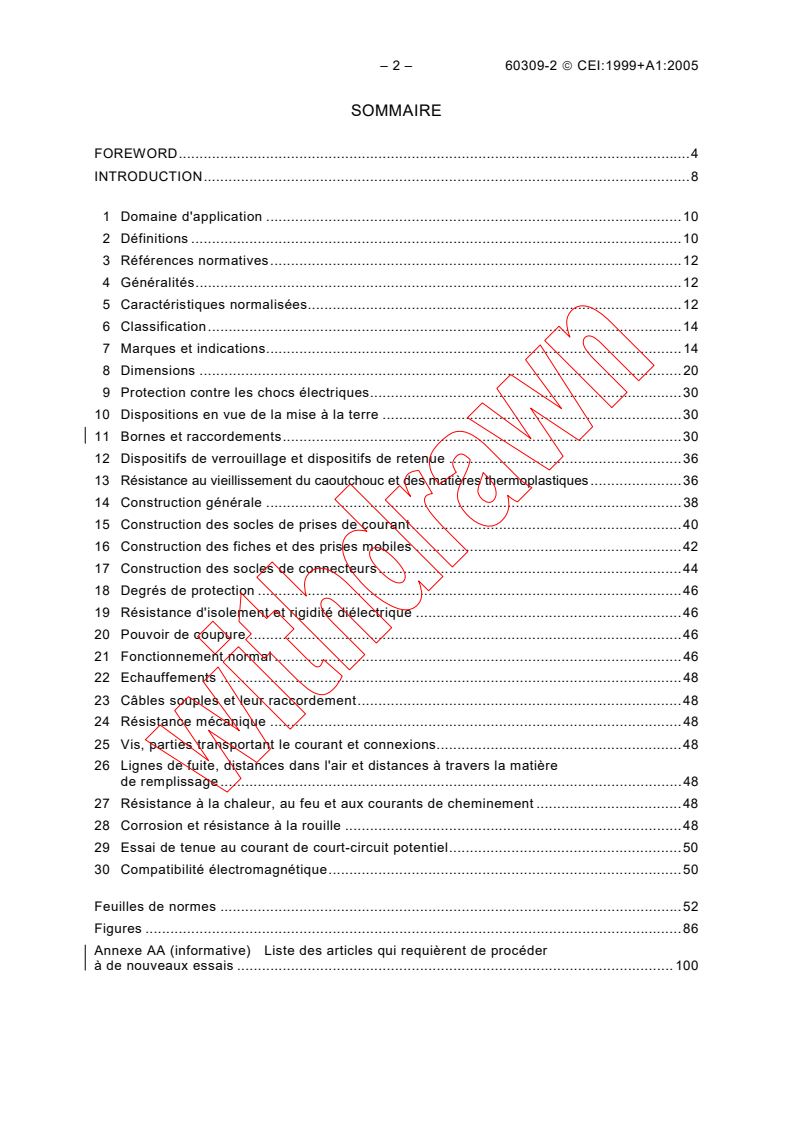
– 2 – 60309-2 CEI:1999+A1:2005
SOMMAIRE
FOREWORD.4
INTRODUCTION.8
1 Domaine d'application .10
2 Définitions .10
3 Références normatives.12
4 Généralités.12
5 Caractéristiques normalisées.12
6 Classification.14
7 Marques et indications.14
8 Dimensions .20
9 Protection contre les chocs électriques.30
10 Dispositions en vue de la mise à la terre .30
11 Bornes et raccordements.30
12 Dispositifs de verrouillage et dispositifs de retenue .36
13 Résistance au vieillissement du caoutchouc et des matières thermoplastiques.36
14 Construction générale .38
15 Construction des socles de prises de courant.40
16 Construction des fiches et des prises mobiles .42
17 Construction des socles de connecteurs.44
18 Degrés de protection .46
19 Résistance d'isolement et rigidité diélectrique .46
20 Pouvoir de coupure .46
21 Fonctionnement normal .46
22 Echauffements .48
23 Câbles souples et leur raccordement.48
24 Résistance mécanique .48
25 Vis, parties transportant le courant et connexions.48
26 Lignes de fuite, distances dans l'air et distances à travers la matière
de remplissage .48
27 Résistance à la chaleur, au feu et aux courants de cheminement .48
28 Corrosion et résistance à la rouille .48
29 Essai de tenue au courant de court-circuit potentiel.50
30 Compatibilité électromagnétique.50
Feuilles de normes .52
Figures .86
Annexe AA (informative) Liste des articles qui requièrent de procéder
à de nouveaux essais .100
60309-2 IEC:1999+A1:2005 – 3 –
CONTENTS
FOREWORD.5
INTRODUCTION.9
1 Scope.11
2 Definitions .11
3 Normative references .13
4 General .13
5 Standard ratings .13
6 Classification.15
7 Marking .15
8 Dimensions .21
9 Protection against electric shock .31
10 Provision for earthing .31
11 Terminals and terminations .31
12 Interlocks and retaining devices .37
13 Resistance to ageing of rubber and thermoplastic material .37
14 General construction .39
15 Construction of socket-outlets .41
16 Construction of plugs and connectors .43
17 Construction of appliance inlets.45
18 Degrees of protection .47
19 Insulation resistance and dielectric strength .47
20 Breaking capacity .47
21 Normal operation.47
22 Temperature rise .49
23 Flexible cables and their connection.49
24 Mechanical strength .49
25 Screws, current-carrying parts and connections.49
26 Creepage distances, clearances and distances through sealing compound .49
27 Resistance to heat, fire and tracking.49
28 Corrosion and resistance to rusting .49
29 Conditional short-circuit current withstand test .51
30 Electromagnetic compatibility .51
Standards sheets.53
Figures .87
Annex AA (informative) List of the clause numbers that require re-testing.101
– 4 – 60309-2 © CEI:1999+A1:2005
INTERNATIONAL ELECTROTECHNICAL COMMISSION
____________
PRISES DE COURANT POUR USAGES INDUSTRIELS –
Partie 2: Règles d'interchangeabilité dimensionnelle pour
les appareils à broches et alvéoles
AVANT-PROPOS
1) La Commission Electrotechnique Internationale (CEI) est une organisation mondiale de normalisation composée de
l'ensemble des comités électrotechniques nationaux (Comités nationaux de la CEI). La CEI a pour objet de favoriser
la coopération internationale pour toutes les questions de normalisation dans les domaines de l'électricité et de
l'électronique. A cet effet, la CEI – entre autres activités – publie des Normes internationales, des Spécifications
techniques, des Rapports techniques, des Spécifications accessibles au public (PAS) et des Guides (ci-après
dénommés "Publication(s) de la CEI"). Leur élaboration est confiée à des comités d'études, aux travaux desquels
tout Comité national intéressé par le sujet traité peut participer. Les organisations internationales, gouvernementales
et non gouvernementales, en liaison avec la CEI, participent également aux travaux. La CEI collabore étroitement
avec l'Organisation Internationale de Normalisation (ISO), selon des conditions fixées par accord entre les deux
organisations.
2) Les décisions ou accords officiels de la CEI concernant les questions techniques représentent, dans la mesure du
possible, un accord international sur les sujets étudiés, étant donné que les Comités nationaux de la CEI intéressés
sont représentés dans chaque comité d’études.
3) Les Publications de la CEI se présentent sous la forme de recommandations internationales et sont agréées comme
telles par les Comités nationaux de la CEI. Tous les efforts raisonnables sont entrepris afin que la CEI s'assure de
l'exactitude du contenu technique de ses publications; la CEI ne peut pas être tenue responsable de l'éventuelle
mauvaise utilisation ou interprétation qui en est faite par un quelconque utilisateur final.
4) Dans le but d'encourager l'uniformité internationale, les Comités nationaux de la CEI s'engagent, dans toute la
mesure possible, à appliquer de façon transparente les Publications de la CEI dans leurs publications nationales et
régionales. Toutes divergences entre toutes Publications de la CEI et toutes publications nationales ou régionales
correspondantes doivent être indiquées en termes clairs dans ces dernières.
5) La CEI n’a prévu aucune procédure de marquage valant indication d’approbation et n'engage pas sa responsabilité
pour les équipements déclarés conformes à une de ses Publications.
6) Tous les utilisateurs doivent s'assurer qu'ils sont en possession de la dernière édition de cette publication.
7) Aucune responsabilité ne doit être imputée à la CEI, à ses administrateurs, employés, auxiliaires ou mandataires, y
compris ses experts particuliers et les membres de ses comités d'études et des Comités nationaux de la CEI, pour
tout préjudice causé en cas de dommages corporels et matériels, ou de tout autre dommage de quelque nature que
ce soit, directe ou indirecte, ou pour supporter les coûts (y compris les frais de justice) et les dépenses découlant de
la publication ou de l'utilisation de cette Publication de la CEI ou de toute autre Publication de la CEI, ou au crédit qui
lui est accordé.
8) L'attention est attirée sur les références normatives citées dans cette publication. L'utilisation de publications
référencées est obligatoire pour une application correcte de la présente publication.
9) L’attention est attirée sur le fait que certains des éléments de la présente Publication de la CEI peuvent faire l’objet
de droits de propriété intellectuelle ou de droits analogues. La CEI ne saurait être tenue pour responsable de ne pas
avoir identifié de tels droits de propriété et de ne pas avoir signalé leur existence.
La Norme internationale CEI 60309-2 a été établie par le sous-comité 23H: Prises de courant
à usage industriel, du comité d'études 23 de la CEI: Petit appareillage.
La présente partie 2 doit être lue conjointement avec la partie 1.
La présente version consolidée de la CEI 60309-2 comprend la quatrième édition (1999)
[documents 23H/89/FDIS et 23H/92/RVD] et son amendement 1 (2005) [documents
23H/175/FDIS et 23H/183/RVD].
Le contenu technique de cette version consolidée est donc identique à celui de l'édition de
base et à son amendement; cette version a été préparée par commodité pour l'utilisateur.
Elle porte le numéro d'édition 4.1.
Une ligne verticale dans la marge indique où la publication de base a été modifiée par
l'amendement 1.
60309-2 © IEC:1999+A1:2005 – 5 –
INTERNATIONAL ELECTROTECHNICAL COMMISSION
____________
PLUGS, SOCKET-OUTLETS AND COUPLERS
FOR INDUSTRIAL PURPOSES –
Part 2: Dimensional interchangeability requirements
for pin and contact-tube accessories
FOREWORD
1) The International Electrotechnical Commission (IEC) is a worldwide organization for standardization comprising
all national electrotechnical committees (IEC National Committees). The object of IEC is to promote
international co-operation on all questions concerning standardization in the electrical and electronic fields. To
this end and in addition to other activities, IEC publishes International Standards, Technical Specifications,
Technical Reports, Publicly Available Specifications (PAS) and Guides (hereafter referred to as “IEC
Publication(s)”). Their preparation is entrusted to technical committees; any IEC National Committee interested
in the subject dealt with may participate in this preparatory work. International, governmental and non-
governmental organizations liaising with the IEC also participate in this preparation. IEC collaborates closely
with the International Organization for Standardization (ISO) in accordance with conditions determined by
agreement between the two organizations.
2) The formal decisions or agreements of IEC on technical matters express, as nearly as possible, an international
consensus of opinion on the relevant subjects since each technical committee has representation from all
interested IEC National Committees.
3) IEC Publications have the form of recommendations for international use and are accepted by IEC National
Committees in that sense. While all reasonable efforts are made to ensure that the technical content of IEC
Publications is accurate, IEC cannot be held responsible for the way in which they are used or for any
misinterpretation by any end user.
4) In order to promote international uniformity, IEC National Committees undertake to apply IEC Publications
transparently to the maximum extent possible in their national and regional publications. Any divergence
between any IEC Publication and the corresponding national or regional publication shall be clearly indicated in
the latter.
5) IEC provides no marking procedure to indicate its approval and cannot be rendered responsible for any
equipment declared to be in conformity with an IEC Publication.
6) All users should ensure that they have the latest edition of this publication.
7) No liability shall attach to IEC or its directors, employees, servants or agents including individual experts and
members of its technical committees and IEC National Committees for any personal injury, property damage or
other damage of any nature whatsoever, whether direct or indirect, or for costs (including legal fees) and
expenses arising out of the publication, use of, or reliance upon, this IEC Publication or any other IEC
Publications.
8) Attention is drawn to the Normative references cited in this publication. Use of the referenced publications is
indispensable for the correct application of this publication.
9) Attention is drawn to the possibility that some of the elements of this IEC Publication may be the subject of
patent rights. IEC shall not be held responsible for identifying any or all such patent rights.
International Standard IEC 60309-2 has been prepared by subcommittee 23H: Industrial plugs
and socket-outlets, of IEC technical committee 23: Electrical accessories.
This part 2 shall be used in conjunction with part 1.
This consolidated version of IEC 60309-2 consists of the fourth (1999) [documents
23H/89/FDIS and 23H/92/RVD] and its amendment 1 (2005) [documents 23H/175/FDIS and
23H/183/RVD].
The technical content is therefore identical to the base edition and its amendment and has
been prepared for user convenience.
It bears the edition number 4.1.
A vertical line in the margin shows where the base publication has been modified by
amendment 1.
– 6 – 60309-2 CEI:1999+A1:2005
Le comité a décidé que le contenu de la publication de base et de ses amendements ne sera
pas modifié avant la date de maintenance indiquée sur le site web de la CEI sous
"http://webstore.iec.ch" dans les données relatives à la publication recherchée. A cette date,
la publication sera
• reconduite,
• supprimée,
• remplacée par une édition révisée, ou
• amendée.
60309-2 IEC:1999+A1:2005 – 7 –
The committee has decided that the contents of the base publication and its amendments will
remain unchanged until the maintenance result date indicated on the IEC web site under
"http://webstore.iec.ch" in the data related to the specific publication. At this date,
the publication will be
• reconfirmed,
• withdrawn,
• replaced by a revised edition, or
• amended.
– 8 – 60309-2 CEI:1999+A1:2005
INTRODUCTION
La présente norme comporte plusieurs parties:
Partie 1: Règles générales, qui comprend les articles de caractère général.
Parties suivantes: Règles particulières, traitant de types particuliers. Les articles de ces
règles particulières représentent des compléments ou modifications aux articles
correspondants de la première partie. Si le texte des parties suivantes indique une «addition»
ou un «remplacement» des règles, essais ou commentaires pertinents de la première partie,
ces changements sont introduits dans les passages pertinents de la première partie, et ils
deviennent alors des parties de la norme. Lorsque aucune modification n'est nécessaire, les
mots «L'article de la première partie est applicable» sont utilisés.
60309-2 IEC:1999+A1:2005 – 9 –
INTRODUCTION
This standard is divided into several parts:
Part 1: General requirements, comprising clauses of a general character.
Subsequent parts: Particular requirements dealing with particular types. The clauses of these
particular requirements supplement or modify the corresponding clauses in Part 1. Where the
text of subsequent parts indicates an "addition" to or a "replacement" of the relevant
requirement, test specification or explanation of Part 1, these changes are made to the
relevant text of Part 1, which then becomes part of the standard. Where no change is
necessary, the words "This clause of Part 1 is applicable" are used.
– 10 – 60309-2 CEI:1999+A1:2005
PRISES DE COURANT POUR USAGES INDUSTRIELS –
Partie 2: Règles d'interchangeabilité dimensionnelle pour
les appareils à broches et alvéoles
1 Domaine d'application
Remplacement:
La présente norme s'applique aux prises de courant, aux prolongateurs et aux connecteurs
ayant une tension nominale d'emploi ne dépassant pas 690 V, 500 Hz et un courant nominal
ne dépassant pas 125 A, destinés essentiellement aux usages industriels, à l'intérieur ou à
l'extérieur des bâtiments.
NOTE Toutes références aux appareils ayant un courant nominal dépassant 125 A dans la partie 1 ne sont plus
valables dans cette deuxième partie.
La présente norme s'applique aux prises de courant, aux prolongateurs et aux connecteurs
comportant des broches et des alvéoles de contact, ayant des configurations normalisées.
La présente norme s'applique aux prises de courant, aux prolongateurs et aux connecteurs,
désignés dans la suite du texte sous le nom d'appareils, pour usage dans une température
ambiante comprise normalement dans une plage de –25 °C à 40 °C.
L'usage de ces appareils dans des chantiers de construction et pour des applications
agricoles, commerciales et domestiques n'est pas exclu.
La présente norme s'applique aux appareils équipés de bornes sans vis ou de bornes à
perçage d’isolant, de courant nominal ne dépassant pas 16 A pour la série I et 20 A pour la
série II.
NOTE Dans les pays suivants, la présente norme s'applique aux appareils équipés de bornes sans vis ou
de bornes à perçage d’isolant, de courant nominal ne dépassant pas 32 A pour la série I et 30 A pour la série II:
DE, IT.
Les socles de prises de courant et les socles de connecteurs incorporés ou fixés au matériel
électrique sont compris dans le domaine d'application de la présente norme. La présente
norme s'applique aussi aux appareils destinés à être utilisés dans les installations à très
basse tension.
NOTE La présente norme ne s'applique pas aux appareils destinés essentiellement aux usages domestiques et
aux usages généraux analogues.
Pour l'emploi dans des locaux présentant des conditions particulières, par exemple à bord des navires et dans les
locaux présentant des risques d'explosion, des prescriptions complémentaires peuvent être nécessaires.
2 Définitions
L'article de la partie 1 est applicable avec l'exception suivante:
Paragraphe complémentaire:
2.101
inverseur de phases
une fiche ou un socle de connecteur avec un dispositif permettant d'interchanger la position
de deux broches de phases sans les déconnecter des conducteurs
60309-2 IEC:1999+A1:2005 – 11 –
PLUGS, SOCKET-OUTLETS AND COUPLERS
FOR INDUSTRIAL PURPOSES –
Part 2: Dimensional interchangeability requirements for
pin and contact-tube accessories
1 Scope
Replacement:
This standard applies to plugs and socket-outlets, cable couplers and appliance couplers with
a rated operating voltage not exceeding 690 V, 500 Hz and a rated current not exceeding 125
A, primarily intended for industrial use, either indoors or outdoors.
NOTE All references for accessories with a rated current of more than 125 A in part 1 are not applicable to this
part 2.
This standard applies to plugs and socket-outlets, cable couplers and appliance couplers with
pins and contact tubes of standardized configurations.
This standard applies to plugs and socket-outlets, cable couplers and appliance couplers,
hereinafter referred to as accessories, for use when the ambient temperature is normally
within the range –25 °C to 40 °C.
The use of these accessories on building sites and for agricultural, commercial and domestic
applications is not precluded.
This standard applies to accessories with screwless type terminals or insulation piercing
terminals, with a rated current up to and including 16 A for Series I and 20 A for Series II .
NOTE In the following countries, this standard applies to accessories with screwless type terminals or insulation
piercing terminals, with a rated current up to and including 32 A for Series I and 30 A for Series II : DE, IT.
Socket-outlets or appliance inlets incorporated in or fixed to electrical equipment are within
the scope of this standard. This standard also applies to accessories intended to be used in
extra-low voltage installations.
NOTE This standard does not apply to accessories primarily intended for domestic and similar general purposes.
In locations where special conditions prevail, for example on board ship or where explosions are liable to occur,
additional requirements may be necessary.
2 Definitions
This clause of part 1 is applicable except as follows:
Additional subclause:
2.101
phase inverter
a plug or an appliance inlet with operating means to interchange the position of two phase
pins without disconnecting them from the conductors
– 12 – 60309-2 CEI:1999+A1:2005
3 Références normatives
L'article de la partie 1 est applicable avec l'exception suivante:
Addition:
CEI 60617-2: 1996, Symboles graphiques pour schémas – Partie 2: Eléments de symboles,
symboles distinctifs et autres symboles d'application générale
4 Généralités
L'article de la partie 1 est applicable avec l'exception suivante:
4.1 Le dernier alinéa de ce paragraphe de la Partie 1 n’est pas applicable.
Voir Amendement 1 de la CEI 60309-1.
Paragraphe complémentaire:
4.101 Si des calibres sont utilisés, ils doivent être faits en acier trempé. Tous les coins
doivent être légèrement arrondis avec un rayon maximal de 0,1 mm et l'état de surface pour
N8
toutes les surfaces servant aux mesures doit être min., sauf spécification contraire.
Dans cette norme:
2P + inclut 2P + et 1P + N + et
3P + inclut 3P + et 2P + N +
à moins que le contraire ne soit explicitement spécifié (voir Tableau 104).
5 Caractéristiques normalisées
L'article de la partie 1 est applicable avec l'exception suivante:
5.2 Remplacement:
Les courants nominaux normalisés sont donnés dans le Tableau 101.
Tableau 101
Série I Série II
A A
16 20
32 30
63 60
125 100
5.101 Les degrés de protection IP normalisés selon la CEI 60529 sont:
– IP44,
– IP67,
– IP66/IP67
60309-2 IEC:1999+A1:2005 – 13 –
3 Normative references
This clause of part 1 is applicable except as follows:
Addition:
IEC 60617-2:1996, Graphical symbols for diagrams – Part 2: Symbol elements, qualifying
symbols and other symbols having general application
4 General
This clause of part 1 is applicable except as follows:
4.1 The last paragraph of this subclause of Part 1 is not applicable.
See Amendment 1 of IEC 60309-1.
Additional subclause:
4.101 If gauges are used, they shall be of hardened steel, all corners shall be slightly
rounded-off with a maximum radius of 0,1 mm, and the surface finish for all measurement
N8
surfaces shall be min., if not otherwise specified.
In this standard:
2P + covers both 2P + and 1P + N + and
3P + covers both 3P + and 2P + N +
unless specifically excluded (see Table 104).
5 Standard ratings
This clause of part 1 is applicable except as follows:
5.2 Replacement:
Standard rated currents are given in Table 101.
Table 101
Series I Series II
A A
16 20
32 30
63 60
125 100
5.101 The standard IP ratings according to IEC 60529 are:
– IP44,
– IP67,
– IP66/IP67.
– 14 – 60309-2 CEI:1999+A1:2005
6 Classification
L'article de la partie 1 est applicable avec l'exception suivante:
6.1.2 L'article de la Partie 1 est applicable.
7 Marques et indications
L'article de la partie 1 est applicable avec l'exception suivante:
7.1 Modification:
Supprimer la note
Addition:
Le symbole indiquant la position du contact de terre ou de l'ergot ou de la rainure auxiliaire
doit être placé avant ou au-dessus du nombre indiquant la tension nominale d'emploi, et
séparé de celui-ci par une ligne.
Ces indications doivent être placées après celle du courant nominal, un trait les séparant si le
symbole indiquant la position du contact de terre ou de l'ergot ou de la rainure auxiliaire et le
nombre indiquant la tension nominale d'emploi sont séparés par une ligne oblique.
Si l'on utilise un symbole pour la nature du courant, il doit être placé aussitôt après ou
au-dessous de l'indication de la tension nominale d'emploi.
Pour les appareils triphasés il n'est pas nécessaire de marquer la tension phase neutre, si
elle existe.
L'indication du ou des courants nominaux, de la position du contact de terre ou de l'ergot ou
de la rainure auxiliaire, de la ou des tensions nominales d'emploi et de la nature du courant
peut, par exemple, avoir les formes suivantes:
Pour la série I:
9 h
16 A - 9 h/400 V~, ou 16 - 9 h/400~, ou 16 - , ou
400 ~
9 h
16 A - 9 h/380-415 V~, ou 16 - 9 h/380-415~, ou 16 -
380 - 415 ~
6 h
32 A - 6 h/230/400 V~, ou 32 - 6 h/230/400~, ou 32 - , ou
230 / 400 ~
6 h
6 h / 220 / 380 V ~ 6 h / 220 / 380 ~
32 A - , ou 32 - , ou 32 -
220 / 380 ~
240 / 415 V ~ 240 / 415 V ~
240 / 415 ~
60309-2 IEC:1999+A1:2005 – 15 –
6 Classification
This clause of part 1 is applicable except as follows:
6.1.2 This clause of Part 1 is applicable.
7 Marking
This clause of part 1 is applicable except as follows:
7.1 Modification:
Delete the note
Addition:
The symbol indicating the position of the earthing contact or of the minor key or keyway shall
be placed before or above the figure for the rated operating voltage, and separated from it by
a line.
These markings shall be placed after that for rated current, separated from it by a dash if an
oblique line separates the symbol indicating the position of the earthing contact or of the
minor key or keyway from the figure for the rated operating voltage.
If a symbol for nature of supply is used, it shall be placed next to or below the marking for
rated operating voltage.
For three-phase accessories it is not necessary to mark the voltage phase to neutral, if any.
The marking for rated current(s), position of the earthing contact or the minor key, keyway,
rated operating voltage(s) and nature of supply accordingly may be as follows:
For series I:
9 h
16 A - 9 h/400 V~, or 16 - 9 h/400~, or 16 - , or
400 ~
9 h
16 A - 9 h/380-415 V~, or 16 - 9 h/380-415~, or 16 -
380 - 415 ~
6 h
32 A - 6 h/230/400 V~, or 32 - 6 h/230/400~, or 32 - , or
230 / 400 ~
6 h
6 h / 220 / 380 V ~ 6 h / 220 / 380 ~
32 A - , or 32 - , or 32 -
220 / 380 ~
240 / 415 V ~ 240 / 415 V ~
240 / 415 ~
– 16 – 60309-2 CEI:1999+A1:2005
Pour la série II
7 h
20 A - 7 h/480 V a.c. ou 20 A - 7 h/480~, ou 20 A -
480 ~
7 h
30 A - 7 h/480 V, 3 Phase, ou 30 A - 7 h/480, 3Φ, ou 30 A -
480 V, 3Φ
7 h
60 A - 7 h/277/480 V, 3 Phase Y, ou 60 A - 7 h/277/480, 3ΦY, ou 60 A -
277 / 480 V, 3Φ Y
Il est permis de mettre les symboles (~) pour courant alternatif et ( ou ) pour courant
continu après les valeurs (CEI 60617-2).
Les dessins figurant sur les feuilles de normes 2-I, 2-II, 2-III et 2-lV représentent des
appareils ayant le symbole 6 h, et ceux figurant sur les feuilles de normes 2-VIII et 2-lX
représentent des appareils ayant le symbole 12 h.
Pour les appareils de tension nominale d'emploi dépassant 50 V, le symbole indiquant la
position du contact de terre doit être une valeur suivie de la lettre h.
La valeur est déduite de la position de l'alvéole de terre, par comparaison à un cadran
d'horloge, le socle de prise de courant ou la prise mobile étant vu de devant et la rainure
étant sur la sixième heure.
Pour les appareils de tension nominale d'emploi ne dépassant pas 50 V, le symbole indiquant
la position de l'ergot doit être une valeur suivie de la lettre h.
La valeur est déduite de la position de l'ergot auxiliaire, par comparaison à un cadran
d'horloge, le socle de prise de courant ou la prise mobile étant vu de devant et l'ergot
principal étant sur la sixième heure.
Pour les fiches et les socles de connecteurs, le symbole indiquant la position du contact de
terre ou de la rainure auxiliaire doit être identique à celui du socle de prise de courant ou de
la prise mobile correspondante.
Les alvéoles des socles de prises de courant et des prises mobiles doivent se trouver dans le sens
de rotation des aiguilles d'une montre, si l'on regarde les alvéoles de l'avant conformément aux
feuilles de normes (voir aussi 7.5)
Les broches des fiches et des socles des connecteurs doivent se trouver dans l'ordre opposé,
si l'on regarde les broches de l'avant.
7.2 L'article de la Partie 1 est applicable.
7.4 Remplacement
Pour les fiches et les prises mobiles, le marquage spécifié en 7.1 doit être distingué lorsque
l'appareil est équipé de ses conducteurs et prêt à l'emploi.
L'indication de la tension d'isolement doit être portée sur la partie principale; elle ne doit pas être
visible lorsque l'appareil est installé et équipé de ses conducteurs comme en usage normal.
NOTE 1 L'expression «prêt à l'emploi» n'implique pas qu'une fiche ou une prise mobile soit engagée dans
l'appareil complémentaire.
NOTE 2 L'expression «partie principale» d'une fiche ou d'une prise mobile désigne la partie qui porte les
contacts.
La conformité est vérifiée par examen.
60309-2 IEC:1999+A1:2005 – 17 –
For series II
7 h
20 A - 7 h/480 V a.c. or 20 A - 7 h/480~, or 20 A -
480 ~
7 h
30 A - 7 h/480 V, 3 Phase, or 30 A - 7 h/480, 3Φ, or 30 A -
480 V, 3Φ
7 h
60 A - 7 h/277/480 V, 3 Phase Y, or 60 A - 7 h/277/480, 3ΦY, or 60 A -
277 / 480 V, 3Φ Y
It is allowed to put the symbols for a.c. (~) and d.c. ( or ) after the values (IEC 60617-2).
The drawings of standard sheets 2-I, 2-II, 2-III and 2-lV show accessories with the symbol 6 h
and those of standard sheets 2-VIII and 2-lX accessories with the symbol 12 h.
For accessories having rated operating voltages exceeding 50 V, the symbol indicating the
position of the earthing contact shall be a numeral followed by the letter h.
The numeral is derived from the position of the earth contact tube, when compared with the
face of a clock, the socket-outlet or connector being viewed from the front with the keyway at
the sixth hour.
For accessories having rated operating voltages not exceeding 50 V, the symbol indicating
the position of the minor key shall be a numeral followed by the letter h.
The numeral is derived from the position of the minor key, when compared with the face of a
clock, the socket-outlet or connector being viewed from the front with the major key at the
sixth hour.
For plugs and appliance inlets, the symbol indicating the position of the earthing contact or
the minor keyway shall be the same as that for the corresponding socket-outlet or connector.
Contact tubes of socket-outlets and connectors shall be positioned in the clockwise order
when viewed from the front as shown in the standard sheets (see also 7.5).
Pins of plugs and appliance inlets shall be positioned in the opposite order viewed from the
front.
7.2 This clause of Part 1 is applicable.
7.4 Replacement
For plugs and connectors, the marking specified in 7.1 shall be easily discernible when the
accessory is wired ready for use.
The marking for insulation voltage shall be on the main part; it shall not be visible when the
accessory is mounted and wired as in normal use.
NOTE 1 The term "ready for use" does not imply that the plug or connector is engaged with its complementary
accessory.
NOTE 2 The term "main part" of a plug or a connector means the part carrying the contacts.
Compliance is checked by inspection.
– 18 – 60309-2 CEI:1999+A1:2005
7.5 Remplacement
Pour les appareils démontables les contacts doivent être repérés par les symboles suivants.
– pour les appareils avec trois contacts (phase + neutre + terre, ou, phase + phase + terre)
L / +, non marqué, ou
sauf pour la série II position 4 h et 5 h qui sont marqués comme suit:
N, non marqué, ou
– pour les appareils avec quatre contacts (trois phases + terre):
L1, L2, L3, ou ou en variante 1, 2, 3 ou
sauf pour la série II position 12 h (monophasé + trou central + monophasé + terre) qui est
marqué:
L1, N, L2, ou
– pour les appareils avec cinq contacts (trois phases + neutre + terre):
L1, L2, L3, N, ou ou en variante 1, 2, 3, N, ou
– pendant un temps, les indications R1, S2, T3 peuvent être utilisées à la place de L1, L2, L3.
– pour les appareils de tension nominale d'emploi inférieure ou égale à 50 V, en position 8 h
pour couveuses électriques portables: +12, +24.
Ces symboles doivent être placés près des bornes correspondantes; ils ne doivent pas être
placés sur des vis, des rondelles amovibles ou d'autres parties amovibles.
Pour les inverseurs de phases ces symboles doivent être conformes avec les prescriptions
de 7.1 dans une seule position. Dans l'autre position du dispositif d'inversion, le marquage
des phases n'a pas besoin d'être conforme.
NOTE Aucun repérage n'est requis pour les bornes des conducteurs pilotes.
Les chiffres utilisés avec des lettres peuvent être écrits en indice. Il est recommandé d'utiliser, si possible, le
symbole
La conformité est vérifiée par inspection.
7.7 Modification:
Le paragraphe de la partie 1 est applicable avec l'adjonction suivante:
Ajouter:
Les appareils 2P + N + terre, 12 h, de la série II, doivent utiliser des indications de couleur orange.
60309-2 IEC:1999+A1:2005 – 19 –
7.5 Replacement
For rewirable accessories, the contacts shall be indicated by the following symbols.
– for accessories with three contacts (phase + neutral + earth, or, phase + phase + earth):
L / +, unmarked, or
except for Series II clock position 4 h and 5 h which are marked:
N, unmarked, or
– for accessories with four contacts (three phase + ear
...
IEC 60309-2 ®
Edition 4.2 2012-05
INTERNATIONAL
STANDARD
NORME
INTERNATIONALE
Plugs, socket-outlets and couplers for industrial purposes –
Part 2: Dimensional interchangeability requirements for pin and contact-tube
accessories
Prises de courant pour usages industriels –
Partie 2: Règles d'interchangeabilité dimensionnelle pour les appareils à
broches et alvéoles
All rights reserved. Unless otherwise specified, no part of this publication may be reproduced or utilized in any form
or by any means, electronic or mechanical, including photocopying and microfilm, without permission in writing from
either IEC or IEC's member National Committee in the country of the requester.
If you have any questions about IEC copyright or have an enquiry about obtaining additional rights to this publication,
please contact the address below or your local IEC member National Committee for further information.
Droits de reproduction réservés. Sauf indication contraire, aucune partie de cette publication ne peut être reproduite ni
utilisée sous quelque forme que ce soit et par aucun procédé, électronique ou mécanique, y compris la photocopie et les
microfilms, sans l'accord écrit de la CEI ou du Comité national de la CEI du pays du demandeur.
Si vous avez des questions sur le copyright de la CEI ou si vous désirez obtenir des droits supplémentaires sur cette
publication, utilisez les coordonnées ci-après ou contactez le Comité national de la CEI de votre pays de résidence.
IEC Central Office Tel.: +41 22 919 02 11
3, rue de Varembé Fax: +41 22 919 03 00
CH-1211 Geneva 20 info@iec.ch
Switzerland www.iec.ch
About the IEC
The International Electrotechnical Commission (IEC) is the leading global organization that prepares and publishes
International Standards for all electrical, electronic and related technologies.
About IEC publications
The technical content of IEC publications is kept under constant review by the IEC. Please make sure that you have the
latest edition, a corrigenda or an amendment might have been published.
Useful links:
IEC publications search - www.iec.ch/searchpub Electropedia - www.electropedia.org
The advanced search enables you to find IEC publications The world's leading online dictionary of electronic and
by a variety of criteria (reference number, text, technical electrical terms containing more than 30 000 terms and
committee,…). definitions in English and French, with equivalent terms in
It also gives information on projects, replaced and additional languages. Also known as the International
withdrawn publications. Electrotechnical Vocabulary (IEV) on-line.
IEC Just Published - webstore.iec.ch/justpublished Customer Service Centre - webstore.iec.ch/csc
Stay up to date on all new IEC publications. Just Published If you wish to give us your feedback on this publication
details all new publications released. Available on-line and or need further assistance, please contact the
also once a month by email. Customer Service Centre: csc@iec.ch.
A propos de la CEI
La Commission Electrotechnique Internationale (CEI) est la première organisation mondiale qui élabore et publie des
Normes internationales pour tout ce qui a trait à l'électricité, à l'électronique et aux technologies apparentées.
A propos des publications CEI
Le contenu technique des publications de la CEI est constamment revu. Veuillez vous assurer que vous possédez
l’édition la plus récente, un corrigendum ou amendement peut avoir été publié.
Liens utiles:
Recherche de publications CEI - www.iec.ch/searchpub Electropedia - www.electropedia.org
La recherche avancée vous permet de trouver des Le premier dictionnaire en ligne au monde de termes
publications CEI en utilisant différents critères (numéro de électroniques et électriques. Il contient plus de 30 000
référence, texte, comité d’études,…). termes et définitions en anglais et en français, ainsi que
Elle donne aussi des informations sur les projets et les les termes équivalents dans les langues additionnelles.
publications remplacées ou retirées. Egalement appelé Vocabulaire Electrotechnique
International (VEI) en ligne.
Just Published CEI - webstore.iec.ch/justpublished
Service Clients - webstore.iec.ch/csc
Restez informé sur les nouvelles publications de la CEI.
Just Published détaille les nouvelles publications parues. Si vous désirez nous donner des commentaires sur
Disponible en ligne et aussi une fois par mois par email. cette publication ou si vous avez des questions
contactez-nous: csc@iec.ch.
IEC 60309-2 ®
Edition 4.2 2012-05
INTERNATIONAL
STANDARD
NORME
INTERNATIONALE
Plugs, socket-outlets and couplers for industrial purposes –
Part 2: Dimensional interchangeability requirements for pin and contact-tube
accessories
Prises de courant pour usages industriels –
Partie 2: Règles d'interchangeabilité dimensionnelle pour les appareils à
broches et alvéoles
INTERNATIONAL
ELECTROTECHNICAL
COMMISSION
COMMISSION
ELECTROTECHNIQUE
PRICE CODE
INTERNATIONALE
CODE PRIX CR
ICS 29.120.30 ISBN 978-2-88912-054-3
– 2 – 60309-2 IEC:1999+A1:2005
+A2:2012
CONTENTS
FOREWORD . 4
INTRODUCTION . 6
1 Scope . 7
2 Definitions . 7
3 Normative references . 8
4 General . 8
5 Standard ratings . 8
6 Classification . 9
7 Marking . 9
8 Dimensions . 12
9 Protection against electric shock . 17
10 Provision for earthing . 17
11 Terminals and terminations . 17
12 Interlocks and retaining devices . 20
13 Resistance to ageing of rubber and thermoplastic material . 20
14 General construction . 21
15 Construction of socket-outlets . 22
16 Construction of plugs and connectors . 23
17 Construction of appliance inlets . 24
18 Degrees of protection . 25
19 Insulation resistance and dielectric strength . 25
20 Breaking capacity . 25
21 Normal operation . 25
22 Temperature rise . 26
23 Flexible cables and their connection . 26
24 Mechanical strength . 26
25 Screws, current-carrying parts and connections . 26
26 Creepage distances, clearances and distances through sealing compound . 26
27 Resistance to heat, fire and tracking . 26
28 Corrosion and resistance to rusting . 26
29 Conditional short-circuit current withstand test . 26
30 Electromagnetic compatibility . 26
Standards sheets . 54
Figures . 91
Annex AA (informative) List of the clause numbers that require re-testing . 105
Table 101 . 8
Table 102 . 12
Table 103-1 – General purpose accessories with rated voltage not exceeding 50 V . 13
Table 103-2 – Special application accessories with rated voltage not exceeding 50 V . 13
Table 104 . 14
Table 105 . 16
60309-2 IEC:1999+A1:2005 – 3 –
+A2:2012
Table 106 . 17
Table 107 – Size of connectable conductors . 19
Table 108 . 20
Table 109 . 21
Table 110 . 22
Table 111 . 23
Table 112 . 23
– 4 – 60309-2 IEC:1999+A1:2005
+A2:2012
INTERNATIONAL ELECTROTECHNICAL COMMISSION
____________
PLUGS, SOCKET-OUTLETS AND COUPLERS
FOR INDUSTRIAL PURPOSES –
Part 2: Dimensional interchangeability requirements
for pin and contact-tube accessories
FOREWORD
1) The International Electrotechnical Commission (IEC) is a worldwide organization for standardization comprising
all national electrotechnical committees (IEC National Committees). The object of IEC is to promote
international co-operation on all questions concerning standardization in the electrical and electronic fields. To
this end and in addition to other activities, IEC publishes International Standards, Technical Specifications,
Technical Reports, Publicly Available Specifications (PAS) and Guides (hereafter referred to as “IEC
Publication(s)”). Their preparation is entrusted to technical committees; any IEC National Committee interested
in the subject dealt with may participate in this preparatory work. International, governmental and non-
governmental organizations liaising with the IEC also participate in this preparation. IEC collaborates closely
with the International Organization for Standardization (ISO) in accordance with conditions determined by
agreement between the two organizations.
2) The formal decisions or agreements of IEC on technical matters express, as nearly as possible, an international
consensus of opinion on the relevant subjects since each technical committee has representation from all
interested IEC National Committees.
3) IEC Publications have the form of recommendations for international use and are accepted by IEC National
Committees in that sense. While all reasonable efforts are made to ensure that the technical content of IEC
Publications is accurate, IEC cannot be held responsible for the way in which they are used or for any
misinterpretation by any end user.
4) In order to promote international uniformity, IEC National Committees undertake to apply IEC Publications
transparently to the maximum extent possible in their national and regional publications. Any divergence
between any IEC Publication and the corresponding national or regional publication shall be clearly indicated in
the latter.
5) IEC itself does not provide any attestation of conformity. Independent certification bodies provide conformity
assessment services and, in some areas, access to IEC marks of conformity. IEC is not responsible for any
services carried out by independent certification bodies.
6) All users should ensure that they have the latest edition of this publication.
7) No liability shall attach to IEC or its directors, employees, servants or agents including individual experts and
members of its technical committees and IEC National Committees for any personal injury, property damage or
other damage of any nature whatsoever, whether direct or indirect, or for costs (including legal fees) and
expenses arising out of the publication, use of, or reliance upon, this IEC Publication or any other IEC
Publications.
8) Attention is drawn to the Normative references cited in this publication. Use of the referenced publications is
indispensable for the correct application of this publication.
9) Attention is drawn to the possibility that some of the elements of this IEC Publication may be the subject of
patent rights. IEC shall not be held responsible for identifying any or all such patent rights.
International Standard IEC 60309-2 has been prepared by subcommittee 23H: Industrial plugs
and socket-outlets, of IEC technical committee 23: Electrical accessories.
This part 2 shall be used in conjunction with part 1.
This consolidated version of IEC 60309-2 consists of the fourth (1999) [documents
23H/89/FDIS and 23H/92/RVD], its amendment 1 (2005) [documents 23H/175/FDIS and
23H/183/RVD] and its amendment 2 (2012) [documents 23H/275/FDIS and 23H/280/RVD].
The technical content is therefore identical to the base edition and its amendments and has
been prepared for user convenience.
It bears the edition number 4.2.
A vertical line in the margin shows where the base publication has been modified by
amendments 1 and 2.
60309-2 IEC:1999+A1:2005 – 5 –
+A2:2012
The committee has decided that the contents of the base publication and its amendments will
remain unchanged until the stability date indicated on the IEC web site under
"http://webstore.iec.ch" in the data related to the specific publication. At this date, the
publication will be
• reconfirmed,
• withdrawn,
• replaced by a revised edition, or
• amended.
– 6 – 60309-2 IEC:1999+A1:2005
+A2:2012
INTRODUCTION
This standard is divided into several parts:
Part 1: General requirements, comprising clauses of a general character.
Subsequent parts: Particular requirements dealing with particular types. The clauses of these
particular requirements supplement or modify the corresponding clauses in Part 1. Where the
text of subsequent parts indicates an "addition" to or a "replacement" of the relevant
requirement, test specification or explanation of Part 1, these changes are made to the
relevant text of Part 1, which then becomes part of the standard. Where no change is
necessary, the words "This clause of Part 1 is applicable" are used.
60309-2 IEC:1999+A1:2005 – 7 –
+A2:2012
PLUGS, SOCKET-OUTLETS AND COUPLERS
FOR INDUSTRIAL PURPOSES –
Part 2: Dimensional interchangeability requirements for
pin and contact-tube accessories
1 Scope
Replacement:
This standard applies to plugs and socket-outlets, cable couplers and appliance couplers with
a rated operating voltage not exceeding 1 000 V, 500 Hz and a rated current not exceeding
125 A, primarily intended for industrial use, either indoors or outdoors.
NOTE All references for accessories with a rated current of more than 125 A in part 1 are not applicable to this
part 2.
This standard applies to plugs and socket-outlets, cable couplers and appliance couplers with
pins and contact tubes of standardized configurations.
This standard applies to plugs and socket-outlets, cable couplers and appliance couplers,
hereinafter referred to as accessories, for use when the ambient temperature is normally
within the range –25 °C to 40 °C.
The use of these accessories on building sites and for agricultural, commercial and domestic
applications is not precluded.
This standard applies to accessories with screwless type terminals or insulation piercing
terminals, with a rated current up to and including 32 A for series I and 30 A for series II.
Socket-outlets or appliance inlets incorporated in or fixed to electrical equipment are within
the scope of this standard. This standard also applies to accessories intended to be used in
extra-low voltage installations.
NOTE This standard does not apply to accessories primarily intended for domestic and similar general purposes.
In locations where special conditions prevail, for example on board ship or where explosions are liable to occur,
additional requirements may be necessary.
2 Definitions
This clause of part 1 is applicable except as follows:
Additional subclause:
2.101
phase inverter
a plug or an appliance inlet with operating means to interchange the position of two phase
pins without disconnecting them from the conductors
– 8 – 60309-2 IEC:1999+A1:2005
+A2:2012
3 Normative references
This clause of part 1 is applicable except as follows:
Addition:
IEC 60364-4-41, Low-voltage electrical installations – Part 4-41: Protection for safety –
Protection against electric shock
IEC 60617-2:1996, Graphical symbols for diagrams – Part 2: Symbol elements, qualifying
symbols and other symbols having general application
4 General
This clause of part 1 is applicable except as follows:
4.1 The last paragraph of this subclause of Part 1 is not applicable.
See Amendment 1 of IEC 60309-1.
Additional subclause:
4.101 If gauges are used, they shall be of hardened steel, all corners shall be slightly
rounded-off with a maximum radius of 0,1 mm, and the surface finish for all measurement
N8
surfaces shall be min., if not otherwise specified.
In this standard:
covers both 2P + and 1P + N + and
2P +
3P + covers both 3P + and 2P + N +
unless specifically excluded (see Table 104).
5 Standard ratings
This clause of part 1 is applicable except as follows:
5.2 Replacement:
Standard rated currents are given in Table 101.
Table 101
Series I Series II
A A
16 20
32 30
63 60
125 100
5.101 The standard IP ratings according to IEC 60529 are:
– IP44,
– IP67,
– IP66/IP67.
60309-2 IEC:1999+A1:2005 – 9 –
+A2:2012
6 Classification
This clause of part 1 is applicable except as follows:
6.1.2 This clause of Part 1 is applicable.
7 Marking
This clause of part 1 is applicable except as follows:
7.1 Modification:
Delete the note
Addition:
The symbol indicating the position of the earthing contact or of the minor key or keyway shall
be placed before or above the figure for the rated operating voltage, and separated from it by
a line.
These markings shall be placed after that for rated current, separated from it by a dash if an
oblique line separates the symbol indicating the position of the earthing contact or of the
minor key or keyway from the figure for the rated operating voltage.
If a symbol for nature of supply is used, it shall be placed next to or below the marking for
rated operating voltage.
For three-phase accessories it is not necessary to mark the voltage phase to neutral, if any.
The marking for rated current(s), position of the earthing contact or the minor key, keyway,
rated operating voltage(s) and nature of supply accordingly may be as follows:
For series I:
9 h
16 A - 9 h/400 V~, or 16 - 9 h/400~, or 16 - , or
400 ~
9 h
16 A - 9 h/380-415 V~, or 16 - 9 h/380-415~, or 16 -
380 - 415 ~
6 h
32 A - 6 h/230/400 V~, or 32 - 6 h/230/400~, or 32 - , or
230 / 400 ~
6 h
6 h / 220 / 380 V ~ 6 h / 220 / 380 ~
32 A - , or 32 - , or 32 -
220 / 380 ~
240 / 415 V ~ 240 / 415 V ~
240 / 415 ~
– 10 – 60309-2 IEC:1999+A1:2005
+A2:2012
For series II
7 h
20 A - 7 h/480 V a.c. or 20 A - 7 h/480~, or 20 A -
480 ~
7 h
30 A - 7 h/480 V, 3 Phase, or 30 A - 7 h/480, 3Φ, or 30 A -
480 V, 3Φ
7 h
60 A - 7 h/277/480 V, 3 Phase Y, or 60 A - 7 h/277/480, 3ΦY, or 60 A -
277 / 480 V, 3Φ Y
It is allowed to put the symbols for a.c. (~) and d.c. ( or ) after the values (IEC 60617-2).
The drawings of standard sheets 2-I, 2-II, 2-III and 2-lV show accessories with the symbol 6 h
and those of standard sheets 2-VIII and 2-lX accessories with the symbol 12 h.
For accessories having rated operating voltages exceeding 50 V, the symbol indicating the
position of the earthing contact shall be a numeral followed by the letter h.
The numeral is derived from the position of the earth contact tube, when compared with the
face of a clock, the socket-outlet or connector being viewed from the front with the keyway at
the sixth hour.
For accessories having rated operating voltages not exceeding 50 V, the symbol indicating
the position of the minor key shall be a numeral followed by the letter h.
The numeral is derived from the position of the minor key, when compared with the face of a
clock, the socket-outlet or connector being viewed from the front with the major key at the
sixth hour.
For plugs and appliance inlets, the symbol indicating the position of the earthing contact or
the minor keyway shall be the same as that for the corresponding socket-outlet or connector.
Contact tubes of socket-outlets and connectors shall be positioned in the clockwise order
when viewed from the front as shown in the standard sheets (see also 7.5).
Pins of plugs and appliance inlets shall be positioned in the opposite order viewed from the
front.
7.2 This clause of Part 1 is applicable.
7.4 Replacement
For plugs and connectors, the marking specified in 7.1 shall be easily discernible when the
accessory is wired ready for use.
The marking for insulation voltage shall be on the main part; it shall not be visible when the
accessory is mounted and wired as in normal use.
NOTE 1 The term "ready for use" does not imply that the plug or connector is engaged with its complementary
accessory.
NOTE 2 The term "main part" of a plug or a connector means the part carrying the contacts.
Compliance is checked by inspection.
60309-2 IEC:1999+A1:2005 – 11 –
+A2:2012
7.5 Replacement
For rewirable accessories, the contacts shall be indicated by the following symbols.
– for accessories with three contacts (phase + neutral + earth, or, phase + phase + earth):
L / +, unmarked, or
except for Series II clock position 4 h and 5 h which are marked:
N, unmarked, or
– for accessories with four contacts (three phase + earth):
L1, L2, L3, or or alternatively 1, 2, 3, or
except for Series II clock position 12 h (phase + centre tap + phase + earth) which is
marked:
L1, N, L2, or
– for accessories with five contacts (three phase + neutral + earth):
L1, L2, L3, N, or or alternatively 1, 2, 3, N or
– for a period of time the marking R1, S2, T3 may be used instead of L1, L2, L3.
– for accessories having a rated operating voltage not exceeding 50 V, 8 h clock position for
portable electric incubator : +12, +24.
These symbols shall be placed close to the relevant terminals; they shall not be placed on
screws, removable washers or other removable parts.
For phase inverters these symbols shall conform in one position with the requirements of 7.1.
In the other position of the inverting means, the phase marking need not conform.
NOTE The terminals for pilot conductors are not required to be indicated.
The figures used with the letters may be written as an index. It is recommended that where practicable the
symbol be used.
Compliance is checked by inspection.
7.7 Modification:
This subclause of part 1 is applicable except for the following addition:
Add:
The 2P + N + earth, 12 h, Series II accessories shall use the indicating colour orange.
– 12 – 60309-2 IEC:1999+A1:2005
+A2:2012
8 Dimensions
This clause of part 1 is applicable except as follows:
8.1 Replacement:
Accessories shall comply with the relevant standard sheets as specified below:
– accessories having rated operating voltages exceeding 50 V:
• 16/20 A and 32/30 A: . Sheets 2-I and 2-II;
• 63/60 A and 125/100 A, without pilot contact:. Sheets 2-III and 2-IV;
• 63/60 A and 125/100 A, with pilot contact: . Sheets 2-IIIa and 2-IVa;
• mechanical interlock for 16 A to 125 A accessories . Sheet 2-V
– accessories having rated operating voltage not exceeding 50 V:
16/20 A and 32/30 A: .… Sheets 2-VIII and 2-IX.
Deviations from the dimensions specified in the standard sheets may be made, but only if
they provide a technical advantage and do not adversely affect the purpose and safety of the
accessories complying with the standard sheets, especially with regard to interchangeability
and non-interchangeability.
Compliance is checked by means of gauges or by measurement for those dimensions not
covered by gauges,
– for accessories having rated operating voltages exceeding 50 V according to:
• Figures 101 and 102 for socket-outlets and connectors;
• Figures 107 and 108 for plugs and appliance inlets;
– for accessories having rated operating voltages not exceeding 50 V according to:
• Figures 110 and 112 for 16/20 A and 32/30 A accessories.
The gauges shall be moved axially to the centre line of the accessory with a force as shown in
the Table 102, applied for 1 min.
Table 102
Rated current
Rated operating Force (max.) for Force (max.) for
voltage "GO" gauge "NOT GO" gauge
A
N ( )
V Series I Series II N
−1
Not exceeding 50 V 16 20 150 30
32 30 150 30
Exceeding 50 V 16 20 60 20
32 30 90 30
63 60 165 55
125 100 240 80
Before the test, the test specimen of insulating material shall be stored at a temperature of
(20 ± 5) °C and a relative humidity between 45 % and 75 % for four weeks.
For accessories having rated operating voltages not exceeding 50 V, the position of the minor
key or keyway shall be as shown in Tables 103-1 or 103-2
60309-2 IEC:1999+A1:2005 – 13 –
+A2:2012
For accessories having rated operating voltages exceeding 50 V, the position of the earthing
contact shall be as shown in Table 104.
Compliance is checked by inspection.
Table 103-1 – General purpose accessories with rated voltage
not exceeding 50 V
Rated operating
Frequency Minor key or
voltage
keyway position*
V Hz
20 to 25 50 and 60 No minor key or keyway
40 to 50 50 and 60 12
100 up to and including 200 4
20 to 25 300 2
and 400 3
40 to 50 Over 400 up to and including 500 11
Direct current 10
* The minor key or keyway position is indicated by the relevant number (see 7.1).
Table 103-2 – Special application accessories with rated voltage not exceeding 50 V
Rated Minor key or
Numbers of
operating Rated current Other characteristics and application keyway
poles
voltage position *
Portable electric incubators – use at 12 V d.c. or
25 V 32 A 3 8
24 V d.c. on ambulances or helicopters
* The minor key or keyway is indicated by the relevant number.
Positions 1 and 9 are reserved for future standardisation. For constructional reasons,
positions 5, 6 and 7 cannot be used.
– 14 – 60309-2 IEC:1999+A1:2005
+A2:2012
Table 104
Number of Accessories earthing-
Type Frequency Rated operating voltage
contacts a
contact position
16/20 A 63/60 A
Hz V
32/30 A 125/100 A
1P+N+ 50 and 60 100 to 130 4 4
Series II 60 277 5 5
100 to 130 4 4
50 and 60
200 to 250 6 6
380 to 415 9 9
50 and 60 480 to 500 7 7
3 contacts Supply from an isolating 12 12
2P+
transformer
Series I
and II
100 up to and Over 50 10 10
including 300
Over 300 up to Over 50 2 2
and including 500
d 3 3
Over 50 up to and including 250
Direct current
Over 250 8 8
2P+N+ 50 and 60 125/250 12 12
single-phase
Series II
Series I 50 and 60 Supply from an isolating 12 12
transformer
7100 to 130 4 4
50 and 60 200 to 250 9 9
380 to 415 6 6
60 b 11 11
440 to 460
4 contacts 3P+ 480 to 500 7 7
50 and 60
Series I 600 to 690 5 5
and II
50 380 3 3
60 c
50 and 60 1000 - 8
100 up to and Over 50 10 10
including 300
Over 300 up to Over 50 2 2
and including 500
57/100 to 75/130 4 4
120/208 to 144/250 9 9
50 and 60 200/346 to 240/415 6 6
277/480 to 288/500 7 7
5 contacts 3P+N+ 347/600 to 400/690 5 5
Series I 60 b 11 11
250/440 to 265/460
and II
50 220/380 3 3
60 c
250/440
60309-2 IEC:1999+A1:2005 – 15 –
+A2:2012
Table 104 (2 of 2)
Number of Accessories earthing-
Type Frequency Rated operating voltage
contacts a
contact position
16/20 A 63/60 A
Hz V
32/30 A 125/100 A
50 and 60 Supply from an isolating 12 12
transformer
100 up to and Over 50 10 10
including 300
Over 300 up to Over 50 2 2
and including 500
All types All rated operating voltage and/or frequencies 1 1
not covered by other configurations.
This clock counter position can additionally be used in
special applications where a distinction to
standardized positions is needed
NOTE The positions shown by a dash (–) are not standardized.
a The earthing-contact position is indicated by the relevant numeral (see 7.1).
b
Mainly for marine installations.
c
Only for refrigerated containers (standardized ISO).
d
This configuration is required to have an earthing contact because it covers voltages above the upper limits of
ELV (d.c.) according to IEC 60364-4-41.
8.2 Replacement:
For accessories having rated operating voltages exceeding 50 V, it shall not be possible to
engage plugs or connectors with socket-outlets or appliance inlets having different ratings, or
having different contact combinations.
In addition, for all accessories the design shall be such that improper connections shall not be
possible between:
– the earth and/or pilot plug-contact and a live socket-contact, or a live plug-contact and the
earth and/or pilot socket-contact;
– the phase plug-contacts and the neutral socket-contact, if any;
– the neutral plug-contact and a phase socket-contact.
Compliance is checked by inspection, with the following exception:
For the two last indents, compliance is not required between three contacts accessories
Series I and II, 4 h, since these have reciprocal contact positions.
NOTE These conflicting versions have both been in use for many years and resolution of this problem has been
found to be impractical.
It shall not be possible to engage plugs with socket-outlets or connectors having different
earthing-contact positions or minor key positions.
Compliance is checked by inspection and tests using the methods indicated below. These
tests are made after storage of test specimens of insulating material at a temperature of
(20 ± 5) °C and with relative humidity between 45 % and 75 % for four weeks.
For accessories having thermoplastic housing, this test is made at a temperature of (35 ± 2) °C,
both the accessories and the gauges being at this temperature.
– 16 – 60309-2 IEC:1999+A1:2005
+A2:2012
a) Checking plugs and appliance inlets
For plugs and appliance inlets with rated operating voltage exceeding 50 V, gauges
according to Figure 109 are used.
For plugs and appliance inlets with rated operating voltage not exceeding 50 V, gauges
according to Figure 113 are used.
First test (key)
The socket-gauge shown in Figure 109 is placed before the plug in such a way that during
the test the key shall hit the lower part of the shroud of the gauge approximately in the
middle.
The force F is slowly increased in such a way that the total force given in Table 105 is
exerted after 15 s. After that the full force is applied for 1 min.
The forces used are given in Table 105.
Table 105
Rated current
A 16/20 32/30 63/60 125/100
Series I/II
Force F N 175 210 385 560
When the force is applied the gauge is not permitted to move more than 4 mm in relation to
the shroud of the plug or appliance inlet.
After the test, the plug and appliance inlet shall not be damaged in such a way that
impairs further use of the accessory.
These forces are equal to 1,4 times the corresponding withdrawal forces.
Second test (earth-pin)
The force F shall be applied to the earth-pin in the same manner and for the same
duration as in the previous test.
After that test, the plug and appliance inlet shall comply with the relevant standard sheet.
b) Checking socket-outlets and connectors
For socket-outlets and connectors having rated operating voltages exceeding 50 V,
gauges according to Figure 104 are used.
For socket-outlets and connectors having rated operating voltages not exceeding 50 V,
gauges according to Figure 111 are used.
First test (shroud)
The first test is carried out on all different clock positions, except for the one
corresponding to the socket-outlet or connector to be used.
The test specimen shall be fixed and supported in such a way that the rigidity of the
socket-outlet or connector is not influenced.
Arrangement for test shall be according to Figure 103.
The gauge shown in Figure 104 shall hit two opposite points of the accessory at the same
time. The axis of the gauge and of the accessory shall be approximately parallel and the
chamfer shall be equally divided in both sides.
The force F is slowly increased in such a way that the total force given in Table 105 is
exerted after 15 s. After that the full force is applied for 1 min.
When the force is applied, the gauge is not permitted to move more than 4 mm in relation
to the shroud of the socket-outlet or connector.
After the test, the socket-outlet of the connector shall not be damaged to the extent of
impairing the further use of the accessory.
Second test (holes)
For the second test, the gauge shown in Figure 105 is inserted in each phase hole.
60309-2 IEC:1999+A1:2005 – 17 –
+A2:2012
The gauge shall not enter the phase hole by a greater distance than that shown in
Table 106 measured from the front of the internal part (see Figure 106).
The same forces and duration and the same method of application are used as for the
previous test.
Table 106
Rated current
A 16/20 32/30 63/60 125/100
Series I/II
Distance X mm 11 12,5 15 20
8.3 Addition:
Compliance is checked by manual test and, for accessories with enclosures of resilient or
thermoplastic material, by means of the gauge shown in Figure 114.
The gauge is applied with a force of 200 N for 1 min. For accessories with enclosures of
thermoplastic material the gauge is applied at a temperature of (35 ± 2) °C, both the
accessories and the gauge being at this temperature.
NOTE For accessories of rigid material, such as metal, thermosetting resins, ceramic material and the like,
conformity to the relevant standard sheets ensures compliance with this requirement.
9 Protection against electric shock
This clause of part 1 is applicable except as follows:
9.1 Addition:
Conformity with the relevant standard sheets ensures compliance with the requirement as far
as inaccessibility of contacts during insertion of a plug or connector into the complementary
accessories is concerned.
9.2 Addition:
Conformity with the relevant standard sheets ensures compliance with these requirements.
10 Provision for earthing
This clause of part 1 is applicable.
11 Terminals and terminations
This clause of Part 1 is applicable except as follows:
11.2.1 Addition:
Screw type terminals may be identified by the terminal sizes given in the Table 107.
NOTE For screw type terminals not identified by terminal sizes given in the Table 107, Part 1 is applicable.
Screw type terminals identified by terminal sizes shall comply with standard sheets as
specified in 11.101 of this standard and are not subject to test as in 11.5 of Part 1.
– 18 – 60309-2 IEC:1999+A1:2005
+A2:2012
Add the following new subclause:
11.101 Screw type terminals identified by terminal sizes
11.101.1 Terminals shall comply with the standard sheets as specified below, except those
for standard sheets 2-X, 2-XI and 2-XII. For these standard sheets, the length of thread in the
fixed part or nut and the length of thread on the screw or stud may be reduced, if the
mechanical strength of the terminal is adequate and at least two full threads of every
clamping screw are in engagement when a conductor of the most unfavourable cross-
sectional area is clamped.
Standard sheet 2-X applies to pillar terminals.
Standard sheet 2-XI applies to screw terminals and stud terminals.
Standard sheet 2-XII applies to saddle terminals.
Standard sheet 2-XIII applies to lug terminals.
Mantle terminals shall comply with standard sheet 2-X with regard to the dimensions D and e.
Terminals which are essentially of the pillar type, but with the part with the hole for the
conductor slotted to enable the conductor to be moved laterally into position, shall comply
with standard sheet 2-X. Anyhow, the maximum gap between the conductor restraining parts
on the side where the slot is located shall comply with standard sheet 2-XI.
If the required length of thread in a terminal screw hole is obtained by plunging, the edge of
the extrusion shall be reasonably smooth and the length of the thread shall exceed the
specified minimum value by at least 0,5 mm.
Compliance is checked by inspection, by measurement and, for terminals with a reduced
length of thread, by test of 11.101.2.
The maximum gap between the conductor restraining parts is checked by means of a steel
gauge pin with a diameter equal to e ± 0,05 mm.
For terminals without pressure plate(s) or the like, complying with standard sheet 2-X, the
clamping screw is screwed fully home without a conductor in position. It shall not then be
possible to insert the gauge pin between the threaded part of the screw and the wall of the
conductor space.
For terminals complying with standard sheet 2-XI, and for terminals with a pressure plate or
the like complying with standard sheet 2-X, where it is not appropriate to insert the gauge pin
in all positions, a conductor is clamped in the terminal.
For terminals complying with standard sheet 2-X, the conductor is in the form of a rod with a
diameter equal to that corresponding to the middle cross-sectional area of the range specified
for the particular terminal, and having a flat end perpendicular to the axis.
For terminals complying with standard sheet 2-XI, the conductor is solid and has a diameter D
as specified in this standard sheet.
With this conductor in position, it shall not be possible to insert the gauge pin, applied in a
direction parallel to the axis of the conductor, into any gap through which a wire of a stranded
conductor might escape.
The minimum distance between the clamping screw and the end of the conductor, when fully
inserted, is specified in standard sheet 2-X. It is checked by means of the rod conductor
specified above, which shall pass into the conductor space for a distance, beyond the
threaded hole, at Ieast equal to the minimum distance specified.
For terminals with pressure plate(s) complying with standard sheet 2-X, the gauge pin is
applied to the gap between the pressure plate and the wall of the conductor space.
60309-2 IEC:1999+A1:2005 – 19 –
+A2:2012
The following negative deviations from the specified values are allowed for the minimum
nominal thread diameter of the screw:
– 0,15 mm for screws with a nominal diameter not exceeding 5 mm;
– 0,22 mm for screws with a nominal diameter over 5 mm but not exceeding 10 mm;
– 0,27 mm for screws with a nominal diameter of over 10 mm.
This subclause does not exclude terminals of types other than those shown in the standard
sheets. Such terminals shall, however, comply with the other requirements of this clause as
far as is reasonable, and it may be necessary to formulate additional requirements.
If the thread in the fixed part or nut is recessed, the total length of the shank of headed
screws shall be increased accordingly.
If one or more of the dimensions are larger than the minimum values specified in the standard
sheets, the other dimensions need not be correspondingly increased, but departures from the
specified values shall not impair the function of the terminal.
11.101.2 Terminals complying with standard sheet 2-X, but with a reduced length of thread,
are fitted with a conductor of the smallest cross-sectional area specified in Table 107, tightly
clamped, or a conductor of the largest cross-sectional area specified in this table, lightly
clamped, whichever is the most unfavourable.
Table 107 – Size of connectabl
...