


IEC 60749-31:2002
(Main)Semiconductor devices - Mechanical and climatic test methods - Part 31: Flammability of plastic-encapsulated devices (internally induced)
General Information
- Abstract
Applicable to semiconductor devices (discrete devices and integrated circuits), this test determines whether the device ignites due to internal heating caused by excessive overloads. The contents of the corrigendum of August 2003 have been included in this copy.
- Status
- Published
- Publication Date
- 29-Aug-2002
- Technical Committee
- TC 47 - Semiconductor devices
- Drafting Committee
- WG 2 - TC 47/WG 2
- Current Stage
- PPUB - Publication issued
- Start Date
- 30-Aug-2002
- Completion Date
- 31-Oct-2002
Overview
IEC 60749-31:2002 is an international standard published by the International Electrotechnical Commission (IEC) that specifies test methods for evaluating the flammability of plastic-encapsulated semiconductor devices caused by internal heating. This standard applies to both discrete semiconductor devices and integrated circuits. The primary objective is to determine whether these devices ignite as a result of excessive internal electrical overloads during operation.
The standard ensures safety and reliability in semiconductor device manufacturing by providing a rigorous test procedure to assess the risk of ignition due to internally induced heating. Compliance with IEC 60749-31 helps manufacturers verify that their plastic-encapsulated devices will not pose fire hazards under severe electrical stress conditions.
Key Topics
Scope and Applicability
IEC 60749-31 covers semiconductor devices including discrete components and integrated circuits encapsulated in plastic materials. It focuses on scenarios where overheating arises internally from electrical overloads.Test Objective
The test identifies whether a device will ignite or smoulder when subjected to increasing internal power dissipation beyond its maximum rated limits.Test Procedure
- The device is operated in free air without heat sinks.
- Internal power dissipation is gradually increased from the device’s maximum rated power at 25 °C, up to five times that rating.
- The power at five times the maximum rated level is maintained for at least one minute if reached without other failure modes.
- Testing stops if:
- The device’s electrical resistance increases prohibitively, or it becomes open-circuited or short-circuited.
- The device ignites (smoulders or bursts into flame).
Failure Criteria
A device is considered defective only if it smoulders or ignites during the test.Standard Background and Maintenance
The test method is aligned with IEC 60749 (1996) and updated with corrigenda from August 2003. The standard is managed by IEC Technical Committee 47 focused on semiconductor devices. The current version of the standard was set to remain unchanged until 2007, after which it could be reconfirmed, revised, replaced, or amended.
Applications
IEC 60749-31:2002 is essential in semiconductor quality assurance and reliability testing for:
Semiconductor Device Manufacturers
Ensuring the mechanical and climatic robustness of plastic-encapsulated semiconductors under extreme electrical overload conditions and preventing fire hazards during device failure.Electronics Industry Safety Compliance
Supporting product safety certifications by demonstrating that devices can withstand overloads without ignition, conforming to international fire safety standards.Design and Development Testing
Allowing engineers to validate the thermal resilience and material flammability characteristics of new semiconductor packaging designs.Risk Assessment
Identifying potential fire risks in electronic components used in consumer electronics, automotive systems, industrial controls, and other critical applications.
Related Standards
IEC 60749 Series
A complete suite covering mechanical and climatic test methods for semiconductor devices, with separate parts addressing different test criteria such as electrical, mechanical, and environmental stresses.IEC 60034 Series
Related IEC publications renumbered under the 60000 series for electrical device standards, illustrating IEC’s systematic approach to numbering and classification.ISO/IEC Directives, Part 3
Applies to the drafting and maintenance of standards like IEC 60749-31, ensuring consistency and international acceptance.Other Flammability and Safety Standards
While IEC 60749-31 focuses on semiconductor devices, related safety and flammability standards may cover broader electronic assemblies or fire prevention in electrical equipment.
Keywords: IEC 60749-31, semiconductor devices, plastic-encapsulated devices, flammability test, internal heating, electrical overload, semiconductor reliability, electronic component safety, fire hazard testing, mechanical and climatic test methods, IEC standards, integrated circuits, discrete devices.
Relations
- Effective Date
- 05-Sep-2023
- Effective Date
- 05-Sep-2023
- Effective Date
- 05-Sep-2023
- Effective Date
- 05-Sep-2023
Frequently Asked Questions
IEC 60749-31:2002 is a standard published by the International Electrotechnical Commission (IEC). Its full title is "Semiconductor devices - Mechanical and climatic test methods - Part 31: Flammability of plastic-encapsulated devices (internally induced)". This standard covers: Applicable to semiconductor devices (discrete devices and integrated circuits), this test determines whether the device ignites due to internal heating caused by excessive overloads. The contents of the corrigendum of August 2003 have been included in this copy.
Applicable to semiconductor devices (discrete devices and integrated circuits), this test determines whether the device ignites due to internal heating caused by excessive overloads. The contents of the corrigendum of August 2003 have been included in this copy.
IEC 60749-31:2002 is classified under the following ICS (International Classification for Standards) categories: 31.080.01 - Semiconductor devices in general. The ICS classification helps identify the subject area and facilitates finding related standards.
IEC 60749-31:2002 has the following relationships with other standards: It is inter standard links to IEC 60749:1996/AMD2:2001, IEC 60749:1996/AMD1:2000, IEC 60749:1996, IEC 60749-31:2002/COR1:2003. Understanding these relationships helps ensure you are using the most current and applicable version of the standard.
IEC 60749-31:2002 is available in PDF format for immediate download after purchase. The document can be added to your cart and obtained through the secure checkout process. Digital delivery ensures instant access to the complete standard document.
Standards Content (Sample)
NORME CEI
INTERNATIONALE IEC
60749-31
INTERNATIONAL
Première édition
STANDARD
First edition
2002-08
Dispositifs à semiconducteurs –
Méthodes d'essais mécaniques et climatiques –
Partie 31:
Inflammabilité des dispositifs à encapsulation
plastique (cas d'une cause interne d'inflammation)
Semiconductor devices –
Mechanical and climatic test methods –
Part 31:
Flammability of plastic-encapsulated devices
(internally induced)
Numéro de référence
Reference number
CEI/IEC 60749-31:2002
Numérotation des publications Publication numbering
Depuis le 1er janvier 1997, les publications de la CEI As from 1 January 1997 all IEC publications are
sont numérotées à partir de 60000. Ainsi, la CEI 34-1 issued with a designation in the 60000 series. For
devient la CEI 60034-1. example, IEC 34-1 is now referred to as IEC 60034-1.
Editions consolidées Consolidated editions
Les versions consolidées de certaines publications de la The IEC is now publishing consolidated versions of its
CEI incorporant les amendements sont disponibles. Par publications. For example, edition numbers 1.0, 1.1
exemple, les numéros d’édition 1.0, 1.1 et 1.2 indiquent and 1.2 refer, respectively, to the base publication,
respectivement la publication de base, la publication de the base publication incorporating amendment 1 and
base incorporant l’amendement 1, et la publication de the base publication incorporating amendments 1
base incorporant les amendements 1 et 2. and 2.
Informations supplémentaires Further information on IEC publications
sur les publications de la CEI
Le contenu technique des publications de la CEI est The technical content of IEC publications is kept
constamment revu par la CEI afin qu'il reflète l'état under constant review by the IEC, thus ensuring that
actuel de la technique. Des renseignements relatifs à the content reflects current technology. Information
cette publication, y compris sa validité, sont dispo- relating to this publication, including its validity, is
nibles dans le Catalogue des publications de la CEI available in the IEC Catalogue of publications
(voir ci-dessous) en plus des nouvelles éditions, (see below) in addition to new editions, amendments
amendements et corrigenda. Des informations sur les and corrigenda. Information on the subjects under
sujets à l’étude et l’avancement des travaux entrepris consideration and work in progress undertaken by the
par le comité d’études qui a élaboré cette publication, technical committee which has prepared this
ainsi que la liste des publications parues, sont publication, as well as the list of publications issued,
également disponibles par l’intermédiaire de: is also available from the following:
• Site web de la CEI (www.iec.ch) • IEC Web Site (www.iec.ch)
• Catalogue des publications de la CEI • Catalogue of IEC publications
Le catalogue en ligne sur le site web de la CEI The on-line catalogue on the IEC web site
(http://www.iec.ch/searchpub/cur_fut.htm) vous permet (http://www.iec.ch/searchpub/cur_fut.htm) enables
de faire des recherches en utilisant de nombreux you to search by a variety of criteria including text
critères, comprenant des recherches textuelles, par searches, technical committees and date of
comité d’études ou date de publication. Des publication. On-line information is also available
informations en ligne sont également disponibles sur on recently issued publications, withdrawn and
les nouvelles publications, les publications rempla- replaced publications, as well as corrigenda.
cées ou retirées, ainsi que sur les corrigenda.
• IEC Just Published • IEC Just Published
Ce résumé des dernières publications parues This summary of recently issued publications
(http://www.iec.ch/online_news/justpub/jp_entry.htm) (http://www.iec.ch/online_news/justpub/jp_entry.htm)
est aussi disponible par courrier électronique. is also available by email. Please contact the
Veuillez prendre contact avec le Service client Customer Service Centre (see below) for further
(voir ci-dessous) pour plus d’informations. information.
• Service clients • Customer Service Centre
Si vous avez des questions au sujet de cette If you have any questions regarding this
publication ou avez besoin de renseignements publication or need further assistance, please
supplémentaires, prenez contact avec le Service contact the Customer Service Centre:
clients:
Email: custserv@iec.ch Email: custserv@iec.ch
Tél: +41 22 919 02 11 Tel: +41 22 919 02 11
Fax: +41 22 919 03 00 Fax: +41 22 919 03 00
.
NORME CEI
INTERNATIONALE IEC
60749-31
INTERNATIONAL
Première édition
STANDARD
First edition
2002-08
Dispositifs à semiconducteurs –
Méthodes d'essais mécaniques et climatiques –
Partie 31:
Inflammabilité des dispositifs à encapsulation
plastique (cas d'une cause interne d'inflammation)
Semiconductor devices –
Mechanical and climatic test methods –
Part 31:
Flammability of plastic-encapsulated devices
(internally induced)
IEC 2002 Droits de reproduction réservés Copyright - all rights reserved
Aucune partie de cette publication ne peut être reproduite ni No part of this publication may be reproduced or utilized in any
utilisée sous quelque forme que ce soit et par aucun procédé, form or by any means, electronic or mechanical, including
électronique ou mécanique, y compris la photocopie et les photocopying and microfilm, without permission in writing from
microfilms, sans l'accord écrit de l'éditeur. the publisher.
International Electrotechnical Commission, 3, rue de Varembé, PO Box 131, CH-1211 Geneva 20, Switzerland
Telephone: +41 22 919 02 11 Telefax: +41 22 919 03 00 E-mail: inmail@iec.ch Web: www.iec.ch
CODE PRIX
E
Commission Electrotechnique Internationale PRICE CODE
International Electrotechnical Commission
Международная Электротехническая Комиссия
Pour prix, voir catalogue en vigueur
For price, see current catalogue
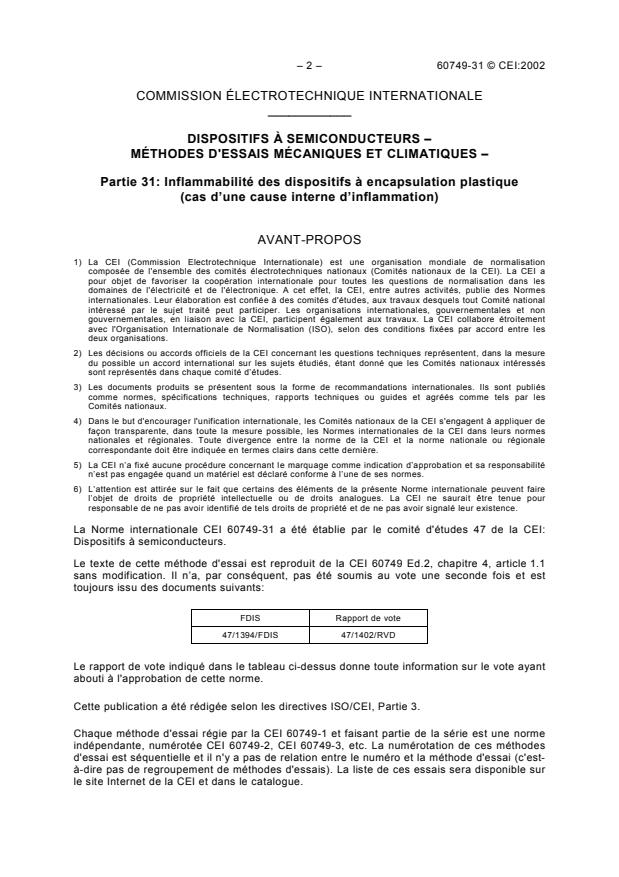
– 2 – 60749-31 © CEI:2002
COMMISSION ÉLECTROTECHNIQUE INTERNATIONALE
____________
DISPOSITIFS À SEMICONDUCTEURS –
MÉTHODES D'ESSAIS MÉCANIQUES ET CLIMATIQUES –
Partie 31: Inflammabilité des dispositifs à encapsulation plastique
(cas d’une cause interne d’inflammation)
AVANT-PROPOS
1) La CEI (Commission Electrotechnique Internationale) est une organisation mondiale de normalisation
composée de l'ensemble des comités électrotechniques nationaux (Comités nationaux de la CEI). La CEI a
pour objet de favoriser la coopération internationale pour toutes les questions de normalisation dans les
domaines de l'électricité et de l'électronique. A cet effet, la CEI, entre autres activités, publie des Normes
internationales. Leur élaboration est confiée à des comités d'études, aux travaux desquels tout Comité national
intéressé par le sujet traité peut participer. Les organisations internationales, gouvernementales et non
gouvernementales, en liaison avec la CEI, participent également aux travaux. La CEI collabore étroitement
avec l'Organisation Internationale de Normalisation (ISO), selon des conditions fixées par accord entre les
deux organisations.
2) Les décisions ou accords officiels de la CEI concernant les questions techniques représentent, dans la mesure
du possible un accord international sur les sujets étudiés, étant donné que les Comités nationaux intéressés
sont représentés dans chaque comité d’études.
3) Les documents produits se présentent sous la forme de recommandations internationales. Ils sont publiés
comme normes, spécifications techniques, rapports techniques ou guides et agréés comme tels par les
Comités nationaux.
4) Dans le but d'encourager l'unification internationale, les Comités nationaux de la CEI s'engagent à appliquer de
façon transparente, dans toute la mesure possible, les Normes internationales de la CEI dans leurs normes
nationales et régionales. Toute divergence entre la norme de la CEI et la norme nationale ou régionale
correspondante doit être indiquée en termes clairs dans cette dernière.
5) La CEI n’a fixé aucune procédure concernant le marquage comme indication d’approbation et sa responsabilité
n’est pas engagée quand un matériel est déclaré conforme à l’une de ses normes.
6) L’attention est attirée sur le fait que certains des éléments de la présente Norme internationale peuvent faire
l’objet de droits de propriété intellectuelle ou de droits analogues. La CEI ne saurait être tenue pour
responsable de ne pas avoir identifié de tels droits de propriété et de ne pas avoir signalé leur existence.
La Norme internationale CEI 60749-31 a été établie par le comité d'études 47 de la CEI:
Dispositifs à semiconducteurs.
Le texte de cette méthode d'essai est reproduit de la CEI 60749 Ed.2, chapitre 4, article 1.1
sans modification. Il n’a, par conséquent, pas été soumis au vote une seconde fois et est
toujours issu des documents suivants:
FDIS Rapport de vote
47/1394/FDIS 47/1402/RVD
Le rapport de vote indiqué dans le tableau ci-dessus donne toute information sur le
...