

IEC 60603-7:2008/AMD2:2019
(Amendment)Amendment 2 - Connectors for electronic equipment - Part 7: Detail specification for 8-way, unshielded, free and fixed connectors
General Information
- Abstract
- Status
- Published
- Publication Date
- 10-Jan-2019
- Technical Committee
- SC 48B - Electrical connectors
- Current Stage
- DELPUB - Deleted Publication
- Start Date
- 09-Oct-2020
- Completion Date
- 28-Aug-2026
Overview
IEC 60603-7:2008/AMD2:2019 is the second amendment to the international standard specifying connectors for electronic equipment, specifically focusing on the 8-way, unshielded, free and fixed connectors. Published by the International Electrotechnical Commission (IEC), this amendment updates critical definitions and compatibility levels that ensure interoperability and reliable use in electronic equipment. The standard is essential for manufacturers, designers, and engineers working with unshielded connectors in electronic applications where consistent quality, compatibility, and performance are imperative.
Key Topics
Connector Specifications
- 8-way unshielded connectors: Detail specifications cover both free (plugs) and fixed (sockets) connectors with 8 electrical contacts.
- Dimensional consistency: The amendment emphasizes precise definitions for overall dimensions, interface dimensions, mounting dimensions, and electrical wiring-related dimensions to standardize design and ensure universal fit and function.
Compatibility Levels
The amendment introduces an important annex explaining levels of compatibility among connectors from different manufacturers or families, classified into four tiers:
- Intermountable (Level 1): Connectors share identical overall and mounting dimensions, allowing them to fit interchangeably in the same physical spaces.
- Intermateable (Level 2): Connectors guarantee mating interface dimension conformity. Compatible plugs and sockets can physically connect but may have varying internal electrical or mechanical properties.
- Interoperable (Level 3): Ensures not only mechanical connection but also reliable electrical, mechanical, and climatic performance compatibility between connectors.
- Interchangeable (Level 4): The highest compatibility level, guaranteeing full interchangeability, including electrical, mechanical, climatic, and wiring-related conformity.
Technical Updates
- Replacement and clarification of terms such as intermateability and interoperability aligned with IEC 61076-1:2006.
- Addition of a normative annex detailing compatibility levels, essential for manufacturers to declare the performance and compatibility of their products accurately.
- Specifies testing procedures and dimensional tolerances to ensure compliance and interchangeability.
Applications
This IEC amendment is primarily applied in:
- Electronic equipment manufacturing where consistent connector designs enable flexibility in sourcing and assembly.
- Industrial automation and control systems requiring robust and reliable 8-way unshielded connectors for signal transmission.
- Telecommunications and IT hardware benefiting from standardized connectors for easier maintenance and replacement.
- Environments demanding adherence to international standards to ensure safety, performance, and interoperability among connectors from multiple vendors.
The updated standard helps users avoid compatibility issues when integrating connectors from different manufacturers, reducing downtime, improving safety, and enhancing device longevity.
Related Standards
- IEC 61076-1:2006 – Connectors for electrical and electronic equipment – General requirements, providing framework terms and definitions used within this amendment.
- IEC 61076-3:2008 – Rectangular connectors – Sectional specification, referred to for product requirements that complement this standard.
- IEC 60050-581:2008 – International Electrotechnical Vocabulary providing formal definitions relevant to connector technology.
- Other parts of the IEC 60603 family, which cover shielded connectors and connectors with different contact configurations.
Keywords: IEC 60603-7 amendment 2, 8-way unshielded connectors, electronic equipment connectors, connector compatibility, intermateability, intermountability, interoperability, connector standards, IEC connector specifications, electronic connector performance
Relations
- Effective Date
- 05-Sep-2023
- Effective Date
- 05-Sep-2023
Frequently Asked Questions
IEC 60603-7:2008/AMD2:2019 is a standard published by the International Electrotechnical Commission (IEC). Its full title is "Amendment 2 - Connectors for electronic equipment - Part 7: Detail specification for 8-way, unshielded, free and fixed connectors". This standard covers: Amendment 2 - Connectors for electronic equipment - Part 7: Detail specification for 8-way, unshielded, free and fixed connectors
Amendment 2 - Connectors for electronic equipment - Part 7: Detail specification for 8-way, unshielded, free and fixed connectors
IEC 60603-7:2008/AMD2:2019 is classified under the following ICS (International Classification for Standards) categories: 31.220.01 - Electromechanical components in general. The ICS classification helps identify the subject area and facilitates finding related standards.
IEC 60603-7:2008/AMD2:2019 has the following relationships with other standards: It is inter standard links to IEC 60603-7:2008, IEC 60603-7:2020. Understanding these relationships helps ensure you are using the most current and applicable version of the standard.
IEC 60603-7:2008/AMD2:2019 is available in PDF format for immediate download after purchase. The document can be added to your cart and obtained through the secure checkout process. Digital delivery ensures instant access to the complete standard document.
Standards Content (Sample)
IEC 60603-7 ®
Edition 3.0 2019-01
INTERNATIONAL
STANDARD
NORME
INTERNATIONALE
A MENDMENT 2
AM ENDEMENT 2
Connectors for electronic equipment –
Part 7: Detail specification for 8-way, unshielded, free and fixed connectors
Connecteurs pour équipements électroniques –
Partie 7: Spécification particulière pour les fiches et les embases non écrantées
à 8 voies
IEC 60603-7:2008-07/AMD2:2019-01(en-fr)
All rights reserved. Unless otherwise specified, no part of this publication may be reproduced or utilized in any form
or by any means, electronic or mechanical, including photocopying and microfilm, without permission in writing from
either IEC or IEC's member National Committee in the country of the requester. If you have any questions about IEC
copyright or have an enquiry about obtaining additional rights to this publication, please contact the address below or
your local IEC member National Committee for further information.
Droits de reproduction réservés. Sauf indication contraire, aucune partie de cette publication ne peut être reproduite
ni utilisée sous quelque forme que ce soit et par aucun procédé, électronique ou mécanique, y compris la photocopie
et les microfilms, sans l'accord écrit de l'IEC ou du Comité national de l'IEC du pays du demandeur. Si vous avez des
questions sur le copyright de l'IEC ou si vous désirez obtenir des droits supplémentaires sur cette publication, utilisez
les coordonnées ci-après ou contactez le Comité national de l'IEC de votre pays de résidence.
IEC Central Office Tel.: +41 22 919 02 11
3, rue de Varembé info@iec.ch
CH-1211 Geneva 20 www.iec.ch
Switzerland
About the IEC
The International Electrotechnical Commission (IEC) is the leading global organization that prepares and publishes
International Standards for all electrical, electronic and related technologies.
About IEC publications
The technical content of IEC publications is kept under constant review by the IEC. Please make sure that you have the
latest edition, a corrigendum or an amendment might have been published.
IEC publications search - webstore.iec.ch/advsearchform Electropedia - www.electropedia.org
The advanced search enables to find IEC publications by a The world's leading online dictionary on electrotechnology,
variety of criteria (reference number, text, technical containing more than 22 000 terminological entries in English
committee,…). It also gives information on projects, replaced and French, with equivalent terms in 16 additional languages.
and withdrawn publications. Also known as the International Electrotechnical Vocabulary
(IEV) online.
IEC Just Published - webstore.iec.ch/justpublished
Stay up to date on all new IEC publications. Just Published IEC Glossary - std.iec.ch/glossary
details all new publications released. Available online and 67 000 electrotechnical terminology entries in English and
once a month by email. French extracted from the Terms and Definitions clause of
IEC publications issued since 2002. Some entries have been
IEC Customer Service Centre - webstore.iec.ch/csc collected from earlier publications of IEC TC 37, 77, 86 and
If you wish to give us your feedback on this publication or CISPR.
need further assistance, please contact the Customer Service
Centre: sales@iec.ch.
A propos de l'IEC
La Commission Electrotechnique Internationale (IEC) est la première organisation mondiale qui élabore et publie des
Normes internationales pour tout ce qui a trait à l'électricité, à l'électronique et aux technologies apparentées.
A propos des publications IEC
Le contenu technique des publications IEC est constamment revu. Veuillez vous assurer que vous possédez l’édition la
plus récente, un corrigendum ou amendement peut avoir été publié.
Electropedia - www.electropedia.org
Recherche de publications IEC -
webstore.iec.ch/advsearchform Le premier dictionnaire d'électrotechnologie en ligne au
La recherche avancée permet de trouver des publications IEC monde, avec plus de 22 000 articles terminologiques en
en utilisant différents critères (numéro de référence, texte, anglais et en français, ainsi que les termes équivalents dans
comité d’études,…). Elle donne aussi des informations sur les 16 langues additionnelles. Egalement appelé Vocabulaire
projets et les publications remplacées ou retirées. Electrotechnique International (IEV) en ligne.
IEC Just Published - webstore.iec.ch/justpublished Glossaire IEC - std.iec.ch/glossary
Restez informé sur les nouvelles publications IEC. Just 67 000 entrées terminologiques électrotechniques, en anglais
Published détaille les nouvelles publications parues. et en français, extraites des articles Termes et Définitions des
Disponible en ligne et une fois par mois par email. publications IEC parues depuis 2002. Plus certaines entrées
antérieures extraites des publications des CE 37, 77, 86 et
Service Clients - webstore.iec.ch/csc CISPR de l'IEC.
Si vous désirez nous donner des commentaires sur cette
publication ou si vous avez des questions contactez-nous:
sales@iec.ch.
IEC 60603-7 ®
Edition 3.0 2019-01
INTERNATIONAL
STANDARD
NORME
INTERNATIONALE
A MENDMENT 2
AM ENDEMENT 2
Connectors for electronic equipment –
Part 7: Detail specification for 8-way, unshielded, free and fixed connectors
Connecteurs pour équipements électroniques –
Partie 7: Spécification particulière pour les fiches et les embases non écrantées
à 8 voies
INTERNATIONAL
ELECTROTECHNICAL
COMMISSION
COMMISSION
ELECTROTECHNIQUE
INTERNATIONALE
ICS 31.220.01 ISBN 978-2-8322-6251-1
– 2 – IEC 60603-7:2008/AMD2:2019
© IEC 2019
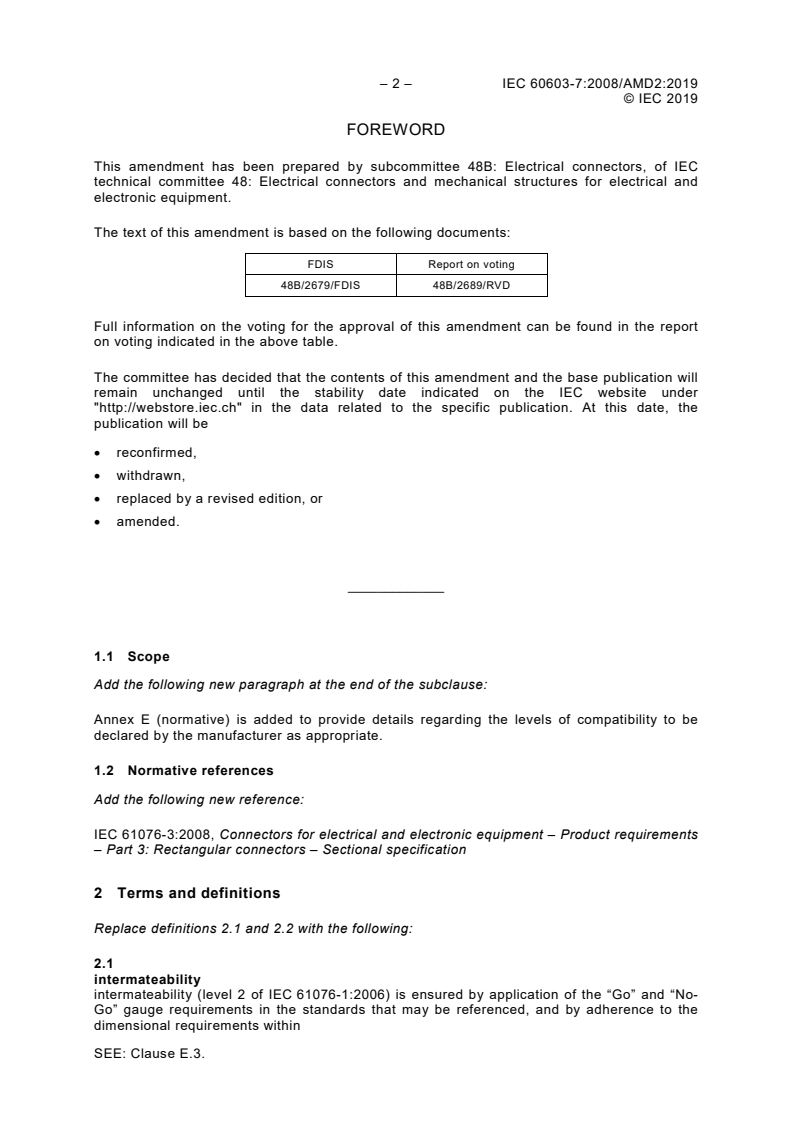
FOREWORD
This amendment has been prepared by subcommittee 48B: Electrical connectors, of IEC
technical committee 48: Electrical connectors and mechanical structures for electrical and
electronic equipment.
The text of this amendment is based on the following documents:
FDIS Report on voting
48B/2679/FDIS 48B/2689/RVD
Full information on the voting for the approval of this amendment can be found in the report
on voting indicated in the above table.
The committee has decided that the contents of this amendment and the base publication will
remain unchanged until the stability date indicated on the IEC website under
"http://webstore.iec.ch" in the data related to the specific publication. At this date, the
publication will be
• reconfirmed,
• withdrawn,
• replaced by a revised edition, or
• amended.
_____________
1.1 Scope
Add the following new paragraph at the end of the subclause:
Annex E (normative) is added to provide details regarding the levels of compatibility to be
declared by the manufacturer as appropriate.
1.2 Normative references
Add the following new reference:
IEC 61076-3:2008, Connectors for electrical and electronic equipment – Product requirements
– Part 3: Rectangular connectors – Sectional specification
2 Terms and definitions
Replace definitions 2.1 and 2.2 with the following:
2.1
intermateability
intermateability (level 2 of IEC 61076-1:2006) is ensured by application of the “Go” and “No-
Go” gauge requirements in the standards that may be referenced, and by adherence to the
dimensional requirements within
SEE: Clause E.3.
© IEC 2019
2.2
interoperability
interoperability of different IEC 60603-7 connectors and of IEC 60603-7 connectors with
connectors of other families (e.g. IEC 61076-3 series) is ensured by compliance with the
specified interface dimensions, when they have the same number of contacts, the same
electrical wiring-related dimensions and when the lowest electrical, mechanical and climatic
performance (performance level) among the two connectors is suitable for the intended
application
SEE: Clause E.5.
Add, after Subclause 2.4, the following new terms and definitions:
2.5
number of contacts
number of contacts (or ways) that a connector owns, including the protective and/or functional
earth contact(s), if any
Note 1 to entry: A connector for removable contacts is characterized by its number of contact positions (seats): its
number of contacts (ways) may be lower than the number of contact positions (seats).
Note 2 to entry: The same number of contacts does not grant the same electrical interface: the geometry of said
contacts may be different while their number is the same.
2.6
overall dimensions
dimensions providing the overall space occupied by a connector
Note 1 to entry: Two connectors of the same gender may have the same overall dimensions but different
mounting dimensions and/or different interface dimensions.
2.7
interface dimensions
set of dimensions required to fully describe the connector’s mating interface, belonging to
both the connector insert and to the relevant electric contacts
Note 1 to entry: Interface dimensions enable the proper functioning of a mated set of connectors according to the
relevant product detail specification or manufacturer’s detail specification.
Note 2 to entry: Two connectors with same interface dimensions have the same number of contact seats (or
positions), whereas they may not show the same number of contacts (ways).
2.8
mounting dimensions
dimensions enabling the mounting of a connector
Note 1 to entry: Examples of mounting dimensions are panel cutout size, size and interaxes of fixing holes or
threads.
Note 2 to entry: The geometry of the mounting interface of Printed Circuit Board connectors to the PCB belongs
to the mounting dimensions: two Printed Circuit Board connectors of the same gender with the same mounting
dimensions share the same pattern and pitch of their contacts.
Note 3 to entry: Two connectors not of the Printed Circuit Board type of the same gender with the same mounting
dimensions may have different interface dimensions.
Note 4 to entry: Two connectors of the same gender with the same mounting dimensions may have different
overall dimensions.
2.9
electrical wiring-related dimensions
dimensions related to the wiring of the connector, i.e. to its number and type of contacts
(ways)
– 4 – IEC 60603-7:2008/AMD2:2019
© IEC 2019
Note 1 to entry: Two connectors of the same gender with the same electrical wiring-related dimensions have the
same number of contacts (ways) or contact positions (seats), the same dimensions of these contacts or contact
positions, the same overall dimensions, the same interface dimensions, and if they are Printed Circuit Board
connectors, the same mounting dimensions
2.10
electrical, mechanical and climatic performances
levels of electrical, mechanical and climatic performance assigned to a connector in the
relevant product detail specification or manufacturer’s detail specification, therein verified
through dedicated groups of tests
Note 1 to entry: The electrical performance includes signal integrity.
________________________________________________________________
This space intentionally left blank
© IEC 2019
Add the following new Annex E (normative):
Annex E
(normative)
Levels of compatibility
E.1 General
In applications where connectors according to IEC 60603-7 are used, a mixture of connectors
from different sources may be available. In cases where these products were given a different
rating by the manufacturer, and also when dimensional details are deviating, it is important to
know and consider the right level of compatibility.
The levels of compatibility are intended to compare connectors of the same gender on their
capability to be mated with a complementary connector of the different gender. The levels
indicate the functional differences (if any) between connector products of the same gender but
from different sources.
A product detail specification under this standard may declare a certain level of compatibility –
e.g. in terms of backward compatibility or of interoperability – with other product detail
specification(s) within the same family of standards (e.g. this IEC 60603-7 family or
IEC 61076-3 family) or with a cross reference to a connector covered by a product detail
specification belonging to a different IEC family.
In fact, for historical reasons some recent additions have been assigned to this IEC 60603-7
family of standards, while other new connectors have been assigned to the IEC 61076-3
family of rectangular connectors. For this reason a similar Annex has been included in the
generic specification IEC 61076-1 in order to align the terminology used in both families in
regard to levels of compatibility.
The levels of compatibility between connectors from different sources are characterized – as
a function of the standardization degree – by 4 levels. These levels are already defined in
2.2.3.2 to 2.2.3.5 of IEC 61076-1:2006 and shall, when appropriate, be indicated in the
relevant detail product specification of connectors.
_________________________________________________________________________
This space intentionally left blank
– 6 – IEC 60603-7:2008/AMD2:2019
© IEC 2019
In Table E.1, for each level of compatibility the required parameters are indicated by “x” in a
graphical way.
b) c) b)
Table E.1 – Levels of compatibility and required parameters
Level of Number of Overall Interface Mounting Electrical Electrical,
compatibility contacts dimensions dimensions dimensions wiring-related mechanical
of IEC 61076-1 dimensions and climatic
performance
a)
Intermountable Level 1 x x
a)
Intermateable Level 2 x x
a)
Intermountable and
Level 3 x x x x
a)
intermateable
a) d)
Interoperable x x x x
a)
Interchangeable Level 4 x x x x x x
Backward
e)
x x x x
e)
compatible
a)
The prefix “inter” in the terms “intermountable”, “intermateable”, “interoperable”, and “interchangeable” has the meaning of
“interchangeably” (adv), i.e. intermountable = interchangeably mountable, and so on. Thus the prefix “inter” has not the
meaning “among them”, i.e. intermountable does not mean “mountable among them”, intermateable does not mean “mateable
among them”. In other words, two intermateable connectors are not a male and a female connector mateable among them.
b)
Levels of compatibility and relevant required parameters include also the influence of features for latching, locking and
keying.
c)
Special attention is required for safety: all levels of compatibility may pose a certain risk for safety, especially when voltages
higher than SELV levels (50 V AC / 120 V DC) and/or high currents are applied.
d)
Two interoperable connectors shall grant electrical, mechanical and climatic performance suitable for the application. In other
words their performance level is not necessarily the same, but none of them owns a performance level unsuitable for the
application.
e)
IEC 60050-581:2008, 581-24-08: “feature of connectors which ensures at least the lower requirements in case of mating
connectors with higher and lower requirements”. The backward compatibility requirement ensures that a free or fixed
connector in compliance with this standard, when mated with a fixed or free connector in compliance with any lower
frequency IEC 60603-7 series connector standard, fully complies with the requirements of the lower frequency IEC 60603-7
series connector standard.
E.2 Intermountability
The term intermountable (adj) and consequently intermountability (noun) is defined in
IEC 60050-581:2008, 581-24-04: “pertaining to each of two connectors when their overall
dimensions, dimensions on printed board or panel cut-out, and cable termination are
identical”.
This level of compatibility is defined as level 1 – Intermountable in 2.2.3.2. of IEC 61076-
1:2006. This levels standardizes only overall dimensions and mounting dimensions on printed
board or panel cut-out and cable termination assembly; mating face dimensions are not
relevant to standardize intermountability.
This means that each of two intermountable connectors will fit in a given location (e.g. a
position/footprint on a PCB, and/or in a panel cut-out, and/or at the end of a cable). The
electrical (e.g. different current and/or voltage rating) or mechanical performance (one
connector may be a free or fixed connector with male contacts, the other one with female
contacts) may be different. This IEC 60050-581 description even allows two connectors with
two completely different types of interface.
Intermountability – once declared for a connector by its manufacturer with respect to certain
dimensions common to other products or product families – shall be declared by referencing
an unambiguous set of dimensions. This may also be achieved by reference to a set of
dimensions as given by a published standard.
© IEC 2019
E.3 Intermateability
The term intermateable (adj) and consequently intermateability (noun) is defined in IEC 60050-
581:2008, 581-24-07: “pertaining to each of two connectors when they feature identical
dimensions for electrical and mechanical interfaces”.
This level of compatibility is defined as level 2 – Intermateable in 2.2.3.3 of IEC 61076-
1:2006. This level standardizes only the dimensions of the mating contact interfaces. The
electrical and mechanical and environmental performances and the functionality of connectors
from different sources, when mated, are not fully guaranteed.
In other words: here, each of two connectors will fit in one counterpart connector, but the
electrical, mechanical and environmental performances and the functionality may be different.
For instance: the two connectors from different sources may contain a different number of
contacts, different conductive materials, differently rated insulating materials – if the relevant
product detail specification allows such choice, different – although compatible – contact
plating, different sizing of wire terminations or conductive paths, thus differently sized allowed
wiring).
Intermateability shall be proven by testing the mechanical performance and verification of the
electrical conductivity of the mated electrical contacts according the relevant requirements of
the Product Detail Specification.
NOTE 1 Intermateable connectors can have different number of contacts (ways), i.e. a different electrical
interface, within the same mechanical interface. It is allowed that the missing contacts of one of them do not mate
with the contacts of the corresponding mating connector, as well as the opposite, i.e. the contacts in excess of one
of them do not find correspondence in the corresponding mating connector.
A connector can have less female contacts but due to the lack of holes to accept the male contacts may not be
intermateable with a connector having a full set of male contacts.
As the mechanical interface does not include overall dimensions and mounting dimensions covered by
intermountability (Clause E.2), two connectors may be intermateable but not intermountable.
NOTE 2 In general, product detail specifications for connectors include dimensions to provide that two connectors
in compliance with that detail specification are both intermountable and intermateable, see further Clause E.4.
E.4 Intermountability and intermateability
The terms intermountable (adj.) and intermateable (adj.) and consequently the relevant nouns
“intermountability” and “intermateability” are already defined in IEC 60050-581 as described in
Clause E.2 and Clause E.3.
There is a further level of compatibility defined as level 3 – Intermountable and intermateable
in 2.2.3.4 of IEC 61076-1:2006. This level standardizes mounting dimensions, electrical and
mechanical interface and overall dimensions.
This means that each of two intermountable and intermateable connectors will fit in a given
location (e.g. a position/footprint on a PCB, and/or in a panel cut-out, and/or at the end of a
cable) and each of two connectors will fit in one counterpart connector, but the electrical,
mechanical and environmental performances and the functionality may be different. For
instance: the two connectors from different sources may contain a different number of
contacts within a compatible mating face geometry, different conductive materials, differently
rated insulating materials (if the relevant product detail specification allows such choice),
different – although compatible – contact plating, different sizing of wire terminations or
conductive paths, thus differently sized allowed wiring.
Intermateability shall be demonstrated as described in Clause E.3, intermountability as
described in Clause E.2.
– 8 – IEC 60603-7:2008/AMD2:2019
© IEC 2019
NOTE Intermateable connectors can have different number of contacts (ways), i.e. a different electrical interface,
within the same mechanical interface. It is allowed that the missing contacts of one of them do not mate with the
contacts of the corresponding mating connector, as well as the opposite, i.e. the contacts in excess of one of them
do not find correspondence in the corresponding mating connector.
E.5 Interoperability
A connector is interoperable with another connector of the same gender but from different
source or product family if the two connectors are intermateable and if both connectors offer
the same contact functions. In the case of interoperability, the level of performance of this
interoperability is always that of the less performing connector, and the performance level
shall be suitable for the application. One of the two interoperable connectors of the same
gender may be provided with a level of performance in excess of the requirements for the
application, none can be provided with performance level unfit for the application
In other words: here, each of two connectors will fit and contact in one counterpart connector.
The electrical, mechanical and climatic performances may be different but the functionality is
similar. The two connectors from different manufacturers will contain the same number of
contacts, but may be produced of different conductive materials, differently rated insulating
materials – if the relevant product detail specification allows such choice. Also, different –
although compatible – contact plating, different wire termination sizes or conductive paths,
may occur.
NOTE Connector specifications according IEC 61984 cannot be met with interoperable connectors from different
sources.
E.6 Interchangeability
The term interchangeable (adj.) and consequently interchangeability (noun) is defined in
IEC 60050-581:2008, 581-24-03: “pertaining to a connector when all elements guaranteeing
compliance of electrical, mechanical and climatic performance of mated connectors when
individual connector halves are from different sources.
This level of compatibility is defined as level 4 – Interchangeable in 2.2.3.5 in this document.
This level standardizes all the elements guaranteeing compliance of the electrical, mechanical
and environmental performances of mated connector pairs when individual connectors are
from different sources.
To be interchangeable, the form, fit, function and performance of connectors from different
sources are identical, so that a connector from one source can be replaced by a similar
connector from another source without loss of functionality or performance of the connector
pair.
NOTE The term “identical” when addressing dimensions and ratings is used here with the meaning “within the
tolerances provided either by a published product detail specification (standard sheet) or as a result of a
comparison of the different manufacturer product detail specifications and/or drawings”.
Interchangeability shall be proven by compariso
...