

IEC 60512-11-1:2019
(Main)Connectors for electrical and electronic equipment - Tests and measurements - Part 11-1: Climatic tests - Test 11a - Climatic sequence
General Information
- Abstract
IEC 60512-11-1:2019 est utilisée, lorsque la spécification particulière (de produit) l'exige, pour soumettre à l'essai des connecteurs qui entrent dans le domaine d'application du comité d'études 48 de l'IEC. Cet essai peut aussi être utilisé sur des dispositifs similaires (c'est-à-dire lorsque les mécanismes de dégradation sont les mêmes) lorsqu'une spécification particulière (de produit) l'indique. L'objet de cet essai est de définir une méthode d'essai normalisée pour évaluer l'aptitude des connecteurs à fonctionner de manière spécifiée dans un environnement spécifié qui pourrait être rencontré dans des conditions normales d'utilisation, y compris le stockage. Le présent document fournit une méthode d'essai composite normalisée pour déterminer l'aptitude des connecteurs soumis à des conditions d'environnement consistant en une séquence de contraintes climatiques comportant température, humidité, et si cela est exigé, basse pression. Mots clés: connecteurs, Essais climatiques
- Status
- Published
- Publication Date
- 15-May-2019
- Technical Committee
- SC 48B - Electrical connectors
- Current Stage
- PPUB - Publication issued
- Start Date
- 16-May-2019
- Completion Date
- 14-May-2019
Overview
IEC 60512-11-1:2019 is an international standard published by the International Electrotechnical Commission (IEC) that specifies a standardized method for climatic testing of electrical and electronic connectors. Known as "Test 11a – Climatic sequence," this document defines a composite environmental test sequence designed to assess the performance and reliability of connectors under conditions simulating real-world climate stresses.
The primary objective of IEC 60512-11-1:2019 is to evaluate connectors’ ability to function within specified climatic environments, including variations in temperature, humidity, and optionally low air pressure, which may be encountered during normal usage or storage. This test sequence accelerates and amplifies the natural degradation mechanisms connectors face, ensuring robust quality assessment.
This standard is particularly relevant when detailed product specifications require climatic testing aligned with the scope of IEC Technical Committee 48, which focuses on electrical connectors and related structures.
Key Topics
Climatic Sequence Test Method
The standard outlines a multi-step climatic sequence involving:- Dry heat exposure
- Cyclic damp heat testing
- Cold temperature exposure
- Optional low air pressure (altitude simulation)
- Repeated damp heat cycles
This sequence stresses connectors in a controlled but accelerated manner to simulate real environmental impacts on material integrity and function.
Preconditioning and Measurements
The procedure includes preconditioning of samples, initial electrical and mechanical measurements, followed by environmental conditioning steps, and concluded with recovery and final measurements to assess any performance degradation.Application Scope
While the main focus is on connectors within the purview of IEC TC 48, the test may also be applied to other similar devices when degradation mechanisms are comparable and specified by product standards.Normative References
The test method builds upon foundational IEC environmental testing standards such as IEC 60068-1, IEC 60068-2 series, and IEC 60512 parts that address generic specifications, contact resistance, visual examinations, and other mechanical and electrical assessments relevant to connector performance.Accelerated Stress Testing
The sequence is designed to bring out potential climatic degradation by combining temperature extremes, humidity cycles, and pressure variations in an accelerated timeline to mimic years of natural exposure within a much shorter period.
Applications
Connector Qualification
Manufacturers and test laboratories use IEC 60512-11-1 to qualify electrical connectors for use in environments exposed to temperature fluctuations, humidity, and altitude variations.Quality Assessment and Compliance
IEC 60512-11-1 supports quality assurance programs by providing internationally recognized climatic test procedures to validate product durability, promoting compliance and global market acceptance.Design Validation
Engineers leverage the climatic sequence test to validate new connector designs for performance under harsh conditions, enabling improvements in material selection, sealing techniques, and construction.Post-Mechanical Stress Testing
This test is often sequenced after mechanical stress tests (shock, vibration, solderability, termination robustness) to determine if mechanical stresses have compromised connector sealing or electrical integrity.Storage and Usage Simulation
The standard ensures connectors can maintain functionality during long-term storage and usage in varying climatic conditions, critical for aerospace, automotive, telecommunications, and industrial applications.
Related Standards
IEC 60068 Series
- IEC 60068-1: Environmental testing – General guidance
- IEC 60068-2-1: Cold testing
- IEC 60068-2-2: Dry heat testing
- IEC 60068-2-13: Low air pressure testing
- IEC 60068-2-30: Cyclic damp heat testing
These provide foundational environmental test methods referenced and adapted for connector-specific conditions.
IEC 60512 Series
- Part 1: Generic test specifications for connectors
- Part 1-101: Blank product specification template
- Part 1-1: Visual examinations
- Part 2-1/2: Electrical continuity and contact resistance tests
These standards complement the climatic test by covering mechanical, electrical, and visual assessments to ensure comprehensive connector performance evaluation.
IECQ Quality System
The IEC Quality Assessment System for Electronic Components (IECQ) often integrates IEC 60512-11-1 as part of testing protocols to certify components for quality and reliability in electronic assemblies.
Keywords: IEC 60512-11-1, climatic sequence test, electrical connectors, environmental testing, humidity test, temperature cycling, low air pressure test, connector qualification, IEC standards, connector durability, electronic equipment testing, accelerated climatic testing.
Frequently Asked Questions
IEC 60512-11-1:2019 is a standard published by the International Electrotechnical Commission (IEC). Its full title is "Connectors for electrical and electronic equipment - Tests and measurements - Part 11-1: Climatic tests - Test 11a - Climatic sequence". This standard covers: IEC 60512-11-1:2019 est utilisée, lorsque la spécification particulière (de produit) l'exige, pour soumettre à l'essai des connecteurs qui entrent dans le domaine d'application du comité d'études 48 de l'IEC. Cet essai peut aussi être utilisé sur des dispositifs similaires (c'est-à-dire lorsque les mécanismes de dégradation sont les mêmes) lorsqu'une spécification particulière (de produit) l'indique. L'objet de cet essai est de définir une méthode d'essai normalisée pour évaluer l'aptitude des connecteurs à fonctionner de manière spécifiée dans un environnement spécifié qui pourrait être rencontré dans des conditions normales d'utilisation, y compris le stockage. Le présent document fournit une méthode d'essai composite normalisée pour déterminer l'aptitude des connecteurs soumis à des conditions d'environnement consistant en une séquence de contraintes climatiques comportant température, humidité, et si cela est exigé, basse pression. Mots clés: connecteurs, Essais climatiques
IEC 60512-11-1:2019 est utilisée, lorsque la spécification particulière (de produit) l'exige, pour soumettre à l'essai des connecteurs qui entrent dans le domaine d'application du comité d'études 48 de l'IEC. Cet essai peut aussi être utilisé sur des dispositifs similaires (c'est-à-dire lorsque les mécanismes de dégradation sont les mêmes) lorsqu'une spécification particulière (de produit) l'indique. L'objet de cet essai est de définir une méthode d'essai normalisée pour évaluer l'aptitude des connecteurs à fonctionner de manière spécifiée dans un environnement spécifié qui pourrait être rencontré dans des conditions normales d'utilisation, y compris le stockage. Le présent document fournit une méthode d'essai composite normalisée pour déterminer l'aptitude des connecteurs soumis à des conditions d'environnement consistant en une séquence de contraintes climatiques comportant température, humidité, et si cela est exigé, basse pression. Mots clés: connecteurs, Essais climatiques
IEC 60512-11-1:2019 is classified under the following ICS (International Classification for Standards) categories: 31.220.01 - Electromechanical components in general. The ICS classification helps identify the subject area and facilitates finding related standards.
IEC 60512-11-1:2019 is available in PDF format for immediate download after purchase. The document can be added to your cart and obtained through the secure checkout process. Digital delivery ensures instant access to the complete standard document.
Standards Content (Sample)
IEC 60512-11-1 ®
Edition 2.0 2019-05
INTERNATIONAL
STANDARD
NORME
INTERNATIONALE
Connectors for electrical and electronic equipment – Tests and measurements –
Part 11-1: Climatic tests – Test 11a – Climatic sequence
Connecteurs pour équipements électriques et électroniques – Essais et mesures –
Partie 11-1: Essais climatiques – Essai 11a – Séquence climatique
All rights reserved. Unless otherwise specified, no part of this publication may be reproduced or utilized in any form
or by any means, electronic or mechanical, including photocopying and microfilm, without permission in writing from
either IEC or IEC's member National Committee in the country of the requester. If you have any questions about IEC
copyright or have an enquiry about obtaining additional rights to this publication, please contact the address below or
your local IEC member National Committee for further information.
Droits de reproduction réservés. Sauf indication contraire, aucune partie de cette publication ne peut être reproduite ni
utilisée sous quelque forme que ce soit et par aucun procédé, électronique ou mécanique, y compris la photocopie et
les microfilms, sans l'accord écrit de l'IEC ou du Comité national de l'IEC du pays du demandeur. Si vous avez des
questions sur le copyright de l'IEC ou si vous désirez obtenir des droits supplémentaires sur cette publication, utilisez
les coordonnées ci-après ou contactez le Comité national de l'IEC de votre pays de résidence.
IEC Central Office Tel.: +41 22 919 02 11
3, rue de Varembé info@iec.ch
CH-1211 Geneva 20 www.iec.ch
Switzerland
About the IEC
The International Electrotechnical Commission (IEC) is the leading global organization that prepares and publishes
International Standards for all electrical, electronic and related technologies.
About IEC publications
The technical content of IEC publications is kept under constant review by the IEC. Please make sure that you have the
latest edition, a corrigendum or an amendment might have been published.
IEC publications search - webstore.iec.ch/advsearchform Electropedia - www.electropedia.org
The advanced search enables to find IEC publications by a The world's leading online dictionary on electrotechnology,
variety of criteria (reference number, text, technical containing more than 22 000 terminological entries in English
committee,…). It also gives information on projects, replaced and French, with equivalent terms in 16 additional languages.
and withdrawn publications. Also known as the International Electrotechnical Vocabulary
(IEV) online.
IEC Just Published - webstore.iec.ch/justpublished
Stay up to date on all new IEC publications. Just Published IEC Glossary - std.iec.ch/glossary
details all new publications released. Available online and once 67 000 electrotechnical terminology entries in English and
a month by email. French extracted from the Terms and Definitions clause of IEC
publications issued since 2002. Some entries have been
IEC Customer Service Centre - webstore.iec.ch/csc collected from earlier publications of IEC TC 37, 77, 86 and
If you wish to give us your feedback on this publication or need CISPR.
further assistance, please contact the Customer Service
Centre: sales@iec.ch.
A propos de l'IEC
La Commission Electrotechnique Internationale (IEC) est la première organisation mondiale qui élabore et publie des
Normes internationales pour tout ce qui a trait à l'électricité, à l'électronique et aux technologies apparentées.
A propos des publications IEC
Le contenu technique des publications IEC est constamment revu. Veuillez vous assurer que vous possédez l’édition la
plus récente, un corrigendum ou amendement peut avoir été publié.
Recherche de publications IEC - Le premier dictionnaire d'électrotechnologie en ligne au monde,
webstore.iec.ch/advsearchform avec plus de 22 000 articles terminologiques en anglais et en
La recherche avancée permet de trouver des publications IEC français, ainsi que les termes équivalents dans 16 langues
en utilisant différents critères (numéro de référence, texte, additionnelles. Egalement appelé Vocabulaire
comité d’études,…). Elle donne aussi des informations sur les Electrotechnique International (IEV) en ligne.
projets et les publications remplacées ou retirées.
Glossaire IEC - std.iec.ch/glossary
IEC Just Published - webstore.iec.ch/justpublished 67 000 entrées terminologiques électrotechniques, en anglais
Restez informé sur les nouvelles publications IEC. Just et en français, extraites des articles Termes et Définitions des
Published détaille les nouvelles publications parues. publications IEC parues depuis 2002. Plus certaines entrées
Disponible en ligne et une fois par mois par email. antérieures extraites des publications des CE 37, 77, 86 et
CISPR de l'IEC.
Service Clients - webstore.iec.ch/csc
Si vous désirez nous donner des commentaires sur cette
publication ou si vous avez des questions contactez-nous:
sales@iec.ch.
Electropedia - www.electropedia.org
IEC 60512-11-1 ®
Edition 2.0 2019-05
INTERNATIONAL
STANDARD
NORME
INTERNATIONALE
Connectors for electrical and electronic equipment – Tests and measurements –
Part 11-1: Climatic tests – Test 11a – Climatic sequence
Connecteurs pour équipements électriques et électroniques – Essais et mesures –
Partie 11-1: Essais climatiques – Essai 11a – Séquence climatique
INTERNATIONAL
ELECTROTECHNICAL
COMMISSION
COMMISSION
ELECTROTECHNIQUE
INTERNATIONALE
ICS 31.220.01 ISBN 978-2-8322-6814-8
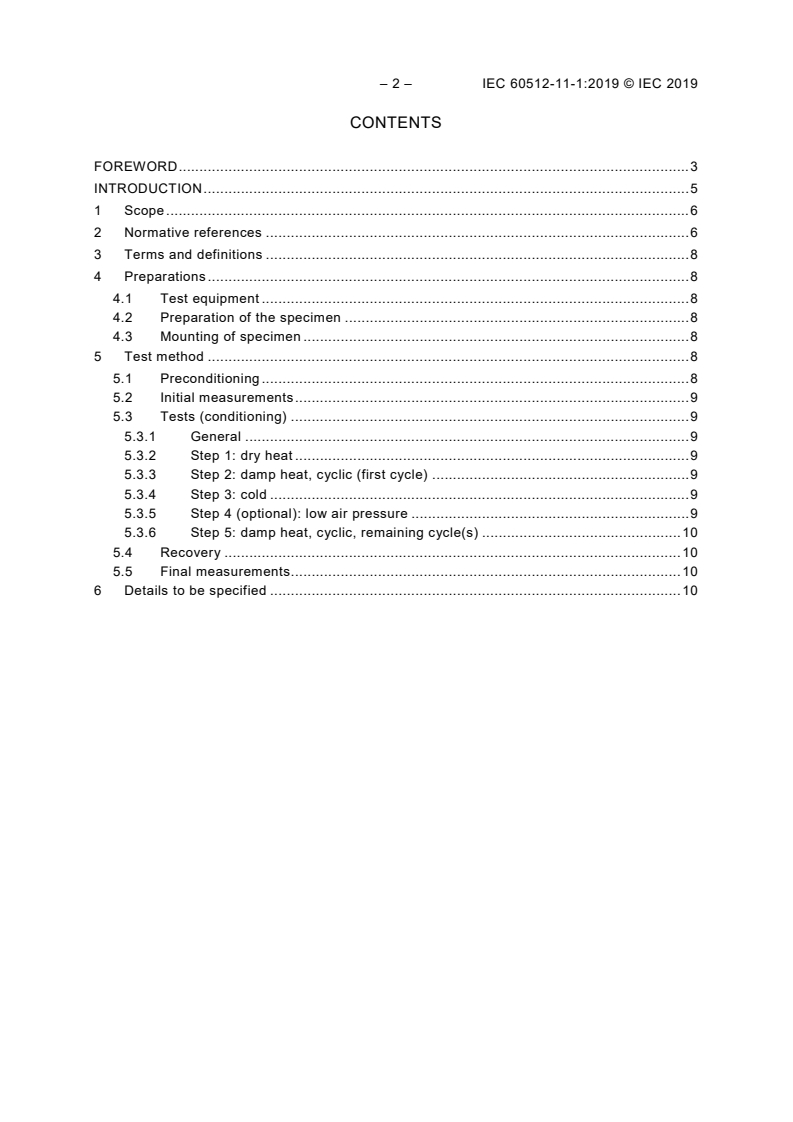
– 2 – IEC 60512-11-1:2019 © IEC 2019
CONTENTS
FOREWORD . 3
INTRODUCTION . 5
1 Scope . 6
2 Normative references . 6
3 Terms and definitions . 8
4 Preparations . 8
4.1 Test equipment . 8
4.2 Preparation of the specimen . 8
4.3 Mounting of specimen . 8
5 Test method . 8
5.1 Preconditioning . 8
5.2 Initial measurements . 9
5.3 Tests (conditioning) . 9
5.3.1 General . 9
5.3.2 Step 1: dry heat . 9
5.3.3 Step 2: damp heat, cyclic (first cycle) . 9
5.3.4 Step 3: cold . 9
5.3.5 Step 4 (optional): low air pressure . 9
5.3.6 Step 5: damp heat, cyclic, remaining cycle(s) . 10
5.4 Recovery . 10
5.5 Final measurements . 10
6 Details to be specified . 10
INTERNATIONAL ELECTROTECHNICAL COMMISSION
___________
CONNECTORS FOR ELECTRICAL AND ELECTRONIC EQUIPMENT –
TESTS AND MEASUREMENTS –
Part 11-1: Climatic tests – Test 11a – Climatic sequence
FOREWORD
1) The International Electrotechnical Commission (IEC) is a worldwide organization for standardization comprising
all national electrotechnical committees (IEC National Committees). The object of IEC is to promote international
co-operation on all questions concerning standardization in the electrical and electronic fields. To this end and
in addition to other activities, IEC publishes International Standards, Technical Specifications, Technical Reports,
Publicly Available Specifications (PAS) and Guides (hereafter referred to as “IEC Publication(s)”). Their
preparation is entrusted to technical committees; any IEC National Committee interested in the subject dealt with
may participate in this preparatory work. International, governmental and non-governmental organizations liaising
with the IEC also participate in this preparation. IEC collaborates closely with the International Organization for
Standardization (ISO) in accordance with conditions determined by agreement between the two organizations.
2) The formal decisions or agreements of IEC on technical matters express, as nearly as possible, an international
consensus of opinion on the relevant subjects since each technical committee has representation from all
interested IEC National Committees.
3) IEC Publications have the form of recommendations for international use and are accepted by IEC National
Committees in that sense. While all reasonable efforts are made to ensure that the technical content of IEC
Publications is accurate, IEC cannot be held responsible for the way in which they are used or for any
misinterpretation by any end user.
4) In order to promote international uniformity, IEC National Committees undertake to apply IEC Publications
transparently to the maximum extent possible in their national and regional publications. Any divergence between
any IEC Publication and the corresponding national or regional publication shall be clearly indicated in the latter.
5) IEC itself does not provide any attestation of conformity. Independent certification bodies provide conformity
assessment services and, in some areas, access to IEC marks of conformity. IEC is not responsible for any
services carried out by independent certification bodies.
6) All users should ensure that they have the latest edition of this publication.
7) No liability shall attach to IEC or its directors, employees, servants or agents including individual experts and
members of its technical committees and IEC National Committees for any personal injury, property damage or
other damage of any nature whatsoever, whether direct or indirect, or for costs (including legal fees) and
expenses arising out of the publication, use of, or reliance upon, this IEC Publication or any other IEC Publications.
8) Attention is drawn to the Normative references cited in this publication. Use of the referenced publications is
indispensable for the correct application of this publication.
9) Attention is drawn to the possibility that some of the elements of this IEC Publication may be the subject of patent
rights. IEC shall not be held responsible for identifying any or all such patent rights.
International Standard IEC 60512-11-1 has been prepared by sub-committee 48B: Electrical
connectors, of IEC technical committee 48: Electrical connectors and mechanical structures for
electrical and electronic equipment.
This second edition cancels and replaces the first edition published in 1995. This edition
constitutes a technical revision.
This edition includes the following significant technical changes with respect to the previous
edition:
a) formatting and clause numbering according to the latest IEC template and the latest
IEC 60512-1-101 blank detail (tests and measurements) specification;
b) update and expansion of normative references;
c) better specification of various details regarding tests.
– 4 – IEC 60512-11-1:2019 © IEC 2019
The text of this International Standard is based on the following documents:
CDV Report on voting
48B/2688/CDV 48B/2722/RVC
Full information on the voting for the approval of this International Standard can be found in the
report on voting indicated in the above table.
This document has been drafted in accordance with the ISO/IEC Directives, Part 2.
Future standards in this series will carry the new general title as cited above. Titles of existing
standards in this series will be updated at the time of the next edition.
A list of all parts in the IEC 60512 series, published under the general title Connectors for
electrical and electronic equipment – Tests and measurements, can be found on the IEC
website.
The committee has decided that the contents of this document will remain unchanged until the
stability date indicated on the IEC website under “http://webstore.iec.ch” in the data related to
the specific document. At this date, the document will be
• reconfirmed,
• withdrawn,
• replaced by a revised edition, or
• amended.
INTRODUCTION
This part of IEC 60512 provides a standard test method for electrical connectors based upon
IEC 60068-2-61, which is referenced as a basis.
The value of a sequence of climatic tests, particularly for the testing of components, has been
witnessed a long time ago by the inclusion of a “climatic sequence” in IEC 60068-1 (in the 2013
edition, it is covered in Clause 6, with guidance in Annex B).
With the increasing importance of the IEC Quality Assessment System for Electronic
Components (IECQ) it had become necessary to define that test sequence more precisely than
could be done therein, with the object of providing for satisfactory reproducibility of the test.
IEC 60068-2-61 was then established by IEC TC 104, describing in detail a composite test
specifying a “climatic sequence” for specimens of products, primarily components, that is based
on Clause 6 of IEC 60068-1:2013, and it includes guidance in informative annexes for
specification writers and those performing the test.
Test Z/ABDM of IEC 60068-2-61 is a “composite test” as defined in IEC 60068-1 rather than a
“sequence” as defined in the same standard. Because of the well-established use of “sequence”
in references to Clause 6 of IEC 60068-1:2013, TC 104 decided that “sequence” should have
continued to be used in referring to the operations in this composite test. This document also
adheres to this decision.
This part of IEC 60512 tailors the above mentioned general-purpose composite climatic test to
the specific needs of electrical connectors.
– 6 – IEC 60512-11-1:2019 © IEC 2019
CONNECTORS FOR ELECTRICAL AND ELECTRONIC EQUIPMENT –
TESTS AND MEASUREMENTS –
Part 11-1: Climatic tests – Test 11a – Climatic sequence
1 Scope
This part of IEC 60512, when required by the detail (product) specification, is used for testing
connectors within the scope of IEC technical committee 48. This test may also be used for
similar devices (i.e. when the degradation mechanisms are the same) when specified in a detail
(product) specification.
The object of this test is to define a standard test method to assess the ability of connectors to
function in a specified manner, in a specified environment which might be encountered during
normal use, including storage.
This document provides a standard composite test method for determining the suitability of
connectors when subjected to environmental conditions consisting of a sequence of
temperature, humidity and, where required, low air pressure environmental stresses.
The order of application of the stresses and the conditions for the change from one step to the
next have been chosen to accelerate, amplify and allow potential interactions of degradation
mechanisms of the same type as those observed under natural climatic conditions.
In this composite test, connector specimens are exposed to environmental tests in a standard
order and categorized according to their climatic category as assigned by the detail (product)
specification, except that the third group of digits is used as an indication of the number of
cycles in step 5 of the damp heat cyclic test according to IEC 60512-11-12.
Where any modification is necessary, the relevant connector detail (product) specification
provides the necessary information for each step in the method.
This test is frequently specified to follow other tests involving mechanical stress, for example
tests for robustness of terminations, solderability, shock and vibration, as a means of
determining whether the sealing of the specimen has been damaged.
2 Normative references
The following documents are referred to in the text in such a way that some or all of their content
constitutes requirements of this document. For dated references, only the edition cited applies.
For undated references, the latest edition of the referenced document (including any
amendments) applies.
IEC 60068-1:2013, Environmental testing – Part 1: General and guidance
IEC 60068-2-1:2007, Environmental testing – Part 2-1: Tests – Test A: Cold
IEC 60068-2-2:2007, Environmental testing – Part 2-2: Tests – Test B: Dry heat
IEC 60068-2-13:1983, Basic environmental testing procedures – Part 2-13: Tests – Test M: Low
air pressure
IEC 60068-2-30, Environmental testing – Part 2-30: Tests – Test Db: Damp heat, cyclic (12 h +
12 h cycle)
IEC 60068-2-61:1991, Environmental testing – Part 2: Tests – Test Z/ABDM: Climatic sequence
IEC 60512-1, Connectors for electrical and electronic equipment – Tests and measurements –
Part 1: Generic specification
IEC 60512-1-101, Connectors for electronic equipment – Tests and measurements – Part 1-
101: Blank detail (product) specification
IEC 60512-1-1, Connectors for electronic equipment – Tests and measurements – Part 1-1:
General examination – Test 1a: Visual examination
IEC 60512-2-1, Connectors for electronic equipment – Tests and measurements – Part 2-1:
Electrical continuity and contact resistance tests – Test 2a: Contact resistance – Millivolt level
method
IEC 60512-2-2, Connectors for electronic equipment – Tests and measurements – Part 2-2:
Electrical continuity and contact resistance tests – Test 2b: Contact resistance – Specified test
current method
IEC 60512-3-1, Connectors for electronic equipment – Tests and measurements – Part 3-1:
Insulation tests – Test 3a: Insulation resistance
IEC 60512-4-1, Connectors for electronic equipment – Tests and measurements – Part 4-1:
Voltage stress tests – Test 4a: Voltage proof
IEC 60512-11-9, Connectors for electronic equipment – Tests and measurements – Part 11-9:
Climatic tests – Test 11i: Dry heat
IEC 60512-11-10, Connectors for electronic equipment – Tests and measurements – Part 11-
10: Climatic tests – Test 11j: Cold
IEC 60512-11-11, Connectors for electronic equipment – Tests and measurements – Part 11-
11: Climatic tests – Test 11k: Low air pressure
IEC 60512-11-12, Connectors for electronic equipment – Tests and measurements – Part 11-
12: Climatic tests – Test 11m: Damp heat, cyclic
IEC 60512-13-1, Connectors for electronic equipment – Tests and measurements – Part 13-1:
Mechanical operation tests – Test 13a: Engaging and separating forces
IEC 60512-13-2, Connectors for electronic equipment – Tests and measurements – Part 13-2:
Mechanical operation tests – Test 13b: Insertion and withdrawal forces
IEC 60512-17-1, Connectors for electronic equipment – Tests and measurements – Part 17-1:
Cable clamping tests – Test 17a: Cable clamp robustness
IEC 60512-17-2, Connectors for electronic equipment – Tests and measurements – Part 17-2:
Cable clamping tests – Test 17b: Cable clamp resistance to cable rotation
IEC 60512-17-3, Connectors for electronic equipment – Tests and measurements – Part 17-3:
Cable clamping tests – Test 17c: Cable clamp resistance to cable pull (tensile)
– 8 – IEC 60512-11-1:2019 © IEC 2019
IEC 60512-17-4, Connectors for electronic equipment – Tests and measurements – Part 17-4:
Cable clamping tests - Test 17d: Cable clamp resistance to cable torsion
3 Terms and definitions
For the purposes of this document, the terms and definitions of IEC 60512-1 and IEC 60512-1-
101 apply.
ISO and IEC maintain terminological databases for use in standardization at the following
addresses:
• IEC Electropedia: available at http://www.electropedia.org/
• ISO Online browsing platform: available at http://www.iso.org/obp
4 Preparations
4.1 Test equipment
The test equipment required to carry out this test is that required for carrying out each of the
individual tests, including variants and methods, with the required severities prescribed for the
sequence.
When using a single test chamber in which the conditions specified for the different steps in the
sequence are successively established, special care is necessary (see Clause B.3 in
IEC 60068-2-61:1991).
The use of a test chamber with automatic transfer of the specimen between compartments can,
in general, be regarded as equivalent to the use of separate test chambers. Also, with test
chambers with automatic transfer, it should be ensured that the recovery conditions at the end
of each step are satisfied, particularly for step 2 (see 8.2.2 of IEC 60068-2-61:1991).
4.2 Preparation of the specimen
Unless otherwise specified, the number of specimens specified by the detail (product)
specification shall be tested in the as-received condition.
4.3 Mounting of specimen
The specimen, equipped with any accessories normally supplied with the connector, shall be
mounted and wired in accordance with the detail (product) specification, as appropriate.
When required by the detail (product) specification, the specimen shall be operated the number
of times specified prior to test.
For each of the individual tests carried out in this composite test, the detail (product)
specification shall specify the condition of the specimen, for example operated or non-operated,
mated or unmated.
5 Test method
5.1 Preconditioning
The duration of the preconditioning shall be at least 1 h under standard atmospheric conditions
for testing as defined in IEC 60068-1.
5.2 Initial measurements
Initial measurements shall be carried out in accordance with the detail (product) specification.
The specimen shall be submitted to the visual, dimensional and functional checks prescribed
therein.
5.3 Tests (conditioning)
5.3.1 General
The test sequence shall be carried out according to IEC 60068-2-61:1991, Test Z/ABDM:
Climatic sequence, method 1.
Severity or condition of test for each of the different steps shall be as specified by the detail
(product) specification.
Intermediate measurements for each of the different steps shall be carried out as specified by
the detail (product) specification.
Method 1 of IEC 60068-2-61 contains five steps, of which one (step 4) is optional.
5.3.2 Step 1: dry heat
This step shall be performed in accordance with IEC 60512-11-9, test 11i (which refers to
IEC 60068-2-2, test Ba).
The upper climate category temperature (i.e. the upper limiting temperature (ULT) of the
connector) shall be applied.
If specified in the detail (product) specification, at the end of this step and while still at high
temperature (i.e. with no recovery time), the insulation resistance shall be measured using test
3a of IEC 60512-3-1.
5.3.3 Step 2: damp heat, cyclic (first cycle)
This step shall be performed in accordance with IEC 60512-11-12, test 11m (which refers to
IEC 60068-2-30, test Db) unless otherwise prescribed by the relevant detail (product)
specification.
5.3.4 Step 3: cold
This step shall be performed in accordance with IEC 60512-11-10, test 11j (which refers to
IEC 60068-2-1, test Aa).
The lower climate category temperature (i.e. the lower limiting temperature (LLT) of the
connector) shall be applied.
5.3.5 Step 4 (optional): low air pressure
This step shall be performed, when prescribed by the detail (product) specification, in
accordance with IEC 60512-11-11, test 11k (which refers to IEC 60068-2-13, test M). The
degree of severity to apply (pressure) shall be defined in the detail (product) specification.
The duration of the test shall be 5 min.
At the end of this test, and while still under low pressure, a voltage proof test shall be applied
using test 4a of IEC 60512-4-1.
– 10 – IEC 60512-11-1:2019 © IEC 2019
5.3.6 Step 5: damp heat, cyclic, remaining cycle(s)
This step shall be performed in accordance with IEC 60512-11-12, test 11m (which refers to
IEC 60068-2-30, test Db), unless otherwise prescribed by the relevant detail (product)
specification.
The number of remaining cycles shall be specified in the detail (product) specification.
5.4 Recovery
Unless otherwise specified by the relevant detail (product) specification, recovery shall be under
the standard atmospheric conditions for testing as defined in IEC 60068-1.
NOTE In the absence of duration specifications therein for recovery, IEC 60068-2-61 provides default values of
recovery duration after each step of the composite test method described in 5.3.
5.5 Final measurements
After removal of the specimens from the test condition or during intermediate measurements (if
any), the specimen(s) shall undergo general inspection and/or specific tests or measurements.
In addition, the measurements as described under 5.2 are repeated.
The specimen(s) shall then be verified for failures by subjecting them to the following tests as
described in the relevant parts of IEC 60512 series and shall meet the requirements specified
by the detail (product) specification:
a) insulation resistance, test 3a according to IEC 60512-3-1;
b) voltage proof, test 4a according to IEC 60512-4-1;
c) contact resistance test as specified in the de
...