

IEC 80001-1:2010
(Main)Application of risk management for IT-networks incorporating medical devices - Part 1: Roles, responsibilities and activities
General Information
- Abstract
IEC 80001-1:2010 Recognizing that medical devices are incorporated into IT-networks to achieve desirable benefits (for example, interoperability), defines the roles, responsibilities and activities that are necessary for risk management of IT-networks incorporating medical devices to address safety, effectiveness and data and system security (the key properties). IEC 80001-1:2010 does not specify acceptable risk levels. IEC 80001-1:2010 applies after a medical device has been acquired by a responsible organization and is a candidate for incorporation into an IT-network. It applies throughout the life cycle of IT-networks incorporating medical devices. IEC 80001-1:2010 applies where there is no single medical device manufacturer assuming responsibility for addressing the key properties of the IT-network incorporating a medical device. IEC 80001-1:2010 applies to responsible organizations, medical device manufacturers and providers of other information technology for the purpose of risk management of an IT-network incorporating medical devices as specified by the responsible organization. It does not apply to personal use applications where the patient, operator and responsible organization are one and the same person.
- Status
- Published
- Publication Date
- 26-Oct-2010
- Technical Committee
- SC 62A - Common aspects of medical equipment, software, and systems
- Drafting Committee
- JWG 7 - TC 62/SC 62A/JWG 7
- Current Stage
- DELPUB - Deleted Publication
- Start Date
- 21-Sep-2021
- Completion Date
- 28-Aug-2026
Overview
IEC 80001-1:2010 is an international standard developed by the International Electrotechnical Commission (IEC) that addresses the application of risk management principles for IT-networks incorporating medical devices. The standard primarily defines the roles, responsibilities, and activities necessary for effective risk management to ensure safety, effectiveness, and data and system security within such interconnected environments.
Medical devices increasingly rely on IT-networks for interoperability and data exchange, but these networks also introduce risks related to patient safety and security. IEC 80001-1:2010 provides structured guidance for responsible organizations, medical device manufacturers, and IT providers on how to manage these risks throughout the life cycle of the network, fostering collaboration and clarifying accountability.
This standard is essential for risk management in healthcare settings where medical devices are integrated into broader IT infrastructures without a single manufacturer assuming total responsibility for the network's key safety and security properties.
Key Topics
Roles and Responsibilities
IEC 80001-1:2010 clearly defines critical roles including:- Responsible Organization: Responsible for implementing risk management policies.
- Top Management: Ensures oversight and support for risk management activities.
- Medical IT-Network Risk Manager: Coordinates the assessment and control of IT-network risks.
- Medical Device Manufacturers and IT Providers: Provide necessary information and support to enable integration and risk mitigation.
Lifecycle Risk Management
The standard covers all phases from planning and initial integration, through operational monitoring, change-release management, and configuration control. It emphasizes:- Risk analysis, evaluation, and control to reduce hazards.
- Residual risk assessment and incident handling.
- Continuous risk monitoring for live IT-networks incorporating medical devices.
Safety, Effectiveness, and Security
Focus is placed on maintaining key network properties including:- Patient safety to prevent harm.
- Effectiveness to ensure medical devices perform as intended.
- Data and system security to protect sensitive health information and maintain system integrity.
Applicability
IEC 80001-1 applies once a medical device is acquired by a responsible organization and considered for network integration. It is relevant where no single manufacturer takes full accountability for the combined IT-network and excludes personal or individual use where patient and operator roles converge.
Applications
IEC 80001-1:2010 is vital for hospitals, clinics, and healthcare IT providers that integrate medical devices into their IT infrastructure. Practical applications include:
Healthcare IT Integration Projects
Guiding safe and secure incorporation of medical devices such as patient monitors, infusion pumps, and diagnostic systems into hospital IT-networks.Risk Management Programs
Helping healthcare organizations establish formal risk management procedures to identify and mitigate risks related to networked medical devices.Regulatory Compliance and Quality Assurance
Supporting organizations in meeting regulatory expectations and enhancing patient safety by adopting internationally recognized risk management practices.Coordination Between Stakeholders
Facilitating communication and clear responsibility agreements between device manufacturers, IT providers, and healthcare operators to manage interoperability risks effectively.
Related Standards
IEC 80001-1:2010 complements and interacts with various standards for medical device safety and IT service management, including:
ISO 14971 – Medical Devices – Application of Risk Management to Medical Devices
Focusing on device-specific risk management, its relationship with IEC 80001-1 enables a comprehensive approach covering devices in networked environments.IEC 60601-1 – Medical Electrical Equipment Safety
Addresses safety requirements for medical electrical equipment, including provisions for network connectivity.ISO/IEC 20000-1 and 20000-2 – IT Service Management
Providing guidance on IT service processes relevant to maintaining medical IT-network performance and security.Health Informatics Standards
Such as those developed by ISO/TC 215, addressing data interoperability and security principles in healthcare IT systems.
By implementing IEC 80001-1:2010, healthcare providers and manufacturers can collaboratively manage the complex risks introduced by integrating medical devices into IT systems, ensuring patient safety and robust data security while enabling advances in interoperable medical technology.
Relations
- Effective Date
- 05-Sep-2023
Get Certified
Connect with accredited certification bodies for this standard

BSI Group
BSI (British Standards Institution) is the business standards company that helps organizations make excellence a habit.

TÜV Rheinland
TÜV Rheinland is a leading international provider of technical services.

TÜV SÜD
TÜV SÜD is a trusted partner of choice for safety, security and sustainability solutions.
Sponsored listings
Frequently Asked Questions
IEC 80001-1:2010 is a standard published by the International Electrotechnical Commission (IEC). Its full title is "Application of risk management for IT-networks incorporating medical devices - Part 1: Roles, responsibilities and activities". This standard covers: IEC 80001-1:2010 Recognizing that medical devices are incorporated into IT-networks to achieve desirable benefits (for example, interoperability), defines the roles, responsibilities and activities that are necessary for risk management of IT-networks incorporating medical devices to address safety, effectiveness and data and system security (the key properties). IEC 80001-1:2010 does not specify acceptable risk levels. IEC 80001-1:2010 applies after a medical device has been acquired by a responsible organization and is a candidate for incorporation into an IT-network. It applies throughout the life cycle of IT-networks incorporating medical devices. IEC 80001-1:2010 applies where there is no single medical device manufacturer assuming responsibility for addressing the key properties of the IT-network incorporating a medical device. IEC 80001-1:2010 applies to responsible organizations, medical device manufacturers and providers of other information technology for the purpose of risk management of an IT-network incorporating medical devices as specified by the responsible organization. It does not apply to personal use applications where the patient, operator and responsible organization are one and the same person.
IEC 80001-1:2010 Recognizing that medical devices are incorporated into IT-networks to achieve desirable benefits (for example, interoperability), defines the roles, responsibilities and activities that are necessary for risk management of IT-networks incorporating medical devices to address safety, effectiveness and data and system security (the key properties). IEC 80001-1:2010 does not specify acceptable risk levels. IEC 80001-1:2010 applies after a medical device has been acquired by a responsible organization and is a candidate for incorporation into an IT-network. It applies throughout the life cycle of IT-networks incorporating medical devices. IEC 80001-1:2010 applies where there is no single medical device manufacturer assuming responsibility for addressing the key properties of the IT-network incorporating a medical device. IEC 80001-1:2010 applies to responsible organizations, medical device manufacturers and providers of other information technology for the purpose of risk management of an IT-network incorporating medical devices as specified by the responsible organization. It does not apply to personal use applications where the patient, operator and responsible organization are one and the same person.
IEC 80001-1:2010 is classified under the following ICS (International Classification for Standards) categories: 11.040.01 - Medical equipment in general; 35.240.80 - IT applications in health care technology. The ICS classification helps identify the subject area and facilitates finding related standards.
IEC 80001-1:2010 has the following relationships with other standards: It is inter standard links to IEC 80001-1:2021. Understanding these relationships helps ensure you are using the most current and applicable version of the standard.
IEC 80001-1:2010 is available in PDF format for immediate download after purchase. The document can be added to your cart and obtained through the secure checkout process. Digital delivery ensures instant access to the complete standard document.
Standards Content (Sample)
IEC 80001-1
Edition 1.0 2010-10
INTERNATIONAL
STANDARD
NORME
INTERNATIONALE
colour
inside
Application of risk management for IT-networks incorporating medical devices –
Part 1: Roles, responsibilities and activities
Application de la gestion des risques aux réseaux des technologies de
l’information contenant des dispositifs médicaux –
Partie 1: Fonctions, responsabilités et activités
All rights reserved. Unless otherwise specified, no part of this publication may be reproduced or utilized in any form or by
any means, electronic or mechanical, including photocopying and microfilm, without permission in writing from either IEC or
IEC's member National Committee in the country of the requester.
If you have any questions about IEC copyright or have an enquiry about obtaining additional rights to this publication,
please contact the address below or your local IEC member National Committee for further information.
Droits de reproduction réservés. Sauf indication contraire, aucune partie de cette publication ne peut être reproduite
ni utilisée sous quelque forme que ce soit et par aucun procédé, électronique ou mécanique, y compris la photocopie
et les microfilms, sans l'accord écrit de la CEI ou du Comité national de la CEI du pays du demandeur.
Si vous avez des questions sur le copyright de la CEI ou si vous désirez obtenir des droits supplémentaires sur cette
publication, utilisez les coordonnées ci-après ou contactez le Comité national de la CEI de votre pays de résidence.
IEC Central Office
3, rue de Varembé
CH-1211 Geneva 20
Switzerland
Email: inmail@iec.ch
Web: www.iec.ch
About the IEC
The International Electrotechnical Commission (IEC) is the leading global organization that prepares and publishes
International Standards for all electrical, electronic and related technologies.
About IEC publications
The technical content of IEC publications is kept under constant review by the IEC. Please make sure that you have the
latest edition, a corrigenda or an amendment might have been published.
ƒ Catalogue of IEC publications: www.iec.ch/searchpub
The IEC on-line Catalogue enables you to search by a variety of criteria (reference number, text, technical committee,…).
It also gives information on projects, withdrawn and replaced publications.
ƒ IEC Just Published: www.iec.ch/online_news/justpub
Stay up to date on all new IEC publications. Just Published details twice a month all new publications released. Available
on-line and also by email.
ƒ Electropedia: www.electropedia.org
The world's leading online dictionary of electronic and electrical terms containing more than 20 000 terms and definitions
in English and French, with equivalent terms in additional languages. Also known as the International Electrotechnical
Vocabulary online.
ƒ Customer Service Centre: www.iec.ch/webstore/custserv
If you wish to give us your feedback on this publication or need further assistance, please visit the Customer Service
Centre FAQ or contact us:
Email: csc@iec.ch
Tel.: +41 22 919 02 11
Fax: +41 22 919 03 00
A propos de la CEI
La Commission Electrotechnique Internationale (CEI) est la première organisation mondiale qui élabore et publie des
normes internationales pour tout ce qui a trait à l'électricité, à l'électronique et aux technologies apparentées.
A propos des publications CEI
Le contenu technique des publications de la CEI est constamment revu. Veuillez vous assurer que vous possédez
l’édition la plus récente, un corrigendum ou amendement peut avoir été publié.
ƒ Catalogue des publications de la CEI: www.iec.ch/searchpub/cur_fut-f.htm
Le Catalogue en-ligne de la CEI vous permet d’effectuer des recherches en utilisant différents critères (numéro de référence,
texte, comité d’études,…). Il donne aussi des informations sur les projets et les publications retirées ou remplacées.
ƒ Just Published CEI: www.iec.ch/online_news/justpub
Restez informé sur les nouvelles publications de la CEI. Just Published détaille deux fois par mois les nouvelles
publications parues. Disponible en-ligne et aussi par email.
ƒ Electropedia: www.electropedia.org
Le premier dictionnaire en ligne au monde de termes électroniques et électriques. Il contient plus de 20 000 termes et
définitions en anglais et en français, ainsi que les termes équivalents dans les langues additionnelles. Egalement appelé
Vocabulaire Electrotechnique International en ligne.
ƒ Service Clients: www.iec.ch/webstore/custserv/custserv_entry-f.htm
Si vous désirez nous donner des commentaires sur cette publication ou si vous avez des questions, visitez le FAQ du
Service clients ou contactez-nous:
Email: csc@iec.ch
Tél.: +41 22 919 02 11
Fax: +41 22 919 03 00
IEC 80001-1
Edition 1.0 2010-10
INTERNATIONAL
STANDARD
NORME
INTERNATIONALE
colour
inside
Application of risk management for IT-networks incorporating medical devices –
Part 1: Roles, responsibilities and activities
Application de la gestion des risques aux réseaux des technologies de
l’information contenant des dispositifs médicaux –
Partie 1: Fonctions, responsabilités et activités
INTERNATIONAL
ELECTROTECHNICAL
COMMISSION
COMMISSION
ELECTROTECHNIQUE
PRICE CODE
INTERNATIONALE
X
CODE PRIX
ICS 11.040.01; 35.240.80 ISBN 978-2-88912-221-9
– 2 – 80001-1 © IEC:2010
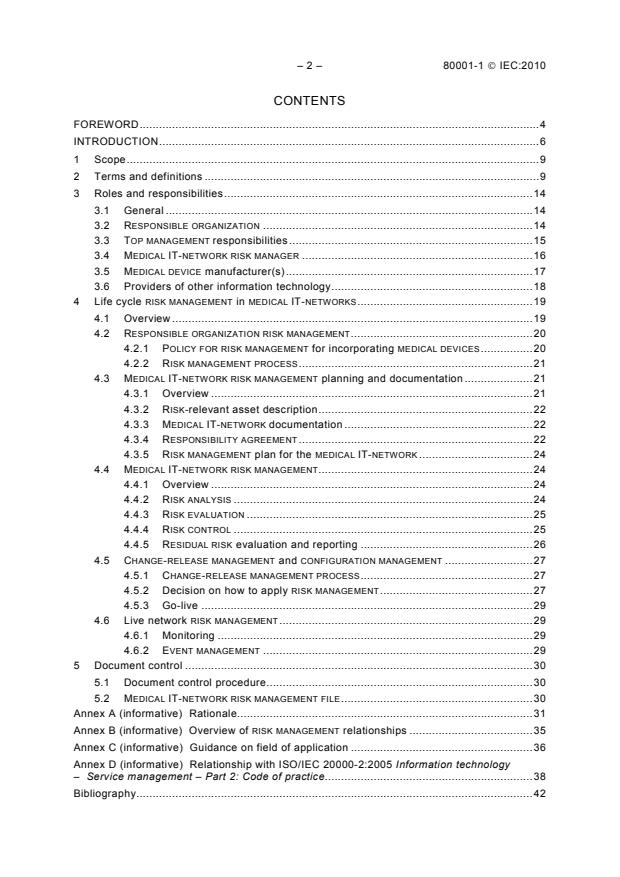
CONTENTS
FOREWORD.4
INTRODUCTION.6
1 Scope.9
2 Terms and definitions .9
3 Roles and responsibilities.14
3.1 General .14
3.2 RESPONSIBLE ORGANIZATION .14
3.3 TOP MANAGEMENT responsibilities .15
3.4 MEDICAL IT-NETWORK RISK MANAGER .16
3.5 MEDICAL DEVICE manufacturer(s).17
3.6 Providers of other information technology.18
4 Life cycle RISK MANAGEMENT in MEDICAL IT-NETWORKS.19
4.1 Overview .19
4.2 RESPONSIBLE ORGANIZATION RISK MANAGEMENT.20
4.2.1 POLICY FOR RISK MANAGEMENT for incorporating MEDICAL DEVICES.20
4.2.2 RISK MANAGEMENT PROCESS.21
4.3 MEDICAL IT-NETWORK RISK MANAGEMENT planning and documentation .21
4.3.1 Overview .21
4.3.2 RISK-relevant asset description.22
4.3.3 MEDICAL IT-NETWORK documentation .22
4.3.4 RESPONSIBILITY AGREEMENT .22
4.3.5 RISK MANAGEMENT plan for the MEDICAL IT-NETWORK .24
4.4 MEDICAL IT-NETWORK RISK MANAGEMENT.24
4.4.1 Overview .24
4.4.2 RISK ANALYSIS .24
4.4.3 RISK EVALUATION .25
4.4.4 RISK CONTROL .25
4.4.5 RESIDUAL RISK evaluation and reporting .26
4.5 CHANGE-RELEASE MANAGEMENT and CONFIGURATION MANAGEMENT .27
4.5.1 CHANGE-RELEASE MANAGEMENT PROCESS.27
4.5.2 Decision on how to apply RISK MANAGEMENT.27
4.5.3 Go-live .29
4.6 Live network RISK MANAGEMENT.29
4.6.1 Monitoring .29
4.6.2 EVENT MANAGEMENT .29
5 Document control .30
5.1 Document control procedure.30
5.2 MEDICAL IT-NETWORK RISK MANAGEMENT FILE.30
Annex A (informative) Rationale.31
Annex B (informative) Overview of RISK MANAGEMENT relationships .35
Annex C (informative) Guidance on field of application .36
Annex D (informative) Relationship with ISO/IEC 20000-2:2005 Information technology
– Service management – Part 2: Code of practice.38
Bibliography.42
80001-1 © IEC:2010 – 3 –
Figure 1 – Illustration of TOP MANAGEMENT responsibilities.16
Figure 2 – Overview of life cycle of MEDICAL IT-NETWORKS including RISK MANAGEMENT .20
Figure B.1 – Overview of roles and relationships .35
Figure D.1 – Service management processes .39
Table A.1 – Relationship between ISO 14971 and IEC 80001-1 .33
Table C.1 – IT-NETWORK scenarios that can be encountered in a clinical environment.36
Table D.1 – Relationship between IEC 80001-1 and ISO/IEC 20000-1:2005 or
ISO/IEC 20000-2:2005.40
– 4 – 80001-1 © IEC:2010
INTERNATIONAL ELECTROTECHNICAL COMMISSION
____________
APPLICATION OF RISK MANAGEMENT FOR IT-NETWORKS
INCORPORATING MEDICAL DEVICES –
Part 1: Roles, responsibilities and activities
FOREWORD
1) The International Electrotechnical Commission (IEC) is a worldwide organization for standardization comprising
all national electrotechnical committees (IEC National Committees). The object of IEC is to promote
international co-operation on all questions concerning standardization in the electrical and electronic fields. To
this end and in addition to other activities, IEC publishes International Standards, Technical Specifications,
Technical Reports, Publicly Available Specifications (PAS) and Guides (hereafter referred to as “IEC
Publication(s)”). Their preparation is entrusted to technical committees; any IEC National Committee interested
in the subject dealt with may participate in this preparatory work. International, governmental and non-
governmental organizations liaising with the IEC also participate in this preparation. IEC collaborates closely
with the International Organization for Standardization (ISO) in accordance with conditions determined by
agreement between the two organizations.
2) The formal decisions or agreements of IEC on technical matters express, as nearly as possible, an international
consensus of opinion on the relevant subjects since each technical committee has representation from all
interested IEC National Committees.
3) IEC Publications have the form of recommendations for international use and are accepted by IEC National
Committees in that sense. While all reasonable efforts are made to ensure that the technical content of IEC
Publications is accurate, IEC cannot be held responsible for the way in which they are used or for any
misinterpretation by any end user.
4) In order to promote international uniformity, IEC National Committees undertake to apply IEC Publications
transparently to the maximum extent possible in their national and regional publications. Any divergence
between any IEC Publication and the corresponding national or regional publication shall be clearly indicated in
the latter.
5) IEC itself does not provide any attestation of conformity. Independent certification bodies provide conformity
assessment services and, in some areas, access to IEC marks of conformity. IEC is not responsible for any
services carried out by independent certification bodies.
6) All users should ensure that they have the latest edition of this publication.
7) No liability shall attach to IEC or its directors, employees, servants or agents including individual experts and
members of its technical committees and IEC National Committees for any personal injury, property damage or
other damage of any nature whatsoever, whether direct or indirect, or for costs (including legal fees) and
expenses arising out of the publication, use of, or reliance upon, this IEC Publication or any other IEC
Publications.
8) Attention is drawn to the Normative references cited in this publication. Use of the referenced publications is
indispensable for the correct application of this publication.
9) Attention is drawn to the possibility that some of the elements of this IEC Publication may be the subject of
patent rights. IEC shall not be held responsible for identifying any or all such patent rights.
International Standard IEC 80001-1 has been prepared by a joint working group of
subcommittee 62A: Common aspects of electrical equipment used in medical practice, of IEC
technical committee 62: Electrical equipment in medical practice and ISO technical committee
215: Health informatics.
It is published as a double logo standard.
The text of this standard is based on the following documents:
FDIS Report on voting
62A/703/FDIS 62A/718/RVD
Full information on the voting for the approval of this standard can be found in the report on
voting indicated in the above table. In ISO, the standard has been approved by 17 P-members
out of 18 having cast a vote.
80001-1 © IEC:2010 – 5 –
This publication has been drafted in accordance with the ISO/IEC Directives, Part 2.
Terms defined in Clause 2 of this standard are printed in SMALL CAPITALS.
For the purposes of this standard:
• “shall” means that compliance with a requirement is mandatory for compliance with this
standard;
• “should” means that compliance with a requirement is recommended but is not mandatory
for compliance with this standard;
• “may” is used to describe a permissible way to achieve compliance with a requirement;
and
• “establish” means to define, document, and implement.
A list of all parts of the IEC 80001 series, published under the general title Application of risk
management for IT-networks incorporating medical devices, can be found on the IEC website.
The committee has decided that the contents of this publication will remain unchanged until
the stability date indicated on the IEC web site under "http://webstore.iec.ch" in the data
related to the specific publication. At this date, the publication will be
• reconfirmed,
• withdrawn,
• replaced by a revised edition, or
• amended.
IMPORTANT – The 'colour inside' logo on the cover page of this publication indicates
that it contains colours which are considered to be useful for the correct
understanding of its contents. Users should therefore print this document using a
colour printer.
– 6 – 80001-1 © IEC:2010
INTRODUCTION
An increasing number of MEDICAL DEVICEs are designed to exchange information electronically
with other equipment in the user environment, including other MEDICAL DEVICES. Such
information is frequently exchanged through an information technology network (IT-NETWORK)
that also transfers data of a more general nature.
At the same time, IT-NETWORKS are becoming increasingly vital to the clinical environment
and are now required to carry increasingly diverse traffic, ranging from life-critical patient data
requiring immediate delivery and response, to general corporate operations data and to email
containing potential malicious content (e.g. viruses).
For many jurisdictions, design and production of MEDICAL DEVICES is subject to regulation, and
to standards recognized by the regulators. Traditionally, regulators direct their attention to
MEDICAL DEVICE manufacturers, by requiring design features and by requiring a documented
PROCESS for design and manufacturing. MEDICAL DEVICES cannot be placed on the market in
these jurisdictions without evidence that those requirements have been met.
The use of the MEDICAL DEVICES by clinical staff is also subject to regulation. Members of
clinical staff have to be appropriately trained and qualified, and are increasingly subject to
defined PROCESSES designed to protect patients from unacceptable RISK.
In contrast, the incorporation of MEDICAL DEVICES into IT-NETWORKS in the clinical environment
1)
is a less regulated area. IEC 60601-1:2005 [1] requires MEDICAL DEVICE manufacturers to
include some information in ACCOMPANYING DOCUMENTS if the MEDICAL DEVICE is intended to be
connected to an IT-NETWORK. Standards are also in place covering common information
technology activities including planning, design and maintenance of IT-NETWORKS, for
instance ISO 20000-1:2005 [9]. However, until the publication of this standard, no standard
addressed how MEDICAL DEVICES can be connected to IT-NETWORKS, including general-purpose
IT-NETWORKS, to achieve INTEROPERABILITY without compromising the organization and
delivery of health care in terms of SAFETY, EFFECTIVENESS, and DATA AND SYSTEM SECURITY.
There remain a number of potential problems associated with the incorporation of MEDICAL
DEVICES into IT-NETWORKS, including:
– lack of consideration for RISK from use of IT-NETWORKS during evaluation of clinical RISK;
– lack of support from manufacturers of MEDICAL DEVICES for the incorporation of their
products into IT-NETWORKS, (e.g. the unavailability or inadequacy of information provided
by the manufacturer to the OPERATOR of the IT-NETWORK);
– incorrect operation or degraded performance (e.g. incompatibility or improper
configuration) resulting from combining MEDICAL DEVICES and other equipment on the same
IT-NETWORK;
– incorrect operation resulting from combining MEDICAL DEVICE SOFTWARE and other software
applications (e.g. open email systems or computer games) in the same IT-NETWORK;
– lack of security controls on many MEDICAL DEVICES; and
– the conflict between the need for strict change control of MEDICAL DEVICES and the need
for rapid response to the threat of cyberattack.
When these problems manifest themselves, unintended consequences frequently follow.
This standard is addressed to RESPONSIBLE ORGANIZATIONS, to manufacturers of MEDICAL
DEVICES, and to providers of other information technology.
___________
1)
Numbers in square brackets refer to the Bibliography.
80001-1 © IEC:2010 – 7 –
This standard adopts the following principles as a basis for its normative and informative
sections:
– The incorporation or removal of a MEDICAL DEVICE or other components in an IT-NETWORK
is a task which requires design of the action; this might be out of the control of the
manufacturer of the MEDICAL DEVICE.
– RISK MANAGEMENT should be used before the incorporation of a MEDICAL DEVICE into an IT-
NETWORK takes place, and for any changes during the entire life cycle of the resulting
MEDICAL IT-NETWORK, to avoid unacceptable RISKS, including possible RISK to patients,
resulting from the incorporation of the MEDICAL DEVICE into the IT-NETWORK. Many things
are part of a RISK decision, such as liability, cost, or impact on mission. These should be
considered in determining acceptable RISK in addition to the requirements described in
this standard.
– Aspects of removal, maintenance, change or modification of equipment, items or
components should be addressed adequately in addition to the incorporation of MEDICAL
DEVICES.
– The manufacturer of the MEDICAL DEVICE is responsible for RISK MANAGEMENT of the
MEDICAL DEVICE during the design, implementation, and manufacturing of the MEDICAL
DEVICE. This standard does not cover the RISK MANAGEMENT PROCESS for the MEDICAL
DEVICE.
– The manufacturer of a MEDICAL DEVICE intended to be incorporated into an IT-NETWORK
might need to provide information about the MEDICAL DEVICE that is necessary to allow the
RESPONSIBLE ORGANIZATION to manage RISK according to this standard. This information
can include, as part of the ACCOMPANYING DOCUMENTS, instructions specifically addressed
to the person who incorporates a MEDICAL DEVICE into an IT-NETWORK.
– Such ACCOMPANYING DOCUMENTS should convey instructions about how to incorporate the
MEDICAL DEVICE into the IT-NETWORK, how the MEDICAL DEVICE transfers information over
the IT-NETWORK, and the minimum IT-NETWORK characteristics necessary to enable the
INTENDED USE of the MEDICAL DEVICE when it is incorporated into the IT-NETWORK. The
ACCOMPANYING DOCUMENTS should warn of possible hazardous situations associated with
failure or disruptions of the IT-NETWORK, and the misuse of the IT-NETWORK connection or
of the information that is transferred over the IT-NETWORK.
– RESPONSIBILITY AGREEMENTS can establish roles and responsibilities among those engaged
in the incorporation of a MEDICAL DEVICE into an IT-NETWORK, all aspects of the life cycle of
the resulting MEDICAL IT-NETWORK and all activities that form part of that life cycle.
– The RESPONSIBLE ORGANIZATION is required to appoint people to certain roles defined in
this standard. This standard defines the responsibilities of those roles. The most important
of those roles is the MEDICAL IT-NETWORK RISK MANAGER. This role can be assigned to
someone within the RESPONSIBLE ORGANIZATION or to an external contractor.
– The MEDICAL IT-NETWORK RISK MANAGER is responsible for ensuring that RISK MANAGEMENT
is included during the PROCESSES of:
• planning and design of new incorporations of MEDICAL DEVICES or changes to such
incorporations;
• putting the MEDICAL IT-NETWORK into use and the consequent use of the MEDICAL IT-
NETWORK; and
• CHANGE-RELEASE MANAGEMENT and change management of the IT-NETWORK during the
IT-NETWORK’S entire life cycle.
– RISK MANAGEMENT should be applied to address the following KEY PROPERTIES appropriate
for the IT-NETWORK incorporating a MEDICAL DEVICE:
• SAFETY (freedom from unacceptable RISK of physical injury or damage to the health of
people or damage to property or the environment);
• EFFECTIVENESS (ability to produce the intended result for the patient and the RESPONSIBLE
ORGANIZATION); and
– 8 – 80001-1 © IEC:2010
• DATA AND SYSTEM SECURITY (an operational state of a MEDICAL IT-NETWORK in which
information assets (data and systems) are reasonably protected from degradation of
confidentiality, integrity, and availability).
80001-1 © IEC:2010 – 9 –
APPLICATION OF RISK MANAGEMENT FOR IT-NETWORKS
INCORPORATING MEDICAL DEVICES –
Part 1: Roles, responsibilities and activities
1 Scope
Recognizing that MEDICAL DEVICES are incorporated into IT-NETWORKS to achieve desirable
INTEROPERABILITY), this international standard defines the roles,
benefits (for example,
responsibilities and activities that are necessary for RISK MANAGEMENT of IT-NETWORKS
incorporating MEDICAL DEVICES to address SAFETY, EFFECTIVENESS and DATA AND SYSTEM
SECURITY (the KEY PROPERTIES). This international standard does not specify acceptable RISK
levels.
NOTE 1 The RISK MANAGEMENT activities described in this standard are derived from those in ISO 14971 [4 ]. Th e
relationship between ISO 14971 and this standard is described in A nne x A .
This standard applies after a MEDICAL DEVICE has been acquired by a RESPONSIBLE
ORGANIZATION and is a candidate for incorporation into an IT-NETWORK.
NOTE 2 This standard does not cover pre-market RISK MANAGEMENT.
This standard applies throughout the life cycle of IT-NETWORKS incorporating MEDICAL DEVICES.
NOTE 3 The life cycle management activities described in this standard are very similar to those of
ISO/IEC 20000-2 [10]. The relationship between ISO/IEC 20000-2 and this standard is described in A nne x D.
This standard applies where there is no single MEDICAL DEVICE manufacturer assuming
responsibility for addressing the KEY PROPERTIES of the IT-NETWORK incorporating a MEDICAL
DEVICE.
NOTE 4 If a single manufacturer specifies a complete MEDICAL DEVICE that includes a network, the installation or
assembly of the MEDICAL DEVICE according to the manufacturer’s ACCOMPANYING DOCUMENTS is not subject to the
provisions of this standard regardless of who installs or assembles the MEDICAL DEVICE.
NOTE 5 If a single manufacturer specifies a complete MEDICAL DEVICE that includes a network, additions to that
MEDICAL DEVICE or modification of the configuration of that MEDICAL DEVICE, other than as specified by the
manufacturer, is subject to the provisions of this standard.
This standard applies to RESPONSIBLE ORGANIZATIONS, MEDICAL DEVICE manufacturers and
providers of other information technology for the purpose of RISK MANAGEMENT of an IT-
NETWORK incorporating MEDICAL DEVICES as specified by the RESPONSIBLE ORGANIZATION.
This standard does not apply to personal use applications where the patient, OPERATOR and
RESPONSIBLE ORGANIZATION are one and the same person.
NOTE 6 In cases where a MEDICAL DEVICE is used at home under the supervision or instruction of the provider,
that provider is deemed to be the RESPONSIBLE ORGANIZATION. Personal use where the patient acquires and uses a
MEDICAL DEVICE without the supervision or instruction of a provider is out of scope of this standard.
This standard does not address regulatory or legal requirements.
2 Terms and definitions
For the purposes of this document, the following terms and definitions apply:
– 10 – 80001-1 © IEC:2010
2.1
ACCOMPANYING DOCUMENT
a document accompanying a MEDICAL DEVICE or an accessory and containing information for
the RESPONSIBLE ORGANIZATION or OPERATOR, particularly regarding SAFETY
NOTE Adapted from IEC 60601-1:2005, definition 3.4.
2.2
CHANGE-RELEASE MANAGEMENT
PROCESS that ensures that all changes to the IT-NETWORK are assessed, approved,
implemented and reviewed in a controlled manner and that changes are delivered, distributed,
and tracked, leading to release of the change in a controlled manner with appropriate input
and output with CONFIGURATION MANAGEMENT
NOTE Adapted from ISO/IEC 20000-1:2005, Subclauses 9.2 (change management) and 10.1 (release
management).
2.3
CHANGE PERMIT
an outcome of the RISK MANAGEMENT PROCESS consisting of a document that allows a specified
change or type of change without further RISK MANAGEMENT Activities subject to specified
constraints
2.4
CONFIGURATION MANAGEMENT
a PROCESS that ensures that configuration information of components and the IT-NETWORK are
defined and maintained in an accurate and controlled manner, and provides a mechanism for
identifying, controlling and tracking versions of the IT-NETWORK
NOTE Adapted from ISO/IEC 20000-1:2005, Subclause 9.1.
2.5
DATA AND SYSTEMS SECURITY
an operational state of a MEDICAL IT-NETWORK in which information assets (data and systems)
are reasonably protected from degradation of confidentiality, integrity, and availability
NOTE 1 Security, when mentioned in this standard, should be taken to include DATA AND SYSTEMS SECURITY.
NOTE 2 DATA AND SYSTEMS SECURITY is assured through a framework of policy, guidance, infrastructure, and
services designed to protect information assets and the systems that acquire, transmit, store, and use information
in pursuit of the organization’s mission.
2.6
EFFECTIVENESS
ability to produce the intended result for the patient and the RESPONSIBLE ORGANIZATION
2.7
EVENT MANAGEMENT
a PROCESS that ensures that all events that can or might negatively impact the operation of
the IT-NETWORK are captured, assessed, and managed in a controlled manner
NOTE Adapted from ISO/IEC 20000-1:2005, Subclauses 8.2 (incident management) and 8.3 (problem
management).
2.8
HARM
physical injury or damage to the health of people, or damage to property or the environment,
or reduction in EFFECTIVENESS, or breach of DATA AND SYSTEM SECURITY
NOTE Adapted from ISO 14971:2007, definition 2.2.
80001-1 © IEC:2010 – 11 –
2.9
HAZARD
potential source of HARM
[ISO 14971:2007, definition 2.3]
2.10
INTENDED USE
INTENDED PURPOSE
use for which a product, PROCESS or service is intended according to the specifications,
instructions and information provided by the manufacturer
[ISO 14971: 2007, definition 2.5]
2.11
INTEROPERABILITY
a property permitting diverse systems or components to work together for a specified purpose
2.12
IT-NETWORK (INFORMATION TECHNOLOGY NETWORK)
a system or systems composed of communicating nodes and transmission links to provide
physically linked or wireless transmission between two or more specified communication
nodes
NOTE 1 Adapted from IEC 61907:2009, definition 3.1.1.
NOTE 2 The scope of the MEDICAL IT-NETWORK in this standard is defined by the RESPONSIBLE ORGANIZATION
based on where the MEDICAL DEVICES in the MEDICAL IT-NETWORK are located and the defined use of the network. It
can contain IT infrastructure, home health and non-clinical contexts. See also 4. 3. 3.
2.13
KEY PROPERTIES
three risk managed characteristics (SAFETY, EFFECTIVENESS, and DATA AND SYSTEMS SECURITY)
of MEDICAL IT-NETWORKS
2.14
MEDICAL DEVICE
means any instrument, apparatus, implement, machine, appliance, implant, in vitro reagent or
calibrator, software, material or other similar or related article:
a) intended by the manufacturer to be used, alone or in combination, for human beings for
one or more of the specific purpose(s) of:
– diagnosis, prevention, monitoring, treatment or alleviation of disease,
– diagnosis, monitoring, treatment, alleviation of or compensation for an injury,
– investigation, replacement, modification, or support of the anatomy or of a physiological
process,
– supporting or sustaining life,
– control of conception,
– disinfection of medical devices,
– providing information for medical or diagnostic purposes by means of in vitro
examination of specimens derived from the human body; and
b) which does not achieve its primary intended action in or on the human body by pharmacological,
immunological or metabolic means, but which may be assisted in its intended function by such
means.
– 12 – 80001-1 © IEC:2010
NOTE 1 The definition of a device for in vitro examination includes, for example, reagents, calibrators, sample
collection and storage devices, control materials, and related instruments or apparatus. The information provided
by such an in vitro diagnostic device may be for diagnostic, monitoring or compatibility purposes. In some
jurisdictions, some in vitro diagnostic devices, including reagents and the like, may be covered by separate
regulations.
NOTE 2 Products which may be considered to be medical devices in some jurisdictions but for which there is not
yet a harmonized approach, are:
– aids for disabled/handicapped people;
– devices for the treatment/diagnosis of diseases and injuries in animals;
– accessories for medical devices (see Note 3);
– disinfection substances;
– devices incorporating animal and human tissues which may meet the requirements of the above definition but
are subject to different controls.
NOTE 3 Accessories intended specifically by manufacturers to be used together with a ‘parent’ medical device to
enable that medical device to achieve its intended purpose should be subject to the same GHTF procedures as
apply to the medical device itself. For example, an accessory will be classified as though it is a medical device in
its own right. This may result in the accessory having a different classification than the ‘parent’ device.
NOTE 4 Components to medical devices are generally controlled through the manufacturer’s quality management
system and the conformity assessment procedures for the device. In some jurisdictions, components are included
in the definition of a ‘medical device’.
[GHTF SG1/N29R16:2005]
2.15
MEDICAL DEVICE SOFTWARE
software system that has been developed for the purpose of being incorporated into the
MEDICAL DEVICE or that is intended for use as a MEDICAL DEVICE in its own right
[IEC 62304:2006, definition 3.12, modified]
2.16
MEDICAL IT-NETWORK
an IT-NETWORK that incorporates at least one MEDICAL DEVICE
2.17
MEDICAL IT-NETWORK RISK MANAGER
person accountable for RISK MANAGEMENT of a MEDICAL IT-NETWORK
2.18
OPERATOR
person handling equipment
[IEC 60601-1:2005, definition 3.73]
2.19
PROCESS
set of interrelated or interacting activities which transforms inputs into outputs
[ISO 14971:2007, definition 2.13]
NOTE The term “activities” covers use of resources.
2.20
RESIDUAL RISK
RISK remaining after RISK CONTROL measures have been taken
[ISO 14971:2007, definition 2.15]
80001-1 © IEC:2010 – 13 –
2.21
RESPONSIBILITY AGREEMENT
one or more documents that together fully define the responsibilities of all relevant
stakeholders
NOTE This agreement can be a legal document, e.g. a contract.
2.22
RESPONSIBLE ORGANIZATION
entity accountable for the use and maintenance of a MEDICAL IT-NETWORK
NOTE 1 The accountable entity can be, for example, a hospital, a private clinician or a telehealth organization.
NOTE 2 Adapted from IEC 60601-1:2005 definition 3.101.
2.23
RISK
combination of the probability of occurrence of HARM and the severity of that HARM
[ISO 14971:2007, definition 2.16]
2.24
RISK ANALYSIS
systematic use of available information to identify HAZARDS and to estimate the RISK
[ISO 14971:2007, definition 2.17]
2.25
RISK ASSESSMENT
overall PROCESS comprising a RISK ANALYSIS and a RISK EVALUATION
[ISO/IEC Guide 51:1999, definition 3.12]
2.26
RISK CONTROL
PROCESS in which decisions are made and measures implemented by which RISKS are reduced
to, or maintained within, specified levels
[ISO 14971:2007, definition 2.19]
2.27
RISK EVALUATION
PROCESS of comparing the estimated RISK against given RISK criteria to determine the
acceptability of the RISK
[ISO 14971:2007, definition 2.21]
2.28
RISK MANAGEMENT
systematic application of management policies, procedures and practices to the tasks of
analyzing, evaluating, controlling, and monitoring RISK
[ISO 14971:2007, definition 2.22]
2.29
RISK MANAGEMENT FILE
set of records and other documents that are produced by RISK MANAGEMENT
– 14 – 80001-1 © IEC:2010
[ISO 14971:2007, definition 2.23]
2.30
SAFETY
freedom from unacceptable RISK of physical injury or damage to the health of people or
damage to property or the environment
NOTE Adapted from ISO 14971:2007, definition 2.24.
2.31
TOP MANAGEMENT
person or group of people who direct(s) and control(s) the RESPONSIBLE ORGANIZATION
accountable for a MEDICAL IT-NETWORK at the highest level
NOTE Adapted from ISO 9000:2005, definition 3.2.7.
2.32
VERIFICATION
confirmation through provision of objective evidence that specified requirements have been
fulfilled
NOTE 1 The term “verified” is used to designate the corresponding status.
NOTE 2 Confirmation can comprise activities such as:
– performing alternative calculations;
– comparing a new design specification with a similar proven design specification;
– undertaking tests and demonstrations; and
– reviewing documents prior to issue.
[ISO 14971:2007, definition 2.28]
NOTE 3 In design and development, VERIFICATION concerns the PROCESS of examining the result of a given
activity to determine conformity with the stated requirement for that activity.
3 Roles and responsibilities
3.1 General
Incorporation and modification of equipment or software of a MEDICAL IT-NETWORK shall be
performed under a framework of clearly defined responsibilities. At a minimum, the parties,
responsibilities and requirements identified in subclauses 3. 2 thr o ug h 3.6 shall be defined.
For the particular MEDICAL IT-NETWORK being considered, the RESPONSIBLE ORGANIZATION shall
establish and maintain a MEDICAL IT-NETWORK RISK MANAGEMENT FILE.
All documentation related to the requirements of this standard for RESPONSIBLE ORGANIZATIONS
as well as all supporting documentation shall be maintained in a MEDICAL IT-NETWORK RISK
MANAGEMENT FILE. This file shall contain the current CONFIGURATION MANAGEMENT information
for the MEDICAL IT-NETWORK.
NOTE The CONFIGURATION MANAGEMENT information can be included in the MEDICAL IT-NETWORK RISK MANAGEMENT
FILE either through explicit documentation or by reference, for example, to a live database.
Compliance is checked by inspection of the MEDICAL IT-NETWORK RISK MANAGEMENT FILE.
3.2 RESPONSIBLE ORGANIZATION
The overall responsibility for RISK MANAGEMENT for a MEDICAL IT-NETWORK shall stay within the
RESPONSIBLE ORGANIZATION.
80001-1 © IEC:2010 – 15 –
The RESPONSIBLE ORGANIZATION shall be the owner of the RISK MANAGEMENT PROCESS for the
MEDICAL IT-NETWORK, spanning planning, design, installation, device connection,
configuration, use/operation, maintenance, and device decommissioning.
Compliance is checked by assessment of the RESPONSIBLE ORGANIZATION.
3.3 TOP MANAGEMENT responsibilities
For RISK MANAGEMENT of MEDICAL IT-NETWORKS, TOP MANAGEMENT shall be accountable for:
a) establishing a policy for RISK MANAGEMENT for incorporating MEDICAL DEVICES;
b) defining the policy for determining acceptable RISK, taking into account relevant
international standards and national or regional regulations;
c) ensuring the provision of adequate resources;
d) ensuring the assignment of qualified personnel for management, performance of work and
assessment activities; and
e) reviewing the results of RISK MANAGEMENT activities, including EVENT MANAGEMENT (see
4.6.2), at defined intervals to ensure the continuing suitability and the effectiveness of the
RISK MANAGEMENT PROCESS.
The above shall be documented in the MEDICAL IT-NETWORK RISK MANAGEMENT FILE.
TOP MANAGEMENT shall appoint a MEDICAL IT-NETWORK RISK MANAGER, who has the necessary
qualifications, knowledge and competence for RISK MANAGEMENT applied to MEDICAL IT-
NETWORKS (see 3. 4) .
TOP MANAGEMENT shall identify the people responsible for the following tasks and ensure that
they co-operate with the MEDICAL IT-NETWORK RISK MANAGER:
f) gathering, analysis, assessment and storage of information needed for RISK MANAGEMENT;
g) lifecycle management of MEDICAL DEVICES incorporated in IT-NETWORKS;
h) reviewing and accepting RESIDUAL RISK on behalf of TOP MANAGEMENT;
i) maintenance of MEDICAL IT-NETWORKS; and
j) choice of and procurement of MEDICAL DEVICES.
TOP MANAGEMENT shall ensure that participation in the RISK MANAGEMENT PROCESS for MEDICAL
IT-NETWORKS includes management responsible for:
k) MEDICAL IT-NETWORKS;
l) general IT activities;
m) life-cycle management of MEDICAL DEVICES connected to IT-NETWORKS;
EXAMPLE biomedical engineering, radiological engineering
n) the use of MEDICAL DEVICES; and
EXAMPLE experienced users from clinical departments
o) maintenance and technical support for MEDICAL DEVICES.
EXAMPLE biomedical engineering department
TOP MANAGEMENT shall ensure:
– 16 – 80001-1 © IEC:2010
p) that all supervision, operation, installation and maintenance of MEDICAL IT-NETWORK(S)
throughout the life cycle is made according to the RISK MANAGEMENT plan and follows the
results of the IT-NETWORK RISK MANAGEMENT PROCESS, whoever performs these tasks;
q) that all parties performing supervision, operation, installation, service, troubleshooting and
maintenance of MEDICAL IT-NETWORK(S) are adequately informed about their responsibility
according to this standard, including their responsibility for maintaining the effectiveness
of RISK CONTROLS.
NOTE The TOP MANAGEMENT responsibilities are illustrated in Figure 1.
RESPONSIBLE ORGANIZATION
TOP MANAGEMENT responsibilities
Policies for
• RISK MANAGEMENT PROCESS
• RISK acceptability criteria
• Balancing the three KEY PROPERITIES with the
mission of the RESPONSIBLE ORGANIZATION
Resources
• Provision of adequate resources
• Assignment of qualified personnel
• Appointment of the MEDICAL IT-NETWORK RISK
MANAGER
• Enforcement of RESPONSIBILITY AGREEMENTS
RISK MANAGEMENT PROCESS
• Clear connection to other PROCESSES
• Ensuring continuing suitability and
effectiveness
• Reviewing results at defined intervals
IEC 2388/10
Figure 1 – Illustration of TOP MANAGEMENT responsibilities
Compliance is checked by inspection of the MEDICAL IT-NETWORK RISK MANAGEMENT FILE.
3.4 MEDICAL IT-NETWORK RISK MANAGER
The MEDICAL IT-NETWORK RISK MANAGER shall be responsible for the management of the RISK
MANAGEMENT PROCESS.
The MEDICAL IT-NETWORK RISK MANAGER shall supervise the execution of the RISK MANAGEMENT
PROCESS to maintain the KEY PROPERTIES of the MEDICAL IT-NETWORK.
80001-1 © IEC:2010 – 17 –
The MEDICAL IT-NETWORK RISK MANAGER shall be responsible for the following aspects of the
RISK MANAGEMENT of IT-NETWORKS incorporating MEDICAL DEVICES:
a) Overall management of the RISK MANAGEMENT PROCESS;
b) reporting on the RISK MANAGEMENT PROCESS to the TOP MANAGEMENT; and
c) managing the necessary communication between the internal and external participants in
RISK MANAGEMENT. Such participants may include, as appropriate:
1) MEDICAL DEVICE manufacturers;
2) other suppliers of IT equipment, software and services;
3) internal IT function and other facilities management functions;
4) clinical users; and
5) technical support function responsible for MEDICAL DEVICES (for example biomedical
engineering).
The MEDICAL IT-NETWORK RISK MANAGER shall be responsible for the performance of the RISK
MANAGEMENT PROCESS. This includes but is not limited to responsibility for:
d) collection of all RISK-relevant information on the MEDICAL DEVICES;
e) planning the incorporation of the MEDICAL DEVICES in accordance with the instructions
provided by the various MEDICAL DEVICE manufacturers and the policies of the RESPONSIBLE
ORGANIZATION;
f) the performance of the RISK MANAGEMENT PROCESS whenever a MEDICAL DEVICE is added to
an IT-NETWORK;
g) the performance
...