

IEC 60534-8-4:2015
(Main)Industrial-process control valves - Part 8-4: Noise considerations - Prediction of noise generated by hydrodynamic flow
General Information
- Abstract
IEC 60534-8-4:2015 establishes a method to predict the noise generated in a control valve by liquid flow and the resulting noise level measured downstream of the valve and outside of the pipe. The noise may be generated both by normal turbulence and by liquid cavitation in the valve. Parts of the method are based on fundamental principles of acoustics, fluid mechanics, and mechanics. The method is validated by test data. This third edition cancels and replaces the second edition published 2005. This edition constitutes a technical revision. This edition includes the following significant technical changes with respect to the previous edition:
a) Hydrodynamic noise is predicted as a function of frequency and
b) Elimination of the acoustic power ratio.
- Status
- Published
- Publication Date
- 14-Sep-2015
- Technical Committee
- SC 65B - Measurement and control devices
- Drafting Committee
- WG 9 - TC 65/SC 65B/WG 9
- Current Stage
- PPUB - Publication issued
- Start Date
- 15-Sep-2015
- Completion Date
- 30-Sep-2015
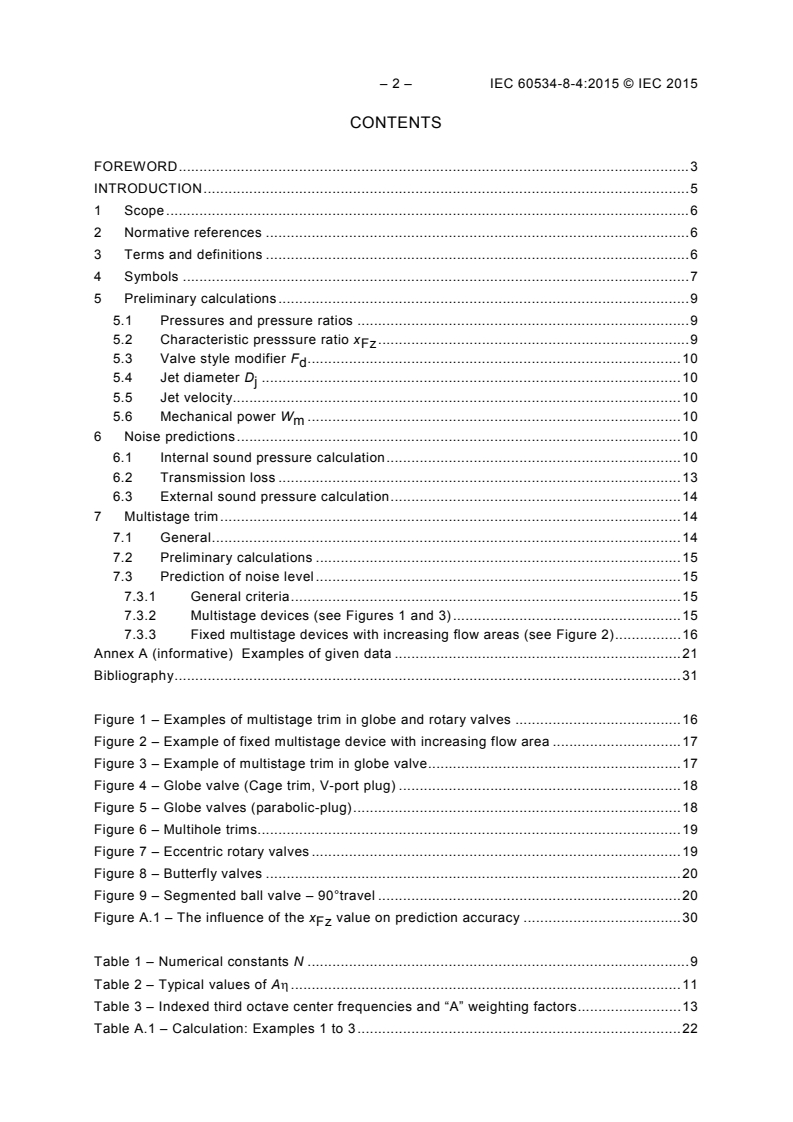
Overview
IEC 60534-8-4:2015 is an international standard developed by the International Electrotechnical Commission (IEC) that addresses noise considerations in industrial-process control valves. Specifically, this part 8-4 of the series provides a method for predicting noise generated by hydrodynamic flow-liquid flow through control valves. It focuses on calculating the noise level downstream of the valve and externally measured outside the pipe wall. The standard takes into account noise caused by both normal turbulence and liquid cavitation within the valve.
This third edition, published in 2015, replaces the 2005 edition and introduces key updates including prediction of hydrodynamic noise as a function of frequency and the removal of the acoustic power ratio parameter.
Key Topics
Hydrodynamic Noise Prediction
The standard establishes a method that predicts noise generated due to the mechanical energy conversion from turbulent fluid flow and cavitation in valves to audible noise levels.Frequency-based Noise Analysis
Noise emissions are predicted across different frequencies rather than as a single aggregated value, allowing more accurate assessment aligned with real-world measurements.Noise Measurement Location
Predictions focus on noise measured 1 meter downstream from the valve and 1 meter away from the pipe’s outer surface, assuming an acoustic free field and ideal straight piping conditions.Fluid Flow Characteristics
Calculations incorporate pressures, pressure ratios, jet velocity, mechanical power, and valve-specific characteristics such as style and trim type.Validated Methodology
The method is validated primarily for water applications, covering valve sizes DN 15 to DN 300 with inlet pressures up to 15 bar and is considered accurate within ±5 dB(A) for typical installations.Exclusions
The standard does not cover noise generated from mechanical vibrations, flashing conditions, unstable flow, or other unpredictable behaviors. It also currently focuses on hydrodynamic noise and does not extend to other fluids beyond water.
Applications
IEC 60534-8-4:2015 is crucial for engineers, designers, and maintenance personnel involved in industrial process control systems that utilize control valves. Typical application areas include:
Industrial Process Automation
Ensuring control valves meet noise emission regulations and occupational health standards.Valve Design and Selection
Supporting valve manufacturers and process engineers in designing low-noise valves and selecting appropriate valve trims and configurations.Occupational Safety
Helping industries comply with noise exposure limits to protect workers around valve installations.Equipment and Pipeline Integrity
Predicting and mitigating noise levels to prevent pipe failure and damage to surrounding equipment caused by excessive hydrodynamic noise.Acoustic Compliance Testing
Providing a standardized prediction methodology to complement or reduce the need for extensive field noise testing.
Related Standards
This standard is part of the broader IEC 60534 series focused on industrial-process control valves. For comprehensive understanding and application, it is often used in conjunction with:
IEC 60534-8-2: Noise Considerations – Measurement of Flow Noise
Provides methods for determining parameters such as flow coefficients essential for noise prediction calculations.IEC 60534-8-3: Noise Considerations – Control Valve Noise and Vibration in Service
Deals with measuring and addressing noise and vibration issues in operational valve installations.Other relevant IEC and ISO standards for acoustics, fluid mechanics, and occupational noise exposure may also be consulted to develop complete noise management strategies.
Keywords: IEC 60534-8-4, industrial process control valves, hydrodynamic noise, valve noise prediction, liquid flow noise, control valve acoustics, cavitation noise, valve design, noise measurement, occupational noise standards, valve trim noise.
Relations
- Effective Date
- 05-Sep-2023
- Effective Date
- 05-Sep-2023
Get Certified
Connect with accredited certification bodies for this standard

DVS-ZERT GmbH
German welding certification society.
Institut za varilstvo d.o.o. (Welding Institute)
Slovenia's leading welding institute since 1952. ISO 3834, EN 1090, pressure equipment certification, NDT personnel, welder qualification. Only IIW Au
BSMI (Bureau of Standards, Metrology and Inspection)
Taiwan's standards and inspection authority.
Sponsored listings
Frequently Asked Questions
IEC 60534-8-4:2015 is a standard published by the International Electrotechnical Commission (IEC). Its full title is "Industrial-process control valves - Part 8-4: Noise considerations - Prediction of noise generated by hydrodynamic flow". This standard covers: IEC 60534-8-4:2015 establishes a method to predict the noise generated in a control valve by liquid flow and the resulting noise level measured downstream of the valve and outside of the pipe. The noise may be generated both by normal turbulence and by liquid cavitation in the valve. Parts of the method are based on fundamental principles of acoustics, fluid mechanics, and mechanics. The method is validated by test data. This third edition cancels and replaces the second edition published 2005. This edition constitutes a technical revision. This edition includes the following significant technical changes with respect to the previous edition: a) Hydrodynamic noise is predicted as a function of frequency and b) Elimination of the acoustic power ratio.
IEC 60534-8-4:2015 establishes a method to predict the noise generated in a control valve by liquid flow and the resulting noise level measured downstream of the valve and outside of the pipe. The noise may be generated both by normal turbulence and by liquid cavitation in the valve. Parts of the method are based on fundamental principles of acoustics, fluid mechanics, and mechanics. The method is validated by test data. This third edition cancels and replaces the second edition published 2005. This edition constitutes a technical revision. This edition includes the following significant technical changes with respect to the previous edition: a) Hydrodynamic noise is predicted as a function of frequency and b) Elimination of the acoustic power ratio.
IEC 60534-8-4:2015 is classified under the following ICS (International Classification for Standards) categories: 17.140.20 - Noise emitted by machines and equipment; 23.060.40 - Pressure regulators; 25.040.40 - Industrial process measurement and control. The ICS classification helps identify the subject area and facilitates finding related standards.
IEC 60534-8-4:2015 has the following relationships with other standards: It is inter standard links to IEC 60534-8-4:2005/COR1:2006, IEC 60534-8-4:2005. Understanding these relationships helps ensure you are using the most current and applicable version of the standard.
IEC 60534-8-4:2015 is available in PDF format for immediate download after purchase. The document can be added to your cart and obtained through the secure checkout process. Digital delivery ensures instant access to the complete standard document.
Standards Content (Sample)
IEC 60534-8-4 ®
Edition 3.0 2015-09
INTERNATIONAL
STANDARD
NORME
INTERNATIONALE
Industrial-process control valves –
Part 8-4: Noise considerations – Prediction of noise generated by hydrodynamic
flow
Vannes de régulation des processus industriels –
Partie 8-4: Considérations sur le bruit – Prévisions du bruit généré par un
écoulement hydrodynamique
All rights reserved. Unless otherwise specified, no part of this publication may be reproduced or utilized in any form
or by any means, electronic or mechanical, including photocopying and microfilm, without permission in writing from
either IEC or IEC's member National Committee in the country of the requester. If you have any questions about IEC
copyright or have an enquiry about obtaining additional rights to this publication, please contact the address below or
your local IEC member National Committee for further information.
Droits de reproduction réservés. Sauf indication contraire, aucune partie de cette publication ne peut être reproduite
ni utilisée sous quelque forme que ce soit et par aucun procédé, électronique ou mécanique, y compris la photocopie
et les microfilms, sans l'accord écrit de l'IEC ou du Comité national de l'IEC du pays du demandeur. Si vous avez des
questions sur le copyright de l'IEC ou si vous désirez obtenir des droits supplémentaires sur cette publication, utilisez
les coordonnées ci-après ou contactez le Comité national de l'IEC de votre pays de résidence.
IEC Central Office Tel.: +41 22 919 02 11
3, rue de Varembé Fax: +41 22 919 03 00
CH-1211 Geneva 20 info@iec.ch
Switzerland www.iec.ch
About the IEC
The International Electrotechnical Commission (IEC) is the leading global organization that prepares and publishes
International Standards for all electrical, electronic and related technologies.
About IEC publications
The technical content of IEC publications is kept under constant review by the IEC. Please make sure that you have the
latest edition, a corrigenda or an amendment might have been published.
IEC Catalogue - webstore.iec.ch/catalogue Electropedia - www.electropedia.org
The stand-alone application for consulting the entire The world's leading online dictionary of electronic and
bibliographical information on IEC International Standards, electrical terms containing more than 30 000 terms and
Technical Specifications, Technical Reports and other definitions in English and French, with equivalent terms in 15
documents. Available for PC, Mac OS, Android Tablets and additional languages. Also known as the International
iPad. Electrotechnical Vocabulary (IEV) online.
IEC publications search - www.iec.ch/searchpub IEC Glossary - std.iec.ch/glossary
The advanced search enables to find IEC publications by a More than 60 000 electrotechnical terminology entries in
variety of criteria (reference number, text, technical English and French extracted from the Terms and Definitions
committee,…). It also gives information on projects, replaced clause of IEC publications issued since 2002. Some entries
and withdrawn publications. have been collected from earlier publications of IEC TC 37,
77, 86 and CISPR.
IEC Just Published - webstore.iec.ch/justpublished
Stay up to date on all new IEC publications. Just Published IEC Customer Service Centre - webstore.iec.ch/csc
details all new publications released. Available online and If you wish to give us your feedback on this publication or
also once a month by email. need further assistance, please contact the Customer Service
Centre: csc@iec.ch.
A propos de l'IEC
La Commission Electrotechnique Internationale (IEC) est la première organisation mondiale qui élabore et publie des
Normes internationales pour tout ce qui a trait à l'électricité, à l'électronique et aux technologies apparentées.
A propos des publications IEC
Le contenu technique des publications IEC est constamment revu. Veuillez vous assurer que vous possédez l’édition la
plus récente, un corrigendum ou amendement peut avoir été publié.
Catalogue IEC - webstore.iec.ch/catalogue Electropedia - www.electropedia.org
Application autonome pour consulter tous les renseignements
Le premier dictionnaire en ligne de termes électroniques et
bibliographiques sur les Normes internationales,
électriques. Il contient plus de 30 000 termes et définitions en
Spécifications techniques, Rapports techniques et autres
anglais et en français, ainsi que les termes équivalents dans
documents de l'IEC. Disponible pour PC, Mac OS, tablettes
15 langues additionnelles. Egalement appelé Vocabulaire
Android et iPad.
Electrotechnique International (IEV) en ligne.
Recherche de publications IEC - www.iec.ch/searchpub
Glossaire IEC - std.iec.ch/glossary
Plus de 60 000 entrées terminologiques électrotechniques, en
La recherche avancée permet de trouver des publications IEC
en utilisant différents critères (numéro de référence, texte, anglais et en français, extraites des articles Termes et
comité d’études,…). Elle donne aussi des informations sur les Définitions des publications IEC parues depuis 2002. Plus
projets et les publications remplacées ou retirées. certaines entrées antérieures extraites des publications des
CE 37, 77, 86 et CISPR de l'IEC.
IEC Just Published - webstore.iec.ch/justpublished
Service Clients - webstore.iec.ch/csc
Restez informé sur les nouvelles publications IEC. Just
Published détaille les nouvelles publications parues. Si vous désirez nous donner des commentaires sur cette
Disponible en ligne et aussi une fois par mois par email. publication ou si vous avez des questions contactez-nous:
csc@iec.ch.
IEC 60534-8-4 ®
Edition 3.0 2015-09
INTERNATIONAL
STANDARD
NORME
INTERNATIONALE
Industrial-process control valves –
Part 8-4: Noise considerations – Prediction of noise generated by hydrodynamic
flow
Vannes de régulation des processus industriels –
Partie 8-4: Considérations sur le bruit – Prévisions du bruit généré par un
écoulement hydrodynamique
INTERNATIONAL
ELECTROTECHNICAL
COMMISSION
COMMISSION
ELECTROTECHNIQUE
INTERNATIONALE
ICS 17.140.20; 23.060.40; 25.040.40 ISBN 978-2-8322-2879-1
– 2 – IEC 60534-8-4:2015 © IEC 2015
CONTENTS
FOREWORD . 3
INTRODUCTION . 5
1 Scope . 6
2 Normative references . 6
3 Terms and definitions . 6
4 Symbols . 7
5 Preliminary calculations . 9
5.1 Pressures and pressure ratios . 9
5.2 Characteristic presssure ratio x . 9
Fz
5.3 Valve style modifier F . 10
d
5.4 Jet diameter D . 10
j
5.5 Jet velocity. 10
5.6 Mechanical power W . 10
m
6 Noise predictions . 10
6.1 Internal sound pressure calculation . 10
6.2 Transmission loss . 13
6.3 External sound pressure calculation . 14
7 Multistage trim . 14
7.1 General . 14
7.2 Preliminary calculations . 15
7.3 Prediction of noise level . 15
7.3.1 General criteria . 15
7.3.2 Multistage devices (see Figures 1 and 3) . 15
7.3.3 Fixed multistage devices with increasing flow areas (see Figure 2) . 16
Annex A (informative) Examples of given data . 21
Bibliography . 31
Figure 1 – Examples of multistage trim in globe and rotary valves . 16
Figure 2 – Example of fixed multistage device with increasing flow area . 17
Figure 3 – Example of multistage trim in globe valve . 17
Figure 4 – Globe valve (Cage trim, V-port plug) . 18
Figure 5 – Globe valves (parabolic-plug) . 18
Figure 6 – Multihole trims. 19
Figure 7 – Eccentric rotary valves . 19
Figure 8 – Butterfly valves . 20
Figure 9 – Segmented ball valve – 90°travel . 20
Figure A.1 – The influence of the x value on prediction accuracy . 30
Fz
Table 1 – Numerical constants N . 9
Table 2 – Typical values of Aη . 11
Table 3 – Indexed third octave center frequencies and “A” weighting factors. 13
Table A.1 – Calculation: Examples 1 to 3 . 22
INTERNATIONAL ELECTROTECHNICAL COMMISSION
____________
INDUSTRIAL-PROCESS CONTROL VALVES –
Part 8-4: Noise considerations –
Prediction of noise generated by hydrodynamic flow
FOREWORD
1) The International Electrotechnical Commission (IEC) is a worldwide organization for standardization comprising
all national electrotechnical committees (IEC National Committees). The object of IEC is to promote
international co-operation on all questions concerning standardization in the electrical and electronic fields. To
this end and in addition to other activities, IEC publishes International Standards, Technical Specifications,
Technical Reports, Publicly Available Specifications (PAS) and Guides (hereafter referred to as “IEC
Publication(s)”). Their preparation is entrusted to technical committees; any IEC National Committee interested
in the subject dealt with may participate in this preparatory work. International, governmental and non-
governmental organizations liaising with the IEC also participate in this preparation. IEC collaborates closely
with the International Organization for Standardization (ISO) in accordance with conditions determined by
agreement between the two organizations.
2) The formal decisions or agreements of IEC on technical matters express, as nearly as possible, an international
consensus of opinion on the relevant subjects since each technical committee has representation from all
interested IEC National Committees.
3) IEC Publications have the form of recommendations for international use and are accepted by IEC National
Committees in that sense. While all reasonable efforts are made to ensure that the technical content of IEC
Publications is accurate, IEC cannot be held responsible for the way in which they are used or for any
misinterpretation by any end user.
4) In order to promote international uniformity, IEC National Committees undertake to apply IEC Publications
transparently to the maximum extent possible in their national and regional publications. Any divergence
between any IEC Publication and the corresponding national or regional publication shall be clearly indicated in
the latter.
5) IEC itself does not provide any attestation of conformity. Independent certification bodies provide conformity
assessment services and, in some areas, access to IEC marks of conformity. IEC is not responsible for any
services carried out by independent certification bodies.
6) All users should ensure that they have the latest edition of this publication.
7) No liability shall attach to IEC or its directors, employees, servants or agents including individual experts and
members of its technical committees and IEC National Committees for any personal injury, property damage or
other damage of any nature whatsoever, whether direct or indirect, or for costs (including legal fees) and
expenses arising out of the publication, use of, or reliance upon, this IEC Publication or any other IEC
Publications.
8) Attention is drawn to the Normative references cited in this publication. Use of the referenced publications is
indispensable for the correct application of this publication.
9) Attention is drawn to the possibility that some of the elements of this IEC Publication may be the subject of
patent rights. IEC shall not be held responsible for identifying any or all such patent rights.
International Standard IEC 60534-8-4 has been prepared by subcommittee 65B: Measurement
and control devices , of IEC technical committee 65: Industrial-process measurement, control
and automation.
This third edition cancels and replaces the second edition published 2005. This edition
constitutes a technical revision.
This edition includes the following significant technical changes with respect to the previous
edition:
a) Hydrodynamic noise is predicted as a function of frequency.
b) Elimination of the acoustic power ratio
– 4 – IEC 60534-8-4:2015 © IEC 2015
The text of this standard is based on the following documents:
FDIS Report on voting
65B/1005/FDIS 65B/1017/RVD
Full information on the voting for the approval of this standard can be found in the report on
voting indicated in the above table.
This publication has been drafted in accordance with the ISO/IEC Directives, Part 2.
A list of all parts in the IEC 60534 series, published under the general title Industrial-process
control valves, can be found on the IEC website.
The committee has decided that the contents of this publication will remain unchanged until
the stability date indicated on the IEC web site under "http://webstore.iec.ch" in the data
related to the specific publication. At this date, the publication will be
• reconfirmed,
• withdrawn,
• replaced by a revised edition, or
• amended.
INTRODUCTION
It is valuable to predict the noise levels that will be generated by valves. Safety requirements,
such as the occupational health standards require that human exposure to noise be limited.
There is also data indicating that noise levels above certain levels could lead to pipe failure or
affect associated equipment. See IEC 60534-8-3. Earlier hydrodynamic noise standards relied
on manufacturer test data and were neither generic nor as complete as desired. The method
can be used with all conventional control valve styles including globe, butterfly, cage type,
eccentric rotary, and modified ball valves.
A valve restricts flow by converting pressure energy into turbulence, heat and mechanical
pressure waves in the fluid contained within the valve body and piping. A small portion of this
mechanical vibration is converted into acoustical energy. Most of the noise is retained within
the piping system with only a small portion passing through the pipe wall downstream of the
valve. Calculation of the mechanical energy involved is straightforward. The difficulties arise
from determining first the acoustic efficiency of the mechanical energy to noise conversion
and then the noise attenuation caused by the pipe wall.
This part of IEC 60534 considers only noise generated by normal turbulence and liquid
cavitation. It does not consider any noise that might be generated by mechanical vibrations,
flashing conditions, unstable flow patterns, or unpredictable behaviour. In the typical
installation, very little noise travels through the wall of the control valve body. The noise
predicted is that which would be measured at the standard measuring point of 1 m
downstream of the valve and 1 m away from the outer surface of the pipe in an acoustic free
field. Ideal straight piping is assumed. Since an acoustic free field is seldom encountered in
industrial installations, this prediction cannot guarantee actual results in the field.
This prediction method has been validated with test results based on water covering a
majority of control valve types, in the DN 15 to DN 300 size range, at inlet pressures up to
15 bar. However, some types of low noise valves may not be covered. This method is
considered accurate within ± 5 dB(A), for most cases, if based on tested values of x using
FZ
the method from IEC 60534-8-2. The applicability of this method for fluids other than water is
not known at this time.
– 6 – IEC 60534-8-4:2015 © IEC 2015
INDUSTRIAL-PROCESS CONTROL VALVES –
Part 8-4: Noise considerations –
Prediction of noise generated by hydrodynamic flow
1 Scope
This part of IEC 60534 establishes a method to predict the noise generated in a control valve
by liquid flow and the resulting noise level measured downstream of the valve and outside of
the pipe. The noise may be generated both by normal turbulence and by liquid cavitation in
the valve. Parts of the method are based on fundamental principles of acoustics, fluid
mechanics, and mechanics. The method is validated by test data.
2 Normative references
The following documents, in whole or in part, are normatively referenced in this document and
are indispensable for its application. For dated references, only the edition cited applies. For
undated references, the latest edition of the referenced document (including any
amendments) applies.
IEC 60534-1, Industrial-process control valves – Part 1: Control valve terminology and
general considerations
IEC 60534-2-3, Industrial-process control valves – Part 2-3: Flow capacity – Test procedures
IEC 60534-8-2, Industrial-process control valves – Part 8-2: Noise considerations –
Laboratory measurement of noise generated by hydrodynamic flow through control valves
IEC 60534-8-3, Industrial-process control valves – Part 8-3: Noise considerations – Control
valve aerodynamic noise prediction method
3 Terms and definitions
For the purpose of this document, all of the terms and definitions given in IEC 60534 series
and the following apply:
3.1
acoustical efficiency η
ratio of the stream power converted into sound power propagating downstream to the stream
power of the mass flow
3.2
fluted vane butterfly valve
butterfly valve which has flutes (grooves) on the face(s) of the disk. These flutes are intended
to shape the flow stream without altering the seating line or seating surface
3.3
independent flow passage
flow passage where the exiting flow is not affected by the exiting flow from adjacent flow
passages
3.4
peak frequency f
p
frequency at which the internal sound pressure is maximum
3.5
valve style modifier F
d
ratio of the hydraulic diameter of a single flow passage to the diameter of a circular orifice,
the area of which is equivalent to the sum of areas of all identical flow passages at a given
travel
4 Symbols
Symbol Description Unit
A(f) Frequency dependent A-weighting value dBA (ref P )
o
A Valve correction factor for acoustic efficiency Dimensionless
η
(see Table 2)
c Speed of sound in liquid m/s
c Speed of sound in air at standard conditions = 343 m/s
a
c Speed of sound in pipe (for steel pipe 5 000) m/s
S
C Flow coefficient (K and C ) Various
v v
(see IEC 60534-1)
C Flow coefficient (K and C ) at rated travel Various
R v v
(see IEC 60534-1)
C Flow coefficents of n stages (i=1…n) in a multistage valve Various
i
(K and C ) (see IEC 60534-1)
v v
C Flow coefficent of last stage in a multistage valve (K and Various
n v
C ) (see IEC 60534-1)
v
D Internal pipe diameter m
i
D Jet diameter m
j
D Nominal valve size m
d Multihole trim hole diameter m
H
d Seat or orifice diameter m
o
F Frequency distribution function (cavitating) Dimensionless
cav
F Valve style modifier Dimensionless
d
F Liquid pressure recovery factor of a valve without Dimensionless
L
attached fittings
F
Liquid pressure recovery factor of the last throttling stage Dimensionless
Ln
F Frequency distribution function (turbulent) Dimensionless
turb
f
Frequency Hz
f Cutoff frequency Hz
c
f
Octave band frequency Hz
ji
f Ring frequency Hz
r
f
Internal peak sound frequency (turbulent) Hz
p,turb
f Internal peak sound frequency (cavitating) Hz
p,cav
K Differential pressure ratio of incipient choked flow Dimensionless
c
3 2
(approximately in the range of F to F )
L L
L External sound pressure level 1 m from pipe wall dB (ref P )
pe,1m o
– 8 – IEC 60534-8-4:2015 © IEC 2015
Symbol Description Unit
L A-weighted external sound pressure level 1 m from pipe dBA (ref P )
pAe,1m o
wall
L A-weighted external sound pressure level 1 m from pipe dBA (ref P )
pAe,1m,i o
wall of stage i (number i from 1…n) in multistage valve
with n stages
L Internal sound pressure level at pipe wall dB (ref P )
pi o
Mass flow rate kg/s
m
n Number of stages in multistage trim Dimensionless
N Numerical constants (see Table 1) Various
N Number of independent and identical flow passages in Dimensionless
o
valve trim or throttling stage
P Pa
Reference pressure = 1 × 10
a
–5
P
Reference sound pressure = 2 × 10 Pa
o
p Valve inlet absolute pressure Pa
p Valve outlet absolute pressure Pa
p Inlet absolute pressure of stage i (number i from 1…n) in Pa
1,i
multistage valve with n stages
p Outlet absolute pressure of stage i (number i from 1…n) in Pa
2,i
multistage valve with n stages
p Vapour pressure of liquid Pa
v
Pressure differential Pa
∆p
∆p Pressure differential for U calculation Pa
c vc
St Strouhal number for peak frequency calculation Dimensionless
p
t Pipe wall thickness m
S
TL Transmission loss dB
TL Transmission loss at ring frequency f dB
fr r
U Vena contracta velocity m/s
vc
W Sound power of noise created by valve flow which W
a
propagates downstream
W Mechanical stream power W
m
x Differential pressure ratio Dimensionless
F
x Differential pressure ratio of incipient cavitation noise with Dimensionless
Fz
inlet pressure of 6 × 10 Pa
x Differential pressure ratio corrected for inlet pressure Dimensionless
Fzp1
η Acoustic efficiency factor (turbulent) Dimensionless
turb
Acoustic efficiency factor (cavitating) Dimensionless
η
cav
Acoustic efficiency factor of pipe wall Dimensionless
η
s
Density of liquid kg/m
ρ
ρ Density of air = 1,293 kg/m
a
Density of pipe material (= 7 800 for steel) kg/m
ρ
S
Table 1 – Numerical constants N
Flow coefficent
Constant K C
v v
–3 –3
N
4,9 × 10 4,6 × 10
N 1 1,17
5 Preliminary calculations
5.1 Pressures and pressure ratios
There are several pressures and pressure ratios needed in the noise prediction procedure.
They are given below.
The differential pressure ratio x for liquids depends on the pressure difference p -p and the
F 1 2
difference of the inlet pressure p and the vapour pressure p .
1 v
p − p
1 2
x = (1)
F
p − p
1 v
The differential pressure for beginning choked flow is approximately F (p –p ). Some
L 1 v
calculations are based on the following pressure differential:
Δp = lower of (p − p ) or F (p − p ) (2)
c 1 2 L 1 v
For low differential pressure ratios, the noise is mainly generated by turbulence. If x exceeds
F
x cavitation noise overlays the turbulent noise. At x = 1, cavitation noise has a second
z F,p1 F
minimum and for x > 1, in the flashing region, there is a very gradual increase in sound level
F
as x increases above x = 1.
F F
5.2 Characteristic presssure ratio x
Fz
The valve specific characteristic pressure ratio x can be measured with dependency on the
Fz
valve travel according to IEC 60534-8-2. It should not be confused with K , the value at which
c
choked flow caused by cavitation starts. It identifies the pressure ratio at which the cavitation
is acoustically detected. The value of x depends on the valve and closure member type and
Fz
the specific flow capacity.
Alternatively, the value of x can be estimated from equations (3), (4), and (5). Calculations
Fz
of hydrodynamic noise based on equation (3), (4) and (5) can create uncertainties as
illustrated in Annex A. Figures 4 to 9 include typical curves of x for different control valve
Fz
types. Both equation (3a) and Figures 4 to 9 are based on an inlet pressure of 6 × 10 Pa. If a
different inlet pressure is required, then the x value shall be corrected using equation (5).
Fz
0,90
(3)
XFz = for valve types except multihole trims
C
1+ 3 F
d
N34 F
L
XFz = for multihole trims (4)
N0 dH
4,5 + 1650
FL
NOTE N is a numerical constant, the values of which account for the specific flow coefficient (K or C ) used.
34 v v
– 10 – IEC 60534-8-4:2015 © IEC 2015
is obtained by testing at an inlet pressure of 6 × 10 Pa, then the tested value shall
When x
Fz
be corrected for the actual inlet pressure using the following equation and using x in place
Fzp1
of x :
Fz
0,125
6 x 10
x = x
(5)
Fzp1 Fz
p
5.3 Valve style modifier F
d
The valve style modifier depends on the valve and closure member type and on the flow
coefficient C (see IEC 60534-2-3).
5.4 Jet diameter D
j
The jet diameter D can be predicted as in IEC 60534-8-3 per the following equation:
j
D = N F C F (6)
j 14 d L
5.5 Jet velocity
The vena contracta flow velocity, used in calculating the mechanical power, is determined as
follows:
1 2 ∆p
c
U (7)
=
vc
F ρ
L L
5.6 Mechanical power W
m
The mechanical energy dissipated in the valve orifice is determined from the following
equation:
2 2
m U F
vc L
(8)
W =
m
6 Noise predictions
6.1 Internal sound pressure calculation
from 5.6 converted to valve internal noise and
The portion of the mechanical power W
m
radiated into the downstream pipe is a function of the acoustic efficiency η.
For turbulent conditions defined here where (x ≤ x ):
F Fzp1
W = η W (9)
a turb m
For cavitating conditions defined here where (x < x < 1):
Fzp1 F
W = (η +η )W (10)
a turb cav m
For turbulent flow due to the relatively low fluid velocity U the valve is considered a
vc
–4
monopole source with an acoustical efficiency of approximately 10 at U = c (see
vc 1
reference [1] ). The acoustic efficiency factor for turbulent flow is calculated as follows using
A from Table 2:
η
A U
vc
η = 10 (11)
turb
c
Table 2 – Typical values of A
η
Valve or fitting A
η
Globe, parabolic plug –4,6
Globe, V-port plug –4,6
Globe, ported cage design –4,6
Globe, multihole drilled plug or cage –4,6
Butterfly, eccentric –4,3
Butterfly, swing-through (centered shaft), to 70° –4,3
Butterfly, fluted vane, to 70° –4,3
Butterfly, 60° flat disk –4,3
Eccentric rotary plug –4,6
Segmented ball 90° –4,6
Drilled hole plate fixed resistance –4,6
Expanders –4,0
Additional noise is produced as cavitation begins. Cavitation is the second part of a two-part
process. Vapour bubbles develop when the pressure at a point is lower than the vapour
pressure of the fluid at that point. This occurs at the vena contracta or point of maximum
velocity and minimum pressure in the valve. The second part of this process is the collapse of
these vapour bubbles as the fluid pressure rises above the vapour pressure as the vapour
leaves the point of minimum pressure. The energy which created the bubbles is returned to
the flowing fluid in the form of a high intensity jet as the bubble collapses. This can cause
noise and serious damage. The process of cavitation, the energies involved, the reasons that
water is one of the most destructive liquids, and why some other liquids cause less damage is
part of current hydraulic research.
Reference [3] includes a mathematical model for the sound power of a cavitating jet. The
calculation noise prediction model includes the fact that cavitation occurs in a turbulent flow
field because at any point the static pressure varies randomly with time and that there is the
probability that at some instant the pressure falls below the threshold pressure (i.e. nearly the
vapour pressure). They define the average duration of a pressure minimum with values lower
than the threshold pressure. This depends on the peak frequency of turbulent noise. Together
with a constant velocity bubble-growth model, the radius of the most-frequently occurring
cavitation bubbles can be estimated. After these bubbles have grown to a certain size, they
collapse in the collapse time, which determines the peak frequency of the cavitation noise.
In the cavitation region (x ≤ x ≤ 1), this modified theoretical model (see reference [2]) for
Fzp1 F
cavitating jets combined with many test results for validation leads to the following acoustical
efficiency factor equation.
0,5
1− x
p − p 1 Fzp1 x
1 2 F 1,5
(12)
η = 0,32 η exp(5x ) (x − x )
cav turb Fzp1 F Fzp1
∆p x 1− x x
c Fzp1 F Fzp1
___________
Numbers in square brackets refer to the bibliography.
η
– 12 – IEC 60534-8-4:2015 © IEC 2015
where “exp(x)” represents the constant e raised to the power of the object x.
The internal sound pressure level L is calculated as follows:
pi
3,2 x 10 W ρ c
a 1 1
L = 10 log (13)
pi 10
D
i
where the appropriate value for W is from equation (9) or (10), depending on whether
a
turbulent or cavitating flow, is used.
Using equations (14) and (15), the internal sound pressure level can be predicted at each
third octave center frequency, f , as given in Table 3.
i
≤ x ):
For turbulent conditions (x
F Fzp1
L (f ) = L + F (f ) (14)
pi i pi turb i
For cavitating conditions (x < x < 1):
Fzp1 F
η η
turb 0,1F (f ) cav 0,1F (f )
turb i cav i
L (f ) = L + 10 log 10 + 10 (15)
pi i pi 10
ηturb +ηcav ηturb +ηcav
3 −1
1 f f
i i
F (f ) = − 8 −10 log + (16)
turb i 10
4 f f
p,turb p,turb
1,5 −1,5
1 f f
i i
F (f ) = − 9 −10 log + (17)
cav i 10
4 f f
p,cav p,cav
Table 3 – Indexed third octave center frequencies and “A” weighting factors
Index, i Third octave “A” weighting Index, i Third octave “A” weighting
center factor center factor
frequency frequency
f ∆L (f ) f ∆L (f )
i A i i A i
(Hz) (dB) (Hz) (dB)
1 12,5 –63,4 18 630 –1,9
2 16* –56,7 19 800 –0,8
3 20 –50,5 20 1 000* 0
4 25 –44,7 21 1 250 0,6
5 31,5* –39,4 22 1 600 1,0
6 40 –34,6 23 2 000* 1,2
7 50 –30,2 24 2 500 1,3
8 63* –26,2 25 3 150 1,2
9 80 –22,5 26 4 000* 1,0
10 100 –19,1 27 5 000 0,5
11 125* –16,1 28 6 300 –0,1
12 160 –13,4 29 8 000* –1,1
13 200 –10,9 30 10 000 –2,5
14 250* –8,6 31 12 500 –4,3
15 315 –6,6 32 16 000* –6,6
16 400 –4,8 33 20 000 –9,3
17 500* –3,2
* Octave center frequencies (octave center frequencies could be used in place of third octave center
frequencies, but of course the corresponding index numbers would be changed. If octave bands are used,
the constant 8 in equation (12) should be replaced by 3 and the constant 9 in equation (13) should be
replaced by 4.)
The peak frequencies are different for turbulent and cavitating flow. The turbulent peak
frequency can be calculated as in IEC 60534-8-3 as follows:
U
vc
f = St (18)
p,turb p
D
j
0,57
2 0,75
0,036 F C Fd 1
L
St = (19)
p
1,5
p − p
N x D d 1 v
34 Fzp1 0
The following equation determines the peak frequency in the cavitation region [2,3,8].
2,5
x
1− x
Fzp1
F
f = 6 f (20)
p,cav p,turb
1− x x
Fzp1 F
6.2 Transmission loss
As in IEC 60534-8-3 for aerodynamic flow, the following frequencies are needed to calculate
the transmission loss.
– 14 – IEC 60534-8-4:2015 © IEC 2015
The ring frequency with c as the velocity of sound in the pipe (5 000 m/s for steel) is given
s
by:
c
S
f = (21)
r
π D
i
The reference minimum transmission loss for f = f can be predicted from the following
r
equation (see reference [4] in the Bibliography):
c ρ t
S S S
TL = −10 −10 log (22)
fρ 10
c ρ D
a a i
The transmission loss at given frequencies f is determined as follows:
i
(23)
TL(f ) = TL + ∆TL(f )
i fr i
1,5
f f
r i
∆TL(f ) = −20 log + (24)
i 10
f f
i r
6.3 External sound pressure calculation
The external sound pressure level spectrum at a distance of 1 m from the pipe wall can be
calculated from the internal sound-pressure level spectrum and the transmission losses.
D + 2 t + 2
i S
L (f ) = L (f ) +TL(f ) −10 log (25)
pe,1m i pi i i 10
D + 2 t
i S
Finally, the overall A-weighted sound pressure level at a distance of 1 m from the pipe wall
can be calculated by:
L (f )+ ∆L (f )
pe,1m i A i
L = 10·log 10
pAe,1m 10 ∑ (26)
i=1
where:
f = third octave band center frequency
i
L (f ) = internal sound pressure level at frequency f
pi i i
TL(f ) = transmission loss at frequency f
i i
∆L (f ) = “A” weighting factor at frequency fi (see Table 3)
A i
7 Multistage trim
7.1 General
Clause 8 is applicable to valves with trims having more than one stage. Although it uses
much of the same procedures as in the previous clauses, it is separated because these trims
require special consideration.
It is assumed that the rated flow coefficients C of the n stages (i =1.n) are known by the
i
values of
manufacturer. The numbering of stages occurs in the direction of flow. The x
Fzp1,i
each stage for such a trim have to be stated by the manufacturer or they can be taken from
Figures 4 to 9 for single-stage configurations. This is the same with the F and F values.
d,i L,i
7.2 Preliminary calculations
The following calculations for pressure assume choking does not occur in any stage.
The inlet pressure ahead of each stage (i = 1 . n) can be approximated as follows:
(27)
p = p i = 1
1,i 1
p − p
1 2
p = p − i = 2.n (28)
1,i 1,i−1
(C /C)
i−1
The outlet pressure behind each stage (i = 1 . n) can be approximated as follows:
p = p i = 1.n −1 (29)
2,i 1,i+1
p = p i = n (30)
2,i 2
The jet diameter of each stage opening according to equation (6) is:
(31)
D = N F C F
j,i 14 d,i i L,i
The valve style modifier F for the first and last stages are F (first stage) and F (last
d d,1 d,n
stage). These values depend on the valve and closure member type and on the value of C
i
(IEC 60534-8-3).
The differential pressure ratio x for each stage according to equation (1) is:
F,i
p − p
1,i 2,i
x = i = 1.n (32)
F,i
p − p
1,i v
7.3 Prediction of noise level
7.3.1 General criteria
Calculations for turbulent noise apply when x ≤ x ; otherwise, use applicable equations
F,i Fzp1,i
for cavitation.
7.3.2 Multistage devices (see Figures 1 and 3)
Determine the x values for each stage using Figures 4 to 9. Calculate L for each
Fzp1,i pAe,1m,i
stage using Clauses 5 to 7 and equation (33) using the appropriate input from equations (27)
to (32) for each stage. Add up the total sound level as follows:
n
0,1LpAe,1m,i
(33)
L = 10 log 10
pAe,1m 10 ∑
i =1
Proceed to calculate the internal and external frequency profile using f from the first and last
p
stages.
– 16 – IEC 60534-8-4:2015 © IEC 2015
7.3.3 Fixed multistage devices with increasing flow areas (see Figure 2)
Experimental evidence indicates that most of the sound power in stages ahead of the last
stage is attenuated within the flow path. It is, therefore, sufficient to calculate only the sound
generated by jets eminating from the last stage; thus:
:
a) Calculate ∆p
c
∆p = lesser of p − p or x (p − p ) (34)
c 1,n 2 Fzp1,n 1,n v
b) The valve style modifier F depends on the number of uniform outlet passages at the last
d
stage and can be estimated using the F value stated by the manufacturer or from
d
equation (35).
F = (35)
d
N
o
where
N is the number of uniform openings within the last stage.
o
Calculate D using equation (31) with C as the flow coefficient of the exit stage.
j,n n
d can be estimated from equation d = 5,2 N C . (36)
o 34 n
o
c) Calculate the velocity and the mechanical power from equations (7) and (8) using ∆p
c
(equation (2)) of the last stage and F instead of F .
Ln L
d) Calculate the turbulent sound power from equation (9) and the cavitation sound power
from equation (10), except use ∆p from equation (33) and use p from equation (23)
c 1,n
instead of p . Calculate η from equation (11), except use U of the last stage (see
1 turb vc
item c) above).
e) Calculate L from equations (13) to (18), except use the jet velocity and D of the last
pi j
stage. For f , use C and F instead of C and F .
p,cav n Ln L
f) Calculate the transmission loss using equations (21) to (24).
g) Proceed to calculate the external sound pressure level using equations (25) and (26),
from the last stage (see item e) above.
except use f
p
C
n
C
n
p p
n 2
p p p
1 n 2
p
Globe Rotary
IEC
Figure 1 – Examples of multistage trim in globe and rotary valves
C
n
p
p
n
p
IEC
Figure 2 – Example of fixed multistage device with increasing flow area
IEC
Figure 3 – Example of multistage trim in globe valve
– 18 – IEC 60534-8-4:2015 © IEC 2015
IEC
Figure 4 – Globe valve (Cage trim, V-port plug)
IEC
Figure 5 – Globe valves (parabolic-plug)
IEC
Figure 6 – Multihole trims
IEC
Figure 7 – Eccentric rotary valves
– 20 – IEC 60534-8-4:2015 © IEC 2015
IEC
Figure 8 – Butterfly valves
IEC
Figure 9 – Segmented ball valve – 90°travel
Annex A
(informative)
Examples of given data
Valve
Single seat globe valve (no multihole trim) installed flow to open
Valve size: DN 100
Nominal valve size: d = 100 mm = 0,1 m
Rated C : C = 195
v vR
Required C : C = 90
v v
Seat diameter: d : 100 mm = 0,1 m
o
Liquid pressure recovery factor: F = 0,92
L
Valve style modifier: F = 0,42
d
Pipe
Inlet nominal pipe size: DN 100
Outlet nominal pipe size: DN 100
Internal pipe diameter: D = 107,1 mm = 0,1071 m
i
Pipe wall thickness: t = 3,6 mm = 0,0036 m
p
Speed of sound in pipe: c = 5 000 m/s
s
Density of pipe material: ρ = 7 800 kg/m
s
Other
Speed of sound in air: c = 343 m/s
a
ρ = 1,293 kg/m
Density of air:
a
Table A.1 provides calculation examples for the given data and three different flow rates.
– 22 – IEC 60534-8-4:2015 © IEC 2015
Table A.1 – Calculation: Examples 1 to 3
Example 1 Example 2 Example 3
Medium: water
Mass flow rate
m = 30 kg/s m = 40 kg/s m = 40 kg/s
Valve inlet absolute pressure p = 10 bar = p = 10 bar = p = 10 bar =
1 1 1
6 6 6
1,0 × 10 Pa 1,0 × 10 Pa 1,0 × 10 Pa
Valve outlet absolute pressure
p = 8 bar = p = 6,5 bar = p = 6,5 bar =
2 2 2
5 5 5
8,0 × 10 Pa 6,5 × 10 Pa 6,5 × 10 Pa
3 3 3
Vapour pressure of liquid
p = 2,32 × 10 Pa p = 2,32 × 10 Pa p = 2,32 × 10 Pa
v v v
3 3 3
Density of liquid
ρ = 997 kg/m ρ = 997 kg/m ρ = 997 kg/m
1 1 1
Speed of sound in liquid c = 1 400 m/s c = 1 400 m/s c = 1 400 m/s
1 1 1
(1) Differential pressure ratio x = 0,200 5 x = 0,350 8 x = 0,350 8
F F F
p − p
1 2
x =
F
p − p
1 v
(2) Pressure differential for U calculation x (p – p ) = x (p – p ) = x (p – p ) =
vc F 1 v F 1 v F 1 v
5 5 5
2,0 × 10 Pa 3,5 × 10 Pa 3,5 × 10 Pa
p = lower of (p − p ) or F (p − p )
c 1 2 L 1 v
2 2 2
F (p – p ) = F (p – p ) = F (p – p ) =
L 1 v L 1 v L 1 v
5 5 5
8,44 × 10 Pa 8,44 × 10 Pa 8,44 × 10 Pa
5 5 5
⇒ ∆p = 2,0 × 10 ⇒ ∆p = 3,5 × 10 ⇒ ∆p = 3,5 × 10
c c c
Pa Pa Pa
(3) Differential pressure ratio of incipient cavitation C = C = 90 C = C = 90
Calculation with
v v
noise
X = x + 0,1
Fz Fz
0,90
XFz =
N = 1,17 N = 1,17
From example 2
34 34
C
1+ 3 F
d
⇒ x = 0,254 3 ⇒ x = 0,254 3 ⇒ x = 0,354 3
N34 F Fz Fz Fz
L
(4) Differential pressure ratio corrected for inlet x = 0,238 6 x = 0,238 6 x = 0,332 4
Fzp1 Fzp1 Fzp1
pressure
0,125
6 x 10
x = x
Fzp1 Fz
p
(6) Jet diameter C = C = 90 C = C = 90 C = C = 90
v v v
N = 0,004 6 N = 0,004 6 N = 0,004 6
D = N F C F 14 14 14
j 14 d L
⇒ D = 0,017 58 m ⇒ D = 0,017 58 m ⇒ D = 0,017 58 m
j j j
(7) Vena contracta velocity U = 21,772 m/s U = 28,801 m/s U = 28,801 m/s
vc vc vc
1 2 ∆p
c
U =
vc
F ρ
L L
(8) Mechanical stream power W = 6 018,05 W W = 14 042,1 W W = 14 042,1 W
m m m
2 2
m U F
vc L
W =
m
Flow conditions
∆p = p – p = ∆p = p – p = ∆p = p – p =
1 2 1 2 1 2
5 5 5
2 × 10 Pa 3,5 × 10 Pa 3,5 × 10 Pa
∆p < x (p – ∆p > x (p – ∆p > x (p –
Fzp1 1 Fzp1 1 Fzp1 1
5 5 5
p ) = 2,38 × 10 p ) = 2,38 × 10 p ) = 3,32 × 10
v v v
Pa Pa Pa
⇒ Turbulent ⇒Cavitating ⇒ Cavitating
– – –
(11) Acoustic efficiency factor (turbulent) η = 3,906 × 10 η = 5,168 × 10 η = 5,168 × 10
turb turb turb
7 7 7
U
A
vc
A = –4,6 A = –4,6 A = –4,6
η = 10
turb η η η
c
1
– –
(12) Acoustic efficiency factor (cavitating)
η = 3,121 × 10 η
...