

IEC 60534-8-2:2011
(Main)Industrial-process control valves - Part 8-2: Noise considerations - Laboratory measurement of noise generated by hydrodynamic flow through control valves
General Information
- Abstract
IEC 60534-8-2:2011 includes the method for measuring the sound pressure level due to liquid flow through a control valve and the method for determining the characteristic increase of noise due to the onset of cavitation. It also defines the equipment, methods and procedures for the laboratory measurement of the airborne sound needed to determine these characteristics. Two methods are provided for testing the noise generating characteristics of control valves. The first is a uniform method of measuring the radiated noise from the valve and the associated test piping including fixed flow restrictions through which the test fluid (water) is passing. The second is a procedure for measuring the sound pressure levels within pipe systems upstream and downstream of the valve under fixed operating conditions. This second edition cancels and replaces the first edition published in 1991 and constitutes a technical revision that includes internal noise measurement.
- Status
- Published
- Publication Date
- 11-Oct-2011
- Technical Committee
- SC 65B - Measurement and control devices
- Drafting Committee
- WG 9 - TC 65/SC 65B/WG 9
- Current Stage
- PPUB - Publication issued
- Start Date
- 12-Oct-2011
- Completion Date
- 31-Oct-2011
Buy Documents

IEC 60534-8-2:2011 - Industrial-process control valves - Part 8-2: Noise considerations - Laboratory measurement of noise generated by hydrodynamic flow through control valves Released:10/12/2011
Overview
IEC 60534-8-2:2011 is an essential international standard published by the International Electrotechnical Commission (IEC) that addresses noise considerations in industrial-process control valves. Specifically, it focuses on the laboratory measurement of noise generated by hydrodynamic flow through control valves. The standard prescribes detailed methods, equipment, and procedures for assessing the sound pressure levels caused by liquid flow, particularly water, through control valves in controlled laboratory settings.
This second edition, replacing the first from 1991, introduces significant technical revisions, including internal noise measurement techniques. The standard aids in reliably quantifying noise emissions, which is critical for valve design, selection, and maintenance to meet noise regulations and operational requirements in industrial environments.
Key Topics
Noise Measurement Methods
IEC 60534-8-2 specifies two primary testing approaches:- Radiated noise measurement from the valve and associated test piping with fixed flow restrictions.
- Sound pressure level measurement inside the piping system, upstream and downstream of the valve, under fixed operating conditions. The latter method provides higher accuracy by eliminating pipe transmission inaccuracies.
Determination of Characteristic Noise Increase Due to Cavitation
The standard includes procedures for identifying the characteristic pressure ratio ( x ) that signals the onset of cavitation noise, crucial for predicting valve noise behavior during operation.Instrumentation and Test Setup
Comprehensive guidelines on test specimen preparation, acoustic test environments, pressure taps, and instrumentation calibration ensure reproducibility and accuracy of results.Internal and External Noise Measurement
The inclusion of internal noise measurement expands the understanding of how noise propagates through piping systems, providing deeper insights for noise control.Reference Fluids and Conditions
Water is the specified test fluid to maintain consistency across labs and applications. Tests with other fluids or valves without downstream piping are outside this standard's scope.
Applications
IEC 60534-8-2:2011 serves multiple practical purposes in industrial and process engineering:
Valve Acoustic Characterization
Helps manufacturers and users evaluate valve noise levels under controlled conditions to ensure compliance with noise control standards and optimize valve design for quieter operation.Noise Prediction and Comparison
Enables comparison among different valve types and noise data, facilitating better selection for noise-sensitive applications.Service Life and Noise Reduction Planning
Understanding noise generation aids in planning maintenance schedules and implementing noise abatement measures, prolonging valve lifespan and improving workplace environments.Flow Measurement Accuracy
Helps identify potential adverse effects of valve noise on ultra-sonic flow meters, ensuring measurement reliability.Design of Noise Mitigation Solutions
Provides data necessary for the proper sizing and placement of sound absorbers and other noise control components in piping systems.
Related Standards
IEC 60534-8-2:2011 complements and references other international standards, creating a comprehensive noise and valve performance framework:
- IEC 60534-1:2005 – Control valve terminology and general considerations
- IEC 60534-2-3:1997 – Flow capacity test procedures for control valves
- IEC 60534-8-4 – Noise considerations and prediction of noise generated by hydrodynamic flow through control valves
- IEC 61672-1:2002 – Specifications for sound level meters
- ISO 3744:1994 – Engineering methods for sound power level determination in free field conditions
- ISO 3745:2003 – Precision methods for sound power level determination in anechoic chambers
These standards together support a robust methodology for valve noise measurement, prediction, and control, enabling industries to meet stringent noise regulations and improve process control reliability.
Keywords: IEC 60534-8-2, industrial-process control valves, noise measurement, hydrodynamic flow noise, cavitation noise, sound pressure level, valve acoustic characterization, lab noise testing, valve noise prediction, noise abatement, industrial valve standards, control valve noise measurement, ultrasonic flow meter noise, sound absorber sizing.
Buy Documents
IEC 60534-8-2:2011 - Industrial-process control valves - Part 8-2: Noise considerations - Laboratory measurement of noise generated by hydrodynamic flow through control valves Released:10/12/2011
Get Certified
Connect with accredited certification bodies for this standard

DVS-ZERT GmbH
German welding certification society.
Institut za varilstvo d.o.o. (Welding Institute)
Slovenia's leading welding institute since 1952. ISO 3834, EN 1090, pressure equipment certification, NDT personnel, welder qualification. Only IIW Au
BSMI (Bureau of Standards, Metrology and Inspection)
Taiwan's standards and inspection authority.
Sponsored listings
Frequently Asked Questions
IEC 60534-8-2:2011 is a standard published by the International Electrotechnical Commission (IEC). Its full title is "Industrial-process control valves - Part 8-2: Noise considerations - Laboratory measurement of noise generated by hydrodynamic flow through control valves". This standard covers: IEC 60534-8-2:2011 includes the method for measuring the sound pressure level due to liquid flow through a control valve and the method for determining the characteristic increase of noise due to the onset of cavitation. It also defines the equipment, methods and procedures for the laboratory measurement of the airborne sound needed to determine these characteristics. Two methods are provided for testing the noise generating characteristics of control valves. The first is a uniform method of measuring the radiated noise from the valve and the associated test piping including fixed flow restrictions through which the test fluid (water) is passing. The second is a procedure for measuring the sound pressure levels within pipe systems upstream and downstream of the valve under fixed operating conditions. This second edition cancels and replaces the first edition published in 1991 and constitutes a technical revision that includes internal noise measurement.
IEC 60534-8-2:2011 includes the method for measuring the sound pressure level due to liquid flow through a control valve and the method for determining the characteristic increase of noise due to the onset of cavitation. It also defines the equipment, methods and procedures for the laboratory measurement of the airborne sound needed to determine these characteristics. Two methods are provided for testing the noise generating characteristics of control valves. The first is a uniform method of measuring the radiated noise from the valve and the associated test piping including fixed flow restrictions through which the test fluid (water) is passing. The second is a procedure for measuring the sound pressure levels within pipe systems upstream and downstream of the valve under fixed operating conditions. This second edition cancels and replaces the first edition published in 1991 and constitutes a technical revision that includes internal noise measurement.
IEC 60534-8-2:2011 is classified under the following ICS (International Classification for Standards) categories: 17.140.20 - Noise emitted by machines and equipment; 23.060.40 - Pressure regulators; 25.040.40 - Industrial process measurement and control. The ICS classification helps identify the subject area and facilitates finding related standards.
IEC 60534-8-2:2011 is available in PDF format for immediate download after purchase. The document can be added to your cart and obtained through the secure checkout process. Digital delivery ensures instant access to the complete standard document.
Standards Content (Sample)
IEC 60534-8-2 ®
Edition 2.0 2011-10
INTERNATIONAL
STANDARD
NORME
INTERNATIONALE
Industrial-process control valves –
Part 8-2: Noise considerations – Laboratory measurement of noise generated by
hydrodynamic flow through control valves
Vannes de régulation des processus industriels –
Partie 8-2: Considérations sur le bruit – Mesure en laboratoire du bruit créé par
un écoulement hydrodynamique dans une vanne de régulation
All rights reserved. Unless otherwise specified, no part of this publication may be reproduced or utilized in any form or by
any means, electronic or mechanical, including photocopying and microfilm, without permission in writing from either IEC or
IEC's member National Committee in the country of the requester.
If you have any questions about IEC copyright or have an enquiry about obtaining additional rights to this publication,
please contact the address below or your local IEC member National Committee for further information.
Droits de reproduction réservés. Sauf indication contraire, aucune partie de cette publication ne peut être reproduite
ni utilisée sous quelque forme que ce soit et par aucun procédé, électronique ou mécanique, y compris la photocopie
et les microfilms, sans l'accord écrit de la CEI ou du Comité national de la CEI du pays du demandeur.
Si vous avez des questions sur le copyright de la CEI ou si vous désirez obtenir des droits supplémentaires sur cette
publication, utilisez les coordonnées ci-après ou contactez le Comité national de la CEI de votre pays de résidence.
IEC Central Office
3, rue de Varembé
CH-1211 Geneva 20
Switzerland
Email: inmail@iec.ch
Web: www.iec.ch
About the IEC
The International Electrotechnical Commission (IEC) is the leading global organization that prepares and publishes
International Standards for all electrical, electronic and related technologies.
About IEC publications
The technical content of IEC publications is kept under constant review by the IEC. Please make sure that you have the
latest edition, a corrigenda or an amendment might have been published.
Catalogue of IEC publications: www.iec.ch/searchpub
The IEC on-line Catalogue enables you to search by a variety of criteria (reference number, text, technical committee,…).
It also gives information on projects, withdrawn and replaced publications.
IEC Just Published: www.iec.ch/online_news/justpub
Stay up to date on all new IEC publications. Just Published details twice a month all new publications released. Available
on-line and also by email.
Electropedia: www.electropedia.org
The world's leading online dictionary of electronic and electrical terms containing more than 20 000 terms and definitions
in English and French, with equivalent terms in additional languages. Also known as the International Electrotechnical
Vocabulary online.
Customer Service Centre: www.iec.ch/webstore/custserv
If you wish to give us your feedback on this publication or need further assistance, please visit the Customer Service
Centre FAQ or contact us:
Email: csc@iec.ch
Tel.: +41 22 919 02 11
Fax: +41 22 919 03 00
A propos de la CEI
La Commission Electrotechnique Internationale (CEI) est la première organisation mondiale qui élabore et publie des
normes internationales pour tout ce qui a trait à l'électricité, à l'électronique et aux technologies apparentées.
A propos des publications CEI
Le contenu technique des publications de la CEI est constamment revu. Veuillez vous assurer que vous possédez
l’édition la plus récente, un corrigendum ou amendement peut avoir été publié.
Catalogue des publications de la CEI: www.iec.ch/searchpub/cur_fut-f.htm
Le Catalogue en-ligne de la CEI vous permet d’effectuer des recherches en utilisant différents critères (numéro de référence,
texte, comité d’études,…). Il donne aussi des informations sur les projets et les publications retirées ou remplacées.
Just Published CEI: www.iec.ch/online_news/justpub
Restez informé sur les nouvelles publications de la CEI. Just Published détaille deux fois par mois les nouvelles
publications parues. Disponible en-ligne et aussi par email.
Electropedia: www.electropedia.org
Le premier dictionnaire en ligne au monde de termes électroniques et électriques. Il contient plus de 20 000 termes et
définitions en anglais et en français, ainsi que les termes équivalents dans les langues additionnelles. Egalement appelé
Vocabulaire Electrotechnique International en ligne.
Service Clients: www.iec.ch/webstore/custserv/custserv_entry-f.htm
Si vous désirez nous donner des commentaires sur cette publication ou si vous avez des questions, visitez le FAQ du
Service clients ou contactez-nous:
Email: csc@iec.ch
Tél.: +41 22 919 02 11
Fax: +41 22 919 03 00
IEC 60534-8-2 ®
Edition 2.0 2011-10
INTERNATIONAL
STANDARD
NORME
INTERNATIONALE
Industrial-process control valves –
Part 8-2: Noise considerations – Laboratory measurement of noise generated by
hydrodynamic flow through control valves
Vannes de régulation des processus industriels –
Partie 8-2: Considérations sur le bruit – Mesure en laboratoire du bruit créé par
un écoulement hydrodynamique dans une vanne de régulation
INTERNATIONAL
ELECTROTECHNICAL
COMMISSION
COMMISSION
ELECTROTECHNIQUE
PRICE CODE
INTERNATIONALE
CODE PRIX S
ICS 17.140.20; 23.060.40; 25.040.40 ISBN 978-2-88912-709-2
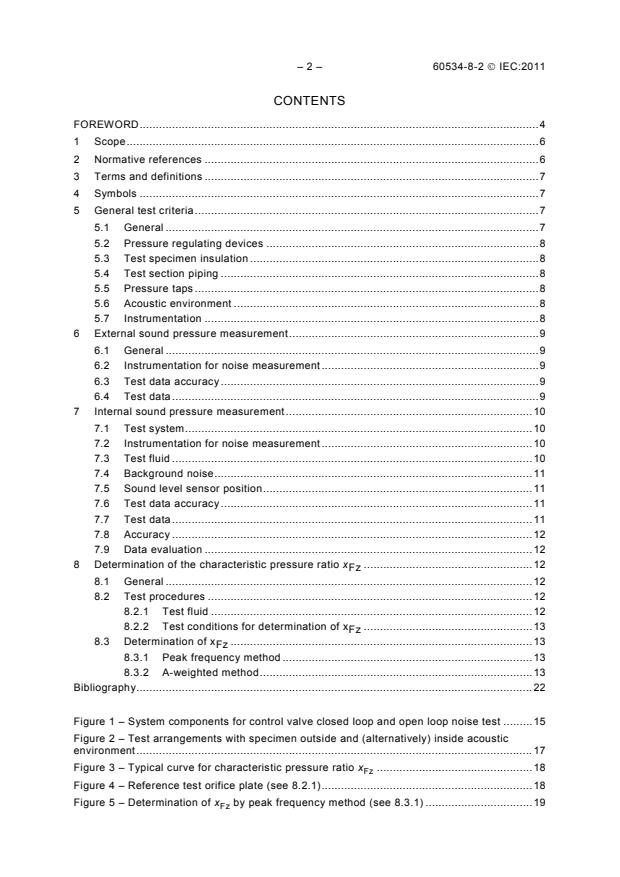
– 2 – 60534-8-2 IEC:2011
CONTENTS
FOREWORD . 4
1 Scope . 6
2 Normative references . 6
3 Terms and definitions . 7
4 Symbols . 7
5 General test criteria . 7
5.1 General . 7
5.2 Pressure regulating devices . 8
5.3 Test specimen insulation . 8
5.4 Test section piping . 8
5.5 Pressure taps . 8
5.6 Acoustic environment . 8
5.7 Instrumentation . 8
6 External sound pressure measurement . 9
6.1 General . 9
6.2 Instrumentation for noise measurement . 9
6.3 Test data accuracy . 9
6.4 Test data . 9
7 Internal sound pressure measurement . 10
7.1 Test system . 10
7.2 Instrumentation for noise measurement . 10
7.3 Test fluid . 10
7.4 Background noise . 11
7.5 Sound level sensor position . 11
7.6 Test data accuracy . 11
7.7 Test data . 11
7.8 Accuracy . 12
7.9 Data evaluation . 12
8 Determination of the characteristic pressure ratio x . 12
Fz
8.1 General . 12
8.2 Test procedures . 12
8.2.1 Test fluid . 12
8.2.2 Test conditions for determination of x . 13
Fz
8.3 Determination of x . 13
Fz
8.3.1 Peak frequency method . 13
8.3.2 A-weighted method . 13
Bibliography . 22
Figure 1 – System components for control valve closed loop and open loop noise test . 15
Figure 2 – Test arrangements with specimen outside and (alternatively) inside acoustic
environment . 17
Figure 3 – Typical curve for characteristic pressure ratio x . 18
Fz
Figure 4 – Reference test orifice plate (see 8.2.1) . 18
Figure 5 – Determination of x by peak frequency method (see 8.3.1) . 19
Fz
60534-8-2 IEC:2011 – 3 –
Figure 6 – Determination of x by measuring the overall L , dB(A), at a constant
Fz pA
valve travel . 20
Figure 7 – Mounting position of the sound level meter in the pipe for ∆h < 0,5 mm . 21
– 4 – 60534-8-2 IEC:2011
INTERNATIONAL ELECTROTECHNICAL COMMISSION
____________
INDUSTRIAL-PROCESS CONTROL VALVES –
Part 8-2: Noise considerations –
Laboratory measurement of noise generated
by hydrodynamic flow through control valves
FOREWORD
1) The International Electrotechnical Commission (IEC) is a worldwide organization for standardization comprising
all national electrotechnical committees (IEC National Committees). The object of IEC is to promote
international co-operation on all questions concerning standardization in the electrical and electronic fields. To
this end and in addition to other activities, IEC publishes International Standards, Technical Specifications,
Technical Reports, Publicly Available Specifications (PAS) and Guides (hereafter referred to as “IEC
Publication(s)”). Their preparation is entrusted to technical committees; any IEC National Committee interested
in the subject dealt with may participate in this preparatory work. International, governmental and non-
governmental organizations liaising with the IEC also participate in this preparation. IEC collaborates closely
with the International Organization for Standardization (ISO) in accordance with conditions determined by
agreement between the two organizations.
2) The formal decisions or agreements of IEC on technical matters express, as nearly as possible, an international
consensus of opinion on the relevant subjects since each technical committee has representation from all
interested IEC National Committees.
3) IEC Publications have the form of recommendations for international use and are accepted by IEC National
Committees in that sense. While all reasonable efforts are made to ensure that the technical content of IEC
Publications is accurate, IEC cannot be held responsible for the way in which they are used or for any
misinterpretation by any end user.
4) In order to promote international uniformity, IEC National Committees undertake to apply IEC Publications
transparently to the maximum extent possible in their national and regional publications. Any divergence
between any IEC Publication and the corresponding national or regional publication shall be clearly indicated in
the latter.
5) IEC itself does not provide any attestation of conformity. Independent certification bodies provide conformity
assessment services and, in some areas, access to IEC marks of conformity. IEC is not responsible for any
services carried out by independent certification bodies.
6) All users should ensure that they have the latest edition of this publication.
7) No liability shall attach to IEC or its directors, employees, servants or agents including individual experts and
members of its technical committees and IEC National Committees for any personal injury, property damage or
other damage of any nature whatsoever, whether direct or indirect, or for costs (including legal fees) and
expenses arising out of the publication, use of, or reliance upon, this IEC Publication or any other IEC
Publications.
8) Attention is drawn to the Normative references cited in this publication. Use of the referenced publications is
indispensable for the correct application of this publication.
9) Attention is drawn to the possibility that some of the elements of this IEC Publication may be the subject of
patent rights. IEC shall not be held responsible for identifying any or all such patent rights.
International Standard IEC 60534-8-2 has been prepared by subcommittee 65B:
Measurements and control devices, of IEC technical committee 65: Industrial-process
measurement, control and automation.
This second edition cancels and replaces the first edition published in 1991 and constitutes a
technical revision that includes internal noise measurement.
The text of this standard is based on the following documents:
FDIS Report on voting
65B/801/FDIS 65B/808/RVD
60534-8-2 IEC:2011 – 5 –
Full information on the voting for the approval of this standard can be found in the report on
voting indicated in the above Table.
This publication has been drafted in accordance with the ISO/IEC Directives, Part 2.
A list of all parts of the IEC 60534 series, published under the general title Industrial-process
control valves, can be found on the IEC website.
The committee has decided that the contents of this publication will remain unchanged until
the stability date indicated on the IEC web site under "http://webstore.iec.ch" in the data
related to the specific publication. At this date, the publication will be
• reconfirmed,
• withdrawn,
• replaced by a revised edition, or
• amended.
– 6 – 60534-8-2 IEC:2011
INDUSTRIAL-PROCESS CONTROL VALVES –
Part 8-2: Noise considerations –
Laboratory measurement of noise generated
by hydrodynamic flow through control valves
1 Scope
This part of IEC 60534-8 includes the method for measuring the sound pressure level due to
liquid flow through a control valve and the method for determining the characteristic increase
of noise due to the onset of cavitation. It also defines the equipment, methods and procedures
for the laboratory measurement of the airborne sound needed to determine these
characteristics.
Two methods are provided for testing the noise generating characteristics of control valves.
The first is a uniform method of measuring the radiated noise from the valve and the
associated test piping including fixed flow restrictions through which the test fluid (water) is
passing (see Note 1). The noise criteria are expressed by determining the sound pressure
level of the valve under consideration.
The second is a procedure for measuring the sound pressure levels within pipe systems
upstream and downstream of the valve under fixed operating conditions. Since inaccuracies
due to the pipe transmission are eliminated, this method shall be preferred for evaluation of
the acoustical characteristic of valves.
The noise characteristics to be determined are useful:
a) to determine acoustical characteristics of valves and valve assemblies and the
characteristic pressure ratio factor x of a control valve;
Fz
b) to predict valve noise for given process conditions;
c) to compare the performance of different valves and various measuring results;
d) to plan measures for increasing service life and noise abatement;
e) to determine possible adverse effects on ultra-sonic flow meter measurements;
f) to enable proper sizing of sound absorbers.
NOTE 1 Test fluids other than water or valves without downstream piping are not within the scope of this
section of IEC 60534-8.
NOTE 2 The factor x is used in a noise prediction method which is covered in IEC 60534-8-4.
Fz
2 Normative references
The following referenced documents are indispensable for the application of this document.
For dated references, only the edition cited applies. For undated references, the latest edition
of the referenced document (including any amendments) applies.
IEC 60534-1:2005, Industrial-process control valves – Part 1: Control valve terminology and
general considerations
IEC 60534-2-3:1997, Industrial-process control valves – Part 2-3: Flow capacity – Test
procedures
60534-8-2 IEC:2011 – 7 –
IEC 60534-8-4, Industrial-process control valves – Part 8-4: Noise considerations – Prediction
of noise generated by hydrodynamic flow
IEC 61672-1:2002, Sound level meters – Part 1: Specifications
ISO 3744:1994, Acoustics – Determination of sound power levels of noise sources using
sound pressure – Engineering methods in an essentially free field conditions over a reflecting
plane
ISO 3745:2003, Acoustics – Determination of sound power levels of noise sources using
sound pressure – Precision methods for anechoic and hemi-anechoic rooms
3 Terms and definitions
For the purposes of this document, the terms and definitions given in IEC 60534-1, as well
as the following, apply.
3.1
test specimen
valve or combination of valve, reducer, expander, or other fittings for which test data are
required. All parts/accessories necessary to operate the specimen properly shall be included
4 Symbols
Symbol Description Unit
C Flow coefficient (C , K ) Various
v v
(see IEC 60534-1)
F Pressure recovery factor of a control valve without attached fittings at Dimensionless
L
choked flow
F Pressure recovery factor of a control valve with attached fittings at choked Dimensionless
LP
flow
F Piping geometry factor Dimensionless
p
L Internal sound pressure level at pipe wall dB(ref P )
pi o
Mass flow rate kg/s
m
p Inlet absolute static pressure kPa or bar
p Outlet absolute static pressure kPa or bar
Differential pressure between upstream and downstream pressure taps kPa or bar
∆p
(p – p )
1 2
Q Volumetric flow rate m /h
T Inlet temperature K
T Outlet temperature K
u Mean (average fluid velocity) m/s
x Ratio of pressure differential to difference of the inlet pressure p and the Dimensionless
F 1
vapour pressure p (∆p/(p -p ))
v 1 v
x Value of x where cavitation noise becomes dominant over non-cavitating Dimensionless
Fz F
noise.
5 General test criteria
5.1 General
Hydrodynamic noise may be measured externally as it radiates from the pipewall or internally
as it propagates through the fluid. Both of these measurements can be made in either a
closed loop or an open loop system and are shown in Figures 1a and 1b.
– 8 – 60534-8-2 IEC:2011
The following information is common to all test configurations.
5.2 Pressure regulating devices
The upstream and/or downstream regulating devices are used to regulate the test
pressures. Caution should be taken to avoid a pressure differential which will create
significant noise, i.e. cavitation. If such pressure drops are unavoidable, the use of silencers,
see 5.6, is recommended as shown in Figure 1. Flow meters should be installed in
accordance with the manufacturer’s instructions.
5.3 Test specimen insulation
The test specimen shall not be provided with any insulation other than that attached by the
manufacturer as part of the normal production for the test specimen.
5.4 Test section piping
There is no limitation concerning the maximum length of upstream and downstream piping
connected to the test specimen. Uninsulated pipe shall be used. The exposed downstream or
upstream pipe within the acoustic environment shall be of a straight one-piece construction,
i.e. no flanges, circumferential joints or other pipewall reinforcements. The exposed length of
the downstream pipe shall be as specified in Figure 2a or Figure 2b. The corresponding
length of the upstream pipe shall be at least 1 m.
A mismatch between the inlet and outlet diameters of the test specimen with the inside
diameter of the adjacent piping should be minimized as far as is practical. The distance of the
pipe axis from the floor shall be approximately 1 m.
Other pipe wall thicknesses, pipe materials and insulated piping may be used but shall be
reported in the test data as (an) optional test(s).
5.5 Pressure taps
Pressure taps shall be provided for the measurement of pressures and shall conform to
IEC 60534-2-3.
5.6 Acoustic environment
The test environment shall be controlled in such a way that background, reflected, and other
extraneous noise be at least 10 dB lower than that radiated by the test section. Depending on
the test system and the acoustic environment, upstream and downstream silencers may be
necessary. General considerations for the acoustic environment can be found in ISO 3744
and ISO 3745. No sound pressure level correction shall be made for the presence of
extraneous noise.
5.7 Instrumentation
The instrumentation for sound pressure level measurement shall conform to IEC 61672-1
Class 1 or Class 2. Sound level meter characteristics shall conform to IEC 61272-1 Table 2
(A-weighting). Sound level meter calibration and sensitivity test results shall be corrected to
sea level conditions.
Additional instrumentation such as electronic recording devices and computers shall not
cause errors in the measured data of more than ± 1 dB.
60534-8-2 IEC:2011 – 9 –
6 External sound pressure measurement
6.1 General
Alternative test arrangements are shown in Figures 2a and 2b.
The test system according to Figure 2a includes the control valve as a noise radiating device.
The test system according to Figure 2b does not include the valve, however, it does provide a
uniform sound field radiating from the pipe.
6.2 Instrumentation for noise measurement
The sound level sensor shall be located level with the centreline of the pipe 1 m from the
nearest pipe surface. Downstream distance shall be six nominal pipe diameters, but not
less than 1 m, from the test specimen outlet (see Figures 2a and 2b). Orientation of the
microphone with respect to the piping shall be in accordance with the requirements of the
microphone manufacturer.
6.3 Test data accuracy
Accuracy of flow rate, pressure and temperature measurements shall conform to
IEC 60534-2-3.
6.4 Test data
The following data and description of the test specimen and equipment facility shall be
recorded:
Units
1 Absolute upstream pressure, p kPa or bar
2 Differential pressure, ∆p kPa or bar
3 Differential pressure corresponding to
characteristic pressure ratio, ∆p kPa or bar
k
4 Absolute vapour pressure, p kPa or bar
v
5 Density of test fluid, ρ kg/m
6 Upstream fluid temperature, T K
7 Characteristic pressure ratio, x
Fz
for orifice plate Dimensionless
8 Flow rate, Q m /h
9 Rated travel mm or degrees
10 Relative travel, h Dimensionless
11 Flow coefficient at test travels (A , K , C ) Various
v v v
(see IEC 60534-1)
12 Relative flow coefficient at test travel, φ Dimensionless
13 Characteristic pressure ratio, x (see note) Dimensionless
Fz,φ
14 Sound pressure level for each measuring dB or dB(A)
point L (as required)
p
15 Peak frequency Hz
16 Instruments used
17 Sound level sensor position
– 10 – 60534-8-2 IEC:2011
18 Description of test specimen including nominal
size of valve, direction of flow, etc.
19 Description of test facility including:
a) piping and instrumentation (schematic)
b) nominal pipe size and wall thickness
c) environmental chamber (if appropriate)
d) dimensional sketch of test facility
20 Any deviation from this part of IEC 60534-8
NOTE See Clause 8 for values of φ at which test data are to be taken.
7 Internal sound pressure measurement
7.1 Test system
The principal arrangement of a test stand for measuring internal sound pressure is shown in
Figure 1a.
The measuring arrangement and the equipment for measuring the parameters Q, T , p and
1 1
T , p shall meet the requirements of IEC 60534-2-3.
2 2
The upstream silencer 4b and downstream silencer 9b shall be designed to avoid any
increase of the measured noise due to sound power generated by the upstream pressure
regulating valve 3 and downstream pressure regulating valve 9 and to prevent any acoustic
reflections of the noise created by the measured device 6. The latter is fulfilled when the
attenuation of the silencer reaches 15 dB in the considered frequency range.
7.2 Instrumentation for noise measurement
The sound level sensors exposed to the fluid shall be suitable for the given operating
conditions. For the measurement of pressures which deviate considerably from the normal air
pressure, dynamic pressure sensors are recommended. The dynamic range of the pressure
sensor arrangement (range between background noise and over modulation) should amount
to at least 80 dB. The frequency range should comprise 40 (63 Hz octave band or 50 Hz 1/3
octave band centre frequency) and 22 400 Hz (16 000 Hz octave band or 20 000 Hz 1/3
octave band centre frequency) with an amplitude deviation of ± 1 dB. Before and after each
measuring procedure, the measuring system has to be tested by means of an acoustical
calibrator.
NOTE Certain low noise trims have peak frequencies exceeding 16 000 Hz. Verification that the peak frequency is
within the measuring range of the sound level meter before processing the measured data is recommended. The
peak frequency is that frequency at which the sound pressure level decays by at least 4 dB per octave above and
below this frequency.
Additional instrumentation such as electronic recording devices and computers shall not
cause errors in the measured data of more than ± 1 dB.
7.3 Test fluid
Water is the only fluid to be used in the test procedure, because other incompressible fluids
behave differently and do not allow a comparison of test data. The water shall be sufficiently
free from suspended particles, air, or other gases so as to ensure that the test results are not
affected.
The mean (average) fluid velocity u through the measuring area shall be limited by selecting a
suitable nominal pipe diameter in such a way that the noise level caused by disturbances in
the boundary layer is at least 5 dB lower than the measured internal sound pressure level.
60534-8-2 IEC:2011 – 11 –
7.4 Background noise
Background noise or noise induced by the measuring system, or by the test stand itself, shall
be at least 5 dB lower than the measured internal sound pressure level in the octave band
range between 63 Hz and 16 000 Hz.
7.5 Sound level sensor position
The sound level sensor positions shall be located within the measuring area. The tap for
mounting the sound level sensors shall be situated at the lower part of the pipe for liquids.
The tap shall be even with the inner pipe wall to avoid secondary noise generation (see
Figure 7).
7.6 Test data accuracy
Accuracy of flow rate, pressure, travel, and temperature measurements shall conform to
IEC 60534-2-3.
7.7 Test data
For the determination of the acoustical characteristics, the pressure ratios x at the test
F
specimen have to be widely varied. A range of x > 0,1 is recommended. The following data
F
shall be recorded:
1) Absolute upstream pressure kPa or bar
2) Pressure differential and/or downstream pressure kPa or bar
3) Upstream fluid temperature K
4) Downstream fluid temperature K
5) Flow rate m /h (see note), kg/s
6) Relative travel Dimensionless
7) Acoustic data: dB
The unweighted sound pressure levels L , measured at 1/3 octave bands, in
pi
the octave band range 63 Hz to 16 000 Hz
8) Description of the test specimen, including at least the following
a) Nominal size of valve
a) Description of fittings
b) Description of flow direction
c) Rated flow coefficient C (K or C ) Various (see IEC 60534-1)
v v
d) Rated travel/opening angle mm/°
9) Description of the test facility including:
a) Piping and instrumentation schematic
b) Nominal pipe size and wall thickness
c) Pipe material
d) Dimensional sketch of test facility
10) Description of test fluid, including one of the following:
a) Absolute vapour pressure kPa or bar
b) Density kg/m
11) Description of instruments
12) Flow coefficient C (K or C ) at the test travel Various (see IEC 60534-1)
v v
13) Pressure recovery factor of a control valve without attached fittings at choked Dimensionless
flow, F
L
14) Pressure recovery factor of a control valve with attached fittings at choked Dimensionless
flow, F
LP
15) Piping geometry factor, F Dimensionless
p
16) Any deviation from this standard
– 12 – 60534-8-2 IEC:2011
7.8 Accuracy
The overall accuracy of this method is limited to ± 3 dB.
7.9 Data evaluation
The data shall be evaluated in accordance with the IEC 60534-8-4.
factor can be determined alternatively based on the procedure as described in Clause
The x
Fz
8 by using the internal sound pressure level L instead of the external sound pressure level.
pi
8 Determination of the characteristic pressure ratio x
Fz
8.1 General
The pressure ratio x is given as follows:
F
∆p
x =
F
p − p
1 v
When x is increased sufficiently, there is a transition from non-cavitating to cavitating flow.
F
The pressure differential where the sound pressure level begins to increase due to cavitation
during this transition is ∆p . The corresponding ratio is the characteristic pressure ratio x
k Fz
and is defined as follows:
0,125
∆p p
k 1
x = •
Fz
2
p − p 6x10
1 v
According to IEC 60534-8-4, x is related to the reference inlet pressure p = 6 bar (600 kPa).
Fz 1
If other inlet pressures are used, they shall be corrected with the second term in the equation
above (p in kPa). Generally, x varies with travel and shall be measured at relative flow
1 Fz
coefficients of 0,25, 0,50, 0,75 and 1,00 or the highest one achievable. When necessary,
additional measurements with other relative flow coefficients should be included. With these
values of x , linear interpolation may be used to obtain x values for other relative flow
Fz Fz
coefficients. The value of x at a relative flow coefficient φ is denoted as x . See Figure 3
Fz Fz,φ
for a typical curve of x .
Fz
8.2 Test procedures
8.2.1 Test fluid
Water is the only fluid to be used in the test procedure, because other incompressible
fluids behave differently and do not allow a comparison of test data. The water shall be
sufficiently free from suspended particles, air, or other gases so as to ensure that the test
results are not affected. To accomplish this, the suitability of the water shall be tested first
by using a special orifice plate, which is to be considered the reference test orifice plate
(Figure 4). This orifice plate shall be installed in a DN 50 pipe (either permanently in a
bypass or by changing the test section piping). The characteristic pressure ratio x for the
Fz
orifice plate shall be determined at an absolute upstream pressure between 300 kPa and
400 kPa (3 bar and 4 bar). The value of x shall be not less than 0,35. Water within a
Fz
temperature range of 5 °C to 40 °C shall be the basic fluid used in this test procedure.
During the test, the temperature shall remain constant within ± 3 °C.
Other orifice plates may be used as an alternative provided the upstream pressure is as
stated above. The dimensions shown in Figure 4 shall remain the same, except that the
diameters shall be changed to maintain the same opening ratio of 0,25.
60534-8-2 IEC:2011 – 13 –
8.2.2 Test conditions for determination of x
Fz
The determination of x depends on many parameters. A detailed explanation is beyond the
Fz
scope of this section of IEC 60534-8. To make the test results comparable, the following test
conditions shall be maintained:
a) Either closed or open test loops may be used in accordance with Figure 1a and 1b,
provided all requirements of this standard are met.
b) Absolute upstream pressure p shall be in the range of 500 kPa to 700 kPa (5 bar to
7 bar). The selected test pressure shall be kept constant within ± 5 %.
NOTE Caution should be exercised not to exceed the rated service conditions of the valve.
c) To avoid incorrect results due to "cavitation hysteresis", the characteristic pressure ratio
x shall be determined by decreasing the pressure ratio x in such a way that there is a
Fz F
transition from cavitating to non-cavitating flow.
d) Water within a temperature range of 5 °C to 40 °C shall be the basic fluid used in this test
procedure. During the test, the temperature shall remain constant within ± 3 °C.
8.3 Determination of x
Fz
8.3.1 Peak frequency method
The determination of x by this method requires the measurement of the sound pressure
Fz
level (L ) at the peak frequency. The procedure is as follows (refer to Figure 5):
p
a) select a travel corresponding to one of the relative flow coefficients given in Clause 8;
b) decrease the pressure ratio x in such a way that there is a transition from cavitating to
F
non-cavitating flow and measure L as a function of frequency for each value of x used;
p F
c) from the data obtained in b), determine the approximate frequency which gives the
maximum L response. This is the peak frequency;
p
d) using a sound level meter with an octave band filter that includes the peak frequency,
measure the L as x is decreased. The range of x shall be sufficient to establish the
p F F
curves in both the cavitating and non-cavitating regions;
e) in both the cavitating and non-cavitating regions, fit a straight line through the data points.
The intersection of the straight lines shall determine the value of x . See point A in
Fz
Figure 5;
f) repeat the procedure for the other relative flow coefficients given in Clause 8.
8.3.2 A-weighted method
This method of determining x requires the measurement of the overall sound pressure level
Fz
(L ) using the A-weighted method. The procedure is as follows (refer to Figure 6):
pA
a) at a given travel (corresponding to one of the relative flow coefficients given in Clause 8),
the L versus x curve as shown by the dashed line shall be determined. Decrease the
pA F
pressure ratio x in such a way that there is a transition from cavitating to non-cavitating
F
flow and measure L for each value of x used;
pA F
b) from the above curve, x and x , which are the approximate values at which the L
F3 F6 pA
curve changes slope, shall be determined;
c) the ranges ∆x and ∆x shall each be divided into three equal parts (designated as "a"
FI FII
and "b", respectively);
d) at each of the values x through x , the A-weighted overall sound pressure level shall be
F6 F1
measured. This procedure shall be repeated twice so that there are three series of
measurements;
e) for each value of x , the arithmetic average, L , of the three L values shall be
pA
F pA
calculated and the points plotted;
– 14 – 60534-8-2 IEC:2011
f) using the values of L at x through x , the curves designated as lines 1 and 2 shall
pA
F1 F6
be determined by linear regression;
g) the point at which lines 1 and 2 intersect shall be determined. The value of x at this point
F
is x ;
Fz
h) repeat the procedure for the other relative flow coefficients given in Clause 8.
4 5 5
T P P
9b
4b 9
14 11
PC
F
TC
IEC 2131/11
NOTES System components
1 See Figure 2a or 2b for placement of item 8 1 = pump
(acoustic environment) and item 10 (microphone)
2 = flow measuring device
2 Items 8, 12 and 15 are optional
3 = upstream throttling valve
4 = temperature measuring device
4b = upstream in-line silencer (if necessary)
5 = pressure measuring device
6 = test specimen
7 = test section piping
8 = acoustic environment (test chamber)
(Notes 1 and 2)
9 = downstream throttling valve
9b = downstream in-line silencer (if necessary)
10 = sound level sensor (Note 1)
11 = water tank
12 = temperature controlling device (Note 2)
13 = vessel with air cushion to increase static
pressure, if necessary
14 = exhaust valve
15 = pressure controller (Note 2)
Figure 1a – Control valve closed loop noise test – System components
60534-8-2 IEC:2011 – 15 –
4 5 5
T P P
9b
4b
PC
F
IEC 2132/11
NOTES System components
1 = pump
1 See Figure 2a or 2b for placement of item 8
(acoustic environment) and item 10 (microphone)
2 = flow measuring device
2 Items 8, 12 and 15 are optional
3 = upstream throttling valve
4 = temperature measuring device
4b = upstream in-line silencer (if necessary)
5 = pressure measuring device
6 = test specimen
7 = test section piping
8 = acoustic environment (test chamber)
(Notes 1 and 2)
9 = downstream throttling valve
9b = downstream in-line silencer (if necessary)
10 = sound level sensor (Note 1)
11 = water tank
13 = vessel with air cushion to increase static
pressure, if necessary
15 = pressure controller (Note 2)
Figure 1b – Control valve open loop noise test – System components
Figure 1 – System components for control valve closed loop and open loop noise test
– 16 – 60534-8-2 IEC:2011
≥2 m
Seal between chamber
and pipe at both ends
According to
Seals shall not damp
IEC 60534-2-3
pipe vibrations to extent
that noise measurements
are affected
≥0,5 m
T2 P2
Flow
1,0 m
(Note2)
≥1,0 m ≥1,0 m
Note 4
IEC 2133/11
NOTES System components
1 D = nominal pipe diameter of outlet pipe, in 4 temperature measuring device
mm
2 The sound level sensor shall be located at a 5 pressure measuring device
distance of 1 m from the outer surface to the
pipe and should be no closer than 0,5 m to
the nearest chamber surface.
3 The test section piping inside the test 6 test specimen
chamber should be continuous with no
flanges, circumferential joints, or other
pipewall reinforcements.
4 For specimens 150 mm (6 in) and smaller, 7 test section piping (Note 3)
1,0 m minimum and 3,0 m maximum. Above
150 mm size, 6 D minimum and 20 D
maximum should be held (see Clause 6 for
further clarification).
8 acoustic environment (test chamber)
10 sound level sensor (Note 2)
Figure 2a – Test arrangement with test specimen outside acoustic environment
60534-8-2 IEC:2011 – 17 –
Seal between chamber
and pipe at both ends
Seals shall not damp
According to
pipe vibrations to extent
IEC 60534-2-3
that noise measurements
are affected
≥0,5 m
T P
2 2
Flow
1,0 m
(Note2)
≥0,5 m
(Note2)
≥1,0 m
Note 4
IEC 2134/11
NOTES System components
1 D = nominal pipe diameter of outlet pipe, in 4 temperature measuring device
mm
2 The sound level sensor should be located at 5 pressure measuring device
a distance of 1 m from the outer surface of
the pipe and shall be no closer than 0,5 m to
the nearest chamber surface.
3 The test section piping inside the test 6 test specimen
chamber should be continuous with no
flanges, circumferential joints, or other
pipewall reinforcements.
4 For specimens 150 mm (6 in) and smaller, 7 test section piping (Note 3)
1,0 m minimum and 3,0 m maximum. Above
150 mm size, 6 D minimum and 20 D
maximum should be held (see Clause 6 for
further clarification).
8 acoustic environment (test chamber)
10 sound level sensor (Note 2)
Figure 2b – Alternative test arrangement with test specimen
inside acoustic environment
Figure 2 – Test arrangements with specimen outside and (alternatively)
inside acoustic environment
– 18 – 60534-8-2 IEC:2011
0 0,25 0,5 0,75 1,00
Relative flow coefficient φ
IEC 2135/11
Figure 3 – Typical curve for characteristic pressure ratio x
Fz
Surface finish Ra
IEC 2136/11
Dimensions in millimetres
Figure 4 – Reference test orifice plate (see 8.2.1)
Characteristic pressure ratio x
Fz
60534-8-2 IEC:2011 – 19 –
A
x
Fz
Pressure ratio x
F
IEC 2137/11
Figure 5 – Determination of x by peak frequency method (see 8.3.1)
Fz
Sound pressure level (dB)
– 20 – 60534-8-2 IEC:2011
Line 1: from x , L Line 2: from x , L
pA1 pA4
F1 F4
x , L x , L
pA2 pA5
F2 F5
x , L x , L
pA3 pA6
F3 F6
Determined by linear regression
L
pA
dB (A)
L
pA6
First measured
L
pA5
L versus x curve
pA F
L
pA4
Line 2
L
pA3
L
pA2
Line 1
L
pA1
x
Fz
x x x x x x x
F1 F2 F3 F4 F5 F6 F
a a a b b b
∆x
FI
a =
∆x ∆x
FI FII
∆x
FII
b =
L Arithemetic average of three measured values
pA
∆x ∆x
FII
FI
a = b =
3 IEC 2138/11
Figure 6 – Determination of x by measuring the overall L , dB(A),
Fz pA
at a constant valve travel
60534-8-2 IEC:2011 – 21 –
Sound level sensor
∆h
Recommended
mounting position
∆h
Pipe behind specimen
Uneveness
IEC 2139/11
Figure 7 – Mounting position of the sound level meter in the pipe for ∆h < 0,5 mm
If it is not possible to keep ∆h, as shown on Figure 7, less than 0,5 mm, the mismatch shall be
compensated either by means of a filling compound in a flat angle < 8 ° between sound level
meter and pipe wall or by special shaping of the inner pipe wall.
– 22 – 60534-8-2 IEC:2011
Bibliography
ISO 7-1:1994, Pipe threads wher
...